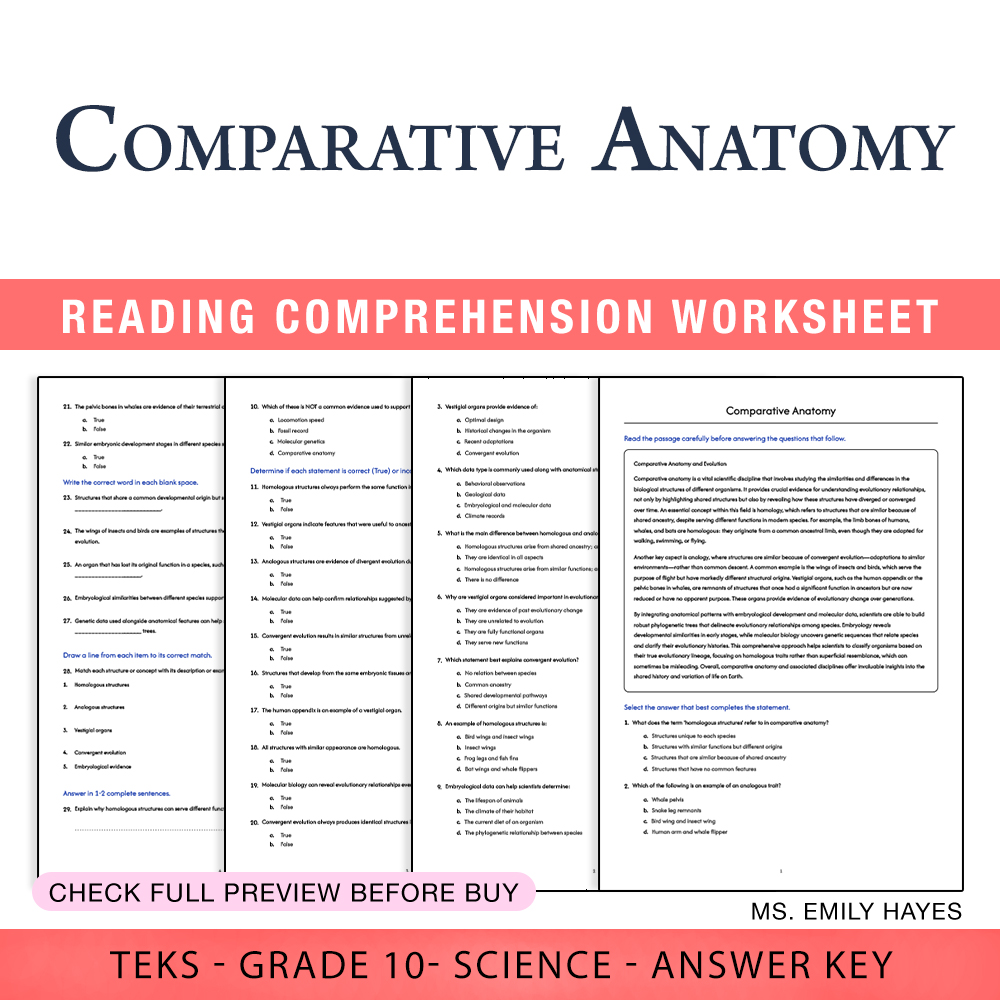
Are you seeking a comprehensive, print-ready worksheet that helps your 10th-grade students master the essential concepts of comparative anatomy? This targeted resource is designed to address a common classroom challenge: building students’ understanding of evolutionary biology and anatomical similarities across species, all while providing engaging activities that reinforce critical thinking and mastery. Perfect for in-class practice, homework, or review sessions, this worksheet will empower your students to grasp complex biological concepts with confidence and clarity. 🚀
Why Teachers Love This✅ Offers a ready-to-use, high-quality PDF worksheet for easy printing and classroom deployment
✅ Fully aligned with TEKS standards, ensuring curriculum compliance
✅ Engages students through varied question formats, from reading passages to essay prompts
✅ Supports active learning with exercises that encourage critical thinking and application
Why Students Succeed With This✅ Clear, concise instructions and prompts make complex concepts accessible
✅ The worksheet’s diverse question types promote deep understanding of homologous structures, vestigial organs, and evolutionary relationships
✅ Scaffolded activities help build confidence step-by-step
✅ Real-world examples and application questions make learning relevant and meaningful
What You GetThis resource includes a carefully crafted PDF worksheet along with a PDF answer key with rubric for objective assessment. The materials are designed for seamless classroom integration and are ready for immediate use, saving you valuable prep time. It features:
• A comprehensive reading passage introducing students to
comparative anatomy concepts
• Multiple-choice questions to assess understanding of key terms like
homologous and analogous structures • True/False exercises to reinforce concepts such as vestigial organs and anatomical functions
• Fill-in-the-blank questions to deepen comprehension of developmental origins and structure functions
• Matching activities to connect concepts to real-world examples
• Short answer questions to promote critical thinking, including explanations of evolutionary evidence
• Thought-provoking essay prompts encouraging synthesis of multiple biological disciplines
Key Learning ObjectivesStudents will master these core skills:
➡️ Explain the difference between homologous and analogous structures
➡️ Identify vestigial organs and explain their significance in evolution
➡️ Understand how molecular data supports common ancestry
➡️ Analyze developmental origins of anatomical features
➡️ Describe the role of comparative anatomy in supporting evolutionary theory
Ideal UsageThis worksheet is perfect for in-class lessons, homework assignments, or review sessions. Its print-ready format ensures easy distribution for whole-class activities, small-group discussions, or independent study. Use it as a formative assessment tool, a supplement for AP Biology or general science courses, or as part of a science unit on evolution and anatomy. The variety of question types keeps students engaged and actively involved, fostering a deeper understanding of biological similarities and differences across species.
Equip your classroom with a ready-made, engaging resource that builds fundamental skills while supporting curriculum standards. This invaluable worksheet will help your students connect biological concepts to real-world examples, preparing them for exams and future scientific study. Get your copy today and experience the difference it makes in student learning and achievement! 🚀