
Daily Reading Worksheets Worksheets
8,400 type resources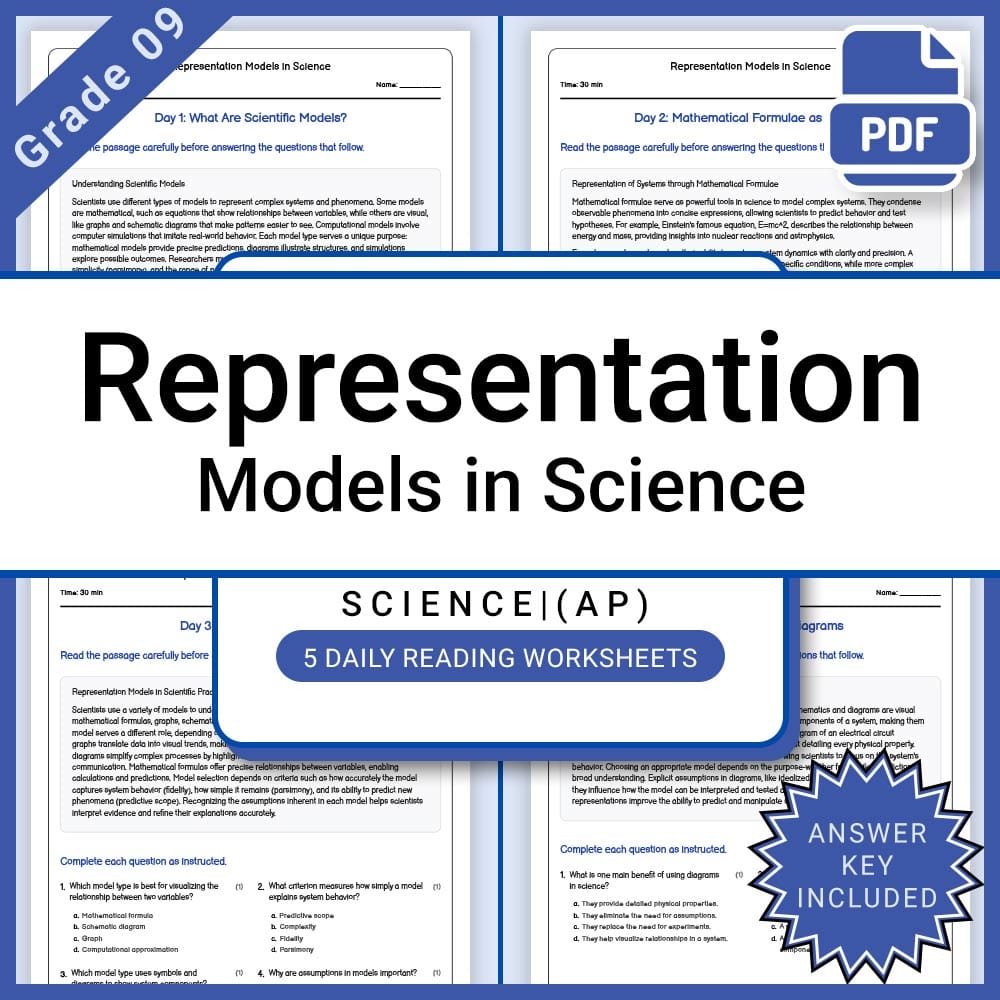
Grade 9 Science – Representation Models Daily Reading Worksheet + Answer Key
JCreated byJ.S SheetsLearning Objectives
- Identify different types of scientific models: mathematical formulae, graphs, schematic diagrams, and computational approximations.
- Explain the roles of various models in capturing system behavior.
- Evaluate criteria for selecting appropriate models based on fidelity, simplicity, and scope.
Also included in: Grade 9 Science Lesson Group - AP Framework Daily Reading Worksheets +1 more
Instant download
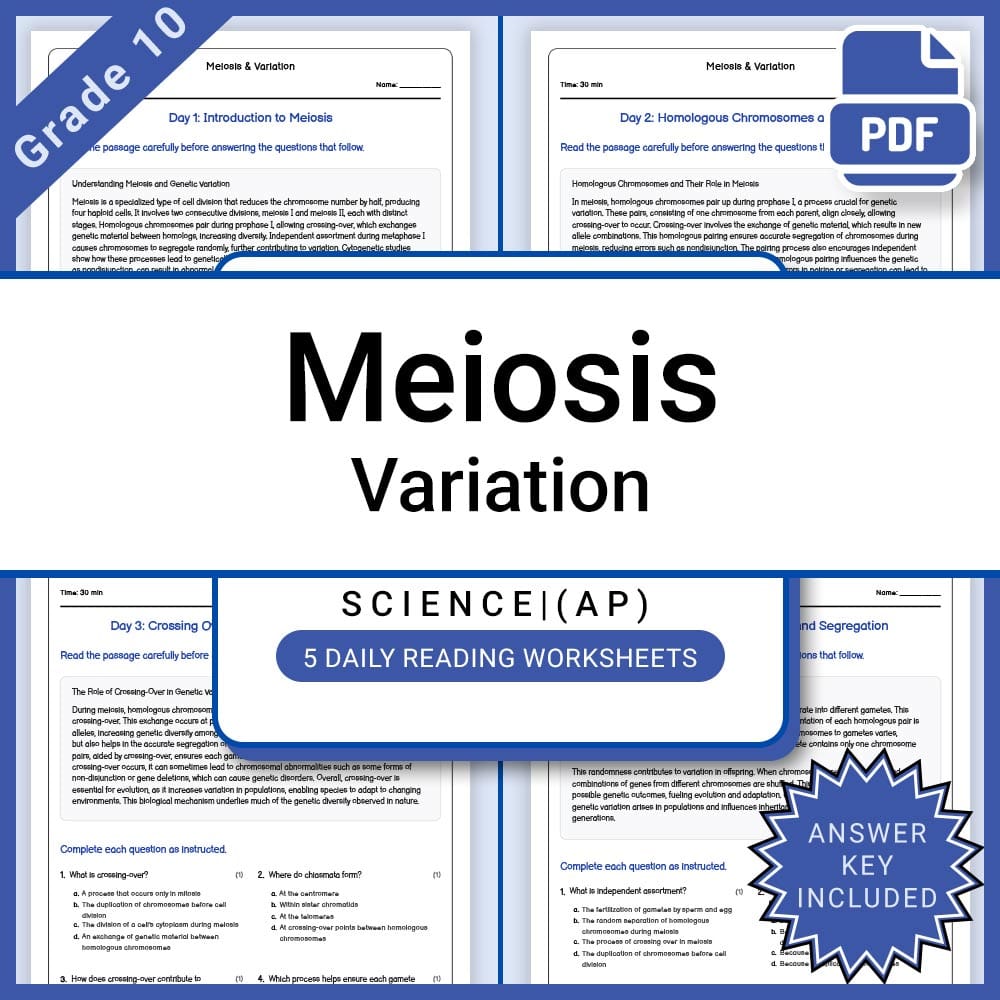
Grade 10 Science – Meiosis & Variation Daily Reading Worksheet with Answer Key
JCreated byJ.S SheetsLearning Objectives
- Understand the stages of meiosis and their significance in genetic variation.
- Describe the processes of homologous pairing, crossing-over, and independent assortment.
- Explain how meiosis leads to genetic diversity and its importance in evolution.
Also included in: Grade 10 Science Lesson Group Bundle | AP Framework & Daily Worksheets
Instant download
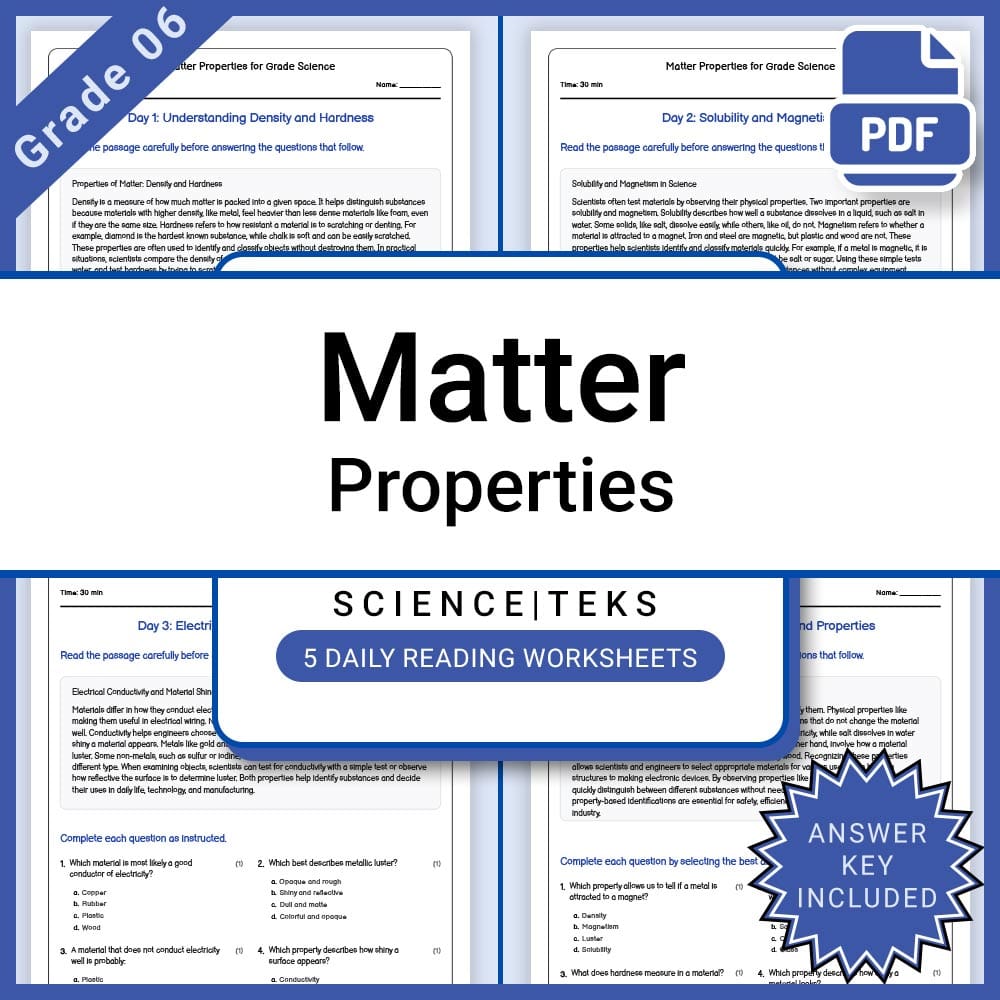
Grade 6 Science – Matter Properties Daily Reading Worksheet + Answer Key
JCreated byJ.S SheetsLearning Objectives
- Understand the concept of density and how it helps distinguish substances.
- Learn about hardness and how it can be used to identify materials.
- Explore simple qualitative and quantitative methods to compare substances.
Also included in: Grade 6 Science Lesson Bundle | States of Matter, Energy, and More +1 more
Instant download

Grade 3 Structural Forms Worksheet | Ontario Practice & PDF
 Created byClear Sky Classroom
Learning Objectives
- Identify common structural forms (arches, beams, frames) and describe how their shapes help them support loads.
- Explain how compressive and bending forces affect different structures in real-world examples.
- Compare span, curvature, and connection types to predict strength and stability.
Instant download

Grade 9 Celestial Motions Worksheet | Ontario Science | Earth & Space
Created byClear Sky ClassroomLearning Objectives
- Explain how Earth’s rotation and orbital motion produce observable daily and yearly cycles.
- Differentiate sidereal and solar periods and describe how they affect apparent motion of the Sun and stars.
- Describe how relative geometry between Earth, the Moon, and the Sun leads to repeating observational patterns (eclipses, tides).
Instant download
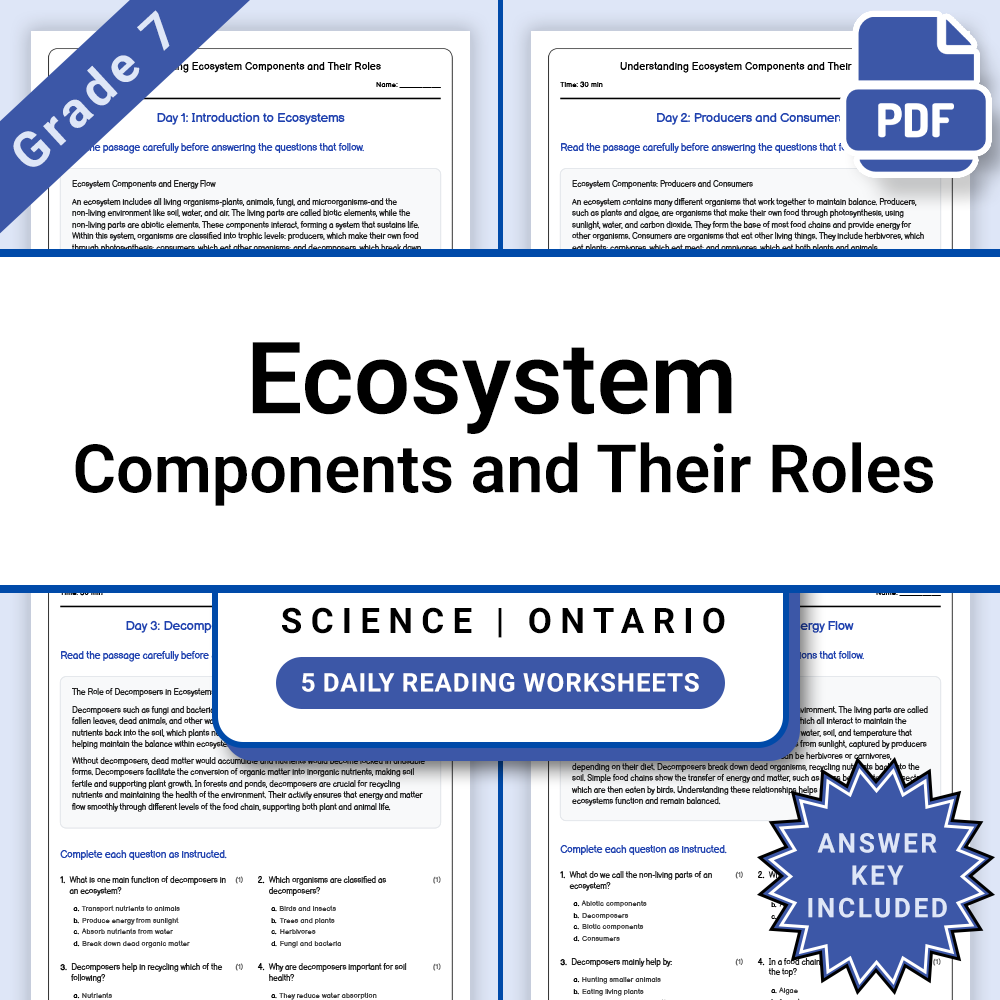
Grade 7 Science – Understanding Ecosystem Components Worksheet + Answer Key
JCreated byJ.S SheetsLearning Objectives
- Define biotic and abiotic components of ecosystems.
- Identify trophic categories: producers, consumers, decomposers.
- Explain how energy flows from sunlight to organic matter.
Also included in: Grade 7 Science Lesson Group Bundle | Ecology & Ecosystems Framework +1 more
Instant download
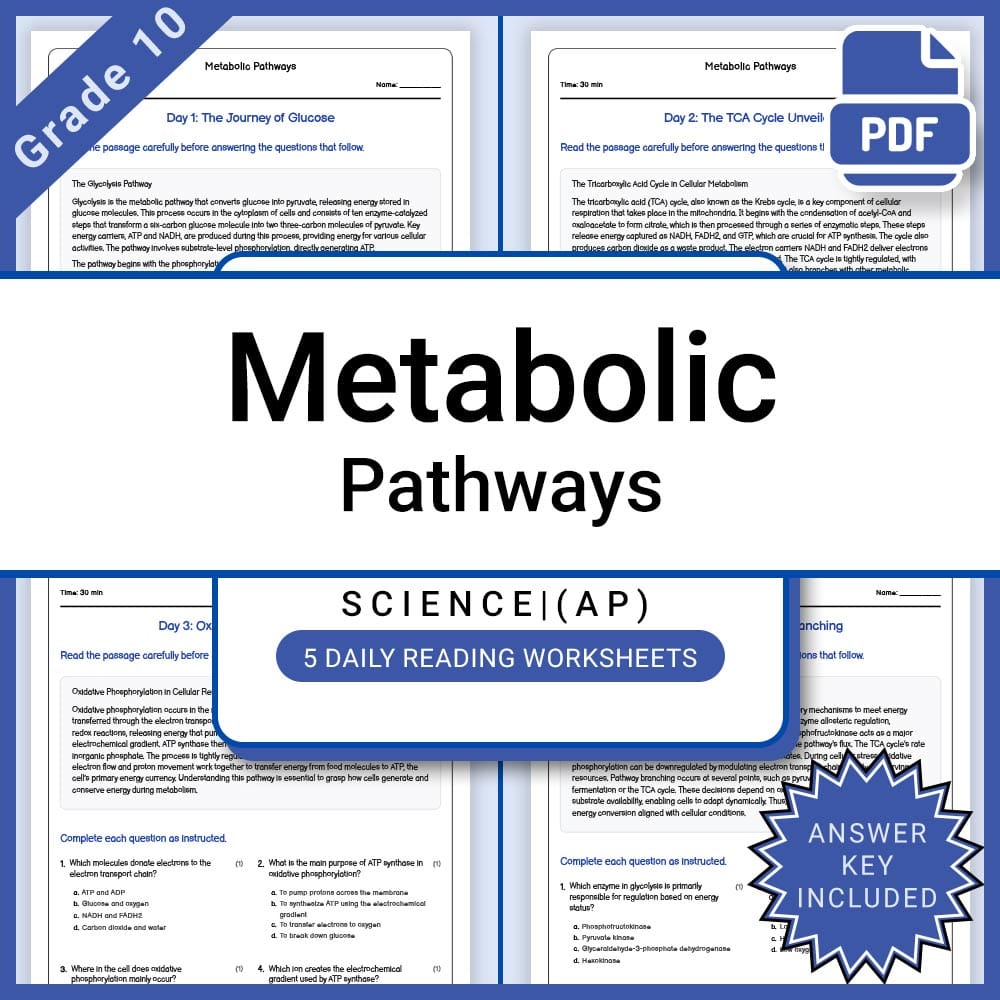
Grade 10 Science – Metabolic Pathways Daily Reading Worksheet + Answer Key
JCreated byJ.S SheetsLearning Objectives
- Understand key concepts related to Science
- Apply knowledge through practice questions
- Demonstrate comprehension of the material
Also included in: Grade 10 Science Lesson Group Bundle | AP Framework & Daily Worksheets
Instant download

Grade 8 Science – The Cell Cycle & Mitosis Daily Reading Worksheet
 Created byQuiet Forest Education
Learning Objectives
- Identify the different stages of the cell cycle.
- Describe the processes involved in interphase, mitosis, and cytokinesis.
- Understand the roles of cyclins, kinases, and checkpoints in cell division.
Also included in: Cell Biology Grade 8 Science Daily Reading Worksheets Bundle | Ontario +1 more
Instant download

Grade 8 Electric Magnetism Worksheet | NGSS Science Activity PDF
 Created byBRIGHT PATH RESOURCES
Learning Objectives
- Understand the basic concepts of electric charges and Coulomb's law
- Describe how electric forces depend on charge magnitude and distance
- Identify factors influencing the strength and direction of electric interactions
Also included in: Forces & Electromagnetism Grade 8 Science Daily Reading Lesson Bundle | NGSS +2 more
Instant download

Grade 8 Science Daily Reading: Momentum and Collisions NGSS Worksheet
Created byBRIGHT PATH RESOURCESLearning Objectives
- Identify the main idea of a science passage about momentum and collisions.
- Understand key vocabulary such as momentum, collision, and conservation of linear momentum.
- Distinguish elastic and inelastic collisions using momentum and kinetic energy ideas.
Also included in: Forces & Electromagnetism Grade 8 Science Daily Reading Lesson Bundle | NGSS +2 more
Instant download
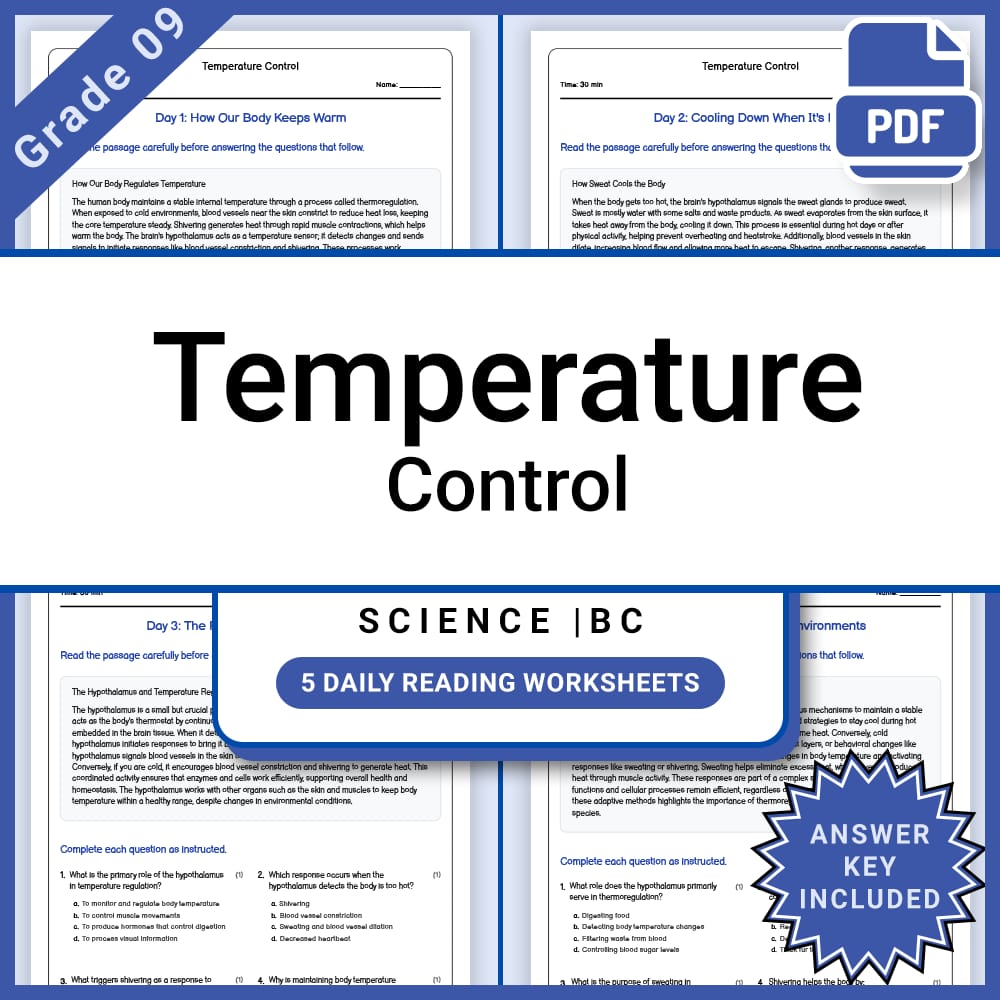
Grade 9 Science – Temperature Control Daily Reading Worksheet + Answer Key
JCreated byJ.S SheetsLearning Objectives
- Understand how skin blood flow helps regulate internal body temperature.
- Explain the role of shivering in maintaining warmth.
- Describe how the hypothalamus detects temperature changes and activates responses.
Also included in: Grade 9 Science Lesson Group Bundle | BC Framework Activities & Worksheets +1 more
Instant download
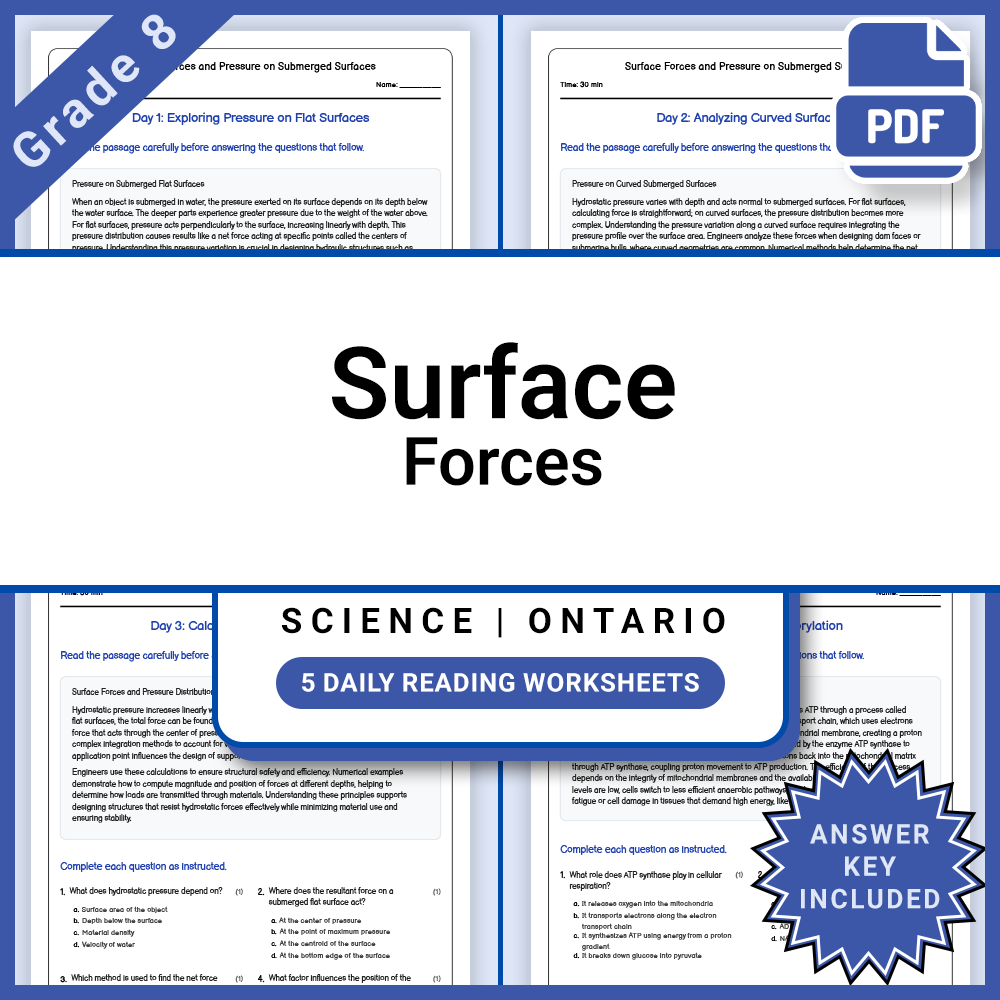
Grade 8 Science – Surface Forces and Pressure Worksheet + Answer Key
JCreated byJ.S SheetsLearning Objectives
- Understand how pressure varies with depth on submerged surfaces
- Learn to determine the resultant force on planar and curved surfaces
- Explore how pressure distribution affects structures like dams and bulkheads
Also included in: Grade 8 Science Lesson Bundle: Fluids, Pressure, and Density Topics +1 more
Instant download
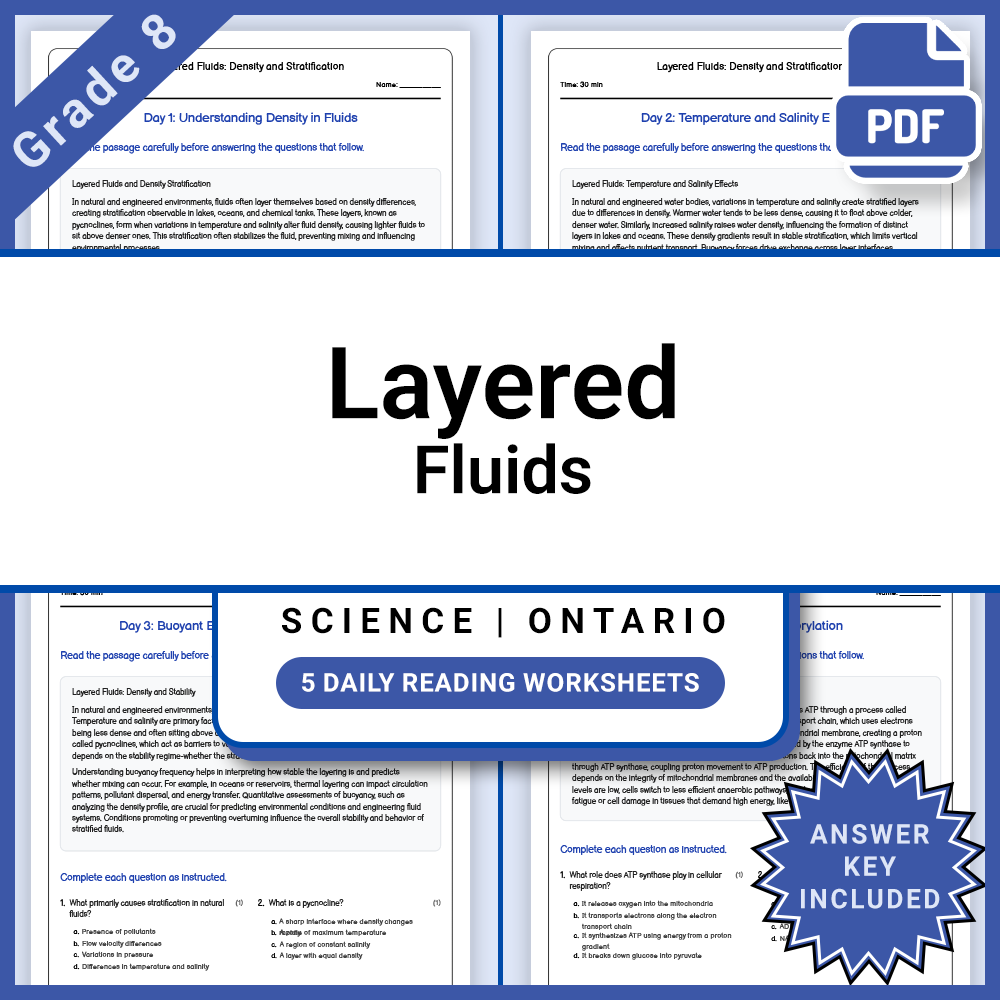
Grade 8 Science – Layered Fluids Density Stratification Worksheet + Answer Key
JCreated byJ.S SheetsLearning Objectives
- Understand key concepts related to Science
- Apply knowledge through practice questions
- Demonstrate comprehension of the material
Also included in: Grade 8 Science Lesson Bundle: Fluids, Pressure, and Density Topics +1 more
Instant download
Grade 8 Science – Viscosity & Flow Daily Reading Worksheet with Answer Key
JCreated byJ.S SheetsLearning Objectives
- Understand the concept of viscosity and how it affects fluid flow
- Differentiate between dynamic and kinematic viscosity
- Explore how temperature influences viscosity
Also included in: Grade 8 Science Lesson Bundle: Fluids, Pressure, and Density Topics +1 more
Instant download
Grade 8 Science – Submarine Ballast Systems Daily Reading Worksheet + Answer Key
JCreated byJ.S SheetsLearning Objectives
- Understand key concepts related to Science
- Apply knowledge through practice questions
- Demonstrate comprehension of the material
Also included in: Grade 8 Science Lesson Bundle: Fluids, Pressure, and Density Topics +1 more
Instant download
Grade 8 Science – Flotation Stability Daily Reading Worksheet + Answer Key
JCreated byJ.S SheetsLearning Objectives
- Understand the concepts of centre of gravity and centre of buoyancy
- Learn how hull shape and loading affect a boat's stability
- Calculate stability margins and buoyancy shifts during loading
Also included in: Grade 8 Science Lesson Bundle: Fluids, Pressure, and Density Topics +1 more
Instant download
Grade 8 Science – Buoyant Force Daily Reading Worksheet + Answer Key
JCreated byJ.S SheetsLearning Objectives
- Explain the concept of buoyant force and how it relates to fluid displacement.
- Understand Archimedes' principle and its application to floating and sinking objects.
- Apply density and volume relationships to calculate buoyant forces in various scenarios.
Also included in: Grade 8 Science Lesson Bundle: Fluids, Pressure, and Density Topics +1 more
Instant download
Grade 8 Science – Hydraulic Pressure Daily Reading Worksheet + Answer Key
JCreated byJ.S SheetsLearning Objectives
- Explain the principle of hydraulic systems and pressure transmission
- Apply force-area relationships to hydraulic apparatus
- Calculate input pressure needed for specific lifting tasks
Also included in: Grade 8 Science Lesson Bundle: Fluids, Pressure, and Density Topics +1 more
Instant download
Grade 8 Science - Pascal's Principle Daily Reading Worksheet + Answer Key
JCreated byJ.S SheetsLearning Objectives
- Explain how pressure is transmitted in confined fluids
- Calculate forces in hydraulic systems using piston areas
- Identify real-world applications of Pascal's Principle
Also included in: Grade 8 Science Lesson Bundle: Fluids, Pressure, and Density Topics +1 more
Instant download

Grade 8 Science – Pressure in Fluids Daily Reading Worksheet + Answer Key
JCreated byJ.S SheetsLearning Objectives
- Define pressure and its SI units
- Differentiate between surface contact pressure and internal fluid pressure
- Apply mathematical relationships to convert pressure units
Also included in: Grade 8 Science Lesson Bundle: Fluids, Pressure, and Density Topics +1 more
Instant download
Grade 8 Science – Measuring Density Daily Reading Worksheet with Answer Key
JCreated byJ.S SheetsLearning Objectives
- Understand different techniques for measuring density, including direct calculation and displacement methods.
- Learn how to interpret measurement data considering precision, uncertainty, and significant figures.
- Analyze example scenarios comparing theoretical and measured densities, identifying possible sources of error.
Also included in: Grade 8 Science Lesson Bundle: Fluids, Pressure, and Density Topics +1 more
Instant download
Grade 10 Science – Photosynthesis Daily Reading Worksheet with Answer Key
JCreated byJ.S SheetsLearning Objectives
- Understand the overall process of photosynthesis
- Identify the role of chloroplasts and pigments in capturing light energy
- Explain the light-dependent reactions and the Calvin cycle
Also included in: Grade 10 Science Lesson Bundle | Ontario Curriculum and Daily Reading Worksheets +1 more
Instant download

Cell Components Worksheet | Grade 9 Science Ontario Biology Organelles
Created byClear Sky ClassroomLearning Objectives
- Identify major organelles in eukaryotic cells and describe how their structures support their functions
- Explain how membrane composition, compartmentalization, and folding affect transport and metabolic efficiency
- Connect processes like protein synthesis, ATP production, and intracellular transport to specific cell components
Instant download
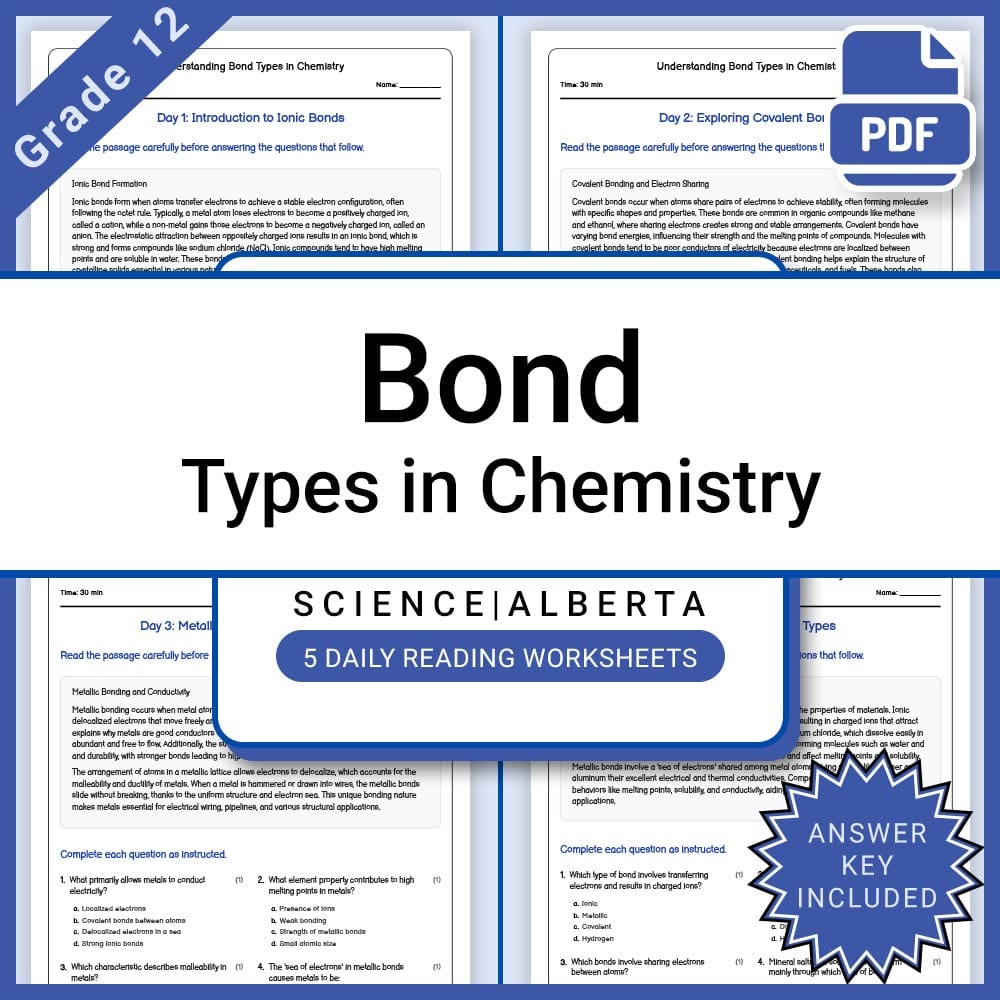
Grade 12 Science – Bond Types in Chemistry Daily Reading Worksheet + Answer Key
JCreated byJ.S SheetsLearning Objectives
- Identify different types of chemical bonds, focusing on ionic bonds.
- Explain the formation of ionic bonds between atoms.
- Recognize examples of ionic compounds and their properties.
Also included in: Grade 12 Science Lesson Bundle | Alberta Framework and Daily Reading Worksheets +1 more
Instant download
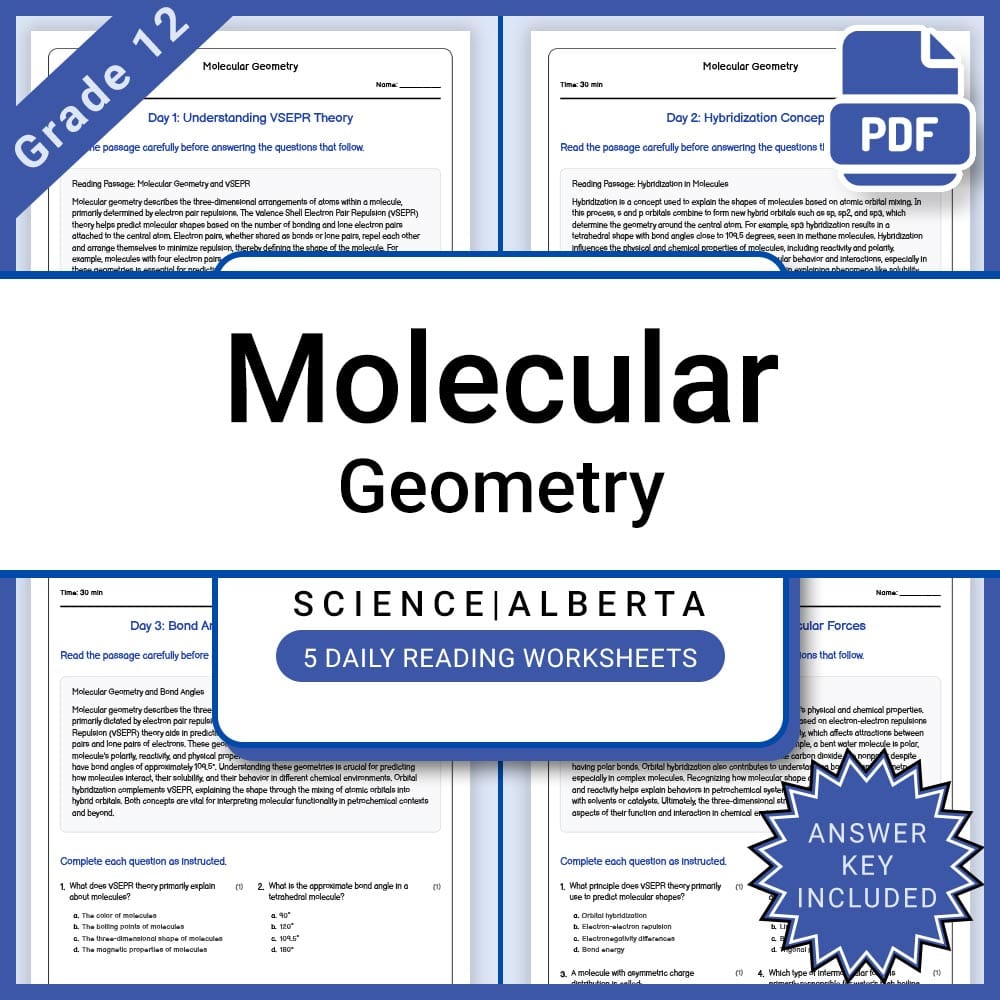
Grade 12 Science – Molecular Geometry Daily Reading Worksheet + Answer Key
JCreated byJ.S SheetsLearning Objectives
- Understand the principles of VSEPR theory to predict molecular shapes
- Identify electron pairs (bonding and lone pairs) around central atoms
- Determine bond angles from electron pair arrangements
Also included in: Grade 12 Science Lesson Bundle | Alberta Framework and Daily Reading Worksheets +1 more
Instant download
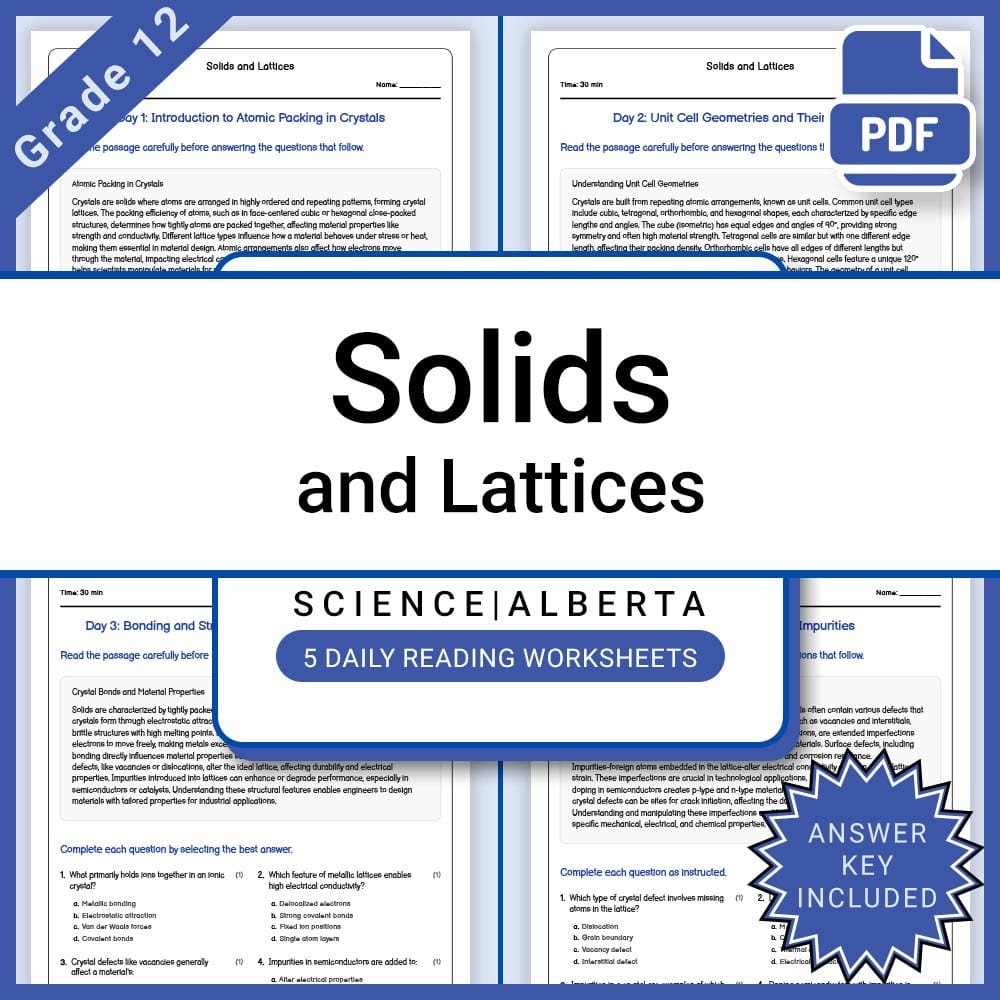
Grade 12 Science – Solids and Lattices Daily Reading Worksheet + Answer Key
JCreated byJ.S SheetsLearning Objectives
- Understand key concepts related to Science
- Apply knowledge through practice questions
- Demonstrate comprehension of the material
Also included in: Grade 12 Science Lesson Bundle | Alberta Framework and Daily Reading Worksheets +1 more
Instant download
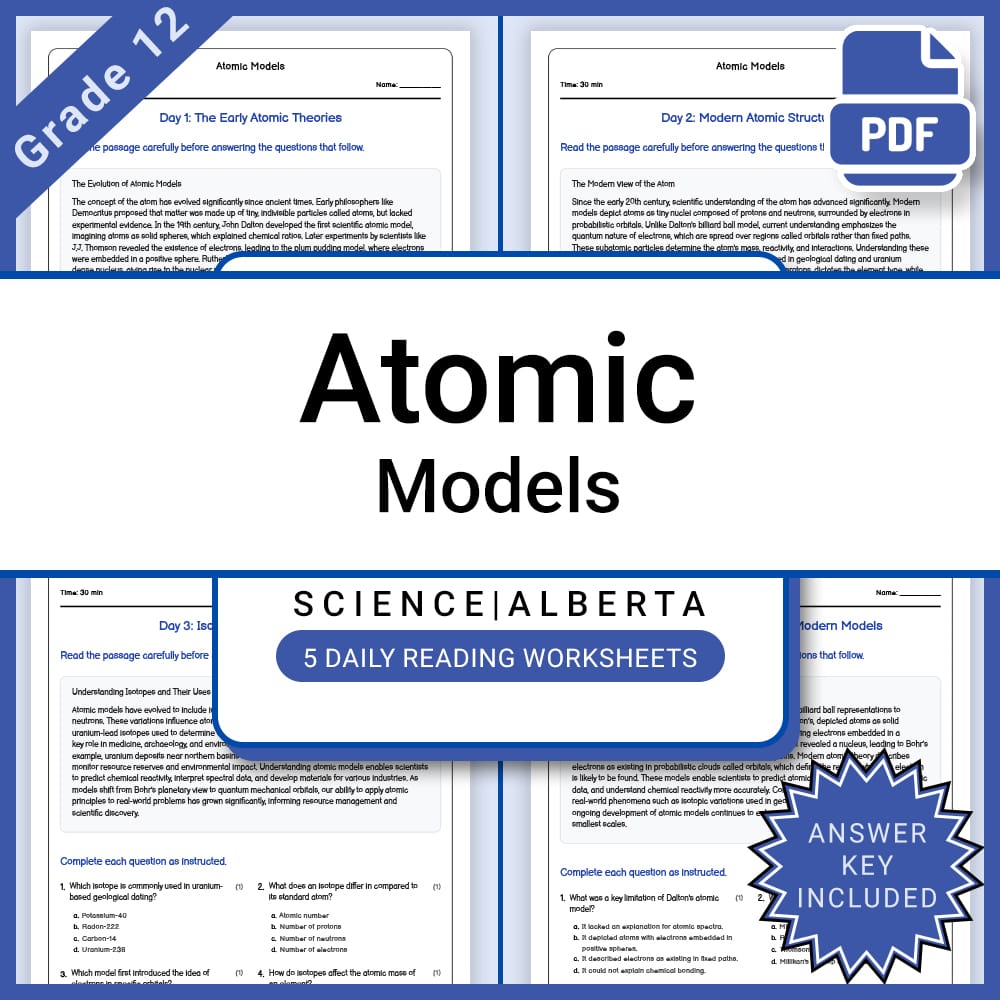
Grade 12 Science – Atomic Models Daily Reading Worksheet with Answer Key
JCreated byJ.S SheetsLearning Objectives
- Recognize and describe the key features of historical atomic models, including Dalton's billiard ball model, Thomson's plum pudding model, and Rutherford's nuclear model.
- Understand the evolution of atomic theory based on experimental evidence and technological advancements.
- Explain how atomic models influence our comprehension of atomic structure, behavior, and real-world applications such as isotopic dating and uranium deposits.
Also included in: Grade 12 Science Lesson Bundle | Alberta Framework and Daily Reading Worksheets +1 more
Instant download
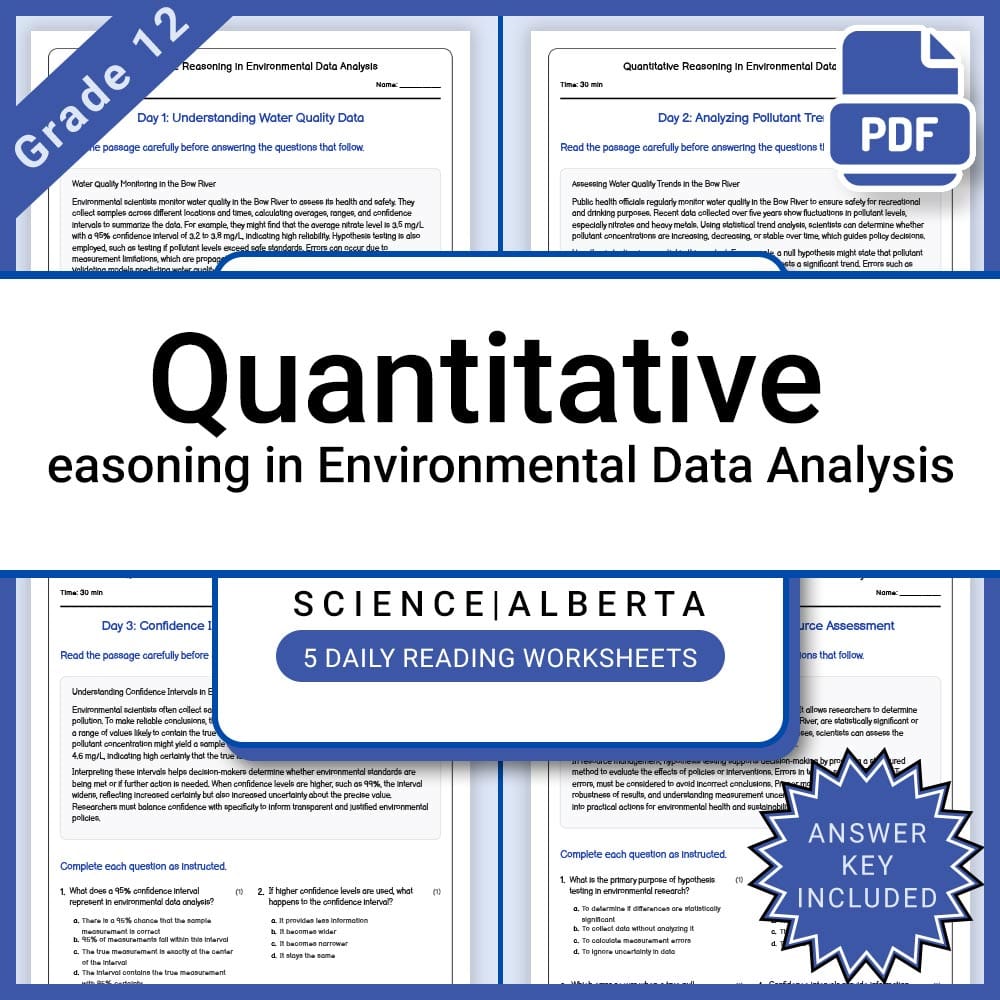
Grade 12 Science – Quantitative Reasoning | Daily Reading Worksheet + Answer Key
JCreated byJ.S SheetsLearning Objectives
- Understand fundamental concepts of statistical summaries used in environmental monitoring.
- Interpret confidence intervals and hypothesis evaluations related to water quality data.
- Recognize how measurement errors propagate in environmental assessments.
Also included in: Grade 12 Science Lesson Bundle | Alberta Framework and Real-World Applications +1 more
Instant download
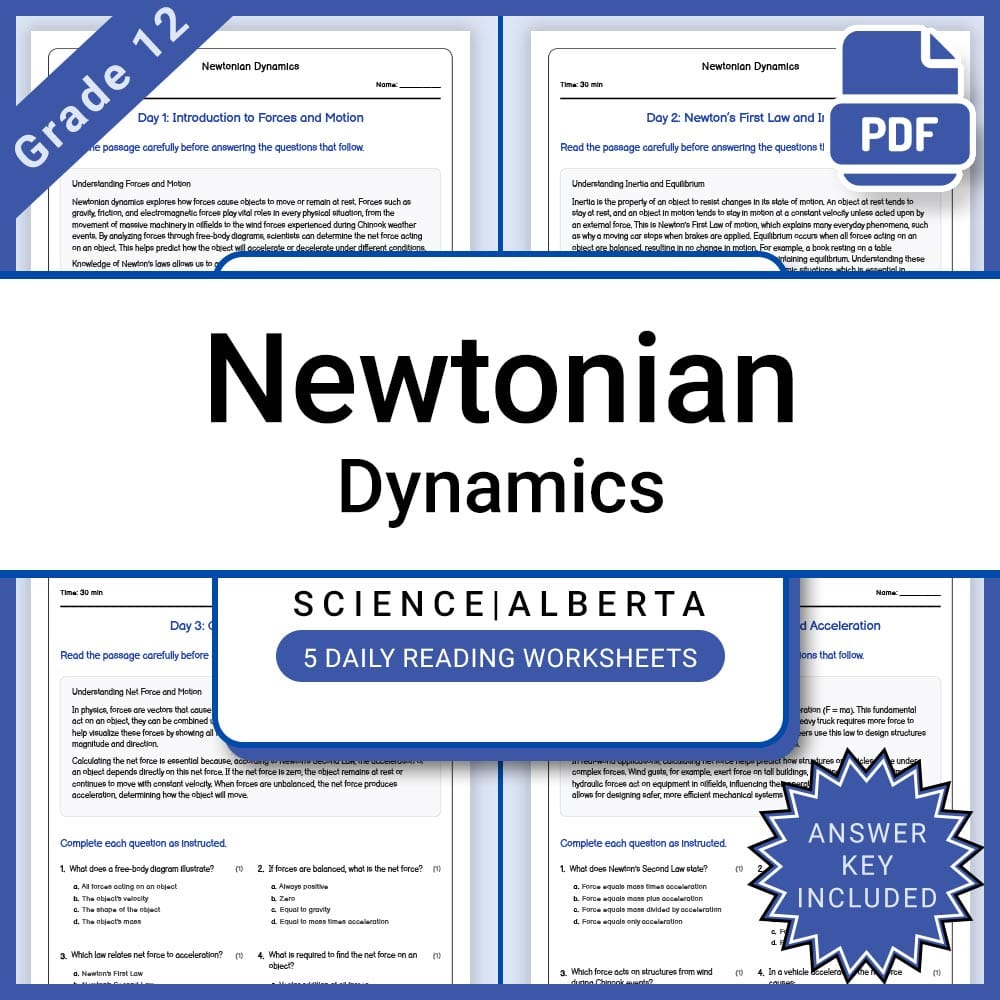
Grade 12 Science – Newtonian Dynamics Daily Reading Worksheet + Answer Key
JCreated byJ.S SheetsLearning Objectives
- Understand the fundamental forces that influence motion
- Apply Newton’s three laws to analyze mechanical situations
- Interpret free-body diagrams and calculate net forces
Also included in: Grade 12 Science Lesson Bundle | Physics, Nuclear, Waves & Circuits +1 more
Instant download
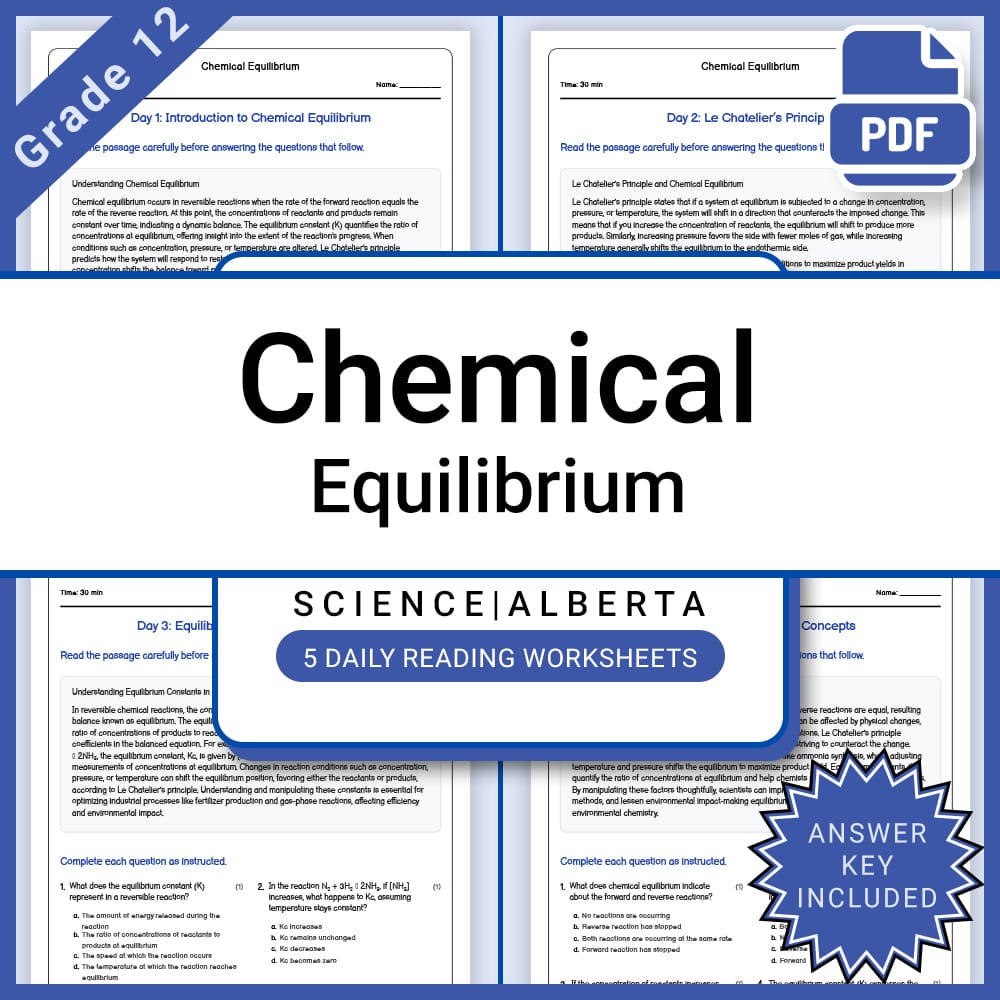
Grade 12 Science – Chemical Equilibrium Daily Reading Worksheet + Answer Key
JCreated byJ.S SheetsLearning Objectives
- Define chemical equilibrium and describe its characteristics.
- Understand Le Chatelier’s principle and how it predicts shifts in equilibrium.
- Apply the concept of equilibrium constants to real-world chemical reactions.
Also included in: Grade 12 Science Lesson Bundle | Alberta Framework and Daily Reading Worksheets +1 more
Instant download
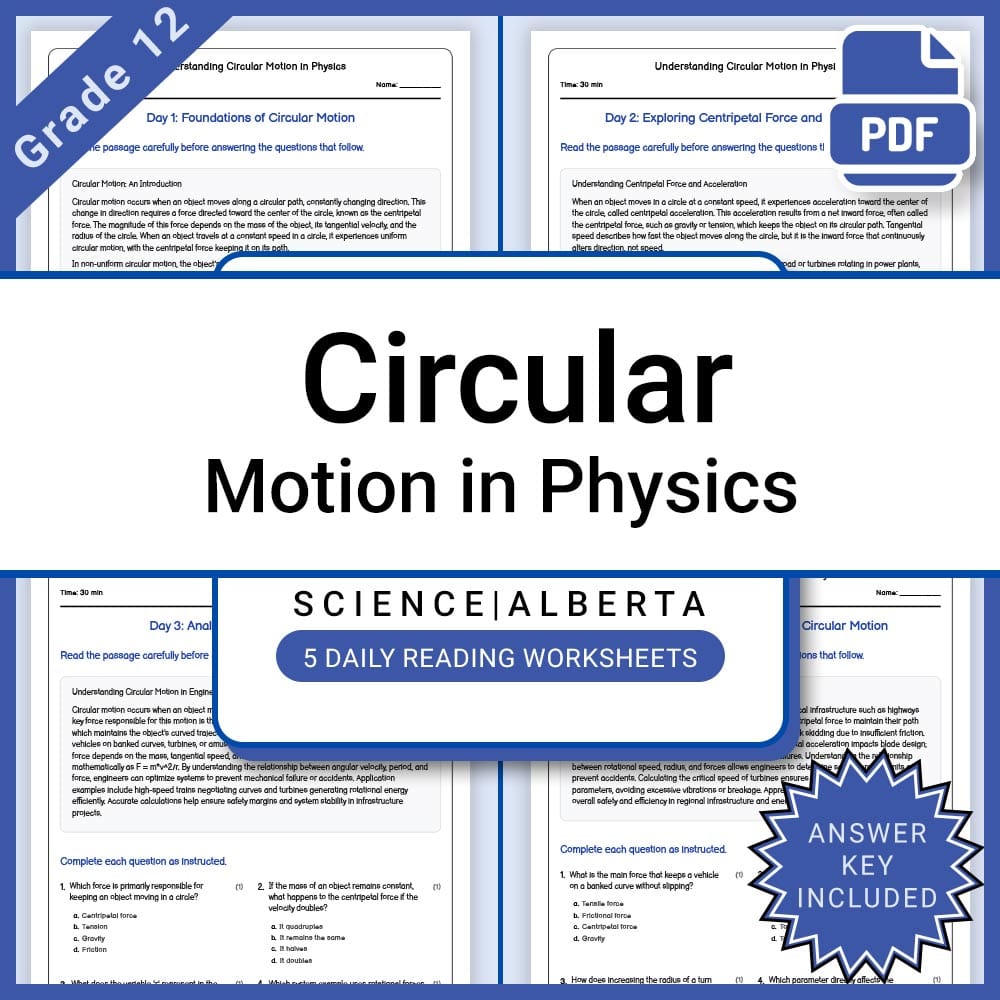
Grade 12 Science – Circular Motion Daily Reading Worksheet + Answer Key
JCreated byJ.S SheetsLearning Objectives
- Define and explain the concept of centripetal force.
- Describe the relationship between tangential speed and radius in circular motion.
- Identify the forces acting on an object moving in a circle.
Also included in: Grade 12 Science Lesson Bundle | Physics, Nuclear, Waves & Circuits +1 more
Instant download
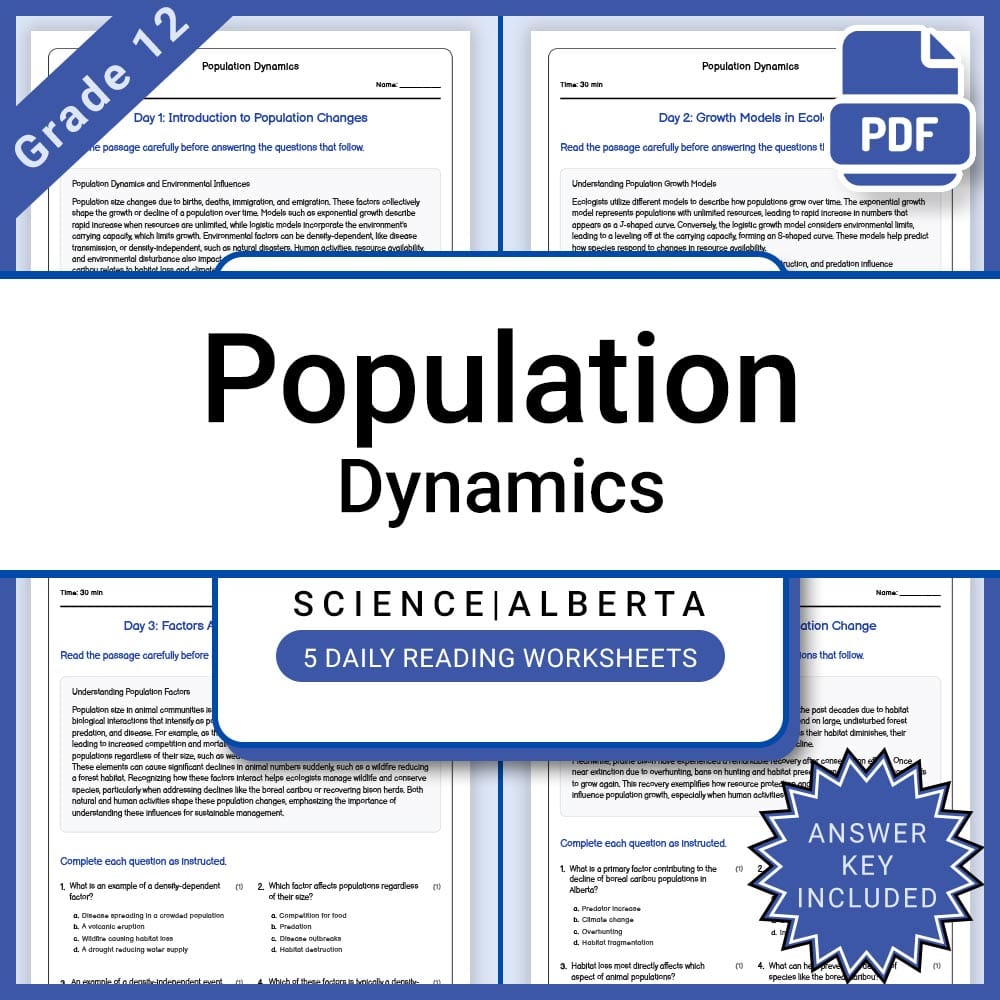
Grade 12 Science – Population Dynamics Daily Reading Worksheet + Answer Key
JCreated byJ.S SheetsLearning Objectives
- Identify factors that influence population size
- Understand models of population growth
- Analyze the effects of environmental factors on populations
Also included in: Grade 12 Science Lesson Bundle | Daily Reading Worksheets +1 more
Instant download
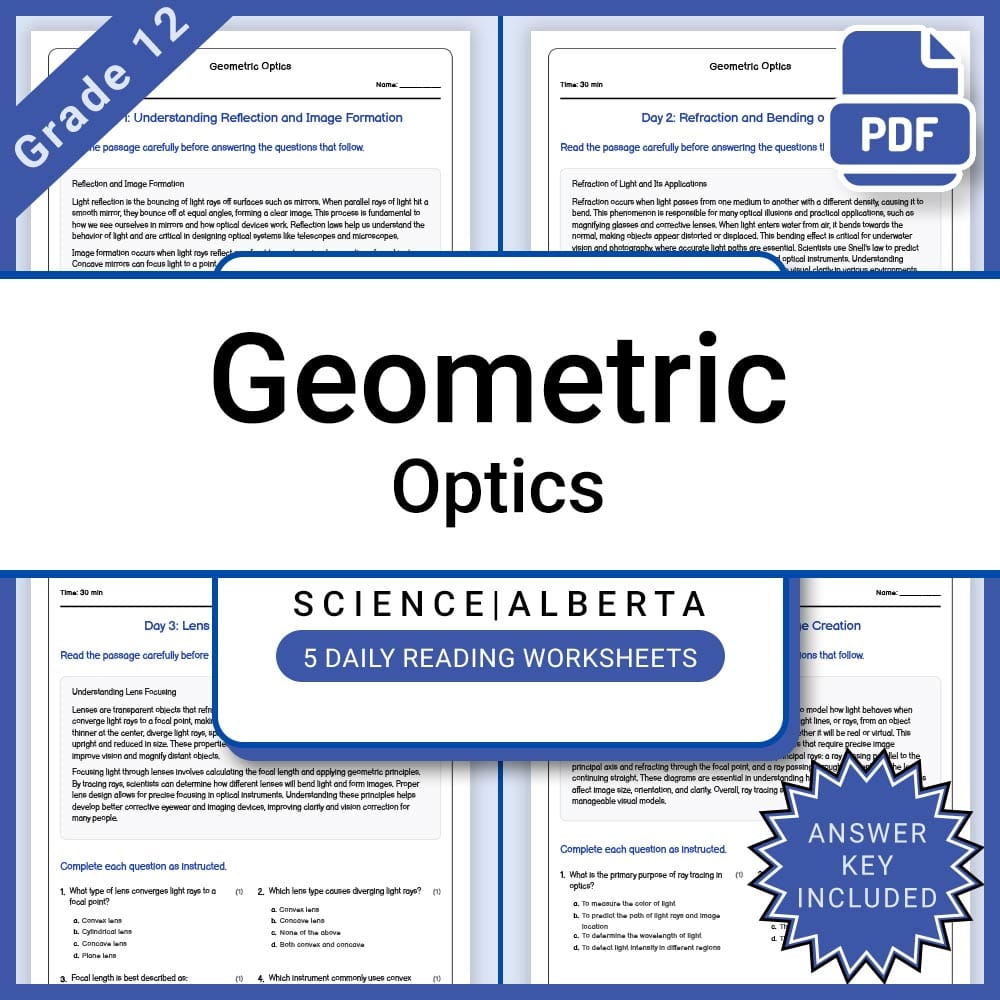
Grade 12 Science – Geometric Optics Daily Reading Worksheet + Answer Key
JCreated byJ.S SheetsLearning Objectives
- Understand how light reflects and forms images using ray models
- Apply laws of reflection and refraction to optical problems
- Identify the importance of mirrors and lenses in daily life and scientific applications
Also included in: Grade 12 Science Lesson Bundle | Physics, Nuclear, Waves & Circuits +1 more
Instant download
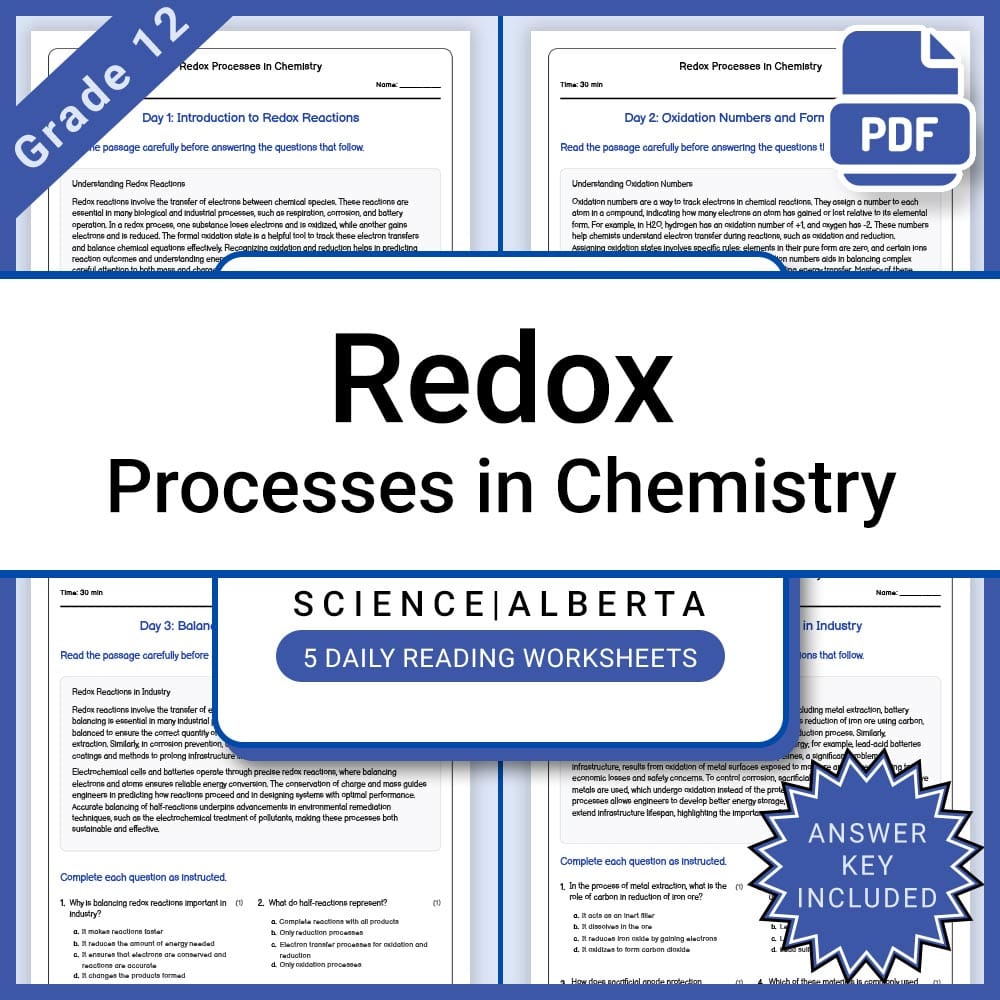
Grade 12 Science – Redox Processes Daily Reading Worksheet + Answer Key
JCreated byJ.S SheetsLearning Objectives
- Understand key concepts related to Science
- Apply knowledge through practice questions
- Demonstrate comprehension of the material
Also included in: Grade 12 Science Lesson Bundle | Alberta Framework and Daily Reading Worksheets +1 more
Instant download

Grade 12 Science – Recombinant DNA Daily Reading Worksheet + Answer Key
JCreated byJ.S SheetsLearning Objectives
- Understand the basic concepts of recombinant DNA techniques
- Identify common tools used in genetic modification
- Explain how recombinant methods are applied in real-world scenarios
Also included in: Grade 12 Science Lesson Bundle | Daily Reading Worksheets +1 more
Instant download
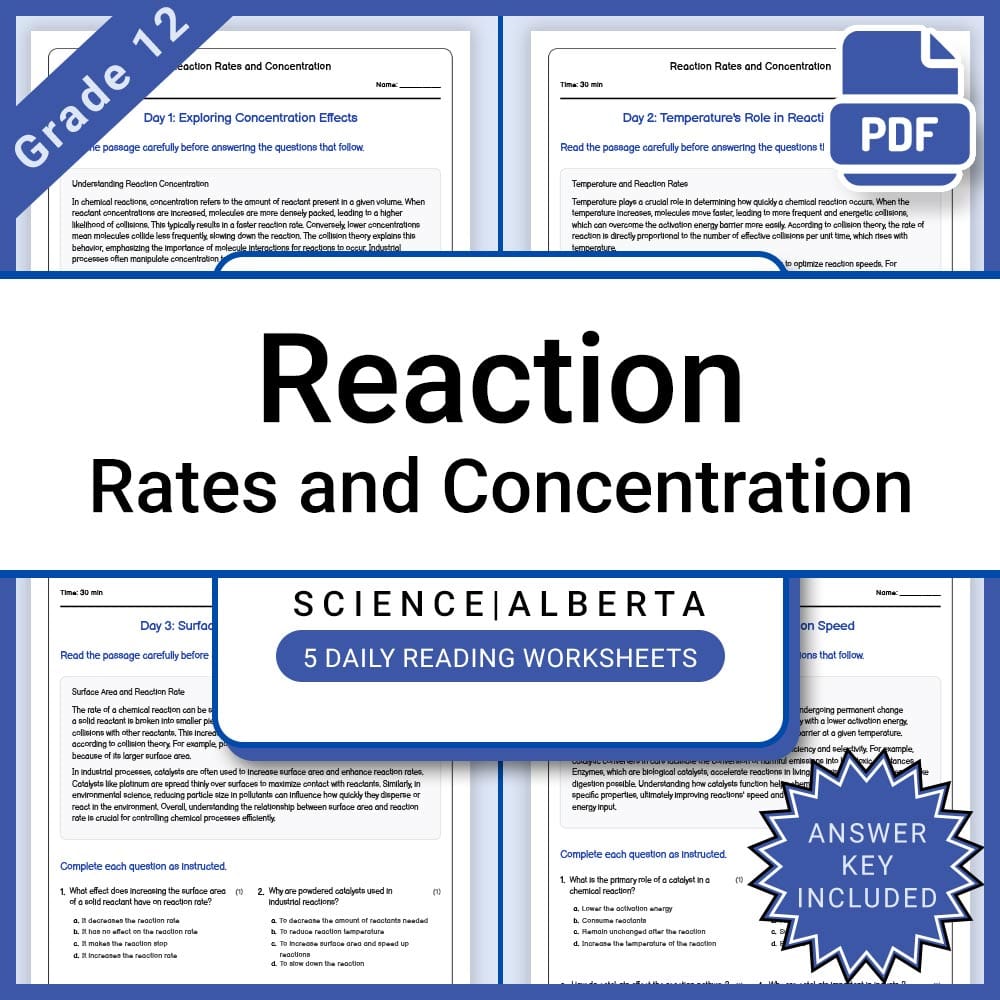
Grade 12 Science – Reaction Rates and Concentration Daily Worksheet + Answer Key
JCreated byJ.S SheetsLearning Objectives
- Understand key concepts related to Science
- Apply knowledge through practice questions
- Demonstrate comprehension of the material
Also included in: Grade 12 Science Lesson Bundle | Alberta Framework and Daily Reading Worksheets +1 more
Instant download

Grade 12 Science – Regulatory Networks Daily Reading Worksheet with Answer Key
JCreated byJ.S SheetsLearning Objectives
- Understand the components involved in gene regulation and how they interact.
- Identify different types of regulatory molecules such as transcription factors and noncoding RNAs.
- Explain how epigenetic modifications influence gene expression.
Also included in: Grade 12 Science Lesson Bundle | Daily Reading Worksheets +1 more
Instant download

Grade 12 Molecular Inheritance Worksheet | AP Practice & PDF
Created byClear Sky ClassroomLearning Objectives
- Explain how meiotic chromosome behavior, recombination, and linkage influence molecular inheritance patterns.
- Interpret recombination frequency and connect it to physical and genetic maps using molecular marker evidence.
- Differentiate single-gene inheritance effects from polygenic influences and predict outcomes of chromosomal anomalies.
Also included in: Grade 12 Cell, Genetics, and Ecosystems Science AP Lesson Bundle Worksheet B +1 more
Instant download
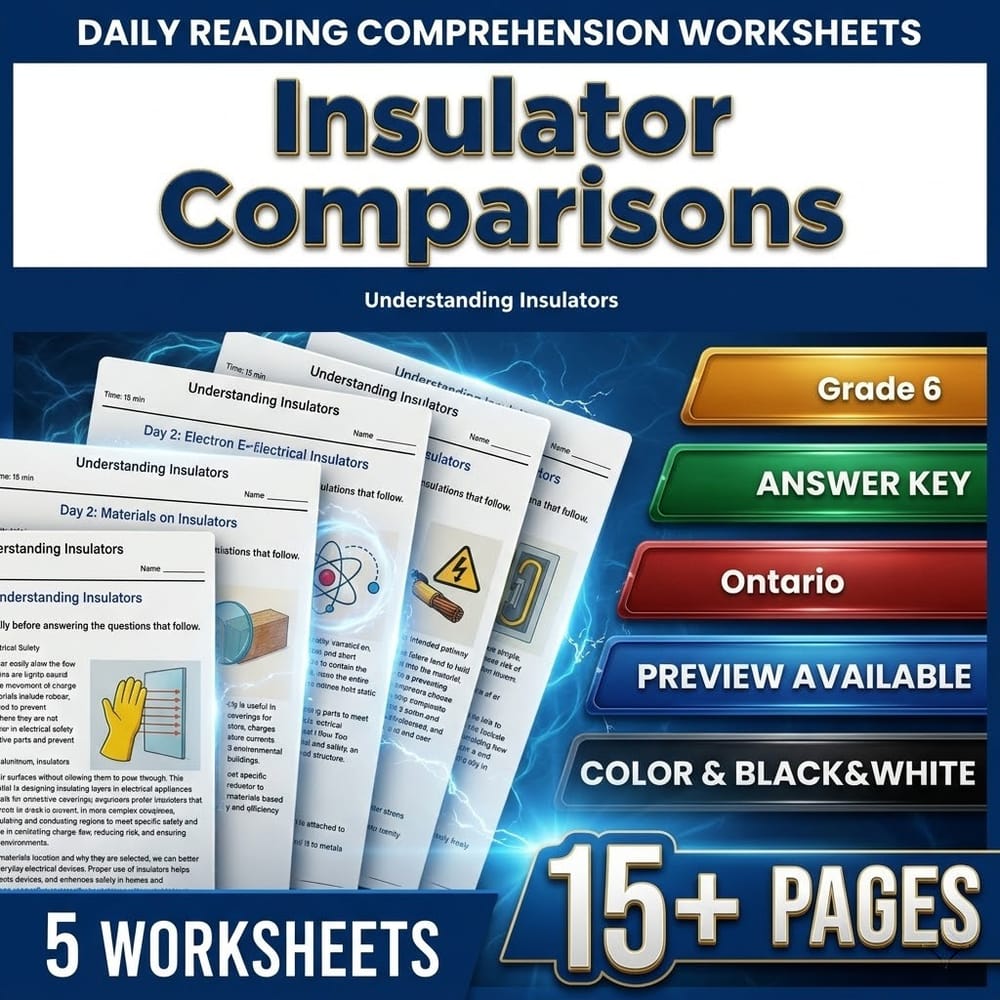
Grade 6 Science – Insulators & Conductors | Daily Reading Worksheet
Created byQuiet Forest EducationLearning Objectives
- Explain what insulators are and how their electron binding prevents charge flow.
- Identify common insulating materials such as rubber, glass, and dry wood.
- Describe how insulators prevent electrical charges from flowing and support safety.
Also included in: Electricity Grade 6 Science Daily Reading Worksheets Bundle | Ontario +1 more
Instant download
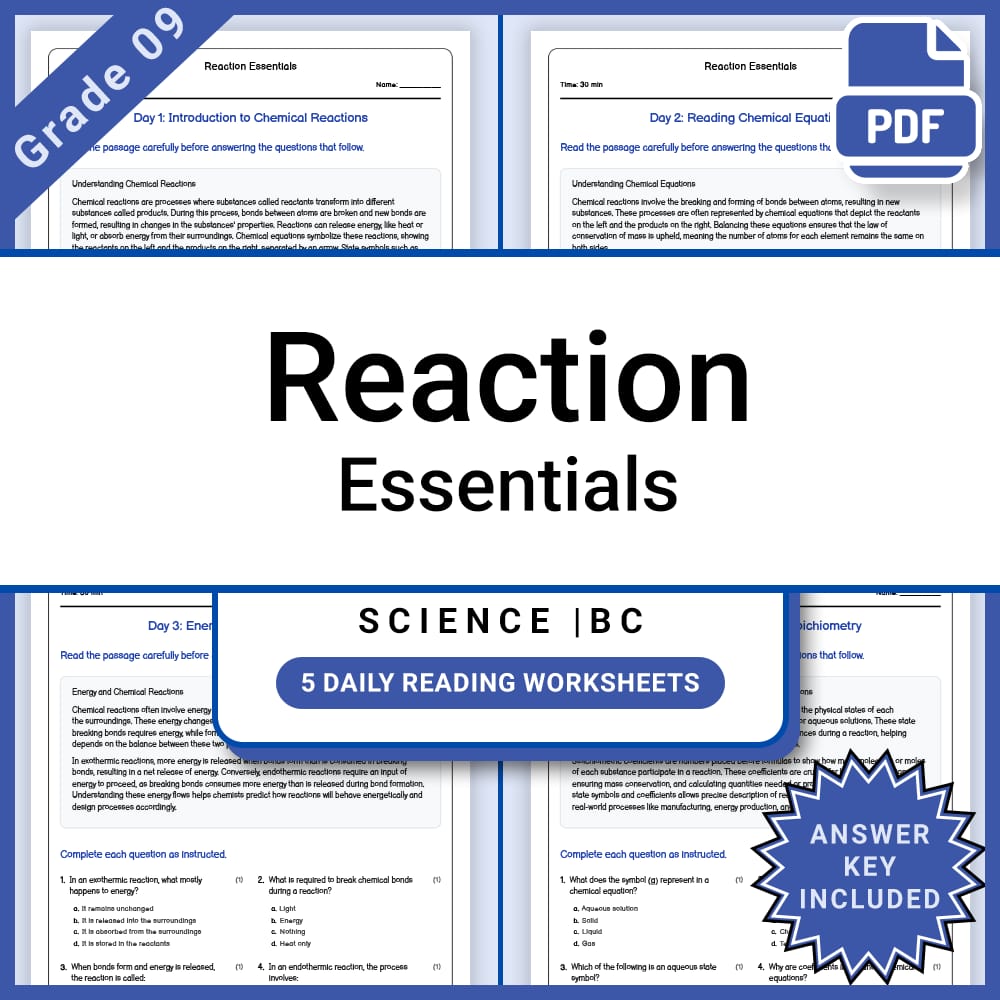
Grade 9 Science – Reaction Essentials Daily Reading Worksheet + Answer Key
JCreated byJ.S SheetsLearning Objectives
- Understand the basic concepts of chemical reactions
- Identify reactants and products in chemical equations
- Explain how bonds break and form during reactions
Also included in: Grade 9 Science Lesson Group BC Framework | Chemistry, Physics, and More +1 more
Instant download
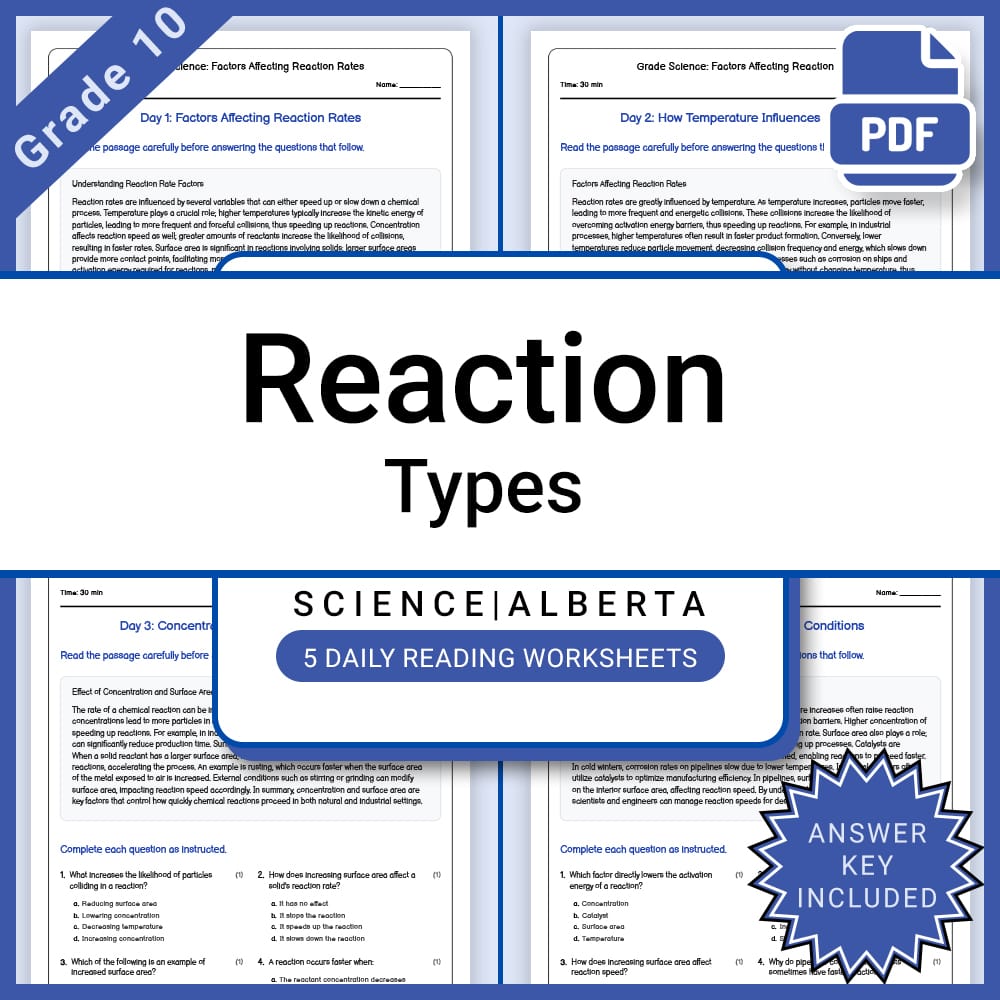
Grade 10 Science – Reaction Types Daily Reading Worksheet + Answer Key
JCreated byJ.S SheetsLearning Objectives
- Understand the basic types of chemical reactions
- Identify synthesis, decomposition, displacement, and combustion reactions
- Predict reaction products based on reaction patterns
Also included in: Grade 10 Science Lesson Group Bundle Alberta | Worksheets & Activities +1 more
Instant download
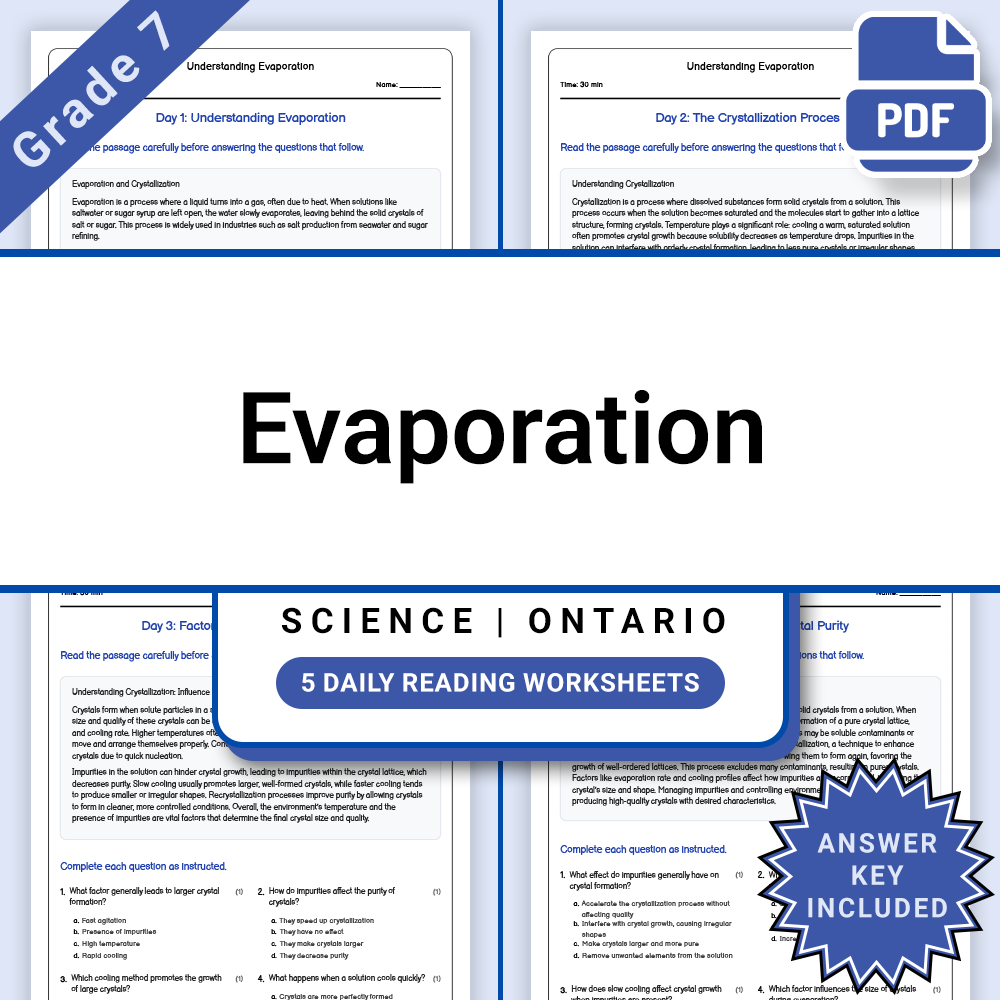
Grade 7 Science – Understanding Evaporation Daily Reading Worksheet + Answer Key
JCreated byJ.S SheetsLearning Objectives
- Explain the process of evaporation and how it contributes to crystallization.
- Identify factors that influence crystal formation, size, and purity.
- Describe real-life examples of evaporation crystallization, such as salt and sugar production.
Also included in: Grade 7 Science Lesson Group | Ontario Framework Worksheets Bundle +1 more
Instant download

Grade 4 Internal Structure Functions Worksheet | Practice & PDF
Created byClear Sky ClassroomLearning Objectives
- Identify how major internal body systems work together to support survival and growth.
- Describe the functions of the digestive, circulatory, respiratory, and reproductive systems.
- Use vocabulary from internal structures to explain how life processes continue under changing conditions.
Instant download
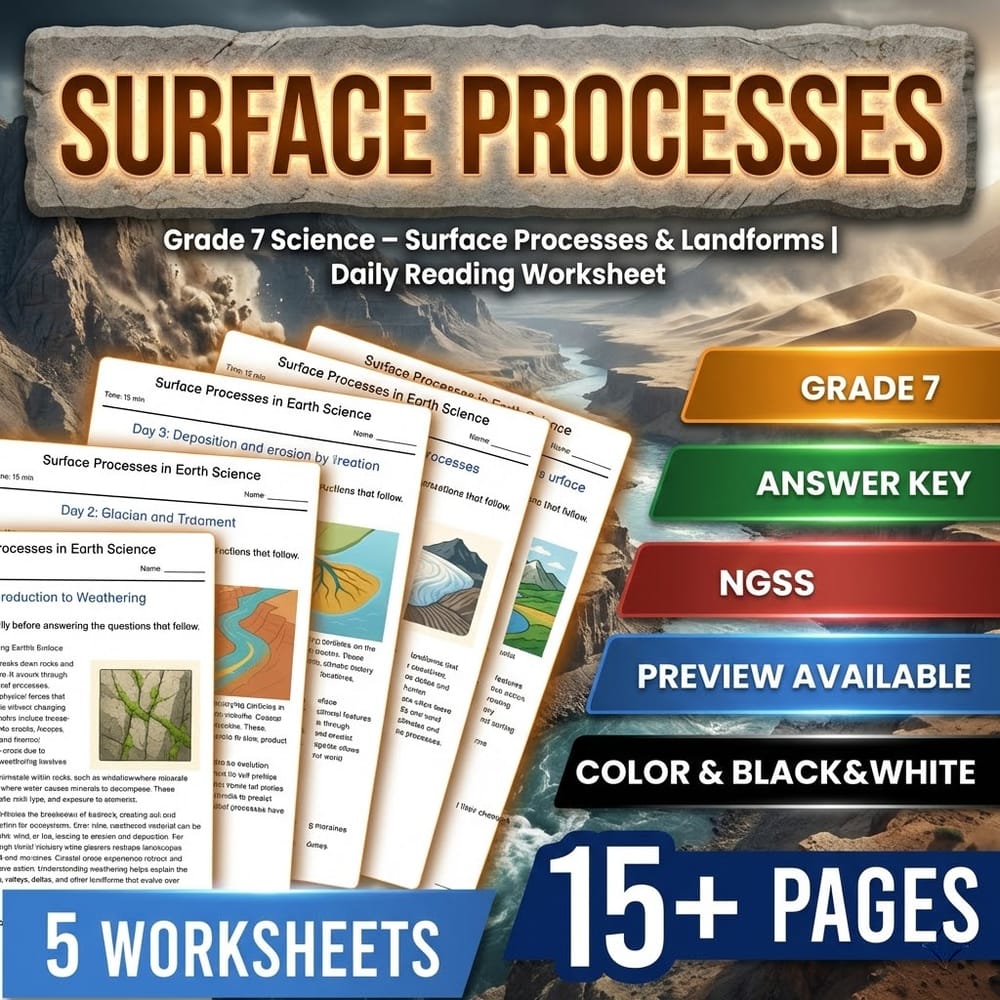
Grade 7 Science – Surface Processes & Landforms | Daily Reading Worksheet
 Created byElena Brooks
Learning Objectives
- Understand the different types of weathering: mechanical and chemical.
- Identify agents and signatures of erosion, transport, and deposition.
- Recognize landform examples created by surface processes.
Also included in: Water Cycle & Landforms Grade 7 Science Daily Reading Worksheets Bundle | NGSS +1 more
Instant download
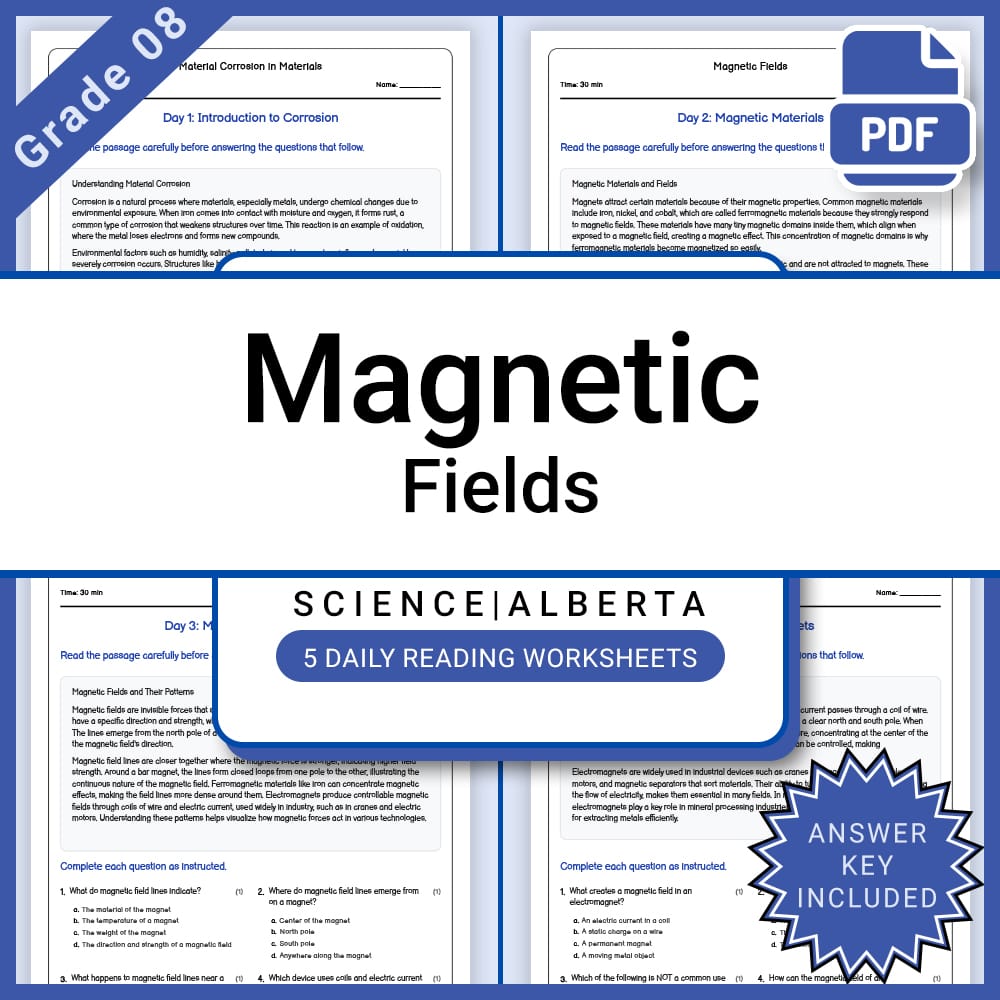
Grade 8 Science – Magnetic Fields Daily Reading Worksheet + Answer Key
JCreated byJ.S SheetsLearning Objectives
- Understand the concept of magnetic fields and how they are visualized
- Identify materials that produce magnetic fields and their applications
- Explain how electromagnets work and their uses in industry
Also included in: Grade 8 Science Lesson Bundle — Electricity, Circuits & Energy +1 more
Instant download

Grade 9 Atmospheric Energy Worksheet | California Standards Practice PDF
Created byClear Sky ClassroomLearning Objectives
- Explain how unequal heating by the Sun creates temperature and pressure differences that drive atmospheric circulation.
- Describe how energy transfer between Earth’s surface and the atmosphere influences humidity, clouds, and precipitation.
- Connect local weather patterns to interactions among temperature, humidity, and Earth–atmosphere energy balance.
Instant download
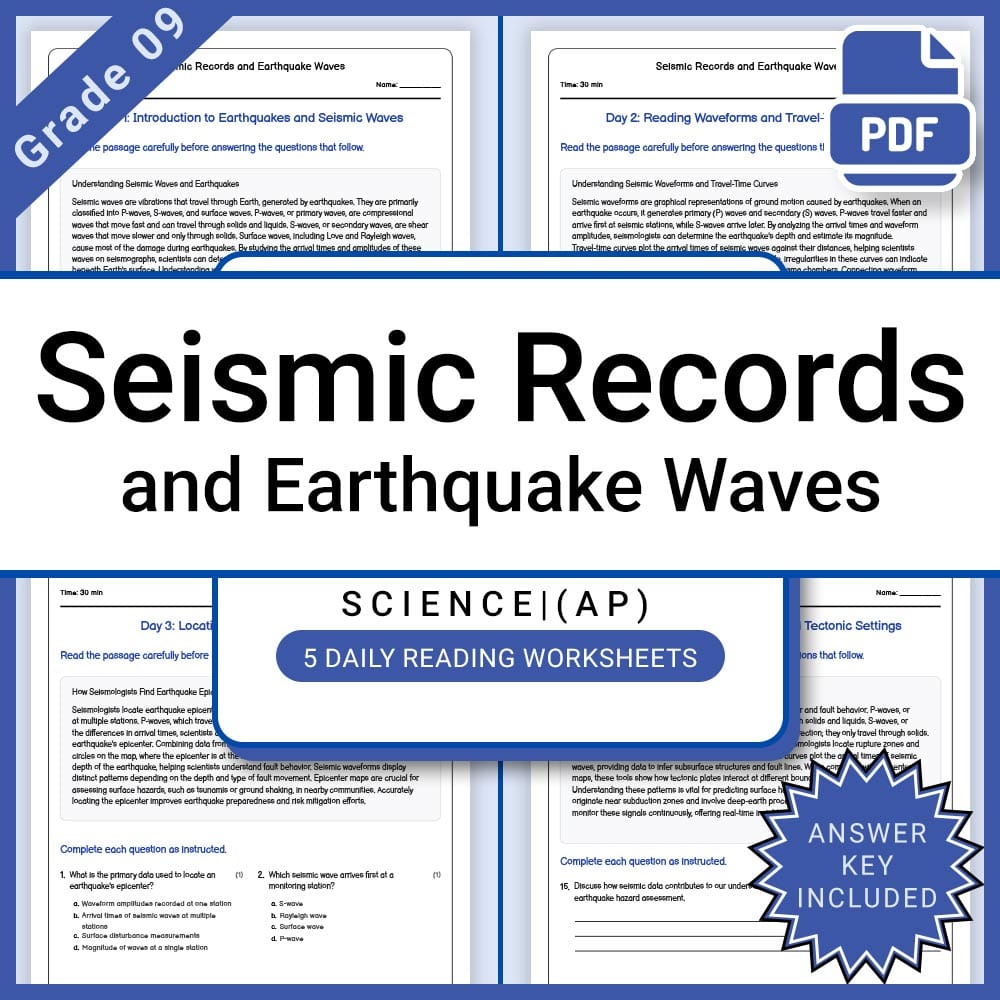
Grade 9 Science – Seismic Records and Earthquake Waves | Worksheet + Answer Key
JCreated byJ.S SheetsLearning Objectives
- Identify different types of seismic waves and their features
- Understand how seismic waveforms and travel-time curves are used to infer Earth's subsurface structure
- Compare P- and S-wave characteristics to determine earthquake depth and fault behavior
Also included in: Grade 9 Science Lesson Bundle – AP Framework Daily Reading Worksheets +1 more
Instant download

Grade 10 Enzymes And Transport Worksheet | Practice & PDF
Created byClear Sky ClassroomLearning Objectives
- Explain how enzymes act as catalysts by lowering activation energy and increasing reaction rate
- Describe how membrane structure affects diffusion, osmosis, and selective transport
- Compare passive transport with active transport and identify roles of channels and pumps
Instant download
Browse more categories
About Daily Reading Worksheets Worksheets
Explore daily reading worksheets activities across subjects and grades. Our 8,400 daily reading worksheets printables are ready to print, with answer keys where available.
Every worksheet on MyTeachingSheets is created by independent teacher-authors and reviewed before publication. All resources download as printable PDFs for classroom, homework, or at-home practice, and many include answer keys. Preview any worksheet free before buying.