
Grade 10 Worksheets
9,315 grade resources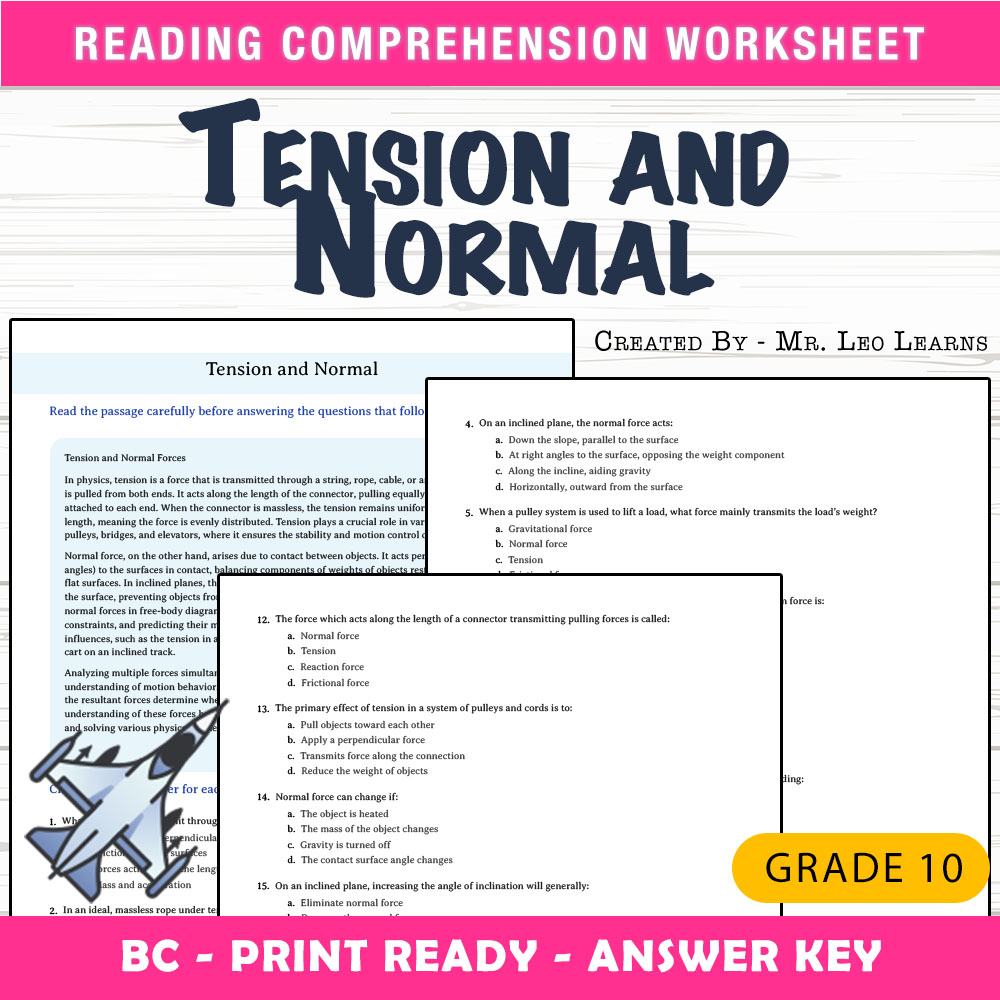
Grade 10 Science — Worksheet MCQ Paper for Mastering Tension and Normal
 Created byThe Resource Hub
Learning Objectives
- Understand how tension transmits forces through connectors and acts along their length.
- Identify the role of normal force in contact situations and on inclines.
- Analyze how combined forces influence the motion and equilibrium of objects.
Also included in: Grade 10 Science | Forces, Motion & Fields UNIT Worksheet Bundle +1 more
Instant download

Adaptation Strategies Worksheet for AP Science Grade 10 with Answer Key
 Created byBright Quill Resources
Learning Objectives
- Evaluate trade-offs among carbon management, engineered resilience, conservation, and land-use policy in Earth systems
- Use systems thinking and scenario comparisons to predict potential effectiveness and unintended consequences of adaptation strategies
- Apply cost-benefit reasoning and uncertainty analysis to judge scalable interventions and monitoring needs
Instant download
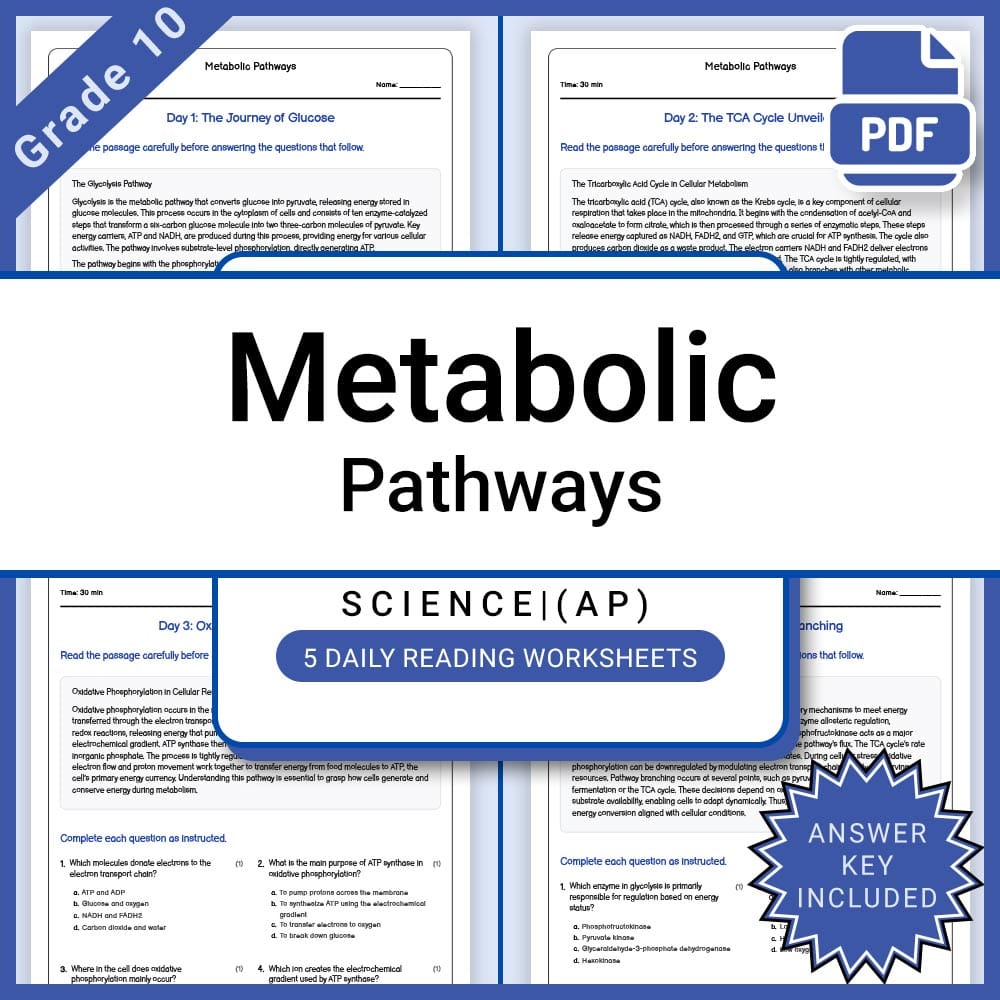
Grade 10 Science – Metabolic Pathways Daily Reading Worksheet + Answer Key
JCreated byJ.S SheetsLearning Objectives
- Understand key concepts related to Science
- Apply knowledge through practice questions
- Demonstrate comprehension of the material
Also included in: Grade 10 Science Lesson Group Bundle | AP Framework & Daily Worksheets
Instant download

Grade 10 Science – DNA Structure & Function | Daily Reading Worksheet
 Created byBright Mind Resources
Learning Objectives
- Understand the structural features of DNA, including double helix geometry, complementary base pairing, and antiparallel strands.
- Describe the mechanisms of DNA replication, including roles of DNA polymerase and helicase, and the importance of fidelity mechanisms.
- Explain how DNA sequences encode proteins through transcription and translation.
Also included in: Grade 10 Genetics Science Daily Reading Lesson Bundle | NGSS +2 more
Instant download
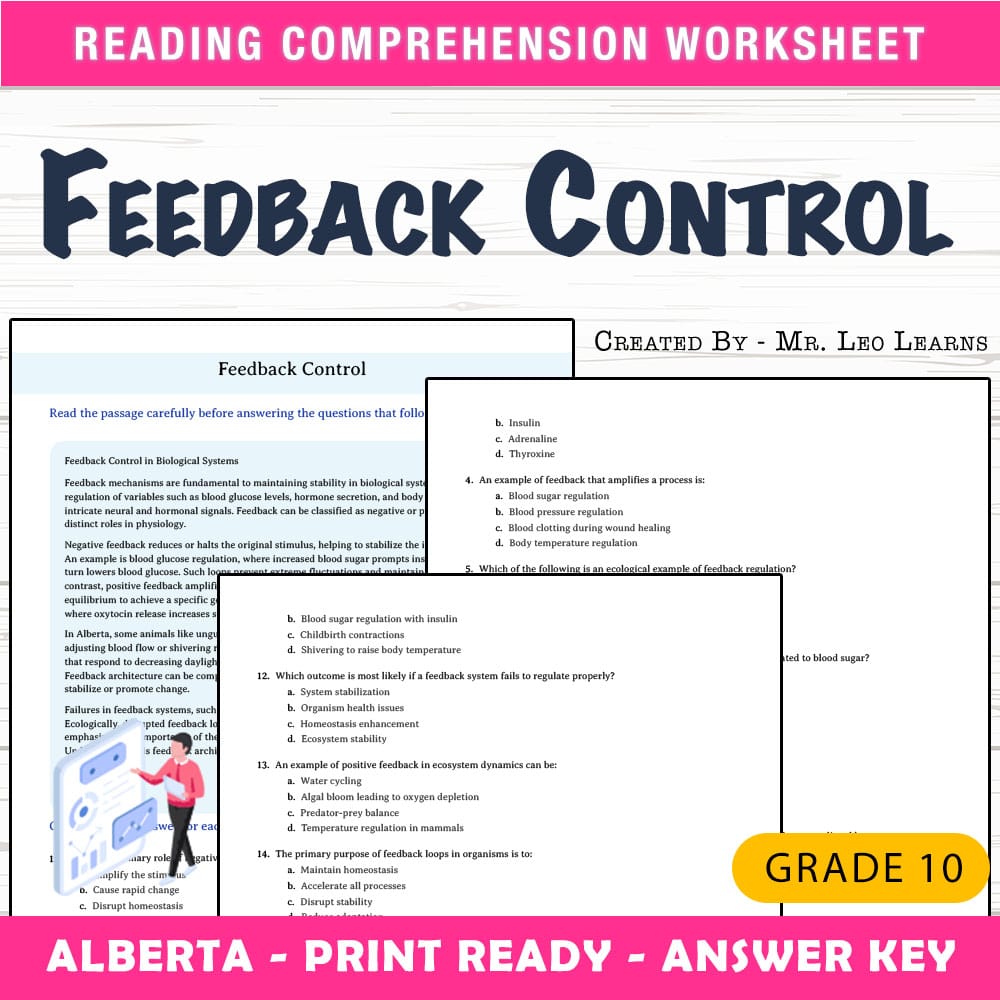
Grade 10 Science — Worksheet MCQ Paper for Mastering Feedback Control
Created byThe Resource HubLearning Objectives
- Understand the mechanisms of negative and positive feedback in physiological regulation.
- Identify real-world examples of feedback systems in organisms and ecosystems.
- Differentiate between stabilizing (negative) and amplifying (positive) feedback loops.
Also included in: Grade 10 Science Cells and Systems Lesson Bundle | Alberta Curriculum +1 more
Instant download
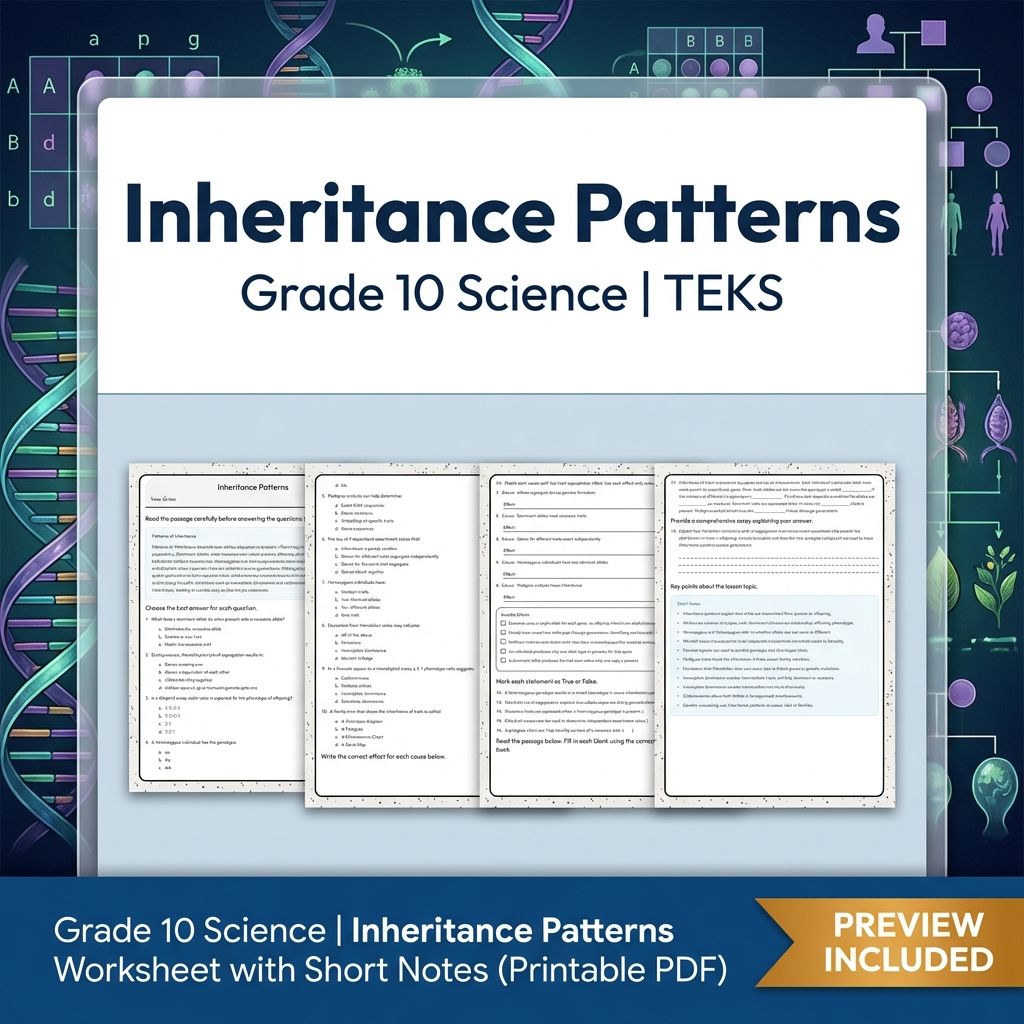
Grade 10 Science | Inheritance Patterns Worksheet with Short Notes (PDF)
 Created byMeadowlark Worksheets
Learning Objectives
- Explain how dominant and recessive alleles influence traits.
- Describe Mendelian principles such as segregation and independent assortment.
- Interpret pedigree charts to analyze trait inheritance.
Instant download
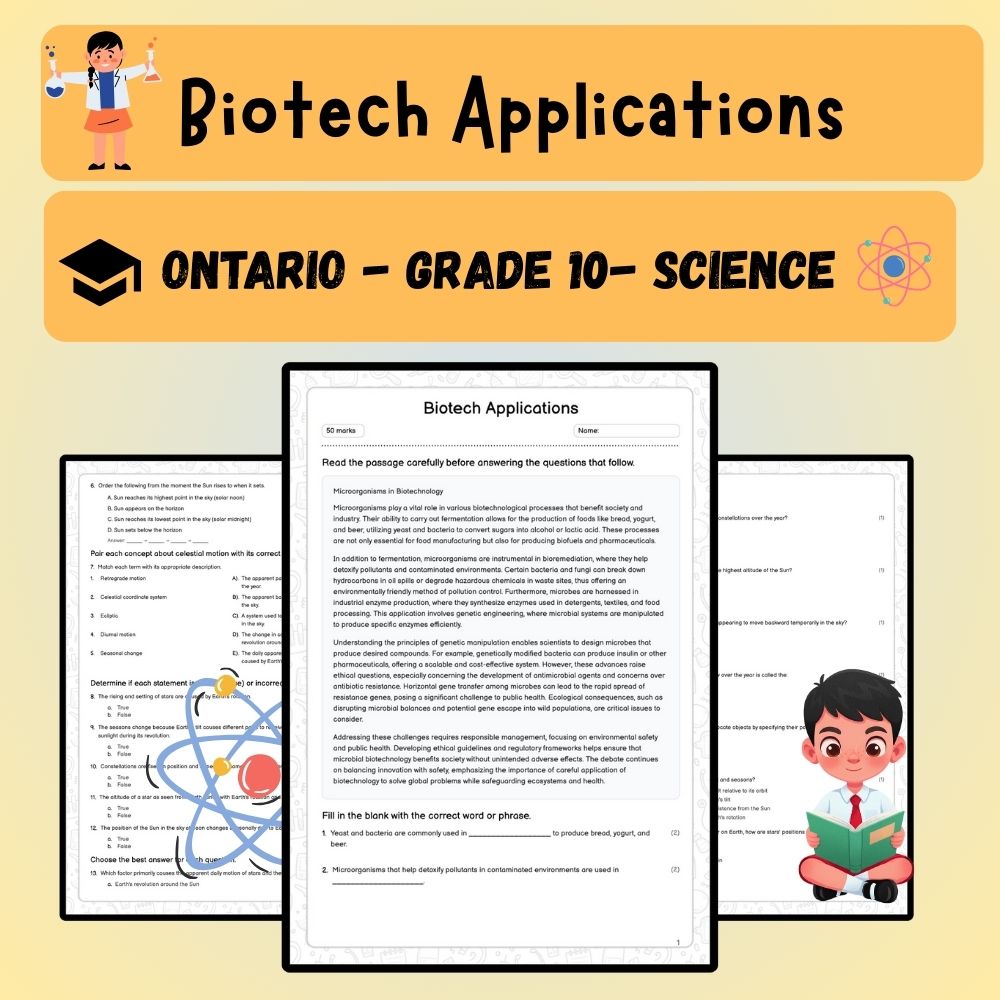
Grade 10 Science | Biotech Applications Worksheet (PDF) - Ontario Standards
 Created byPrism Point Learning
Learning Objectives
- Describe key biotechnological applications of microorganisms, including fermentation and bioremediation.
- Explain principles of genetic manipulation in microbial systems for product synthesis.
- Analyze the ecological and health implications of antibiotic resistance and horizontal gene transfer.
Also included in: Grade 10 Science Unit | Cells, Photosynthesis & Microbes Worksheet Pack +1 more
Instant download
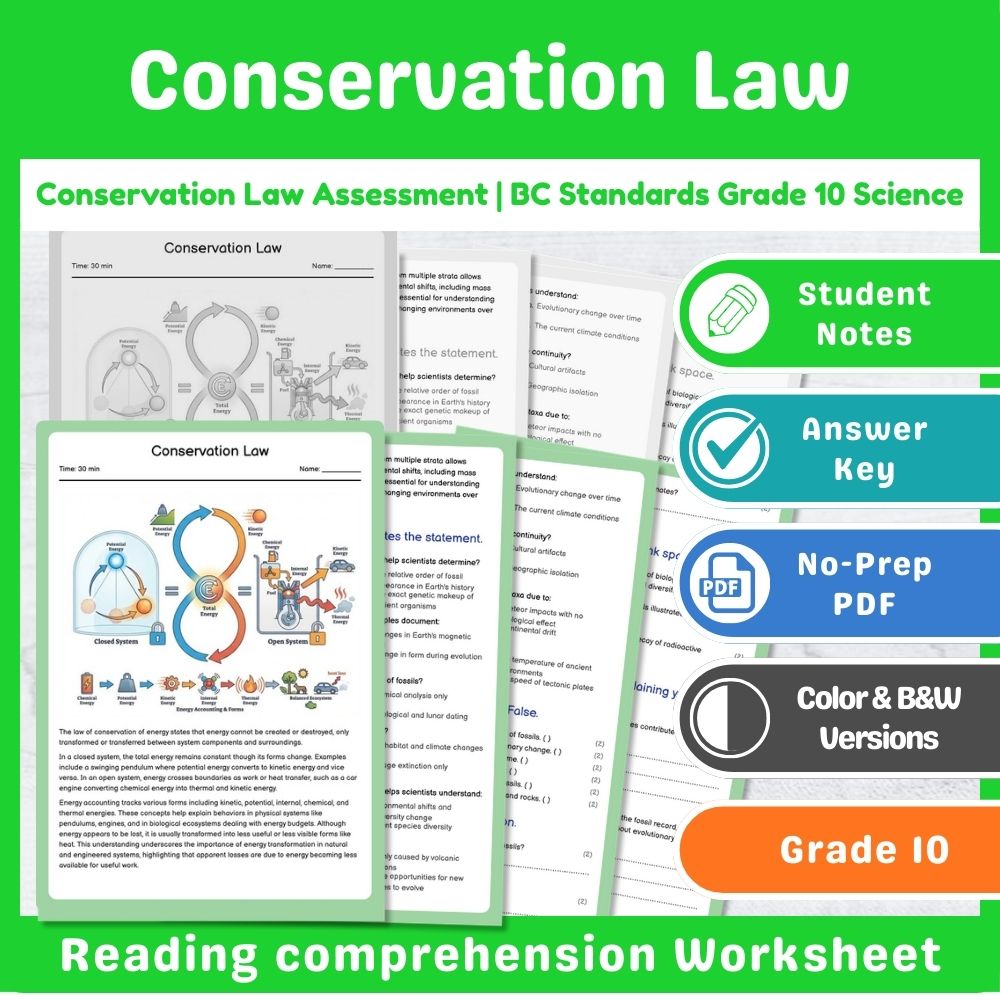
Conservation Law Assessment | BC Standards Grade 10 Science
Created byPrism Point LearningLearning Objectives
- Understand the principle of conservation of energy and its implications.
- Identify different forms of energy and how they transform within systems.
- Explain how energy transfer affects physical and biological processes.
Also included in: Grade 10 Science | Energy Assessment - BC Standards-Aligned Mini Bundle
Instant download
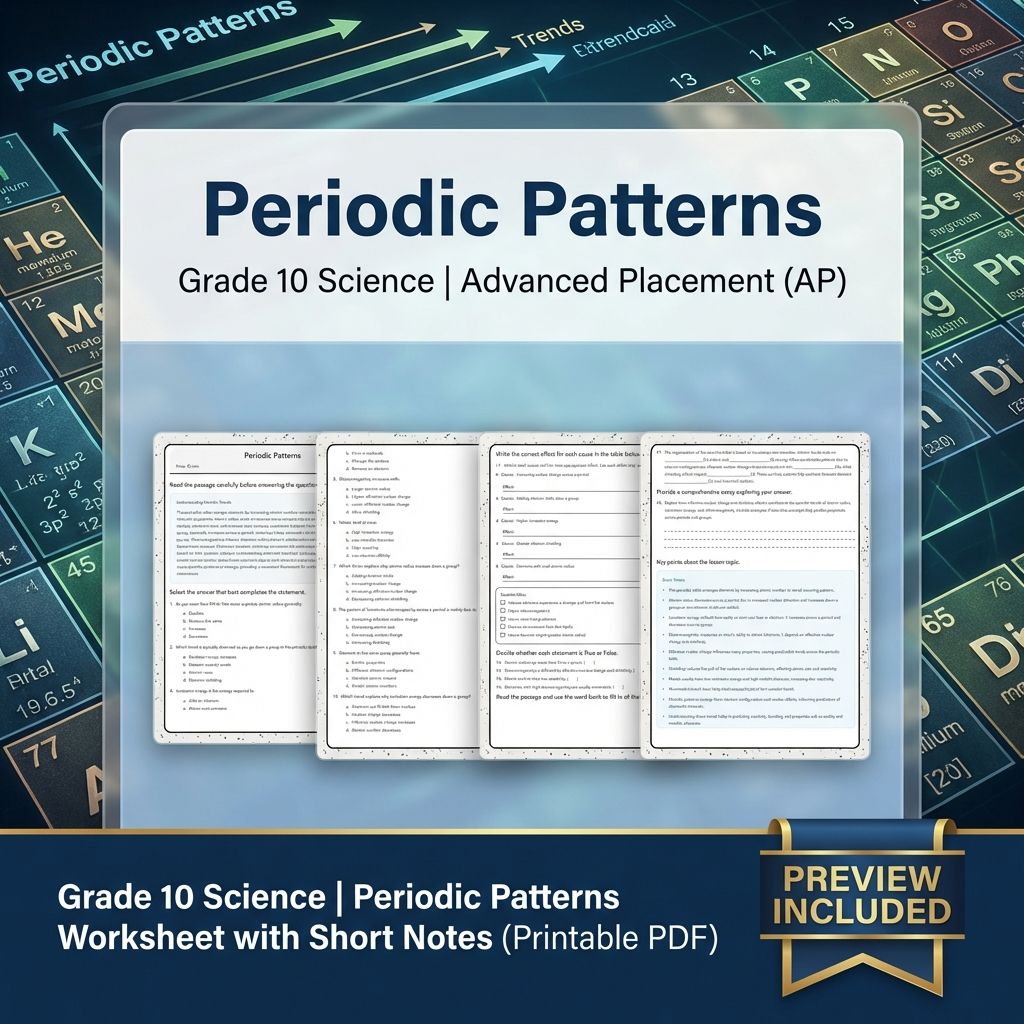
Grade 10 Science | Periodic Patterns Worksheet with Short Notes (Printable PDF)
Created byMeadowlark WorksheetsLearning Objectives
- Explain how the organization of the periodic table relates to atomic properties.
- Interpret trends such as atomic radius, ionization energy, and electronegativity across periods and groups.
- Understand the concepts of effective nuclear charge and shielding effects in atomic behavior.
Also included in: Grade 10 Science | Comprehensive Unit Bundle on Atomic Structure
Instant download
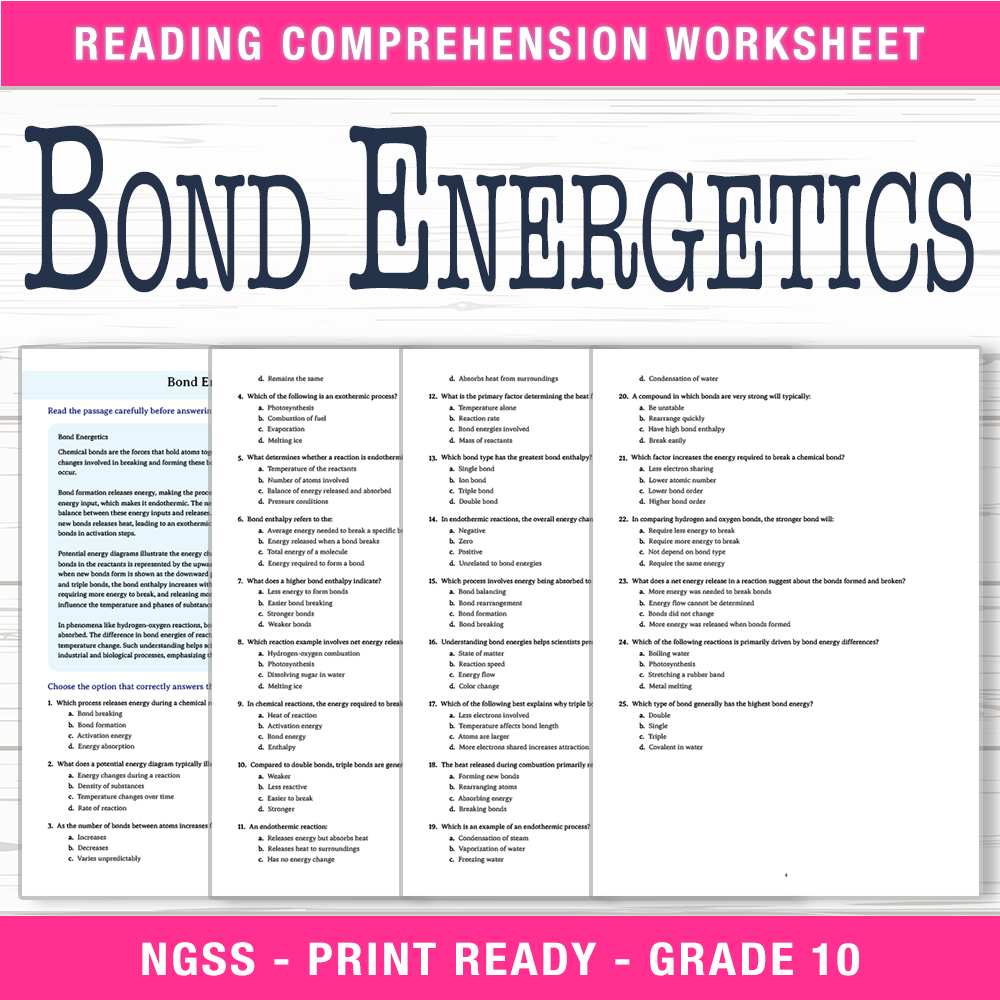
Grade 10 Science | Bond Energetics Worksheet (PDF + Answer Key)
 Created byRiverstone Classroom
Learning Objectives
- Explain how bond formation and breaking involve energy changes in chemical reactions.
- Distinguish between exothermic and endothermic processes based on bond energies.
- Interpret potential energy diagrams related to chemical bonds.
Instant download

Natural Selection Worksheet | Grade 10 Biology NGSSS | Evolution Practice + Key
 Created byEvergreen Desk Education
Learning Objectives
- Explain how natural selection changes heritable traits in a population across generations.
- Use the concept of fitness to predict how traits become more common under specific environmental conditions.
- Differentiate structural, behavioral, and physiological traits and relate them to survival and reproduction.
Instant download
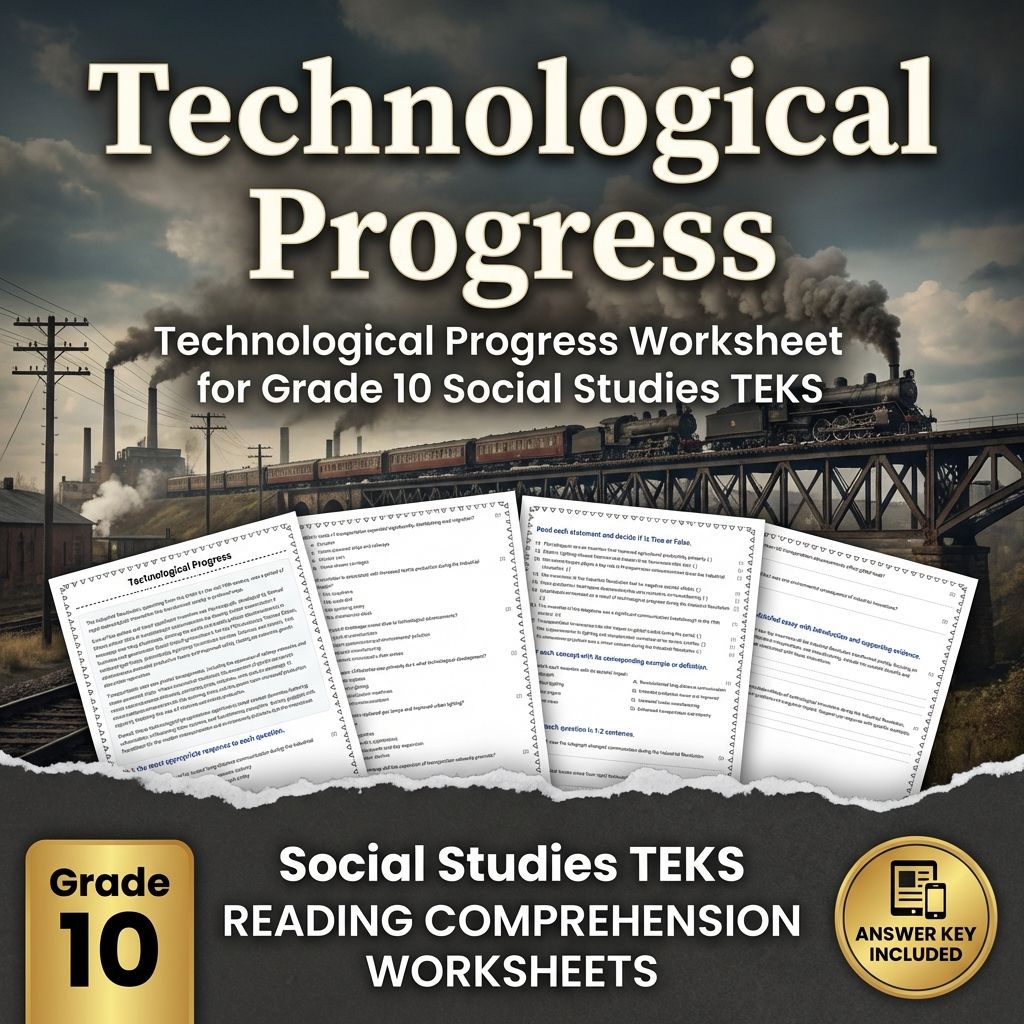
Technological Progress Worksheet for Grade 10 Social Studies TEKS
JCreated byJ.S SheetsLearning Objectives
- Analyze key technological innovations during the Industrial Revolution.
- Understand how inventions like the telegraph and electric lighting impacted society.
- Evaluate the societal effects of technological advancements on communication, transportation, and manufacturing.
Instant download

Industrial Growth Worksheet | Grade 10 Social Studies TEKS Activity
Created byThe Resource HubLearning Objectives
- Explain how steam power and mechanized production contributed to industrial growth and economic change
- Analyze how industrialization and urbanization reshaped labor, living conditions, and social classes
- Describe how global capitalism and expanding trade increased economic interdependence among regions
Also included in: Global Conflicts & Decolonization Lesson Bundle | Grade 10 Social Studies TEKS +1 more
Instant download

Cultural Transformations Worksheet | Grade 10 Social Studies TEKS
Created byThe Resource HubLearning Objectives
- Explain how major intellectual and cultural movements challenged traditional authority in Europe.
- Analyze how new ideas influenced religion, education, art, and scientific inquiry.
- Evaluate how technology (such as printing) helped ideas spread and shaped social change.
Also included in: Global Conflicts & Decolonization Lesson Bundle | Grade 10 Social Studies TEKS +1 more
Instant download

Argument With Evidence Assessment for Grade 10 Science | Standards-Aligned
Created byPrism Point LearningLearning Objectives
- Understand how evidence supports scientific claims in argumentation.
- Distinguish between correlation and causation in scientific reasoning.
- Evaluate counterclaims by assessing relevant data and observations.
Instant download

Grade 10 Science | Balancing Equations Worksheet | BC Standards
 Created byLumora Learning
Learning Objectives
- Understand the importance of balancing chemical equations to reflect conservation of mass.
- Learn how to adjust coefficients without changing chemical formulas.
- Identify and interpret stoichiometric relationships in balanced equations.
Instant download
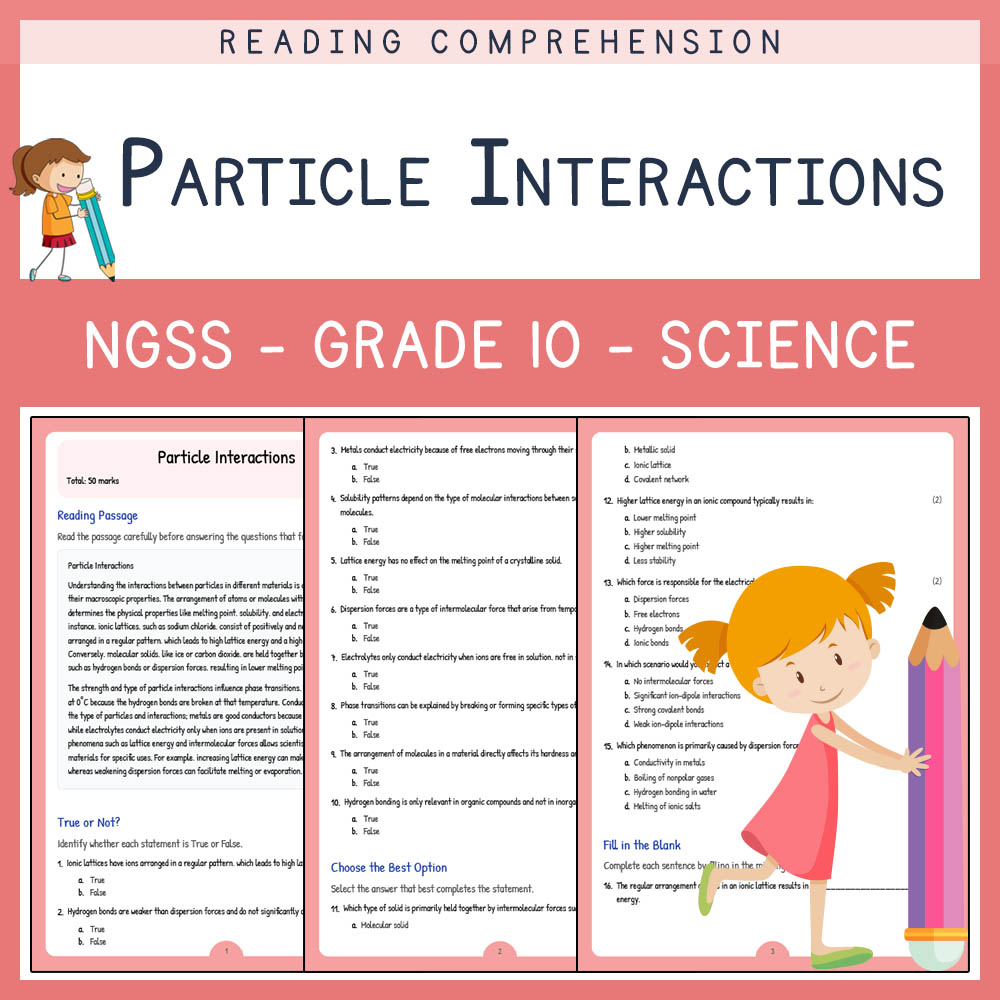
Grade 10 Science | Particle Interactions Worksheet & Answer Key (NGSS Aligned)
Created byLumora LearningLearning Objectives
- Understand how crystal structures influence material properties such as melting point and solubility.
- Analyze the role of molecular interactions, including ionic bonds, hydrogen bonds, and dispersion forces, in phase transitions.
- Compare electrical forces in metals and electrolytes and relate them to conductivity.
Instant download
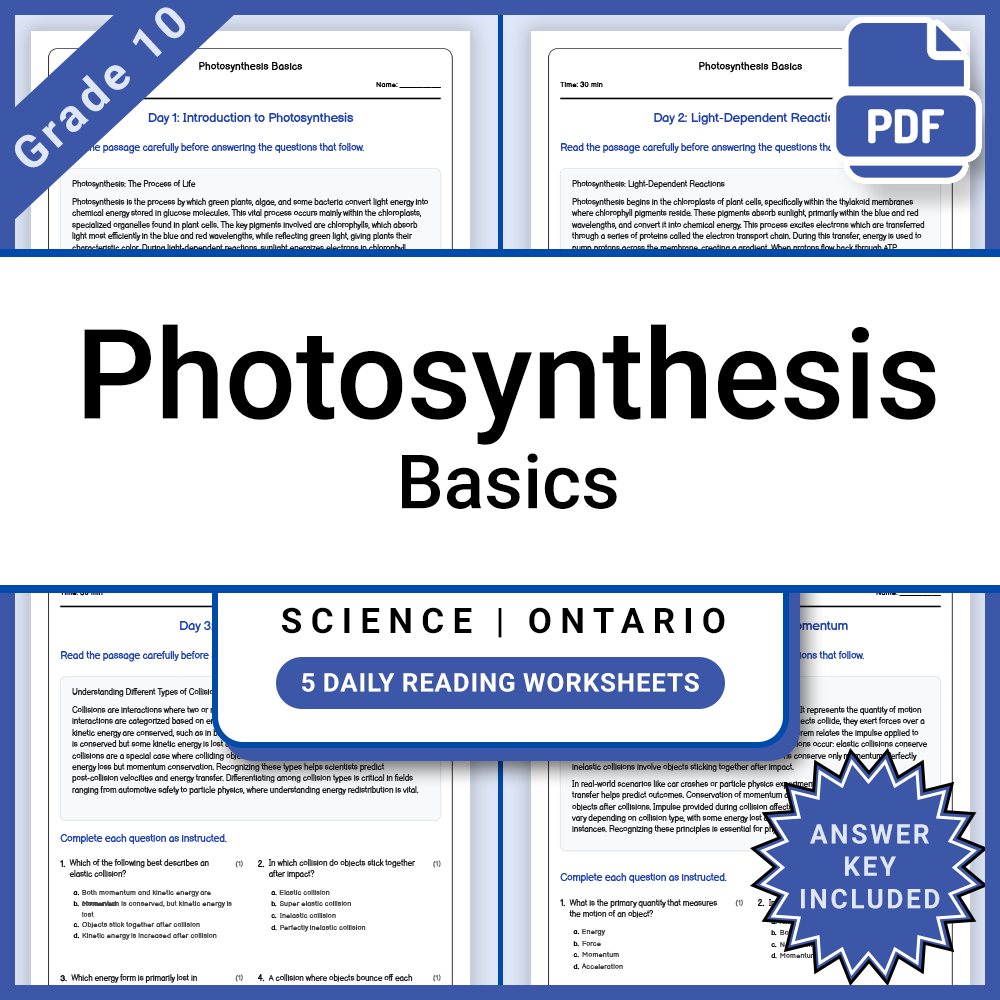
Grade 10 Science – Photosynthesis Daily Reading Worksheet with Answer Key
JCreated byJ.S SheetsLearning Objectives
- Understand the overall process of photosynthesis
- Identify the role of chloroplasts and pigments in capturing light energy
- Explain the light-dependent reactions and the Calvin cycle
Also included in: Grade 10 Science Lesson Bundle | Ontario Curriculum and Daily Reading Worksheets +1 more
Instant download

Cultural Celebrations Worksheet Grade 10 | September Holiday Activity
 Created byShaNova Worksheets
Learning Objectives
- Identify key traditions associated with Mexican Independence Day festivities, including music, dance, food, and clothing.
- Analyze how shared cultural customs support national pride and collective memory.
- Use holiday-related vocabulary accurately in written responses.
Instant download
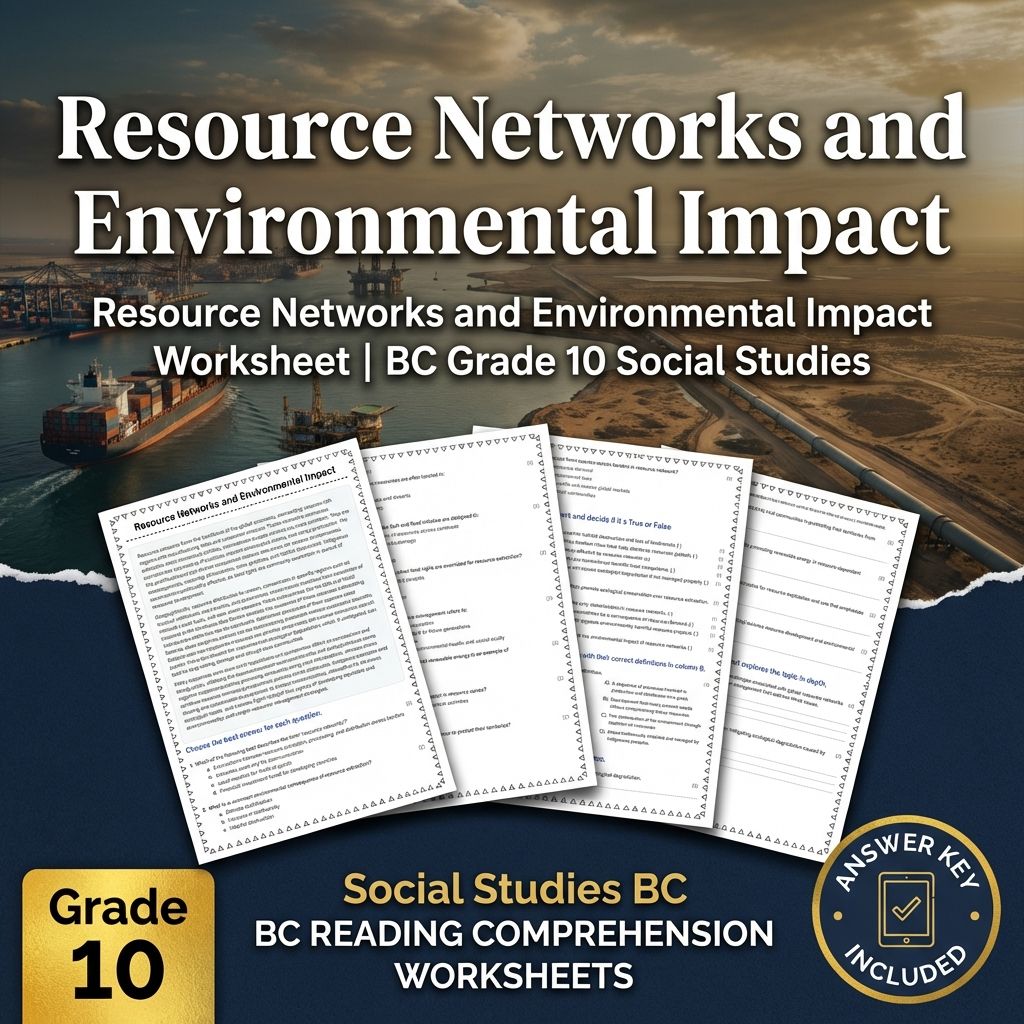
Resource Networks and Environmental Impact | BC Grade 10 Social Studies
JCreated byJ.S SheetsLearning Objectives
- Understand the structure of global resource extraction and supply chains.
- Analyze the ecological and social consequences of resource networks.
- Evaluate perspectives on sustainable development and environmental justice.
Instant download

Grade 10 Science – Population Dynamics Worksheet (TEKS) PDF
Created byEvergreen Desk EducationLearning Objectives
- Explain how birth and death rates, immigration and emigration shape population size over time
- Describe how carrying capacity and limiting factors influence exponential vs. logistic growth
- Interpret how biotic interactions (competition, predation, disease) and resource availability can change growth rates
Instant download
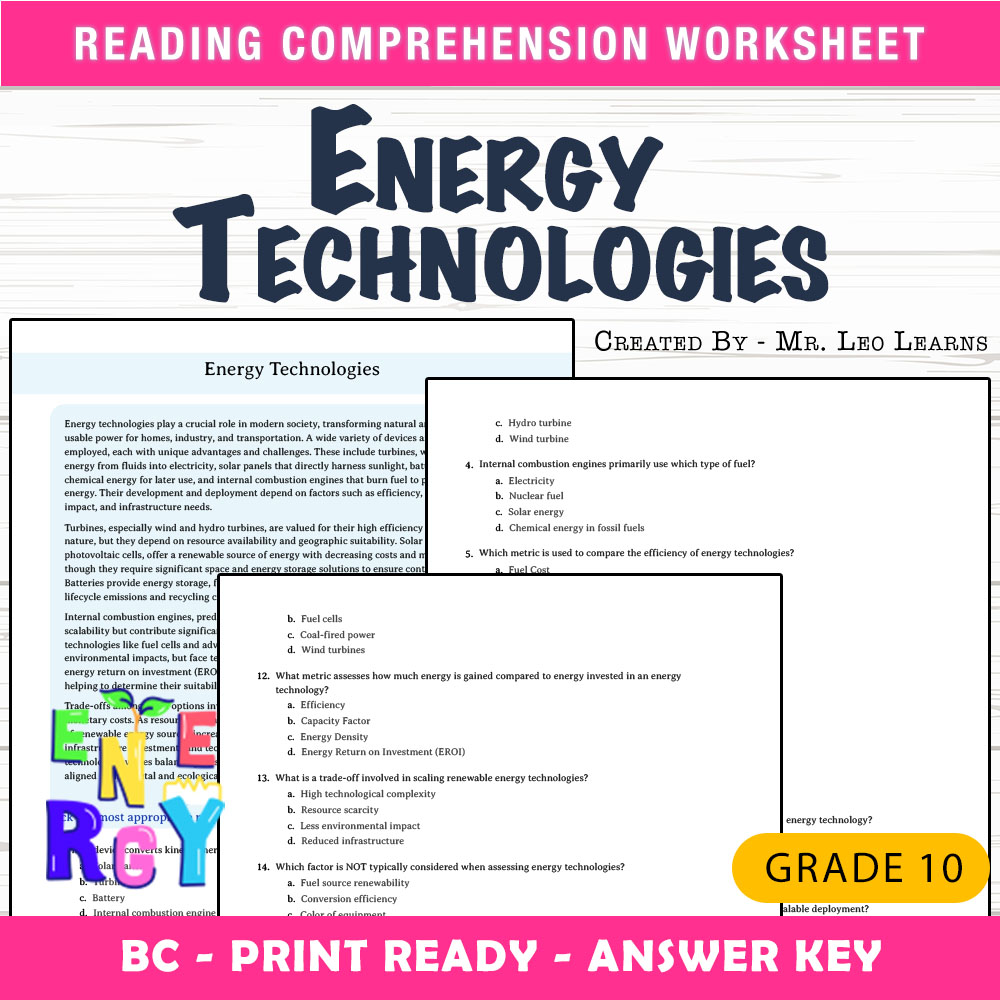
Grade 10 Science — Worksheet MCQ Paper for Mastering Energy Technologies
Created byThe Resource HubLearning Objectives
- Understand the diversity of energy conversion devices and their mechanisms.
- Evaluate the efficiency, sustainability, and environmental impact of various energy technologies.
- Compare different energy sources using quantitative metrics such as energy return on investment and efficiency.
Also included in: Grade 10 Science | Energy Transfer & Conservation UNIT Worksheet Bundle +1 more
Instant download
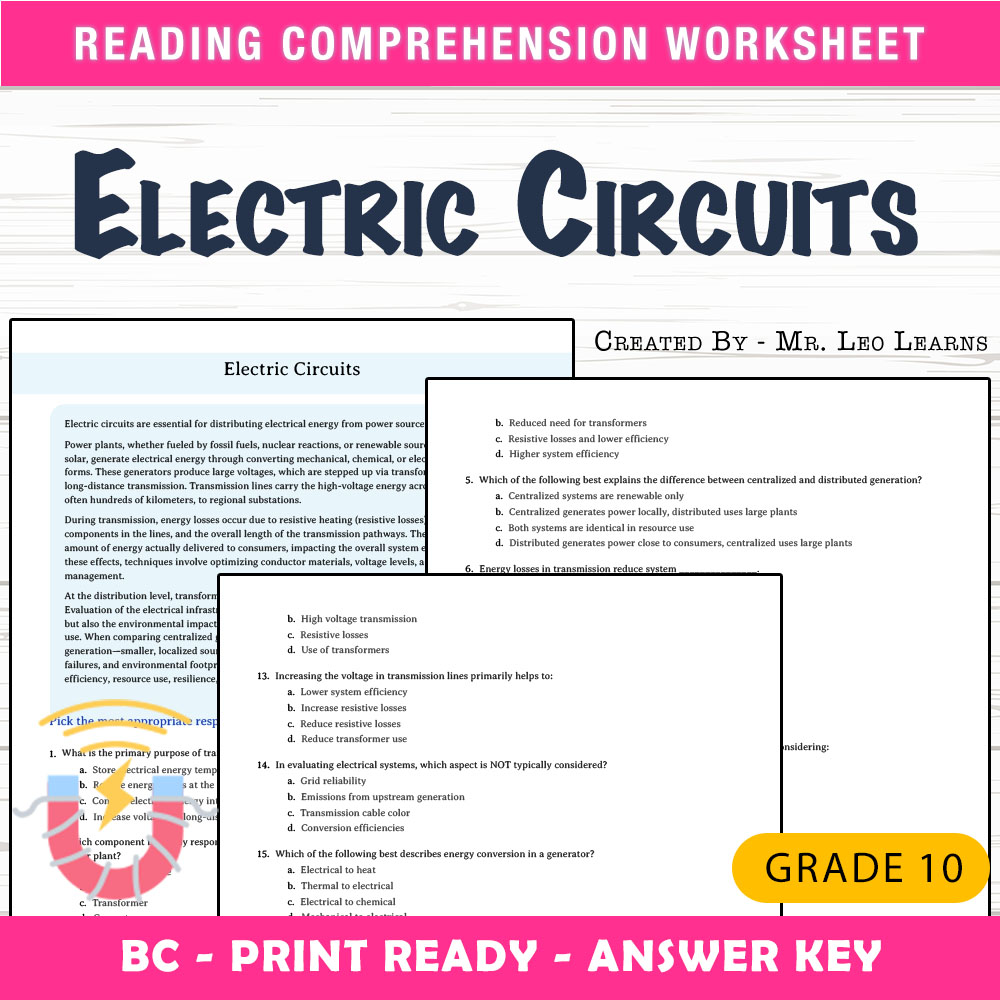
Grade 10 Science — Worksheet MCQ Paper for Mastering Electric Circuits
Created byThe Resource HubLearning Objectives
- Understand the components and basic principles of electric circuits.
- Identify the roles of generators, transformers, and transmission lines in electrical supply.
- Analyze factors affecting the efficiency of power transmission.
Also included in: Grade 10 Science | Energy Transfer & Conservation UNIT Worksheet Bundle +1 more
Instant download
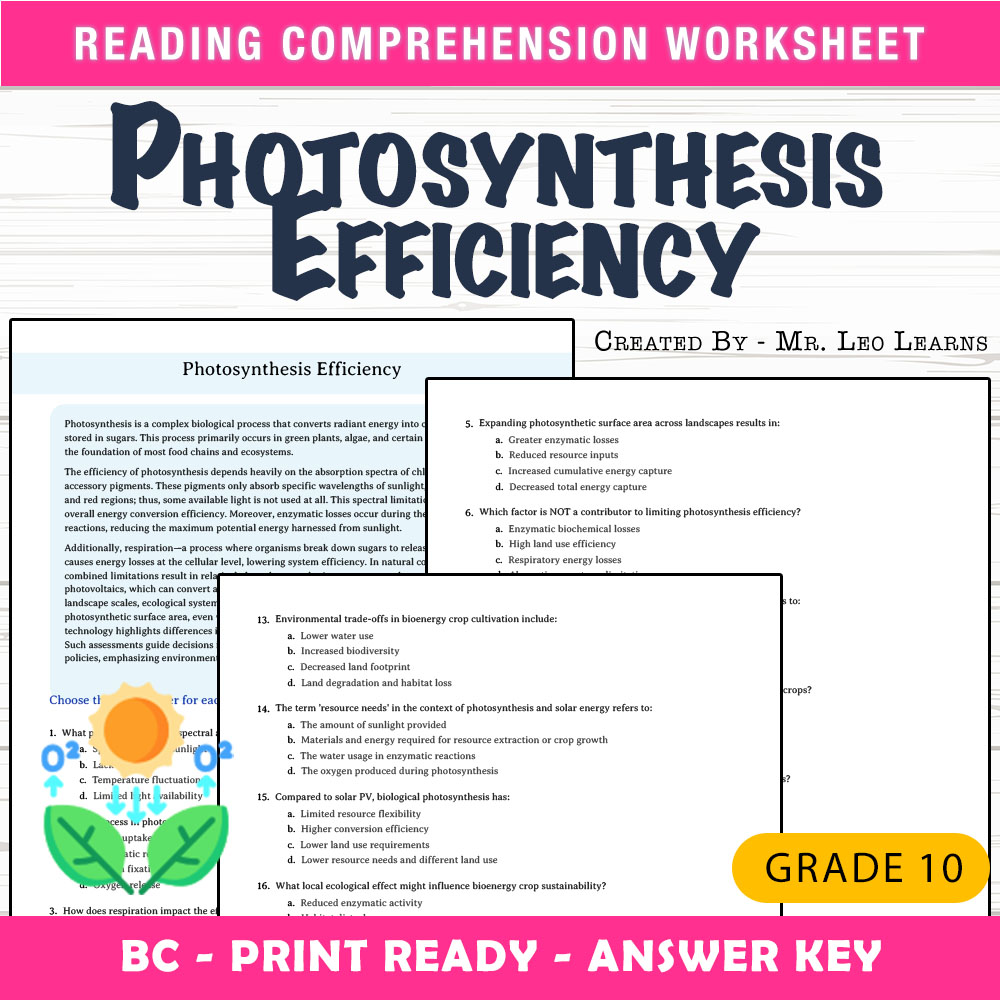
Grade 10 Science — Photosynthesis Efficiency Worksheet MCQ for Mastery
Created byThe Resource HubLearning Objectives
- Explain the role of absorption spectra, enzymatic processes, and respiration in limiting photosynthesis efficiency.
- Compare natural photosynthesis with engineered photovoltaic systems in terms of resource needs and energy conversion.
- Evaluate environmental trade-offs involved in bioenergy cropping and land use for renewable energy.
Also included in: Grade 10 Science | Energy Transfer & Conservation UNIT Worksheet Bundle +1 more
Instant download
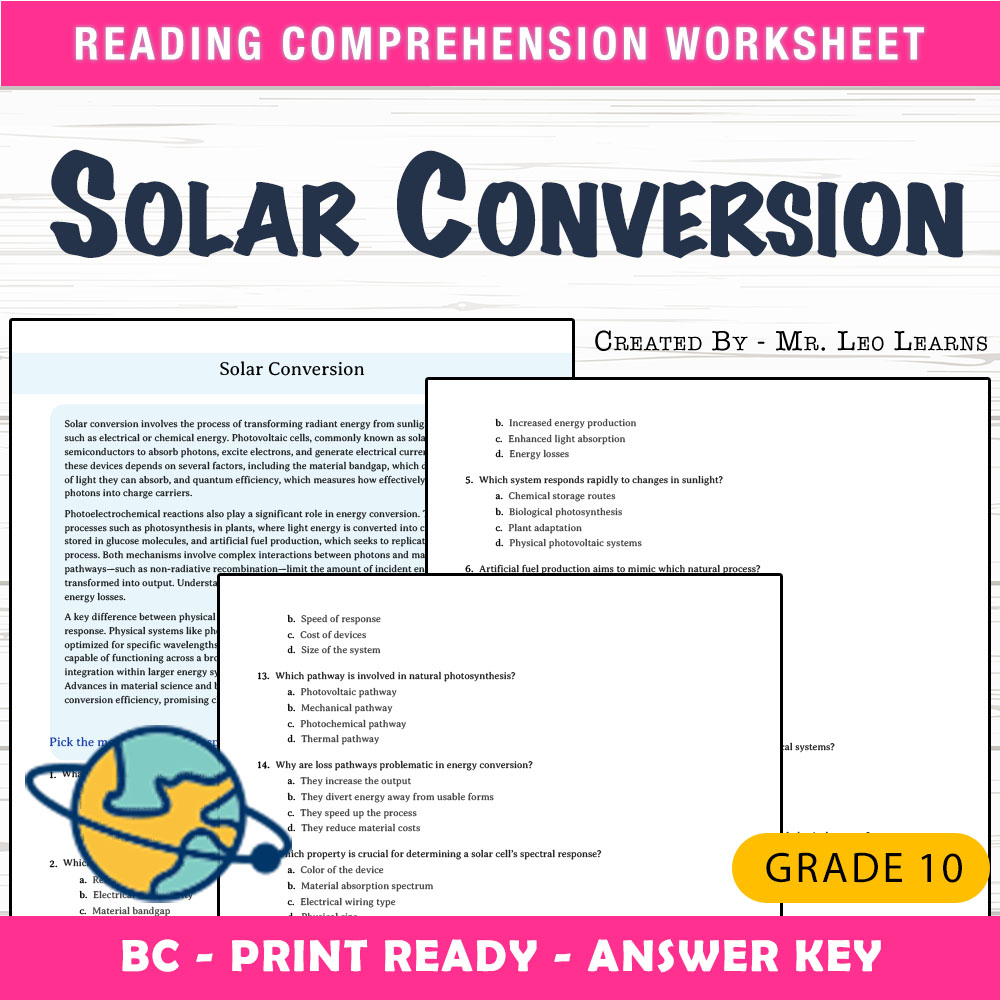
Grade 10 Science — Worksheet MCQ Paper for Mastering Solar Conversion
Created byThe Resource HubLearning Objectives
- Understand the processes involved in converting radiant energy into electrical and chemical forms.
- Identify the role of semiconductors and photoelectrochemical reactions in solar energy systems.
- Explain the significance of material properties like bandgaps and quantum efficiency in energy conversion.
Also included in: Grade 10 Science | Energy Transfer & Conservation UNIT Worksheet Bundle +1 more
Instant download
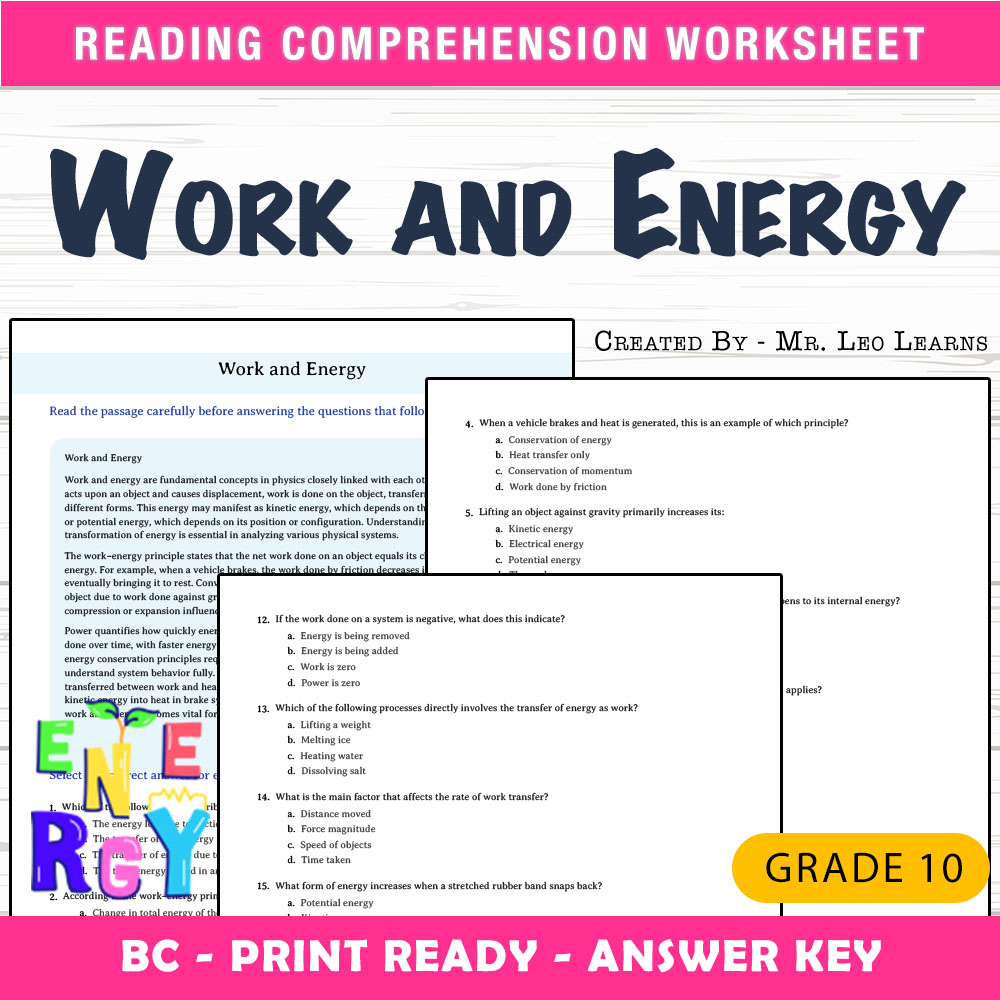
Grade 10 Science — Work and Energy Worksheet for Mastery
Created byThe Resource HubLearning Objectives
- Understand the relationship between work done by forces and energy transfer.
- Explain the work–energy principle and its role in mechanical systems.
- Describe how power measures the rate of energy transfer.
Also included in: Grade 10 Science | Energy Transfer & Conservation UNIT Worksheet Bundle +1 more
Instant download
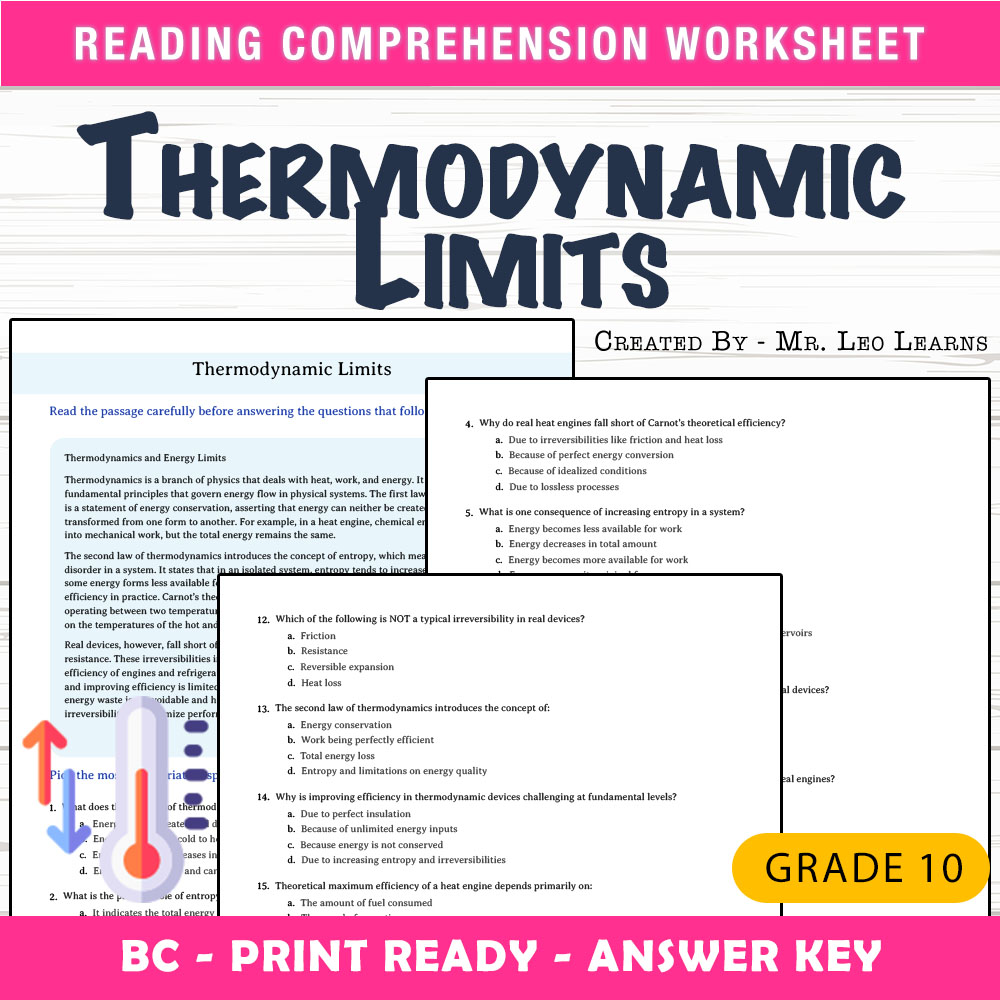
Grade 10 Science — Worksheet MCQ Paper for Mastering Thermodynamics
Created byThe Resource HubLearning Objectives
- Understand the fundamental principles of thermodynamics, including energy conservation and entropy.
- Explain how heat engines and refrigerators operate between temperature reservoirs.
- Analyze the factors limiting the efficiency of real thermodynamic devices.
Also included in: Grade 10 Science | Energy Transfer & Conservation UNIT Worksheet Bundle +1 more
Instant download
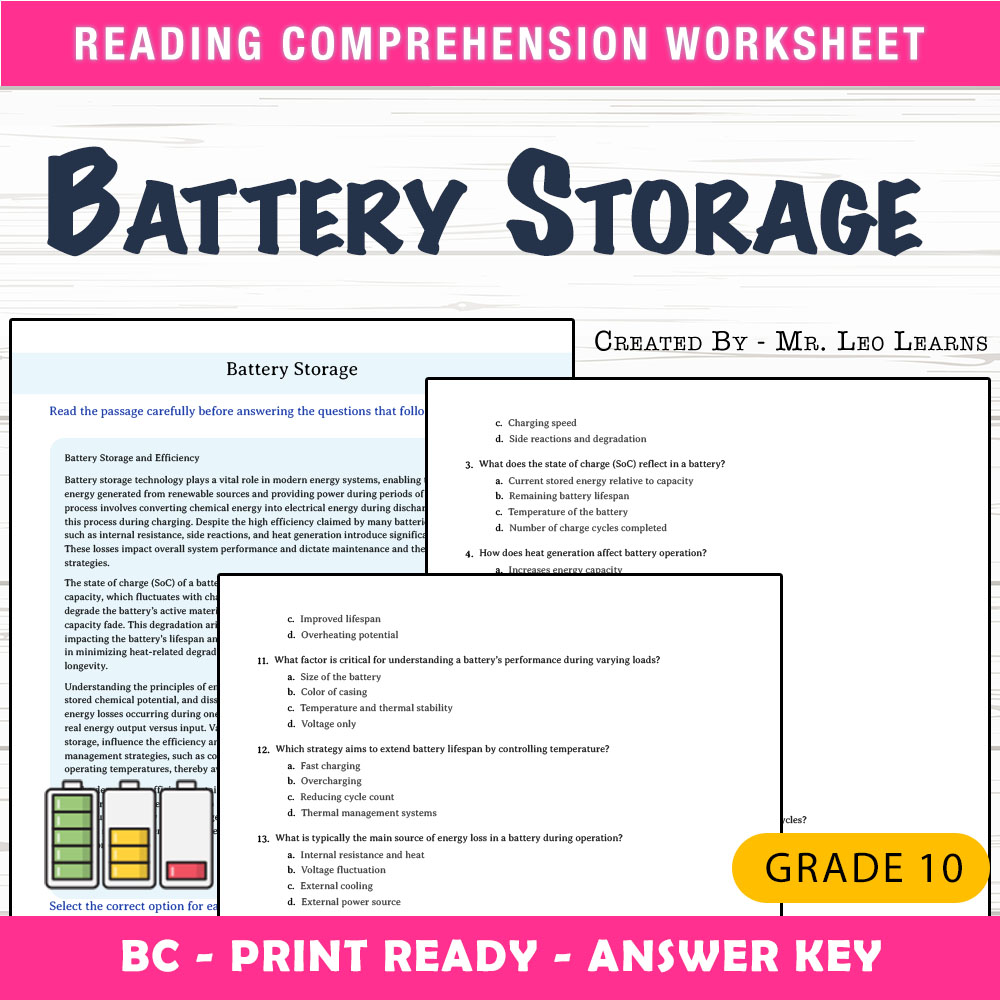
Grade 10 Science — Battery Storage Worksheet MCQ Paper for Mastery
Created byThe Resource HubLearning Objectives
- Understand the principles of chemical to electrical energy conversion in batteries
- Explain how charge–discharge cycles affect battery capacity and performance
- Describe the factors influencing battery efficiency and longevity
Also included in: Grade 10 Science | Energy Transfer & Conservation UNIT Worksheet Bundle +1 more
Instant download
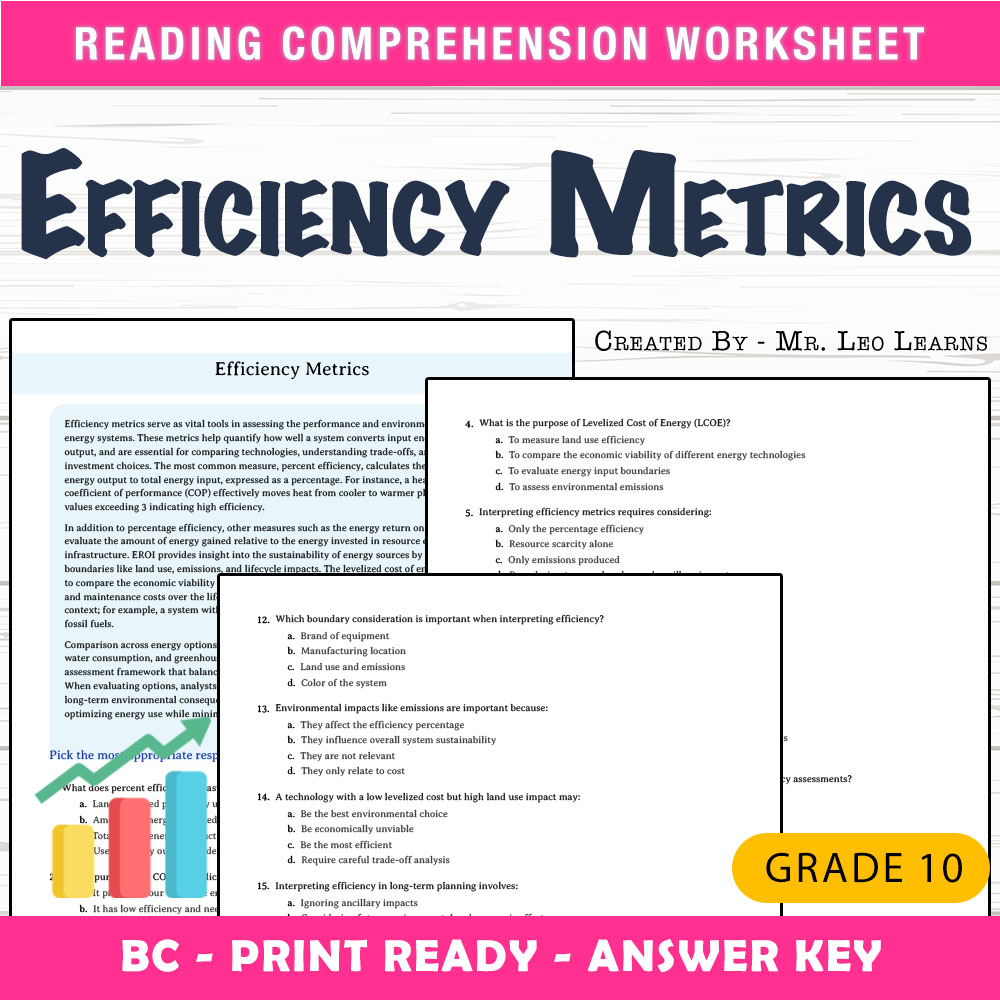
Grade 10 Science — Worksheet MCQ Paper for Mastering Efficiency Metrics
Created byThe Resource HubLearning Objectives
- Understand the key efficiency metrics used in energy systems.
- Interpret different efficiency indicators including percent efficiency, EROI, COP, and LCOE.
- Evaluate trade-offs and impacts when comparing energy technologies.
Also included in: Grade 10 Science | Energy Transfer & Conservation UNIT Worksheet Bundle +1 more
Instant download
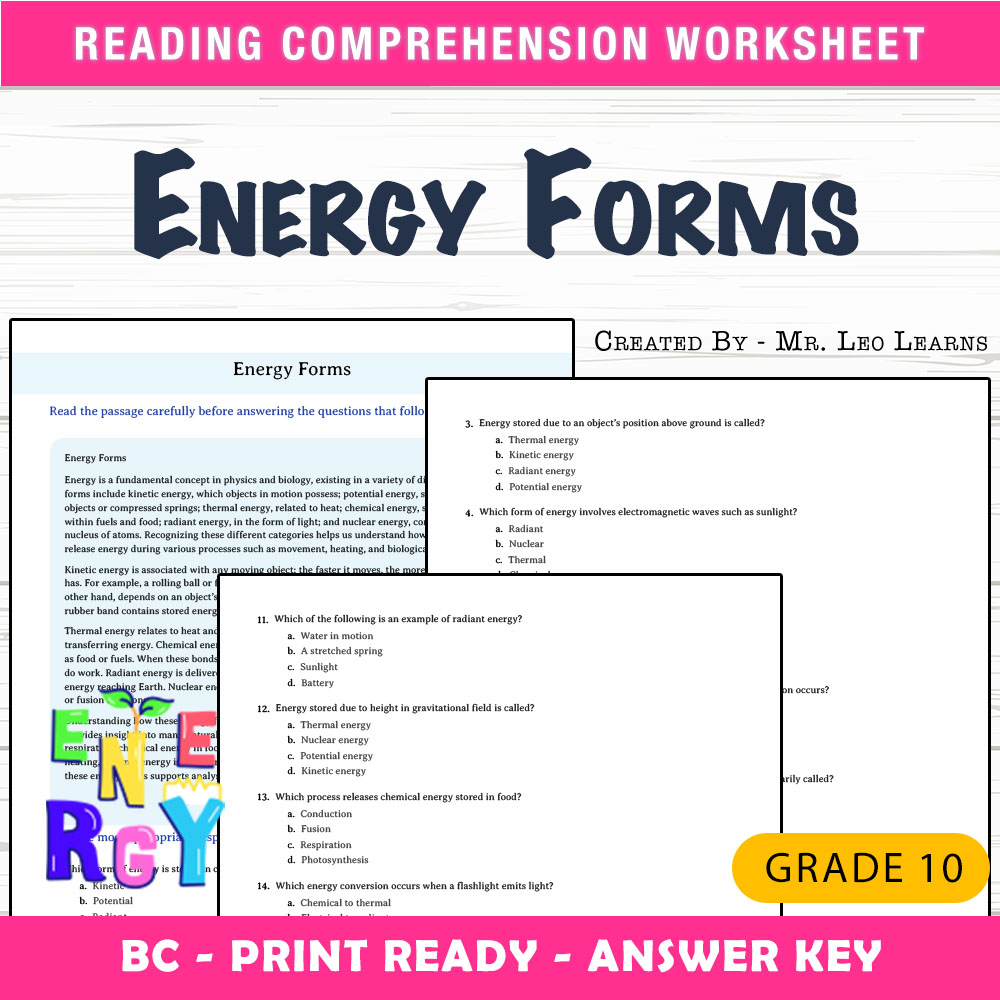
Grade 10 Science — Worksheet MCQ Paper for Mastering Energy Forms
Created byThe Resource HubLearning Objectives
- Identify different forms of energy such as kinetic, potential, thermal, chemical, radiant, and nuclear.
- Understand how systems store and release energy during various processes.
- Analyze how energy shifts between forms during movement, respiration, or heating.
Also included in: Grade 10 Science | Energy Transfer & Conservation UNIT Worksheet Bundle +1 more
Instant download
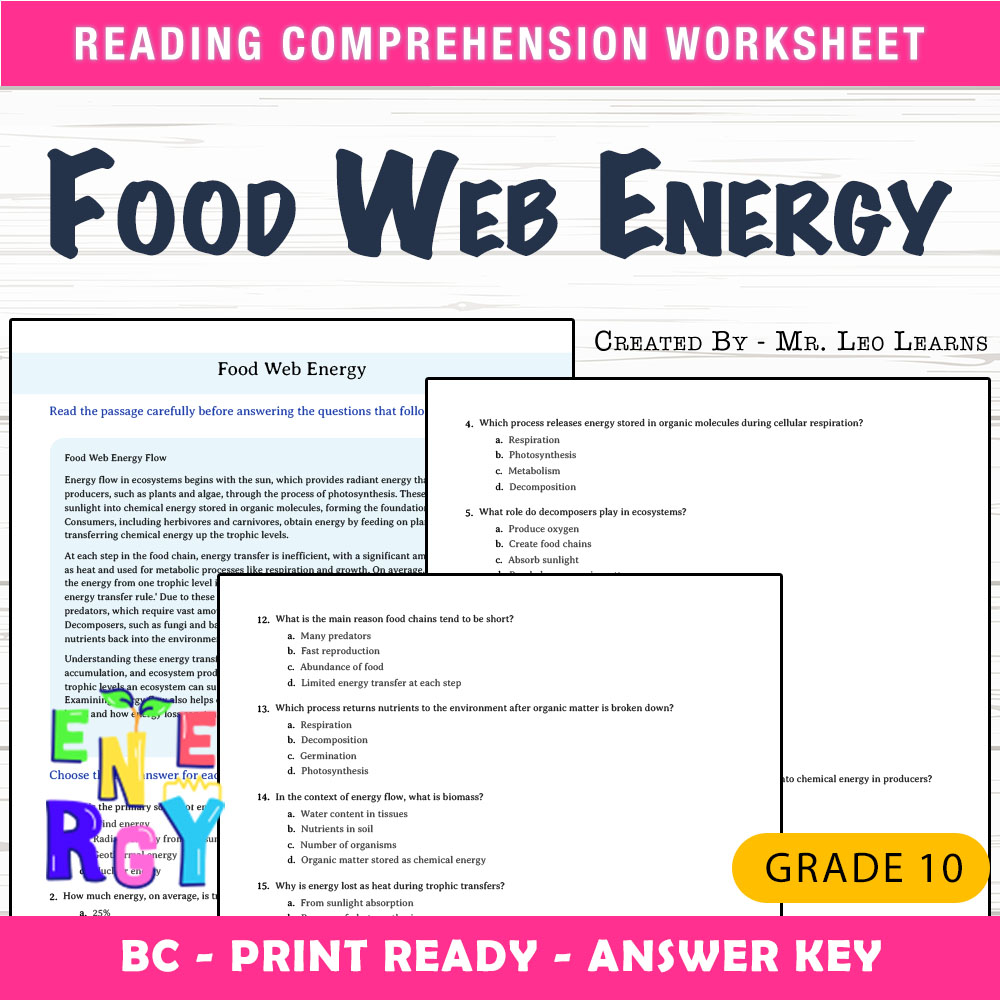
Grade 10 Science — Food Web Energy Worksheet for Mastery
Created byThe Resource HubLearning Objectives
- Understand how energy flows through an ecosystem via food webs.
- Identify the roles of producers, consumers, and decomposers in energy transfer.
- Explain the concept of energy transfer efficiency between trophic levels.
Also included in: Grade 10 Science | Energy Transfer & Conservation UNIT Worksheet Bundle +1 more
Instant download
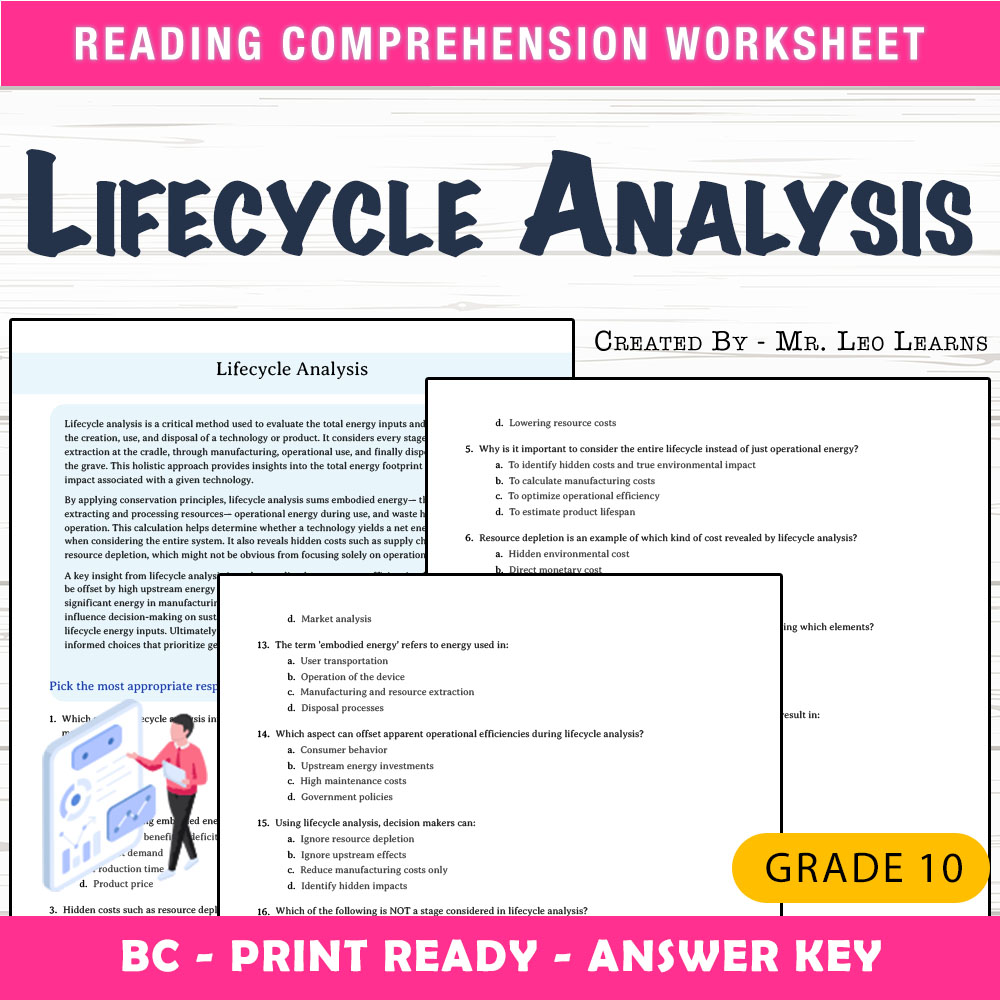
Grade 10 Science — Lifecycle Analysis Worksheet MCQ Paper
Created byThe Resource HubLearning Objectives
- Understand the concept of lifecycle analysis and its stages.
- Identify energy inputs and outputs across a technology's lifecycle.
- Explain how upstream energy investments impact overall energy benefits.
Also included in: Grade 10 Science | Energy Transfer & Conservation UNIT Worksheet Bundle +1 more
Instant download
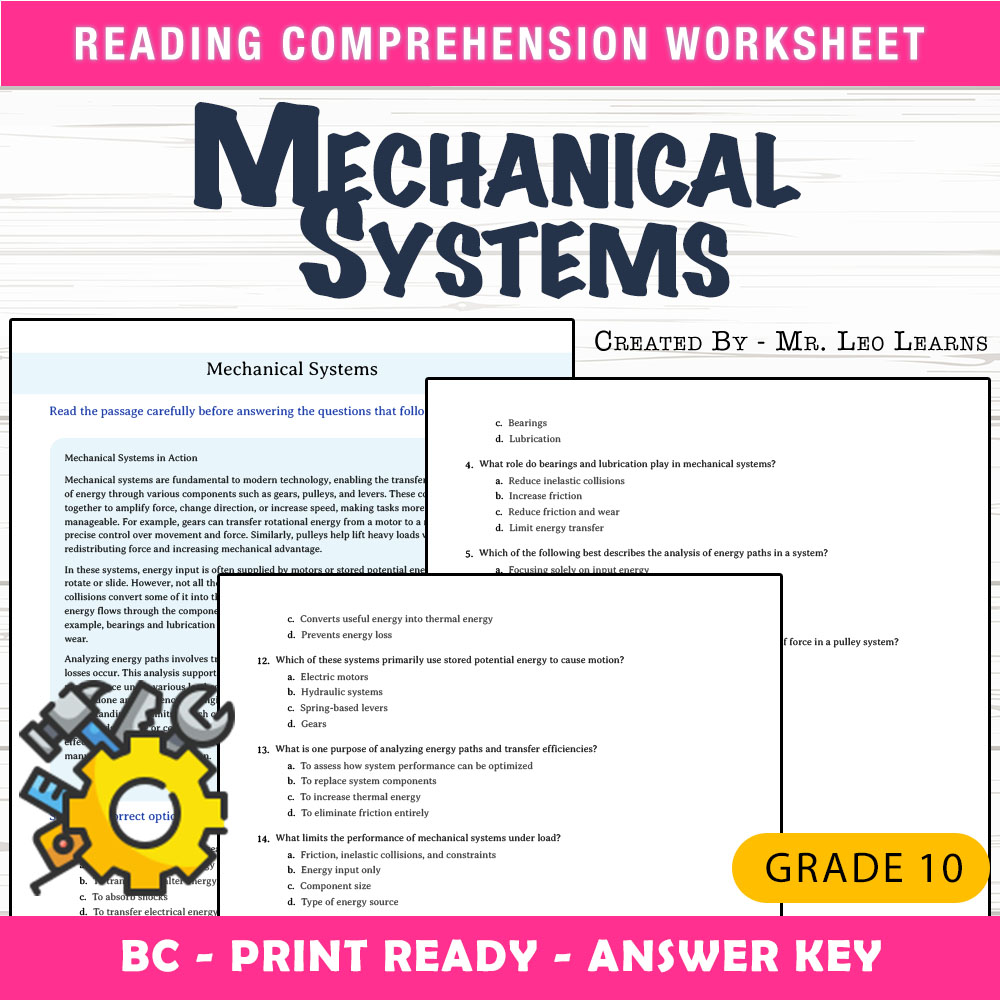
Grade 10 Science — Mechanical Systems Worksheet MCQ Paper PDF + Answer Key
Created byThe Resource HubLearning Objectives
- Understand how mechanical systems transfer and transform energy using gears, pulleys, and levers.
- Identify the effects of friction and collisions on mechanical energy.
- Analyze energy paths, transfer efficiencies, and the function of constraints like bearings and lubrication.
Also included in: Grade 10 Science | Energy Transfer & Conservation UNIT Worksheet Bundle +1 more
Instant download
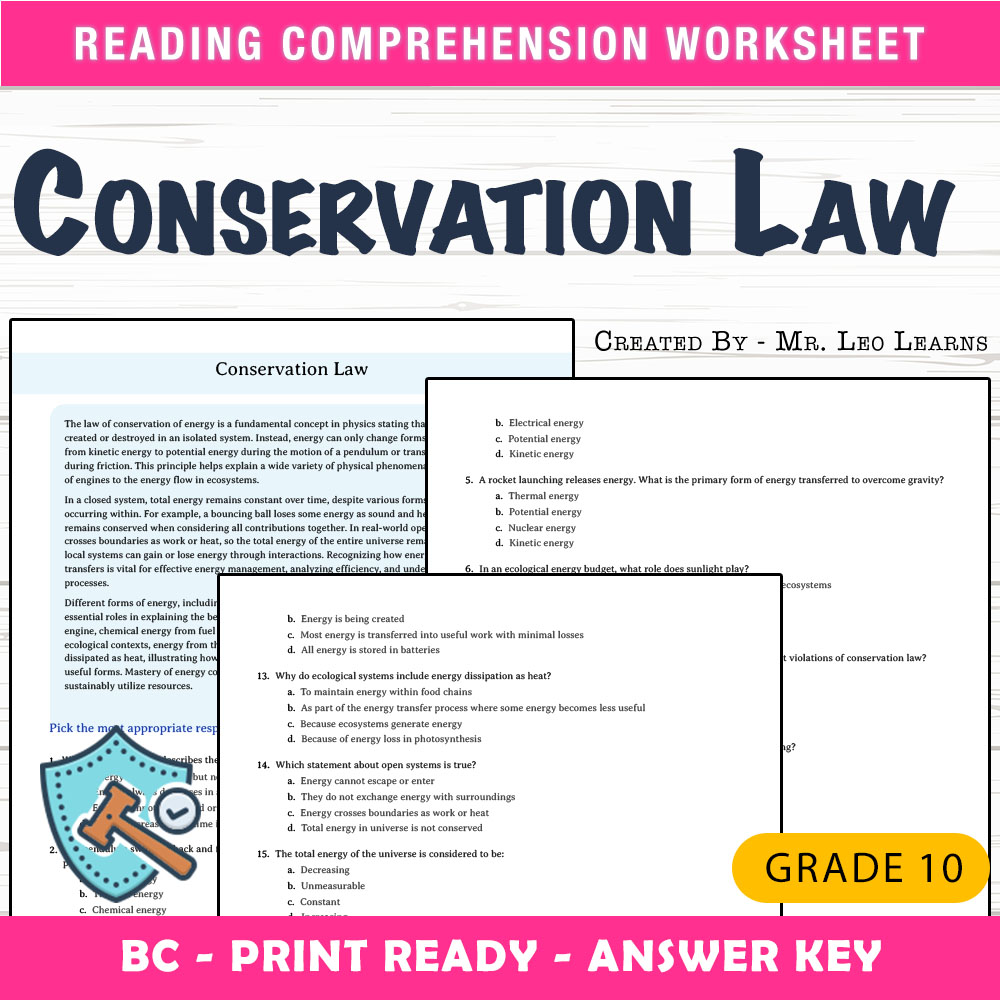
Grade 10 Science — Conservation Law Worksheet MCQ Paper PDF + Answer Key
Created byThe Resource HubLearning Objectives
- Understand the principle that energy cannot be created or destroyed but only transferred or transformed.
- Identify different forms of energy and how they relate to conservation law.
- Apply the conservation law to real-world systems like pendulums, engines, and ecological energy budgets.
Also included in: Grade 10 Science | Energy Transfer & Conservation UNIT Worksheet Bundle +1 more
Instant download
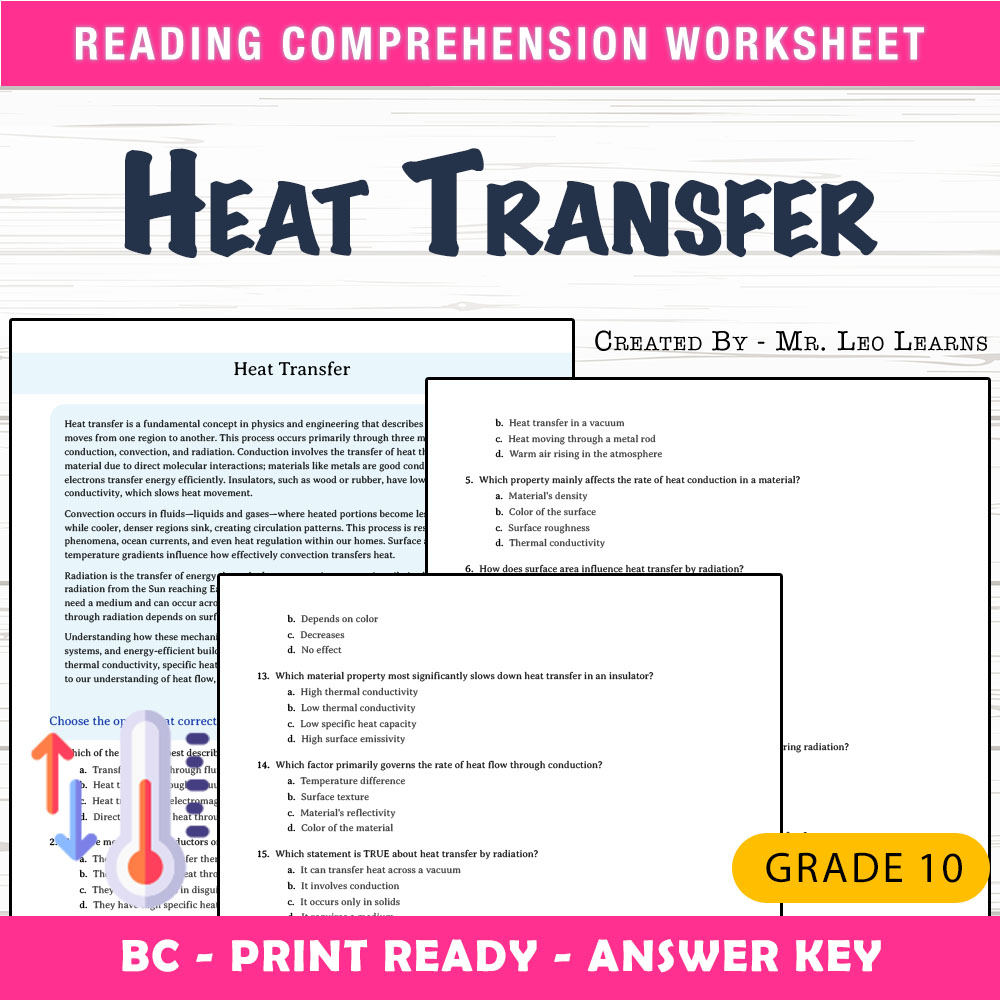
Grade 10 Science — Heat Transfer Worksheet MCQ Paper for Mastery
Created byThe Resource HubLearning Objectives
- Explain the mechanisms of heat transfer: conduction, convection, and radiation.
- Identify material properties that affect heat transfer rates.
- Describe the role of conduction, convection, and radiation in real-world systems.
Also included in: Grade 10 Science | Energy Transfer & Conservation UNIT Worksheet Bundle +1 more
Instant download
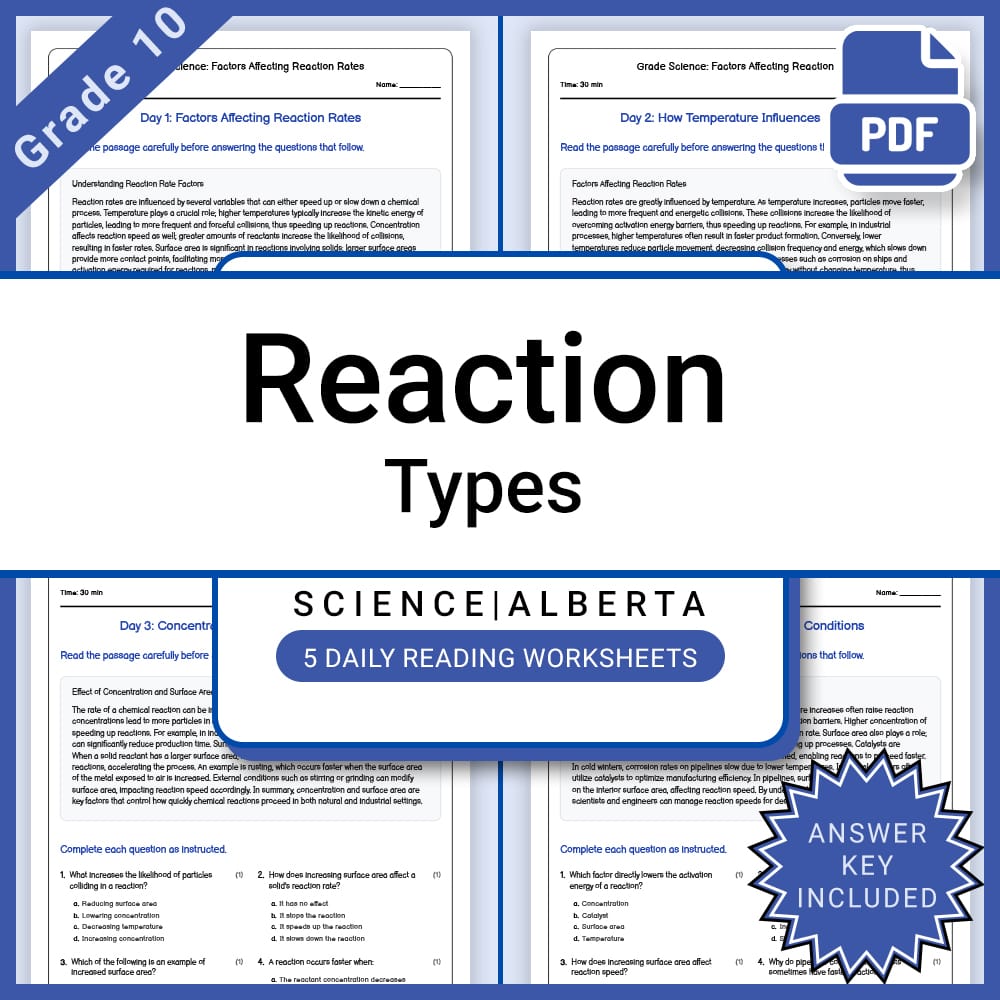
Grade 10 Science – Reaction Types Daily Reading Worksheet + Answer Key
JCreated byJ.S SheetsLearning Objectives
- Understand the basic types of chemical reactions
- Identify synthesis, decomposition, displacement, and combustion reactions
- Predict reaction products based on reaction patterns
Also included in: Grade 10 Science Lesson Group Bundle Alberta | Worksheets & Activities +1 more
Instant download
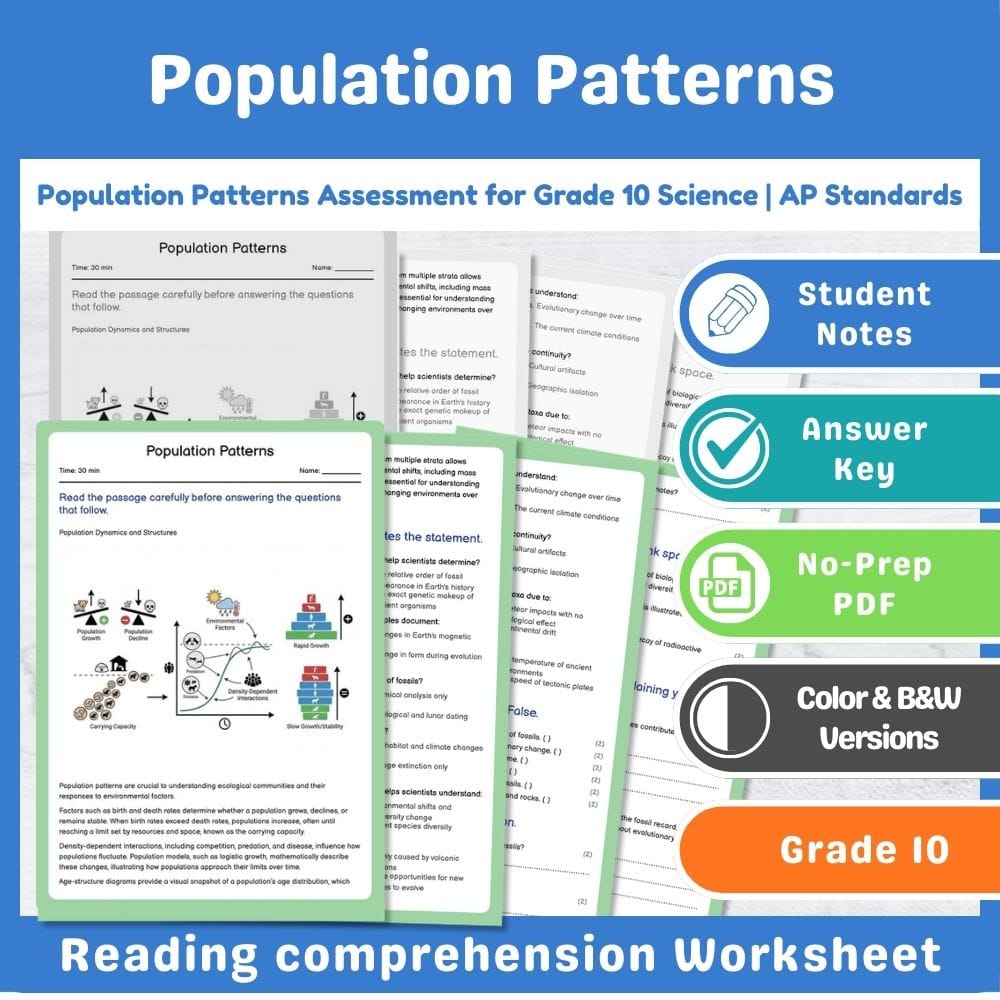
Population Patterns Assessment for Grade 10 Science | AP Standards
Created byPrism Point LearningLearning Objectives
- Explain factors that influence population growth, decline, and stability.
- Identify and interpret population models, age-structure diagrams, and population dynamics.
- Analyze how organism traits and environmental interactions affect population cycles and limits.
Also included in: Lesson Grade 10 Science Assessment Bundle | AP Standards-Aligned
Instant download

Grade 10 | World Refugees Day Worksheet for Refugee Stories | PDF + Answer Key
Created byShaNova WorksheetsLearning Objectives
- Analyze a refugee narrative to understand themes of leaving home, facing adversity, and rebuilding life.
- Identify and explain vocabulary related to trauma, hope, and identity in context.
- Evaluate how storytelling supports empathy and human rights advocacy.
Instant download

Cell Membrane Transport Worksheet Grade 10 Biology Activity & Review
Created byPrism Point LearningLearning Objectives
- Explain how selective permeability controls what enters and leaves a cell.
- Describe diffusion and osmosis using concentration gradients and water movement.
- Distinguish between passive transport and energy-requiring transport across membranes.
Instant download
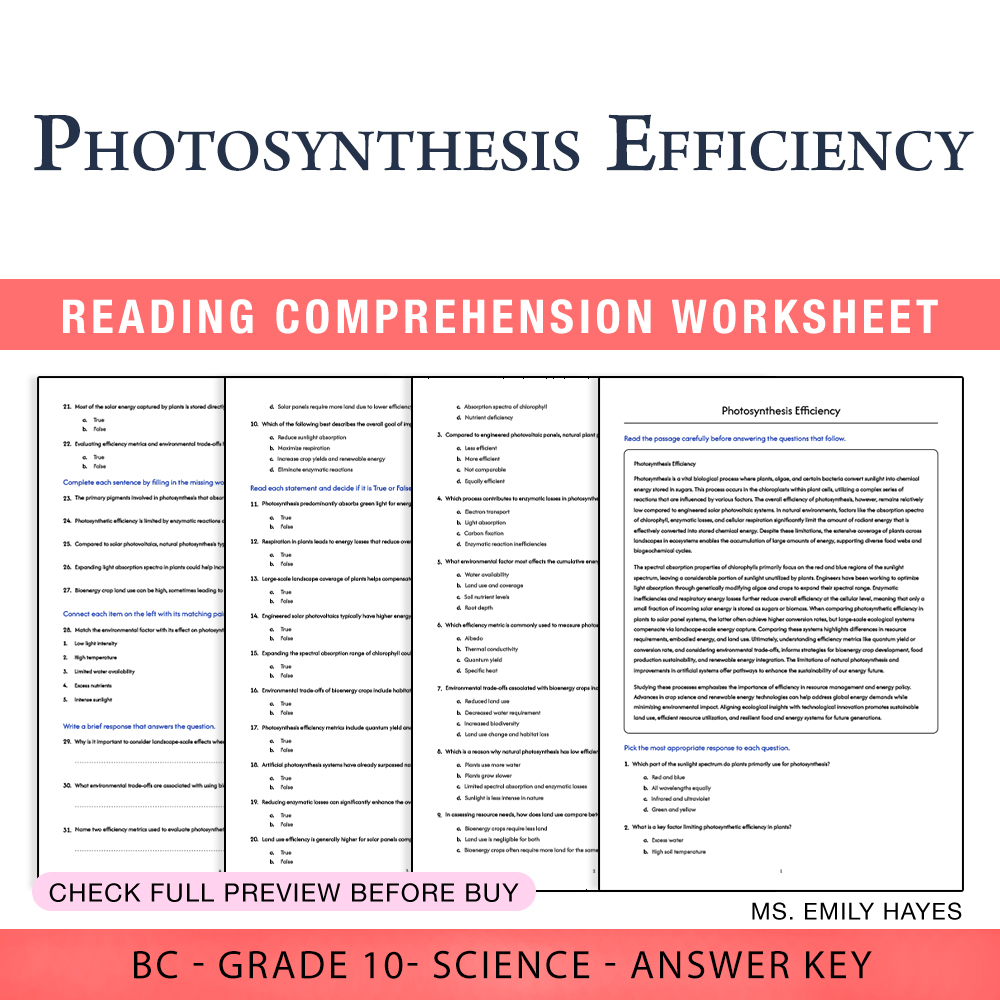
Grade 10 Science | Photosynthesis Efficiency Worksheet (PDF + Answer Key)
 Created byCopper Leaf Classroom
Learning Objectives
- Understand the factors that influence the efficiency of photosynthesis in plants.
- Compare natural photosynthetic systems and engineered solar technologies.
- Evaluate environmental and resource trade-offs in bioenergy and renewable energy sources.
Also included in: Grade 10 Science BC – Energy, Thermodynamics & Ecosystems (PDF + Answer Key) +1 more
Instant download
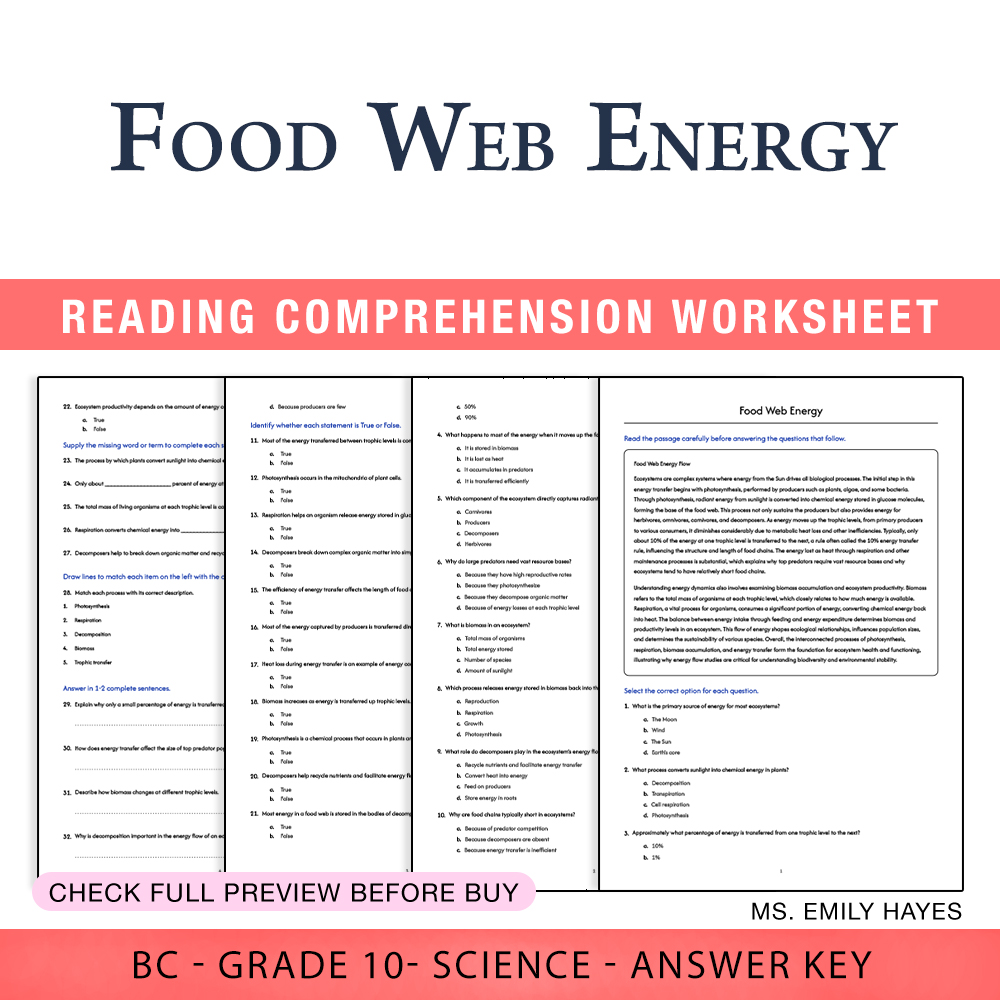
10th Grade Science | Food Web Energy Worksheet (PDF + Answer Key)
Created byCopper Leaf ClassroomLearning Objectives
- Understand how energy flows through ecosystems via the food web.
- Describe the transfer and losses of energy between producers, consumers, and decomposers.
- Explain the concept of trophic transfer efficiency and its impact on ecosystem productivity.
Also included in: Grade 10 Science BC – Energy, Thermodynamics & Ecosystems (PDF + Answer Key) +1 more
Instant download

Grade 10 Science – Understanding Chemical Equations | Daily Reading Worksheet
Created byBright Mind ResourcesLearning Objectives
- Identify reactants and products in chemical equations
- Interpret chemical formulas and symbols
- Understand the use of coefficients and state symbols
Also included in: Chem Reactions Grade 10 Science Daily Reading Worksheets Lesson Bundle | BC +1 more
Instant download
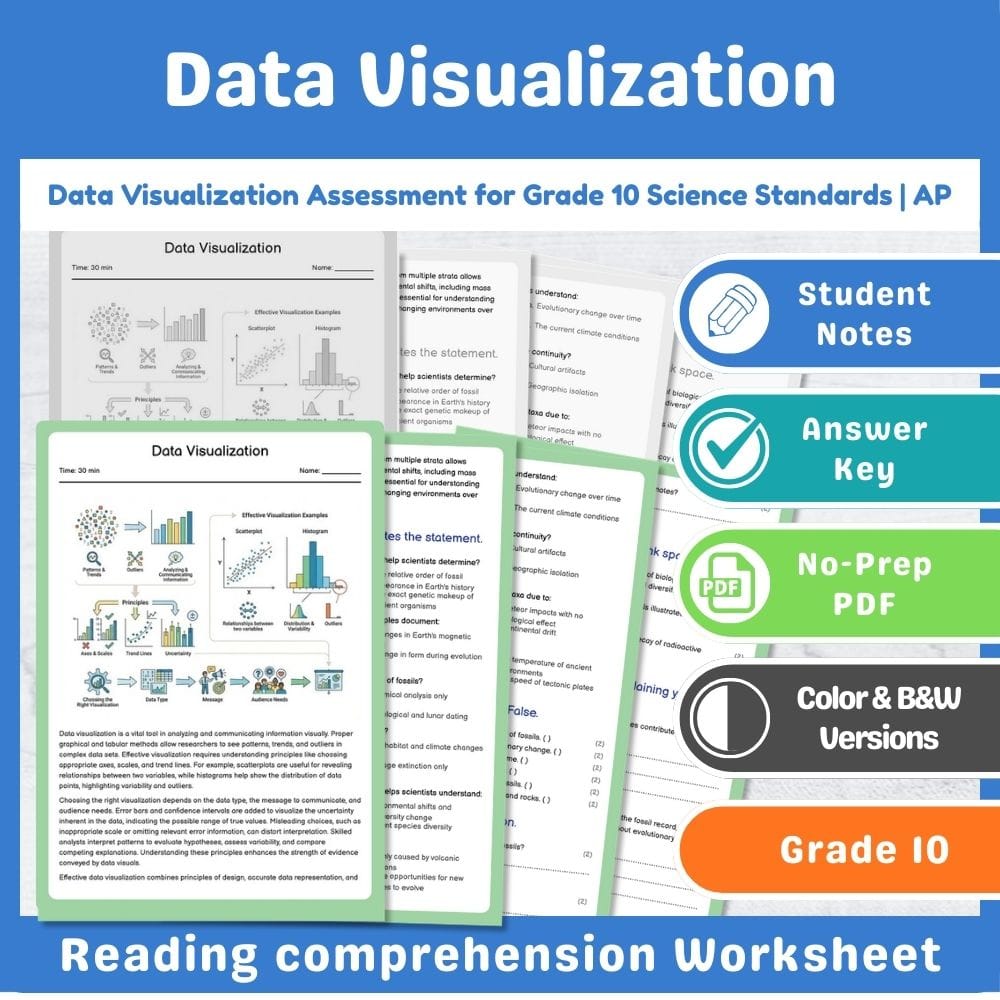
Data Visualization Assessment for Grade 10 Science Standards | AP
Created byPrism Point LearningLearning Objectives
- Describe principles and conventions for graphical and tabular representation of data.
- Identify and interpret various data visualization types such as scatterplots, histograms, and boxplots.
- Evaluate the appropriateness of different visualization choices like axes, scale, and trend lines.
Instant download
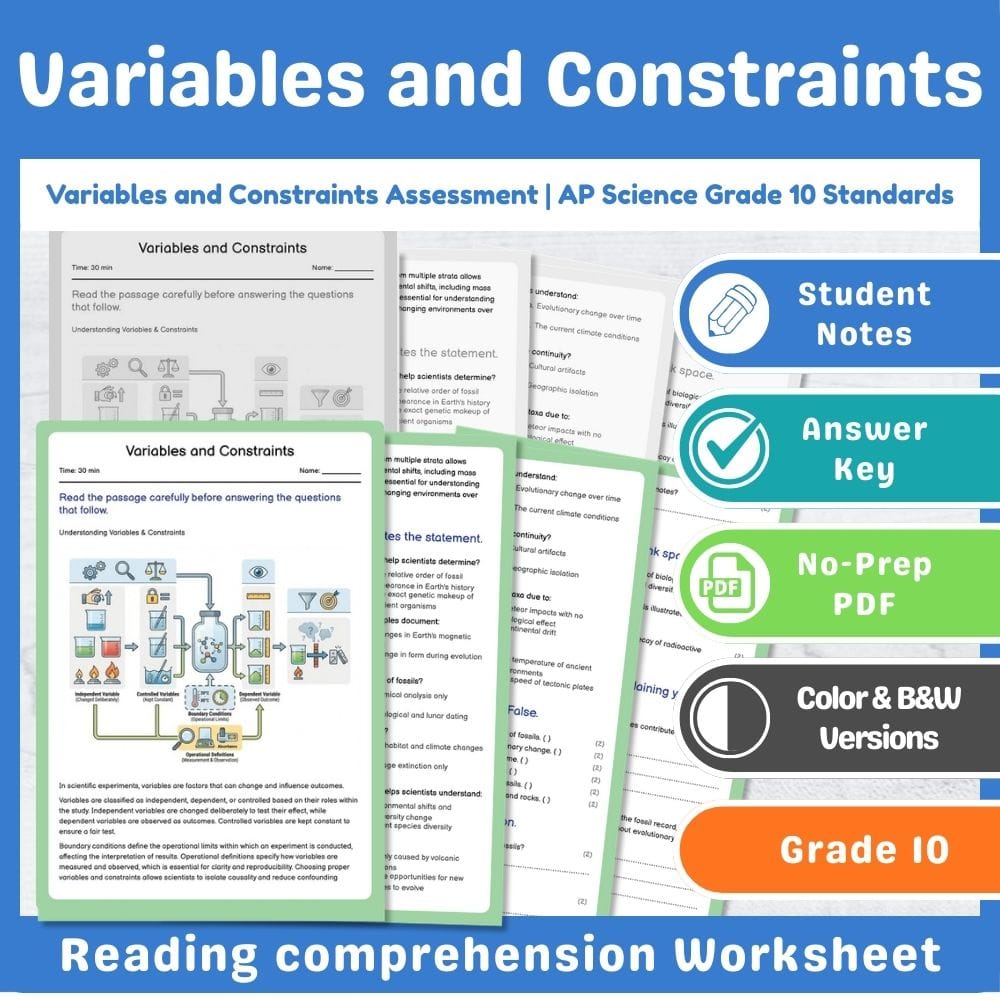
Variables and Constraints Assessment | AP Science Grade 10 Standards
Created byPrism Point LearningLearning Objectives
- Identify and classify variables as independent, dependent, or controlled in experimental scenarios.
- Explain the role of boundary conditions and operational definitions in scientific investigations.
- Discuss strategies for selecting variables and controls to produce meaningful and interpretable results.
Instant download
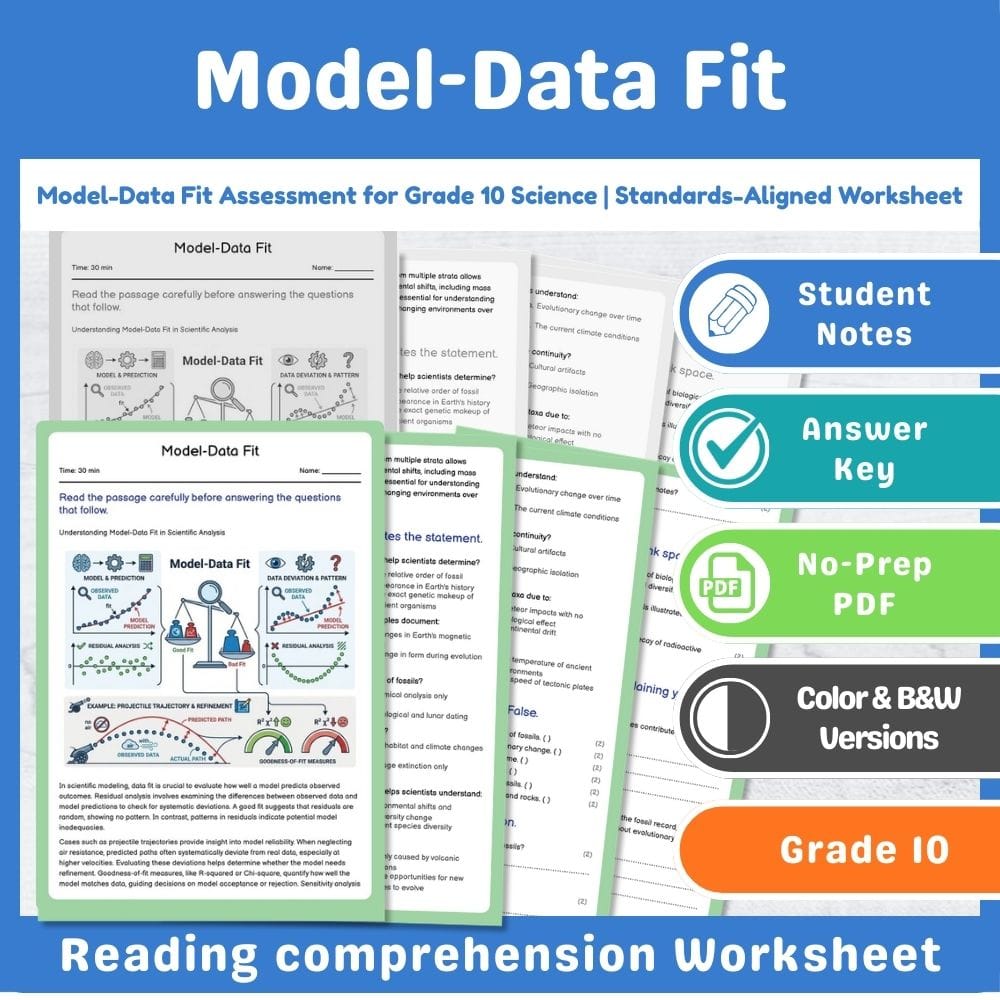
Model-Data Fit Assessment for Grade 10 Science | Standards-Aligned Worksheet
Created byPrism Point LearningLearning Objectives
- Interpret residuals and assess model adequacy using residual analysis.
- Apply goodness-of-fit concepts to evaluate the accuracy of model predictions.
- Analyze cases like projectile motion with and without air resistance to understand systematic deviations.
Instant download
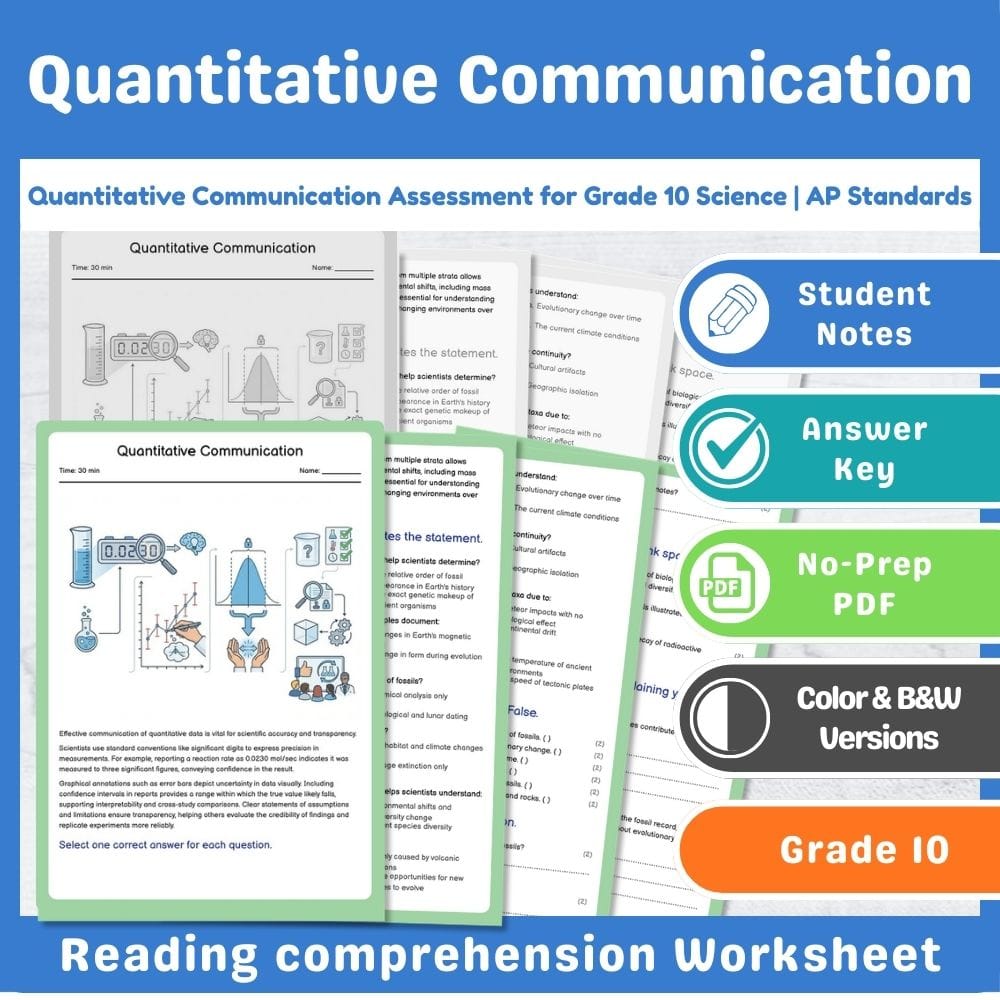
Quantitative Communication Assessment for Grade 10 Science | AP Standards
Created byPrism Point LearningLearning Objectives
- Understand conventions for reporting quantitative results, including uncertainty notation and significant digits.
- Learn strategies for visualizing data using graphs and annotations effectively.
- Identify how to articulate assumptions, limitations, and confidence intervals transparently.
Instant download
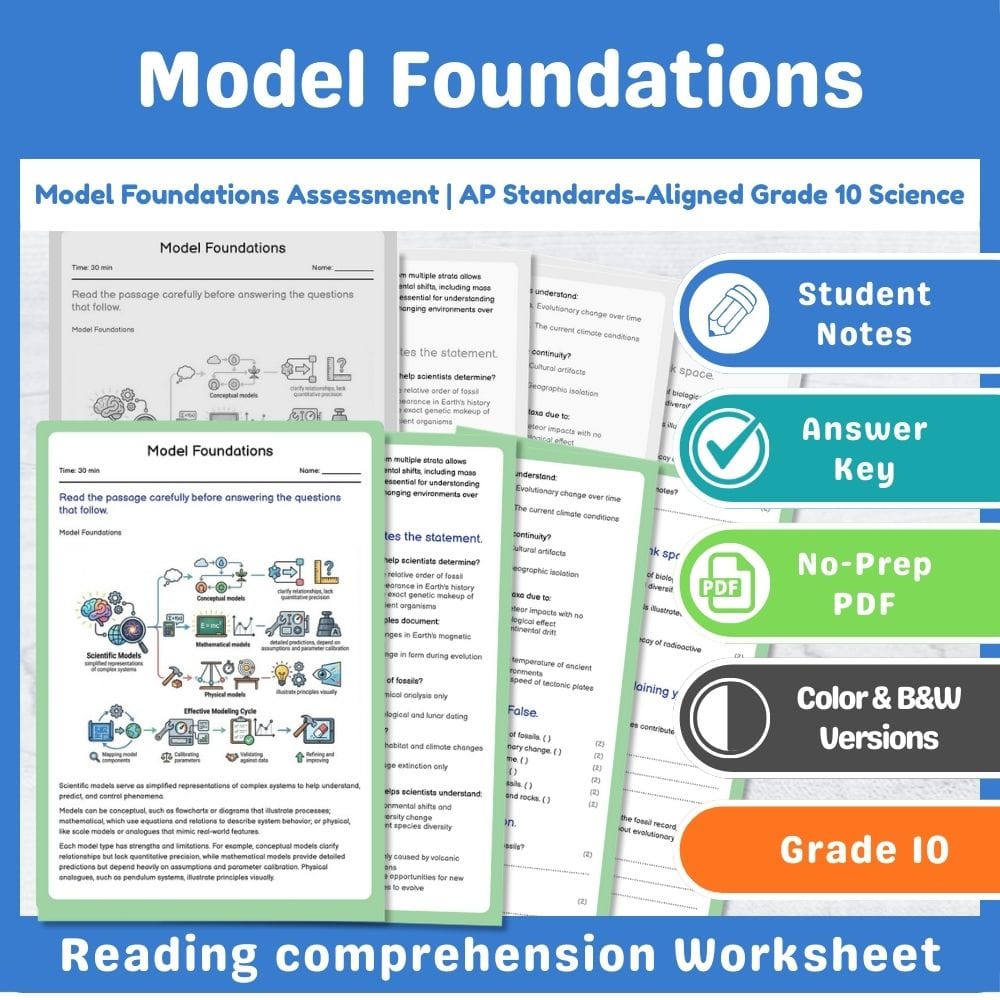
Model Foundations Assessment | AP Standards-Aligned Grade 10 Science
Created byPrism Point LearningLearning Objectives
- Explain the purpose and forms of scientific models including conceptual diagrams, mathematical relations, and physical analogues.
- Compare strengths and limitations of various types of models with examples such as pendulum motion and linear approximations.
- Understand how model components relate to observable features and how parameters and assumptions influence model applicability.
Instant download
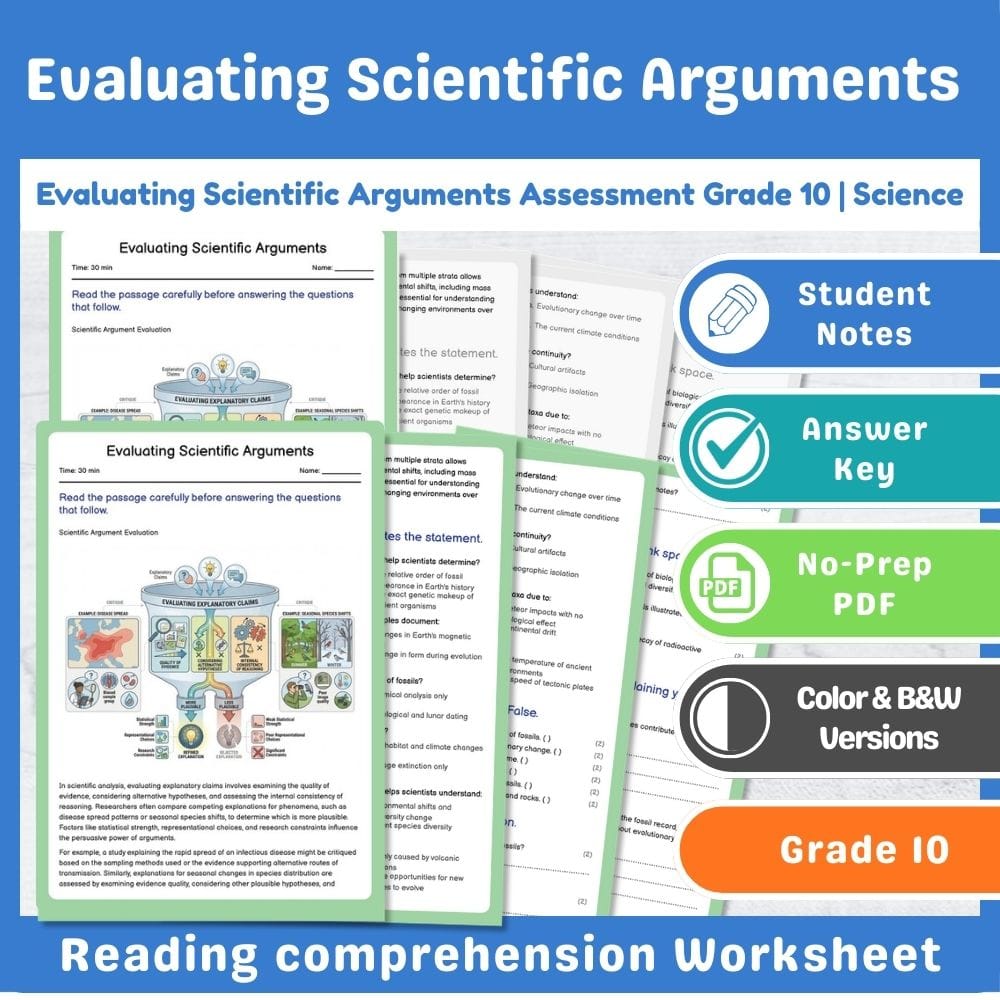
Evaluating Scientific Arguments Assessment Grade 10 | Science
Created byPrism Point LearningLearning Objectives
- Learn criteria for critically assessing explanatory claims in science.
- Examine evidence quality, alternative hypotheses, and logical coherence.
- Understand how statistical and methodological factors influence argument strength.
Instant download
Browse more categories
About Grade 10 Worksheets
Find Grade 10 worksheets covering algebra, biology, literature, and history. All 9,315 resources download instantly as PDFs for classwork, homework, or review.
MyTeachingSheets worksheets are made by real teacher-authors and checked before they go live. Download any as a print-ready PDF for lessons, homework, or independent practice — most include answer keys, and previews are always free.