
Grade 9 Worksheets
9,304 grade resources
Relative Motion Worksheet | Science Practice for Grade 9 | Alberta Standards
JCreated byJ.S SheetsLearning Objectives
- Understand how different frames of reference affect observed velocity and displacement.
- Describe vector addition of velocities in various scenarios.
- Explain how choice of reference frame influences apparent motion and acceleration.
Also included in: Grade 9 Newtonian Motion & Energy Science Lesson Bundle | Alberta
Instant download
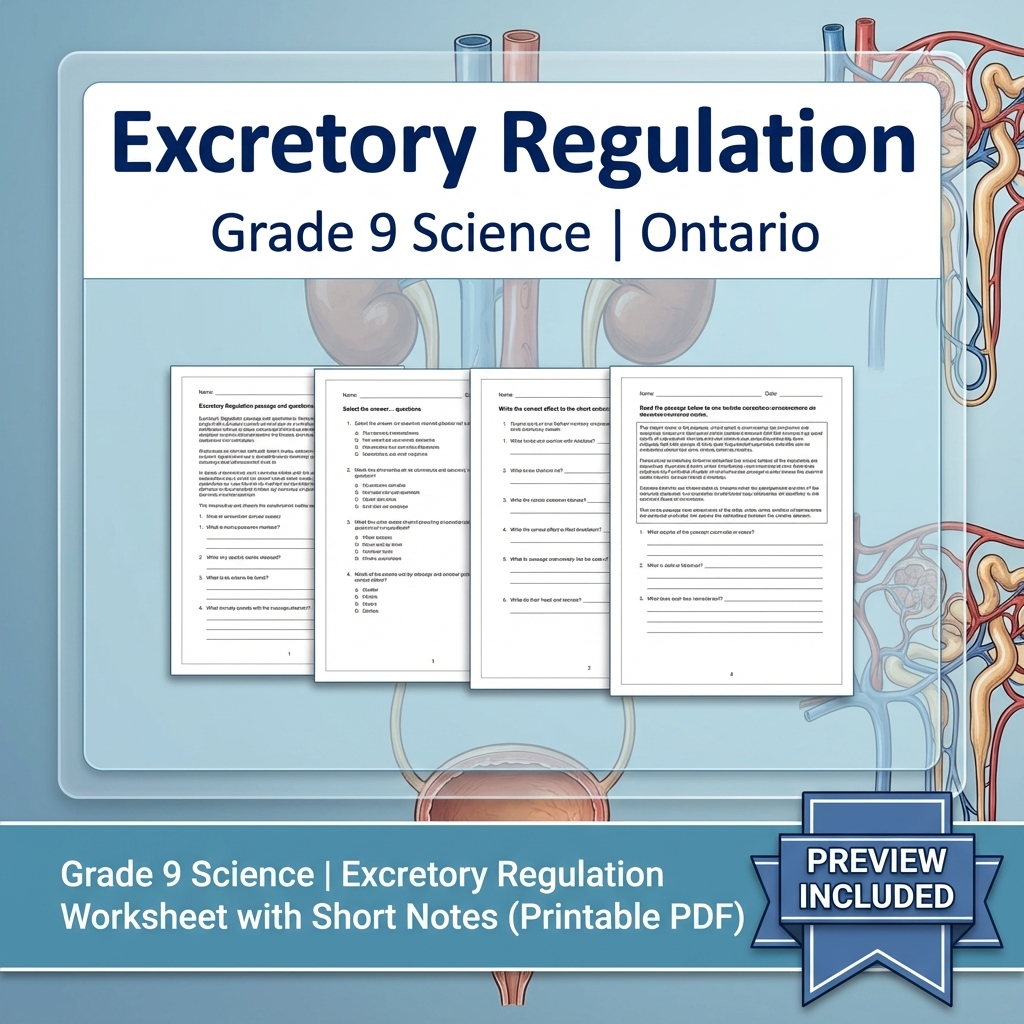
Grade 9 Science | Excretory Regulation Worksheet with Short Notes
 Created byMeadowlark Worksheets
Learning Objectives
- Describe the structure and function of the nephron in blood filtration and urine formation.
- Explain the processes of glomerular filtration, reabsorption, and secretion in the kidney.
- Understand how the kidney concentrates urine through countercurrent mechanisms.
Instant download
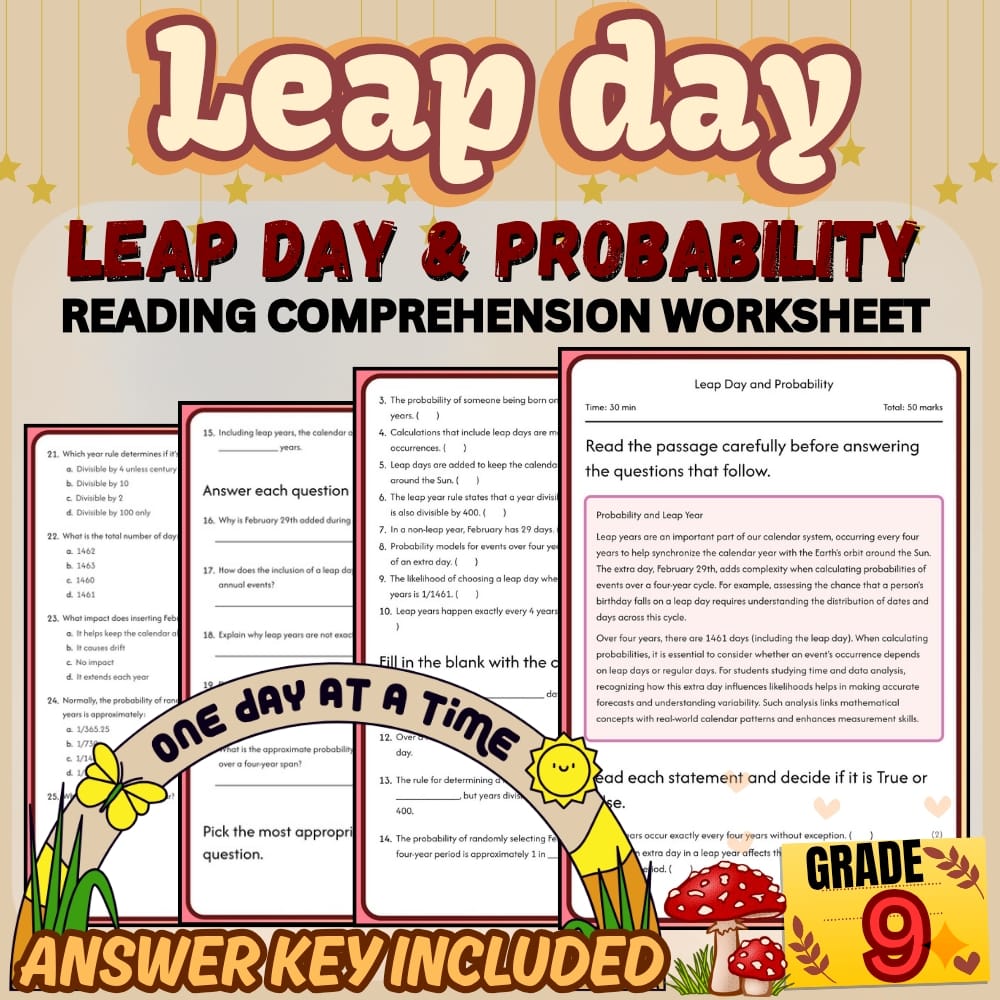
Grade 9 | Leap Day for Mastering Probability & Calendar Math | PDF + Answer Key
 Created byShaNova Worksheets
Learning Objectives
- Understand how leap years affect probability calculations over a four-year cycle.
- Analyze the likelihood of events occurring within a leap year framework.
- Interpret data considering the inclusion of an extra day in the calendar.
Also included in: Grade 9 Holiday Worksheets Bundle | Leap Day & Calendar Math Activities
Instant download

Grade 9 | Leap Day and Calendar Origins Worksheet for Mastery | PDF + Answer Key
Created byShaNova WorksheetsLearning Objectives
- Understand the historical development of calendar systems related to leap year.
- Explain the scientific and cultural reasons for adding an extra day every four years.
- Identify how different civilizations perceived and adapted the concept of leap year.
Also included in: Grade 9 Holiday Worksheets Bundle | Leap Day & Calendar Math Activities
Instant download

Grade 9 Leap Day Traditions Worksheet for February | PDF + Answer Key
Created byShaNova WorksheetsLearning Objectives
- Discover diverse cultural beliefs and practices associated with Leap Day around the world.
- Understand themes of renewal, luck, and uniqueness in cultural celebrations.
- Analyze how different communities interpret and mark this special day.
Also included in: Grade 9 Holiday Worksheets Bundle | Leap Day & Calendar Math Activities
Instant download

Mass Measurement Worksheet | Grade 9 Science Activities
 Created byPrism Point Learning
Learning Objectives
- Explain how conservation of mass relates to measurable changes during chemical reactions within a defined system
- Distinguish between open and closed systems and predict how gas escape can affect measured mass
- Identify measurement factors (buoyancy and instrument sensitivity) that can change readings without changing total atomic conservation
Also included in: Grade 9 Matter and Chemical Change Lesson Bundle | Science | BC +1 more
Instant download
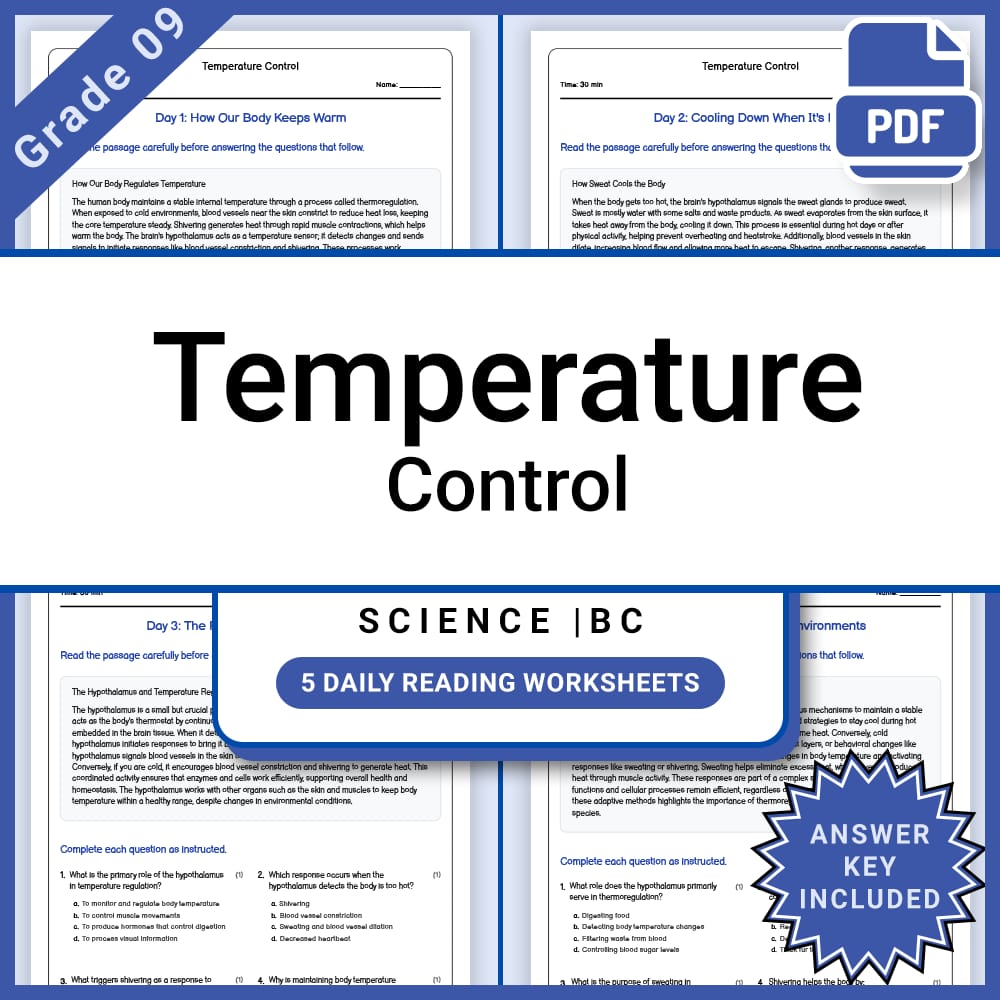
Grade 9 Science – Temperature Control Daily Reading Worksheet + Answer Key
JCreated byJ.S SheetsLearning Objectives
- Understand how skin blood flow helps regulate internal body temperature.
- Explain the role of shivering in maintaining warmth.
- Describe how the hypothalamus detects temperature changes and activates responses.
Also included in: Grade 9 Science Lesson Group Bundle | BC Framework Activities & Worksheets +1 more
Instant download
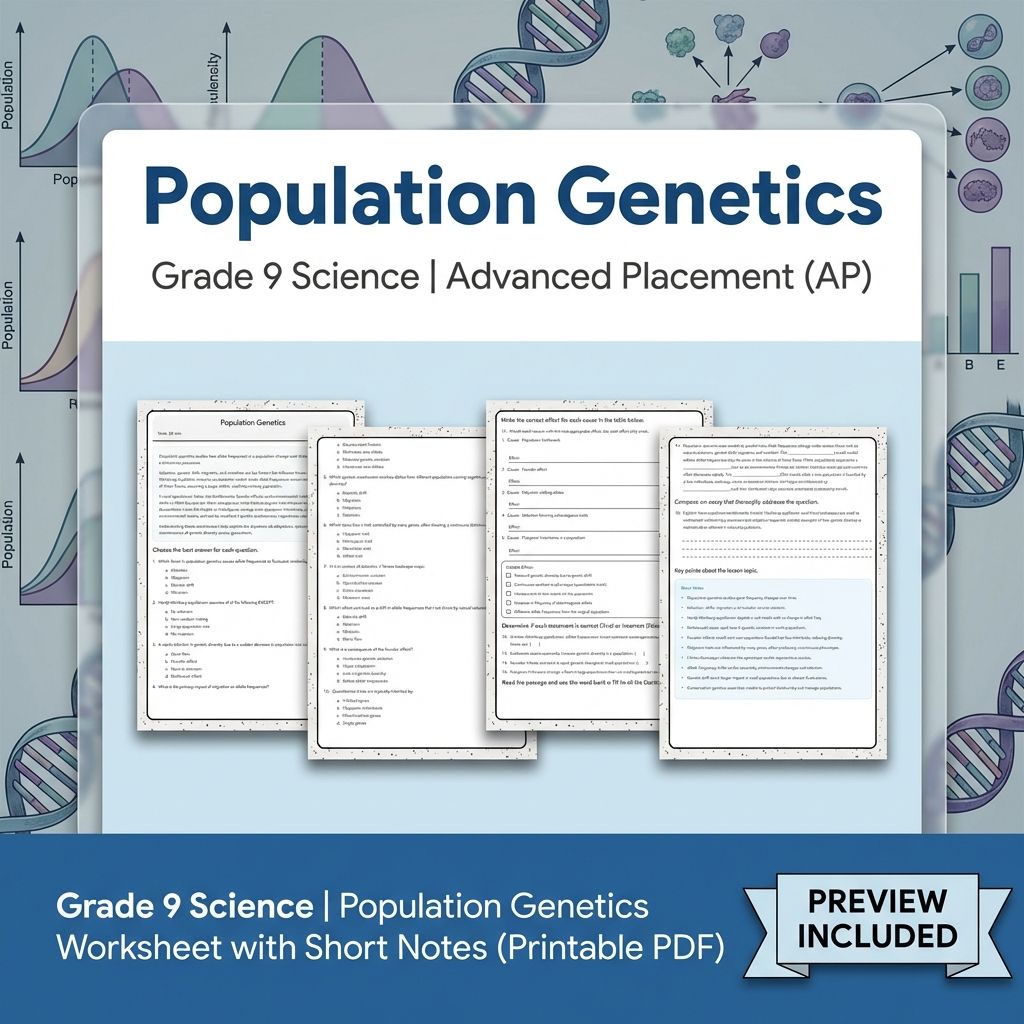
Grade 9 Science | Population Genetics Worksheet with Short Notes (PDF)
Created byMeadowlark WorksheetsLearning Objectives
- Understand how allele frequencies change under different evolutionary forces such as selection, drift, migration, and mutation.
- Explain the concept of Hardy-Weinberg equilibrium as a null model in population genetics.
- Describe the emergence of quantitative traits from polygenic inheritance and environmental interactions.
Also included in: Grade 9 Science Unit | Cellular Processes & Ecosystems Worksheet Pack (PDF) +1 more
Instant download
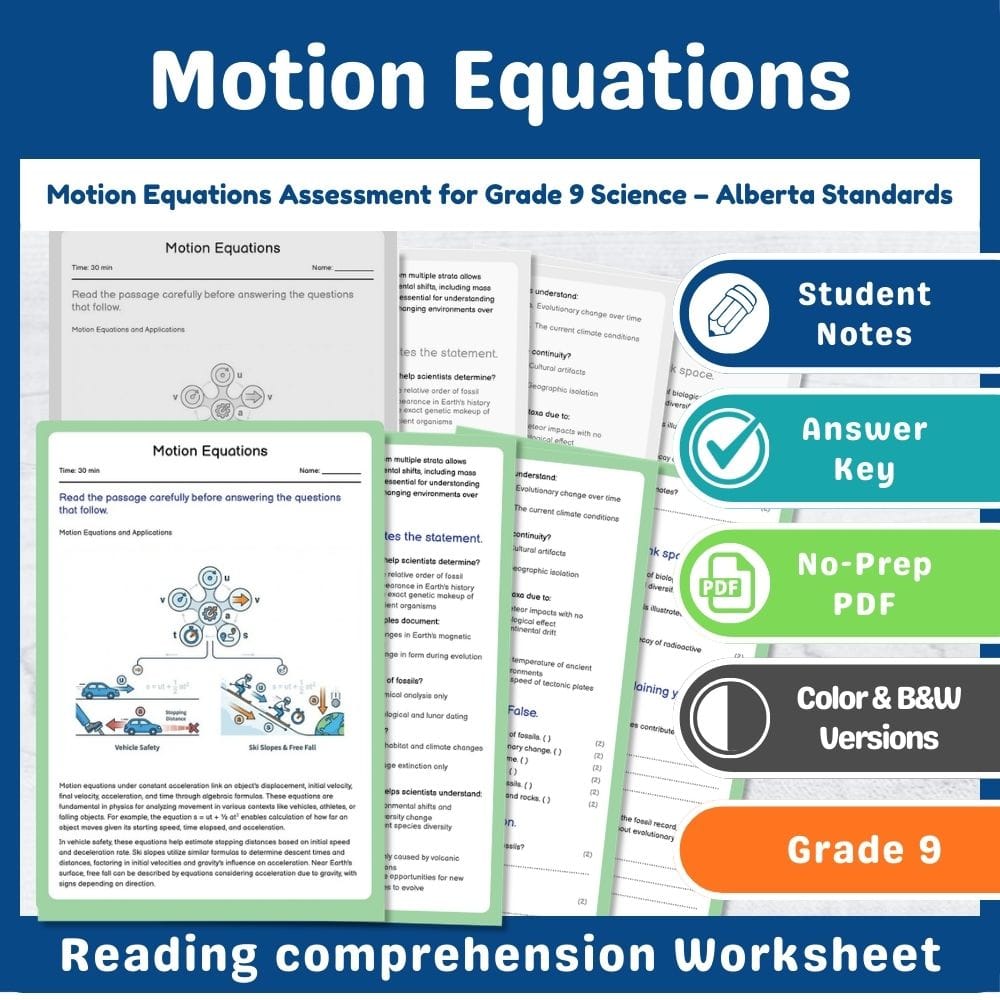
Motion Equations Assessment for Grade 9 Science – Alberta Standards
Created byPrism Point LearningLearning Objectives
- Understand and apply constant-acceleration equations in various motion scenarios.
- Solve numerical problems involving displacement, velocity, acceleration, and time.
- Analyze real-world situations such as stopping distances and free fall using motion equations.
Also included in: Grade 9 Forces and Motion Science Lesson Bundle Alberta Framework +1 more
Instant download

Grade 9 Science | Natural Selection Worksheet (TEKS) Practice Set
 Created byEvergreen Desk Education
Learning Objectives
- Explain how natural selection acts on heritable variation within a population to change allele frequencies over generations.
- Identify and distinguish directional, stabilizing, and disruptive selection using trait distributions and real-world examples.
- Analyze how mutation, gene flow, and genetic drift interact with selection to influence evolutionary outcomes.
Instant download
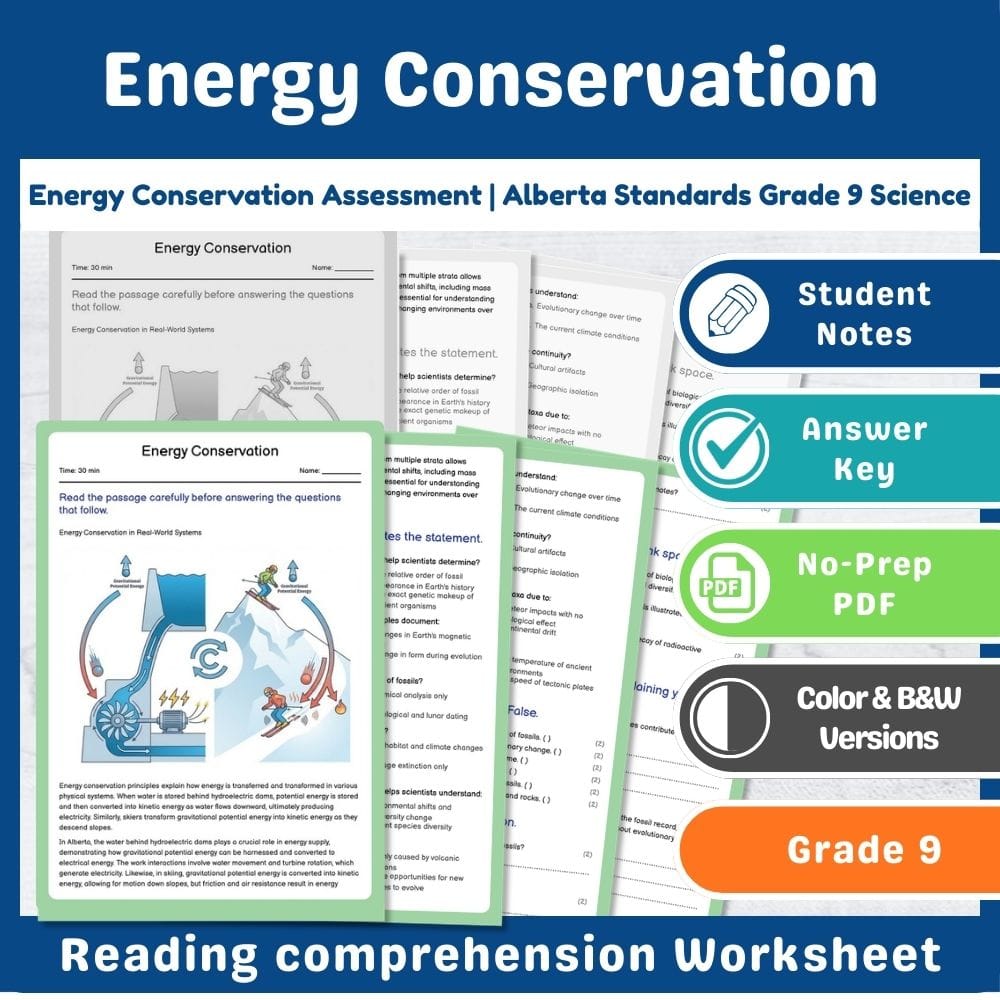
Energy Conservation Assessment | Alberta Standards Grade 9 Science
Created byPrism Point LearningLearning Objectives
- Understand the principles of mechanical energy conservation and energy transfer mechanisms.
- Analyze real-world examples involving potential and kinetic energy conversions.
- Evaluate the impact of non-conservative forces, such as friction, on energy systems.
Also included in: Grade 9 Forces and Motion Science Lesson Bundle Alberta Framework +1 more
Instant download

Cell Components Worksheet | Grade 9 Science Ontario Biology Organelles
 Created byClear Sky Classroom
Learning Objectives
- Identify major organelles in eukaryotic cells and describe how their structures support their functions
- Explain how membrane composition, compartmentalization, and folding affect transport and metabolic efficiency
- Connect processes like protein synthesis, ATP production, and intracellular transport to specific cell components
Instant download

Grade 9 Holiday | May Day for Mastering Cultural Stories | PDF + Answer Key
Created byShaNova WorksheetsLearning Objectives
- Analyze how cultural stories preserve identity and shared values across communities.
- Use context clues to determine the meanings of culture-related vocabulary in narratives.
- Explain how storytelling supports resilience, belonging, and historical continuity.
Also included in: Grade 9 May Day Holiday Custom Bundle: Inquiry Framework Worksheets
Instant download

Grade 9 Holiday | Word day of social justice | PDF + Answer Key
Created byShaNova WorksheetsLearning Objectives
- Understand the significance of the World Day of Social Justice and its history.
- Recognize the importance of equity, rights, and civic responsibility worldwide.
- Analyze stories from different cultures that showcase struggles for social fairness.
Instant download
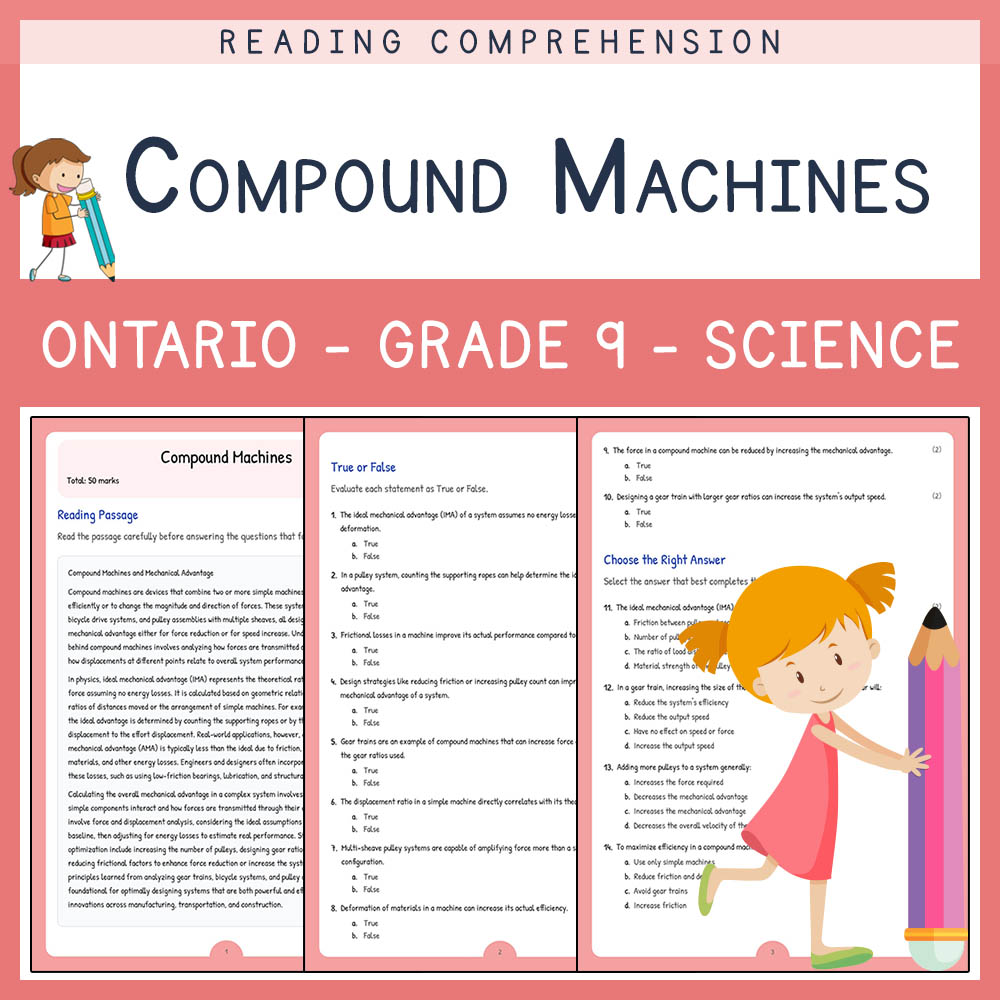
Grade 9 Science | Compound Machines Worksheet Elena | Ontario Standards
 Created byLumora Learning
Learning Objectives
- Explain how to determine the mechanical advantage of compound machines by combining simple machine principles.
- Differentiate between ideal and actual mechanical advantage, considering friction and deformation.
- Apply force and displacement relationships to calculate overall mechanical advantage in various systems.
Instant download
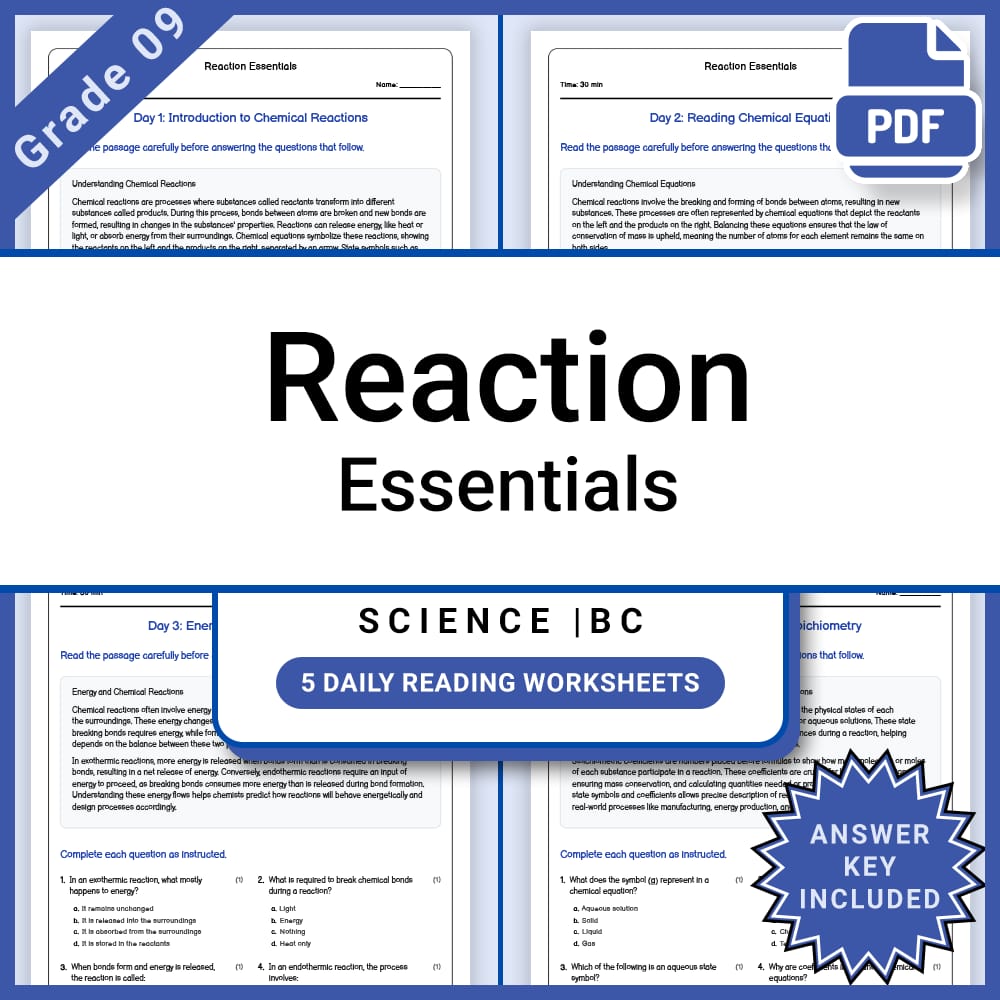
Grade 9 Science – Reaction Essentials Daily Reading Worksheet + Answer Key
JCreated byJ.S SheetsLearning Objectives
- Understand the basic concepts of chemical reactions
- Identify reactants and products in chemical equations
- Explain how bonds break and form during reactions
Also included in: Grade 9 Science Lesson Group BC Framework | Chemistry, Physics, and More +1 more
Instant download
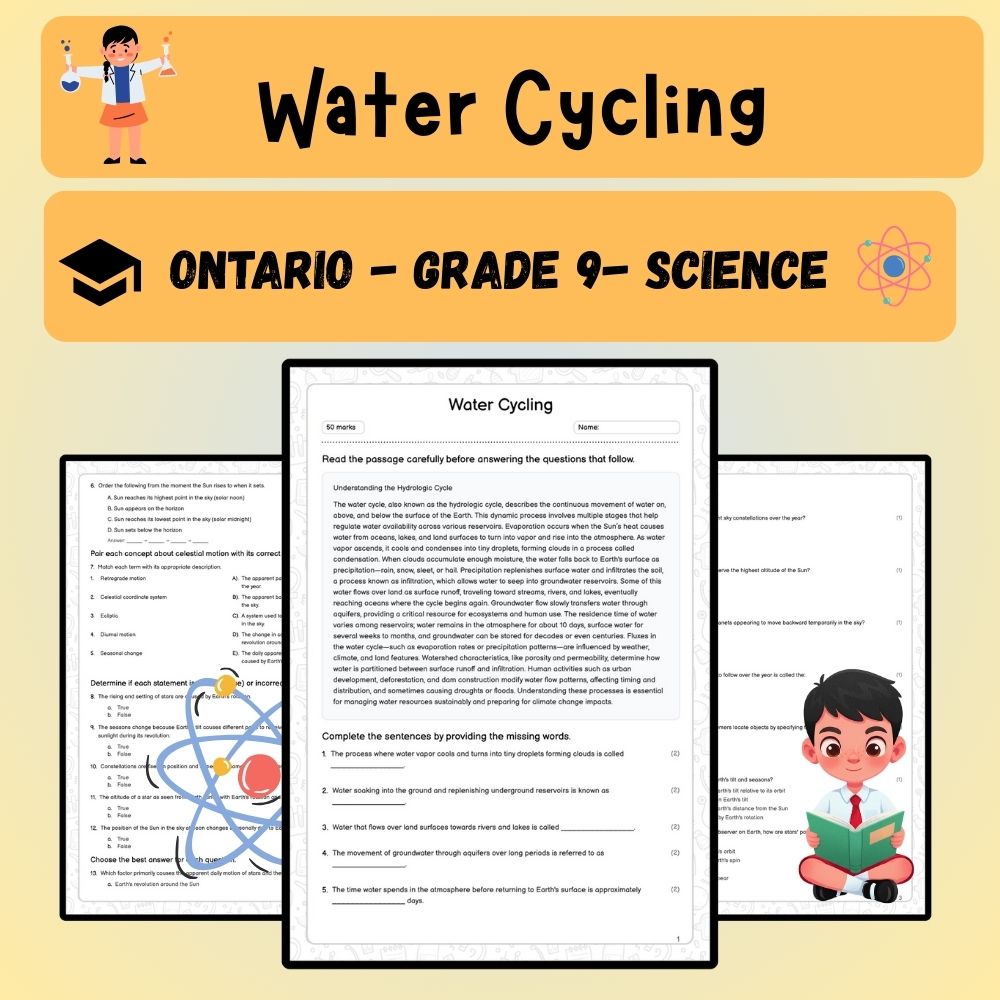
Grade 9 Science Water Cycling Worksheet – Hydrologic Cycle & Standard Ontario (PDF)
Created byPrism Point LearningLearning Objectives
- Describe the processes of evaporation, condensation, and precipitation in the water cycle.
- Explain how infiltration, runoff, and groundwater flow transfer water among different reservoirs.
- Analyze how watershed characteristics, porosity, and permeability influence water movement.
Also included in: Grade 9 Science Unit Bundle | Earth, Weather, Energy & Tectonics +1 more
Instant download

Grade 9 Seismic Waves Worksheet | Earth Structure & Hazards Ontario
 Created byChalk and Compass
Learning Objectives
- Describe how P, S, and surface seismic waves propagate and what their travel-time patterns indicate.
- Explain how focal mechanisms reveal fault types and stress orientations.
- Use travel-time ideas to understand epicentre location and relate magnitude to energy release.
Also included in: Earth Systems & Space Lesson Bundle – Grade 9 Science Ontario Framework +1 more
Instant download

Ethical Decision-Making in Genetic Technologies Worksheet Grade 9
 Created bySunny Desk Resources
Learning Objectives
- Explain how privacy, consent, and labeling raise ethical issues in genetic technologies
- Compare trade-offs between innovation, public benefit, and potential harms
- Identify stakeholder responsibilities and policy roles in responsible genetic science
Also included in: Genetics & Heredity Lesson Bundle | Grade 9 Science | Alberta Framework +1 more
Instant download
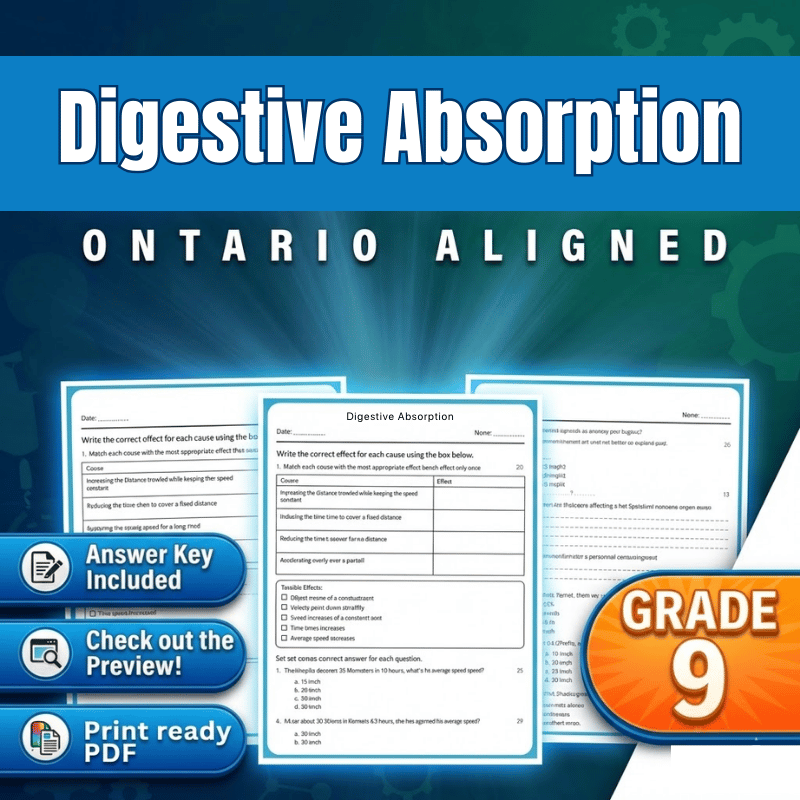
Grade 9 Science – Digestive Absorption Worksheet (Ontario) (PDF)
 Created byBright Mind Resources
Learning Objectives
- Describe the mechanical and chemical processes involved in digestion and nutrient absorption.
- Explain how villi and microvilli increase surface area for absorption across the intestinal epithelium.
- Identify the roles of enzymes, transport mechanisms, bile, and micelles in nutrient uptake.
Instant download

Microscopy Analysis Assessment | TEKS Grade 9 Science Standards
Created byPrism Point LearningLearning Objectives
- Interpret visual data from microscopy images to identify cellular structures.
- Understand the principles of resolution, contrast, and staining in microscopy.
- Compare electron and fluorescence microscopy techniques and their applications.
Instant download

Grade 9 Atmospheric Energy Worksheet | California Standards Practice PDF
Created byClear Sky ClassroomLearning Objectives
- Explain how unequal heating by the Sun creates temperature and pressure differences that drive atmospheric circulation.
- Describe how energy transfer between Earth’s surface and the atmosphere influences humidity, clouds, and precipitation.
- Connect local weather patterns to interactions among temperature, humidity, and Earth–atmosphere energy balance.
Instant download

Orbital Motion Assessment for Grade 9 Science NGSS Standards
Created byPrism Point LearningLearning Objectives
- Explain the fundamental principles of orbital motion, including Kepler's laws and Newton's law of gravitation.
- Analyze relationships between orbital period, semi-major axis, and escape velocity.
- Apply concepts of conservation of angular momentum to planetary and satellite motion.
Instant download
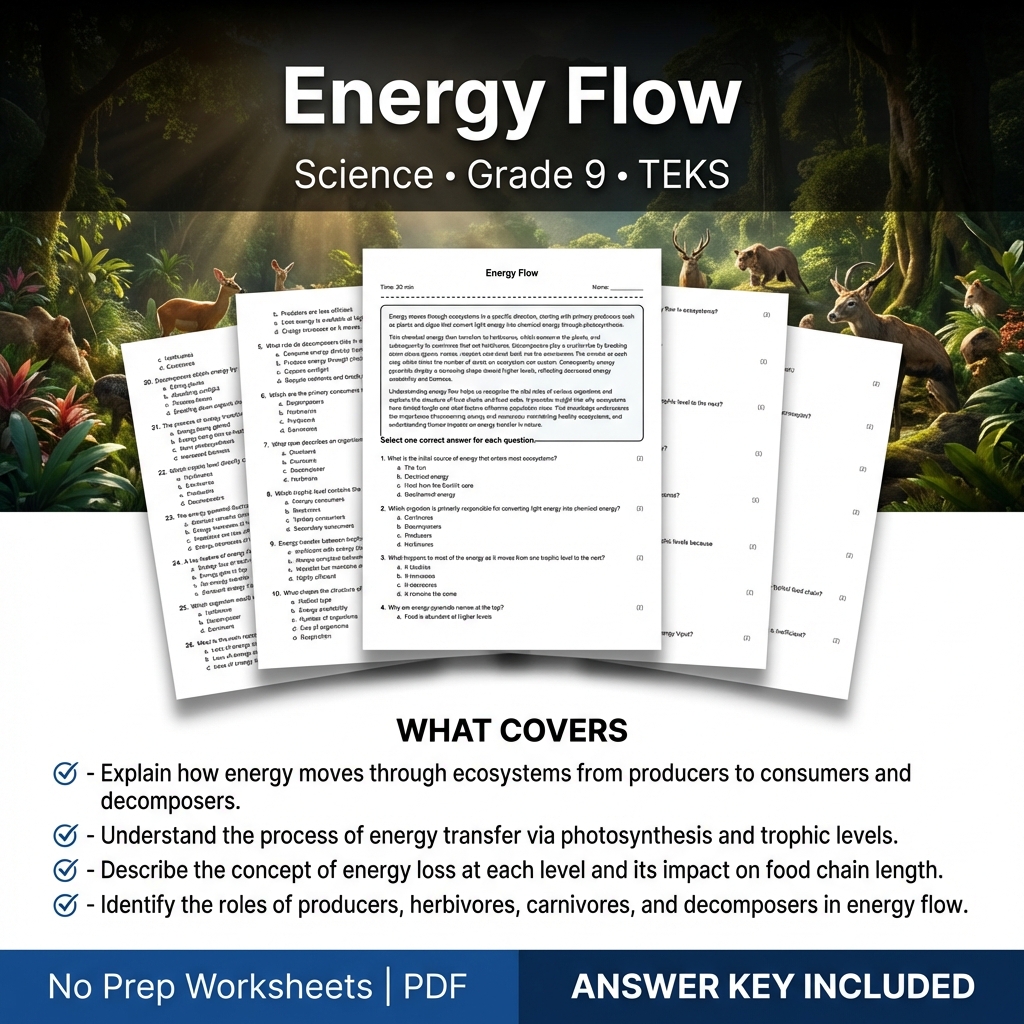
Energy Flow Worksheet for Grade 9 Science | Standard Practice and Assessment
 Created byCoral Reef Learning
Learning Objectives
- Explain how energy moves through ecosystems from producers to consumers and decomposers.
- Understand the process of energy transfer via photosynthesis and trophic levels.
- Describe the concept of energy loss at each level and its impact on food chain length.
Instant download
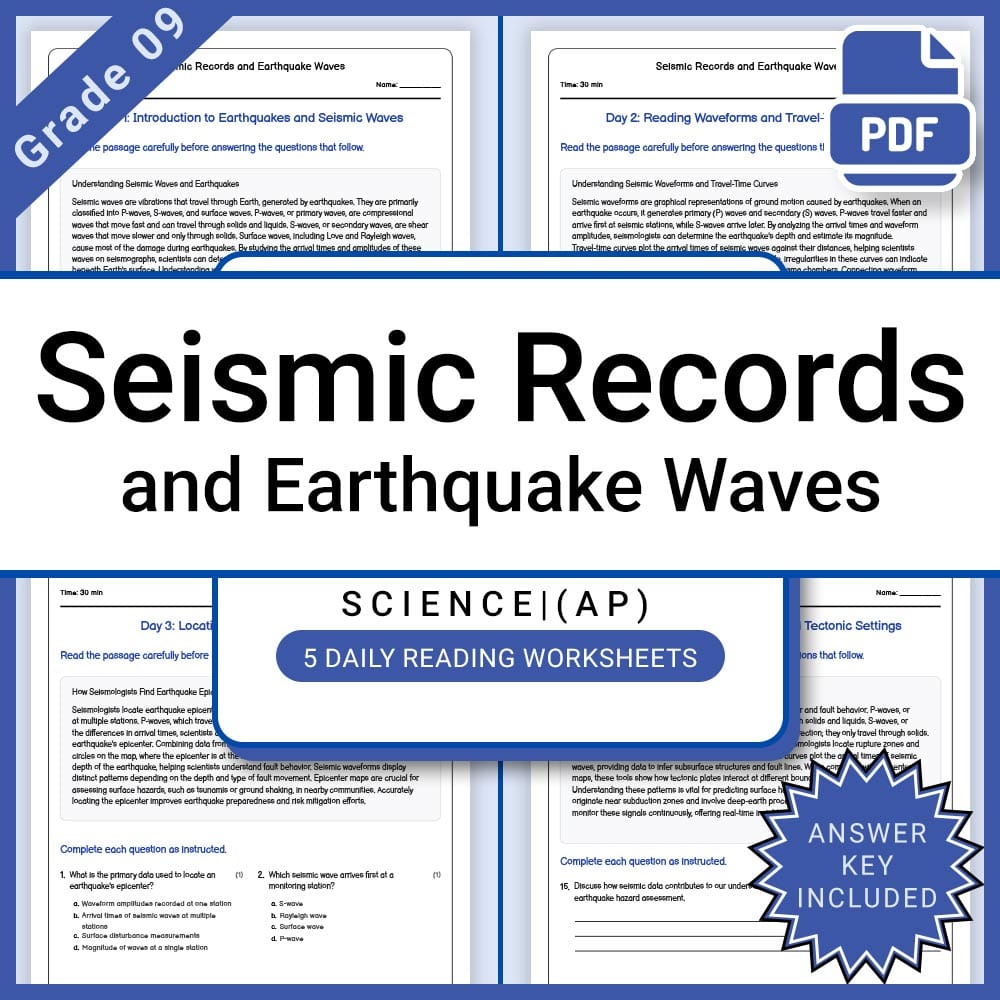
Grade 9 Science – Seismic Records and Earthquake Waves | Worksheet + Answer Key
JCreated byJ.S SheetsLearning Objectives
- Identify different types of seismic waves and their features
- Understand how seismic waveforms and travel-time curves are used to infer Earth's subsurface structure
- Compare P- and S-wave characteristics to determine earthquake depth and fault behavior
Also included in: Grade 9 Science Lesson Bundle – AP Framework Daily Reading Worksheets +1 more
Instant download

Biotech Applications Worksheet | TEKS-Aligned Science Practice for Grade 9
JCreated byJ.S SheetsLearning Objectives
- Explain how common biotechnology tools (PCR, gel electrophoresis, DNA sequencing, and CRISPR) are used to analyze and modify genetic material.
- Describe real-world applications of biotechnology in medicine, agriculture, and forensics.
- Evaluate ethical, legal, and societal implications of biotechnology, including privacy, ecological risk, and equitable access.
Instant download

Grade 9 Science Worksheet: Physical Changes | Standards-Aligned Practice
JCreated byJ.S SheetsLearning Objectives
- Characterize physical changes as alterations in state or form that do not change a substance’s chemical identity.
- Differentiate reversible and seemingly irreversible physical transformations using examples.
- Explain how energy transfer accompanies phase changes such as melting, freezing, evaporation, condensation, and dissolution.
Instant download

Grade 9 Navigating Health Care Systems Worksheet | NHES Health Activity
Created byPrism Point LearningLearning Objectives
- Explain how to schedule an appointment and what information to prepare.
- Describe the role of referrals in accessing specialist care.
- Identify how insurance claims work and what can cause delays.
Instant download
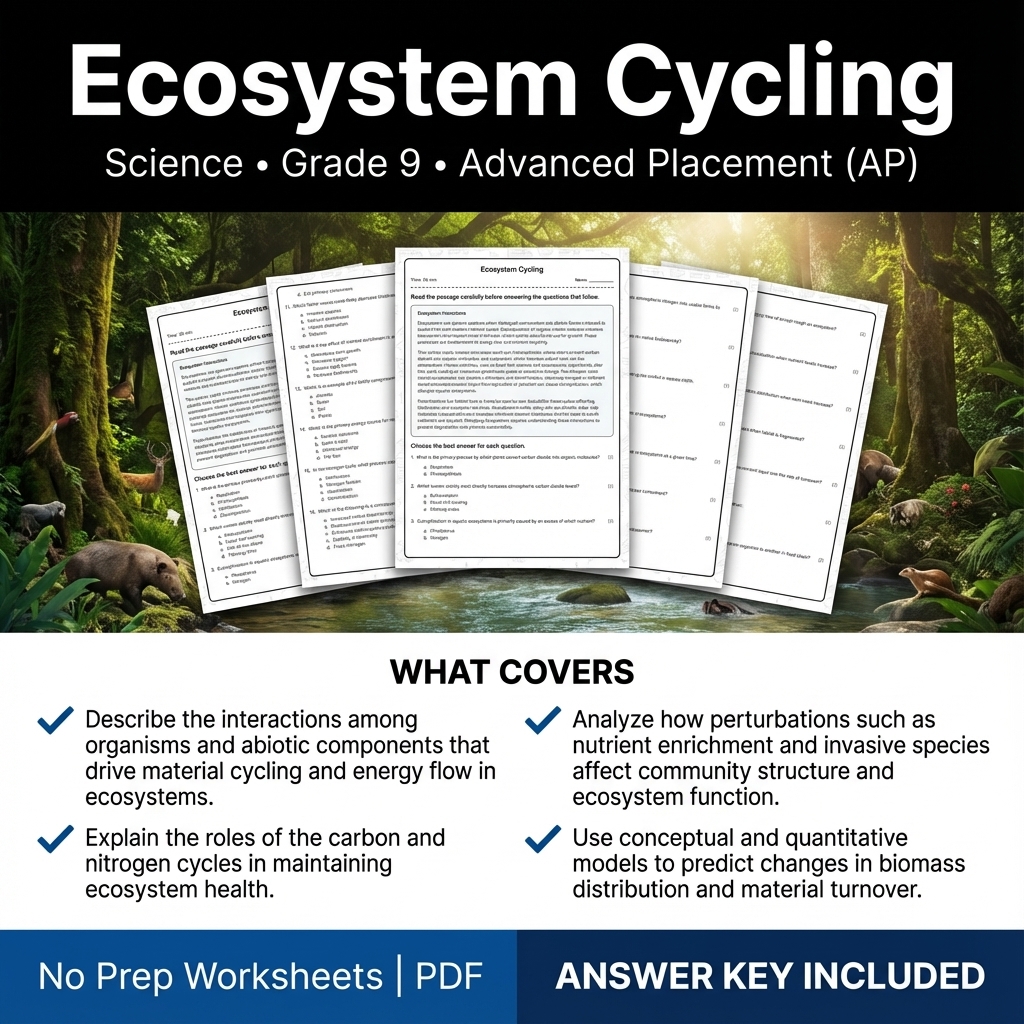
9th Grade Science | Ecosystem Cycling Worksheet (Printable PDF + Answer Key)
Created byCoral Reef LearningLearning Objectives
- Describe the interactions among organisms and abiotic components that drive material cycling and energy flow in ecosystems.
- Explain the roles of the carbon and nitrogen cycles in maintaining ecosystem health.
- Analyze how perturbations such as nutrient enrichment and invasive species affect community structure and ecosystem function.
Also included in: Grade 9 Science Unit Worksheet Bundle | Cell Function to Ecosystem Dynamics +2 more
Instant download

Grade 9 | Nelson Mandela International Day for Human Rights | PDF + Answer Key
Created byShaNova WorksheetsLearning Objectives
- Explain key moments in Nelson Mandela’s lifelong advocacy for human rights and equality.
- Describe how dignity, freedom, and respect connect to the Universal Declaration of Human Rights (UDHR).
- Apply human-rights concepts to modern social justice issues with empathy and global awareness.
Instant download

Grade 9 Science – Humidity & Cloud Formation | Daily Reading Worksheet
Created byBright Mind ResourcesLearning Objectives
- Explain how water vapor condenses into clouds.
- Identify factors affecting cloud types and formation.
- Describe the role of humidity and atmospheric stability in weather patterns.
Also included in: Earth Systems Grade 9 Science Daily Reading Worksheets Bundle | Florida NGSSS +1 more
Instant download
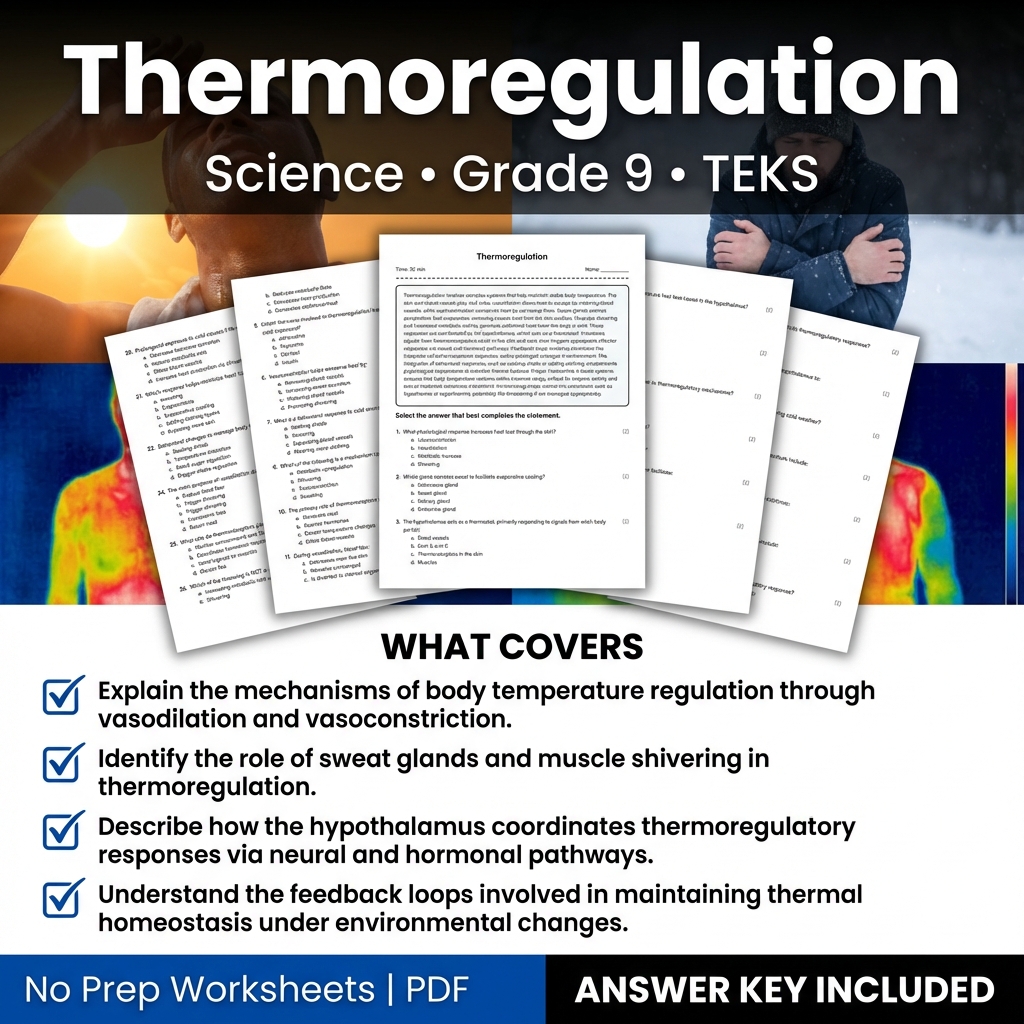
Thermoregulation Worksheet for Grade 9 Science | Standard Practice PDF
Created byCoral Reef LearningLearning Objectives
- Explain the mechanisms of body temperature regulation through vasodilation and vasoconstriction.
- Identify the role of sweat glands and muscle shivering in thermoregulation.
- Describe how the hypothalamus coordinates thermoregulatory responses via neural and hormonal pathways.
Instant download

Adaptation and Selection Worksheet | Grade 9 Science Activities
Created byPrism Point LearningLearning Objectives
- Explain how natural selection works using the ideas of variation, heritability, selective pressure, and reproductive success.
- Define fitness and describe how it depends on environmental conditions.
- Compare natural selection and artificial selection and predict how populations may change over generations.
Instant download

Grade 9 Science Integrated Case Worksheet | Practice Alberta Standards
Created byPrism Point LearningLearning Objectives
- Explain how sexual and asexual reproduction affect genetic diversity in breeding programs.
- Trace how inheritance patterns can be linked to chromosomes and Mendelian rules.
- Analyze how selection changes trait frequencies and why variation matters for adaptation.
Instant download

Asexual Strategies Worksheet | Grade 9 Science Activities
Created byPrism Point LearningLearning Objectives
- Describe major mechanisms of asexual reproduction, including fission, budding, spore formation, and vegetative propagation
- Explain how producing genetically identical offspring affects variation, spread rate, and resilience
- Connect asexual strategies to real-world examples such as aspen groves, bacterial growth in environments, and horticultural propagation
Instant download
Grade 9 Science | Energy Transfer Worksheet (Ontario) – Science (PDF)
Created byBright Mind ResourcesLearning Objectives
- Understand sources of energy within Earth systems, including solar radiation and geothermal heat flow.
- Describe mechanisms of energy transfer such as conduction, convection, and radiation.
- Explain how energy gradients drive atmospheric and oceanic circulation and tectonic processes.
Instant download

Grade 9 Science | Power Analysis Worksheet with Short Notes (Printable PDF)
Created byMeadowlark WorksheetsLearning Objectives
- Understand the differences between power and energy in systems.
- Learn methods to calculate energy consumption over time.
- Evaluate efficiency and system losses in energy systems.
Also included in: Grade 9 Science NGSS Energy UNIT Bundle – Power, Heat, & Conversion Worksheets +1 more
Instant download

Grade 9 Science | Mechanical Energy Worksheet with Short Notes (Printable PDF)
Created byMeadowlark WorksheetsLearning Objectives
- Understand the concept of mechanical energy and its types.
- Identify different forms of energy involved in mechanical systems.
- Explain how energy is transferred and conserved in mechanical processes.
Also included in: Grade 9 Science NGSS Energy UNIT Bundle – Power, Heat, & Conversion Worksheets +1 more
Instant download
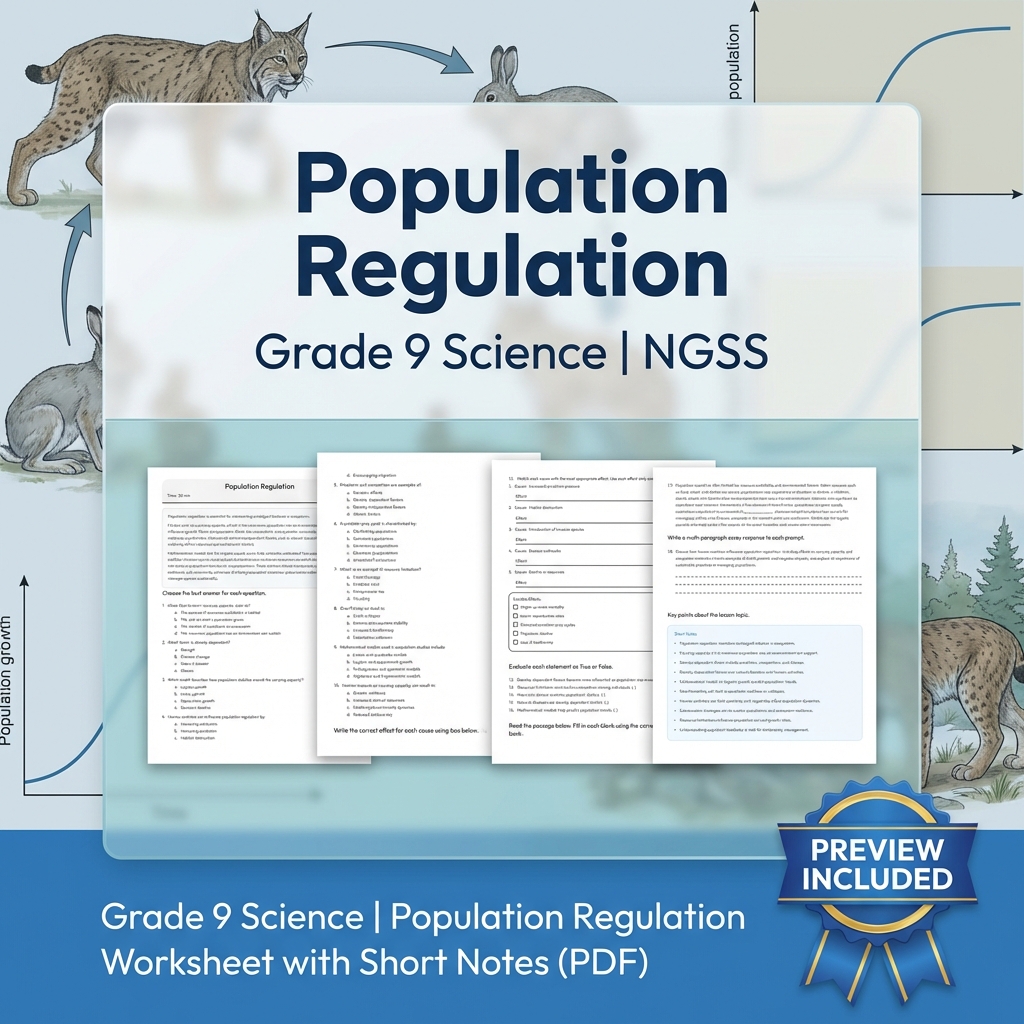
Grade 9 Science | Population Regulation Worksheet with Short Notes (PDF)
Created byMeadowlark WorksheetsLearning Objectives
- Understand factors affecting population size and dynamics, including carrying capacity, competition, predation, disease, and resource limitations.
- Analyze mathematical models such as logistic growth and predator-prey cycles.
- Evaluate human impacts on population regulation and the implications for conservation and ecosystem management.
Also included in: Grade 9 Science | Ecosystems: Interactions, Energy & Dynamics NGSS UNIT Bundle +2 more
Instant download

Grade 9 Science | Heat Quantification Worksheet with Short Notes (Printable PDF)
Created byMeadowlark WorksheetsLearning Objectives
- Understand the mathematical representations and principles of heat transfer and internal energy change.
- Apply formulas involving specific heat capacity, mass, and temperature change to real-world scenarios.
- Differentiate between conduction, convection, and radiation as modes of heat transfer.
Also included in: Grade 9 Science NGSS Energy UNIT Bundle – Power, Heat, & Conversion Worksheets +1 more
Instant download

Grade 9 Science | Energy Conversion Worksheet with Short Notes (Printable PDF)
Created byMeadowlark WorksheetsLearning Objectives
- Analyze various device mechanisms that convert energy from one form to another.
- Understand energy accounting including losses and efficiency constraints.
- Identify canonical examples such as photovoltaic cells, thermoelectric modules, and electrochemical cells.
Also included in: Grade 9 Science NGSS Energy UNIT Bundle – Power, Heat, & Conversion Worksheets +1 more
Instant download

Producers & Consumers Review & Practice Worksheet | Grade 9 Science
Created byPrism Point LearningLearning Objectives
- Explain how photosynthesis and cellular respiration transfer energy through ecosystems.
- Analyze how net primary productivity (NPP) and biomass accumulation affect food availability for consumers.
- Describe how organisms cycle carbon and oxygen through photosynthesis and respiration.
Also included in: Grade 9 Ecosystem Dynamics Science Lesson Bundle: NGSS Review Worksheets
Instant download

Human Impacts Practice Worksheet | Grade 9 Science NGSS Review
Created byPrism Point LearningLearning Objectives
- Explain how land-use change, invasive species, pollution, and resource extraction can reduce biodiversity.
- Interpret evidence from real-world examples (deforestation, coral reef degradation, agricultural runoff) to evaluate ecosystem impacts.
- Describe trade-offs between conservation goals, provisioning services, and socioecological outcomes.
Also included in: Grade 9 Ecosystem Dynamics Science Lesson Bundle: NGSS Review Worksheets
Instant download
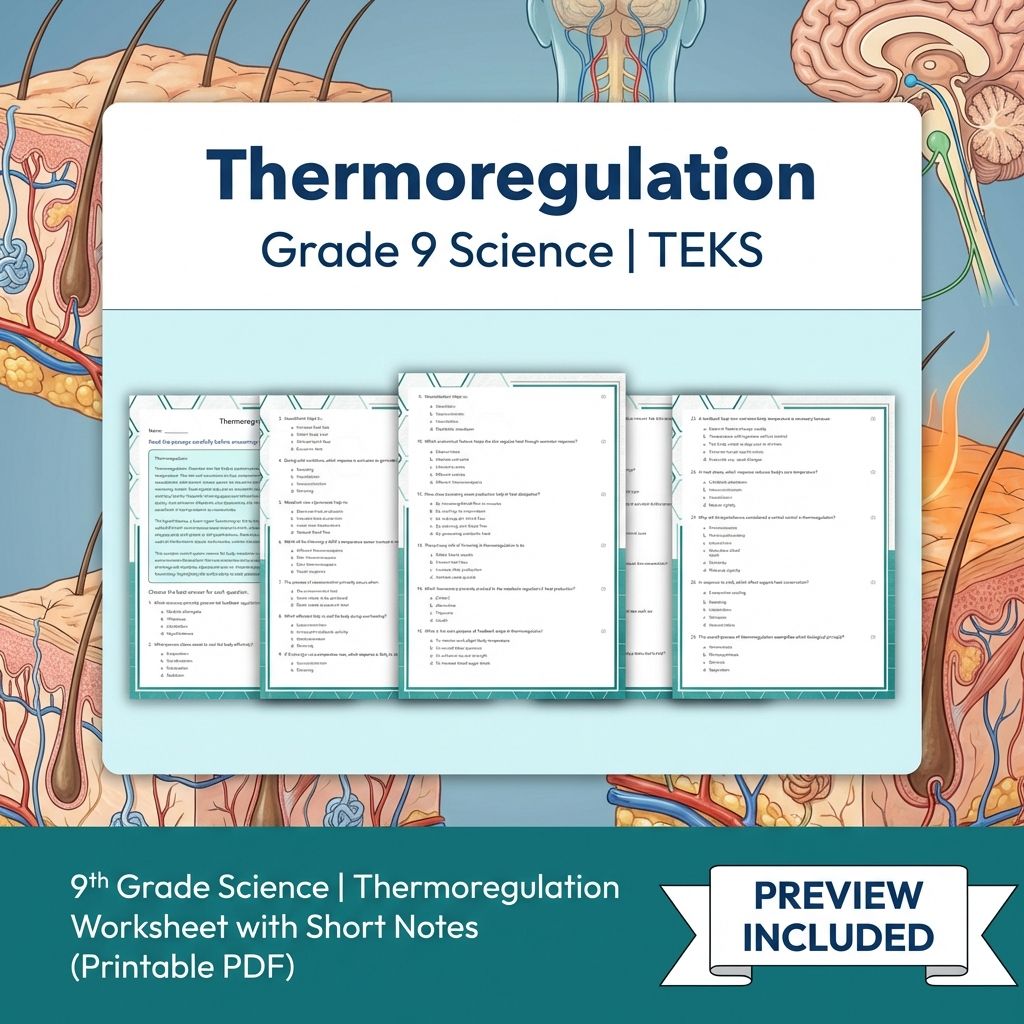
9th Grade Science | Thermoregulation Worksheet with Short Notes (Printable PDF)
Created byMeadowlark WorksheetsLearning Objectives
- Understand the mechanisms involved in human body temperature regulation.
- Identify the roles of skin, vasculature, sweat glands, muscles, and the hypothalamus in thermoregulation.
- Explain how feedback loops maintain thermal homeostasis under varying environmental conditions.
Instant download

Grade 9 Science - Atomic Structure Worksheet (NGSS) PDF (Practice Set)
 Created byMaple Path Learning
Learning Objectives
- Understand the fundamental particles composing atoms, including protons, neutrons, and electrons.
- Describe electron configurations and their relation to energy levels.
- Explain how the periodic table organization reflects valence electrons and chemical behavior.
Also included in: Grade 9 Science | Matter and Its Interactions NGSS Unit Bundle – Worksheets +1 more
Instant download

Grade 9 | Black history month for Mastering Cultural Heritage | PDF + Answer Key
Created byShaNova WorksheetsLearning Objectives
- Identify key aspects of African American cultural traditions and contributions.
- Understand the historical roots and significance of cultural practices within African American communities.
- Foster respect and appreciation for cultural diversity and heritage.
Instant download
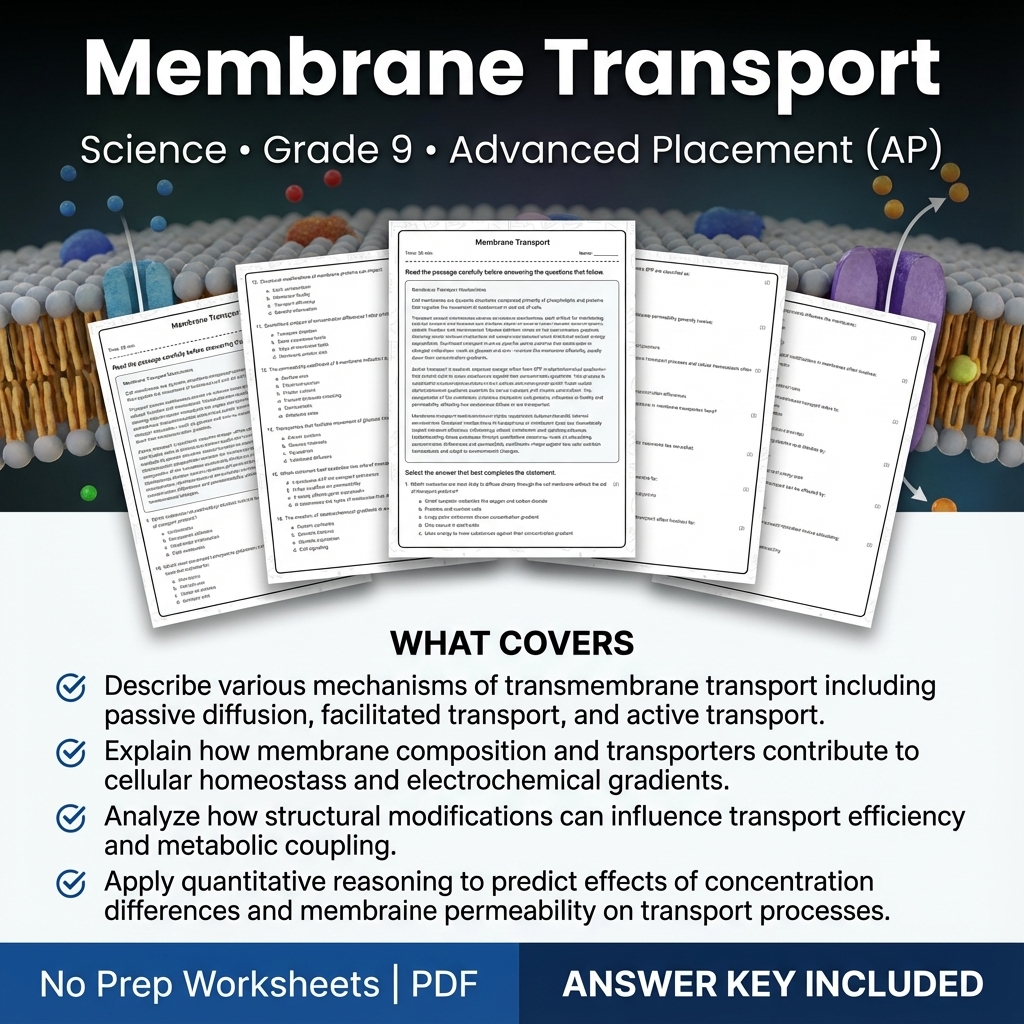
9th Grade Science | Membrane Transport Worksheet (Printable PDF + Answer Key)
Created byCoral Reef LearningLearning Objectives
- Describe various mechanisms of transmembrane transport including passive diffusion, facilitated transport, and active transport.
- Explain how membrane composition and transporters contribute to cellular homeostasis and electrochemical gradients.
- Analyze how structural modifications can influence transport efficiency and metabolic coupling.
Also included in: Grade 9 Science Unit Worksheet Bundle | Cell Function to Ecosystem Dynamics +2 more
Instant download
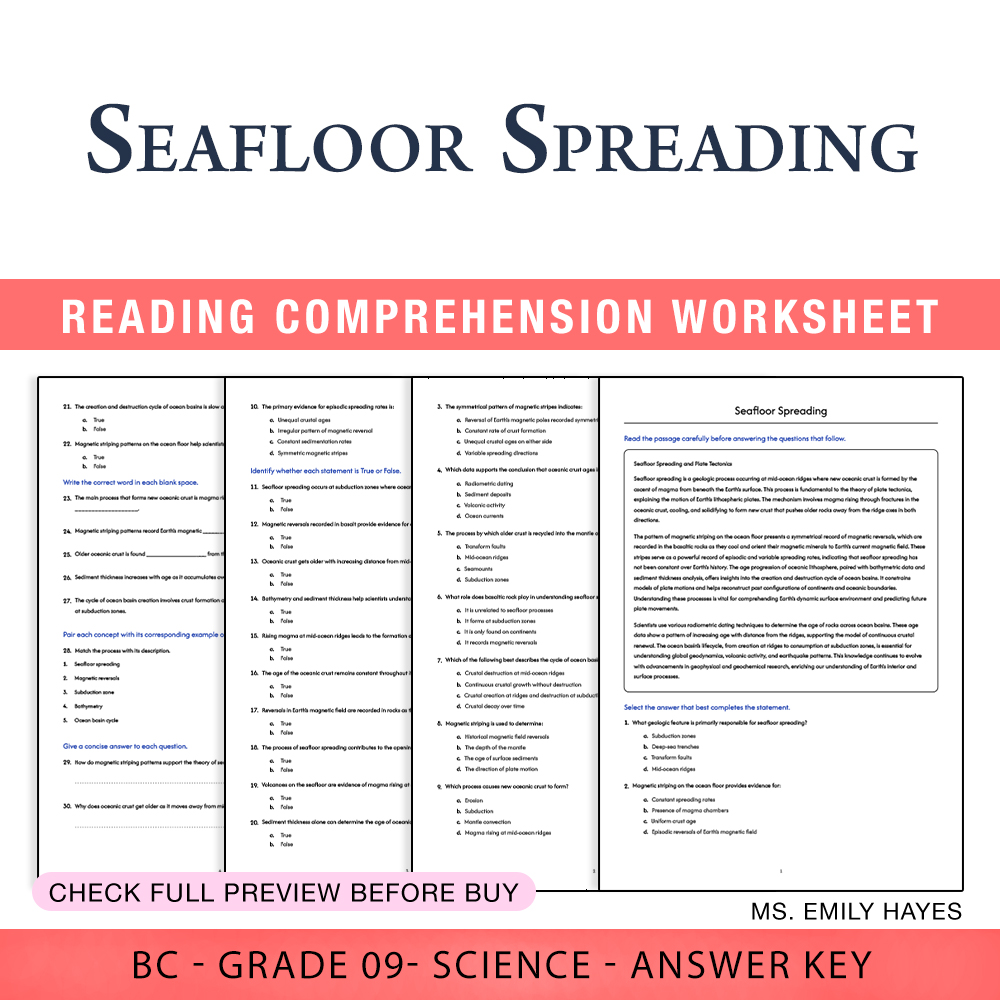
9th Grade Science | Seafloor Spreading Worksheet (PDF+ Answer Key)
 Created byCopper Leaf Classroom
Learning Objectives
- Describe the process of seafloor spreading at mid-ocean ridges and how it creates new oceanic crust.
- Explain how magnetic striping provides evidence for episodic spreading rates and plate movements.
- Analyze the age progression of oceanic lithosphere and its implications for ocean basin cycles.
Also included in: Grade 9 Science Worksheet Bundle | Earth's Dynamic Processes (PDF + Answer Key) +1 more
Instant download
Browse more categories
About Grade 9 Worksheets
Browse 9,304 printable Grade 9 worksheets across algebra, biology, literature, and history — each a ready-to-print PDF with optional answer keys.
Every worksheet on MyTeachingSheets is created by independent teacher-authors and reviewed before publication. All resources download as printable PDFs for classroom, homework, or at-home practice, and many include answer keys. Preview any worksheet free before buying.