


Grade 5 Truss Mechanics and Load Paths Worksheet | Ontario Science Activity
 Created byChalk and Compass
Learning Objectives
- Explain how axial forces (tension and compression) form in truss members
- Describe how joints transfer loads to create efficient load distribution
- Compare common truss geometries and predict where members carry tension or compression
Instant download

Grade 5 Tensile Strength, Yield & Failure Worksheet | Ontario Science
Created byChalk and CompassLearning Objectives
- Describe how tensile force creates stress in cables, ties, and connectors.
- Identify key material ideas: tensile strength, yield, ductility, and typical failure modes.
- Explain how anchor design, corrosion, and fatigue affect long-span tension members.
Instant download
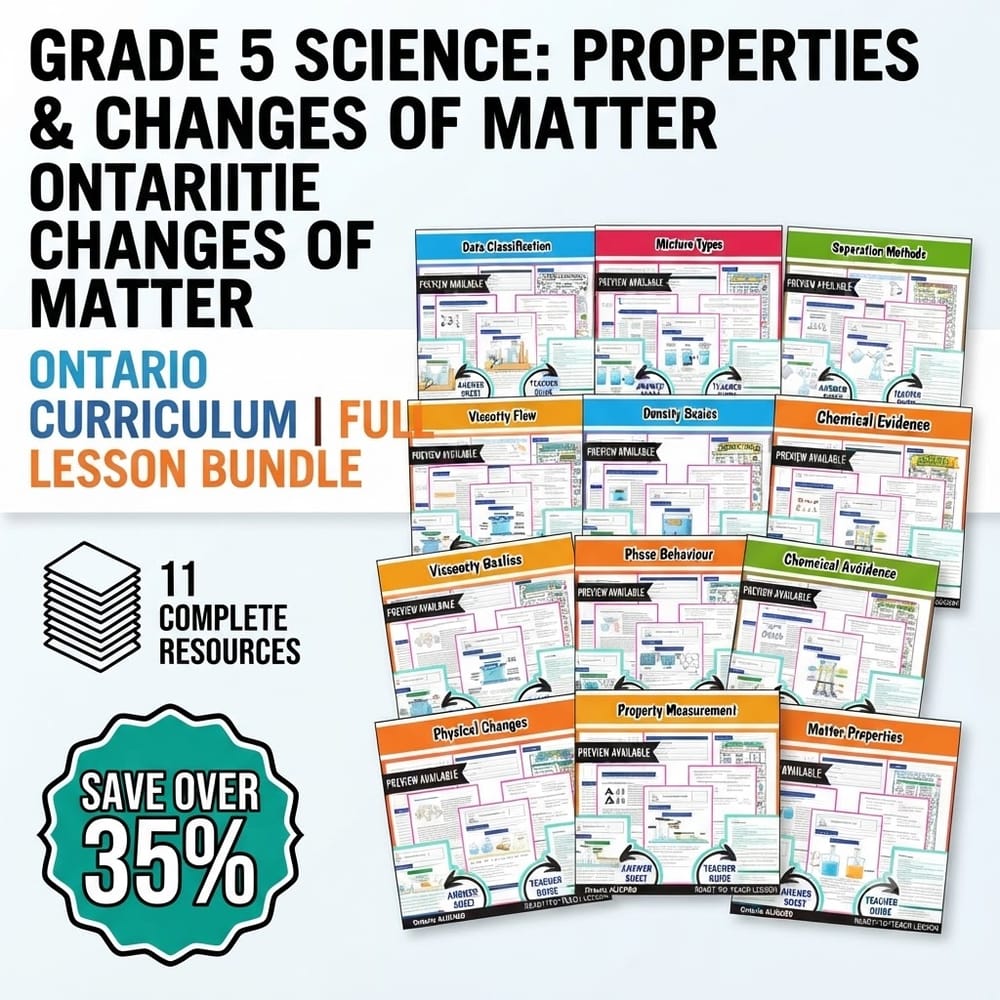
Grade 5 Science Properties and Changes of Matter Lesson Bundle | Ontario
Created byChalk and CompassOverview Grade 5 Science Properties and Changes of Matter is a print-only, classroom-ready bundle of Ontario worksheet activities that develop observational and reasoning skills through 11 focused worksheets. Built as a standards-aligned unit using Ontario Science {standards}, this printable resource pack includes worksheets plus PDF answer keys with rubric …
Instant download

Grade 5 Viscosity and Flow Worksheet | Ontario Science Liquids Activity
Created byChalk and CompassLearning Objectives
- Explain how viscosity describes how resistant a liquid is to flowing
- Connect cohesive forces and shear forces to different flow rates in liquids
- Predict how temperature affects viscosity and flow in simple examples
Also included in: Grade 5 Science Properties and Changes of Matter Lesson Bundle | Ontario
Instant download

Grade 5 Solubility Patterns in Solutions Worksheet | Ontario Science Activity
Created byChalk and CompassLearning Objectives
- Describe solubility as how much solute dissolves in a solvent to form a solution
- Compare unsaturated, saturated, and supersaturated solutions using observable clues
- Explain how temperature and agitation can change solubility for different substances
Also included in: Grade 5 Science Properties and Changes of Matter Lesson Bundle | Ontario
Instant download

Grade 5 Science Separation Methods Worksheet | Ontario Physical Properties
Created byChalk and CompassLearning Objectives
- Explain how filtration, decanting, evaporation, and crystallization use physical properties to separate mixture components.
- Describe how magnetic separation, chromatography, and distillation separate substances using different particle behaviors.
- Choose the most suitable separation method for a given mixture based on solubility, volatility, solute size, or magnetic response.
Also included in: Grade 5 Science Properties and Changes of Matter Lesson Bundle | Ontario
Instant download

Grade 5 Measuring Properties of Matter Worksheet | Ontario Science Activity
Created byChalk and CompassLearning Objectives
- Describe how mass, volume, temperature, and qualitative viscosity indicators are measured and recorded.
- Use consistent units and instrument conventions to compare properties of solids and liquids.
- Explain how repeat measurements and uncertainty affect the reliability of results.
Also included in: Grade 5 Science Properties and Changes of Matter Lesson Bundle | Ontario
Instant download

Grade 5 Identifying Physical Changes Worksheet | Ontario Science Activity
Created byChalk and CompassLearning Objectives
- Define physical changes as changes in form or state that do not produce new substances
- Identify signs of physical changes such as melting, cutting, crushing, and phase changes
- Explain how mass and observable properties (appearance and texture) help show that chemical identity stays the same
Also included in: Grade 5 Science Properties and Changes of Matter Lesson Bundle | Ontario
Instant download

Grade 5 Particle Explanations for Phase Changes Science Worksheet Ontario
Created byChalk and CompassLearning Objectives
- Explain phase changes using particle behavior and kinetic energy changes
- Describe how intermolecular forces affect melting, freezing, evaporation, condensation, and sublimation
- Connect heating and cooling to reversible physical changes
Also included in: Grade 5 Science Properties and Changes of Matter Lesson Bundle | Ontario
Instant download

Grade 5 Science Mixture Types Worksheet | Observable Properties | Ontario
Created byChalk and CompassLearning Objectives
- Classify mixtures as homogeneous solutions, heterogeneous suspensions, or colloids based on uniformity and particle behavior
- Use evidence such as settling and light scattering to distinguish mixture types
- Select an appropriate separation approach for a given mixture scenario
Also included in: Grade 5 Science Properties and Changes of Matter Lesson Bundle | Ontario
Instant download

Grade 5 Comparing Solids and Liquids Worksheet | Ontario Science Activity
Created byChalk and CompassLearning Objectives
- Compare solids and liquids using observable properties such as shape and volume
- Explain how particle arrangement and motion relate to macroscopic behavior
- Identify and use correct science vocabulary for matter properties
Also included in: Grade 5 Science Properties and Changes of Matter Lesson Bundle | Ontario
Instant download

Grade 5 Density, Mass, Volume & Buoyancy Worksheet | Ontario Science
Created byChalk and CompassLearning Objectives
- Define density as mass per unit volume and explain how it helps identify materials.
- Use mass and volume measurements to compare densities of different objects.
- Predict whether an object will sink or float based on relative density.
Also included in: Grade 5 Science Properties and Changes of Matter Lesson Bundle | Ontario
Instant download

Grade 5 Classifying Materials Using Properties Science Worksheet Ontario
Created byChalk and CompassLearning Objectives
- Identify how measured and observed properties help classify materials as solids or liquids.
- Use property values (such as density and solubility) to group materials with reproducible criteria.
- Explain why using more than one property can make classification more reliable, especially for ambiguous cases.
Also included in: Grade 5 Science Properties and Changes of Matter Lesson Bundle | Ontario
Instant download

Grade 5 Evidence of Chemical Changes Worksheet | Ontario Science Activity
Created byChalk and CompassLearning Objectives
- Identify observable evidence that a chemical change has formed new substances
- Differentiate chemical changes from physical changes using signs such as gas production, precipitates, and persistent color changes
- Explain how energy changes can happen during chemical reactions
Also included in: Grade 5 Science Properties and Changes of Matter Lesson Bundle | Ontario
Instant download
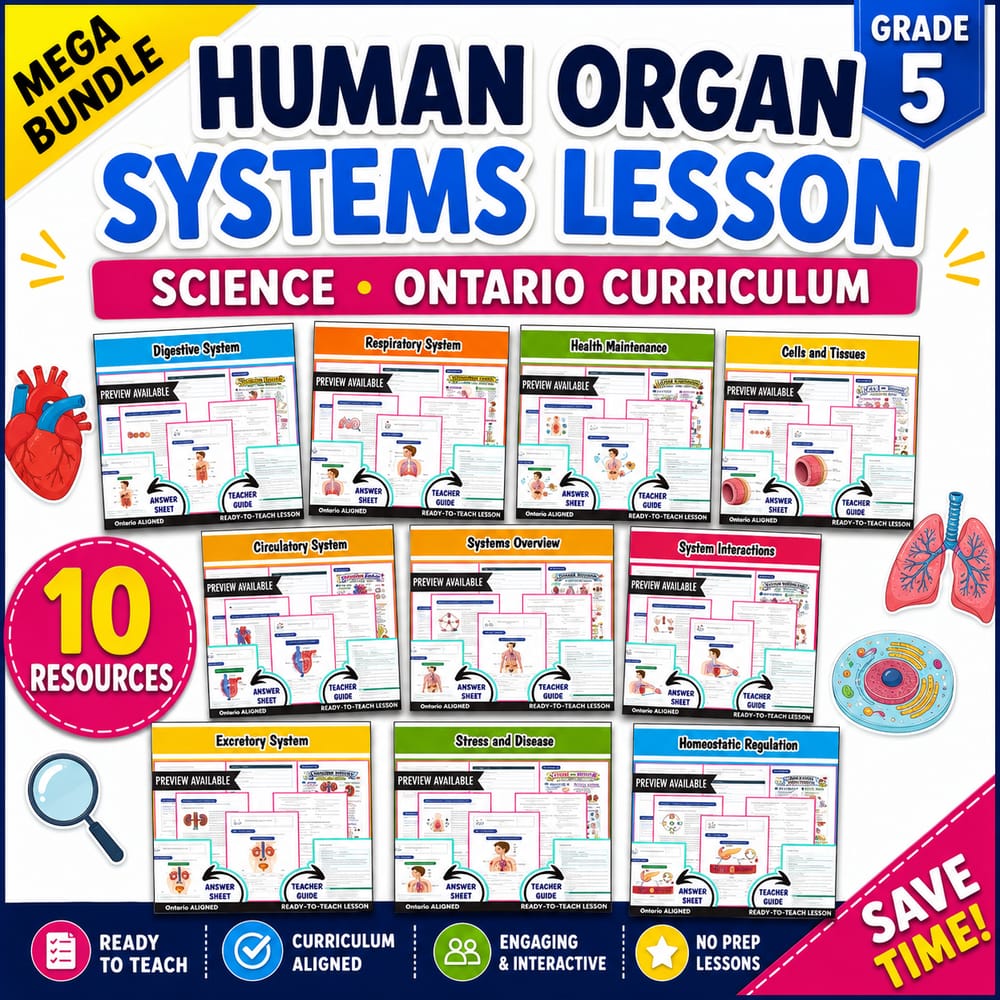
Human Organ Systems Lesson Bundle: Grade 5 Science Ontario Framework
Created byChalk and CompassOverview Grade 5 Science Human Organ Systems is a structured, standards-aligned unit for Ontario learners built around 10 print-only worksheets. This printable resource pack supports a full cycle of learning with printable PDF worksheets plus PDF answer keys with rubric so you can assess thinking and applications consistently across the unit. Students explor…
Instant download

Grade 5 Human Organ Systems Worksheet | Ontario Science Activities & Notes
Created byChalk and CompassLearning Objectives
- Identify key parts of major human organ systems and describe how their structures support their functions
- Explain how the circulatory, respiratory, digestive, and excretory systems work together at a high level
- Use evidence from a short passage to answer questions about system interactions and processes
Also included in: Human Organ Systems Lesson Bundle: Grade 5 Science Ontario Framework
Instant download

Grade 5 Human Body System Interactions Worksheet | Ontario Science Activity
Created byChalk and CompassLearning Objectives
- Explain how the lungs and circulatory system work together to deliver oxygen to tissues.
- Describe how the digestive system and circulatory system cooperate to deliver nutrients to cells.
- Model how the circulatory system delivers substances to the kidneys for filtration and waste removal.
Also included in: Human Organ Systems Lesson Bundle: Grade 5 Science Ontario Framework
Instant download

Grade 5 Physiological Responses to Stress and Disease Science Worksheet
Created byChalk and CompassLearning Objectives
- Describe how the body responds to injury and infection using inflammation and fever
- Explain how stress on organs can change homeostasis, including breathing and kidney filtration
- Identify compensations such as faster heart rate, fluid redistribution, and immune activation
Also included in: Human Organ Systems Lesson Bundle: Grade 5 Science Ontario Framework
Instant download

Grade 5 Respiratory Anatomy and Gas Exchange Worksheet | Ontario Science
Created byChalk and CompassLearning Objectives
- Identify major parts of the upper and lower respiratory system and describe their roles.
- Explain how pressure changes in the chest help move air in and out of the lungs.
- Describe how oxygen enters the blood and how carbon dioxide leaves using diffusion at the alveoli.
Also included in: Human Organ Systems Lesson Bundle: Grade 5 Science Ontario Framework
Instant download

Grade 5 Homeostatic Regulation Mechanisms Worksheet | Ontario Science
Created byChalk and CompassLearning Objectives
- Explain how negative feedback helps keep internal conditions stable.
- Describe how the nervous and endocrine systems make short-term and longer-term adjustments.
- Connect chemoreceptor signaling to breathing and blood pH changes.
Also included in: Human Organ Systems Lesson Bundle: Grade 5 Science Ontario Framework
Instant download

Grade 5 Organ System Health Worksheet | Daily Healthy Habits Science Ontario
Created byChalk and CompassLearning Objectives
- Explain how balanced nutrition, hydration, and sleep support organ system functions.
- Identify how aerobic activity affects the cardiovascular and respiratory systems.
- Use evidence-based examples to prevent common health problems.
Also included in: Human Organ Systems Lesson Bundle: Grade 5 Science Ontario Framework
Instant download

Grade 5 Urine Formation & Kidney Function Worksheet | Ontario Science
Created byChalk and CompassLearning Objectives
- Explain how the kidneys filter blood and form urine using glomeruli and renal tubules.
- Describe the roles of ureters and the bladder in urine transport and storage.
- Connect selective reabsorption and secretion to removing wastes and balancing ions.
Also included in: Human Organ Systems Lesson Bundle: Grade 5 Science Ontario Framework
Instant download

Grade 5 Digestive System Processes & Absorption Worksheet | Ontario Science
Created byChalk and CompassLearning Objectives
- Describe the path food takes through the digestive system, from the oral cavity to the large intestine
- Explain mechanical and chemical digestion, including the roles of enzymes and stomach acid
- Connect how villi and microvilli increase surface area for nutrient absorption
Also included in: Human Organ Systems Lesson Bundle: Grade 5 Science Ontario Framework
Instant download

Grade 5 Circulatory System Parts & Blood Flow Worksheet | Ontario Science
Created byChalk and CompassLearning Objectives
- Identify major heart parts, including chambers and valves that guide one-way blood flow
- Compare arteries, veins, and capillaries by their wall structure and function
- Describe how blood components help with transport, immunity, and clotting
Also included in: Human Organ Systems Lesson Bundle: Grade 5 Science Ontario Framework
Instant download