
Grade 9 Science Worksheets
6,926 worksheets
Grade 9 Science | Organelle Systems - Daily Reading Comprehension
 Created byCoral Reef Learning
Learning Objectives
- Identify mitochondria within a cell diagram
- Explain the function of mitochondria in energy production
- Understand how organelles coordinate to support cell activity
Instant download
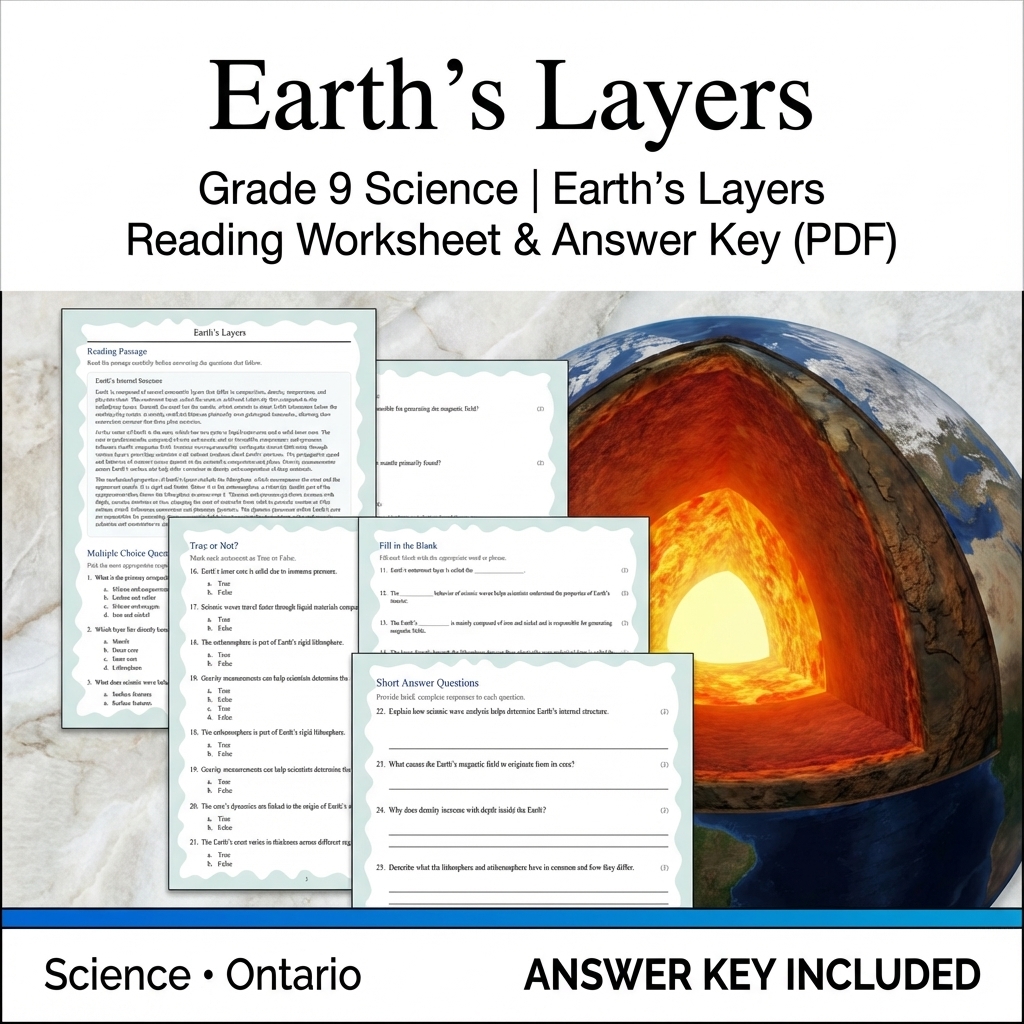
Grade 9 Science | Earth's Layers Reading Worksheet & Answer Key (PDF)
JCreated byJ.S SheetsLearning Objectives
- Describe the main layers of Earth and their properties.
- Understand how seismic waves and gravity inform about Earth's interior.
- Compare the mechanical behavior of Earth's lithosphere and asthenosphere.
Also included in: Grade 9 Science | Earth Processes & Celestial Phenomena Worksheets Collection +1 more
Instant download
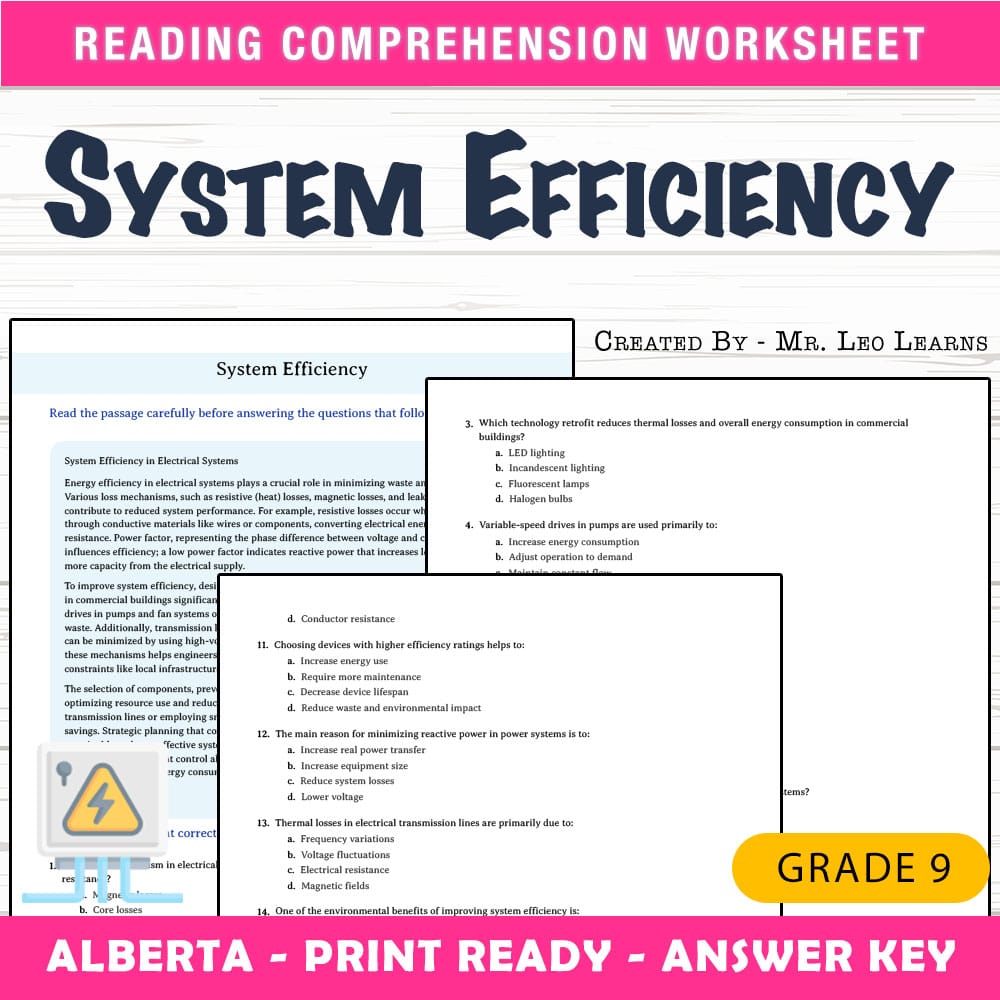
Grade 9 Science — Worksheet MCQ Paper for System Efficiency
 Created byThe Resource Hub
Learning Objectives
- Understand the mechanisms of energy losses in electrical systems.
- Identify strategies to improve energy efficiency and reduce operational costs.
- Evaluate the impact of device selection and system design on overall efficiency.
Also included in: Grade 9 Science Electricity and Magnetism Worksheet Bundle | Alberta Curriculum +1 more
Instant download
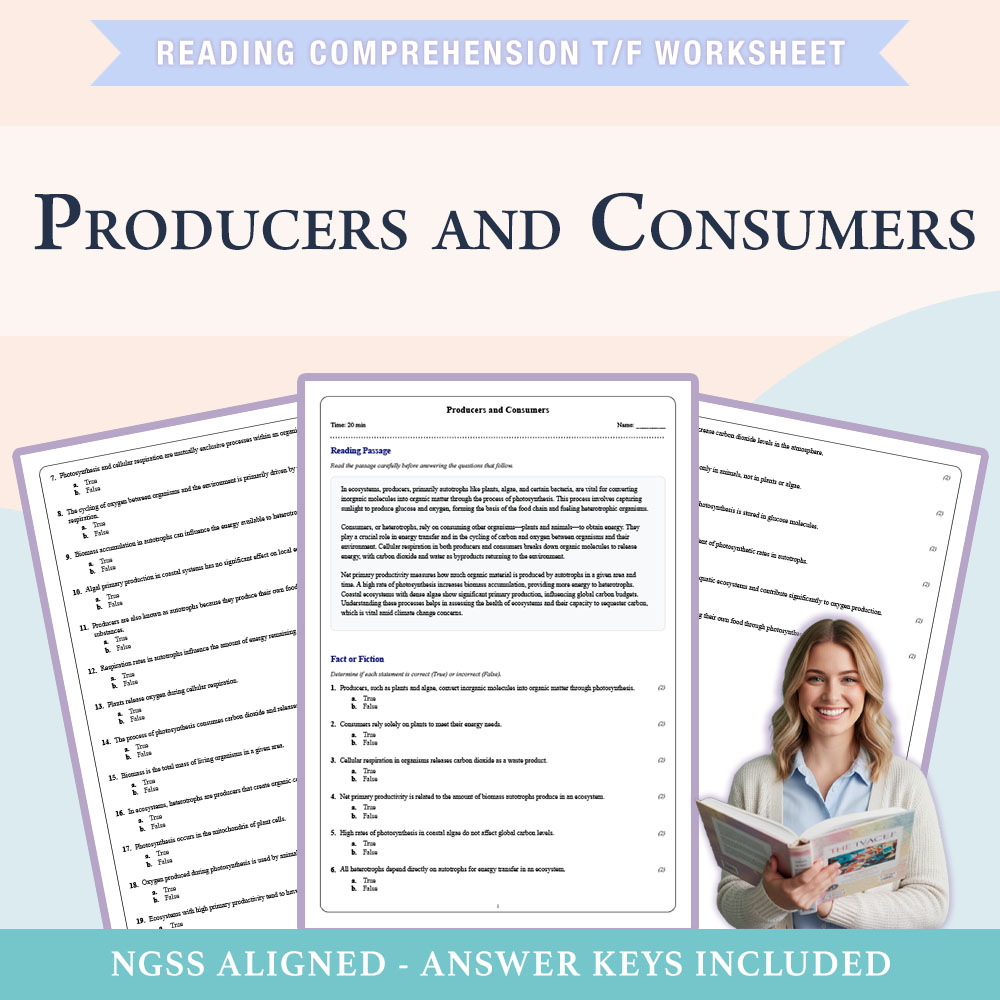
9th Grade Science | Producers and Consumers Worksheet (PDF + Answer Key)
 Created byCopper Leaf Classroom
Learning Objectives
- Understand the roles of producers and consumers in the ecosystem.
- Explain how photosynthesis and cellular respiration transfer energy and cycle carbon and oxygen.
- Identify examples of autotrophs and heterotrophs and their contributions to biomass and energy flow.
Also included in: Grade 9 Science | Ecosystem Dynamics & Human Impact Bundle (PDF + Answer Key) +1 more
Instant download
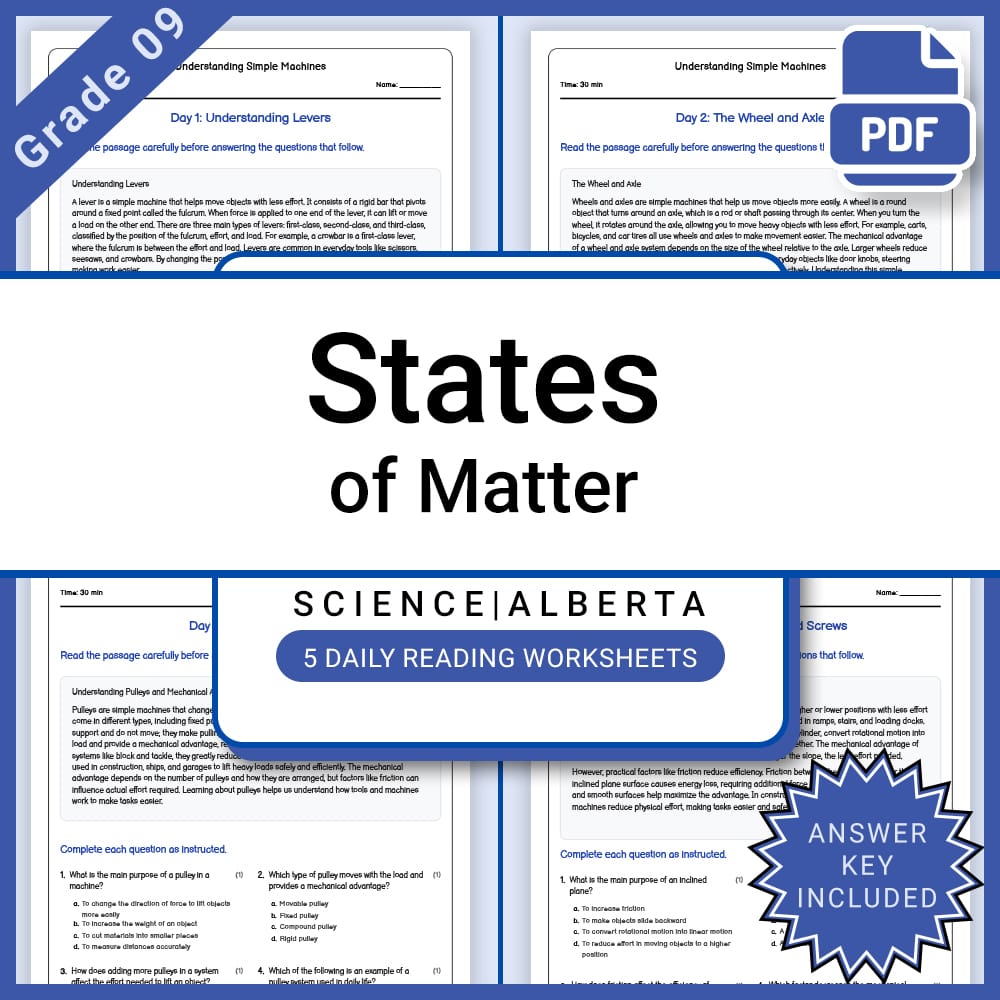
Grade 9 Science – States of Matter Daily Reading Worksheet + Answer Key
JCreated byJ.S SheetsLearning Objectives
- Understand the characteristics of solids, liquids, and gases.
- Identify the behavior and properties of each state.
- Describe the phase transitions between different states.
Also included in: Grade 9 Science Lesson Bundle | Alberta Framework +1 more
Instant download
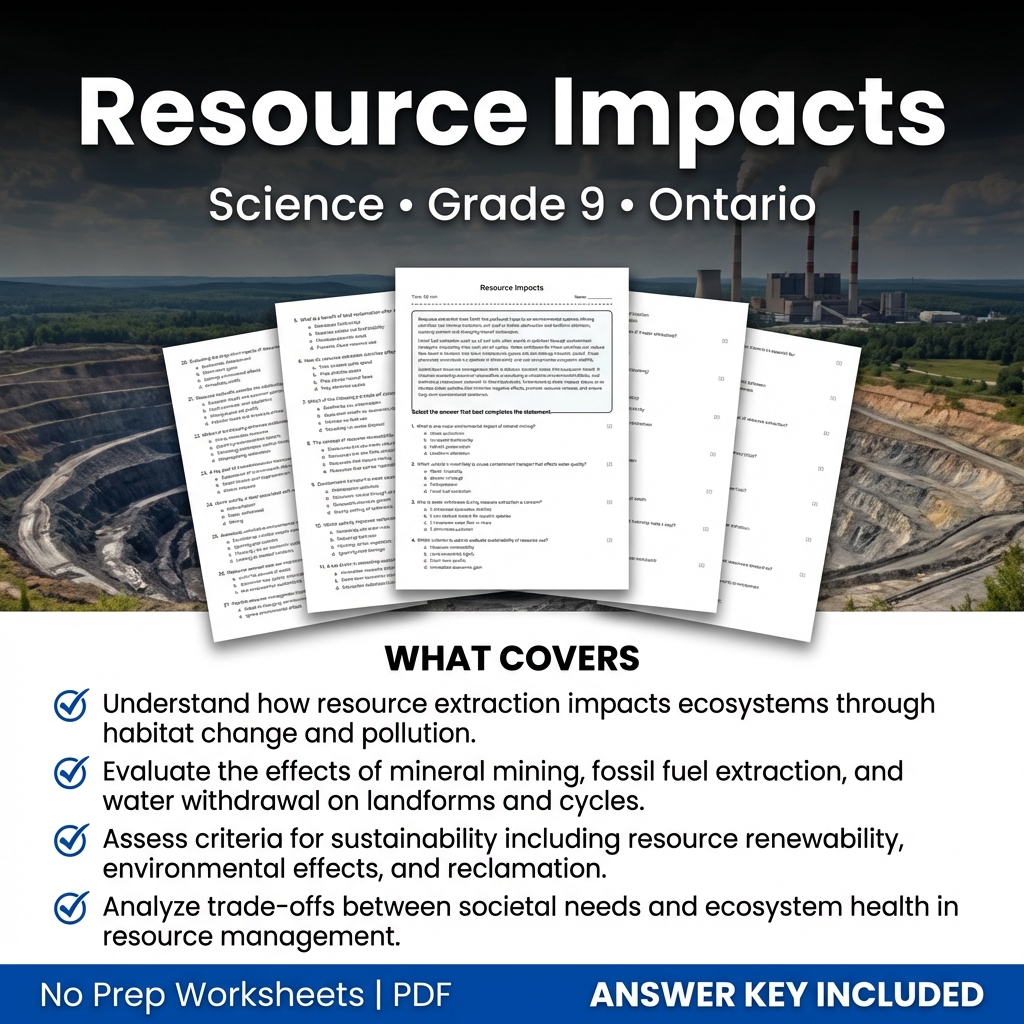
Resource Impacts Worksheet for Grade 9 Science – Ontario Standards
Created byCoral Reef LearningLearning Objectives
- Understand how resource extraction impacts ecosystems through habitat change and pollution.
- Evaluate the effects of mineral mining, fossil fuel extraction, and water withdrawal on landforms and cycles.
- Assess criteria for sustainability including resource renewability, environmental effects, and reclamation.
Instant download
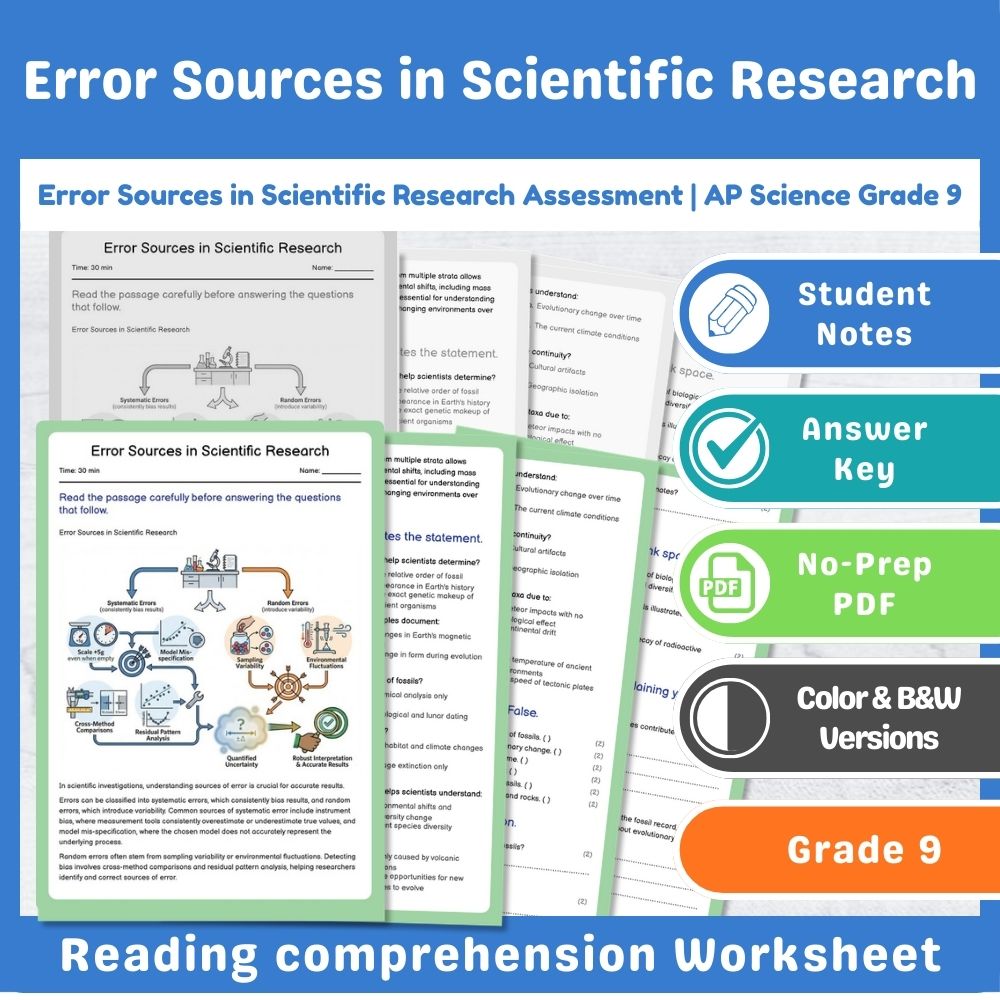
Error Sources in Scientific Research Assessment | AP Science Grade 9
 Created byPrism Point Learning
Learning Objectives
- Understand key concepts related to Science
- Apply knowledge through practice questions
- Demonstrate comprehension of the material
Instant download
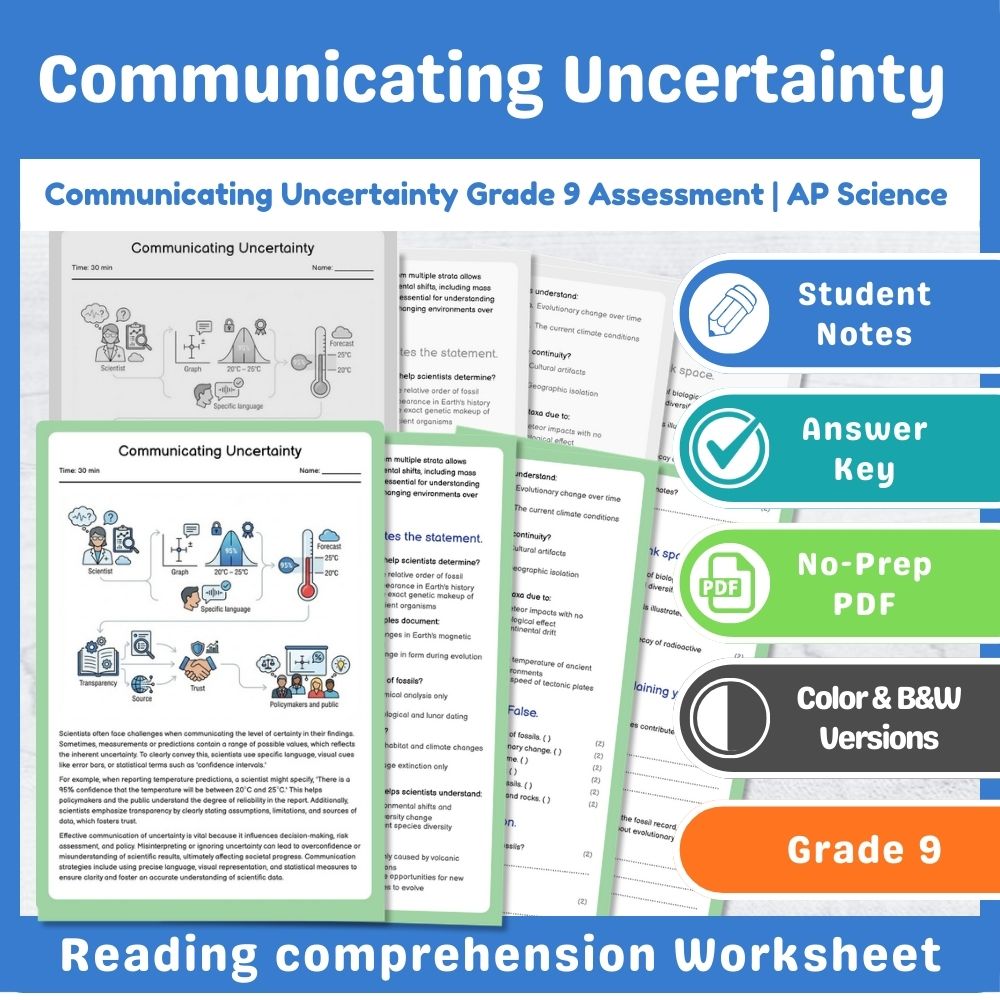
Communicating Uncertainty Grade 9 Assessment | AP Science Standards-Aligned
Created byPrism Point LearningLearning Objectives
- Understand how scientists communicate uncertainty in data and results.
- Identify different methods used to express uncertainty.
- Evaluate the importance of transparency and clarity when communicating scientific findings.
Instant download
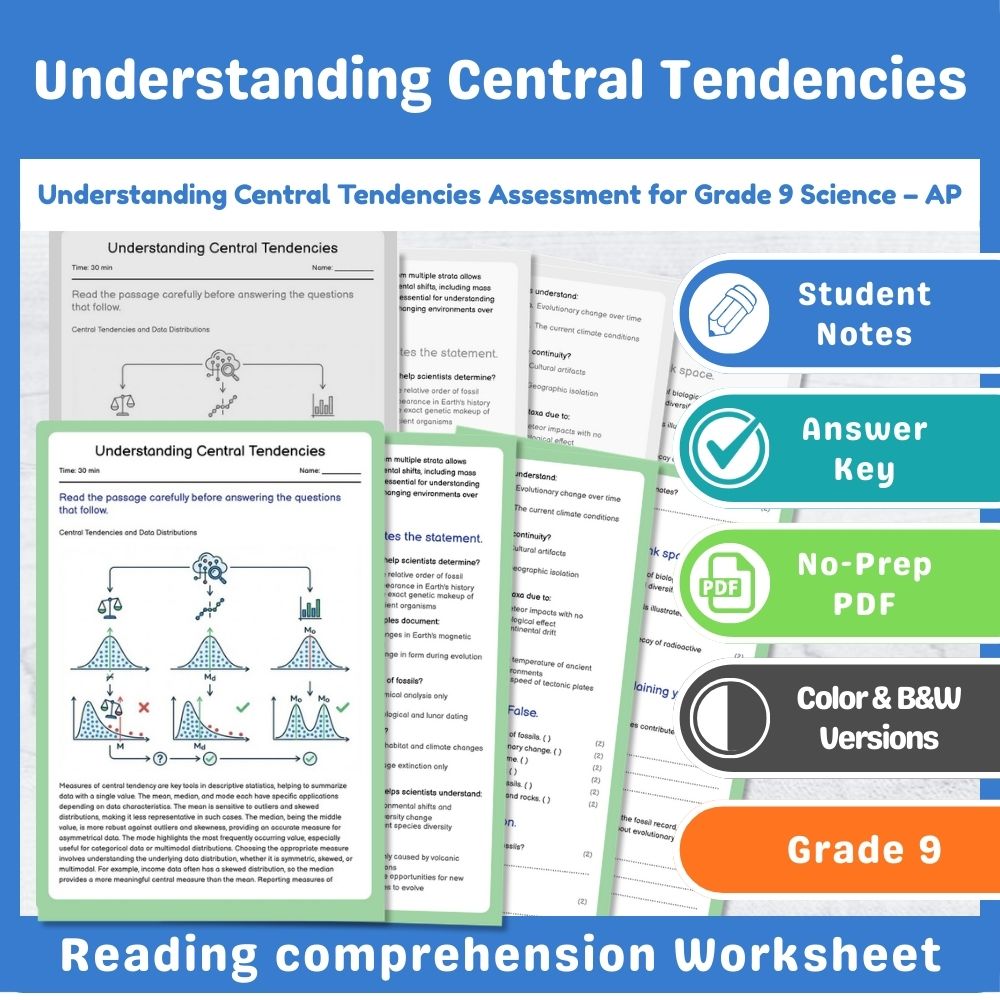
Understanding Central Tendencies Assessment for Grade 9 Science – AP
Created byPrism Point LearningLearning Objectives
- Understand key concepts related to Science
- Apply knowledge through practice questions
- Demonstrate comprehension of the material
Instant download
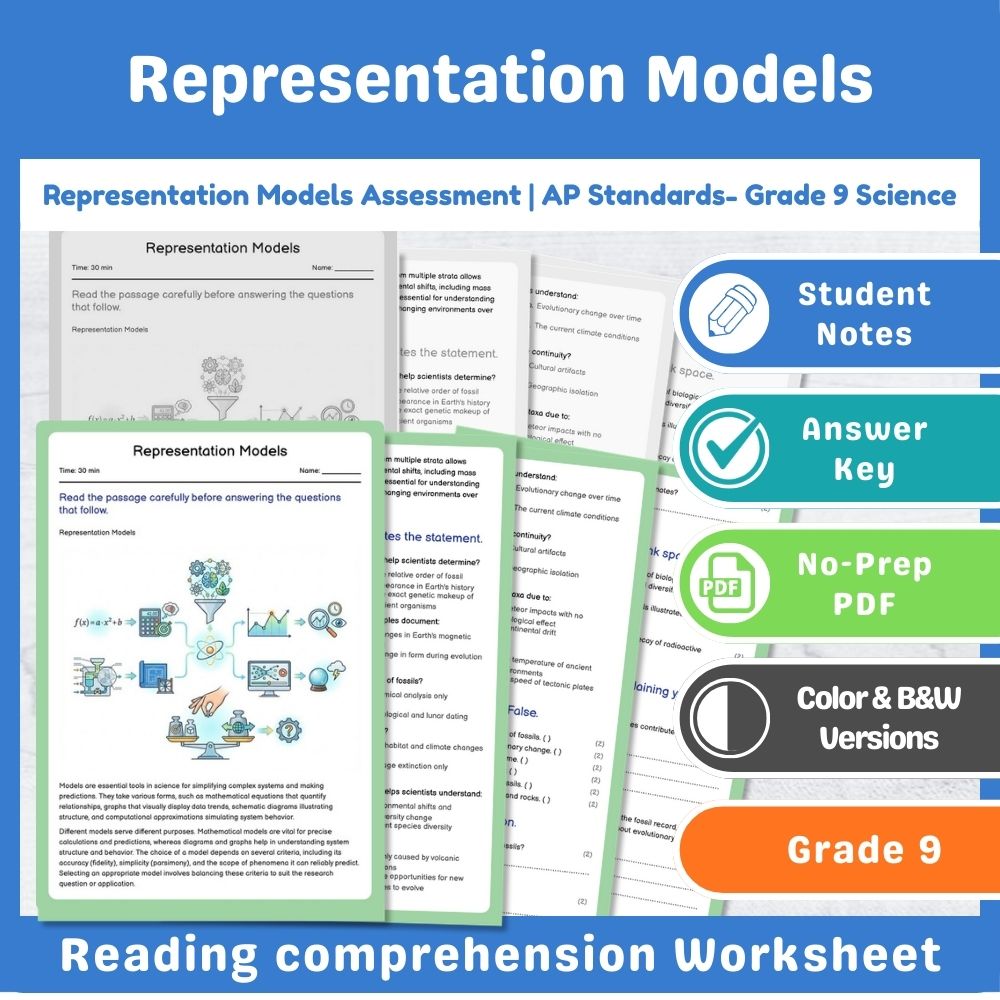
Representation Models Assessment | AP Standards-Aligned Assessment Grade 9 Science
Created byPrism Point LearningLearning Objectives
- Characterize different types of models such as mathematical formulae, graphs, schematic diagrams, and computational approximations.
- Explain the roles of various models in capturing system behavior and predicting outcomes.
- Evaluate criteria for selecting an appropriate model based on fidelity, parsimony, and scope.
Instant download
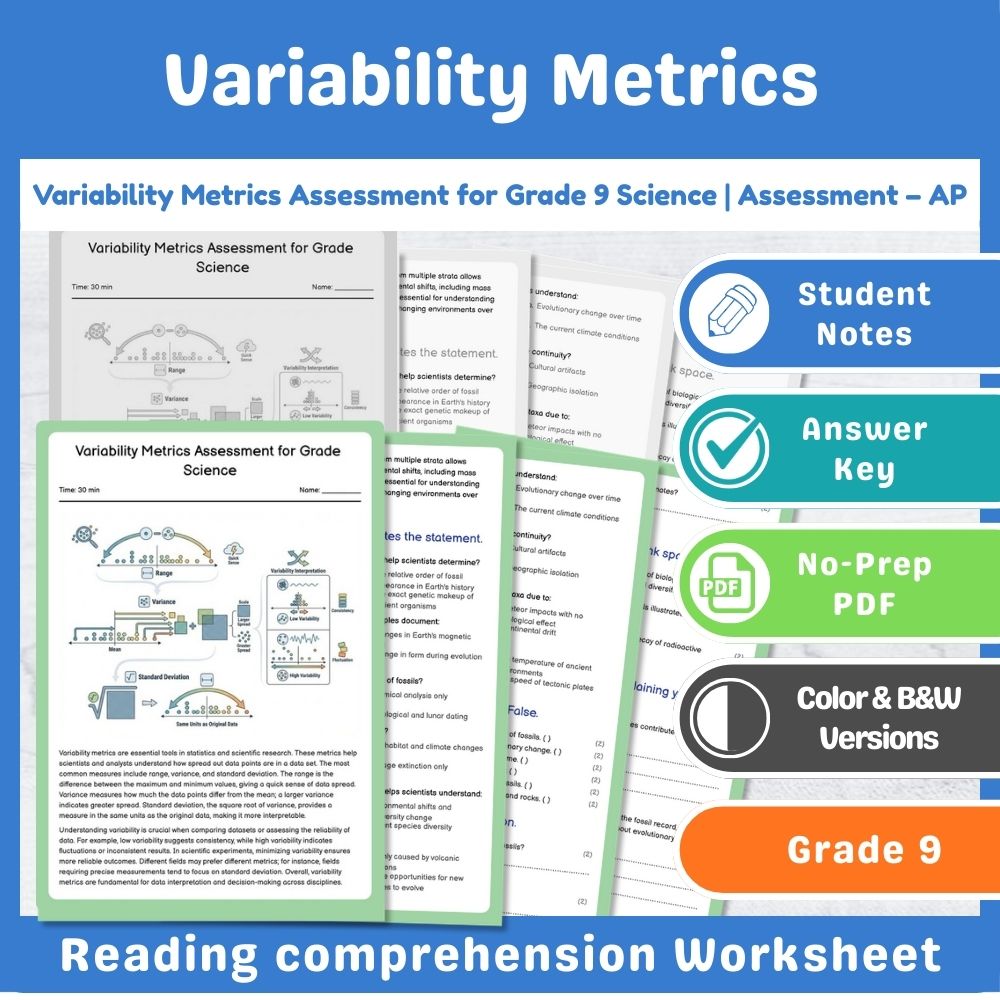
Variability Metrics Assessment for Grade 9 Science | Assessment – AP
Created byPrism Point LearningLearning Objectives
- Understand the concept of variability metrics and their application in data analysis.
- Identify various measures of variability such as range, variance, and standard deviation.
- Analyze data sets to calculate variability metrics and interpret their significance.
Instant download
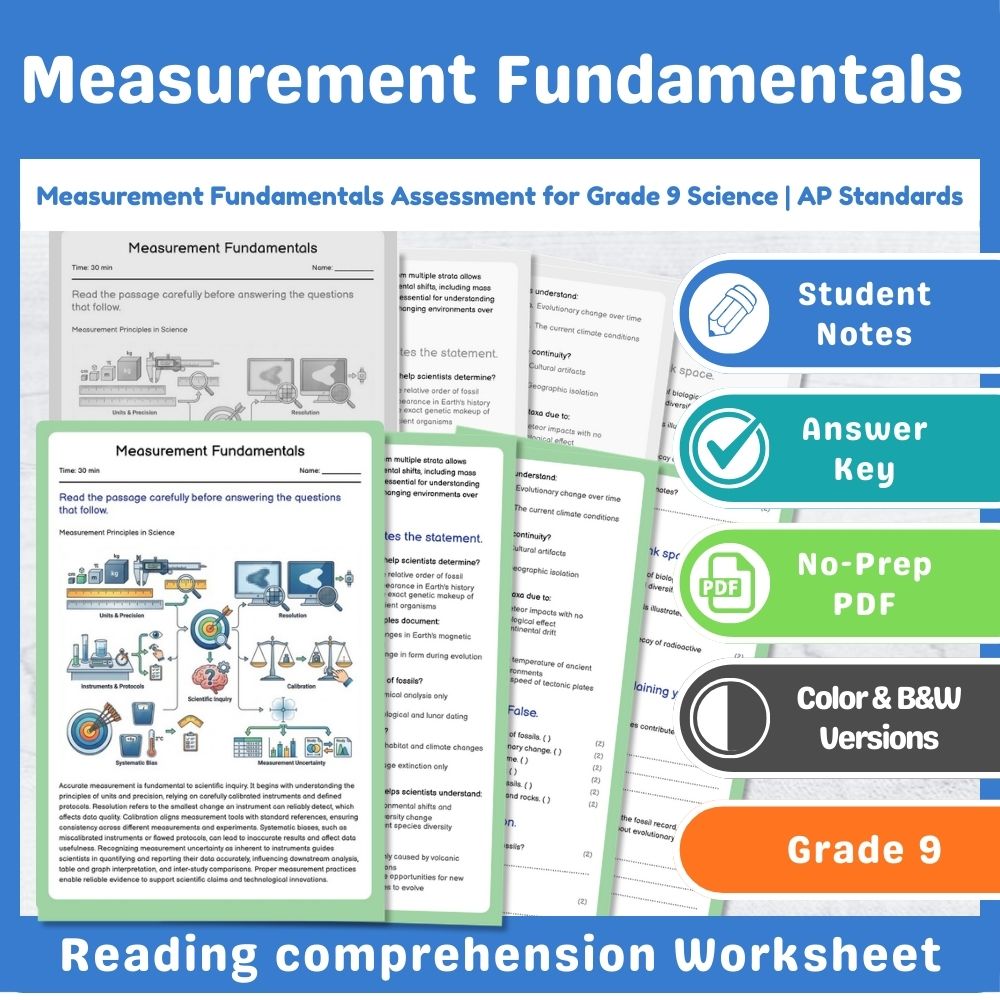
Measurement Fundamentals Assessment for Grade 9 Science | AP Standards
Created byPrism Point LearningLearning Objectives
- Understand the principles of metric measurement and instrument resolution.
- Recognize the importance of calibration in obtaining reliable data.
- Connect raw measurements to data representations and assess measurement uncertainty.
Instant download
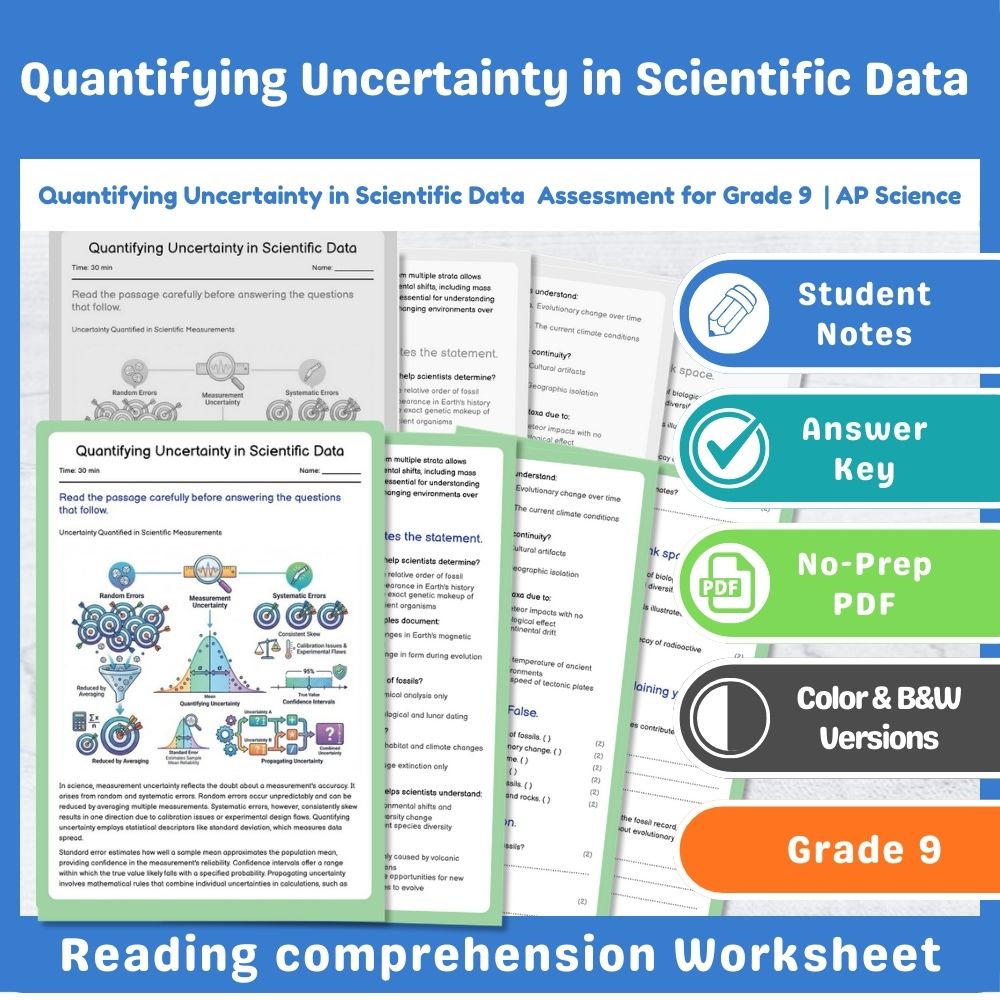
Quantifying Uncertainty in Scientific Data Assessment | Standard Aligned Grade 9 Science
Created byPrism Point LearningLearning Objectives
- Understand how to quantify and interpret random and systematic uncertainties in measurements.
- Learn to apply statistical descriptors such as standard deviation, standard error, and confidence intervals.
- Explore procedures for propagating uncertainty through calculations and combined data.
Instant download
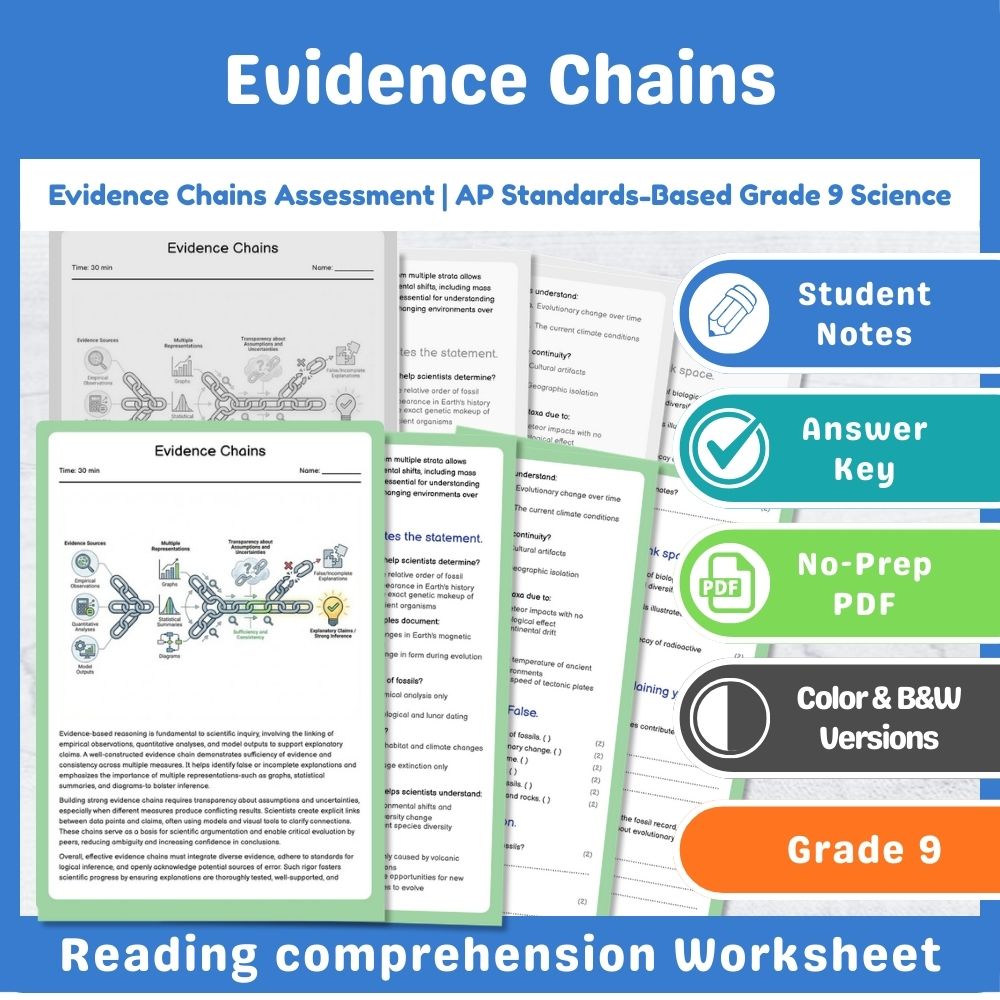
Evidence Chains Assessment | AP Standards-Based Grade 9 Science
Created byPrism Point LearningLearning Objectives
- Understand the structure of evidence-based reasoning linking observations, analyses, and claims.
- Identify criteria for sufficiency, consistency, and alternative explanations in scientific reasoning.
- Use multiple representations—graphs, summaries, diagrams—to support inferences.
Instant download
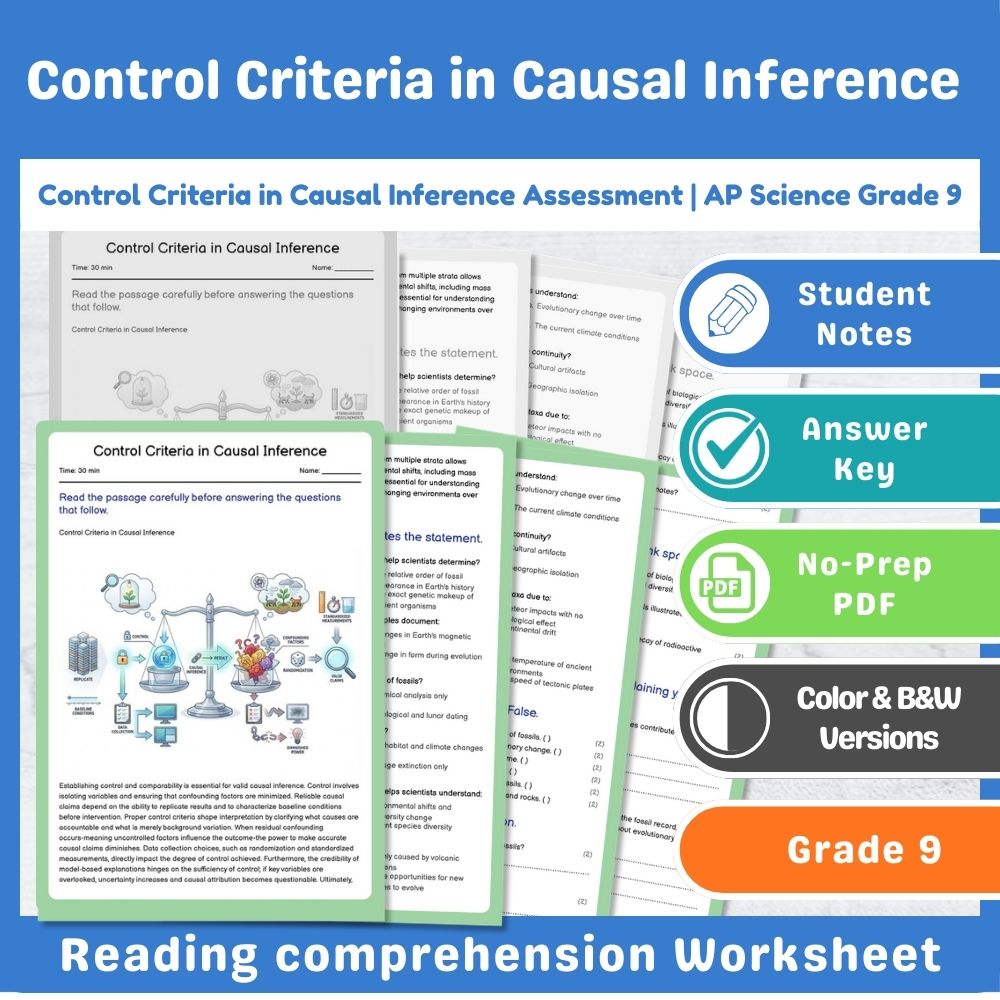
Control Criteria in Causal Inference Assessment | AP Science Grade 9
Created byPrism Point LearningLearning Objectives
- Understand the key criteria used to establish control and comparability in causal inference.
- Describe how variable isolation, replication, and baseline characterization contribute to causal analysis.
- Evaluate how control considerations influence data collection and model credibility.
Instant download
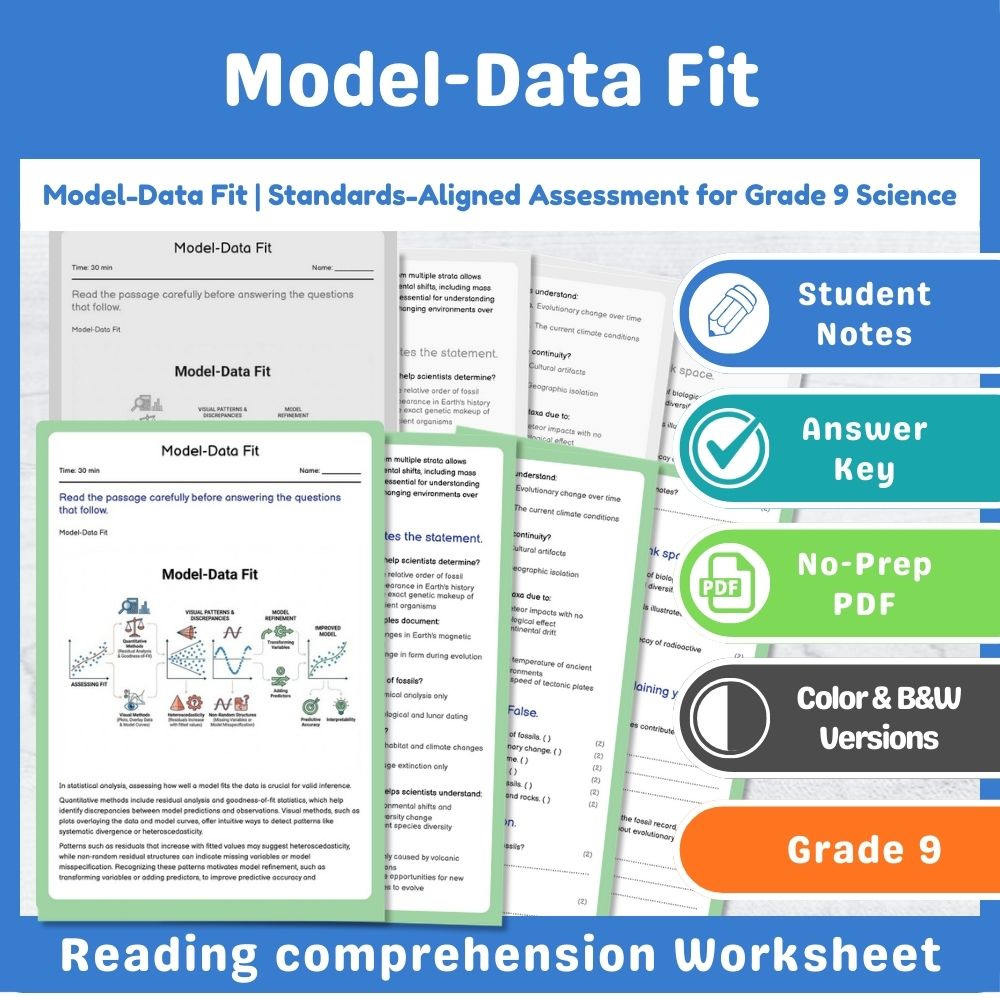
Model-Data Fit Assessment | Standards-Aligned Assessment for Grade 9 Science
Created byPrism Point LearningLearning Objectives
- Understand methods for assessing the fit between models and empirical data.
- Identify diagnostic patterns indicating systematic divergence, heteroscedasticity, or missing variables.
- Explain the significance of residual analysis and goodness-of-fit measures in model validation.
Instant download
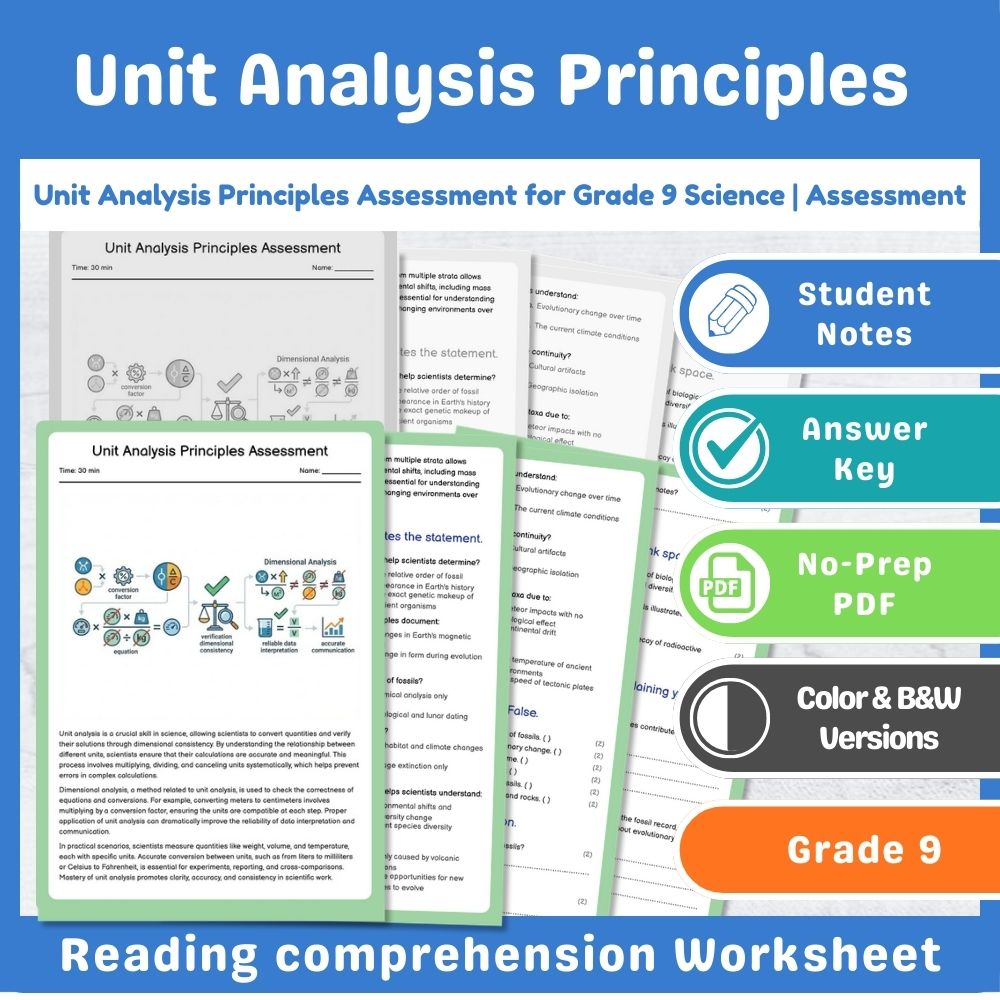
Unit Analysis Principles Assessment for Grade 9 Science | Assessment
Created byPrism Point LearningLearning Objectives
- Understand the fundamental principles of unit analysis in scientific measurements.
- Apply dimensional analysis to solve multi-step transformation problems.
- Evaluate the accuracy and precision of measurement results using unit conversions.
Instant download
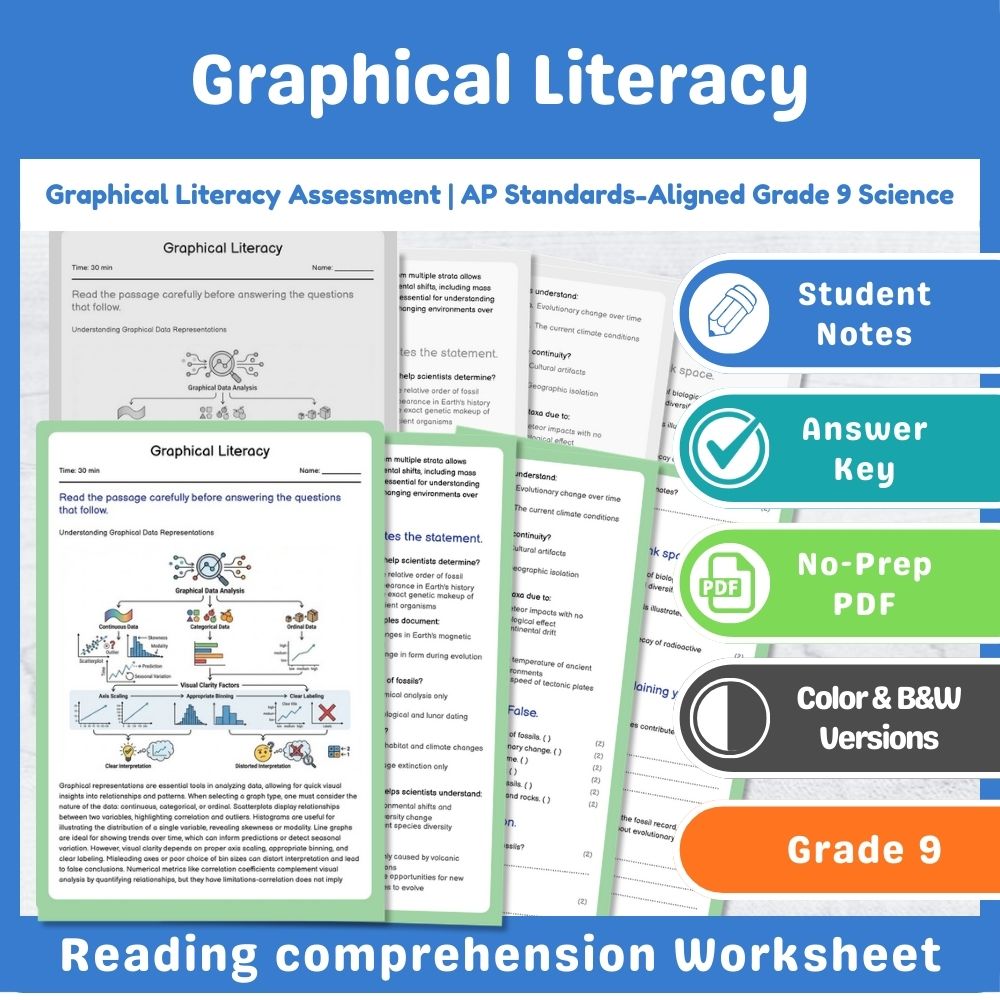
Graphical Literacy Assessment | AP Standards-Aligned Grade 9 Science
Created byPrism Point LearningLearning Objectives
- Identify various types of graphical representations used in data analysis.
- Construct accurate and effective graphs such as scatterplots, histograms, and line graphs.
- Interpret visual patterns, outliers, and trends in data visualizations.
Instant download
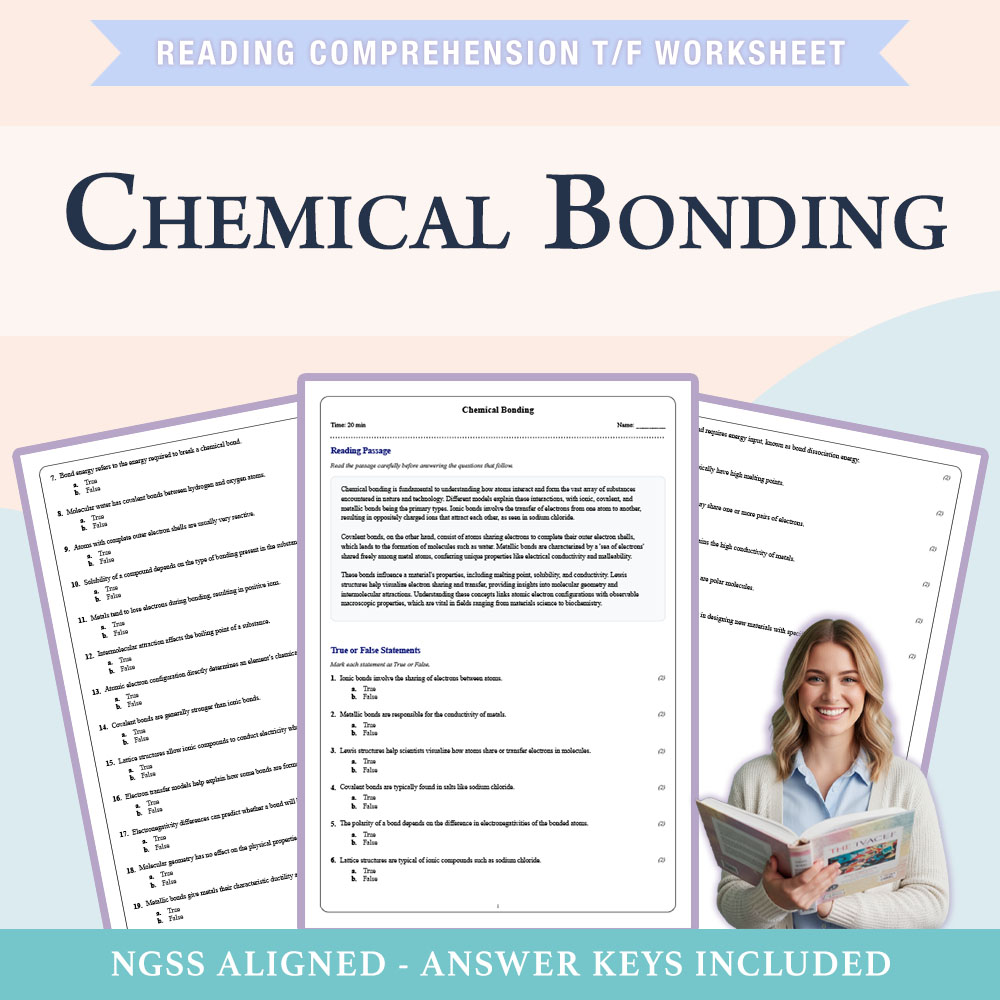
9th Grade Science | Chemical Bonding Worksheet (PDF + Answer Key)
Created byCopper Leaf ClassroomLearning Objectives
- Understand the different types of chemical bonds: ionic, covalent, and metallic.
- Recognize how bonding influences molecular structure and properties.
- Interpret Lewis structures and models of electron sharing and transfer.
Also included in: Grade 9 Science | Reaction & Atomic Structure Unit Bundle (PDF + Answer Key) +1 more
Instant download
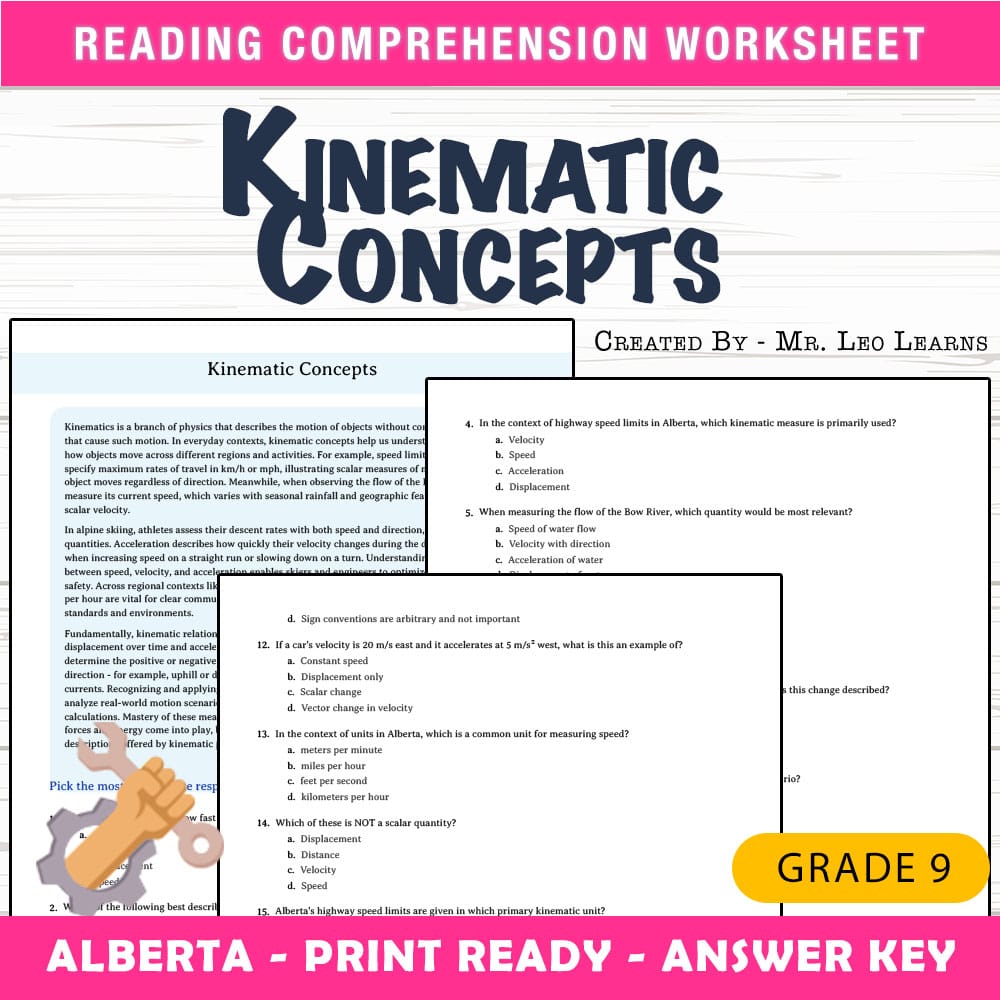
Grade 9 Science — Kinematic Concepts Worksheet MCQ Paper for Mastery
Created byThe Resource HubLearning Objectives
- Understand the definitions of speed, velocity, and acceleration and how they differ.
- Apply scalar and vector measures to describe object motion.
- Interpret real-world examples of motion using kinematic measures.
Also included in: Grade 9 Science Forces and Motion Worksheet Pack | Alberta Curriculum +1 more
Instant download
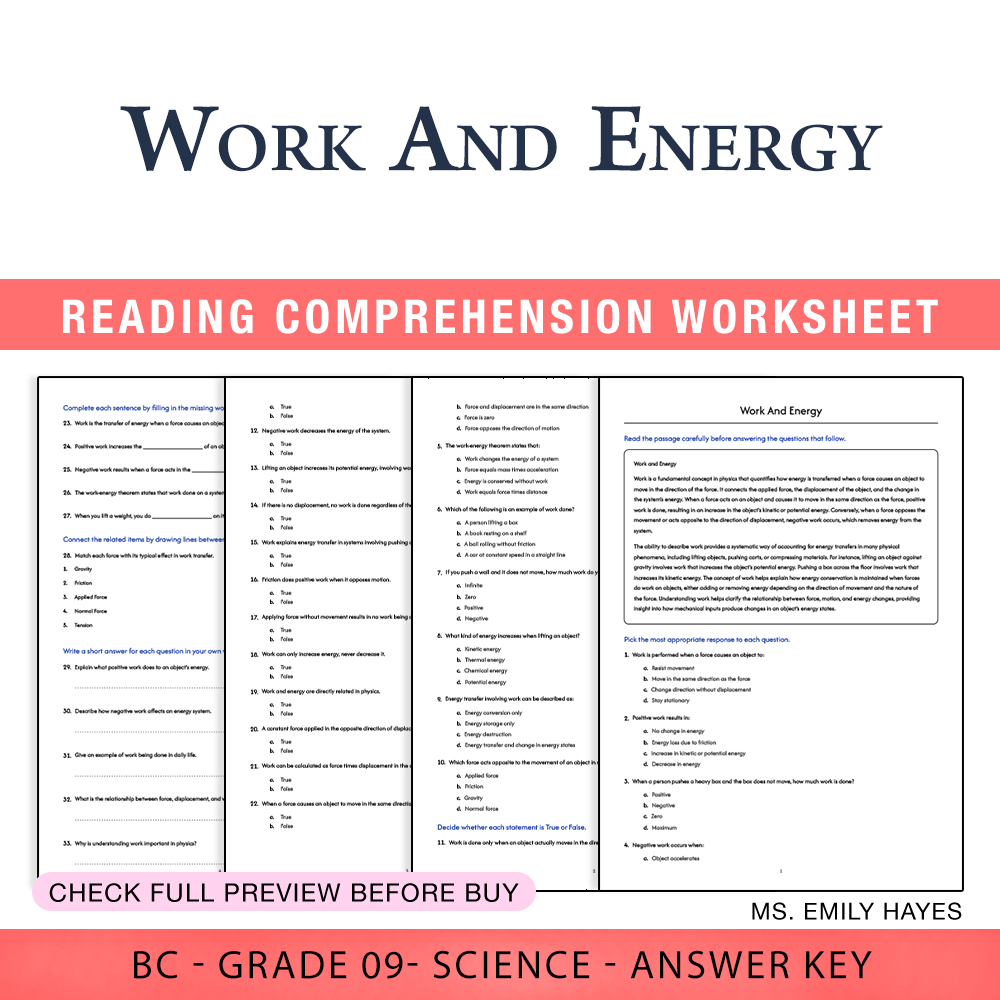
9th Grade Science | Work & Energy Worksheet (PDF+ Answer Key)
Created byCopper Leaf ClassroomLearning Objectives
- Understand the concept of work in relation to force, displacement, and energy transfer.
- Distinguish between positive and negative work and their effects on energy.
- Apply the work-energy theorem to simple physics problems.
Also included in: Grade 9 Science Worksheet Bundle | Forces, Energy & Motion (PDF + Answer Key) +1 more
Instant download
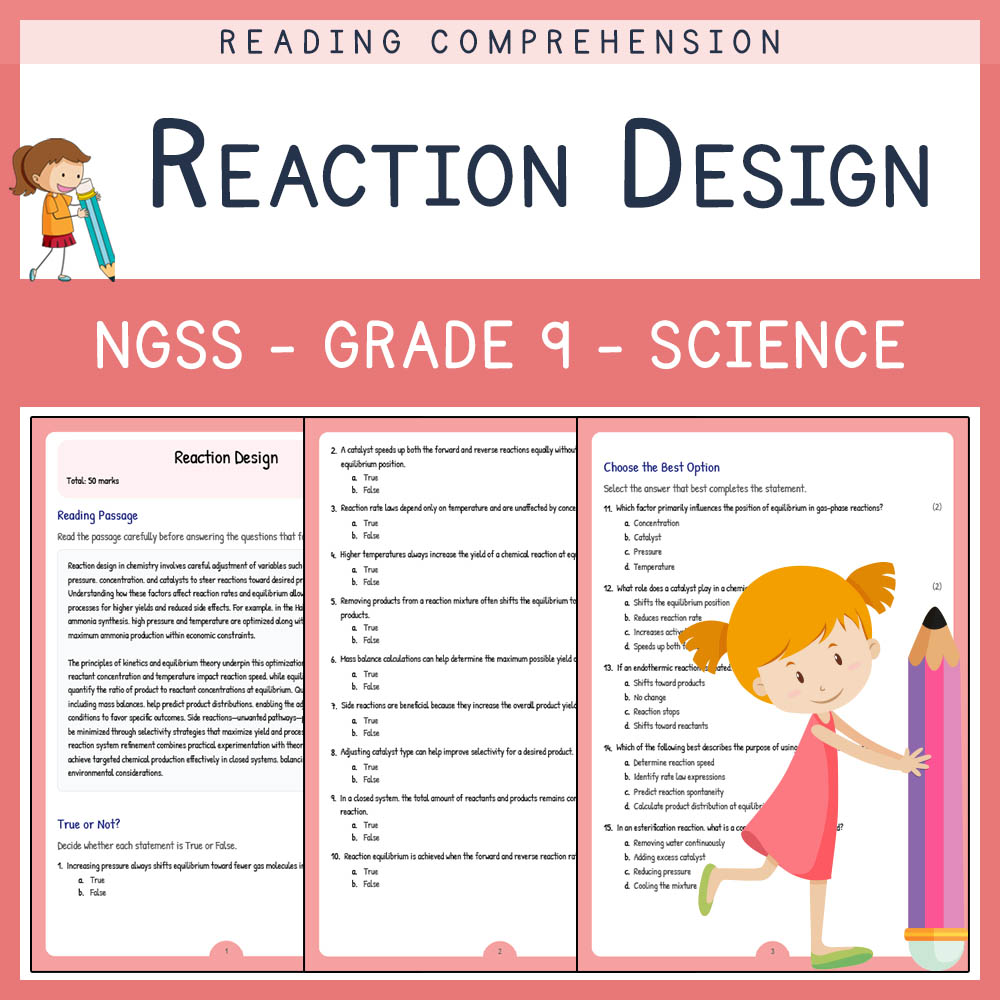
Grade 9 Science | Reaction Design Worksheet & Answer Key for NGSS
 Created byLumora Learning
Learning Objectives
- Understand how temperature, pressure, concentration, and catalysts influence reaction rates and equilibrium.
- Analyze the role of equilibrium constants and reaction-rate expressions in predicting product yields.
- Apply principles of kinetics and equilibrium to optimize chemical processes like Haber synthesis and esterification.
Instant download
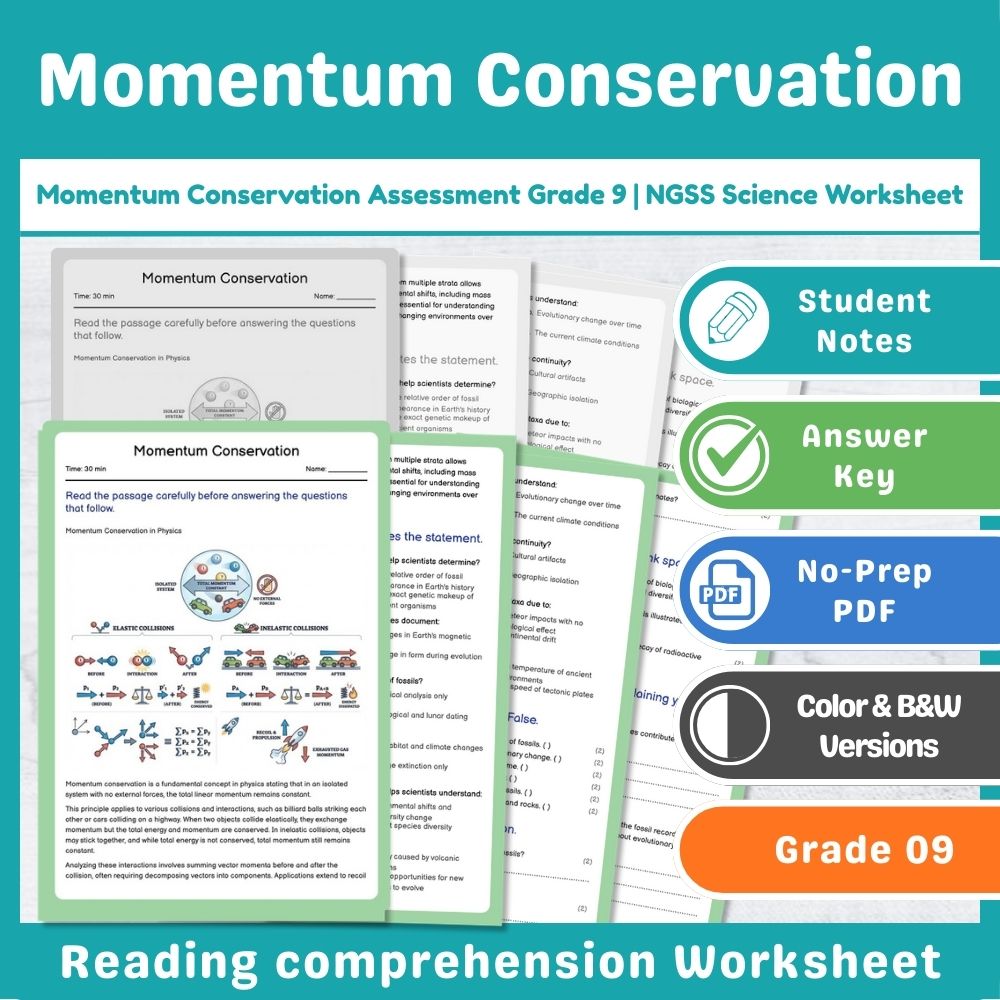
Momentum Conservation Assessment Grade 9 | NGSS Science Worksheet
Created byPrism Point LearningLearning Objectives
- Understand the principle of conservation of linear momentum in isolated systems.
- Differentiate between elastic and inelastic collisions using vector sums.
- Calculate total momentum before and after interactions in various scenarios.
Instant download
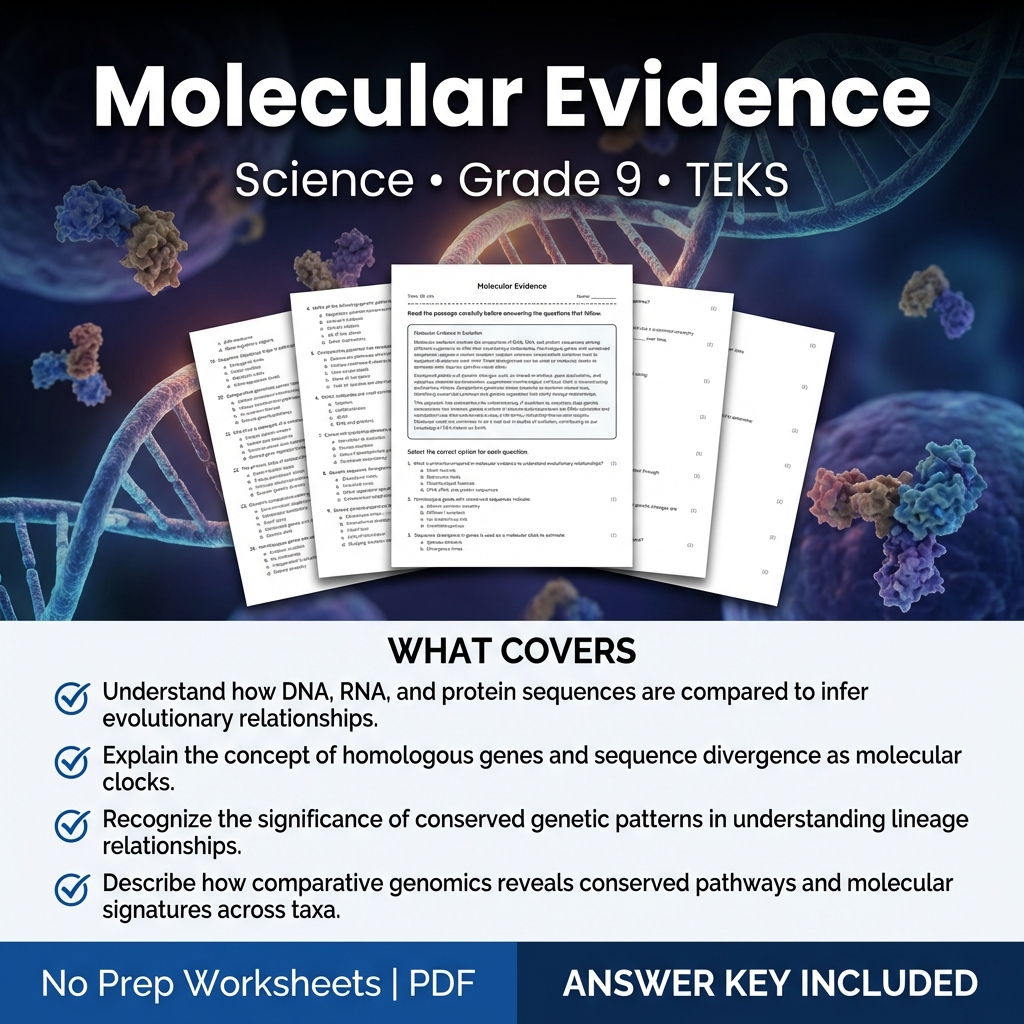
Molecular Evidence Worksheet for Grade 9 Science | TEKS Aligned
Created byCoral Reef LearningLearning Objectives
- Understand how DNA, RNA, and protein sequences are compared to infer evolutionary relationships.
- Explain the concept of homologous genes and sequence divergence as molecular clocks.
- Recognize the significance of conserved genetic patterns in understanding lineage relationships.
Instant download
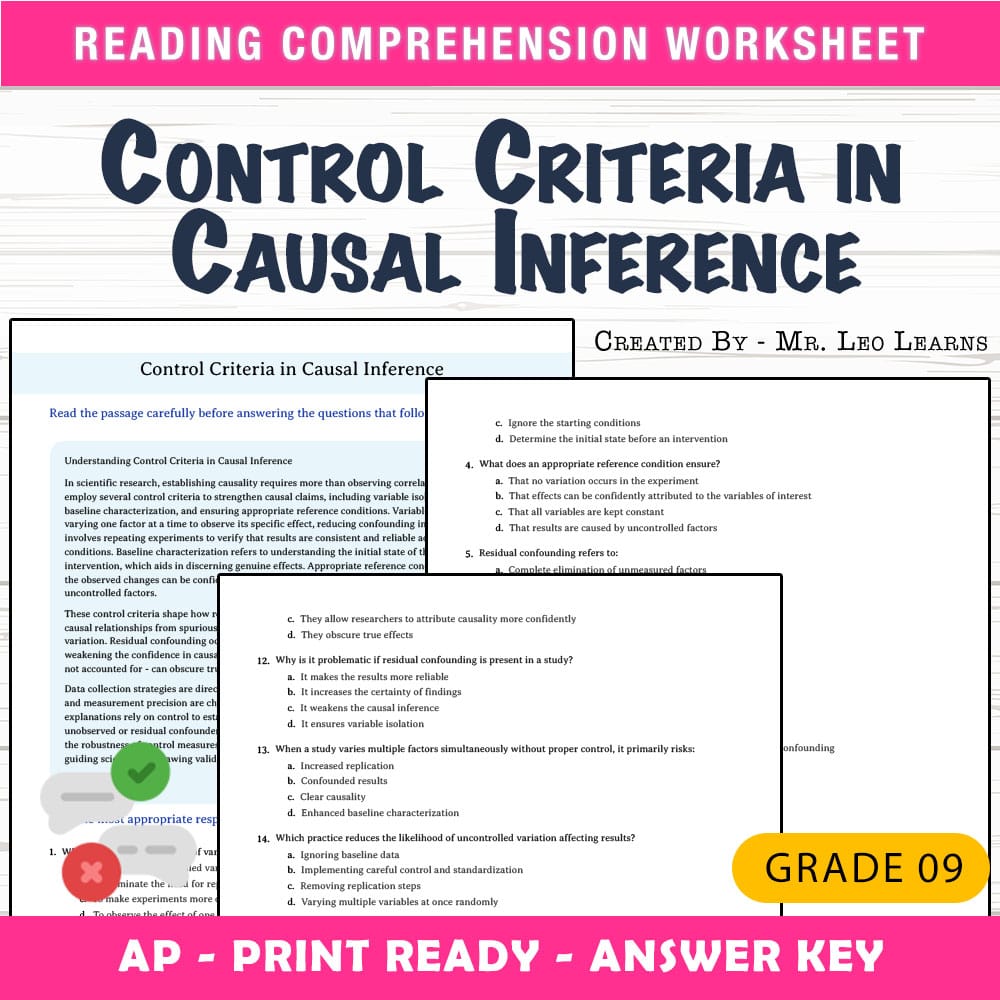
Grade 9 Science — Worksheet MCQ Paper for Mastering Control Criteria
Created byThe Resource HubLearning Objectives
- Understand the key criteria used to establish control and comparability in causal analysis.
- Identify the importance of variable isolation, replication, and baseline characterization.
- Recognize how control considerations influence data collection and the interpretation of causal claims.
Also included in: Grade 9 Science Practices Lesson Bundle for AP Standards +1 more
Instant download

Grade 9 Science | Mass Conservation in Chemistry - Daily Reading Comprehension
Created byCoral Reef LearningLearning Objectives
- Understand key concepts related to Science
- Apply knowledge through practice questions
- Demonstrate comprehension of the material
Instant download
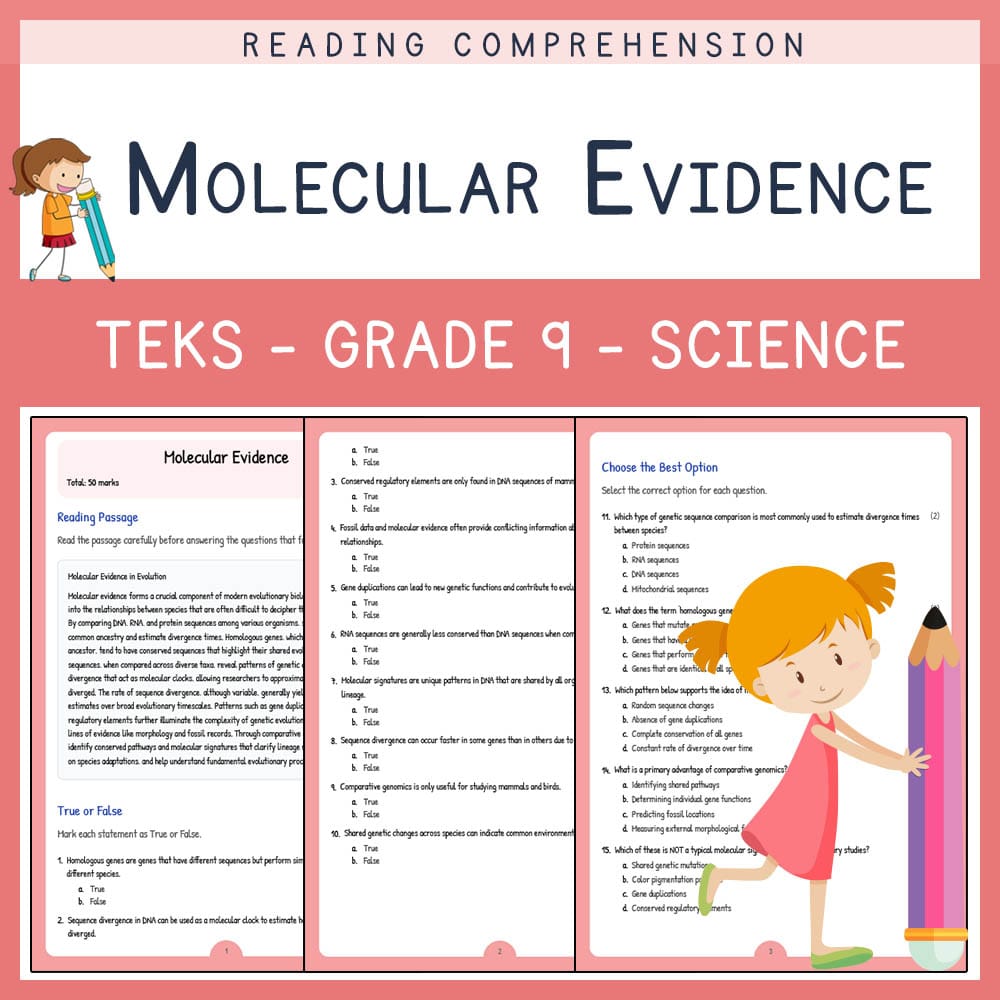
Grade 9 Science | Molecular Evidence Worksheet | TEKS Aligned
Created byLumora LearningLearning Objectives
- Understand how DNA, RNA, and protein sequences are used to infer evolutionary relationships.
- Explain the concept of homologous genes and sequence divergence as molecular clocks.
- Identify patterns of shared genetic changes, gene duplications, and conserved elements that inform lineage relationships.
Instant download

Cell Type Differences Worksheet | Grade 9 Science Activities
Created byPrism Point LearningLearning Objectives
- Compare prokaryotic and eukaryotic cell structure, including key organelles and chromosomes
- Explain how cell architecture affects cell size, complexity, and possible metabolic roles
- Apply knowledge of cell type differences to classify features and evaluate statements
Also included in: Cells and Body Systems Lesson Bundle | Grade 9 Science | BC +1 more
Instant download

Grade 9 Science – Central Tendencies Worksheet (AP Standards) (PDF)
 Created byEvergreen Desk Education
Learning Objectives
- Describe and compare mean, median, and mode as measures of central tendency.
- Explain how skew, outliers, and multimodality affect which central tendency is most informative.
- Choose an appropriate measure of center based on assumptions about the data-generating process.
Also included in: Grade 9 Scientific Reasoning & Uncertainty in Science Lesson Bundle AP +1 more
Instant download
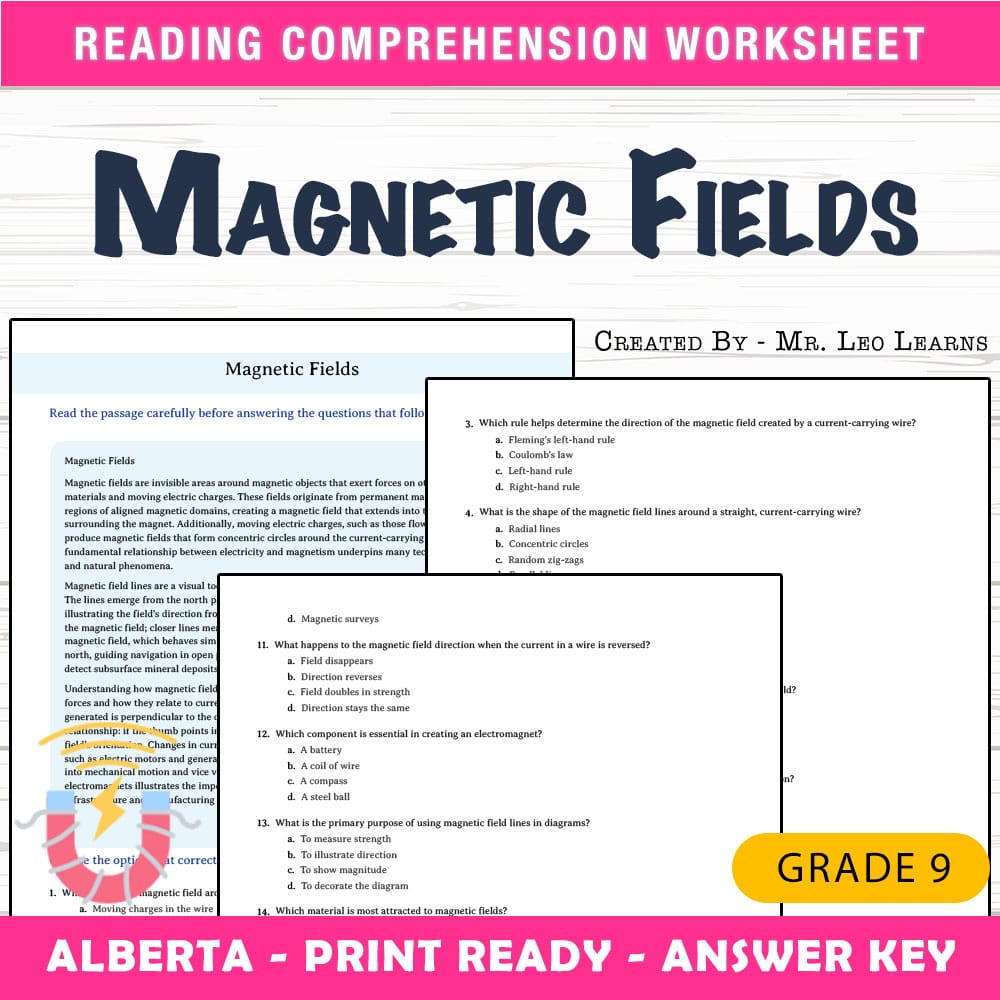
Grade 9 Science — Worksheet MCQ Paper for Mastering Magnetic Fields
Created byThe Resource HubLearning Objectives
- Explain the origin of magnetic fields from permanent magnets and moving electric charges.
- Describe the concept of magnetic field lines and their directional properties.
- Connect the practical applications of magnetism such as compass navigation and industrial sensing.
Also included in: Grade 9 Science Electricity and Magnetism Worksheet Bundle | Alberta Curriculum +1 more
Instant download

Grade 9 Science – Electrical Quantities & Circuits | Daily Reading Worksheet
 Created byBright Mind Resources
Learning Objectives
- Define electric current, voltage, and resistance.
- Explain the role of these quantities in electrical systems.
- Identify units and symbols used to measure electrical quantities.
Also included in: Grade 9 Electrical Circuits & Electromagnetism Science Lesson Bundle | Alberta +1 more
Instant download
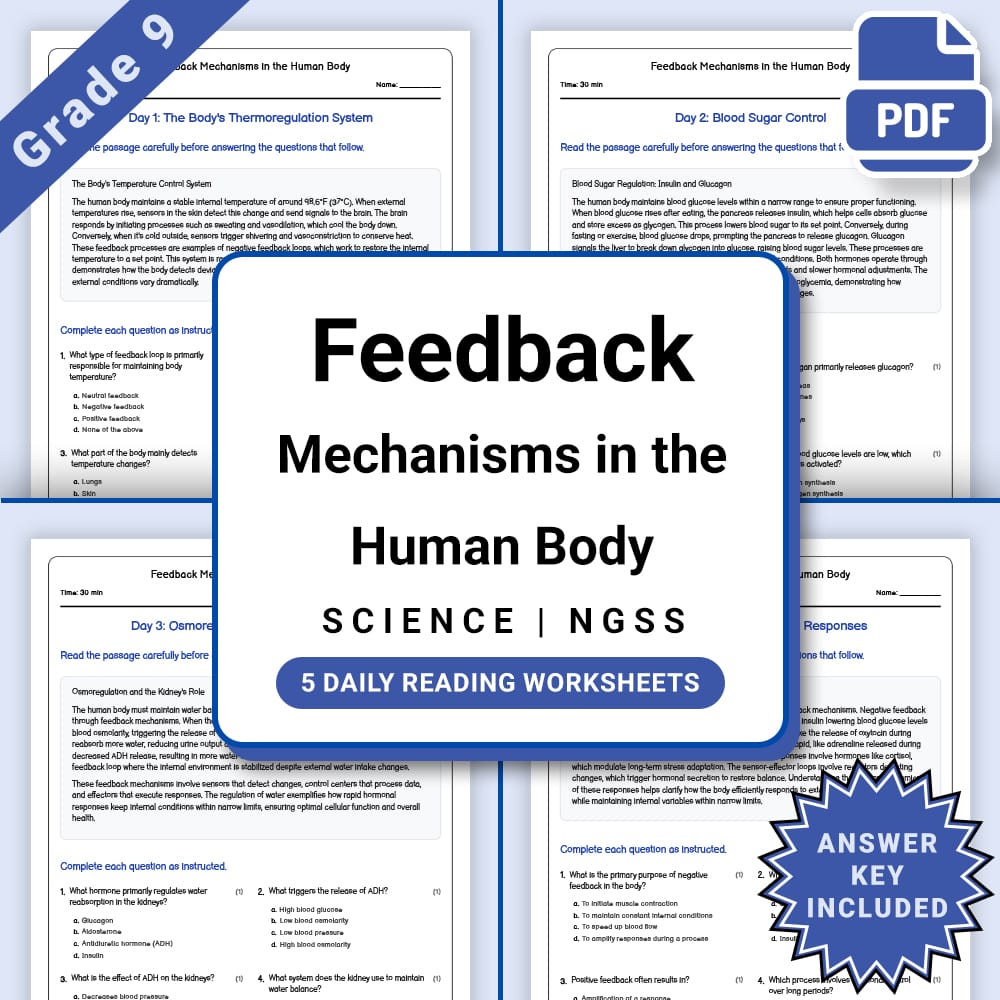
Grade 9 Science – Feedback Mechanisms Worksheet(PDF + Answer Key)
Created byCopper Leaf ClassroomLearning Objectives
- Understand the concepts of negative and positive feedback in physiological processes.
- Identify examples of feedback systems such as thermoregulation, blood glucose control, and osmoregulation.
- Learn how sensors and effectors work together to maintain internal stability.
Instant download

Grade 9 Science – Biogeochemical Cycles Worksheet (Answer Key) | TEKS Standard
Created byBright Mind ResourcesLearning Objectives
- Explain the movement of elements such as carbon, nitrogen, and phosphorus among Earth's reservoirs.
- Identify key processes like photosynthesis, decomposition, nitrogen fixation, and weathering in biogeochemical cycles.
- Analyze how fluxes and reservoir sizes influence ecosystem responses to environmental disturbances.
Also included in: Grade 9 Science UNIT Bundle | Ecosystems & Biogeochemical Cycles TEKS-Aligned +3 more
Instant download

Molecular Geometry Worksheet | Grade 9 Science Activities
Created byPrism Point LearningLearning Objectives
- Use VSEPR ideas to predict the 3D molecular shape from electron-pair arrangement and bond order.
- Relate molecular geometry to molecular polarity and expected intermolecular forces.
- Explain how molecular shape helps predict properties such as boiling point, solubility, and reactivity.
Also included in: Grade 9 Matter and Chemical Change Lesson Bundle | Science | BC +1 more
Instant download

Intermolecular Forces Worksheet Grade 9 Science Activities | Assessment
Created byPrism Point LearningLearning Objectives
- Explain how intermolecular forces influence physical properties such as boiling point and viscosity
- Differentiate between London dispersion forces, dipole–dipole interactions, and hydrogen bonding
- Relate molecular polarity and molecular size to the strength of intermolecular attractions
Also included in: Grade 9 Matter and Chemical Change Lesson Bundle | Science | BC +1 more
Instant download

Reaction Categories Worksheet | Grade 9 Science Activities
Created byPrism Point LearningLearning Objectives
- Classify common chemical reactions into synthesis, decomposition, single displacement, double displacement, and combustion.
- Predict typical products by recognizing patterns in reactants and understanding bond/ion reorganization.
- Explain how oxidation and redox ideas relate to combustion reactions.
Also included in: Grade 9 Matter and Chemical Change Lesson Bundle | Science | BC +1 more
Instant download
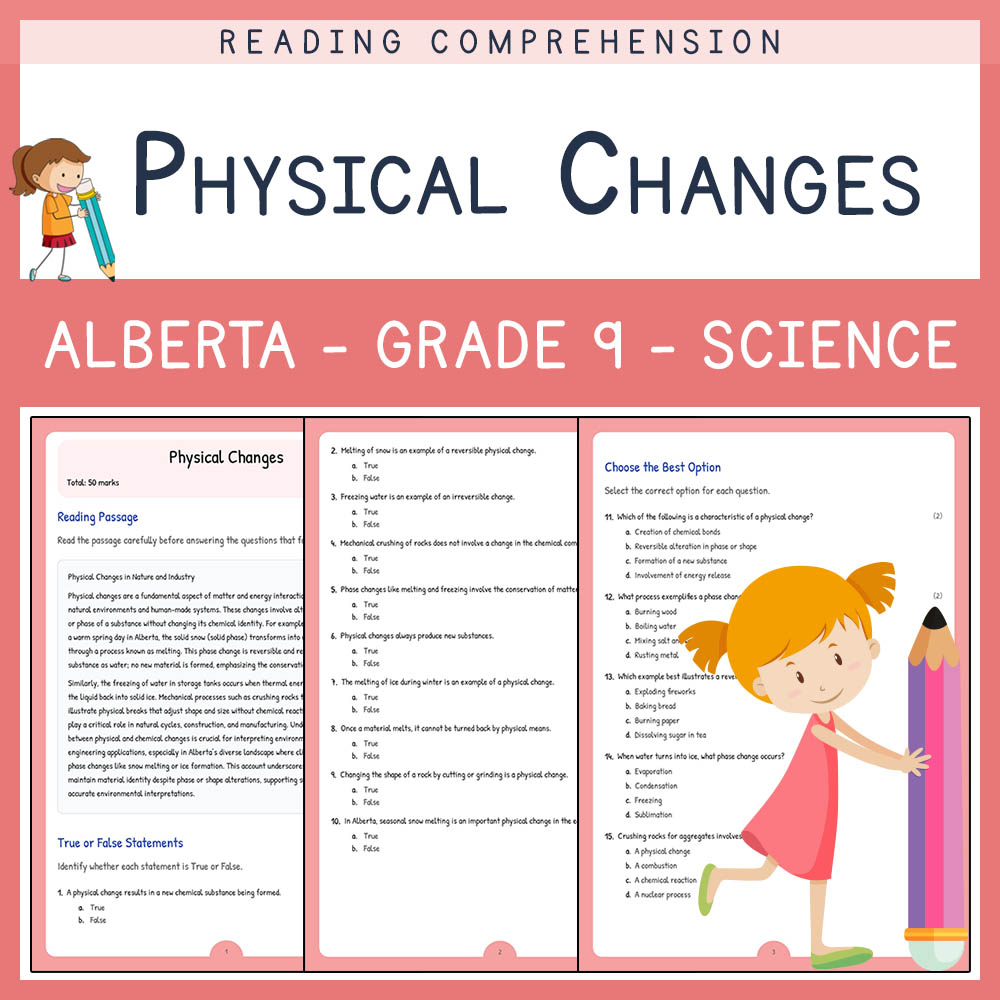
Grade 9 Science | Physical Changes Worksheet | Alberta Standards
Created byLumora LearningLearning Objectives
- Define and differentiate between physical changes and chemical transformations.
- Identify examples of reversible physical changes in everyday scenarios.
- Analyze the effects of phase shifts like melting and freezing in natural and engineered processes.
Instant download
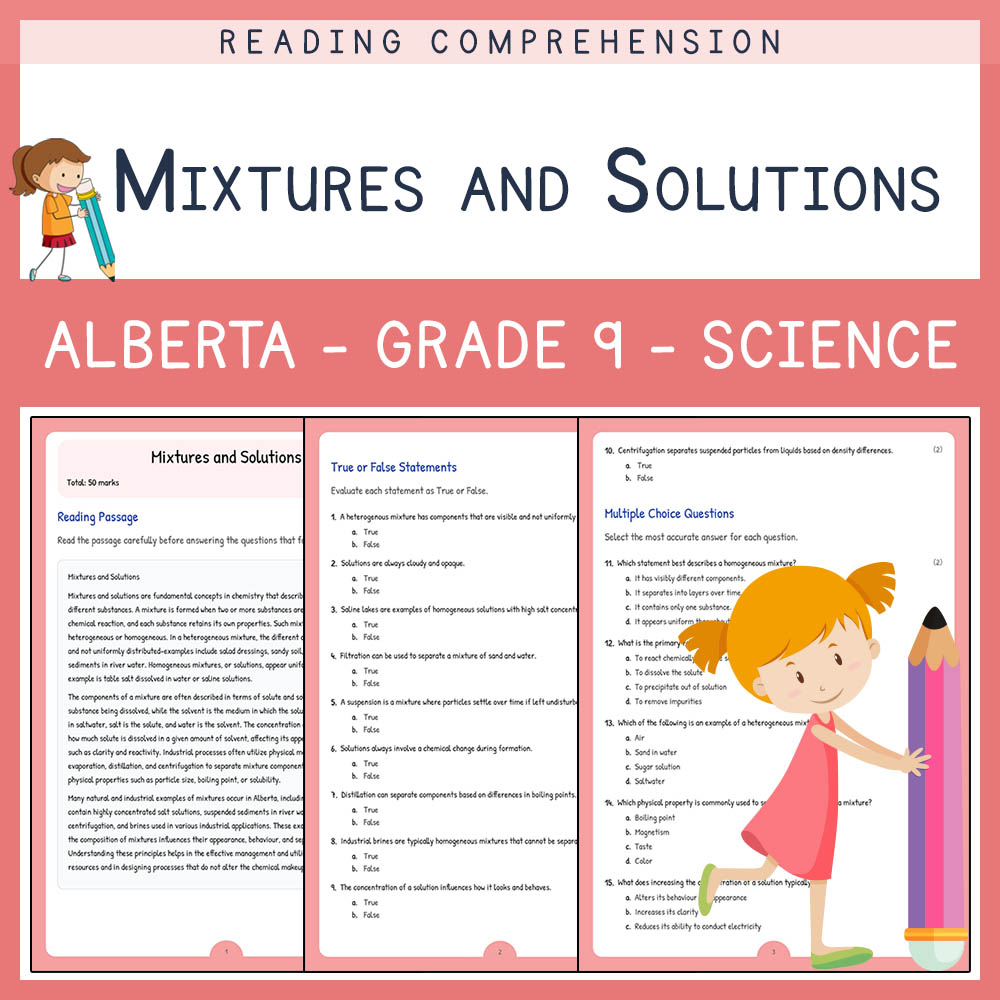
Grade 9 Science | Mixtures and Solutions Worksheet | Alberta Standards
Created byLumora LearningLearning Objectives
- Differentiate between heterogeneous mixtures and homogeneous solutions based on their properties.
- Identify key components of mixtures and solutions, such as solute and solvent.
- Understand how concentration affects the appearance and behaviour of mixtures.
Instant download
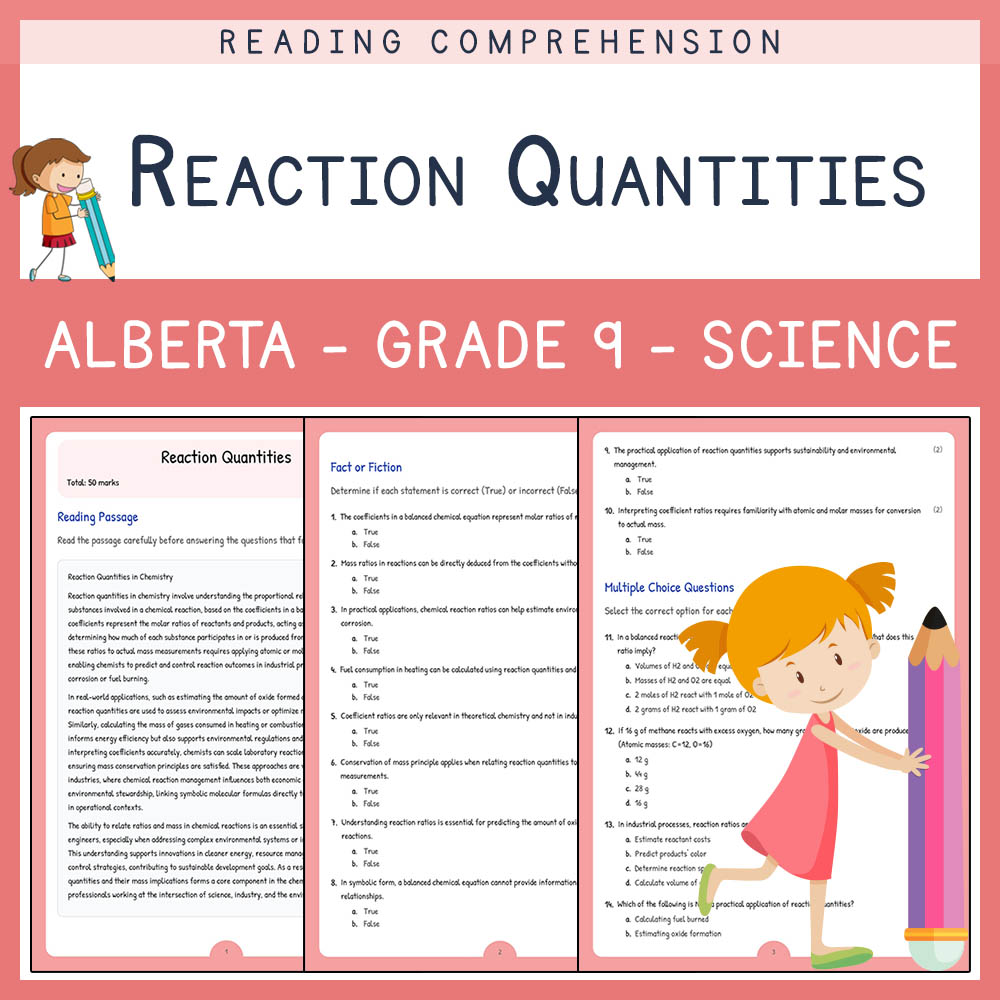
Grade 9 Science | Reaction Quantities Worksheet | Alberta Standards
Created byLumora LearningLearning Objectives
- Understand how to interpret and apply coefficient ratios from balanced chemical equations.
- Calculate mass relationships among reactants and products in chemical reactions.
- Relate symbolic chemical equations to real-world mass measurements and conservation laws.
Instant download
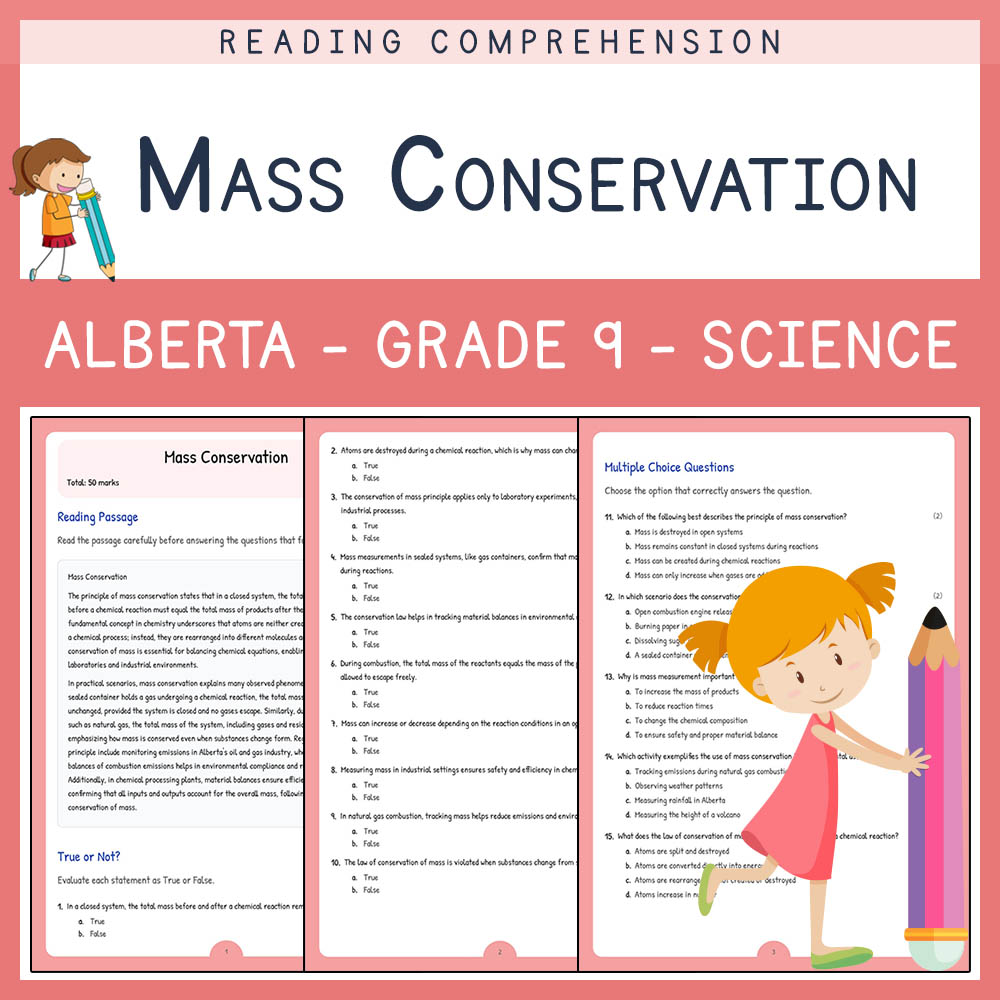
Grade 9 Science | Mass Conservation Worksheet | Alberta Standards
Created byLumora LearningLearning Objectives
- Understand the principle of conservation of mass in chemical reactions.
- Explain how mass remains constant in closed systems during chemical processes.
- Apply the conservation of mass concept to real-world regional contexts such as emissions and resource processing.
Instant download
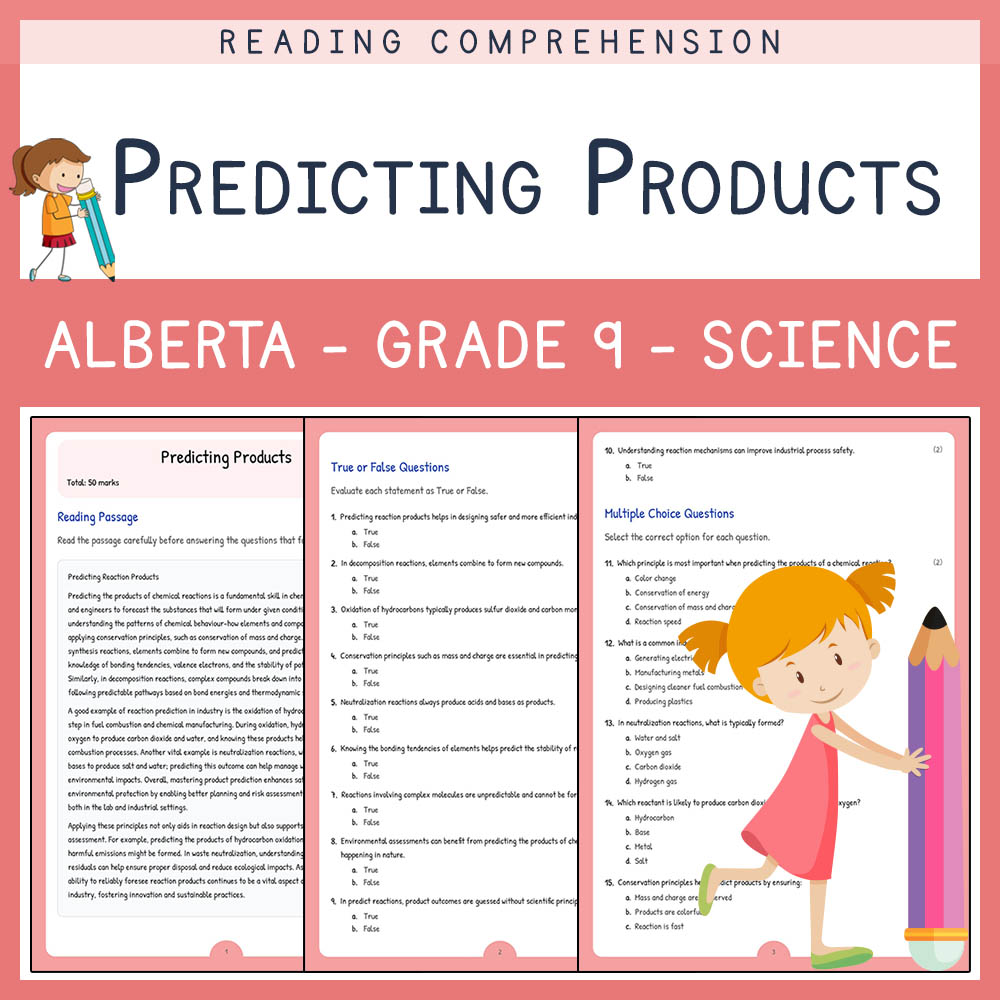
Grade 9 Science | Predicting Products Worksheet | Alberta Standards
Created byLumora LearningLearning Objectives
- Understand how to apply patterns of chemical behaviour to predict reaction products.
- Recognize common reaction types such as synthesis, decomposition, and neutralization.
- Identify the significance of conservation principles in predicting outcomes.
Instant download
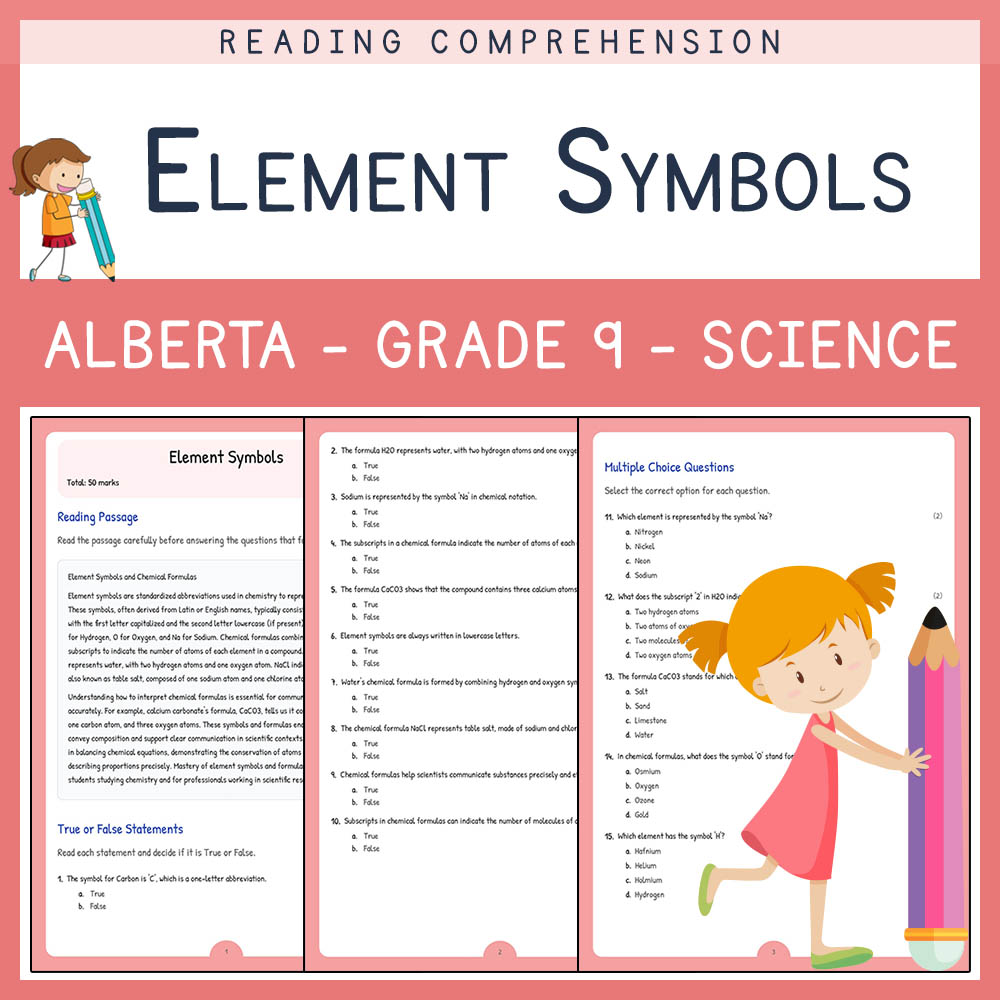
Grade 9 Science | Element Symbols Worksheet | Alberta Standards
Created byLumora LearningLearning Objectives
- Understand the concept of element symbols and their formation.
- Identify common chemical formulas and interpret their meaning.
- Connect symbolic representations to real-world chemical substances.
Instant download
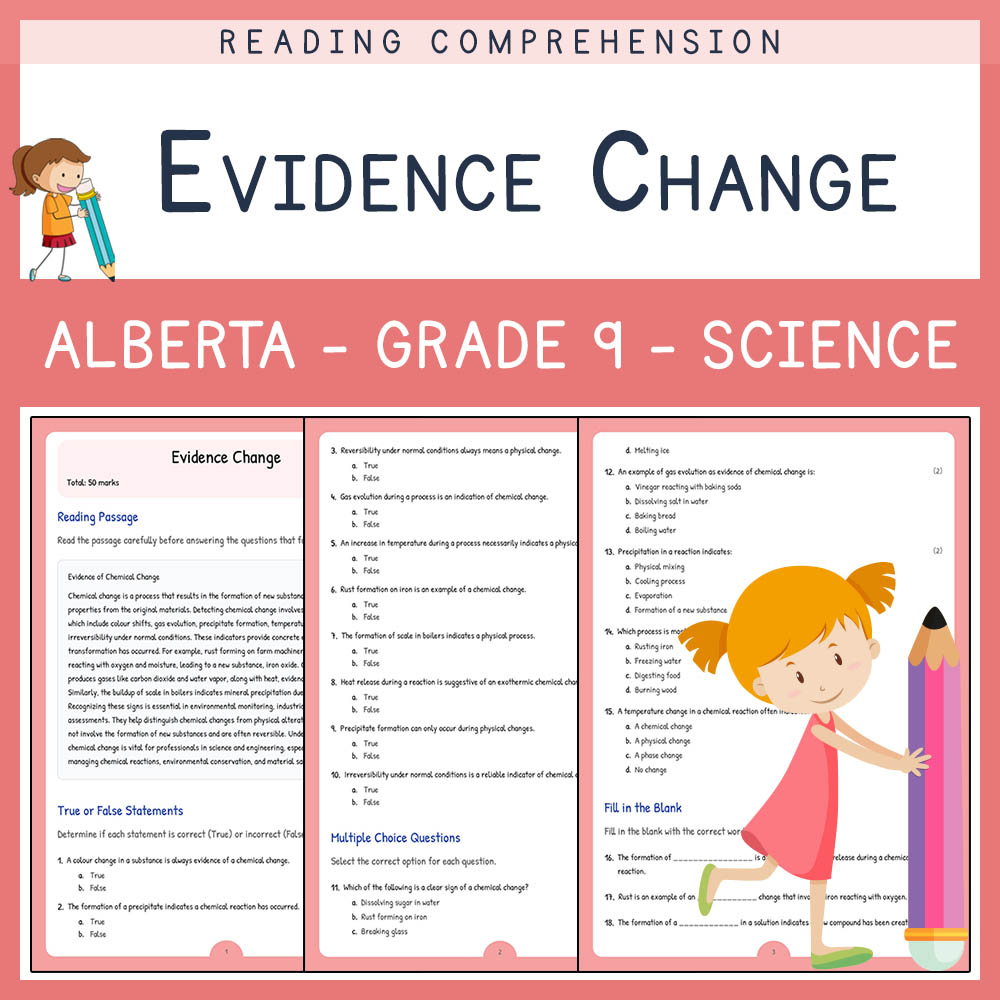
Grade 9 Science | Evidence Change Worksheet | Alberta Standards
Created byLumora LearningLearning Objectives
- Understand the observable signs indicating chemical changes in substances.
- Identify real-world examples of chemical change evidence, such as rusting and combustion.
- Differentiate between physical and chemical changes based on observable evidence.
Instant download
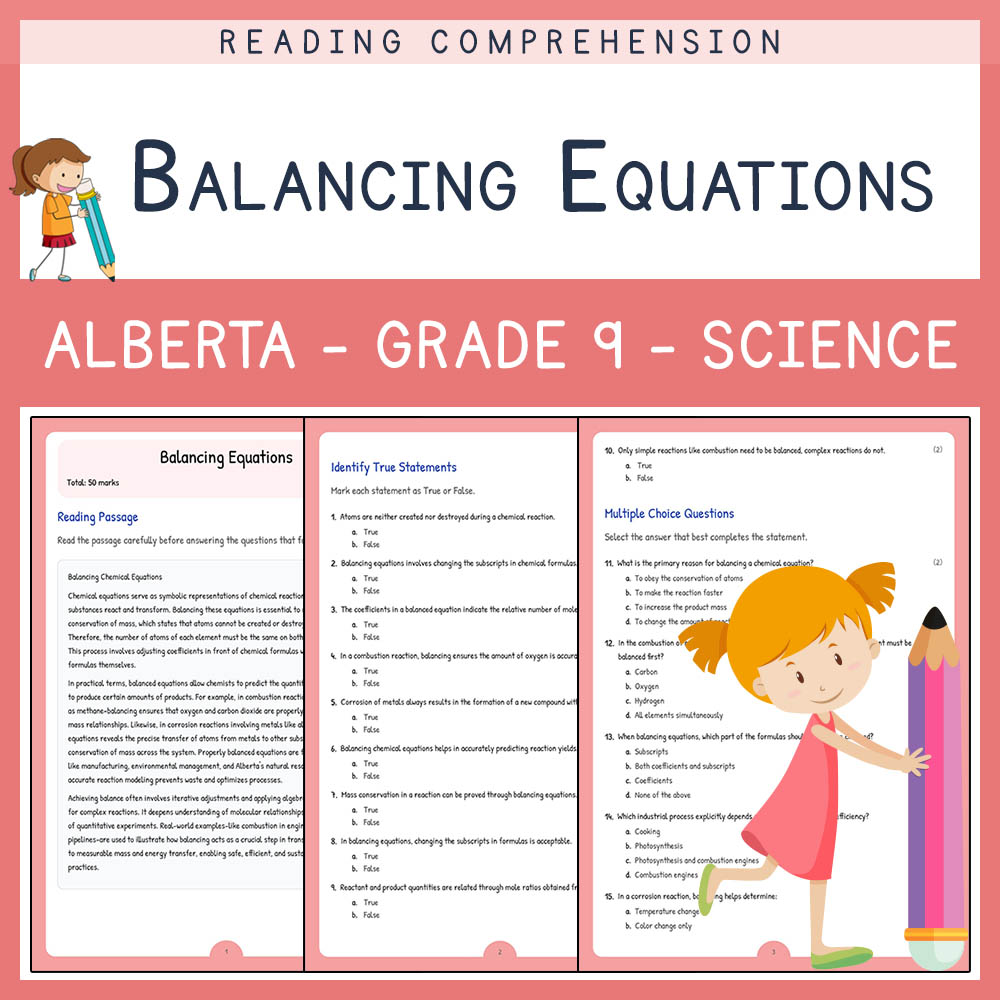
Grade 9 Science | Balancing Equations Worksheet | Alberta Standards
Created byLumora LearningLearning Objectives
- Understand the principle of conservation of atoms and mass in chemical equations.
- Learn how to balance chemical equations to reflect accurate reactant and product ratios.
- Link formula notation to measurable mass relationships in chemical reactions.
Instant download
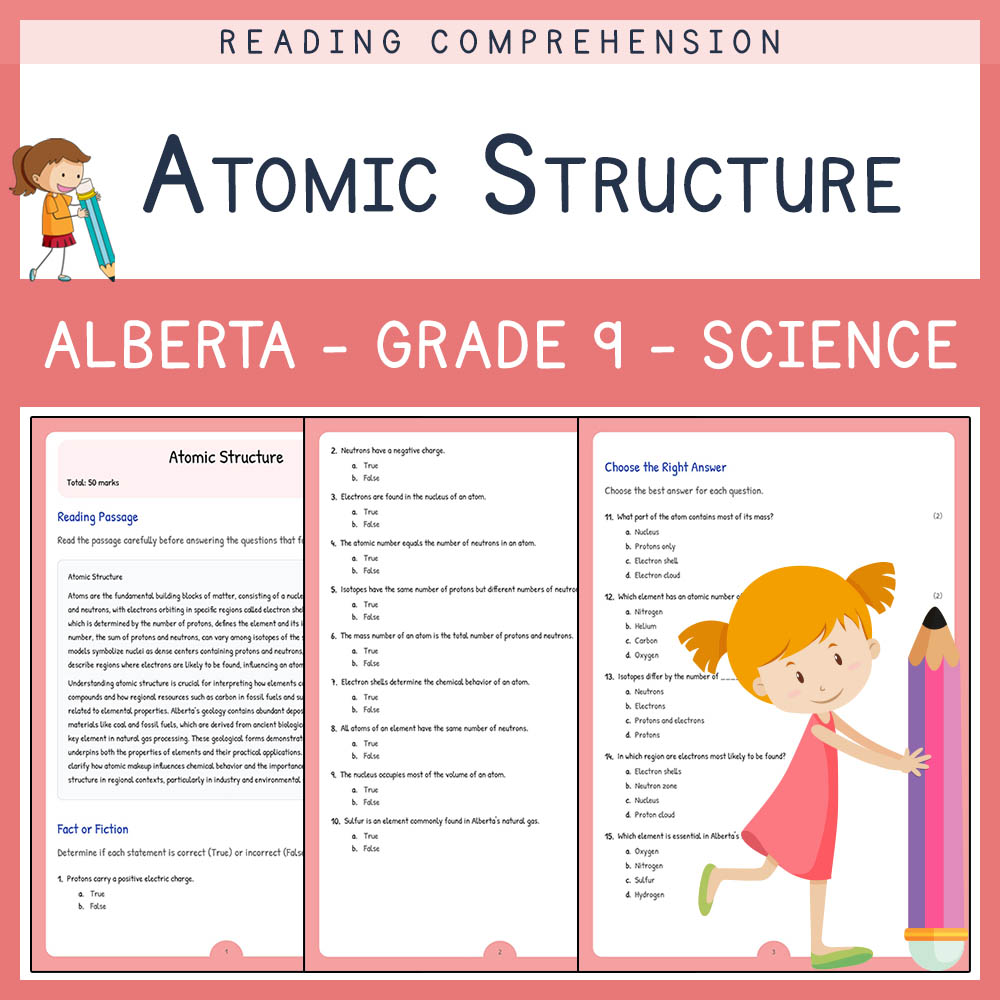
Grade 9 Science | Atomic Structure Worksheet | Alberta Standards
Created byLumora LearningLearning Objectives
- Describe the basic components of an atom: protons, neutrons, and electrons.
- Explain how atomic number and mass number relate to isotopes and element identity.
- Understand the Bohr model of electron shells and nuclear composition.
Instant download
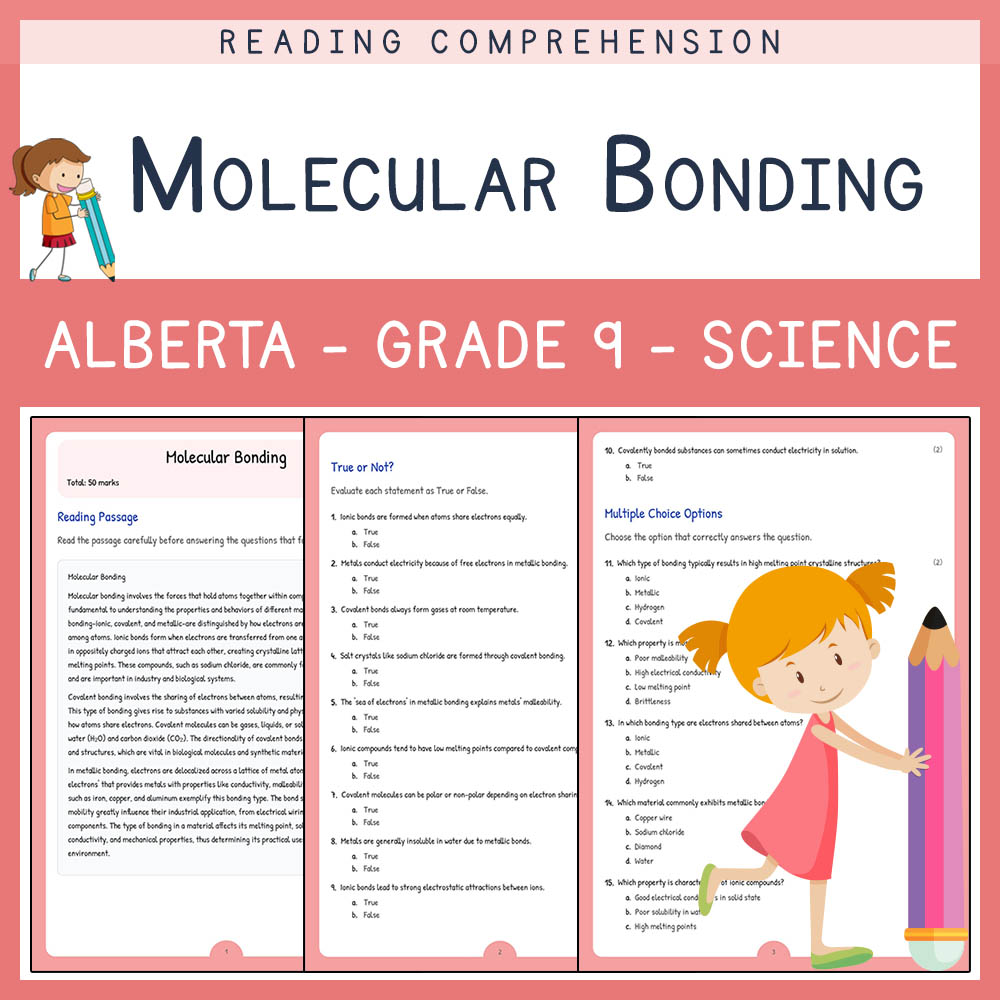
Grade 9 Science | Molecular Bonding Worksheet | Alberta Standards
Created byLumora LearningLearning Objectives
- Understand the different types of chemical bonds and their properties.
- Identify examples of ionic, covalent, and metallic bonding in real-world materials.
- Distinguish between the characteristics and behaviors of different bonding types.
Instant download
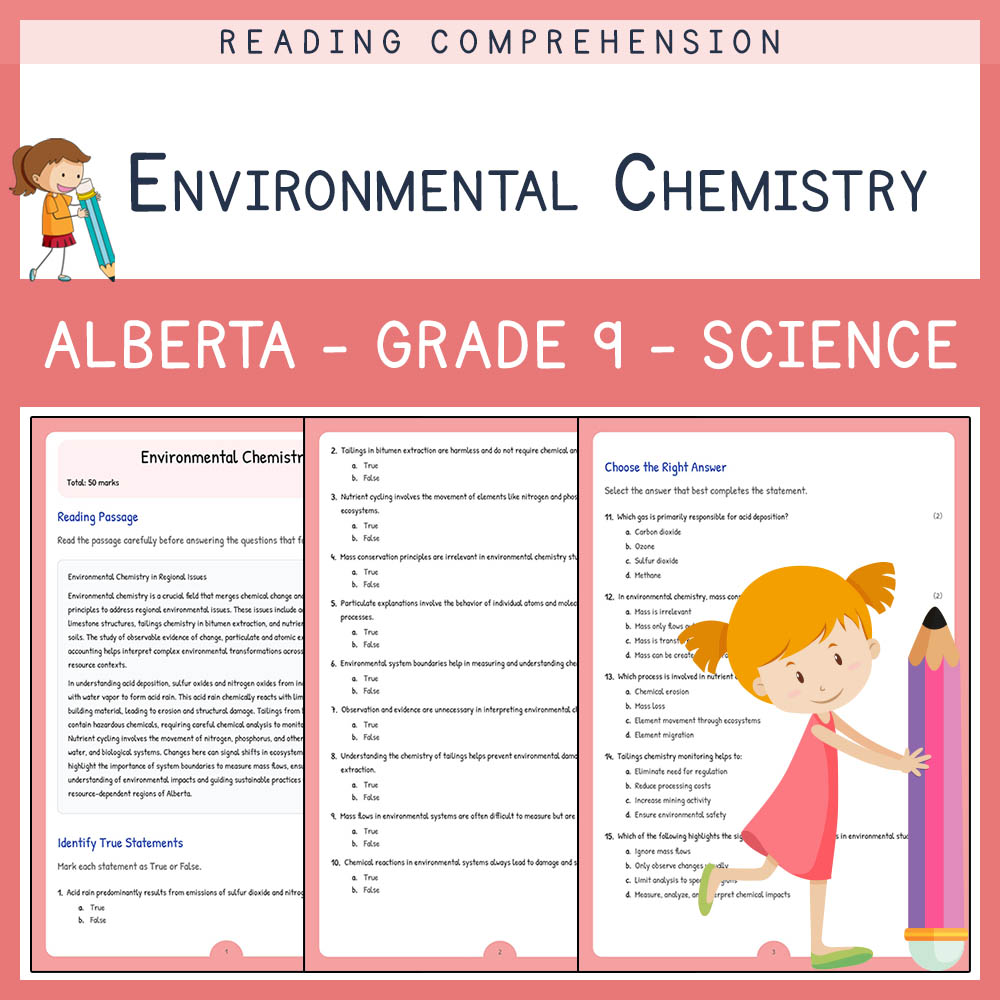
Grade 9 Science | Environmental Chemistry Worksheet | Alberta Standards
Created byLumora LearningLearning Objectives
- Understand the principles of mass conservation in environmental systems.
- Identify chemical processes involved in regional environmental issues such as acid rain and nutrient cycling.
- Interpret observable evidence of environmental change using particulate and atomic explanations.
Instant download
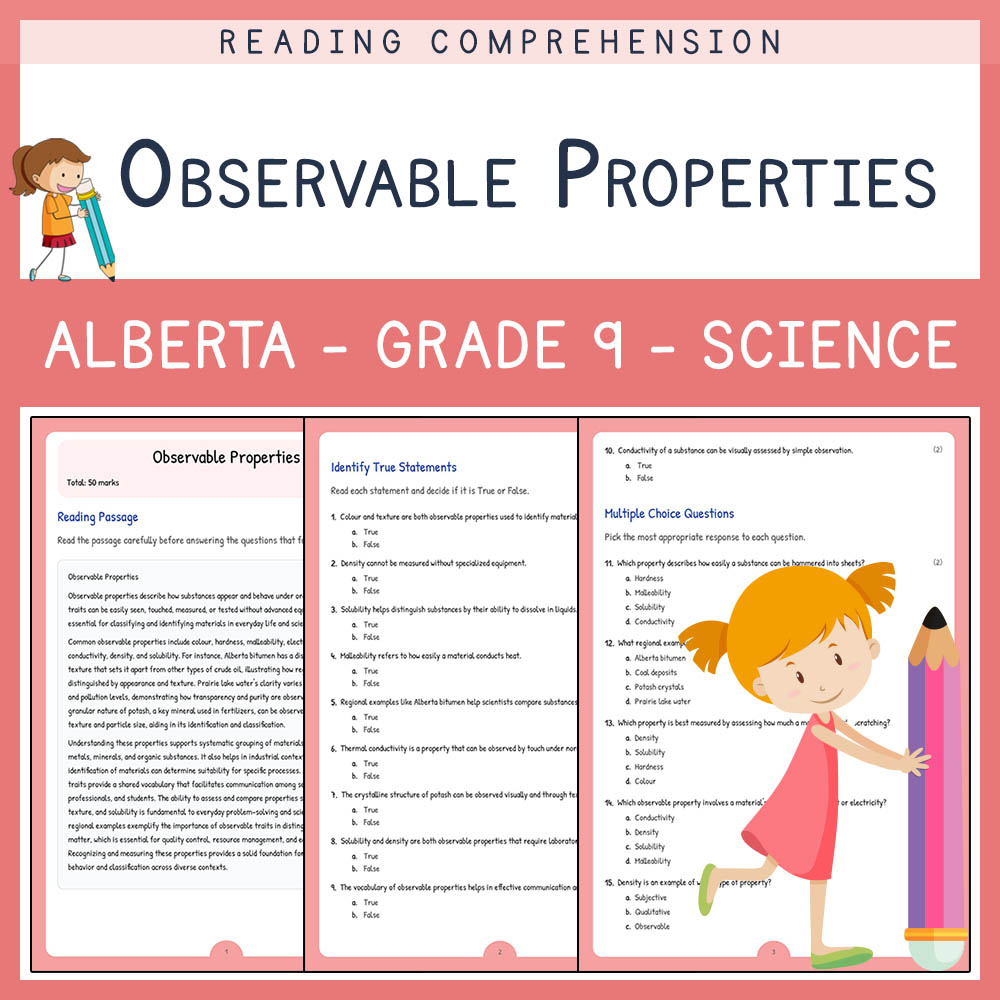
Grade 9 Science | Observable Properties Worksheet | Alberta Standards
Created byLumora LearningLearning Objectives
- Describe common observable properties used to classify substances.
- Identify examples of observable properties in real-world contexts.
- Differentiate materials based on their observable traits using measurable criteria.
Instant download
About Grade 9 Science Worksheets
Find Science worksheets built for Grade 9. All 6,926 cover core skills, practice, and review, each an instant PDF download.
Every worksheet on MyTeachingSheets is created by independent teacher-authors and reviewed before publication. All resources download as printable PDFs for classroom, homework, or at-home practice, and many include answer keys. Preview any worksheet free before buying.