
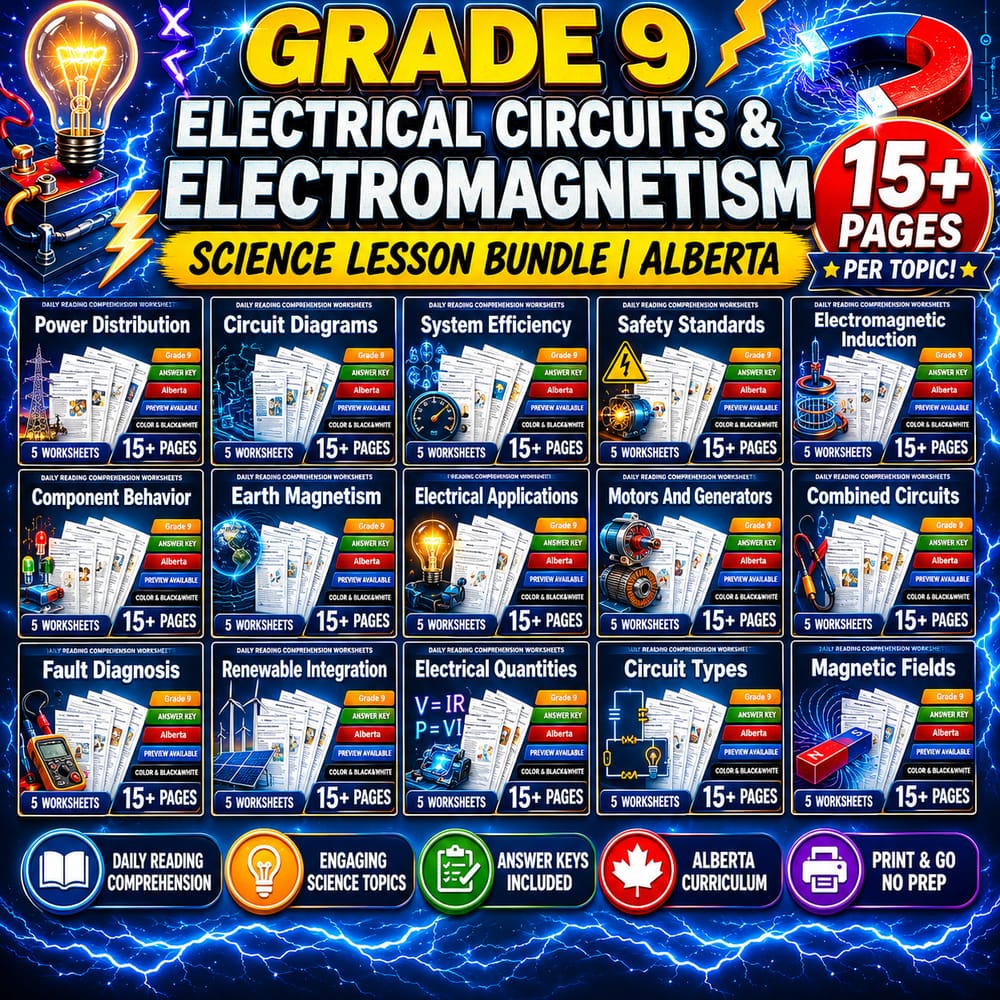


Grade 9 Electrical Circuits & Electromagnetism Science Lesson Bundle | Alberta
$48.00$60.00Save $12.00
Bright Mind Resources
New·1 followers·12 sales
SubjectScienceGradeGrade 9
What’s included
15 worksheets · Save $12.00 (20%) · prices shown inside the bundle
 Grade 9 Science – Power Distribution & Systems | Daily Reading Worksheet
- Identify key components involved in power distribution systems.
- Understand how electricity moves from generation to consumers.
- Recognize regional examples of power transmission like hydroelectric and wind farms.
$3.20$4.00 Grade 9 Science – Circuit Diagrams & Symbols | Daily Reading Worksheet
- Understand key concepts related to Science
- Apply knowledge through practice questions
- Demonstrate comprehension of the material
$3.20$4.00 Grade 9 Science – System Efficiency & Energy Losses | Reading Worksheet
- Understand common energy loss mechanisms in electrical systems
- Identify techniques to reduce resistive and thermal losses
- Analyze the impact of system design choices on energy efficiency
$3.20$4.00 Grade 9 Science – Electrical Safety Standards | Daily Reading Worksheet
- Understand key concepts related to Science
- Apply knowledge through practice questions
- Demonstrate comprehension of the material
$3.20$4.00 Grade 9 Science – Electromagnetic Induction & Magnetic Flux | Reading Worksheet
- Understand the basic concepts of electromagnetic induction
- Identify how changing magnetic flux induces voltage
- Recognize practical applications such as generators and transformers
$3.20$4.00 Grade 9 Science – Component Behavior in Electrical Circuits | Reading Worksheet
- Understand how resistors exhibit linear behavior in circuits
- Identify the characteristics of nonlinear components like diodes
- Describe how temperature affects the performance of electrical components
$3.20$4.00 Grade 9 Science – Earth's Magnetism & Movement | Daily Reading Worksheet
- Describe the basic properties of Earth's magnetic field.
- Explain how a compass indicates direction based on Earth's magnetism.
- Identify regional variations in magnetic declination.
$3.20$4.00 Grade 9 Science – Electrical Applications in Residential Settings | Worksheet
- Understand the importance of proper device ratings for safe electrical systems.
- Identify safety measures necessary for residential wiring.
- Recognize different electrical device functions and appropriate protective measures.
$3.20$4.00 Grade 9 Science – Motors & Generators | Daily Reading Worksheet
- Identify different types of electric motors and their basic principles
- Explain how electromagnetic induction allows generators to produce electricity
- Apply knowledge of motor and generator operation to real-world applications
$3.20$4.00 Grade 9 Science – Understanding Combined Circuits Daily Reading Worksheet
- Identify series and parallel arrangements in electrical circuits.
- Explain how series and parallel circuits differ in current and voltage.
- Simplify complex circuits by reducing series and parallel components.
$3.20$4.00
Reviews & Feedback
Loading reviews...
Questions & Answers
Loading questions…
About this bundle
Related categories
Frequently asked questions
Who is Grade 9 Electrical Circuits & Electromagnetism Science Lesson Bundle | Alberta designed for?
Grade 9 Electrical Circuits & Electromagnetism Science Lesson Bundle | Alberta is designed for Grade 9 students and Science learners and can be used in classrooms, homeschool, or independent practice.
How do I download Grade 9 Electrical Circuits & Electromagnetism Science Lesson Bundle | Alberta?
Add it to your cart and complete checkout. After payment, you can download immediately from your account, and you'll also receive a download link by email.
Similar Products

Grade 8 Science Electricity & Electromagnetism Lesson Bundle | Alberta
$60.00$75.00

Grade 9 Electrical Circuits and Energy Science Lesson Bundle (Alberta)
$60.00$75.00

Grade 9 Electrical Circuits & Magnetism Science Lesson Bundle – Alberta
$60.00$75.00

Grade 6 Electricity and Circuits Science lesson bundle: Ontario framework
$60.00$75.00

Grade 8 Electricity & Circuits Science Lesson Bundle: Alberta Framework
$60.00$75.00