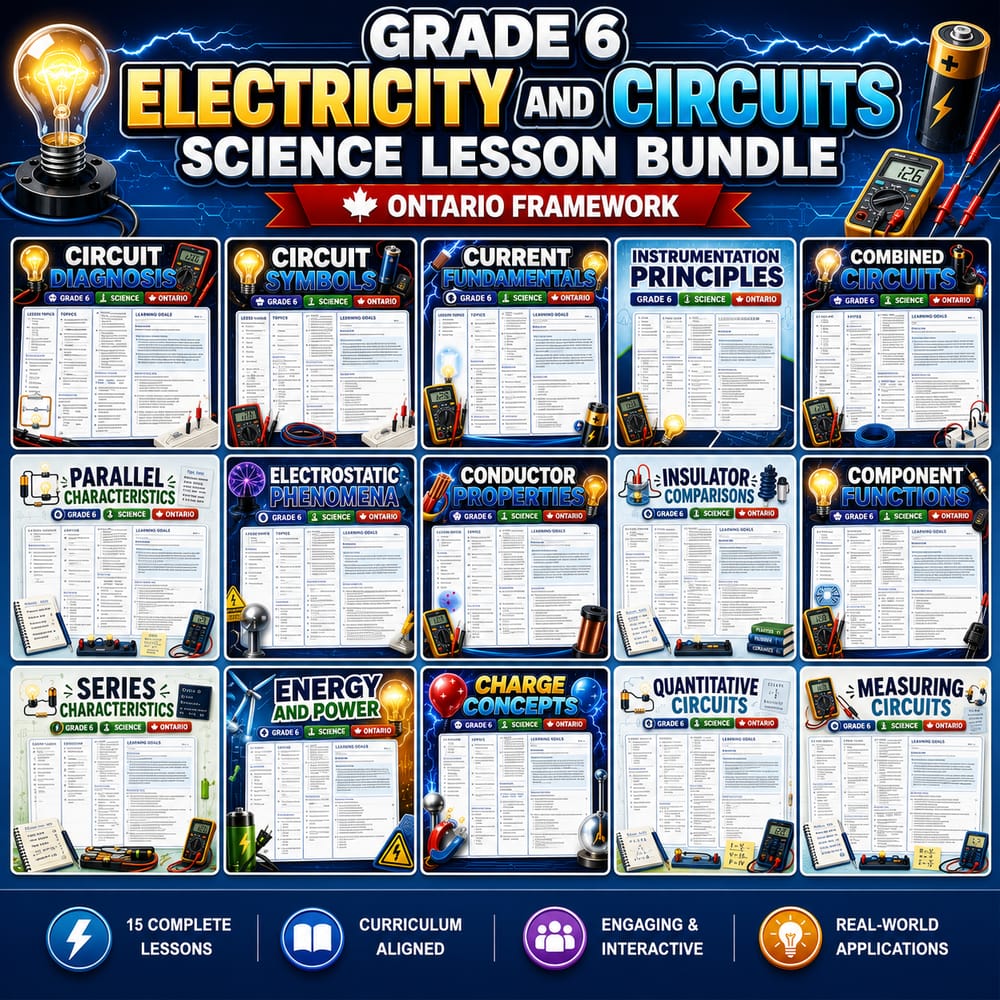
Grade 6 Electricity and Circuits Science lesson bundle: Ontario framework — bundle cover
Grade 6 Electricity and Circuits Science lesson bundle: Ontario framework — included worksheet 1
Grade 6 Electricity and Circuits Science lesson bundle: Ontario framework — included worksheet 2
Grade 6 Electricity and Circuits Science lesson bundle: Ontario framework — included worksheet 3
Grade 6 Electricity and Circuits Science lesson bundle: Ontario framework — included worksheet 4
Grade 6 Electricity and Circuits Science lesson bundle: Ontario framework — included worksheet 5
Grade 6 Electricity and Circuits Science lesson bundle: Ontario framework — included worksheet 6
Grade 6 Electricity and Circuits Science lesson bundle: Ontario framework — included worksheet 7
Grade 6 Electricity and Circuits Science lesson bundle: Ontario framework — included worksheet 8
Grade 6 Electricity and Circuits Science lesson bundle: Ontario framework — included worksheet 9
Grade 6 Electricity and Circuits Science lesson bundle: Ontario framework — included worksheet 10
Grade 6 Electricity and Circuits Science lesson bundle: Ontario framework — included worksheet 11
Grade 6 Electricity and Circuits Science lesson bundle: Ontario framework — included worksheet 12
Grade 6 Electricity and Circuits Science lesson bundle: Ontario framework — included worksheet 13
Grade 6 Electricity and Circuits Science lesson bundle: Ontario framework — included worksheet 14
Grade 6 Electricity and Circuits Science lesson bundle: Ontario framework — included worksheet 15
Grade 6 Science worksheet — Grade 6 Electricity and Circuits Science lesson bundle: Ontario framework

Description

Overview


Grade 6 electricity and circuits practice built for Ontario Science helps students connect charge, current, and circuit behavior through targeted worksheet work. This lesson bundle provides 15 Grade 6 Science worksheets mapped to the Ontario framework to reinforce inquiry, modeling, and evidence-based explanations. 🔌

What’s Included


  • ✅ Series Characteristics Worksheet Grade 6 Science | Ontario Standards – Practice reading how series circuits behave as components are added.
  • ✅ Quantitative Circuits Worksheet | Grade 6 Science PDF | Ontario – Apply quantitative thinking with relationships found in circuit outcomes.
  • ✅ Parallel Characteristics Worksheet Grade 6 Science | Ontario Standards – Compare how parallel paths influence brightness, current, or function.
  • ✅ Measuring Circuits Worksheet | Ontario Grade 6 Science Assessment – Use measurement language to support conclusions about circuit performance.
  • ✅ Insulator Comparisons Worksheet | Ontario Grade 6 Science Assessment – Differentiate conductors and insulators using evidence from tests or scenarios.
  • ✅ Instrumentation Principles Worksheet | Ontario Grade 6 Science Assessment – Strengthen understanding of instruments and how readings should be interpreted.
  • ✅ Energy and Power Worksheet | Ontario Grade 6 Science Assessment – Connect energy transfer ideas to power-related outcomes in circuits.
  • ✅ Electrostatic Phenomena Worksheet | Grade 6 Science Ontario Standards – Explain electrostatic effects using charge ideas and observed patterns.
  • ✅ Grade 6 Science Worksheet on Electricity, Current Fundamentals | Ontario – Build foundations for current as a concept tied to charge movement.
  • ✅ Conductor Properties Worksheet | Ontario Grade 6 Science Assessment – Analyze properties that help predict whether charge can move.
  • ✅ Component Functions Worksheet | Ontario Grade 6 Science Assessment – Identify component roles and justify how each part affects circuit function.
  • ✅ Combined Circuits Worksheet | Ontario Grade 6 Science Assessment – Reason through mixed circuit setups with structured, step-by-step questions.
  • ✅ Circuit Symbols Worksheet | Ontario Grade 6 Science Assessment – Translate diagrams by recognizing common symbols used in electricity.
  • ✅ Circuit Diagnosis Worksheet | Grade 6 Science Ontario Standards – Use analytical reasoning to diagnose likely faults from clues.
  • ✅ Charge Concepts Worksheet | Ontario Grade 6 Science Assessment – Practice charge vocabulary and apply it to everyday and classroom scenarios.

Skills & Standards


Designed to fit Ontario’s science inquiry approach, these worksheets reinforce crosscutting concepts such as systems, cause-and-effect, and patterns. Students work through disciplinary core ideas related to electricity, circuits, charge, and energy transfer while practicing modeling by representing circuit structures and predicting behavior. Throughout the bundle, learners use analytical reasoning to interpret measured or described outcomes and develop evidence-based explanations that link observations to claims.

Perfect For


  • Teachers seeking structured instruction
  • Sub plans
  • Homework or review
  • Intervention or centers
  • Assessment preparation

How to Use


Use this lesson bundle across a multi-day pacing sequence: start with fundamentals and circuit representations (symbols and current basics), then move into series and parallel characteristics, followed by measurement, instrumentation, and comparative investigations (insulators and conductors). Finish with combined circuits and circuit diagnosis so students synthesize models into evidence-based explanations. For classroom implementation, try a station rotation where students complete one worksheet at a time, then share a short justification; assign measurement or instrumentation pages as exit tickets; and use the diagnosis and electrostatic worksheets for small-group intervention or center work.

Closing


Support consistent Grade 6 electricity and circuits instruction with ready-to-use Ontario-aligned worksheets. ✅

Grade 6 Electricity and Circuits Science lesson bundle: Ontario framework

$60.00$75.00Save $15.00
Cedar Grove Learning
New·1 followers·2 sales
SubjectScienceGradeGrade 6Pages120 Pages

What’s included

15 worksheets · 120 pages · Save $15.00 (20%) · prices shown inside the bundle

  1. Circuit Diagnosis Worksheet | Grade 6 Science Ontario Standards
    Circuit Diagnosis Worksheet | Grade 6 Science Ontario Standards

    Grade 6 · Science · 8 Pages

    • Use circuit topology (series vs. parallel) to predict how brightness and current should behave
    • Identify the most likely fault by comparing expected measurement patterns with observed symptoms
    • Explain how continuity and resistance readings support reasoning about open circuits and faulty components
    $4.00$5.00
  2. Circuit Symbols Worksheet | Ontario Grade 6 Science Assessment
    Circuit Symbols Worksheet | Ontario Grade 6 Science Assessment

    Grade 6 · Science · 8 Pages

    • Interpret common circuit schematic symbols for sources, components, and measuring devices
    • Explain how wire connections and topology (series vs. parallel) affect predicted circuit behavior
    • Identify which instrument (ammeter or voltmeter) measures current or potential difference based on diagram placement
    $4.00$5.00
  3. Grade 6 Science Worksheet on Electricity, Current Fundamentals  | Ontario
    Grade 6 Science Worksheet on Electricity, Current Fundamentals | Ontario

    Grade 6 · Science · 8 Pages

    • Explain electric current as the organized movement of electric charges through a conductor
    • Distinguish conventional current direction from electron flow
    • Describe potential difference as the driving force that pushes charges through a circuit
    $4.00$5.00
  4. Instrumentation Principles Worksheet | Ontario Grade 6 Science Assessment
    Instrumentation Principles Worksheet | Ontario Grade 6 Science Assessment

    Grade 6 · Science · 8 Pages

    • Explain the roles of ammeters and voltmeters in measuring current and voltage in circuits
    • Identify the measurement units for current (amperes) and potential difference (volts)
    • Predict how ideal meter readings behave in series and parallel circuits
    $4.00$5.00
  5. Combined Circuits Worksheet | Ontario Grade 6 Science Assessment
    Combined Circuits Worksheet | Ontario Grade 6 Science Assessment

    Grade 6 · Science · 8 Pages

    • Explain how mixed (series-parallel) circuits can be decomposed into simpler series and parallel subcircuits to predict behavior.
    • Describe how current and voltage distribute in combined configurations, including what remains the same across series and what can split across parallel branches.
    • Diagnose how changing or removing a component affects brightness or readings by using conceptual reasoning about circuit paths.
    $4.00$5.00
  6. Parallel Characteristics Worksheet Grade 6 Science | Ontario Standards
    Parallel Characteristics Worksheet Grade 6 Science | Ontario Standards

    Grade 6 · Science · 8 Pages

    • Explain how parallel circuits provide the same potential difference across each branch.
    • Describe how total current in a parallel circuit relates to the sum of branch currents.
    • Compare fault tolerance of parallel circuits with the vulnerability of series circuits.
    $4.00$5.00
  7. Electrostatic Phenomena Worksheet | Grade 6 Science Ontario Standards
    Electrostatic Phenomena Worksheet | Grade 6 Science Ontario Standards

    Grade 6 · Science · 8 Pages

    • Explain how static charge builds up through triboelectric effects and charge transfer
    • Use the triboelectric series idea to predict which material tends to become positively or negatively charged
    • Describe common electrostatic phenomena such as attraction, repulsion, and electrostatic discharge
    $4.00$5.00
  8. Conductor Properties Worksheet | Ontario Grade 6 Science Assessment
    Conductor Properties Worksheet | Ontario Grade 6 Science Assessment

    Grade 6 · Science · 8 Pages

    • Explain how free electrons in materials allow electrical charge to move
    • Describe typical metallic behaviour and how metals conduct electricity
    • Identify factors that affect conductivity, including material type, temperature, and cross-sectional area
    $4.00$5.00
  9. Insulator Comparisons Worksheet | Ontario Grade 6 Science Assessment
    Insulator Comparisons Worksheet | Ontario Grade 6 Science Assessment

    Grade 6 · Science · 8 Pages

    • Explain how insulators differ from conductors in terms of electron binding and the availability of free charge carriers.
    • Use examples such as rubber, glass, and dry wood to describe how insulators reduce charge flow.
    • Compare how bulk insulating properties and surface charge behaviors can both affect electrical interactions.
    $4.00$5.00
  10. Component Functions Worksheet | Ontario Grade 6 Science Assessment
    Component Functions Worksheet | Ontario Grade 6 Science Assessment

    Grade 6 · Science · 8 Pages

    • Identify the function of major circuit components: power sources, resistive loads, switches, and connectors.
    • Match physical circuit components to their roles in circuit behavior and to common schematic ideas.
    • Describe qualitative effects of component changes on current and voltage in everyday circuits.
    $4.00$5.00

Reviews & Feedback

Loading reviews...

Questions & Answers

Loading questions…

About this bundle

Related categories

Frequently asked questions

Who is Grade 6 Electricity and Circuits Science lesson bundle: Ontario framework designed for?
Grade 6 Electricity and Circuits Science lesson bundle: Ontario framework is designed for Grade 6 students and Science learners and can be used in classrooms, homeschool, or independent practice.
How do I download Grade 6 Electricity and Circuits Science lesson bundle: Ontario framework?
Add it to your cart and complete checkout. After payment, you can download immediately from your account, and you'll also receive a download link by email.