
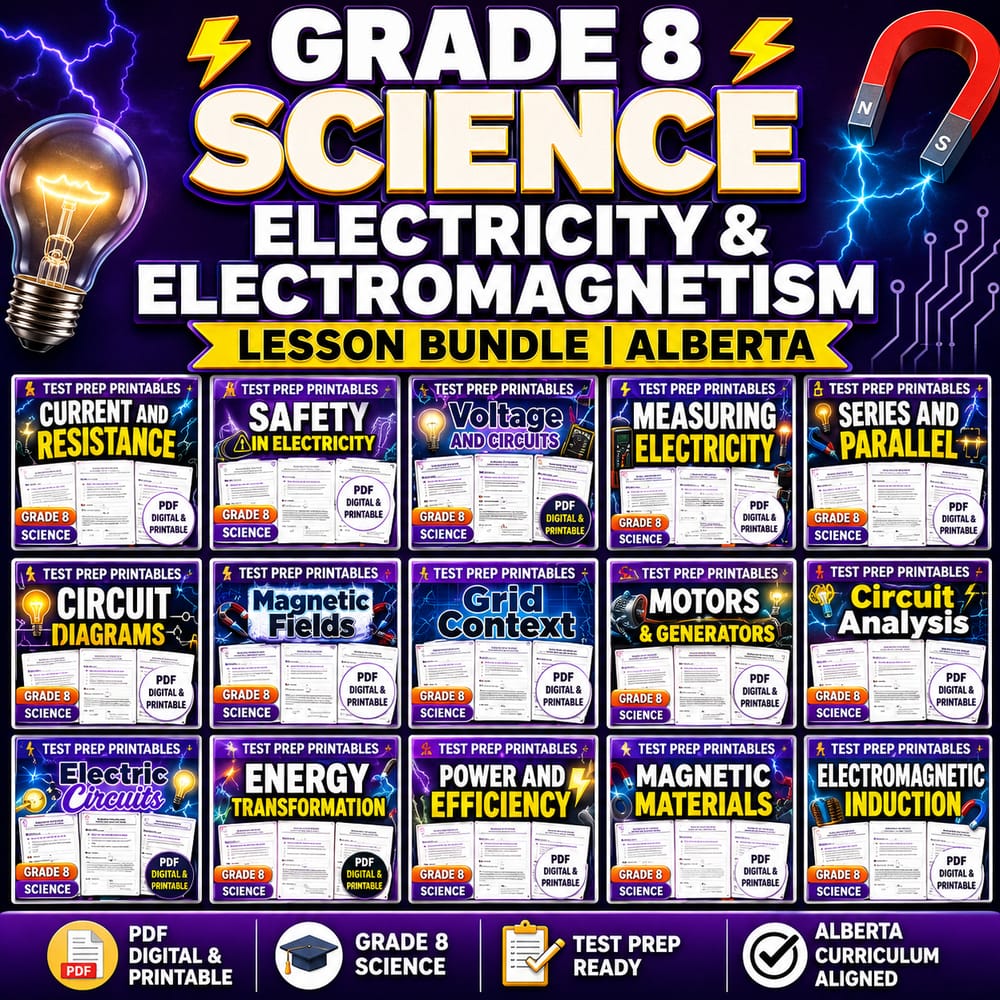


Grade 8 Science Electricity & Electromagnetism Lesson Bundle | Alberta
$60.00$75.00Save $15.00
Prism Point Learning
·2 followers·13 sales
SubjectScienceGradeGrade 8
What’s included
15 worksheets · Save $15.00 (20%) · prices shown inside the bundle
 Current and Resistance Worksheet | Grade 8 Science Activities
- Explain how electric current relates to the rate of charge flow and how resistance opposes that flow
- Use the relationship between voltage, current, and resistance to predict circuit behavior
- Describe how material properties, temperature, and geometry affect resistance
$4.00$5.00 Safety Considerations Worksheet Grade 8 Science | Assessment Activities
- Explain how grounding and insulation reduce the risk of electric shock and equipment damage.
- Describe how overload protection (e.g., fuses and circuit breakers) helps prevent fires.
- Connect electrical safety practices with environmental impacts of energy generation and infrastructure.
$4.00$5.00 Voltage Concepts Worksheet | Grade 8 Science Activities
- Explain voltage (electric potential difference) as energy per unit charge and relate it to current and resistance
- Use reference points to interpret potential differences across circuit elements
- Compare voltage sources (cells, batteries, generators) and describe how multi-source circuits affect circuit behaviour
$4.00$5.00 Measuring Electricity Worksheet | Grade 8 Science Activities
- Describe how voltage, current, and resistance are measured using common meters in an electrical circuit.
- Choose correct meter ranges and connections to avoid inaccurate readings.
- Explain how meter impedance (resistance of the meter) can affect measured values.
$4.00$5.00 Series and Parallel Worksheet | Grade 8 Science Activities
- Explain how series circuits share the same current and add resistances to determine total resistance
- Compare parallel circuits where branches split current and share the same voltage across each branch
- Use resistance and circuit relationships to predict how brightness changes with different wiring
$4.00$5.00 Circuit Fundamentals Worksheet | Grade 8 Science Practice
- Identify the roles of cells or batteries, conductors, loads, and switches in an electric circuit.
- Use schematic symbols and component functions to explain how a circuit completes a path for charge flow.
- Predict basic circuit behavior in series and parallel arrangements using component roles.
$4.00$5.00 Magnetic Fields Worksheet | Grade 8 Science Practice
- Describe how magnetic fields are produced by magnets and by moving electric charges in current-carrying wires.
- Use field line diagrams to predict the direction and relative strength of a magnetic field.
- Explain how ferromagnetic materials and electromagnets affect magnetic field patterns and practical applications.
$4.00$5.00 Grid Context Worksheet Pack | Grade 8 Science Activities
- Describe how electric power grids move energy from generation to distribution using transmission and transformers.
- Explain how grids manage supply and demand in real time to support reliability.
- Identify regional factors that affect generation mix and the challenges of intermittency.
$4.00$5.00 Motors and Generators Worksheet | Grade 8 Science Activities
- Explain how electric motors convert electrical energy into mechanical motion using magnetic fields and current-carrying conductors.
- Describe how generators convert mechanical motion into electrical energy using electromagnetic induction.
- Compare motors and generators as reciprocal devices and relate design parameters to efficiency and power output.
$4.00$5.00 Circuit Analysis Worksheet | Grade 8 Science Activities
- Use Ohm’s law and equivalent resistance to find currents and voltages in simple series and parallel circuits.
- Apply conservation ideas (Kirchhoff’s laws) to check consistency between expected and measured electrical values.
- Calculate electrical power from voltage and current and interpret how changes in components affect a circuit.
$4.00$5.00
Reviews & Feedback
Loading reviews...
Questions & Answers
Loading questions…
About this bundle
Related categories
Frequently asked questions
Who is Grade 8 Science Electricity & Electromagnetism Lesson Bundle | Alberta designed for?
Grade 8 Science Electricity & Electromagnetism Lesson Bundle | Alberta is designed for Grade 8 students and Science learners and can be used in classrooms, homeschool, or independent practice.
How do I download Grade 8 Science Electricity & Electromagnetism Lesson Bundle | Alberta?
Add it to your cart and complete checkout. After payment, you can download immediately from your account, and you'll also receive a download link by email.
Similar Products

Grade 9 Electrical Circuits & Electromagnetism Science Lesson Bundle | Alberta
$48.00$60.00

Forces, Momentum, Gravitation & Electromagnetism Lesson Bundle | Grade 10 Science NGSS
$16.80$24.00

Energy, Motion and Electricity Lesson Bundle | Grade 10 Science | Alberta
$60.00$75.00

Grade 8 Forces and Electromagnetism Science Lesson Bundle NGSS Worksheets
$16.00$20.00

Grade 9 Electricity & Magnetism Lesson Bundle | Alberta Science
$36.00$45.00