


Cells and Body Systems Lesson Bundle | Grade 9 Science | BC
$56.00$70.00Save $14.00
Prism Point Learning
·2 followers·14 sales
SubjectScienceGradeGrade 9
What’s included
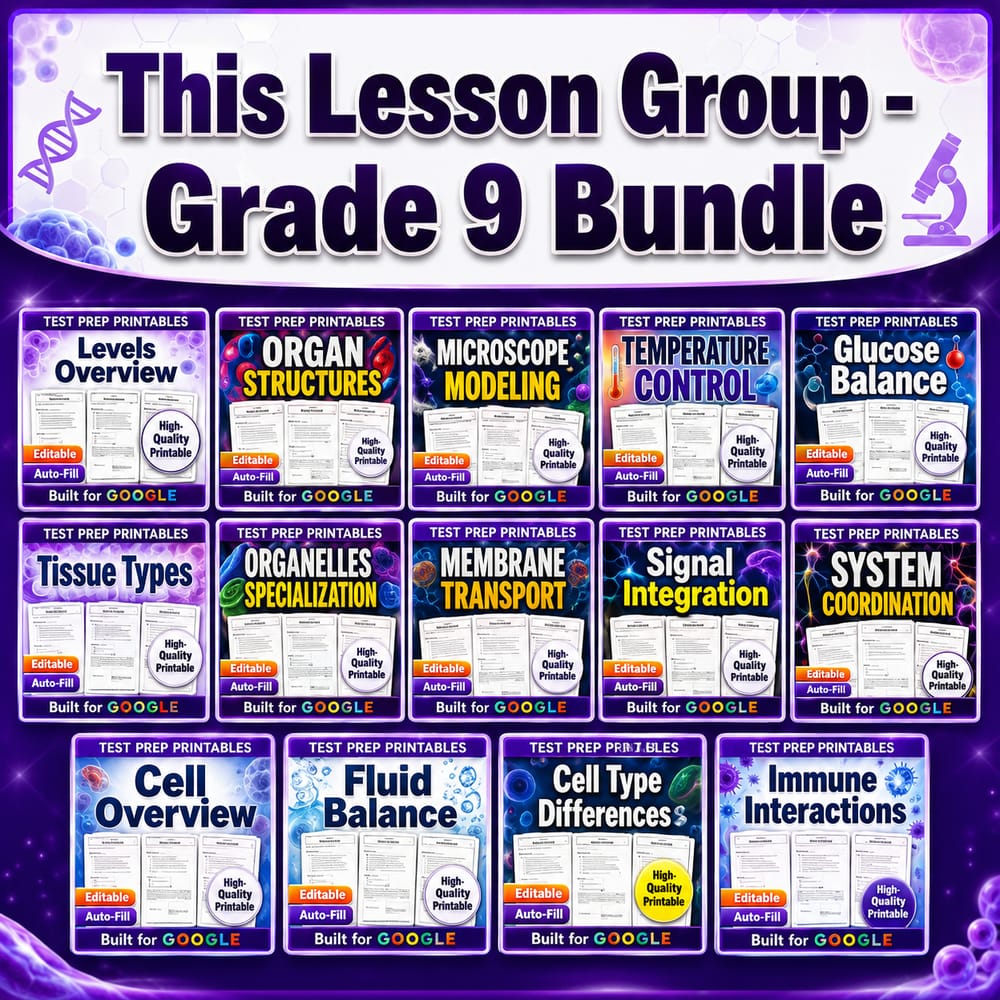
14 worksheets · Save $14.00 (20%) · prices shown inside the bundle
 Level Overview Worksheet Pack | Grade 9 Science Activities
- Describe the biological hierarchy from molecules to organisms
- Explain how emergent properties appear at higher levels of organization
- Connect tissue, organ, and organ system structure to overall biological function
$4.00$5.00 Organ Structures Worksheet Pack | Grade 9 Science Activities
- Explain how organs are built from multiple tissue types to perform specific functions
- Describe how organ systems connect to support body processes such as gas exchange and nutrient transport
- Compare structural features of organs with how those structures help organisms function
$4.00$5.00 Microscope Modeling Worksheet | Grade 9 Science Activities
- Explain how microscope images relate to scale, proportion, and spatial structure in cells.
- Distinguish between light microscopy and electron microscopy in terms of what they can resolve.
- Use diagrammatic and physical models to form and test structural hypotheses about cell processes.
$4.00$5.00 Temperature Control Worksheet | Grade 9 Science Activities
- Explain how thermoregulation maintains internal temperature within functional limits through coordinated body responses
- Describe the roles of the hypothalamus, skin blood flow, sweating, shivering, and metabolic adjustments in homeostasis
- Analyze how temperature changes affect enzyme activity, membrane stability, and overall cellular function
$4.00$5.00 Glucose Balance Worksheet | Grade 9 Science Activities
- Explain how insulin and glucagon respond to changes in blood glucose.
- Describe how the liver, muscle, and adipose tissue help maintain blood glucose homeostasis.
- Compare how feeding and fasting affect glucose uptake, storage, and release.
$4.00$5.00 Tissue Types Worksheet | Grade 9 Science Activities
- Identify the four major tissue types and match each to its primary function in the body.
- Explain how tissue structure and cell specialization affect the properties of organs.
- Compare epithelial, connective, muscle, and nervous tissues using correct science vocabulary.
$4.00$5.00 Organelles Specialization Worksheet | Grade 9 Science Practice
- Explain how membrane-bound organelles specialize to carry out distinct cellular functions in eukaryotic cells.
- Describe the roles of mitochondria, ribosomes, rough endoplasmic reticulum, Golgi apparatus, lysosomes, and peroxisomes in metabolism and transport.
- Connect organelle specialization to efficiency and coordination of energy transfer and macromolecule processing.
$4.00$5.00 Membrane Transport Worksheet | Grade 9 Science Activities
- Explain how the plasma membrane controls the movement of substances using selective permeability
- Differentiate between passive transport (diffusion and osmosis) and active transport
- Describe how membrane proteins (channels, pumps, and receptors) enable specific transport and cell communication
$4.00$5.00 Signal Integration Worksheet Pack | Grade 9 Science Activities
- Explain how nervous and endocrine systems coordinate to maintain homeostasis.
- Describe how neural impulses provide rapid responses and how hormones provide longer-lasting regulation.
- Predict how changes in one signaling system can affect the other system.
$4.00$5.00 System Coordination Worksheet Grade 9 Science Activities
- Explain how feedback loops, redundancy, and cross-regulation help maintain homeostasis in complex body systems.
- Describe how neural, hormonal, and local signals coordinate respiratory, cardiovascular, and metabolic responses during exercise.
- Analyze how a disruption in one component can cascade to affect whole-organism outcomes.
$4.00$5.00
Reviews & Feedback
Loading reviews...
Questions & Answers
Loading questions…
About this bundle
Related categories
Frequently asked questions
Who is Cells and Body Systems Lesson Bundle | Grade 9 Science | BC designed for?
Cells and Body Systems Lesson Bundle | Grade 9 Science | BC is designed for Grade 9 students and Science learners and can be used in classrooms, homeschool, or independent practice.
How do I download Cells and Body Systems Lesson Bundle | Grade 9 Science | BC?
Add it to your cart and complete checkout. After payment, you can download immediately from your account, and you'll also receive a download link by email.
Similar Products

Grade 9 Human Body Systems & Cellular Processes Science Lesson Bundle: Ontario
$48.00$60.00

Grade 9 Body Systems and Cells Science Ontario Lesson Bundle Test Prep
$60.00$75.00

Grade 8 Body Systems & Cell Structure Science Daily Reading Lesson Bundle | BC
$48.00$60.00

Cells & Human Body Systems Lesson Bundle | Grade 6 Science | NGSS
$28.00$35.00

Grade 8 Science Worksheets | NGSS Cells & Body Systems Bundle
$7.20$9.00