
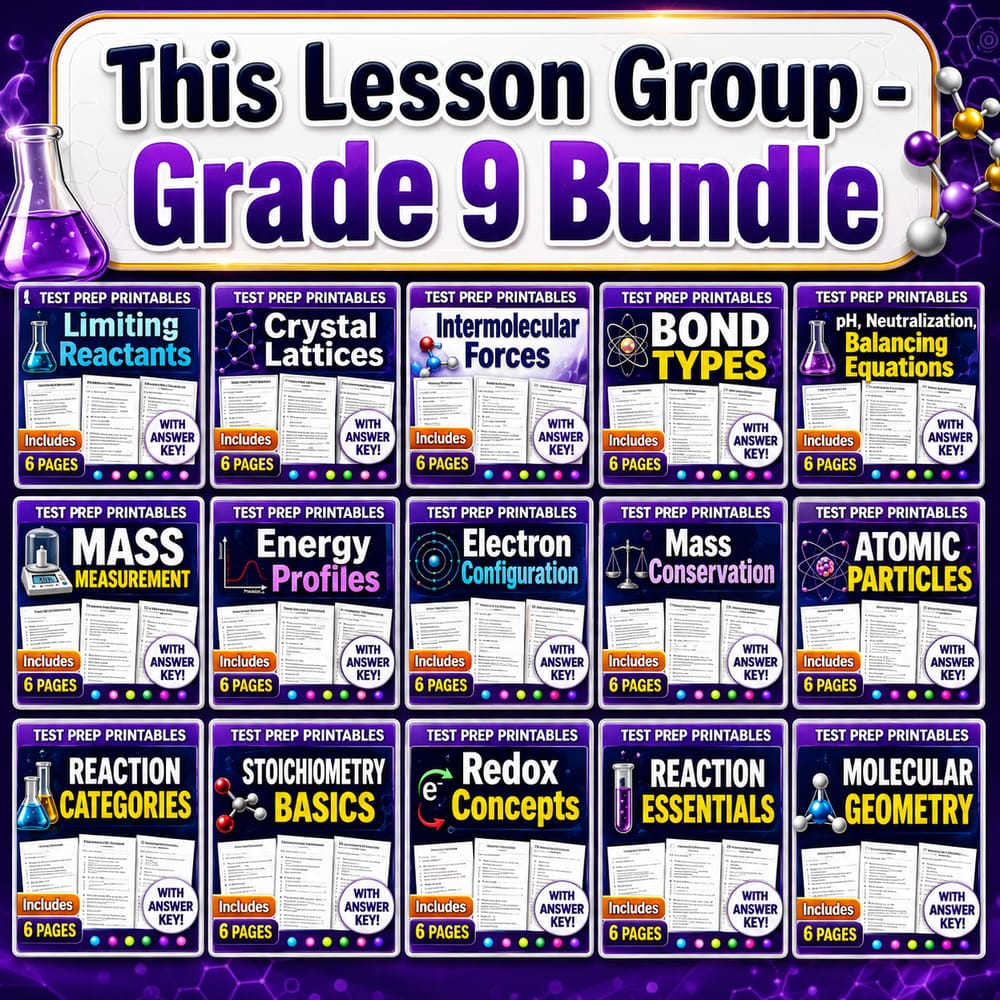


Grade 9 Matter and Chemical Change Lesson Bundle | Science | BC
$60.00$75.00Save $15.00
Prism Point Learning
·2 followers·13 sales
SubjectScienceGradeGrade 9
What’s included
15 worksheets · Save $15.00 (20%) · prices shown inside the bundle
 Limiting Reactants Worksheet | Grade 9 Science Practice
- Explain how a limiting reactant determines the maximum amount of product in a reaction.
- Calculate theoretical yield from balanced mole ratios and molar masses.
- Use percent yield to compare actual yield to theoretical yield.
$4.00$5.00 Crystal Lattices Worksheet | Grade 9 Science Practice
- Explain what crystal lattices and unit cells are in terms of repeating atomic patterns.
- Compare ionic, metallic, and covalent network lattices using properties like conductivity and hardness.
- Use lattice structure to predict macroscopic behavior of materials.
$4.00$5.00 Intermolecular Forces Worksheet Grade 9 Science Activities | Assessment
- Explain how intermolecular forces influence physical properties such as boiling point and viscosity
- Differentiate between London dispersion forces, dipole–dipole interactions, and hydrogen bonding
- Relate molecular polarity and molecular size to the strength of intermolecular attractions
$4.00$5.00 Bond Types Worksheet | Grade 9 Science Practice
- Distinguish ionic, covalent, and metallic bonds based on electron behavior.
- Predict how bond type affects properties such as melting point, conductivity, volatility, and solubility.
- Use particle models (ions, shared electrons, electron sea) to explain observable material behaviors.
$4.00$5.00 Balancing Equations Worksheet | Grade 9 Science Activities
- Explain why chemical equations must be balanced to conserve atoms.
- Use coefficients to represent relative numbers of reactant and product formula units or molecules.
- Interpret balanced equations with state indicators to predict relative reactant and product amounts.
$4.00$5.00 Mass Measurement Worksheet | Grade 9 Science Activities
- Explain how conservation of mass relates to measurable changes during chemical reactions within a defined system
- Distinguish between open and closed systems and predict how gas escape can affect measured mass
- Identify measurement factors (buoyancy and instrument sensitivity) that can change readings without changing total atomic conservation
$4.00$5.00 Energy Profiles Worksheet | Grade 9 Science Practice
- Explain how reaction-coordinate energy profiles represent activation energy and overall enthalpy change.
- Differentiate exothermic and endothermic reactions using the sign of ΔH.
- Identify the role of transition states in an energy profile and relate them to bond changes.
$4.00$5.00 Electron Configuration Worksheet Grade 9 Science Activities
- Explain what electron configuration represents and how it describes electron distribution in shells and orbitals.
- Determine how valence electrons influence reactivity, ion formation, and bonding patterns.
- Use electron configuration ideas to predict periodic trends in atomic size and ionization energy.
$4.00$5.00 Mass Conservation Worksheet | Grade 9 Science Practice
- Explain the law of conservation of mass in chemical reactions using evidence from measurements.
- Interpret balanced chemical equations by matching the number and type of atoms on both sides.
- Connect conservation of mass to quantitative reasoning such as stoichiometry and yield calculations.
$4.00$5.00 Atomic Particles Worksheet | Grade 9 Science Practice
- Explain how protons, neutrons, and electrons form an atom and how they affect atomic identity and behavior.
- Compare isotopes and relate differences in neutron count to changes in atomic mass and stability.
- Use subatomic structure to predict how an atom’s electron arrangement connects to chemical bonding.
$4.00$5.00
Reviews & Feedback
Loading reviews...
Questions & Answers
Loading questions…
About this bundle
Related categories
Frequently asked questions
Who is Grade 9 Matter and Chemical Change Lesson Bundle | Science | BC designed for?
Grade 9 Matter and Chemical Change Lesson Bundle | Science | BC is designed for Grade 9 students and Science learners and can be used in classrooms, homeschool, or independent practice.
How do I download Grade 9 Matter and Chemical Change Lesson Bundle | Science | BC?
Add it to your cart and complete checkout. After payment, you can download immediately from your account, and you'll also receive a download link by email.
Similar Products

Matter and Chemical Change Lesson Bundle | Grade 9 Science | Ontario
$38.40$48.00

Matter and Chemical Change Lesson Bundle: Grade 7 Science Alberta
$60.00$75.00

Grade 8 Matter & Chemical Change Science Lesson Bundle | Alberta Framework
$60.00$75.00

Grade 8 Matter and Chemical Change Science Lesson Bundle – Alberta Framework
$60.00$75.00

Grade 8 Matter & Chemical Change Lesson Bundle | Alberta Science
$60.00$75.00