
Grade 9 Science Worksheets
6,926 worksheets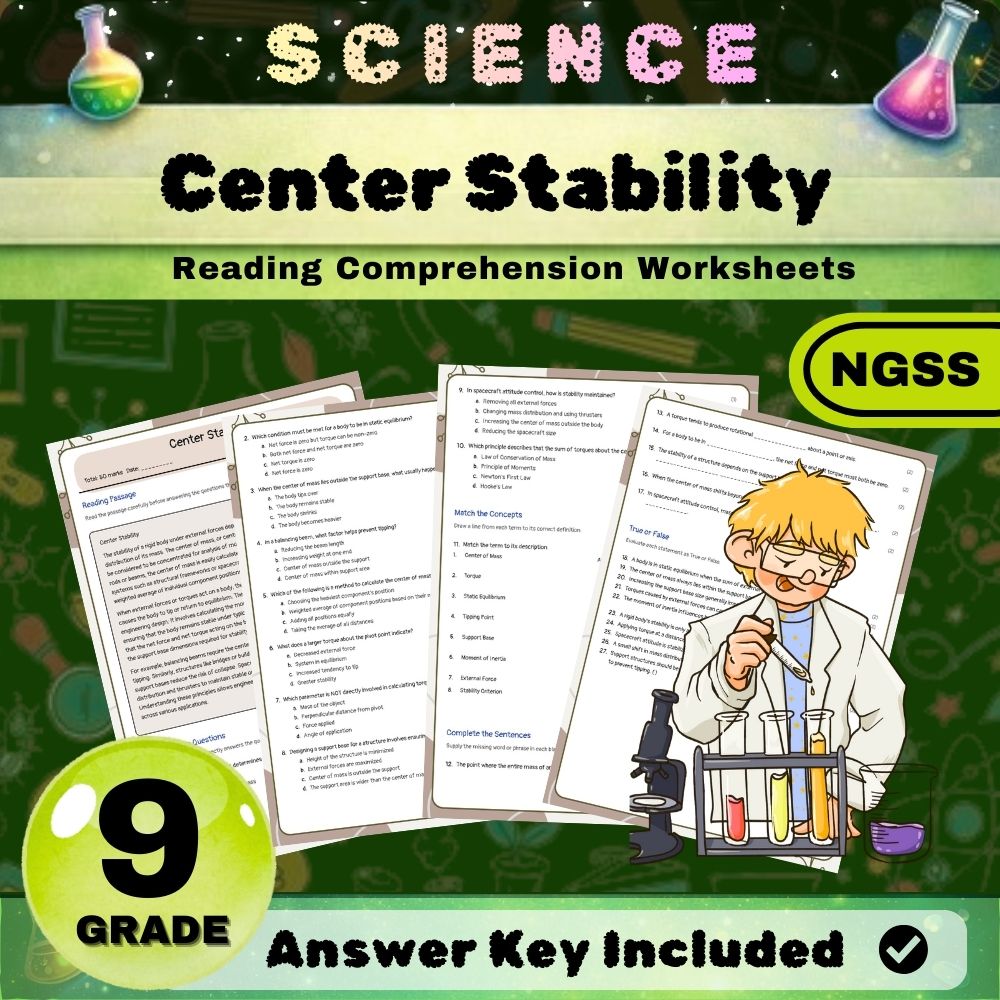
Grade 9 Science | Center Stability Worksheet (NGSS) (PDF)
 Created byMaple Path Learning
Learning Objectives
- Understand the concepts of center of mass and how it affects the stability of rigid bodies.
- Calculate the center of mass for composite systems and analyze their stability.
- Apply torque and equilibrium conditions to determine tipping thresholds for structures.
Also included in: Grade 9 Science | Motion and Stability Forces & Interactions NGSS Unit Bundle +1 more
Instant download

Trophic Dynamics in Food Webs Worksheet | Grade 9 NGSS Ecology Activity
 Created byBRIGHT PATH RESOURCES
Learning Objectives
- Understand the flow of energy through trophic levels in an ecosystem
- Identify the structure and components of food webs
- Describe concepts of biomass distribution, production-to-biomass ratios, and ecological efficiency
Also included in: Ecosystems Grade 9 Science Daily Reading Worksheets Lesson Bundle | NGSS +1 more
Instant download

Grade 9 Science | Eclipses Explained Worksheet | BC Standard
 Created byLumora Learning
Learning Objectives
- Understand the different types of eclipses and how they occur
- Identify the celestial bodies involved in solar and lunar eclipses
- Explain the role of orbital inclination and paths of totality in eclipse visibility
Also included in: Grade 9 Science | Earth Systems Unit Bundle | BC Aligned Worksheets
Instant download
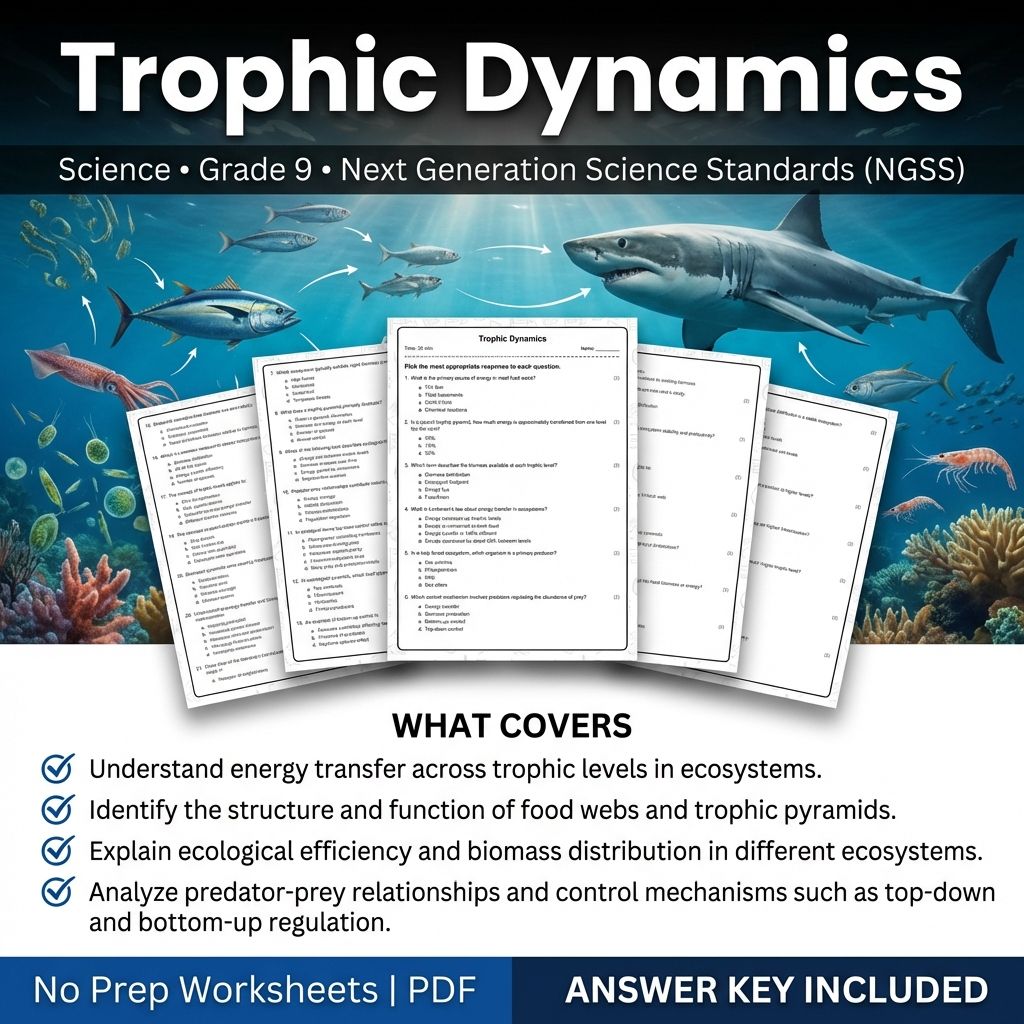
9th Grade Science Worksheet | Trophic Dynamics & Food Webs Practice + Answer Key
 Created byCoral Reef Learning
Learning Objectives
- Understand energy transfer across trophic levels in ecosystems.
- Identify the structure and function of food webs and trophic pyramids.
- Explain ecological efficiency and biomass distribution in different ecosystems.
Also included in: Grade 9 Science Unit Worksheet Bundle | Ecosystems & Biodiversity Practice +1 more
Instant download
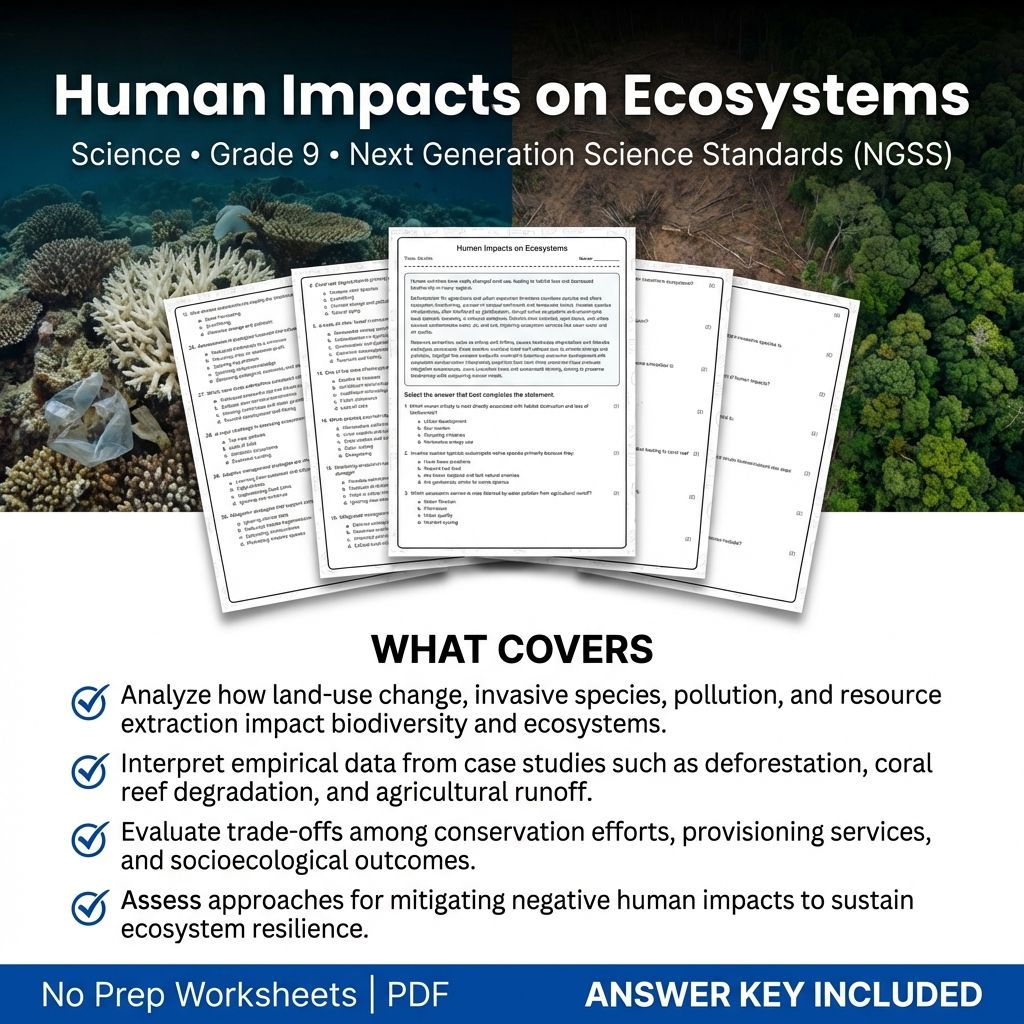
Grade 9 Science Worksheet | Human Impacts on Ecosystems ( PDF & Answer Key)
Created byCoral Reef LearningLearning Objectives
- Analyze how land-use change, invasive species, pollution, and resource extraction impact biodiversity and ecosystems.
- Interpret empirical data from case studies such as deforestation, coral reef degradation, and agricultural runoff.
- Evaluate trade-offs among conservation efforts, provisioning services, and socioecological outcomes.
Also included in: Grade 9 Science Unit Worksheet Bundle | Ecosystems & Biodiversity Practice +1 more
Instant download
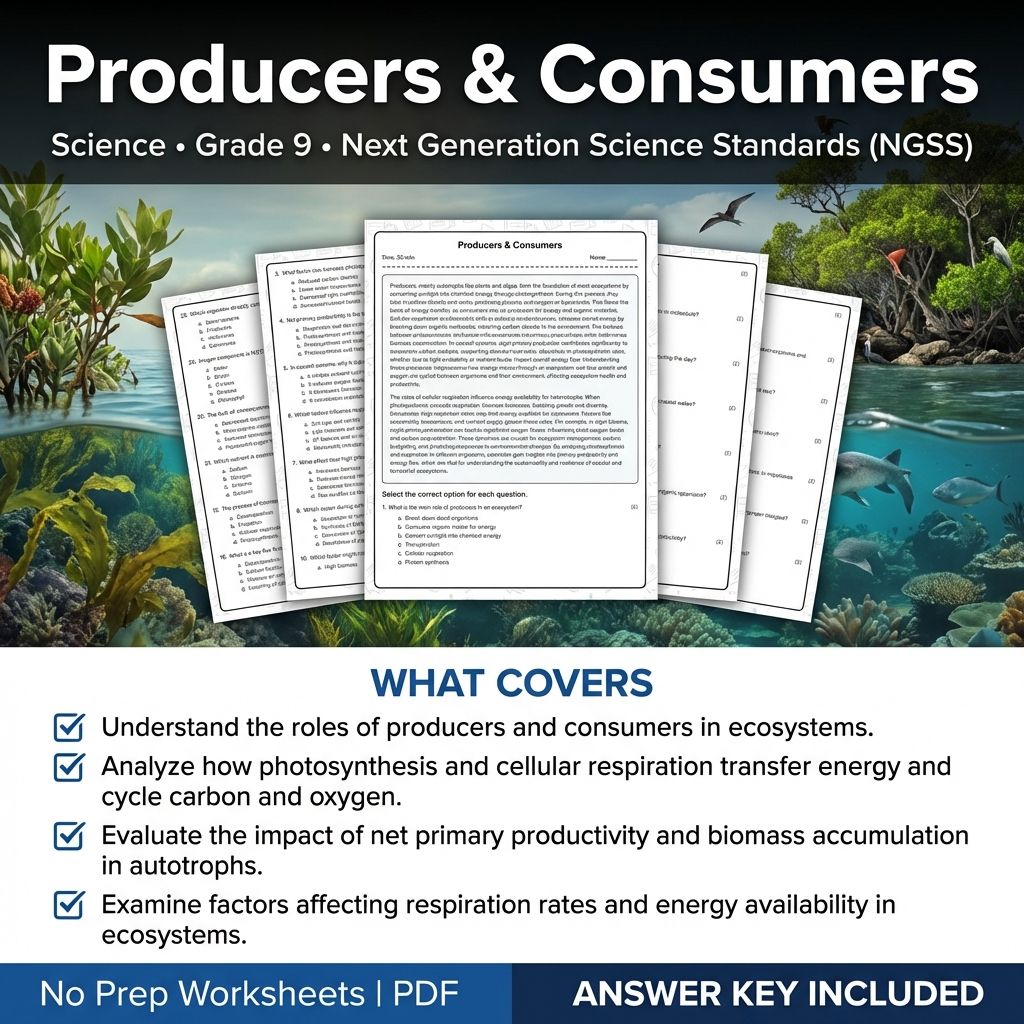
Grade 9 Science Worksheet | Producers & Consumers NGSS + Answer Key (PDF)
Created byCoral Reef LearningLearning Objectives
- Understand the roles of producers and consumers in ecosystems.
- Analyze how photosynthesis and cellular respiration transfer energy and cycle carbon and oxygen.
- Evaluate the impact of net primary productivity and biomass accumulation in autotrophs.
Also included in: Grade 9 Science Unit Worksheet Bundle | Ecosystems & Biodiversity Practice +1 more
Instant download
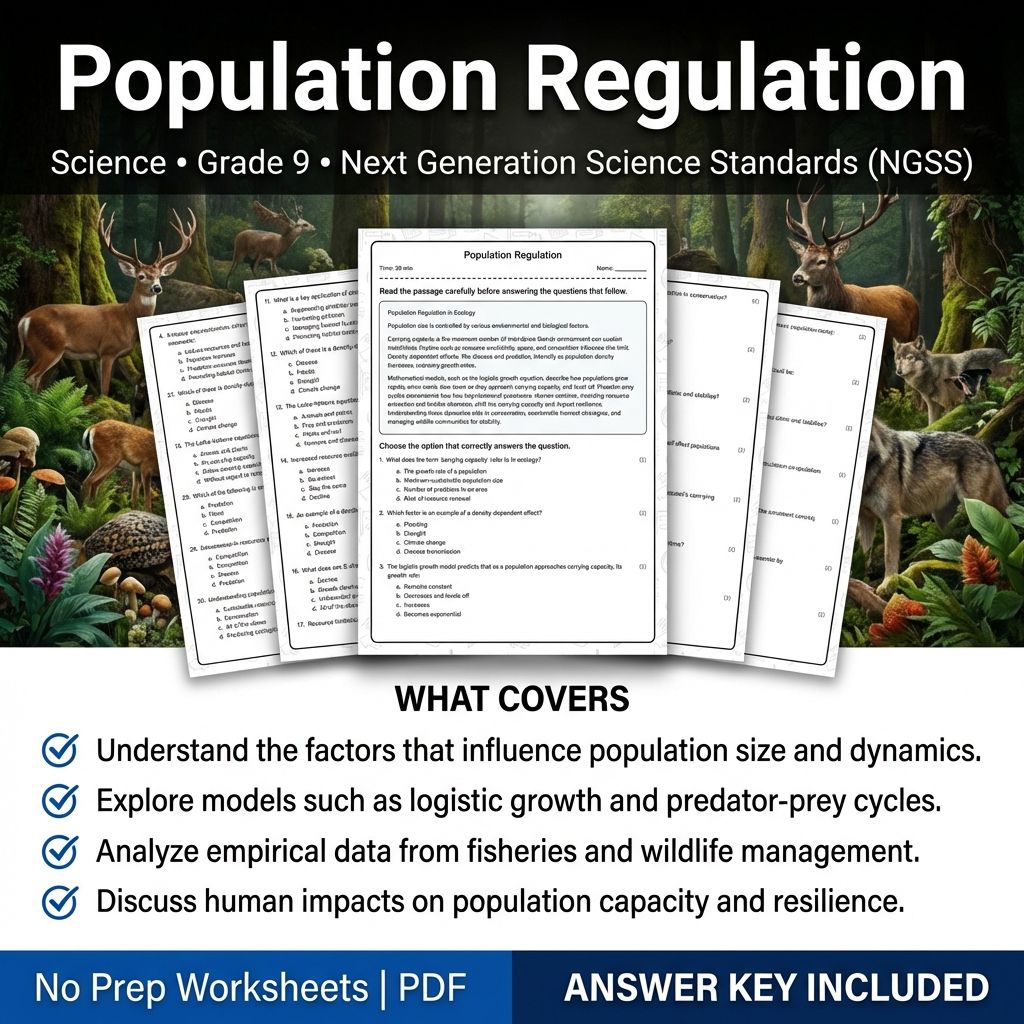
Grade 9 Science Worksheet | Population Regulation Practice PDF & Answer Key
Created byCoral Reef LearningLearning Objectives
- Understand the factors that influence population size and dynamics.
- Explore models such as logistic growth and predator-prey cycles.
- Analyze empirical data from fisheries and wildlife management.
Also included in: Grade 9 Science Unit Worksheet Bundle | Ecosystems & Biodiversity Practice +1 more
Instant download
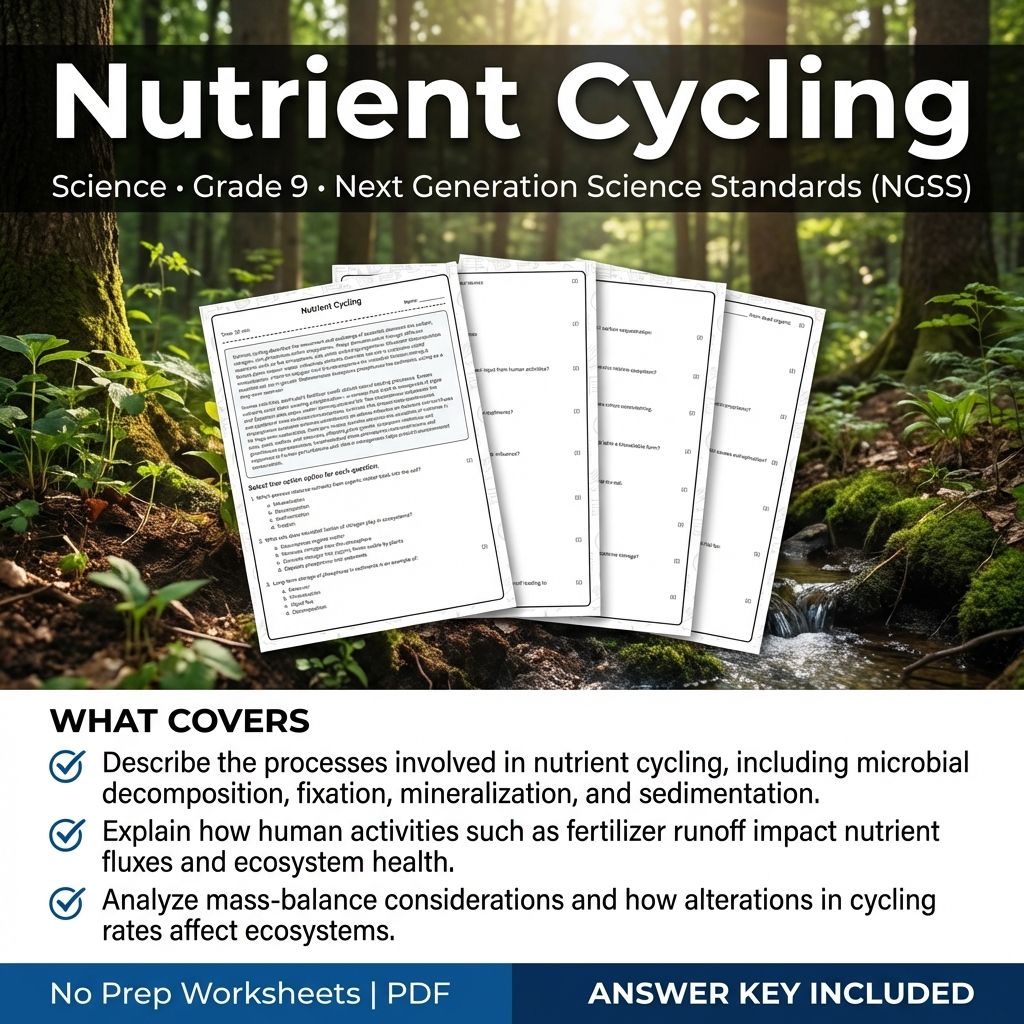
9th Grade Science Worksheet | Nutrient Cycling Practice with Answer Key (PDF)
Created byCoral Reef LearningLearning Objectives
- Describe the processes involved in nutrient cycling, including microbial decomposition, fixation, mineralization, and sedimentation.
- Explain how human activities such as fertilizer runoff impact nutrient fluxes and ecosystem health.
- Analyze mass-balance considerations and how alterations in cycling rates affect ecosystems.
Also included in: Grade 9 Science Unit Worksheet Bundle | Ecosystems & Biodiversity Practice +1 more
Instant download

Population Genetics Worksheet | Grade 9 Science Standards-Aligned
JCreated byJ.S SheetsLearning Objectives
- Understand the principles of allele frequency and Hardy-Weinberg equilibrium.
- Explain the effects of genetic drift, bottlenecks, and founder effects on genetic diversity.
- Analyze how gene flow, selection, and stochastic processes influence evolution and conservation.
Also included in: Grade 9 Genetics & Inheritance Science Lesson Bundle – Alberta Framework
Instant download

Patterns of Inheritance Worksheet | Grade 9 Science Standards-Aligned
JCreated byJ.S SheetsLearning Objectives
- Explain Mendelian inheritance patterns including dominant and recessive alleles.
- Distinguish between genotype and phenotype in genetic traits.
- Use Punnett squares to predict inheritance ratios for single-gene traits.
Also included in: Grade 9 Genetics & Inheritance Science Lesson Bundle – Alberta Framework
Instant download

Risks and Benefits Worksheet for Grade 9 Science – Alberta Standards Alignment
JCreated byJ.S SheetsLearning Objectives
- Understand the ecological, economic, and health risks and benefits associated with genetic technologies.
- Evaluate potential consequences such as gene flow, resistance development, and market impacts.
- Analyze therapeutic opportunities and the importance of risk assessment and mitigation strategies.
Also included in: Grade 9 Genetics & Inheritance Science Lesson Bundle – Alberta Framework
Instant download

Adaptation and Selection Worksheet | Alberta Grade 9 Science Standards
JCreated byJ.S SheetsLearning Objectives
- Understand the concept of natural selection and how it influences adaptation in populations.
- Identify examples of selective pressure and adaptive trade-offs in Alberta ecosystems.
- Differentiate between natural selection and artificial selection in shaping species traits.
Also included in: Grade 9 Genetics & Inheritance Science Lesson Bundle – Alberta Framework
Instant download
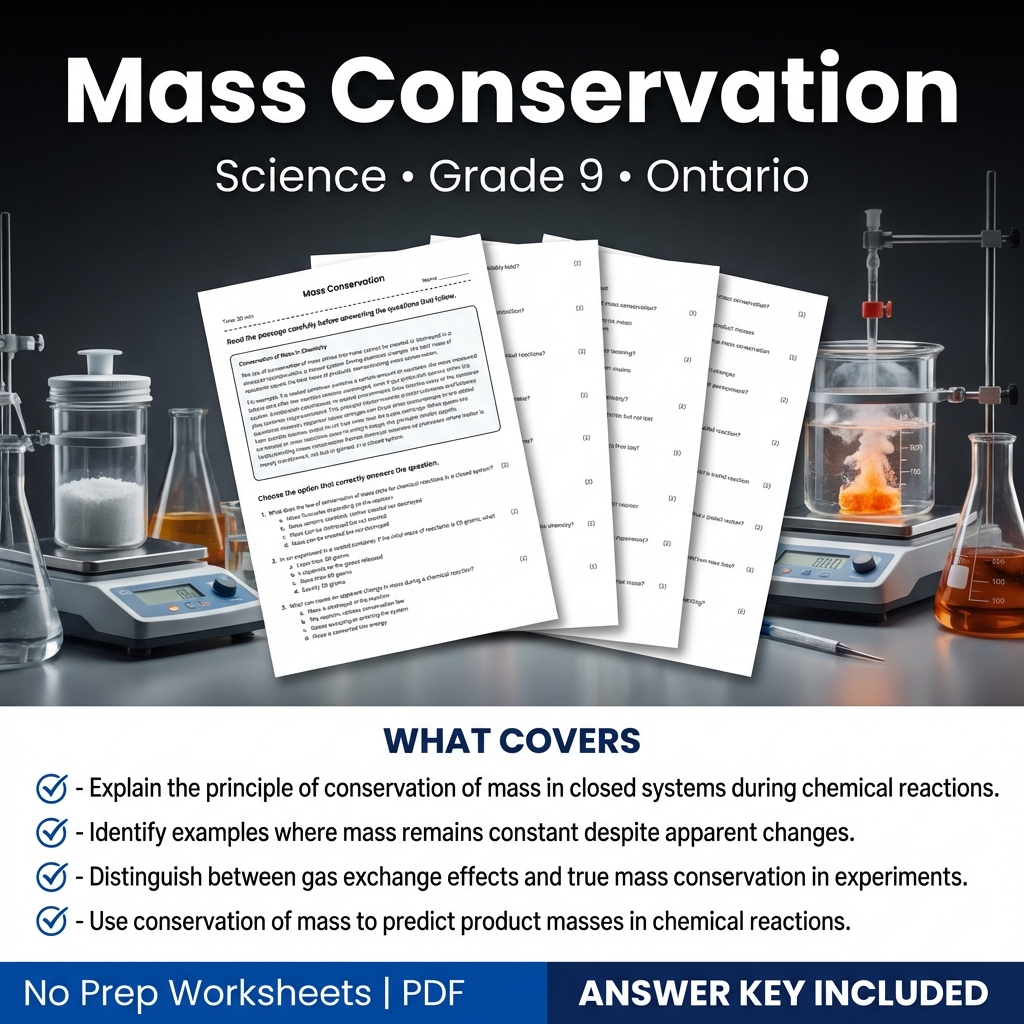
Mass Conservation Science Worksheet | Grade 9 Ontario Standard Practice
Created byCoral Reef LearningLearning Objectives
- Explain the principle of conservation of mass in closed systems during chemical reactions.
- Identify examples where mass remains constant despite apparent changes.
- Distinguish between gas exchange effects and true mass conservation in experiments.
Instant download
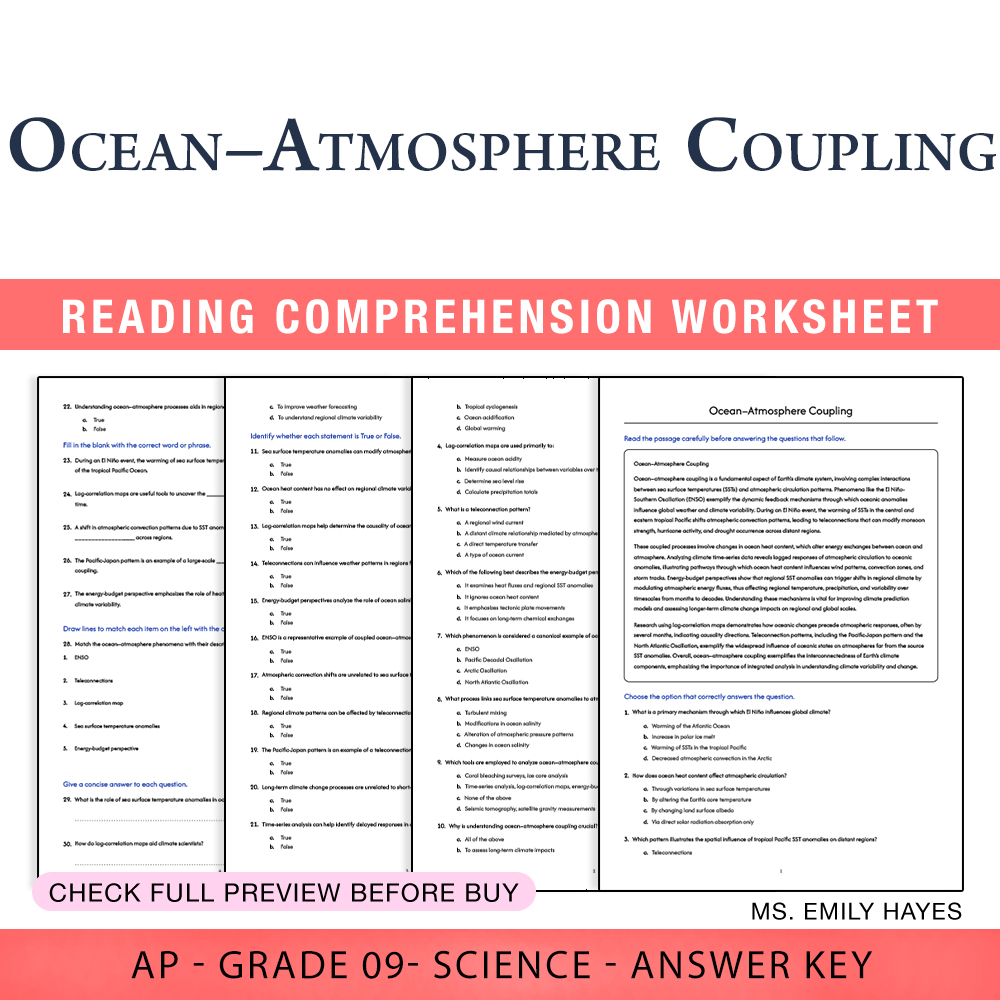
9th Grade Science | Ocean–Atmosphere Coupling Worksheet (PDF+ Answer Key)
 Created byCopper Leaf Classroom
Learning Objectives
- Describe the mechanisms linking oceanic and atmospheric variability in climate systems.
- Explain phenomena such as ENSO and how sea surface temperature anomalies influence global weather patterns.
- Analyze time-series data, lag-correlation maps, and energy-budget perspectives related to ocean–atmosphere interactions.
Also included in: Grade 9 Science | Earth and Space Sciences AP Worksheet (PDF + Answer Key) +1 more
Instant download
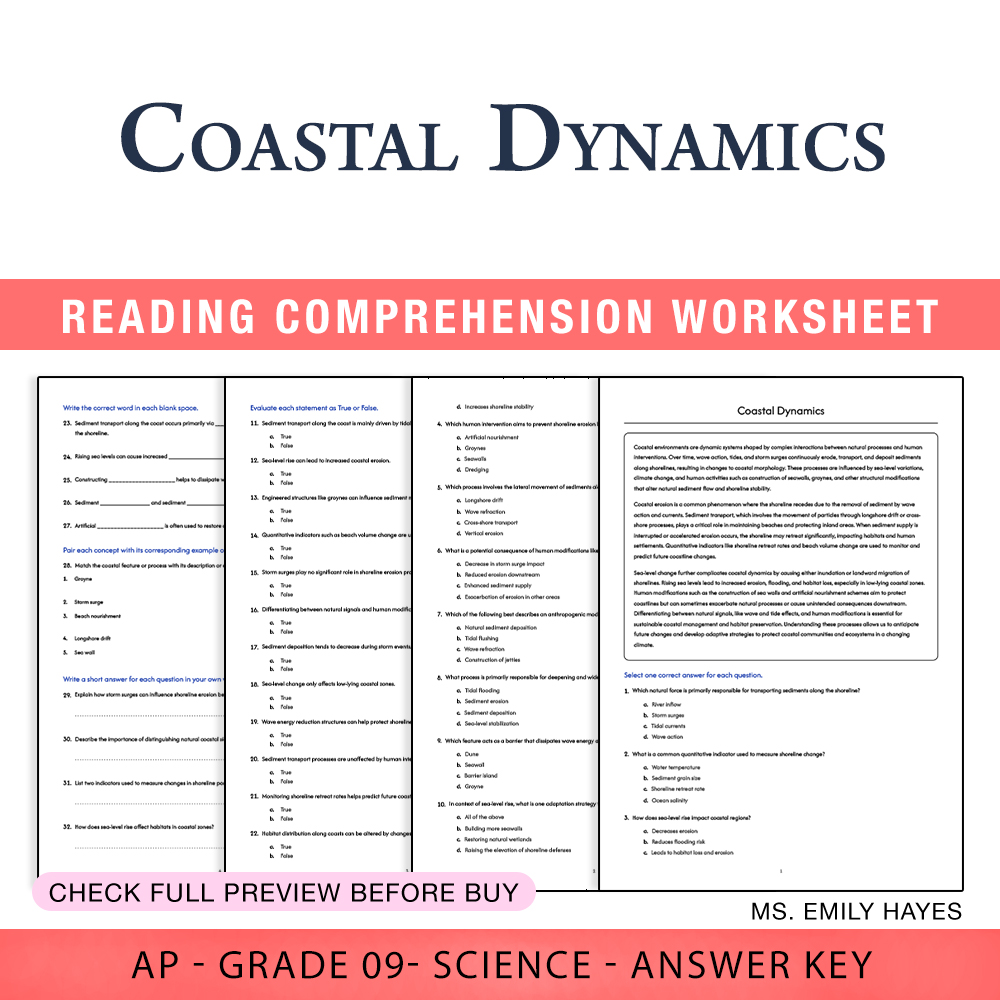
Grade 9 Science | Coastal Dynamics Worksheet (PDF+ Answer Key)
Created byCopper Leaf ClassroomLearning Objectives
- Explain the processes of coastal erosion, sediment transport, and shoreline response to various natural forces.
- Analyze how sea-level change influences coastal morphology and habitats.
- Evaluate quantitative indicators such as shoreline retreat rates and beach volume changes.
Also included in: Grade 9 Science | Earth and Space Sciences AP Worksheet (PDF + Answer Key) +1 more
Instant download
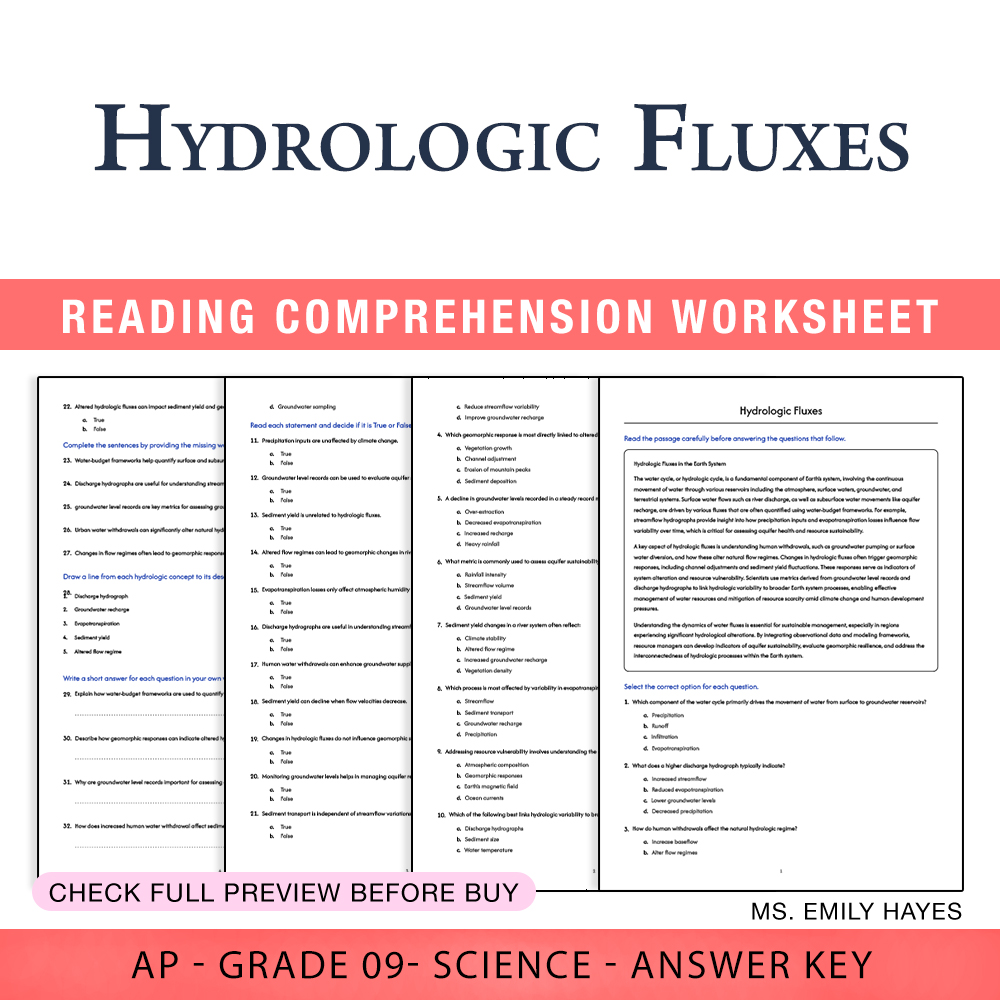
9th Grade Science | Hydrologic Fluxes Worksheet (PDF+ Answer Key)
Created byCopper Leaf ClassroomLearning Objectives
- Quantify surface and subsurface water flows using water-budget frameworks, hydrographs, and groundwater level records.
- Relate precipitation inputs, evapotranspiration, and human withdrawals to streamflow variability and aquifer sustainability.
- Analyze how altered hydrologic fluxes impact geomorphic responses such as channel adjustments and sediment yield.
Also included in: Grade 9 Science | Earth and Space Sciences AP Worksheet (PDF + Answer Key) +1 more
Instant download
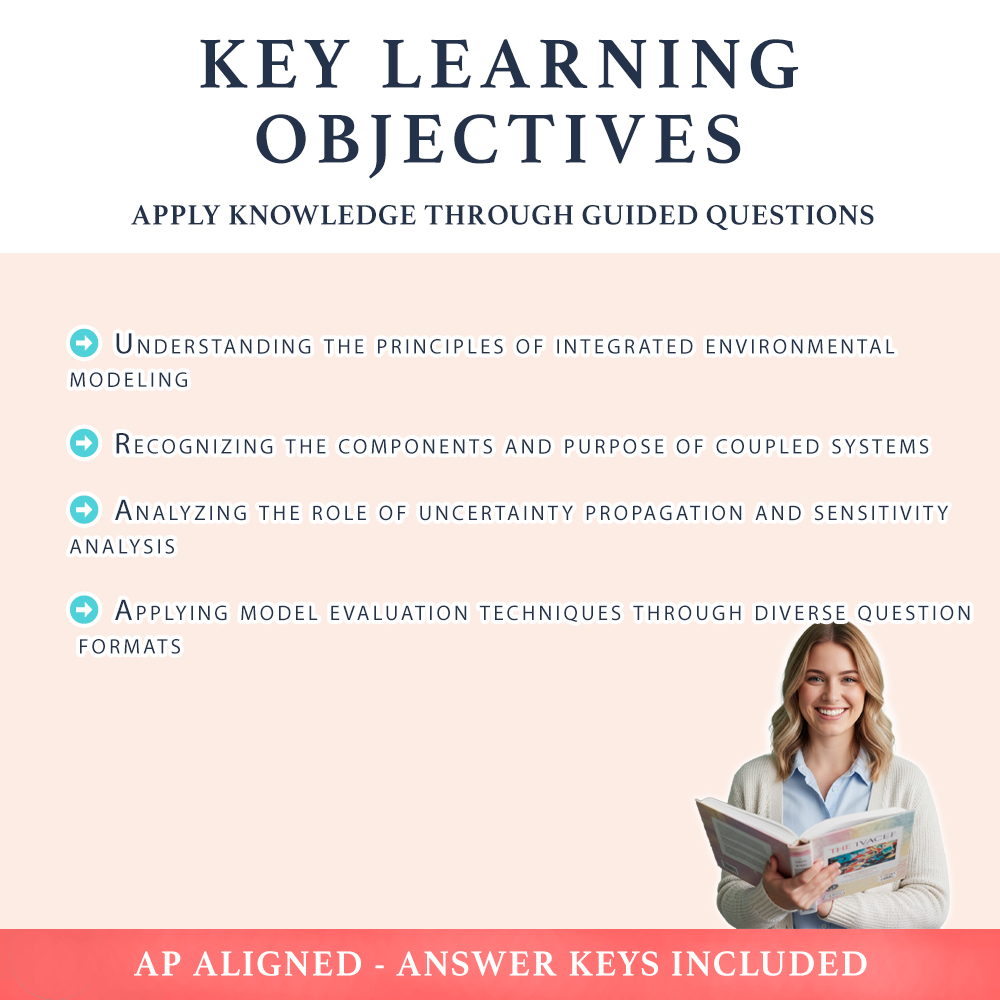
Grade 9 Science | Integrated Modeling Worksheet (PDF+ Answer Key)
Created byCopper Leaf ClassroomLearning Objectives
- Understand the components and interactions within coupled environmental models.
- Identify key parameters and sensitivities in integrated models.
- Evaluate how uncertainties propagate through complex environmental scenarios.
Also included in: Grade 9 Science | Earth and Space Sciences AP Worksheet (PDF + Answer Key) +1 more
Instant download
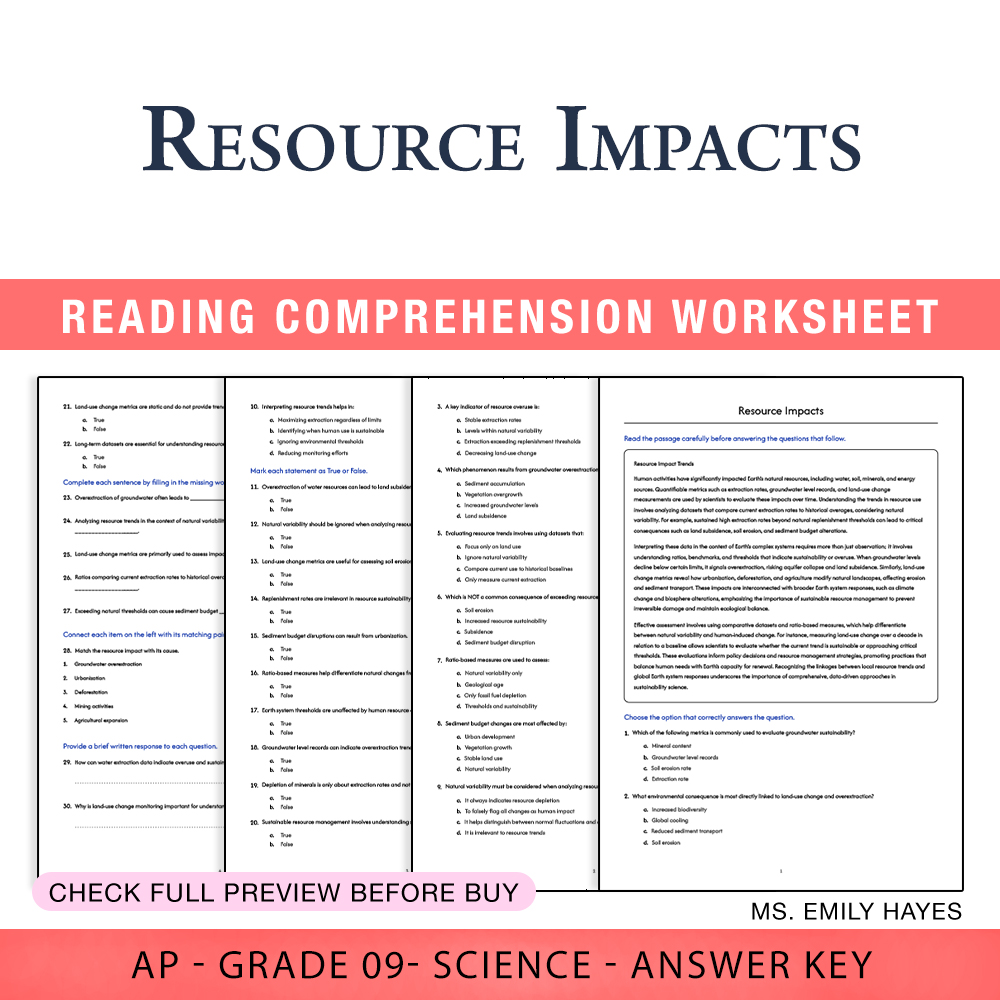
Grade 9 Science | Resource Impacts Worksheet (PDF+ Answer Key)
Created byCopper Leaf ClassroomLearning Objectives
- Analyze human activities affecting natural resources using quantifiable indicators.
- Interpret resource trends considering natural variability and system thresholds.
- Assess sustainability implications through comparative datasets and ratio-based measures.
Also included in: Grade 9 Science | Earth and Space Sciences AP Worksheet (PDF + Answer Key) +1 more
Instant download
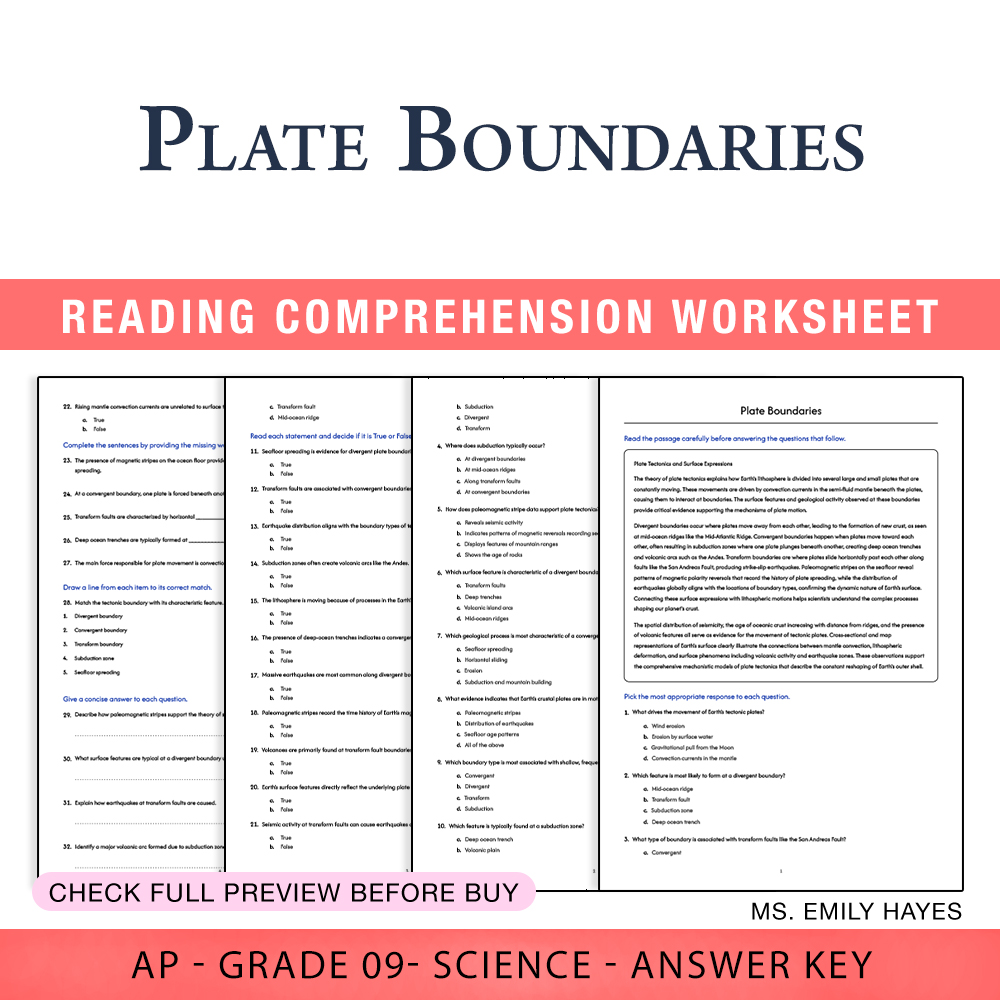
9th Grade Science | Plate Boundaries Worksheet (PDF+ Answer Key)
Created byCopper Leaf ClassroomLearning Objectives
- Explain the mechanisms behind the three main types of plate boundaries: divergent, convergent, and transform.
- Identify surface expressions and characteristic features associated with each boundary type.
- Analyze geologic evidence such as seafloor age patterns, paleomagnetic stripes, and earthquake distribution to interpret plate movements.
Also included in: Grade 9 Science | Earth and Space Sciences AP Worksheet (PDF + Answer Key) +1 more
Instant download
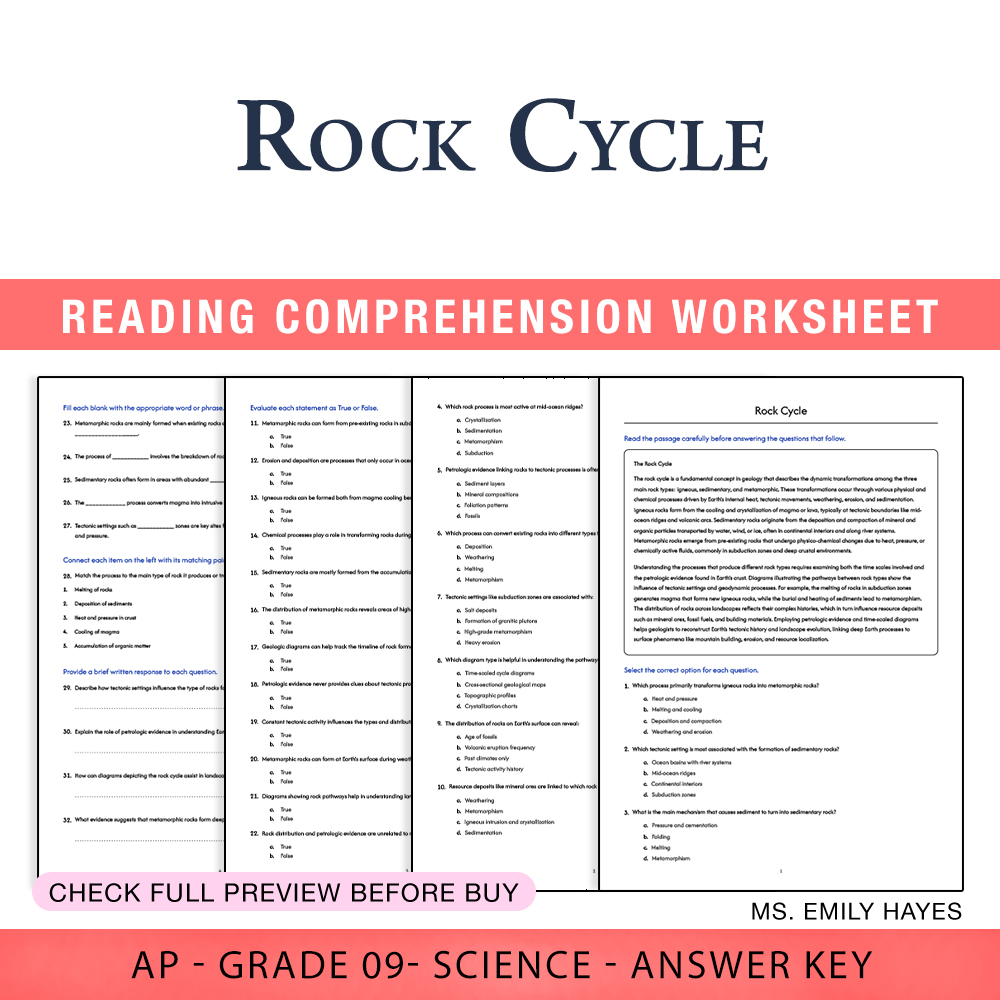
Grade 9 Science | Rock Cycle Worksheet (PDF+ Answer Key)
Created byCopper Leaf ClassroomLearning Objectives
- Describe the processes involved in the transformation of igneous, sedimentary, and metamorphic rocks.
- Explain the physical and chemical mechanisms driving changes in rock types within various tectonic settings.
- Connect petrologic evidence and diagrams to the understanding of landscape evolution and resource distribution.
Also included in: Grade 9 Science | Earth and Space Sciences AP Worksheet (PDF + Answer Key) +1 more
Instant download
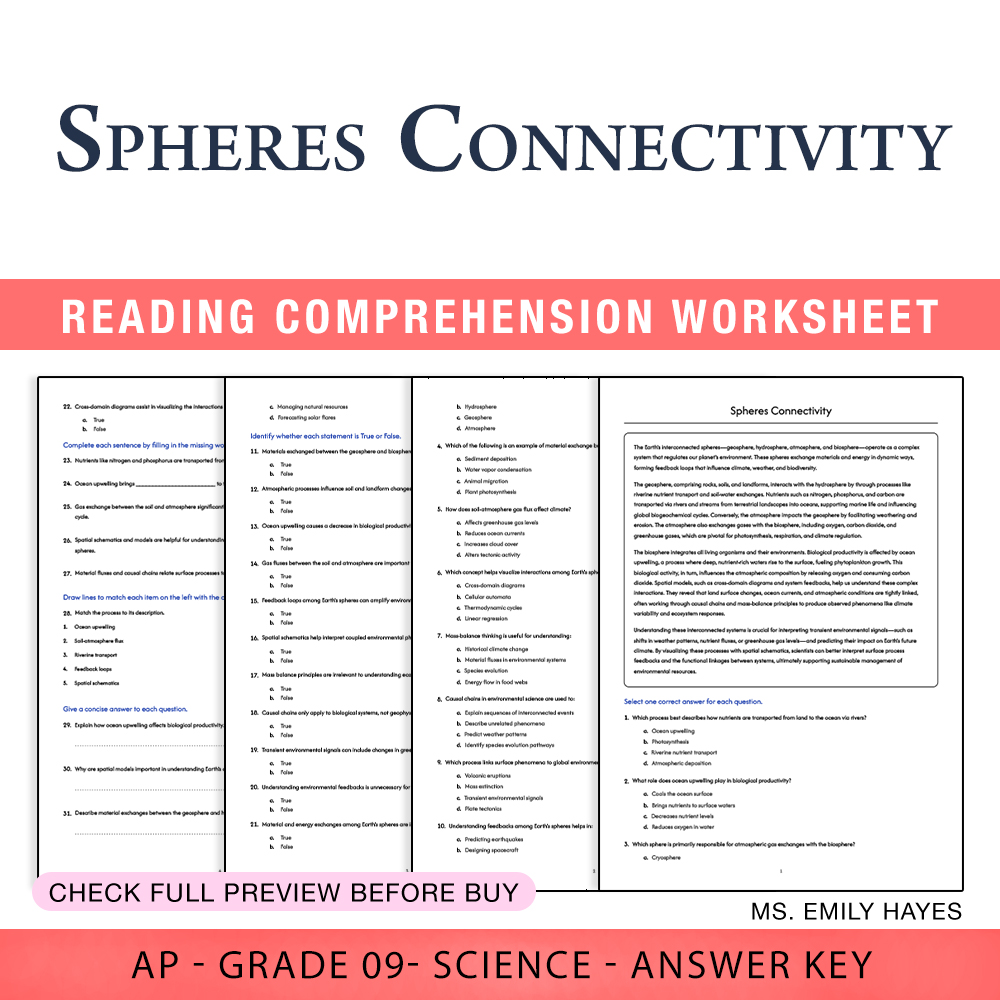
Grade 9 Science | Spheres Connectivity Worksheet (PDF+ Answer Key)
Created byCopper Leaf ClassroomLearning Objectives
- Describe interactions among geosphere, hydrosphere, atmosphere, and biosphere using models and diagrams.
- Analyze material and energy exchanges such as nutrient transport, gas fluxes, and ocean upwelling effects.
- Use spatial schematics, mass-balance thinking, and causal chains to interpret environmental phenomena.
Also included in: Grade 9 Science | Earth and Space Sciences AP Worksheet (PDF + Answer Key) +1 more
Instant download

9th Grade Science | Volcanic Processes Worksheet (PDF+ Answer Key)
Created byCopper Leaf ClassroomLearning Objectives
- Explain the different magmatic systems and their influence on volcanic eruptive styles.
- Describe how volcanic gas emissions are linked to magma composition and tectonic setting.
- Contrast effusive shield volcanism with explosive stratovolcano behavior based on magma viscosity and volatile content.
Also included in: Grade 9 Science | Earth and Space Sciences AP Worksheet (PDF + Answer Key) +1 more
Instant download
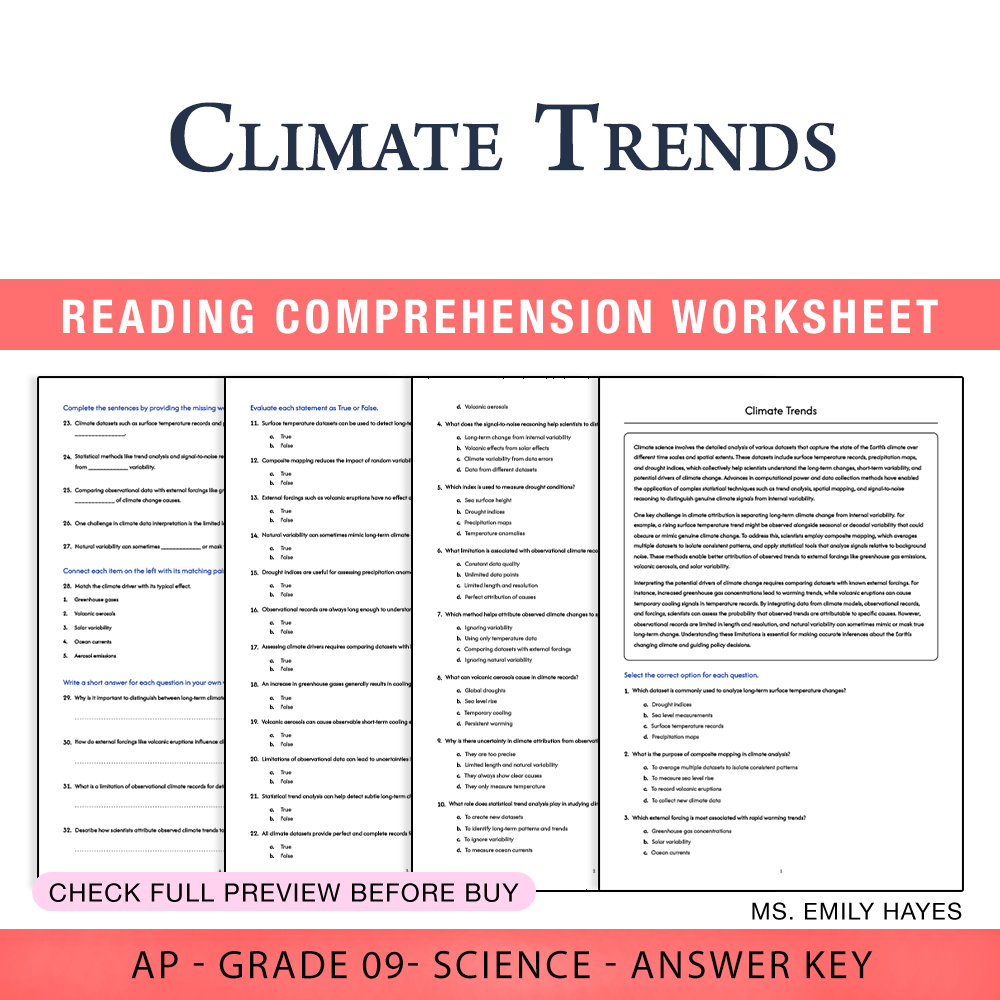
9th Grade Science | Climate Trends Worksheet (PDF+ Answer Key)
Created byCopper Leaf ClassroomLearning Objectives
- Analyze spatial and temporal climate datasets to identify trends and anomalies.
- Understand the application of statistical trend analysis and composite mapping in climate science.
- Interpret potential climate drivers by comparing datasets with external forcings such as greenhouse gases and volcanic aerosols.
Also included in: Grade 9 Science | Earth and Space Sciences AP Worksheet (PDF + Answer Key) +1 more
Instant download
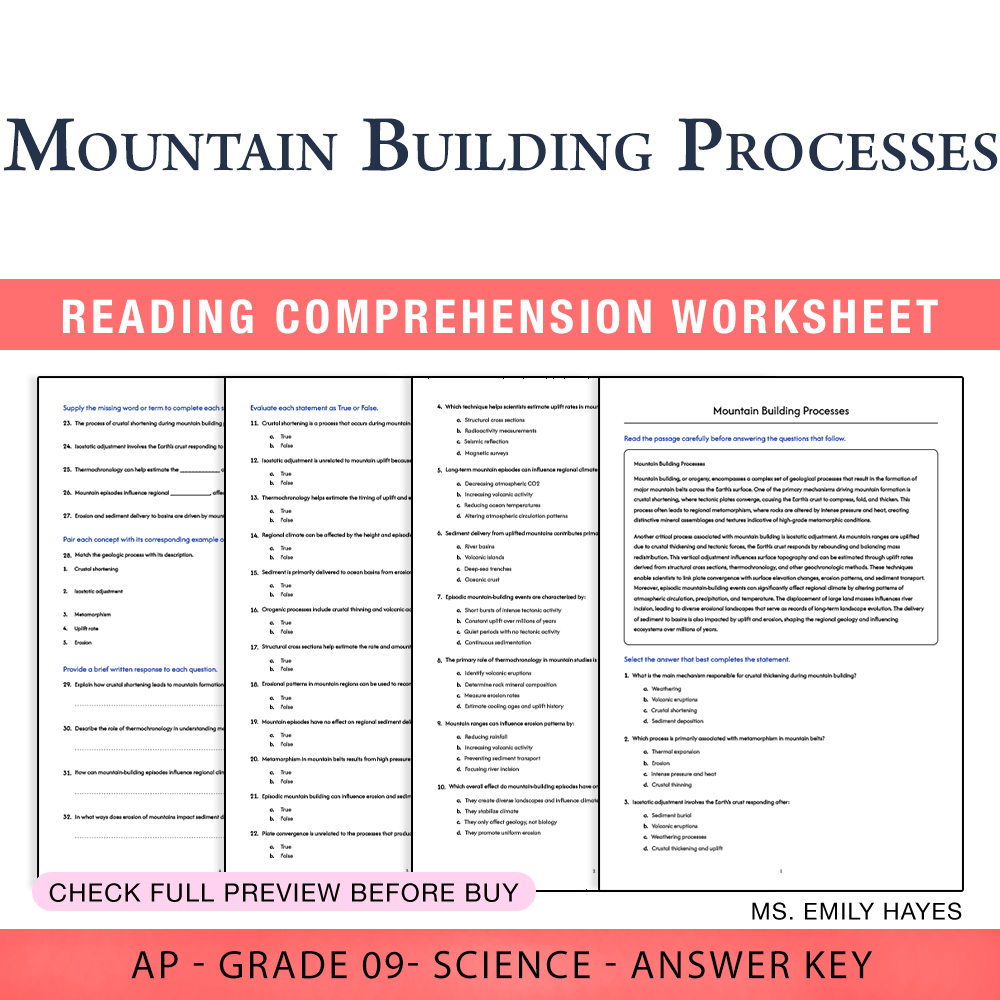
Grade 9 Science | Mountain Building Processes Worksheet (PDF+ Answer Key)
Created byCopper Leaf ClassroomLearning Objectives
- Describe the geologic processes involved in mountain building, including crustal shortening and isostatic adjustment.
- Explain how structural cross sections, uplift rate estimates, and thermochronology contribute to understanding mountain formation.
- Analyze the influence of mountain-building episodes on regional climate, erosion, and sediment delivery.
Also included in: Grade 9 Science | Earth and Space Sciences AP Worksheet (PDF + Answer Key) +1 more
Instant download
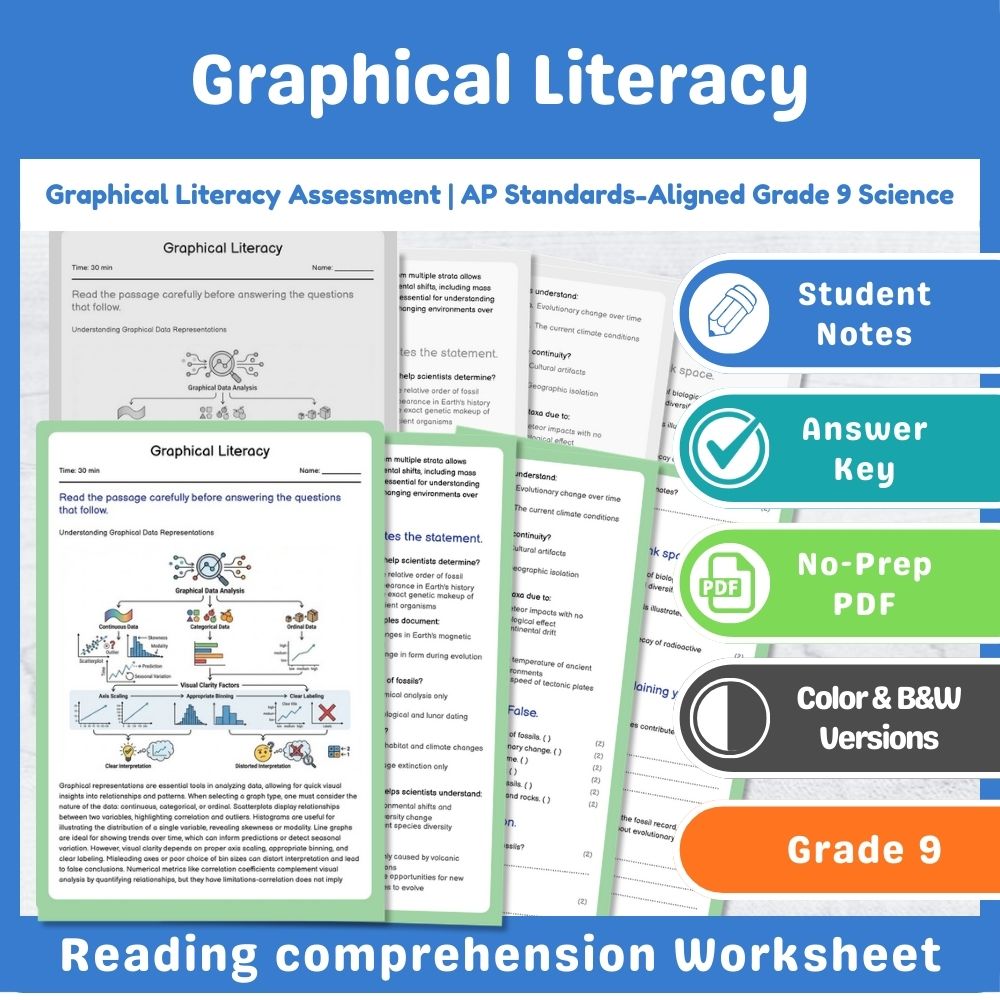
Graphical Literacy Assessment | AP Standards-Aligned Grade 9 Science
 Created byPrism Point Learning
Learning Objectives
- Identify various types of graphical representations used in data analysis.
- Construct accurate and effective graphs such as scatterplots, histograms, and line graphs.
- Interpret visual patterns, outliers, and trends in data visualizations.
Instant download
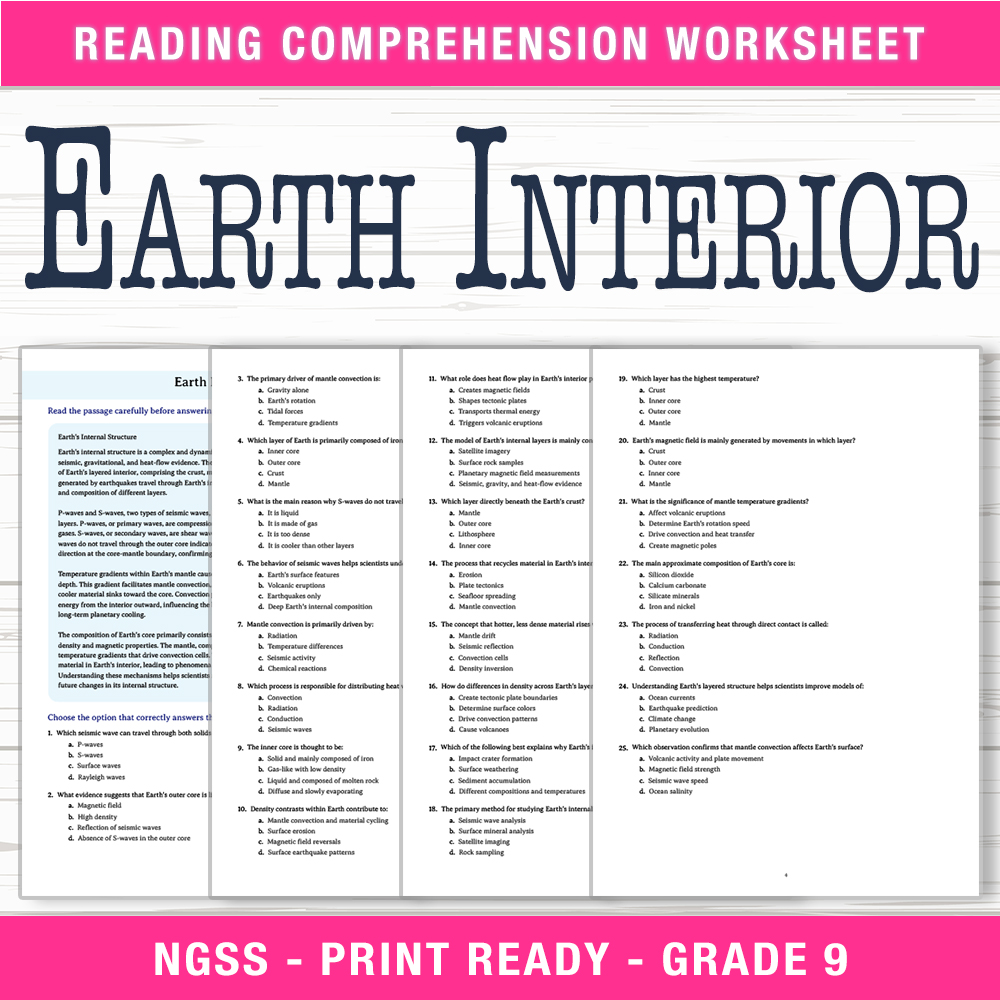
Grade 9 Science | Earth's Interior Worksheet (PDF + Answer Key)
 Created byRiverstone Classroom
Learning Objectives
- Understand the layered structure of Earth's interior based on seismic, gravity, and heat-flow evidence.
- Interpret the behavior of P-waves and S-waves and their implications for Earth's internal composition.
- Explain how temperature gradients and density contrasts drive mantle convection and material cycling.
Also included in: Grade 9 Science Unit | Earth Processes & Climate Worksheet Bundle
Instant download

Atomic Particles Worksheet for Grade 9 Science | Standards-Aligned Practice
JCreated byJ.S SheetsLearning Objectives
- Identify and describe the subatomic particles within an atom.
- Explain how protons, neutrons, and electrons determine an atom's properties.
- Understand the concept of isotopes and their effect on atomic stability.
Instant download

Grade 9 Computational Modeling Worksheet | NGSS Science Activity & Doodle Note
 Created byAmber Owl Education
Learning Objectives
- Explain how computational models use assumptions, variables, and parameters to predict system behavior.
- Use algebraic performance objective functions to compare design scenarios and justify parameter choices.
- Describe and interpret results from sensitivity analysis to understand how outputs change with inputs.
Also included in: Grade 9 Science Engineering Design and Computational Modeling Lesson Bundle +1 more
Instant download

Grade 9 Tidal Forces Worksheet | Practice & BC Standards PDF
 Created byClear Sky Classroom
Learning Objectives
- Explain how the Moon, Sun, and Earth’s orbital motion produce tidal forces
- Describe how spring and neap tides form from the relative alignment of the Moon and Sun
- Analyze how local ocean depth and coastline geometry can change tidal range and current strength
Instant download

Grade 9 Science | Molecules and Lattices Worksheet with Short Notes (PDF)
 Created byMeadowlark Worksheets
Learning Objectives
- Explain how bulk material structures relate to the arrangement of particles.
- Differentiate between ionic lattices, covalent networks, and molecular solids based on their properties.
- Interpret observations of melting point, electrical conductivity, hardness, and solubility to determine lattice organization.
Also included in: Grade 9 Science Unit | Matter and Its Interactions NGSS Worksheet Pack +1 more
Instant download
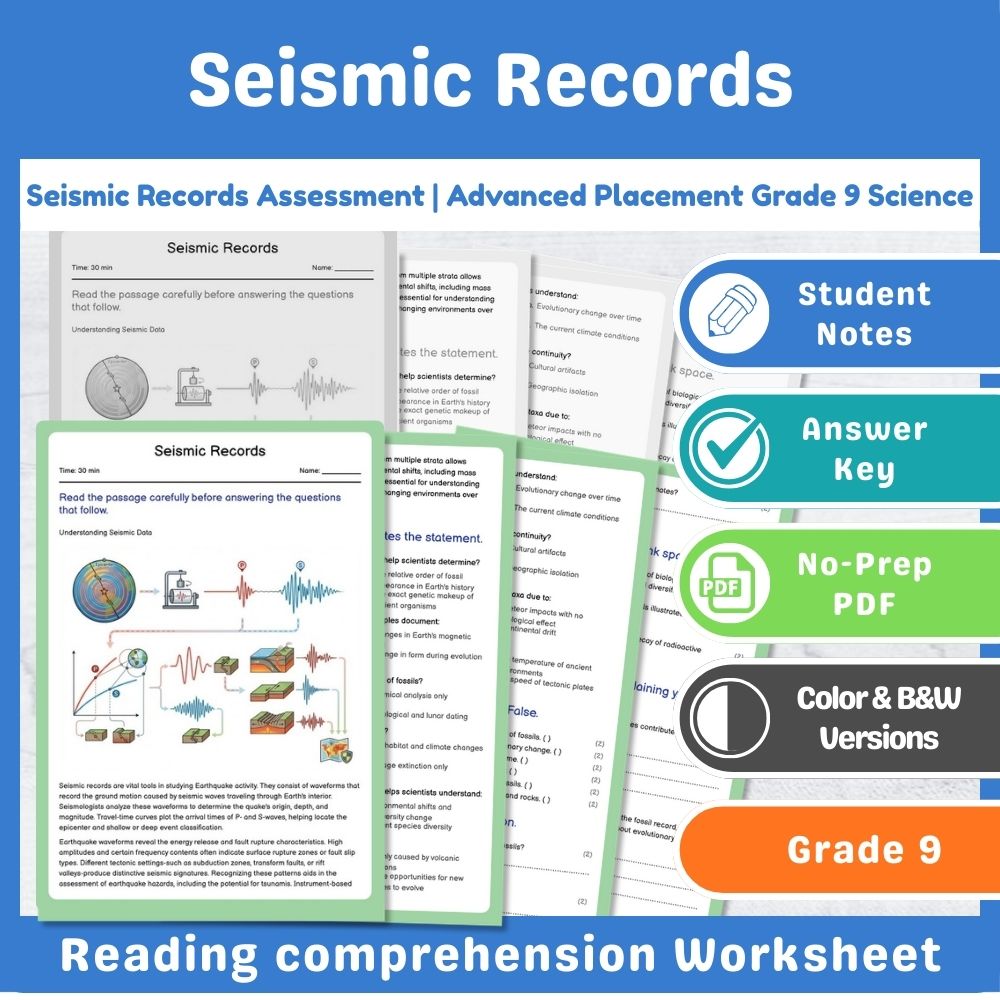
Seismic Records Assessment | Advanced Placement Grade 9 Science
Created byPrism Point LearningLearning Objectives
- Interpret earthquake waveforms and travel-time curves to infer subsurface structures.
- Compare P- and S-wave arrivals, waveform amplitudes, and frequency content to distinguish earthquake depths and locations.
- Connect seismic activity patterns to tectonic environments and surface hazard phenomena such as tsunamis.
Also included in: Grade 9 Science Mini Bundle | Earth and Space Sciences AP Standards
Instant download
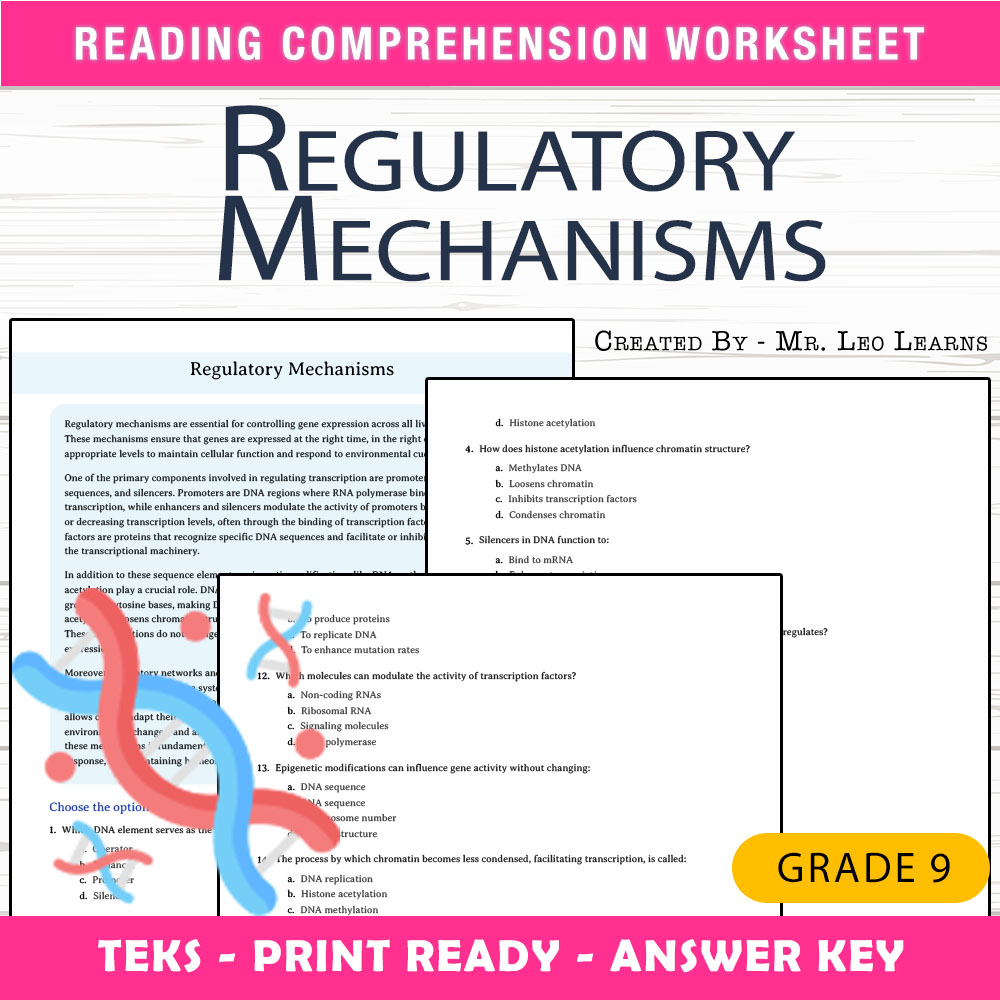
9th Grade Science – Regulatory Mechanisms Worksheet for Mastery
 Created byThe Resource Hub
Learning Objectives
- Understand how gene expression is controlled through regulatory mechanisms.
- Describe the roles of promoters, enhancers, silencers, transcription factors, and repressors.
- Explain epigenetic modifications and their impact on chromatin accessibility and transcription.
Also included in: Grade 9 Science Unit Bundle | Genetics, DNA & Biotechnology Worksheets +1 more
Instant download
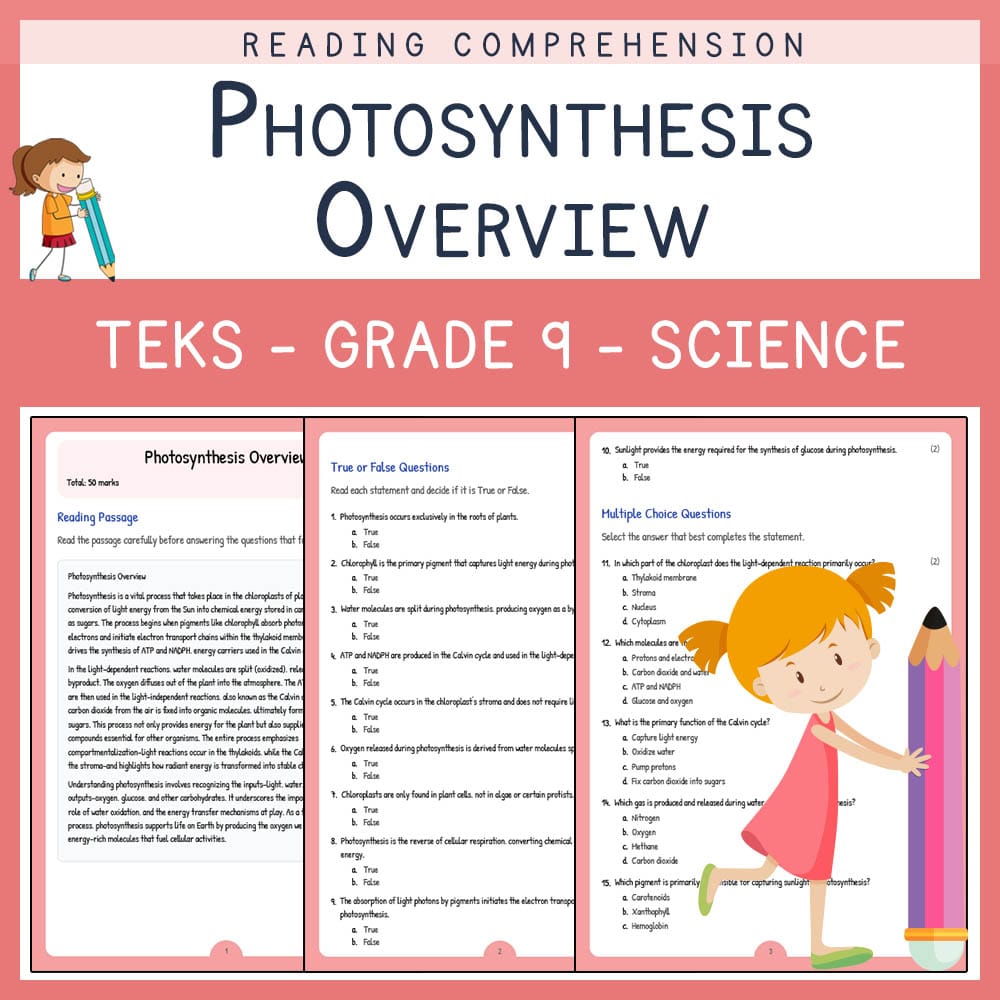
Grade 9 Science | Photosynthesis Overview Worksheet | TEKS Aligned
Created byLumora LearningLearning Objectives
- Understand the process of photosynthesis and its components.
- Identify inputs, outputs, and the steps involved in photosynthesis.
- Explain the role of chloroplasts, pigments, and electron transport in capturing light energy.
Instant download
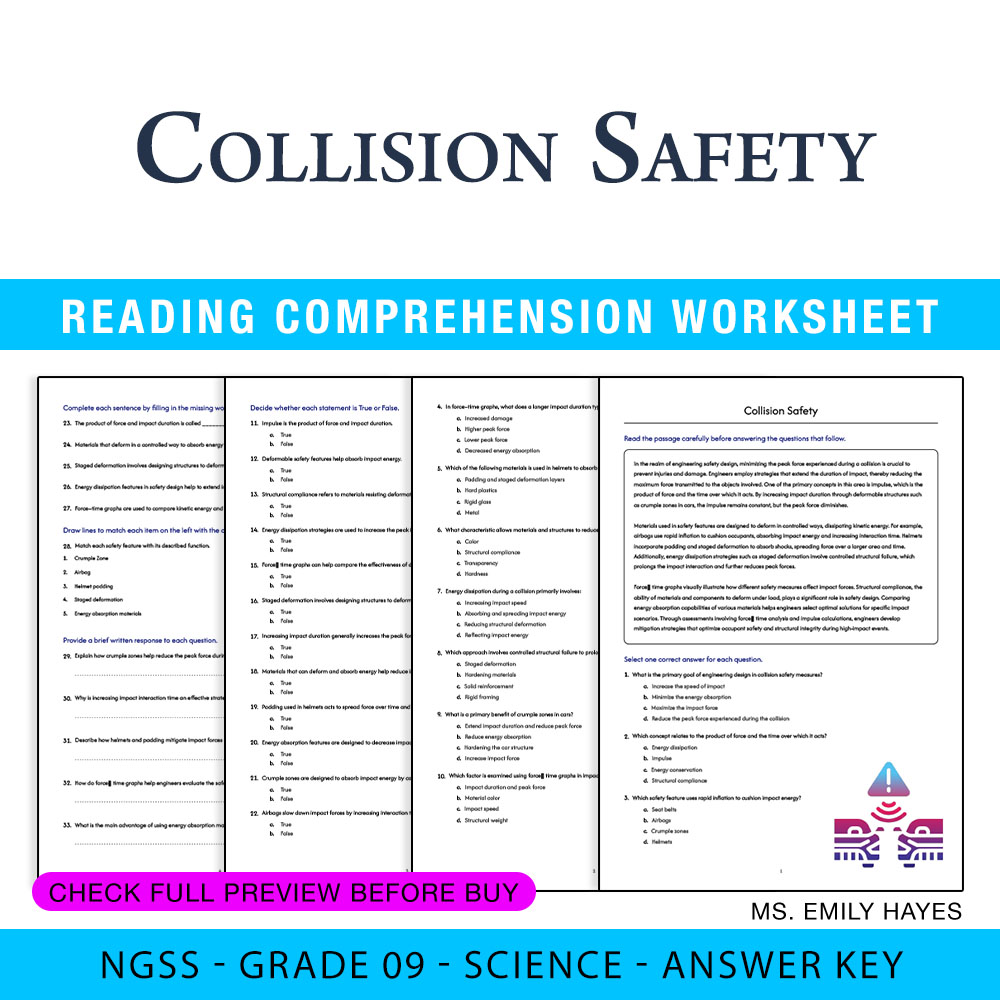
Grade 9 Science | Collision Safety Worksheet (PDF+ Answer Key)
Created byCopper Leaf ClassroomLearning Objectives
- Understand the concepts of impulse, force, and energy dissipation in collision scenarios.
- Analyze force‑time graphs to evaluate impact mitigation methods such as crumple zones and airbags.
- Describe how materials deform and dissipate energy during collisions to reduce peak forces.
Instant download

Sex-Linked Traits Worksheet | Grade 9 Science Activities
Created byPrism Point LearningLearning Objectives
- Explain how sex chromosomes (X and Y) influence inheritance of certain traits.
- Distinguish X-linked recessive traits from other inheritance patterns using hemizygosity in males.
- Describe how dosage compensation affects gene expression across sexes.
Instant download
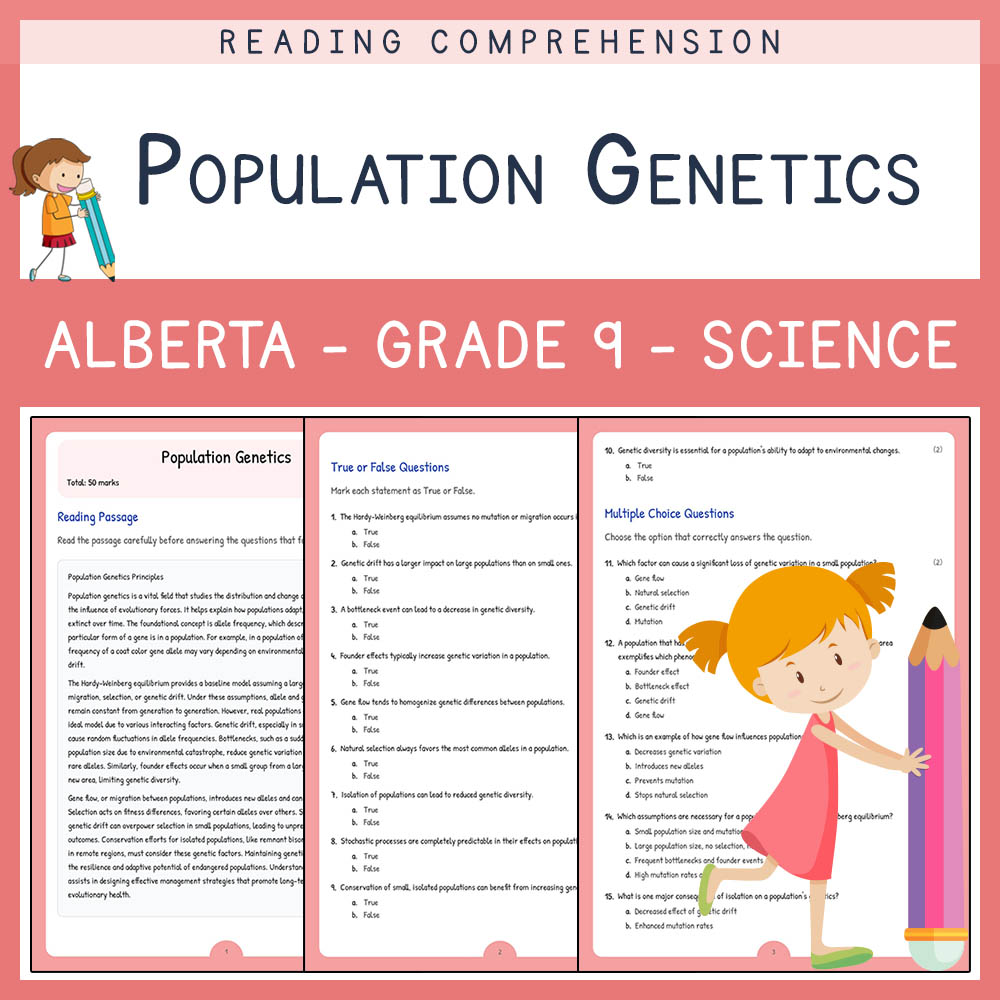
Grade 9 Science | Population Genetics Worksheet | Alberta Standards
Created byLumora LearningLearning Objectives
- Understand the core principles of population genetics, including allele frequency and genetic drift.
- Describe the assumptions of Hardy-Weinberg equilibrium and factors that disrupt it.
- Explain the effects of bottlenecks, founder effects, and gene flow on genetic diversity.
Instant download

Volcanic Processes Worksheet | Grade 9 AP Science Practice
 Created byBright Quill Resources
Learning Objectives
- Explain how magma composition, temperature, viscosity, and volatile content control eruptive styles.
- Compare effusive shield volcanism and explosive stratovolcano behavior using evidence such as gas emissions and eruption deposits.
- Interpret tectonic settings and petrologic indicators to connect volcanic activity with landscape and atmospheric change.
Instant download
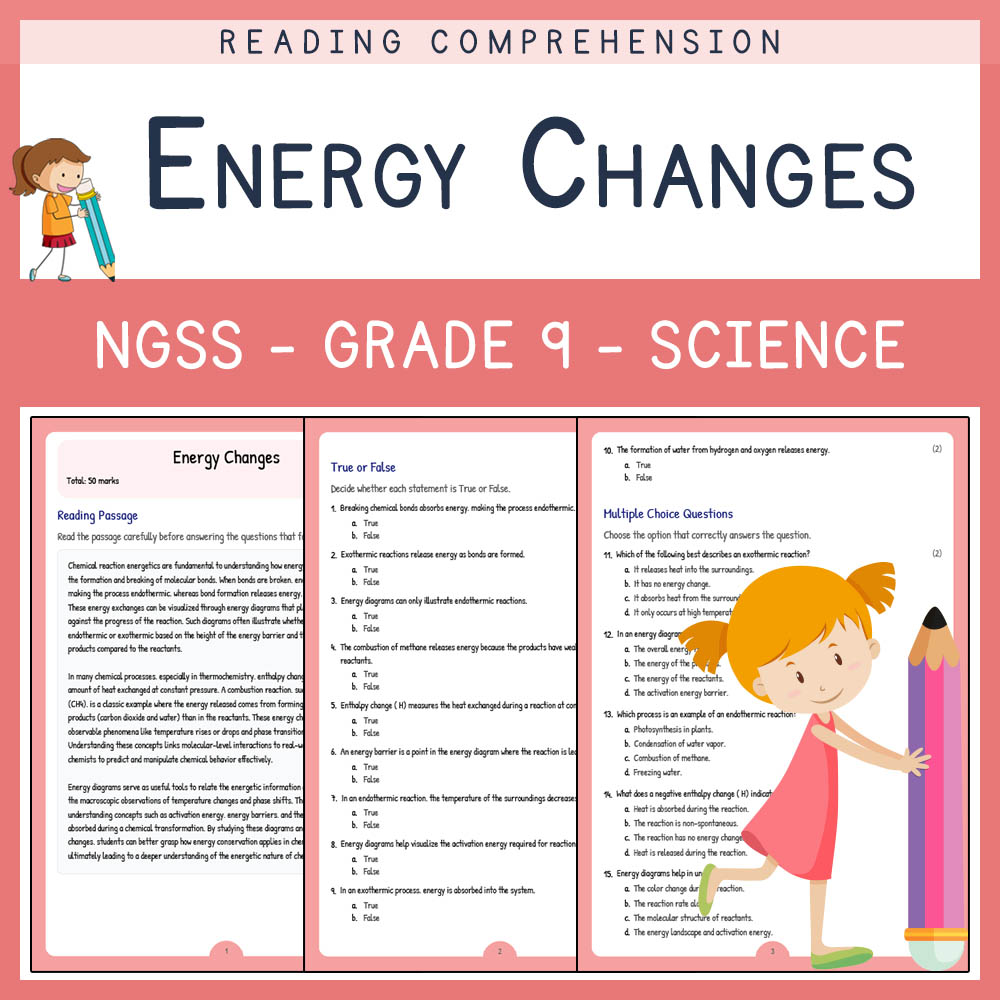
Grade 9 Science | Energy Changes Worksheet (PDF + Answer Key) – NGSS Aligned
Created byLumora LearningLearning Objectives
- Understand the concept of energy changes during chemical reactions, including endothermic and exothermic processes.
- Interpret energy diagrams to relate molecular interactions to observable temperature and phase changes.
- Identify and describe the role of bond breaking and formation in energy changes.
Instant download

Grade 9 Science | Energy Molecules Worksheet (TEKS Alignment) (PDF)
 Created byEvergreen Desk Education
Learning Objectives
- Explain the structure of ATP and how its components relate to storing usable cellular energy.
- Describe how ATP hydrolysis releases energy and how that energy powers cellular work.
- Compare ATP regeneration by phosphorylation with ATP breakdown, focusing on energy transfer.
Instant download
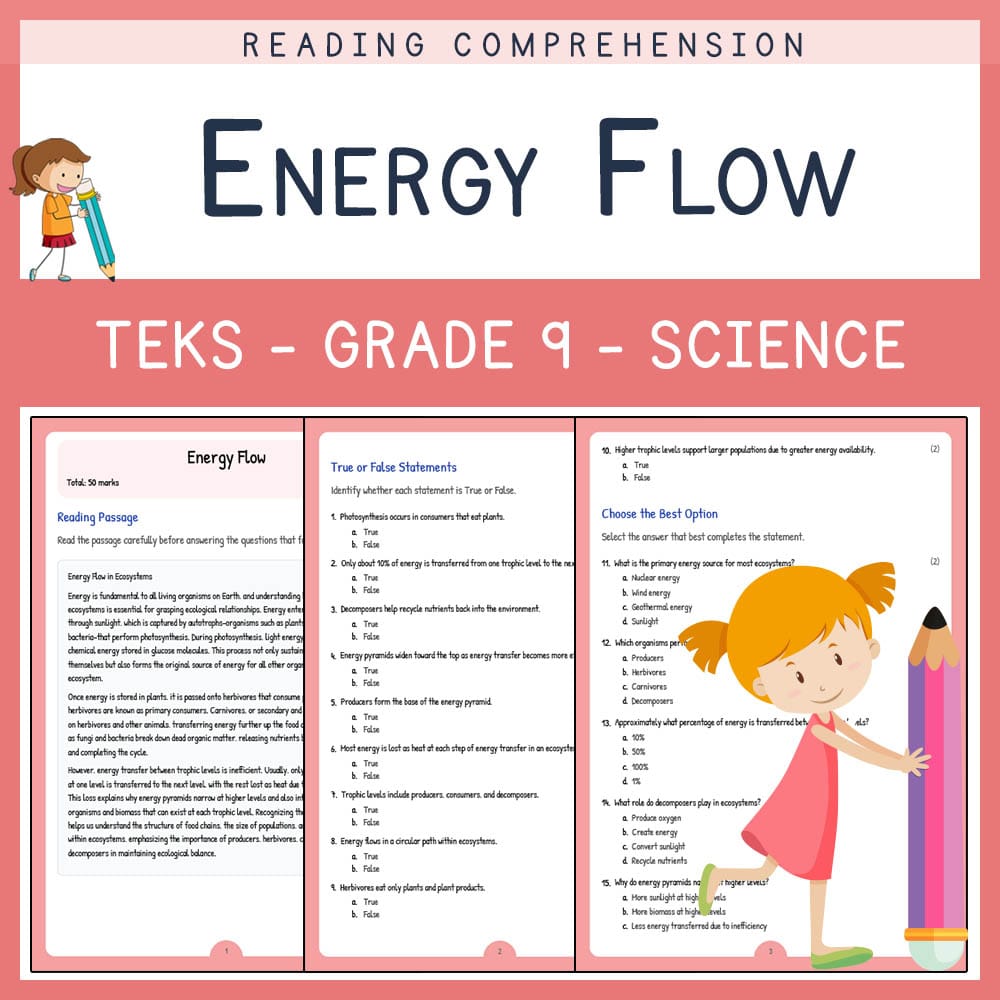
Grade 9 Science | Energy Flow Worksheet | TEKS-Aligned
Created byLumora LearningLearning Objectives
- Describe how energy flows through ecosystems from primary producers to consumers and decomposers.
- Explain the process of photosynthesis and its role in energy transfer.
- Identify different trophic levels and understand the energy loss at each level.
Instant download
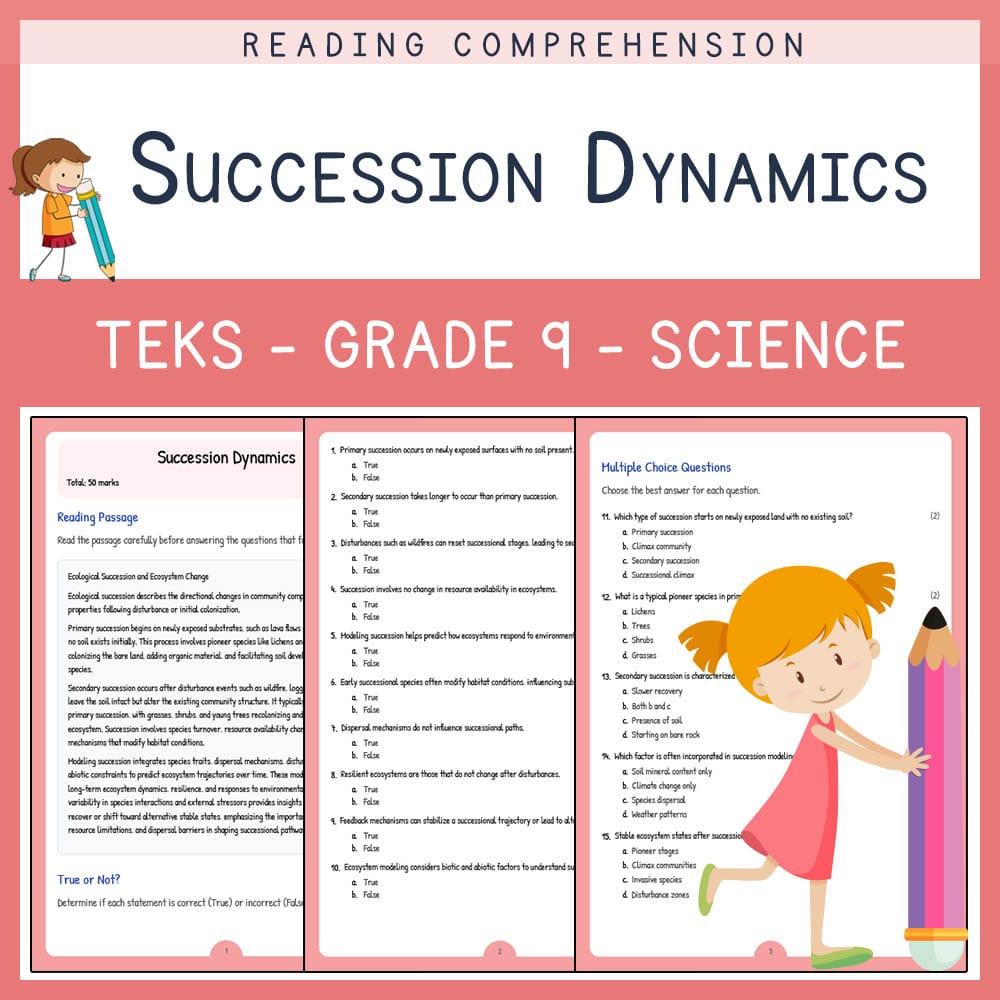
Grade 9 Science | Succession Dynamics Worksheet | TEKS Aligned
Created byLumora LearningLearning Objectives
- Explain the process of ecological succession and its different types.
- Identify factors influencing succession trajectories in ecosystems.
- Model succession incorporating species traits, dispersal, and environmental constraints.
Instant download
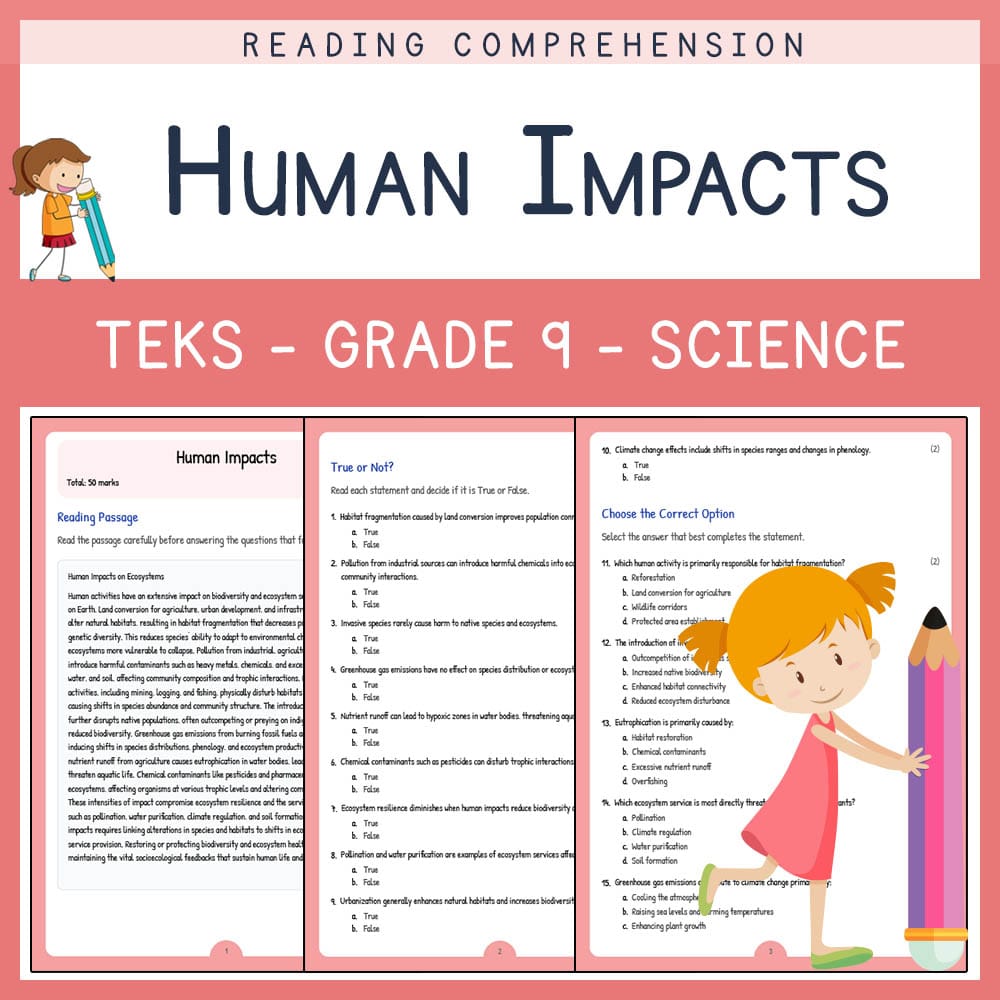
Grade 9 Science | Human Impacts Worksheet | TEKS Aligned
Created byLumora LearningLearning Objectives
- Understand how human activities affect biodiversity and ecosystem services.
- Identify different types of human impacts on habitats and species.
- Evaluate the consequences of habitat fragmentation, pollution, and resource extraction.
Instant download
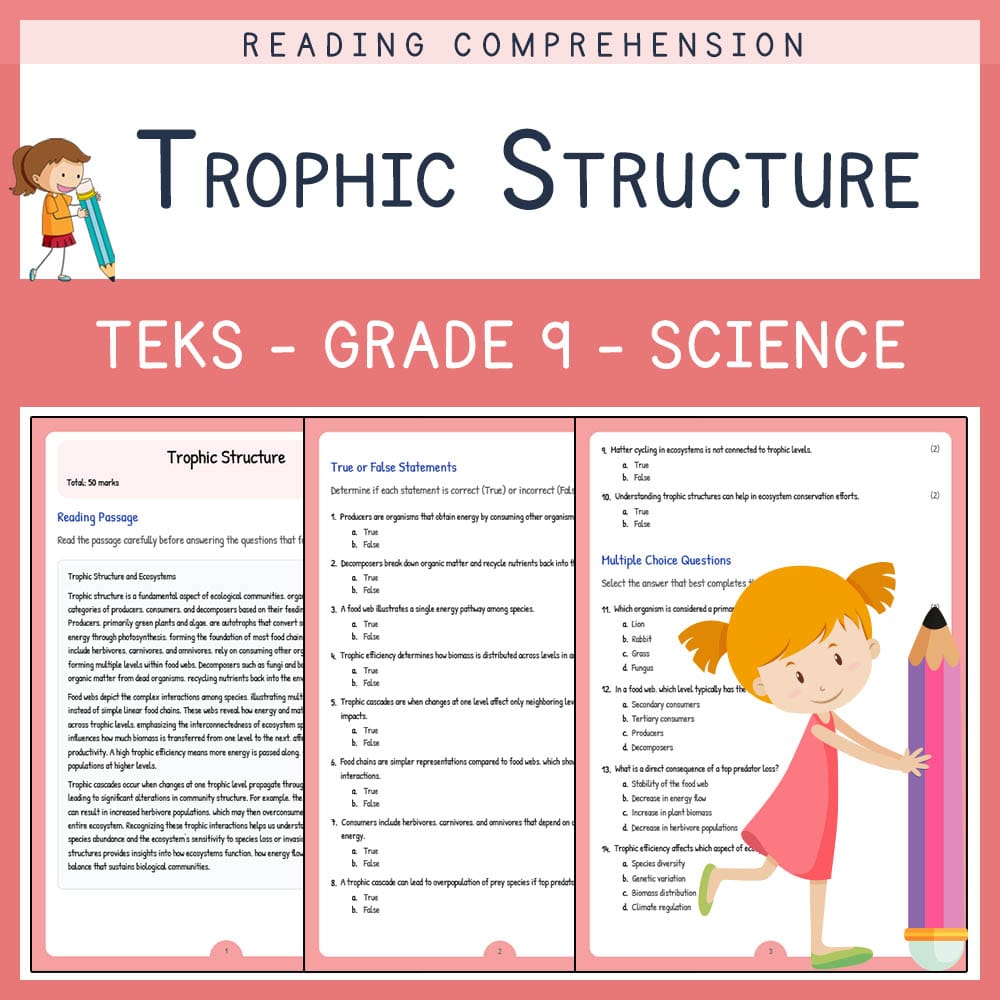
Grade 9 Science | Trophic Structure Worksheet | TEKS-Aligned
Created byLumora LearningLearning Objectives
- Understand the components of trophic structure including producers, consumers, and decomposers.
- Explain how food chains and food webs illustrate energy flow within ecosystems.
- Describe the concepts of trophic efficiency and trophic cascades and their effects on ecosystems.
Instant download
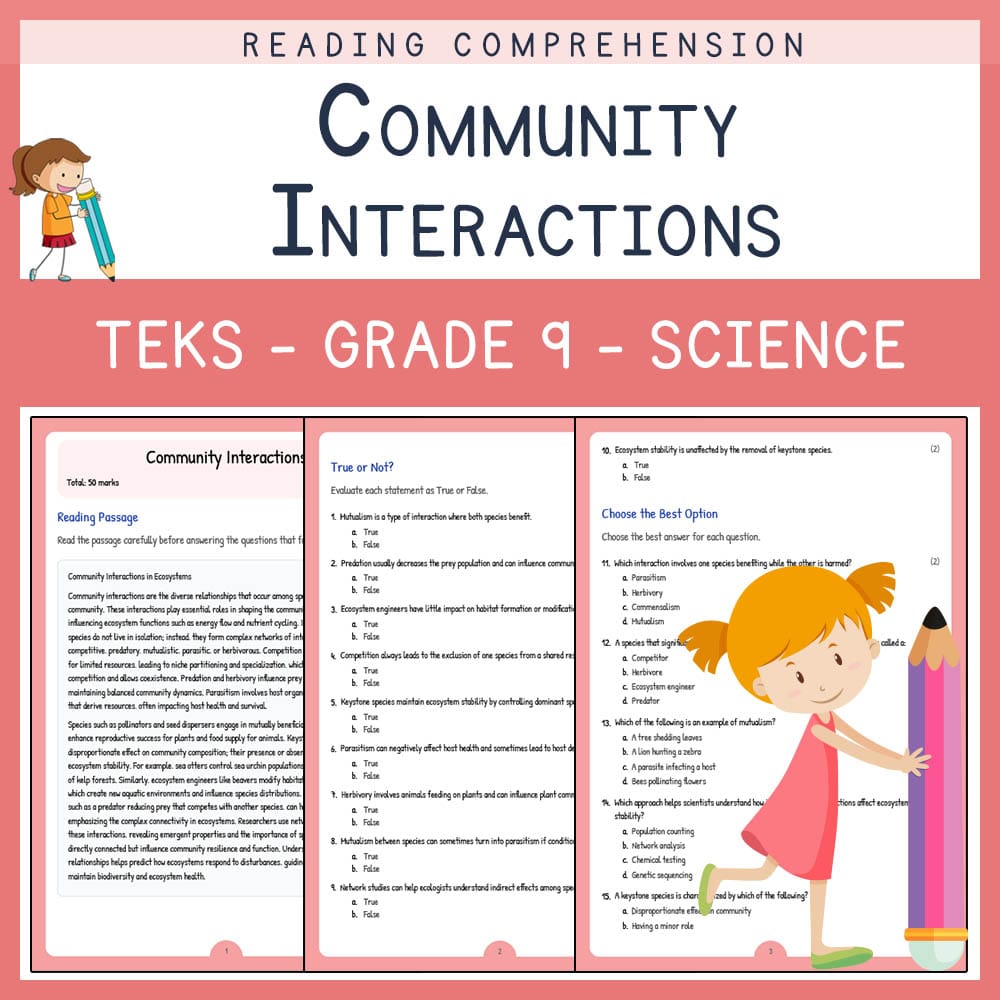
Grade 9 Science | Community Interactions Worksheet | TEKS-Aligned
Created byLumora LearningLearning Objectives
- Explain how different species interact within a community and the effects on ecosystem stability.
- Identify and describe various types of species interactions such as competition, predation, and mutualism.
- Understand the roles of keystone species and ecosystem engineers in shaping community structure.
Instant download
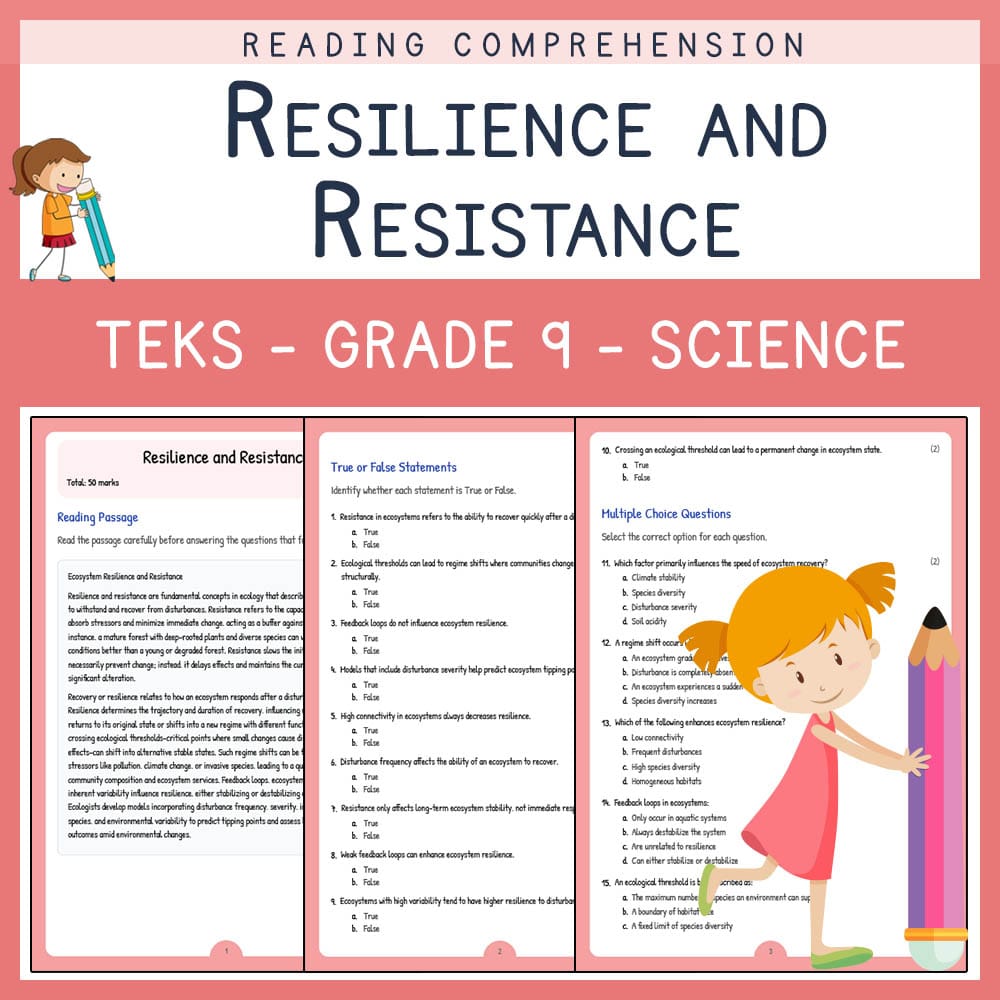
Grade 9 Science | Resilience and Resistance Worksheet | TEKS Aligned
Created byLumora LearningLearning Objectives
- Explain the concepts of resilience and resistance in ecosystems.
- Identify factors that influence ecosystem recovery and stability.
- Describe ecological thresholds and regime shifts.
Instant download
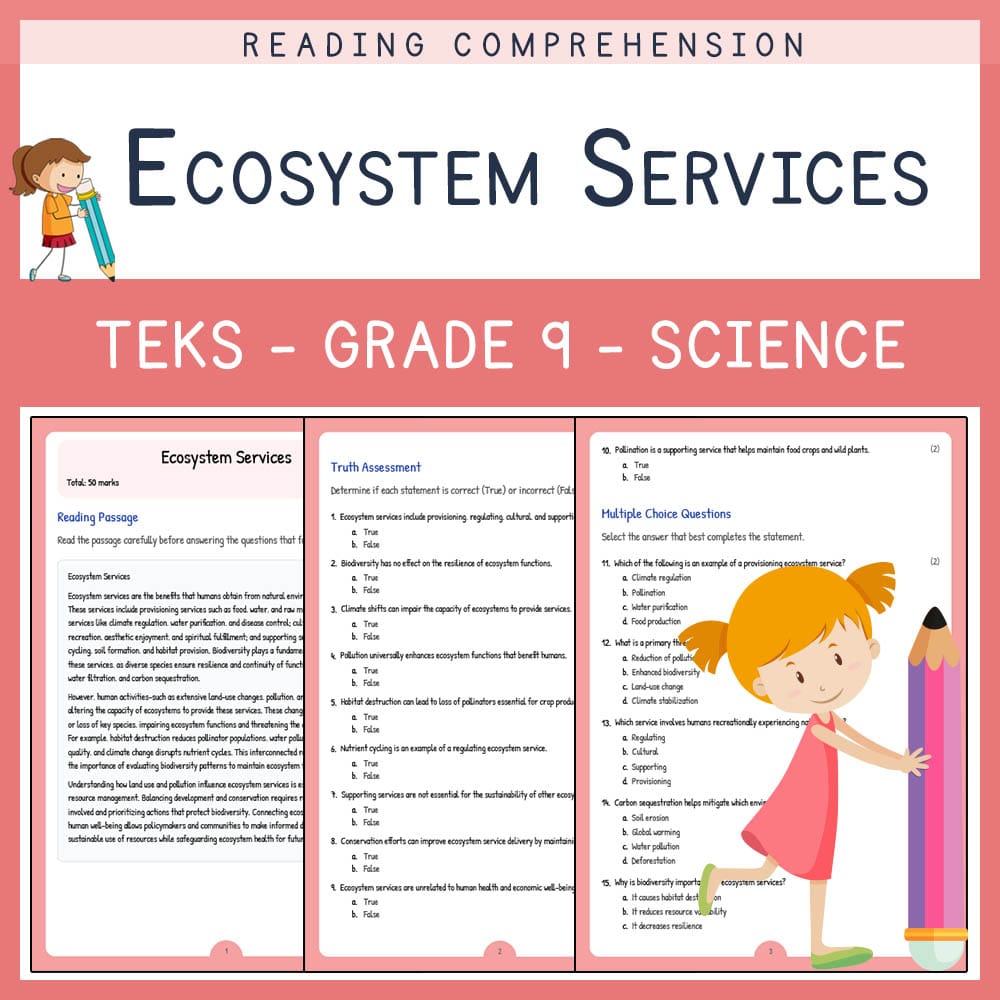
Grade 9 Science | Ecosystem Services Worksheet | TEKS Aligned
Created byLumora LearningLearning Objectives
- Define ecosystem services and their categories: provisioning, regulating, cultural, and supporting.
- Explain the role of biodiversity in ecosystem service provision, such as pollination and water purification.
- Evaluate how human activities like land-use change and pollution impact ecosystem services.
Instant download
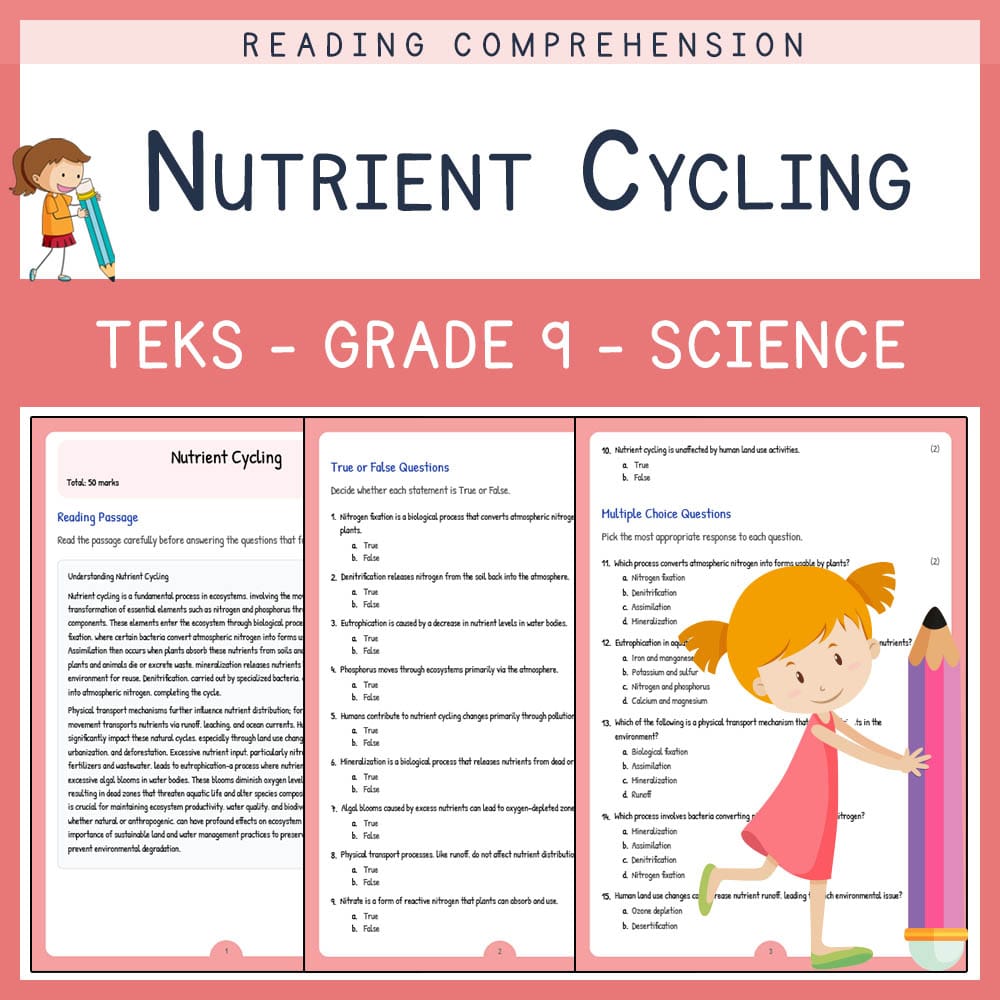
Grade 9 Science | Nutrient Cycling Worksheet | TEKS Aligned
Created byLumora LearningLearning Objectives
- Understand the processes involved in nutrient cycling, including biological and physical mechanisms.
- Identify the roles of nitrogen and phosphorus in ecosystems.
- Explain how human activities influence nutrient flow and ecosystem health.
Instant download
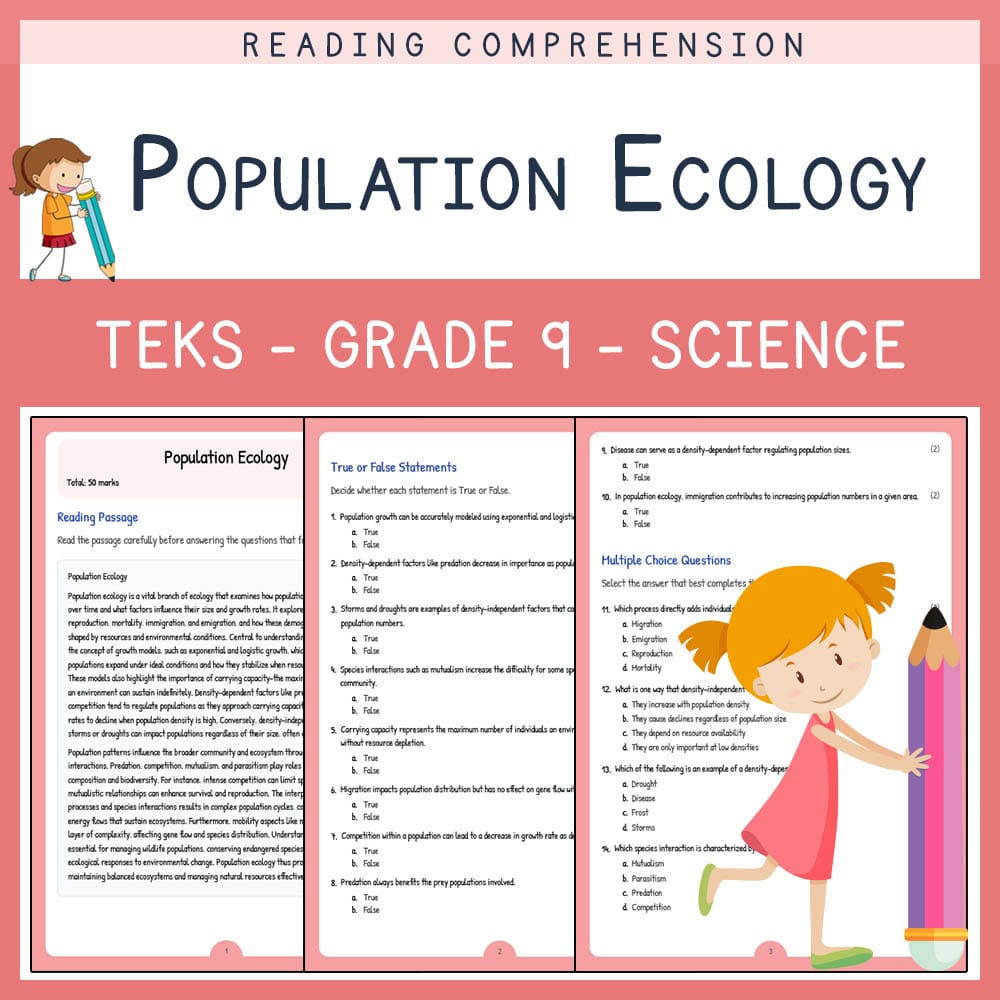
Grade 9 Science | Population Ecology Worksheet | TEKS-Aligned
Created byLumora LearningLearning Objectives
- Explain the key concepts and factors affecting population growth and decline.
- Analyze how density-dependent and density-independent factors influence populations.
- Describe species interactions and their effects on community structure.
Instant download
About Grade 9 Science Worksheets
Find Science worksheets built for Grade 9. All 6,926 cover core skills, practice, and review, each an instant PDF download.
Every worksheet on MyTeachingSheets is created by independent teacher-authors and reviewed before publication. All resources download as printable PDFs for classroom, homework, or at-home practice, and many include answer keys. Preview any worksheet free before buying.