
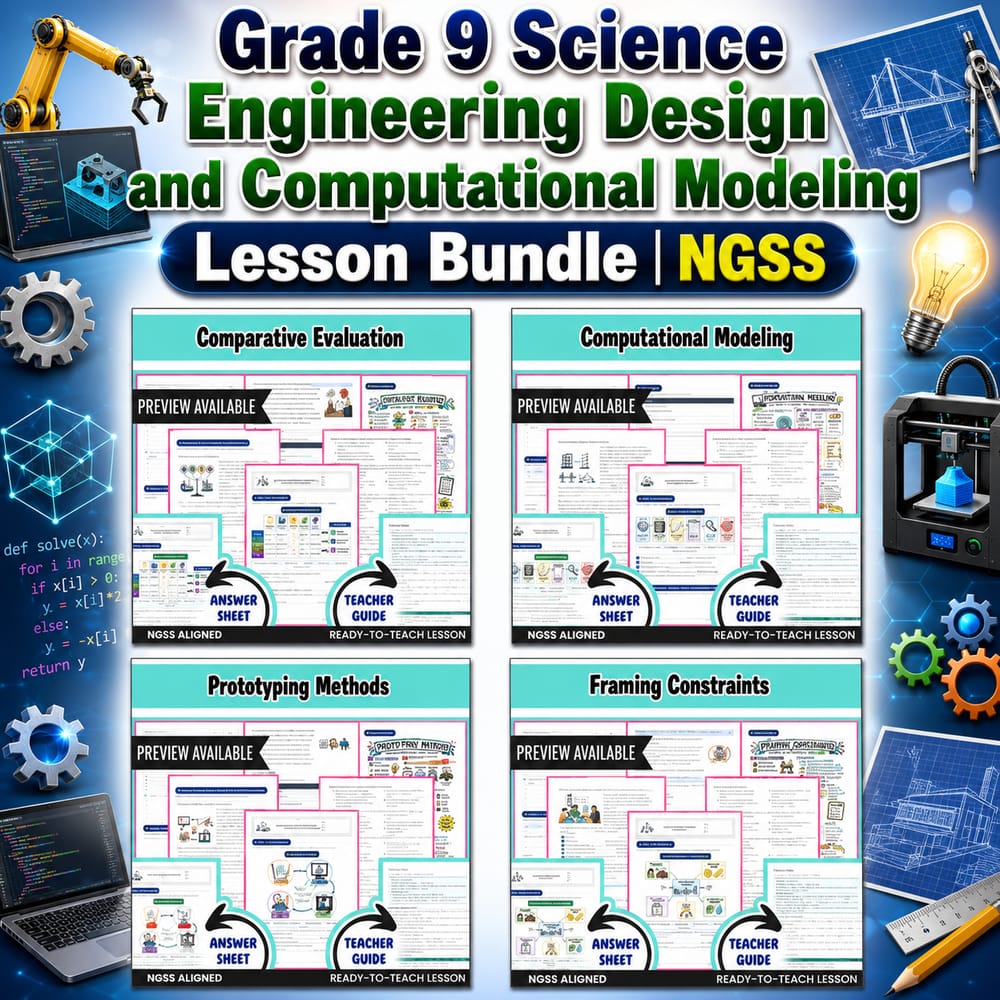
Grade 9 Science Engineering Design and Computational Modeling Lesson Bundle
$16.00$20.00Save $4.00
Amber Owl Education
New·0 followers·1 sales
SubjectScienceGradeGrade 9
What’s included
4 worksheets · Save $4.00 (20%) · prices shown inside the bundle
 Grade 9 Science Comparative Evaluation Worksheet | NGSS Engineering Design
- Explain how quantitative and qualitative criteria are used to compare competing design solutions.
- Use a comparative matrix to justify a selection based on performance metrics, cost, manufacturability, and environmental impact.
- Evaluate uncertainty by checking how results change when assumptions or parameters shift.
$4.00$5.00 Grade 9 Computational Modeling Worksheet | NGSS Science Activity & Doodle Note
- Explain how computational models use assumptions, variables, and parameters to predict system behavior.
- Use algebraic performance objective functions to compare design scenarios and justify parameter choices.
- Describe and interpret results from sensitivity analysis to understand how outputs change with inputs.
$4.00$5.00 Grade 9 Science Prototyping Methods Worksheet | NGSS Engineering Design
- Compare prototyping methods by fidelity level and purpose.
- Select appropriate materials and testing protocols for a tangible engineering prototype.
- Use test data to guide iterative refinement and document prototype limitations.
$4.00$5.00 Grade 9 Science Engineering Framing Constraints Worksheet | NGSS Activity
- Identify functional requirements, stakeholder criteria, and measurable constraints when framing an engineering challenge.
- Explain how social impacts, economic limits, regulatory restrictions, and environmental constraints interact in engineering design choices.
- Evaluate conceptual approaches by checking that objectives can be met within safety margins and available resources.
$4.00$5.00
Reviews & Feedback
Loading reviews...
Questions & Answers
Loading questions…
About this bundle
Related categories
Frequently asked questions
Who is Grade 9 Science Engineering Design and Computational Modeling Lesson Bundle designed for?
Grade 9 Science Engineering Design and Computational Modeling Lesson Bundle is designed for Grade 9 students and Science learners and can be used in classrooms, homeschool, or independent practice.
How do I download Grade 9 Science Engineering Design and Computational Modeling Lesson Bundle ?
Add it to your cart and complete checkout. After payment, you can download immediately from your account, and you'll also receive a download link by email.
Similar Products

Grade 11 Engineering Design & Computational Modeling Science Lesson Bundle (NGSS)
$16.00$20.00

Grade 11 Engineering Design and Computational Modeling Science NGSS
$16.00$20.00

Grade 11 Engineering Design with Computational Modeling Science
$16.00$20.00

Grade 9 Science NGSS Engineering Design Lesson Bundle | Prototyping & Modeling
$9.60$12.00

Grade 9 Engineering Design Prototyping & Modeling Lesson Bundle | NGSS
$12.80$16.00