
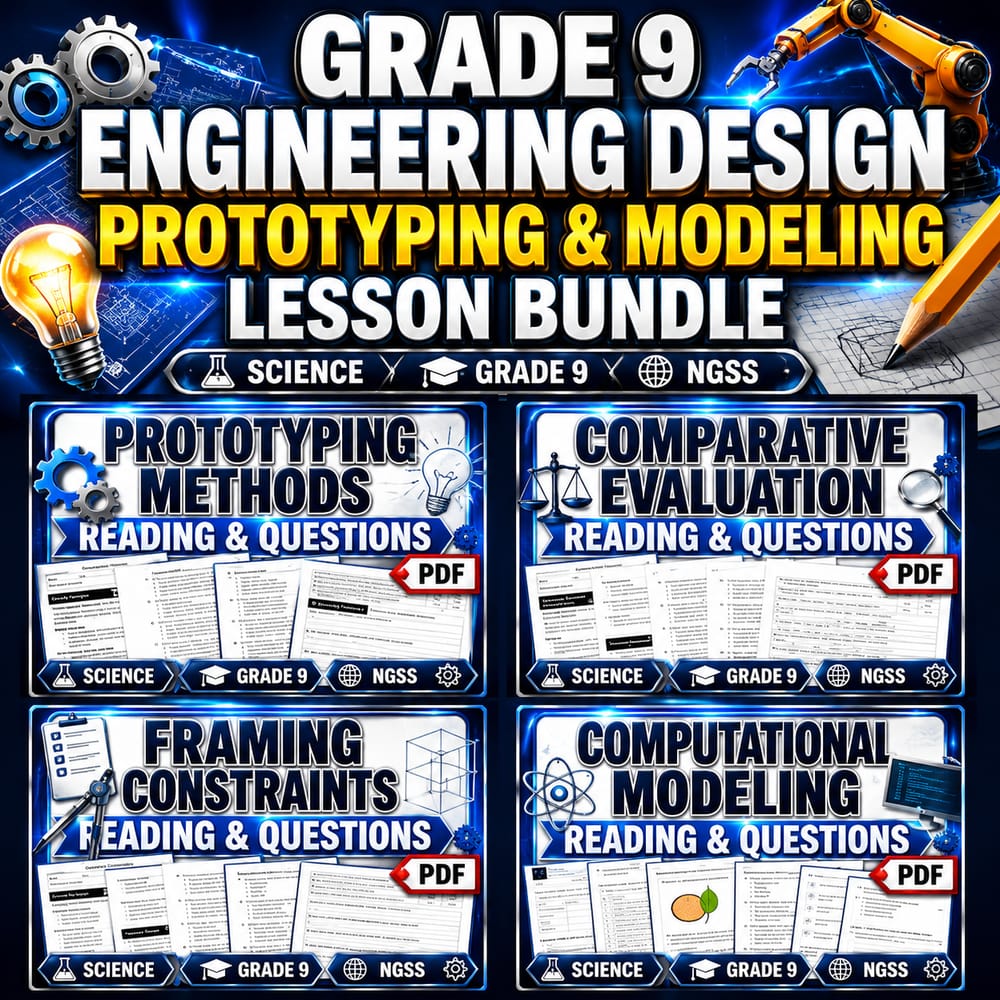
Grade 9 Engineering Design Prototyping & Modeling Lesson Bundle | NGSS
$12.80$16.00Save $3.20
Skylark Worksheets
New·0 followers·0 sales
SubjectScienceGradeGrade 9Pages66 Pages
What’s included
4 worksheets · 66 pages · Save $3.20 (20%) · prices shown inside the bundle
 Prototyping Methods Worksheet | NGSS Grade 9 Science Assessment
- Compare prototyping methods by selecting appropriate fidelity levels for a design problem.
- Explain how materials and manufacturing choices affect prototype performance and limitations.
- Interpret test data to refine a prototype iteratively and document results for future design cycles.
$3.20$4.00 Comparative Evaluation Worksheet | NGSS Grade 9 Science Assessment PDF
- Use quantitative and qualitative criteria to compare competing engineering design solutions.
- Evaluate trade-offs among efficiency, durability, cost, and safety using a structured decision framework.
- Incorporate life-cycle cost, manufacturability, and environmental impact into a comparative matrix.
$3.20$4.00 Framing Constraints Worksheet | NGSS Grade 9 Science Assessment
- Identify functional requirements and distinguish them from constraints in an engineering problem frame.
- Analyze competing constraints (social, economic, regulatory, environmental, and safety) to prioritize design choices.
- Use qualitative reasoning and basic quantitative bounds to judge feasibility of a conceptual solution.
$3.20$4.00 Computational Modeling Worksheet | NGSS Grade 9 Science Assessment
- Explain how computational models use equations, functions, and simulation to predict system performance.
- Develop and interpret performance objective functions for design decision-making.
- Describe how parameter estimation and sensitivity analysis support model tuning and uncertainty awareness.
$3.20$4.00
Reviews & Feedback
Loading reviews...
Questions & Answers
Loading questions…
About this bundle
Related categories
Frequently asked questions
Who is Grade 9 Engineering Design Prototyping & Modeling Lesson Bundle | NGSS designed for?
Grade 9 Engineering Design Prototyping & Modeling Lesson Bundle | NGSS is designed for Grade 9 students and Science learners and can be used in classrooms, homeschool, or independent practice.
How do I download Grade 9 Engineering Design Prototyping & Modeling Lesson Bundle | NGSS?
Add it to your cart and complete checkout. After payment, you can download immediately from your account, and you'll also receive a download link by email.
Similar Products

Grade 11 Engineering Design & Computational Modeling Science Lesson Bundle (NGSS)
$16.00$20.00

Grade 11 Engineering Design and Computational Modeling Science NGSS
$16.00$20.00

Grade 9 Engineering Design Modeling Science Lesson Bundle for NGSS
$16.00$20.00

Grade 10 Science Engineering Design Worksheets NGSS Lesson Bundle | STEM Skills
$4.80$6.00

Grade 6 Science Engineering Design Lesson Bundle | NGSS Worksheets
$9.60$12.00