

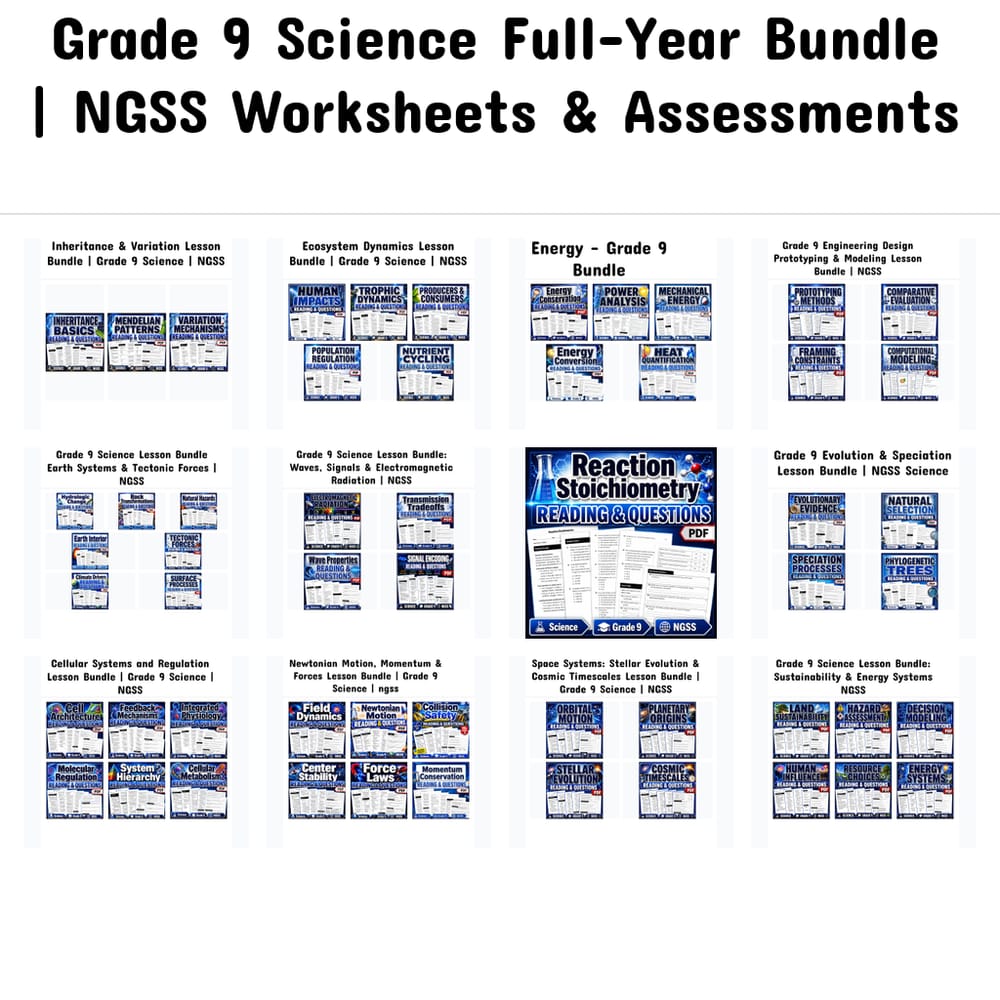
Grade 9 Science Full-Year Bundle | NGSS Worksheets & Assessments
 Created bySkylark Worksheets
Overview Grade 9 NGSS Science worksheets that support a full year of instruction, practice, and assessment across core NGSS performance expectations. This curriculum-scale bundle for Grade 9 Science includes 61 worksheets, organized for vertical progression—from life science and energy to Earth systems, motion, and matter—so students build usable models, exp…
Instant download
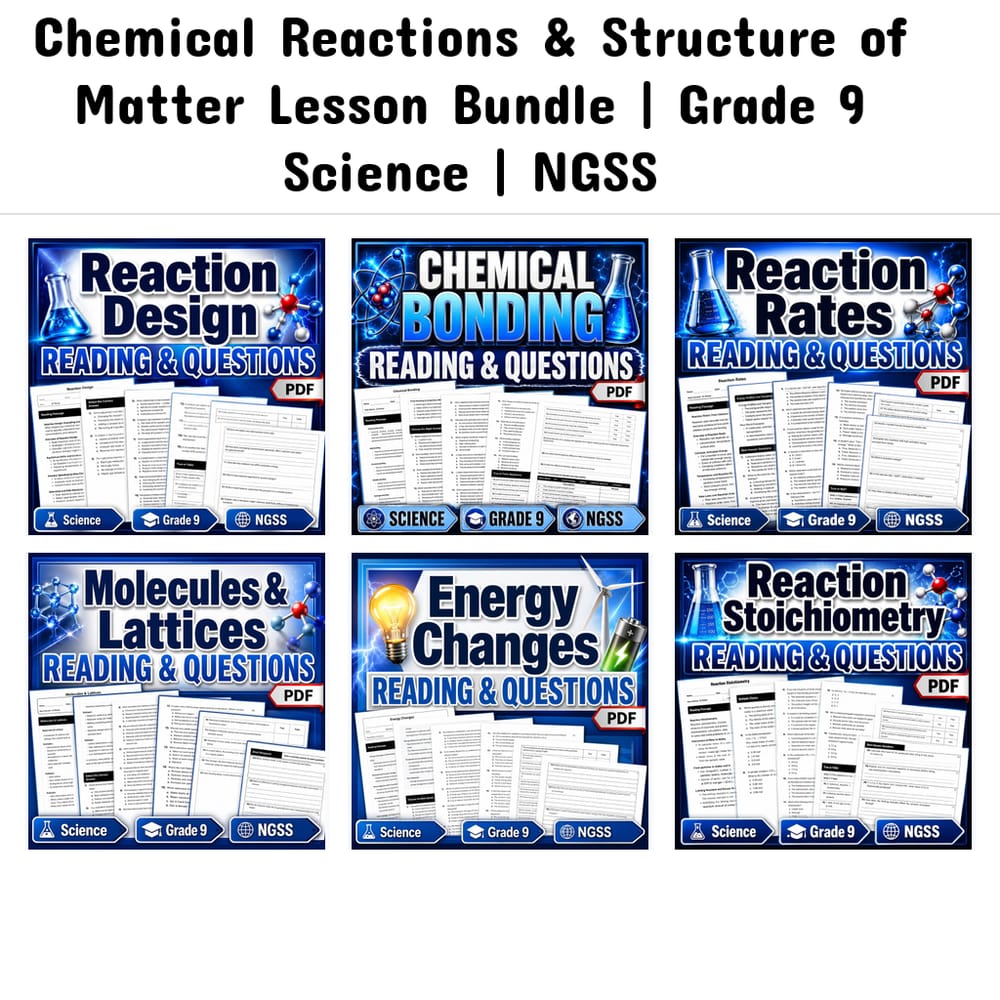
Chemical Reactions & Structure of Matter Lesson Bundle | Grade 9 Science | NGSS
Created bySkylark WorksheetsOverview Chemical Reactions & Structure of Matter (Grade 9 Science, NGSS) includes 7 NGSS Grade 9 Science Assessment worksheets for building models and making evidence-based explanations of chemical change. What's Included ✅ Reaction Stoichiometry Worksheet | NGSS Grade 9 Science Assessment – Practice connecting mole relationships to particle and mass mo…
Instant download
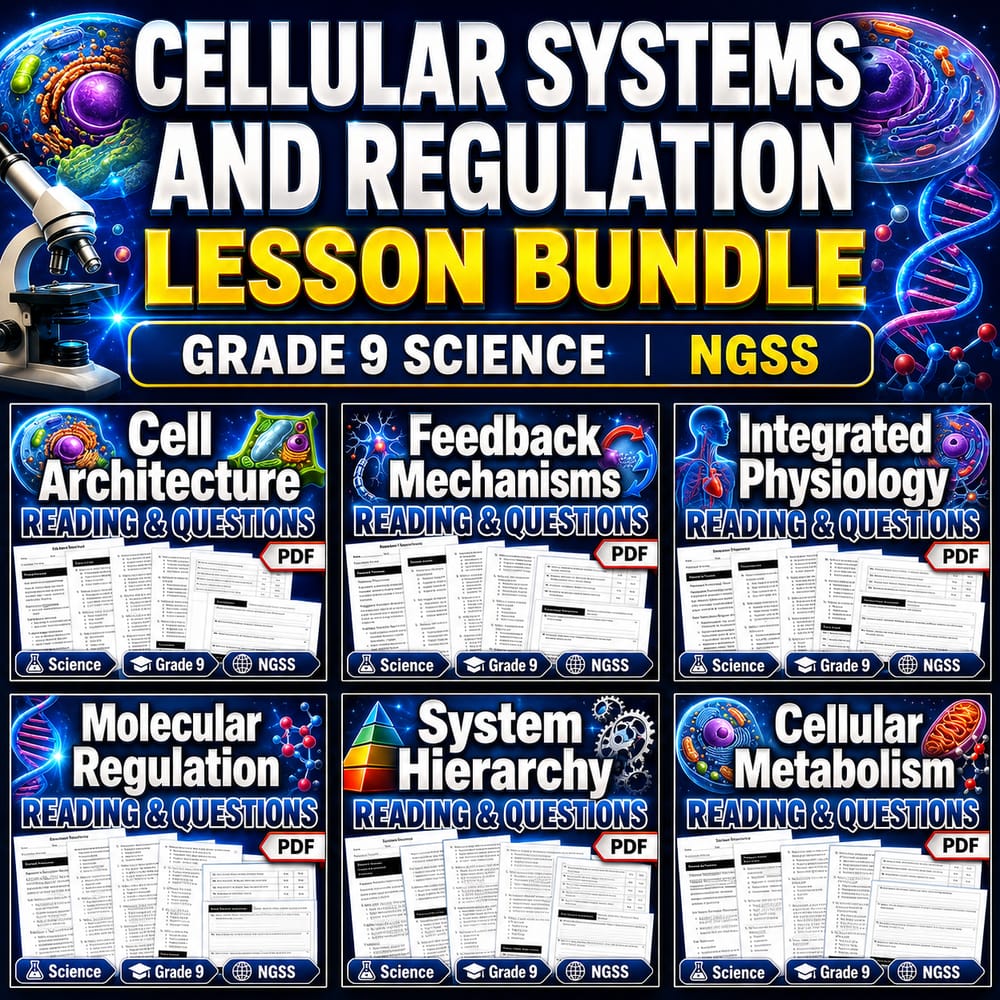
Cellular Systems and Regulation Lesson Bundle | Grade 9 Science | NGSS
Created bySkylark WorksheetsOverview Cellular Systems and Regulation lesson bundle for Grade 9 Science (NGSS) provides 6 focused worksheets for modeling how cells maintain stability and coordinate physiological responses. This unit centers on how cellular structures, molecular regulation, metabolism, and feedback mechanisms work together to explain real biological phenomena. Students m…
Instant download
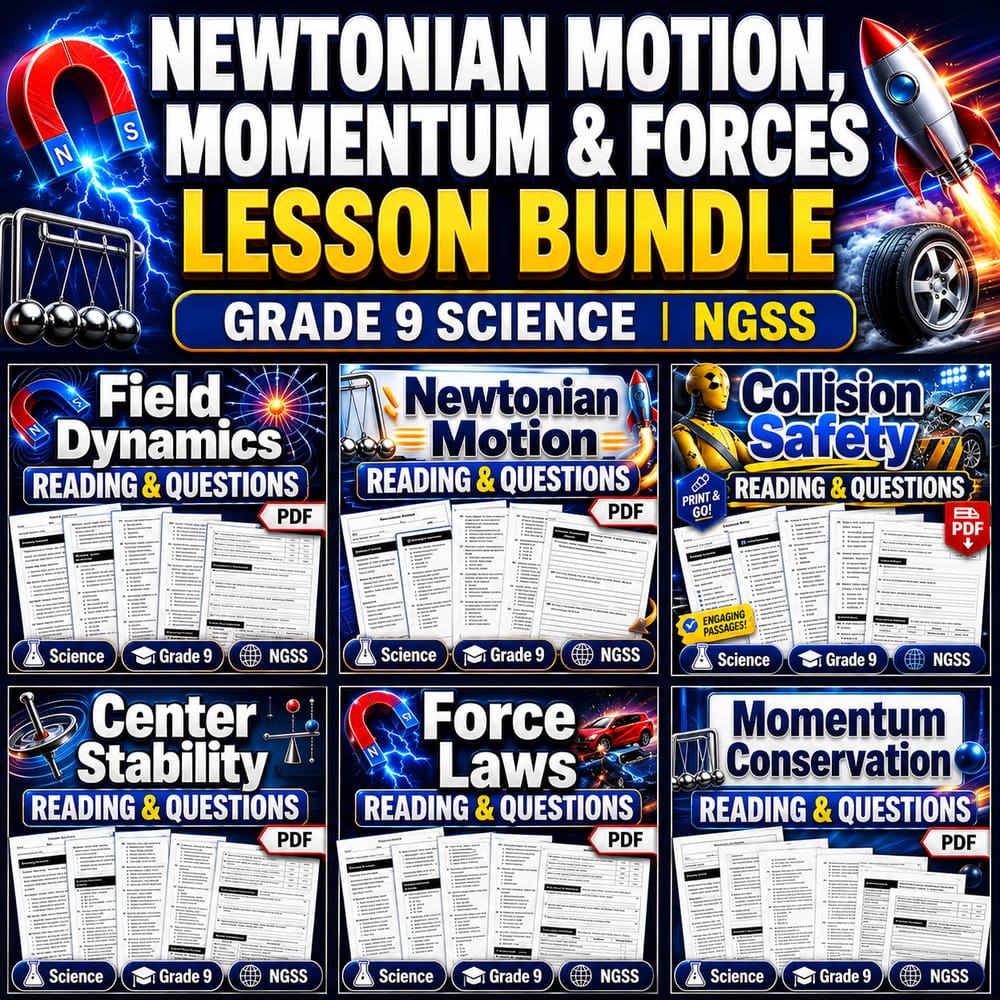
Newtonian Motion, Momentum & Forces Lesson Bundle | Grade 9 Science | ngss
Created bySkylark WorksheetsOverview Newtonian motion, momentum, and forces come to life in this Newtonian Motion, Momentum & Forces Grade 9 Science Lesson Bundle aligned to ngss, with 6 assessment-ready worksheets. Designed for students who are building from foundational ideas to more quantitative reasoning, this unit bundle supports clear problem-solving routines: interpret diagr…
Instant download
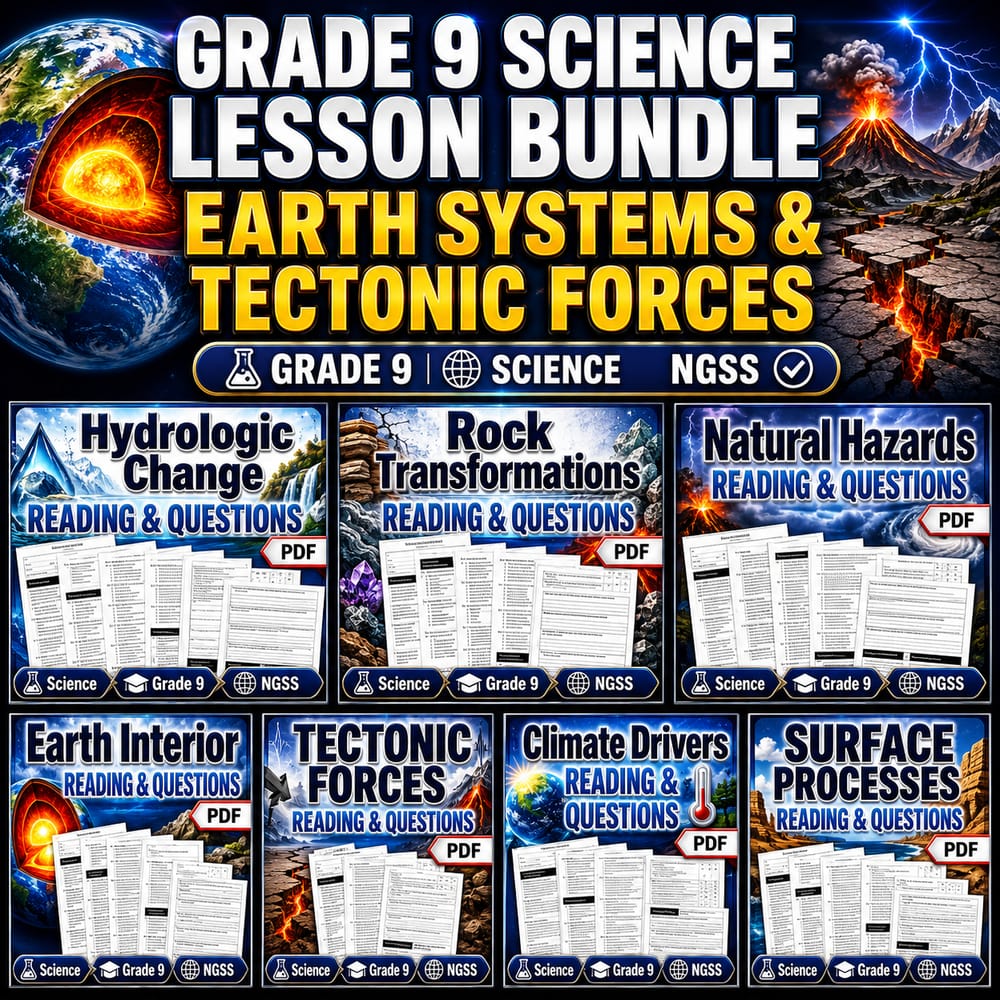
Grade 9 Science Lesson Bundle Earth Systems & Tectonic Forces | NGSS
Created bySkylark WorksheetsOverview Earth Systems & Tectonic Forces is the focus of this Grade 9 NGSS Grade 9 Science lesson bundle, designed to guide students through how Earth’s internal processes shape surface features, hazards, water systems, and climate-related change. This unit includes 7 worksheets that support consistent practice with interpreting models, extracting eviden…
Instant download
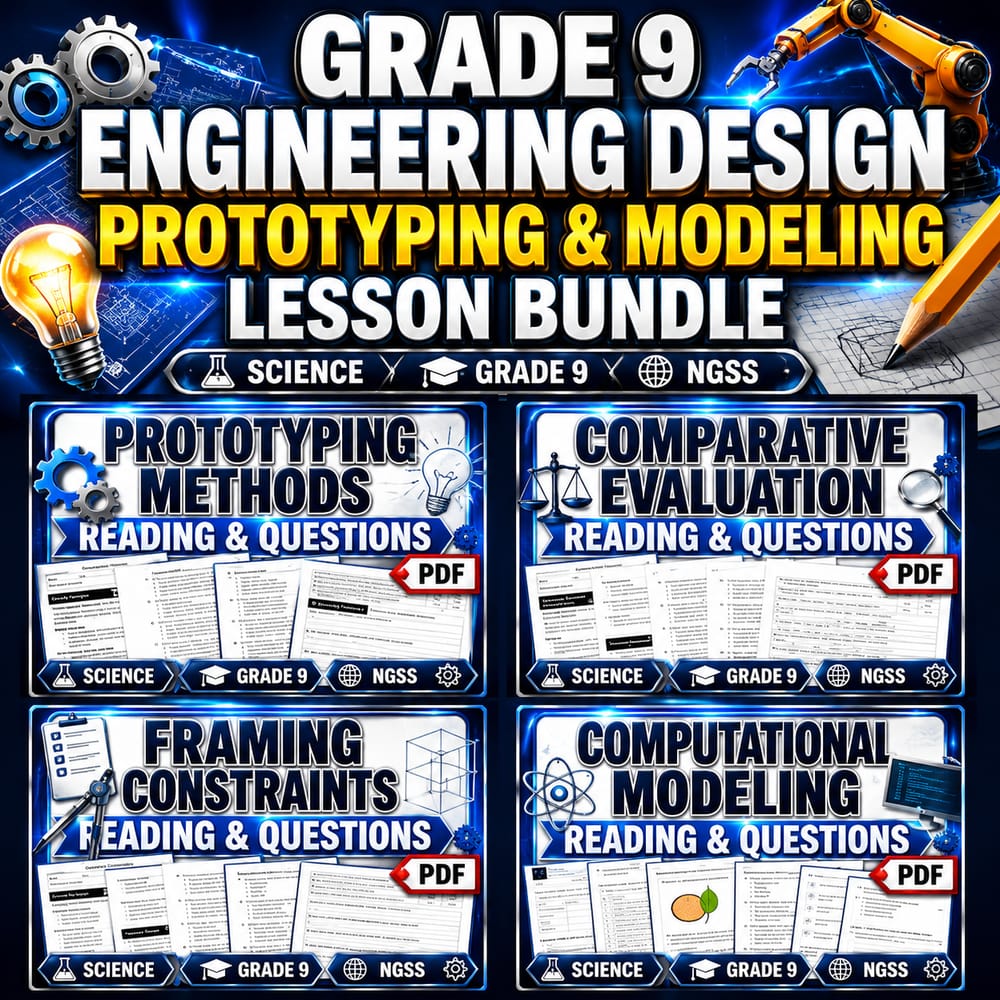
Grade 9 Engineering Design Prototyping & Modeling Lesson Bundle | NGSS
Created bySkylark WorksheetsOverview Engineering Design Prototyping & Modeling for Grade 9 Science builds engineering design prototyping skills through four NGSS-aligned worksheets that guide students from constraints to modeled solutions. This Lesson Bundle supports NGSS engineering design expectations by moving learners through the iterative workflow: develop prototypes, define a…
Instant download

Variation Mechanisms Worksheet | NGSS Grade 9 Science Assessment
Created bySkylark WorksheetsLearning Objectives
- Explain how point mutations, chromosomal rearrangements, meiotic recombination, and independent assortment generate heritable genetic variation.
- Describe how molecular changes (base substitutions and indels) can alter gene expression and protein function.
- Connect genetic variation mechanisms to population-level changes in allele frequencies and phenotypic distributions.
Also included in: Grade 9 Science Full-Year Bundle | NGSS Worksheets & Assessments
Instant download

Mendelian Patterns Worksheet | NGSS Grade 9 Science Assessment
Created bySkylark WorksheetsLearning Objectives
- Use Punnett squares to predict genotype and phenotype ratios in single-gene crosses involving dominant and recessive alleles.
- Interpret probability outcomes in monohybrid and dihybrid inheritance, including how independent assortment affects ratios.
- Compare simple Mendelian expectations with real inheritance patterns (incomplete dominance, codominance, and linked loci).
Also included in: Grade 9 Science Full-Year Bundle | NGSS Worksheets & Assessments
Instant download

Inheritance Basics Worksheet | NGSS Grade 9 Science Assessment
Created bySkylark WorksheetsLearning Objectives
- Explain how DNA replication and meiosis help ensure hereditary information is passed from parents to offspring.
- Describe the roles of gametes and zygote formation in forming a new individual with a complete set of chromosomes.
- Use karyotype patterns and simple pedigree ratios to connect chromosome behavior with observable traits.
Also included in: Grade 9 Science Full-Year Bundle | NGSS Worksheets & Assessments
Instant download

Trophic Dynamics Worksheet | NGSS Grade 9 Science Assessment
Created bySkylark WorksheetsLearning Objectives
- Explain how energy is transferred and lost across trophic levels using trophic pyramids and ecological efficiency.
- Describe how food webs are structured and how predators and prey can influence energy flow through top-down and bottom-up control.
- Quantify relationships among production, biomass, and ecological efficiency using kelp-forest and grassland style examples.
Also included in: Grade 9 Science Full-Year Bundle | NGSS Worksheets & Assessments
Instant download

Producers & Consumers Worksheet | NGSS Grade 9 Science Assessment
Created bySkylark WorksheetsLearning Objectives
- Explain how photosynthesis and cellular respiration transfer energy between autotrophs and heterotrophs.
- Analyze how net primary productivity (NPP) and respiration rates influence biomass accumulation and energy availability.
- Use carbon and oxygen cycle ideas to interpret ecosystem carbon budgets and coastal/algal productivity.
Also included in: Grade 9 Science Full-Year Bundle | NGSS Worksheets & Assessments
Instant download

Population Regulation Worksheet — Grade 9 Science Practice & Assessment
Created bySkylark WorksheetsLearning Objectives
- Explain how carrying capacity and resource limitation regulate population size over time
- Distinguish between density-dependent and density-independent factors and give examples
- Use logistic growth ideas to interpret how populations stabilize rather than grow forever
Also included in: Grade 9 Science Full-Year Bundle | NGSS Worksheets & Assessments
Instant download

Nutrient Cycling Worksheet | NGSS Grade 9 Science Assessment
Created bySkylark WorksheetsLearning Objectives
- Explain how carbon, nitrogen, and phosphorus cycle through ecosystems using reservoirs and fluxes.
- Describe microbial decomposition processes and how they affect nutrient availability and primary productivity.
- Use mass-balance reasoning to predict how changes in nutrient inputs and cycling rates can alter long-term ecosystem outcomes.
Also included in: Grade 9 Science Full-Year Bundle | NGSS Worksheets & Assessments
Instant download

Human Impacts Worksheet | NGSS Grade 9 Science Assessment
Created bySkylark WorksheetsLearning Objectives
- Explain how land-use change, invasive species, pollution, and resource extraction can alter biodiversity and ecosystem functioning
- Interpret cause-and-effect relationships using empirical indicators (e.g., species abundance, water quality, oxygen levels)
- Evaluate trade-offs among conservation actions, provisioning services, and socioecological outcomes
Also included in: Grade 9 Science Full-Year Bundle | NGSS Worksheets & Assessments
Instant download

Speciation Processes Worksheet | NGSS Grade 9 Science Assessment
Created bySkylark WorksheetsLearning Objectives
- Explain how reproductive isolation prevents gene flow and enables speciation
- Compare allopatric and sympatric speciation models using examples
- Describe how genetic divergence, hybrid zones, and polyploidy contribute to new species
Also included in: Grade 9 Science Full-Year Bundle | NGSS Worksheets & Assessments
Instant download

Phylogenetic Trees Worksheet | NGSS Grade 9 Science Assessment
Created bySkylark WorksheetsLearning Objectives
- Construct phylogenetic trees from morphological characters and molecular sequence data using cladistic principles.
- Interpret branching diagrams by identifying shared derived characters, sister taxa, and implied evolutionary relationships.
- Compare tree-building approaches (parsimony and molecular distance) and explain how molecular clocks calibrate time.
Also included in: Grade 9 Science Full-Year Bundle | NGSS Worksheets & Assessments
Instant download

Natural Selection Worksheet | NGSS Grade 9 Science Assessment
Created bySkylark WorksheetsLearning Objectives
- Explain how heritable variation and environmental pressures can cause differential survival and reproduction in a population.
- Describe how allele frequencies can change under directional, stabilizing, and disruptive selection using fitness ideas.
- Connect natural selection to measurable genetic and trait shifts across generations.
Also included in: Grade 9 Science Full-Year Bundle | NGSS Worksheets & Assessments
Instant download

Evolutionary Evidence Worksheet | NGSS Grade 9 Science Assessment
Created bySkylark WorksheetsLearning Objectives
- Explain how fossil evidence can reveal patterns of descent and change over time.
- Compare homologous structures and predict how similar body plans support common ancestry.
- Interpret molecular sequence similarities and use them to infer relatedness.
Also included in: Grade 9 Science Full-Year Bundle | NGSS Worksheets & Assessments
Instant download

Power Analysis Worksheet | NGSS Grade 9 Science Assessment
Created bySkylark WorksheetsLearning Objectives
- Differentiate power and energy and convert between them using consistent units.
- Calculate energy demand over time from power ratings and duty cycles.
- Analyze how efficiency and system losses affect real energy throughput and performance.
Also included in: Grade 9 Science Full-Year Bundle | NGSS Worksheets & Assessments
Instant download

Mechanical Energy Worksheet | NGSS Grade 9 Science Practice
Created bySkylark WorksheetsLearning Objectives
- Describe and calculate kinetic energy and gravitational potential energy using appropriate formulas and units.
- Use energy accounting to explain how work, power, and mechanical energy change in near-ideal systems.
- Analyze how non-conservative forces (such as friction) affect the mechanical energy budget and motion.
Also included in: Grade 9 Science Full-Year Bundle | NGSS Worksheets & Assessments
Instant download

Heat Quantification Worksheet | NGSS Science Grade 9 Assessment
Created bySkylark WorksheetsLearning Objectives
- Use Q = m·c·ΔT and appropriate sign conventions to calculate thermal energy transferred for temperature changes.
- Explain how conduction, convection, and radiation move heat, and identify which mechanism applies in common scenarios.
- Apply conservation of energy in closed systems by relating heat gained and heat lost across parts of a system.
Also included in: Grade 9 Science Full-Year Bundle | NGSS Worksheets & Assessments
Instant download

Energy Conversion Worksheet | NGSS Grade 9 Science Assessment
Created bySkylark WorksheetsLearning Objectives
- Explain how energy can change forms in common devices (solar cells, thermoelectric modules, electrochemical cells).
- Use energy bookkeeping ideas to describe useful output energy and energy losses during conversion.
- Interpret efficiency and relate device performance to conservation of energy constraints.
Also included in: Grade 9 Science Full-Year Bundle | NGSS Worksheets & Assessments
Instant download

Energy Conservation Worksheet | NGSS Grade 9 Science Assessment
Created bySkylark WorksheetsLearning Objectives
- Explain energy conservation using the idea of system boundaries for open and closed systems.
- Use an energy bookkeeping approach (reservoirs and transfers) to track energy changes quantitatively.
- Interpret and construct simple energy flow diagrams for mechanical and electrical (or chemical) processes.
Also included in: Grade 9 Science Full-Year Bundle | NGSS Worksheets & Assessments
Instant download

Wave Properties Worksheet | NGSS Grade 9 Science Assessment
Created bySkylark WorksheetsLearning Objectives
- Explain how amplitude, frequency, wavelength, and phase describe wave behavior in both transverse and longitudinal waves.
- Use the wave speed relationship v = fλ to solve problems involving sound, string waves, and water-wave scenarios.
- Apply sinusoidal reasoning to predict how interference and standing waves form from superposition and reflections.
Also included in: Grade 9 Science Full-Year Bundle | NGSS Worksheets & Assessments
Instant download