
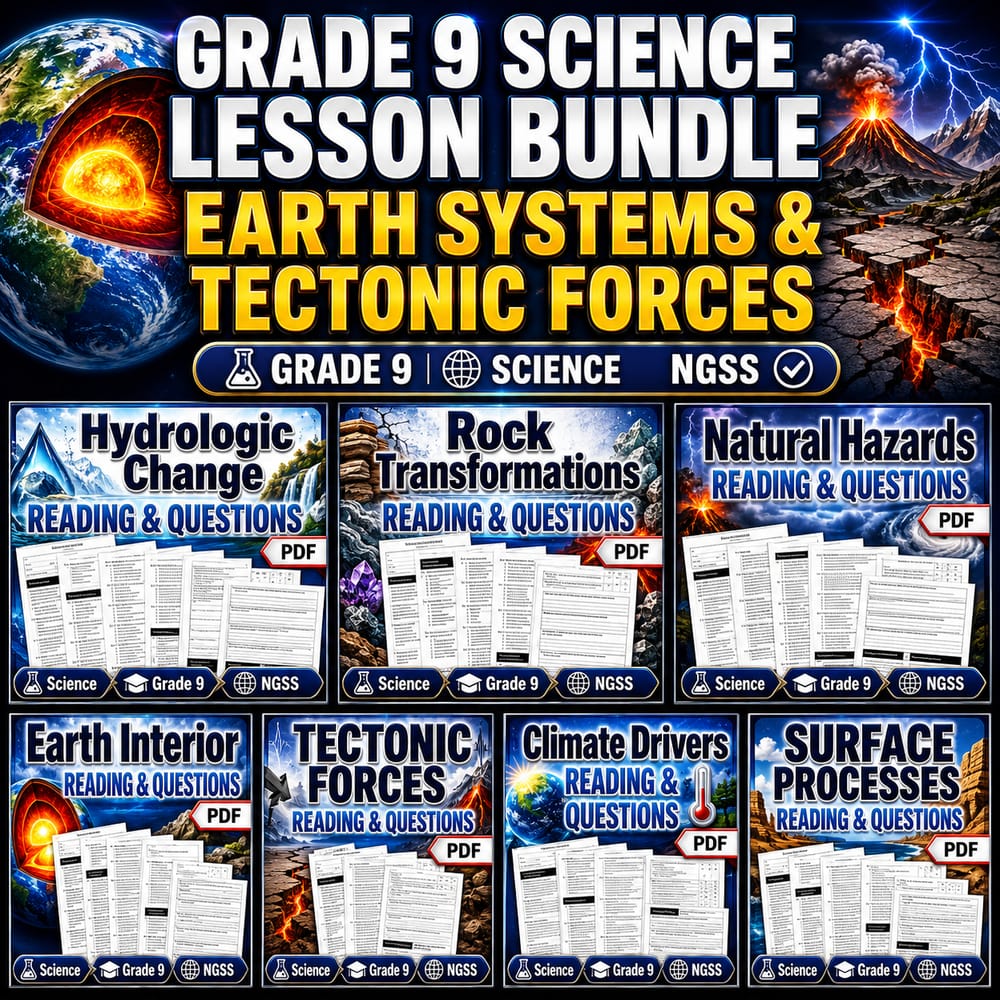
Grade 9 Science Lesson Bundle Earth Systems & Tectonic Forces | NGSS
$22.40$28.00Save $5.60
Skylark Worksheets
New·0 followers·0 sales
SubjectScienceGradeGrade 9
What’s included
7 worksheets · Save $5.60 (20%) · prices shown inside the bundle
 Hydrologic Change Worksheet | NGSS Grade 9 Science Assessment
- Explain how runoff, discharge, and sediment load influence erosion, transport, and deposition over time
- Interpret hydrologic data (discharge records and sediment measurements) to make evidence-based claims about channel or shoreline change
- Describe how different time scales (storms vs. long-term evolution) affect landscape form
$3.20$4.00 Science Worksheet for Grade 9 | Rock Transformations Assessment NGSS
- Explain the rock cycle by tracing how igneous, sedimentary, and metamorphic rocks transform through melting, crystallization, erosion, compaction, and metamorphism.
- Describe how pressure and temperature conditions affect metamorphism and mineral formation.
- Use clues from radiometric ages and process rates to infer the likely sequence of events in rock histories.
$3.20$4.00 Natural Hazards Worksheet | NGSS Grade 9 Science Assessment
- Explain how geologic and atmospheric indicators are used to characterize the origin, frequency, and potential impacts of natural hazards.
- Analyze spatial patterns and triggering mechanisms to describe why some places experience higher hazard and risk.
- Evaluate how recurrence intervals and paleoevidence support risk assessment for human and ecological systems.
$3.20$4.00 Earth Interior Worksheet | NGSS Grade 9 Science Assessment
- Explain how P-wave and S-wave evidence is used to infer Earth’s layered internal structure.
- Use ideas about density contrasts and heat-flow to justify where the crust, mantle, and core are located.
- Describe how mantle convection and thermal energy transfer drive long-term changes in Earth’s interior and surface.
$3.20$4.00 Tectonic Forces Worksheet | NGSS Grade 9 Science Assessment
- Model how seafloor spreading and subduction zones drive changes in Earth’s surface and seafloor features.
- Explain how volcanic arc systems and mountain belt uplift result from crustal deformation and faulting.
- Use evidence such as seafloor magnetic anomaly patterns and geologic cross-sections to support plate tectonics.
$3.20$4.00 Climate Drivers Worksheet | NGSS Grade 9 Science Assessment PDF
- Explain how Earth's energy budget is influenced by solar flux and albedo
- Describe how greenhouse gases affect outgoing longwave radiation and surface-atmosphere energy balance
- Use ideas about ocean heat transport and climate feedbacks to interpret regional variability
$3.20$4.00 Surface Processes Worksheet | NGSS Grade 9 Science Assessment
- Explain how chemical and physical weathering influence sediment supply and soil development.
- Analyze how climate forcing and hydrologic inputs shape surface process rates and patterns across landscapes.
- Compare erosion and deposition landforms (hillslopes, floodplains, alluvial fans, and coasts) using cause-and-effect reasoning.
$3.20$4.00
Reviews & Feedback
Loading reviews...
Questions & Answers
Loading questions…
About this bundle
Related categories
Frequently asked questions
Who is Grade 9 Science Lesson Bundle Earth Systems & Tectonic Forces | NGSS designed for?
Grade 9 Science Lesson Bundle Earth Systems & Tectonic Forces | NGSS is designed for Grade 9 students and Science learners and can be used in classrooms, homeschool, or independent practice.
How do I download Grade 9 Science Lesson Bundle Earth Systems & Tectonic Forces | NGSS?
Add it to your cart and complete checkout. After payment, you can download immediately from your account, and you'll also receive a download link by email.
Similar Products

Earth Systems: Tectonics & Climate Lesson Bundle | Grade 9 Science NGSS
$22.40$28.00

Plate Tectonics & Earth Systems Grade 9 Science Lesson Bundle | NGSS
$28.00$35.00

Grade 7 Human Impacts on Earth Systems Science Lesson Bundle – NGSS
$20.00$25.00

Grade 6 Human Impacts Earth Systems Science Lesson Bundle Resource – NGSS
$16.00$20.00

Space & Earth Systems Lesson Bundle | Grade 10 Science | Florida NGSSS
$36.00$45.00