
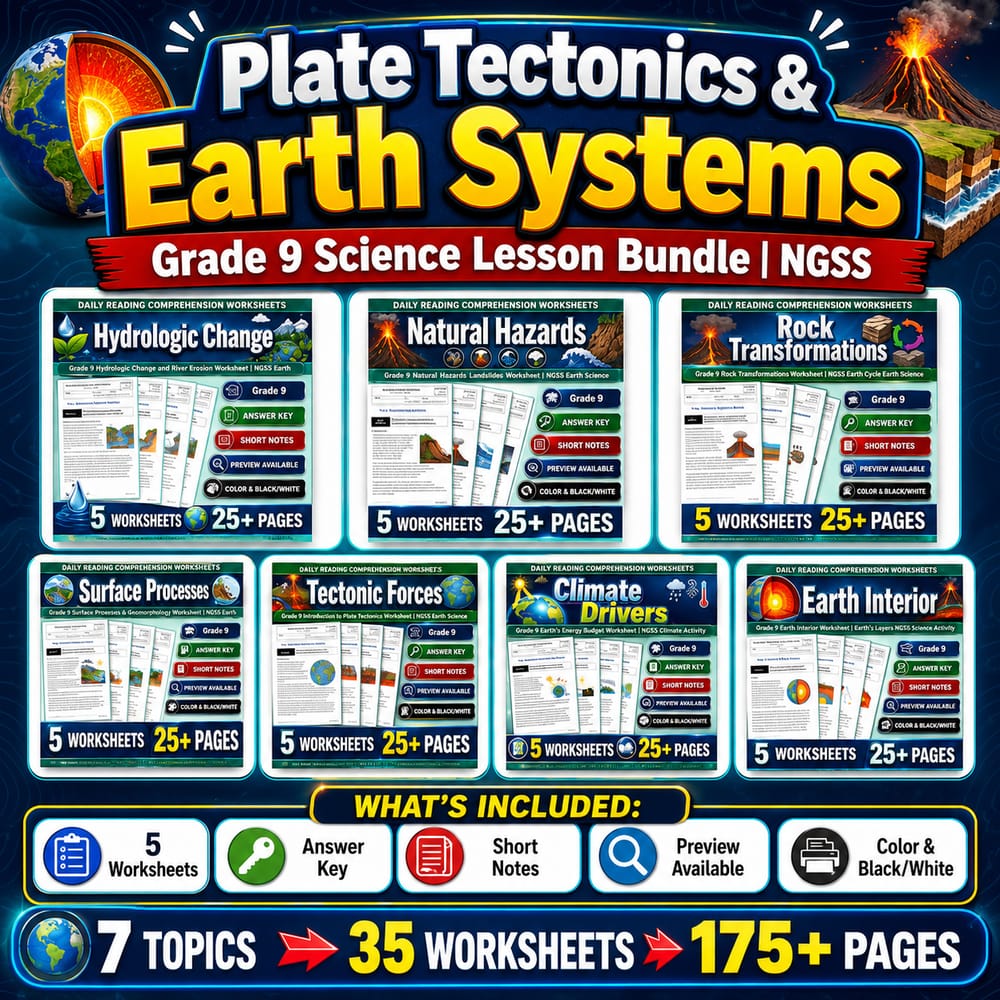
Plate Tectonics & Earth Systems Grade 9 Science Lesson Bundle | NGSS
$28.00$35.00Save $7.00
BRIGHT PATH RESOURCES
·3 followers·23 sales
SubjectScienceGradeGrade 9
What’s included
7 worksheets · Save $7.00 (20%) · prices shown inside the bundle
 Grade 9 Hydrologic Change and River Erosion Worksheet | NGSS Earth Science
- Understand how rivers shape Earth's surface through erosion and transport
- Analyze river discharge and sediment data to interpret landscape changes
- Identify the processes of erosion, transportation, and deposition in river systems
$4.00$5.00 Grade 9 Natural Hazards: Landslides Worksheet | NGSS Earth Science Activity
- Understand what causes landslides.
- Identify the effects of landslides on landscapes.
- Analyze how landslides contribute to Earth's surface changes.
$4.00$5.00 Grade 9 Rock Transformations Worksheet | NGSS Rock Cycle Earth Science
- Understand the process of igneous rock formation from cooling magma
- Identify the different pathways of rock transformation in the rock cycle
- Explain how pressure and temperature influence metamorphic rocks
$4.00$5.00 Grade 9 Surface Processes in Geomorphology Worksheet | NGSS Earth Science
- Identify different surface process types and their effects on landscapes.
- Understand chemical and physical weathering mechanisms.
- Describe the roles of mass wasting and sediment transport in shaping landforms.
$4.00$5.00 Grade 9 Introduction to Plate Tectonics Worksheet | NGSS Earth Science
- Understand different types of plate boundaries
- Identify features associated with each boundary type
- Explain the processes driving plate movements
$4.00$5.00 Grade 9 Earth's Energy Budget Worksheet | NGSS Climate Science Activity
- Explain how solar energy enters Earth's atmosphere
- Describe the processes by which Earth loses energy
- Identify the factors affecting Earth's surface temperatures
$4.00$5.00 Grade 9 Earth Interior Worksheet | Earth's Layers NGSS Science Activity
- Understand key concepts related to Science
- Apply knowledge through practice questions
- Demonstrate comprehension of the material
$4.00$5.00
Reviews & Feedback
Loading reviews...
Questions & Answers
Loading questions…
About this bundle
Related categories
Frequently asked questions
Who is Plate Tectonics & Earth Systems Grade 9 Science Lesson Bundle | NGSS designed for?
Plate Tectonics & Earth Systems Grade 9 Science Lesson Bundle | NGSS is designed for Grade 9 students and Science learners and can be used in classrooms, homeschool, or independent practice.
How do I download Plate Tectonics & Earth Systems Grade 9 Science Lesson Bundle | NGSS?
Add it to your cart and complete checkout. After payment, you can download immediately from your account, and you'll also receive a download link by email.
Similar Products

Grade 10 Earth Systems: Plate Tectonics & Water Lesson Bundle | NGSS
$19.60$28.00

Grade 12 Science Lesson Bundle | Earth Systems & Plate Tectonics Worksheets
$33.60$42.00

Grade 10 Science Unit | Earth's Atmosphere, Plate Tectonics & Climate Worksheets
$11.20$14.00

Earth's Systems Worksheets Grade 7 Science | NGSS Unit Bundle
$19.20$24.00

Geologic Time, Plate Tectonics & Hazards Lesson Bundle | Grade 11 Science | BC
$60.00$75.00