
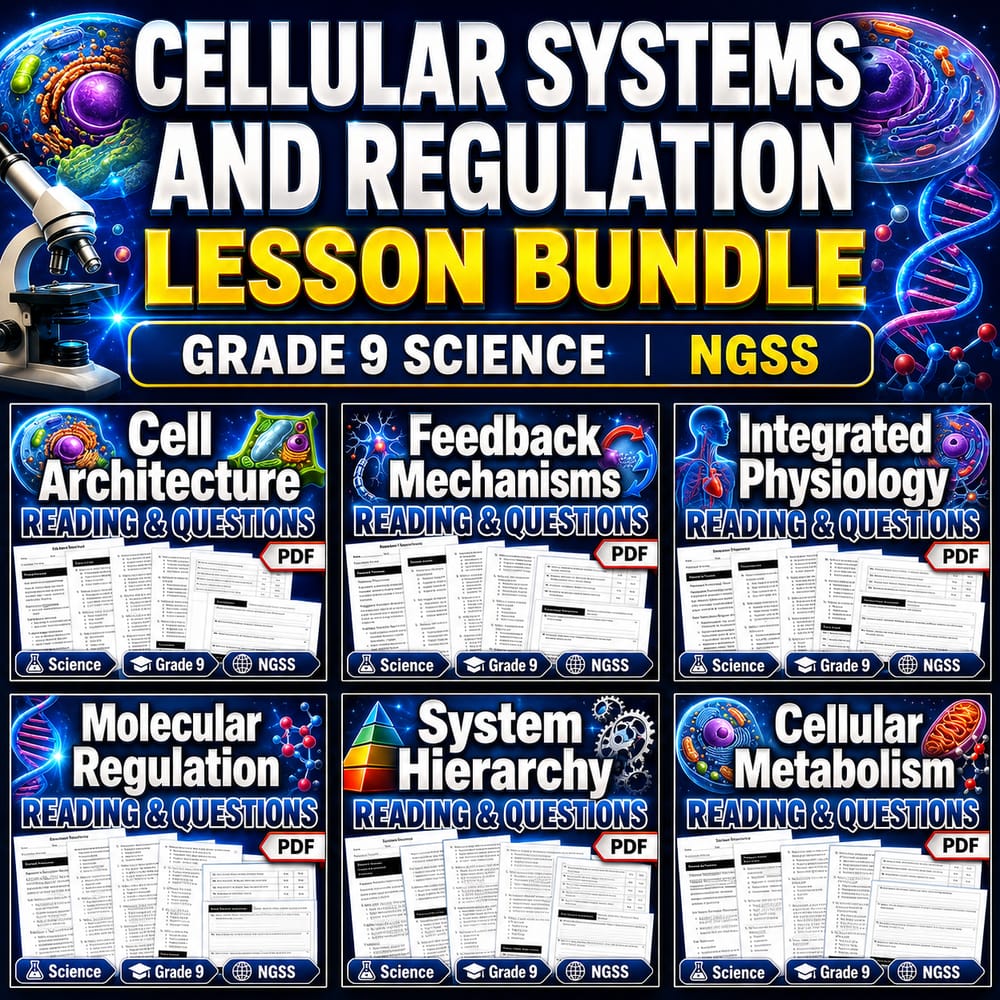
Cellular Systems and Regulation Lesson Bundle | Grade 9 Science | NGSS
$19.20$24.00Save $4.80
Skylark Worksheets
New·0 followers·0 sales
SubjectScienceGradeGrade 9
What’s included
6 worksheets · Save $4.80 (20%) · prices shown inside the bundle
 Cell Architecture Worksheet | NGSS Grade 9 Science Assessment
- Explain how nucleic acid sequences can encode amino acid sequences and lead to specific protein structures.
- Describe how protein structure relates to cellular architecture and function in ribosomes, endoplasmic reticulum, and mitochondria.
- Use evidence to connect macromolecular structure to mechanical and catalytic roles in specialized cells.
$3.20$4.00 Feedback Mechanisms Worksheet | NGSS Grade 9 Science Assessment
- Explain how negative and positive feedback mechanisms help maintain internal conditions within narrow limits.
- Describe sensor-effector loop logic and the role of set points in feedback control.
- Compare rapid corrective responses with slower hormonal adjustments using real physiological examples.
$3.20$4.00 Integrated Physiology Worksheet | NGSS Grade 9 Science Assessment
- Explain how molecular and cellular mechanisms can produce organ-level dysfunction using integrated physiology accounts.
- Construct evidence-based links between genetic variation, biochemical/histological findings, and organ function metrics.
- Interpret multi-level examples (e.g., cystic fibrosis, heart failure, metabolic syndrome) to describe emergent physiological properties.
$3.20$4.00 Molecular Regulation Worksheet | NGSS Grade 9 Science Assessment
- Explain how molecular signals regulate gene expression and protein activity in cells
- Describe how receptor-ligand binding and signal transduction cascades control cellular responses
- Use examples such as insulin signaling to connect molecular regulation to physiological outcomes
$3.20$4.00 System Hierarchy Worksheet | NGSS Grade 9 Science Assessment
- Explain how organization from cells to tissues, organs, and organ systems supports coordinated body functions.
- Describe how different systems communicate (nervous, endocrine, and physical signaling) to maintain homeostasis.
- Model how interacting systems (e.g., circulatory–respiratory and digestive–vascular) support gas exchange and nutrient distribution.
$3.20$4.00 Cellular Metabolism Worksheet | NGSS Grade 9 Science Assessment
- Explain how glycolysis, the citric acid cycle, and the electron transport chain convert energy into ATP in mitochondria.
- Describe how energy coupling links electron flow and proton gradients to ATP synthase activity.
- Use quantitative and empirical ideas (reactants/products, oxygen consumption, ATP yield) to interpret metabolic flux and energy balance.
$3.20$4.00
Reviews & Feedback
Loading reviews...
Questions & Answers
Loading questions…
About this bundle
Related categories
Frequently asked questions
Who is Cellular Systems and Regulation Lesson Bundle | Grade 9 Science | NGSS designed for?
Cellular Systems and Regulation Lesson Bundle | Grade 9 Science | NGSS is designed for Grade 9 students and Science learners and can be used in classrooms, homeschool, or independent practice.
How do I download Cellular Systems and Regulation Lesson Bundle | Grade 9 Science | NGSS?
Add it to your cart and complete checkout. After payment, you can download immediately from your account, and you'll also receive a download link by email.
Similar Products

Grade 9 Cellular Systems & Regulation Science Lesson Bundle NGSS Worksheet Set
$24.00$30.00

Grade 7 Cellular and Organ Systems Science Lesson Bundle: NGSS Practice
$20.00$25.00

Grade 9 Human Body Systems & Cellular Processes Science Lesson Bundle: Ontario
$48.00$60.00

Grade 6 Cellular Systems Science Lesson Bundle NGSS Worksheets
$32.00$40.00

Grade 9 Science Unit Bundle-Biological Systems & Molecular Regulation Worksheets
$9.60$12.00