
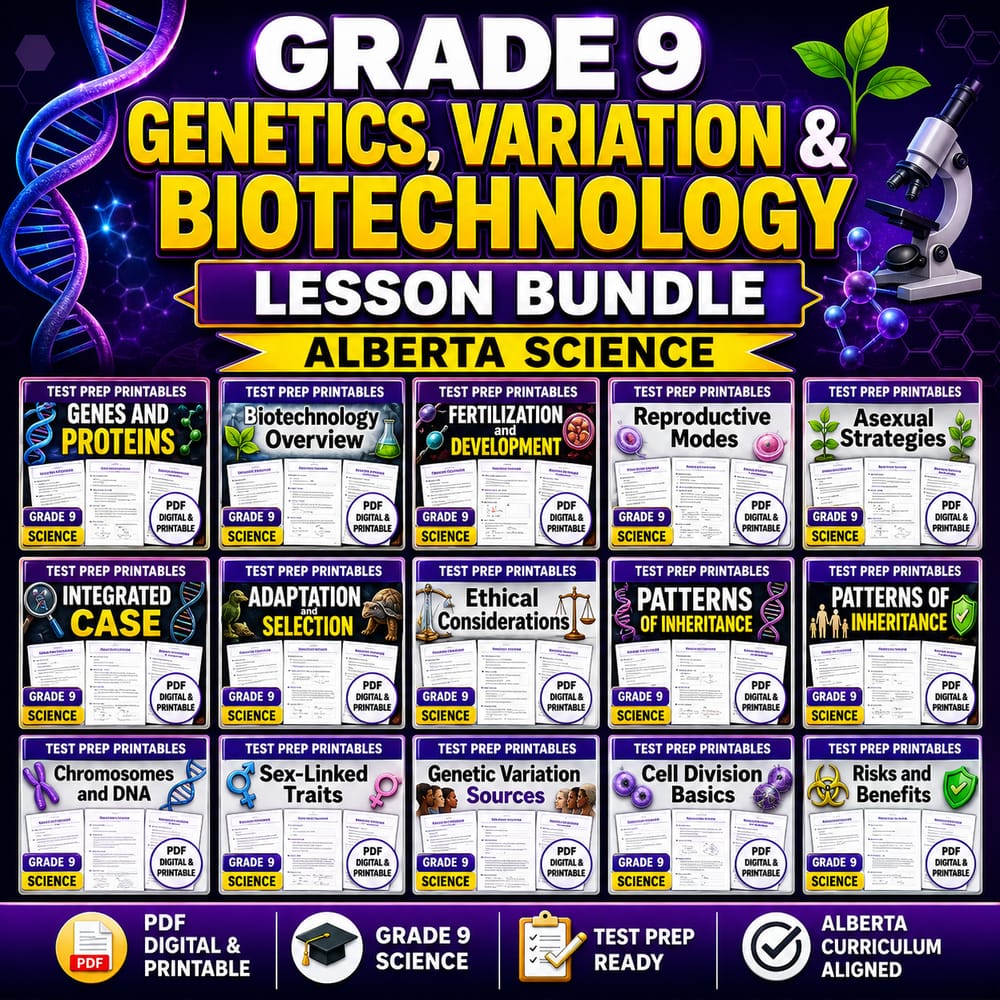


Grade 9 Genetics, Variation & Biotechnology Lesson Bundle | Alberta Science
$60.00$75.00Save $15.00
Prism Point Learning
·2 followers·13 sales
SubjectScienceGradeGrade 9
What’s included
15 worksheets · Save $15.00 (20%) · prices shown inside the bundle
 Genes and Proteins Worksheet | Grade 9 Science Practice
- Explain how genes (DNA segments) can determine protein production and influence observable traits (phenotypes).
- Describe the basic steps of gene expression: transcription and translation.
- Identify how gene regulation and environmental factors can change protein amounts or functions, leading to phenotypic variation.
$4.00$5.00 Biotechnology Overview Worksheet | Grade 9 Science Activities
- Explain how major genetic technologies (selective breeding, hybridization, genetic modification, and gene editing) can change traits
- Describe how trait changes occur at both molecular and population levels in agriculture
- Evaluate why monitoring and risk–benefit assessment matter for deploying biotechnology in real settings
$4.00$5.00 Fertilization and Development Worksheet | Grade 9 Science Practice
- Explain how fertilization leads to zygote formation and early development
- Compare internal and external fertilization strategies using real-world habitat examples
- Describe how embryonic stages and cell differentiation relate to successful development
$4.00$5.00 Reproductive Modes Worksheet | Grade 9 Science Activities
- Compare sexual and asexual reproduction in terms of how offspring are produced and how variation changes.
- Explain how specific asexual mechanisms (budding, binary fission, and vegetative cloning) affect genetic similarity in offspring.
- Connect reproductive modes to ecological trade-offs such as population growth rate and genetic diversity.
$4.00$5.00 Asexual Strategies Worksheet | Grade 9 Science Activities
- Describe major mechanisms of asexual reproduction, including fission, budding, spore formation, and vegetative propagation
- Explain how producing genetically identical offspring affects variation, spread rate, and resilience
- Connect asexual strategies to real-world examples such as aspen groves, bacterial growth in environments, and horticultural propagation
$4.00$5.00 Grade 9 Science Integrated Case Worksheet | Practice Alberta Standards
- Explain how sexual and asexual reproduction affect genetic diversity in breeding programs.
- Trace how inheritance patterns can be linked to chromosomes and Mendelian rules.
- Analyze how selection changes trait frequencies and why variation matters for adaptation.
$4.00$5.00 Adaptation and Selection Worksheet | Grade 9 Science Activities
- Explain how natural selection works using the ideas of variation, heritability, selective pressure, and reproductive success.
- Define fitness and describe how it depends on environmental conditions.
- Compare natural selection and artificial selection and predict how populations may change over generations.
$4.00$5.00 Ethical Considerations Worksheet | Grade 9 Science Activities
- Explain how privacy and consent apply to genetic technologies and why they matter for trust
- Evaluate ethical trade-offs between innovation, public benefit, and potential harms
- Identify how labelling, policy, and stakeholder dialogue can support responsible use of genetic science
$4.00$5.00 Patterns of Inheritance Worksheet | Grade 9 Science Activities
- Differentiate genotype and phenotype in Mendelian inheritance
- Predict offspring outcomes using dominant and recessive allele interactions
- Use simple Punnett square logic to estimate genotype and phenotype probabilities
$4.00$5.00 Population Genetics Worksheet | Grade 9 Science Activities
- Explain how allele frequencies change under Hardy-Weinberg equilibrium assumptions and when those assumptions break down
- Describe how genetic drift, bottlenecks, and founder effects can reduce genetic diversity in small or isolated populations
- Evaluate how gene flow and natural selection interact with stochastic processes to shape evolutionary trajectories
$4.00$5.00
Reviews & Feedback
Loading reviews...
Questions & Answers
Loading questions…
About this bundle
Related categories
Frequently asked questions
Who is Grade 9 Genetics, Variation & Biotechnology Lesson Bundle | Alberta Science designed for?
Grade 9 Genetics, Variation & Biotechnology Lesson Bundle | Alberta Science is designed for Grade 9 students and Science learners and can be used in classrooms, homeschool, or independent practice.
How do I download Grade 9 Genetics, Variation & Biotechnology Lesson Bundle | Alberta Science?
Add it to your cart and complete checkout. After payment, you can download immediately from your account, and you'll also receive a download link by email.
Similar Products

Grade 9 Science Lesson Group | Genetics, Reproduction, and Biotechnology
$36.00$45.00

Grade 12 Molecular Genetics & Evolution Lesson Bundle Daily Reading | Alberta
$48.00$60.00

Grade 9 Genetics and Reproduction Science Lesson Bundle Worksheets – Alberta
$60.00$75.00

Genetics & Heredity Lesson Bundle | Grade 9 Science | Alberta Framework
$36.00$45.00

Grade 12 Evolution & Genetics Lesson Bundle | Alberta Science Framework
$56.00$70.00