
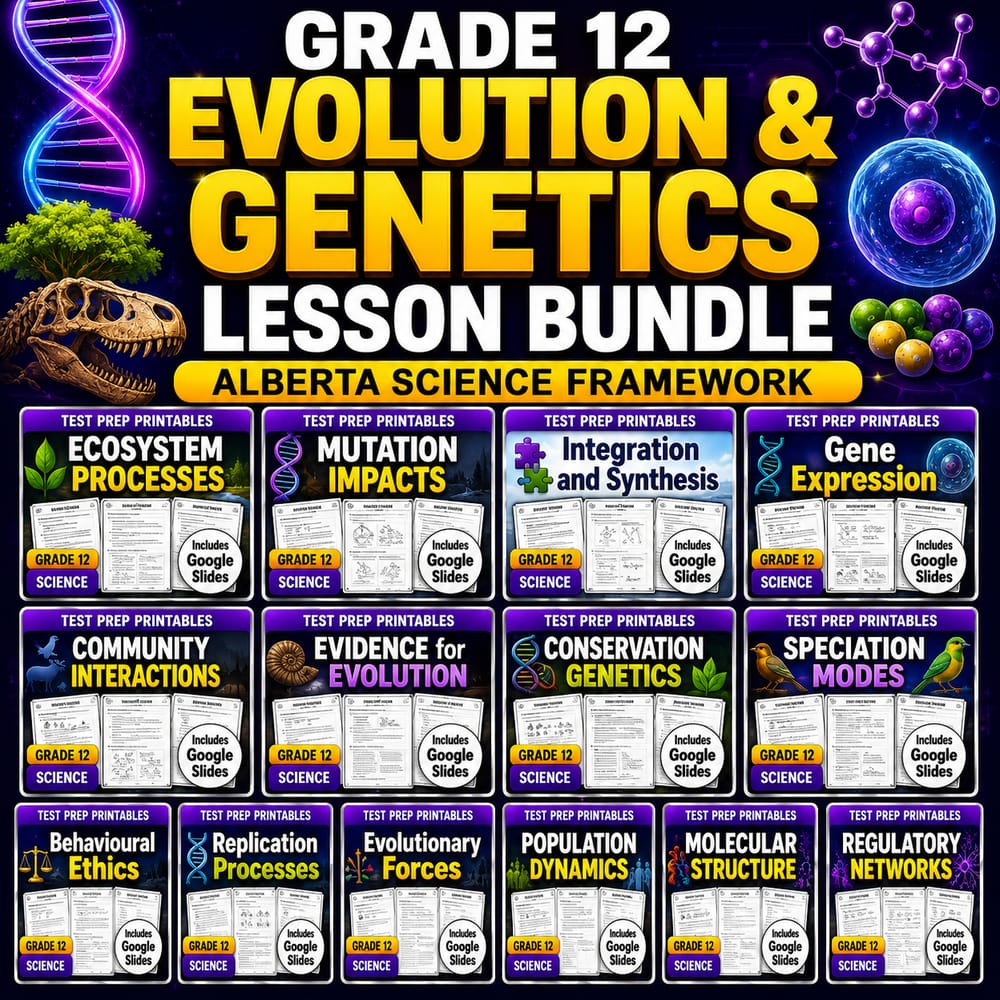


Grade 12 Evolution & Genetics Lesson Bundle | Alberta Science Framework
$56.00$70.00Save $14.00
Prism Point Learning
·2 followers·13 sales
SubjectScienceGradeGrade 12
What’s included
15 worksheets · Save $14.00 (20%) · prices shown inside the bundle
 Ecosystem Processes Worksheet | Grade 12 Science Activities
- Explain how primary productivity and decomposition drive energy flow and matter turnover in ecosystems.
- Describe how biogeochemical cycles connect organisms with the atmosphere, hydrosphere, and soil.
- Interpret how land-use change and climate variability can alter nutrient availability and ecosystem resilience.
$4.00$5.00 Mutation Impacts Worksheet | Grade 12 Science Activities
- Explain how different types of mutations (point substitutions, insertions, deletions, chromosomal rearrangements) can change gene products
- Predict how mutations can have silent, loss-of-function, or gain-of-function effects
- Describe how replication errors and environmental mutagens contribute to genetic variation in populations
$4.00$5.00 Integration and Synthesis Worksheet | Grade 12 Science Activities
- Connect DNA-level variation to gene expression and fitness consequences in evolving populations.
- Explain how mutation, natural selection, and gene flow interact to change allele frequencies over time.
- Evaluate how evolutionary dynamics can alter ecological interactions and ecosystem outcomes.
$4.00$5.00 Gene Expression Worksheet | Grade 12 Science Activities
- Explain how gene expression involves transcription and translation to produce functional proteins.
- Describe how promoters, enhancers, and transcription factors regulate when and where genes are expressed.
- Analyze how epigenetic modifications and regulatory networks affect tissue specificity and timing of expression.
$4.00$5.00 Community Interactions Worksheet | Grade 12 Science Activities
- Explain how interspecific interactions (competition, predation, parasitism, mutualism, commensalism) shape ecological communities and food webs.
- Describe how energy flow and trophic efficiency influence biomass distribution across ecosystems.
- Use Alberta examples to evaluate how species interactions can affect community composition, resilience, biodiversity, and stability.
$4.00$5.00 Evidence for Evolution Worksheet | Grade 12 Science Practice
- Explain how multiple lines of evidence support evolution, including fossils, homology, biogeography, and molecular phylogenetics.
- Use evidence patterns such as transitional forms and congruent trees to justify evolutionary relationships.
- Distinguish scientific interpretations of evidence from misconceptions about evolution.
$4.00$5.00 Conservation Genetics Worksheet | Grade 12 Science Activities
- Explain how molecular markers and genetic theory are used to measure diversity, inbreeding, and gene flow in fragmented populations.
- Interpret genetic metrics (heterozygosity, effective population size, and connectivity) to assess extinction risk and demographic viability.
- Evaluate how genetic information can guide conservation planning, such as habitat corridors and recovery strategies using Alberta examples.
$4.00$5.00 Speciation Modes Worksheet | Grade 12 Science Activities
- Explain how reproductive isolation prevents gene flow and leads to distinct lineages over time
- Compare allopatric, sympatric, and peripatric speciation and identify the main drivers of each mode
- Use examples to connect barriers, divergent selection, and founder events to genetic and reproductive boundaries
Free Biotechnology Ethics Worksheet | Grade 12 Science Activities
- Explain how ethical, legal, and social considerations apply to biotechnology such as genome editing and cloning.
- Analyze biosafety, ecological risk, and equitable access when evaluating biotechnology proposals.
- Describe how intellectual property and regulation influence real-world biotech adoption, including in Alberta.
$4.00$5.00 Replication Processes Worksheet | Grade 12 Science Activities
- Explain semi-conservative DNA replication and how template strands guide complementary base pairing.
- Describe the roles of helicase, primase, and DNA polymerase in coordinating replication.
- Evaluate how proofreading and repair help maintain replication fidelity and reduce mutation rates.
$4.00$5.00
Reviews & Feedback
Loading reviews...
Questions & Answers
Loading questions…
About this bundle
Related categories
Frequently asked questions
Who is Grade 12 Evolution & Genetics Lesson Bundle | Alberta Science Framework designed for?
Grade 12 Evolution & Genetics Lesson Bundle | Alberta Science Framework is designed for Grade 12 students and Science learners and can be used in classrooms, homeschool, or independent practice.
How do I download Grade 12 Evolution & Genetics Lesson Bundle | Alberta Science Framework?
Add it to your cart and complete checkout. After payment, you can download immediately from your account, and you'll also receive a download link by email.
Similar Products

Grade 12 Genetics and Evolution Science Lesson Bundle – General Framework
$32.00$40.00

Grade 12 Molecular Genetics & Evolution Lesson Bundle Daily Reading | Alberta
$48.00$60.00

Grade 12 Genetics & Evolution Science Lesson Bundle, General Framework
$25.60$32.00

Grade 12 Evolution & Genetics Science Lesson Bundle (General Framework)
$19.20$24.00

Grade 12 Genetics & Evolution Science Lesson Bundle – Alberta Framework
$60.00$75.00