
Grade 9 Science Worksheets
6,926 worksheets
Grade 9 Science — Worksheet MCQ on Model-Data Fit
 Created byThe Resource Hub
Learning Objectives
- Understand methods for assessing the fit between models and observations.
- Identify patterns indicating systematic divergence, heteroscedasticity, or missing variables.
- Evaluate graphical and statistical criteria for model acceptance, modification, or rejection.
Also included in: Grade 9 Science Practices Lesson Bundle for AP Standards +1 more
Instant download

Grade 9 Science — Worksheet MCQ Paper for Mastering Representation Models
Created byThe Resource HubLearning Objectives
- Identify different types of scientific representation models such as mathematical formulae, graphs, diagrams, and approximations.
- Understand criteria for selecting appropriate models based on fidelity, simplicity, and predictive scope.
- Explain how mapping model components to measurable observables supports interpretation and testing.
Also included in: Grade 9 Science Practices Lesson Bundle for AP Standards +1 more
Instant download
Grade 9 Science — Communicating Uncertainty Worksheet MCQ Paper
Created byThe Resource HubLearning Objectives
- Understand different conventions for conveying quantitative uncertainty and confidence in statistical inferences.
- Recognize the importance of clarity regarding assumptions, limits, and interpretations when reporting results.
- Identify various visualization techniques that portray variability and effect sizes in data communication.
Also included in: Grade 9 Science Practices Lesson Bundle for AP Standards +1 more
Instant download
Grade 9 Science — Worksheet MCQ Paper for Mastering Argument Structures
Created byThe Resource HubLearning Objectives
- Understand the components of scientific argumentation, including claim, evidence, and reasoning.
- Evaluate the coherence, relevance, and strength of scientific arguments using qualitative and quantitative evidence.
- Identify logical links, explicit assumptions, and criteria for weighing evidence in scientific explanations.
Also included in: Grade 9 Science Practices Lesson Bundle for AP Standards +1 more
Instant download

Grade 9 Science — Measurement Fundamentals Worksheet for Mastery
Created byThe Resource HubLearning Objectives
- Understand the principles of metric measurement and instrument resolution.
- Recognize the importance of calibration and measurement protocols in data accuracy.
- Connect raw measurements to graphical and tabular representations while accounting for uncertainty.
Also included in: Grade 9 Science Practices Lesson Bundle for AP Standards +1 more
Instant download
Grade 9 Science — Worksheet MCQ Paper for Mastering Graphical Literacy
Created byThe Resource HubLearning Objectives
- Understand the different types of graphical representations such as scatterplots, histograms, and line graphs.
- Evaluate the appropriateness of graph types based on data patterns and research questions.
- Identify outliers, trends, and correlation structures in graphs to inform data interpretation.
Also included in: Grade 9 Science Practices Lesson Bundle for AP Standards +1 more
Instant download
Grade 9 Science — Worksheet MCQ Paper for Mastering Dynamic Systems
Created byThe Resource HubLearning Objectives
- Interpret and analyze data from time-series descriptions of systems.
- Identify the roles of feedback loops, rates, and equilibrium in system behavior.
- Differentiate transient versus steady-state behavior using mathematical representations.
Also included in: Grade 9 Science Practices Lesson Bundle for AP Standards +1 more
Instant download

Grade 9 Science | Inherited Trait Origins - Daily Reading Comprehension
 Created byCoral Reef Learning
Learning Objectives
- Understand how genetic inheritance occurs through meiosis and gamete formation.
- Identify sources of genetic variation, including chromosome combinations and mutations.
- Explain how diversity in genotypes can lead to evolutionary change.
Instant download

Grade 9 Science – Genetic Drift Daily Reading Worksheet + Answer Key
JCreated byJ.S SheetsLearning Objectives
- Define genetic drift and explain its role in evolution.
- Describe events that cause genetic drift such as bottlenecks and founder effects.
- Analyze how genetic drift affects genetic diversity and allele frequencies.
Also included in: Grade 9 Science Lesson Bundle | Evolution and Genetics TEKS Framework +1 more
Instant download
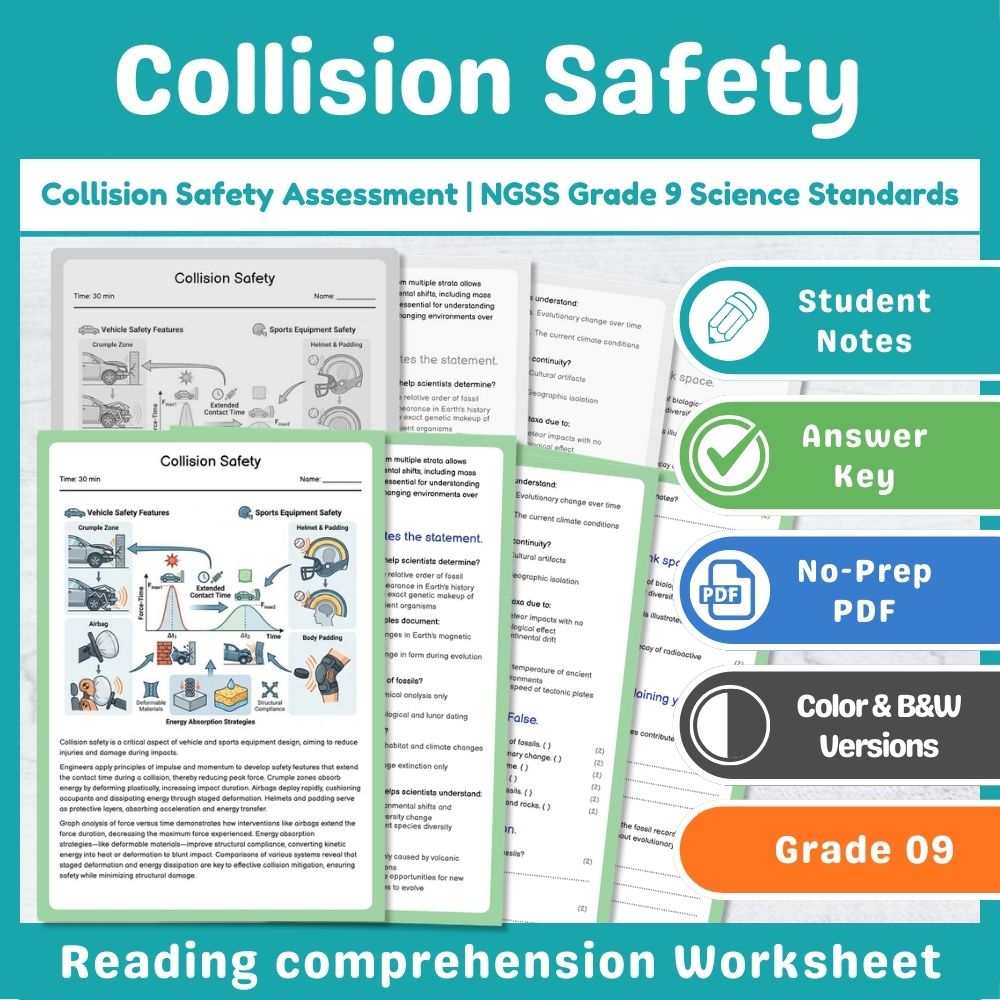
Collision Safety Assessment | NGSS Grade 9 Science Standards
 Created byPrism Point Learning
Learning Objectives
- Understand how impulse and force-time tradeoffs influence collision mitigation strategies.
- Identify engineering design features such as crumple zones, airbags, and helmets for safer high-impact interactions.
- Analyze force-time graphs and energy absorption techniques to evaluate shock absorption effectiveness.
Instant download
Grade 9 Science | Inheritance & Genetics Worksheet (PDF)
 Created byBright Mind Resources
Learning Objectives
- Understand different reproductive strategies and their impact on genetic diversity.
- Trace inheritance mechanisms through chromosomes and Mendelian patterns.
- Examine the adaptive consequences of selection in agricultural and biological contexts.
Instant download

Surface Processes Worksheet | NGSS Grade 9 Science Assessment
 Created byCedar Grove Learning
Learning Objectives
- Understand how atmospheric and hydrologic forces influence geomorphic change.
- Identify and describe physical and chemical weathering processes.
- Explain the role of mass wasting and sediment transport in shaping landforms.
Instant download
Grade 9 Science | Light Reactions Worksheet with Short Notes (Printable PDF)
 Created byMeadowlark Worksheets
Learning Objectives
- Understand the process and components involved in light reactions of photosynthesis.
- Explain how photon energy initiates electron flow and ATP/NADPH production.
- Describe the role of water splitting and oxygen release in light reactions.
Instant download

Grade 9 Science | Variation Mechanisms & Heritable Diversity - Reading Practice
Created byCoral Reef LearningLearning Objectives
- Identify the main sources of genetic variation such as point mutations, chromosomal rearrangements, meiotic recombination, and independent assortment.
- Describe how crossing-over, insertions/deletions, and recombination contribute to allelic diversity.
- Explain the impact of molecular changes on gene expression and protein function.
Instant download
Grade 9 Science | Enzyme Basics Worksheet with Short Notes (Printable PDF)
Created byMeadowlark WorksheetsLearning Objectives
- Understand the role of enzymes as biological catalysts in speeding up metabolic reactions.
- Describe how enzyme structure relates to substrate specificity and catalysis.
- Explain the functions of cofactors and coenzymes in enzyme activity.
Instant download

Grade 9 Science | Meiosis & Genetic Variation - Daily Reading Comprehension
Created byCoral Reef LearningLearning Objectives
- Recognize the basic process of meiosis.
- Understand how genetic variation is generated during meiosis.
- Identify the roles of crossing over and independent assortment.
Instant download
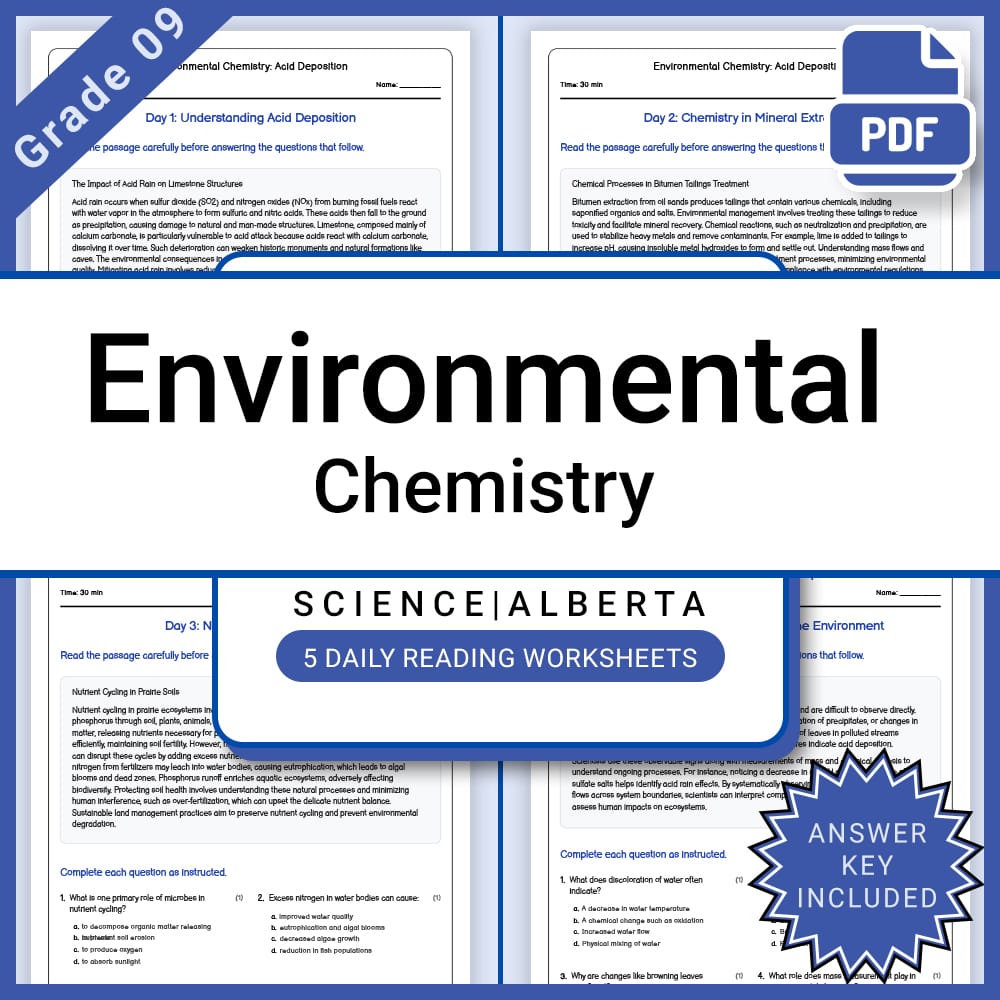
Grade 9 Science – Environmental Chemistry Daily Reading Worksheet + Answer Key
JCreated byJ.S SheetsLearning Objectives
- Understand the causes of acid rain and how it forms.
- Identify the effects of acid rain on limestone formations.
- Analyze environmental impacts of acid deposition.
Also included in: Grade 9 Science Lesson Bundle | Alberta Framework +1 more
Instant download

Grade 9 Science | Signal Integration Worksheet (PDF) & Standards BC
 Created byEvergreen Desk Education
Learning Objectives
- Explain how the nervous and endocrine systems work together to maintain homeostasis.
- Compare the roles of neural signaling and hormonal signaling in short-term and long-term responses.
- Describe how feedback loops can adjust signaling to keep internal conditions stable.
Instant download
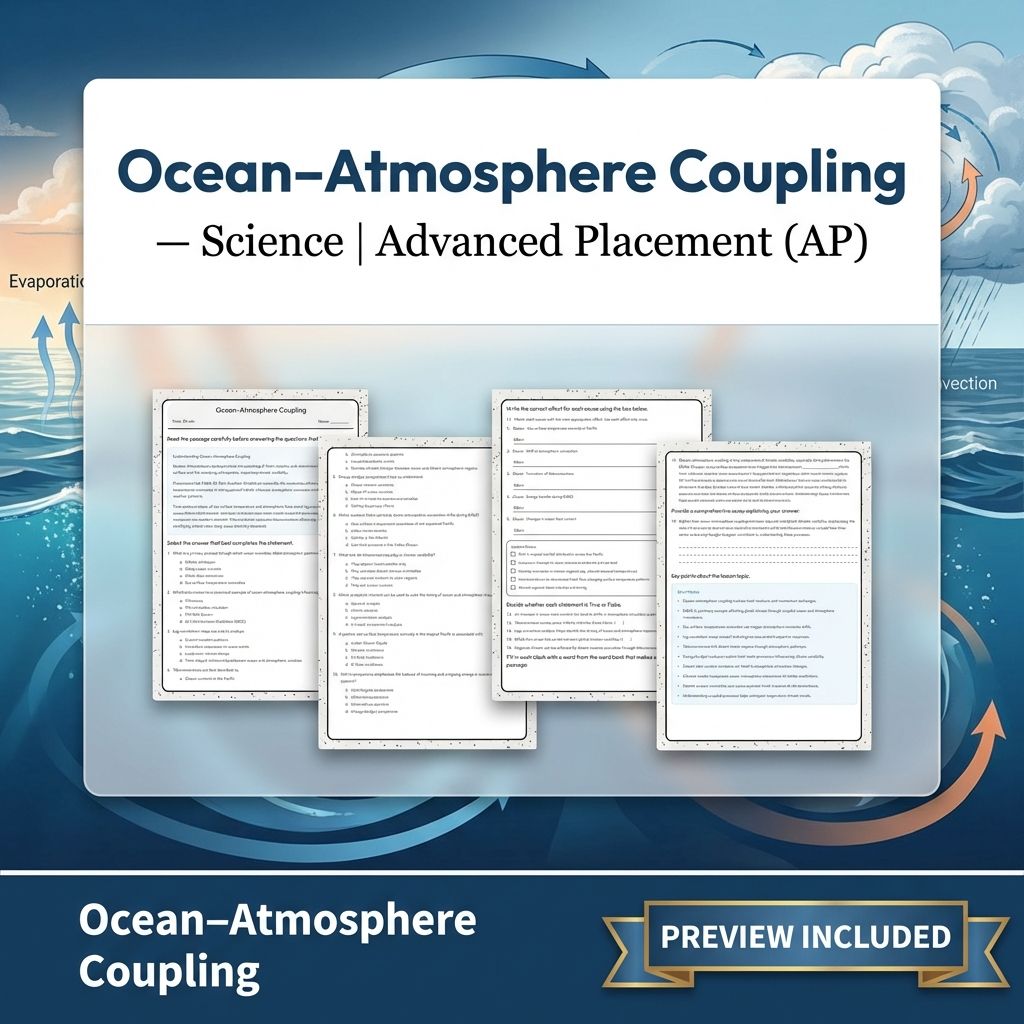
9th Grade Science | Ocean–Atmosphere Coupling Worksheet with Short Notes (PDF)
Created byMeadowlark WorksheetsLearning Objectives
- Understand the mechanisms linking oceanic and atmospheric variability in climate phenomena.
- Interpret time-series analyses and lag-correlation maps related to ocean and atmosphere.
- Explain how ocean heat content influences atmospheric circulation and regional climates.
Also included in: Grade 9 Science | Earth Systems & Geology Unit Worksheet Bundle (Printable PDFs) +1 more
Instant download

Grade 9 Science – Conservation of Matter & Atomic Counts | Reading Worksheet
Created byBright Mind ResourcesLearning Objectives
- Understand that atoms are conserved during chemical reactions
- Recognize how the rearrangement of atoms explains mass conservation
- Identify examples of matter conservation in various reactions
Also included in: Grade 9 Forces, Energy & Matter Science lesson bundle Florida NGSSS +1 more
Instant download
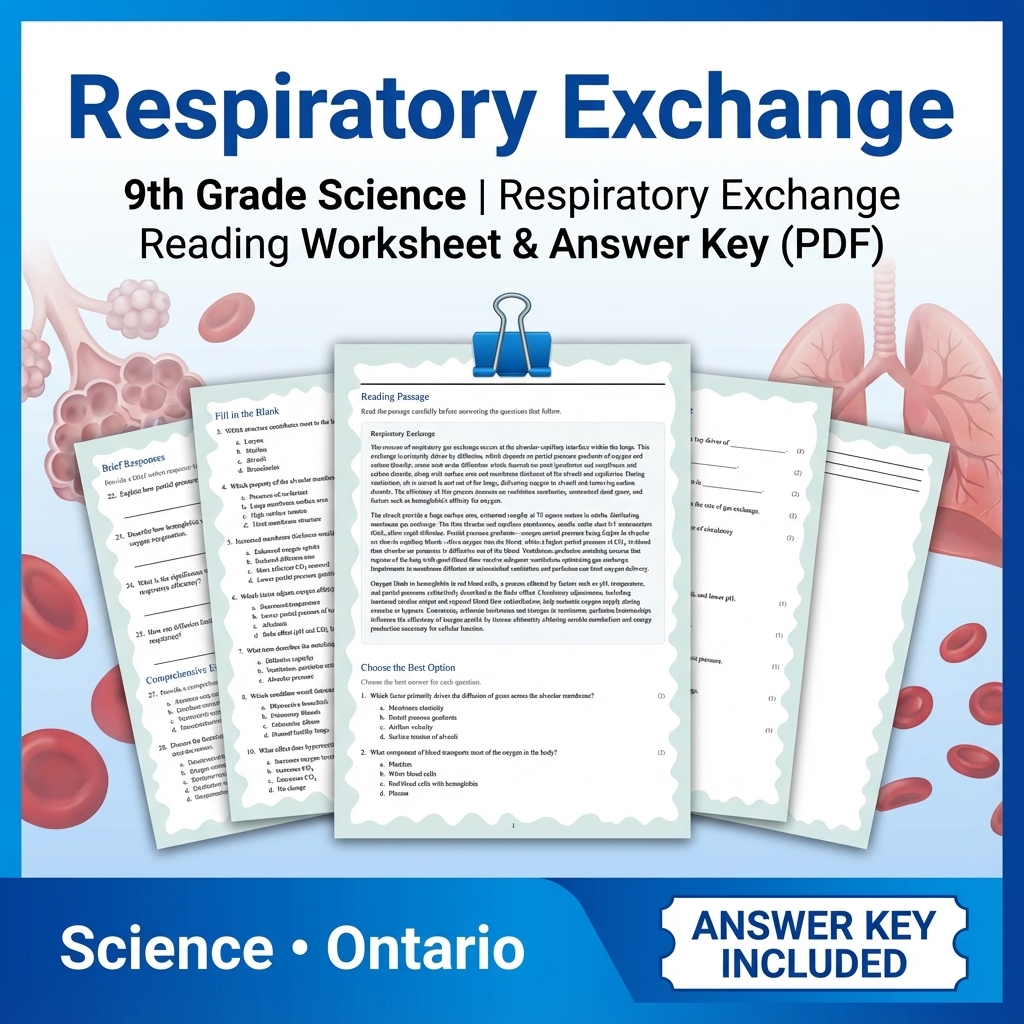
9th Grade Science | Respiratory Exchange Reading Worksheet & Answer Key (PDF)
JCreated byJ.S SheetsLearning Objectives
- Understand the mechanism of pulmonary gas exchange at the alveolar–capillary interface.
- Identify factors influencing diffusion of oxygen and carbon dioxide during respiration.
- Explain how ventilation and perfusion matching optimize gas exchange.
Also included in: Grade 9 Science Unit Bundle | Human Body Systems & Cell Functions +1 more
Instant download
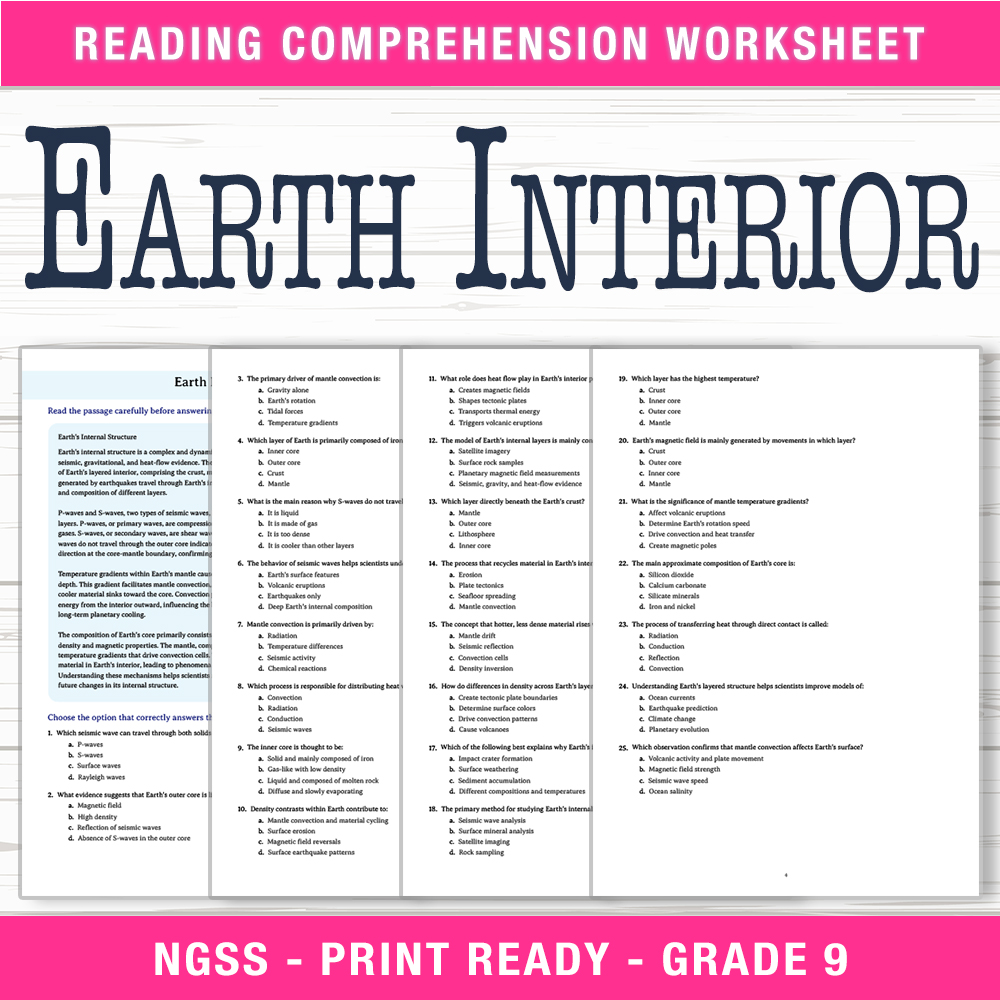
Grade 9 Science | Earth's Interior Worksheet (PDF + Answer Key)
 Created byRiverstone Classroom
Learning Objectives
- Understand the layered structure of Earth's interior based on seismic, gravity, and heat-flow evidence.
- Interpret the behavior of P-waves and S-waves and their implications for Earth's internal composition.
- Explain how temperature gradients and density contrasts drive mantle convection and material cycling.
Also included in: Grade 9 Science Unit | Earth Processes & Climate Worksheet Bundle
Instant download
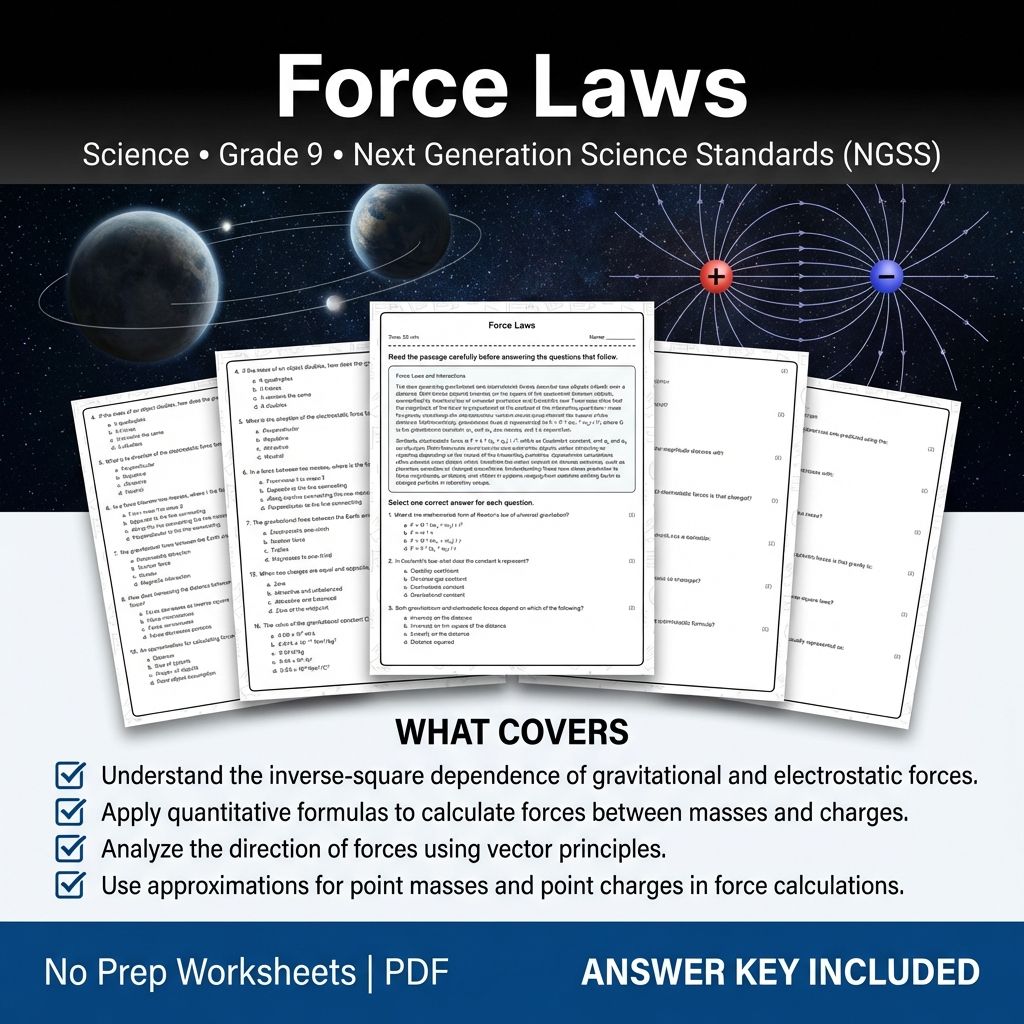
9th Grade Science | Force Laws Worksheet with Answer Key (PDF)
Created byCoral Reef LearningLearning Objectives
- Understand the inverse-square dependence of gravitational and electrostatic forces.
- Apply quantitative formulas to calculate forces between masses and charges.
- Analyze the direction of forces using vector principles.
Also included in: Grade 9 Science Unit Bundle – Newtonian Motion & Physics Practice Worksheets +1 more
Instant download
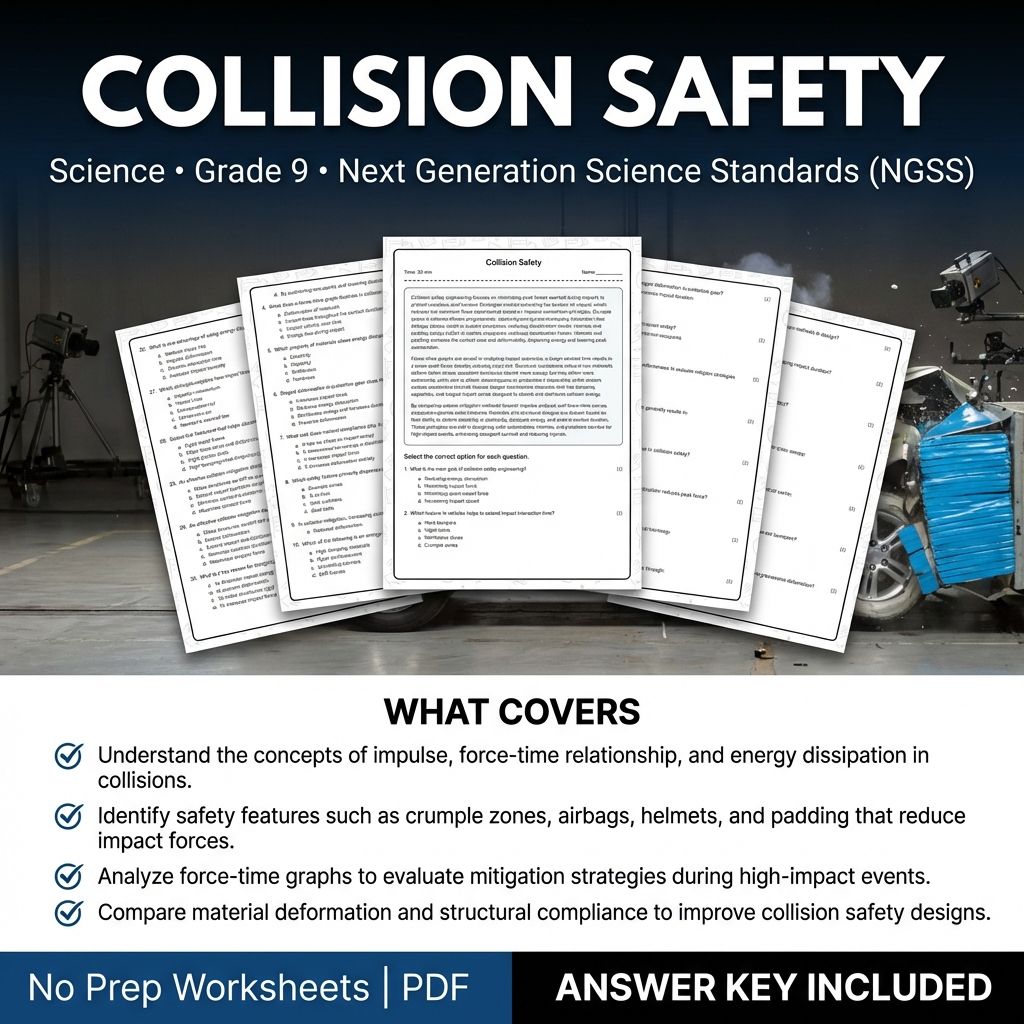
9th Grade Science Worksheet | Collision Safety Engineering Practice & Answer Key
Created byCoral Reef LearningLearning Objectives
- Understand the concepts of impulse, force-time relationship, and energy dissipation in collisions.
- Identify safety features such as crumple zones, airbags, helmets, and padding that reduce impact forces.
- Analyze force-time graphs to evaluate mitigation strategies during high-impact events.
Also included in: Grade 9 Science Unit Bundle – Newtonian Motion & Physics Practice Worksheets +1 more
Instant download
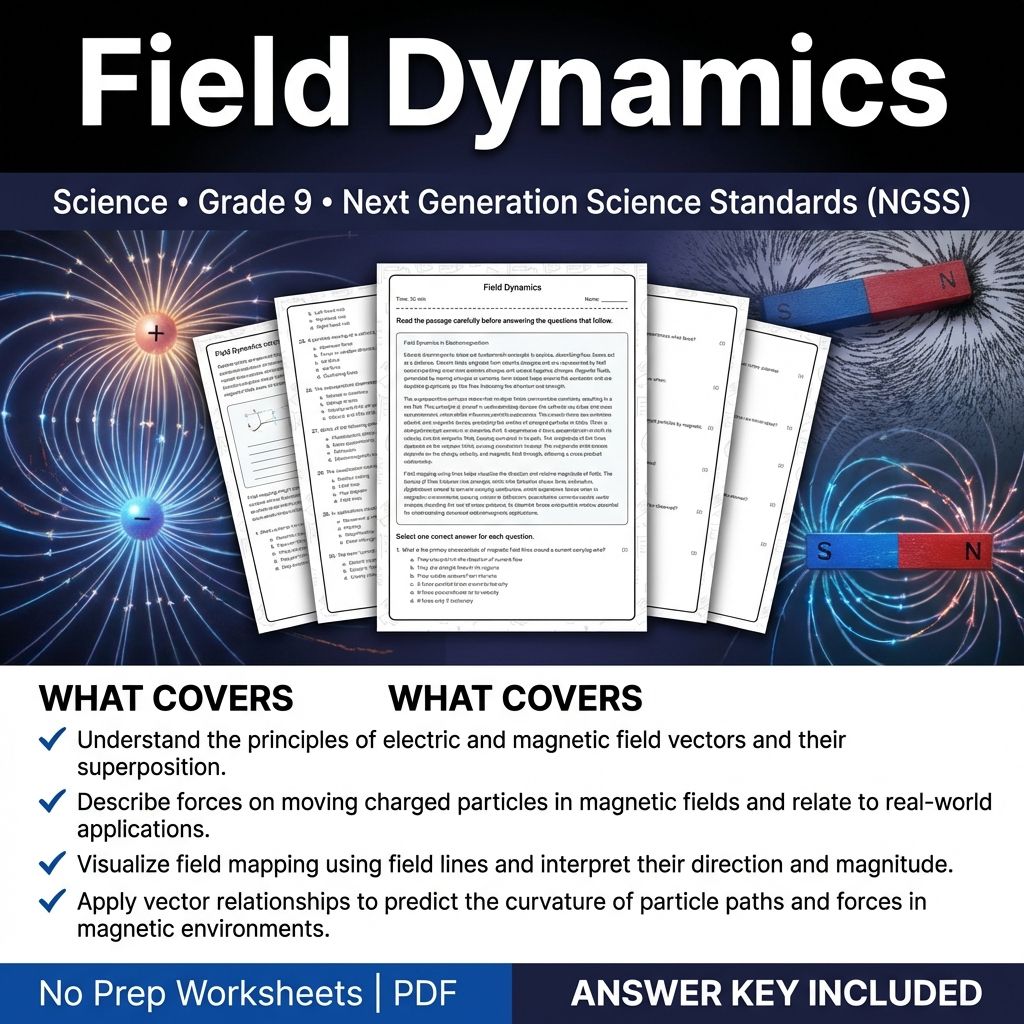
9th Grade Science | Field Dynamics Worksheet + Answer Key (Printable PDF)
Created byCoral Reef LearningLearning Objectives
- Understand the principles of electric and magnetic field vectors and their superposition.
- Describe forces on moving charged particles in magnetic fields and relate to real-world applications.
- Visualize field mapping using field lines and interpret their direction and magnitude.
Also included in: Grade 9 Science Unit Bundle – Newtonian Motion & Physics Practice Worksheets +1 more
Instant download
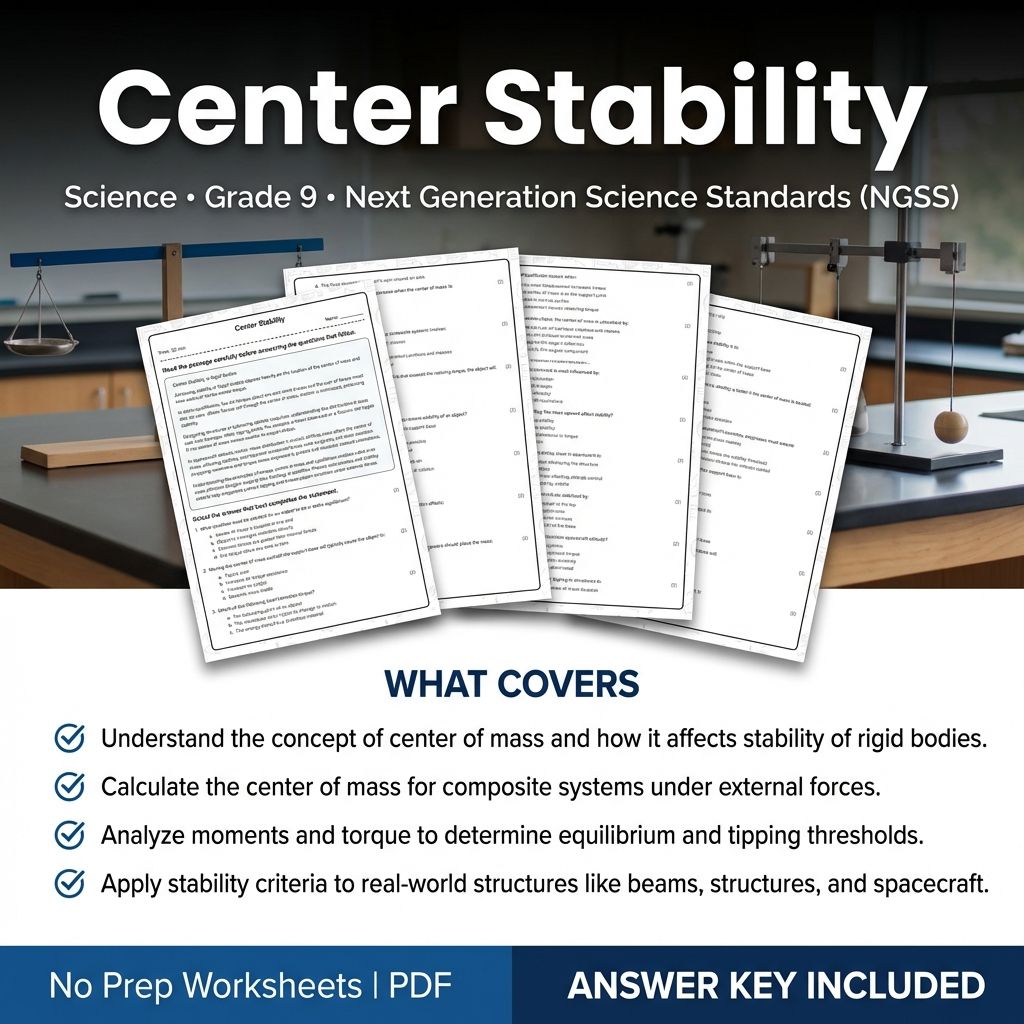
9th Grade Science | Center Stability Worksheet & Answer Key (Printable PDF)
Created byCoral Reef LearningLearning Objectives
- Understand the concept of center of mass and how it affects stability of rigid bodies.
- Calculate the center of mass for composite systems under external forces.
- Analyze moments and torque to determine equilibrium and tipping thresholds.
Also included in: Grade 9 Science Unit Bundle – Newtonian Motion & Physics Practice Worksheets +1 more
Instant download

Grade 9 Science – Climate Evidence Ice Cores & Climate Records | Worksheet
Created byBright Mind ResourcesLearning Objectives
- Understand how ice cores provide information about Earth's past climate
- Identify the types of climate evidence found in natural records
- Differentiate between long-term climate data and short-term weather patterns
Also included in: Grade 9 Science Worksheets: Space-to-Climate Lesson Bundle | Calif. Standards +1 more
Instant download
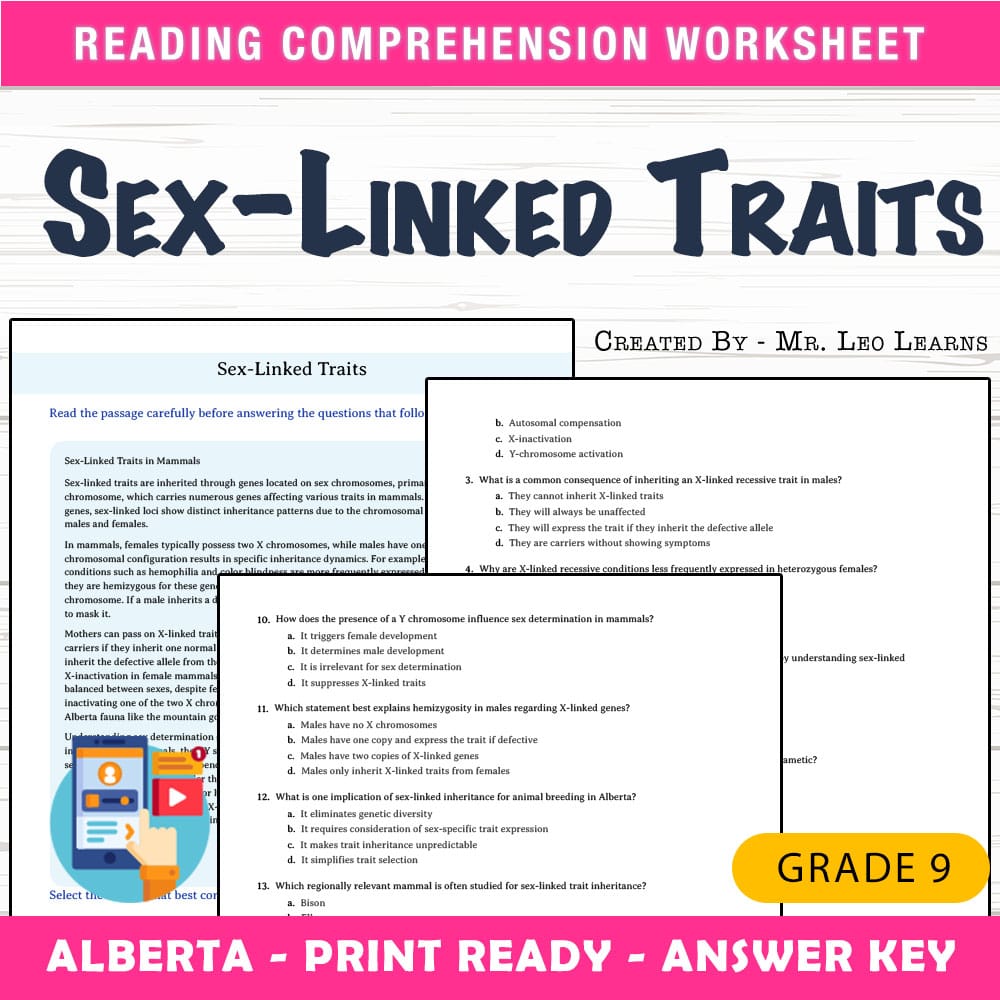
Grade 9 Science — Worksheet MCQ Paper for Mastering Sex-Linked Traits
Created byThe Resource HubLearning Objectives
- Understand the role of sex chromosomes in determining sex-linked traits.
- Describe inheritance patterns of X-linked recessive conditions in mammals.
- Explain mechanisms such as hemizygosity and dosage compensation in sex-linked inheritance.
Also included in: Grade 9 Science Lesson Bundle | Reproduction and Heredity Worksheets +1 more
Instant download

Developmental Variation Worksheet | AP Science | Grade 9 Practice
JCreated byJ.S SheetsLearning Objectives
- Explain how genetic and epigenetic mechanisms contribute to phenotypic diversity.
- Describe the role of regulatory networks and timing changes in development.
- Analyze comparative developmental evidence to link gene variation to traits.
Also included in: Grade 9 Science | DNA and Ecosystems Lesson Group Bundle
Instant download

Cell Components Worksheet | AP Science Grade 9 Practice PDF
JCreated byJ.S SheetsLearning Objectives
- Identify the major components of a cell and their functions.
- Explain how structural features like membranes and organelles contribute to cellular processes.
- Analyze the impact of alterations in membrane composition and organelle integrity on cell function.
Also included in: Grade 9 Science | DNA and Ecosystems Lesson Group Bundle
Instant download

Energy Pathways Worksheet for Grade 9 Science | AP Standards Practice
JCreated byJ.S SheetsLearning Objectives
- Explain the role of ATP in cellular energy transfer.
- Describe how catabolic and anabolic reactions are coupled in energy metabolism.
- Compare the electron transport chains in photosynthesis and respiration.
Also included in: Grade 9 Science | DNA and Ecosystems Lesson Group Bundle
Instant download

Organelle Function Worksheet | AP Science Grade 9 Practice & Assessment
JCreated byJ.S SheetsLearning Objectives
- Identify the major organelles involved in cellular processes and their specific functions.
- Explain how the structure of organelles relates to their roles in metabolism and cellular maintenance.
- Compare different organelles and understand how compartmentation enhances reaction efficiency and pathway integration.
Also included in: Grade 9 Science | DNA and Ecosystems Lesson Group Bundle
Instant download

Metabolic Regulation Worksheet | AP Science Grade 9 Assessment & Practice
JCreated byJ.S SheetsLearning Objectives
- Describe the mechanisms that regulate metabolic pathways, including allosteric enzyme control and covalent modifications.
- Explain feedback inhibition and hormonal signals that influence energy flux between catabolism and anabolism.
- Model how enzyme kinetics and substrate concentrations determine pathway rates and system responses to perturbations.
Also included in: Grade 9 Science | DNA and Ecosystems Lesson Group Bundle
Instant download
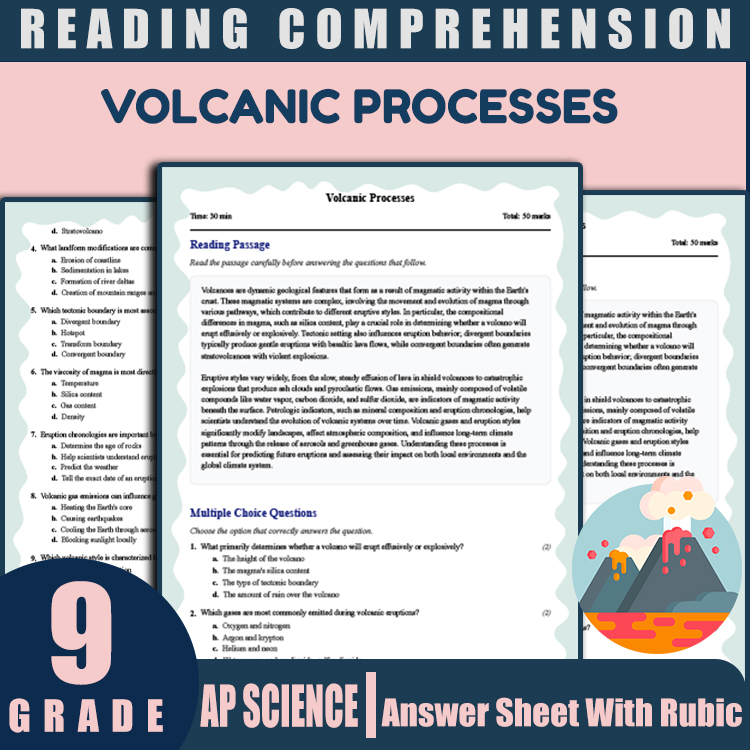
Grade 9 Science | Volcanic Processes Reading Worksheet (PDF + Rubric)
JCreated byJ.S SheetsLearning Objectives
- Explain the different magmatic systems and eruptive styles associated with volcanoes.
- Identify how compositional controls and tectonic settings influence volcanic activity.
- Distinguish between effusive shield volcanism and explosive stratovolcano behavior.
Instant download
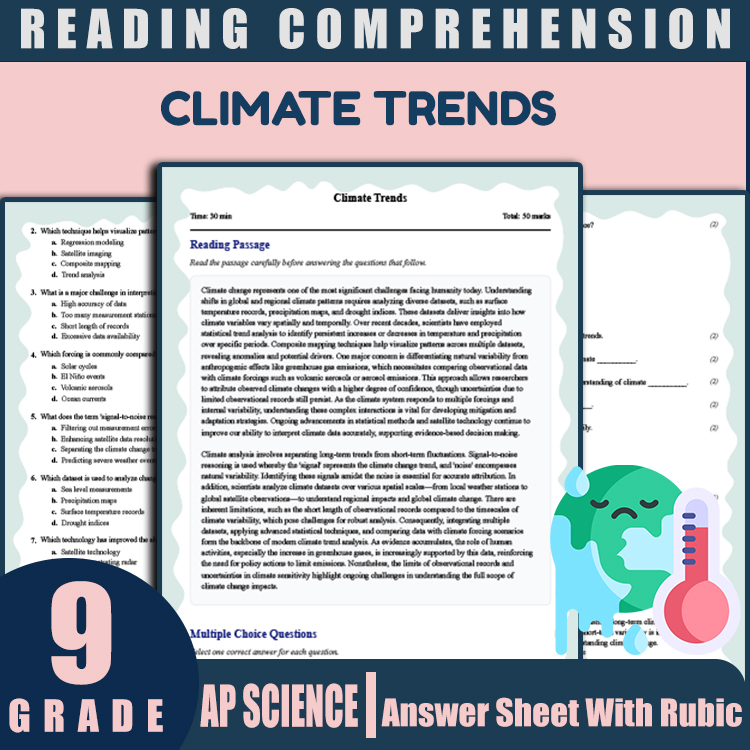
9th Grade Science | Climate Trends Reading Worksheet with Answer Key (PDF)
JCreated byJ.S SheetsLearning Objectives
- Understand how to analyze surface temperature records, precipitation maps, and drought indices to identify climate patterns.
- Apply statistical trend analysis and composite mapping techniques to climate datasets.
- Interpret climatic data to distinguish between long-term changes and short-term variability.
Instant download
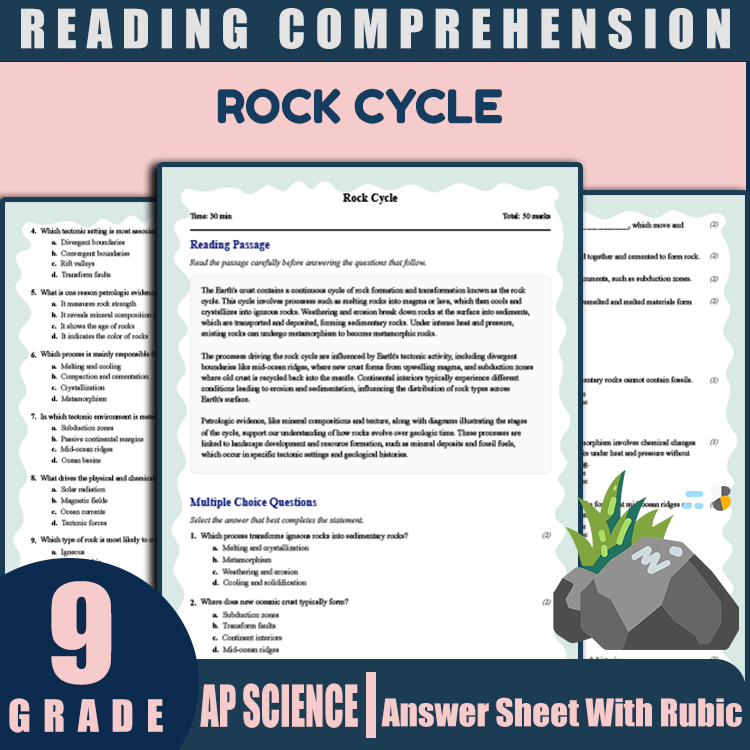
Grade 9 Science | Rock Cycle Reading Worksheets (PDF + Answer Key)
JCreated byJ.S SheetsLearning Objectives
- Explain the processes involved in the rock cycle, including melting, crystallization, weathering, transport, deposition, and metamorphism.
- Identify how tectonic settings such as mid-ocean ridges, subduction zones, and continental interiors influence rock formation and transformation.
- Analyze petrologic evidence and diagrams to understand rock distribution and history.
Instant download
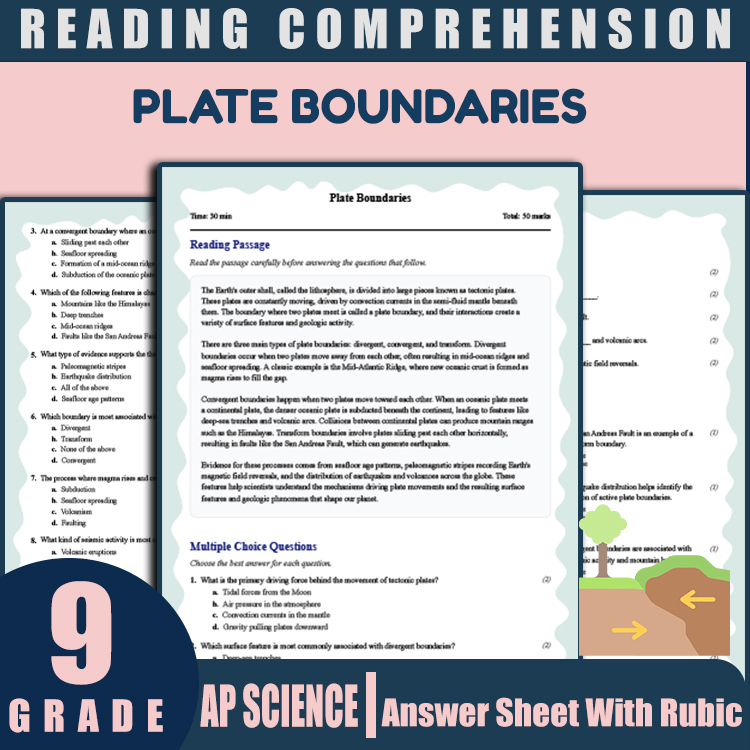
9th Grade Science | Plate Boundaries Reading Worksheets (PDF & Rubric)
JCreated byJ.S SheetsLearning Objectives
- Explain the mechanisms behind divergence, convergence, and transform plate boundaries.
- Identify surface features and geologic evidence associated with different types of plate boundaries.
- Describe how plate tectonics influences seismic and volcanic activity globally.
Instant download
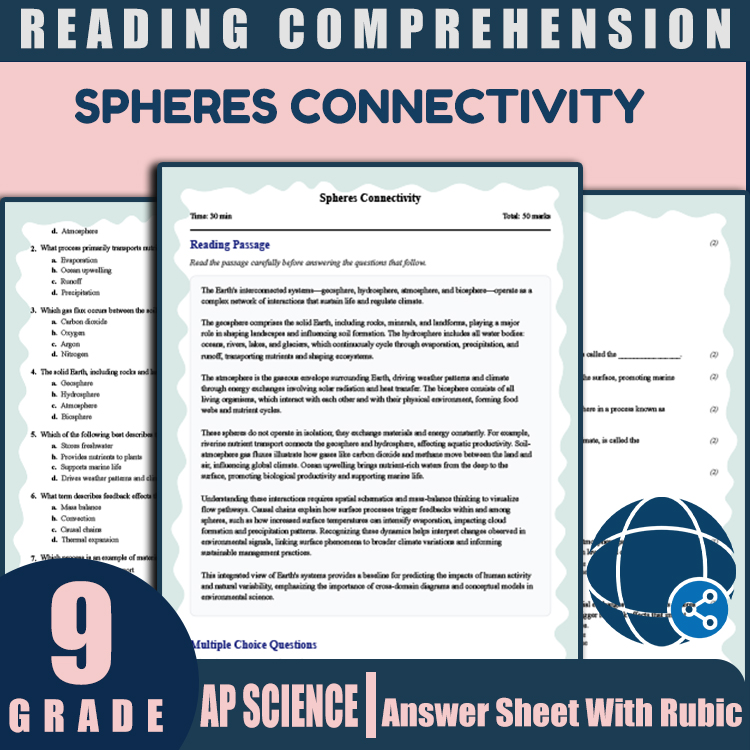
Grade 9 Science | Spheres Connectivity Reading Worksheet & Answer Key (PDF)
JCreated byJ.S SheetsLearning Objectives
- Describe the interactions among the geosphere, hydrosphere, atmosphere, and biosphere using conceptual models.
- Explain material and energy exchanges such as riverine nutrient transport, soil-atmosphere gas fluxes, and ocean upwelling effects.
- Use spatial schematics, mass-balance thinking, and causal chains to interpret coupled environmental phenomena.
Instant download
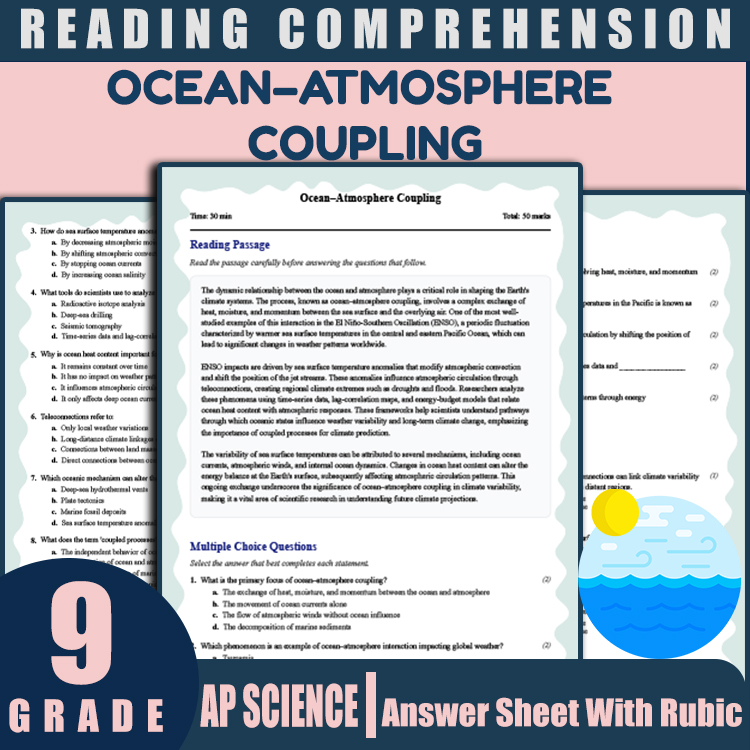
Grade 9 Science | Ocean–Atmosphere Coupling Reading Worksheet (PDF + Answer Key)
JCreated byJ.S SheetsLearning Objectives
- Describe the mechanisms of ocean–atmosphere interactions and their impact on regional climate patterns.
- Explain phenomena such as ENSO and their effects on weather variability.
- Analyze how sea surface temperature anomalies influence atmospheric circulation and teleconnections.
Instant download
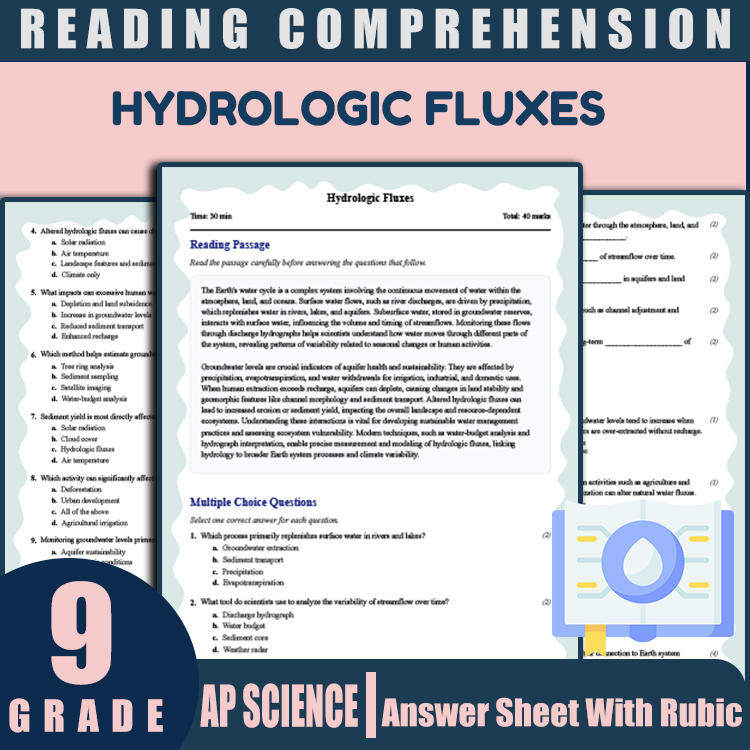
9th Grade Science | Hydrologic Fluxes Reading Worksheet & Answer Key (PDF)
JCreated byJ.S SheetsLearning Objectives
- Understand the water-budget framework and how it quantifies surface and subsurface water flows.
- Interpret discharge hydrographs and groundwater level records to assess streamflow variability and aquifer sustainability.
- Relate precipitation inputs, evapotranspiration losses, and human withdrawals to changes in hydrologic fluxes.
Instant download
9th Grade Science | Energy Pathways Reading Worksheet & Answer Key (PDF)
JCreated byJ.S SheetsLearning Objectives
- Describe the different energy transfer processes that influence atmospheric and oceanic dynamics.
- Interpret global energy budget diagrams and flux tables to understand climate variability.
- Relate energy partitioning to observable climate indicators such as surface temperature distributions and sea surface temperature anomalies.
Instant download
9th Grade Science | Paleoclimate Proxies Reading Worksheet (PDF + Rubric)
JCreated byJ.S SheetsLearning Objectives
- Understand the types of paleoclimate proxies and their significance in climate reconstruction.
- Interpret proxy data such as isotopic ratios, growth increments, and microfossil assemblages to infer past climate conditions.
- Describe how age models and uncertainty quantification enhance the interpretation of paleoclimate records.
Instant download
Grade 9 Science | Mountain Building Reading Worksheet (PDF + Rubric)
JCreated byJ.S SheetsLearning Objectives
- Describe the processes involved in orogenic mountain formation including crustal shortening, thickening, and metamorphism.
- Explain how isostatic adjustments influence mountain belt elevation.
- Analyze how mountain-building episodes affect regional climate, river erosion, and sediment delivery.
Instant download

9th Grade Science | Seismic Records Reading Worksheet (PDF + Rubric)
JCreated byJ.S SheetsLearning Objectives
- Understand how seismic waveforms are used to interpret Earth's subsurface structures.
- Compare P- and S-wave arrivals, waveform amplitudes, and frequency content to identify earthquake characteristics.
- Analyze travel-time curves and epicenter maps to determine earthquake depth and fault behavior.
Instant download
Grade 9 Science | Integrated Modeling in Environmental Science Reading Worksheet
JCreated byJ.S SheetsLearning Objectives
- Understand the concept of integrated models that combine geosphere, hydrosphere, atmosphere, and biosphere interactions.
- Describe how coupled quantitative models are used to simulate environmental change scenarios.
- Explain the importance of model structure, parameter sensitivity, and uncertainty propagation in environmental projections.
Instant download
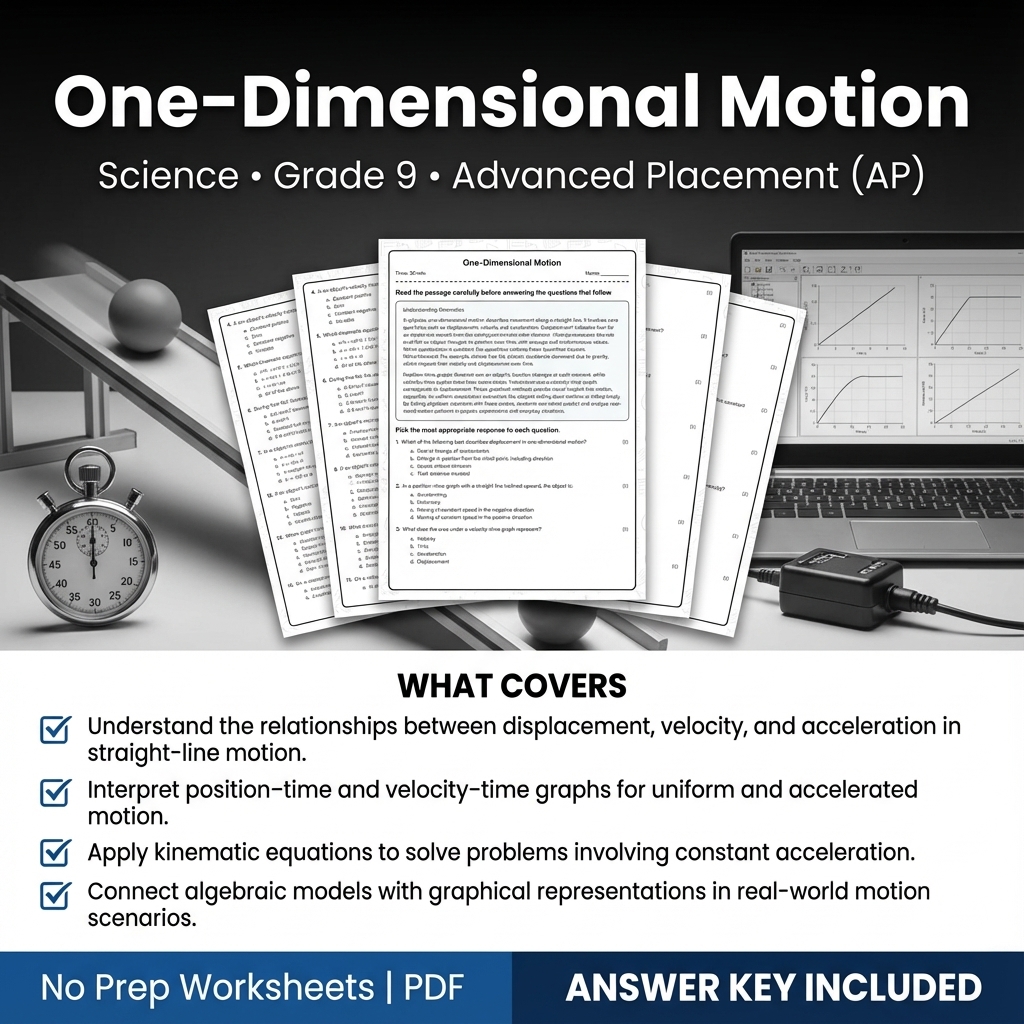
9th Grade Science | One-Dimensional Motion Worksheet (Printable PDF + Answer Key)
Created byCoral Reef LearningLearning Objectives
- Understand the relationships between displacement, velocity, and acceleration in straight-line motion.
- Interpret position–time and velocity–time graphs for uniform and accelerated motion.
- Apply kinematic equations to solve problems involving constant acceleration.
Also included in: Grade 9 Science Unit Bundle – Motion & Force Worksheets with Answer Keys +2 more
Instant download
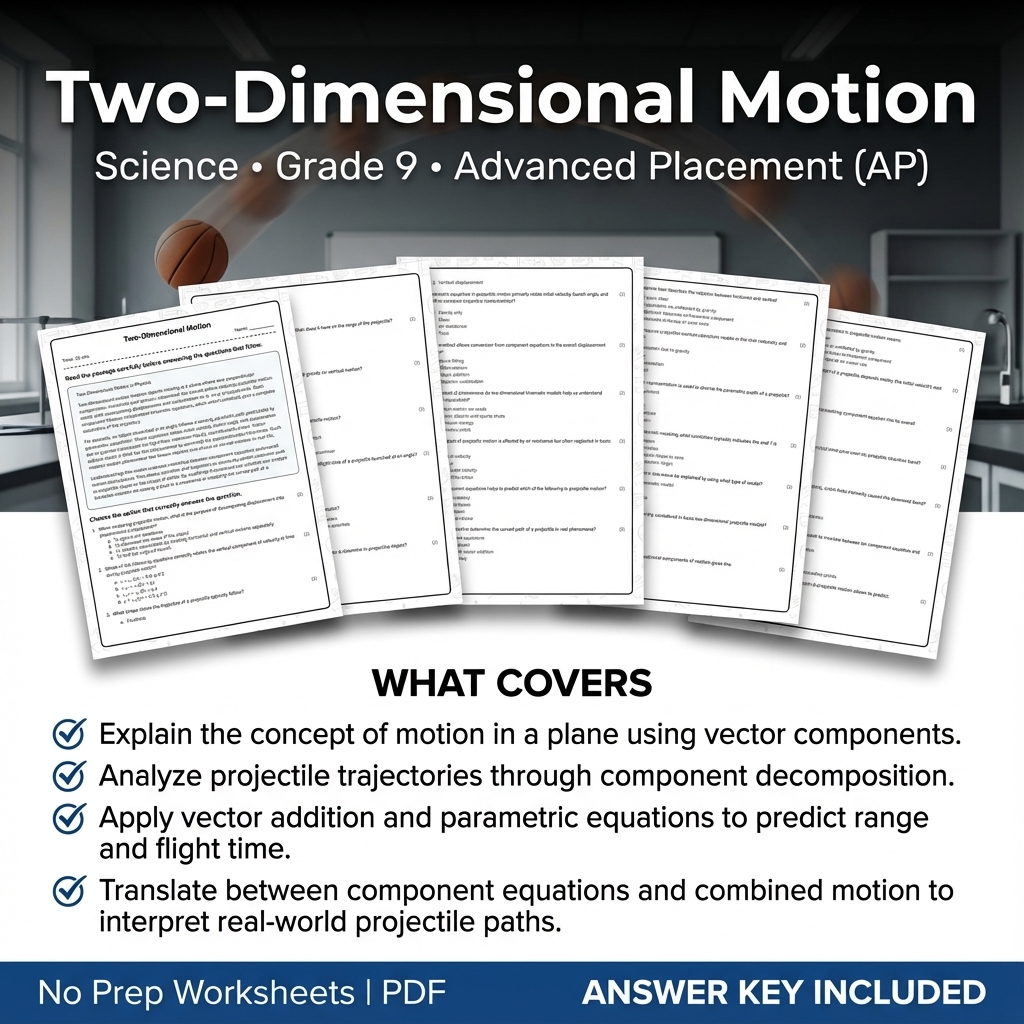
Grade 9 Science | Two-Dimensional Motion Worksheet (Printable PDF + Answer Key)
Created byCoral Reef LearningLearning Objectives
- Explain the concept of motion in a plane using vector components.
- Analyze projectile trajectories through component decomposition.
- Apply vector addition and parametric equations to predict range and flight time.
Also included in: Grade 9 Science Unit Bundle – Motion & Force Worksheets with Answer Keys +2 more
Instant download
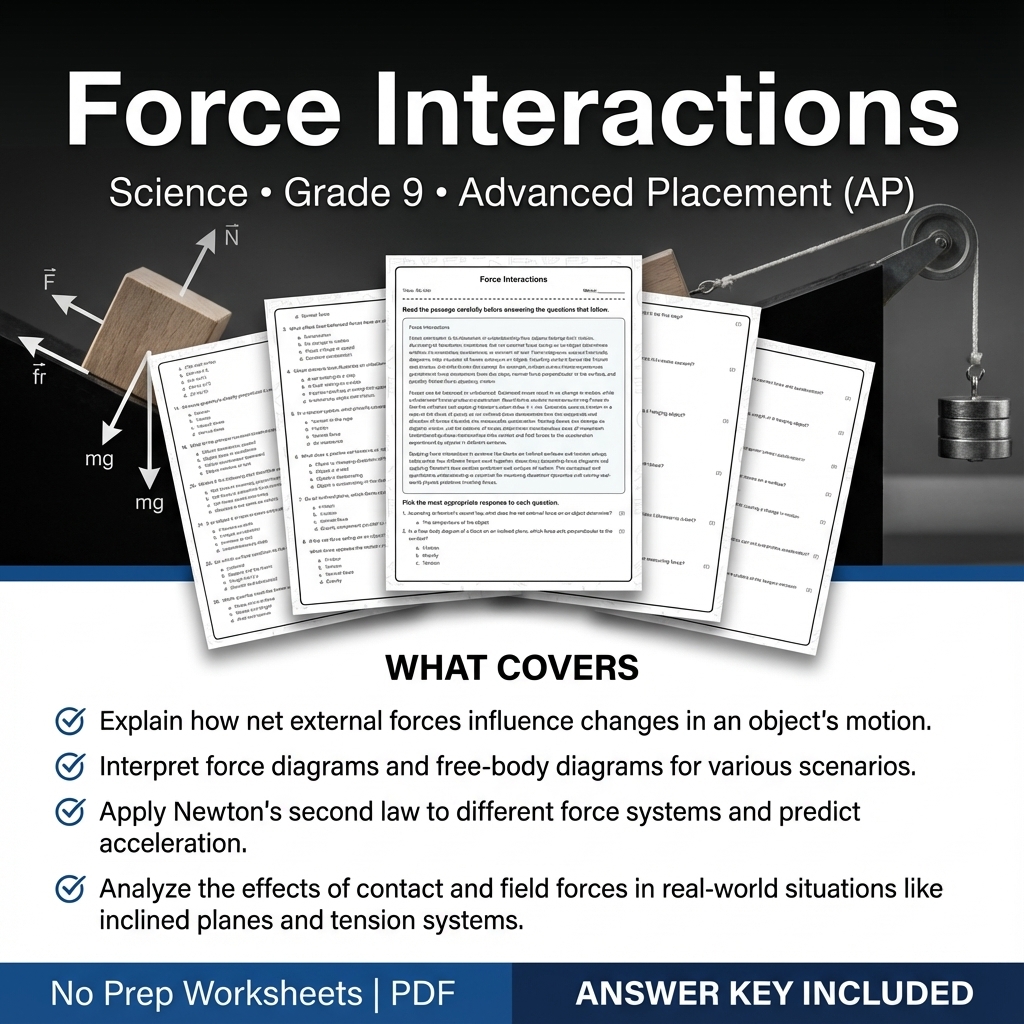
Grade 9 Science | Force Interactions Worksheet (Printable PDF + Answer Key)
Created byCoral Reef LearningLearning Objectives
- Explain how net external forces influence changes in an object's motion.
- Interpret force diagrams and free-body diagrams for various scenarios.
- Apply Newton's second law to different force systems and predict acceleration.
Also included in: Grade 9 Science Unit Bundle – Motion & Force Worksheets with Answer Keys +2 more
Instant download
About Grade 9 Science Worksheets
Find Science worksheets built for Grade 9. All 6,926 cover core skills, practice, and review, each an instant PDF download.
Every worksheet on MyTeachingSheets is created by independent teacher-authors and reviewed before publication. All resources download as printable PDFs for classroom, homework, or at-home practice, and many include answer keys. Preview any worksheet free before buying.