
Grade 9 Science Worksheets
6,926 worksheets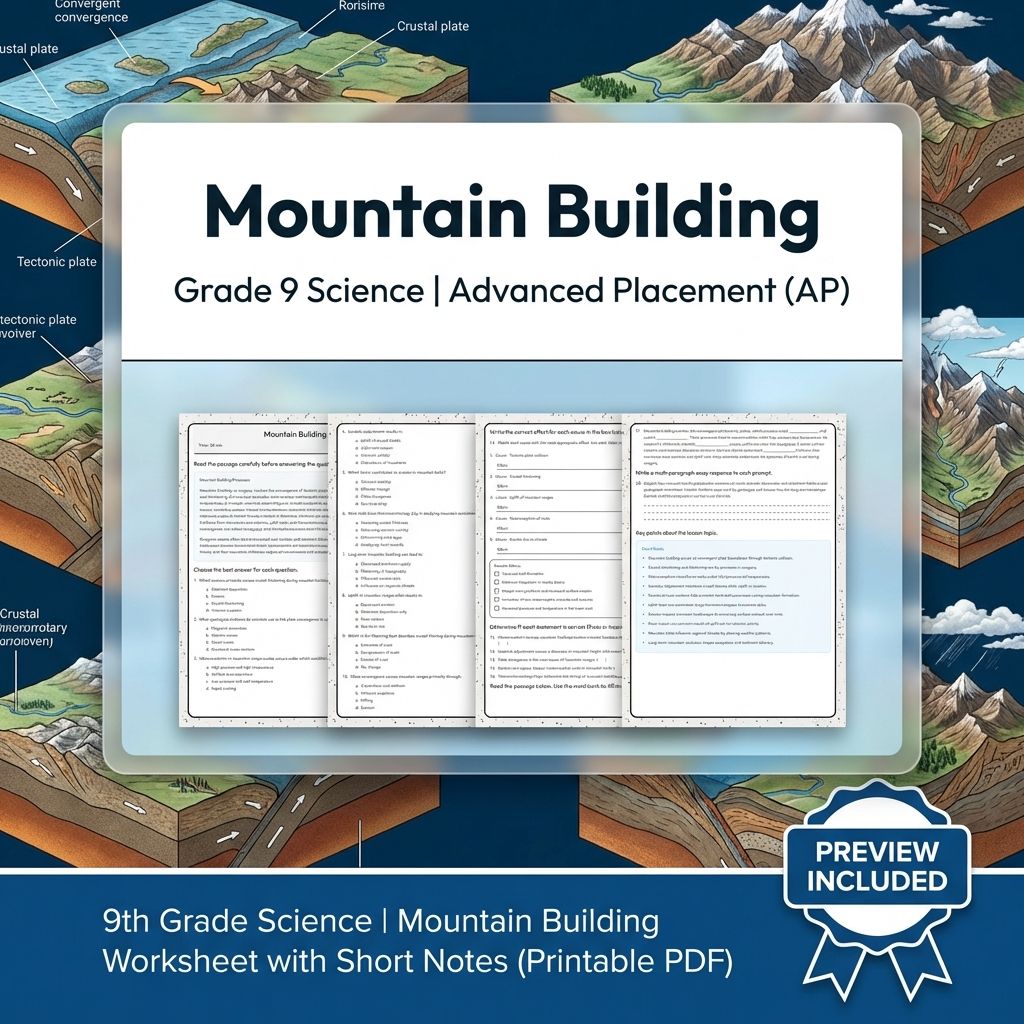
9th Grade Science | Mountain Building Worksheet with Short Notes (Printable PDF)
 Created byMeadowlark Worksheets
Learning Objectives
- Explain the processes involved in mountain building, including crustal shortening, thickening, and metamorphism.
- Describe how isostatic adjustment influences mountain heights and landscape evolution.
- Analyze the impact of mountain-building episodes on regional climate, erosion, and sediment delivery.
Also included in: Grade 9 Science | Earth Systems & Geology Unit Worksheet Bundle (Printable PDFs) +1 more
Instant download
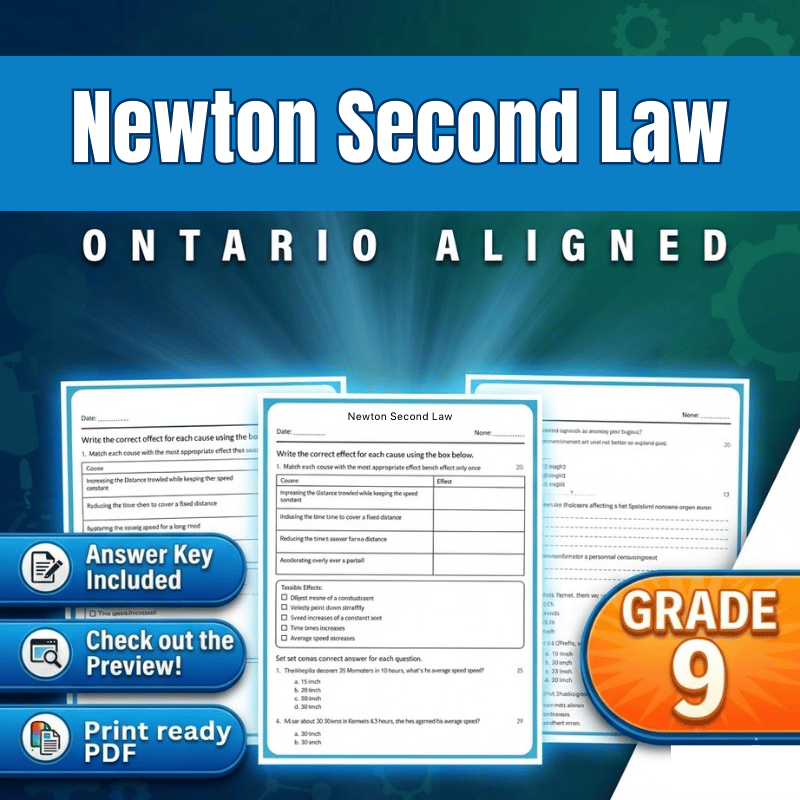
Grade 9 Science – Newton Second Law Worksheet (Ontario) Practice Set (PDF)
 Created byBright Mind Resources
Learning Objectives
- Understand the relationship between net force, mass, and acceleration as described by Newton's second law.
- Differentiate between mass and weight and understand their units and implications.
- Apply the principles of Newton's second law to analyze real-world problems involving force and motion.
Instant download

Grade 9 Science – Water Cycling & Water Movement | Daily Reading Worksheet
Created byBright Mind ResourcesLearning Objectives
- Describe the main components of the hydrologic cycle
- Identify processes such as evaporation, condensation, and precipitation
- Explain the role of reservoirs, fluxes, and residence times in water movement
Also included in: Grade 9 Earth & Space Science Daily Reading Worksheets Lesson Bundle | Ontario +1 more
Instant download
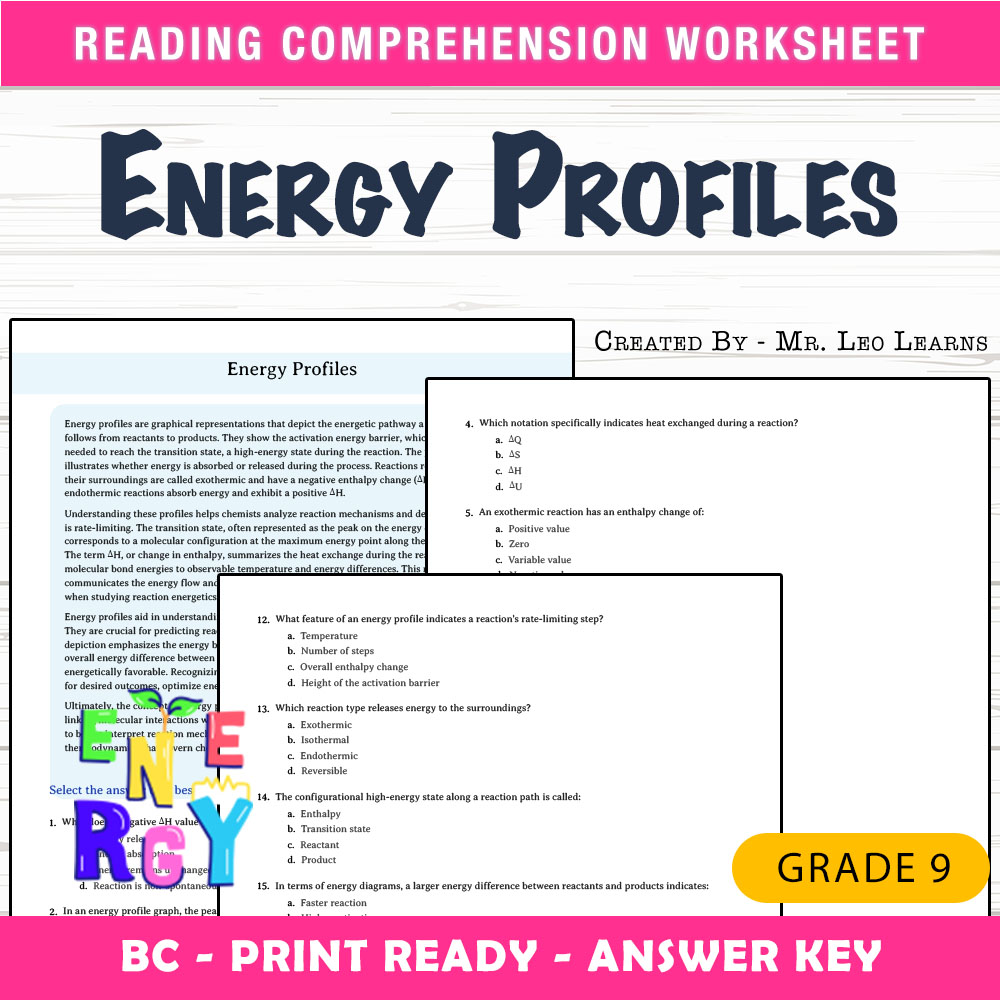
Grade 9 Science — Energy Profiles Worksheet MCQ Paper PDF + Answer Key
 Created byThe Resource Hub
Learning Objectives
- Understand what energy profiles depict in chemical reactions.
- Identify features such as activation energy barriers and enthalpy change.
- Differentiate between exothermic and endothermic reactions.
Also included in: Grade 9 Science | Matter and Chemical Change UNIT Worksheet Bundle +1 more
Instant download
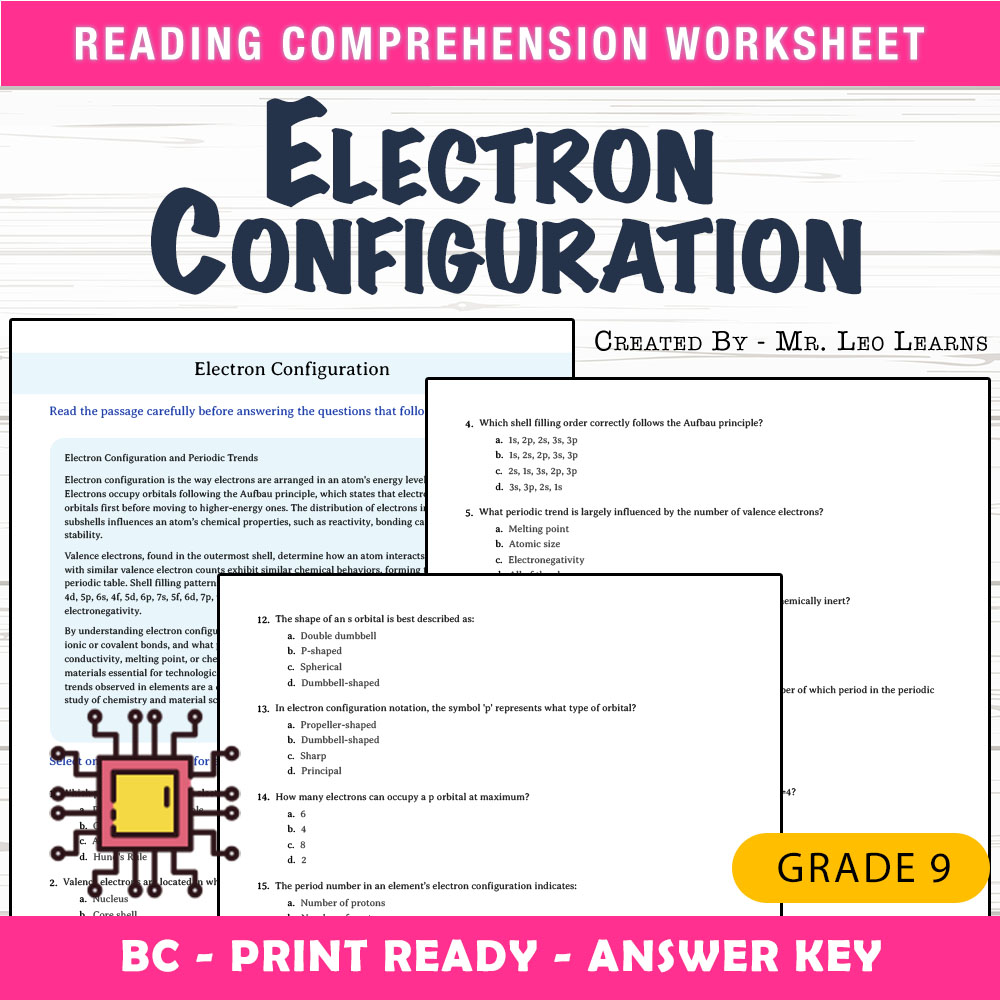
Grade 9 Science — Worksheet MCQ Paper for Mastering Electron Configuration
Created byThe Resource HubLearning Objectives
- Understand the distribution of electrons among energy levels and orbitals.
- Explain the significance of valence electrons in chemical bonding and reactivity.
- Describe the shell filling order and its periodic trends.
Also included in: Grade 9 Science | Matter and Chemical Change UNIT Worksheet Bundle +1 more
Instant download
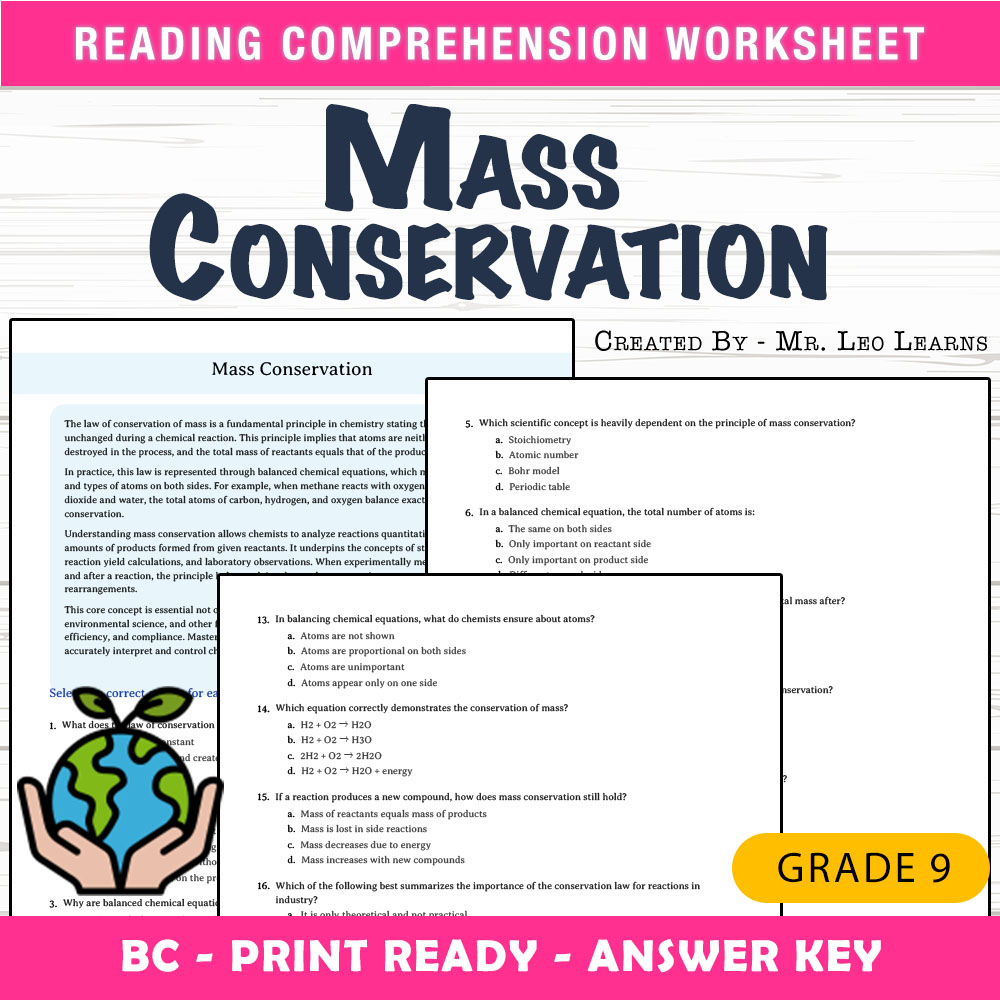
Grade 9 Science — Worksheet MCQ Paper for Mastering Mass Conservation
Created byThe Resource HubLearning Objectives
- Understand the principle of conservation of mass during chemical reactions.
- Identify how balanced chemical equations reflect mass conservation.
- Explain the significance of mass conservation in stoichiometry and reaction analysis.
Also included in: Grade 9 Science | Matter and Chemical Change UNIT Worksheet Bundle +1 more
Instant download
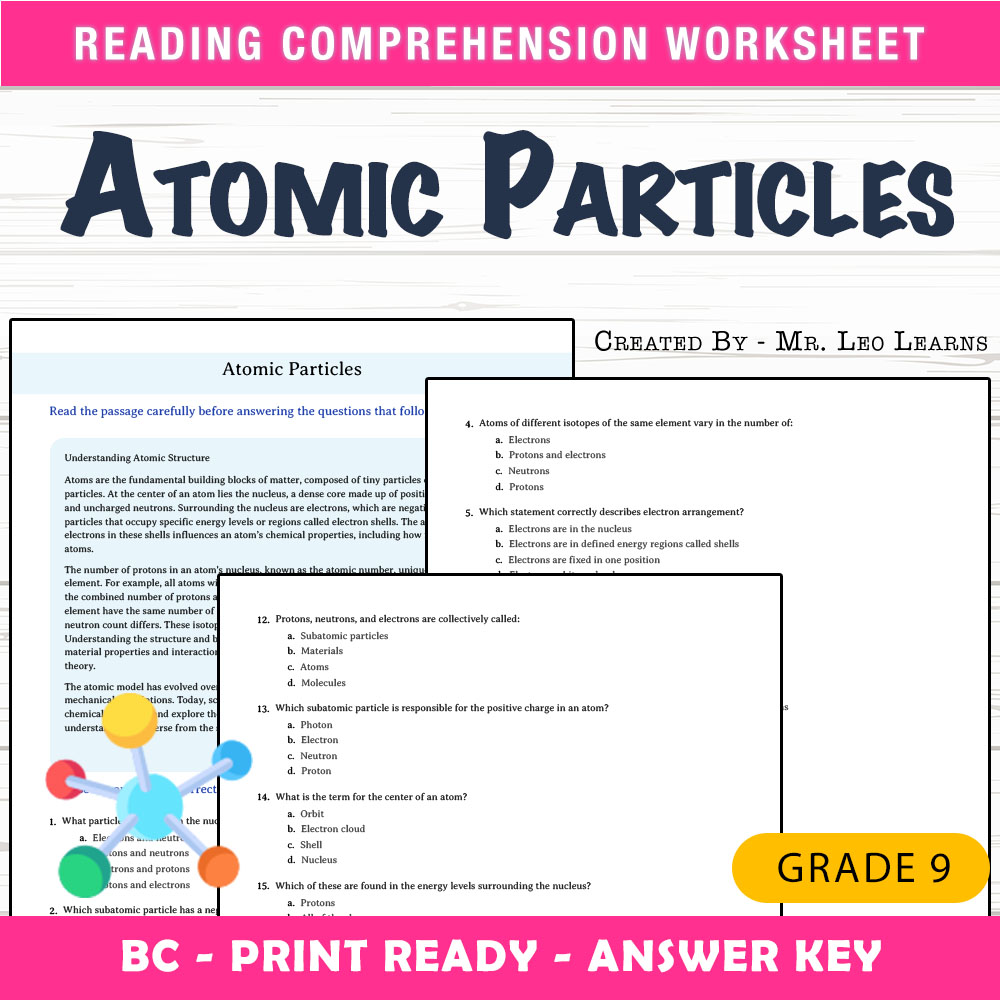
Grade 9 Science — Worksheet MCQ Paper for Mastering Atomic Particles
Created byThe Resource HubLearning Objectives
- Identify the subatomic particles that make up an atom and understand their roles.
- Explain how the number of protons determines the element identity.
- Describe the significance of neutrons and isotopes in atomic stability.
Also included in: Grade 9 Science | Matter and Chemical Change UNIT Worksheet Bundle +1 more
Instant download
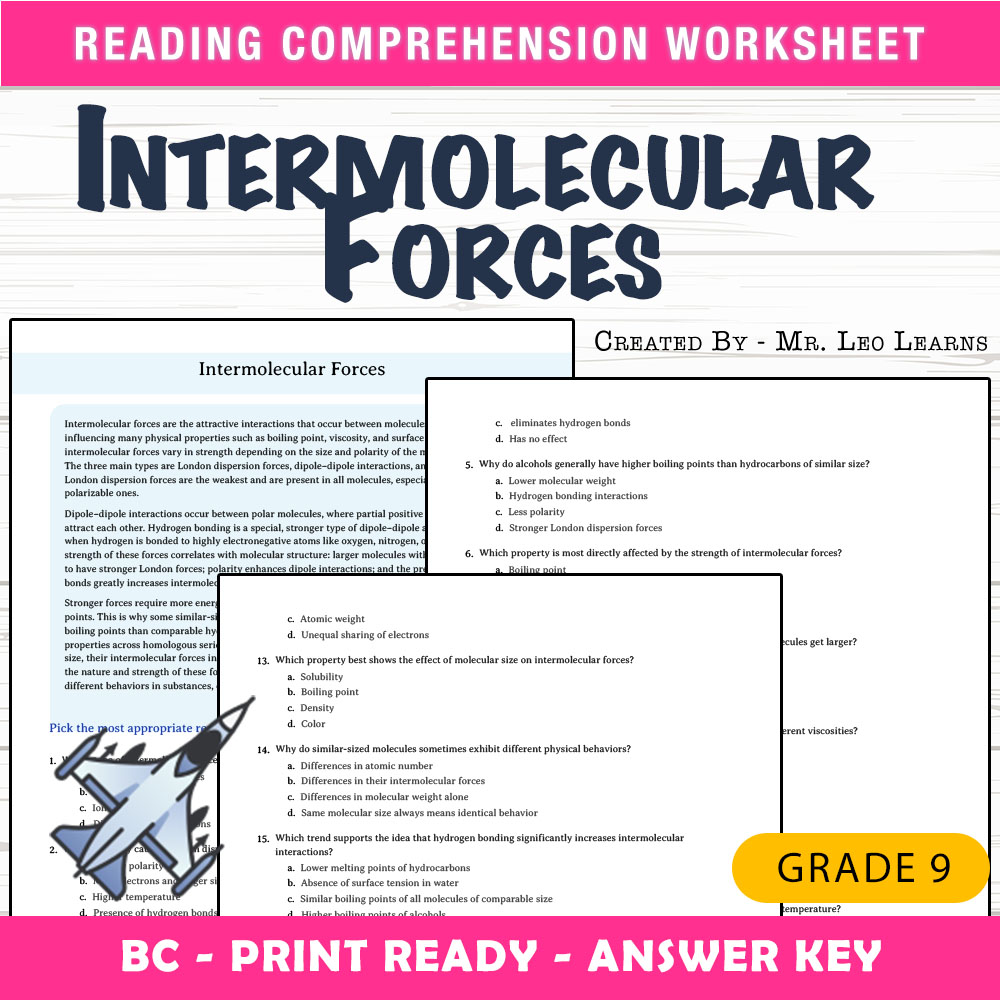
Grade 9 Science — Worksheet MCQ Paper for Intermolecular Forces
Created byThe Resource HubLearning Objectives
- Understand the types of intermolecular forces and their influence on physical properties.
- Identify how molecular size and polarity affect intermolecular interactions.
- Relate molecular structure to behavior such as boiling point, viscosity, and surface tension.
Also included in: Grade 9 Science | Matter and Chemical Change UNIT Worksheet Bundle +1 more
Instant download
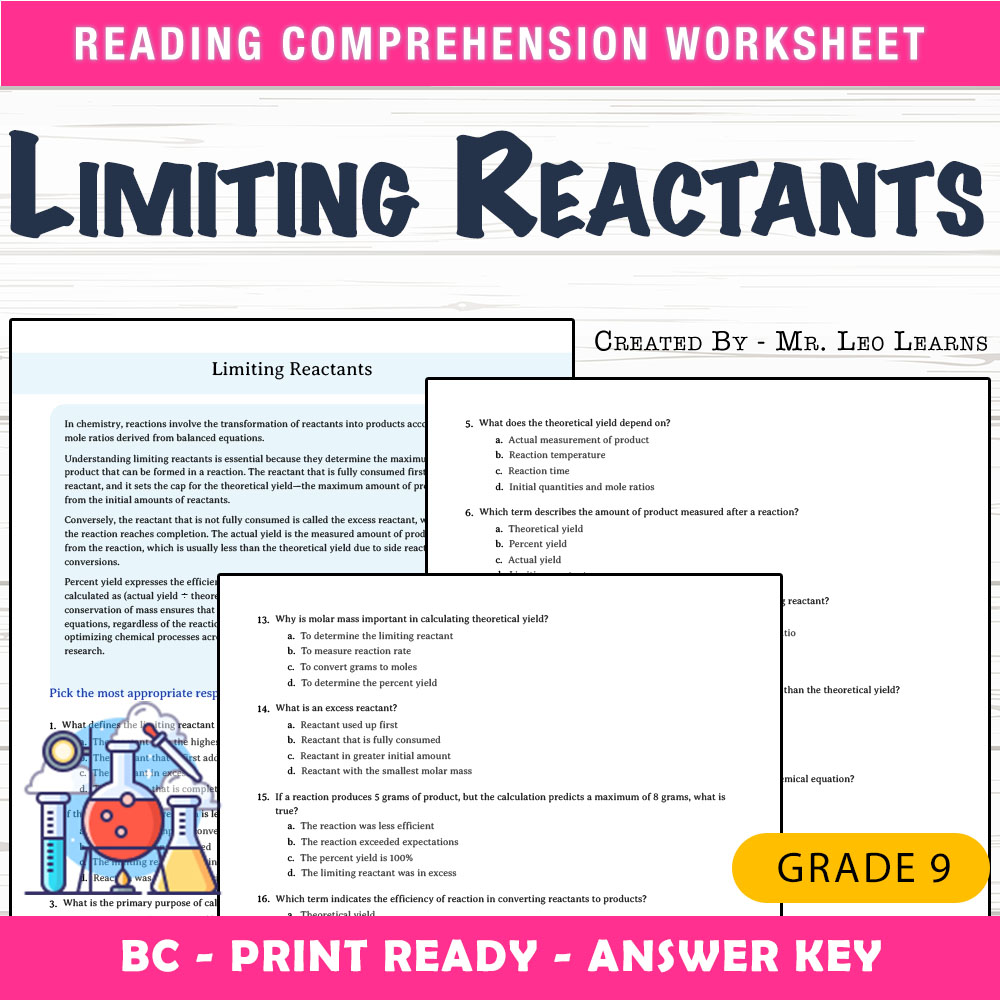
Grade 9 Science — Worksheet MCQ Paper for Mastering Limiting Reactants
Created byThe Resource HubLearning Objectives
- Understand the concept of limiting reactants and their role in chemical reactions.
- Calculate the theoretical yield based on balanced equations and molar masses.
- Differentiate between actual yield and theoretical yield and compute percent yield.
Also included in: Grade 9 Science | Matter and Chemical Change UNIT Worksheet Bundle +1 more
Instant download
Grade 9 Science — Worksheet MCQ Paper for Mastering Molecular Geometry
Created byThe Resource HubLearning Objectives
- Understand the basic principles of molecular geometry and the VSEPR model.
- Identify common molecular shapes such as linear, trigonal planar, tetrahedral, and bent.
- Explain how molecular shape influences polarity and physical properties.
Also included in: Grade 9 Science | Matter and Chemical Change UNIT Worksheet Bundle +1 more
Instant download
Grade 9 Science — Mass Measurement Worksheet MCQ Paper
Created byThe Resource HubLearning Objectives
- Understand the principle of conservation of mass during chemical reactions.
- Identify factors affecting measured mass and how to account for them.
- Explain the importance of system boundaries and all phase accounting in mass measurement.
Also included in: Grade 9 Science | Matter and Chemical Change UNIT Worksheet Bundle +1 more
Instant download
Grade 9 Science — Worksheet MCQ Paper for Mastering Stoichiometry
Created byThe Resource HubLearning Objectives
- Understand how mole relationships connect masses of reactants and products using balanced equations.
- Learn how molar mass converts between mass and amount of substance.
- Comprehend how coefficients in balanced equations define mole ratios for reactions.
Also included in: Grade 9 Science | Matter and Chemical Change UNIT Worksheet Bundle +1 more
Instant download
Grade 9 Science — Worksheet MCQ Paper for Mastering Bond Types
Created byThe Resource HubLearning Objectives
- Understand the differences between ionic, covalent, and metallic bonds.
- Recognize how electron arrangements influence material properties.
- Identify characteristic features of each bond type and relate to observable properties.
Also included in: Grade 9 Science | Matter and Chemical Change UNIT Worksheet Bundle +1 more
Instant download
Grade 9 Science — Worksheet MCQ on Reaction Categories | PDF + Answer Key
Created byThe Resource HubLearning Objectives
- Identify and categorize different types of chemical reactions.
- Describe characteristic reactant patterns and products in each reaction category.
- Understand how classifying reactions helps in predicting products and balancing equations.
Also included in: Grade 9 Science | Matter and Chemical Change UNIT Worksheet Bundle +1 more
Instant download
Grade 9 Science — Worksheet MCQ Paper for Mastering Balancing Equations
Created byThe Resource HubLearning Objectives
- Understand the purpose of balancing chemical equations and how coefficients reflect atomic conservation.
- Identify correct methods to balance chemical equations without changing their identities.
- Learn to properly represent balanced symbolic equations including state indicators and stoichiometric coefficients.
Also included in: Grade 9 Science | Matter and Chemical Change UNIT Worksheet Bundle +1 more
Instant download
Grade 9 Science — Redox Concepts Worksheet for Mastery | PDF + Answer Key
Created byThe Resource HubLearning Objectives
- Understand the fundamental principles of oxidation and reduction in chemical reactions.
- Identify oxidation states and track electron transfer during redox processes.
- Recognize oxidizing and reducing agents in different chemical reactions.
Also included in: Grade 9 Science | Matter and Chemical Change UNIT Worksheet Bundle +1 more
Instant download
Grade 9 Science — Worksheet MCQ Paper for Reaction Essentials | PDF + Answer Key
Created byThe Resource HubLearning Objectives
- Understand the process of chemical reactions involving bonds breaking and forming.
- Recognize representations of reactions through formulas and symbolic equations.
- Identify energy changes associated with chemical bonds during reactions.
Also included in: Grade 9 Science | Matter and Chemical Change UNIT Worksheet Bundle +1 more
Instant download
Grade 9 Science — Worksheet MCQ Paper for Mastering Crystal Lattices
Created byThe Resource HubLearning Objectives
- Understand the basic structure and types of crystal lattices.
- Identify characteristics of ionic, metallic, and covalent network lattices.
- Describe how atomic arrangements influence macroscopic properties of solids.
Also included in: Grade 9 Science | Matter and Chemical Change UNIT Worksheet Bundle +1 more
Instant download

Grade 9 Nuclear Processes Worksheet | Practice & Review PDF
 Created byClear Sky Classroom
Learning Objectives
- Explain how nuclear fission and nuclear fusion change atomic nuclei and release or absorb energy.
- Describe how binding energy and mass-energy equivalence relate to energy outcomes in nuclear reactions.
- Connect ionizing radiation to why nuclear reactions require careful control.
Instant download

Uncertainty & Error Worksheet for Grade 9 Science NGSSS Practice + Key
 Created byEvergreen Desk Education
Learning Objectives
- Explain how uncertainty differs from error and identify sources of random variation and systematic error in measurement data.
- Use uncertainty and significant figures to report measurements appropriately and compare results using error bounds.
- Interpret statements about scientific agreement and uncertainty when reasoning about experimental results.
Instant download

Population Ecology Worksheet | Grade 9 Science Practice
 Created byPrism Point Learning
Learning Objectives
- Explain how birth/reproduction, death/mortality, immigration, and emigration change population size over time
- Differentiate density-dependent and density-independent factors affecting population growth
- Connect population-level changes to carrying capacity and community structure
Instant download
9th Grade Science | Organelle Function Worksheet (PDF+ Answer Key)
 Created byCopper Leaf Classroom
Learning Objectives
- Identify the major organelles involved in cellular processes and their specific functions.
- Explain how internal structures like folded membranes contribute to metabolic efficiency.
- Compare and contrast organelle structures such as mitochondria and chloroplasts.
Also included in: Grade 9 Science | Biology & Ecosystems AP Worksheet Bundle (PDF+ Answer Key) +1 more
Instant download
Grade 9 Science | Photosynthetic Capture Worksheet (PDF+ Answer Key)
Created byCopper Leaf ClassroomLearning Objectives
- Describe the molecular mechanisms underlying photosynthetic light absorption by pigments.
- Explain the energy transfer process among photosynthetic pigments and the role of photosystems.
- Analyze factors affecting photosynthetic efficiency, including light wavelength, intensity, and environmental variables.
Also included in: Grade 9 Science | Biology & Ecosystems AP Worksheet Bundle (PDF+ Answer Key) +1 more
Instant download
9th Grade Science | Genetic Transmission Worksheet (PDF+ Answer Key)
Created byCopper Leaf ClassroomLearning Objectives
- Explain the mechanisms of inheritance including chromosomal behavior during meiosis.
- Analyze Mendelian patterns and deviations such as incomplete dominance, codominance, and linkage.
- Use Punnett squares, pedigrees, and probability to predict genotypic and phenotypic ratios.
Also included in: Grade 9 Science | Biology & Ecosystems AP Worksheet Bundle (PDF+ Answer Key) +1 more
Instant download
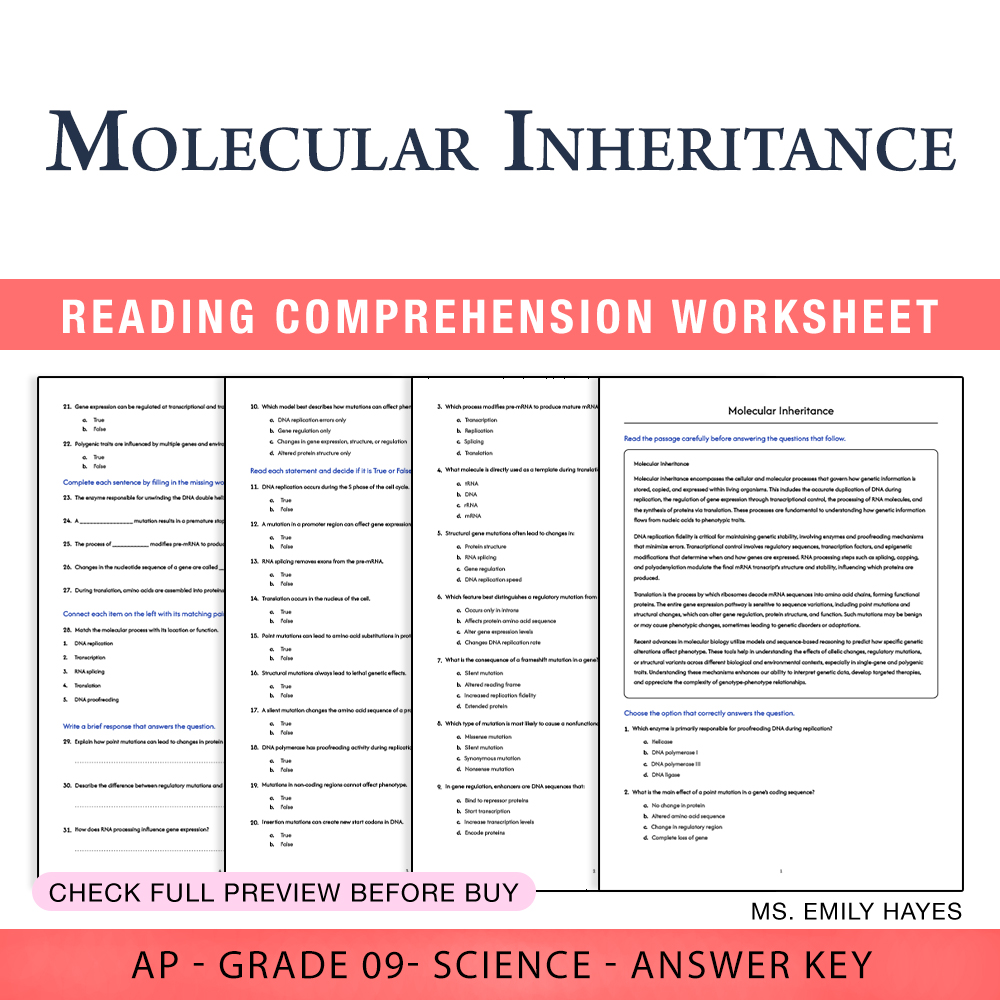
9th Grade Science | Molecular Inheritance Worksheet (PDF+ Answer Key)
Created byCopper Leaf ClassroomLearning Objectives
- Describe the molecular mechanisms of DNA replication, transcription, RNA processing, and translation.
- Explain how sequence variation and mutations influence gene expression and protein function.
- Apply molecular models and sequence reasoning to predict phenotypic effects of allelic changes.
Also included in: Grade 9 Science | Biology & Ecosystems AP Worksheet Bundle (PDF+ Answer Key) +1 more
Instant download
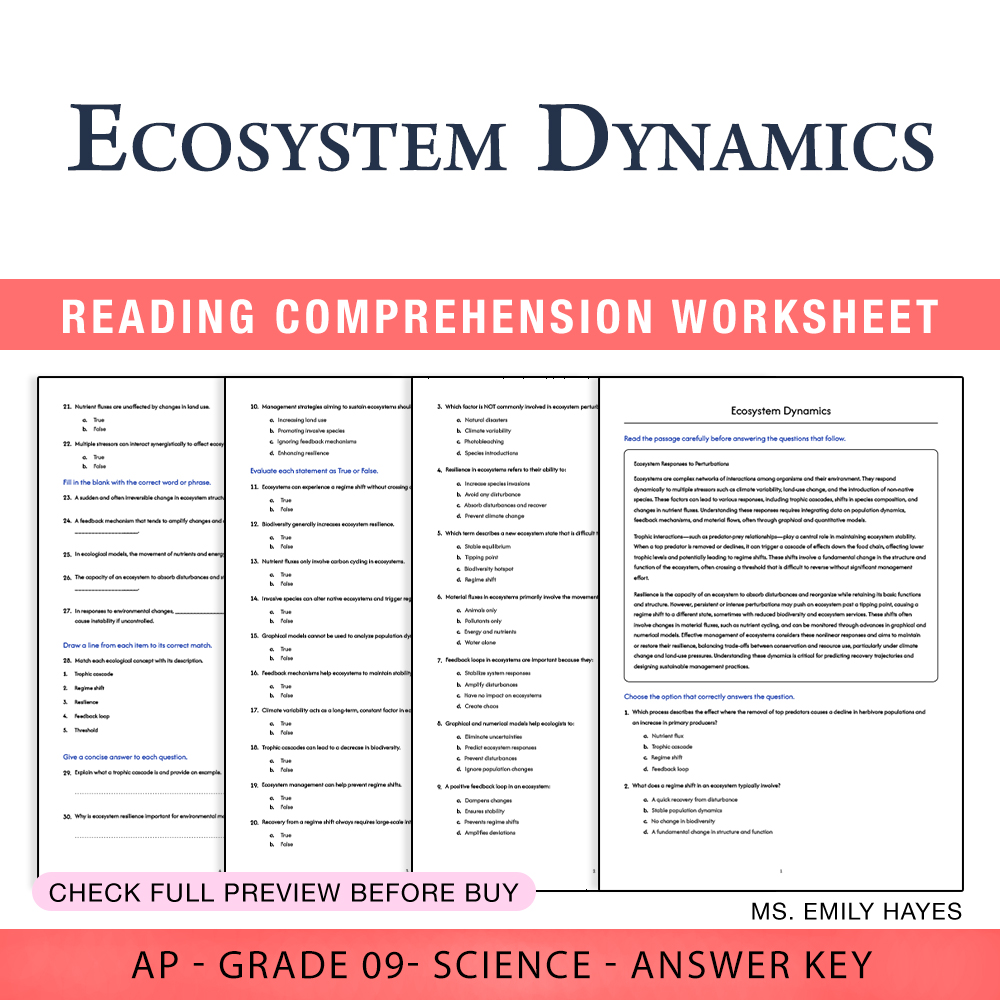
9th Grade Science | Ecosystem Dynamics Worksheet (PDF+ Answer Key)
Created byCopper Leaf ClassroomLearning Objectives
- Understand the complex responses of ecosystems to multiple factors such as climate change, land use, and species introduction.
- Analyze trophic interactions, feedback loops, and material fluxes that influence ecosystem stability.
- Evaluate the concepts of resilience, regime shifts, and thresholds within ecological systems.
Also included in: Grade 9 Science | Biology & Ecosystems AP Worksheet Bundle (PDF+ Answer Key) +1 more
Instant download
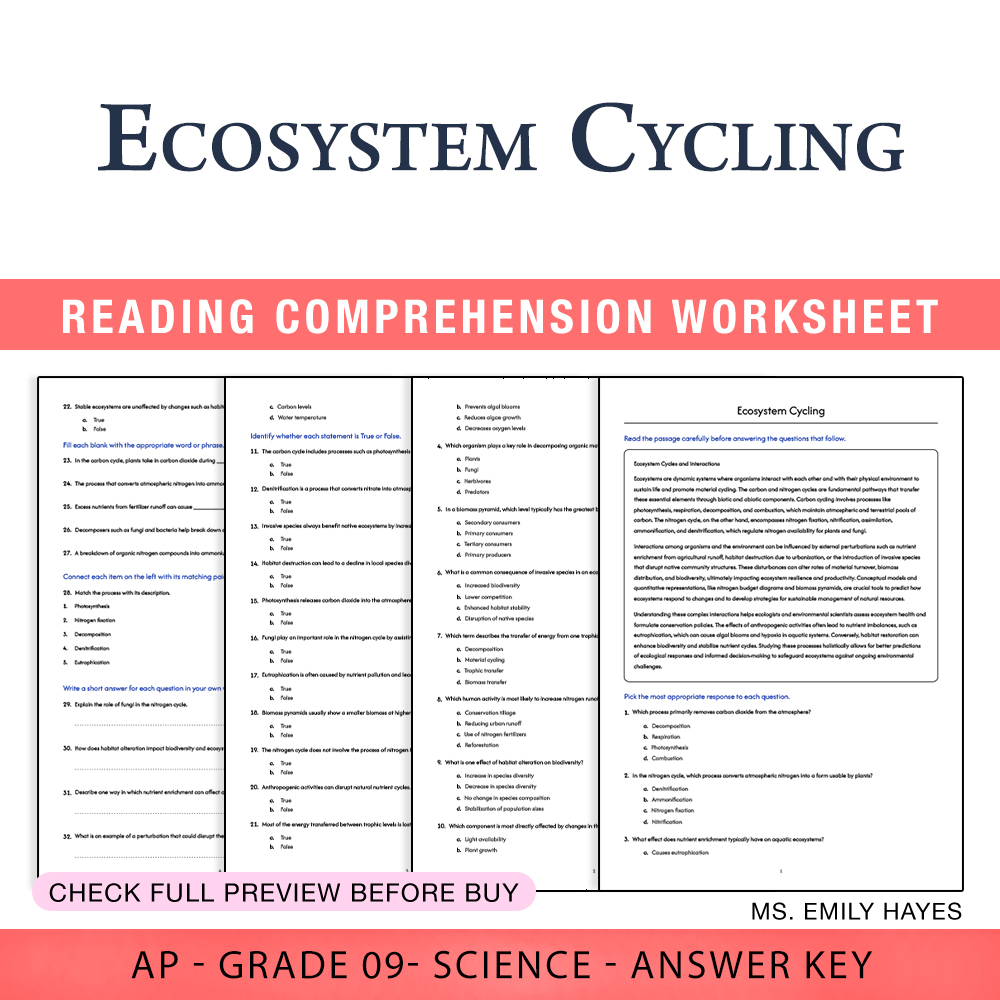
9th Grade Science | Ecosystem Cycling Worksheet (PDF+ Answer Key)
Created byCopper Leaf ClassroomLearning Objectives
- Describe the interactions among organisms and abiotic components that drive material cycling in ecosystems.
- Explain the processes of carbon and nitrogen cycles and their significance in ecosystem function.
- Analyze how perturbations like nutrient enrichment, habitat alteration, and invasive species affect community structure and ecosystem dynamics.
Also included in: Grade 9 Science | Biology & Ecosystems AP Worksheet Bundle (PDF+ Answer Key) +1 more
Instant download
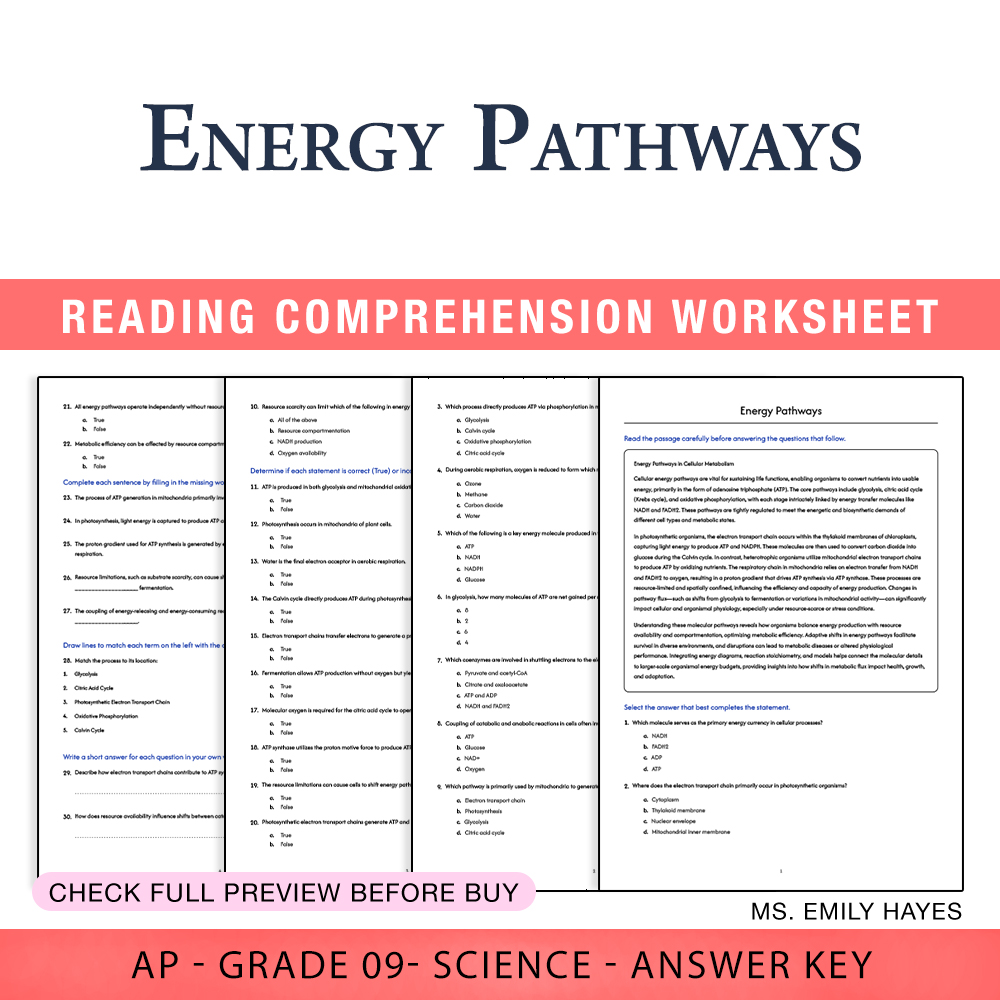
Grade 9 Science | Energy Pathways Worksheet (PDF+ Answer Key)
Created byCopper Leaf ClassroomLearning Objectives
- Explain the processes of ATP production in cellular energy pathways.
- Analyze the coupling mechanisms of catabolic and anabolic reactions.
- Compare the roles of photosynthetic and respiratory electron transport chains.
Also included in: Grade 9 Science | Biology & Ecosystems AP Worksheet Bundle (PDF+ Answer Key) +1 more
Instant download
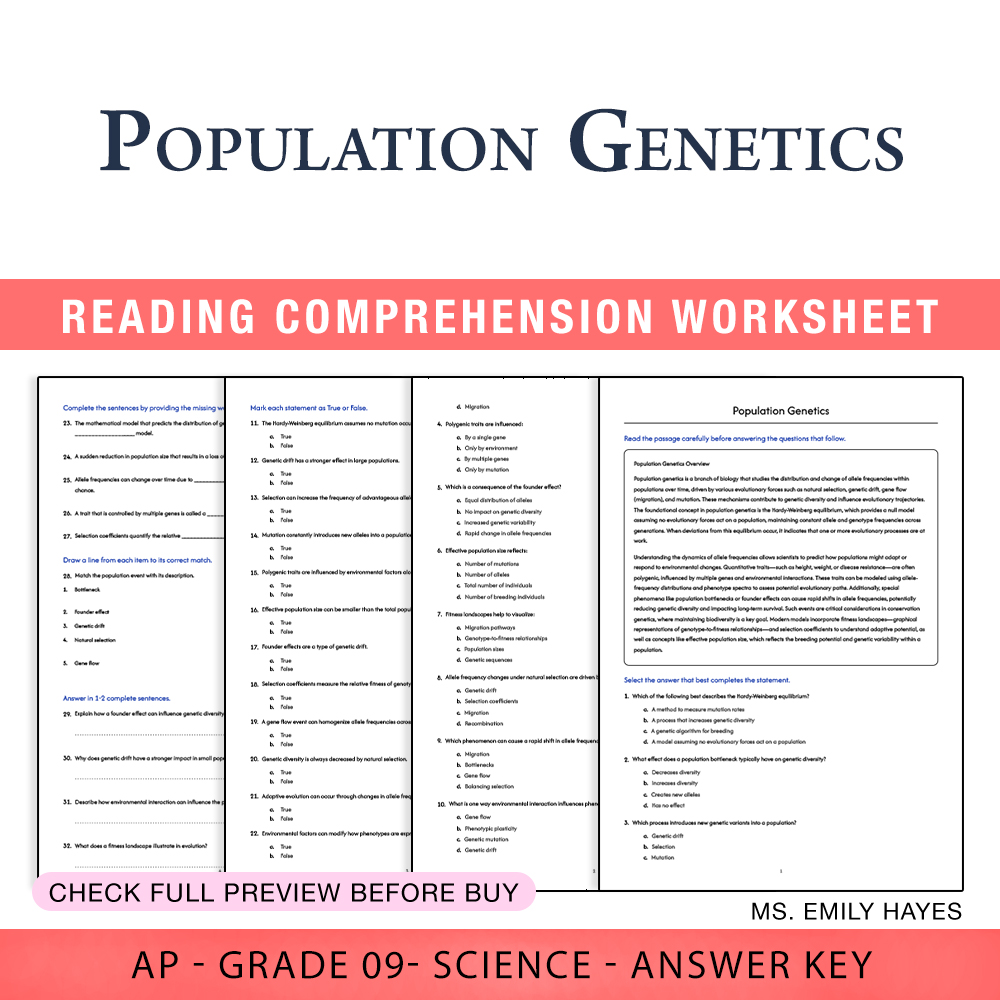
Grade 9 Science | Population Genetics Worksheet (PDF+ Answer Key)
Created byCopper Leaf ClassroomLearning Objectives
- Understand how allele frequencies change under different evolutionary forces such as selection, drift, migration, and mutation.
- Explain the Hardy-Weinberg equilibrium as a null model in population genetics.
- Describe the concepts of fitness landscapes, selection coefficients, and effective population size.
Also included in: Grade 9 Science | Biology & Ecosystems AP Worksheet Bundle (PDF+ Answer Key) +1 more
Instant download
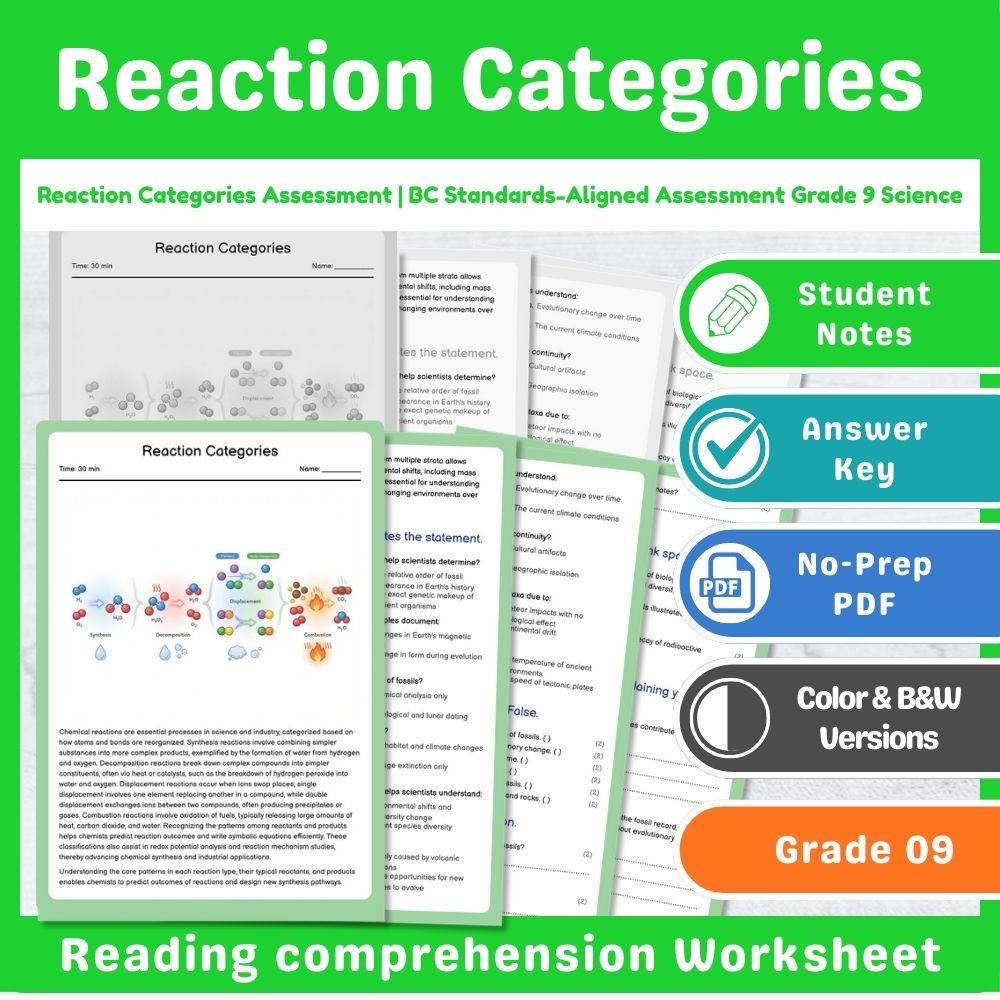
Reaction Categories Assessment | BC Standards-Aligned Assessment Grade 9 Science
Created byPrism Point LearningLearning Objectives
- Identify and describe the main types of chemical reactions: synthesis, decomposition, single displacement, double displacement, and combustion.
- Recognize patterns and characteristic reactants and products of each reaction category.
- Classify given chemical reactions into categories based on reactant and product clues.
Instant download
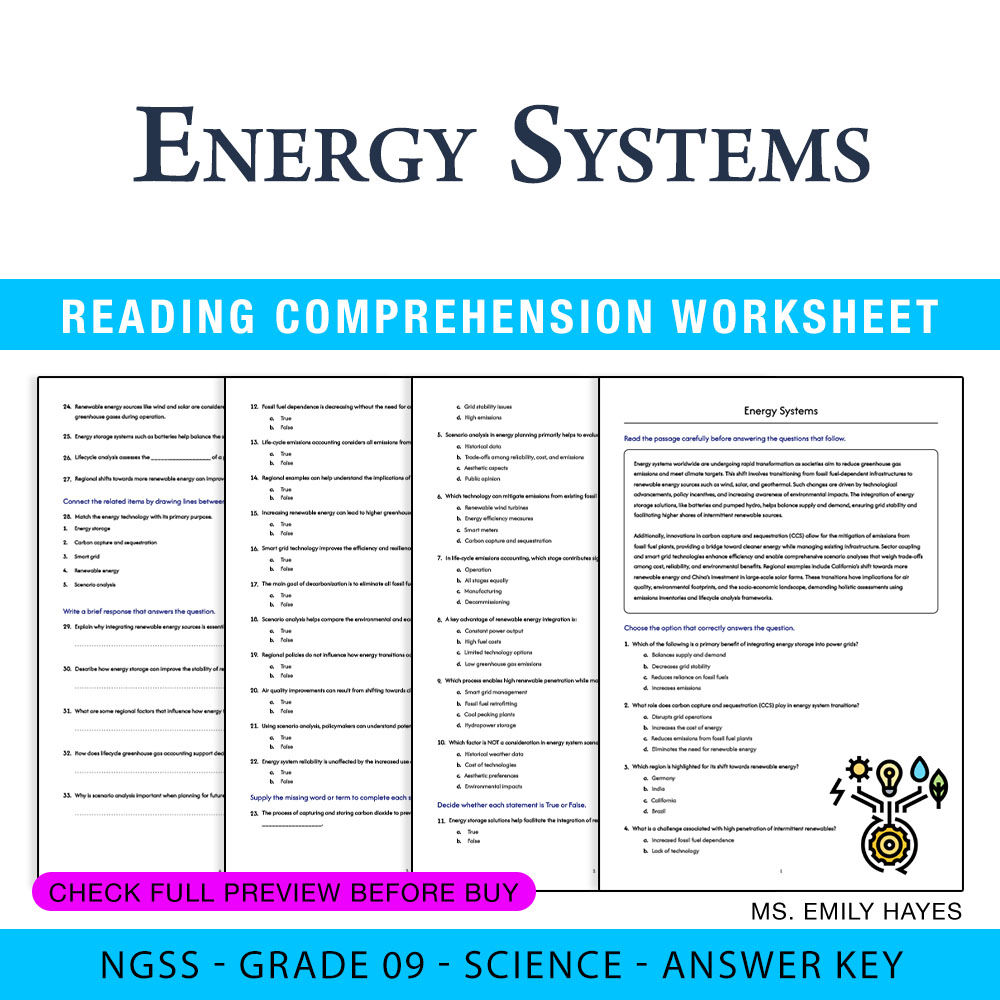
Grade 9 Science | Energy Systems Worksheet (PDF+ Answer Key)
Created byCopper Leaf ClassroomLearning Objectives
- Understand the concept of energy system transitions and decarbonization pathways.
- Analyze the trade-offs between reliability, affordability, and greenhouse gas reduction in energy scenarios.
- Evaluate the role of renewable energy, storage, and carbon capture in reducing emissions.
Instant download
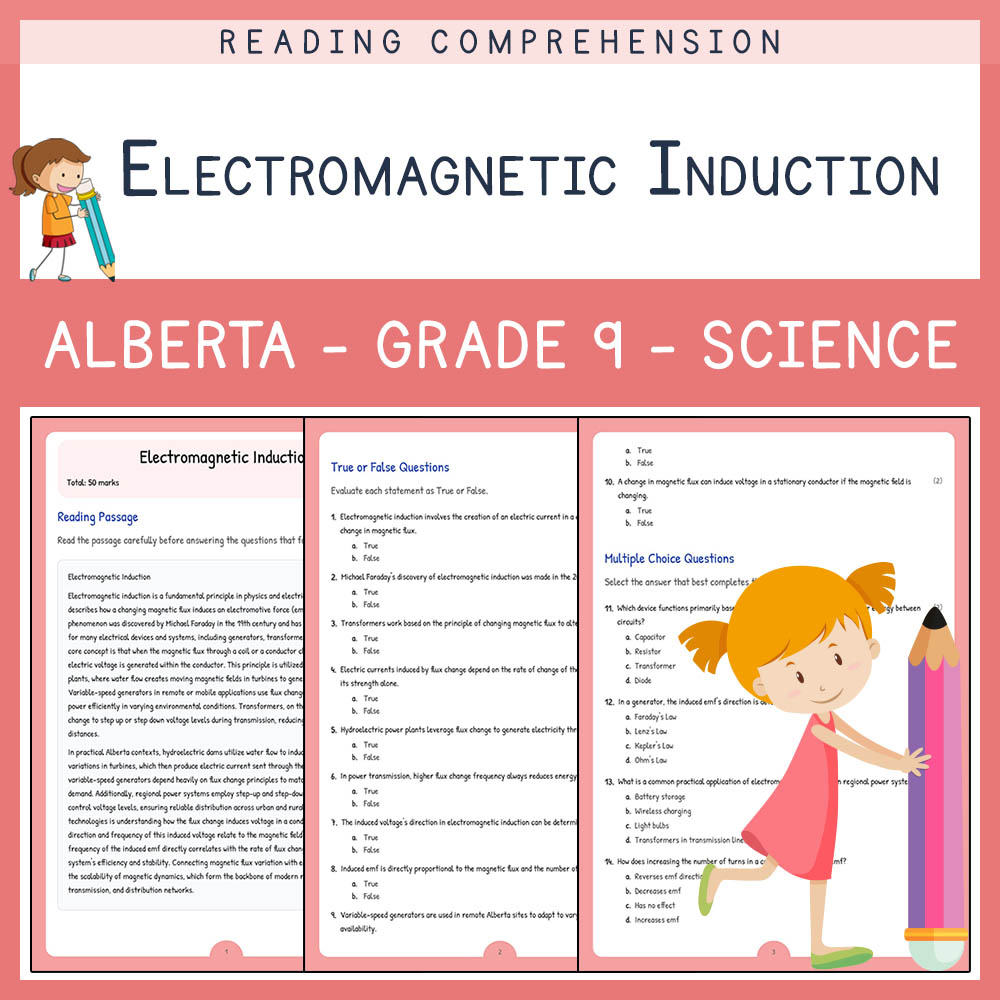
Grade 9 Science | Electromagnetic Induction Worksheet | Alberta Standards
 Created byLumora Learning
Learning Objectives
- Explain the principle of electromagnetic induction and how changing magnetic flux induces voltage.
- Identify the relationship between flux change and induced voltage in electrical systems.
- Describe practical applications of electromagnetic induction in regional power systems, such as hydroelectric generators and transformers.
Instant download

Systems Thinking Worksheet for Grade 9 Science Practice & Review
Created byPrism Point LearningLearning Objectives
- Explain how systems thinking considers matter, energy, and information flows across interacting components.
- Identify how feedback and unintended effects can result from design changes in complex systems.
- Evaluate engineered solutions by using boundaries and long-term system behavior to meet performance targets.
Instant download

Engineering for Society Worksheet for Grade 9 Science & STEM Activities
Created byPrism Point LearningLearning Objectives
- Explain how engineering design uses performance requirements linked to human needs and public priorities.
- Describe how engineering choices affect access, reliability, and safety in real-world systems.
- Evaluate how technology trade-offs can support or limit equity and long-term usability.
Instant download

Grade 9 Evolution Evidence Worksheet | Practice & Assessment PDF
Created byClear Sky ClassroomLearning Objectives
- Explain how the fossil record supports gradual evolutionary change over time.
- Use evidence from homologous structures and genetic data to infer shared ancestry.
- Differentiate homologous traits from analogous traits caused by convergent evolution.
Instant download
Grade 9 Science – Human Influence on Climate Carbon Dioxide (PDF + Answer Key)
Created byCopper Leaf ClassroomLearning Objectives
- Understand key concepts related to Science
- Apply knowledge through practice questions
- Demonstrate comprehension of the material
Instant download

9th Grade Science | Energy System Transitions & Decarbonization (PDF +Answers)
Created byCopper Leaf ClassroomLearning Objectives
- Describe key components of modern energy systems and their roles in decarbonization.
- Evaluate different pathways and technologies for reducing greenhouse gas emissions in energy production.
- Understand the trade-offs among reliability, affordability, and environmental impact in energy transition scenarios.
Also included in: Grade 9 Science|Climate, Sustainability & Energy Transition Bundle(PDF +Answers) +1 more
Instant download
Grade 9 Science — Worksheet MCQ Paper for Mastering Combined Circuits
Created byThe Resource HubLearning Objectives
- Understand the structure of combined series and parallel circuits.
- Learn to simplify complex circuits by reducing series and parallel components.
- Identify equivalent resistances in mixed networks.
Also included in: Grade 9 Science Electricity and Magnetism Worksheet Bundle | Alberta Curriculum +1 more
Instant download
Grade 9 Science – Inheritance Basics Worksheet(PDF + Answer Key)
Created byCopper Leaf ClassroomLearning Objectives
- Understand the structure and function of DNA
- Learn how genes are transmitted through reproduction
- Explore the processes of DNA replication and chromosomal segregation
Instant download

Grade 9 Science – Kidney Function & Urine Formation | Daily Reading Worksheet
 Created byQuiet Forest Education
Learning Objectives
- Describe the structure of nephrons in the kidney.
- Explain how blood is filtered in the glomerulus.
- Identify the processes of reabsorption, secretion, and urine concentration.
Also included in: Human Body Science Grade 9 Daily Reading Worksheets Bundle | Ontario +1 more
Instant download
9th Grade Science | Cell Architecture and Function Worksheet (PDF + Answer Key)
Created byCopper Leaf ClassroomLearning Objectives
- Explain how nucleic acid sequences determine amino acid chains and three-dimensional protein structures.
- Describe the connection between macromolecular structure and cellular organelle architecture.
- Identify examples of how protein structure relates to cellular functions such as transport and catalysis.
Also included in: Grade 9 Science | Cellular Functions & Physiology Bundle (PDF + Answer Key) +1 more
Instant download

Grade 9 Science | Mass Conservation Worksheet | Ontario Standards
Created byLumora LearningLearning Objectives
- Understand the principle of conservation of mass in closed systems during chemical reactions.
- Recognize scenarios where mass appears to change due to gas exchange versus true mass conservation.
- Explain how mass is conserved in processes like combustion in sealed containers and precipitate formation.
Instant download
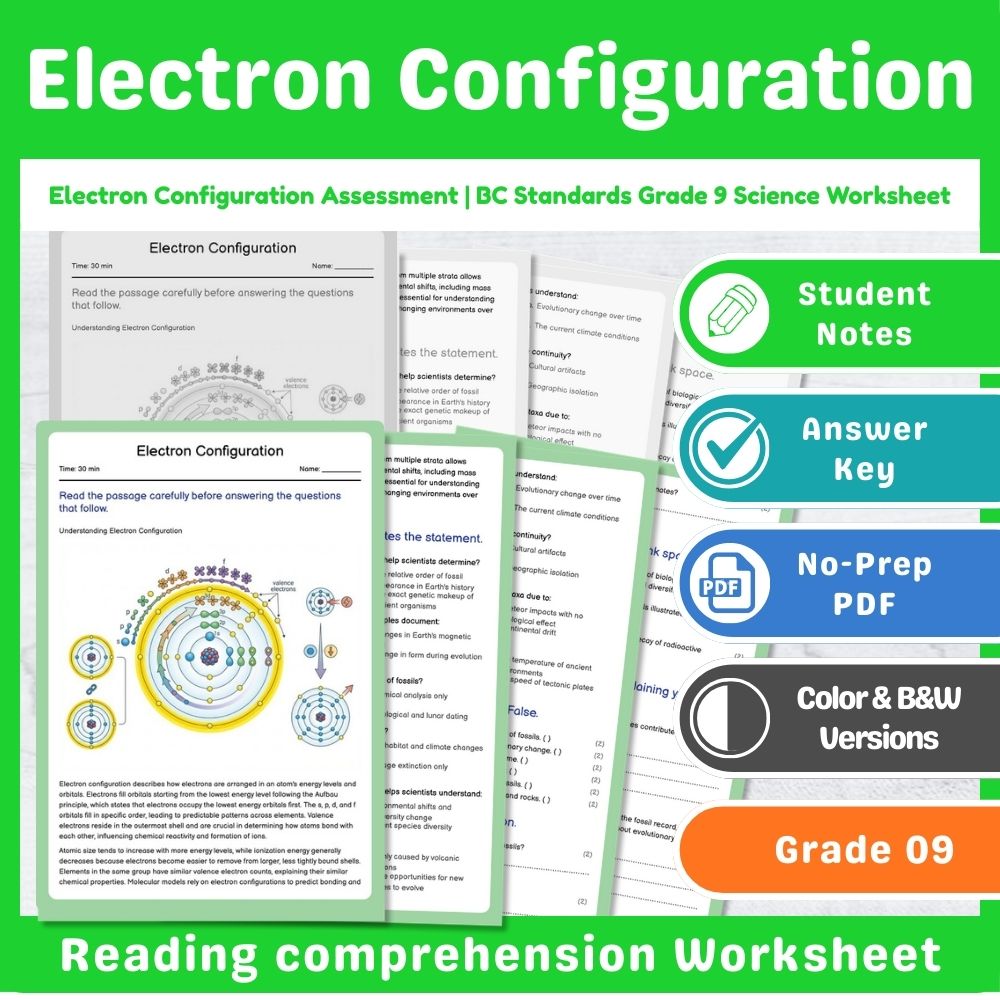
Electron Configuration Assessment | BC Standards Grade 9 Science Worksheet
Created byPrism Point LearningLearning Objectives
- Describe the distribution of electrons in atoms using electron configuration notation.
- Explain the significance of valence electrons in chemical bonding and reactivity.
- Identify trends in atomic size and ionization energy based on electron configurations.
Instant download
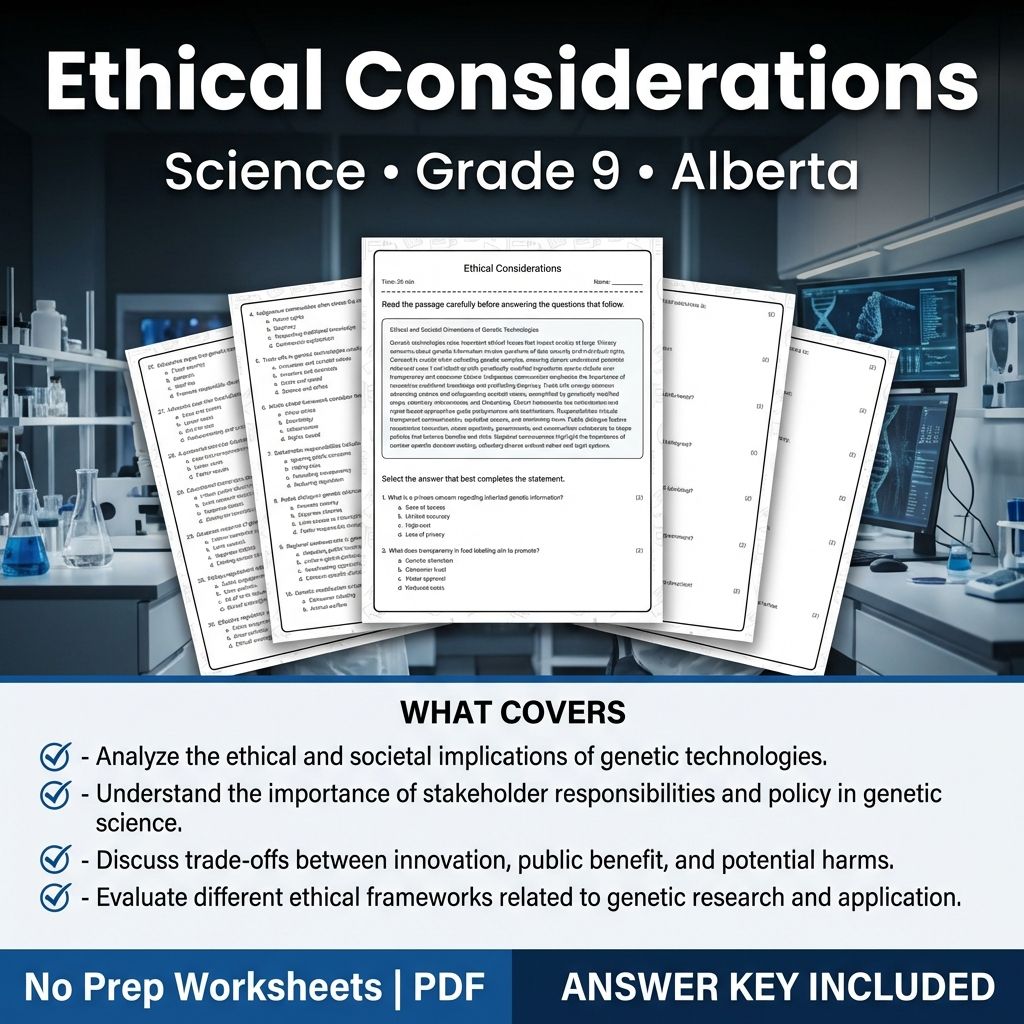
Grade 9 Science Worksheet on Ethical Considerations for Alberta Standards
 Created byCoral Reef Learning
Learning Objectives
- Analyze the ethical and societal implications of genetic technologies.
- Understand the importance of stakeholder responsibilities and policy in genetic science.
- Discuss trade-offs between innovation, public benefit, and potential harms.
Instant download
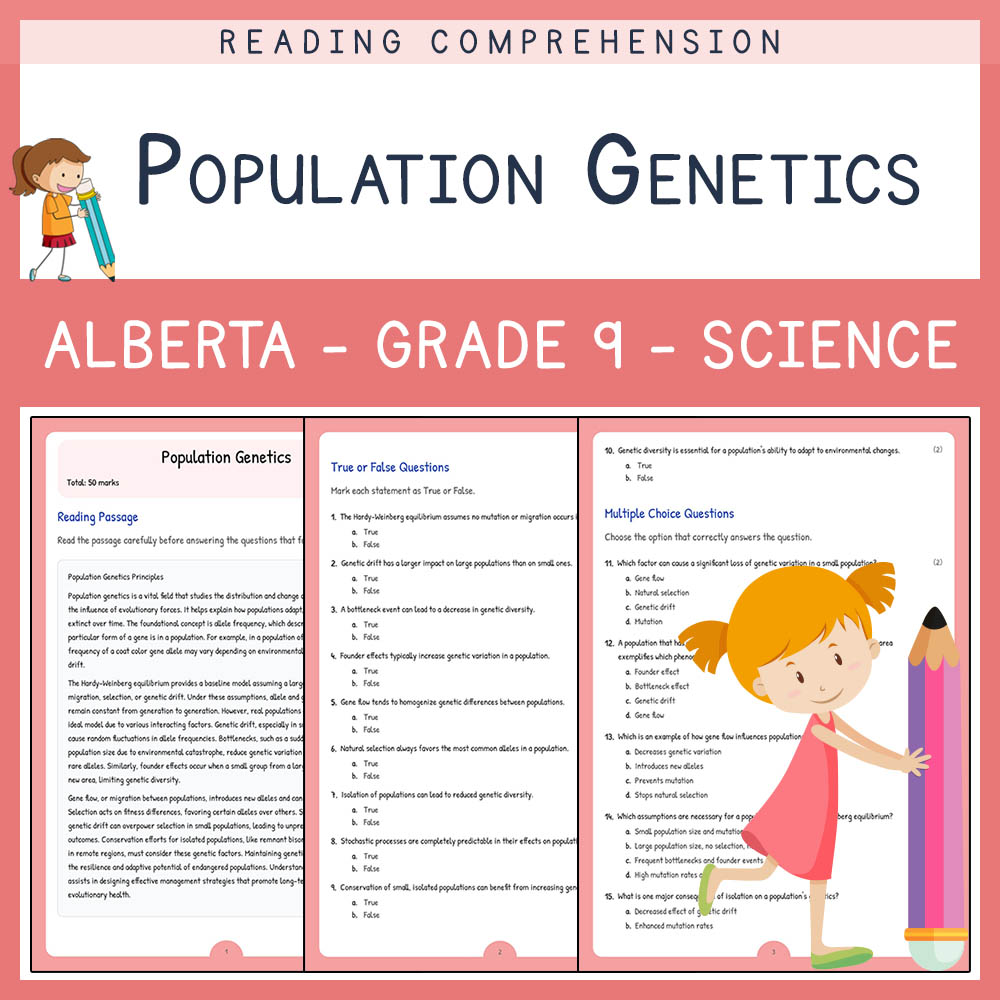
Grade 9 Science | Population Genetics Worksheet | Alberta Standards
Created byLumora LearningLearning Objectives
- Understand the core principles of population genetics, including allele frequency and genetic drift.
- Describe the assumptions of Hardy-Weinberg equilibrium and factors that disrupt it.
- Explain the effects of bottlenecks, founder effects, and gene flow on genetic diversity.
Instant download
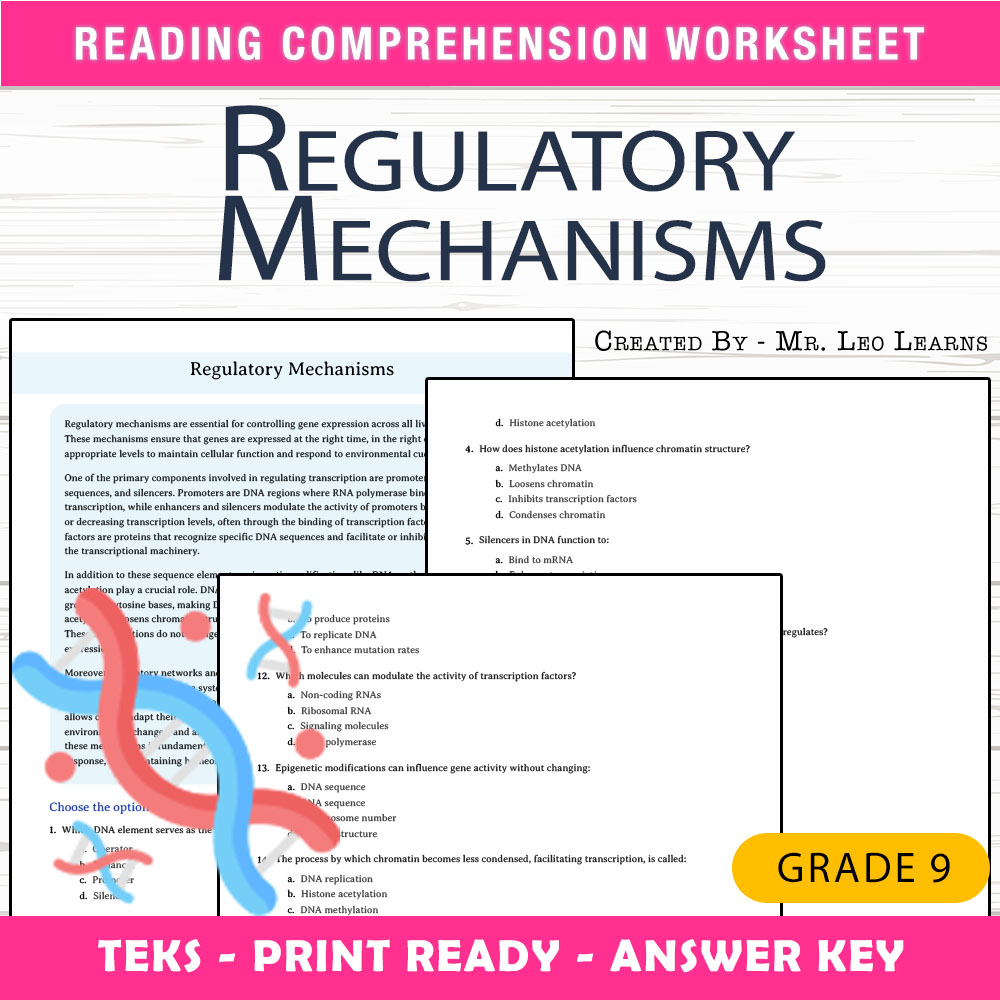
9th Grade Science – Regulatory Mechanisms Worksheet for Mastery
Created byThe Resource HubLearning Objectives
- Understand how gene expression is controlled through regulatory mechanisms.
- Describe the roles of promoters, enhancers, silencers, transcription factors, and repressors.
- Explain epigenetic modifications and their impact on chromatin accessibility and transcription.
Also included in: Grade 9 Science Unit Bundle | Genetics, DNA & Biotechnology Worksheets +1 more
Instant download
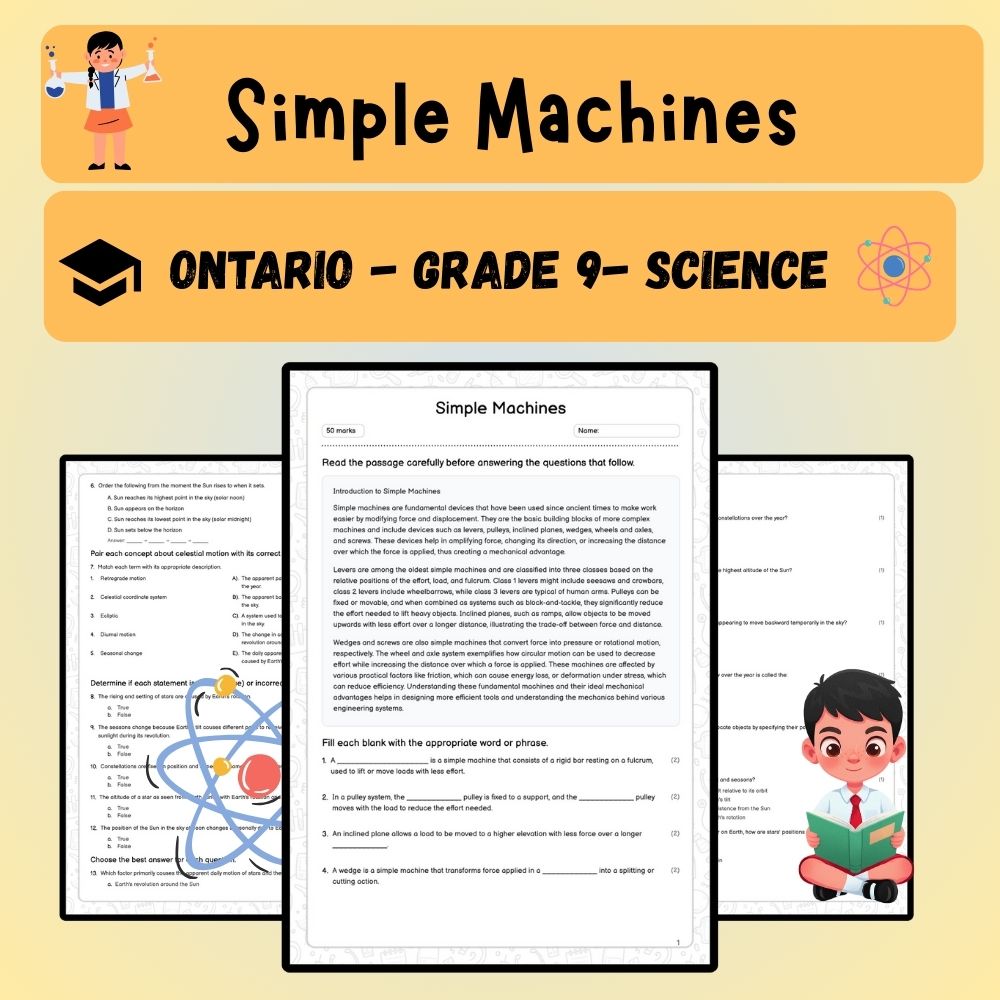
Grade 9 Science | Simple Machines Worksheet (Ontario Standard) – Practice & Assessment (PDF)
Created byPrism Point LearningLearning Objectives
- Understand the basic types of simple machines and their functions.
- Analyze how simple machines modify force and displacement to achieve mechanical advantage.
- Identify different classes of levers, pulley systems, and other simple machine configurations.
Also included in: Grade 9 Science Unit | Forces, Motion & Energy Worksheets (Ontario Standards) +1 more
Instant download
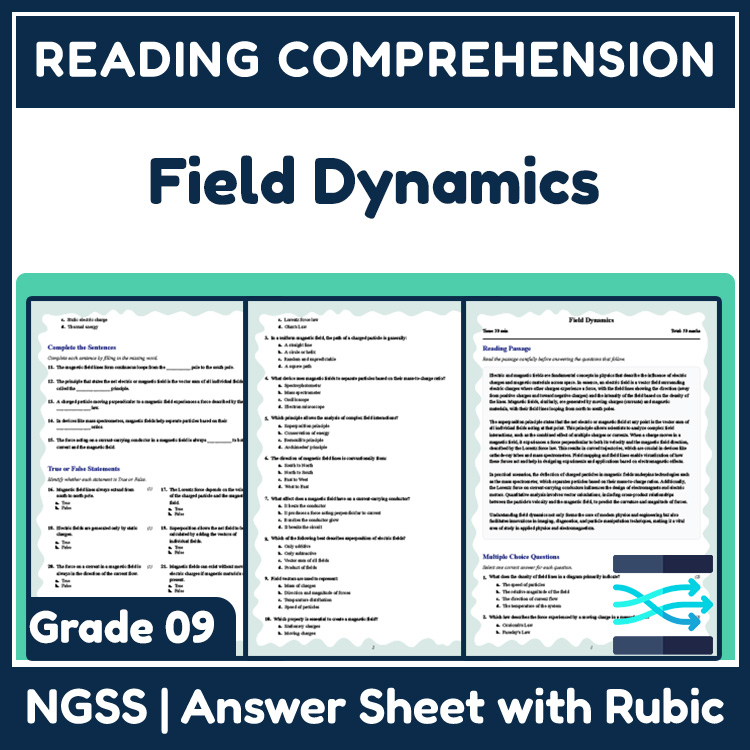
Grade 9 Science | Field Dynamics Reading Worksheet (PDF + Answer Key)
JCreated byJ.S SheetsLearning Objectives
- Understand the concepts of electric and magnetic fields and their vectors.
- Learn about superposition of fields and the forces on moving charges.
- Analyze how field lines represent the direction and magnitude of fields.
Also included in: Grade 9 Science Unit Bundle – Newtonian Motion & Force Laws Worksheets
Instant download
About Grade 9 Science Worksheets
Find Science worksheets built for Grade 9. All 6,926 cover core skills, practice, and review, each an instant PDF download.
Every worksheet on MyTeachingSheets is created by independent teacher-authors and reviewed before publication. All resources download as printable PDFs for classroom, homework, or at-home practice, and many include answer keys. Preview any worksheet free before buying.