
Grade 9 Science Worksheets
6,926 worksheets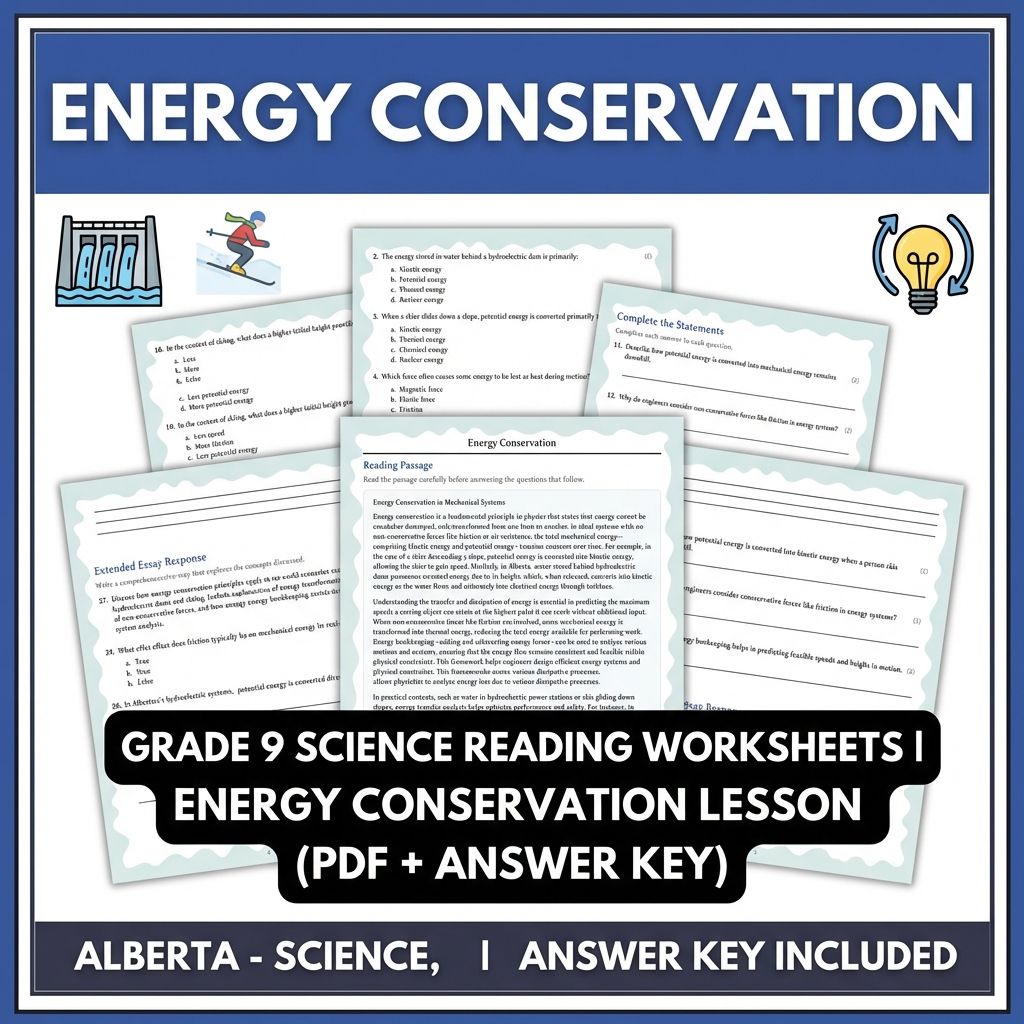
Grade 9 Science Worksheets | Energy Conservation Lesson (PDF + Answer Key)
JCreated byJ.S SheetsLearning Objectives
- Explain the principle of energy conservation in mechanical systems.
- Identify energy transformations in real-world scenarios like hydroelectric dams and skiing.
- Describe the effects of non-conservative forces such as friction on energy transfer.
Also included in: Grade 9 Science Unit Bundle | Motion, Forces & Energy Activities (PDF) +1 more
Instant download
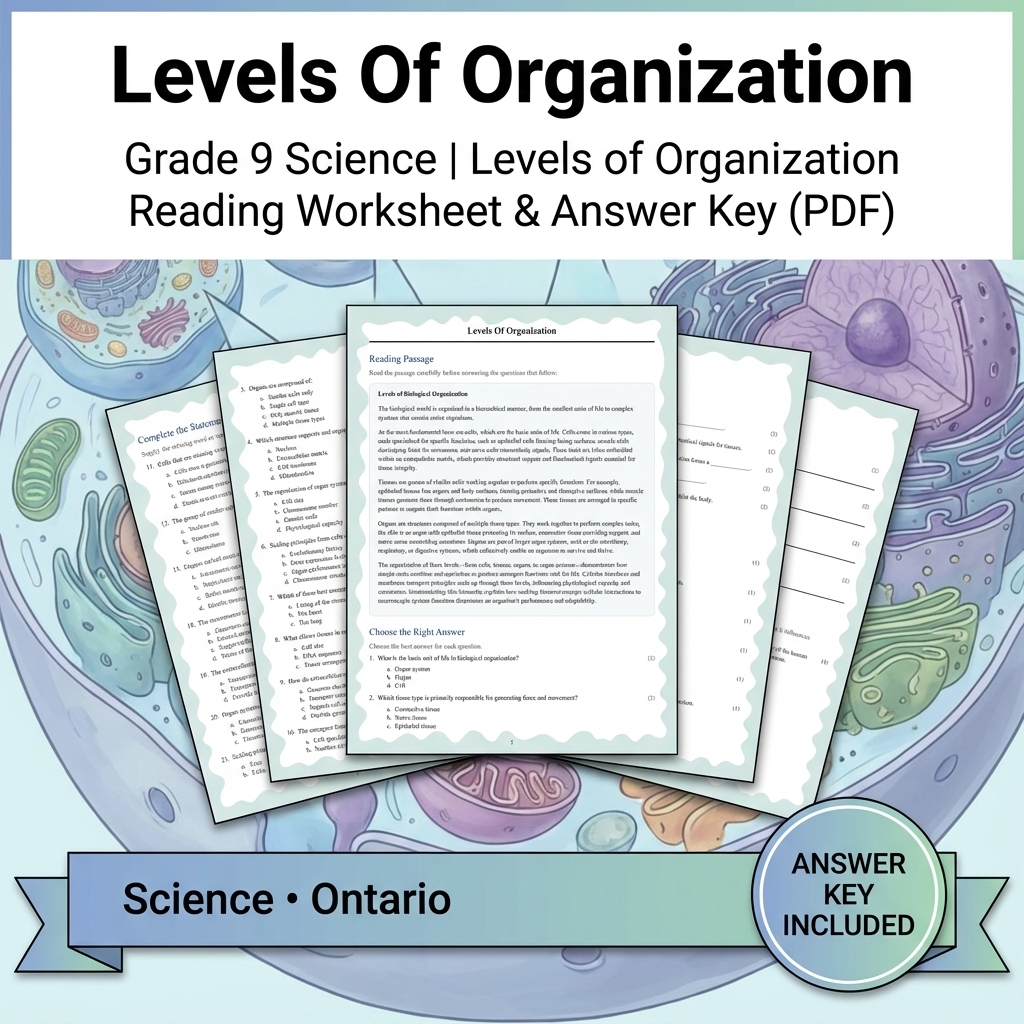
Grade 9 Science | Levels of Organization Reading Worksheet & Answer Key (PDF)
JCreated byJ.S SheetsLearning Objectives
- Explain hierarchical relationships among cells, tissues, organs, and systems using canonical examples.
- Describe how cell specialization and extracellular matrices produce emergent organ functions.
- Understand how tissue arrangement supports organ-level processes and their role in physiological capacity.
Also included in: Grade 9 Science Unit Bundle | Human Body Systems & Cell Functions +1 more
Instant download

Grade 9 Science Worksheet | Quantifying Uncertainty for AP Standards (Printable PDF & Answer Key)
 Created byCoral Reef Learning
Learning Objectives
- Understand the concept of measurement accuracy and precision.
- Learn how to estimate and report uncertainty in measurements.
- Identify sources of uncertainty and how they impact data analysis.
Also included in: Grade 9 Science Unit Worksheets | Scientific Methods & Data Analysis Bundle +2 more
Instant download
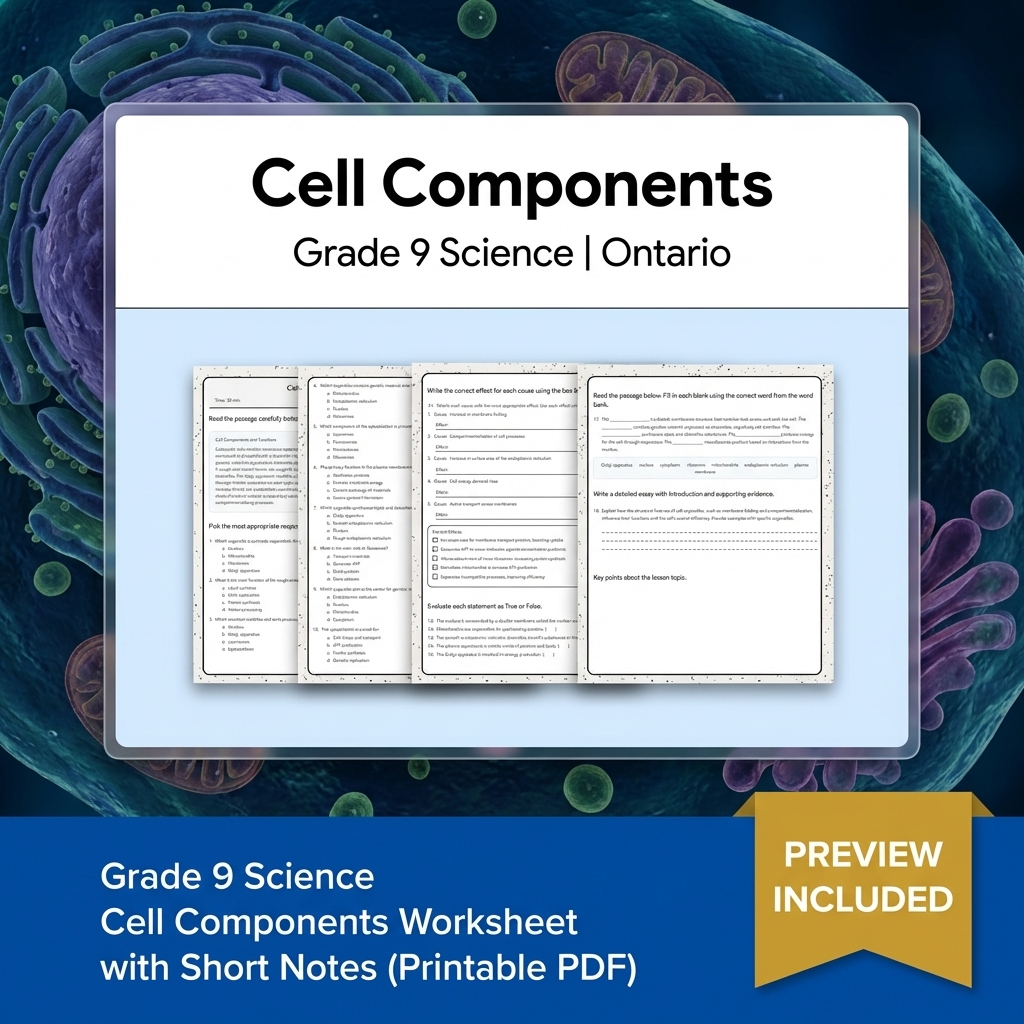
Grade 9 Science Cell Components Worksheet with Short Notes (Printable PDF)
 Created byMeadowlark Worksheets
Learning Objectives
- Identify major organelles of eukaryotic cells and their functions.
- Understand how membrane structures influence metabolic rates and exchange.
- Relate cell structure features to their specific roles in the cell.
Instant download

Grade 9 Science – Periodic Table & Properties | Daily Reading Worksheet
 Created byBright Mind Resources
Learning Objectives
- Describe how atomic number relates to an element's position on the periodic table.
- Explain the significance of periodic trends such as reactivity, ion charge, and bonding tendencies.
- Identify patterns in element properties across periods and groups.
Also included in: Science Grade 9 Science Daily Reading Worksheets lesson-bundle | Calif. Stds +1 more
Instant download

Grade 9 Science – Energy Profiles & Chemical Reactions | Daily Reading Worksheet
Created byBright Mind ResourcesLearning Objectives
- Understand the concept of energy profiles for chemical reactions.
- Identify exothermic and endothermic reactions from energy diagrams.
- Describe the significance of activation energy and transition states.
Also included in: Grade 9 Chemical Reactions Science Lesson Bundle: Daily Reading (BC) +1 more
Instant download

Grade 9 Science – Limiting Reactants & Reactions | Daily Reading Worksheet
Created byBright Mind ResourcesLearning Objectives
- Define limiting reactant in a chemical reaction
- Identify the limiting reactant from initial quantities
- Differentiate between theoretical and actual yields
Also included in: Grade 9 Chemical Reactions Science Lesson Bundle: Daily Reading (BC) +1 more
Instant download

Grade 9 Science – Atomic Particles & Structure | Daily Reading Worksheet
Created byBright Mind ResourcesLearning Objectives
- Identify the main subatomic particles within an atom (protons, neutrons, electrons).
- Understand the location of protons, neutrons, and electrons inside an atom.
- Explain how the number of protons determines an element.
Also included in: Grade 9 Chemical Reactions Science Lesson Bundle: Daily Reading (BC) +1 more
Instant download
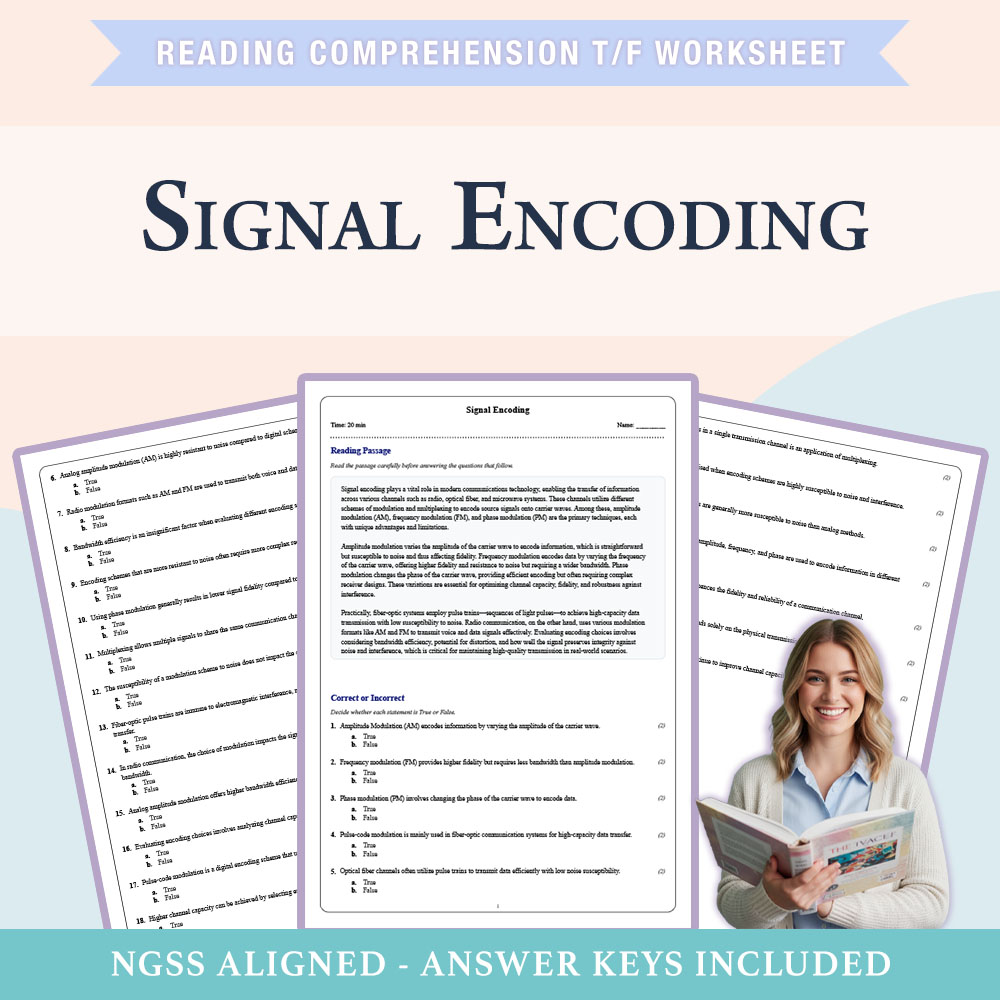
Grade 9 Science | Signal Encoding Worksheet (PDF + Answer Key)
 Created byCopper Leaf Classroom
Learning Objectives
- Understand the principles of information encoding through modulation and multiplexing.
- Differentiate between amplitude, frequency, and phase variation techniques used in signal transmission.
- Compare pulse-code modulation and analog amplitude modulation in terms of bandwidth, fidelity, and noise susceptibility.
Also included in: Grade 9 Science Unit| Wave Properties & Electromagnetic Radiation (PDF +Answers) +1 more
Instant download
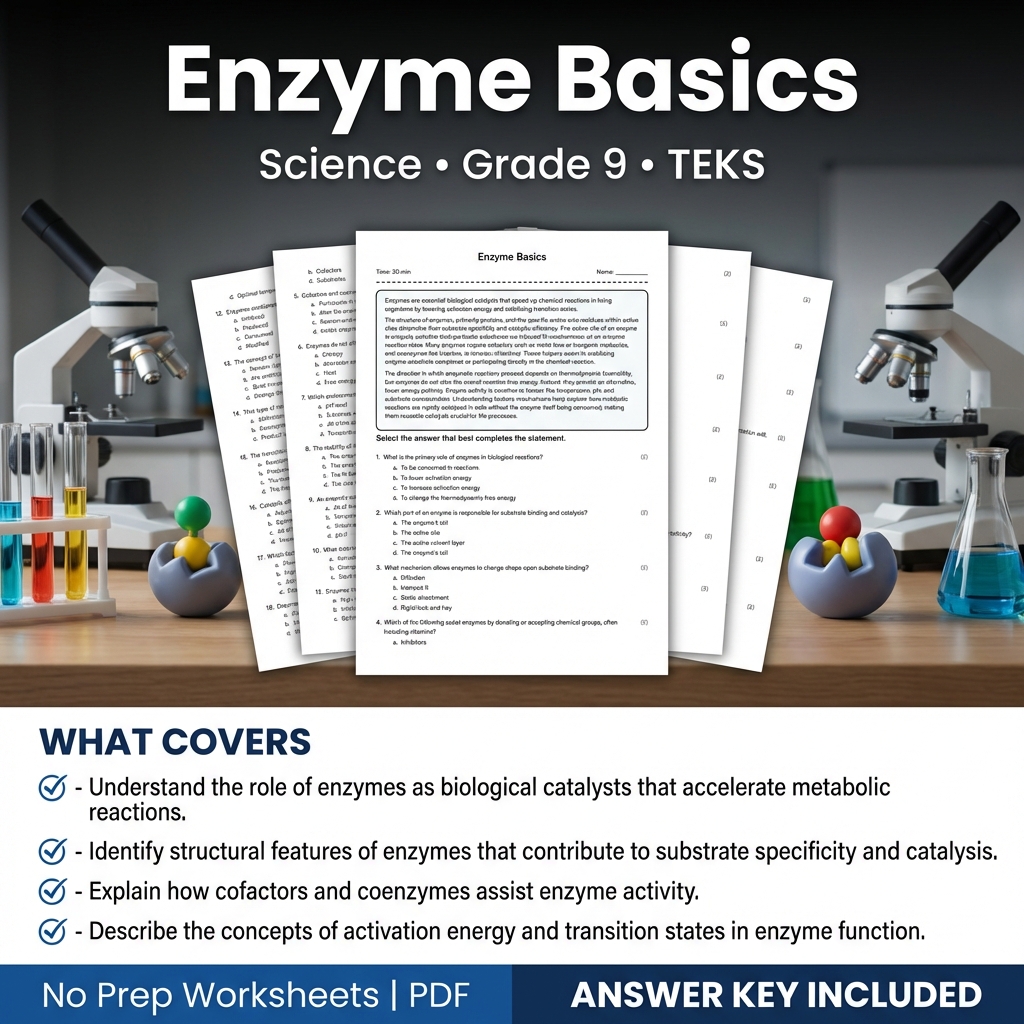
Grade 9 Science Worksheet on Enzyme Basics | TEKS Aligned Practice
Created byCoral Reef LearningLearning Objectives
- Understand the role of enzymes as biological catalysts that accelerate metabolic reactions.
- Identify structural features of enzymes that contribute to substrate specificity and catalysis.
- Explain how cofactors and coenzymes assist enzyme activity.
Instant download
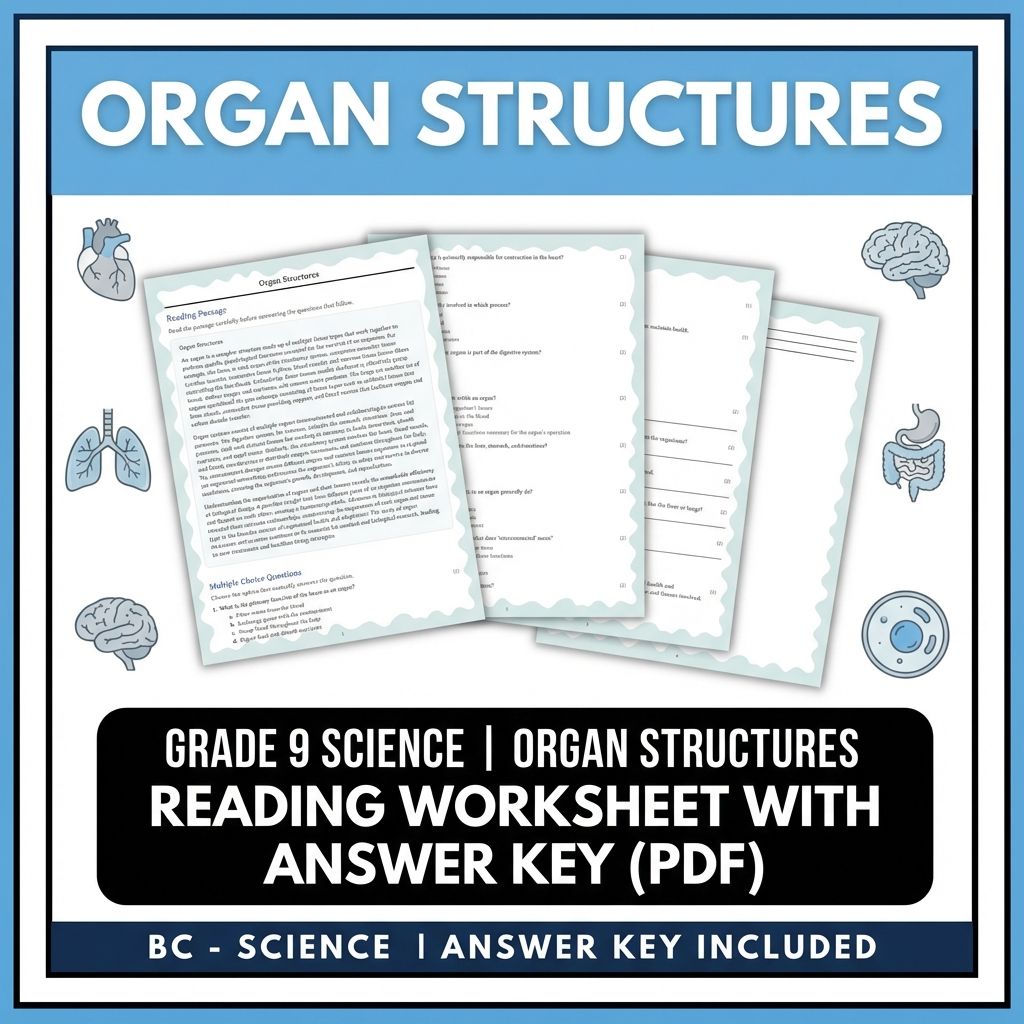
Grade 9 Science | Organ Structures Reading Worksheet with Answer Key (PDF)
JCreated byJ.S SheetsLearning Objectives
- Understand the composition and functions of different organs in the human body.
- Identify the types of tissues that make up organs.
- Explain how organs work together within organ systems to sustain life.
Instant download
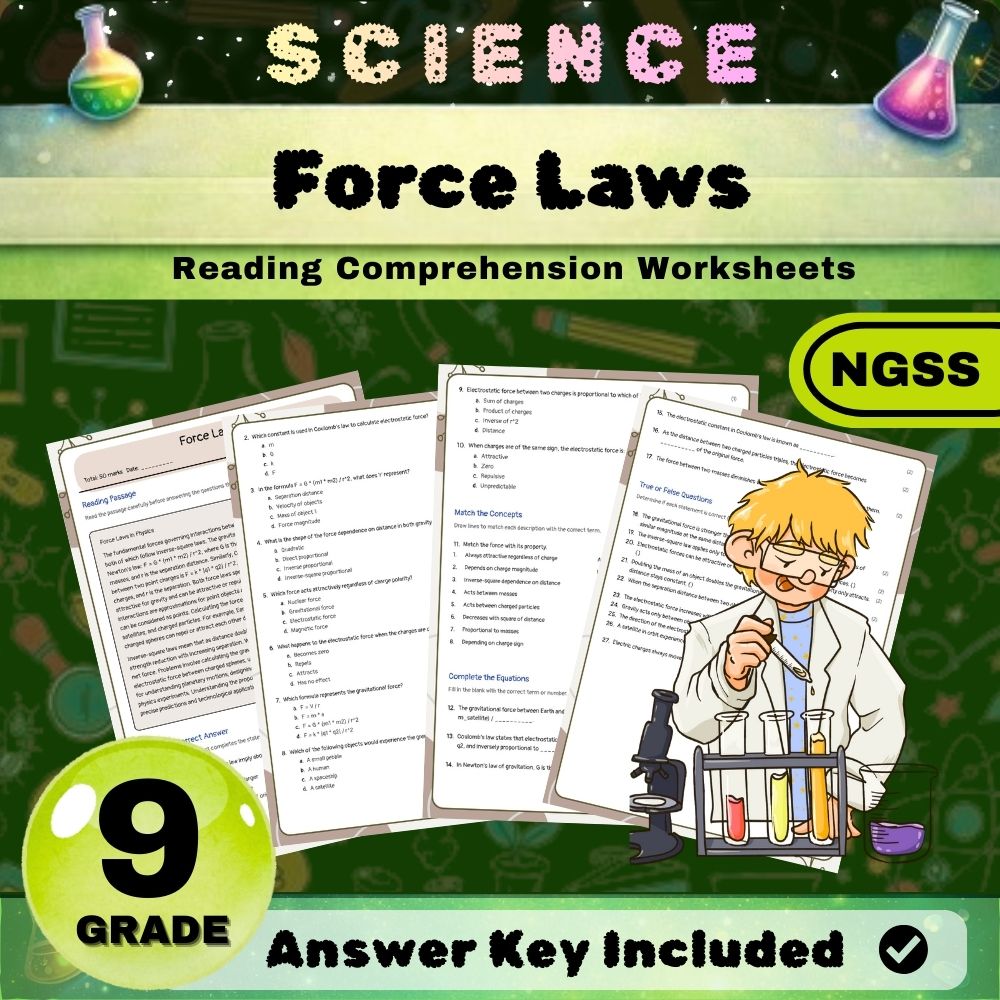
Grade 9 Science | Force Laws Worksheet (NGSS) – PDF
 Created byMaple Path Learning
Learning Objectives
- Understand the inverse-square dependence of gravitational and electrostatic forces.
- Apply quantitative formulas to calculate the magnitude of forces between objects.
- Determine the direction of forces using vector representations.
Also included in: Grade 9 Science | Motion and Stability Forces & Interactions NGSS Unit Bundle +1 more
Instant download
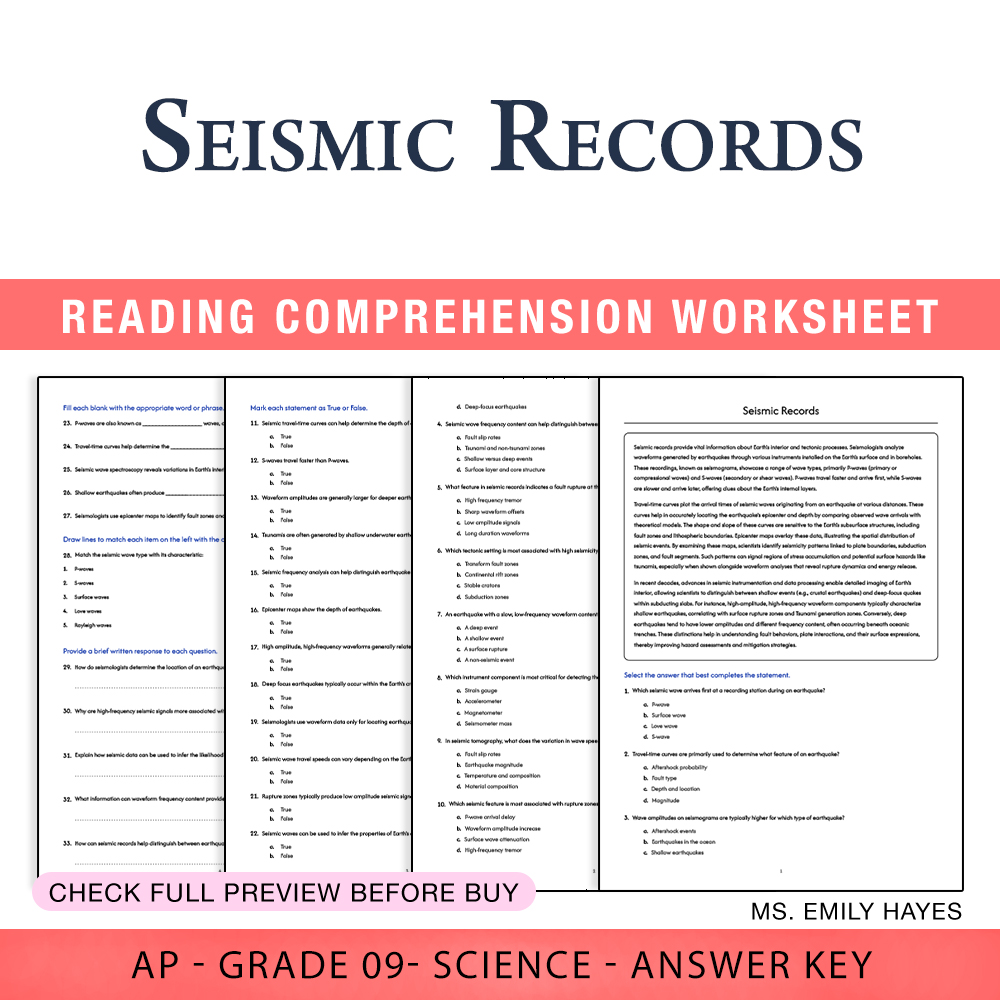
Grade 9 Science | Seismic Records Worksheet (PDF+ Answer Key)
Created byCopper Leaf ClassroomLearning Objectives
- Interpret earthquake waveforms, travel-time curves, and epicenter maps to understand Earth's subsurface structures.
- Compare P- and S-wave arrivals, waveform amplitudes, and frequency content to distinguish shallow versus deep earthquakes.
- Locate rupture zones and relate seismic activity patterns to tectonic plate interactions.
Also included in: Grade 9 Science | Earth and Space Sciences AP Worksheet (PDF + Answer Key) +1 more
Instant download
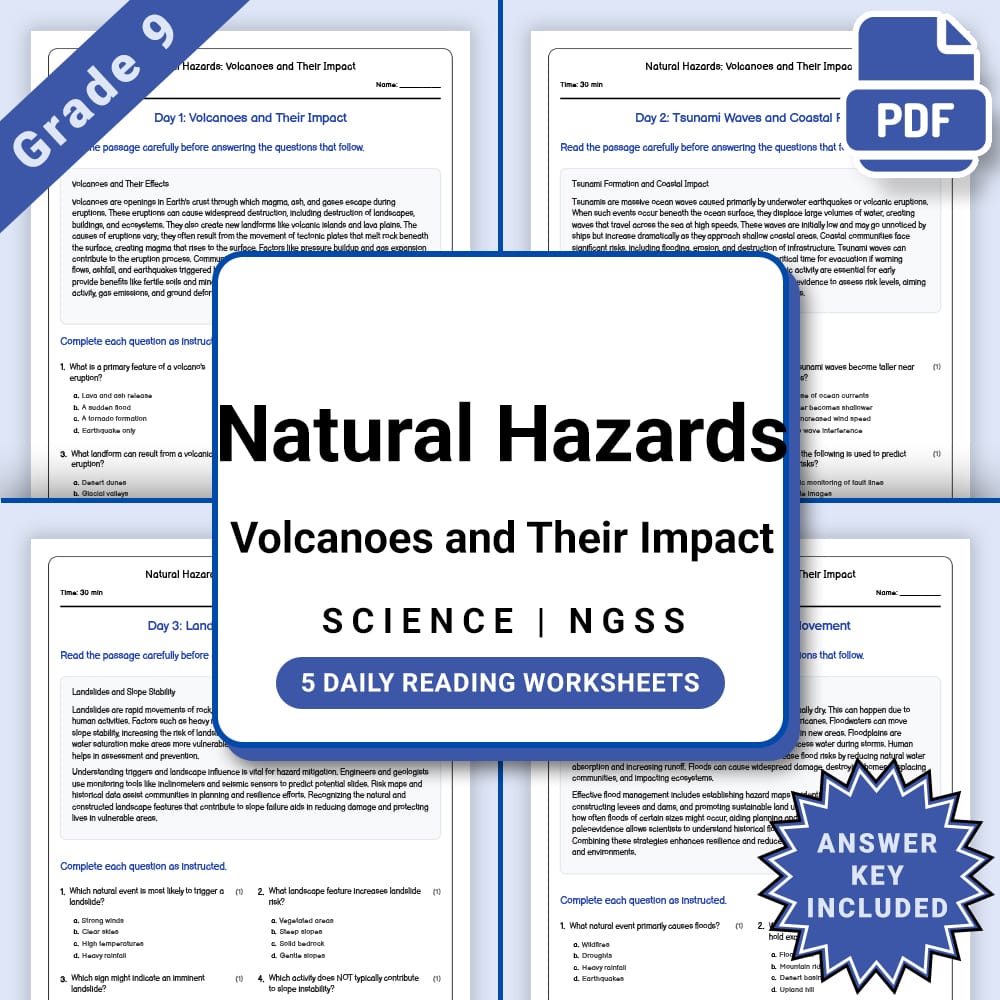
Grade 9 Science – Natural Hazards Volcanoes Worksheet(PDF + Answer Key)
Created byCopper Leaf ClassroomLearning Objectives
- Identify key volcanic hazards and their effects.
- Understand the causes of volcanic eruptions.
- Analyze how volcanoes influence landscapes and communities.
Instant download

Integrated Modeling Worksheet Pack | Grade 9 AP Science Practice
 Created byBright Quill Resources
Learning Objectives
- Explain how integrated models link the geosphere, hydrosphere, atmosphere, and biosphere to simulate environmental change.
- Identify how model parameters influence outputs and why sensitivity matters.
- Describe uncertainty propagation and how it affects projections of climate feedbacks and resource availability.
Instant download
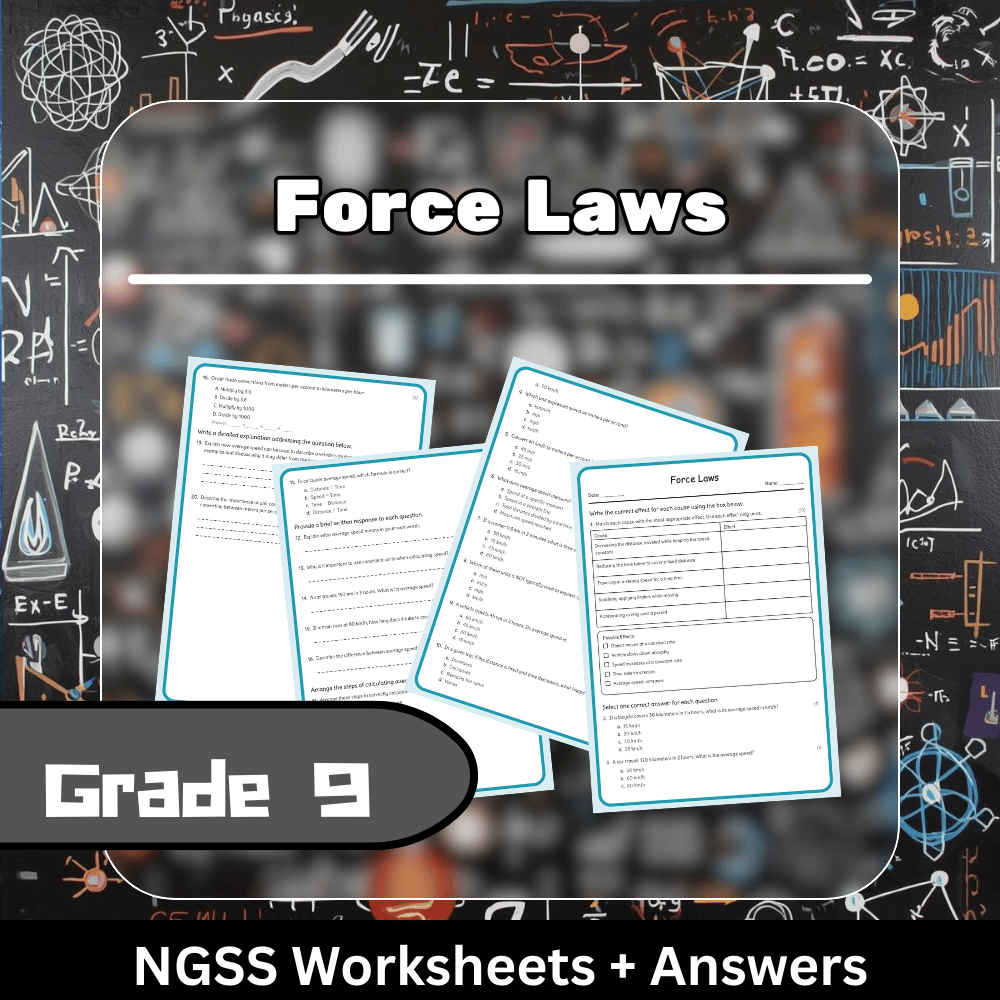
Grade 9 Science | Force Laws Worksheet (NGSS Aligned + PDF) – Science
Created byBright Mind ResourcesLearning Objectives
- Understand the inverse-square relationship in gravitational and electrostatic forces.
- Apply quantitative formulas to calculate the magnitude and direction of forces between objects.
- Use vector analysis to determine net forces in multi-body systems.
Instant download
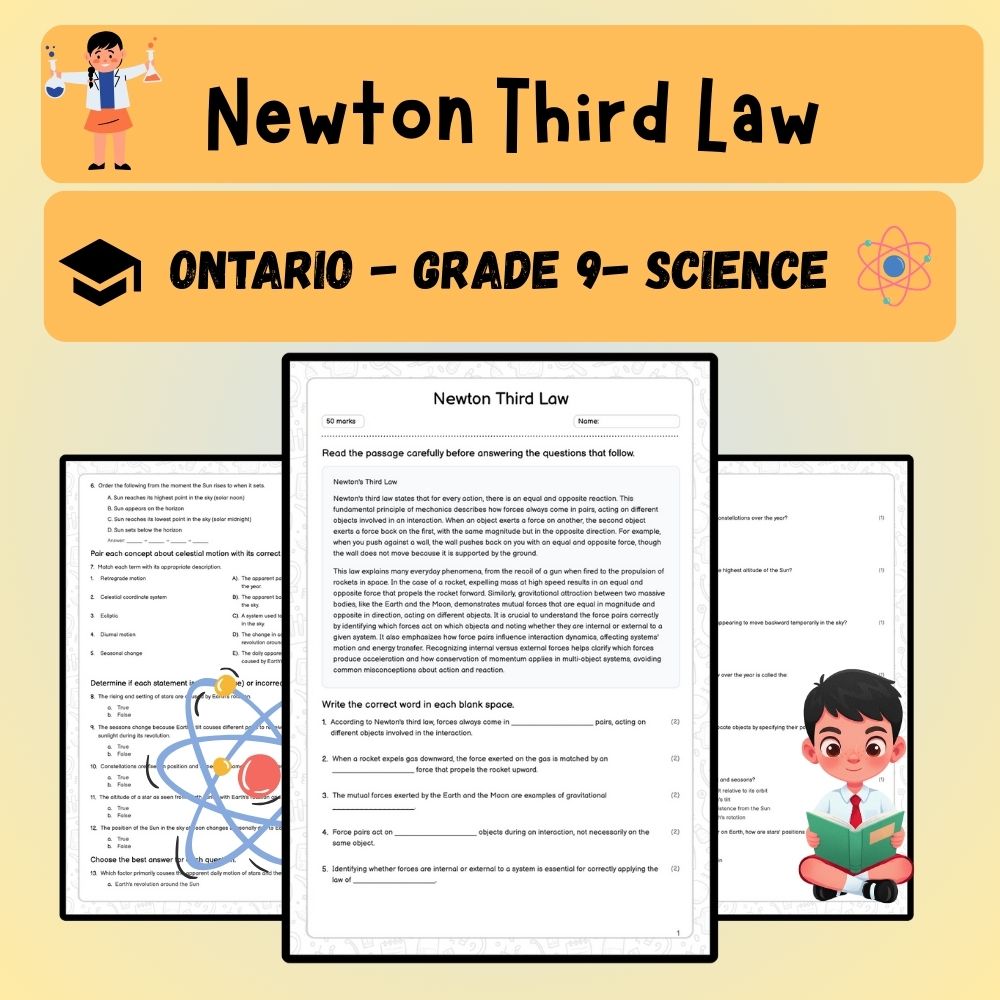
Grade 9 Science | Newton Third Law Worksheet (Worksheet + Answer Key) – Ontario Standards
 Created byPrism Point Learning
Learning Objectives
- Explain the principle of Newton's third law and identify action–reaction force pairs in various scenarios.
- Analyze common phenomena involving equal and opposite forces applied to different objects.
- Differentiate between internal and external forces when applying Newtonian mechanics to systems.
Also included in: Grade 9 Science Unit | Forces, Motion & Energy Worksheets (Ontario Standards) +1 more
Instant download
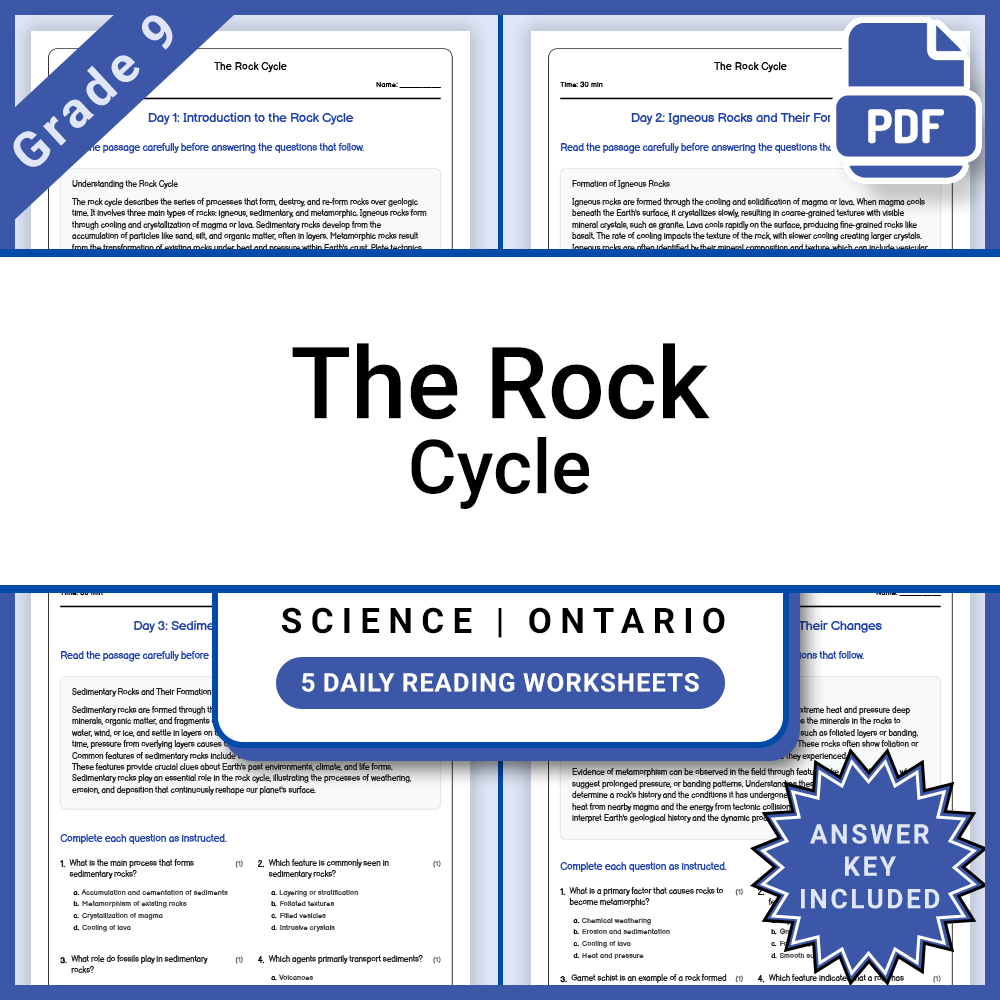
Grade 9 Science – The Rock Cycle Daily Reading Worksheet + Answer Key
JCreated byJ.S SheetsLearning Objectives
- Understand the components and processes involved in the rock cycle
- Identify different types of rocks and how they transform
- Recognize observable evidence of rock cycle processes in the field
Also included in: Grade 9 Science Lesson Group Bundle – Earth Systems & Planetary Concepts +1 more
Instant download
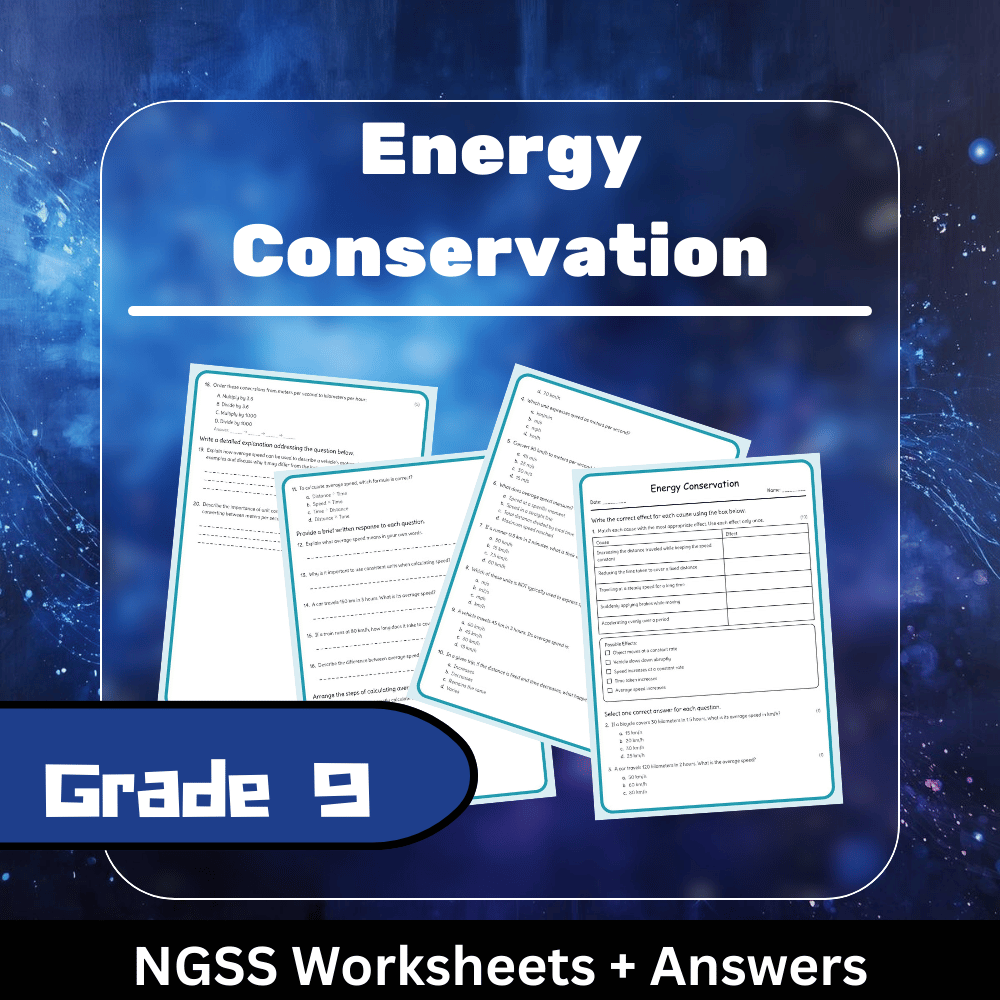
Grade 9 Science – Energy Conservation Worksheet (NGSS-Aligned) (PDF)
Created byBright Mind ResourcesLearning Objectives
- Understand the concept of energy conservation within different systems.
- Learn to represent energy transfers using diagrams and mathematical models.
- Identify and trace energy reservoirs during physical and chemical processes.
Instant download
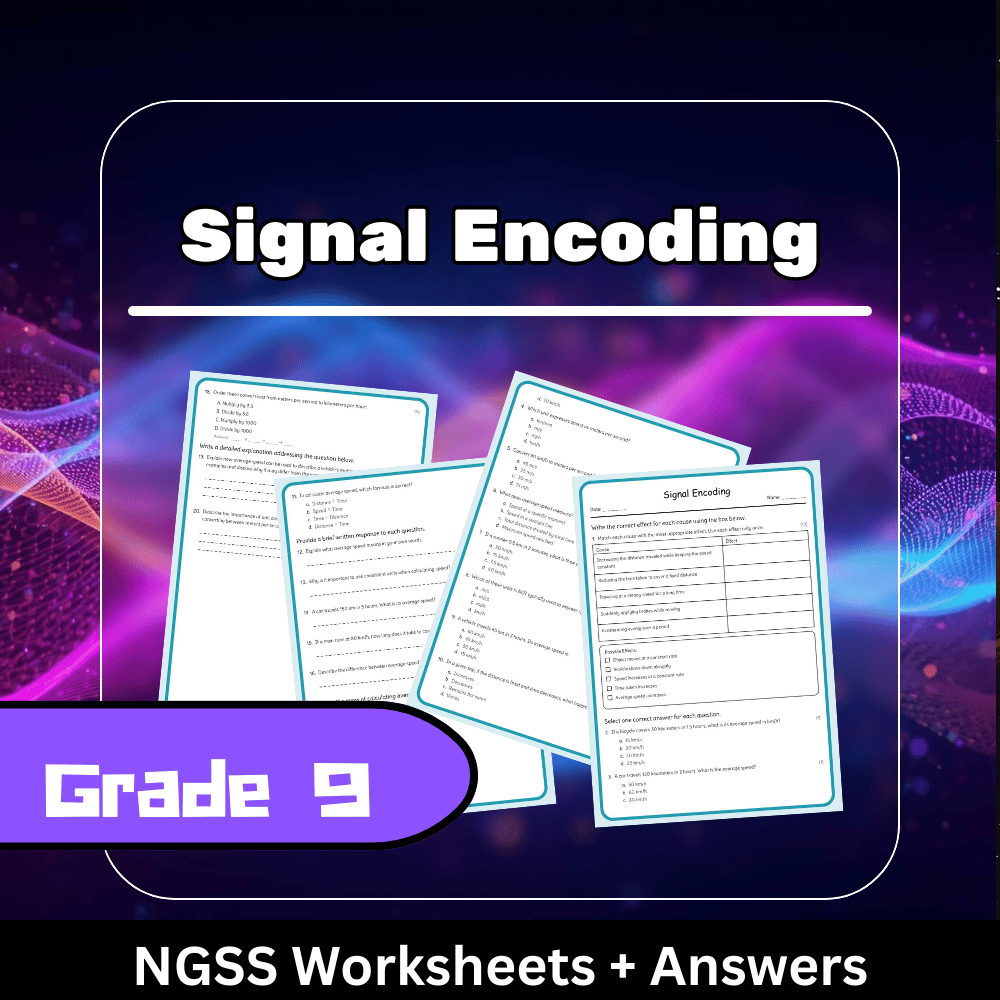
Grade 9 Science | Signal Encoding Worksheet + Answer Key | NGSS Aligned
Created byBright Mind ResourcesLearning Objectives
- Understand the principles of modulation and multiplexing in signal encoding.
- Identify different schemes such as pulse-code modulation and amplitude modulation.
- Compare encoding techniques based on bandwidth, fidelity, and noise susceptibility.
Instant download

Grade 9 Communication Systems Worksheet | Transmission Tradeoffs | NGSS
 Created byBRIGHT PATH RESOURCES
Learning Objectives
- Compare digital and analog signals and their applications
- Explain the concepts of bandwidth, signal-to-noise ratio, and sampling criteria
- Identify techniques used for error correction and maintaining signal fidelity
Also included in: Waves & Communication Systems Grade 9 Science Daily Reading Lesson Bundle | NGSS +1 more
Instant download

Grade 9 Wave Properties Worksheet | NGSS Science Waves & Energy Activity
Created byBRIGHT PATH RESOURCESLearning Objectives
- Understand key concepts related to Science
- Apply knowledge through practice questions
- Demonstrate comprehension of the material
Also included in: Waves & Communication Systems Grade 9 Science Daily Reading Lesson Bundle | NGSS +1 more
Instant download

Endothermic and Exothermic Reactions Worksheets | Grade 9 Science
 Created byTeachers Club
Learning Objectives
- Explain energy changes during chemical reactions at the molecular level
- Classify reactions as endothermic or exothermic using evidence
- Interpret ΔH and connect its sign to reaction type
Also included in: Grade 9 Science Worksheets: From Molecules to Organisms NGSS Bundle +1 more
Instant download
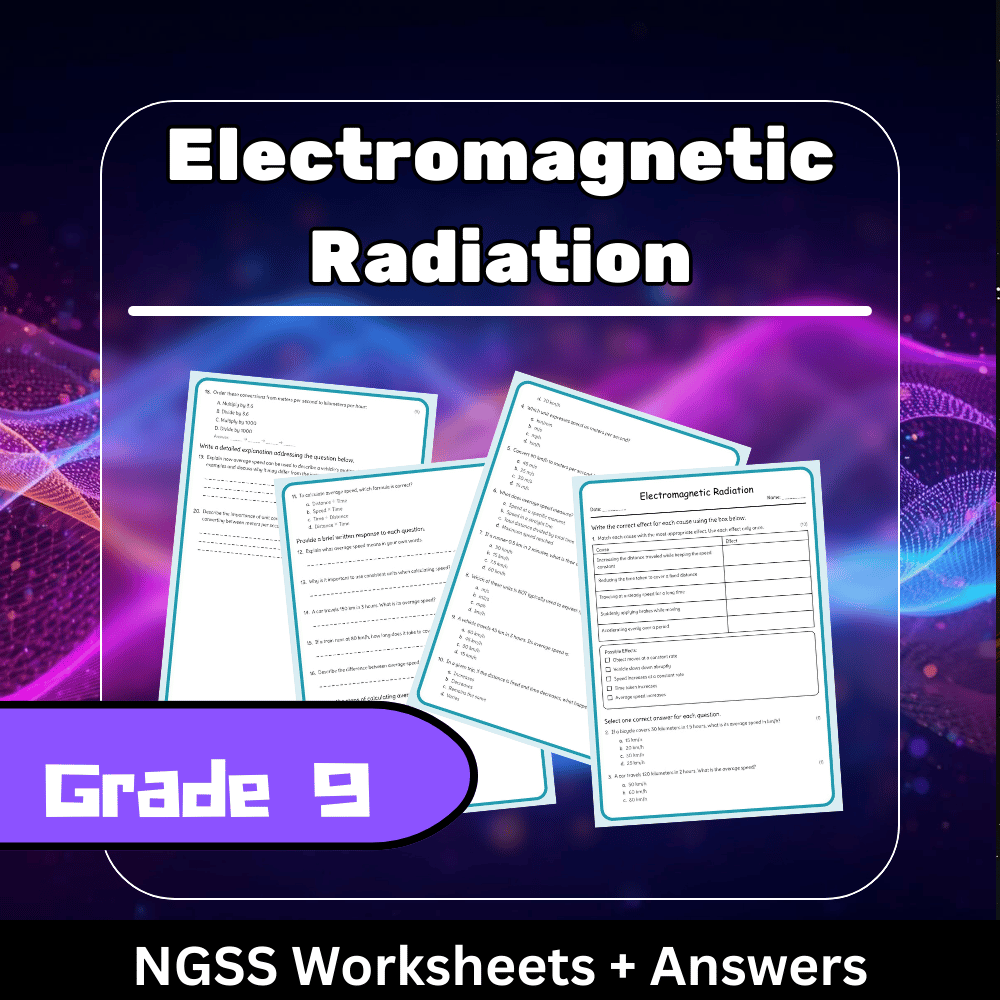
Grade 9 Science | Electromagnetic Radiation Worksheet (Answer Key)– NGSS Aligned
Created byBright Mind ResourcesLearning Objectives
- Understand the relationship between photon energy, frequency, and wavelength across the electromagnetic spectrum.
- Explain characteristic phenomena such as atomic emission and absorption lines.
- Apply Planck’s relation to compare the energy of different electromagnetic signals.
Instant download

Trophic Structure Worksheet | Grade 9 Science Practice
Created byPrism Point LearningLearning Objectives
- Explain how trophic levels (producers, consumers, decomposers) connect through feeding relationships in food chains and webs.
- Describe how energy flow and matter cycling move through trophic groups.
- Evaluate how trophic efficiency and trophic cascades affect ecosystem productivity and species abundance.
Instant download
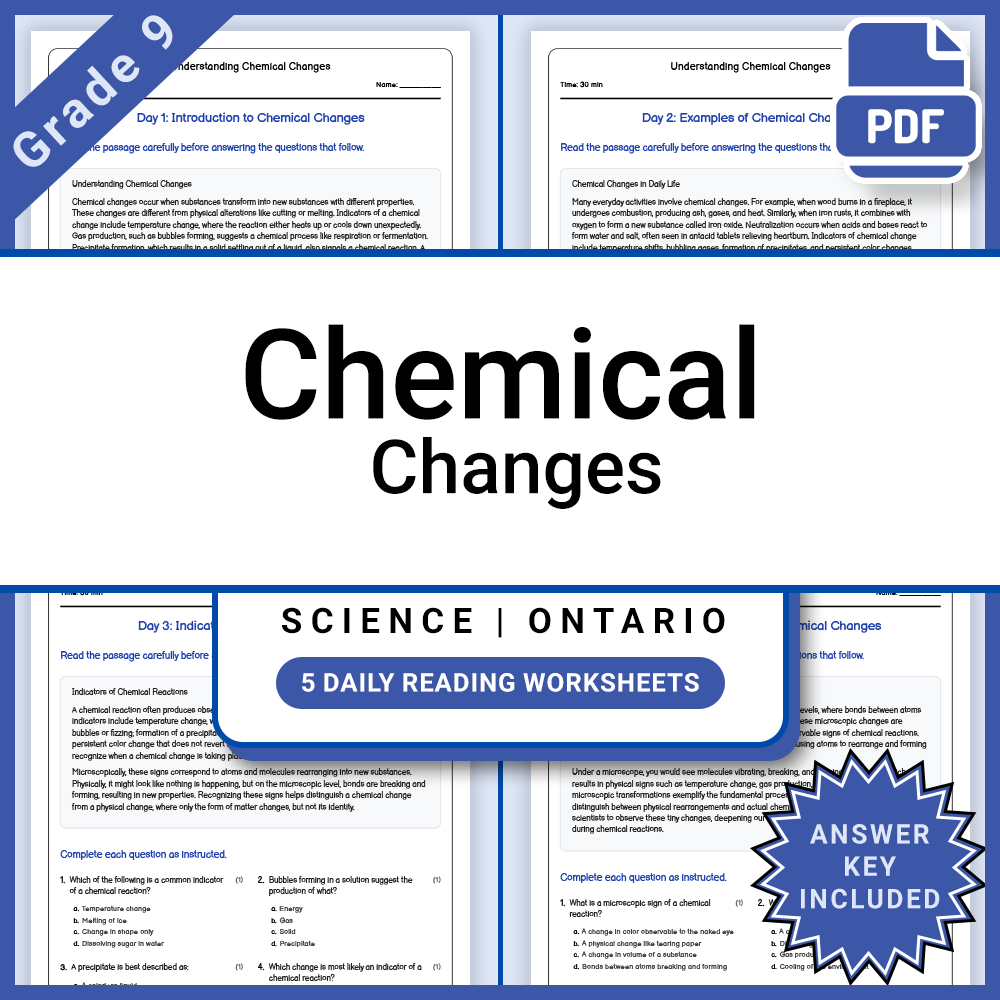
Grade 9 Science – Chemical Changes Daily Reading Worksheet + Answer Key
JCreated byJ.S SheetsLearning Objectives
- Identify signs of chemical reactions
- Differentiate between physical and chemical changes
- Recognize common indicators such as temperature change, gas production, precipitate formation, and colour change
Also included in: Grade 9 Science Lesson Group: Ontario Curriculum Daily Reading Worksheets +1 more
Instant download
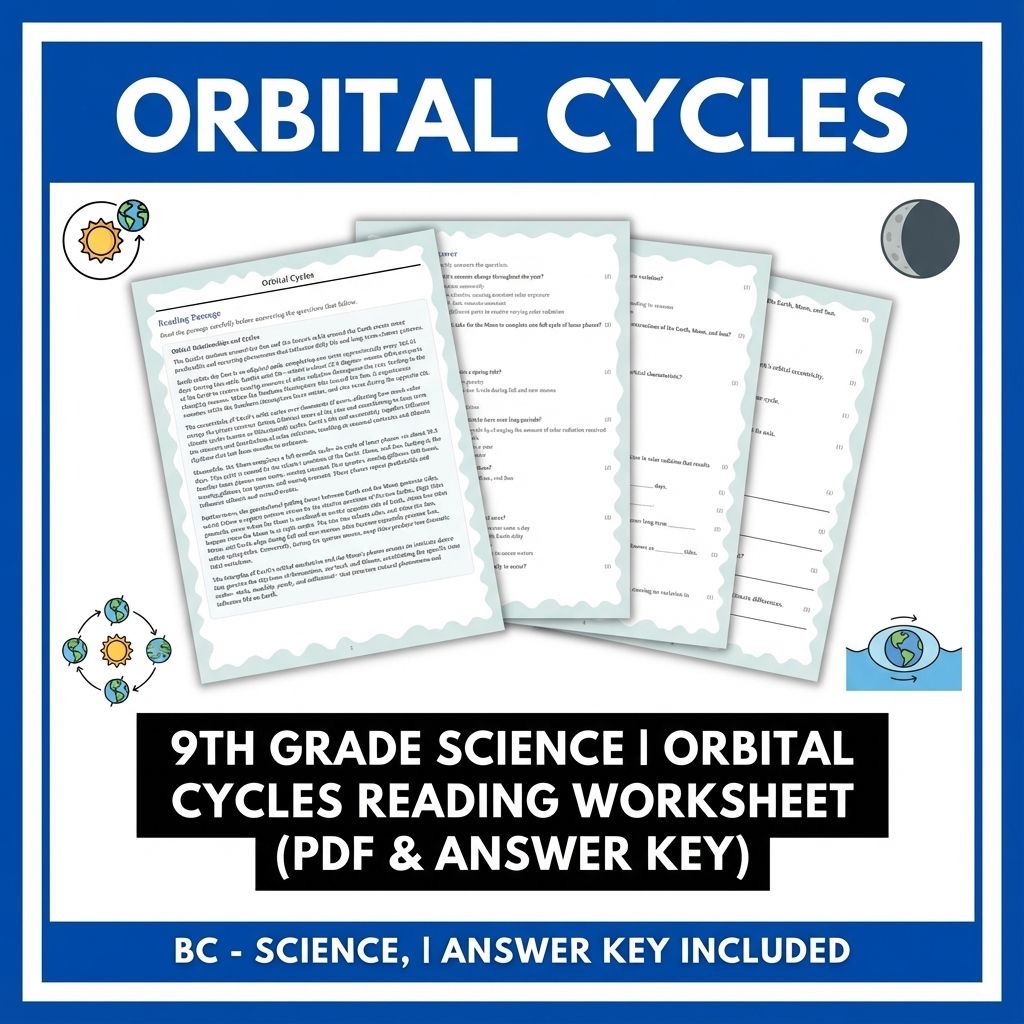
9th Grade Science | Orbital Cycles Reading Worksheet (PDF & Answer Key)
JCreated byJ.S SheetsLearning Objectives
- Explain the orbital relationships among Earth, Sun, and Moon and how they produce phenomena such as seasons, lunar phases, and tides.
- Describe how Earth's axial tilt and orbital eccentricity influence seasonal and climate patterns.
- Identify the causes and predict the patterns of lunar phases and tidal cycles.
Instant download

Grade 9 Science | Control Criteria in Scientific Experiments - Reading Comp.
Created byCoral Reef LearningLearning Objectives
- Understand the importance of variable isolation in experimental design.
- Identify how replication and baseline characterization contribute to causal inference.
- Recognize the impact of uncontrolled variation and residual confounding on experiment validity.
Also included in: Science Practices Lesson Bundle – Grade 9 Science, Advanced Placement Reading +1 more
Instant download
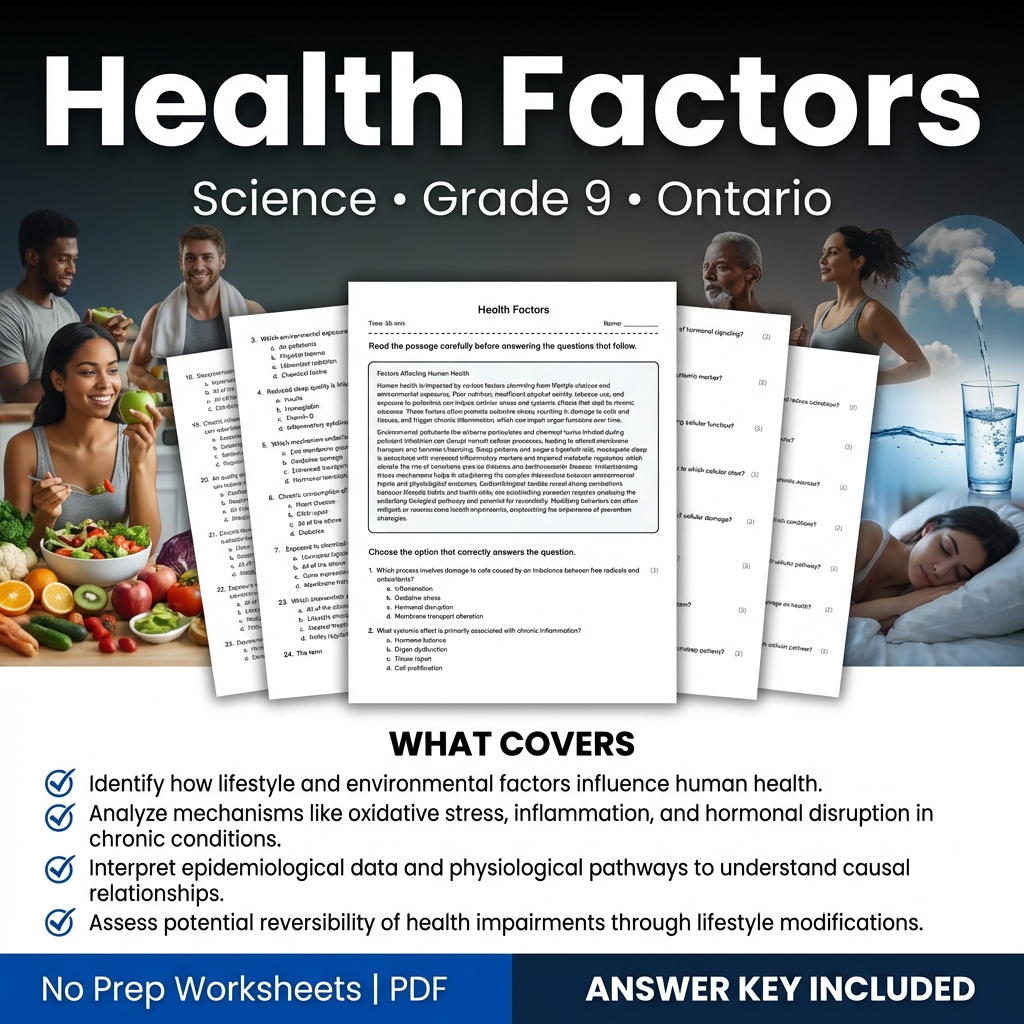
Health Factors Worksheet for Grade 9 Science | Ontario Standards
Created byCoral Reef LearningLearning Objectives
- Identify how lifestyle and environmental factors influence human health.
- Analyze mechanisms like oxidative stress, inflammation, and hormonal disruption in chronic conditions.
- Interpret epidemiological data and physiological pathways to understand causal relationships.
Instant download
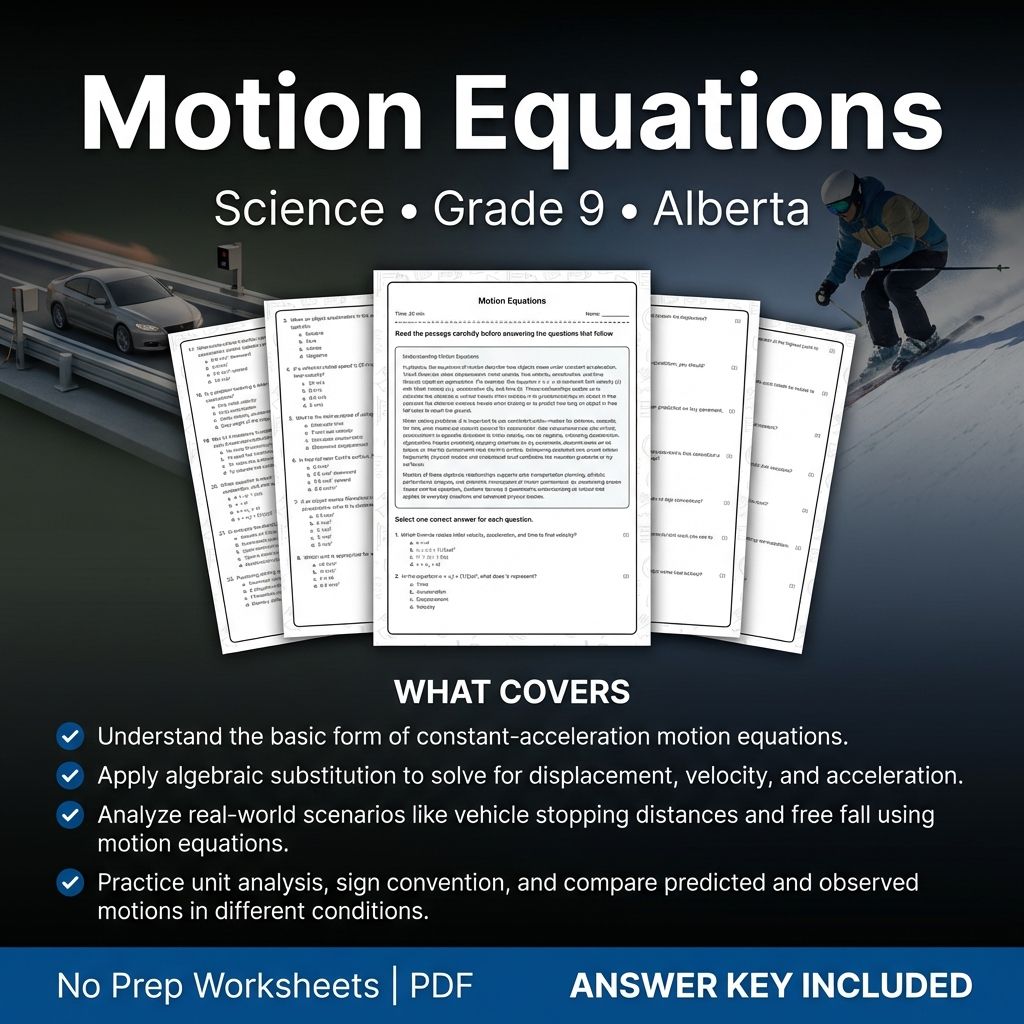
Motion Equations Worksheet | Grade 9 Science | Alberta Standards
Created byCoral Reef LearningLearning Objectives
- Understand the basic form of constant-acceleration motion equations.
- Apply algebraic substitution to solve for displacement, velocity, and acceleration.
- Analyze real-world scenarios like vehicle stopping distances and free fall using motion equations.
Instant download
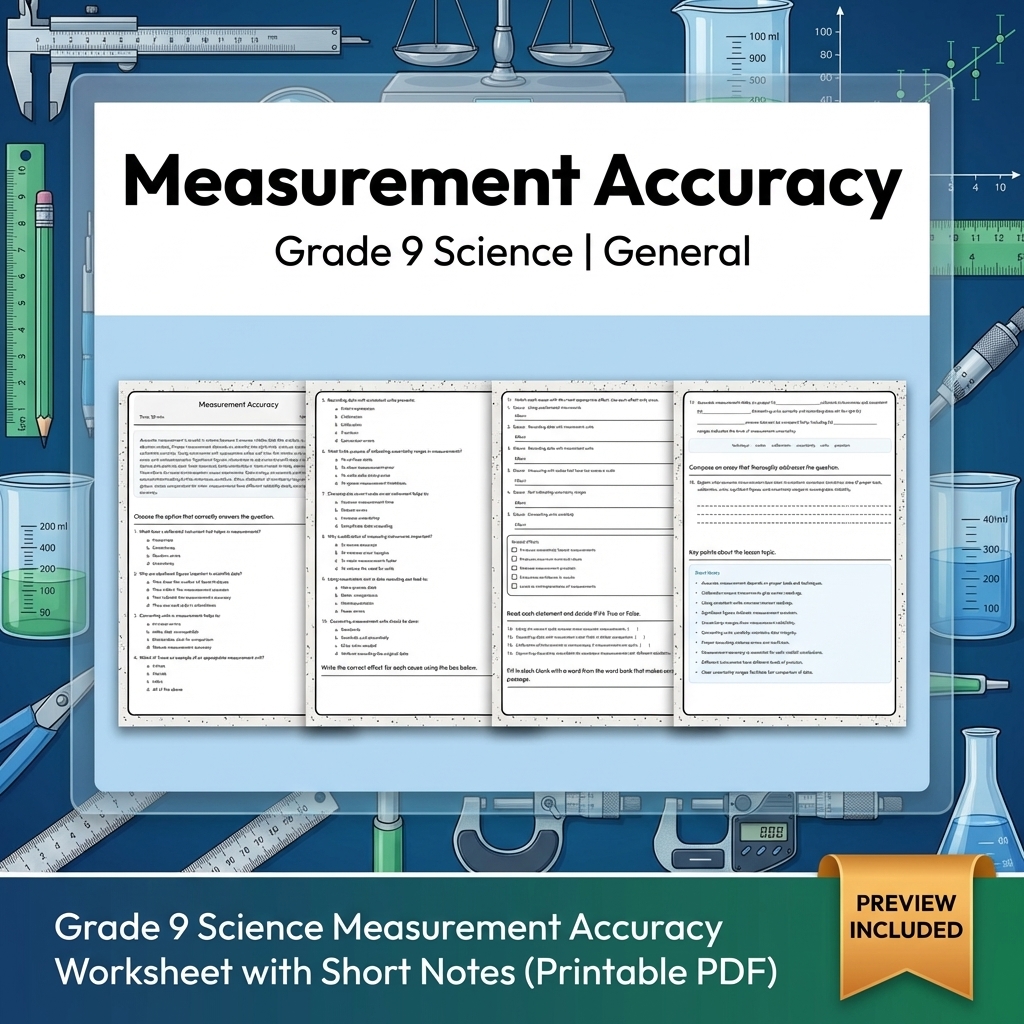
Grade 9 Science Measurement Accuracy Worksheet with Short Notes (Printable PDF)
Created byMeadowlark WorksheetsLearning Objectives
- Understand the importance of appropriate scales, calibration, and units in measurement.
- Explain how significant figures reflect measurement precision.
- Convert between units accurately and record data consistently.
Also included in: Grade 9 Science Uncertainty & Measurement Lesson Bundle: General Framework +1 more
Instant download
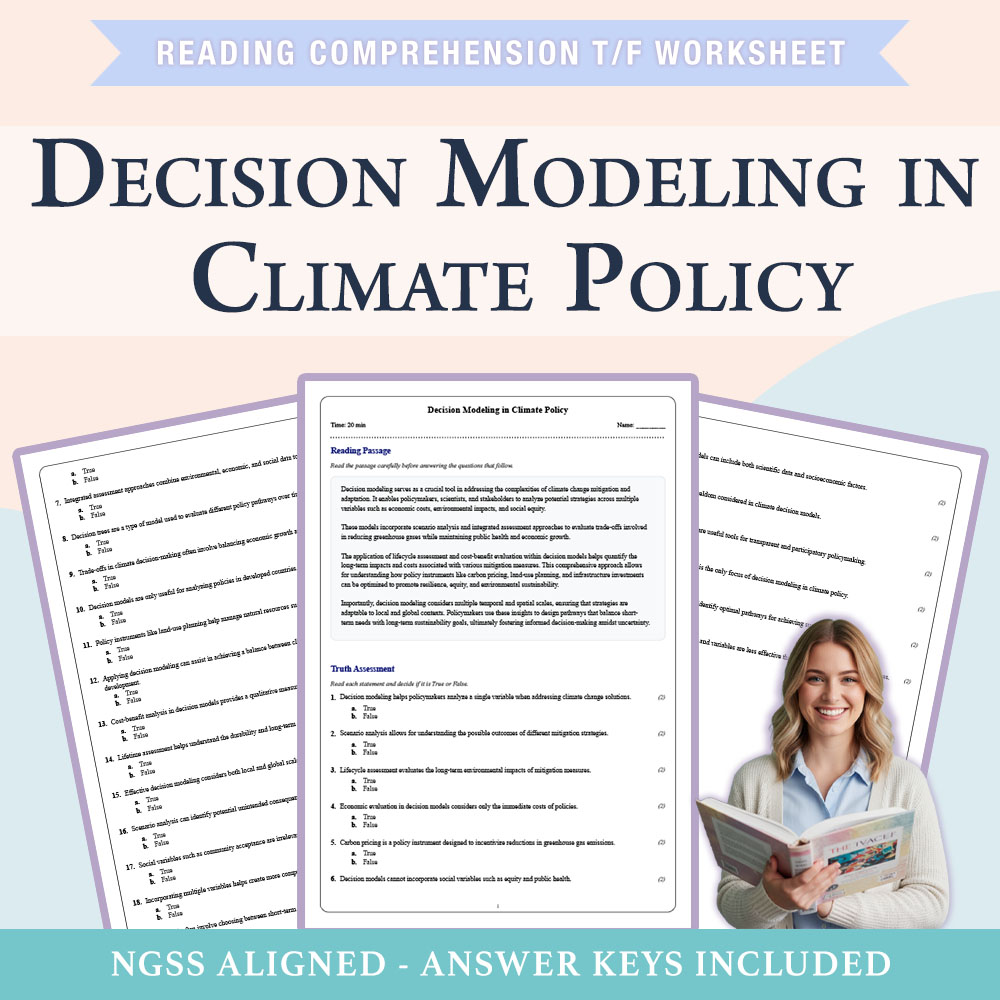
9th Grade Science |Decision Modeling in Climate Policy Worksheet (PDF + Answers)
Created byCopper Leaf ClassroomLearning Objectives
- Understand the application of system and decision models in evaluating climate mitigation and adaptation strategies.
- Analyze trade-offs between environmental, economic, and social variables using scenario analysis and assessment approaches.
- Evaluate the role of policy instruments such as carbon pricing and land-use planning in promoting sustainable development.
Also included in: Grade 9 Science|Climate, Sustainability & Energy Transition Bundle(PDF +Answers) +1 more
Instant download
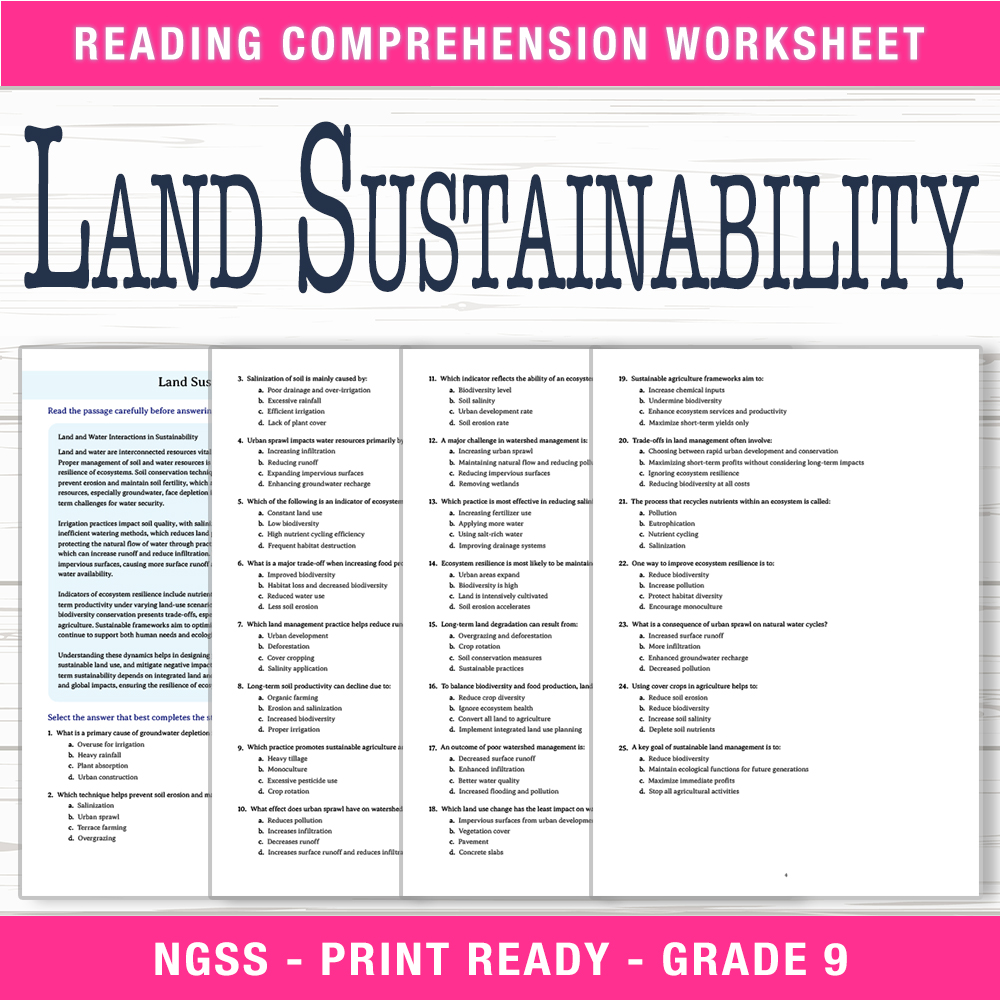
Grade 9 Science | Land Sustainability Worksheet (PDF + Answer Key)
 Created byRiverstone Classroom
Learning Objectives
- Understand the impacts of land and water interactions on ecosystem health and productivity.
- Identify sustainable land use practices such as soil conservation and watershed management.
- Analyze trade-offs among agricultural productivity, biodiversity, and water resource management.
Also included in: Grade 9 Science | Sustainability & Climate Change Unit Worksheet Bundle
Instant download
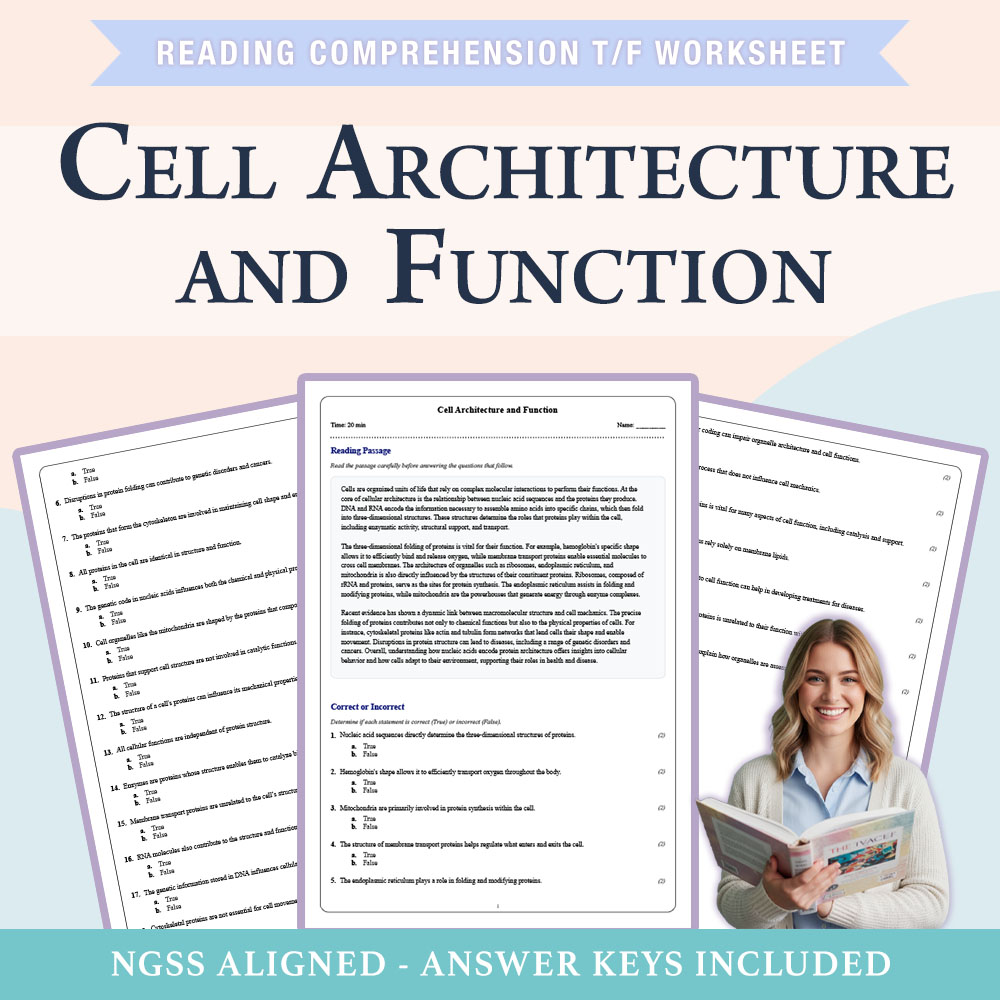
9th Grade Science | Cell Architecture and Function Worksheet (PDF + Answer Key)
Created byCopper Leaf ClassroomLearning Objectives
- Explain how nucleic acid sequences determine amino acid chains and three-dimensional protein structures.
- Describe the connection between macromolecular structure and cellular organelle architecture.
- Identify examples of how protein structure relates to cellular functions such as transport and catalysis.
Also included in: Grade 9 Science | Cellular Functions & Physiology Bundle (PDF + Answer Key) +1 more
Instant download
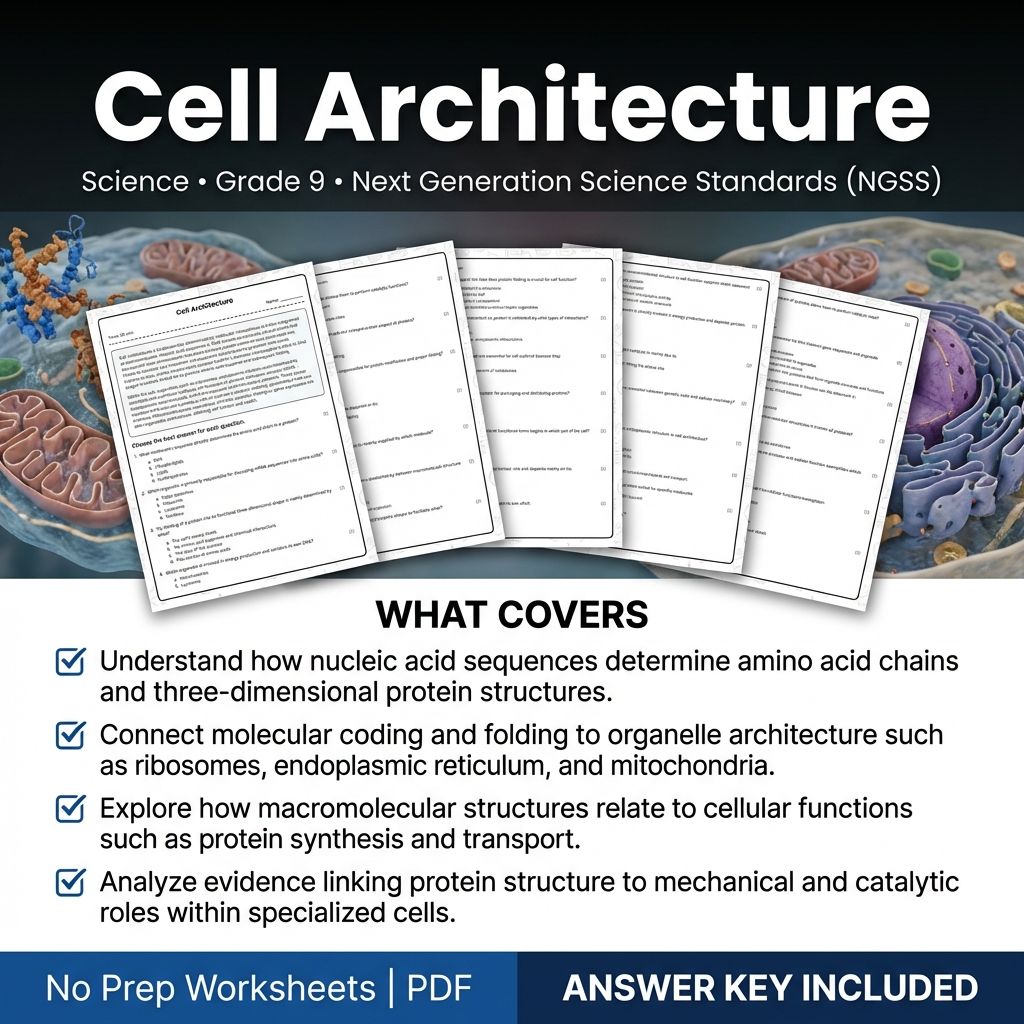
9th Grade Science | Cell Architecture Worksheet & Answer Key (Printable PDF)
Created byCoral Reef LearningLearning Objectives
- Understand how nucleic acid sequences determine amino acid chains and three-dimensional protein structures.
- Connect molecular coding and folding to organelle architecture such as ribosomes, endoplasmic reticulum, and mitochondria.
- Explore how macromolecular structures relate to cellular functions such as protein synthesis and transport.
Also included in: Grade 9 Science Unit Bundle-Biological Systems & Molecular Regulation Worksheets +1 more
Instant download
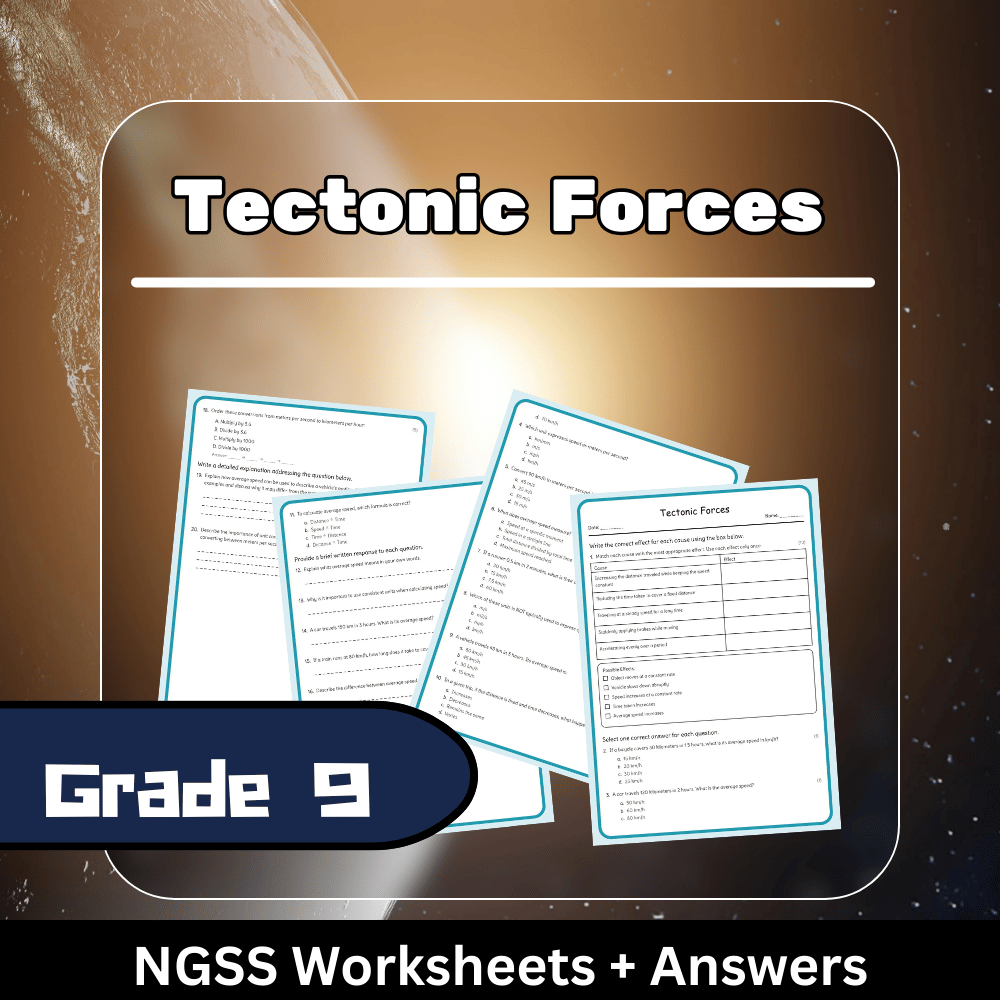
Grade 9 Science | Tectonic Forces Worksheet (Answer Key) – NGSS Standards
Created byBright Mind ResourcesLearning Objectives
- Understand the processes involved in plate tectonics such as seafloor spreading, subduction zones, and mountain uplift.
- Identify the surface features and geological evidence associated with tectonic activity.
- Explain how mantle convection influences lithospheric deformation and faulting patterns.
Instant download
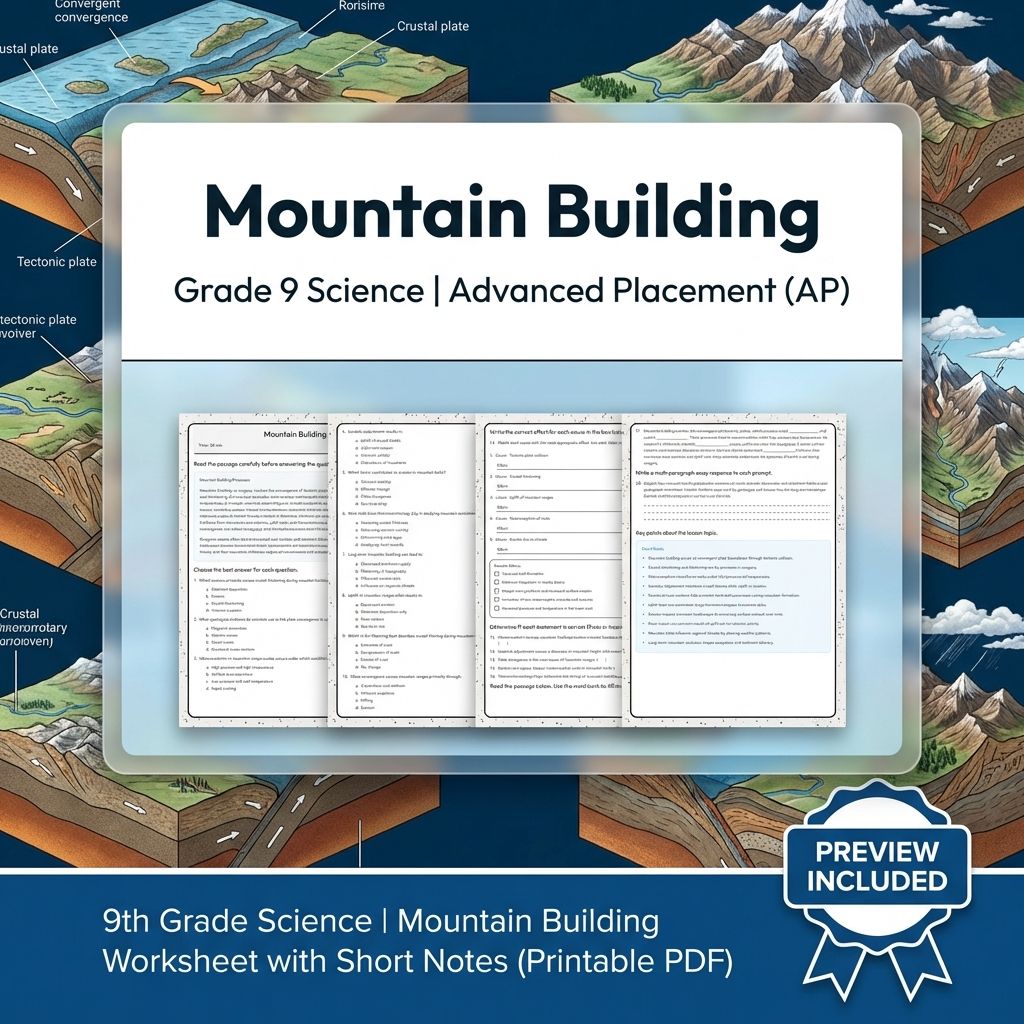
9th Grade Science | Mountain Building Worksheet with Short Notes (Printable PDF)
Created byMeadowlark WorksheetsLearning Objectives
- Explain the processes involved in mountain building, including crustal shortening, thickening, and metamorphism.
- Describe how isostatic adjustment influences mountain heights and landscape evolution.
- Analyze the impact of mountain-building episodes on regional climate, erosion, and sediment delivery.
Also included in: Grade 9 Science | Earth Systems & Geology Unit Worksheet Bundle (Printable PDFs) +1 more
Instant download
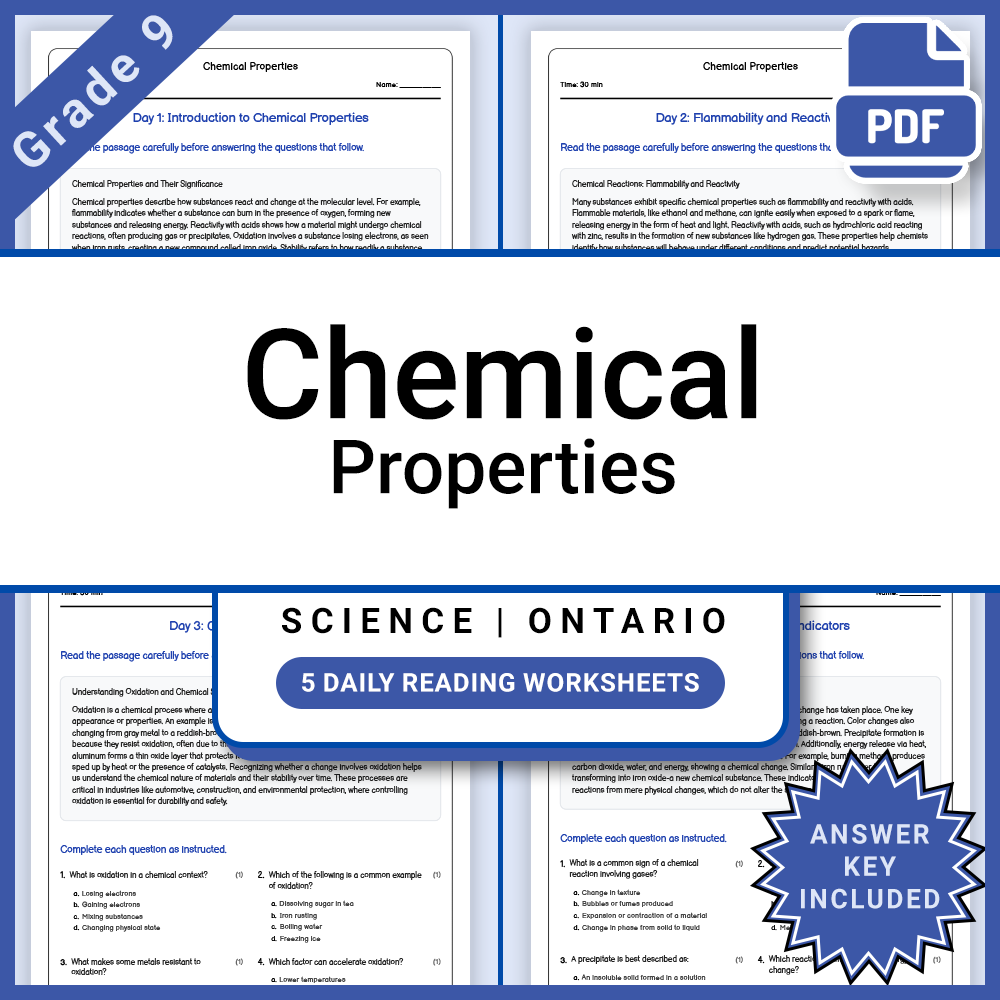
Grade 9 Science – Chemical Properties Daily Reading Worksheet + Answer Key
JCreated byJ.S SheetsLearning Objectives
- Define chemical properties and distinguish them from physical changes.
- Identify examples of chemical properties such as flammability, reactivity with acids, oxidation, and stability.
- Interpret reaction products, gas evolution, precipitate formation, and color changes as indicators of chemical transformations.
Also included in: Grade 9 Science Lesson Group: Ontario Curriculum Daily Reading Worksheets +1 more
Instant download

Grade 9 Science | Circuit Types Worksheet (PDF) – Alberta Standards
 Created bySilver Birch Teaching
Learning Objectives
- Differentiate series and parallel circuit arrangements by describing how current and voltage behave
- Use circuit rules to predict how brightness and load distribution change in series versus parallel circuits
- Interpret simple circuit scenarios involving household wiring and lighting strings
Also included in: Grade 9 Electrical Circuits and Energy Science Lesson Bundle (Alberta) +1 more
Instant download

Grade 9 Science | Motors and Generators Worksheet (Alberta Standards) (PDF)
 Created byEvergreen Desk Education
Learning Objectives
- Explain how electric motors convert electrical energy into mechanical work.
- Describe how generators produce electrical energy using electromagnetic induction.
- Compare motor and generator operation by tracing key energy conversions and magnetic interactions.
Instant download
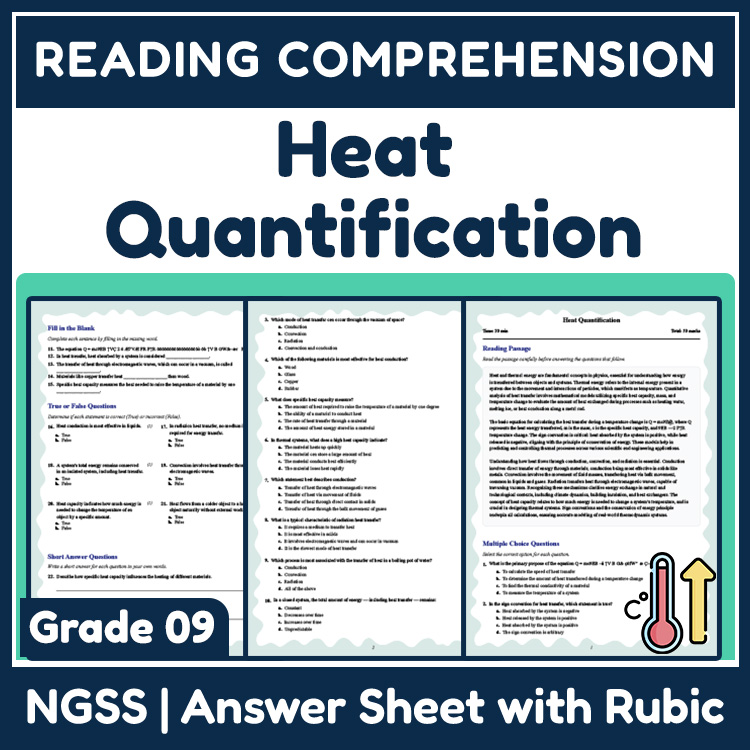
Grade 9 Science | Heat Quantification Reading Worksheet & Answer Key (PDF)
JCreated byJ.S SheetsLearning Objectives
- Understand the mathematical representation of heat transfer and internal energy changes in different processes.
- Apply specific heat capacity concepts to calculate thermal energy transfer in various scenarios.
- Comprehend the sign conventions for energy flow and their connection to conservation principles in closed systems.
Also included in: Grade 9 Science | Energy & Power Analysis Unit Worksheet Pack
Instant download
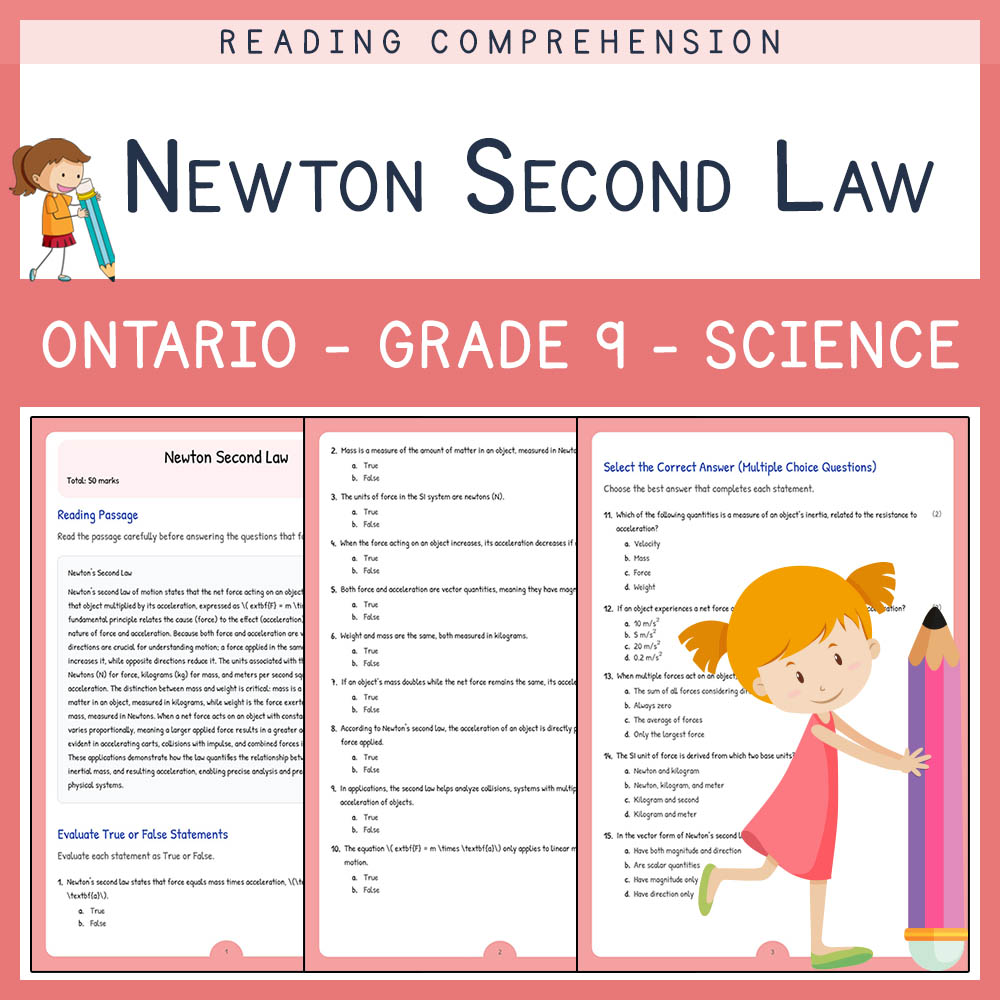
Grade 9 Science Assessment | Newton Second Law Worksheet | Ontario
 Created byLumora Learning
Learning Objectives
- Explain Newton's second law and its formula relating force, mass, and acceleration.
- Differentiate between mass and weight and understand their units.
- Apply the principle of vector quantities in force and acceleration analysis.
Instant download
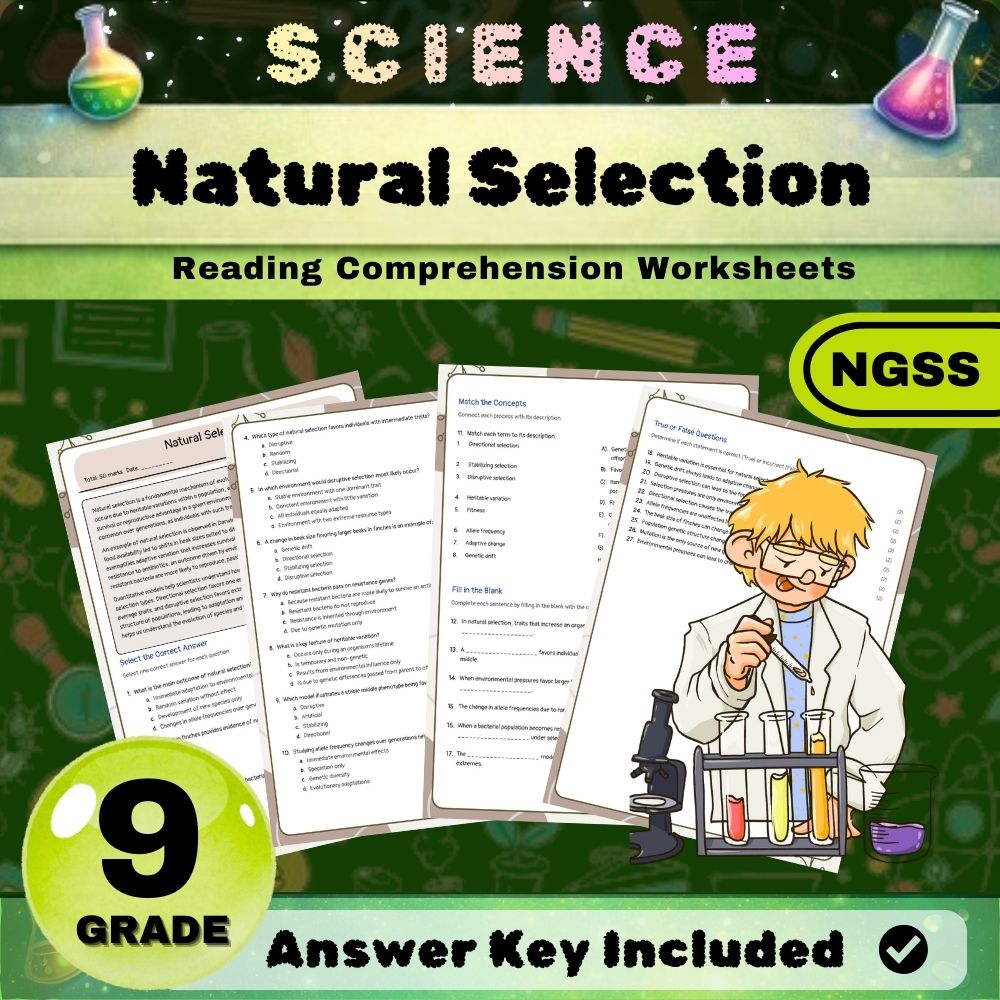
Grade 9 Science | Natural Selection Worksheet (NGSS) (PDF)
Created byMaple Path LearningLearning Objectives
- Explain how heritable variation leads to differential survival and reproduction in populations.
- Describe examples of natural selection such as beak morphology in finches and bacterial antibiotic resistance.
- Use models to understand types of selection: directional, stabilizing, and disruptive.
Also included in: Grade 9 Science Lesson Bundle | Biological Evolution: Unity & Diversity +1 more
Instant download
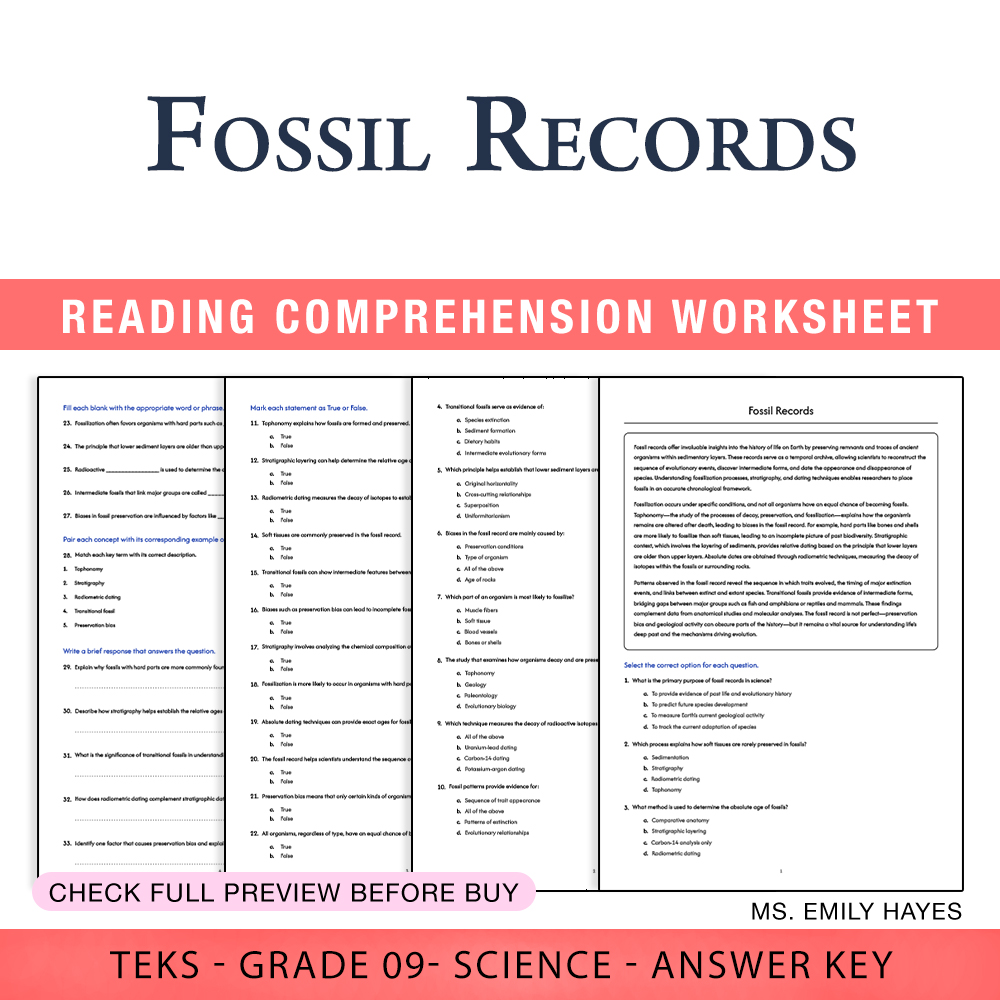
9th Grade Science | Fossil Records Worksheet (PDF+ Answer Key)
Created byCopper Leaf ClassroomLearning Objectives
- Describe the significance of fossil records in understanding evolutionary history.
- Identify different methods for dating fossils and establishing stratigraphic context.
- Explain how taphonomy and preservation bias influence fossil evidence.
Instant download
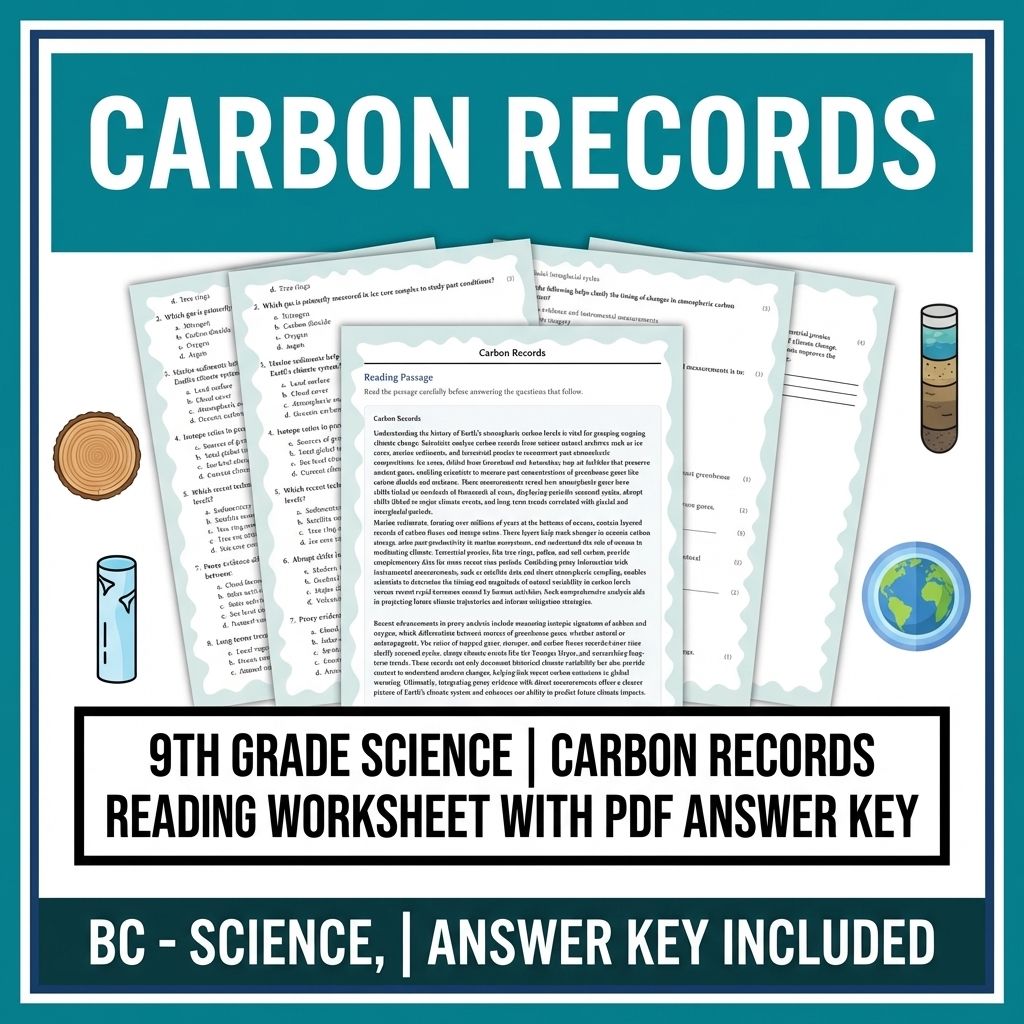
9th Grade Science | Carbon Records Reading Worksheet with PDF Answer Key
JCreated byJ.S SheetsLearning Objectives
- Understand how ice cores, sediments, and proxies inform us about past atmospheric carbon levels.
- Identify the methods used to analyze trapped gases, isotopes, and carbon fluxes in climate research.
- Explain how proxy data and instrumental measurements help distinguish natural variability from recent climate change.
Instant download

Grade 9 Science Worksheet | Microscopy Analysis TEKS (PDF)
Created byEvergreen Desk EducationLearning Objectives
- Interpret microscopy images using scale bars, resolution limits, staining/contrast, and controls
- Differentiate what electron microscopy and fluorescence microscopy can reveal about cells and organelles
- Evaluate claims about cellular processes by comparing image sets over time while accounting for artifacts
Instant download
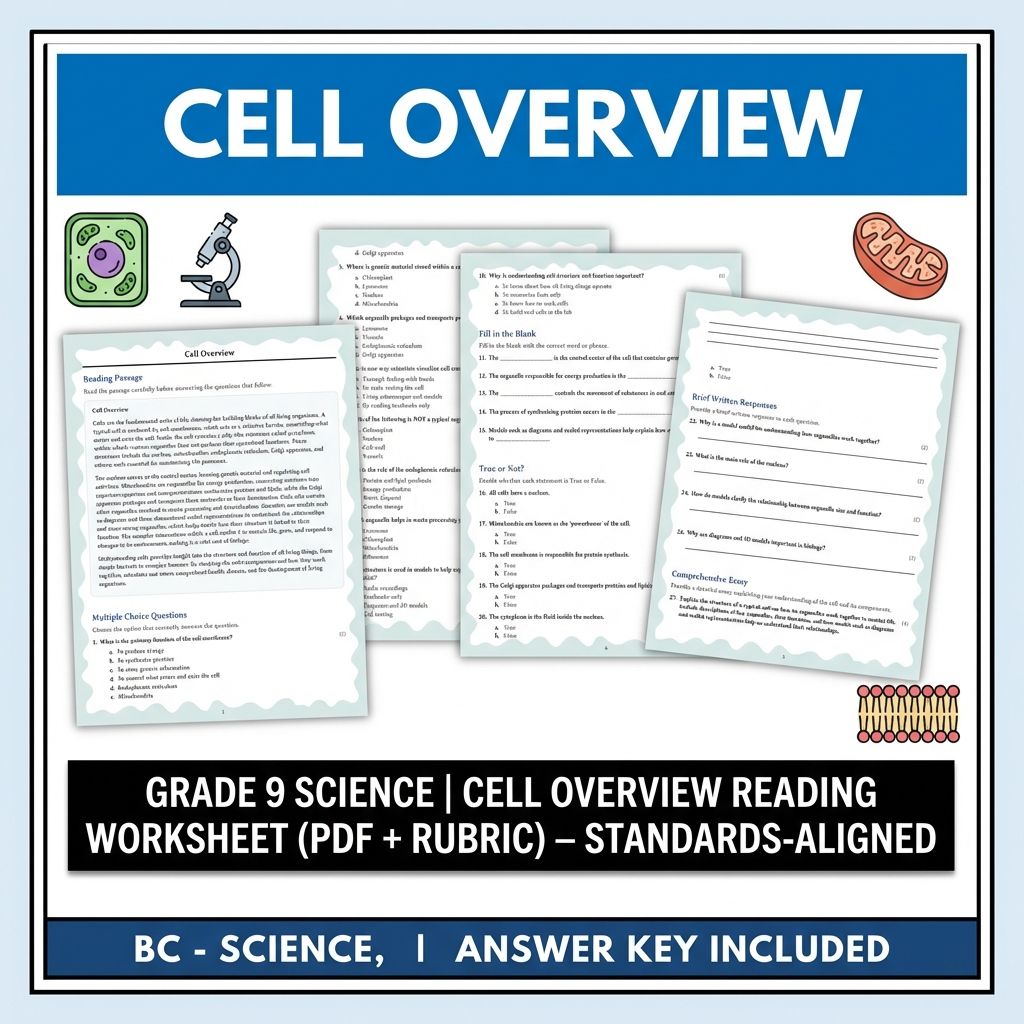
Grade 9 Science | Cell Overview Reading Worksheet (PDF + Rubric)
JCreated byJ.S SheetsLearning Objectives
- Understand the basic structure and functions of a cell.
- Identify the roles of major organelles within a cell.
- Explain how cell structure relates to cell function.
Instant download
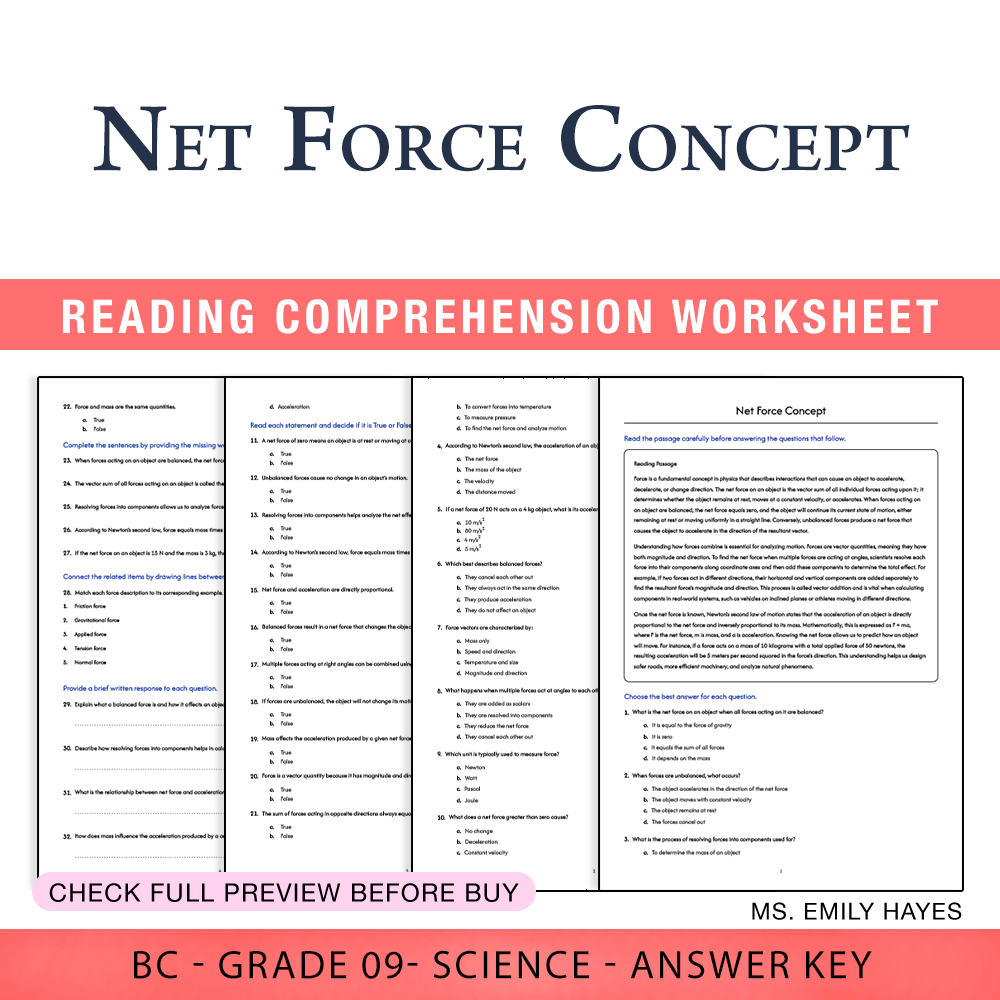
9th Grade Science | Net Force Concept Worksheet (PDF+ Answer Key)
Created byCopper Leaf ClassroomLearning Objectives
- Define and explain the concept of net force and how it affects motion.
- Describe how forces can be resolved into components and summed to find the net effect.
- Calculate the resulting acceleration when given force vectors and mass.
Also included in: Grade 9 Science Worksheet Bundle | Forces, Energy & Motion (PDF + Answer Key) +1 more
Instant download
About Grade 9 Science Worksheets
Find Science worksheets built for Grade 9. All 6,926 cover core skills, practice, and review, each an instant PDF download.
Every worksheet on MyTeachingSheets is created by independent teacher-authors and reviewed before publication. All resources download as printable PDFs for classroom, homework, or at-home practice, and many include answer keys. Preview any worksheet free before buying.