


Grade 10 Science | Work and Power Worksheet (Alberta Standards) (PDF)
 Created bySilver Birch Teaching
Learning Objectives
- Explain and apply the relationship between work, force, and displacement (W = Fd cosθ) in physics and everyday situations
- Relate power to energy transfer per unit time and interpret how changing time affects power
- Use basic problem-solving skills to calculate work and power using units and numerical values
Instant download

Grade 10 Science – Transmission Losses Worksheet (Alberta Standards) (PDF)
Created bySilver Birch TeachingLearning Objectives
- Explain why resistive transmission losses depend on current and conductor resistance
- Describe how increasing transmission voltage reduces current and lowers I^2R losses
- Relate voltage regulation and transformer choices to long-distance power delivery and grid reliability
Instant download

Grade 10 Science – Ohm's Law Worksheet (Alberta Standard) PDF
Created bySilver Birch TeachingLearning Objectives
- Use Ohm’s law (V = IR) to calculate voltage, current, or resistance for a circuit.
- Determine the equivalent resistance of series and parallel resistor combinations.
- Explain how temperature affects resistance and predict changes in current in real circuits.
Instant download

Grade 10 Science | Motors and Generators Worksheet (Alberta Standard PDF)
Created bySilver Birch TeachingLearning Objectives
- Explain how motors and generators convert between electrical energy and mechanical energy using electromagnetic forces.
- Describe how a current-carrying coil in a magnetic field produces torque and rotational motion.
- Compare generator and motor operation in terms of energy flow and the direction of induced effects.
Instant download

Grade 10 Science | Momentum Transfer Worksheet (PDF) Structured Practice
Created bySilver Birch TeachingLearning Objectives
- Explain linear momentum and impulse and how they relate to collisions and interactions.
- Apply conservation of momentum to closed systems and interpret momentum transfer in real-world scenarios.
- Use impulse–momentum ideas to analyze changes in velocity caused by forces acting over time.
Instant download

Grade 10 Science | Mechanical Calculations Worksheet (Alberta Standards) (PDF)
Created bySilver Birch TeachingLearning Objectives
- Apply quantitative energy-balance equations to determine final speed or height in systems with friction and gravity
- Identify how non-conservative work affects mechanical energy during motion
- Use correct units and algebraic rearrangements when solving for unknown variables
Instant download

Grade 10 Science | Kinematic Graphs Worksheet (PDF) Alberta Standard
Created bySilver Birch TeachingLearning Objectives
- Interpret slopes and areas on position–time and velocity–time graphs to determine velocity, acceleration, and displacement
- Connect graph features to equations of motion for real-world scenarios
- Use kinematic reasoning to infer changes in forces from changes in graph shape
Instant download

Grade 10 Science | Integrated Systems Worksheet (Alberta Standards) (PDF)
Created bySilver Birch TeachingLearning Objectives
- Trace energy transformations in integrated mechanical–electrical systems using conservation principles
- Apply work–energy and kinematics ideas to predict how motion relates to electrical power output
- Evaluate real system performance by identifying where energy conversions and losses occur
Instant download
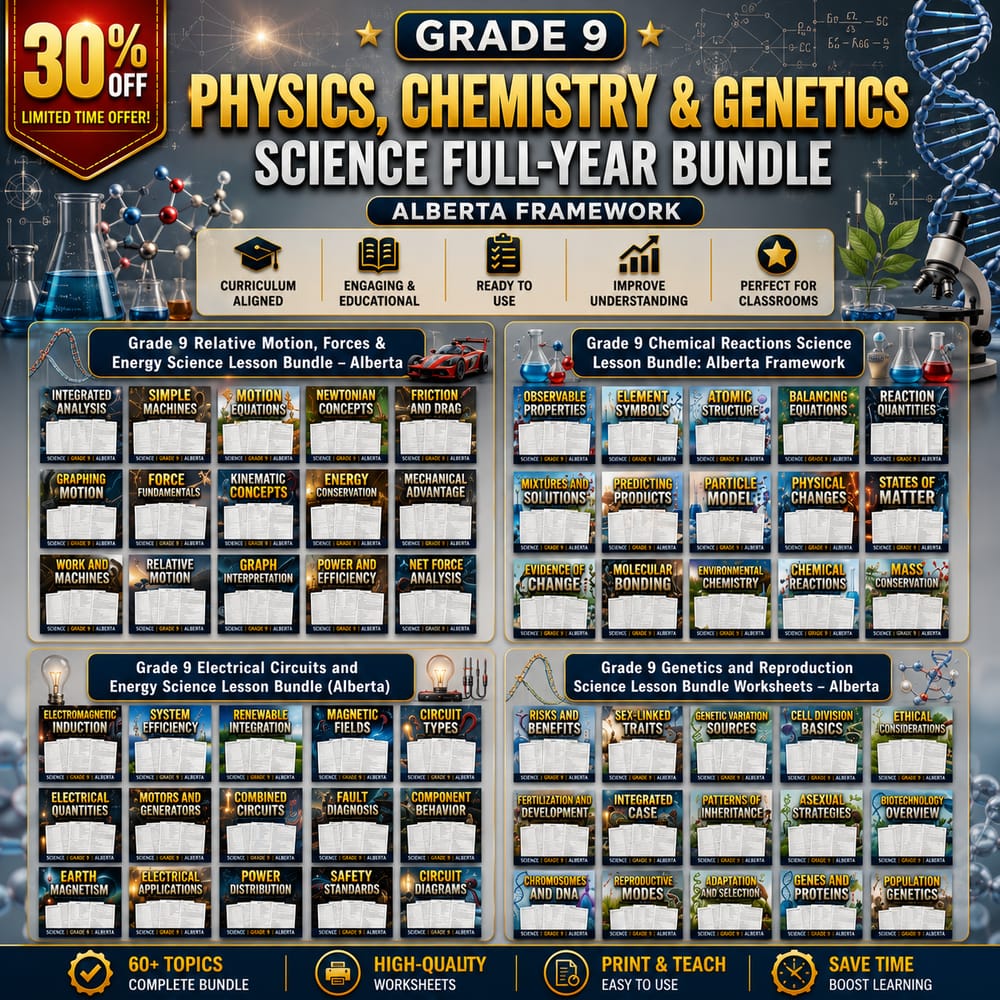
Grade 9 Physics, Chemistry & Genetics Science Full-Year Bundle – Alberta Framework
Created bySilver Birch TeachingOverview Physics, Chemistry & Genetics Grade 9 Science practice—60 print-ready worksheets aligned to the Alberta Framework for a full-year classroom sequence. Use this grade 9 bundle to support consistent skill-building in science, from motion and energy to chemical change and genetics. 😊 What’s Included ✅ Grade 9 Science – Relative Motion Worksheet (Al…
Instant download
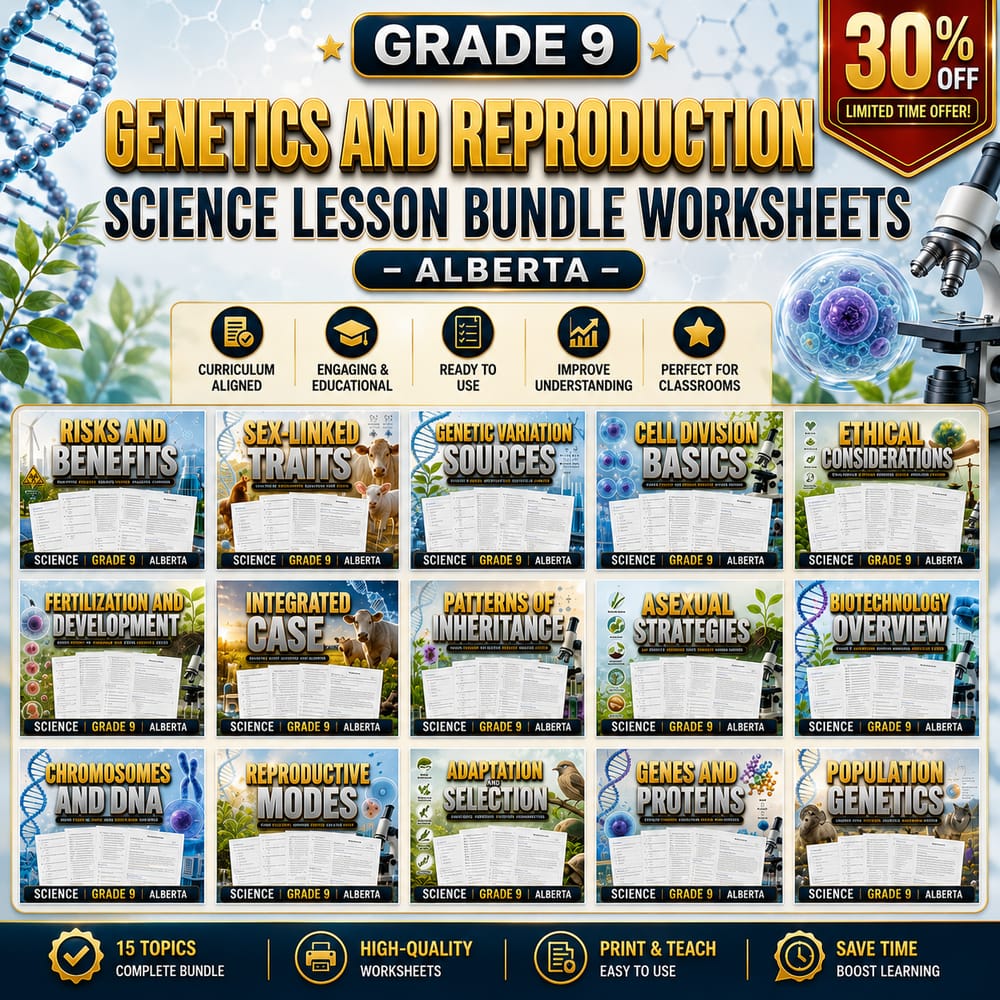
Grade 9 Genetics and Reproduction Science Lesson Bundle Worksheets – Alberta
Created bySilver Birch TeachingOverview Grade 9 genetics and reproduction science lesson bundle with 15 worksheets to support Alberta-aligned instruction, practice, and feedback. Use this lesson bundle to guide students from foundational genetics (including sex-linked patterns and population genetics) through reproductive modes, development, and ethical decision-making, while building hab…
Instant download
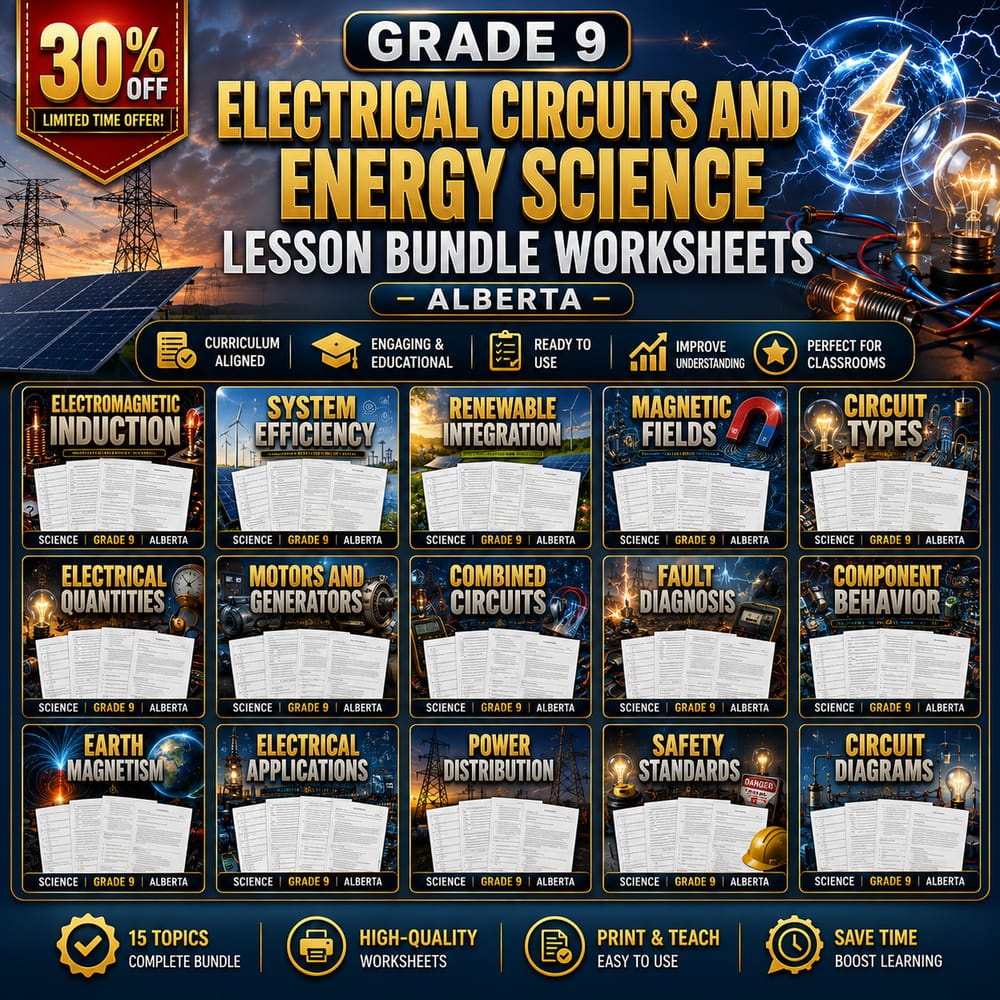
Grade 9 Electrical Circuits and Energy Science Lesson Bundle (Alberta)
Created bySilver Birch TeachingOverview Grade 9 Science electrical circuits lessons support Alberta learning goals with 15 ready-to-use worksheets that help students model electrical systems, connect efficiency to energy use, and write evidence-based explanations. Designed for structured practice across electrical applications, induction, and circuit representations, this lesson bundle is…
Instant download
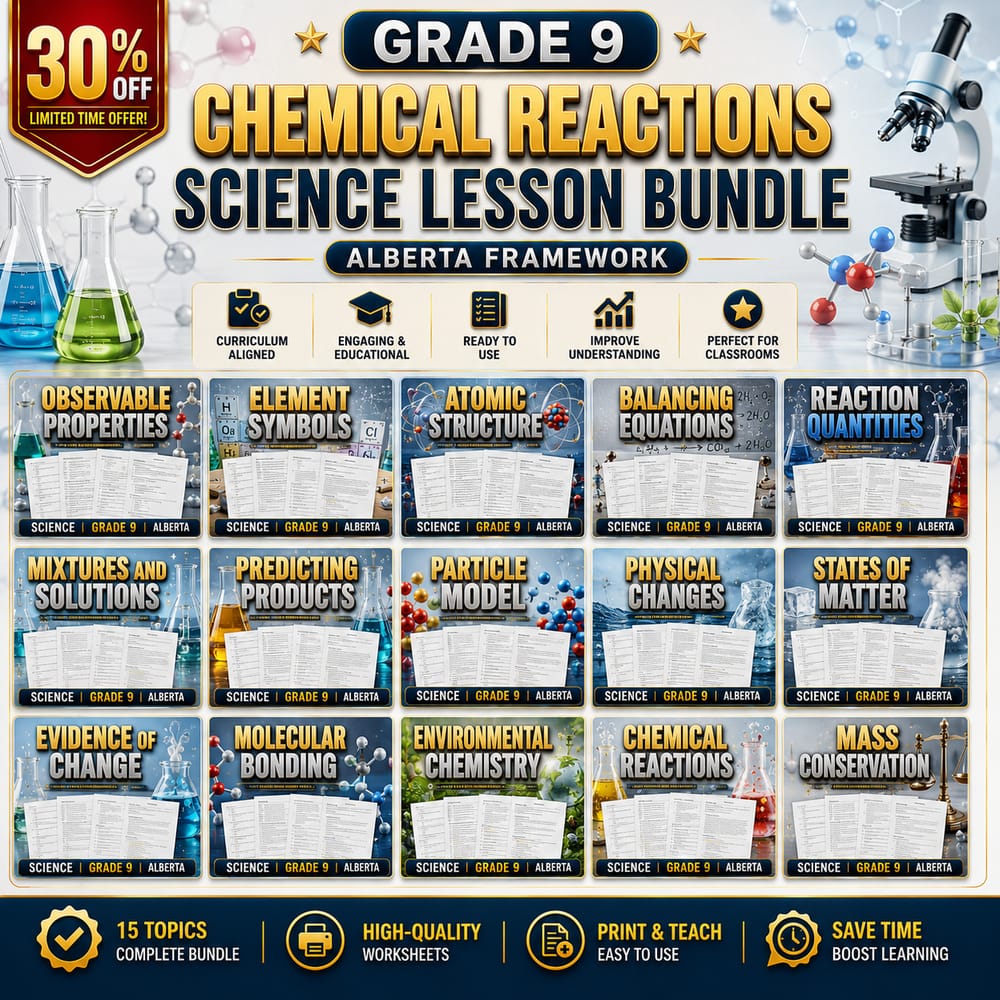
Grade 9 Chemical Reactions Science Lesson Bundle: Alberta Framework
Created bySilver Birch TeachingOverview Grade 9 Chemical Reactions Science lesson bundle for Alberta helps students explain chemical changes with evidence while building a foundation for balancing equations, tracking matter, and connecting models to observations. This grade 9 science bundle includes worksheetCount: 15 Alberta-aligned practice sheets designed for focused instruction 🔎. Wh…
Instant download
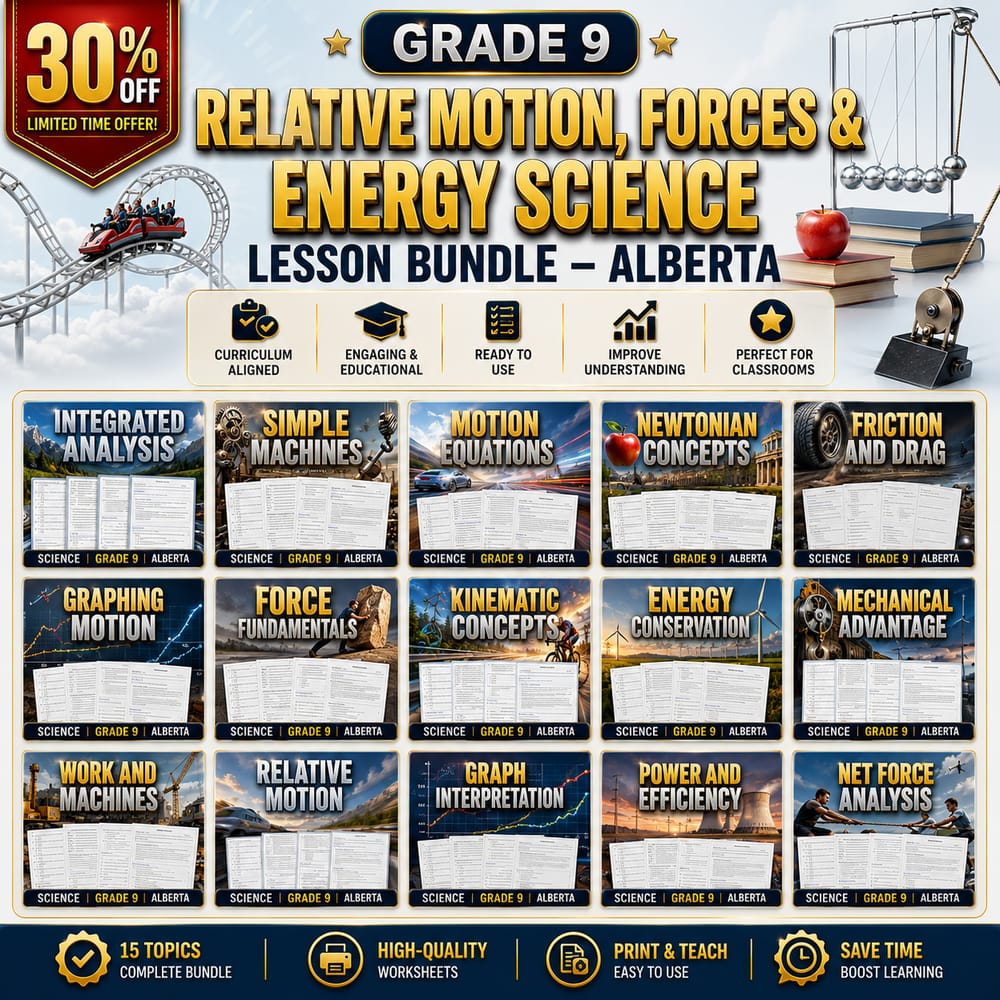
Grade 9 Relative Motion, Forces & Energy Science Lesson Bundle – Alberta
Created bySilver Birch TeachingOverview Grade 9 Science Alberta lesson bundle for relative motion, forces, and energy with 15 worksheets that support consistent practice and clear student reasoning. This lesson bundle connects motion, forces, and energy conservation to everyday problem-solving, giving you ready-to-use pages for classwork, guided work, and follow-up review. What’s Included…
Instant download

Grade 9 Science – Relative Motion Worksheet (Alberta Standards) (PDF)
Created bySilver Birch TeachingLearning Objectives
- Explain how the choice of reference frame affects observed velocity and displacement.
- Apply vector addition to relate velocities measured in different frames (e.g., boat, truck, and aircraft scenarios).
- Interpret real-world motion situations using consistent reference-frame language.
Also included in: Grade 9 Relative Motion, Forces & Energy Science Lesson Bundle – Alberta +1 more
Instant download

Grade 9 Science Worksheet | Reaction Quantities Alberta Standards (PDF)
Created bySilver Birch TeachingLearning Objectives
- Interpret coefficient ratios in balanced chemical equations to relate reactant and product masses
- Use conservation of mass to reason about how much mass appears in products during real chemical processes
- Translate between symbolic chemical representations and real-world mass accounting scenarios
Also included in: Grade 9 Chemical Reactions Science Lesson Bundle: Alberta Framework +1 more
Instant download

Grade 9 Science – System Efficiency Worksheet (Alberta Standard) (PDF)
Created bySilver Birch TeachingLearning Objectives
- Explain how electrical systems waste energy through resistive losses and other loss mechanisms.
- Compare efficiency metrics and relate them to cost, environmental impact, and design choices.
- Identify strategies (e.g., device selection and control methods) that improve system performance.
Also included in: Grade 9 Electrical Circuits and Energy Science Lesson Bundle (Alberta) +1 more
Instant download

Grade 9 Science | Electrical Applications Worksheet (Alberta Standards) (PDF)
Created bySilver Birch TeachingLearning Objectives
- Assess how device ratings and intended function determine appropriate electrical system choices
- Identify protective measures that reduce electrical hazards in different contexts
- Evaluate energy efficiency and environmental impact when selecting electrical applications
Also included in: Grade 9 Electrical Circuits and Energy Science Lesson Bundle (Alberta) +1 more
Instant download

Grade 9 Science – Environmental Chemistry Worksheet (Alberta) PDF
Created bySilver Birch TeachingLearning Objectives
- Explain how environmental chemical reactions can be analyzed using evidence, atomic/particulate explanations, and mass conservation.
- Apply system boundary ideas to track measurable mass flows in real environmental contexts (e.g., acid deposition, tailings chemistry, nutrient cycling).
- Use chemical and environmental vocabulary to describe how substances transform and where they go in an ecosystem.
Also included in: Grade 9 Chemical Reactions Science Lesson Bundle: Alberta Framework +1 more
Instant download

Grade 9 Science | Genetics and Reproduction Assessment (Worksheet + Answer Key)
Created bySilver Birch TeachingLearning Objectives
- Explain how sexual and asexual reproduction affect genetic variation in breeding programs
- Describe how chromosome behavior and Mendelian patterns determine inheritance of traits
- Predict possible outcomes of selection on beneficial and harmful linked traits
Also included in: Grade 9 Genetics and Reproduction Science Lesson Bundle Worksheets – Alberta +1 more
Instant download

Grade 9 Science – Renewable Energy Integration Worksheet (Alberta Standards) (PDF)
Created bySilver Birch TeachingLearning Objectives
- Explain how wind and solar intermittency affects electrical grid reliability and dispatch planning
- Describe grid balancing mechanisms used to coordinate variable renewable generation
- Evaluate how energy storage and infrastructure upgrades support renewable integration
Also included in: Grade 9 Electrical Circuits and Energy Science Lesson Bundle (Alberta) +1 more
Instant download

Grade 9 Science – Electromagnetic Induction Worksheet (Alberta Standards, PDF)
Created bySilver Birch TeachingLearning Objectives
- Explain how changing magnetic flux induces an emf in a conductor.
- Use Lenz’s law to predict the direction of the induced emf (and current).
- Relate transformer operation to step-up/step-down voltage changes in power systems.
Also included in: Grade 9 Electrical Circuits and Energy Science Lesson Bundle (Alberta) +1 more
Instant download

Grade 9 Science – Component Behavior Worksheet (Alberta Standards) (PDF)
Created bySilver Birch TeachingLearning Objectives
- Describe how component I–V characteristics differ for resistors and diodes
- Explain how temperature affects resistance in devices such as thermistors
- Connect power ratings and operating limits to safe, reliable circuit operation
Also included in: Grade 9 Electrical Circuits and Energy Science Lesson Bundle (Alberta) +1 more
Instant download

Grade 9 Science | Work and Machines Worksheet (Alberta Standard) PDF
Created bySilver Birch TeachingLearning Objectives
- Explain how work depends on force and distance using the relationship between applied force and displacement
- Describe how simple machines (levers, pulleys, and ramps) change the magnitude or direction of an applied force
- Analyze trade-offs between force reduction and increased distance in real-world machine designs
Also included in: Grade 9 Relative Motion, Forces & Energy Science Lesson Bundle – Alberta +1 more
Instant download

Grade 9 Science – Simple Machines Worksheet (Alberta Standards) (PDF)
Created bySilver Birch TeachingLearning Objectives
- Explain how simple machines transfer forces to reduce effort and/or change the direction of a force
- Compare ideal mechanical advantage with practical outcomes by accounting for friction
- Identify real-world examples of lever, wheel and axle, pulley, inclined plane, and screw used in everyday contexts
Also included in: Grade 9 Relative Motion, Forces & Energy Science Lesson Bundle – Alberta +1 more
Instant download