
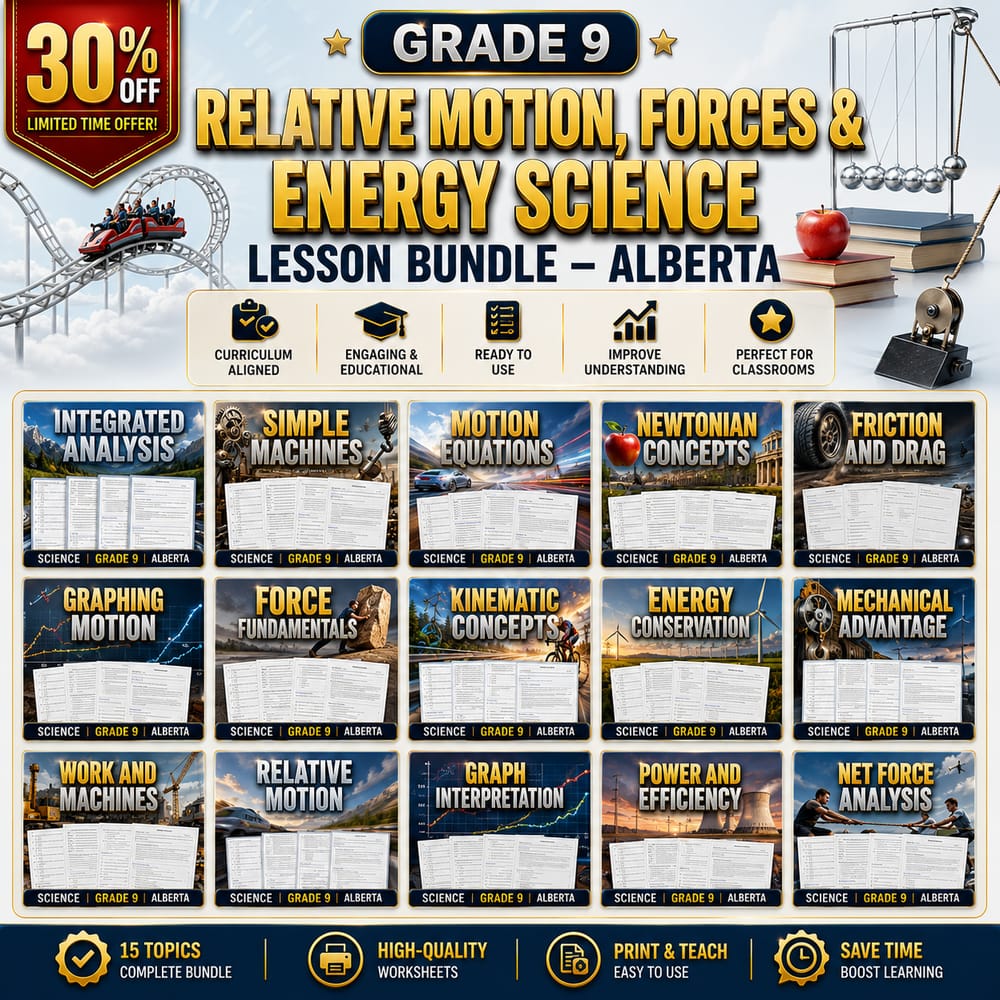


Grade 9 Relative Motion, Forces & Energy Science Lesson Bundle – Alberta
$60.00$75.00Save $15.00
Silver Birch Teaching
New·0 followers·0 sales
SubjectScienceGradeGrade 9
What’s included
15 worksheets · Save $15.00 (20%) · prices shown inside the bundle
 Grade 9 Science | Integrated Analysis Worksheet (Alberta Standard) PDF
- Apply kinematics, net-force reasoning, and energy considerations together to explain complex motion.
- Use free-body diagrams and Newton’s 2nd law to predict acceleration for real-world scenarios.
- Use energy (work and the work-energy theorem) to check or refine predictions such as stopping distance.
$4.00$5.00 Grade 9 Science – Simple Machines Worksheet (Alberta Standards) (PDF)
- Explain how simple machines transfer forces to reduce effort and/or change the direction of a force
- Compare ideal mechanical advantage with practical outcomes by accounting for friction
- Identify real-world examples of lever, wheel and axle, pulley, inclined plane, and screw used in everyday contexts
$4.00$5.00 Grade 9 Science – Motion Equations Worksheet (PDF) | Alberta Standards
- Use constant-acceleration (kinematics) equations to relate displacement, velocity, acceleration, and time.
- Apply a consistent sign convention and unit analysis when solving physics motion problems.
- Solve numerical problems by substituting known values into standard kinematics equations and checking whether results are physically reasonable.
$4.00$5.00 Grade 9 Science Worksheet on Newtonian Concepts | Alberta Standards (Worksheet + Answer Key)
- Explain how Newton’s laws relate forces to changes in motion (inertia, force–acceleration, and action–reaction).
- Use Newtonian reasoning to predict how real objects move in common situations such as snowplows, recoil mechanisms, and anchored structures.
- Interpret motion patterns in regional contexts (e.g., erosion control and playground apparatus) using cause-and-effect physics principles.
$4.00$5.00 Grade 9 Science | Friction and Drag Worksheet (Alberta Standards) (PDF)
- Explain how friction opposes motion and how normal force and surface texture affect frictional force.
- Describe how aerodynamic drag depends on air density, object shape, and relative speed.
- Use quantitative ideas (coefficients and drag concepts) to estimate resistance forces in real-world contexts.
$4.00$5.00 Grade 9 Science – Graphing Motion Worksheet (Alberta Standard) (PDF)
- Interpret displacement–time, velocity–time, and acceleration–time graphs to describe motion qualitatively and quantitatively
- Use slope and area (where appropriate) to connect graphical features to physical meaning
- Select correct axes, labels, and units to compare motion profiles from empirical data
$4.00$5.00 Grade 9 Science – Force Fundamentals Worksheet (Alberta Standards) (PDF)
- Explain how forces can change motion using push or pull effects
- Differentiate contact forces (like friction and normal force) from non-contact forces (like gravity)
- Describe how force direction and magnitude combine using vector reasoning
$4.00$5.00 Grade 9 Science | Kinematic Concepts Worksheet (Alberta) PDF
- Distinguish between speed, velocity, and acceleration and describe what each quantity measures
- Apply sign conventions to interpret motion direction in one-dimensional kinematics problems
- Use unit conversions and algebraic relationships to compare motion quantities
$4.00$5.00 Grade 9 Science | Energy Conservation Worksheet (Alberta Standards) (PDF)
- Explain the relationship between kinetic energy, gravitational potential energy, and mechanical energy conservation.
- Use energy transfer and non-conservative losses (like friction) to predict whether a motion is feasible.
- Apply energy conservation ideas to real-world contexts such as hydroelectric dams and skiers on slopes.
$4.00$5.00 Grade 9 Science – Mechanical Advantage Worksheet (Alberta Standards) (PDF)
- Explain mechanical advantage as a ratio of load force to input force and connect it to how machines move loads.
- Calculate and interpret mechanical advantage for lever and pulley systems, noting the force–distance trade-off.
- Use real-world examples (e.g., bale lifters and scaffold hoists) to predict how design choices affect safety and required input effort.
$4.00$5.00
Reviews & Feedback
Loading reviews...
Questions & Answers
Loading questions…
About this bundle
Related categories
Frequently asked questions
Who is Grade 9 Relative Motion, Forces & Energy Science Lesson Bundle – Alberta designed for?
Grade 9 Relative Motion, Forces & Energy Science Lesson Bundle – Alberta is designed for Grade 9 students and Science learners and can be used in classrooms, homeschool, or independent practice.
How do I download Grade 9 Relative Motion, Forces & Energy Science Lesson Bundle – Alberta?
Add it to your cart and complete checkout. After payment, you can download immediately from your account, and you'll also receive a download link by email.