
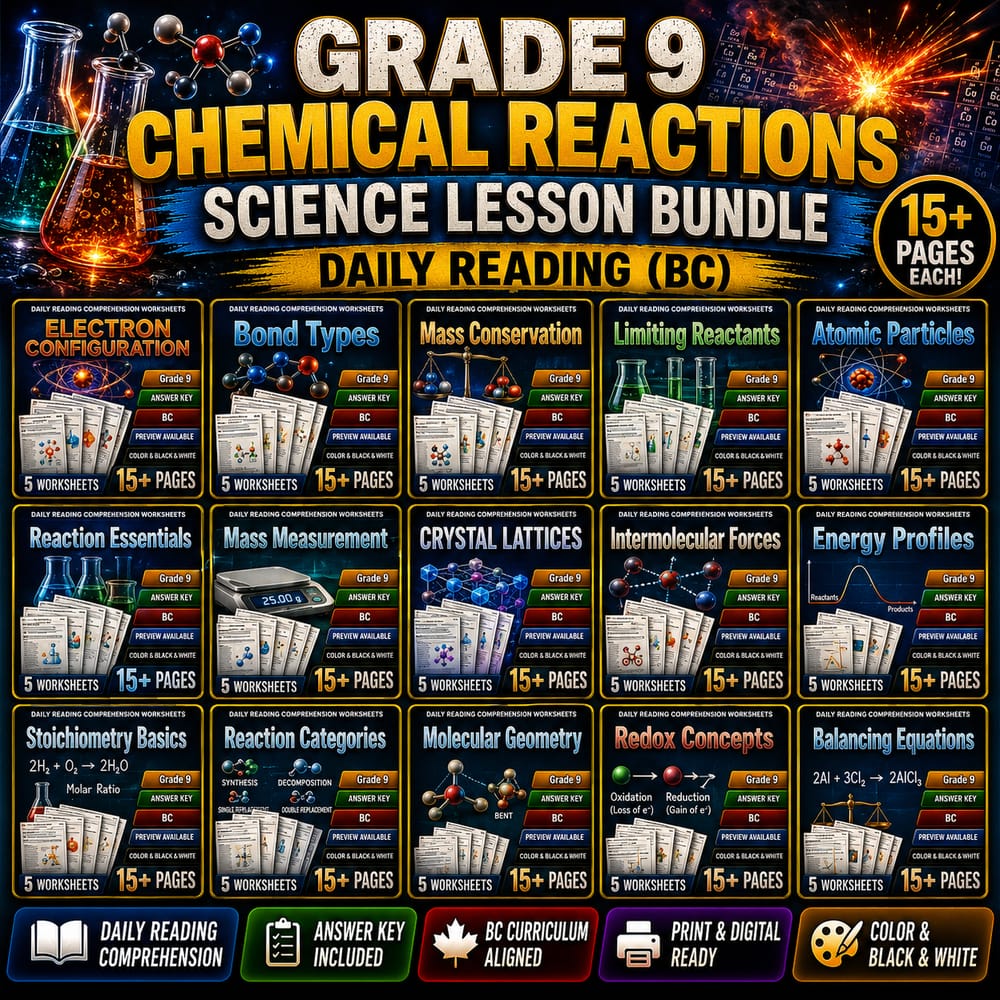


Grade 9 Chemical Reactions Science Lesson Bundle: Daily Reading (BC)
$48.00$60.00Save $12.00
Bright Mind Resources
New·1 followers·12 sales
SubjectScienceGradeGrade 9
What’s included
15 worksheets · Save $12.00 (20%) · prices shown inside the bundle
 Grade 9 Science – Electron Configuration & Atom Structures | Reading Worksheet
- Identify how electrons are arranged in atoms
- Understand valence electrons and their role in chemical bonding
- Learn the order in which electron shells fill
$3.20$4.00 Grade 9 Science – Bond Types & Structures | Daily Reading Worksheet
- Identify ionic bonds and understand electron transfer
- Recognize the characteristics of ionic bonds
- Differentiate ionic bonds from covalent and metallic bonds
$3.20$4.00 Grade 9 Science – Law of Conservation & Reactions | Daily Reading Worksheet
- Define the law of conservation of mass
- Explain how mass is conserved during chemical reactions
- Identify balanced chemical equations that demonstrate mass conservation
$3.20$4.00 Grade 9 Science – Limiting Reactants & Reactions | Daily Reading Worksheet
- Define limiting reactant in a chemical reaction
- Identify the limiting reactant from initial quantities
- Differentiate between theoretical and actual yields
$3.20$4.00 Grade 9 Science – Atomic Particles & Structure | Daily Reading Worksheet
- Identify the main subatomic particles within an atom (protons, neutrons, electrons).
- Understand the location of protons, neutrons, and electrons inside an atom.
- Explain how the number of protons determines an element.
$3.20$4.00 Grade 9 Science – Reaction Essentials Daily Reading Worksheet | BC Standards
- Understand the concept of chemical reactions and bonds
- Identify reactants and products in chemical equations
- Interpret symbolic representations of reactions including state symbols and coefficients
$3.20$4.00 Grade 9 Science – Mass Measurement & Conservation | Daily Reading Worksheet
- Understand the principle of conservation of mass during chemical reactions.
- Identify how gaseous products can affect apparent mass changes.
- Recognize external factors influencing mass measurements.
$3.20$4.00 Grade 9 Science – Crystal Lattices & Structures | Daily Reading Worksheet
- Define what a crystal lattice is and explain its significance.
- Identify the different types of lattice structures such as ionic, metallic, and covalent networks.
- Understand how atomic arrangements influence the properties of solids.
$3.20$4.00 Grade 9 Science – Intermolecular Forces & BC Standards | Daily Reading Worksheet
- Identify different types of intermolecular forces
- Understand how molecular structure influences intermolecular forces
- Explain the effect of intermolecular forces on physical properties
$3.20$4.00 Grade 9 Science – Energy Profiles & Chemical Reactions | Daily Reading Worksheet
- Understand the concept of energy profiles for chemical reactions.
- Identify exothermic and endothermic reactions from energy diagrams.
- Describe the significance of activation energy and transition states.
$3.20$4.00
Reviews & Feedback
Loading reviews...
Questions & Answers
Loading questions…
About this bundle
Related categories
Frequently asked questions
Who is Grade 9 Chemical Reactions Science Lesson Bundle: Daily Reading (BC) designed for?
Grade 9 Chemical Reactions Science Lesson Bundle: Daily Reading (BC) is designed for Grade 9 students and Science learners and can be used in classrooms, homeschool, or independent practice.
How do I download Grade 9 Chemical Reactions Science Lesson Bundle: Daily Reading (BC)?
Add it to your cart and complete checkout. After payment, you can download immediately from your account, and you'll also receive a download link by email.
Similar Products

Reactions & Matter Grade 8 Science Daily Reading Worksheets Lesson Bundle | NGSS
$20.00$25.00

Chemical Reactions Grade 7 Science Daily Reading Worksheets Lesson Bundle | NGSS
$28.00$35.00

Grade 8 Chemical Reactions Science Lesson Bundle: Daily Reading | BC
$44.80$56.00

Chem Reactions Grade 10 Science Daily Reading Worksheets Lesson Bundle | BC
$48.00$60.00

Chemical Reactions Grade 11 Science Daily Reading Worksheets Bundle | Ontario
$38.40$48.00