
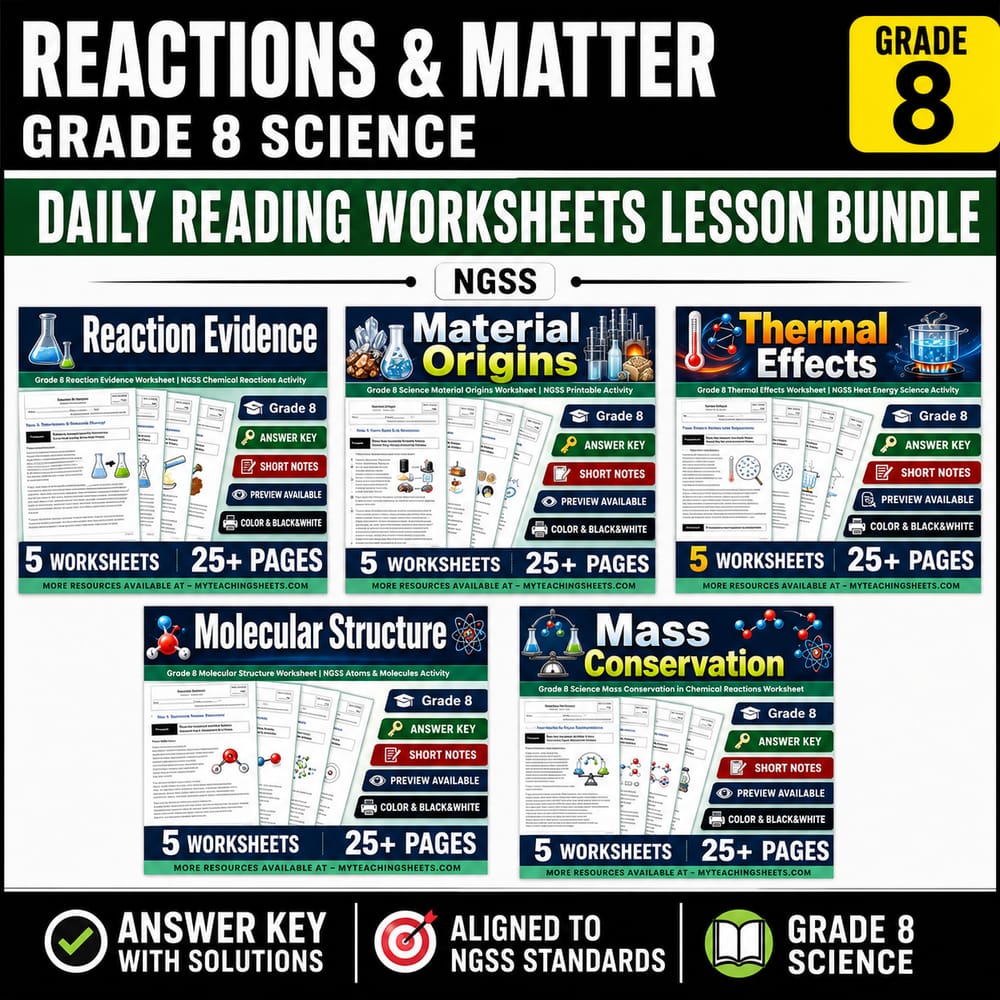
Reactions & Matter Grade 8 Science Daily Reading Worksheets Lesson Bundle | NGSS
$20.00$25.00Save $5.00
BRIGHT PATH RESOURCES
·3 followers·23 sales
SubjectScienceGradeGrade 8
What’s included
5 worksheets · Save $5.00 (20%) · prices shown inside the bundle
 Grade 8 Reaction Evidence Worksheet | NGSS Chemical Reactions Activity
- Identify observable signs of chemical reactions such as color change, gas production, precipitate formation, and temperature change.
- Differentiate between physical and chemical changes based on evidence.
- Interpret qualitative data from chemical reactions like corrosion, combustion, and acid-base interactions.
$4.00$5.00 Grade 8 Science Material Origins Worksheet | NGSS Printable Activity
- Understand how natural resources are transformed into synthetic materials
- Identify source materials like petroleum, silica, and other natural resources
- Explain how processing methods influence material properties such as strength and durability
$4.00$5.00 Grade 8 Thermal Effects Worksheet | NGSS Heat Energy Science Activity
- Understand how particle motion relates to temperature
- Explain phase changes based on particle energy
- Relate microscopic particle behavior to macroscopic temperature measurements
$4.00$5.00 Grade 8 Molecular Structure Worksheet | NGSS Atoms & Molecules Activity
- Identify and describe atoms in simple molecules using particle models and symbolic formulas.
- Understand how molecules like water (H2O) and carbon dioxide (CO2) are represented diagrammatically.
- Differentiate between discrete molecules and extended structures like ionic lattices.
$4.00$5.00 Grade 8 Science Mass Conservation in Chemical Reactions Worksheet | NGSS
- Understand the principle of mass conservation in chemical reactions
- Learn how atoms are conserved during reactions at the particulate level
- Identify real-world examples of mass conservation, such as sealed container reactions and combustion
$4.00$5.00
Reviews & Feedback
Loading reviews...
Questions & Answers
Loading questions…
About this bundle
Related categories
Frequently asked questions
Who is Reactions & Matter Grade 8 Science Daily Reading Worksheets Lesson Bundle | NGSS designed for?
Reactions & Matter Grade 8 Science Daily Reading Worksheets Lesson Bundle | NGSS is designed for Grade 8 students and Science learners and can be used in classrooms, homeschool, or independent practice.
How do I download Reactions & Matter Grade 8 Science Daily Reading Worksheets Lesson Bundle | NGSS?
Add it to your cart and complete checkout. After payment, you can download immediately from your account, and you'll also receive a download link by email.
Similar Products

Grade 7 States of Matter & Reactions Science Daily Reading Lesson Bundle | BC
$48.00$60.00

Chemical Reactions Grade 7 Science Daily Reading Worksheets Lesson Bundle | NGSS
$28.00$35.00

Grade 8 Chemical Reactions Science Lesson Bundle: Daily Reading | BC
$44.80$56.00

Grade 9 Chemical Reactions Science Lesson Bundle: Daily Reading (BC)
$48.00$60.00

Chem Reactions Grade 10 Science Daily Reading Worksheets Lesson Bundle | BC
$48.00$60.00