
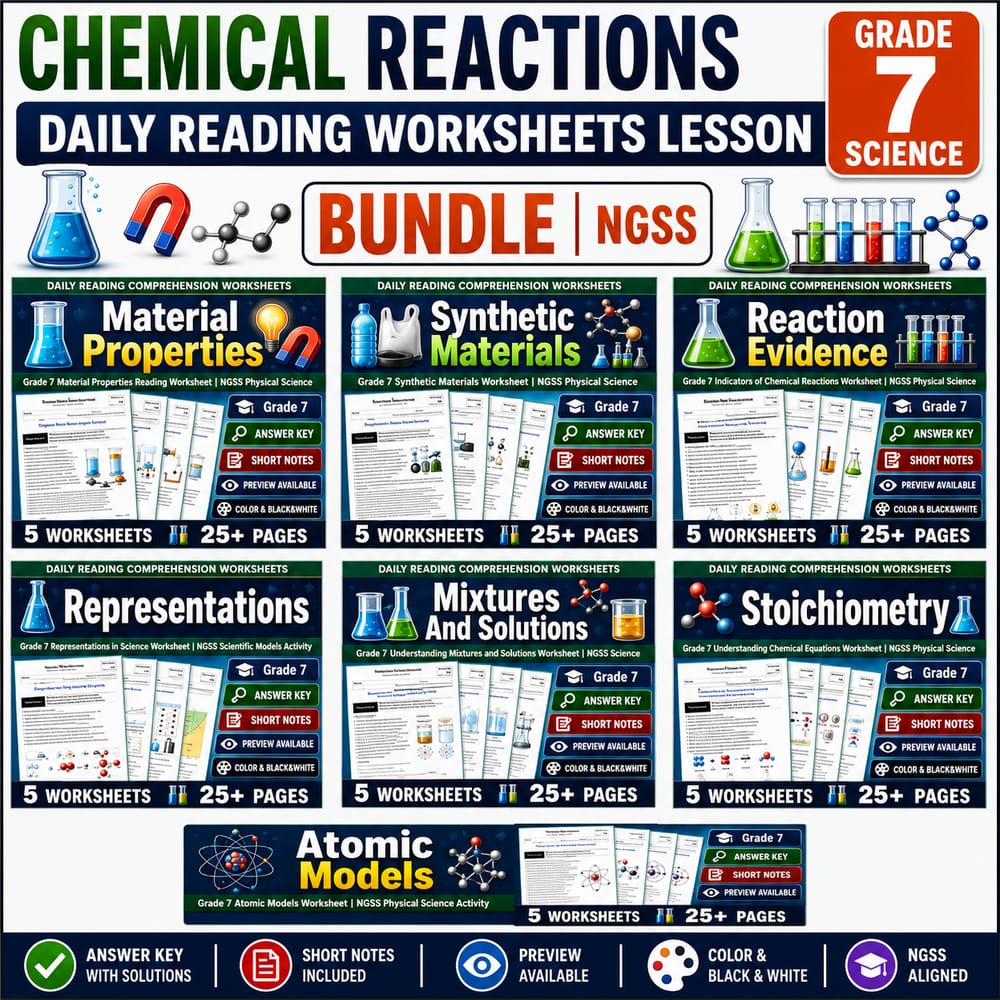
Chemical Reactions Grade 7 Science Daily Reading Worksheets Lesson Bundle | NGSS
$28.00$35.00Save $7.00
BRIGHT PATH RESOURCES
·3 followers·23 sales
SubjectScienceGradeGrade 7
What’s included
7 worksheets · Save $7.00 (20%) · prices shown inside the bundle
 Grade 7 Material Properties Density Worksheet | NGSS Physical Science
- Understand what density is and how it relates to material properties.
- Compare the density of different materials using observations and data.
- Learn how density helps identify and classify materials in everyday life.
$4.00$5.00 Grade 7 Synthetic Materials Worksheet | NGSS Physical Science Activity
- Understand the production pathways from natural resources to synthetic materials
- Identify common synthetic materials like polyethylene, PET, and nylon
- Describe processes such as polymerization and refining
$4.00$5.00 Grade 7 Indicators of Chemical Reactions Worksheet | NGSS Physical Science
- Identify the signs indicating a chemical reaction has occurred
- Understand examples of chemical indicators such as gas production and precipitate formation
- Explain how energy changes and mass measurements relate to chemical reactions
$4.00$5.00 Grade 7 Representations in Science Worksheet | NGSS Scientific Models Activity
- Understand different ways to represent matter interactions
- Interpret symbolic chemical equations
- Read and analyze graphs of mass or temperature versus time
$4.00$5.00 Grade 7 Understanding Mixtures and Solutions Worksheet | NGSS Science
- Define and distinguish between homogeneous and heterogeneous mixtures.
- Identify examples of different types of mixtures, including solutions, suspensions, and colloids.
- Understand concepts of solubility, saturation, and concentration in mixtures.
$4.00$5.00 Grade 7 Understanding Chemical Equations Worksheet | NGSS Physical Science
- Understand key concepts related to Science
- Apply knowledge through practice questions
- Demonstrate comprehension of the material
$4.00$5.00 Grade 7 Atomic Models Worksheet | NGSS Physical Science Activity
- Understand key concepts related to Science
- Apply knowledge through practice questions
- Demonstrate comprehension of the material
$4.00$5.00
Reviews & Feedback
Loading reviews...
Questions & Answers
Loading questions…
About this bundle
Related categories
Frequently asked questions
Who is Chemical Reactions Grade 7 Science Daily Reading Worksheets Lesson Bundle | NGSS designed for?
Chemical Reactions Grade 7 Science Daily Reading Worksheets Lesson Bundle | NGSS is designed for Grade 7 students and Science learners and can be used in classrooms, homeschool, or independent practice.
How do I download Chemical Reactions Grade 7 Science Daily Reading Worksheets Lesson Bundle | NGSS?
Add it to your cart and complete checkout. After payment, you can download immediately from your account, and you'll also receive a download link by email.
Similar Products

Grade 7 Physical Science: Matter & Chemical Reactions Lesson Bundle | NGSS
$28.00$35.00

Reactions & Matter Grade 8 Science Daily Reading Worksheets Lesson Bundle | NGSS
$20.00$25.00

Grade 8 Science Thermal Effects & Chemical Reactions Lesson Bundle | NGSS
$20.00$25.00

Grade 6 Matter & Chemical Reactions Lesson Bundle | NGSS | Science
$20.00$25.00

Grade 6 Science Matter and Chemical Reactions Lesson Bundle | NGSS
$20.00$25.00