
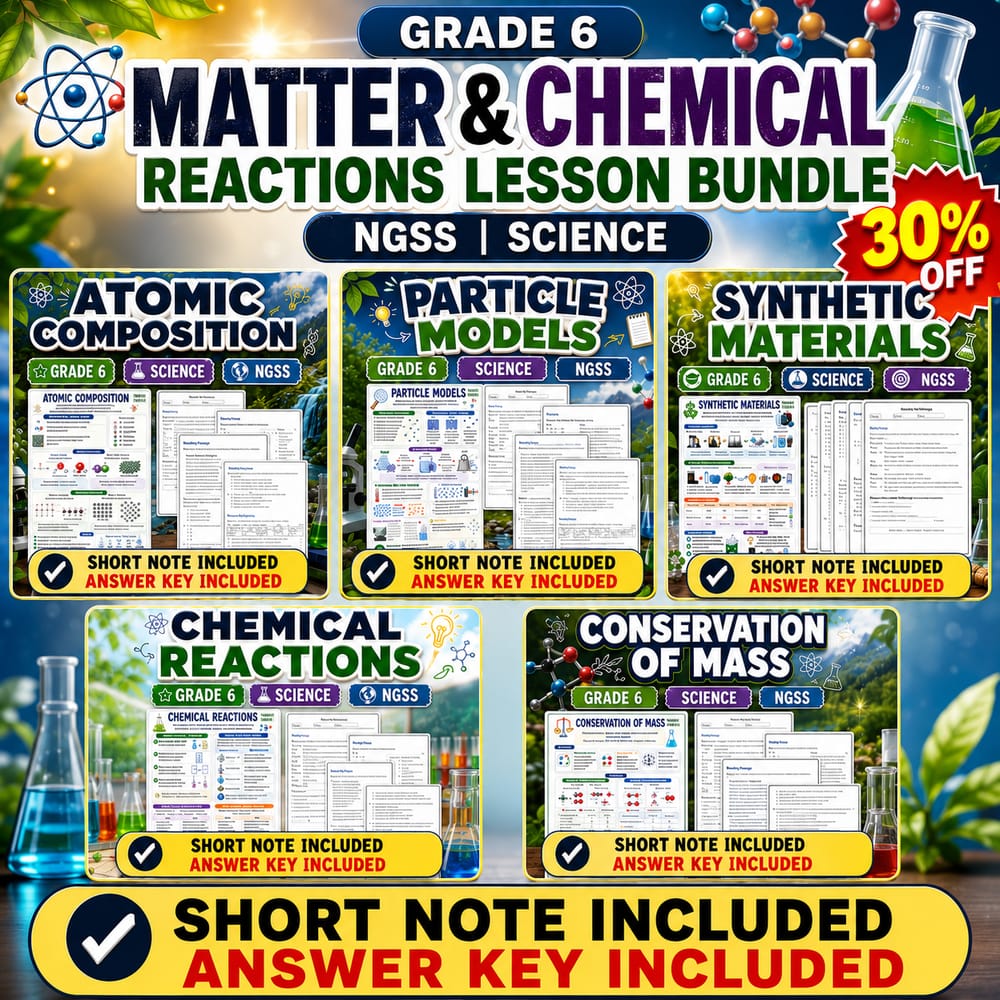
Grade 6 Matter & Chemical Reactions Lesson Bundle | NGSS | Science
$20.00$25.00Save $5.00
Northstar Worksheets
New·0 followers·0 sales
SubjectScienceGradeGrade 6
What’s included
5 worksheets · Save $5.00 (20%) · prices shown inside the bundle
 Atomic Composition Worksheet Grade 6 NGSS Atoms Matter & Molecules
- Use models (ball-and-stick and space-filling) to describe how atoms combine to form simple molecules and extended structures.
- Interpret chemical formulas to identify the relative atom types and counts in H2O and NaCl.
- Explain how repeating units build polymer chains and how ionic charges relate to ionic lattices.
$4.00$5.00 TITLE: Particle Models Worksheet Grade 6 NGSS Science Activity & Answer Key DES
- Explain how particle models describe matter as made of particles that are too small to see.
- Use particle ideas to predict what happens to a substance during melting, freezing, boiling, and condensation.
- Relate temperature and thermal energy to the motion and kinetic energy of particles.
$4.00$5.00 Synthetic Materials Worksheet Grade 6 Science NGSS with Answer Key
- Explain how synthetic materials can be traced back to natural resources and processing steps.
- Compare properties of common synthetic materials (durability, flexibility, conductivity, biodegradability) to match materials to uses.
- Describe how resource extraction and manufacturing can affect society and the environment, including recyclability.
$4.00$5.00 Chemical Reactions Worksheet Grade 6 NGSS Physical Science Activity
- Identify chemical reactions using qualitative evidence such as color change, gas production, and precipitate formation.
- Use quantitative measurements (mass and temperature changes) to support whether new substances formed.
- Compare pre-interaction and post-interaction observations to determine signs of chemical change.
$4.00$5.00 Conservation of Mass Worksheet Grade 6 NGSS Science Activity & Answer Key
- Explain conservation of mass by tracking atoms and total mass in a closed system
- Use particle diagrams and symbolic models to show that atoms rearrange but their total count stays the same
- Connect mass measurements before and after changes to conservation of mass in physical and chemical processes
$4.00$5.00
Reviews & Feedback
Loading reviews...
Questions & Answers
Loading questions…
About this bundle
Related categories
Frequently asked questions
Who is Grade 6 Matter & Chemical Reactions Lesson Bundle | NGSS | Science designed for?
Grade 6 Matter & Chemical Reactions Lesson Bundle | NGSS | Science is designed for Grade 6 students and Science learners and can be used in classrooms, homeschool, or independent practice.
How do I download Grade 6 Matter & Chemical Reactions Lesson Bundle | NGSS | Science?
Add it to your cart and complete checkout. After payment, you can download immediately from your account, and you'll also receive a download link by email.
Similar Products

Grade 7 Physical Science: Matter & Chemical Reactions Lesson Bundle | NGSS
$28.00$35.00

States of Matter & Chemical Reactions Lesson Bundle | Grade 9 Science | Alberta
$60.00$75.00

Grade 6 Science Matter and Chemical Reactions Lesson Bundle | NGSS
$20.00$25.00

Grade 6 Matter and Chemical Reactions Science Lesson Bundle NGSS Worksheets
$16.00$20.00

Grade 6 Matter & Chemical Reactions Science Lesson Bundle—NGSS Worksheets
$20.00$25.00