


Weather Patterns Air Masses and Pressure Worksheet | Grade 8 NGSS
 Created byNorthstar Worksheets
Learning Objectives
- Explain how air mass movement and pressure changes relate to weather conditions such as wind, temperature, humidity, and precipitation.
- Describe how fronts and cyclones form and how frontogenesis and cyclogenesis affect observable weather patterns.
- Use observational tools (surface pressure maps, temperature gradients, radiosonde profiles, and Doppler radar) to support interpretations of weather events.
Instant download

Water Cycle and Earth Processes Worksheet | Grade 8 NGSS Science
Created byNorthstar WorksheetsLearning Objectives
- Describe the water cycle using evaporation, condensation, precipitation, infiltration, runoff, and groundwater flow.
- Explain how sunlight and gravity drive movement of water on land and through the atmosphere.
- Connect hydrologic cycling to weathering and landscape changes such as river incision, karst formation, and coastal erosion.
Instant download

Plate Motions Evidence and Landforms Worksheet | Grade 8 NGSS
Created byNorthstar WorksheetsLearning Objectives
- Explain how seafloor spreading and magnetic striping provide evidence for plate motion.
- Describe how subduction, rifting, and continental collision form landforms and rocks.
- Use paleomagnetic and continental-fit evidence to reconstruct past plate positions.
Instant download

Natural Hazards Data and Risk Worksheet | Grade 8 NGSS Science
Created byNorthstar WorksheetsLearning Objectives
- Interpret simple natural hazard data to describe patterns in time and space.
- Explain how different evidence sources (fault maps, eruption histories, tsunami records) support hazard recurrence estimates.
- Distinguish between short-term events and long-term geologic change when evaluating hazard risk.
Instant download

Earth Materials Cycles and Energy Flows Worksheet | Grade 8 NGSS
Created byNorthstar WorksheetsLearning Objectives
- Model how Earth’s materials cycle through rock, weathering, transport, and deposition processes.
- Explain how Earth’s internal heat and gravitational potential energy drive changes in the geosphere.
- Describe how interactions between the geosphere, hydrosphere, and atmosphere can change Earth’s surface.
Instant download

Climate Circulation Worksheet | Winds, Cells & Ocean Gyres Grade 8
Created byNorthstar WorksheetsLearning Objectives
- Explain how unequal solar heating and Earth’s rotation drive atmospheric circulation cells (Hadley, Ferrel, and polar).
- Describe how the Coriolis effect influences wind direction and helps create trade winds and westerlies.
- Connect major ocean gyres and heat transport to regional climates and multi-year variability such as El Niño–Southern Oscillation.
Instant download

Organ Systems and Homeostasis Worksheet | Grade 8 NGSS Science
Created byNorthstar WorksheetsLearning Objectives
- Explain how multiple organ systems work together to maintain homeostasis.
- Describe feedback mechanisms and how they help keep internal conditions stable.
- Use key vocabulary from circulatory, respiratory, digestive, nervous, and endocrine systems.
Instant download

Prokaryotic vs. Eukaryotic Cells Worksheet | Grade 8 NGSS
Created byNorthstar WorksheetsLearning Objectives
- Describe the major parts of cells and explain what each part does.
- Compare prokaryotic and eukaryotic cells based on their internal structures.
- Relate organelles to functions such as energy transformation and information storage.
Instant download

Cell Modeling Worksheet | Grade 8 NGSS Structure, Function & Membranes
Created byNorthstar WorksheetsLearning Objectives
- Explain how models show structure-function relationships in cells.
- Use models to describe how diffusion and osmosis support cell survival.
- Connect organelle roles to energy transfer in cell processes.
Instant download
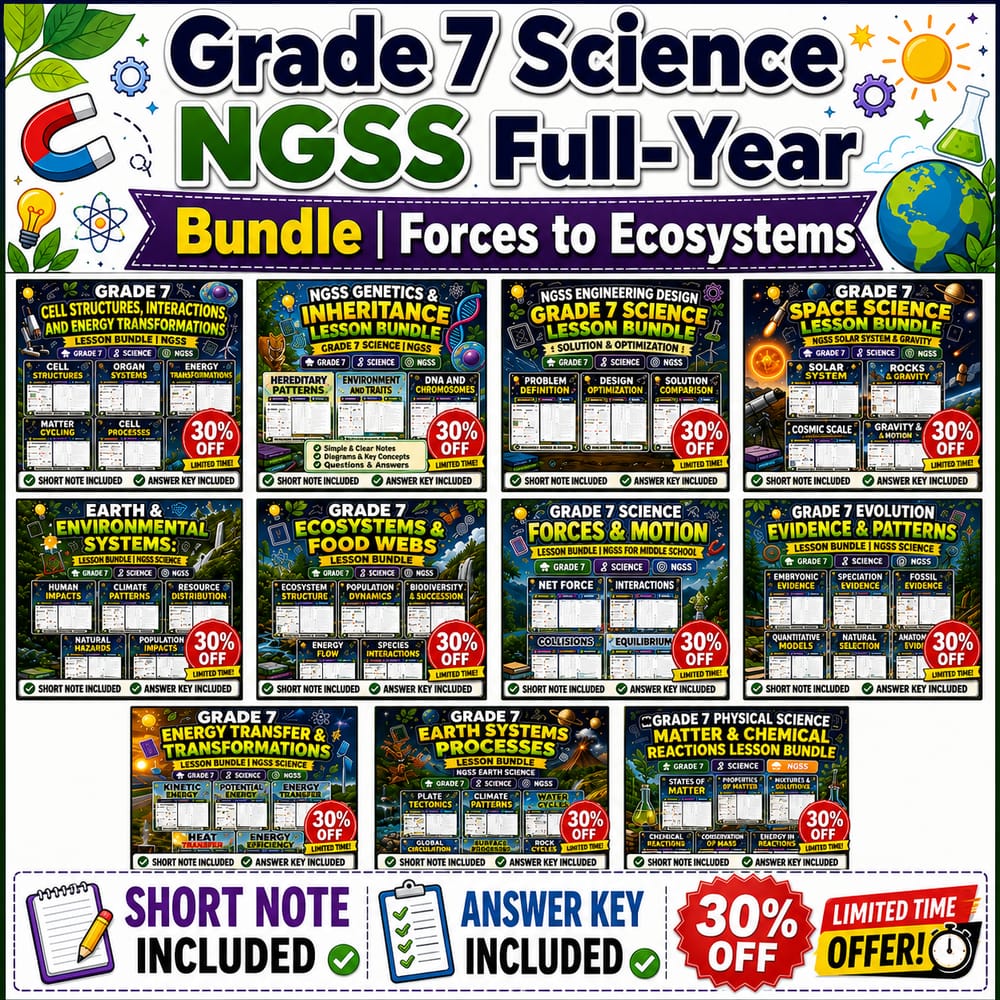
Grade 7 Science NGSS Full-Year Bundle | Forces to Ecosystems
Created byNorthstar WorksheetsOverview Grade 7 Science NGSS full-year bundle materials provide a coherent, NGSS-aligned yearlong sequence across physical, life, and Earth and space science. With 53 worksheets in total, students build skills in modeling, evidence-based explanations, and systems thinking as they progress from motion and stability to matter, ecosystems, and Earth’s changing…
Instant download
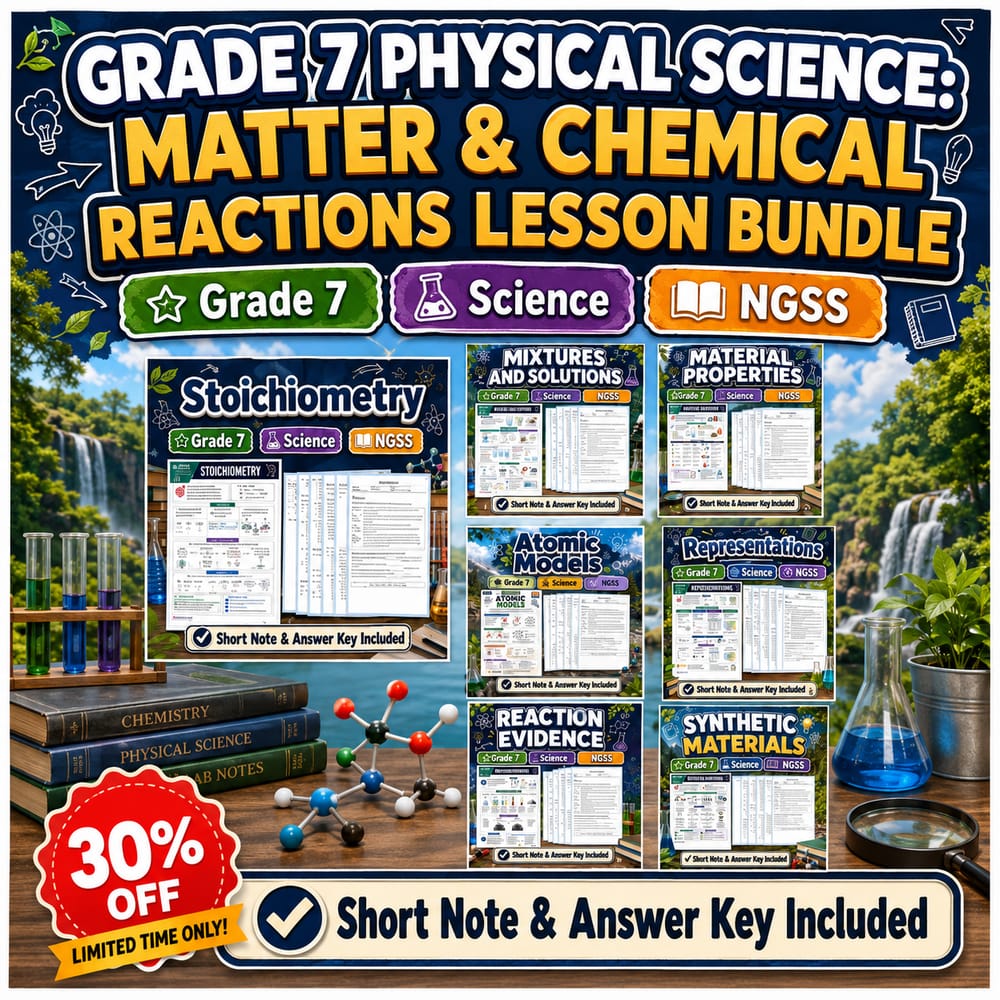
Grade 7 Physical Science: Matter & Chemical Reactions Lesson Bundle | NGSS
Created byNorthstar WorksheetsOverview Grade 7 Physical Science: Matter & Chemical Reactions is a NGSS-aligned lesson bundle designed to help students connect particle-level models to observable phenomena. This Grade 7 Physical Science lesson bundle includes 7 worksheets focused on synthetic materials, stoichiometry and representations, reaction evidence, mixtures and solutions, mate…
Instant download
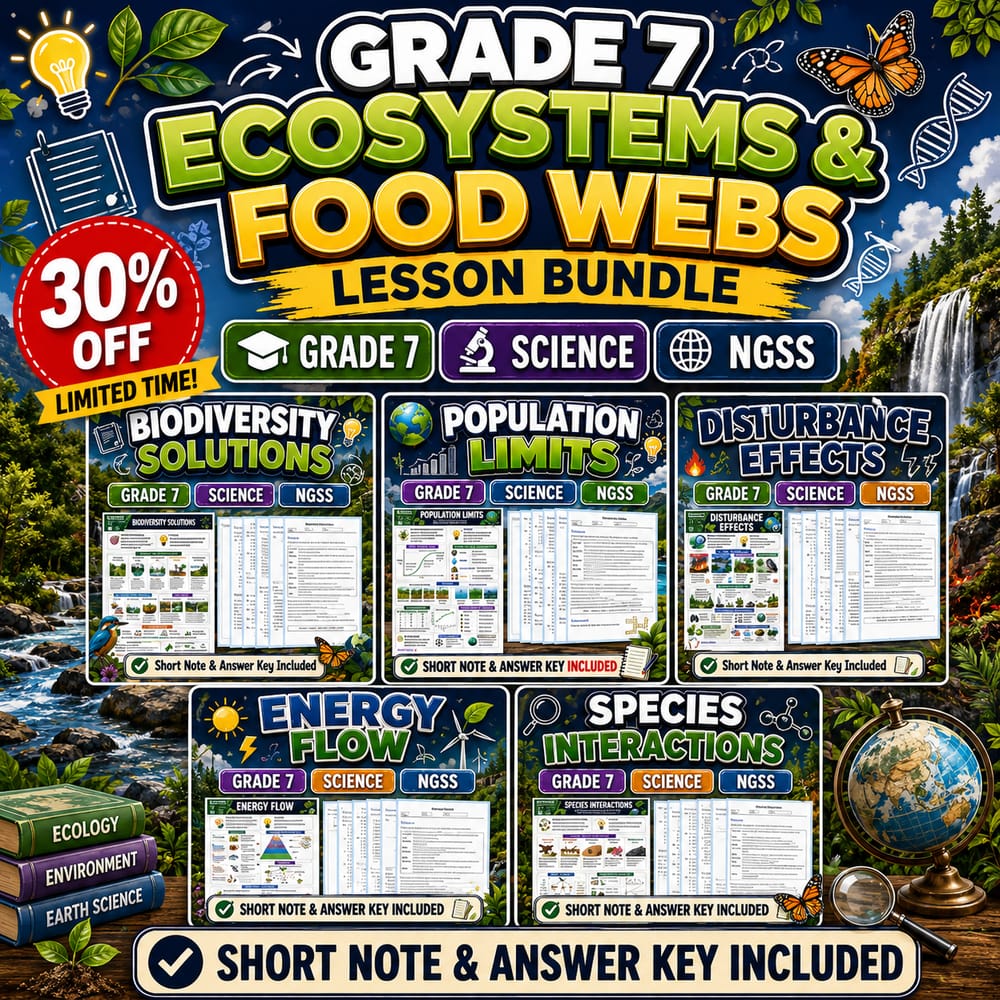
Grade 7 Ecosystems & Food Webs Lesson Bundle | Science | ngss
Created byNorthstar WorksheetsOverview Grade 7 Ecosystems & Food Webs is a NGSS-aligned Science lesson bundle for Grade 7 that builds understanding of how organisms interact, how matter and energy move through ecosystems, and how ecosystems respond to change. In this unit, students complete 5 ready-to-use worksheets that connect core ecosystem concepts to real-world environmental dec…
Instant download
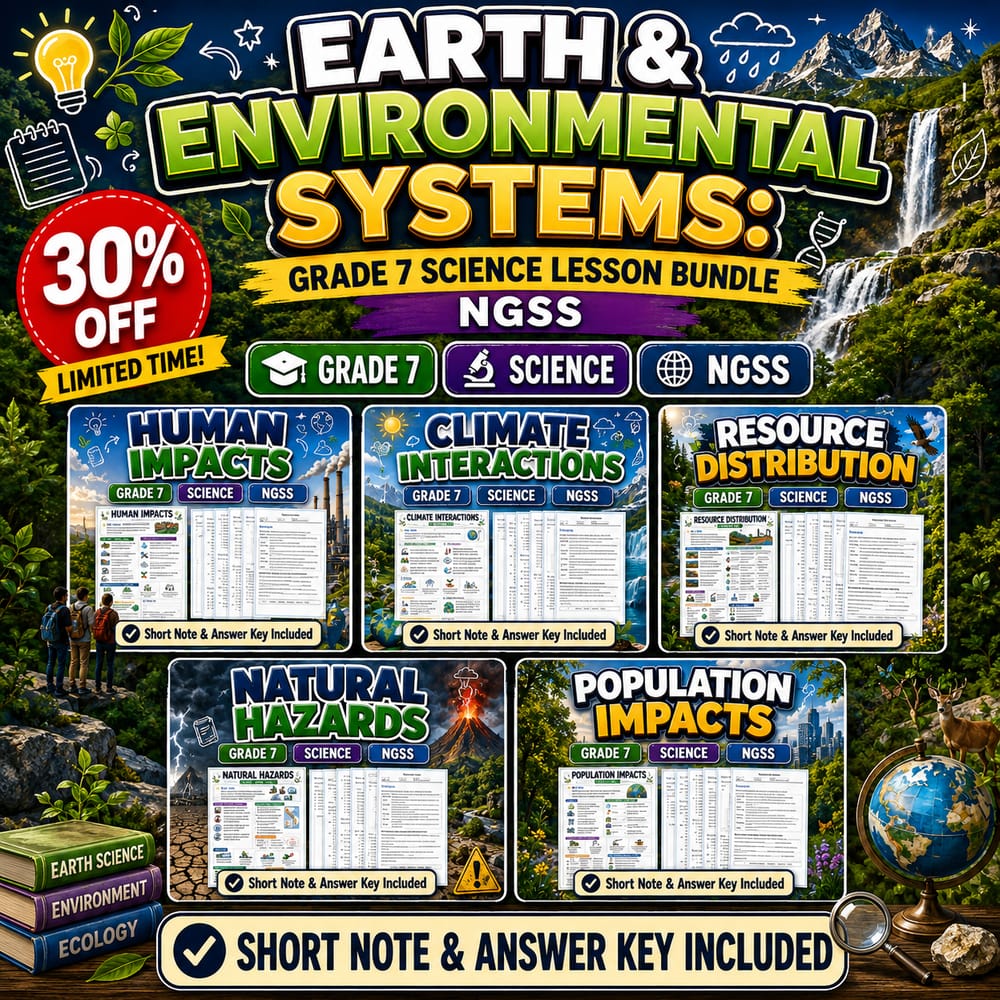
Earth & Environmental Systems: Grade 7 Science Lesson Bundle | NGSS
Created byNorthstar WorksheetsOverview Earth & Environmental Systems is the focus of this Grade 7 NGSS Earth and Environmental Systems lesson bundle, providing 5 NGSS-aligned Grade 7 Science worksheets that help students make sense of how Earth’s systems change over time and how humans influence those changes. Students connect real events—hazards, resource use, population changes, an…
Instant download
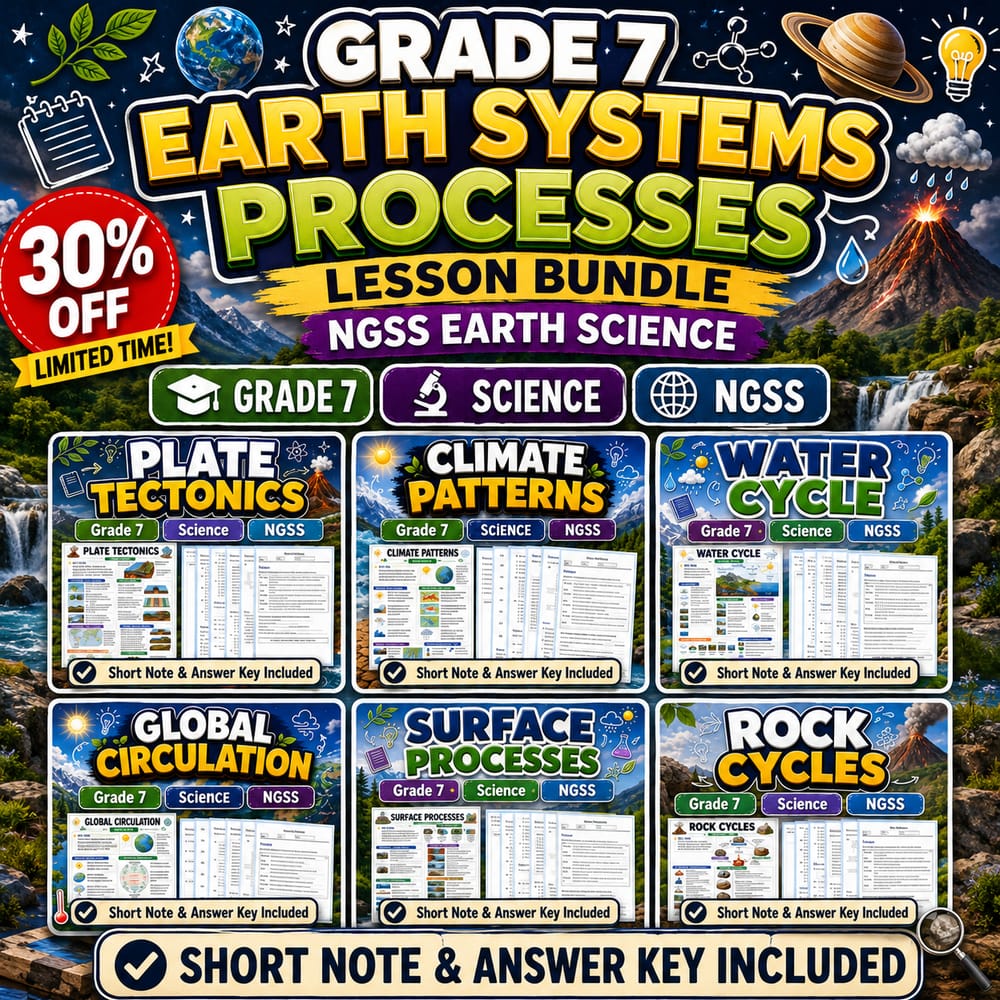
Grade 7 Earth Systems Processes Lesson Bundle | NGSS Earth Science
Created byNorthstar WorksheetsOverview Grade 7 Earth Systems Processes supports NGSS Earth Science with six ready-to-use worksheets that connect key Earth systems to what students observe in their daily lives. This Lesson Bundle brings together the water cycle, surface processes, the rock cycle, plate tectonics, global circulation, and climate patterns—so students can trace how energy an…
Instant download
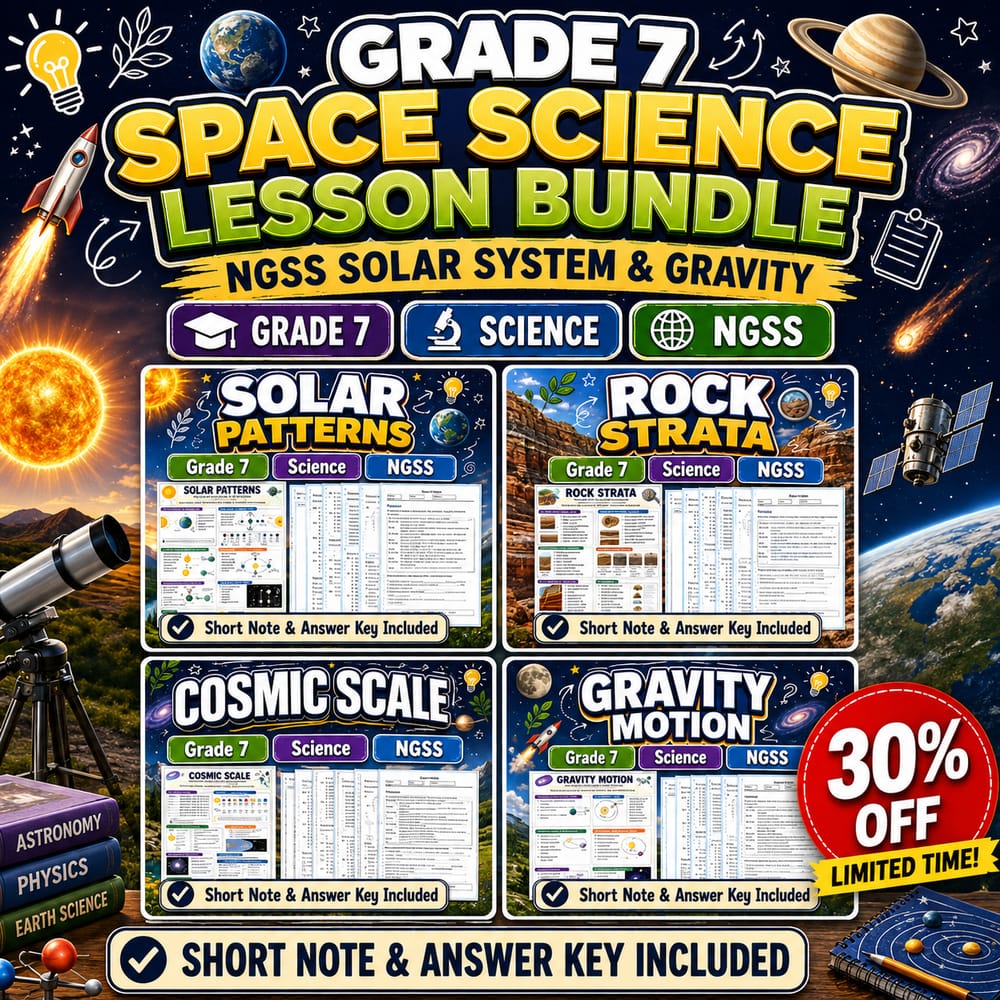
Grade 7 Space Science Lesson Bundle | NGSS Solar System & Gravity
Created byNorthstar WorksheetsOverview Grade 7 Space Science Lesson Bundle brings NGSS space science investigations to life with four ready-to-use worksheets in Science: Solar Patterns, Rock Strata, Gravity & Motion, and Cosmic Scale. Aligned to the NGSS framework, this unit-style set supports classroom modeling, evidence-based reasoning, and sensemaking about how patterns in the sky…
Instant download
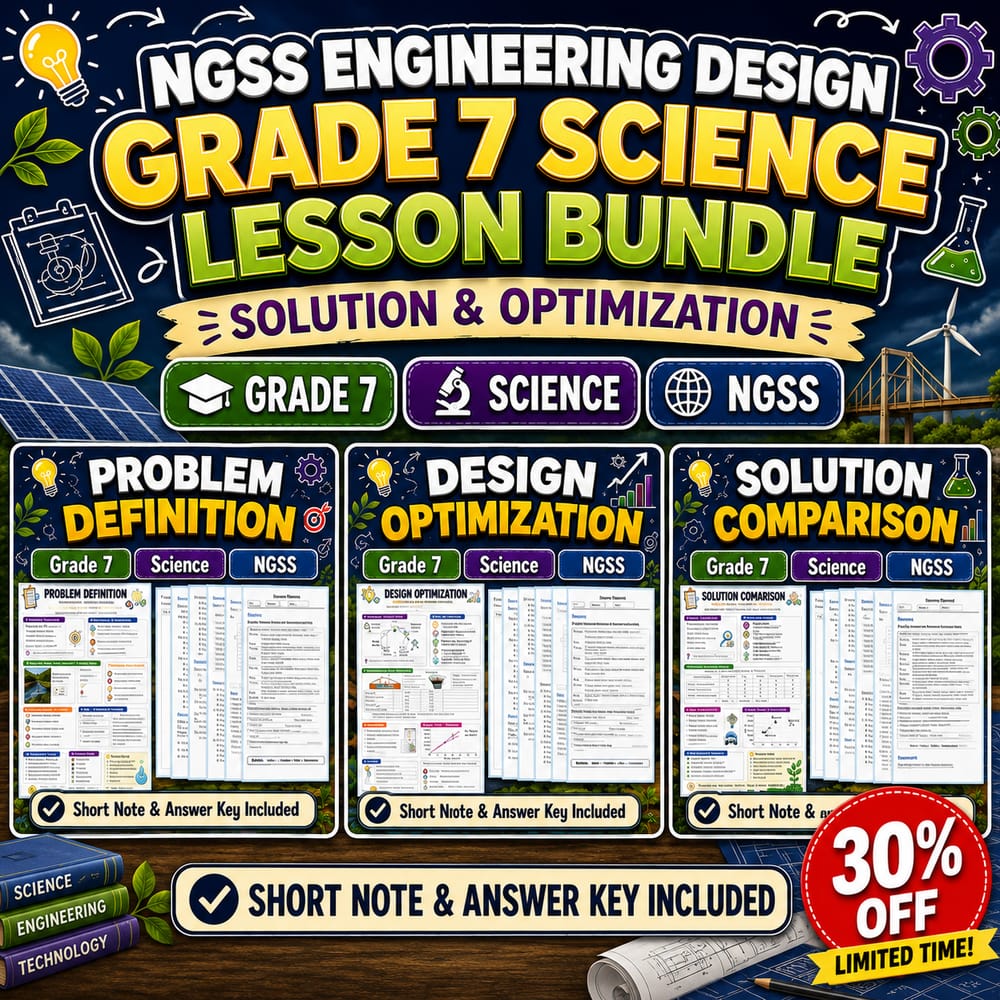
ngss engineering design Grade 7 science Lesson Bundle | Solution & Optimization
Created byNorthstar WorksheetsOverview NGSS engineering design for Grade 7 Science is a 3-worksheet lesson bundle aligned to NGSS that helps students move from problem definition to solution comparison and, finally, design optimization. These prompts and recording structures support productive classroom discussion, written reasoning, and iteration using evidence and clear criteria. Built…
Instant download
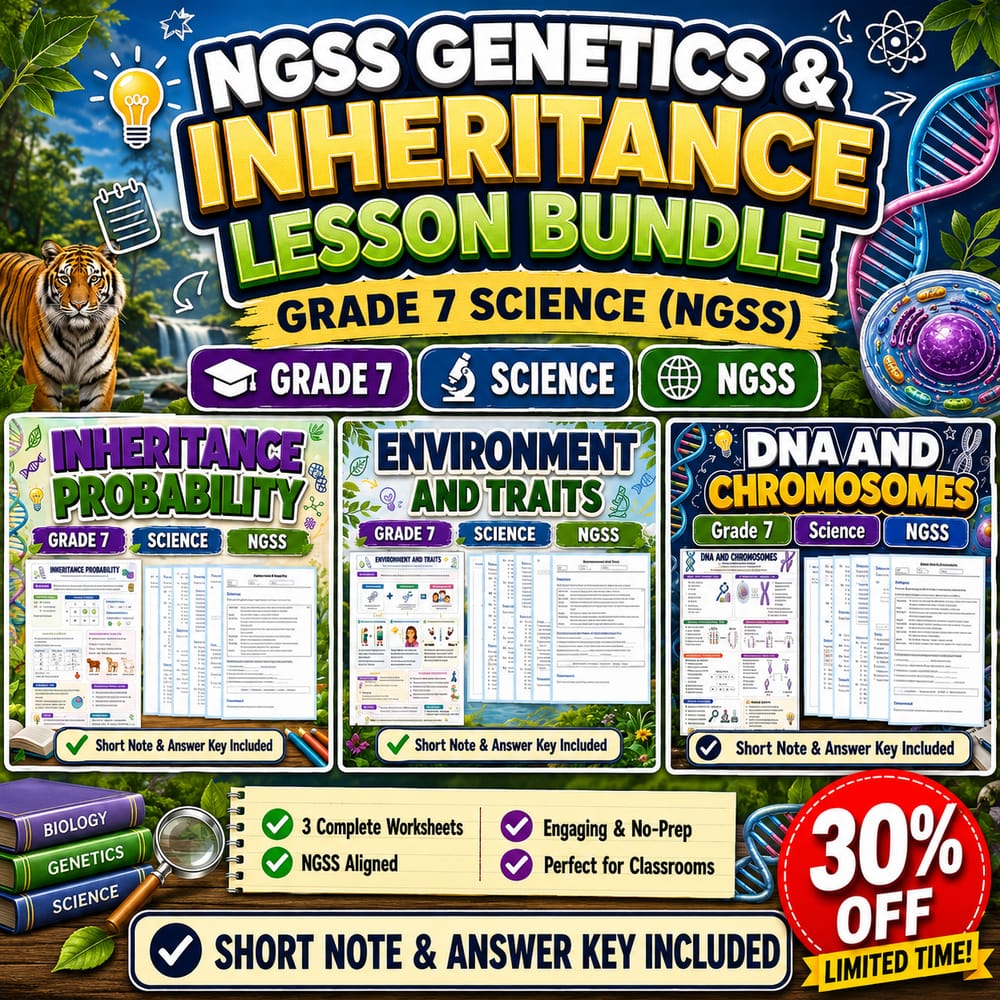
NGSS Genetics & Inheritance Lesson Bundle – Grade 7 Science (NGSS)
Created byNorthstar WorksheetsOverview Genetics & Inheritance in Grade 7 NGSS genetics helps students connect DNA, chromosomes, and environmental influences to explain why traits appear in families. This Grade 7 Science lesson bundle aligned to NGSS includes 3 ready-to-use worksheets focused on inheritance probability, environment-linked traits, and DNA/chromosome structure. Students…
Instant download
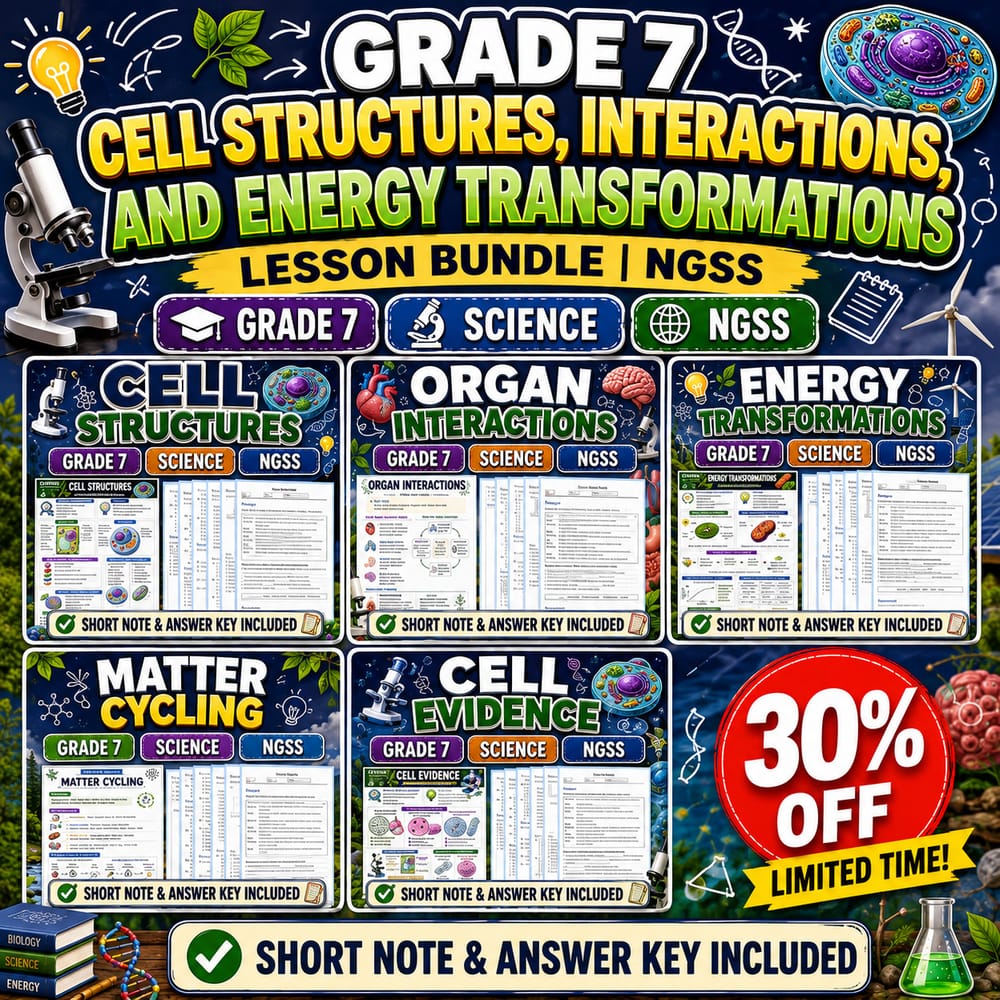
Grade 7 Cell Structures, Interactions, and Energy Transformations Lesson Bundle | NGSS
Created byNorthstar WorksheetsOverview Grade 7 NGSS cell systems come alive in this Cell Structures, Interactions, and Energy Transformations Lesson Bundle for science, aligned to NGSS. This unit bundle includes 5 Grade 7 worksheets that guide students from cell structure and evidence to organ interactions, then to how matter and energy move through living systems. Each worksheet is desi…
Instant download
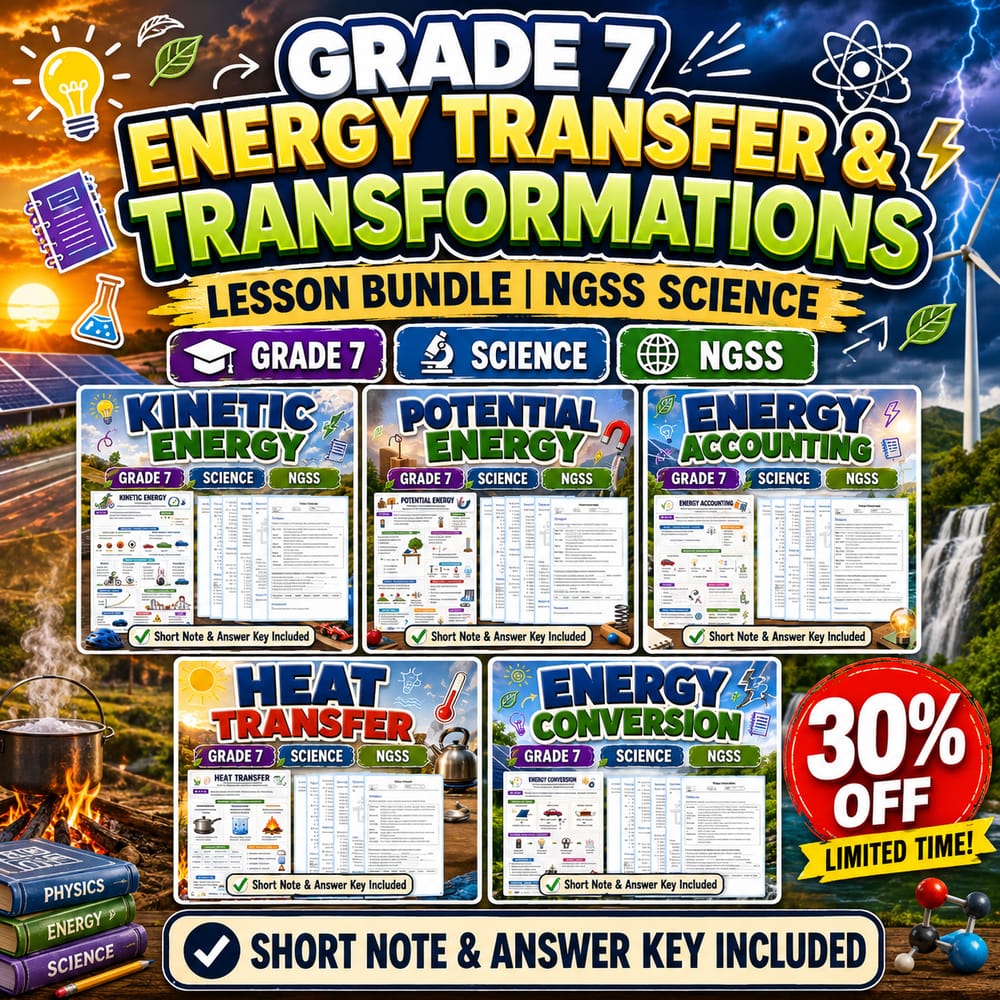
Grade 7 Energy Transfer & Transformations Lesson Bundle | NGSS Science
Created byNorthstar WorksheetsOverview Energy Transfer and Transformations in Grade 7 Science (NGSS) comes as a ready-to-teach lesson bundle with 5 worksheets that help students track how energy moves and changes forms. Designed for focused instruction, this unit supports clear reasoning from observations to explanations. What's Included ✅ Potential Energy Worksheet | Grade 7 NGSS Stored…
Instant download
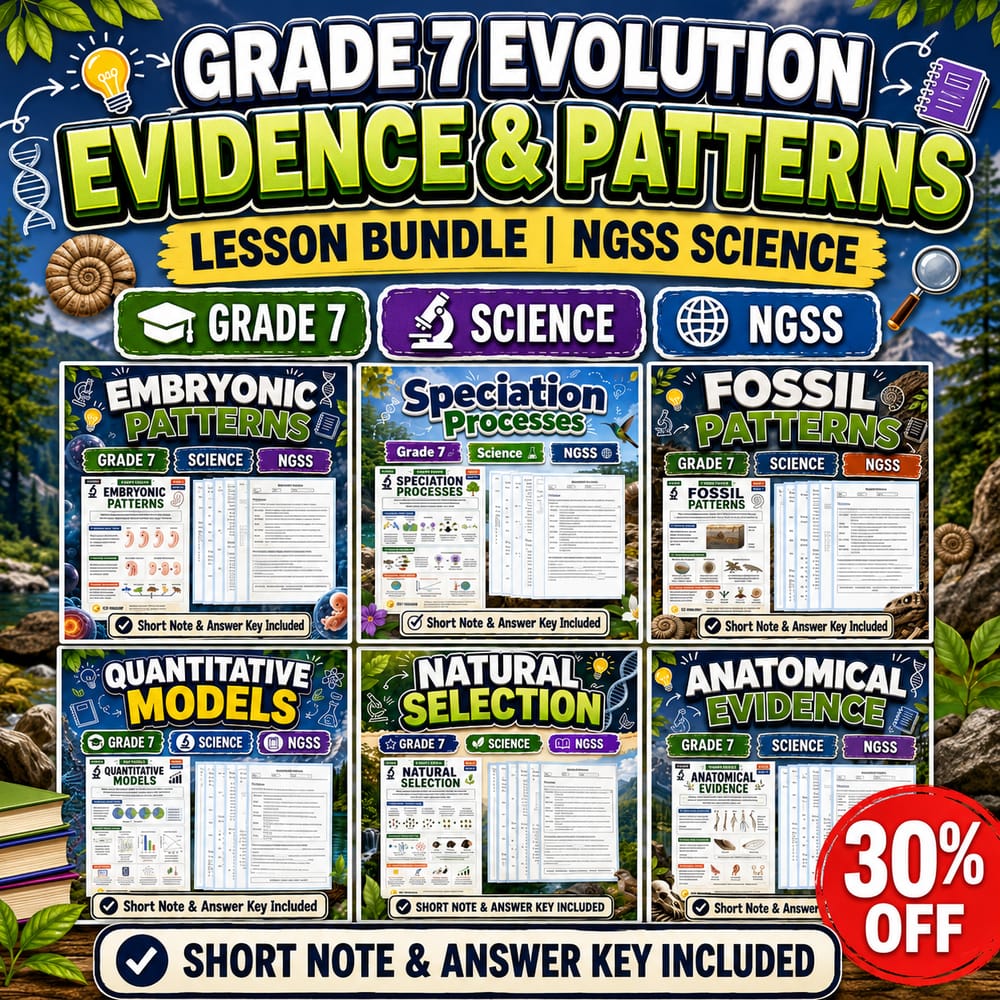
Grade 7 Evolution Evidence & Patterns Lesson Bundle | NGSS Science
Created byNorthstar WorksheetsOverview Evolution Evidence & Patterns for Grade 7 Science builds student understanding of how NGSS concepts explain change over time, using 6 NGSS Evolution Activity answer-key worksheets aligned to NGSS. This lesson bundle supports instruction on embryonic patterns, anatomical evidence, speciation processes, quantitative models, natural selection, and …
Instant download
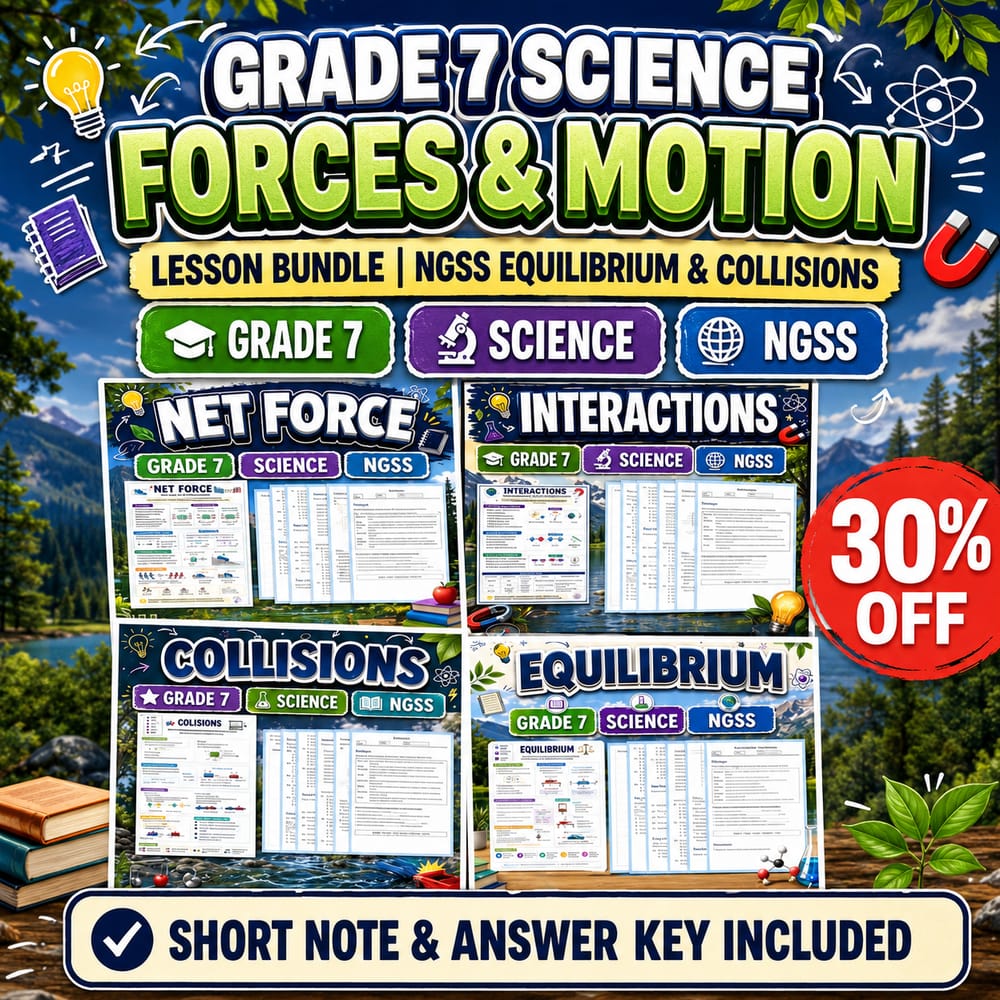
Grade 7 Science Forces & Motion Lesson Bundle | NGSS Equilibrium & Collisions
Created byNorthstar WorksheetsOverview NGSS forces and motion in Grade 7 Science focuses on how forces work together to explain equilibrium, changing motion, and collision outcomes. This Lesson Bundle includes the unit “Forces & Motion (Equilibrium, Net Force, Interactions, Collisions)” with 4 Grade 7 worksheets aligned to the NGSS framework. What's Included ✅ Grade 7 Science Equilib…
Instant download

Grade 7 Science Equilibrium Worksheet | NGSS Forces & Balanced Systems
Created byNorthstar WorksheetsLearning Objectives
- Explain equilibrium as the condition where the net force is zero.
- Differentiate static equilibrium from dynamic equilibrium using acceleration and motion.
- Identify examples of balanced forces, including normal and gravitational forces and tension.
Also included in: Grade 7 Science Forces & Motion Lesson Bundle | NGSS Equilibrium & Collisions +1 more
Instant download

Grade 7 Embryonic Patterns Worksheet NGSS Evolution Activity Answer Key
Created byNorthstar WorksheetsLearning Objectives
- Describe how pharyngeal pouches and limb buds develop early in vertebrates and why they can be evolutionarily informative
- Compare embryonic development across taxa using evidence from developmental timing and patterning
- Explain how conserved developmental stages can support reconstruction of phylogenetic relationships
Also included in: Grade 7 Evolution Evidence & Patterns Lesson Bundle | NGSS Science +1 more
Instant download

Grade 7 Anatomical Evidence Worksheet NGSS Evolution Activity Answer Key
Created byNorthstar WorksheetsLearning Objectives
- Explain how homologous and analogous structures provide evidence for evolution
- Use comparative anatomical features (limb bones, skull shape, vestigial organs) to infer evolutionary relationships
- Connect morphological comparisons with basic genetics and paleontology evidence to support phylogenetic ideas
Also included in: Grade 7 Evolution Evidence & Patterns Lesson Bundle | NGSS Science +1 more
Instant download