
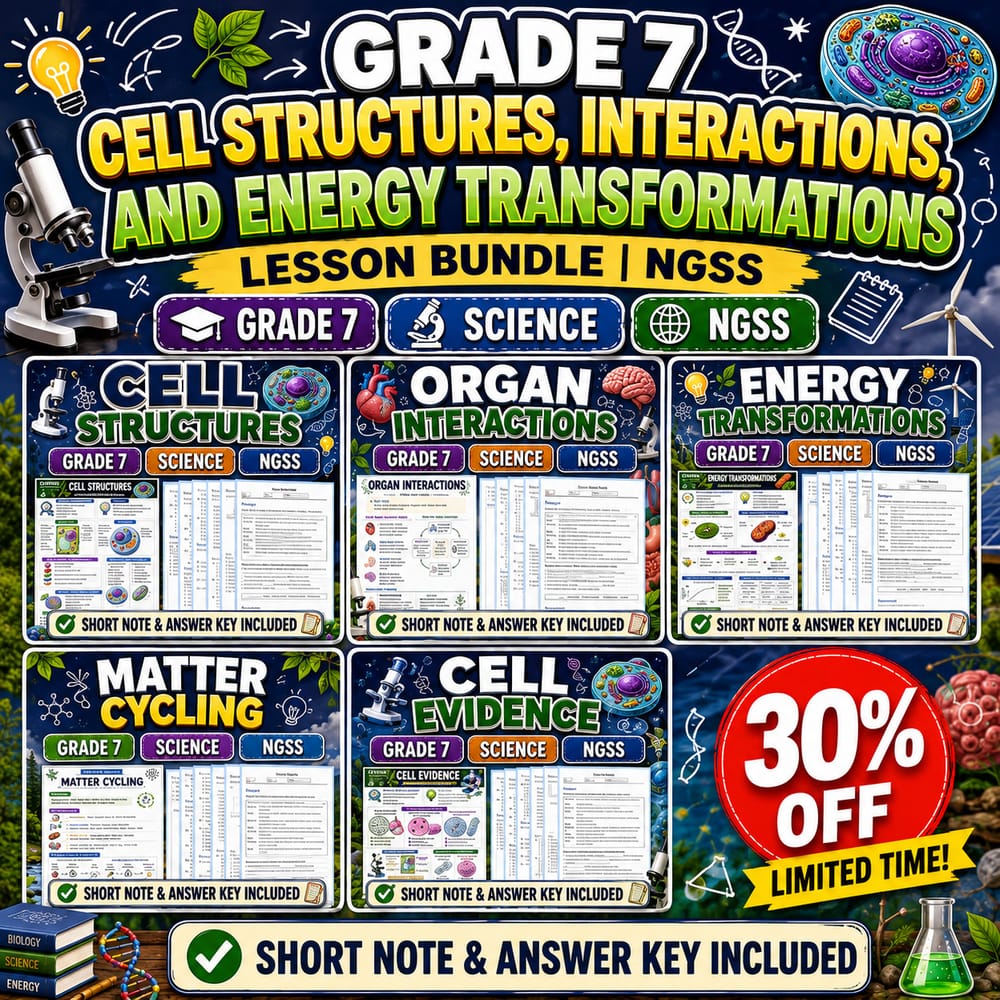
Grade 7 Cell Structures, Interactions, and Energy Transformations Lesson Bundle | NGSS
$20.00$25.00Save $5.00
Northstar Worksheets
New·0 followers·0 sales
SubjectScienceGradeGrade 7Pages60 Pages
What’s included
5 worksheets · 60 pages · Save $5.00 (20%) · prices shown inside the bundle
 Grade 7 Cell Structures Worksheet | NGSS Plant & Animal Cells Activity
- Identify major organelles in eukaryotic cells and describe their functions in cell processes such as transport and synthesis.
- Explain how cell compartments (membranes) help maintain specialized conditions for different activities.
- Compare structural features of plant and animal cells and relate those features to their functions.
$4.00$5.00 Grade 7 Organ Interactions Worksheet | NGSS Science Activity with Answer Key
- Explain how the circulatory, respiratory, digestive, and nervous systems interact to support homeostasis in multicellular animals
- Describe how oxygen and nutrients move through organ systems and how those movements affect body tissues
- Use examples to compare how transport systems work in humans and plants
$4.00$5.00 Grade 7 Energy Transformations Worksheet | NGSS Photosynthesis & Cellular Respiration
- Explain how photosynthesis transforms light energy into chemical energy stored in sugar molecules
- Describe how cellular respiration converts chemical energy in food into ATP that cells can use
- Compare energy use in active versus resting tissues and interpret how limits affect energy transformation rates
$4.00$5.00 Grade 7 Matter Cycling Worksheet | NGSS Science Activity with Answer Key
- Explain how atoms are conserved while matter cycles through organisms during digestion, biosynthesis, and respiration
- Trace the flow of carbon and nitrogen from food into cellular biomolecules and then into waste or the environment
- Describe how biochemical pathways build and break down macromolecules to recycle matter
$4.00$5.00 Grade 7 Cell Evidence Worksheet | NGSS Cell Theory & Microscopy Activity
- Explain how microscopy provides evidence that organisms are made of discrete cells.
- Differentiate unicellular and multicellular organization using examples such as protists and onion epidermis.
- Identify major cell boundaries (plasma membrane and cell wall) and describe how they appear in images.
$4.00$5.00
Reviews & Feedback
Loading reviews...
Questions & Answers
Loading questions…
About this bundle
Related categories
Frequently asked questions
Who is Grade 7 Cell Structures, Interactions, and Energy Transformations Lesson Bundle | NGSS designed for?
Grade 7 Cell Structures, Interactions, and Energy Transformations Lesson Bundle | NGSS is designed for Grade 7 students and Science learners and can be used in classrooms, homeschool, or independent practice.
How do I download Grade 7 Cell Structures, Interactions, and Energy Transformations Lesson Bundle | NGSS?
Add it to your cart and complete checkout. After payment, you can download immediately from your account, and you'll also receive a download link by email.
Similar Products

Grade 7 Science Unit Bundle | Cell Structures, Matter & Energy Transformations (NGSS)
$8.00$10.00

Grade 7 Cell Interactions and Energy Science Lesson Bundle | NGSS
$16.00$20.00

Cell Structure, Homeostasis & Energy Lesson Bundle: Grade 10 Science Alberta
$36.00$45.00

Grade 10 Cells & Energy Science Lesson Bundle Ontario Framework Pack
$44.00$55.00

Grade 10 Cell Functions & Energy Science Lesson Bundle - Ontario Framework
$38.40$48.00