
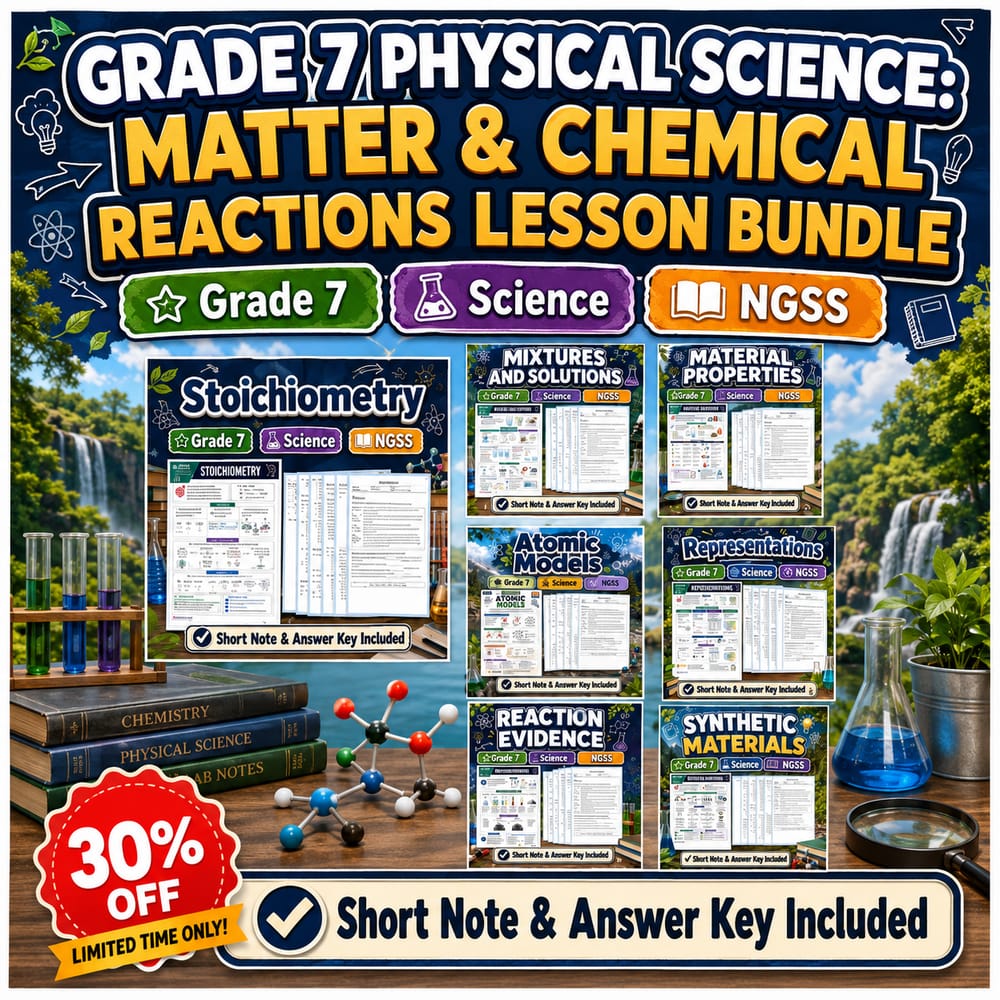
Grade 7 Physical Science: Matter & Chemical Reactions Lesson Bundle | NGSS
$28.00$35.00Save $7.00
Northstar Worksheets
New·0 followers·0 sales
SubjectScienceGradeGrade 7Pages85 Pages
What’s included
7 worksheets · 85 pages · Save $7.00 (20%) · prices shown inside the bundle
 Grade 7 Stoichiometry Worksheet | NGSS Chemical Equations & Mole Ratios
- Interpret balanced chemical equations to determine the mole-to-mole relationships between reactants and products.
- Use ratio reasoning and unit consistency to convert between amounts of substances during chemical transformations.
- Scale reactant and product quantities proportionally and predict outcomes using conservation of matter.
$4.00$5.00 Grade 7 Mixtures and Solutions Worksheet | NGSS Physical Science Activity
- Distinguish homogeneous and heterogeneous mixtures and identify examples of each
- Explain solubility, concentration, and saturation using evidence from observations and simple scenarios
- Differentiate solutions, colloids, and suspensions based on particle size and whether particles separate
$4.00$5.00 Grade 7 Material Properties Worksheet | NGSS Physical & Chemical Properties
- Distinguish physical properties from chemical properties using measurable and observable descriptors.
- Interpret property data (e.g., density, melting point, solubility, conductivity, reactivity, flammability) to support material identification.
- Use quantitative and qualitative evidence to predict how materials respond to temperature changes and chemical contact.
$4.00$5.00 Grade 7 Atomic Models Worksheet NGSS Matter Structure Activity Answer Key
- Explain how atomic number relates to the number of protons and electrons in common cases.
- Compare particle, ball-and-stick, and lattice representations of atoms in molecules and extended structures.
- Use chemical formula notation to describe how bonding patterns affect properties such as melting point and conductivity.
$4.00$5.00 Grade 7 Science Representations Worksheet | NGSS Graphs, Data & Models
- Explain how different representations (chemical equations, graphs, and data tables) help communicate matter interactions and measurable relationships.
- Interpret trends in graphs and stoichiometric information in balanced chemical equations to make quantitative comparisons.
- Select the most appropriate representation for a specific question about rate, mass/temperature change over time, or state changes.
$4.00$5.00 Grade 7 Reaction Evidence Worksheet | NGSS Chemical Reactions Activity
- Identify observable indicators that a chemical reaction has occurred.
- Explain how gas production, precipitate formation, color change, and temperature change serve as evidence of new substances.
- Distinguish chemical changes from reversible physical changes using conservation of mass in sealed systems.
$4.00$5.00 Grade 7 Synthetic Materials Worksheet | NGSS Polymers & Material Science
- Explain how synthetic materials can be produced from natural resources by outlining key steps such as feedstock selection, polymerization, and refining.
- Describe how chemical composition changes during processing and how those changes affect material properties like strength, flexibility, and durability.
- Compare examples (polyethylene, PET, nylon, and metals from ores) and discuss trade-offs involving recyclability and environmental impact.
$4.00$5.00
Reviews & Feedback
Loading reviews...
Questions & Answers
Loading questions…
About this bundle
Related categories
Frequently asked questions
Who is Grade 7 Physical Science: Matter & Chemical Reactions Lesson Bundle | NGSS designed for?
Grade 7 Physical Science: Matter & Chemical Reactions Lesson Bundle | NGSS is designed for Grade 7 students and Science learners and can be used in classrooms, homeschool, or independent practice.
How do I download Grade 7 Physical Science: Matter & Chemical Reactions Lesson Bundle | NGSS?
Add it to your cart and complete checkout. After payment, you can download immediately from your account, and you'll also receive a download link by email.
Similar Products

Grade 8 Science Thermal Effects & Chemical Reactions Lesson Bundle | NGSS
$20.00$25.00

Grade 8 Chemical Reactions & Conservation of Matter Bundle | Science
$24.00$30.00

Matter & Chemical Change Lesson Bundle — Grade 7 Science British Columbia
$60.00$75.00

Matter and Chemical Change Lesson Bundle: Grade 7 Science Alberta
$60.00$75.00

Grade 6 Matter & Chemical Reactions Lesson Bundle | NGSS | Science
$20.00$25.00