
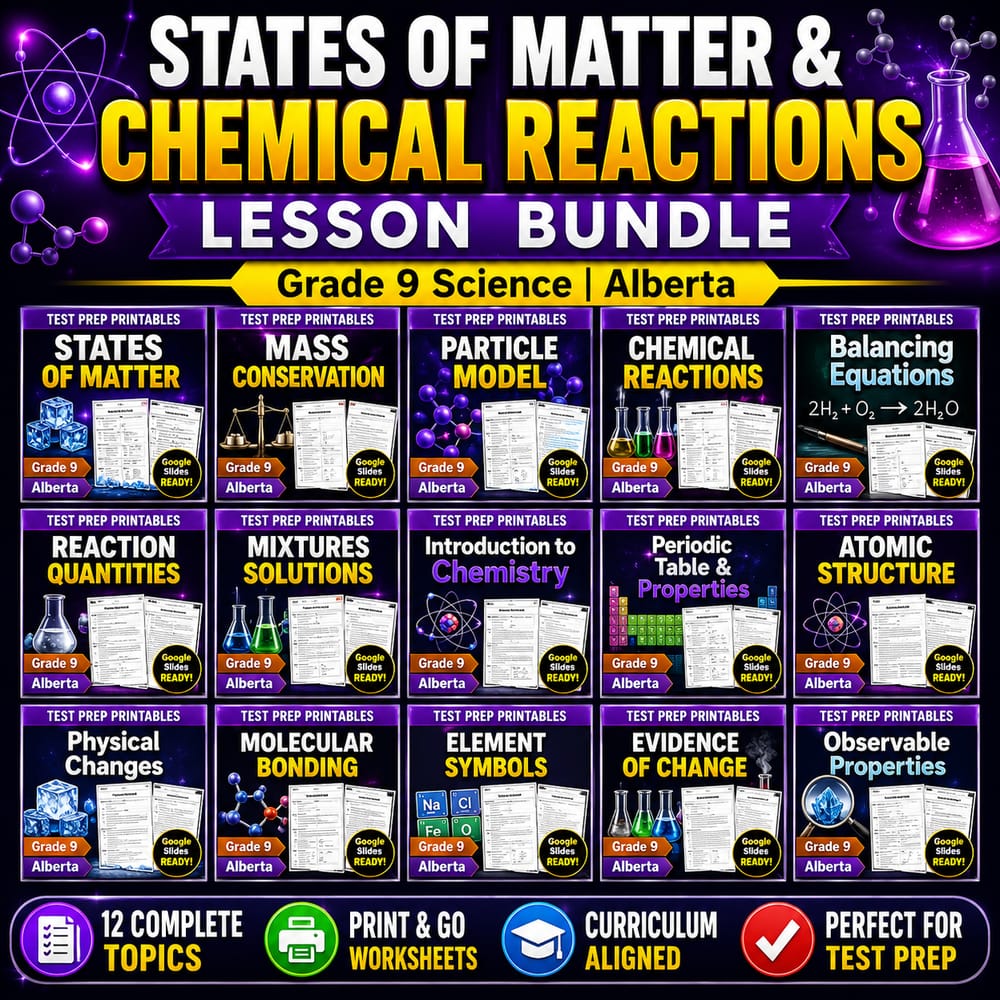


States of Matter & Chemical Reactions Lesson Bundle | Grade 9 Science | Alberta
$60.00$75.00Save $15.00
Prism Point Learning
·2 followers·13 sales
SubjectScienceGradeGrade 9
What’s included
15 worksheets · Save $15.00 (20%) · prices shown inside the bundle
 States of Matter Worksheet | Grade 9 Science Activities
- Describe the physical properties of solids, liquids, and gases and connect them to particle behavior.
- Explain how temperature and pressure changes cause phase transitions between states of matter.
- Use examples from the environment to predict and justify material state changes.
$4.00$5.00 Mass Conservation Worksheet | Grade 9 Science Activities
- Explain the law of conservation of mass in closed chemical reactions using the idea of conserved atoms
- Use mass-conservation reasoning to interpret evidence from sealed systems (e.g., combustion and captured gas)
- Apply conservation of mass to simple particle and measurement scenarios
$4.00$5.00 Particle Model Worksheet | Grade 9 Science Activities
- Explain how the particulate model describes solids, liquids, and gases using particle spacing and motion
- Use the particulate model to predict diffusion, changes in pressure, and temperature effects
- Connect particle collisions and kinetic energy to observable macroscopic properties
$4.00$5.00 Chemical Reactions Worksheet | Grade 9 Science Activities
- Explain how chemical reactions rearrange atoms and can exchange energy with the environment.
- Identify common types of chemical reactions (combustion, synthesis, decomposition) from real-world examples.
- Interpret symbolic chemical equations by matching reactants to products.
$4.00$5.00 Balancing Equations Worksheet | Grade 9 Science Practice
- Explain how balancing chemical equations enforces conservation of atoms and mass.
- Use coefficients to ensure the number of each type of atom matches on both sides of a reaction.
- Interpret balanced equations to predict relative reactant and product amounts.
$4.00$5.00 Reaction Quantities Worksheet | Grade 9 Science Activities
- Interpret coefficient ratios in balanced chemical equations to relate relative amounts of reactants and products.
- Apply the law of conservation of mass to check and explain mass accounting in simple reaction contexts.
- Use balanced equations to estimate product mass from given reactant mass in real-world examples.
$4.00$5.00 Mixtures and Solutions Worksheet | Grade 9 Science Activities
- Distinguish heterogeneous mixtures from homogeneous solutions based on uniformity
- Define solute, solvent, and concentration, and explain how concentration relates to solution properties
- Use physical properties to separate mixture components without chemical change
$4.00$5.00 Environmental Chemistry Worksheet | Grade 9 Science Activities
- Explain how environmental chemical changes can be interpreted using observable evidence and particle/atomic ideas.
- Apply the idea of mass conservation and clear system boundaries to environmental chemical problems.
- Relate chemistry concepts to Alberta-relevant contexts such as acid deposition, tailings chemistry, and nutrient cycling.
$4.00$5.00 Predicting Products Worksheet Pack | Grade 9 Science Activities
- Apply conservation of atoms to predict reaction products from balanced chemical reactions.
- Use reaction-type patterns (synthesis, decomposition, oxidation, neutralization) to make reasonable product predictions.
- Explain how reactant identities and typical bonding tendencies determine expected products.
$4.00$5.00 Atomic Structure Worksheet | Grade 9 Science Practice
- Explain how protons, neutrons, and electrons determine atomic structure and properties of matter
- Use atomic number and mass number to identify elements and isotopes
- Connect simple atomic models (nucleus and electron shells) to chemical behavior and compound formation
$4.00$5.00
Reviews & Feedback
Loading reviews...
Questions & Answers
Loading questions…
About this bundle
Related categories
Frequently asked questions
Who is States of Matter & Chemical Reactions Lesson Bundle | Grade 9 Science | Alberta designed for?
States of Matter & Chemical Reactions Lesson Bundle | Grade 9 Science | Alberta is designed for Grade 9 students and Science learners and can be used in classrooms, homeschool, or independent practice.
How do I download States of Matter & Chemical Reactions Lesson Bundle | Grade 9 Science | Alberta?
Add it to your cart and complete checkout. After payment, you can download immediately from your account, and you'll also receive a download link by email.
Similar Products

Grade 7 States of Matter & Reactions Science Daily Reading Lesson Bundle | BC
$48.00$60.00

Grade 7 Science Unit Bundle – States, Reactions & Atomic Structure Worksheets
$16.00$20.00

Grade 7 Science Lesson Group Bundle | States, Reactions & Properties
$36.00$45.00

Grade 7 Science Lesson – States of Matter & Reaction Types Assessment Bundle
$60.00$75.00

States of Matter Grade 9 Science Daily Reading Worksheets lesson bundle |Alberta
$48.00$60.00