
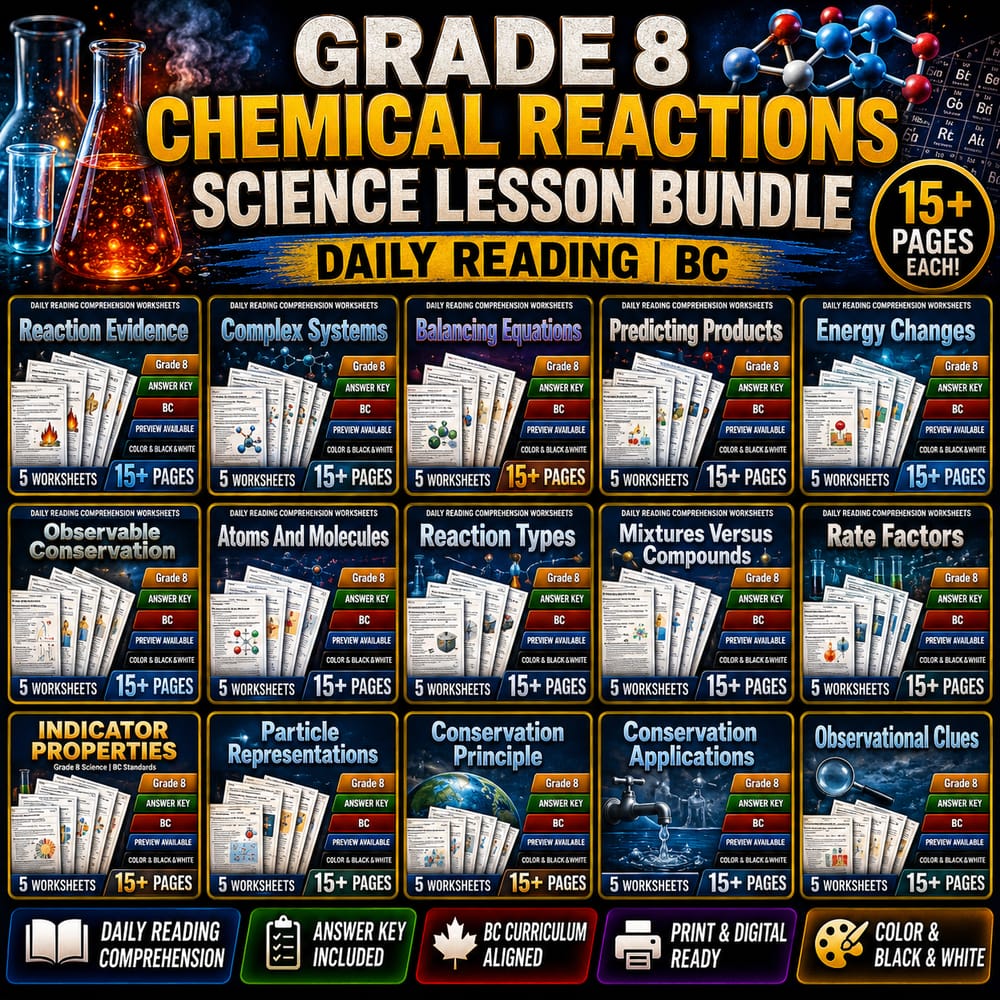


Grade 8 Chemical Reactions Science Lesson Bundle: Daily Reading | BC
$44.80$56.00Save $11.20
Bright Mind Resources
New·1 followers·12 sales
SubjectScienceGradeGrade 8
What’s included
14 worksheets · Save $11.20 (20%) · prices shown inside the bundle
 Grade 8 Science – Reaction Evidence & Changes | Daily Reading Worksheet
- Identify observable evidence of physical and chemical changes
- Describe differences between physical and chemical changes
- Recognize examples of chemical and physical transformations
$3.20$4.00 Grade 8 Science – Balancing Equations & Atomic Counts | Daily Reading Worksheet
- Explain the purpose of balancing chemical equations.
- Identify coefficients in a chemical equation.
- Understand how to balance an unbalanced chemical equation.
$3.20$4.00 Grade 8 Science – Predicting Products & Chemical Reactions | Reading Worksheet
- Understand how to identify reactants in a chemical reaction.
- Learn methods to predict possible products based on reactant types and patterns.
- Apply the principles of conservation of atoms to formulate balanced chemical equations.
$3.20$4.00 Grade 8 Science – Energy & Reactions | Daily Reading Worksheet
- Explain the concepts of endothermic and exothermic reactions.
- Describe how bonds are broken and formed during chemical reactions.
- Interpret energy profiles and bond enthalpies to determine heat absorption or release.
$3.20$4.00 Grade 8 Science – Conservation of Mass & Reactions | Daily Reading Worksheet
- Understand the principle of conservation of mass in closed systems
- Identify examples of mass conservation during chemical reactions
- Learn how measurements demonstrate mass conservation
$3.20$4.00 Grade 8 Science – Atoms & Molecules Daily Reading Worksheet | BC Standards
- Understand the basic structure of atoms
- Learn how atoms bond and form molecules
- Recognize the importance of atomic structure in chemical reactions
$3.20$4.00 Grade 8 Science – Reaction Types in Chemistry | Daily Reading Worksheet
- Understand key concepts related to Science
- Apply knowledge through practice questions
- Demonstrate comprehension of the material
$3.20$4.00 Grade 8 Science – Mixtures & Compounds | Daily Reading Worksheet
- Understand the differences between mixtures and compounds.
- Identify unique properties of mixtures and compounds.
- Learn how to distinguish between physical and chemical changes.
$3.20$4.00 Grade 8 Science – Factors Affecting Reaction Rates & Daily Reading Worksheet
- Understand how temperature influences the speed of chemical reactions.
- Identify the microscopic effects of increasing temperature on particles.
- Relate macroscopic changes in reaction speed to particle energy and collision frequency.
$3.20$4.00 Grade 8 Science – Indicator Properties Daily Reading Worksheet | BC Standards
- Understand how pH levels indicate acidity or alkalinity
- Recognize changes in physical properties during chemical reactions
- Learn to interpret property shifts as evidence of chemical changes
$3.20$4.00
Reviews & Feedback
Loading reviews...
Questions & Answers
Loading questions…
About this bundle
Related categories
Frequently asked questions
Who is Grade 8 Chemical Reactions Science Lesson Bundle: Daily Reading | BC designed for?
Grade 8 Chemical Reactions Science Lesson Bundle: Daily Reading | BC is designed for Grade 8 students and Science learners and can be used in classrooms, homeschool, or independent practice.
How do I download Grade 8 Chemical Reactions Science Lesson Bundle: Daily Reading | BC?
Add it to your cart and complete checkout. After payment, you can download immediately from your account, and you'll also receive a download link by email.
Similar Products

Reactions & Matter Grade 8 Science Daily Reading Worksheets Lesson Bundle | NGSS
$20.00$25.00

Chemical Reactions Grade 7 Science Daily Reading Worksheets Lesson Bundle | NGSS
$28.00$35.00

Grade 9 Chemical Reactions Science Lesson Bundle: Daily Reading (BC)
$48.00$60.00

Chem Reactions Grade 10 Science Daily Reading Worksheets Lesson Bundle | BC
$48.00$60.00

Chemical Reactions Grade 11 Science Daily Reading Worksheets Bundle | Ontario
$38.40$48.00