
Grade 9 Science Worksheets
6,926 worksheets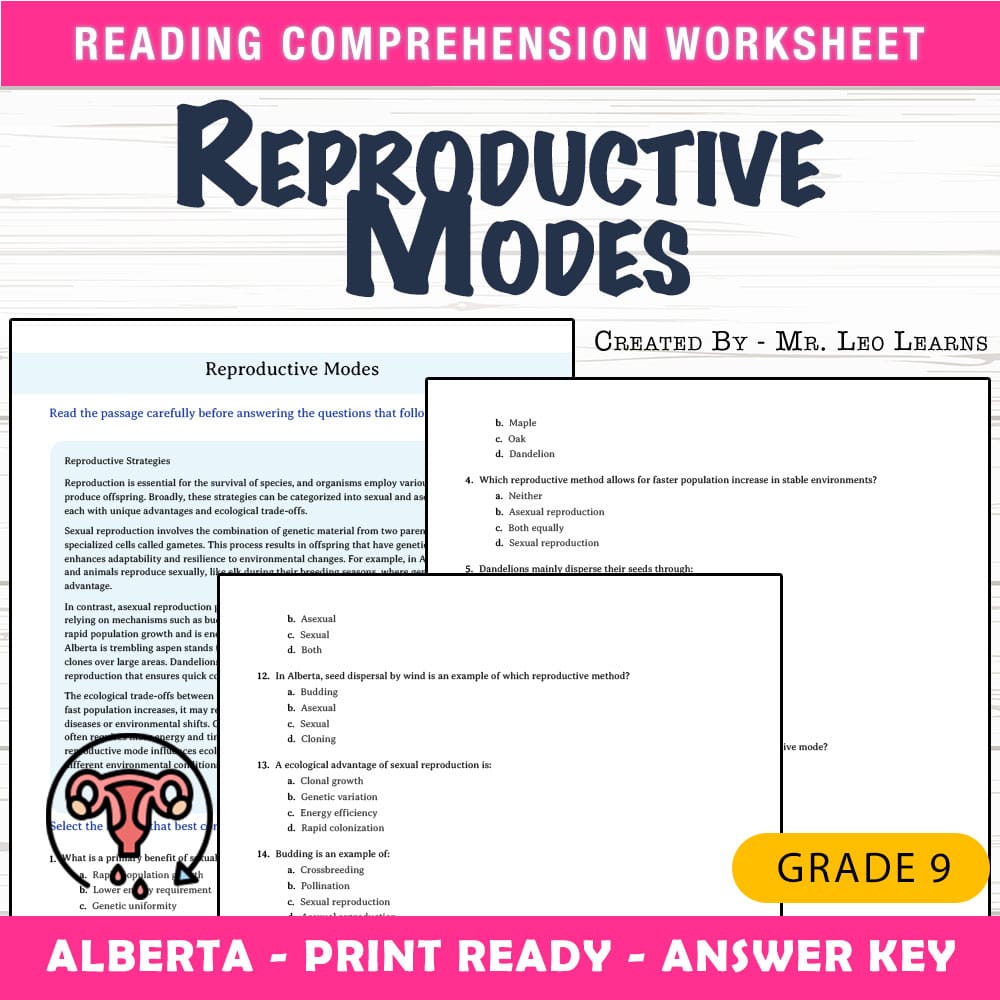
Grade 9 Science — Reproductive Modes Worksheet MCQ Paper
 Created byThe Resource Hub
Learning Objectives
- Understand the differences between sexual and asexual reproduction.
- Identify examples of reproductive strategies in Alberta species.
- Compare ecological trade-offs associated with different reproductive modes.
Also included in: Grade 9 Science Lesson Bundle | Reproduction and Heredity Worksheets +1 more
Instant download
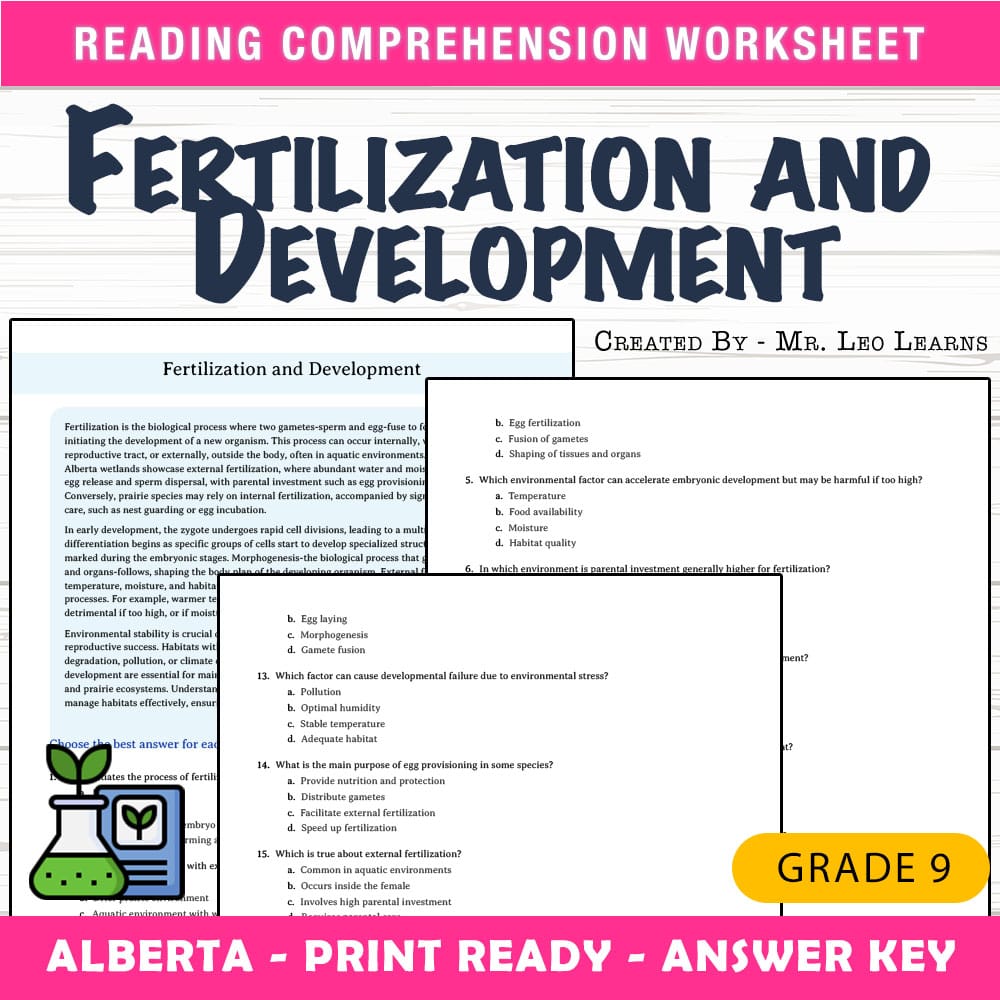
Grade 9 Science — Fertilization and Development Worksheet MCQ Paper
Created byThe Resource HubLearning Objectives
- Understand the process of fertilization as fusion of gametes leading to zygote formation.
- Differentiate between internal and external fertilization strategies with examples.
- Describe early embryonic stages, cell differentiation, and morphogenesis in animal development.
Also included in: Grade 9 Science Lesson Bundle | Reproduction and Heredity Worksheets +1 more
Instant download
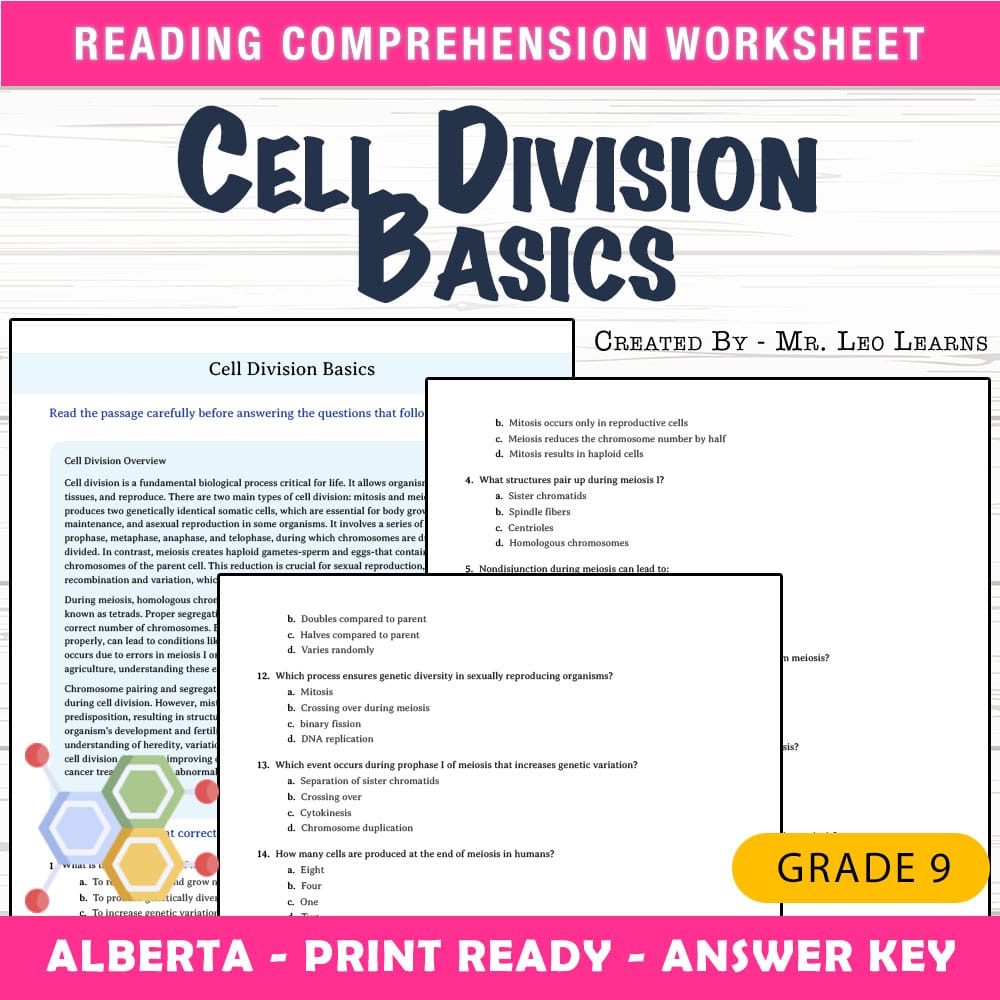
Grade 9 Science — Worksheet MCQ Paper for Mastering Cell Division
Created byThe Resource HubLearning Objectives
- Understand the processes of mitosis and meiosis and their roles in growth, repair, and reproduction.
- Identify key events such as chromosome pairing, segregation, and errors like nondisjunction.
- Explain the implications of cell division errors on heredity and agriculture.
Also included in: Grade 9 Science Lesson Bundle | Reproduction and Heredity Worksheets +1 more
Instant download
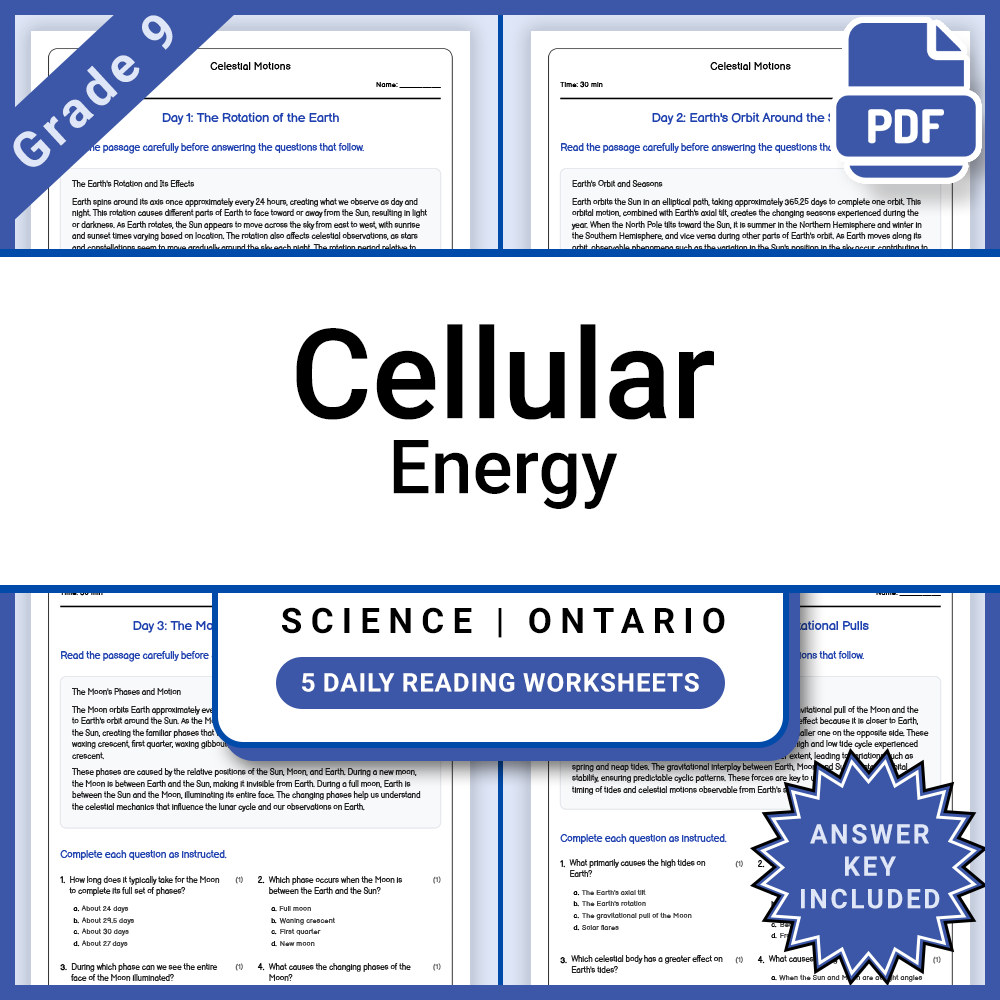
Grade 9 Science Cellular Energy Daily Reading Worksheet with Answer Key
JCreated byJ.S SheetsLearning Objectives
- Understand the process of cellular energy production
- Identify the key stages of cellular respiration
- Explain the role of mitochondria in energy metabolism
Also included in: Grade 9 Science Lesson Group | Human Body Systems, Environment & Energy +1 more
Instant download

Grade 9 Science – Wave Properties & Links | Daily Reading Worksheet
 Created byBright Mind Resources
Learning Objectives
- Understand basic wave parameters: frequency, wavelength, amplitude.
- Describe how changes in wave parameters affect signals.
- Relate wave parameters to different wave representations.
Also included in: Waves & Forces Grade 9 Science Daily Reading Worksheets Lesson Bundle | General +1 more
Instant download
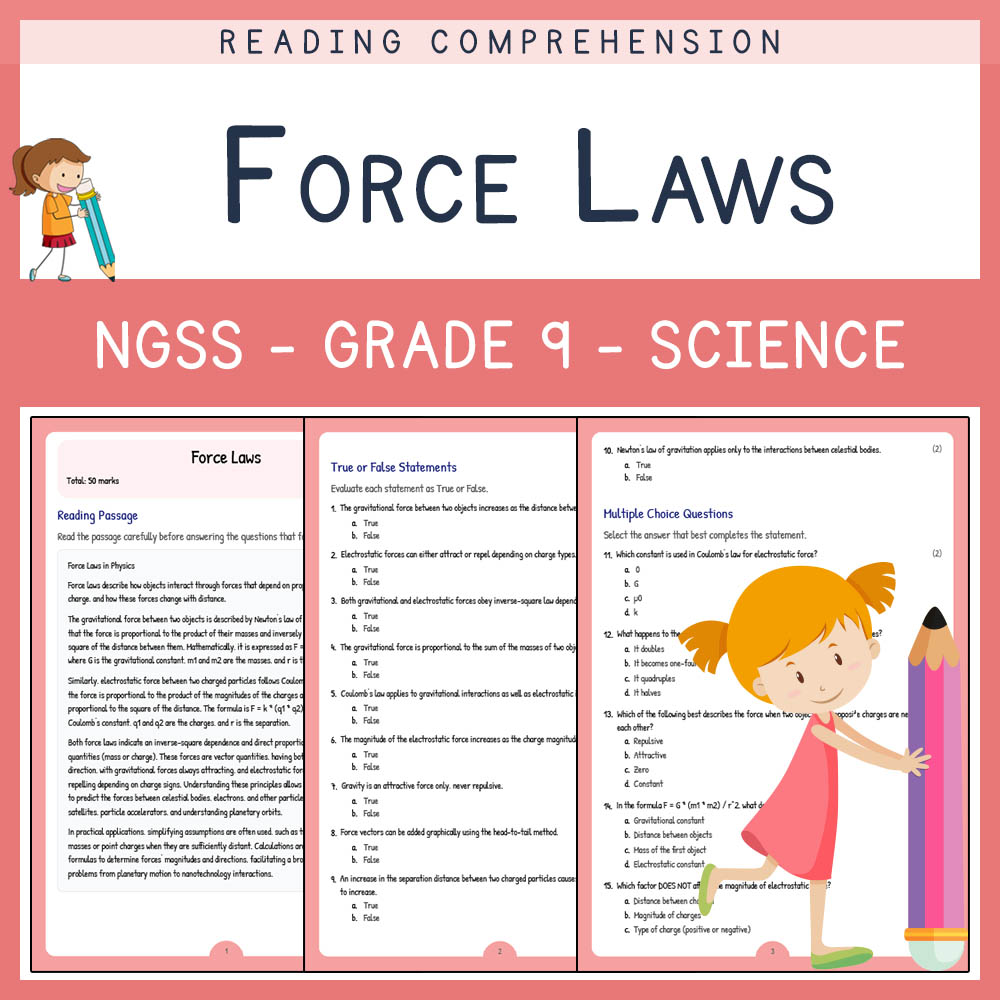
Grade 9 Science | Force Laws Worksheet with Answer Key for NGSS Alignment
 Created byLumora Learning
Learning Objectives
- Understand the mathematical representation of gravitational and electrostatic forces and their inverse-square dependence.
- Apply force equations to calculate magnitudes and directions of forces between objects.
- Interpret vector directions in force interactions and predict net force outcomes.
Also included in: Grade 9 Science | Force & Motion Unit Worksheet Pack (NGSS-Aligned)
Instant download
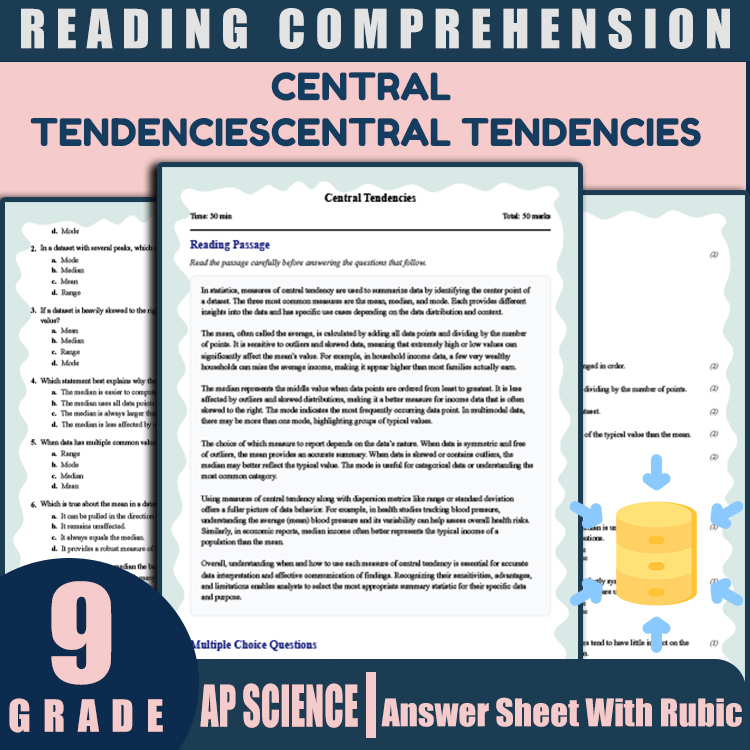
Grade 9 Science | Central Tendencies Reading Worksheet (PDF + Answer Key)
JCreated byJ.S SheetsLearning Objectives
- Understand measures of central tendency: mean, median, and mode.
- Recognize when to use each measure based on data distribution and context.
- Explain how skewness, outliers, and multimodality affect the choice of central tendency.
Instant download
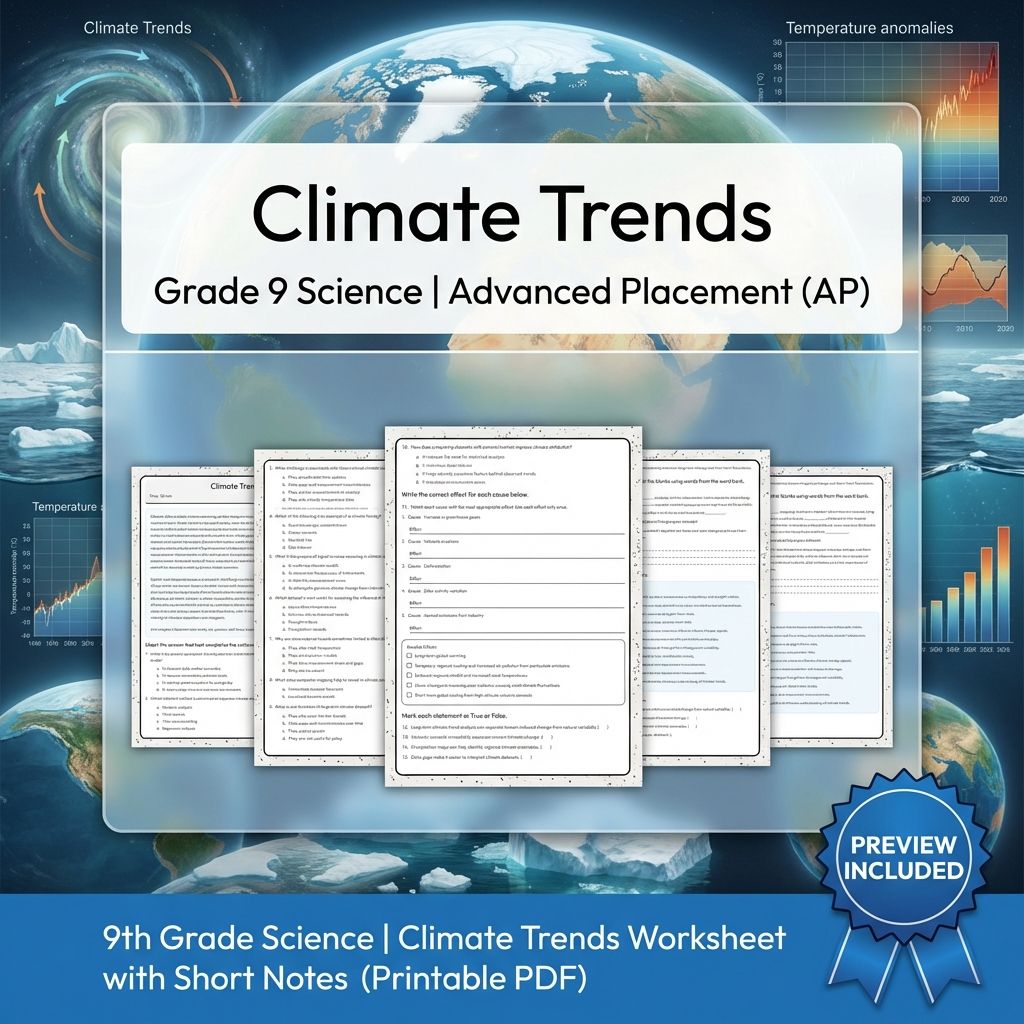
9th Grade Science | Climate Trends Worksheet with Short Notes (Printable PDF)
 Created byMeadowlark Worksheets
Learning Objectives
- Interpret spatial and temporal climate datasets to identify long-term trends and anomalies.
- Apply statistical and visual analysis techniques such as trend analysis and composite mapping.
- Differentiate between long-term climate change signals and internal variability.
Also included in: Grade 9 Science | Earth Systems & Geology Unit Worksheet Bundle (Printable PDFs) +1 more
Instant download

DNA to Proteins Worksheet | Grade 9 Science Standards-Aligned PDF
JCreated byJ.S SheetsLearning Objectives
- Understand how genetic information in DNA directs protein synthesis.
- Describe the roles of DNA, RNA, and proteins in gene expression.
- Explain how changes in DNA can affect protein structure and cellular traits.
Also included in: Grade 9 Evolution, Genetics, and Ecosystems Science Lesson Bundle +1 more
Instant download
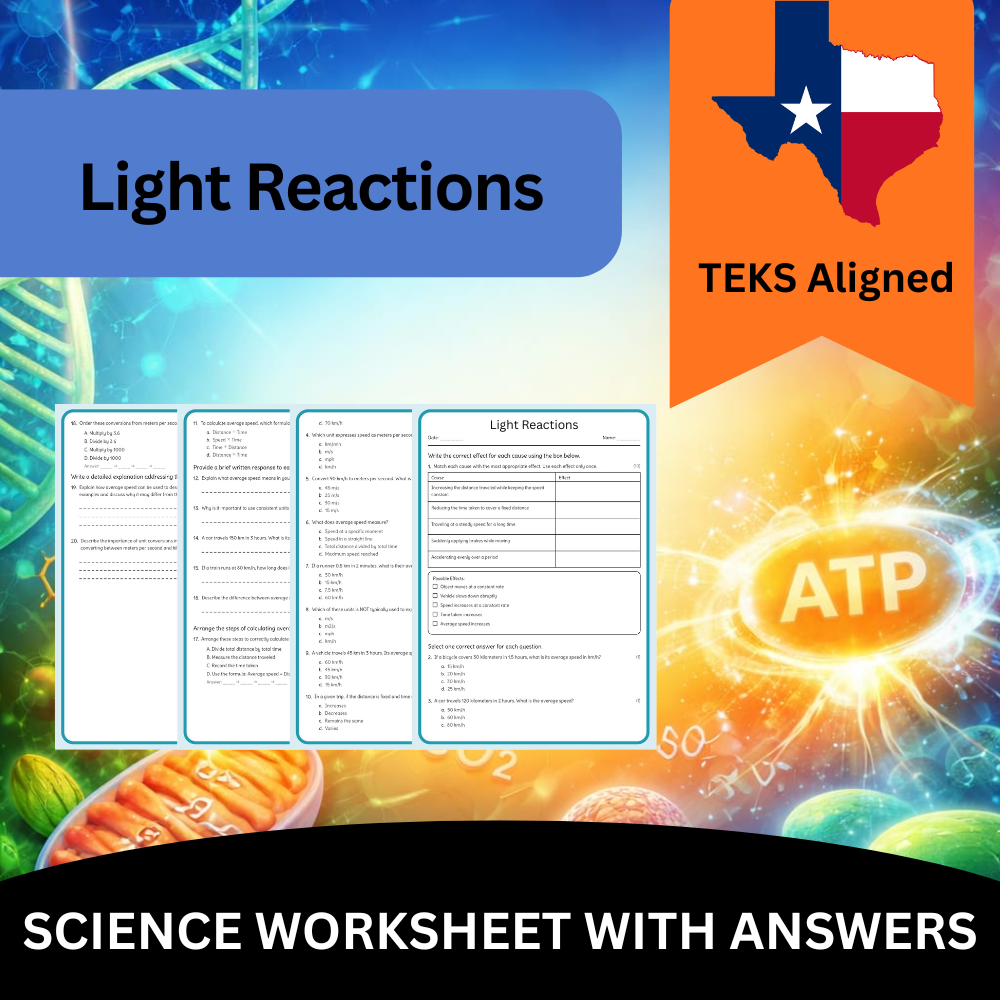
Grade 9 Science – Light Reactions Worksheet (Worksheet + Answer Key) | TEKS Aligned
Created byBright Mind ResourcesLearning Objectives
- Understand the process of light reactions occurring in thylakoid membranes
- Identify key steps in photon absorption and electron transport
- Explain how a proton gradient leads to ATP synthesis and NADPH production
Also included in: Grade 9 Science | Photosynthesis & Metabolic Pathways Unit Bundle (TEKS Aligned) +3 more
Instant download
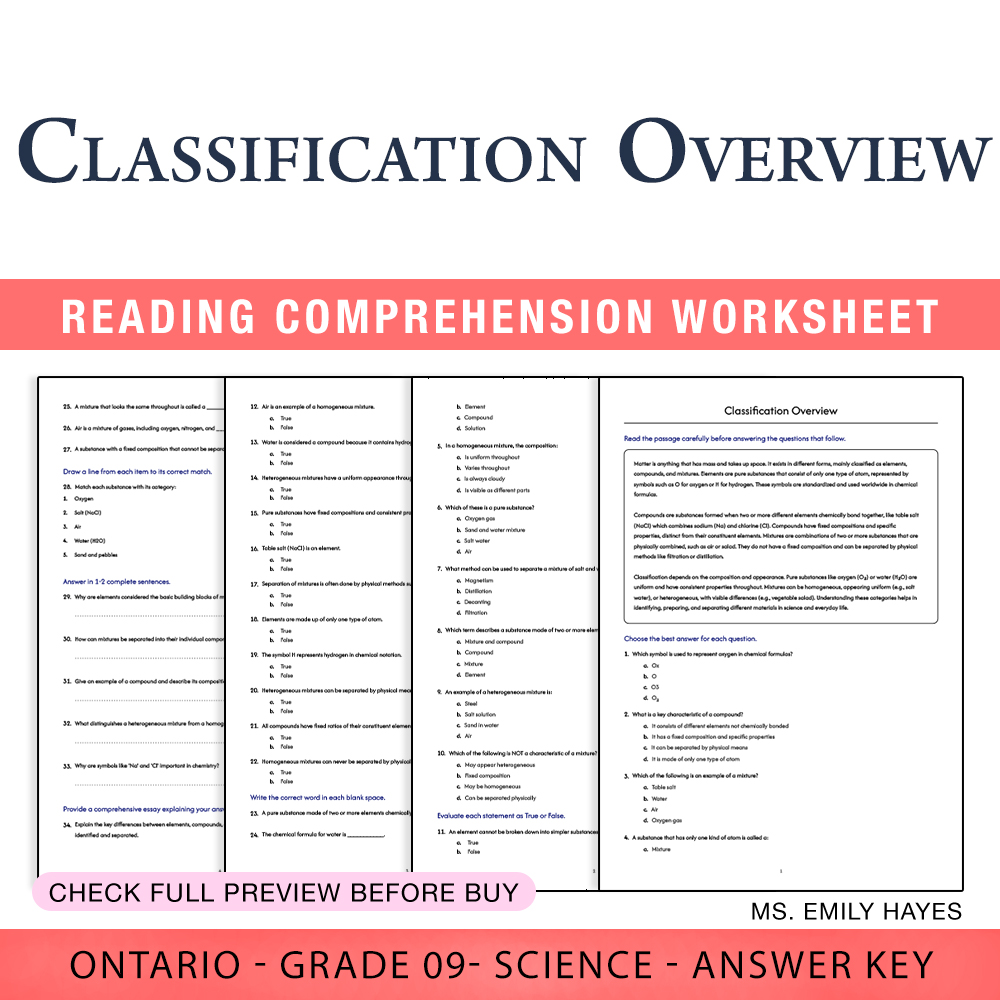
Grade 9 Science | Classification Overview Worksheet (PDF + Answer Key)
 Created byCopper Leaf Classroom
Learning Objectives
- Define and distinguish between elements, compounds, and mixtures based on their composition and appearance.
- Identify examples of elements, compounds, and mixtures such as oxygen, salt, and air.
- Explain the criteria for classifying substances as pure substances or mixtures based on fixed composition and uniformity.
Instant download
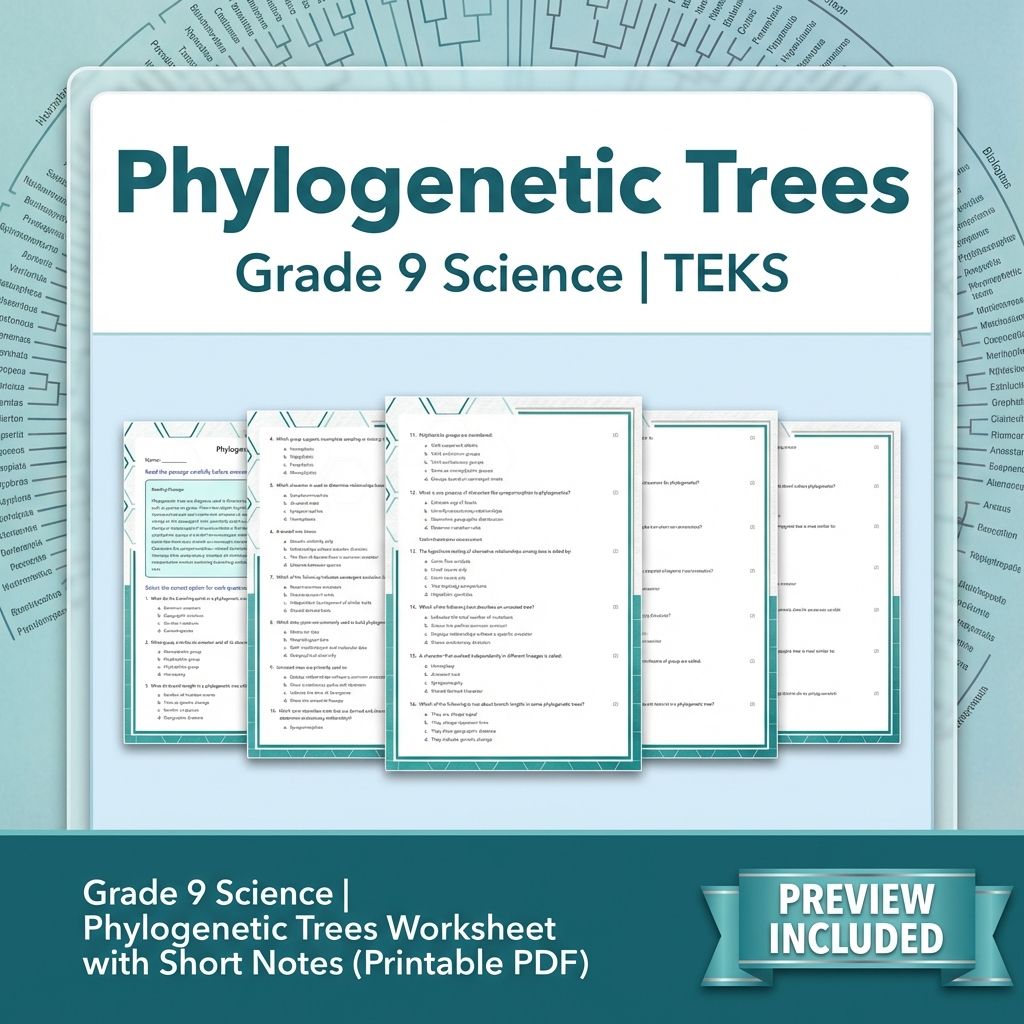
Grade 9 Science | Phylogenetic Trees Worksheet with Short Notes (Printable PDF)
Created byMeadowlark WorksheetsLearning Objectives
- Understand the structure and purpose of phylogenetic trees in evolutionary biology.
- Identify key components such as common ancestors, monophyletic, paraphyletic, and polyphyletic groups.
- Interpret tree topology and branch length information related to genetic change or time.
Instant download
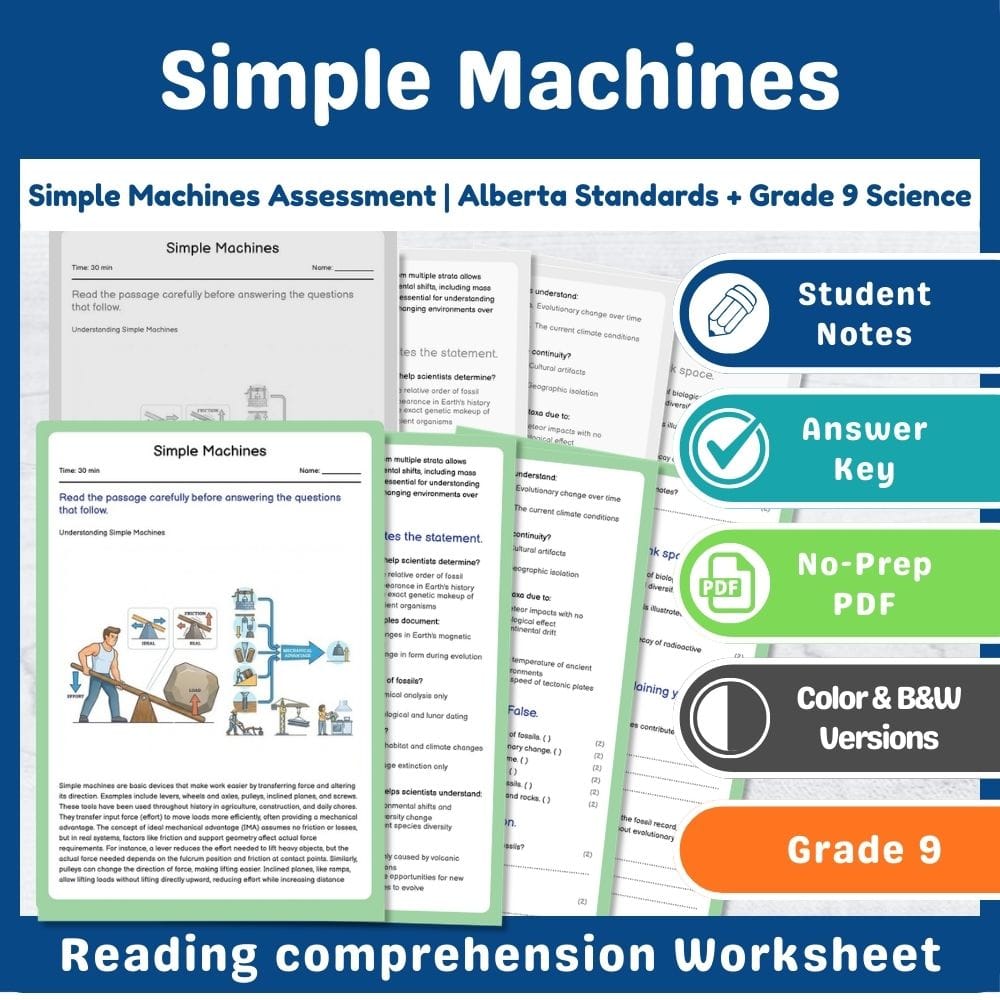
Simple Machines Assessment | Alberta Standards + Grade 9 Science
 Created byPrism Point Learning
Learning Objectives
- Describe the different types of simple machines and their functions.
- Explain how simple machines reduce effort and change the direction of force.
- Differentiate between ideal and actual mechanical advantage in systems involving simple machines.
Also included in: Grade 9 Forces and Motion Science Lesson Bundle Alberta Framework +1 more
Instant download
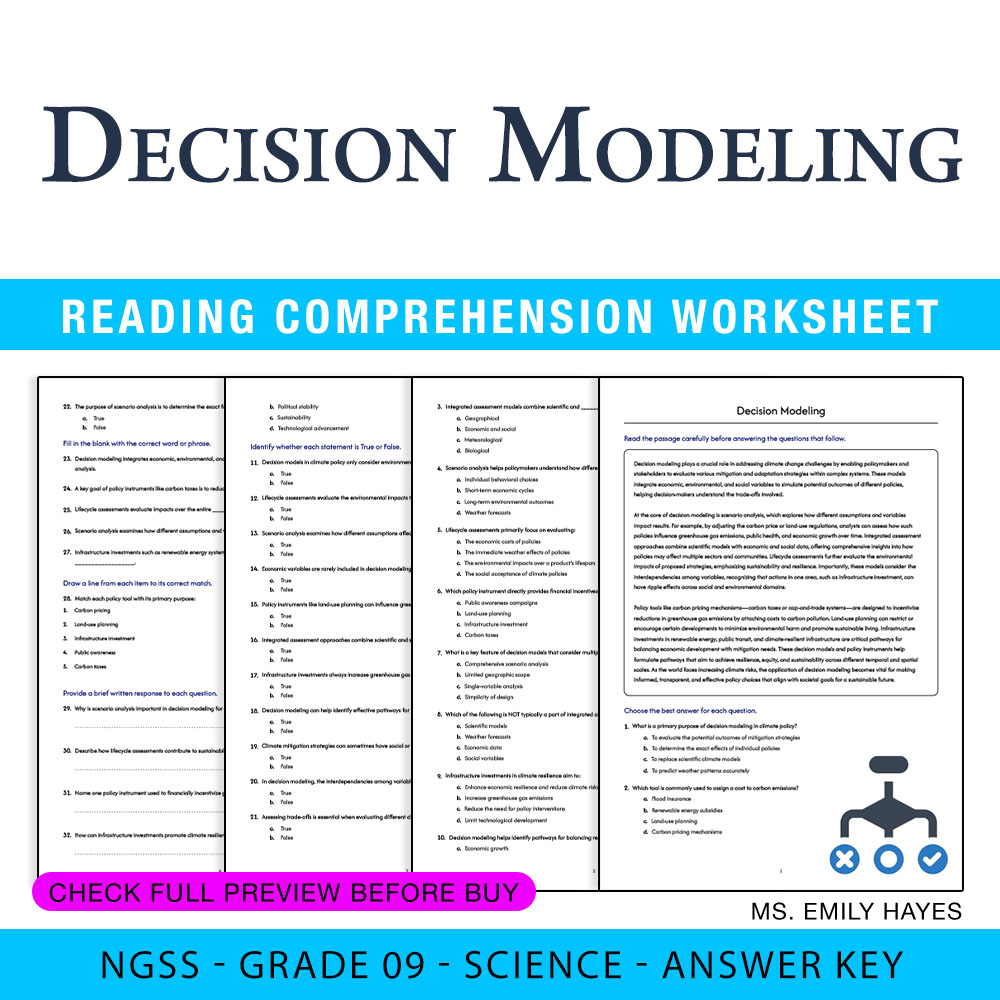
Grade 9 Science | Decision Modeling Worksheet (PDF+ Answer Key)
Created byCopper Leaf ClassroomLearning Objectives
- Describe how systems and decision models are used to evaluate climate mitigation and adaptation strategies.
- Explain the trade-offs among economic, environmental, and social variables in policy decision-making.
- Apply scenario analysis and integrated assessment approaches to real-world decision problems.
Instant download

Grade 9 Science | Chemical Reactions - Daily Reading Comprehension
 Created byCoral Reef Learning
Learning Objectives
- Understand the basic concept of chemical reactions
- Identify different types of chemical reactions such as combustion, synthesis, and decomposition
- Interpret symbolic chemical equations
Also included in: Matter and Chemical Change Lesson Bundle – Grade 9 Science Alberta +1 more
Instant download

Grade 9 Science | Observable Properties - Daily Reading Comprehension
Created byCoral Reef LearningLearning Objectives
- Identify different observable properties such as color and texture in various materials.
- Describe how observable properties can help classify and understand materials.
- Recognize examples of observable properties in regional and everyday contexts.
Also included in: Matter and Chemical Change Lesson Bundle – Grade 9 Science Alberta +1 more
Instant download
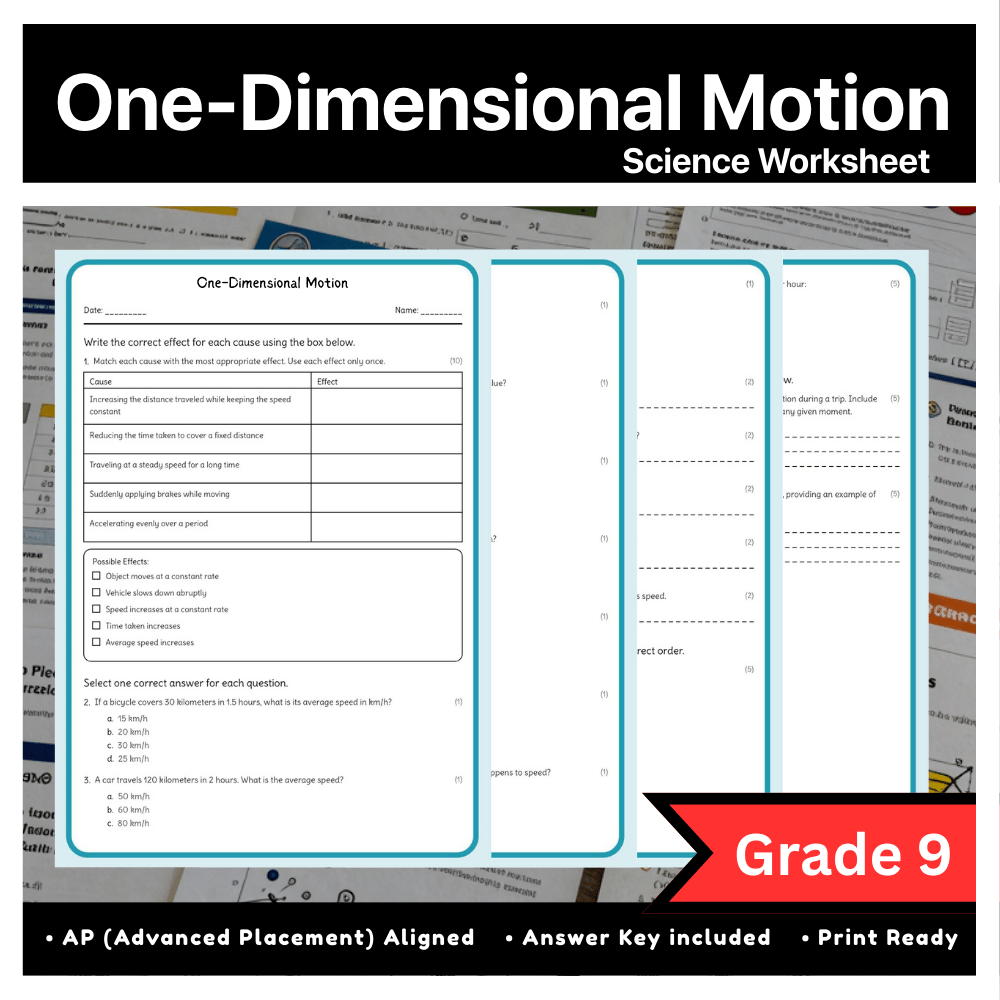
Grade 9 Science | One-Dimensional Motion Worksheet (AP Standards) PDF
Created byBright Mind ResourcesLearning Objectives
- Understand the relationships among displacement, velocity, and acceleration in straight-line motion.
- Interpret position–time and velocity–time graphs.
- Apply constant-acceleration equations to solve motion problems.
Instant download
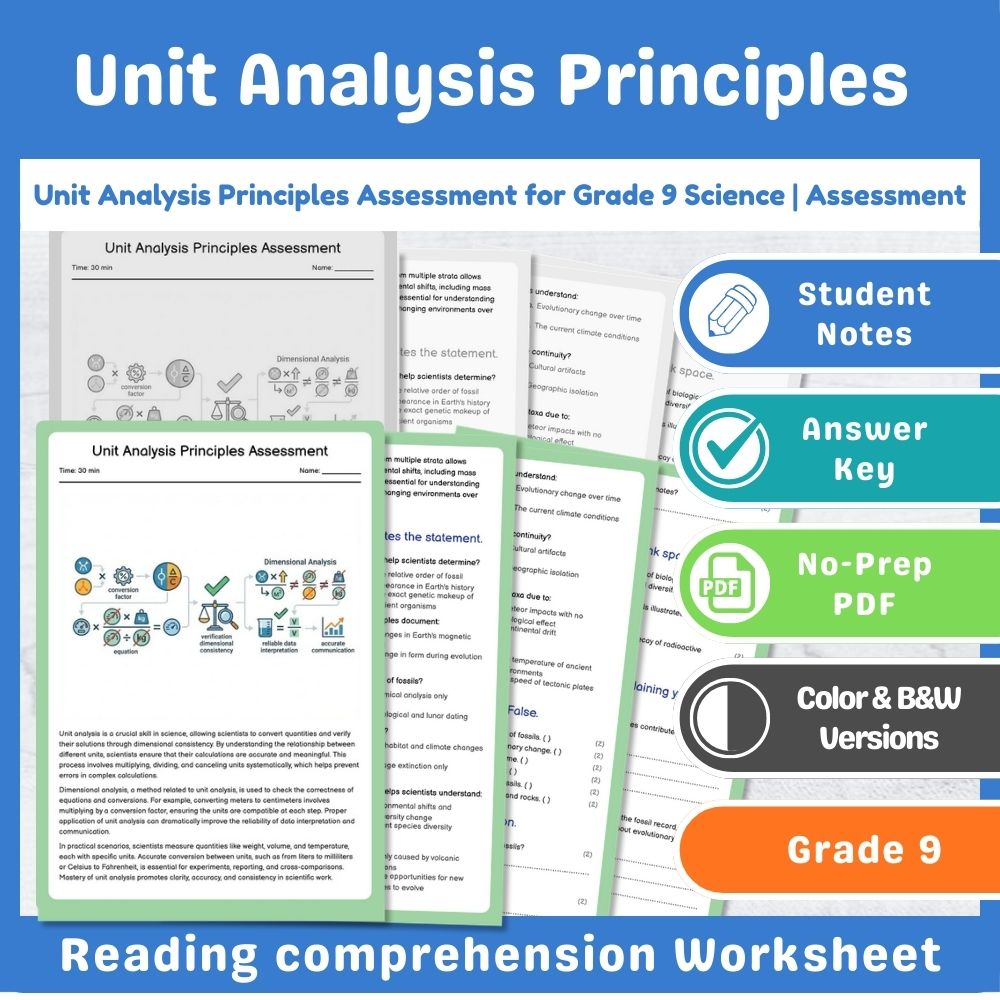
Unit Analysis Principles Assessment for Grade 9 Science | Assessment
Created byPrism Point LearningLearning Objectives
- Understand the fundamental principles of unit analysis in scientific measurements.
- Apply dimensional analysis to solve multi-step transformation problems.
- Evaluate the accuracy and precision of measurement results using unit conversions.
Instant download
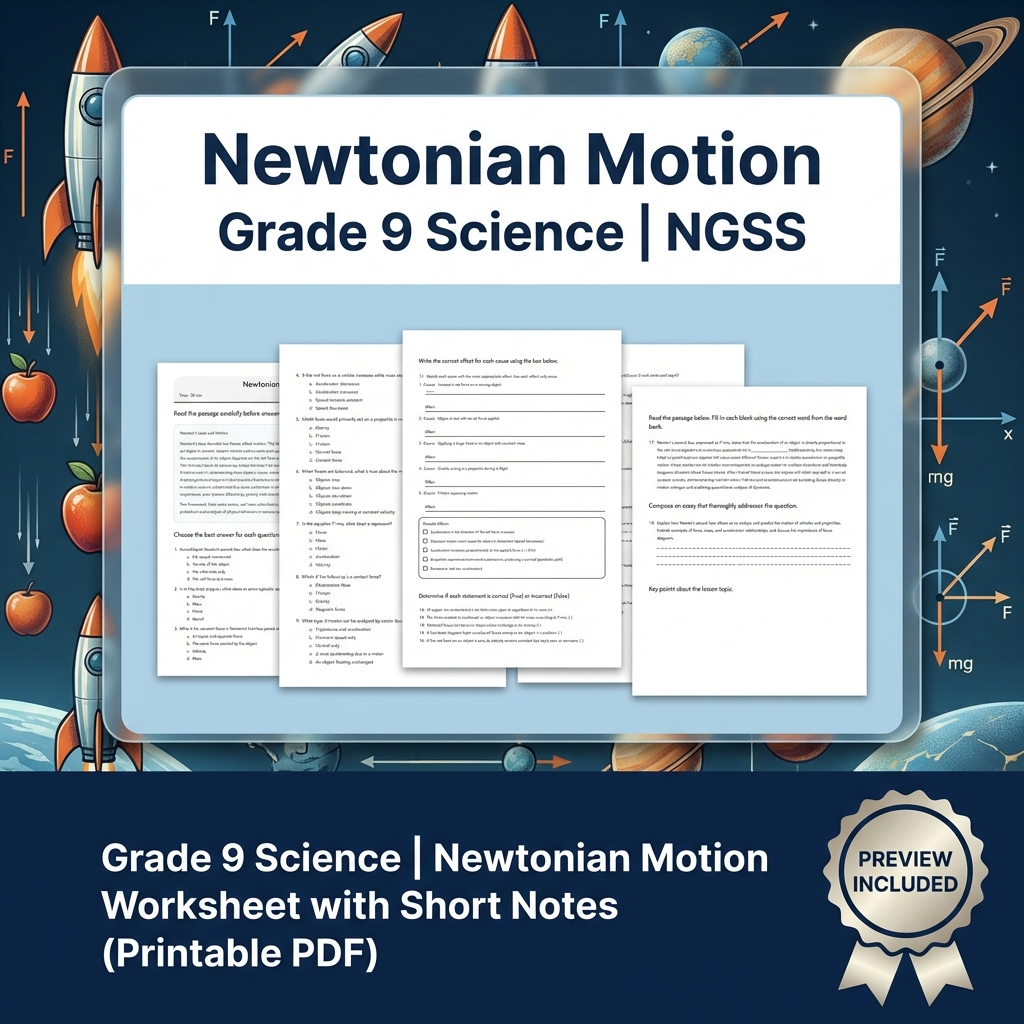
Grade 9 Science | Newtonian Motion Worksheet with Short Notes (Printable PDF)
Created byMeadowlark WorksheetsLearning Objectives
- Describe how Newton's laws relate net force, mass, and acceleration in motion.
- Interpret free-body diagrams and force components in various situations.
- Apply the proportionality between net force and acceleration to solve problems involving constant mass.
Also included in: Grade 9 Science | Motion and Stability Forces & Interactions NGSS UNIT Bundle +1 more
Instant download
Grade 9 Science Worksheet | Compound Formulas & Bonding (Ontario) (PDF)
Created byBright Mind ResourcesLearning Objectives
- Understand the concept of chemical compounds and their fixed elemental ratios.
- Identify the different types of bonding—ionic and covalent—and how they influence properties of compounds.
- Explain the law of definite composition and how chemical formulas represent element ratios.
Instant download
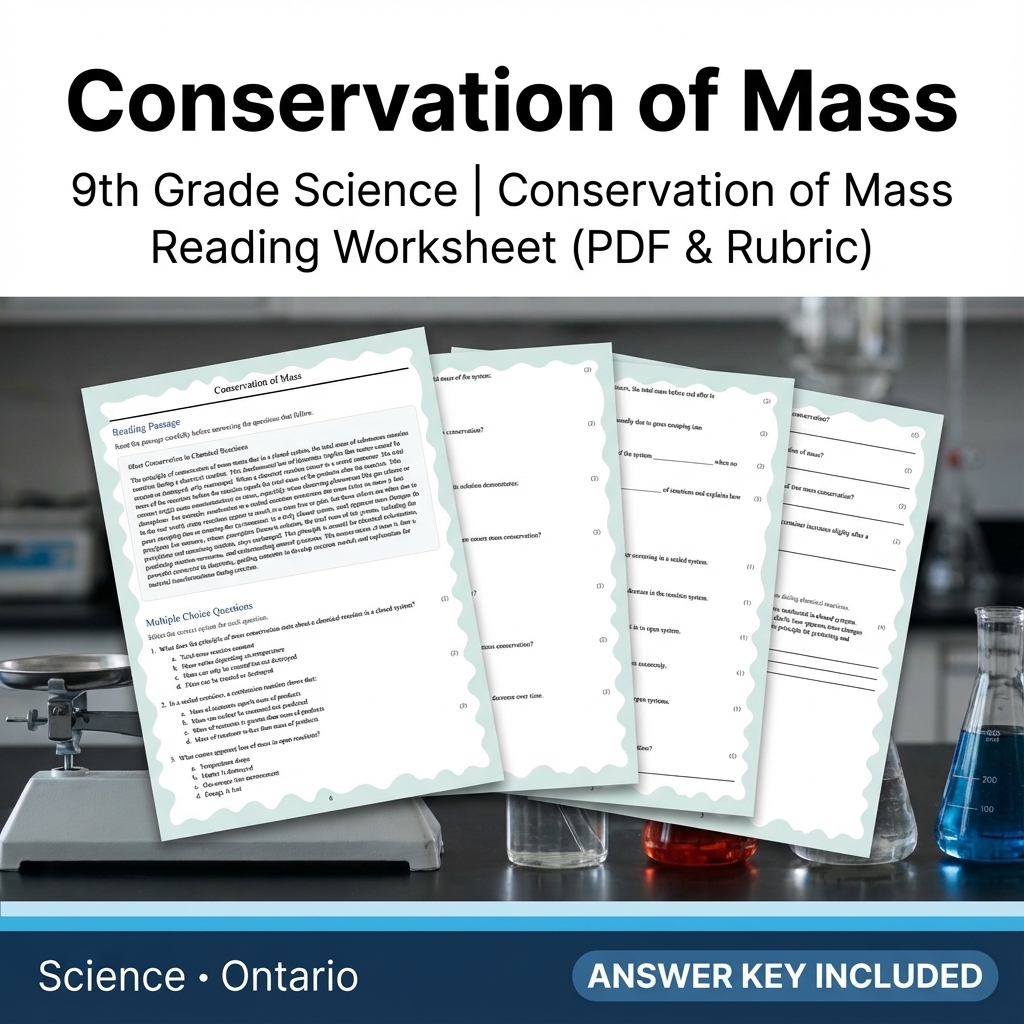
9th Grade Science | Conservation of Mass Reading Worksheet (PDF & Rubric)
JCreated byJ.S SheetsLearning Objectives
- Explain the principle of conservation of mass in closed systems during chemical reactions.
- Describe how total mass before and after a reaction remains constant in sealed environments.
- Differentiate between apparent mass changes caused by gases and true mass conservation.
Also included in: Grade 9 Science Unit Bundle | Essential Concepts & Skills (Answer Keys Included) +1 more
Instant download

Excretory System & Regulation Worksheet | Grade 9 Science Ontario
 Created byClear Sky Classroom
Learning Objectives
- Explain how the nephron forms urine through glomerular filtration, selective reabsorption, secretion, and urine concentration
- Describe how hydrostatic and oncotic pressures influence the glomerular filtration rate
- Use countercurrent multiplication and ADH to predict how urine concentration changes
Instant download
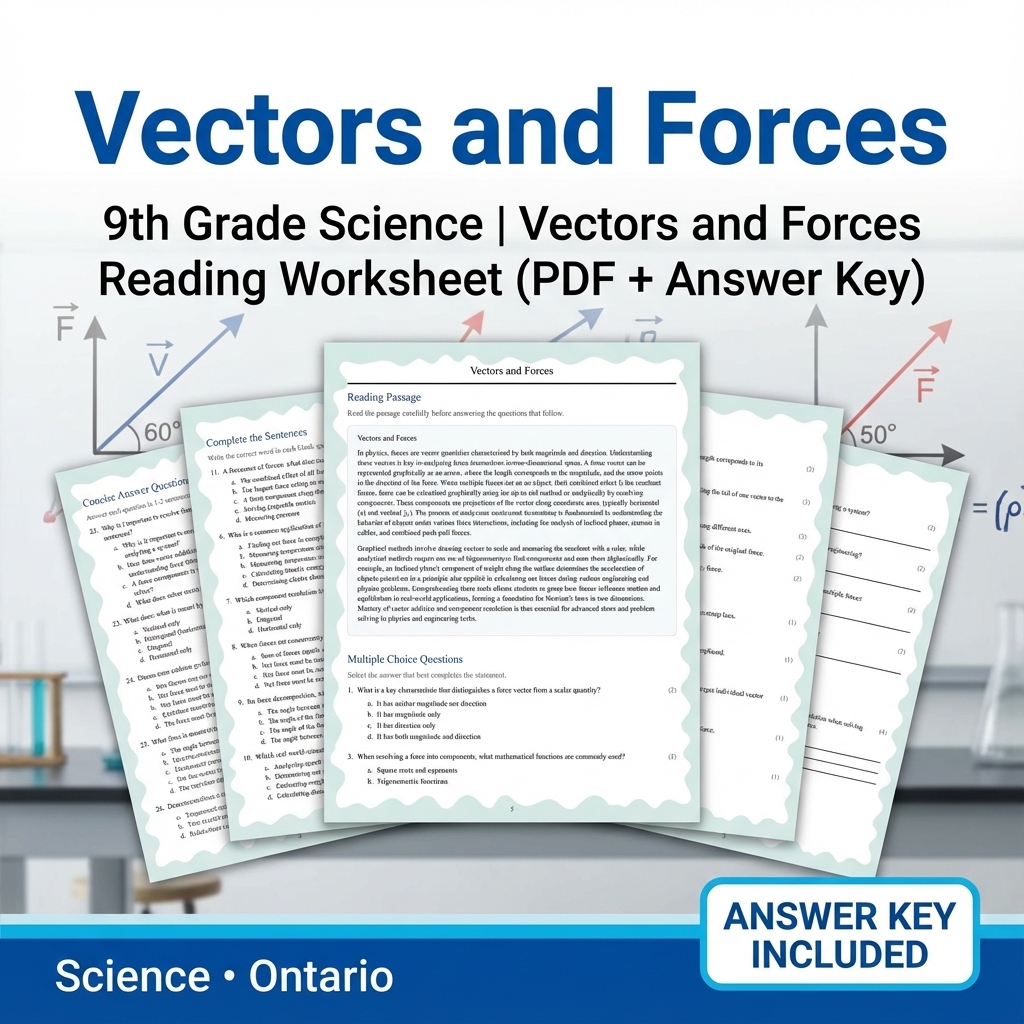
9th Grade Science | Vectors and Forces Reading Worksheet (PDF + Answer Key)
JCreated byJ.S SheetsLearning Objectives
- Understand the concept of vector quantities including magnitude and direction.
- Learn how to resolve force vectors into components along axes.
- Calculate the resultant force using graphical and analytical methods.
Also included in: Grade 9 Science Unit | Force, Motion & Energy Worksheets & Answer Keys Bundle +1 more
Instant download
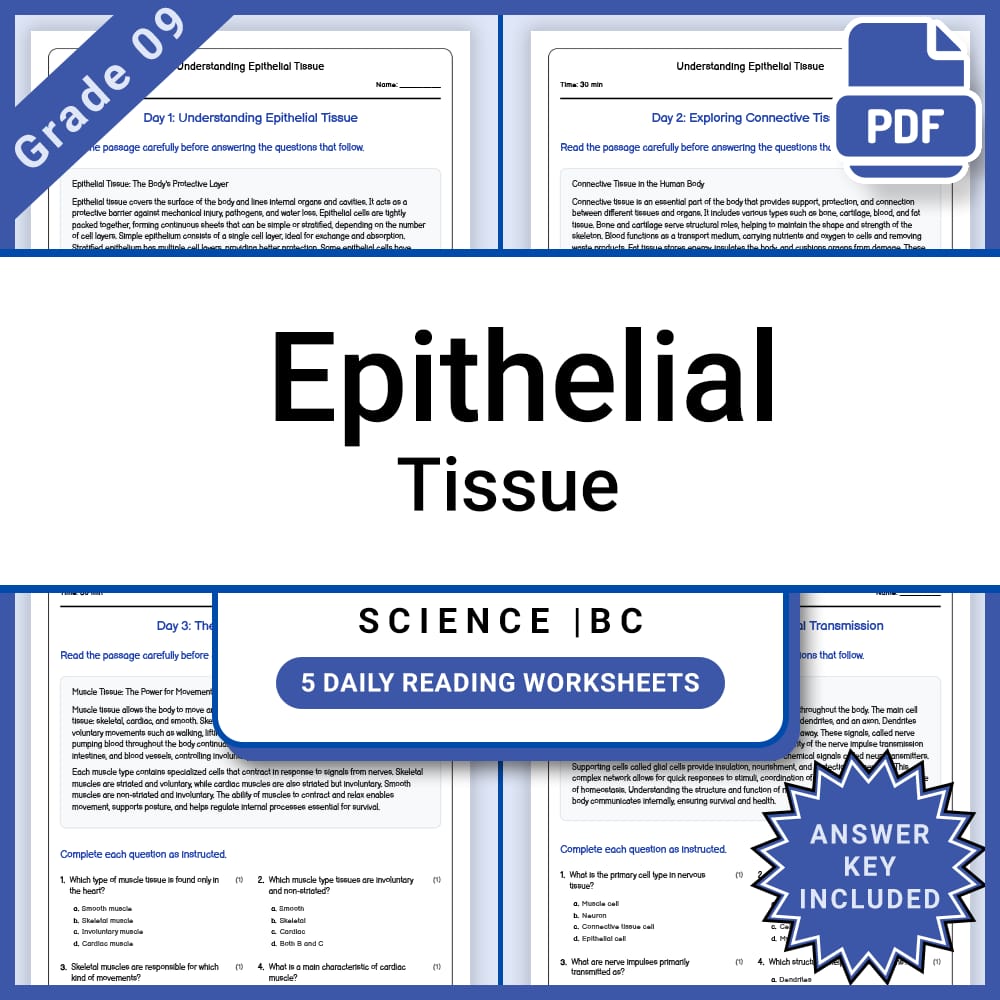
Grade 9 Science – Epithelial Tissue Daily Reading Worksheet + Answer Key
JCreated byJ.S SheetsLearning Objectives
- Identify the structure and functions of epithelial tissue.
- Describe the role of epithelial tissue in protection and exchange.
- Recognize different types of epithelial cells and their specific functions.
Also included in: Grade 9 Science Lesson Group Bundle | BC Framework Activities & Worksheets +1 more
Instant download
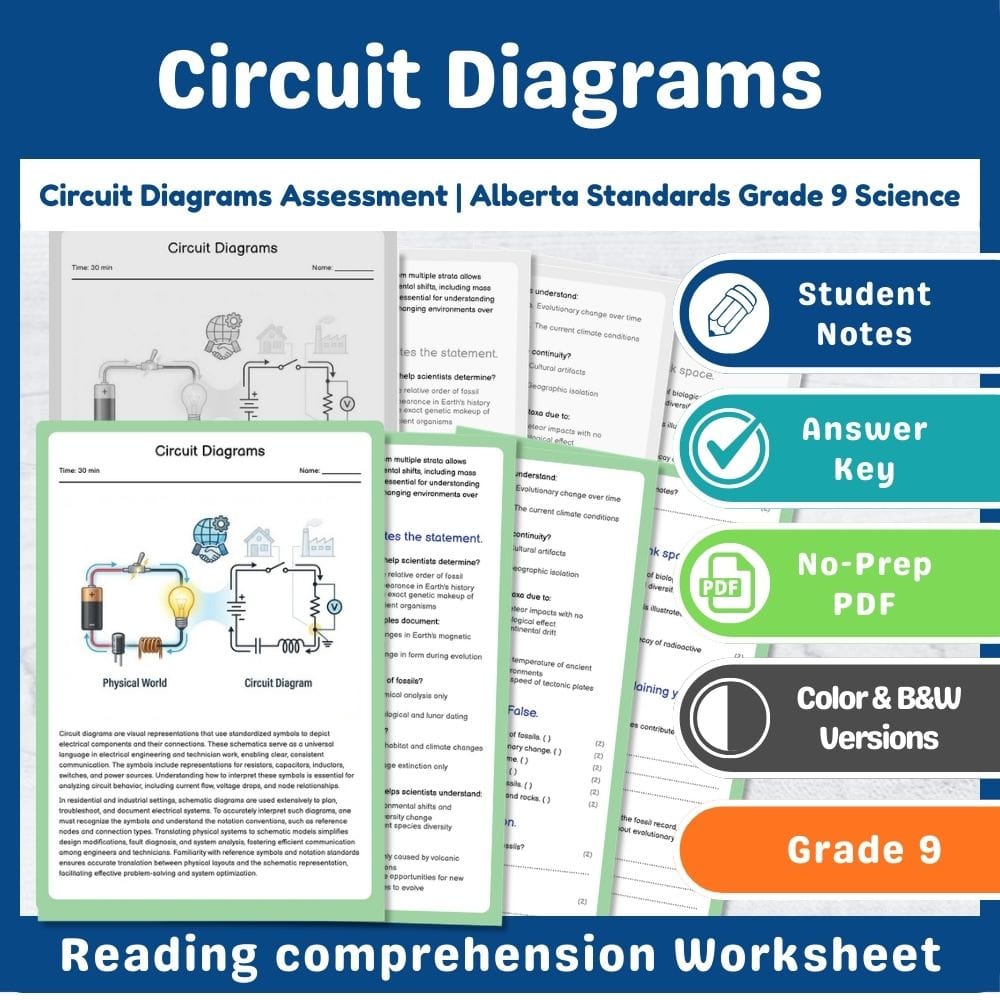
Circuit Diagrams Assessment | Alberta Standards Grade 9 Science
Created byPrism Point LearningLearning Objectives
- Understand and interpret standardized symbols used in circuit diagrams.
- Translate physical circuits into schematic models for analysis and communication.
- Identify components, nodes, and connection types within circuit diagrams.
Also included in: Grade 9 Electricity and Magnetism Science Lesson Bundle | Alberta Framework +1 more
Instant download
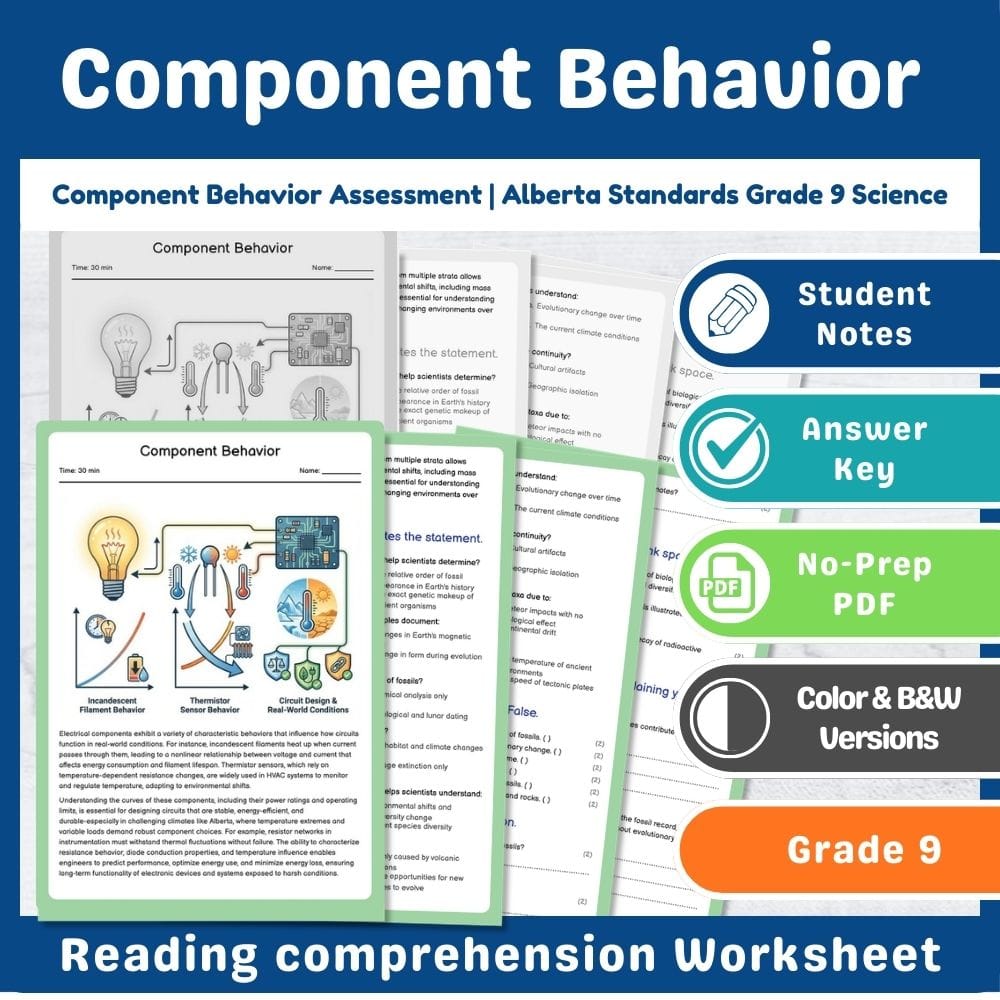
Component Behavior Assessment | Alberta Standards Grade 9 Science
Created byPrism Point LearningLearning Objectives
- Understand the characteristic behaviors of electrical components such as resistance, diode conduction, and temperature dependence.
- Identify real-world examples of component behaviors in electrical circuits.
- Analyze component curves, power ratings, and operating limits to determine their impact on circuit stability, energy efficiency, and longevity.
Also included in: Grade 9 Electricity and Magnetism Science Lesson Bundle | Alberta Framework +1 more
Instant download
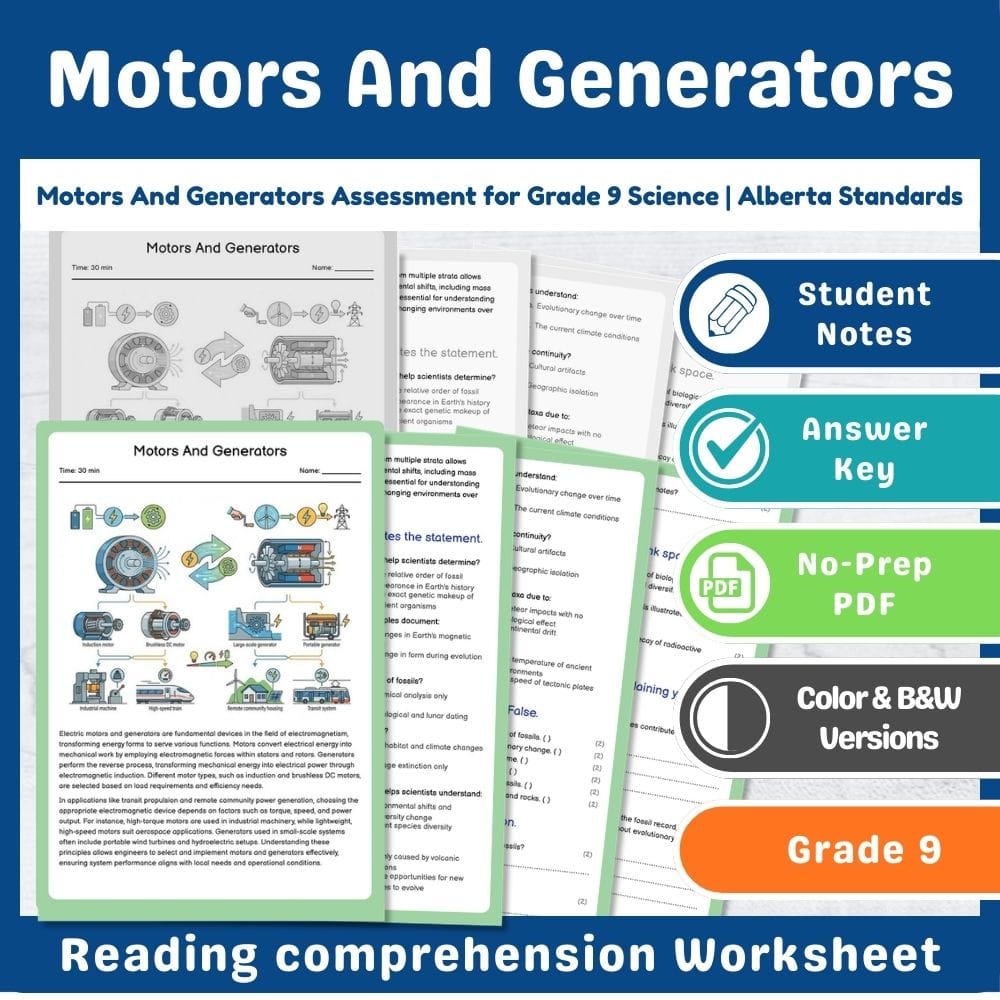
Motors And Generators Assessment for Grade 9 Science | Alberta Standards
Created byPrism Point LearningLearning Objectives
- Describe the basic principles of electric motors and generators.
- Identify different types of motors and their applications.
- Explain electromagnetic induction and its role in generating electricity.
Also included in: Grade 9 Electricity and Magnetism Science Lesson Bundle | Alberta Framework +1 more
Instant download
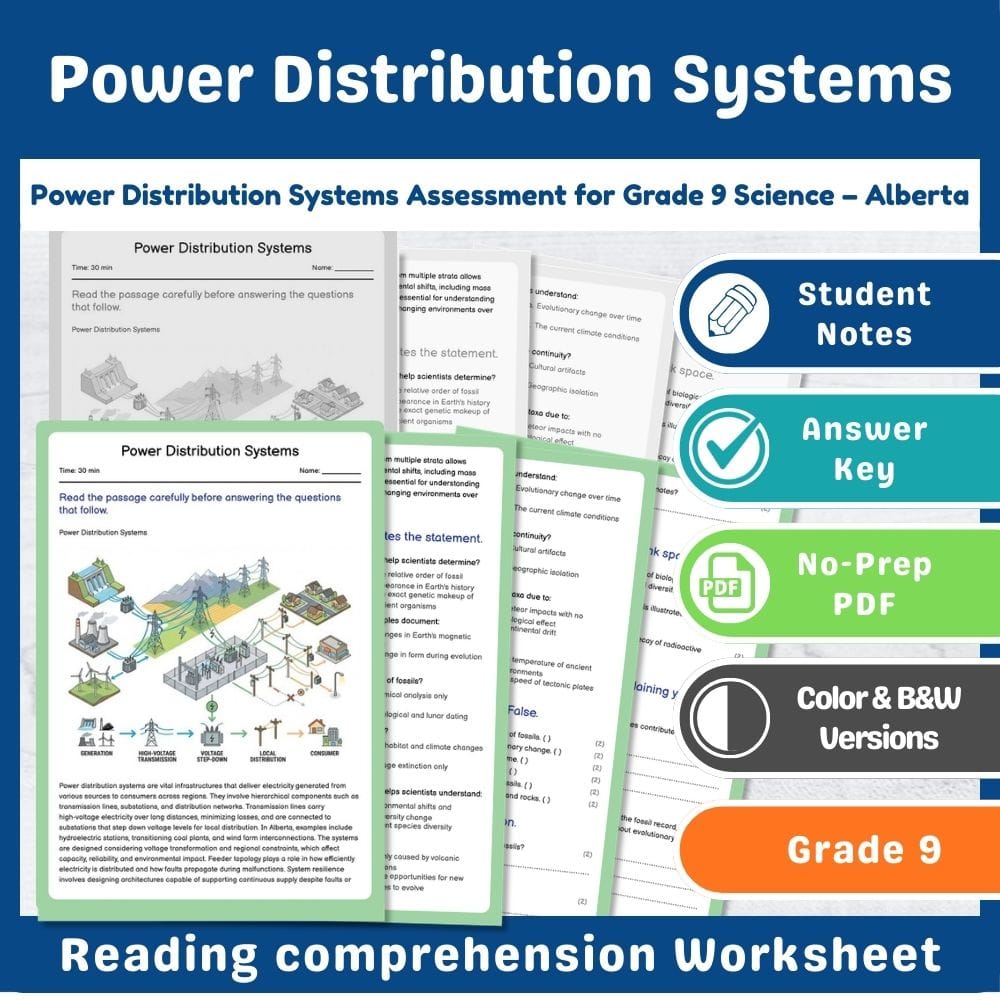
Power Distribution Systems Assessment for Grade 9 Science – Alberta
Created byPrism Point LearningLearning Objectives
- Understand the main components and functions of power distribution systems.
- Analyze how voltage transformation and feeder topology affect system reliability and capacity.
- Evaluate the environmental impacts and resilience considerations in power grid design.
Also included in: Grade 9 Electricity and Magnetism Science Lesson Bundle | Alberta Framework +1 more
Instant download
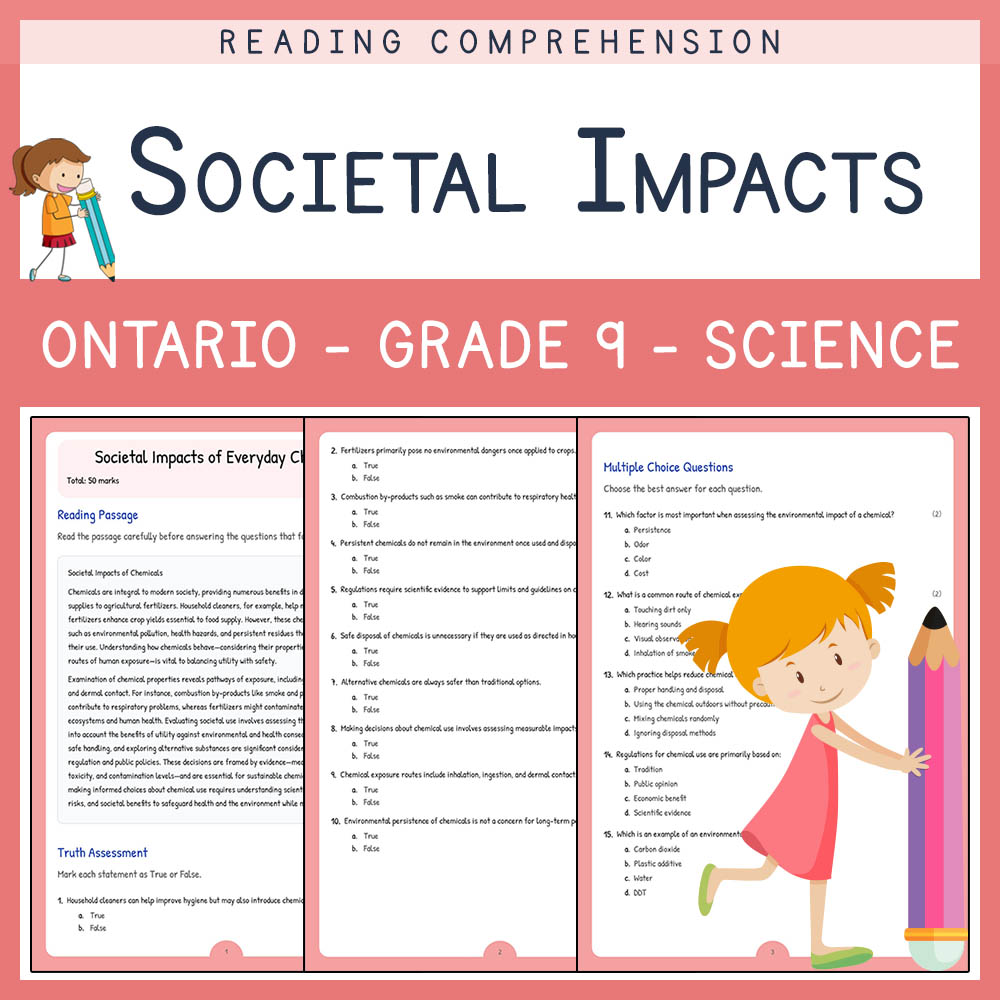
Grade 9 Science | Societal Impacts of Everyday Chemicals Worksheet | Ontario
Created byLumora LearningLearning Objectives
- Analyze the societal uses and benefits of common chemicals.
- Evaluate the risks and environmental impacts associated with chemical applications.
- Understand concepts of safe handling, disposal, and alternatives for chemicals.
Instant download
Grade 9 Science – Societal Impacts of Chemicals Worksheet (PDF)
Created byBright Mind ResourcesLearning Objectives
- Assess societal uses, benefits, and risks of everyday chemicals.
- Understand how chemical properties influence environmental and health impacts.
- Explore trade-offs between utility and safety in chemical use.
Instant download

Grade 9 Representation Models Worksheet | Practice & Assessment PDF
Created byClear Sky ClassroomLearning Objectives
- Differentiate among common science representation models: mathematical formulas, graphs, schematic diagrams, and computational approximations.
- Explain how representational fidelity, parsimony, and predictive scope guide model selection.
- Interpret how mapping model components to measurable observables supports evidence-based evaluation of a claim.
Also included in: Grade 9 Science Practices Science Lesson Bundle | Advanced Placement (AP) +1 more
Instant download

Grade 9 Graphical Literacy Worksheet | Practice & Assessment PDF
Created byClear Sky ClassroomLearning Objectives
- Select an appropriate graph type (scatterplot, histogram, line graph, residual display) for a given scientific question.
- Construct graphs with correct axis scaling, labeling, and binning choices to support valid interpretation.
- Interpret visual patterns, outliers, trends, and correlation structures, and connect them to model choice.
Also included in: Grade 9 Science Practices Science Lesson Bundle | Advanced Placement (AP) +1 more
Instant download
Grade 9 Science | Variation Mechanisms Worksheet (PDF + Answer Key)
 Created byRiverstone Classroom
Learning Objectives
- Explain the key mechanisms that generate genetic variation such as point mutations, chromosomal rearrangements, and meiotic recombination.
- Describe how genetic variation affects phenotype and contributes to heritable diversity in populations.
- Analyze how molecular changes influence gene expression and protein function, impacting heritable traits.
Instant download

Grade 9 Science – Safety Standards Worksheet (Alberta) Practice Set (PDF)
 Created bySilver Birch Teaching
Learning Objectives
- Explain how grounding and overcurrent protection reduce electrical hazards
- Interpret the purpose of insulation, approved installation practices, and device labeling
- Apply Alberta-specific environmental considerations to evaluate whether an electrical installation is safer and more reliable
Also included in: Grade 9 Electrical Circuits and Energy Science Lesson Bundle (Alberta) +1 more
Instant download

Grade 9 Science | Power Distribution Worksheet – Alberta Standards (PDF)
Created bySilver Birch TeachingLearning Objectives
- Explain how power distribution systems move electricity from transmission lines to consumers through substations and feeders
- Describe the role of voltage transformation in reducing losses and improving safe delivery
- Analyze how feeder topology and protection systems affect reliability and the spread of faults
Also included in: Grade 9 Electrical Circuits and Energy Science Lesson Bundle (Alberta) +1 more
Instant download

Grade 9 Science | Electrical Quantities Worksheet (Alberta Standards) (PDF)
Created bySilver Birch TeachingLearning Objectives
- Define electric current, voltage, and resistance using correct symbols and SI units.
- Use quantitative reasoning to connect current, voltage, and resistance to circuit behavior and power.
- Interpret typical values and instrument readings related to electrical quantities in everyday Alberta contexts.
Also included in: Grade 9 Electrical Circuits and Energy Science Lesson Bundle (Alberta) +1 more
Instant download

Energy in Changes Worksheet | Grade 9 Science Practice
Created byPrism Point LearningLearning Objectives
- Compare physical and chemical changes using ideas of energy transfer and system–surroundings interactions.
- Explain how endothermic and exothermic processes relate to observed temperature changes.
- Connect energy transfer to particle behavior in phase changes and to bond rearrangements in chemical changes.
Instant download
Grade 9 Science | Orbital Motion Worksheet with Short Notes (Printable PDF)
Created byMeadowlark WorksheetsLearning Objectives
- Explain the principles governing orbital motion, including Kepler's laws and Newton's law of gravitation.
- Calculate relationships between orbital period, semi-major axis, and escape velocity.
- Describe the effects of orbital resonance and perturbations on satellite and planetary stability.
Also included in: Grade 9 Science NGSS Earth’s Place in the Universe Unit Bundle – Worksheet Pack +1 more
Instant download
Grade 9 Science | Inheritance NGSS Assessment (Worksheet + Answer Key)
 Created byMaple Path Learning
Learning Objectives
- Explain how DNA replication and chromosomal segregation ensure hereditary information transfer.
- Describe the roles of gametes and zygotes in inheritance.
- Identify observable inheritance patterns such as karyotype patterns and transmission ratios.
Also included in: Grade 9 Science NGSS Heredity Unit | Inheritance & Variation Worksheet Bundle +1 more
Instant download
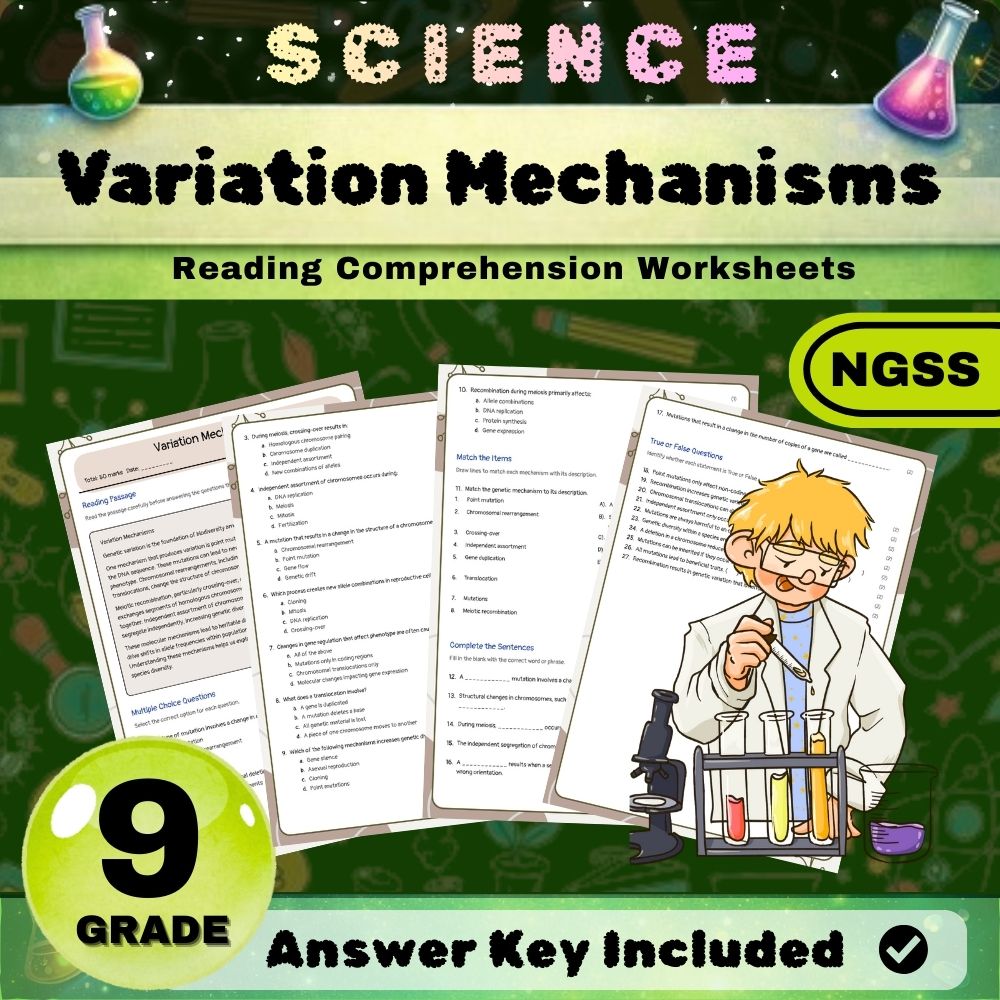
Grade 9 Science | Variation Mechanisms Worksheet (NGSS) (PDF)
Created byMaple Path LearningLearning Objectives
- Describe different genetic mechanisms that generate heritable diversity.
- Explain how mutations, chromosomal rearrangements, and recombination affect allelic variation.
- Connect molecular changes to variations in phenotype and their impact on populations.
Also included in: Grade 9 Science NGSS Heredity Unit | Inheritance & Variation Worksheet Bundle +1 more
Instant download
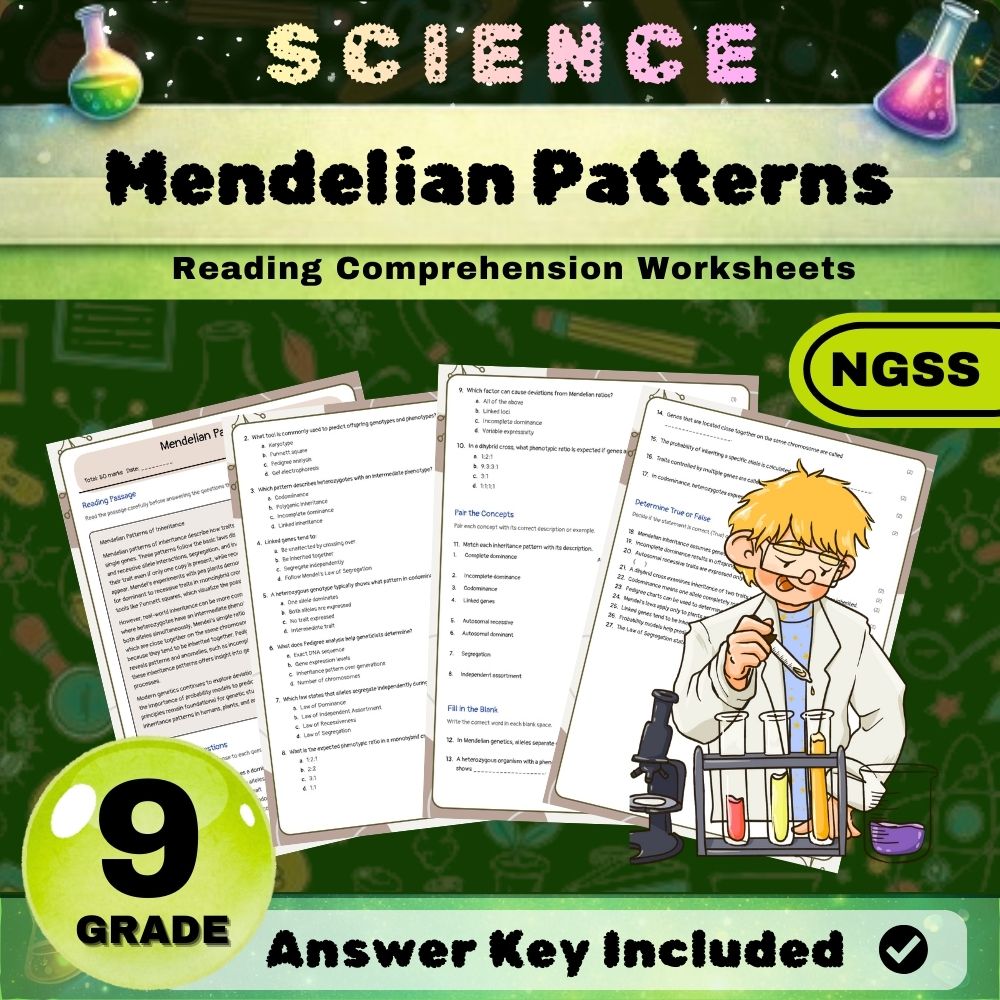
Grade 9 Science | Mendelian Patterns Worksheet (NGSS) (PDF)
Created byMaple Path LearningLearning Objectives
- Describe the principles of single-gene inheritance patterns, including dominance, segregation, and independent assortment.
- Use Punnett squares to predict genotype and phenotype ratios in monohybrid and dihybrid crosses.
- Interpret pedigrees and understand inheritance probabilities and limitations such as incomplete dominance, codominance, and linked loci.
Also included in: Grade 9 Science NGSS Heredity Unit | Inheritance & Variation Worksheet Bundle +1 more
Instant download
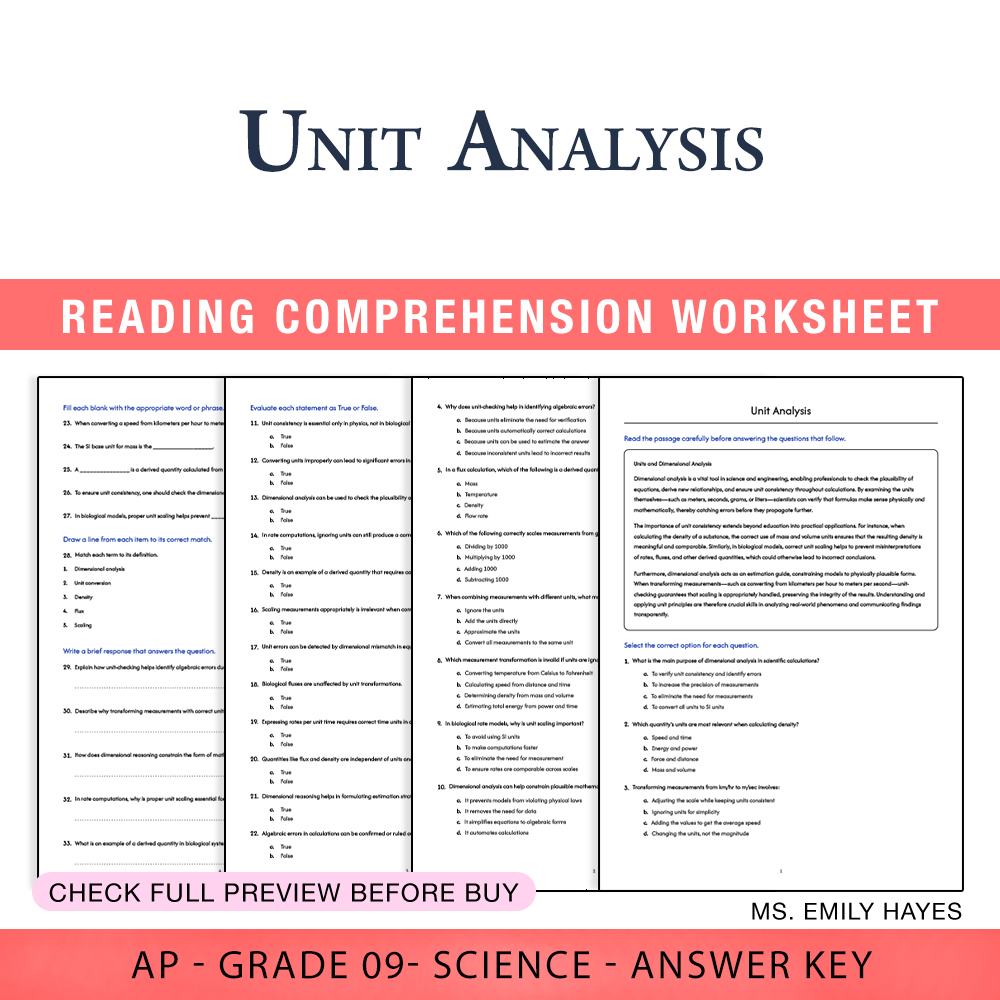
Grade 9 Science | Unit Analysis Worksheet (PDF+ Answer Key)
Created byCopper Leaf ClassroomLearning Objectives
- Understand the principles of dimensional analysis and apply unit consistency when combining measurements.
- Recognize how unit-checking can reveal algebraic errors in calculations.
- Derive relationships and transform measurements using correct units.
Also included in: Grade 9 Science | Scientific Data Analysis & Inquiry Skills (PDF+ Answer Key) +1 more
Instant download
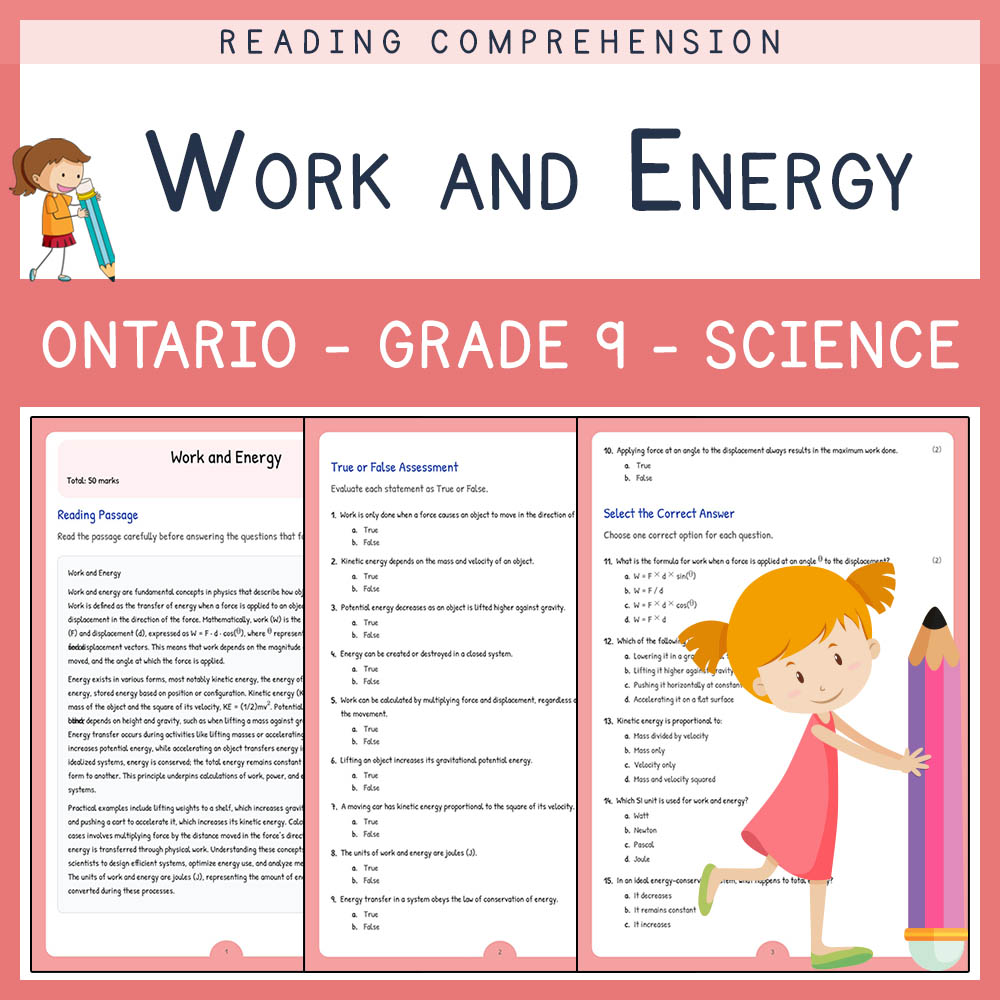
Grade 9 Science Assessment | Work and Energy Worksheet Elena | Ontario Standard
Created byLumora LearningLearning Objectives
- Define and distinguish between work, kinetic energy, and potential energy
- Understand the calculation of work for constant forces
- Explain energy transfer in mechanical systems such as lifting and accelerating objects
Instant download

Grade 9 Science–Eclipses Explained Worksheet (BC) | Standard-Aligned Practice
 Created byEvergreen Desk Education
Learning Objectives
- Explain how the Sun, Moon, and Earth alignment creates solar and lunar eclipses
- Compare the order of bodies (relative positions) for solar vs. lunar eclipses
- Describe how orbital inclination affects eclipse frequency and where totality can be observed
Instant download
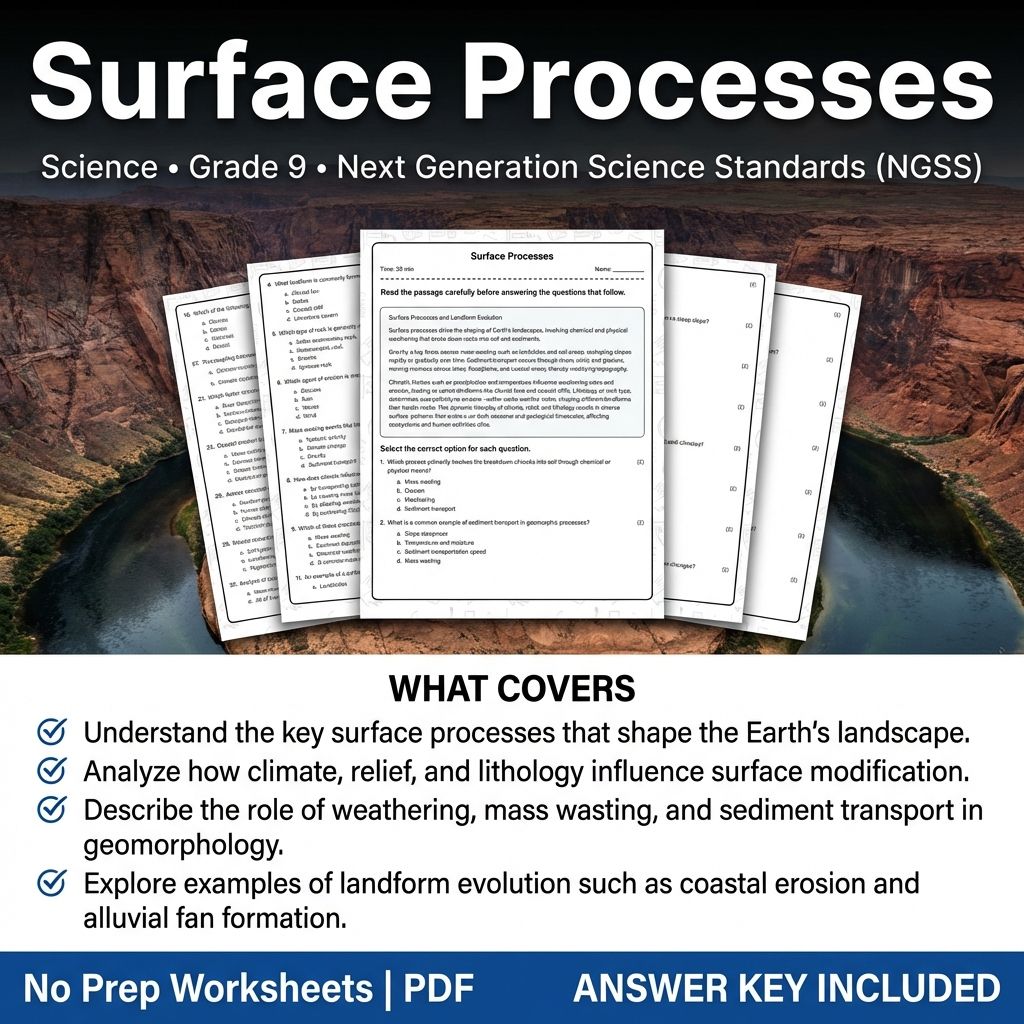
9th Grade Science | Surface Processes Printable Worksheet & Answer Key
Created byCoral Reef LearningLearning Objectives
- Understand the key surface processes that shape the Earth's landscape.
- Analyze how climate, relief, and lithology influence surface modification.
- Describe the role of weathering, mass wasting, and sediment transport in geomorphology.
Also included in: Grade 9 Science Unit Bundle – Earth's Processes & Surface Change Worksheets PDF +1 more
Instant download
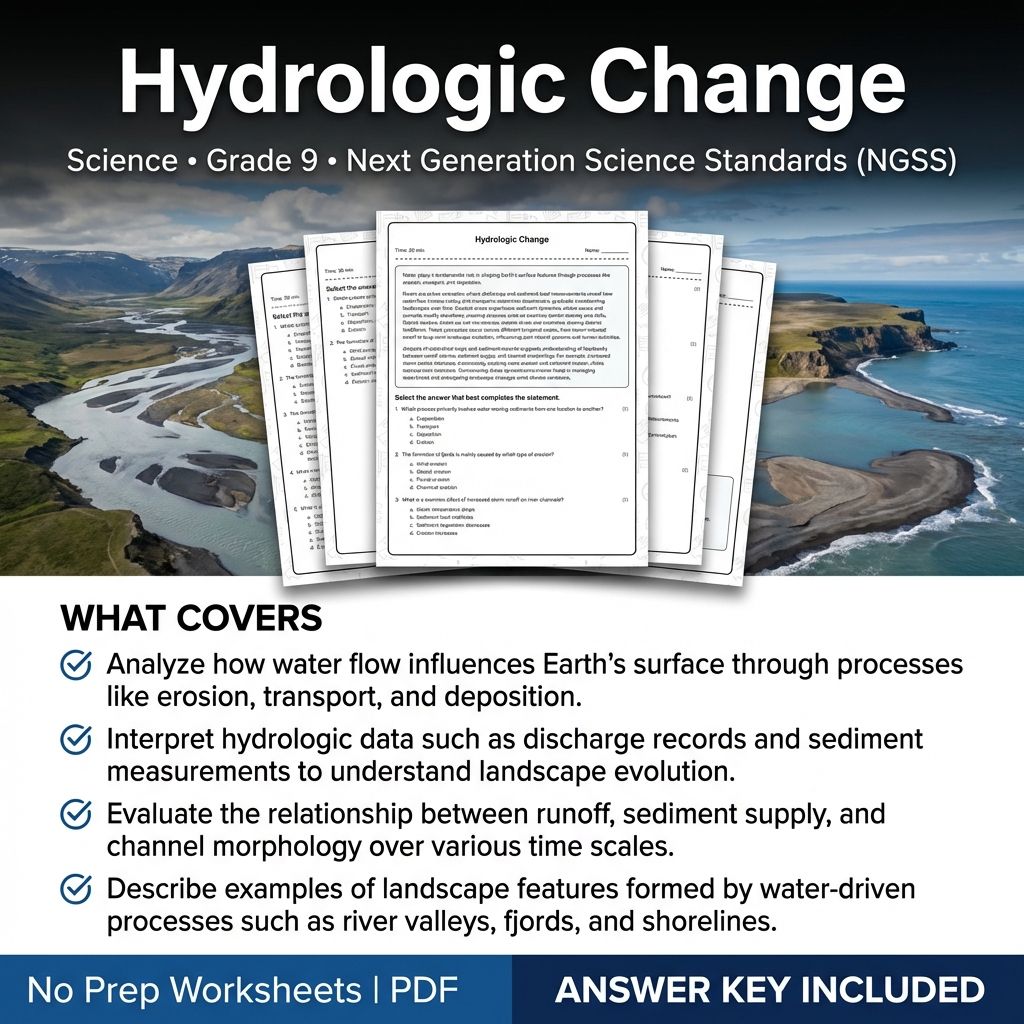
Grade 9 Science | Hydrologic Change Worksheet with Answer Key (Printable PDF)
Created byCoral Reef LearningLearning Objectives
- Analyze how water flow influences Earth's surface through processes like erosion, transport, and deposition.
- Interpret hydrologic data such as discharge records and sediment measurements to understand landscape evolution.
- Evaluate the relationship between runoff, sediment supply, and channel morphology over various time scales.
Also included in: Grade 9 Science Unit Bundle – Earth's Processes & Surface Change Worksheets PDF +1 more
Instant download
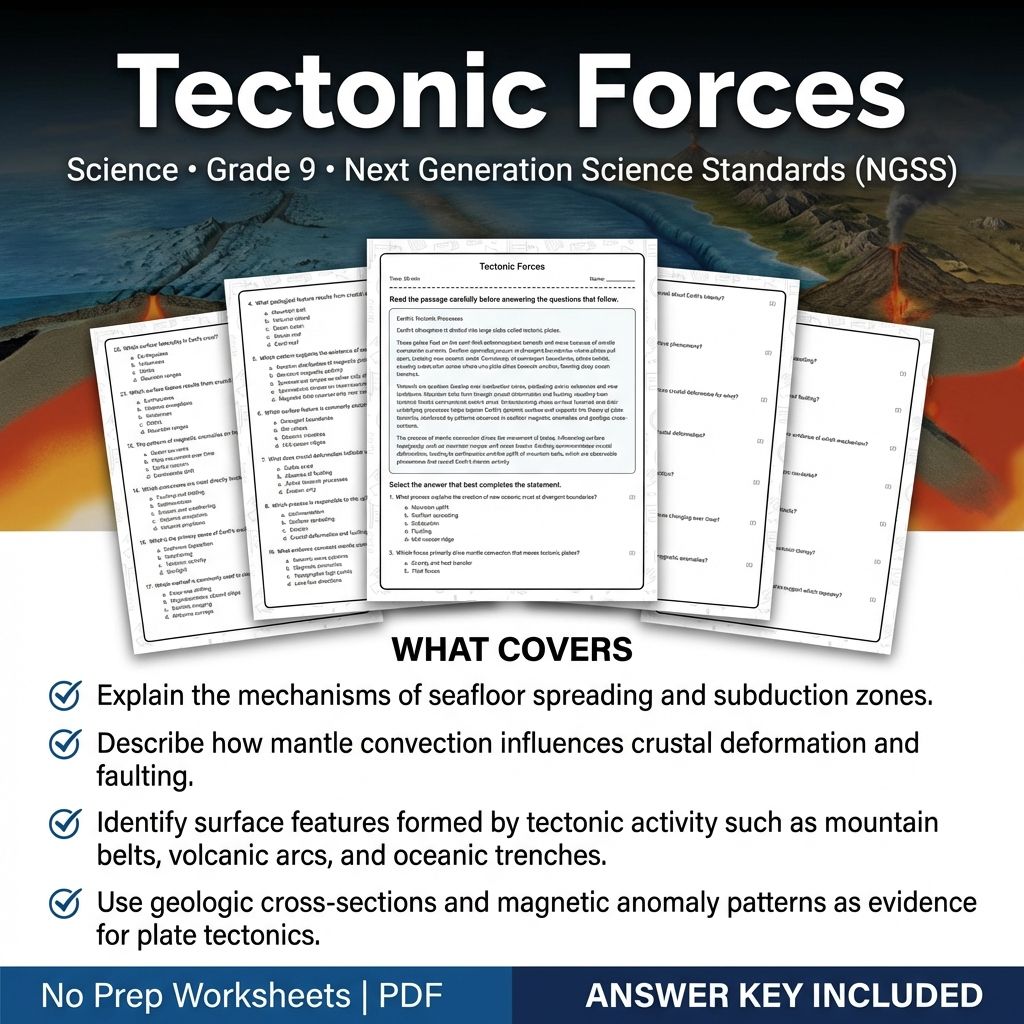
9th Grade Science | Tectonic Forces Worksheet & Answer Key (Printable PDF)
Created byCoral Reef LearningLearning Objectives
- Explain the mechanisms of seafloor spreading and subduction zones.
- Describe how mantle convection influences crustal deformation and faulting.
- Identify surface features formed by tectonic activity such as mountain belts, volcanic arcs, and oceanic trenches.
Also included in: Grade 9 Science Unit Bundle – Earth's Processes & Surface Change Worksheets PDF +1 more
Instant download
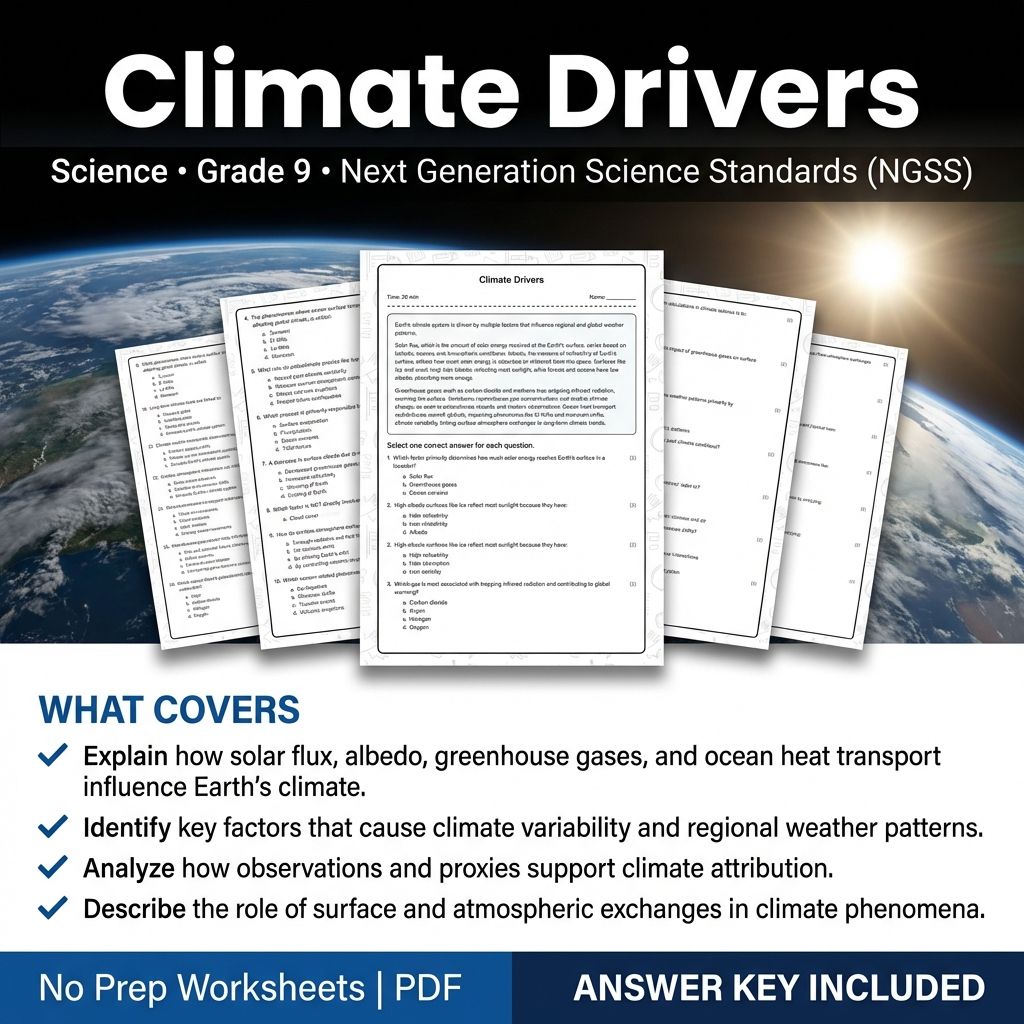
9th Grade Science | Climate Drivers Worksheet + Answer Key (Printable PDF)
Created byCoral Reef LearningLearning Objectives
- Explain how solar flux, albedo, greenhouse gases, and ocean heat transport influence Earth's climate.
- Identify key factors that cause climate variability and regional weather patterns.
- Analyze how observations and proxies support climate attribution.
Also included in: Grade 9 Science Unit Bundle – Earth's Processes & Surface Change Worksheets PDF +1 more
Instant download
About Grade 9 Science Worksheets
Find Science worksheets built for Grade 9. All 6,926 cover core skills, practice, and review, each an instant PDF download.
Every worksheet on MyTeachingSheets is created by independent teacher-authors and reviewed before publication. All resources download as printable PDFs for classroom, homework, or at-home practice, and many include answer keys. Preview any worksheet free before buying.