
Grade 8 Science Worksheets
5,990 worksheets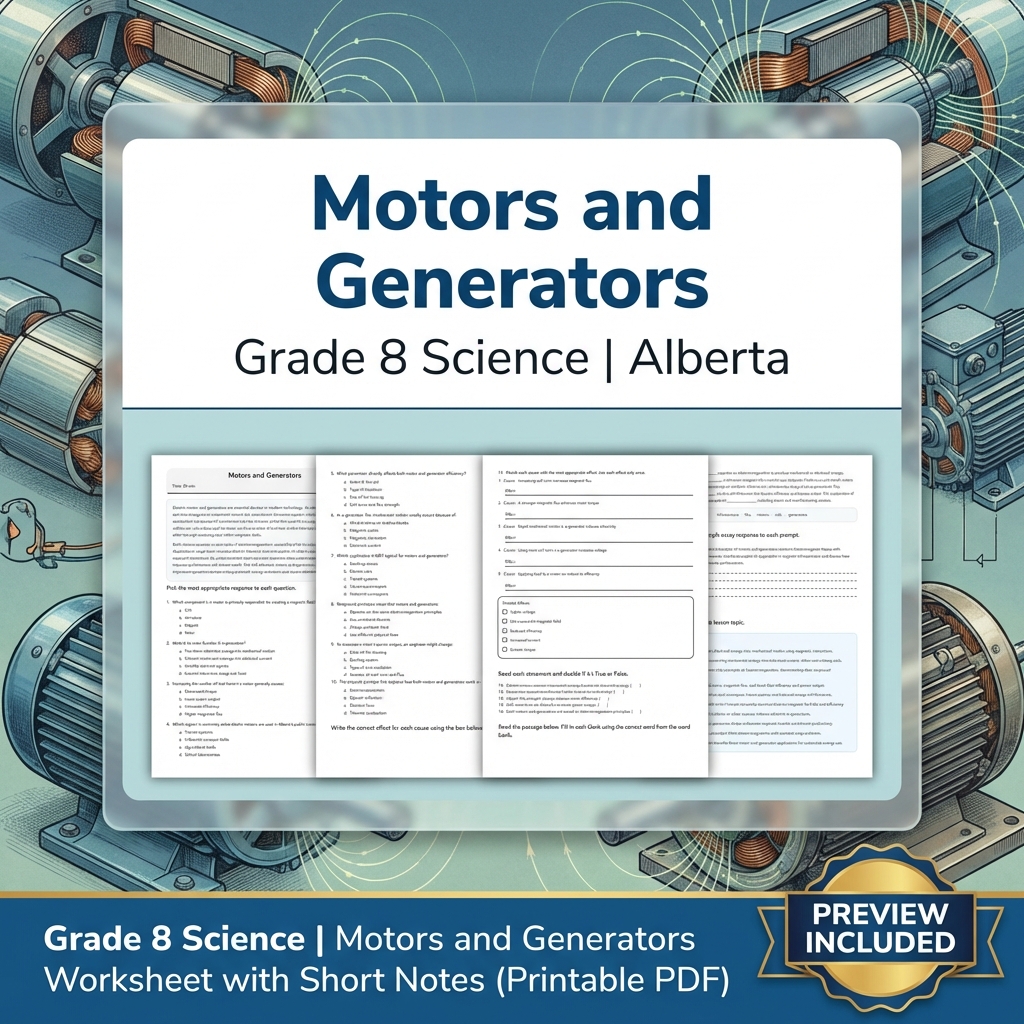
Grade 8 Science | Motors and Generators Worksheet with Short Notes (PDF)
 Created byMeadowlark Worksheets
Learning Objectives
- Understand how electric motors convert electrical energy into mechanical motion using magnetic fields.
- Explain how generators perform the reverse process, converting mechanical energy into electricity.
- Identify design parameters such as coil turns, magnetic flux, and load that affect motor and generator efficiency.
Also included in: Grade 8 Science | Electricity & Magnetism UNIT Worksheet Bundle +1 more
Instant download
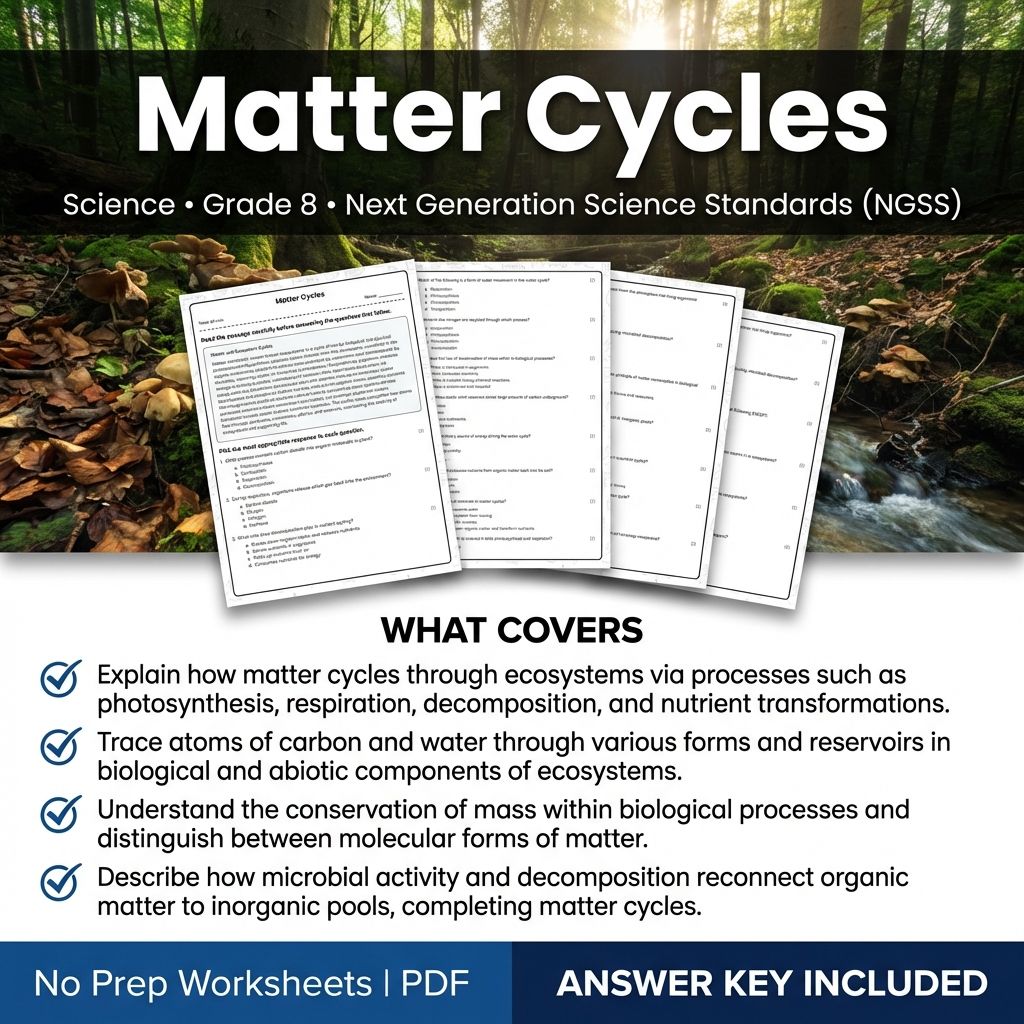
Grade 8 Science | Matter Cycles Worksheet + Answer Key (Printable PDF)
 Created byCoral Reef Learning
Learning Objectives
- Explain how matter cycles through ecosystems via processes such as photosynthesis, respiration, decomposition, and nutrient transformations.
- Trace atoms of carbon and water through various forms and reservoirs in biological and abiotic components of ecosystems.
- Understand the conservation of mass within biological processes and distinguish between molecular forms of matter.
Instant download

Grade 8 Science – Watershed Systems & Water Cycle | Daily Reading Worksheet
 Created byQuiet Forest Education
Learning Objectives
- Understand the characteristics of drainage basins and watershed boundaries.
- Identify key features such as runoff, stream networks, and tributaries.
- Explain how land cover, slope, and soil influence infiltration and overland flow.
Also included in: Grade 8 Science Full Year Bundle Ontario Daily Reading Worksheets
Instant download

Sources of Variation Worksheet | Grade 8 Genetics Practice Activity
 Created byPrism Point Learning
Learning Objectives
- Explain how genetic variation arises through DNA changes and how allele combinations form during reproduction.
- Describe how mutations can introduce new alleles and how this variation can influence traits.
- Connect trait variation in populations to natural selection under different environmental conditions.
Instant download
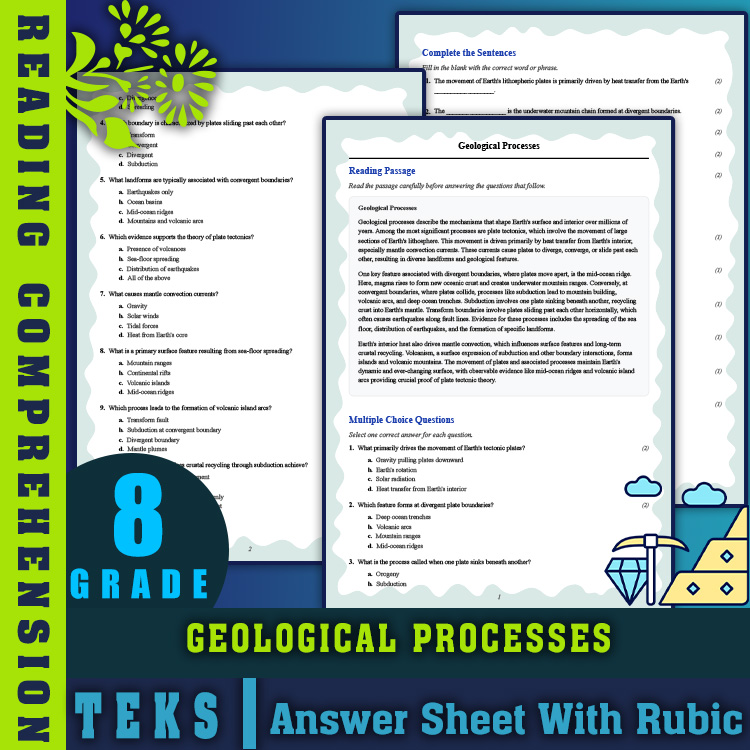
Grade 8 Science | Geological Processes Reading Worksheet & Answer Key (PDF)
JCreated byJ.S SheetsLearning Objectives
- Understand Earth's internal heat transfer mechanisms and their surface expressions.
- Identify different types of plate boundaries and associated landforms and geological activity.
- Explain evidence for plate tectonics such as mid-ocean ridges and volcanic arcs.
Instant download

Grade 8 Science – Understanding Lever Mechanics | Daily Reading Worksheet
Created byQuiet Forest EducationLearning Objectives
- Identify the three classes of levers and their characteristics.
- Explain the roles of fulcrum, effort, and load in lever systems.
- Calculate the mechanical advantage for different lever types.
Also included in: Energy Grade 8 Science Daily Reading Worksheets Bundle | Ontario Framework +1 more
Instant download
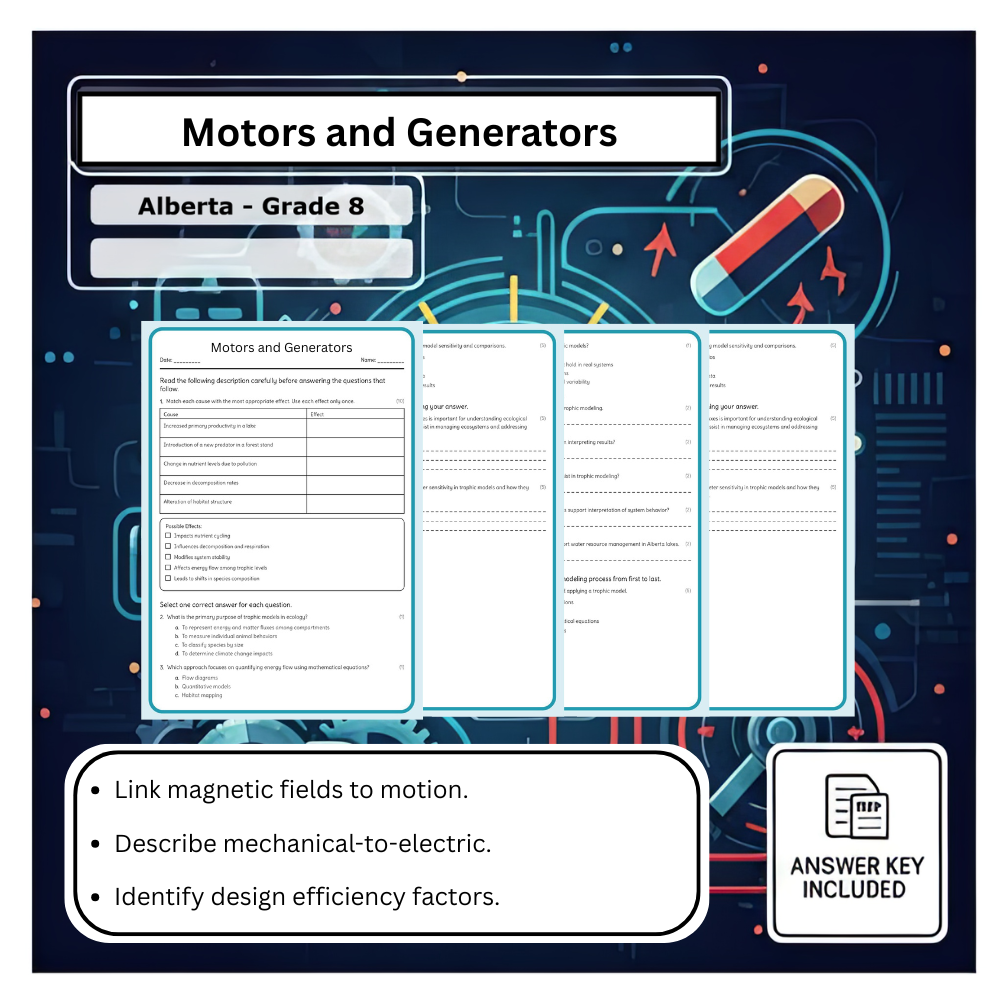
Grade 8 Science – Motors & Generators Worksheet (PDF) | Alberta Standards
 Created byBright Mind Resources
Learning Objectives
- Explain how electric motors convert electrical energy into mechanical motion using magnetic fields.
- Describe how generators produce electrical energy from mechanical motion in magnetic fields.
- Identify design parameters that affect the efficiency and power output of motors and generators.
Instant download
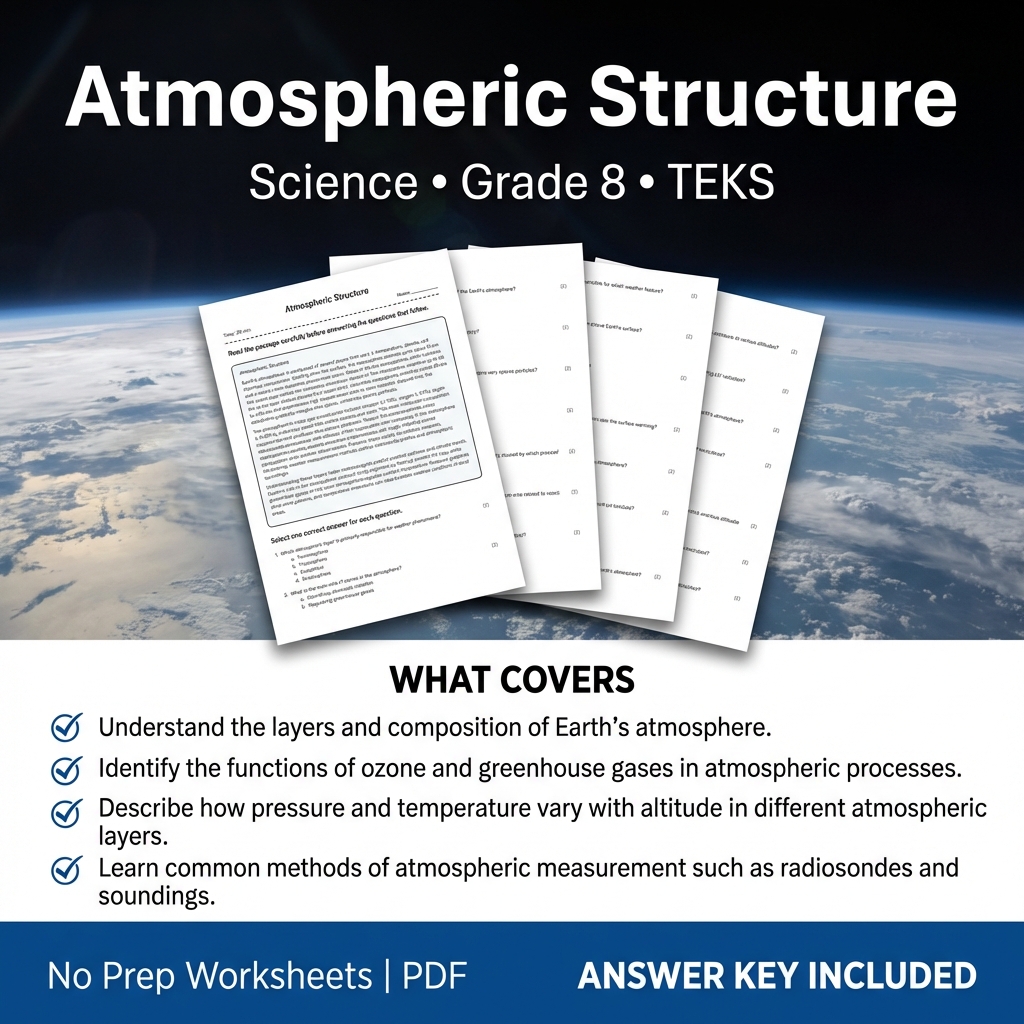
Atmospheric Structure Grade 8 Science Worksheet | TEKS Practice
Created byCoral Reef LearningLearning Objectives
- Understand the layers and composition of Earth's atmosphere.
- Identify the functions of ozone and greenhouse gases in atmospheric processes.
- Describe how pressure and temperature vary with altitude in different atmospheric layers.
Instant download

Grade 8 Science Modeling Data Worksheet with Short Notes (Printable PDF)
Created byMeadowlark WorksheetsLearning Objectives
- Understand how to construct physical and computational models to generate data.
- Identify the limitations and sources of measurement uncertainty in models.
- Learn best practices for data recording, input conditions, and repeatability.
Also included in: Grade 8 Science Engineering Design Unit Bundle (NGSS Worksheets Collection) +1 more
Instant download
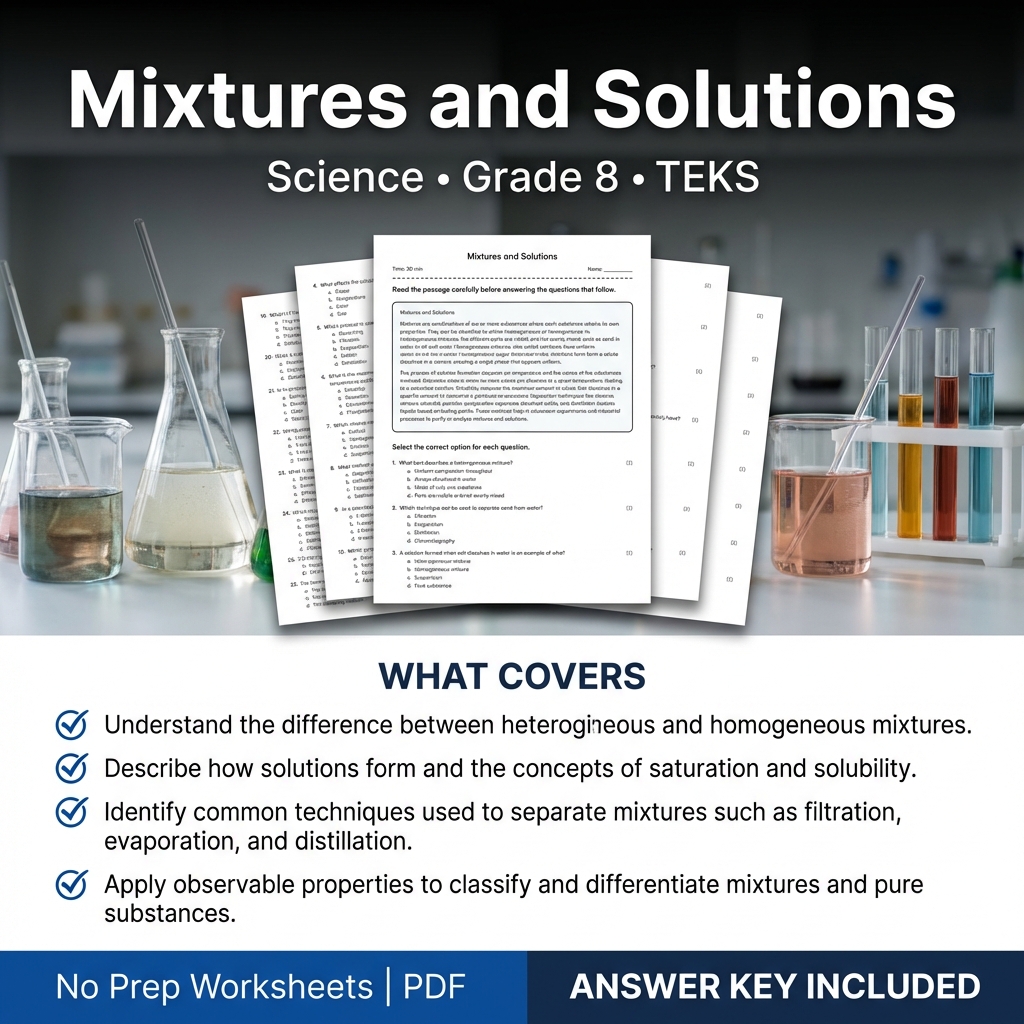
Grade 8 Science Worksheet on Mixtures and Solutions | TEKS Aligned
Created byCoral Reef LearningLearning Objectives
- Understand the difference between heterogeneous and homogeneous mixtures.
- Describe how solutions form and the concepts of saturation and solubility.
- Identify common techniques used to separate mixtures such as filtration, evaporation, and distillation.
Instant download

Grade 8 Science – Systems Integration & Body Systems | Daily Reading Worksheet
Created byBright Mind ResourcesLearning Objectives
- Identify different organ systems involved in maintaining homeostasis
- Describe how respiratory, circulatory, excretory, and endocrine systems function and interact
- Explain the importance of cellular specializations and systemic communication for health and adaptation
Also included in: Grade 8 Body Systems & Cell Structure Science Daily Reading Lesson Bundle | BC +1 more
Instant download
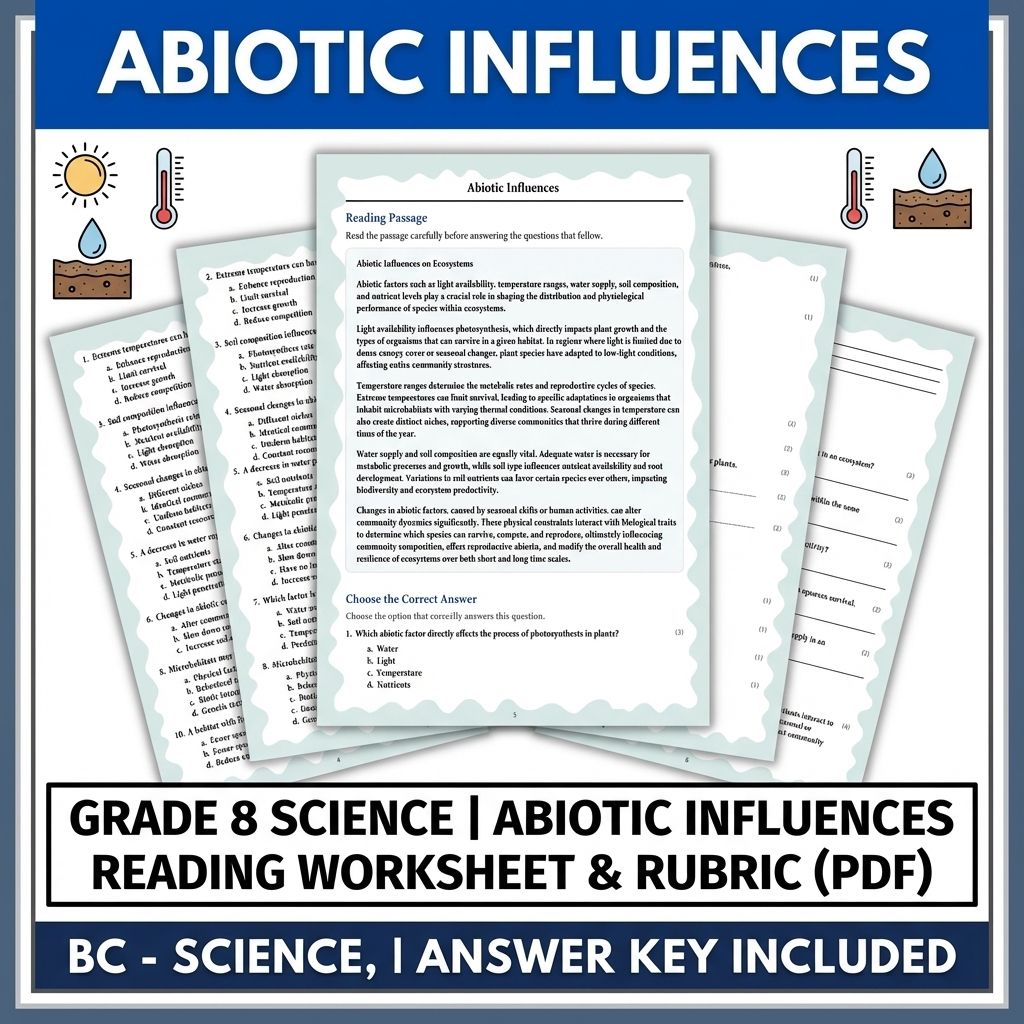
Grade 8 Science | Abiotic Influences Reading Worksheet & Rubric (PDF)
JCreated byJ.S SheetsLearning Objectives
- Understand how abiotic factors such as light, temperature, water, soil, and nutrients influence species distribution and physiology.
- Identify how seasonal and microhabitat variations create different ecological niches.
- Explain how physical constraints and biological traits interact to affect survival and competition.
Instant download

Climate Circulation Worksheet | Assessment Grade 8 Science Printable PDF
Learning Objectives
- Understand the models of atmospheric and oceanic circulation such as Hadley, Ferrel, and polar cells.
- Explain how planetary rotation and solar heating influence wind patterns and ocean currents.
- Describe the link between circulation patterns and regional climates, including monsoons and ocean gyres.
Also included in: Grade 8 Earth's Systems Science Lesson Bundle NGSS | Climate, Water & Land +1 more
Instant download

Speciation Patterns Worksheet | Grade 8 Science printable PDF NGSS Assessment
Learning Objectives
- Understand processes that generate new species through genetic divergence and reproductive barriers.
- Describe how geographic isolation leads to allopatric speciation and adaptive radiation.
- Analyze fossil and genetic evidence of diversification and mass extinctions.
Also included in: Grade 8 Biological Evolution Lesson Bundle: Unity and Diversity +1 more
Instant download

Matter Cycles Worksheet for Grade 8 Science | NGSS Printable PDF
Learning Objectives
- Describe the cycling of matter between living organisms and the environment.
- Explain the processes of photosynthesis, respiration, decomposition, and nutrient transformations.
- Trace atoms such as carbon and water through various biological and environmental reservoirs.
Also included in: Grade 8 Science Ecosystems Lesson Bundle: Interactions, Energy & Dynamics +1 more
Instant download

Population Change Worksheet Assessment for Grade 8 Science NGSS Printable PDF
Learning Objectives
- Understand factors influencing population growth and decline.
- Analyze how biotic and abiotic factors affect population dynamics.
- Interpret population graphs, birth/death rate trends, and resource limitations.
Also included in: Grade 8 Science Ecosystems Lesson Bundle: Interactions, Energy & Dynamics +1 more
Instant download

Weather Patterns Worksheet | Grade 8 Science Printable PDF for Assessment
Learning Objectives
- Analyze relationships between air mass motions and weather changes using observational data.
- Understand the processes of frontogenesis and cyclogenesis in weather systems.
- Identify how polar, tropical, and maritime air masses influence wind, temperature, humidity, and precipitation.
Also included in: Grade 8 Earth's Systems Science Lesson Bundle NGSS | Climate, Water & Land +1 more
Instant download

Natural Selection Worksheet | Grade 8 Science Assessment & Student Practice PDF
Learning Objectives
- Understand the mechanisms of variation and selection that drive evolution.
- Identify examples of natural selection in real-world scenarios.
- Describe how heritable variation and environmental pressures influence trait frequencies.
Also included in: Grade 8 Biological Evolution Lesson Bundle: Unity and Diversity +1 more
Instant download

Tradeoff Analysis Worksheet | Grade 8 Science Printable PDF NGSS Assessment
Learning Objectives
- Understand how to prioritize competing constraints using multi-criteria decision methods.
- Apply cost-benefit estimation and sensitivity analysis to project decisions.
- Use tools like weighted scoring and pareto comparisons to evaluate project options.
Also included in: Grade 8 Science Engineering Design Lesson Bundle | NGSS +1 more
Instant download

Plate Motions worksheet | NGSS Grade 8 Science printable PDF assessment
Learning Objectives
- Understand the mechanisms of plate tectonics, including subduction, rifting, continental collision, and uplift.
- Identify evidence supporting plate movements such as seafloor spreading, magnetic striping, and paleomagnetic records.
- Explain how plate motions influence landform changes like mountains, ocean basins, and volcanic arcs.
Also included in: Grade 8 Earth's Systems Science Lesson Bundle NGSS | Climate, Water & Land +1 more
Instant download

Natural Hazards Worksheet | Grade 8 Science Printable PDF Assessment
Learning Objectives
- Analyze historical and instrumental data related to natural hazards to identify patterns and recurrence intervals.
- Interpret various data types to inform hazard forecasting and mitigation strategies.
- Understand the role of hazard mapping and early-warning systems in reducing disaster risk.
Also included in: Grade 8 Science Earth and Human Activity Lesson Bundle NGSS +1 more
Instant download

Climate Drivers Worksheet | Grade 8 Science Printable PDF | Assessment
Learning Objectives
- Understand the key factors influencing global temperature changes over time.
- Evaluate multiple lines of evidence related to climate change.
- Assess natural versus anthropogenic influences on climate.
Also included in: Grade 8 Science Earth and Human Activity Lesson Bundle NGSS +1 more
Instant download

Mendelian Patterns Worksheet | Assessment & Student Practice Grade 8 Science
Learning Objectives
- Explain how dominant and recessive alleles influence observable traits.
- Predict genotypic and phenotypic ratios using Punnett squares.
- Describe allele segregation and its role in inheritance.
Also included in: Grade 8 Heredity Lesson Bundle | Inheritance and Trait Variation NGSS +1 more
Instant download

Modeling Data Science Worksheet Grade 8 NGSS Printable PDF Assessment
Learning Objectives
- Understand the role of physical and computational models in data collection and analysis.
- Identify different types of models such as scale models and simple simulations, and their limitations.
- Recognize sources of measurement uncertainty and methods to minimize them.
Also included in: Grade 8 Science Engineering Design Lesson Bundle | NGSS +1 more
Instant download

Water Cycle Worksheet Grade 8 Science Printable PDF Assessment & Practice
Learning Objectives
- Understand the processes involved in the water cycle, including evaporation, condensation, precipitation, infiltration, runoff, and groundwater flow.
- Analyze how energy from the Sun and gravity drive the water cycle.
- Connect weathering processes such as river incision and coastal erosion to the water cycle.
Also included in: Grade 8 Earth's Systems Science Lesson Bundle NGSS | Climate, Water & Land +1 more
Instant download

Population Effects Worksheet | Science Assessment Grade 8 NGSS Printable PDF
Learning Objectives
- Analyze how population growth influences resource consumption and environmental change.
- Identify relationships between demographic patterns and Earth system impacts.
- Evaluate evidence linking land use, biogeochemical fluxes, and climate change.
Also included in: Grade 8 Science Earth and Human Activity Lesson Bundle NGSS +1 more
Instant download

Design Optimization Worksheet | NGSS Grade 8 Science printable PDF assessment
Learning Objectives
- Analyze test data to identify performance trends in design modifications.
- Interpret graphical and statistical results to evaluate design effectiveness.
- Quantify trade-offs among multiple performance metrics like strength, durability, and efficiency.
Also included in: Grade 8 Science Engineering Design Lesson Bundle | NGSS +1 more
Instant download

Reaction Evidence Worksheet | Grade 8 Science Printable PDF NGSS Assessment
Learning Objectives
- Identify observable indicators of chemical reactions such as color change, gas production, precipitate formation, and temperature change.
- Differentiate between physical and chemical changes based on qualitative and quantitative data.
- Interpret evidence from reactions like corrosion, combustion, and acid-base interactions to determine chemical transformations.
Also included in: Grade 8 Science Lesson Bundle on Matter and Its Interactions NGSS +1 more
Instant download

Resource Distribution Science Worksheet | Grade 8 NGSS Printable PDF
Learning Objectives
- Analyze geological processes influencing resource formation.
- Identify types and locations of mineral, energy, and groundwater resources.
- Understand the implications of resource distribution for sustainable use.
Also included in: Grade 8 Science Earth and Human Activity Lesson Bundle NGSS +1 more
Instant download

Organ Systems Worksheet | Science Assessment Grade 8 printable PDF
Learning Objectives
- Describe how different organ systems interact to maintain homeostasis.
- Explain the processes of gas exchange, nutrient distribution, and blood glucose regulation.
- Identify the roles of the circulatory, respiratory, digestive, nervous, and endocrine systems.
Also included in: Grade 8 Science Lesson Bundle on Molecules, Cells, and Organ Systems +1 more
Instant download

Earth Materials Worksheet | Grade 8 Science Printable PDF Assessment
Learning Objectives
- Describe the processes involved in Earth's rock cycle and mantle convection.
- Explain interactions among the geosphere, hydrosphere, and atmosphere.
- Identify transfer mechanisms of Earth's materials such as melting, crystallization, and weathering.
Also included in: Grade 8 Earth's Systems Science Lesson Bundle NGSS | Climate, Water & Land +1 more
Instant download
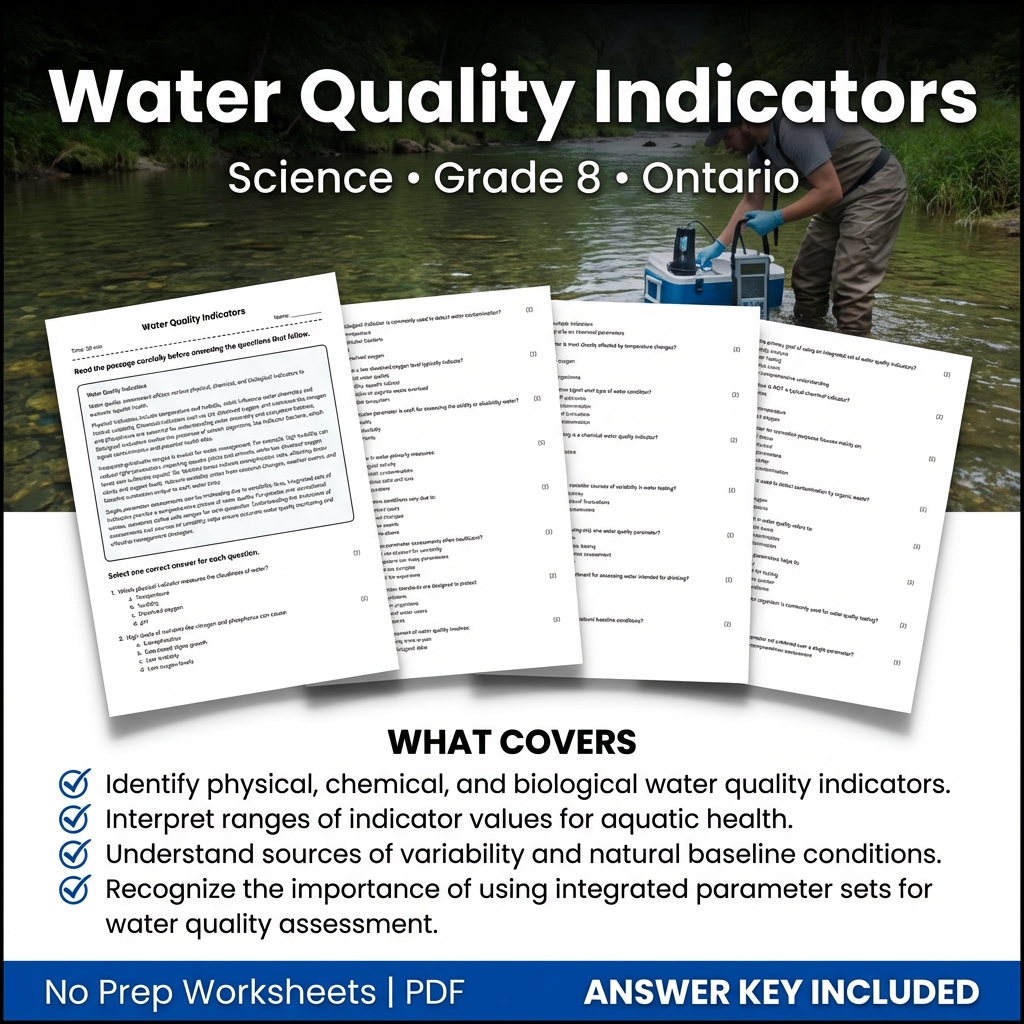
Water Quality Indicators Grade 8 Science Worksheet | Ontario Standards
Created byCoral Reef LearningLearning Objectives
- Identify physical, chemical, and biological water quality indicators.
- Interpret ranges of indicator values for aquatic health.
- Understand sources of variability and natural baseline conditions.
Instant download

Grade 8 Science | Speciation Patterns Worksheet with Short Notes (PDF)
Created byMeadowlark WorksheetsLearning Objectives
- Understand how genetic divergence and reproductive isolation lead to new species.
- Identify different speciation mechanisms such as allopatric and adaptive radiation.
- Analyze fossil and genetic evidence supporting diversification and mass extinction events.
Also included in: Grade 8 Science | Biological Evolution: Unity & Diversity UNIT Bundle +1 more
Instant download

Grade 8 Science | Natural Selection Worksheet with Short Notes (Printable PDF)
Created byMeadowlark WorksheetsLearning Objectives
- Understand the mechanisms of variation and natural selection in populations.
- Identify examples of adaptive change such as industrial melanism and antibiotic resistance.
- Explain how phenotypic variation and environmental factors influence population shifts.
Also included in: Grade 8 Science | Biological Evolution: Unity & Diversity UNIT Bundle +1 more
Instant download

Grade 8 Science | Food Webs Worksheet with Short Notes (Printable PDF)
Created byMeadowlark WorksheetsLearning Objectives
- Describe the roles of producers, consumers, and decomposers within food webs.
- Explain energy transfer and energy loss across trophic levels in ecosystems.
- Analyze how community structure and population sizes are affected by energy flow.
Also included in: Grade 8 Science NGSS Ecosystems Unit Bundle – Interactions, Energy & Dynamics +1 more
Instant download

Grade 8 Science | Population Models Worksheet with Short Notes (Printable PDF)
Created byMeadowlark WorksheetsLearning Objectives
- Understand different types of population growth models, including logistic and exponential growth.
- Interpret graph representations of population curves and identify steady states and fluctuations.
- Apply arithmetic and proportional reasoning to analyze how resources and limiting factors affect populations.
Also included in: Grade 8 Science | Biological Evolution: Unity & Diversity UNIT Bundle +1 more
Instant download
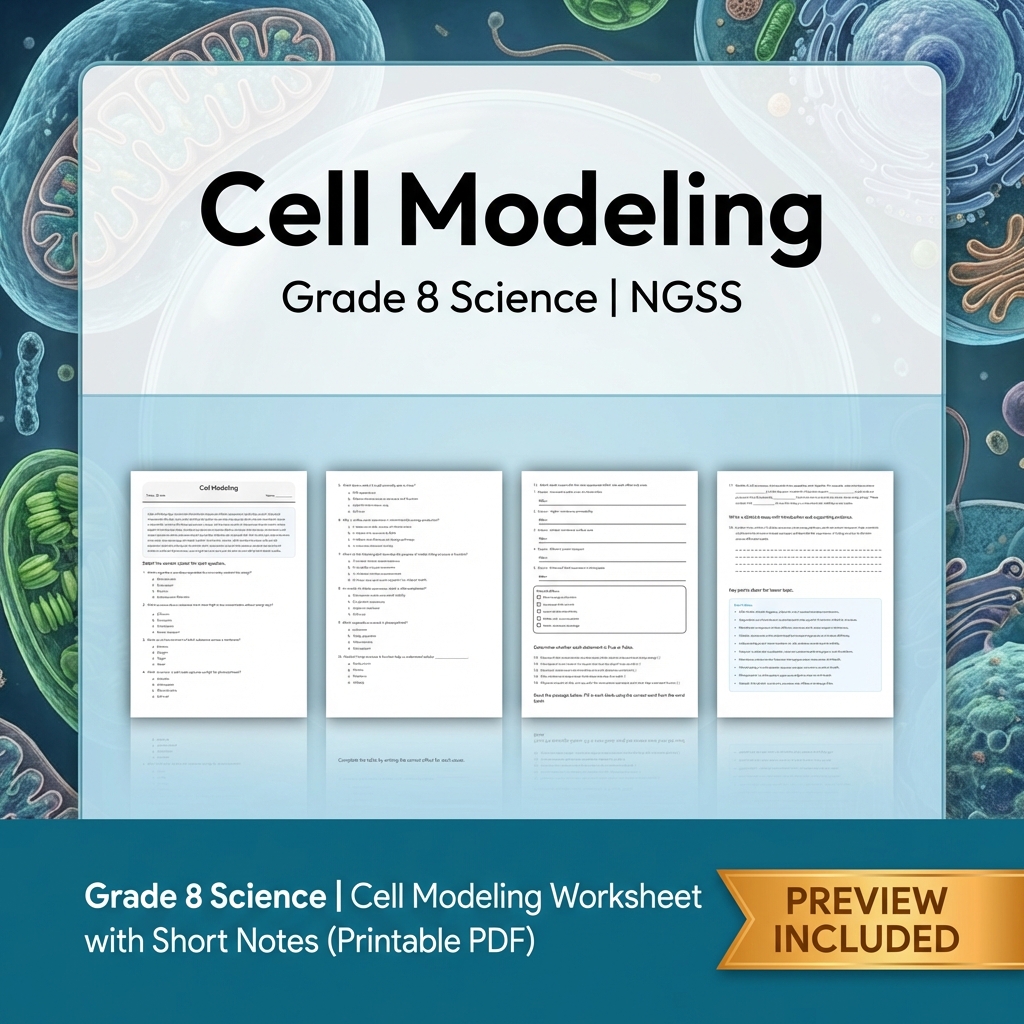
Grade 8 Science | Cell Modeling Worksheet with Short Notes (Printable PDF)
Created byMeadowlark WorksheetsLearning Objectives
- Understand how models represent cellular processes and organelle functions.
- Identify different types of models used in biology such as diagrams and computational tools.
- Explain the relationships between cell structure and function, including membrane transport and energy pathways.
Also included in: Grade 8 Science Unit | From Molecules to Organisms Structures & Processes (NGSS) +1 more
Instant download

Grade 8 Science | Weather Patterns Worksheet with Short Notes (Printable PDF)
Created byMeadowlark WorksheetsLearning Objectives
- Analyze how air mass motions influence weather changes.
- Interpret surface pressure maps, temperature gradients, and radar data.
- Explain the processes of frontogenesis and cyclogenesis.
Also included in: Grade 8 Science | Earth's Systems NGSS Worksheet Unit Bundle +1 more
Instant download

Grade 8 Science Design Optimization Worksheet with Short Notes (Printable PDF)
Created byMeadowlark WorksheetsLearning Objectives
- Analyze test data to identify performance trends in design modifications.
- Interpret graphical and statistical results to evaluate design effectiveness.
- Quantify trade-offs among multiple performance metrics during iterative refinement.
Also included in: Grade 8 Science Engineering Design Unit Bundle (NGSS Worksheets Collection) +1 more
Instant download

Grade 8 Science | Matter Cycles Worksheet with Short Notes (Printable PDF)
Created byMeadowlark WorksheetsLearning Objectives
- Describe the cycling of matter between living organisms and the abiotic environment.
- Explain the roles of photosynthesis, respiration, and decomposition in matter transfer.
- Trace atoms of carbon and water through ecosystems, including producers, consumers, and detritus.
Also included in: Grade 8 Science NGSS Ecosystems Unit Bundle – Interactions, Energy & Dynamics +1 more
Instant download
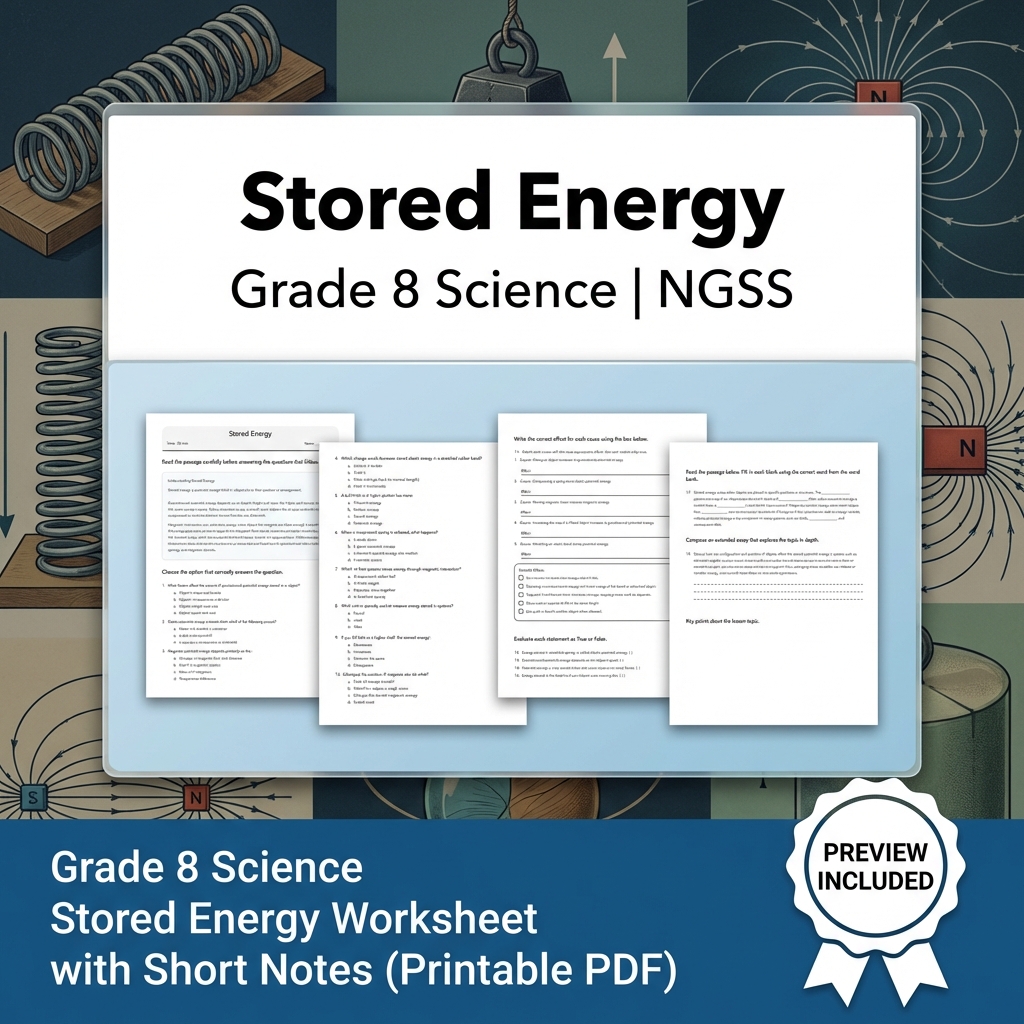
Grade 8 Science Stored Energy Worksheet with Short Notes (Printable PDF)
Created byMeadowlark WorksheetsLearning Objectives
- Understand how energy is stored in systems through gravitational, elastic, and magnetic interactions.
- Identify factors that influence the amount of stored potential energy in various configurations.
- Explain how changes in position or configuration can release or transfer stored energy.
Also included in: Grade 8 Science Energy Unit Bundle | NGSS-Aligned Worksheets & Assessment Pack +1 more
Instant download

Grade 8 Science | Orbital Cycles Worksheet with Short Notes (Printable PDF)
Created byMeadowlark WorksheetsLearning Objectives
- Articulate a coherent model of the Earth–Sun–Moon system explaining cyclic phenomena.
- Describe the relative positions and motions that produce lunar phases, eclipses, and seasonal changes.
- Explain how orbital geometry and axial tilt influence observable sky patterns and calendar cycles.
Also included in: Grade 8 Science | Earth's Place in the Universe Unit Bundle (NGSS-Aligned) +1 more
Instant download

Grade 8 Science | Natural Hazards Worksheet with Short Notes (Printable PDF)
Created byMeadowlark WorksheetsLearning Objectives
- Understand how data on natural hazards is analyzed for risk assessment.
- Interpret patterns and frequency of natural catastrophic events.
- Identify methods used to forecast and mitigate natural hazards.
Also included in: Grade 8 Science | Earth and Human Activity NGSS Unit Bundle (Collection) +1 more
Instant download

Grade 8 Science Reaction Evidence Worksheet with Short Notes (Printable PDF)
Created byMeadowlark WorksheetsLearning Objectives
- Analyze observable indicators such as color change, gas production, precipitate formation, and temperature change to identify chemical reactions.
- Interpret qualitative and quantitative data to distinguish between physical and chemical changes in substances.
- Link macroscopic reaction evidence to particle rearrangement and formation of new substances with different properties.
Also included in: Grade 8 Science | Matter and Its Interactions NGSS Unit Bundle – Worksheets +1 more
Instant download
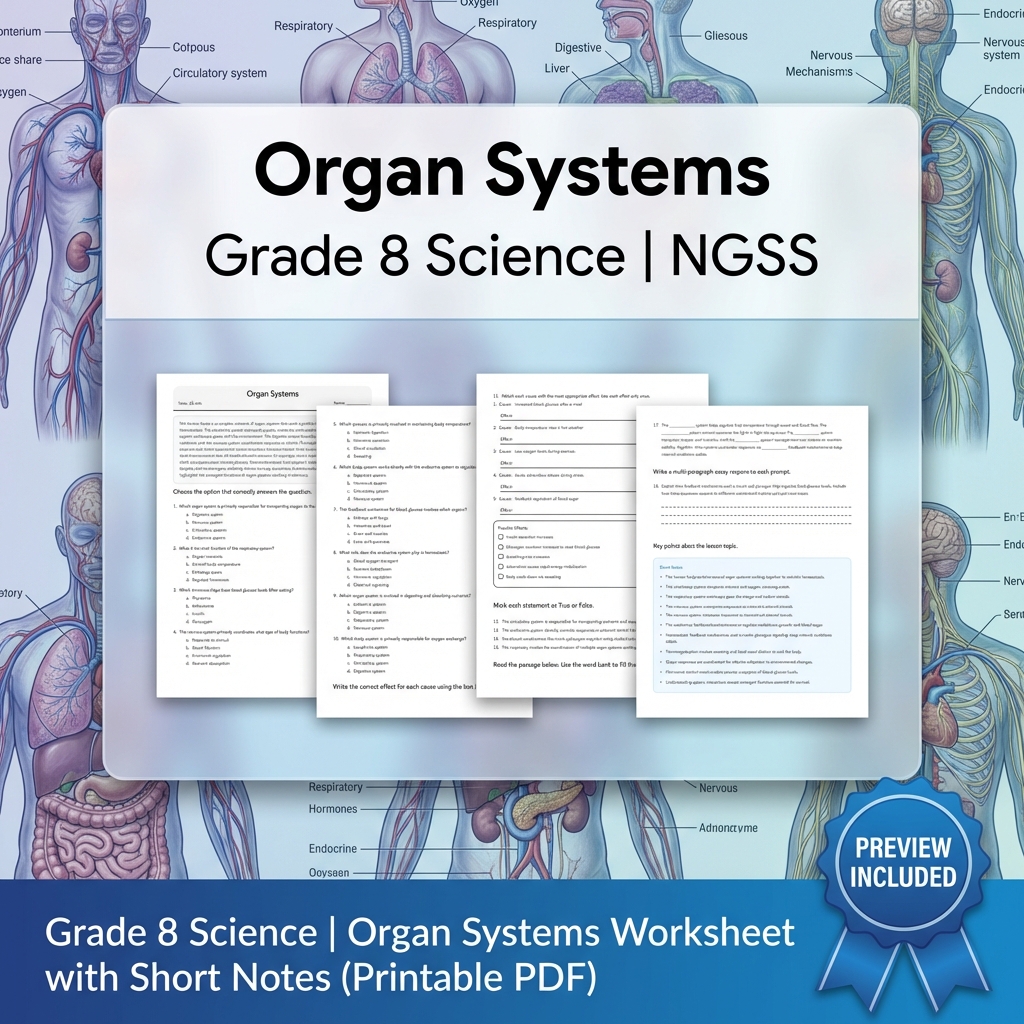
Grade 8 Science | Organ Systems Worksheet with Short Notes (Printable PDF)
Created byMeadowlark WorksheetsLearning Objectives
- Explain how different body systems interact to maintain homeostasis.
- Identify key functions of the circulatory, respiratory, digestive, nervous, and endocrine systems.
- Describe feedback mechanisms such as insulin-glucagon signaling and thermoregulation.
Also included in: Grade 8 Science Unit | From Molecules to Organisms Structures & Processes (NGSS) +1 more
Instant download
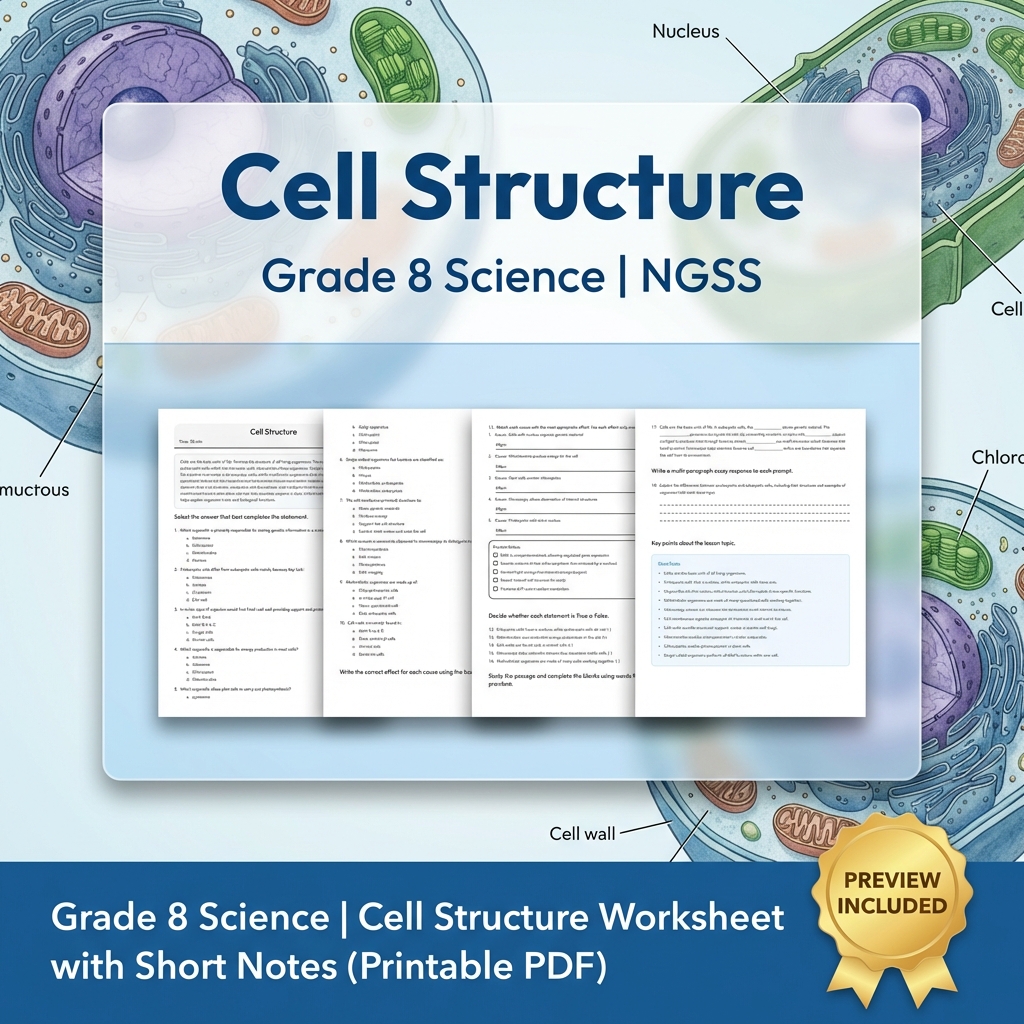
Grade 8 Science | Cell Structure Worksheet with Short Notes (Printable PDF)
Created byMeadowlark WorksheetsLearning Objectives
- Describe the key features and functions of different organelles within cells.
- Compare prokaryotic and eukaryotic cells in terms of structure and organization.
- Understand the differences between single-celled and multicellular organisms.
Also included in: Grade 8 Science Unit | From Molecules to Organisms Structures & Processes (NGSS) +1 more
Instant download

Grade 8 Science Material Origins Worksheet with Short Notes (Printable PDF)
Created byMeadowlark WorksheetsLearning Objectives
- Understand how natural resources are transformed into synthetic materials.
- Identify the connection between source materials, molecular structure, and material properties.
- Explain environmental and resource considerations in material sourcing and modification.
Also included in: Grade 8 Science | Matter and Its Interactions NGSS Unit Bundle – Worksheets +1 more
Instant download
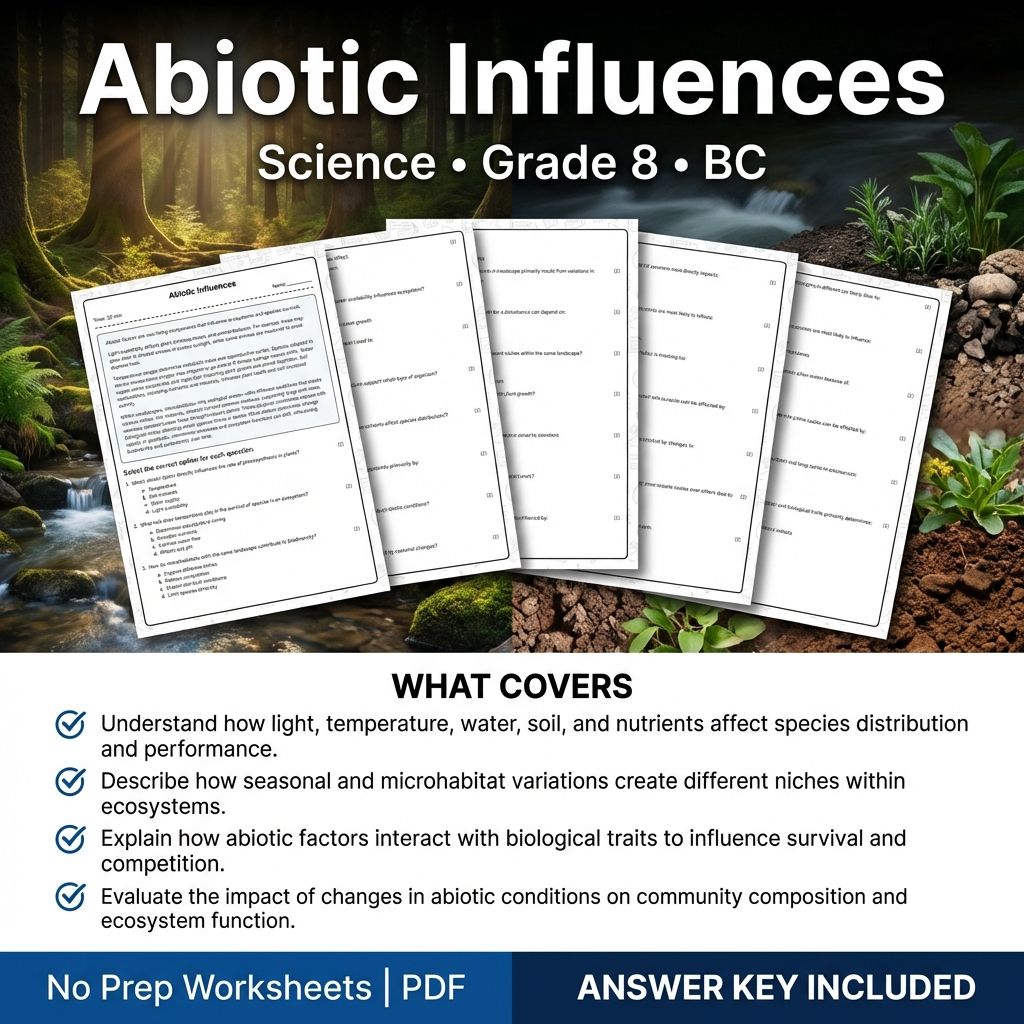
Grade 8 Science Worksheet | Abiotic Influences on Ecosystems (PDF + Answer Key)
Created byCoral Reef LearningLearning Objectives
- Understand how light, temperature, water, soil, and nutrients affect species distribution and performance.
- Describe how seasonal and microhabitat variations create different niches within ecosystems.
- Explain how abiotic factors interact with biological traits to influence survival and competition.
Instant download
About Grade 8 Science Worksheets
Explore Grade 8 Science worksheets for classwork, homework, or review. Our 5,990 printables download instantly as PDFs.
Each resource here is built by an independent educator and reviewed for quality. Worksheets print straight from PDF and suit classroom use, homework, or extra practice; most come with answer keys, and you can preview before purchasing.