
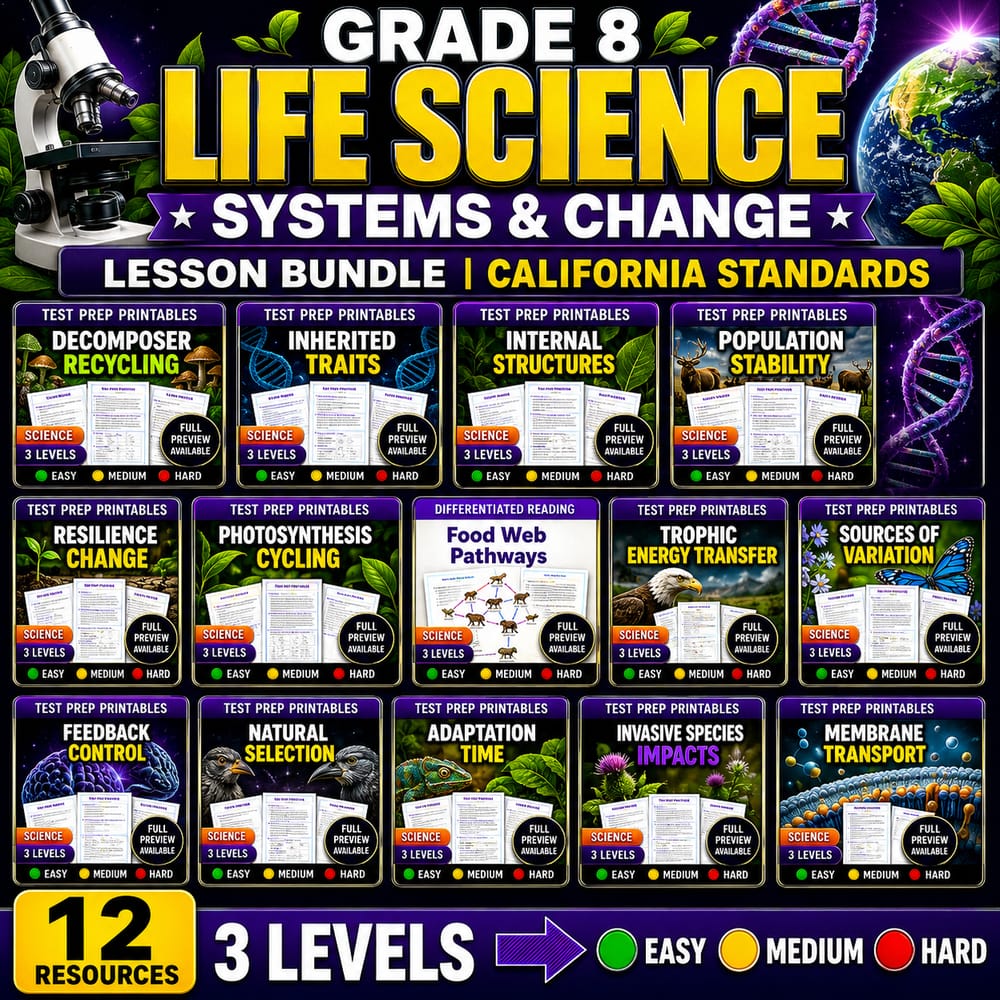


Grade 8 Life Science Systems & Change Lesson Bundle | California Standards
$60.00$75.00Save $15.00
Prism Point Learning
·2 followers·13 sales
SubjectScienceGradeGrade 8
What’s included
15 worksheets · Save $15.00 (20%) · prices shown inside the bundle
 Grade 8 Decomposer Recycling Worksheet | Ecosystem Energy Flow Practice
- Explain how decomposers break down dead matter and waste to return nutrients to ecosystems.
- Describe how decomposition supports biogeochemical cycling and sustained productivity.
- Use scientific vocabulary (decomposer, nutrients, organic matter, recycling) to explain energy and nutrient pathways.
$4.00$5.00 Grade 8 Inherited Traits Worksheet | Genetics & Heredity Practice
- Explain how genes and alleles influence inherited traits in offspring.
- Describe dominant and recessive allele patterns using examples.
- Use observations from a population to support the role of inherited variation in survival.
$4.00$5.00 Grade 8 Internal Structures Worksheet | Body Systems & Functions
- Explain how internal body structures help organisms survive, grow, and reproduce.
- Describe how structure and function are connected in circulatory, digestive, and respiratory systems.
- Compare external features with internal needs related to feeding and protection.
$4.00$5.00 Population and Stability Worksheet | Grade 8 Ecosystems Review
- Explain how interactions among organisms affect population sizes in an ecosystem.
- Describe how predation, competition, disease, and mutualism can change ecosystem stability over time.
- Connect population changes to changes in energy flow and matter cycling.
$4.00$5.00 Organ System Coordination Worksheet | Grade 8 Body Systems Science
- Explain how multiple organ systems work together to maintain conditions cells need to function.
- Describe how nervous and endocrine signaling coordinate body responses.
- Use examples to connect circulatory, respiratory, and digestive systems to transport and processing of materials.
$4.00$5.00 Ecosystem Resilience Worksheet | Grade 8 Science Stability Practice
- Explain how ecosystems respond to disturbances and why some communities return to functional conditions.
- Describe how changes in population size can affect resource availability and later ecosystem development.
- Use evidence-based reasoning to distinguish stability from the idea that nothing changes.
$4.00$5.00 Grade 8 Biogeochemical Cycling Worksheet | Carbon Water Nitrogen Cycles
- Explain how matter (water, carbon, and nitrogen) moves through living and nonliving parts of ecosystems
- Describe the role of decomposition in returning nutrients to soil and water
- Model how cycles keep ecosystems functioning over time
$4.00$5.00 Grade 8 Food Web Pathways Worksheet | Ecosystem Interactions Practice
- Explain how energy can move through a food web using multiple interconnected feeding relationships.
- Describe indirect effects in ecosystems when one population changes.
- Use food web pathway ideas to predict how changes can influence organisms at different trophic levels.
$4.00$5.00 Trophic Energy Transfer Worksheet | Grade 8 Food Web Practice
- Explain how energy moves one direction through trophic levels in an ecosystem.
- Describe how photosynthesis captures energy and how feeding transfers only a portion of it.
- Use ideas like energy loss and energy pyramids to predict patterns in food chains.
$4.00$5.00 Sources of Variation Worksheet | Grade 8 Genetics Practice Activity
- Explain how genetic variation arises through DNA changes and how allele combinations form during reproduction.
- Describe how mutations can introduce new alleles and how this variation can influence traits.
- Connect trait variation in populations to natural selection under different environmental conditions.
$4.00$5.00
Reviews & Feedback
Loading reviews...
Questions & Answers
Loading questions…
About this bundle
Related categories
Frequently asked questions
Who is Grade 8 Life Science Systems & Change Lesson Bundle | California Standards designed for?
Grade 8 Life Science Systems & Change Lesson Bundle | California Standards is designed for Grade 8 students and Science learners and can be used in classrooms, homeschool, or independent practice.
How do I download Grade 8 Life Science Systems & Change Lesson Bundle | California Standards?
Add it to your cart and complete checkout. After payment, you can download immediately from your account, and you'll also receive a download link by email.
Similar Products

Grade 11 Cell Systems Life Science Daily Reading Lesson Bundle | TEKS
$25.60$32.00

Grade 6 Science Lesson Group | Body Systems and Life Processes Worksheet Bundle
$21.60$27.00

Grade 10 Science Worksheets Ontario | Life Systems Cell Bundle
$28.80$36.00

Grade 6 Life Science Science Lesson Bundle – California Standards
$60.00$75.00

Grade 10 Space Systems Science Lesson Bundle: Stellar Lifecycles & Motion NGSS
$20.00$25.00