
Grade 10 Science Worksheets
7,038 worksheets
Physical Properties Assessment | Alberta Standards Grade 10 Science
 Created byPrism Point Learning
Learning Objectives
- Differentiate between intensive and extensive physical properties of substances.
- Identify examples of physical and chemical properties in real-world materials.
- Explain how property classification influences material selection and environmental behavior.
Also included in: Grade 10 Matter and Chemical Change Science Lesson Bundle: Alberta +1 more
Instant download

Grade 10 Collision Momentum Changes Worksheet | NGSS Practice PDF
 Created byClear Sky Classroom
Learning Objectives
- Explain how net force acting over a collision time changes an object’s momentum and velocity
- Use impulse ideas to predict how collisions change motion (including rebounds)
- Connect before-and-after velocity changes to the impulse delivered during contact
Instant download

Molecular Messages Worksheet | AP Science Standards Grade 10
JCreated byJ.S SheetsLearning Objectives
- Explain the structure and function of DNA in storing genetic information.
- Describe the processes of transcription and translation in protein synthesis.
- Analyze the relationship between genetic sequences and phenotypic traits.
Also included in: Grade 10 Genetics & Cellular Systems Science Lesson Bundle – AP Unit
Instant download
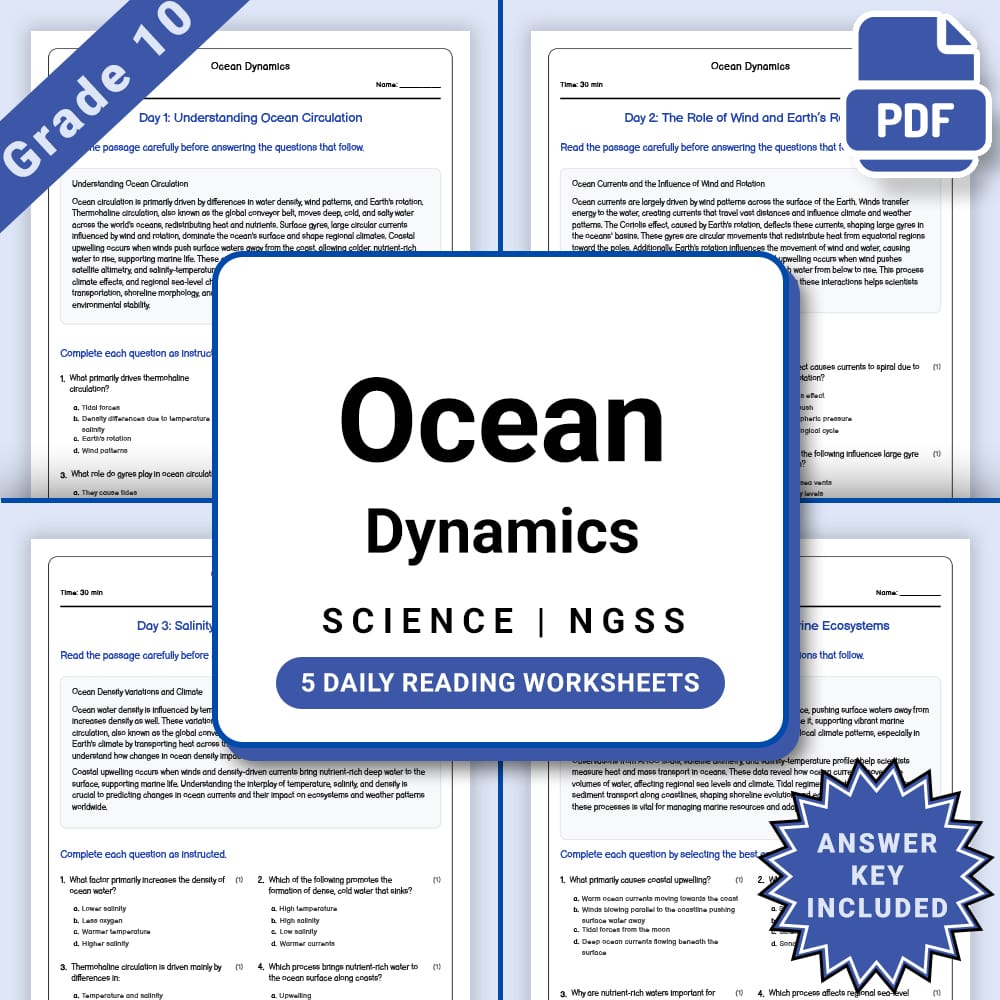
Grade 10 Science – Ocean Dynamics Worksheet (PDF +Answer Key)
 Created byCopper Leaf Classroom
Learning Objectives
- Understand the key circulation patterns in ocean dynamics
- Interpret data from ocean observation tools
- Identify the impact of ocean movement on climate and coastal features
Instant download

Mass Conservation in Chemical Reactions Worksheet | NGSS Grade 10 Science
 Created byAmber Owl Education
Learning Objectives
- Use balanced chemical equations to demonstrate atomic conservation across a reaction.
- Apply mole and molar mass reasoning to predict mass relationships between reactants and products.
- Distinguish between atom counts and measurable mass when interpreting conservation of mass.
Instant download

Grade 10 Science | Atmospheric Processes Worksheet (Alberta Standards) (PDF)
 Created byEvergreen Desk Education
Learning Objectives
- Explain how pressure patterns drive winds and influence weather systems
- Describe how moisture transport and frontal lifting produce precipitation across regions
- Connect thermal gradients, convection, and surface energy balance to storm development
Instant download

Variation and Heredity Assessment | TEKS Standards Grade 10 Science
Created byPrism Point LearningLearning Objectives
- Understand how genetic variation arises from mutation, recombination, and gene flow.
- Explain how heritable traits influence survival and reproduction in populations.
- Describe the process of natural selection and its role in changing allele frequencies.
Also included in: Grade 10 Evolution and Heredity Science Lesson Bundle for TEKS Standards
Instant download
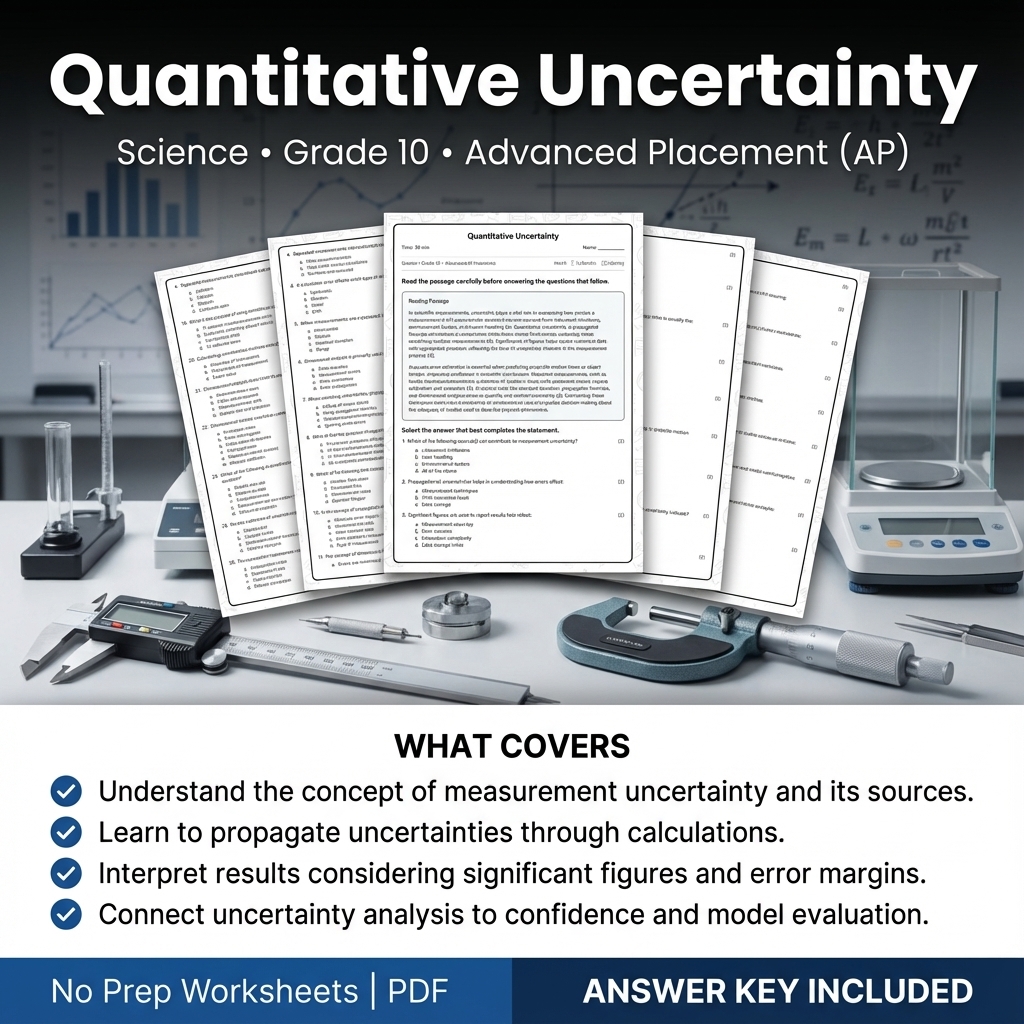
Grade 10 Science | Quantitative Uncertainty Worksheet (Printable PDF + Answer Key)
 Created byCoral Reef Learning
Learning Objectives
- Understand the concept of measurement uncertainty and its sources.
- Learn to propagate uncertainties through calculations.
- Interpret results considering significant figures and error margins.
Also included in: Grade 10 Science Unit Worksheet Bundle | Data Analysis & Scientific Modeling +1 more
Instant download
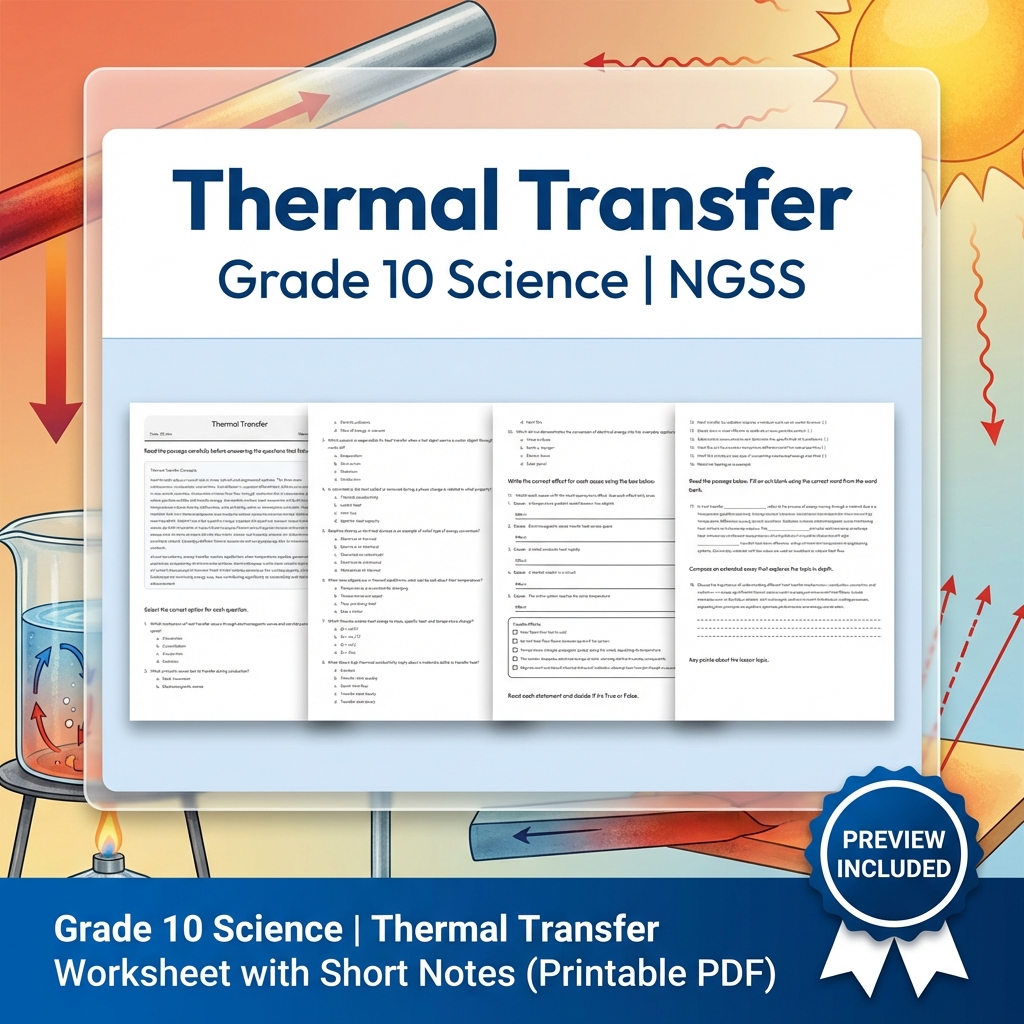
Grade 10 Science | Thermal Transfer Worksheet with Short Notes (Printable PDF)
 Created byMeadowlark Worksheets
Learning Objectives
- Understand the mechanisms of heat transfer: conduction, convection, and radiation.
- Apply calorimetric reasoning to connect thermal energy change with specific heat and phase changes.
- Describe how resistive heating converts electrical energy into thermal energy.
Also included in: Grade 10 Science | Energy Unit Bundle – NGSS Aligned Worksheets +1 more
Instant download
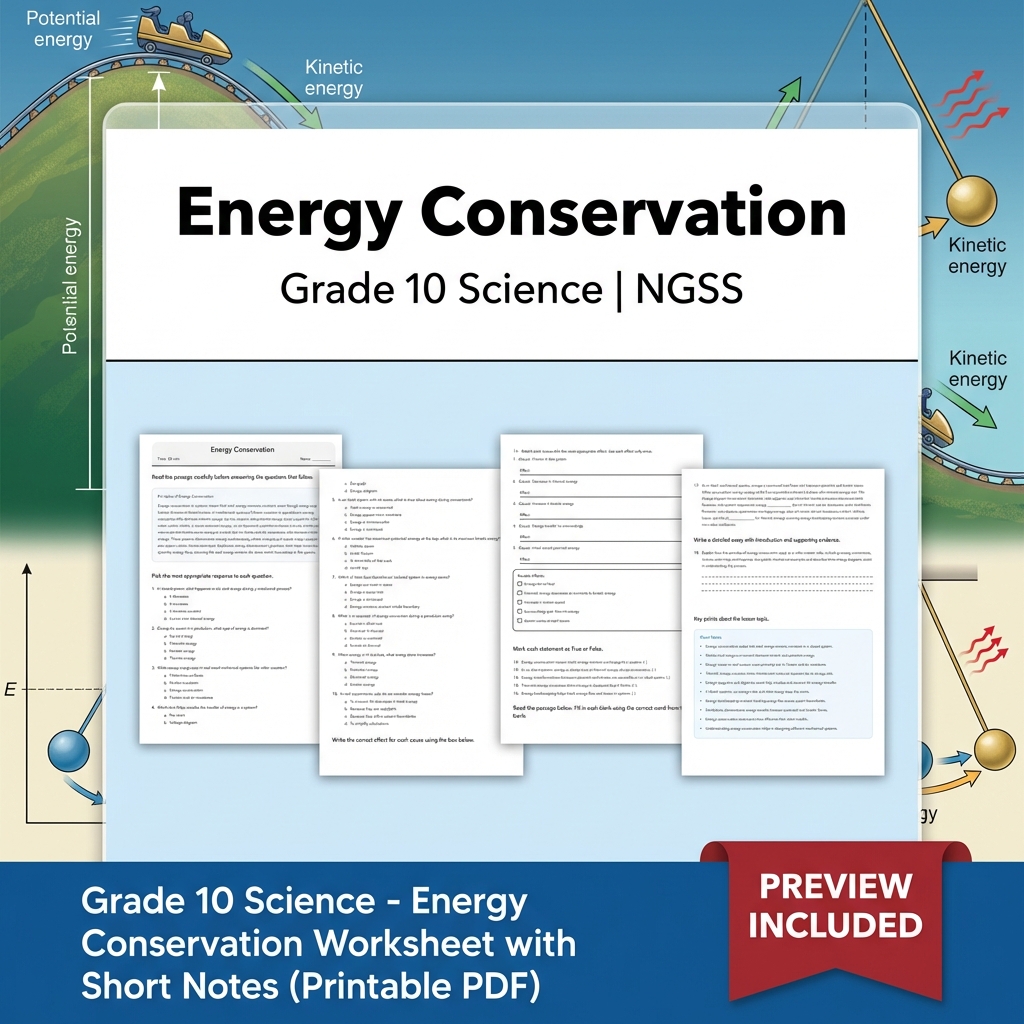
Grade 10 Science - Energy Conservation Worksheet with Short Notes (PDF)
Created byMeadowlark WorksheetsLearning Objectives
- Understand the principles of energy conservation in closed and isolated systems.
- Identify and describe energy conversions between kinetic and potential energy.
- Explain how energy losses to thermal energy occur during mechanical processes.
Also included in: Grade 10 Science | Energy Unit Bundle – NGSS Aligned Worksheets +1 more
Instant download
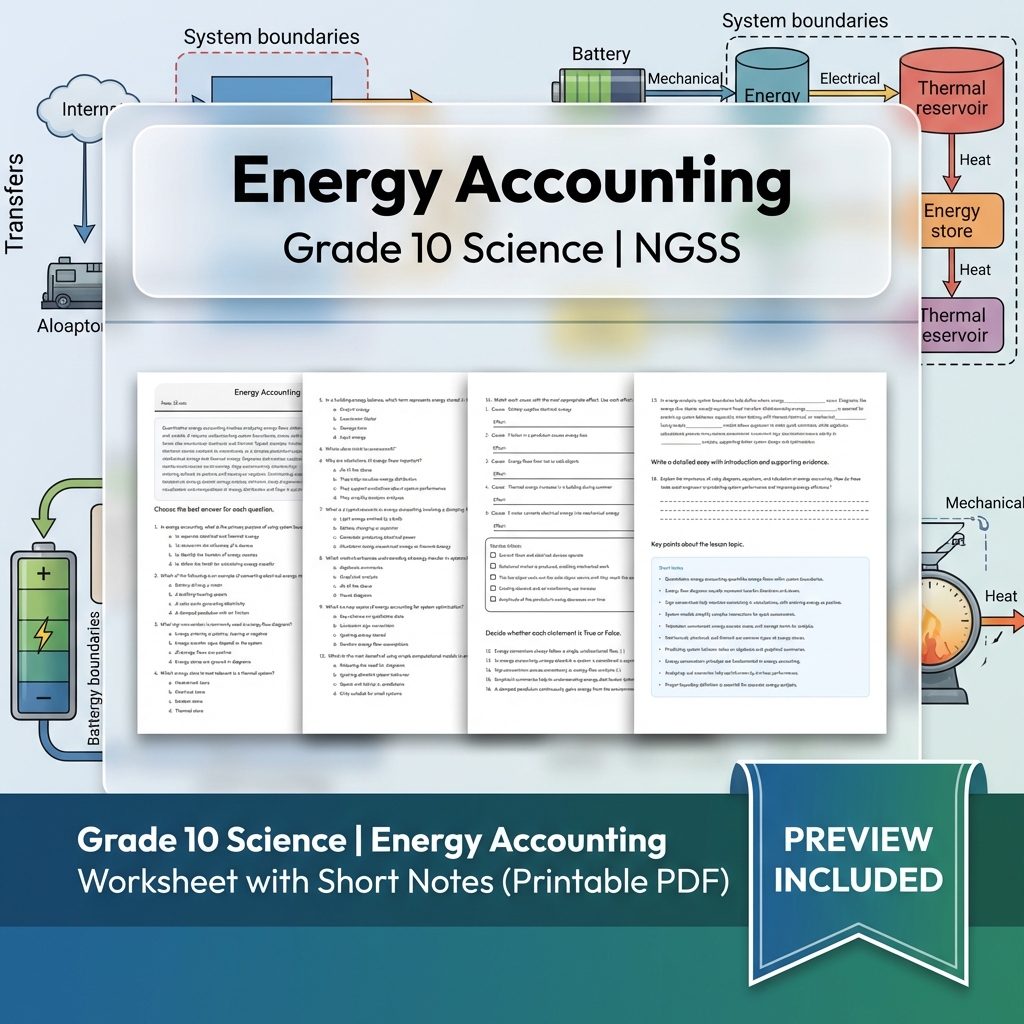
Grade 10 Science | Energy Accounting Worksheet with Short Notes (Printable PDF)
Created byMeadowlark WorksheetsLearning Objectives
- Understand the principles of energy transfer and system boundaries in energy accounting.
- Identify various energy stores and flows in mechanical, electrical, and thermal systems.
- Use algebraic and graphical tools to analyze energy transfer scenarios.
Also included in: Grade 10 Science | Energy Unit Bundle – NGSS Aligned Worksheets +1 more
Instant download
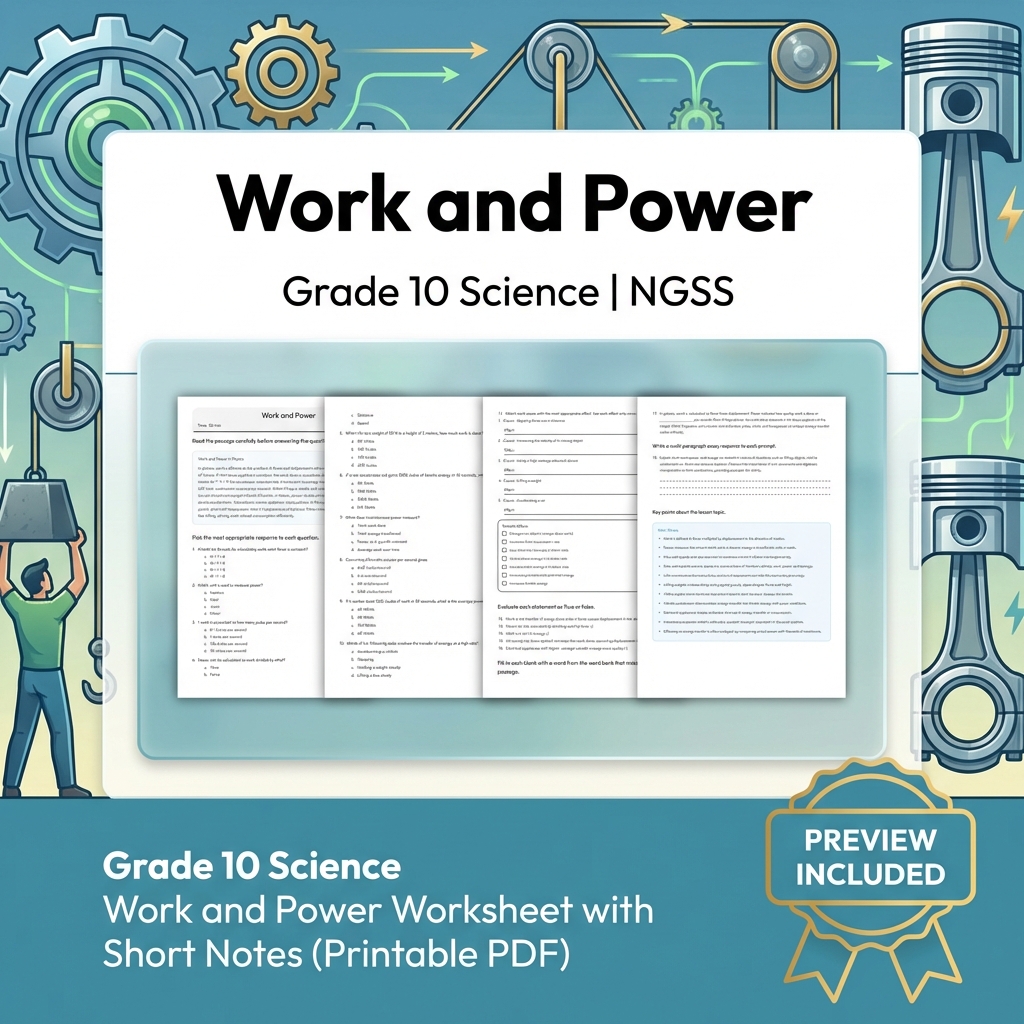
Grade 10 Science Work and Power Worksheet with Short Notes (Printable PDF)
Created byMeadowlark WorksheetsLearning Objectives
- Understand the relationship between force, displacement, and energy through the work–energy theorem.
- Calculate work done and power in various practical contexts such as lifting weights and vehicle acceleration.
- Express and manipulate formulas involving work, power, and energy using algebra.
Also included in: Grade 10 Science | Energy Unit Bundle – NGSS Aligned Worksheets +1 more
Instant download
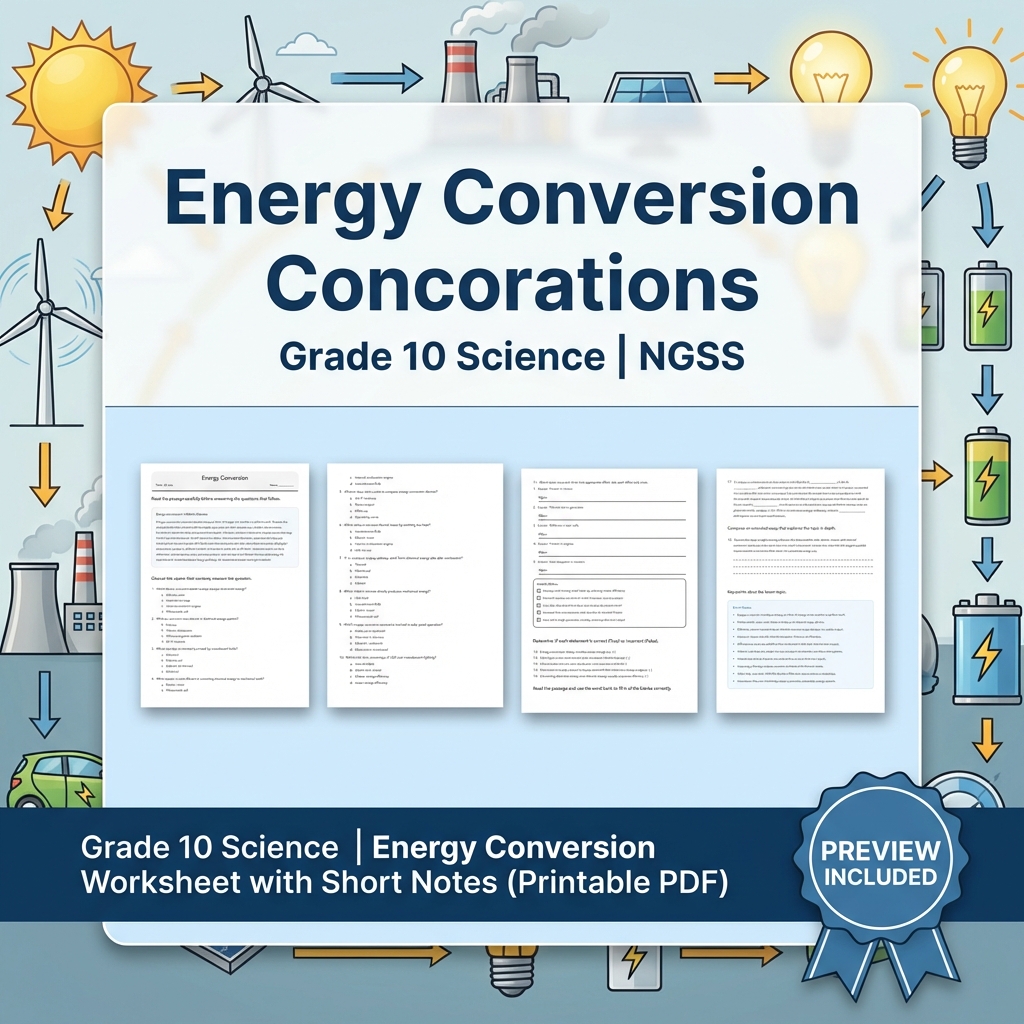
Grade 10 Science | Energy Conversion Worksheet with Short Notes (Printable PDF)
Created byMeadowlark WorksheetsLearning Objectives
- Understand the principles of energy conversion in common devices.
- Identify different energy forms and their pathways in practical systems.
- Evaluate efficiency metrics and loss channels in energy systems.
Also included in: Grade 10 Science | Energy Unit Bundle – NGSS Aligned Worksheets +1 more
Instant download
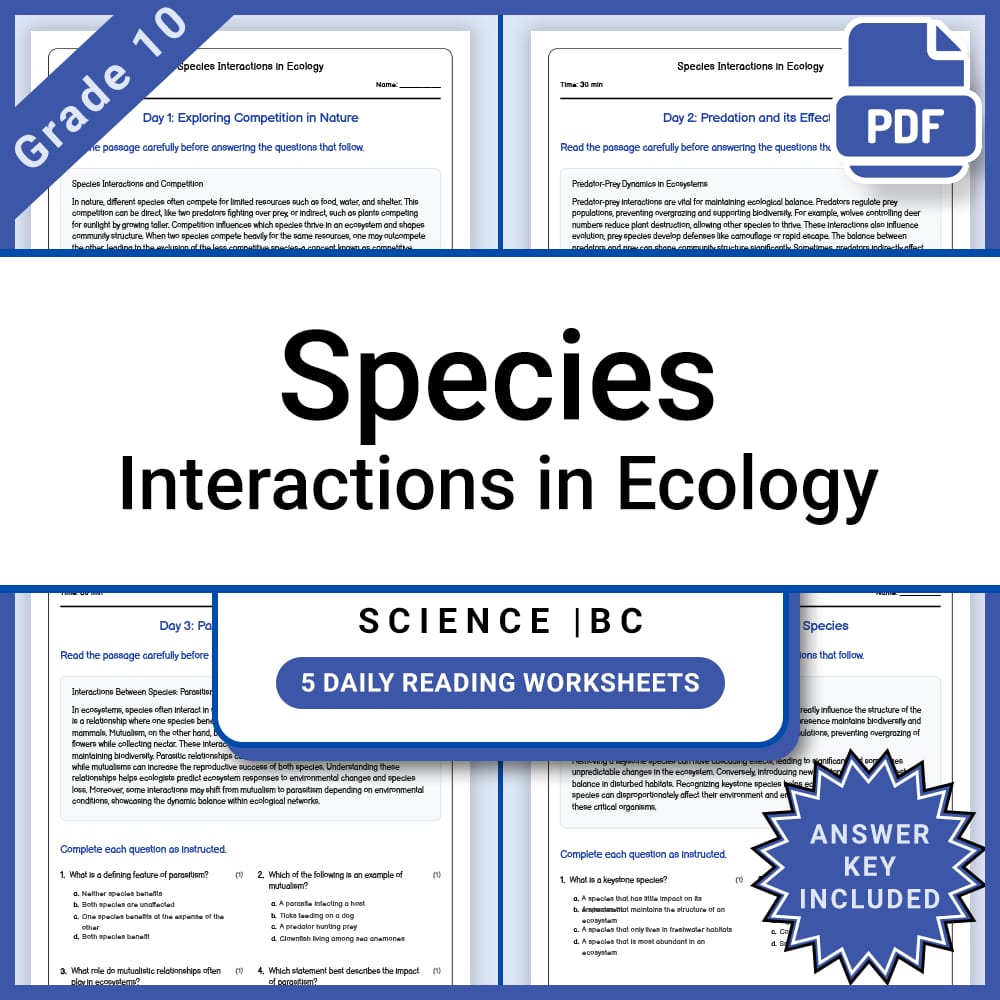
Grade 10 Science – Species Interactions Daily Reading Worksheet + Answer Key
JCreated byJ.S SheetsLearning Objectives
- Understand different types of species interactions such as competition, predation, parasitism, mutualism, and commensalism.
- Identify examples of competitive relationships in nature.
- Explain how species compete for resources and how it influences community structure.
Also included in: Grade 10 Science Lesson Bundle | Genetics, Evolution, Biodiversity & More +1 more
Instant download
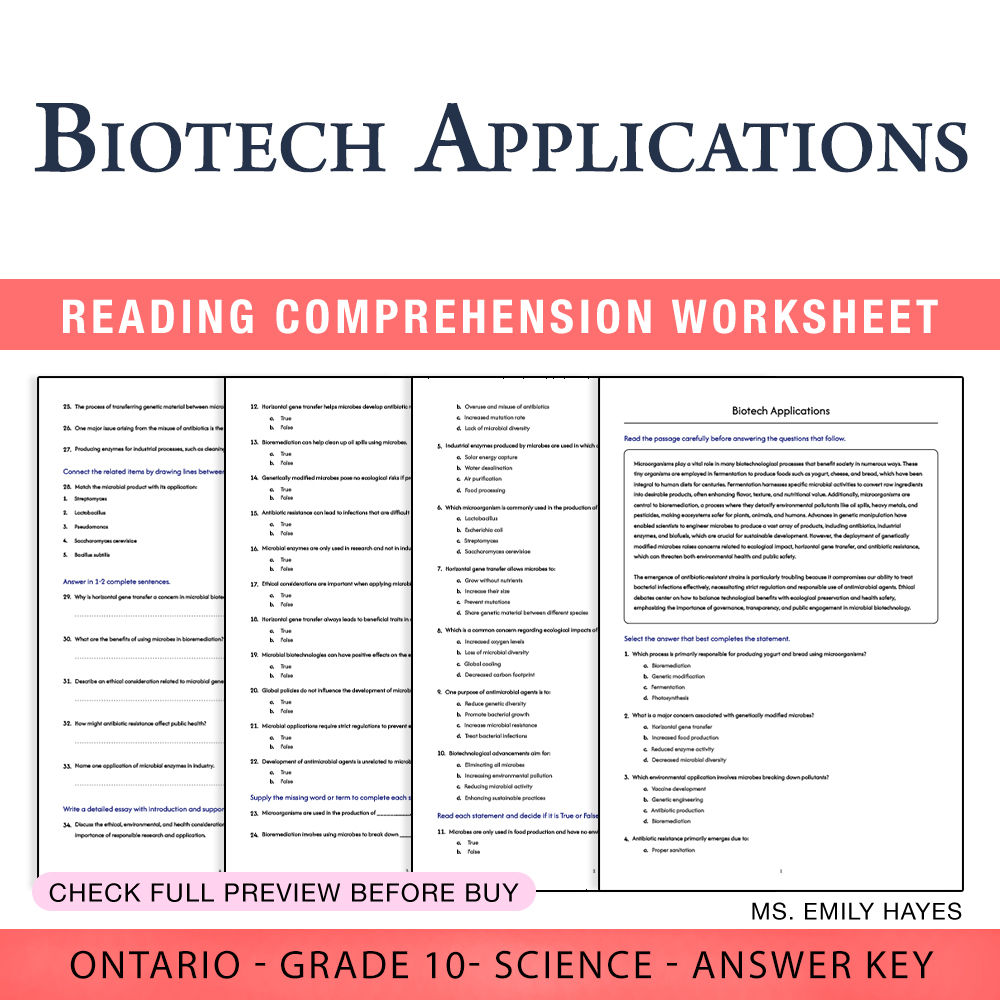
Grade 10 Science | Biotech Applications Worksheet (PDF + Answer Key)
Created byCopper Leaf ClassroomLearning Objectives
- Describe key biotechnological applications of microorganisms in various industries.
- Explain the principles of genetic manipulation in microbial systems for product synthesis.
- Analyze the ecological and health impacts of antibiotic use and resistance.
Instant download
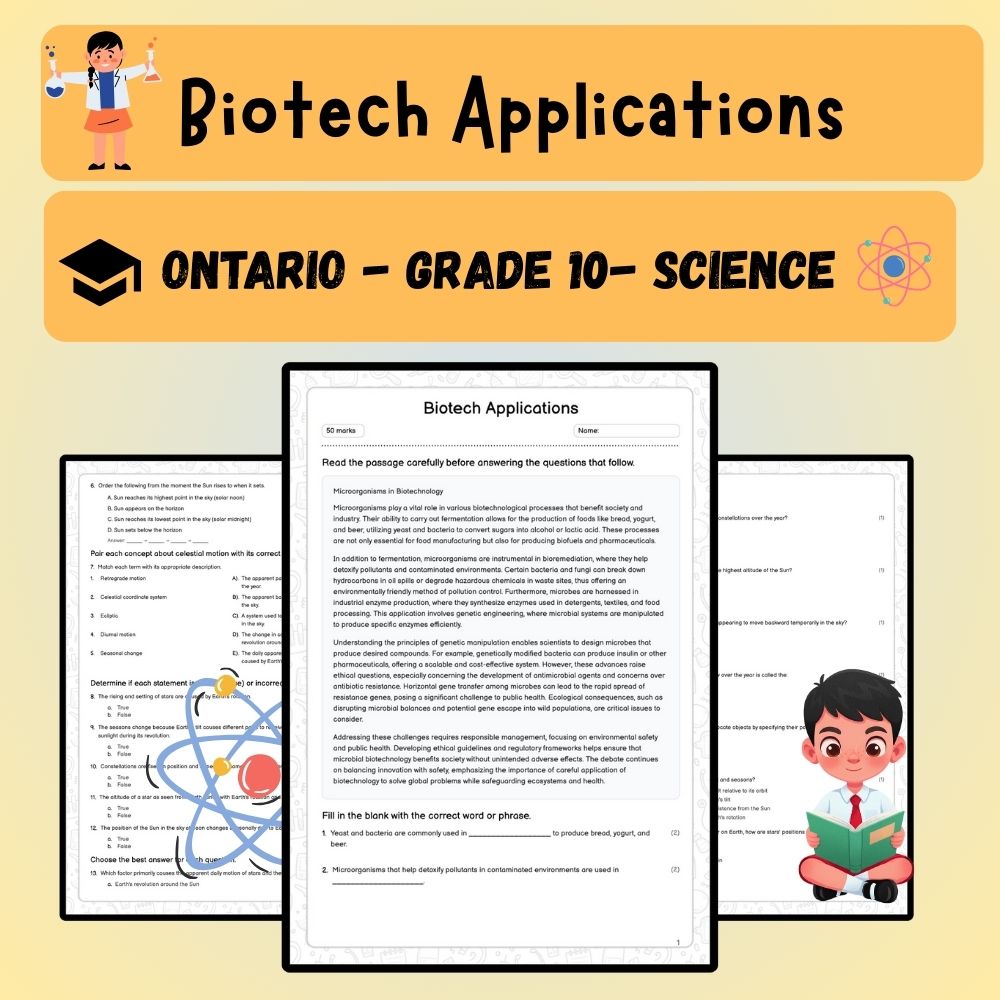
Grade 10 Science | Biotech Applications Worksheet (PDF) - Ontario Standards
Created byPrism Point LearningLearning Objectives
- Describe key biotechnological applications of microorganisms, including fermentation and bioremediation.
- Explain principles of genetic manipulation in microbial systems for product synthesis.
- Analyze the ecological and health implications of antibiotic resistance and horizontal gene transfer.
Also included in: Grade 10 Science Unit | Cells, Photosynthesis & Microbes Worksheet Pack +1 more
Instant download
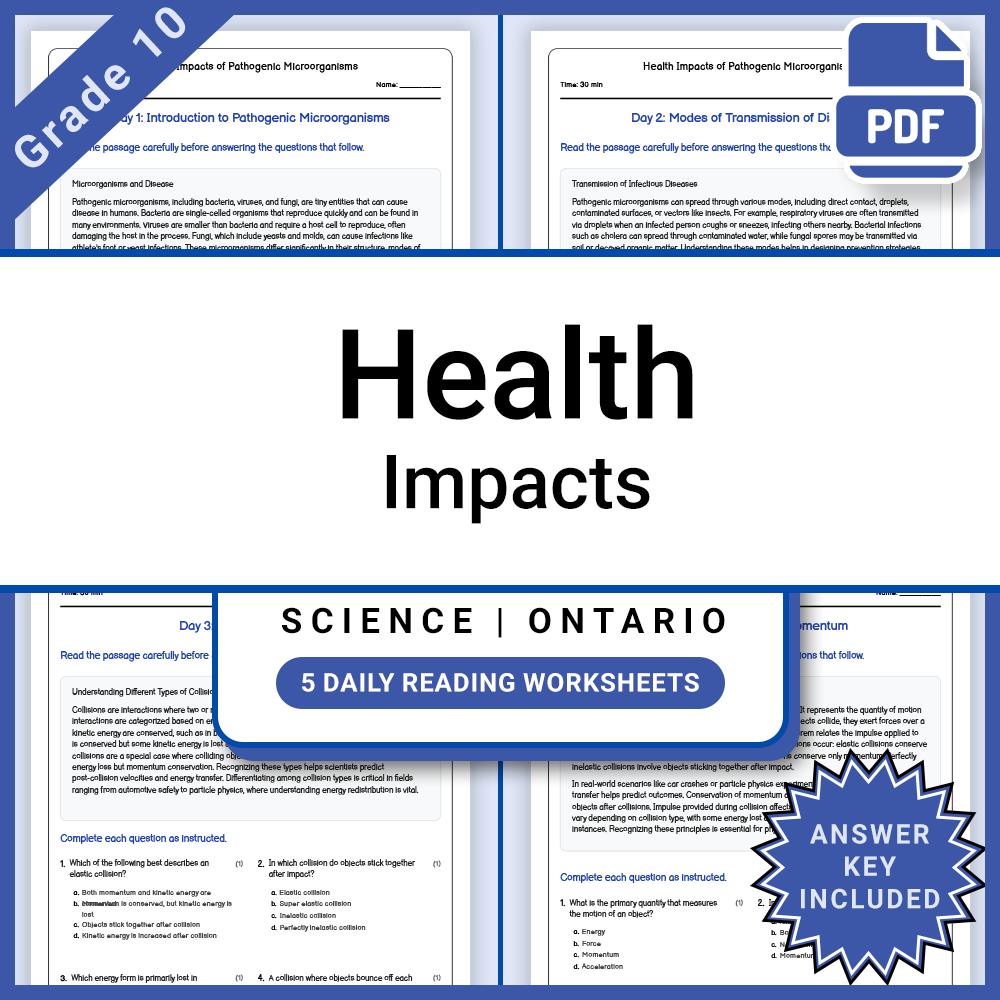
Grade 10 – Health Impacts of Pathogenic Microorganisms Worksheet + Answer Key
JCreated byJ.S SheetsLearning Objectives
- Identify and differentiate between bacterial, viral, and fungal microorganisms.
- Understand how microorganisms are transmitted and cause disease.
- Describe host immune responses to infections, including innate and adaptive immunity.
Also included in: Grade 10 Science Lesson Bundle | Ontario Curriculum and Daily Reading Worksheets +1 more
Instant download

10th Grade Science Worksheet | Ocean Dynamics with Answer Key and Rubric
Created byCoral Reef LearningLearning Objectives
- Understand the key circulation patterns and mechanisms driving ocean dynamics.
- Identify how observations from various technologies contribute to knowledge of ocean behavior.
- Explain the influence of ocean circulation on climate, sea level, and coastal processes.
Also included in: Grade 10 Science Unit Bundle – Earth's Surface Atmosphere & Geology Worksheets +1 more
Instant download

Grade 10 Science | Surface Processes Worksheet | AP Aligned
 Created byLumora Learning
Learning Objectives
- Describe the key processes of weathering, erosion, sediment transport, and deposition that shape landscapes.
- Interpret surface process evidence such as sediment grain size, channel profiles, and delta growth.
- Relate surface processes to climate, lithology, and human activities influencing landscape evolution.
Instant download
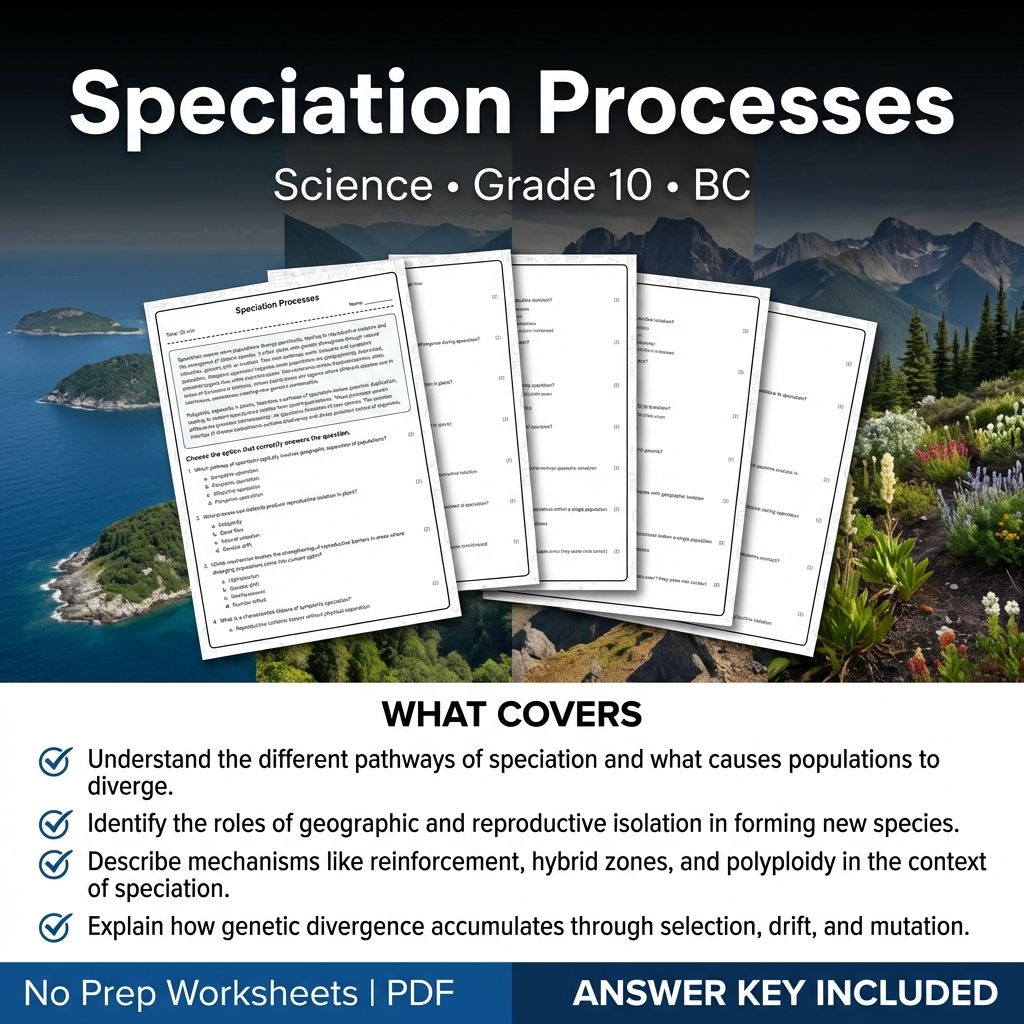
Grade 10 Science | Speciation Processes Worksheet & Answer Key (Printable PDF)
Created byCoral Reef LearningLearning Objectives
- Understand the different pathways of speciation and what causes populations to diverge.
- Identify the roles of geographic and reproductive isolation in forming new species.
- Describe mechanisms like reinforcement, hybrid zones, and polyploidy in the context of speciation.
Instant download
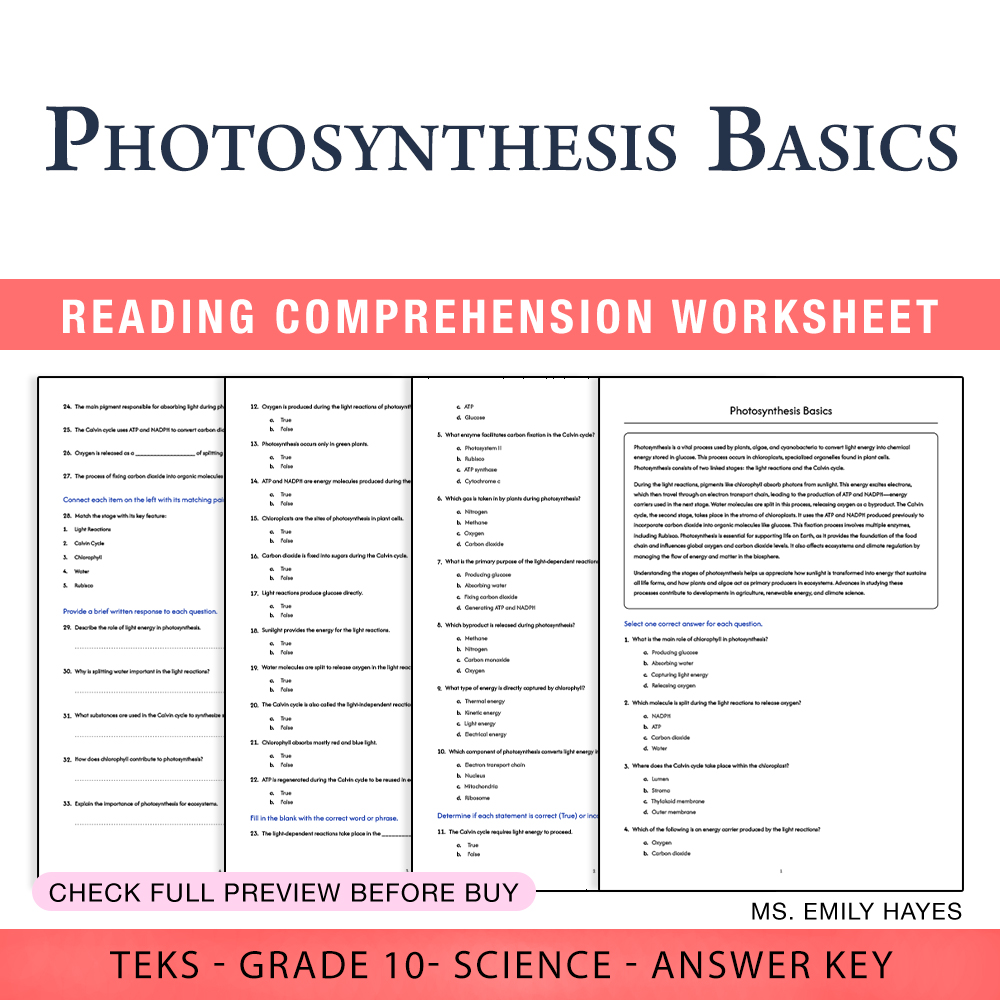
Grade 10 Science | Photosynthesis Basics Worksheet (PDF+ Answer Key)
Created byCopper Leaf ClassroomLearning Objectives
- Explain the two main stages of photosynthesis: light reactions and the Calvin cycle.
- Identify the key molecules involved in photosynthesis such as ATP, NADPH, oxygen, and carbon dioxide.
- Describe the role of pigments in capturing light energy.
Instant download

Grade 10 Science Representing Data Worksheet Ontario Curriculum Skills Practice
Created byClear Sky ClassroomLearning Objectives
- Choose appropriate ways to represent quantitative data using tables, line graphs, scatter plots, and error bars.
- Apply conventions for graphing, including labeled axes and appropriate scaling, to support correct interpretation of trends.
- Explain how visual choices (legends, annotations, best-fit lines) affect whether patterns are recognized or misread.
Instant download
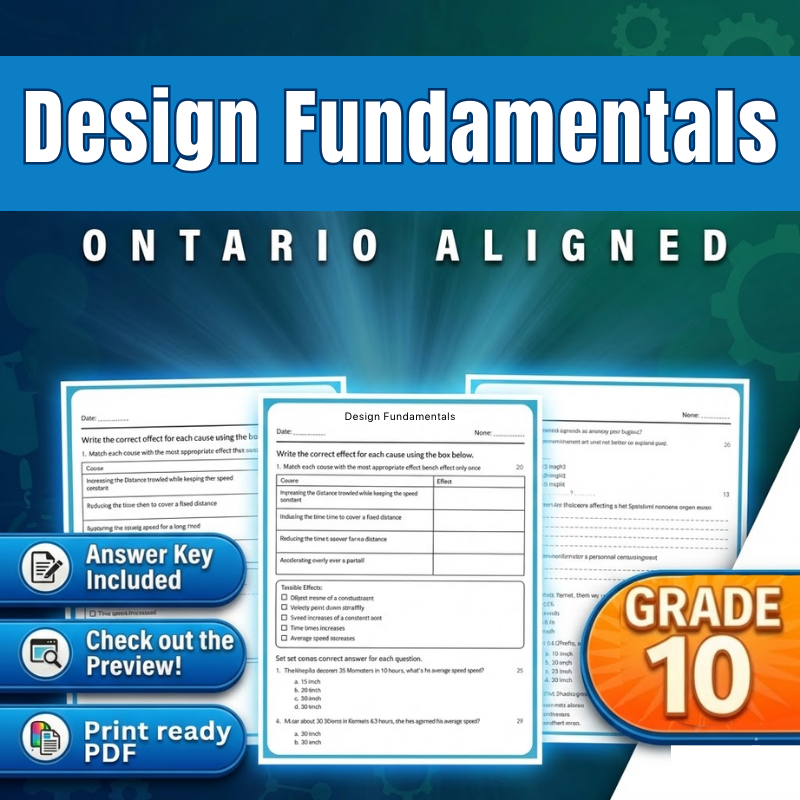
Grade 10 Science | Design Fundamentals Worksheet (Ontario) (PDF)
 Created byBright Mind Resources
Learning Objectives
- Understand the core principles for formulating testable scientific questions.
- Identify and classify variables, including independent, dependent, and controlled factors.
- Learn how to establish reproducibility and measurement criteria for experiments.
Instant download
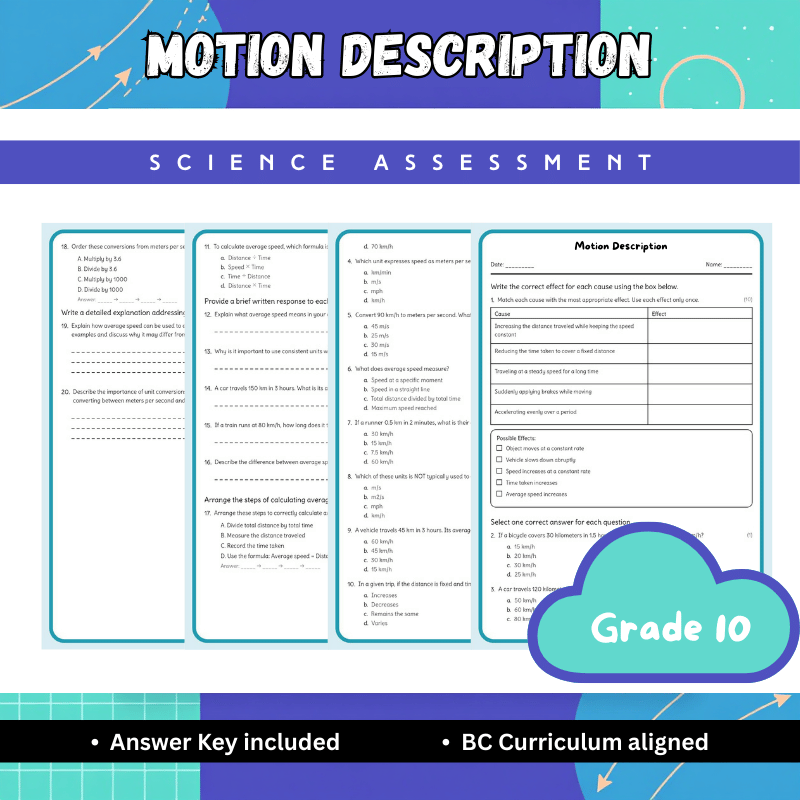
Grade 10 Science | Motion Description Worksheet (PDF) BC Standard / Science
Created byBright Mind ResourcesLearning Objectives
- Understand the basic variables used in describing motion, including position, displacement, speed, velocity, and acceleration.
- Interpret motion graphs and equations to analyze variable relationships and predict future states.
- Differentiate between scalar and vector quantities in one- and two-dimensional motion.
Instant download
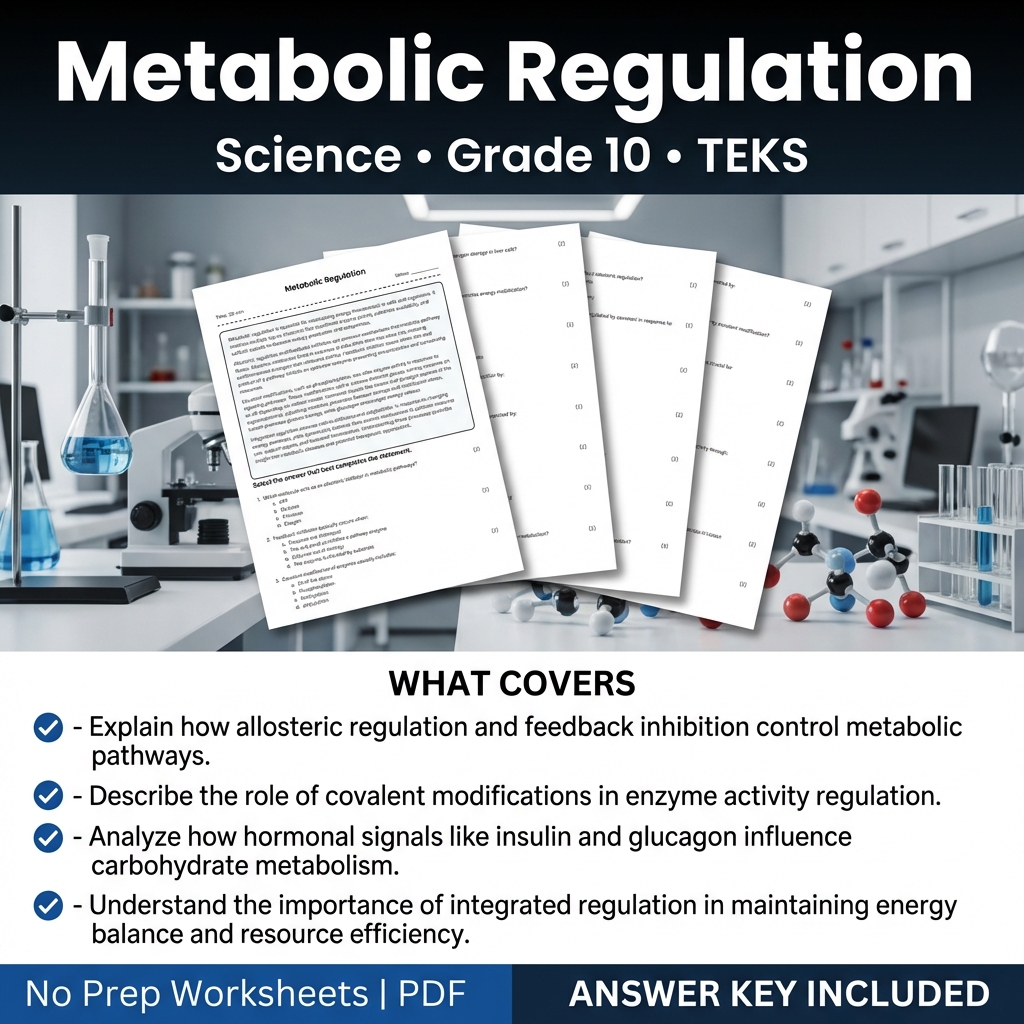
Metabolic Regulation Worksheet Grade 10 Science | TEKS Practice PDF
Created byCoral Reef LearningLearning Objectives
- Explain how allosteric regulation and feedback inhibition control metabolic pathways.
- Describe the role of covalent modifications in enzyme activity regulation.
- Analyze how hormonal signals like insulin and glucagon influence carbohydrate metabolism.
Instant download

Grade 10 Science | Gravitation Fields Reading Worksheet (PDF + Rubric)
JCreated byJ.S SheetsLearning Objectives
- Understand the concept of gravitational fields and their inverse-square law behavior.
- Describe how gravitational field vectors and potentials represent gravitational influence.
- Analyze planetary orbits and tidal effects using Newtonian gravitation concepts.
Instant download
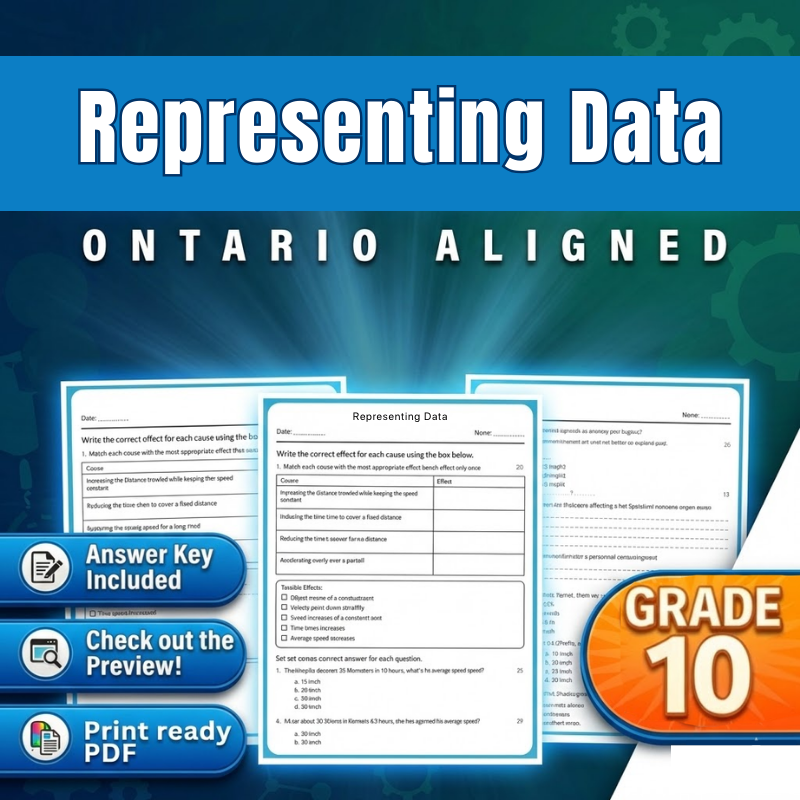
Grade 10 Science | Representing Data Worksheet (PDF) Ontario Standards
Created byBright Mind ResourcesLearning Objectives
- Understand conventions for tabular and graphical data representation.
- Identify appropriate chart types for different data sets.
- Analyze how axis scaling, error bars, and trend lines impact data interpretation.
Instant download

Grade 10 Worksheet B: Signal Integration Worksheet | NGSS Practice PDF
Created byClear Sky ClassroomLearning Objectives
- Explain how nervous and endocrine systems coordinate responses through signal integration
- Describe how receptor specificity and signal transduction cascades regulate rapid and sustained effects
- Compare synaptic transmission with hormone-receptor signaling using examples such as reflex arcs and the hypothalamus–pituitary axis
Also included in: Grade 10 Cellular Regulation and Energy Pathways Science Lesson Bundle | NGSS +1 more
Instant download
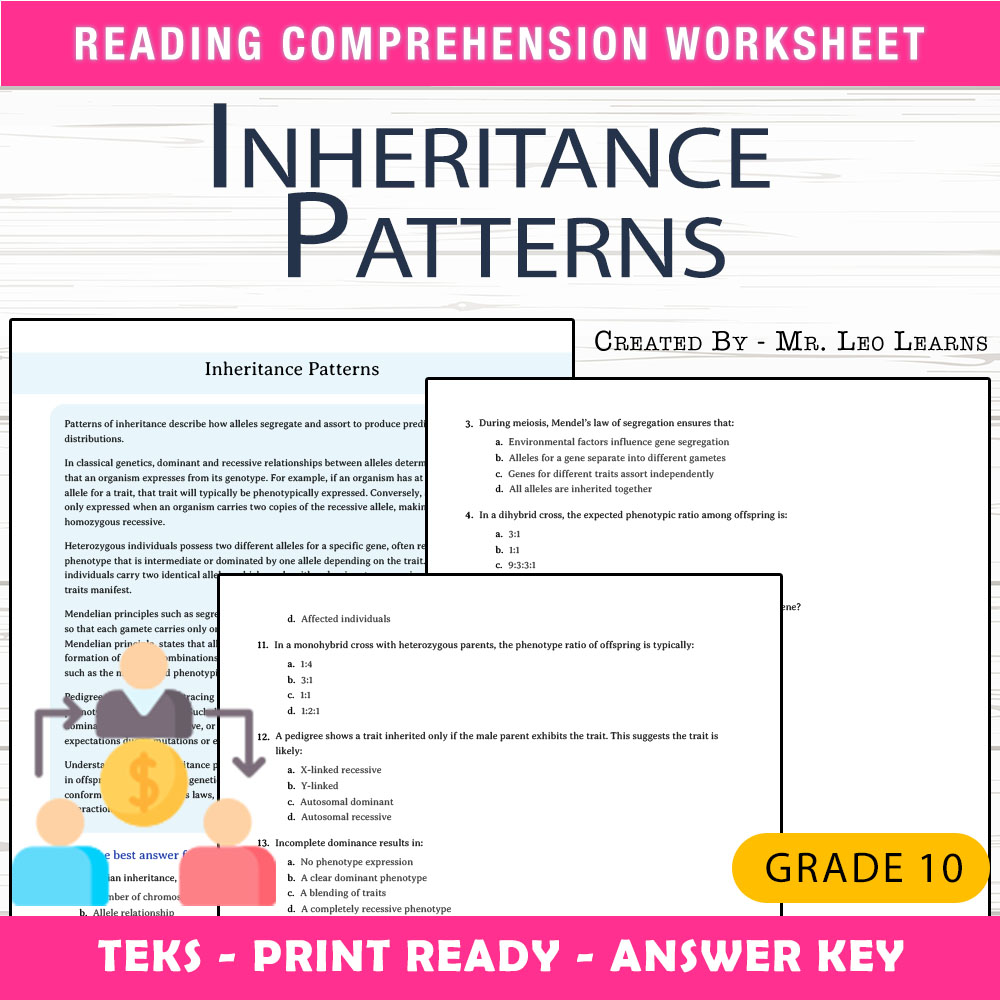
Grade 10 Science | Inheritance Patterns Worksheet for Mastery
 Created byThe Resource Hub
Learning Objectives
- Explain how dominant and recessive alleles influence phenotype expression
- Describe how heterozygous and homozygous genotypes affect traits
- Understand Mendelian principles such as segregation and independent assortment
Also included in: Grade 10 Science DNA & Genetics Worksheet Bundle (Mastery & Reinforcement) +1 more
Instant download

Grade 10 Science Rock Transformations Worksheet with Short Notes (Printable PDF)
Created byMeadowlark WorksheetsLearning Objectives
- Explain the main processes involved in the rock cycle, including crystallization, lithification, metamorphism, and weathering.
- Identify petrologic indicators such as mineral assemblages, texture, and geochemical signatures to interpret pressure–temperature histories.
- Describe how radiometric dating and stratigraphic correlation are used to sequence igneous, sedimentary, and metamorphic events.
Also included in: Grade 10 Science | Earth’s Systems Unit Bundle – NGSS Worksheet Collection +1 more
Instant download

Grade 10 Science | Paleoclimate Evidence Worksheet with Short Notes (PDF)
Created byMeadowlark WorksheetsLearning Objectives
- Understand the types of proxy records used to study past climates.
- Identify methods for interpreting paleoclimate data and their significance.
- Compare paleoclimate reconstructions with modern instrumental records.
Also included in: Grade 10 Science | Earth’s Systems Unit Bundle – NGSS Worksheet Collection +1 more
Instant download

Grade 10 Science | Hydrologic Systems Worksheet with Short Notes (Printable PDF)
Created byMeadowlark WorksheetsLearning Objectives
- Explain the key components and interactions of hydrologic systems within watersheds.
- Identify processes such as aquifer recharge, discharge, and water-table fluctuations.
- Analyze how surface runoff, infiltration, and groundwater contribute to water availability.
Also included in: Grade 10 Science | Earth’s Systems Unit Bundle – NGSS Worksheet Collection +1 more
Instant download

Grade 10 Science Surface Atmosphere Worksheet with Short Notes (Printable PDF)
Created byMeadowlark WorksheetsLearning Objectives
- Explain how surface and atmospheric interactions affect energy exchange.
- Identify key concepts such as albedo effects, radiative forcing, and surface processes.
- Analyze observational data related to greenhouse gases, radiation budgets, and land-surface reflectance.
Also included in: Grade 10 Science | Earth’s Systems Unit Bundle – NGSS Worksheet Collection +1 more
Instant download

Grade 10 Science | Geologic Mapping Worksheet with Short Notes (Printable PDF)
Created byMeadowlark WorksheetsLearning Objectives
- Understand the role of geoscience data in constructing geologic maps.
- Identify key features and methods used in interpreting Earth's structure.
- Explain how rates from stratigraphy inform landscape evolution.
Also included in: Grade 10 Science | Earth’s Systems Unit Bundle – NGSS Worksheet Collection +1 more
Instant download

Grade 10 Science | Ocean Dynamics Worksheet with Short Notes (Printable PDF)
Created byMeadowlark WorksheetsLearning Objectives
- Understand the principles of ocean currents and their effects on climate.
- Identify factors influencing ocean movement, such as wind and temperature.
- Explain the role of tides and waves in ocean dynamics.
Also included in: Grade 10 Science | Earth’s Systems Unit Bundle – NGSS Worksheet Collection +1 more
Instant download

Thermal Energy and Water Cycle Calculations Worksheet Grade 10 Science
 Created bythe curious pencil
Learning Objectives
- Calculate thermal energy transfers using Q = mcΔT and consistent units
- Distinguish temperature changes from phase changes in water
- Compare energy absorption during evaporation and melting with energy release during condensation and freezing
Instant download
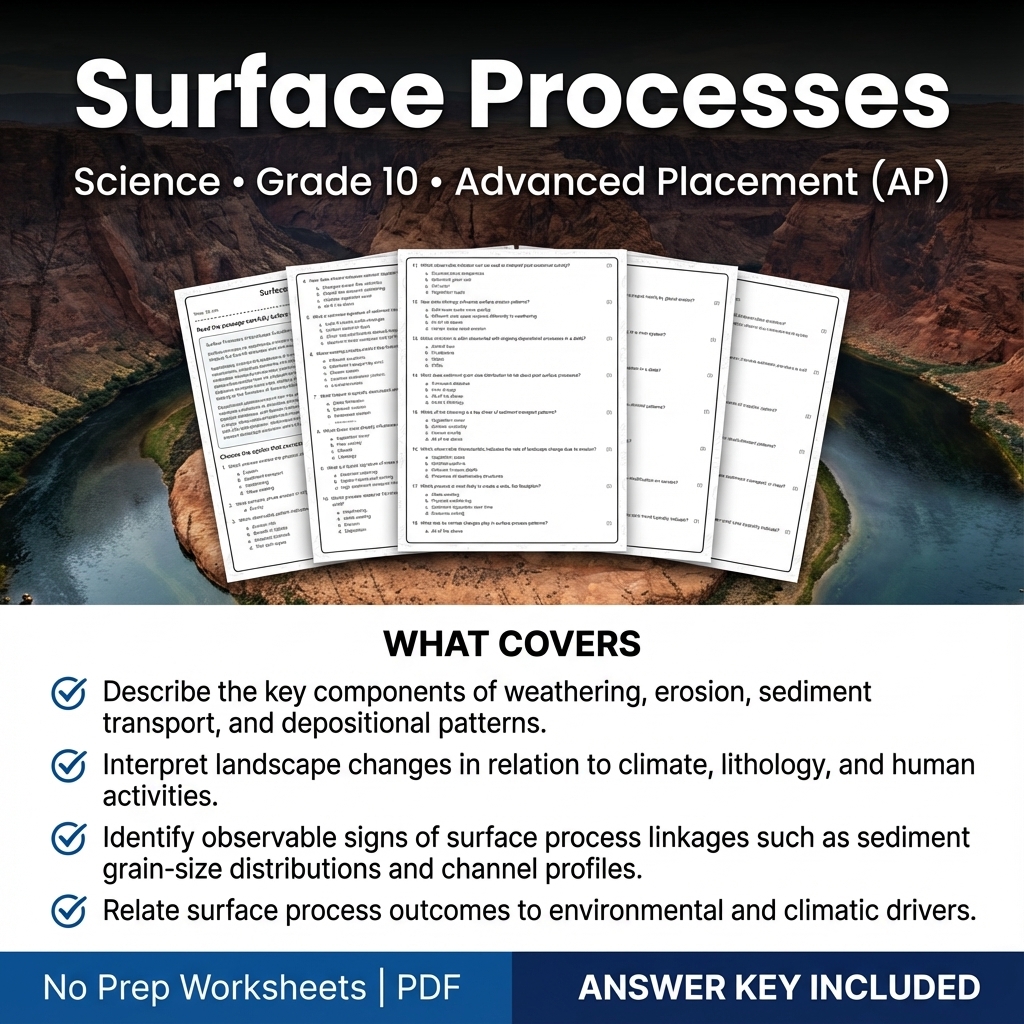
Grade 10 Science | Surface Processes Worksheet (Printable PDF + Answer Key)
Created byCoral Reef LearningLearning Objectives
- Describe the key components of weathering, erosion, sediment transport, and depositional patterns.
- Interpret landscape changes in relation to climate, lithology, and human activities.
- Identify observable signs of surface process linkages such as sediment grain-size distributions and channel profiles.
Also included in: Grade 10 Science Unit Worksheet Bundle – Geology, Climate, Plate Tectonics +1 more
Instant download

Grade 10 Science | Signal Integration Worksheet with Short Notes (Printable PDF)
Created byMeadowlark WorksheetsLearning Objectives
- Understand how signals are integrated in biological systems.
- Identify different types of signal pathways and their functions.
- Explain the importance of signal transduction in maintaining homeostasis.
Also included in: Grade 10 Science NGSS Bundle | Molecules to Organisms Structures & Processes +1 more
Instant download

Grade 10 Science | Earth Moon Sun NGSS Practice Worksheet (PDF)
 Created bySilver Birch Teaching
Learning Objectives
- Explain the relative positions and motions of Earth, Moon, and Sun that produce lunar phases, eclipses, and seasons.
- Describe how axial tilt and orbital inclination affect daylength and insolation.
- Understand the gravitational interactions that cause tidal cycles and their periodicity.
Also included in: Grade 10 Earth and Space Science Lesson Bundle Worksheets for NGSS +1 more
Instant download

Grade 10 Science | Cosmic Origins Worksheet – NGSS (PDF)
Created bySilver Birch TeachingLearning Objectives
- Describe the observational evidence supporting models of the universe's cosmic origin.
- Explain how cosmic microwave background radiation, galactic redshifts, and elemental abundances inform our understanding of the universe's expansion and early conditions.
- Analyze large-scale structures and spectral data to interpret the universe's evolution over cosmological timescales.
Also included in: Grade 10 Earth and Space Science Lesson Bundle Worksheets for NGSS +1 more
Instant download

Grade 10 Ecosystem Roles Worksheet | Ontario Science with Answer Key
Created byClear Sky ClassroomLearning Objectives
- Explain how microorganisms contribute to decomposition and nutrient cycling in ecosystems.
- Describe how microbial processes influence carbon and nitrogen fluxes, including nitrogen fixation and primary production support.
- Analyze how rhizosphere interactions and mycorrhizal partnerships affect soil fertility and ecosystem resilience.
Instant download

Grade 10 Science | Graphical Statistics Daily Reading Comprehension
Created byCoral Reef LearningLearning Objectives
- Understand how line graphs are used to display data trends over time.
- Interpret features of line graphs such as slope, intercept, and patterns.
- Identify upward and downward trends, constants, and variations in data.
Instant download
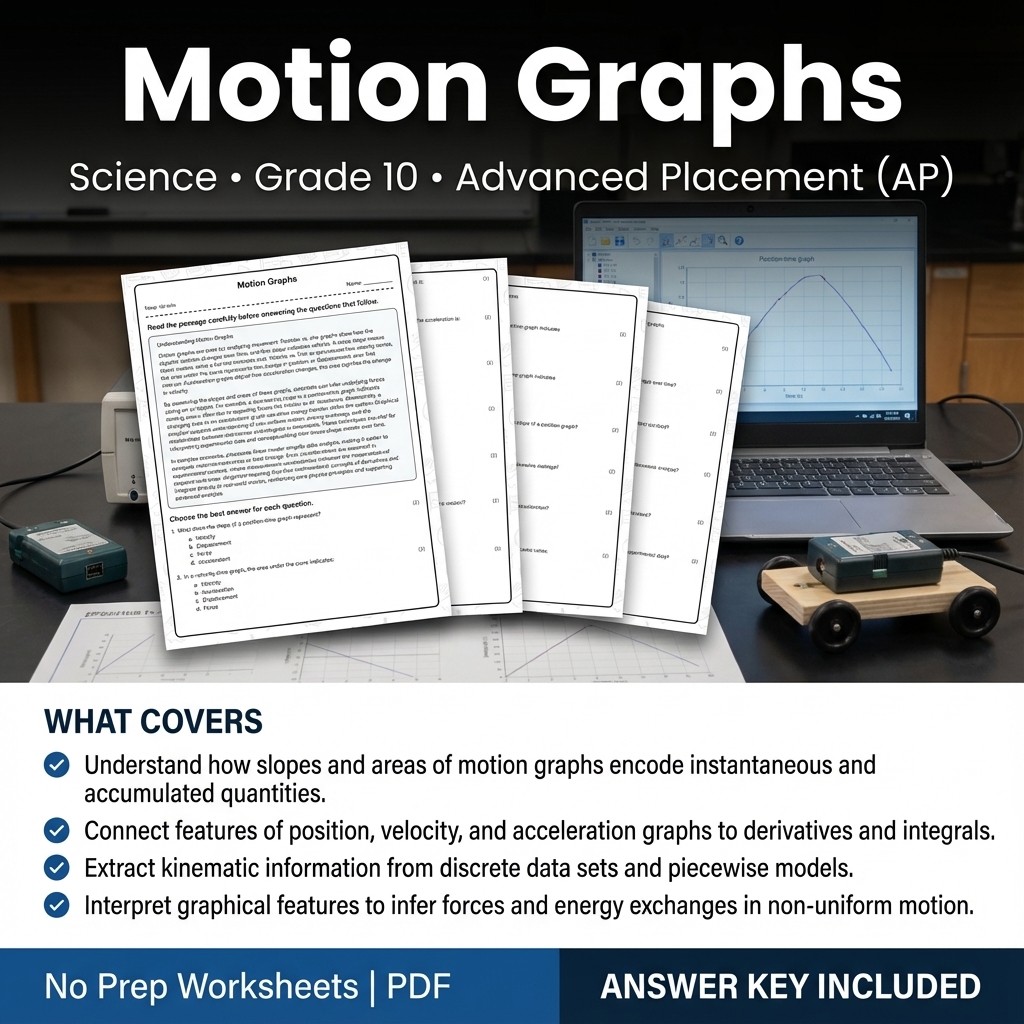
10th Grade Science | Motion Graphs Worksheet (Printable PDF + Answer Key)
Created byCoral Reef LearningLearning Objectives
- Understand how slopes and areas of motion graphs encode instantaneous and accumulated quantities.
- Connect features of position, velocity, and acceleration graphs to derivatives and integrals.
- Extract kinematic information from discrete data sets and piecewise models.
Also included in: Grade 10 Science Unit Worksheet Bundle – Motion, Energy & Forces (PDF Answers) +1 more
Instant download
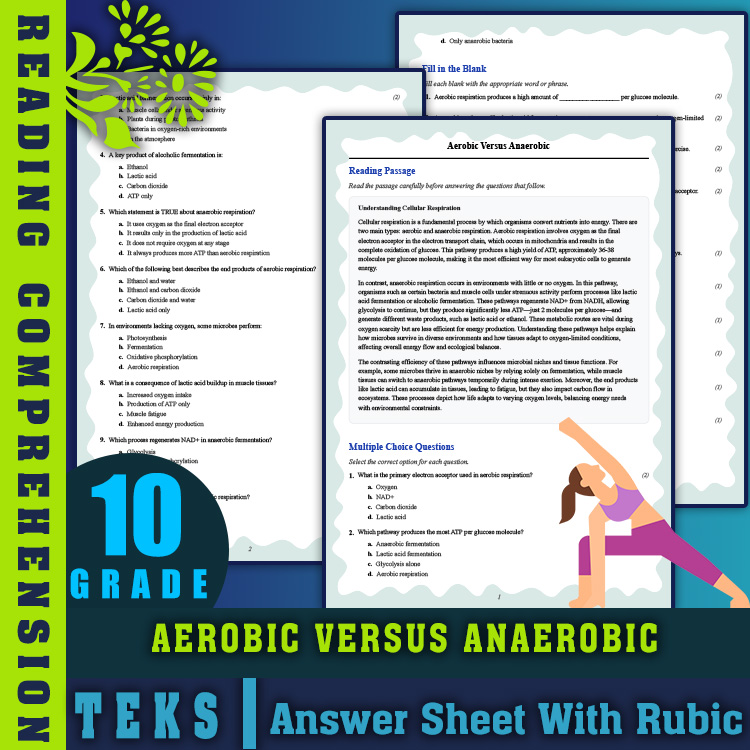
Grade 10 Science | Aerobic Versus Anaerobic Reading Worksheet & Answer Key (PDF)
JCreated byJ.S SheetsLearning Objectives
- Understand the differences between aerobic and anaerobic respiration.
- Identify the processes and end products of both respiration types.
- Explain how oxygen availability influences metabolic pathways in organisms.
Instant download

Grade 10 Science – Magnetic Fields & Electromagnetism | Daily Reading Worksheet
Created byBright Mind ResourcesLearning Objectives
- Identify sources of magnetic fields such as currents and magnets
- Understand the pattern of magnetic field lines around different objects
- Recognize the distinction between magnetic and electrostatic fields
Also included in: Grade 10 Forces & Motion Science Daily Reading Worksheets Lesson Bundle | BC +1 more
Instant download
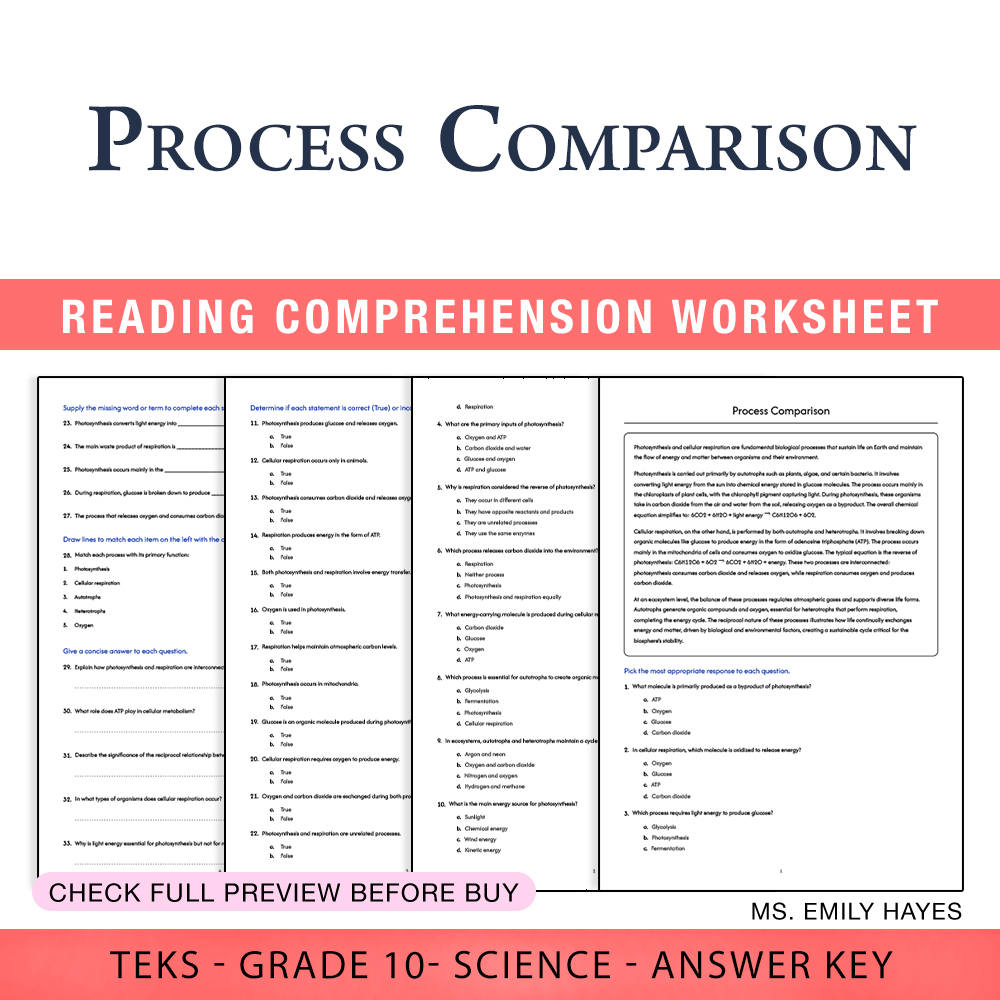
Grade 10 Science | Process Comparison Worksheet (PDF+ Answer Key)
Created byCopper Leaf ClassroomLearning Objectives
- Compare and contrast photosynthesis and cellular respiration in terms of inputs and outputs.
- Identify the roles of key molecules like oxygen, carbon dioxide, ATP, and glucose in metabolic processes.
- Explain how energy and matter cycle between organisms and their environment through these processes.
Instant download
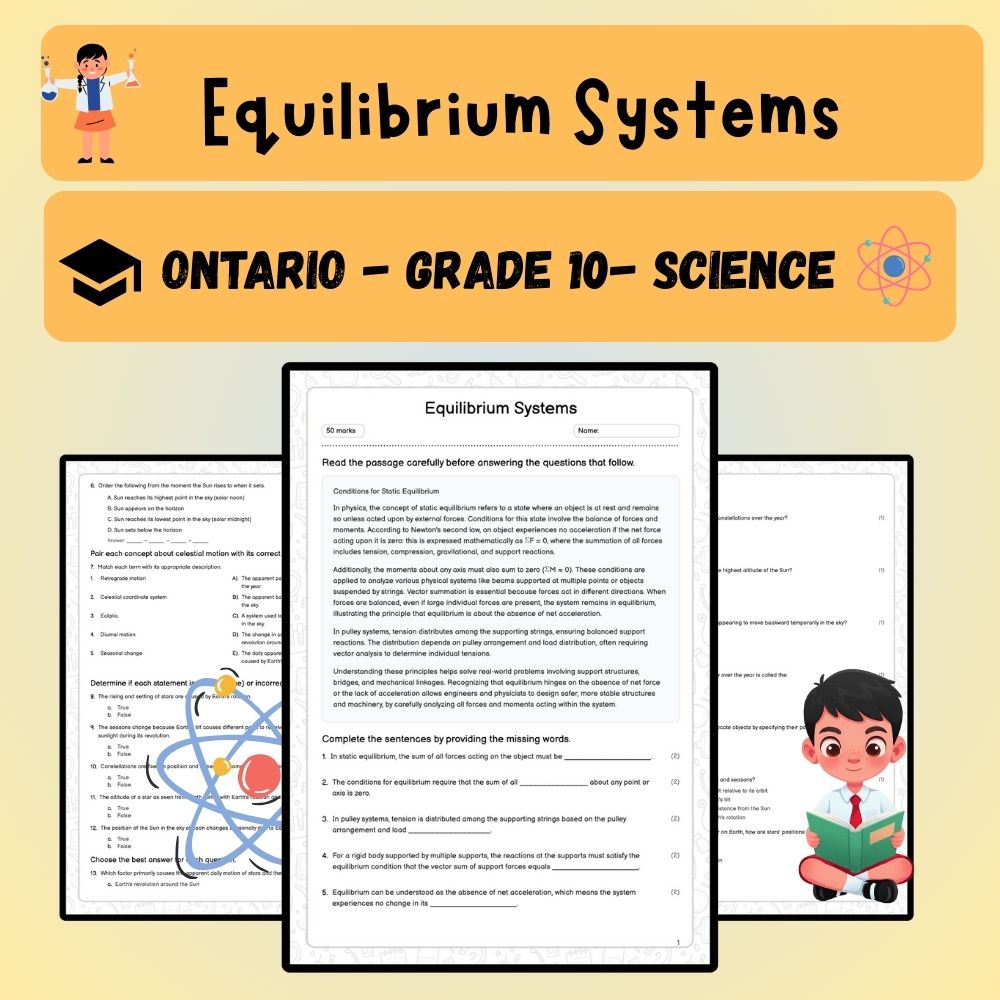
Grade 10 Science | Equilibrium Systems Worksheet (PDF) - Ontario Standard
Created byPrism Point LearningLearning Objectives
- Understand the conditions for static equilibrium using vector summation of forces and moments.
- Analyze various support and pulley arrangements to determine tension and support reactions.
- Interpret equilibrium as the absence of net acceleration rather than the absence of forces.
Also included in: Grade 10 Science Unit Bundle | Motion, Forces & Mechanics Worksheets (Ontario Standards) +1 more
Instant download
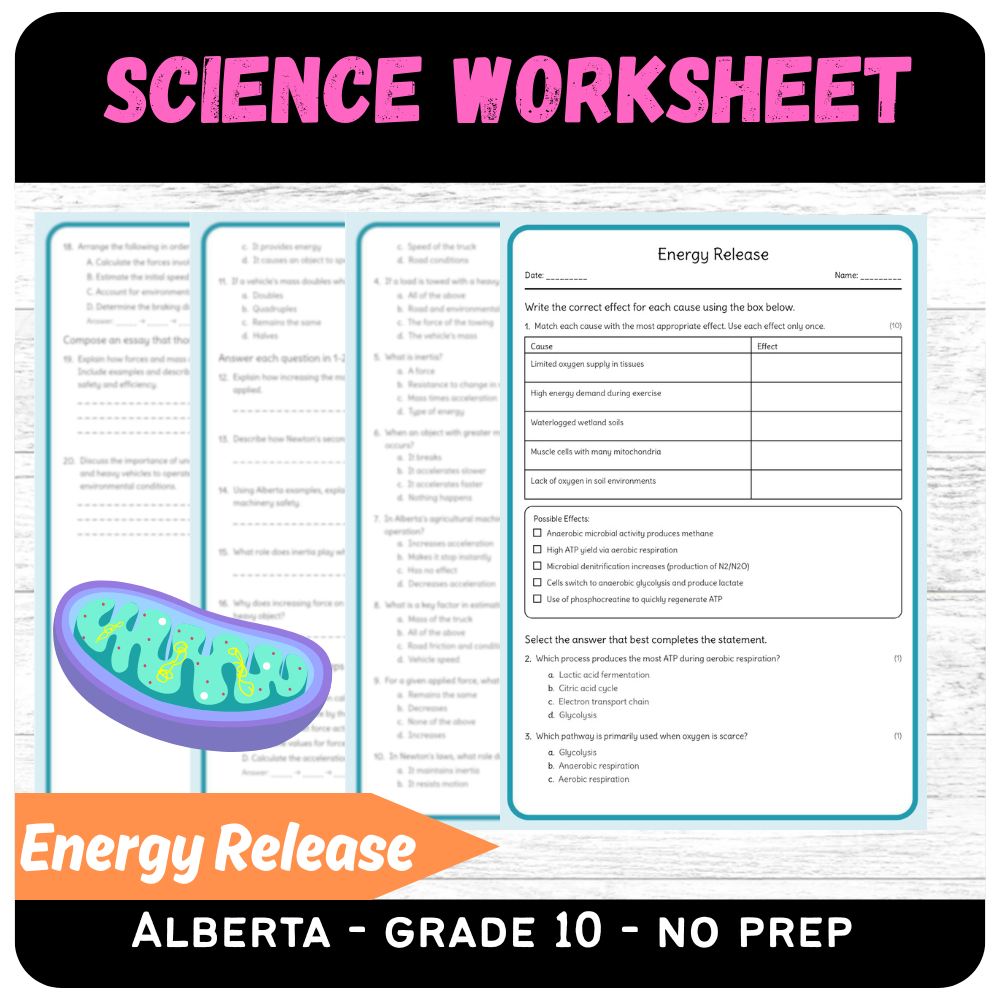
Grade 10 Science – Energy Release Worksheet (PDF) | Alberta Standards
Created byBright Mind ResourcesLearning Objectives
- Describe the processes of glycolysis, the citric acid cycle, and electron transport in cellular respiration.
- Explain how oxygen availability influences aerobic and anaerobic respiration pathways.
- Analyze environmental factors that affect pathway dominance in different ecosystems.
Instant download
About Grade 10 Science Worksheets
Find Science worksheets built for Grade 10. All 7,038 cover core skills, practice, and review, each an instant PDF download.
Every worksheet on MyTeachingSheets is created by independent teacher-authors and reviewed before publication. All resources download as printable PDFs for classroom, homework, or at-home practice, and many include answer keys. Preview any worksheet free before buying.