
Grade 10 Science Worksheets
7,038 worksheets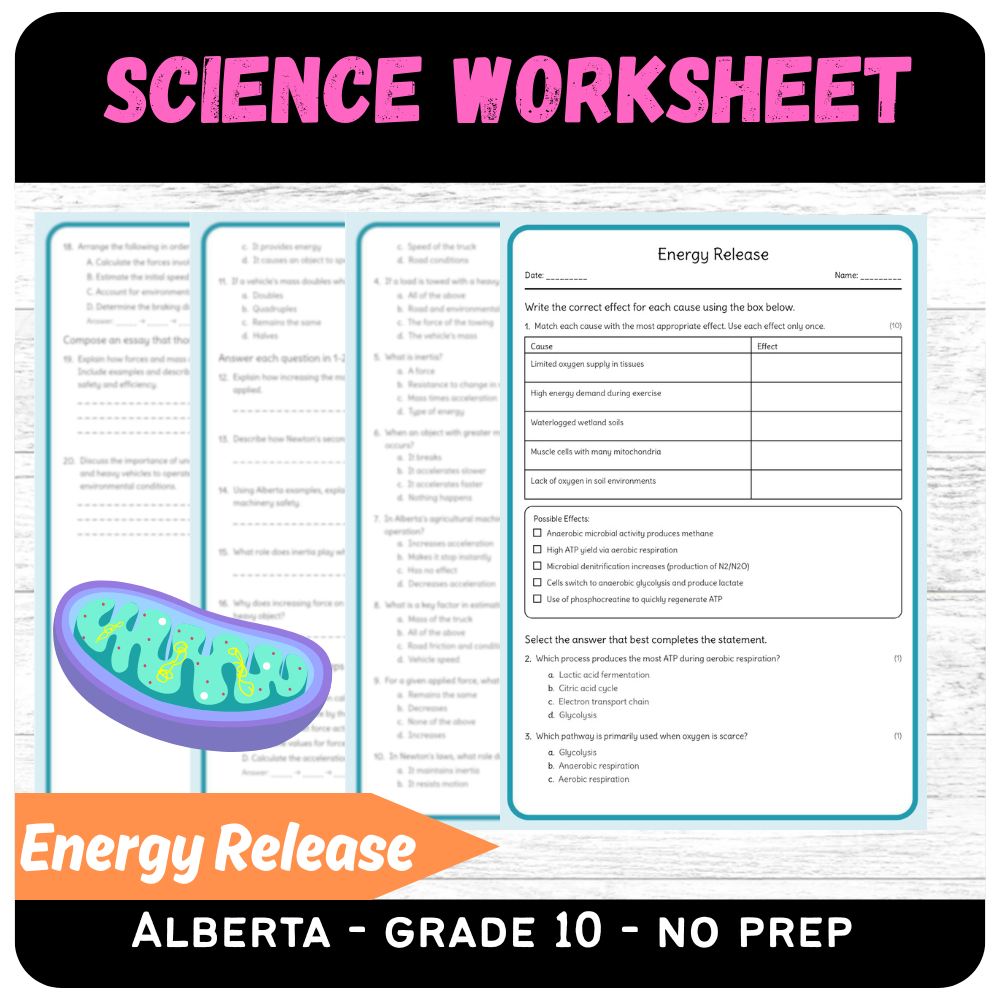
Grade 10 Science – Energy Release Worksheet (PDF) | Alberta Standards
 Created byBright Mind Resources
Learning Objectives
- Describe the processes of glycolysis, the citric acid cycle, and electron transport in cellular respiration.
- Explain how oxygen availability influences aerobic and anaerobic respiration pathways.
- Analyze environmental factors that affect pathway dominance in different ecosystems.
Instant download
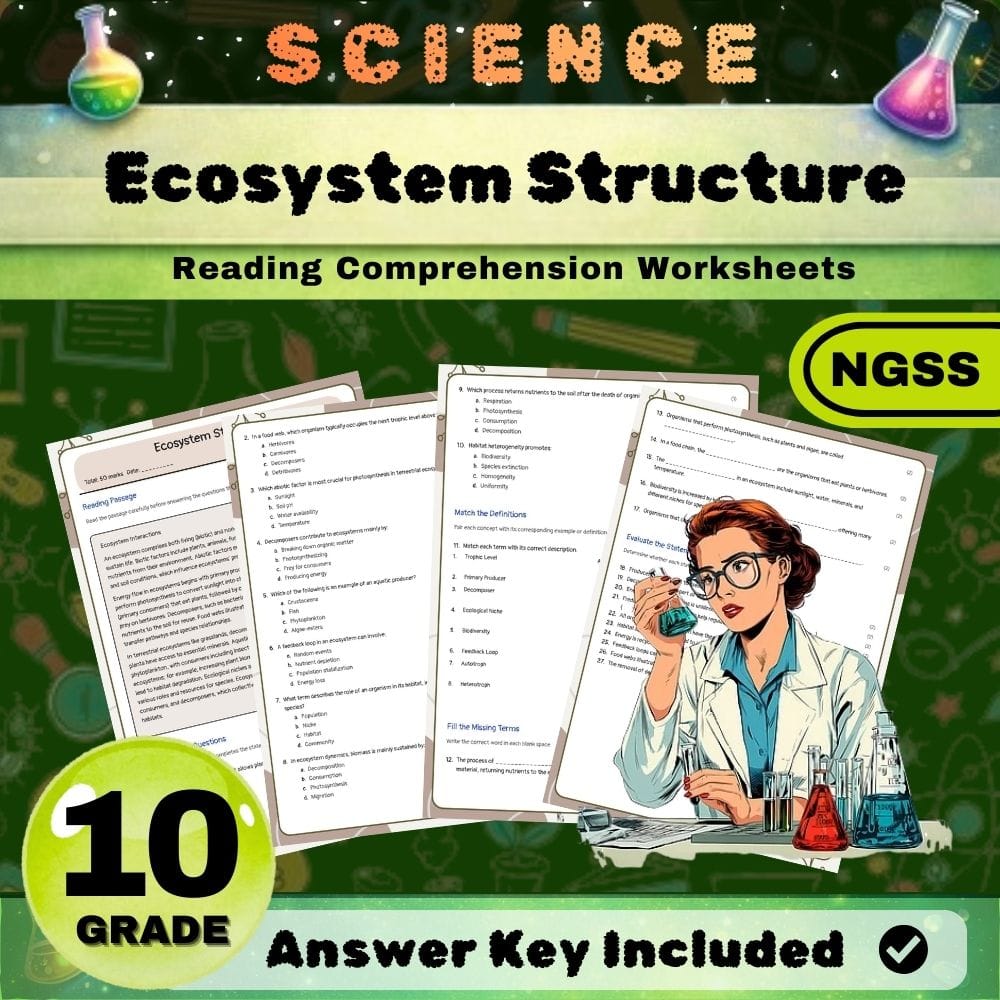
Grade 10 Science | Ecosystem Structure Worksheet (NGSS) PDF
 Created byMaple Path Learning
Learning Objectives
- Identify the components of ecosystems, including biotic and abiotic factors.
- Explain energy flow and trophic levels within food webs.
- Describe the roles of producers, consumers, and decomposers in ecosystem dynamics.
Also included in: Grade 10 Science Ecosystems Interactions Energy and Dynamics Lesson Bundle | NGSS +1 more
Instant download
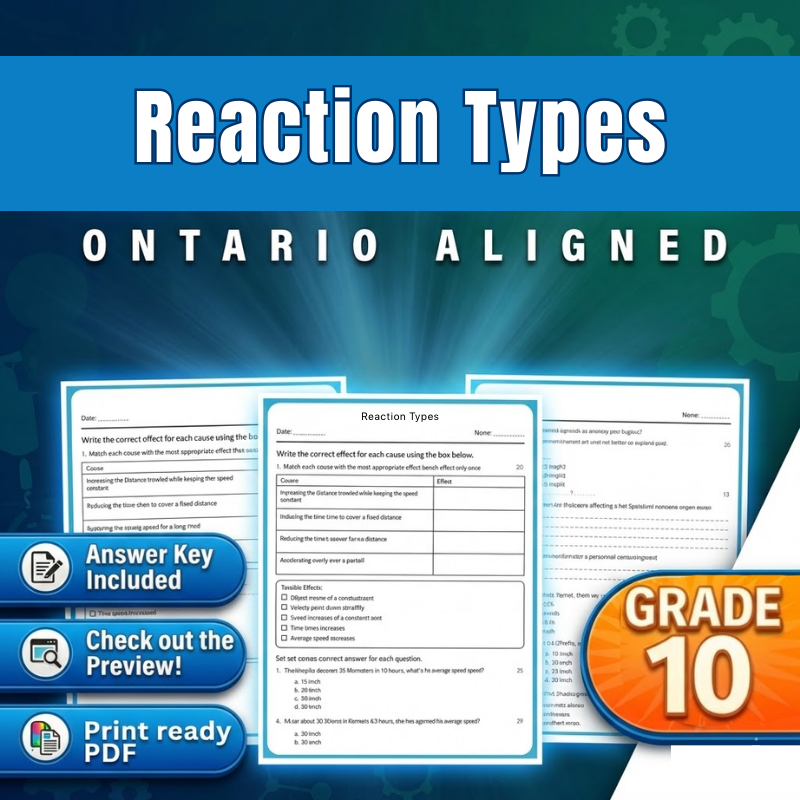
Grade 10 Science | Reaction Types Worksheet (Ontario) PDF
Created byBright Mind ResourcesLearning Objectives
- Identify and classify different reaction types such as synthesis, decomposition, single and double displacement, and combustion.
- Recognize characteristic reactant-product patterns in various chemical reactions.
- Understand the role of redox considerations and predict possible product classes.
Instant download
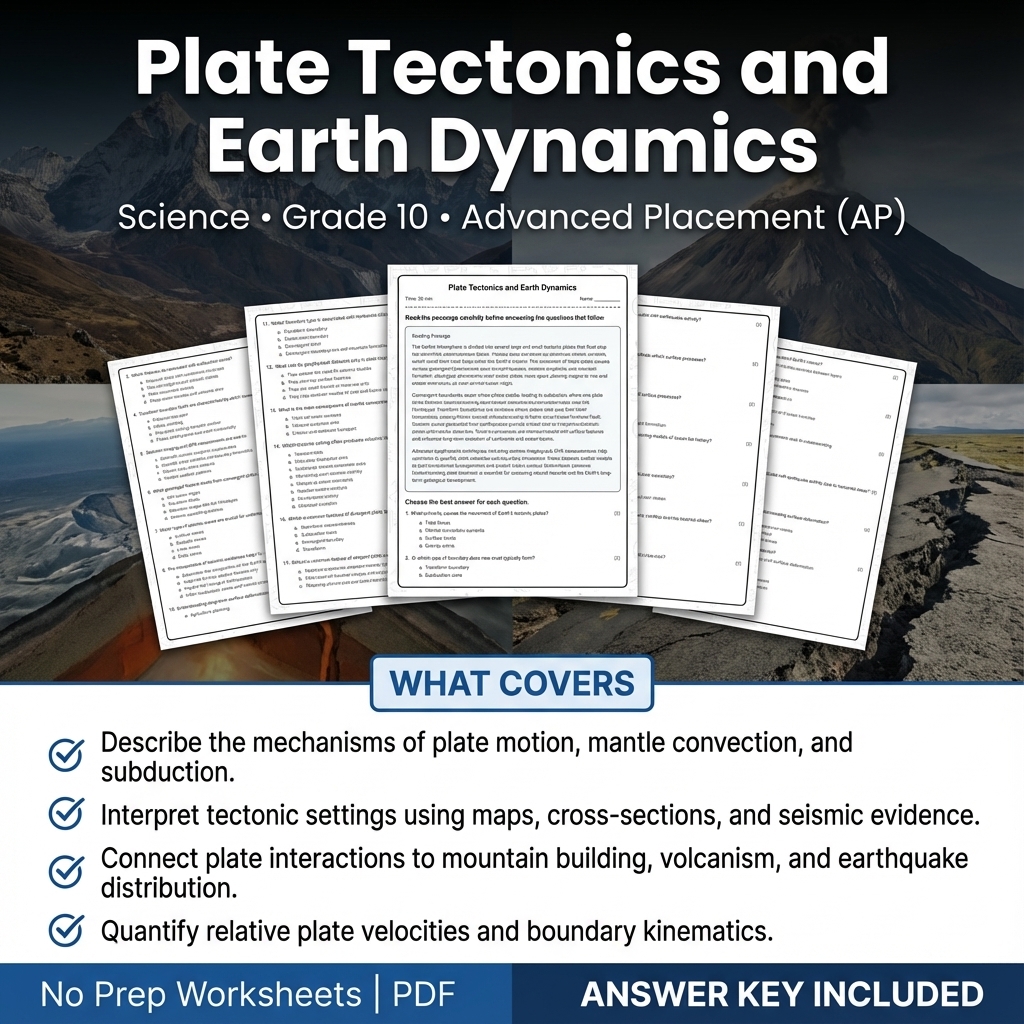
Grade 10 Science Worksheet | Plate Tectonics and Earth Dynamics (PDF + Answer Key)
 Created byCoral Reef Learning
Learning Objectives
- Describe the mechanisms of plate motion, mantle convection, and subduction.
- Interpret tectonic settings using maps, cross-sections, and seismic evidence.
- Connect plate interactions to mountain building, volcanism, and earthquake distribution.
Also included in: Grade 10 Science Unit Worksheet Bundle – Geology, Climate, Plate Tectonics +1 more
Instant download
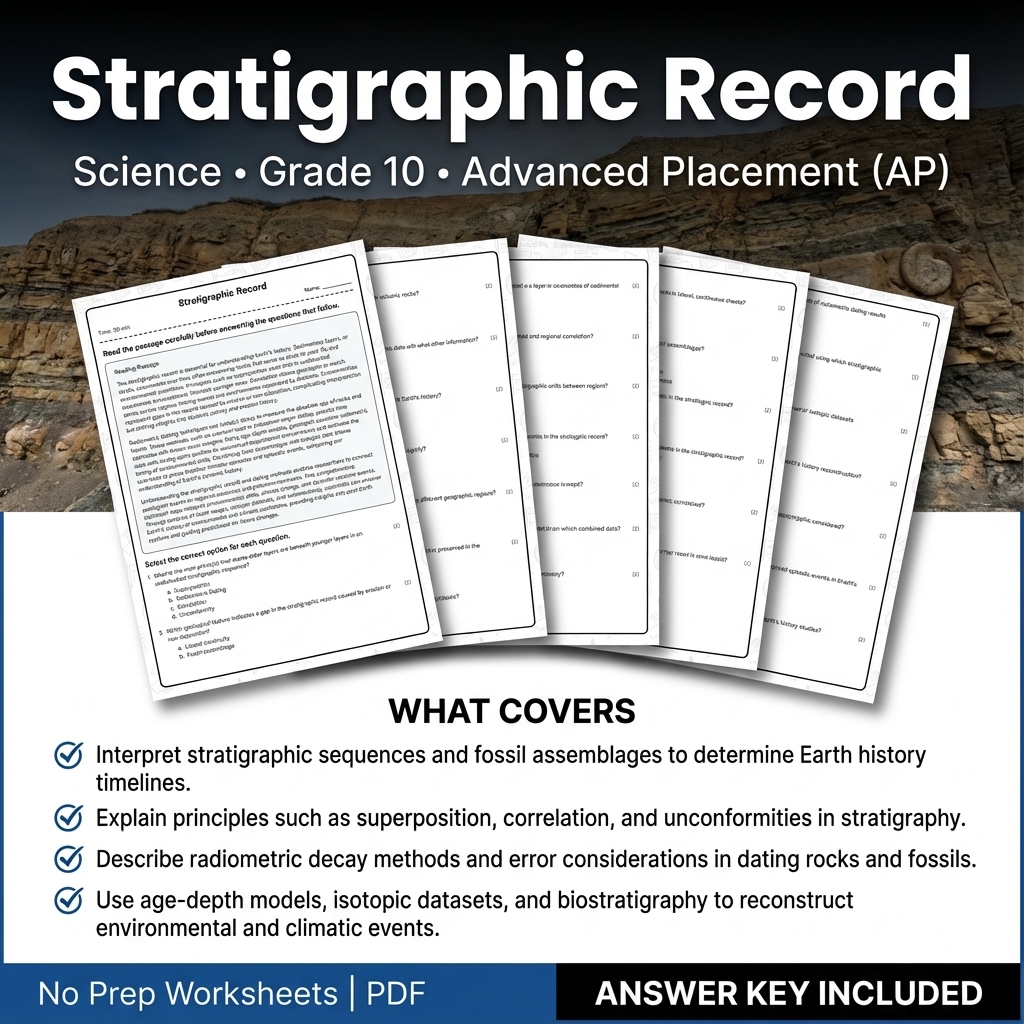
Grade 10 Science | Stratigraphic Record Worksheet (Printable PDF + Answer Key)
Created byCoral Reef LearningLearning Objectives
- Interpret stratigraphic sequences and fossil assemblages to determine Earth history timelines.
- Explain principles such as superposition, correlation, and unconformities in stratigraphy.
- Describe radiometric decay methods and error considerations in dating rocks and fossils.
Also included in: Grade 10 Science Unit Worksheet Bundle – Geology, Climate, Plate Tectonics +1 more
Instant download
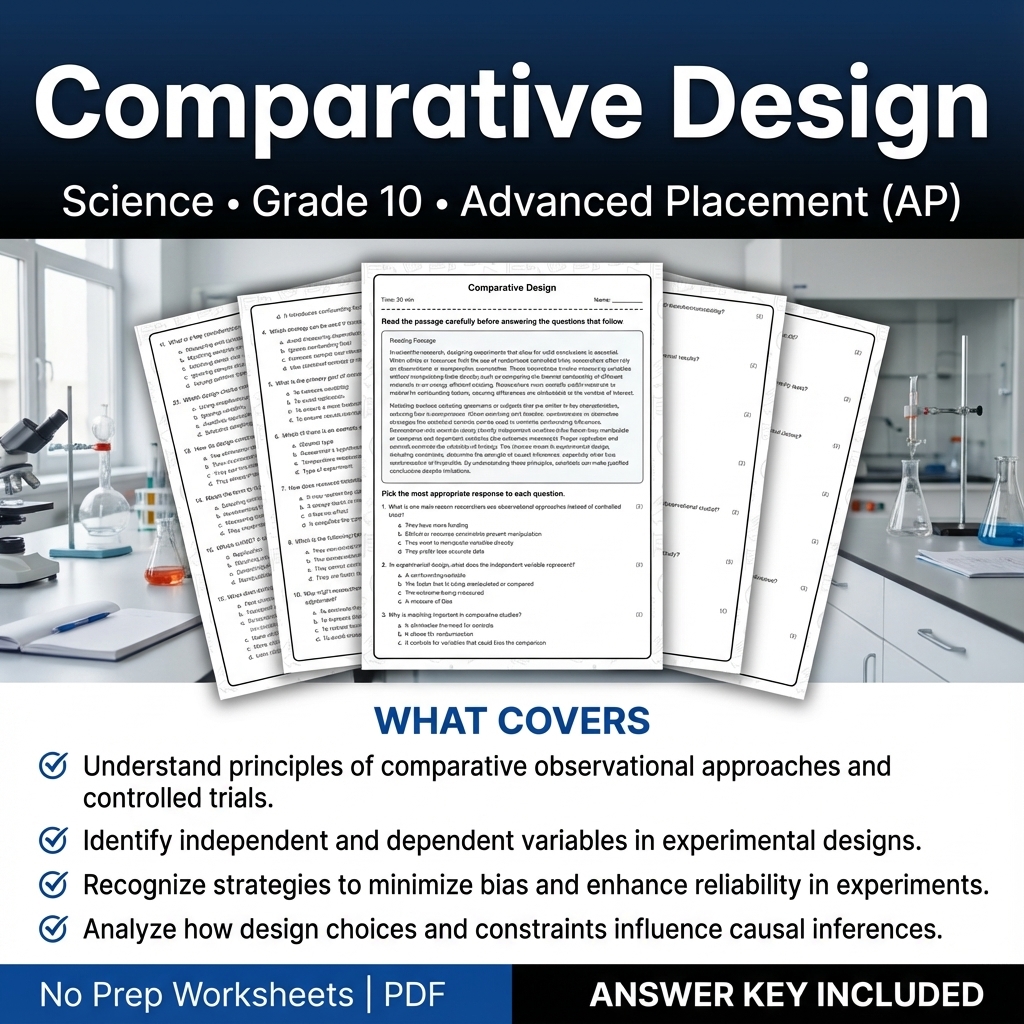
Grade 10 Science | Comparative Design Worksheet (Printable PDF + Answer Key)
Created byCoral Reef LearningLearning Objectives
- Understand principles of comparative observational approaches and controlled trials.
- Identify independent and dependent variables in experimental designs.
- Recognize strategies to minimize bias and enhance reliability in experiments.
Also included in: Grade 10 Science Unit Worksheet Bundle | Data Analysis & Scientific Modeling +1 more
Instant download
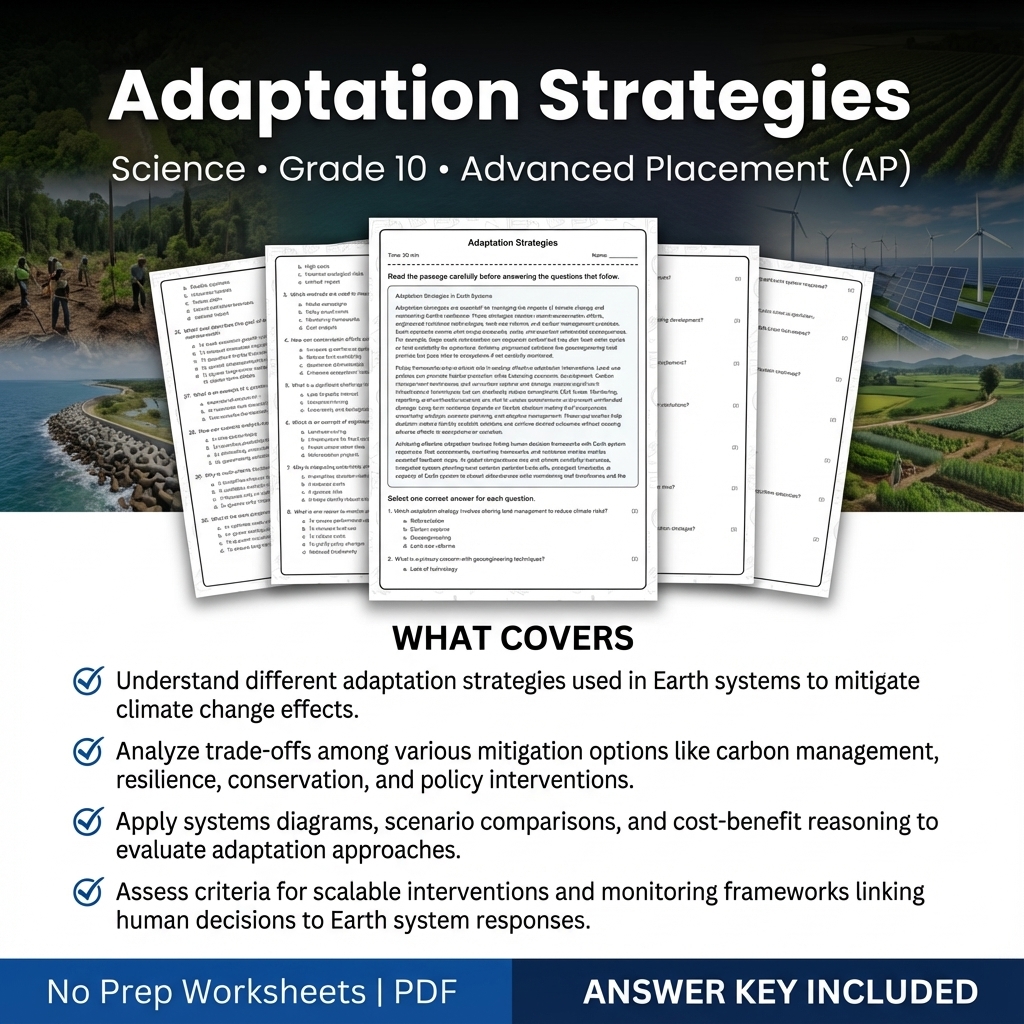
10th Grade Science | Adaptation Strategies Worksheet (Printable PDF + Answer Key)
Created byCoral Reef LearningLearning Objectives
- Understand different adaptation strategies used in Earth systems to mitigate climate change effects.
- Analyze trade-offs among various mitigation options like carbon management, resilience, conservation, and policy interventions.
- Apply systems diagrams, scenario comparisons, and cost-benefit reasoning to evaluate adaptation approaches.
Also included in: Grade 10 Science Unit Worksheet Bundle – Geology, Climate, Plate Tectonics +1 more
Instant download
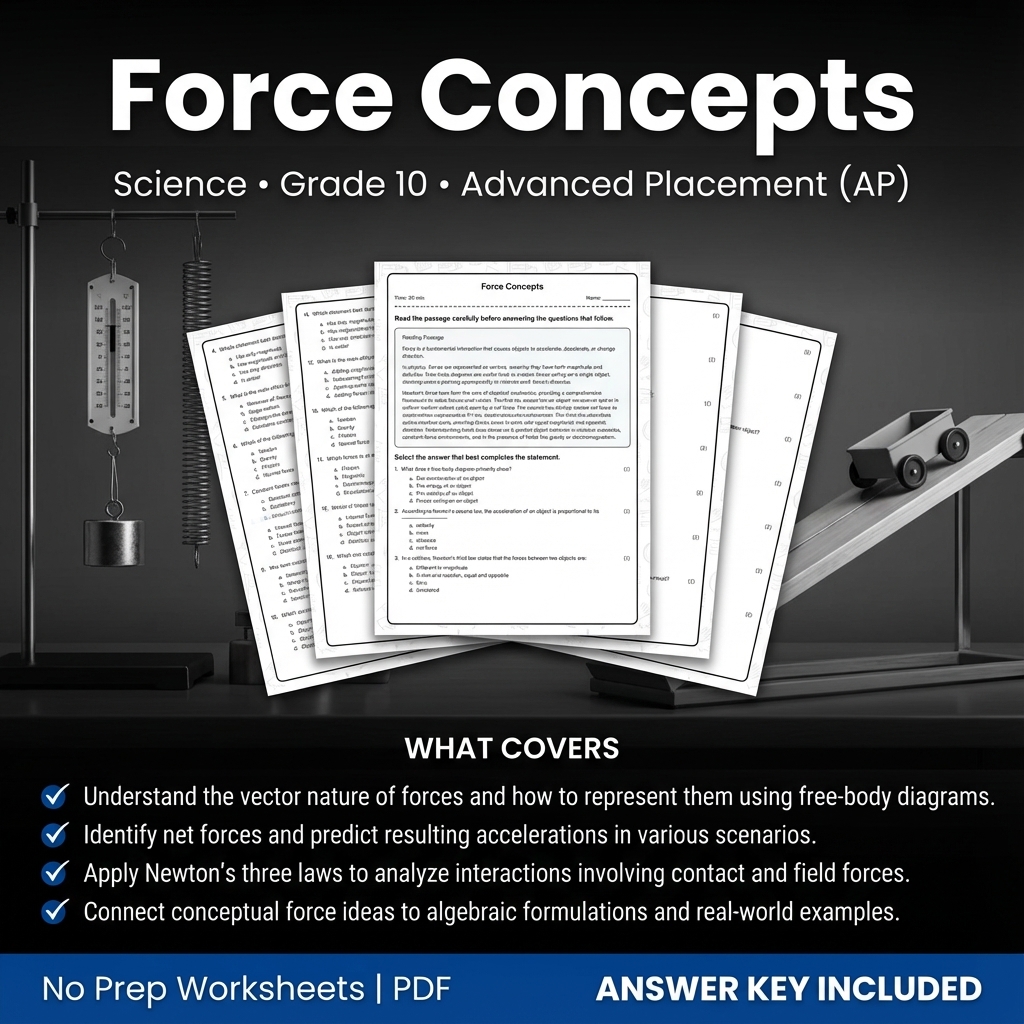
Grade 10 Science | Force Concepts Worksheet (Printable PDF + Answer Key)
Created byCoral Reef LearningLearning Objectives
- Understand the vector nature of forces and how to represent them using free-body diagrams.
- Identify net forces and predict resulting accelerations in various scenarios.
- Apply Newton’s three laws to analyze interactions involving contact and field forces.
Also included in: Grade 10 Science Unit Worksheet Bundle – Motion, Energy & Forces (PDF Answers) +1 more
Instant download
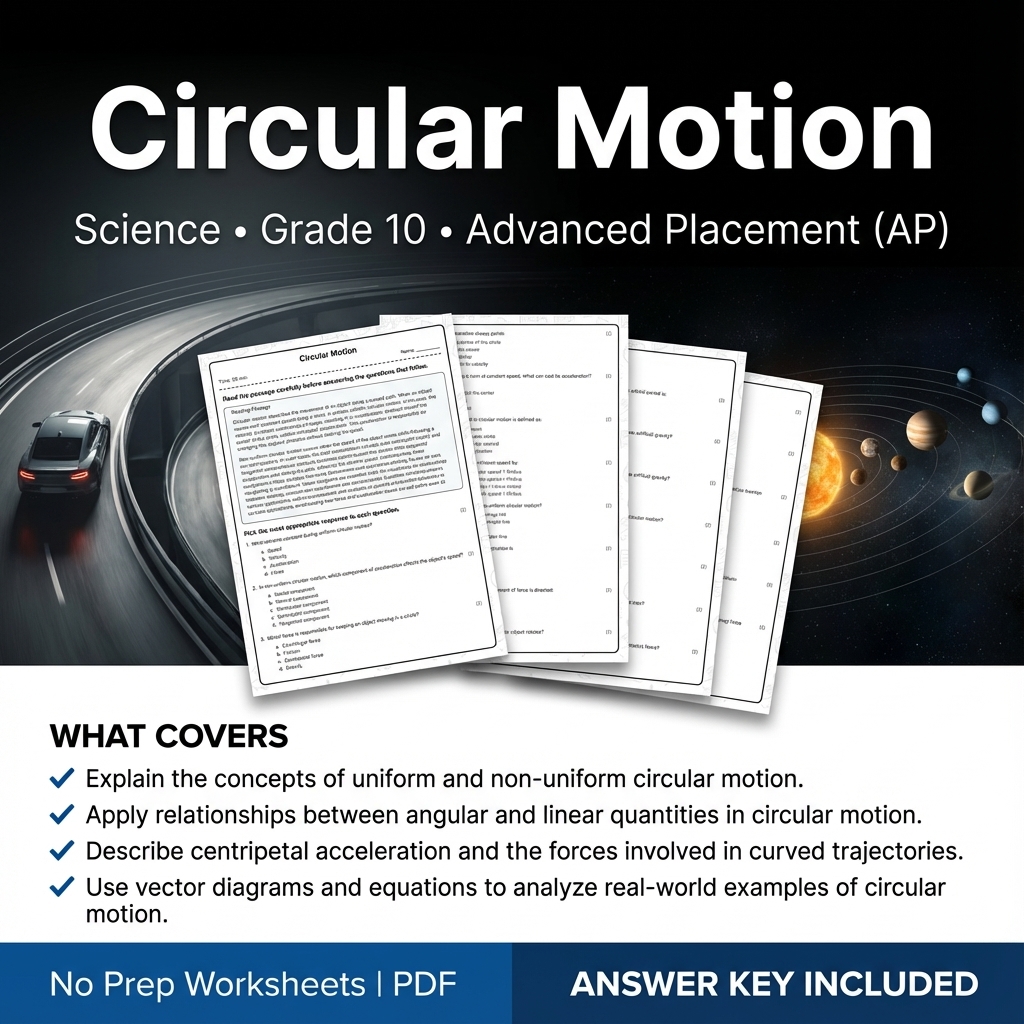
10th Grade Science | Circular Motion Worksheet (Printable PDF + Answer Key)
Created byCoral Reef LearningLearning Objectives
- Explain the concepts of uniform and non-uniform circular motion.
- Apply relationships between angular and linear quantities in circular motion.
- Describe centripetal acceleration and the forces involved in curved trajectories.
Also included in: Grade 10 Science Unit Worksheet Bundle – Motion, Energy & Forces (PDF Answers) +1 more
Instant download
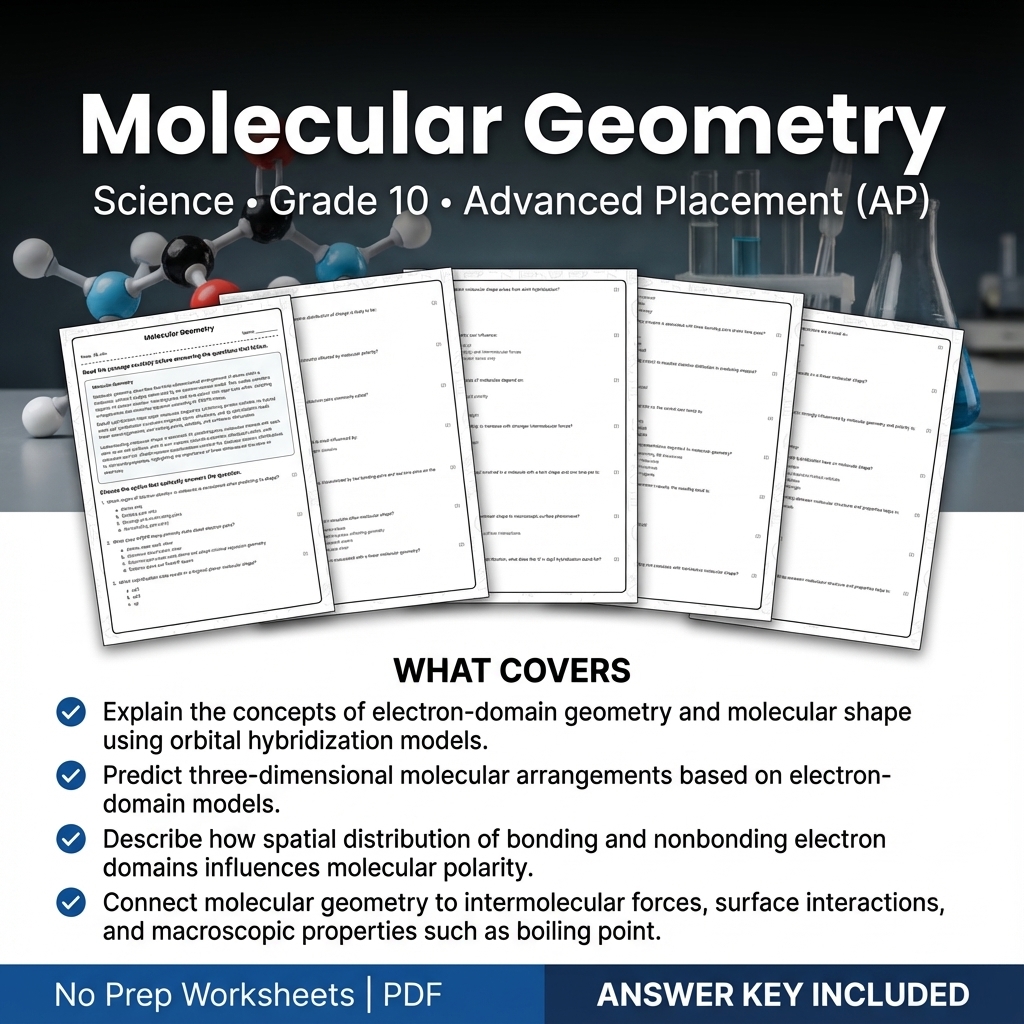
10th Grade Science | Molecular Geometry Worksheet (Printable PDF + Answer Key)
Created byCoral Reef LearningLearning Objectives
- Explain the concepts of electron-domain geometry and molecular shape using orbital hybridization models.
- Predict three-dimensional molecular arrangements based on electron-domain models.
- Describe how spatial distribution of bonding and nonbonding electron domains influences molecular polarity.
Also included in: Grade 10 Science Unit Bundle | Thermochemistry, Stoichiometry & Atomic Structure +1 more
Instant download
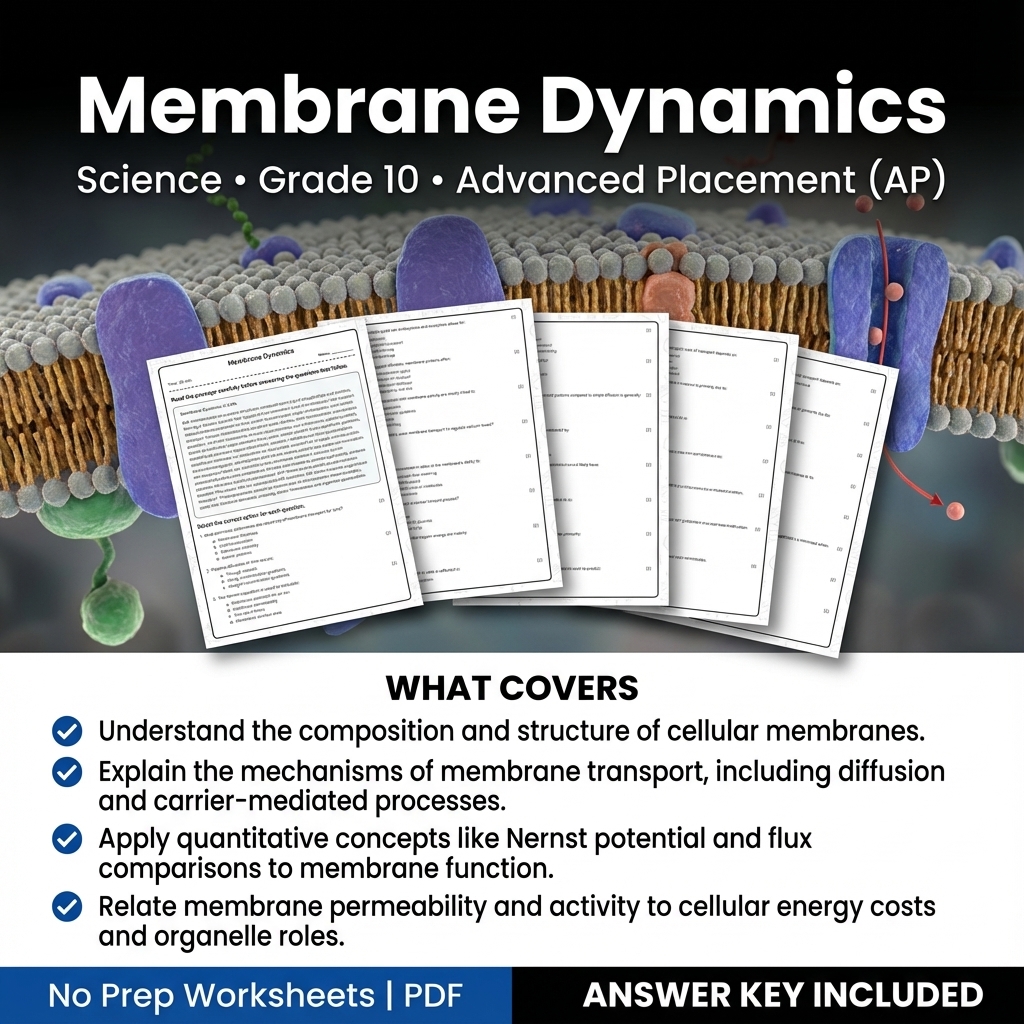
Grade 10 Science | Membrane Dynamics Worksheet (Printable PDF + Answer Key)
Created byCoral Reef LearningLearning Objectives
- Understand the composition and structure of cellular membranes.
- Explain the mechanisms of membrane transport, including diffusion and carrier-mediated processes.
- Apply quantitative concepts like Nernst potential and flux comparisons to membrane function.
Also included in: Grade 10 Science UNIT Worksheet Bundle – Genetics, Ecosystems & Cell Biology +1 more
Instant download
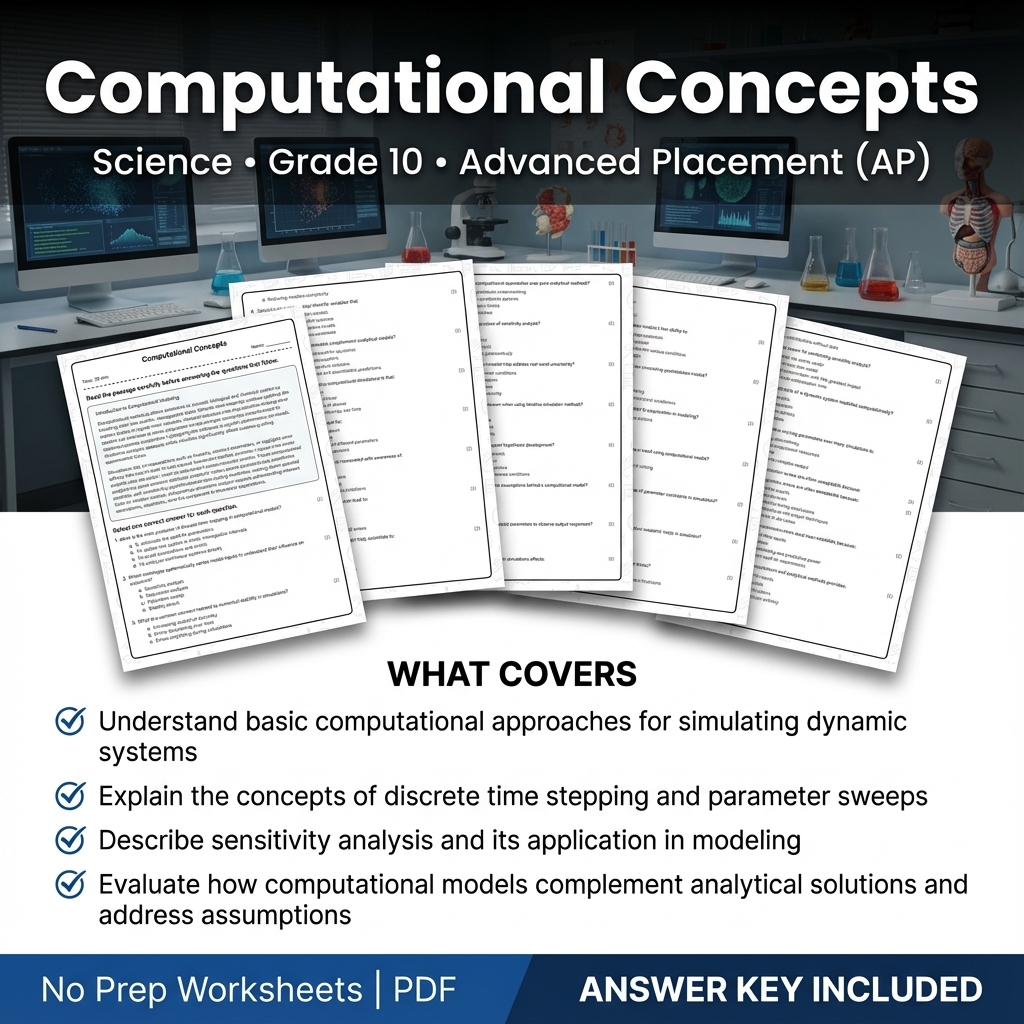
10th Grade Science | Computational Concepts Worksheet (Printable PDF + Answer Key)
Created byCoral Reef LearningLearning Objectives
- Understand basic computational approaches for simulating dynamic systems
- Explain the concepts of discrete time stepping and parameter sweeps
- Describe sensitivity analysis and its application in modeling
Also included in: Grade 10 Science Unit Worksheet Bundle | Data Analysis & Scientific Modeling +1 more
Instant download
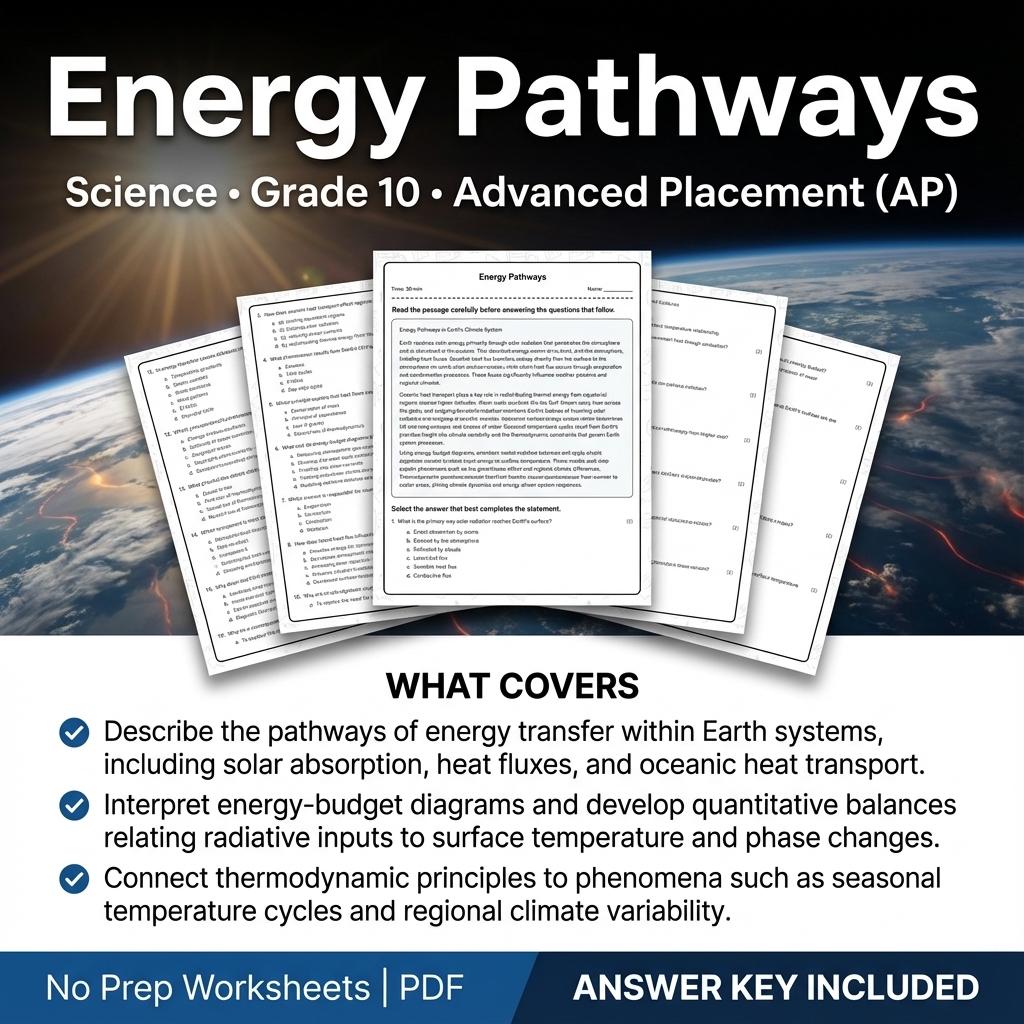
Grade 10 Science | Energy Pathways Worksheet (Printable PDF + Answer Key)
Created byCoral Reef LearningLearning Objectives
- Describe the pathways of energy transfer within Earth systems, including solar absorption, heat fluxes, and oceanic heat transport.
- Interpret energy-budget diagrams and develop quantitative balances relating radiative inputs to surface temperature and phase changes.
- Connect thermodynamic principles to phenomena such as seasonal temperature cycles and regional climate variability.
Also included in: Grade 10 Science Unit Worksheet Bundle – Geology, Climate, Plate Tectonics +1 more
Instant download
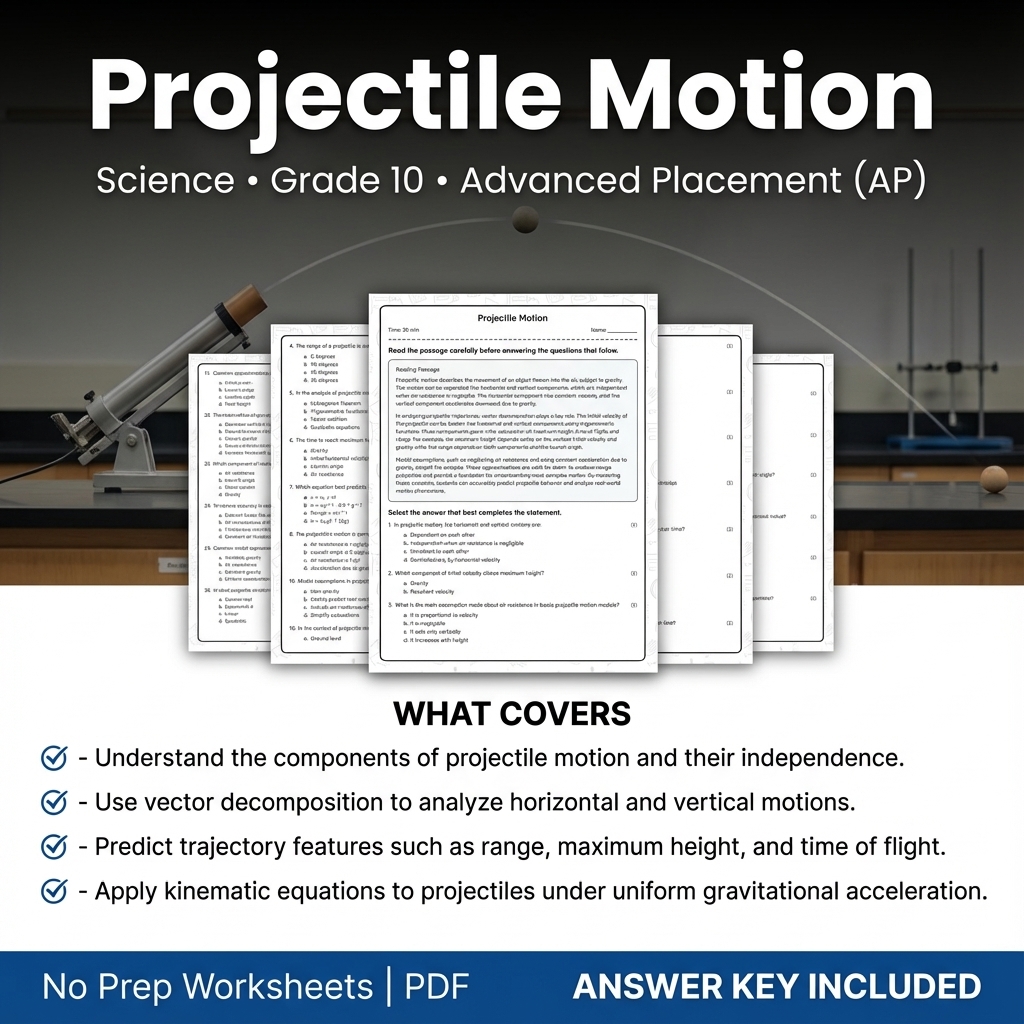
Grade 10 Science | Projectile Motion Worksheet (Printable PDF + Answer Key)
Created byCoral Reef LearningLearning Objectives
- Understand the components of projectile motion and their independence.
- Use vector decomposition to analyze horizontal and vertical motions.
- Predict trajectory features such as range, maximum height, and time of flight.
Also included in: Grade 10 Science Unit Worksheet Bundle – Motion, Energy & Forces (PDF Answers) +1 more
Instant download
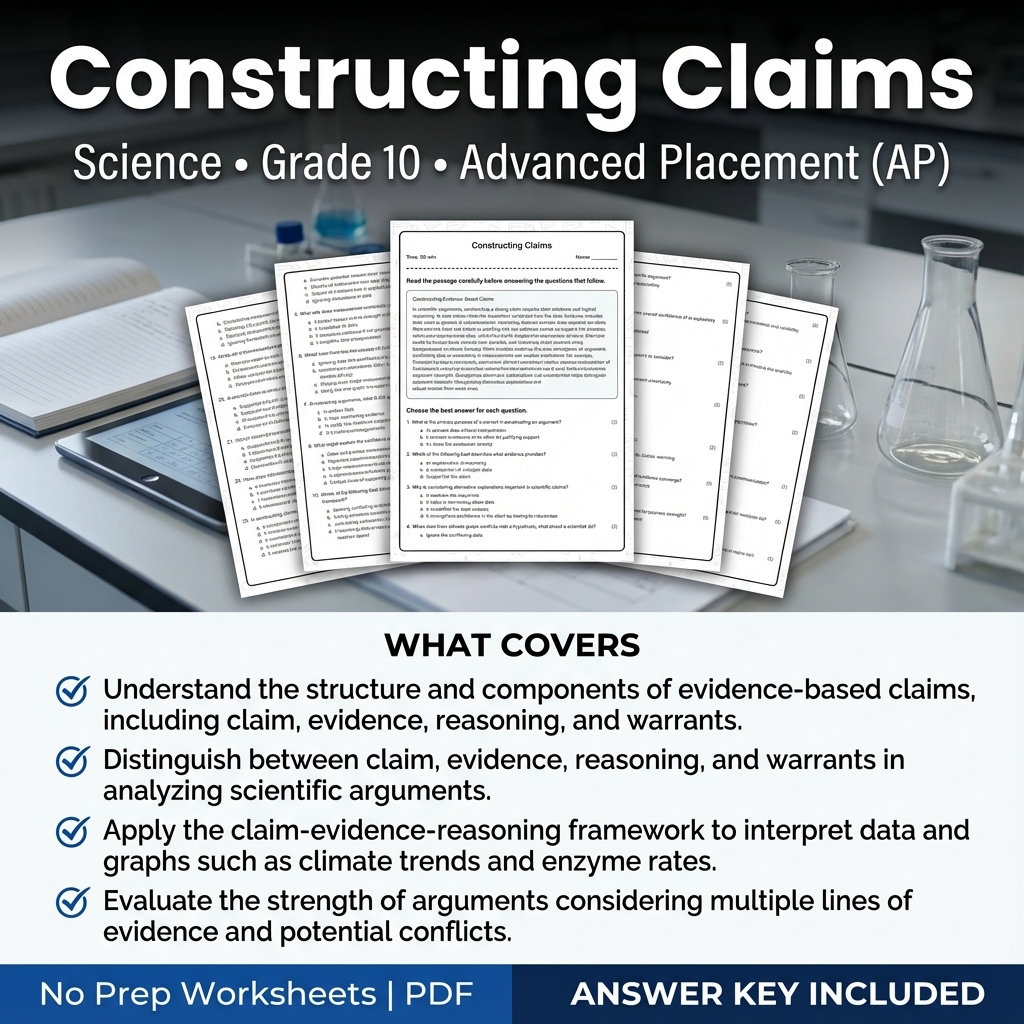
Grade 10 Science | Constructing Claims Worksheet (Printable PDF + Answer Key)
Created byCoral Reef LearningLearning Objectives
- Understand the structure and components of evidence-based claims, including claim, evidence, reasoning, and warrants.
- Distinguish between claim, evidence, reasoning, and warrants in analyzing scientific arguments.
- Apply the claim-evidence-reasoning framework to interpret data and graphs such as climate trends and enzyme rates.
Also included in: Grade 10 Science Unit Worksheet Bundle | Data Analysis & Scientific Modeling +1 more
Instant download
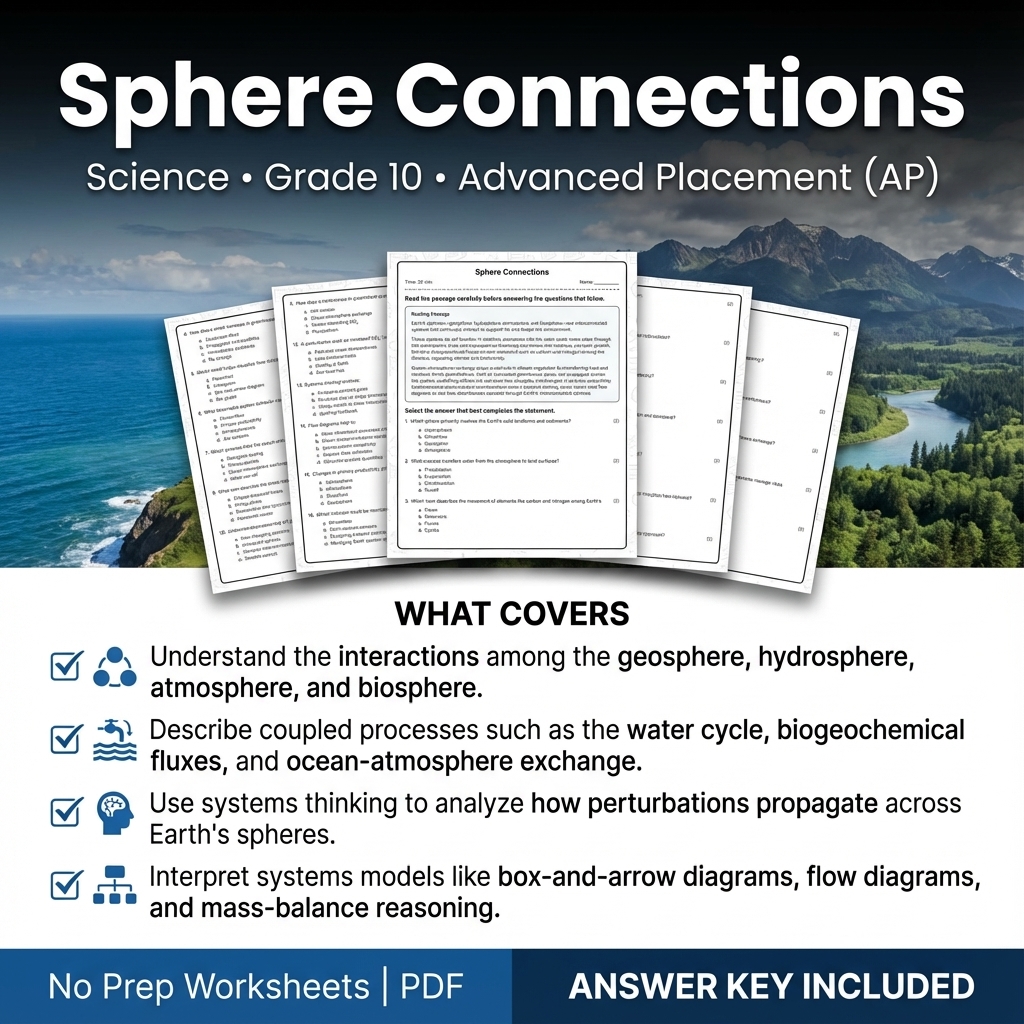
Grade 10 Science | Sphere Connections Worksheet (Printable PDF + Answer Key)
Created byCoral Reef LearningLearning Objectives
- Understand the interactions among the geosphere, hydrosphere, atmosphere, and biosphere.
- Describe coupled processes such as the water cycle, biogeochemical fluxes, and ocean-atmosphere exchange.
- Use systems thinking to analyze how perturbations propagate across Earth's spheres.
Also included in: Grade 10 Science Unit Worksheet Bundle – Geology, Climate, Plate Tectonics +1 more
Instant download
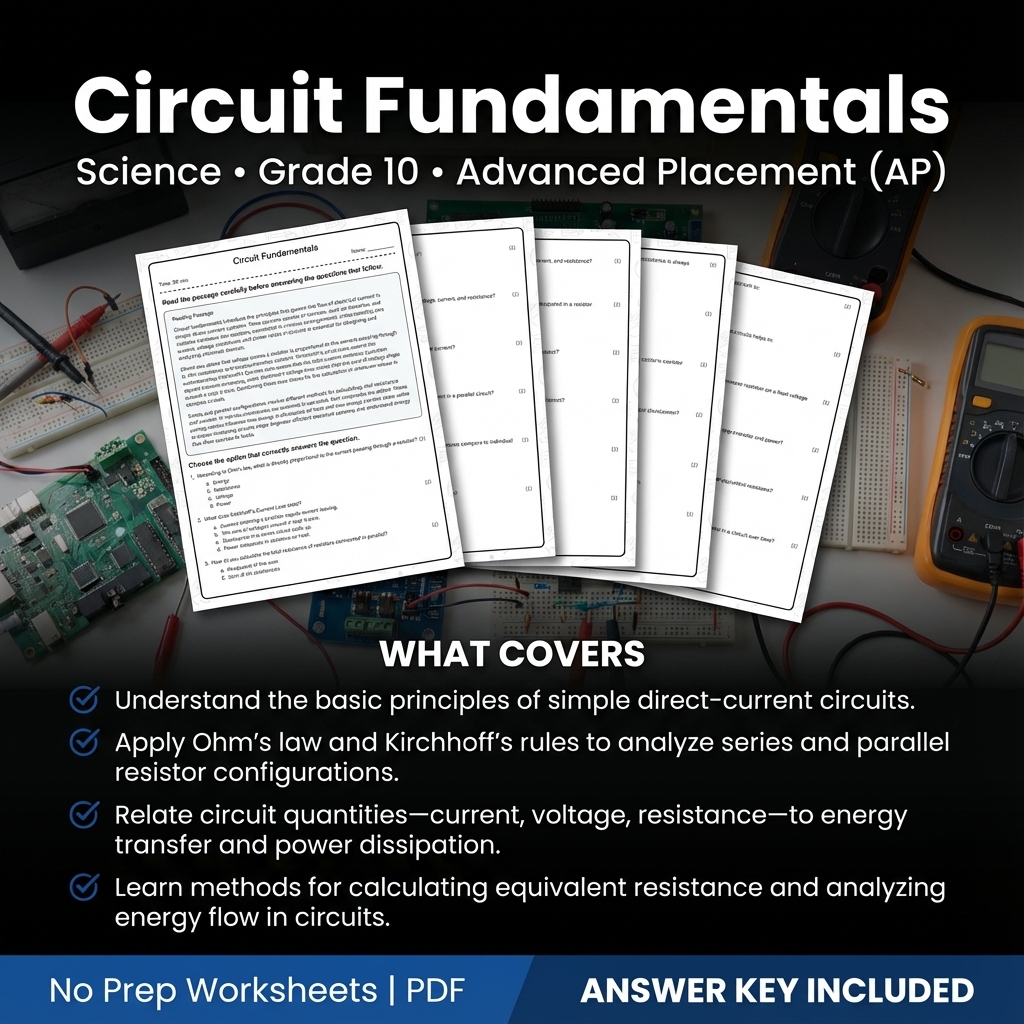
Grade 10 Science | Circuit Fundamentals Worksheet (Printable PDF + Answer Key)
Created byCoral Reef LearningLearning Objectives
- Understand the basic principles of simple direct-current circuits.
- Apply Ohm’s law and Kirchhoff's rules to analyze series and parallel resistor configurations.
- Relate circuit quantities—current, voltage, resistance—to energy transfer and power dissipation.
Also included in: Grade 10 Science Unit Worksheet Bundle – Motion, Energy & Forces (PDF Answers) +1 more
Instant download
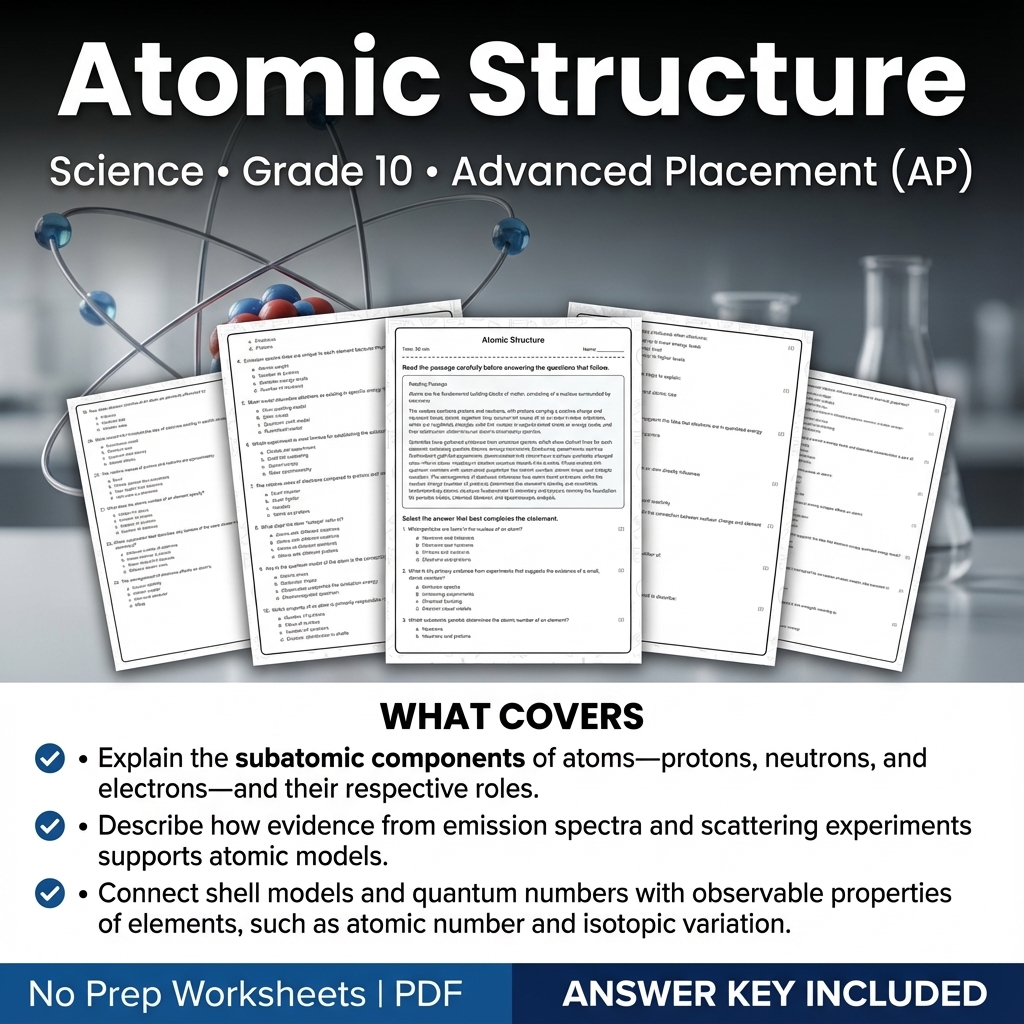
Grade 10 Science | Atomic Structure Worksheet (Printable PDF + Answer Key)
Created byCoral Reef LearningLearning Objectives
- Explain the subatomic components of atoms—protons, neutrons, and electrons—and their respective roles.
- Describe how evidence from emission spectra and scattering experiments supports atomic models.
- Connect shell models and quantum numbers with observable properties of elements, such as atomic number and isotopic variation.
Also included in: Grade 10 Science Unit Bundle | Thermochemistry, Stoichiometry & Atomic Structure +1 more
Instant download
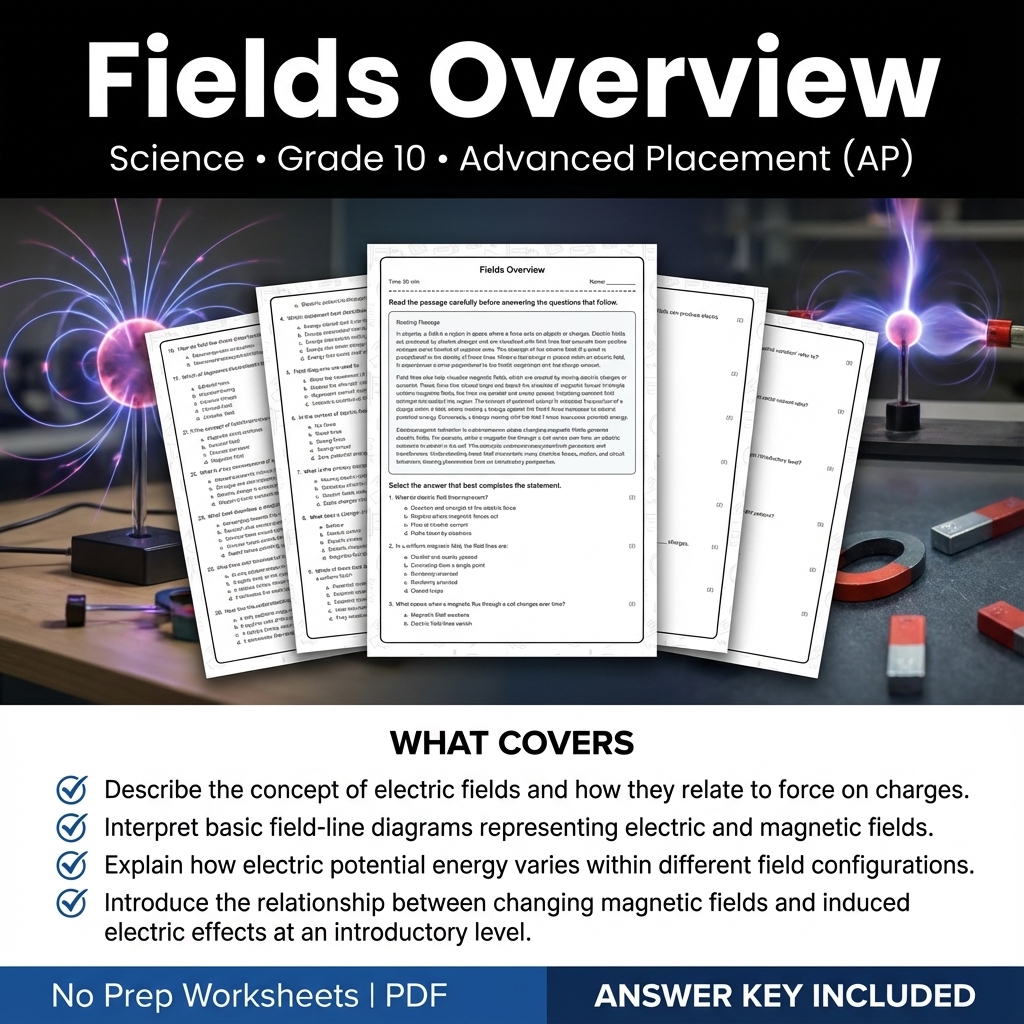
Grade 10 Science | Fields Overview Worksheet (Printable PDF + Answer Key)
Created byCoral Reef LearningLearning Objectives
- Describe the concept of electric fields and how they relate to force on charges.
- Interpret basic field-line diagrams representing electric and magnetic fields.
- Explain how electric potential energy varies within different field configurations.
Also included in: Grade 10 Science Unit Worksheet Bundle – Motion, Energy & Forces (PDF Answers) +1 more
Instant download
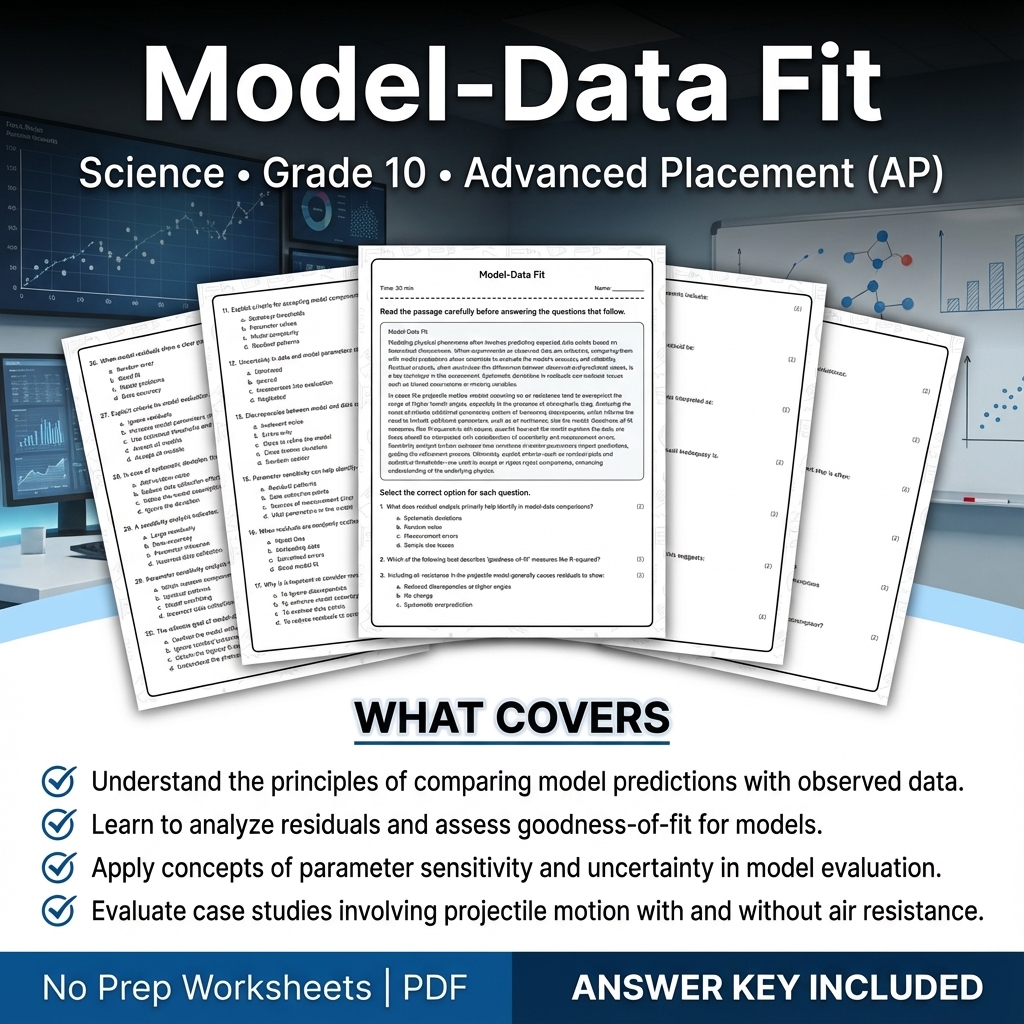
Grade 10 Science | Model-Data Fit Worksheet (Printable PDF + Answer Key)
Created byCoral Reef LearningLearning Objectives
- Understand the principles of comparing model predictions with observed data.
- Learn to analyze residuals and assess goodness-of-fit for models.
- Apply concepts of parameter sensitivity and uncertainty in model evaluation.
Also included in: Grade 10 Science Unit Worksheet Bundle | Data Analysis & Scientific Modeling +1 more
Instant download
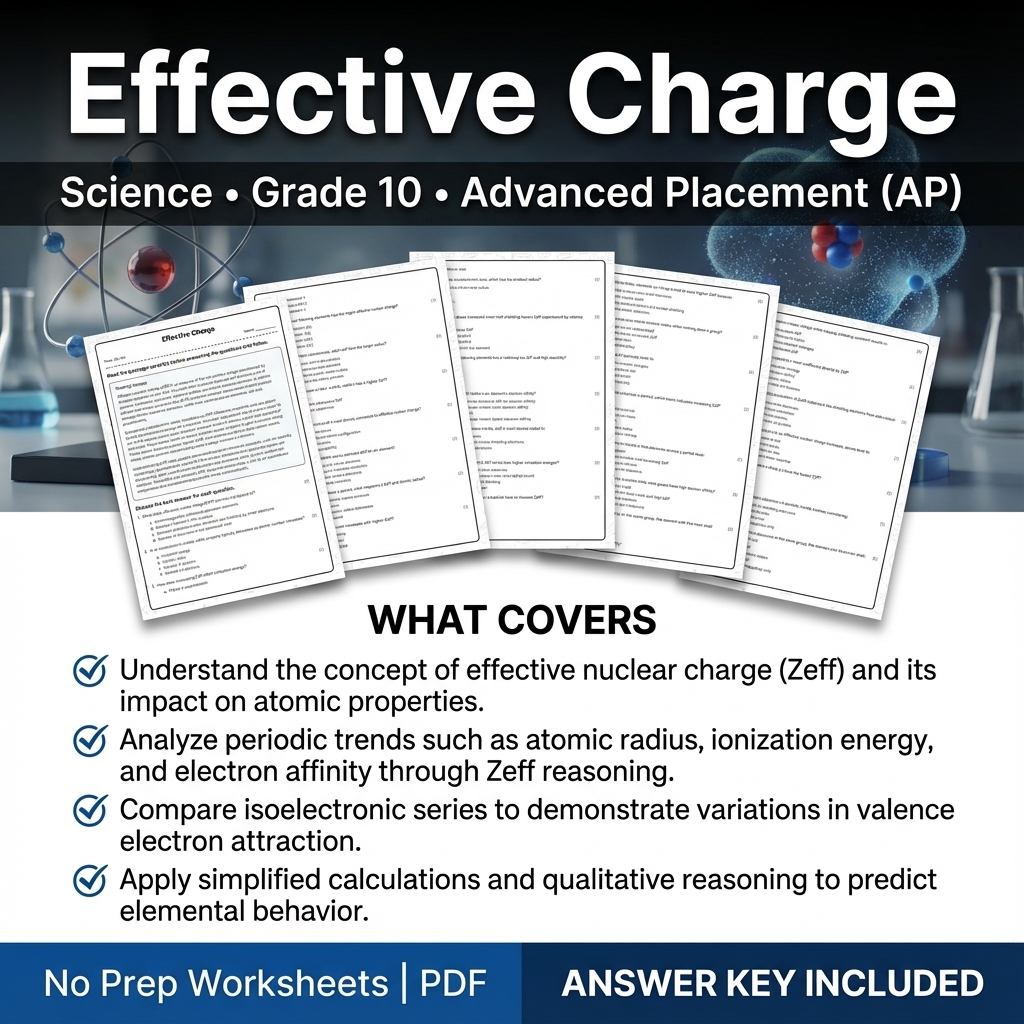
Grade 10 Science | Effective Charge Worksheet (Printable PDF + Answer Key)
Created byCoral Reef LearningLearning Objectives
- Understand the concept of effective nuclear charge (Zeff) and its impact on atomic properties.
- Analyze periodic trends such as atomic radius, ionization energy, and electron affinity through Zeff reasoning.
- Compare isoelectronic series to demonstrate variations in valence electron attraction.
Also included in: Grade 10 Science Unit Bundle | Thermochemistry, Stoichiometry & Atomic Structure +1 more
Instant download
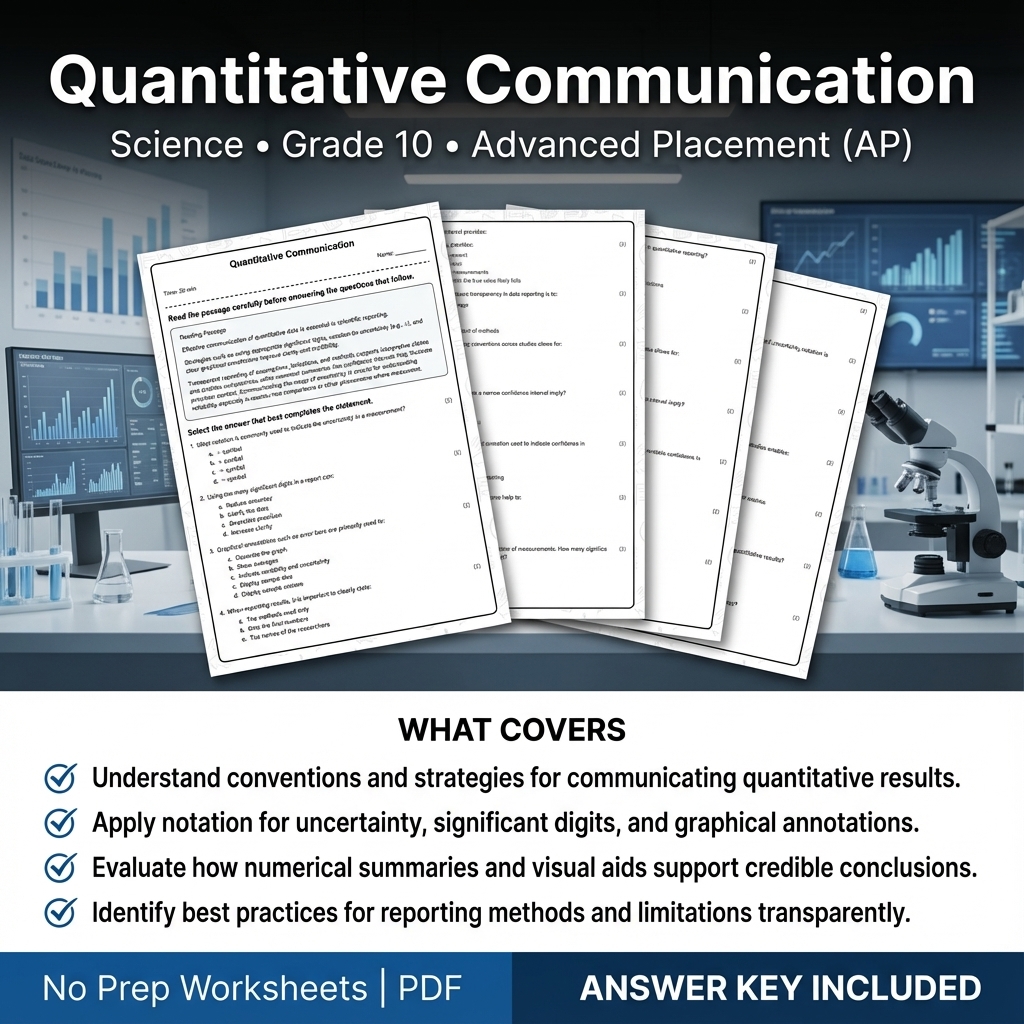
Grade 10 Science | Quantitative Communication Worksheet (Printable PDF + Answer Key)
Created byCoral Reef LearningLearning Objectives
- Understand conventions and strategies for communicating quantitative results.
- Apply notation for uncertainty, significant digits, and graphical annotations.
- Evaluate how numerical summaries and visual aids support credible conclusions.
Also included in: Grade 10 Science Unit Worksheet Bundle | Data Analysis & Scientific Modeling +1 more
Instant download
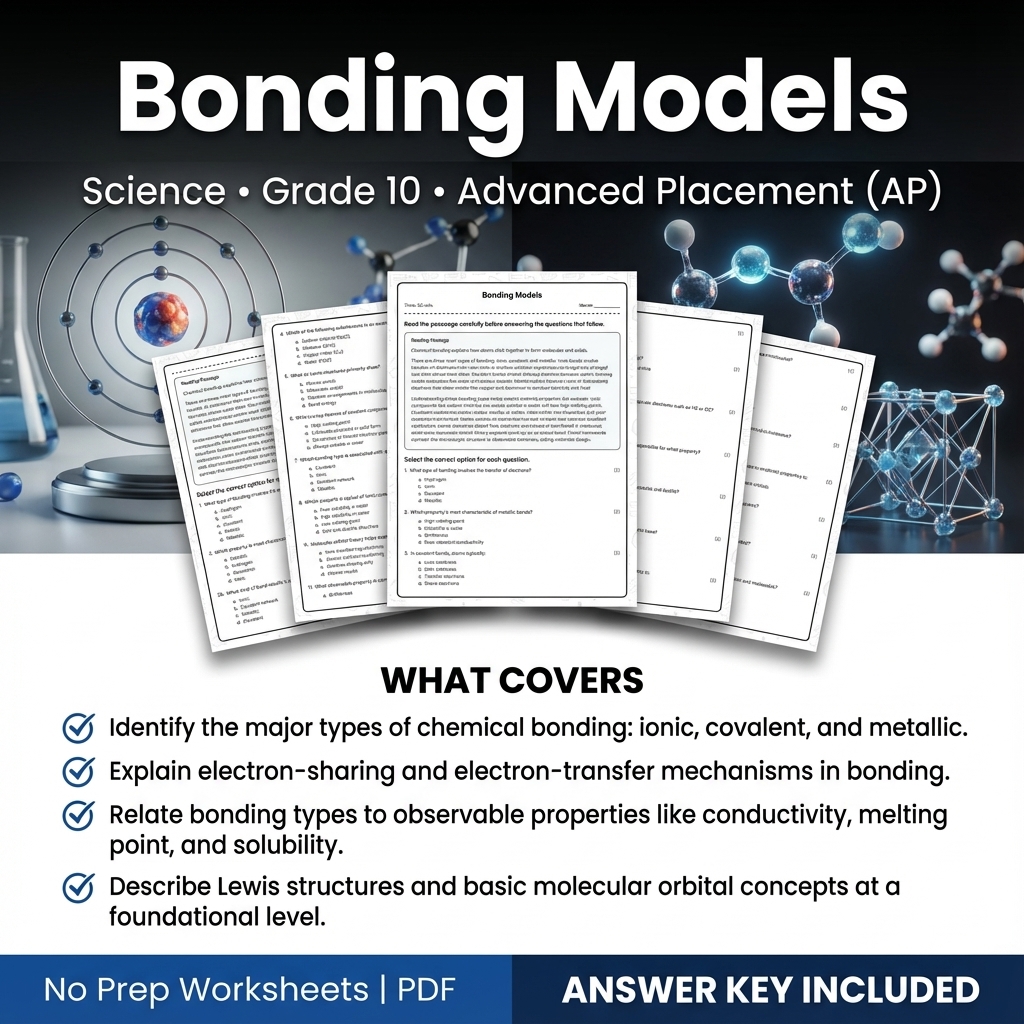
Grade 10 Science | Bonding Models Worksheet (Printable PDF + Answer Key)
Created byCoral Reef LearningLearning Objectives
- Identify the major types of chemical bonding: ionic, covalent, and metallic.
- Explain electron-sharing and electron-transfer mechanisms in bonding.
- Relate bonding types to observable properties like conductivity, melting point, and solubility.
Also included in: Grade 10 Science Unit Bundle | Thermochemistry, Stoichiometry & Atomic Structure +1 more
Instant download
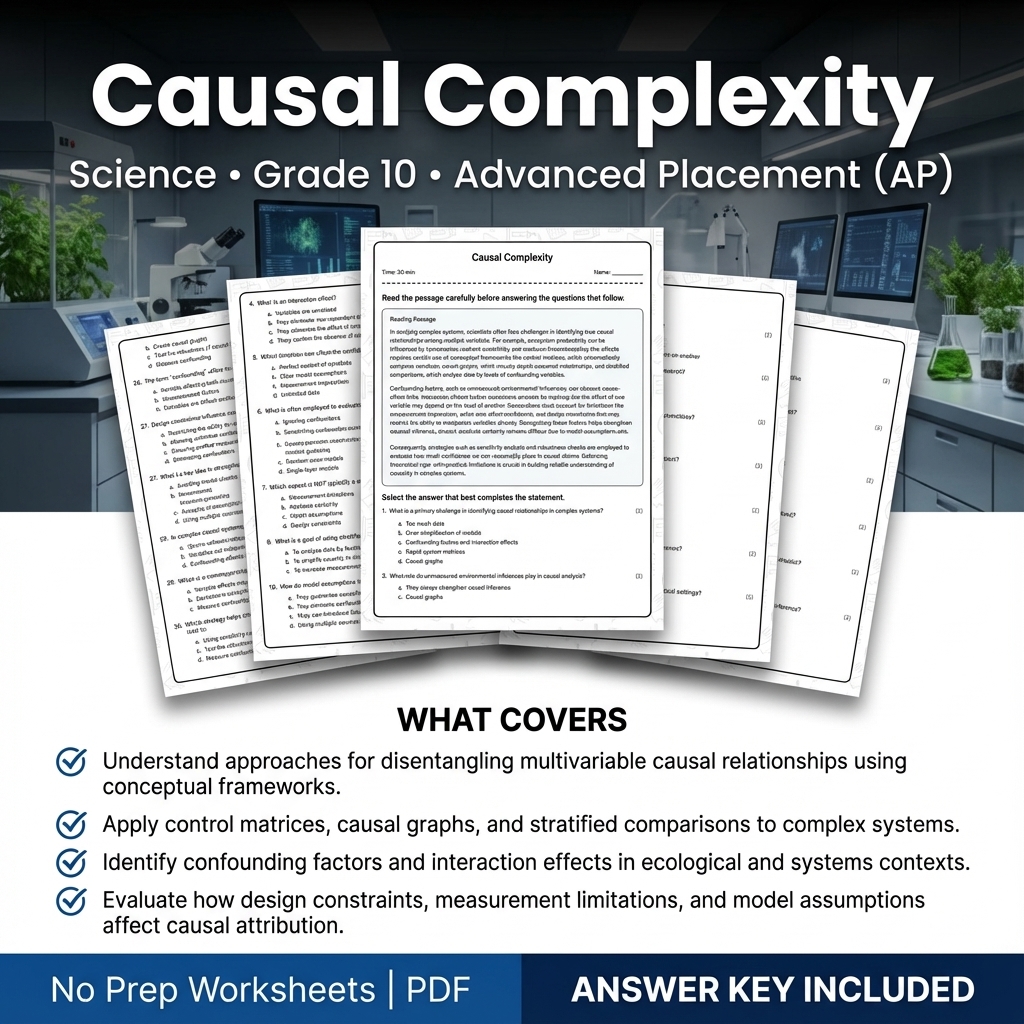
Grade 10 Science | Causal Complexity Worksheet (Printable PDF + Answer Key)
Created byCoral Reef LearningLearning Objectives
- Understand approaches for disentangling multivariable causal relationships using conceptual frameworks.
- Apply control matrices, causal graphs, and stratified comparisons to complex systems.
- Identify confounding factors and interaction effects in ecological and systems contexts.
Also included in: Grade 10 Science Unit Worksheet Bundle | Data Analysis & Scientific Modeling +1 more
Instant download
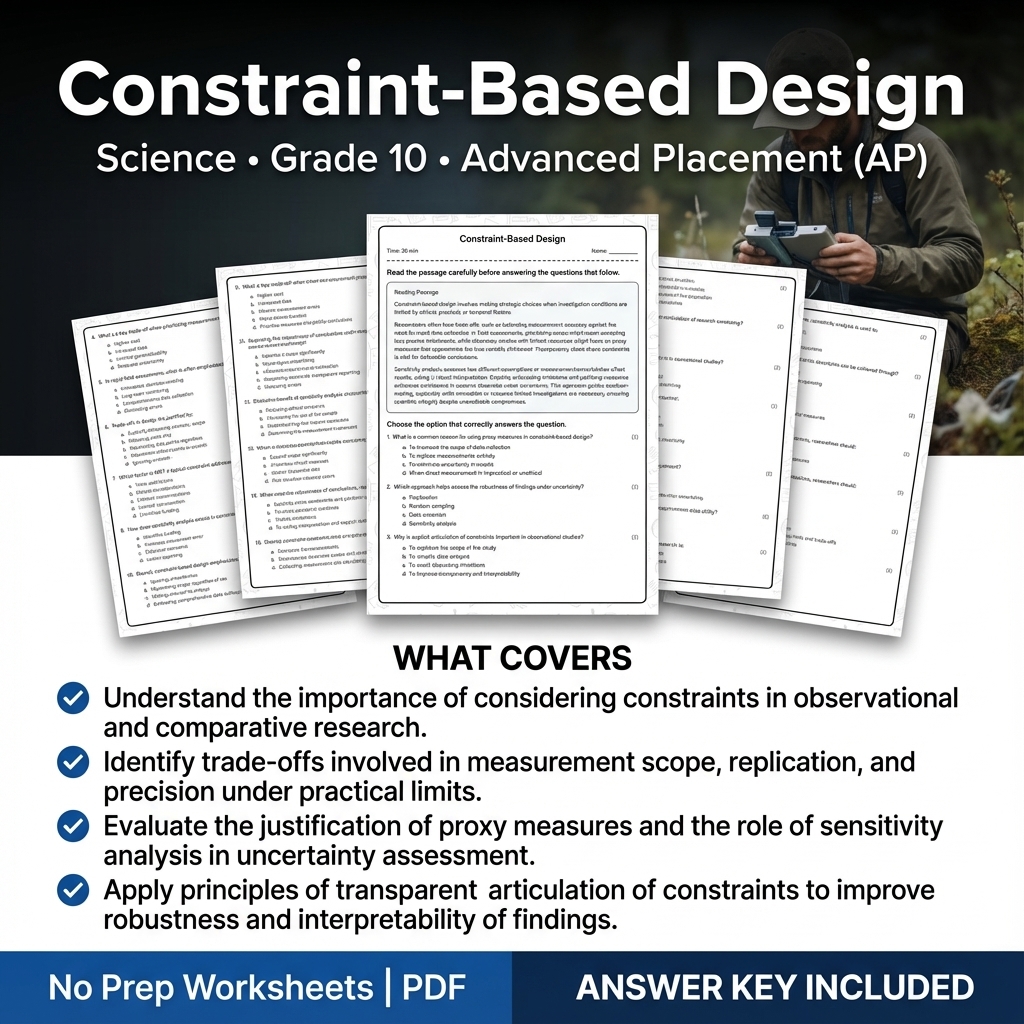
Grade 10 Science | Constraint-Based Design Worksheet (Printable PDF + Answer Key)
Created byCoral Reef LearningLearning Objectives
- Understand the importance of considering constraints in observational and comparative research.
- Identify trade-offs involved in measurement scope, replication, and precision under practical limits.
- Evaluate the justification of proxy measures and the role of sensitivity analysis in uncertainty assessment.
Also included in: Grade 10 Science Unit Worksheet Bundle | Data Analysis & Scientific Modeling +1 more
Instant download
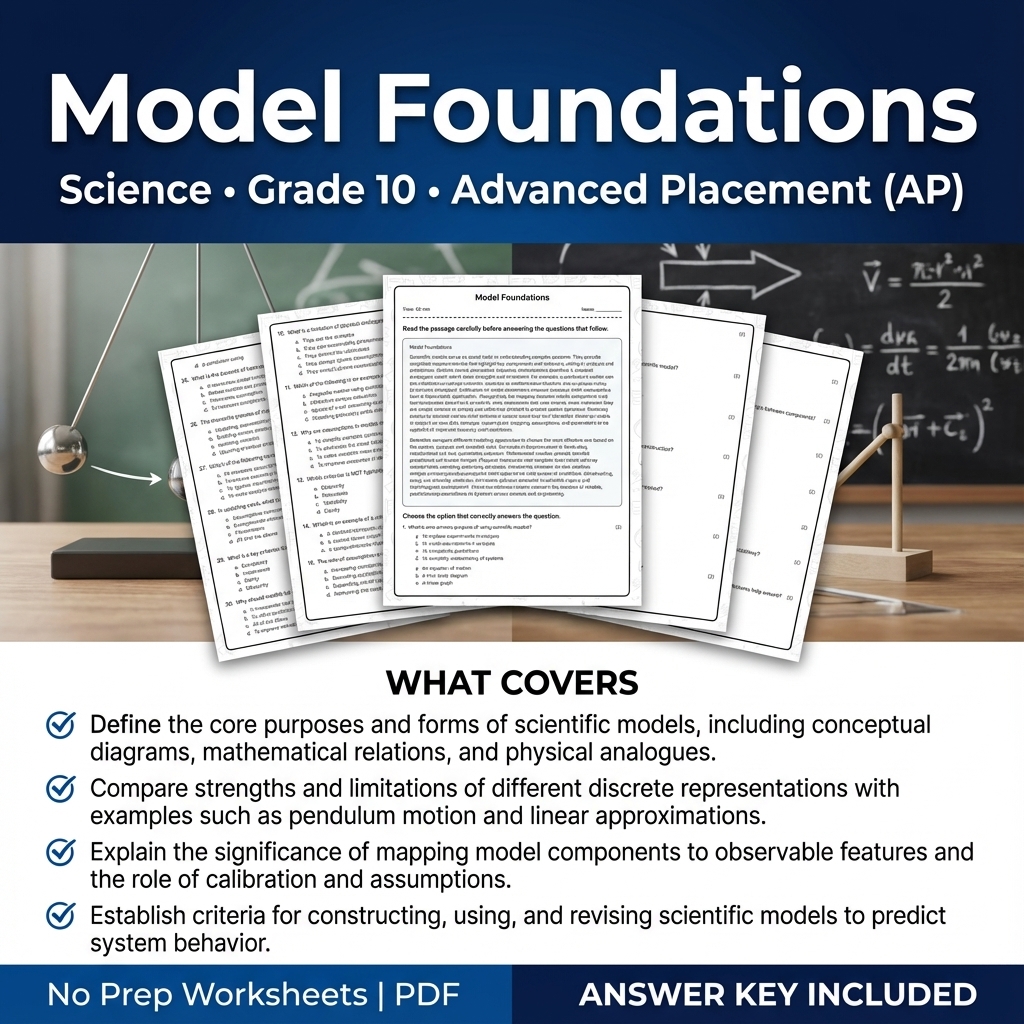
Grade 10 Science | Scientific Models Worksheet (Printable PDF + Answer Key)
Created byCoral Reef LearningLearning Objectives
- Define the core purposes and forms of scientific models, including conceptual diagrams, mathematical relations, and physical analogues.
- Compare strengths and limitations of different discrete representations with examples such as pendulum motion and linear approximations.
- Explain the significance of mapping model components to observable features and the role of calibration and assumptions.
Also included in: Grade 10 Science Unit Worksheet Bundle | Data Analysis & Scientific Modeling +1 more
Instant download
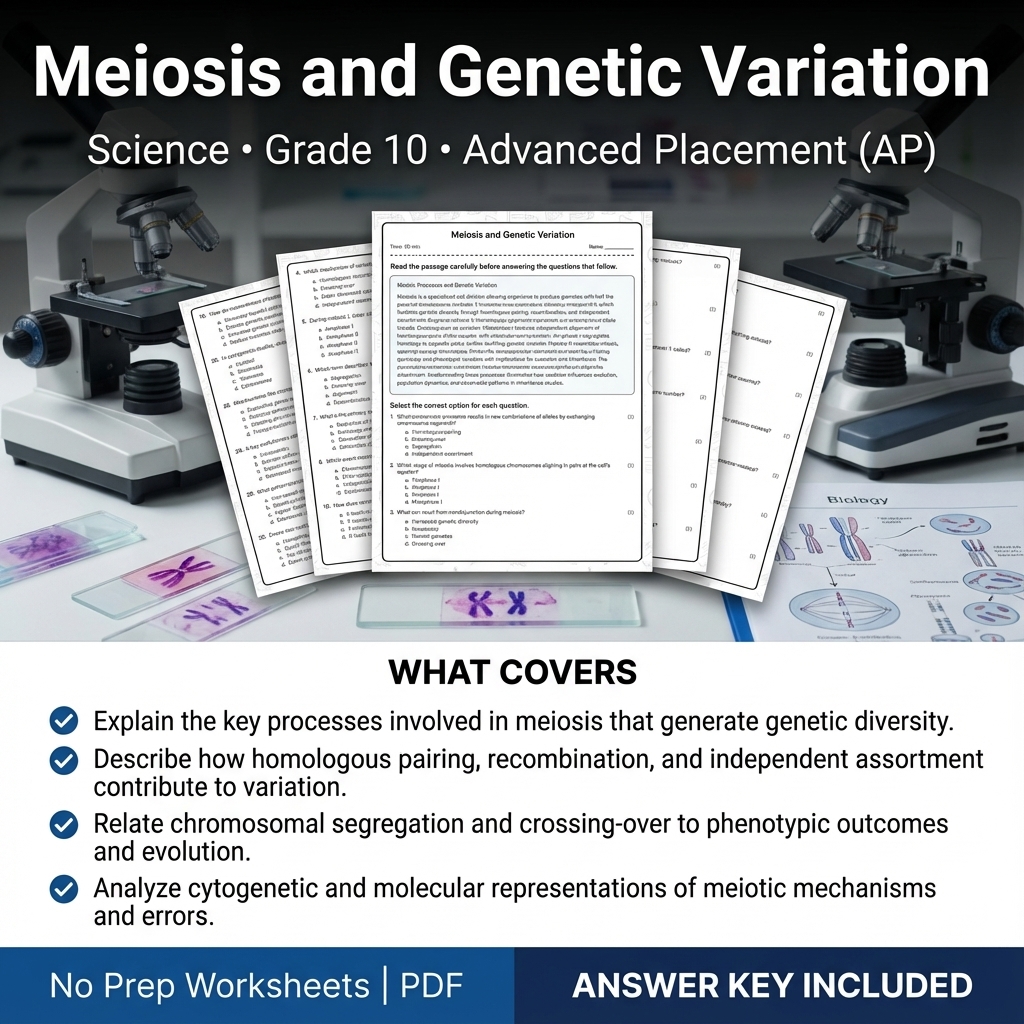
Grade 10 Science | Meiosis and Genetic Variation Worksheet (Printable PDF + Answer Key)
Created byCoral Reef LearningLearning Objectives
- Explain the key processes involved in meiosis that generate genetic diversity.
- Describe how homologous pairing, recombination, and independent assortment contribute to variation.
- Relate chromosomal segregation and crossing-over to phenotypic outcomes and evolution.
Also included in: Grade 10 Science UNIT Worksheet Bundle – Genetics, Ecosystems & Cell Biology +1 more
Instant download
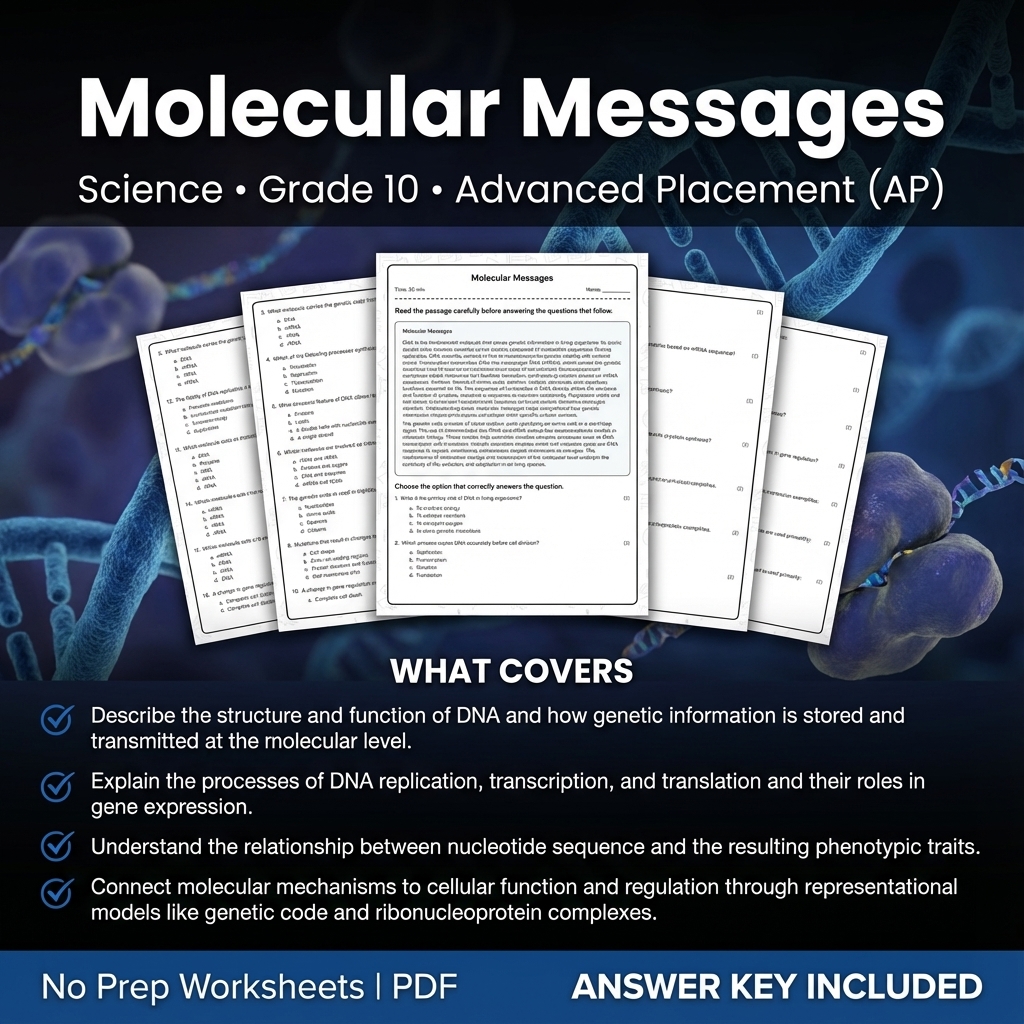
Grade 10 Science | Molecular Messages Worksheet (Printable PDF + Answer Key)
Created byCoral Reef LearningLearning Objectives
- Describe the structure and function of DNA and how genetic information is stored and transmitted at the molecular level.
- Explain the processes of DNA replication, transcription, and translation and their roles in gene expression.
- Understand the relationship between nucleotide sequence and the resulting phenotypic traits.
Also included in: Grade 10 Science UNIT Worksheet Bundle – Genetics, Ecosystems & Cell Biology +1 more
Instant download
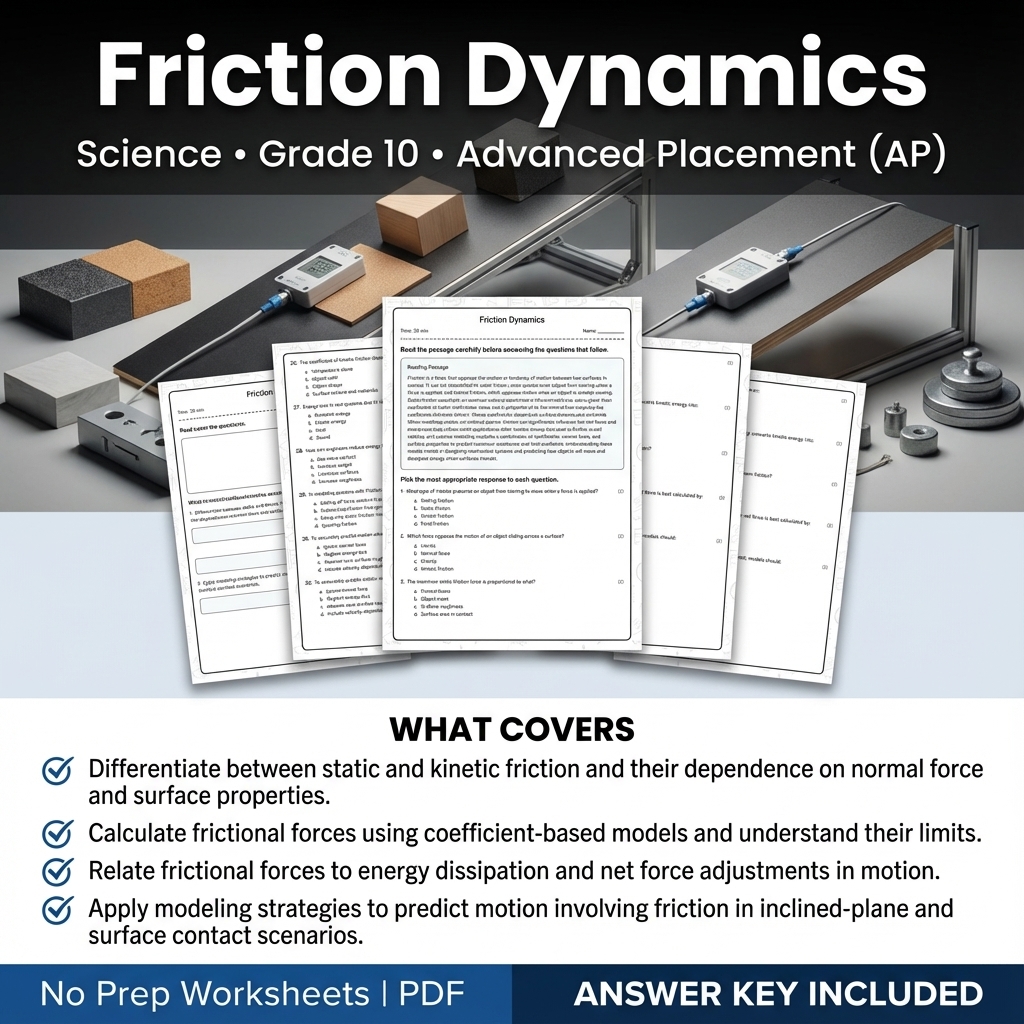
10th Grade Science | Friction Dynamics Worksheet (Printable PDF + Answer Key)
Created byCoral Reef LearningLearning Objectives
- Differentiate between static and kinetic friction and their dependence on normal force and surface properties.
- Calculate frictional forces using coefficient-based models and understand their limits.
- Relate frictional forces to energy dissipation and net force adjustments in motion.
Also included in: Grade 10 Science Unit Worksheet Bundle – Motion, Energy & Forces (PDF Answers) +1 more
Instant download
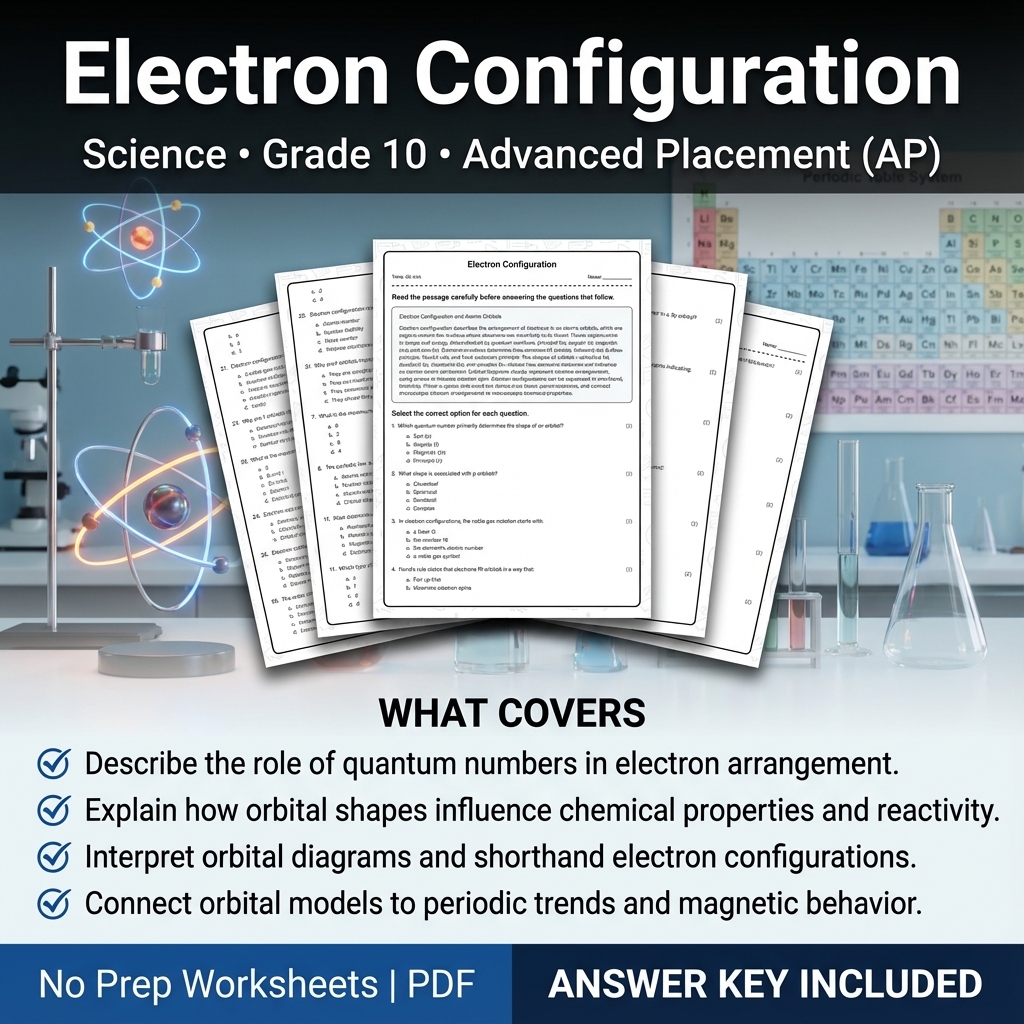
Grade 10 Science | Electron Configuration Worksheet (Printable PDF + Answer Key)
Created byCoral Reef LearningLearning Objectives
- Describe the role of quantum numbers in electron arrangement.
- Explain how orbital shapes influence chemical properties and reactivity.
- Interpret orbital diagrams and shorthand electron configurations.
Also included in: Grade 10 Science Unit Bundle | Thermochemistry, Stoichiometry & Atomic Structure +1 more
Instant download
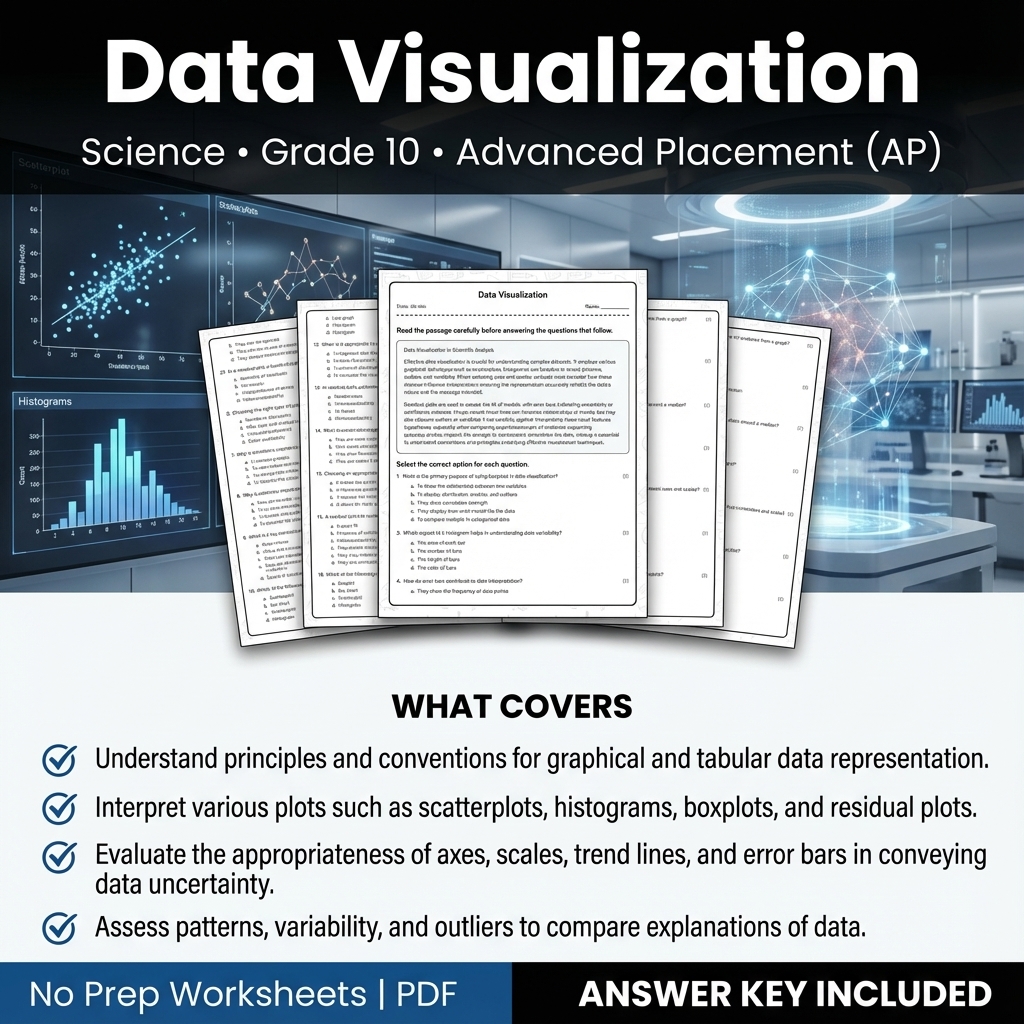
10th Grade Science | Data Visualization Worksheet (Printable PDF + Answer Key)
Created byCoral Reef LearningLearning Objectives
- Understand principles and conventions for graphical and tabular data representation.
- Interpret various plots such as scatterplots, histograms, boxplots, and residual plots.
- Evaluate the appropriateness of axes, scales, trend lines, and error bars in conveying data uncertainty.
Also included in: Grade 10 Science Unit Worksheet Bundle | Data Analysis & Scientific Modeling +1 more
Instant download
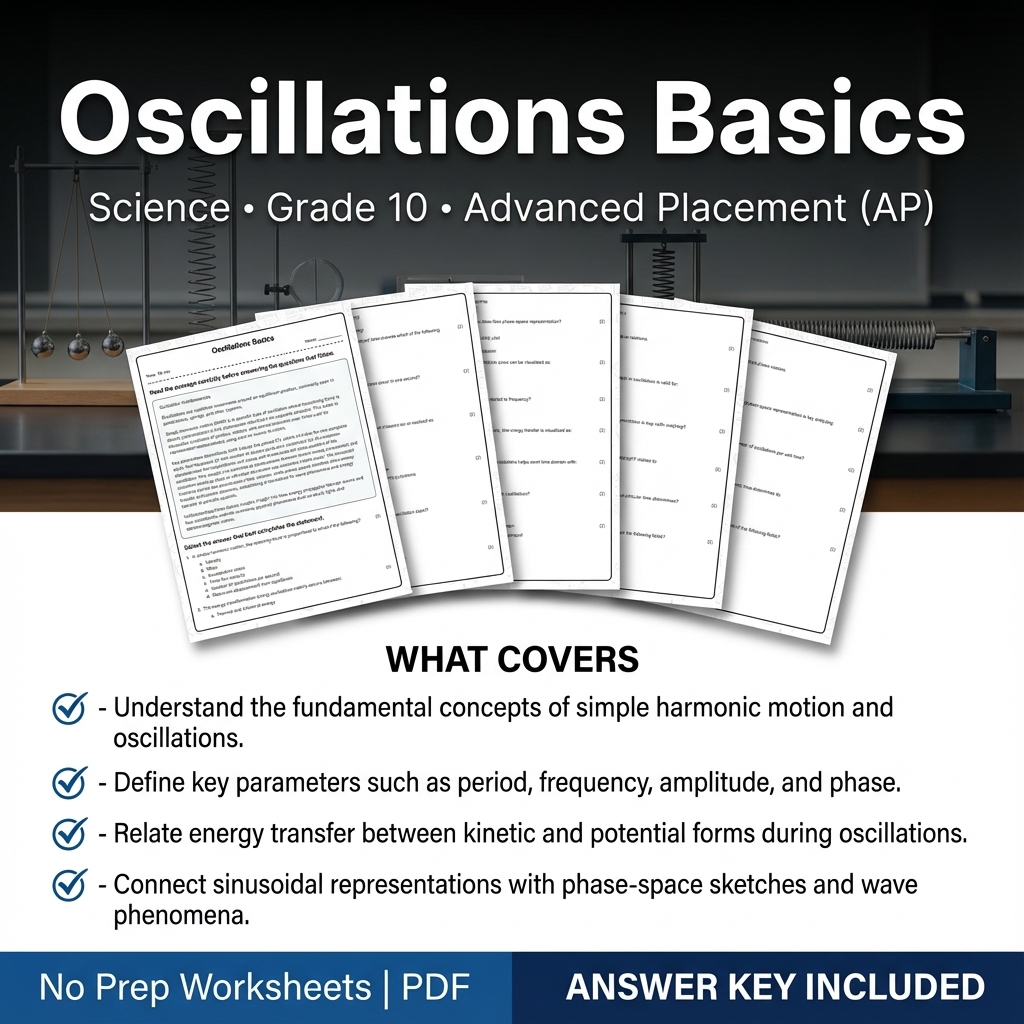
Grade 10 Science | Oscillations Worksheet (Printable PDF + Answer Key)
Created byCoral Reef LearningLearning Objectives
- Understand the fundamental concepts of simple harmonic motion and oscillations.
- Define key parameters such as period, frequency, amplitude, and phase.
- Relate energy transfer between kinetic and potential forms during oscillations.
Also included in: Grade 10 Science Unit Worksheet Bundle – Motion, Energy & Forces (PDF Answers) +1 more
Instant download
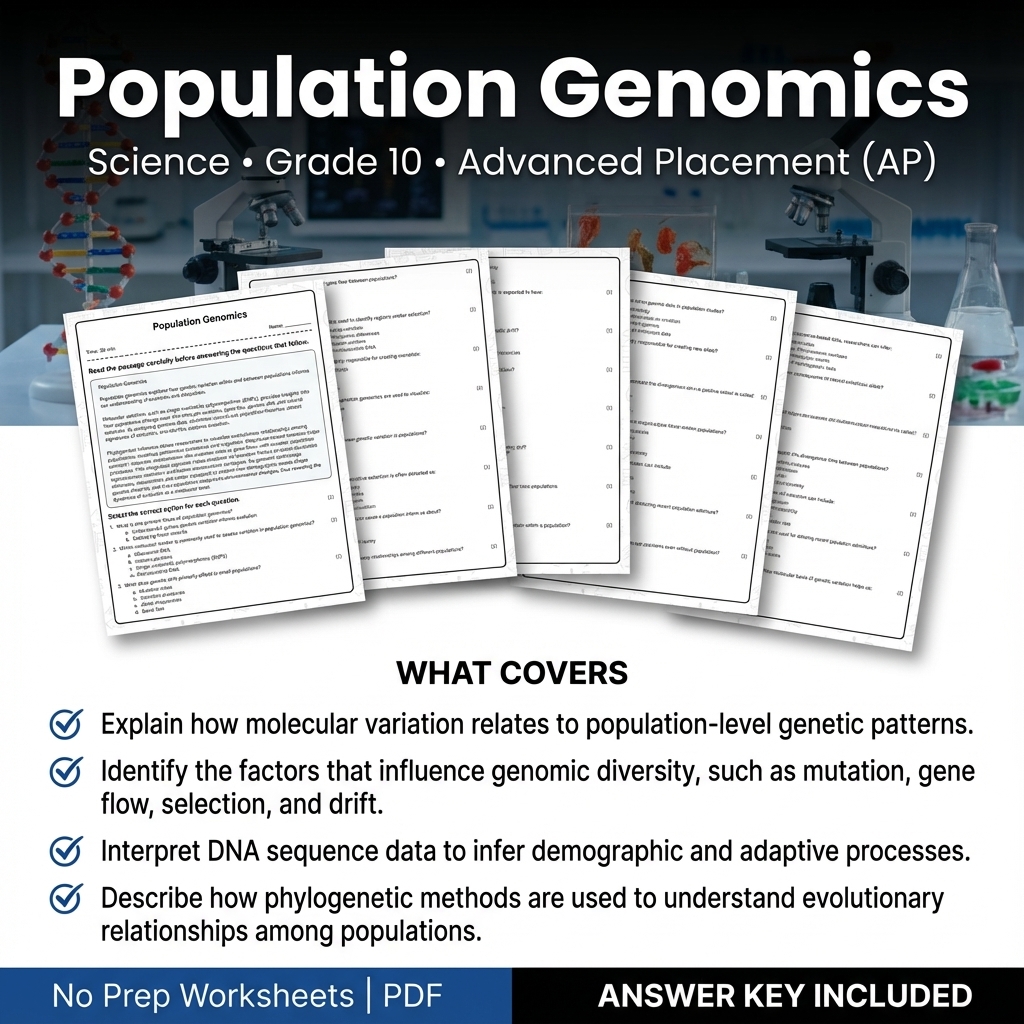
10th Grade Science | Population Genomics Worksheet (Printable PDF + Answer Key)
Created byCoral Reef LearningLearning Objectives
- Explain how molecular variation relates to population-level genetic patterns.
- Identify the factors that influence genomic diversity, such as mutation, gene flow, selection, and drift.
- Interpret DNA sequence data to infer demographic and adaptive processes.
Also included in: Grade 10 Science UNIT Worksheet Bundle – Genetics, Ecosystems & Cell Biology +1 more
Instant download
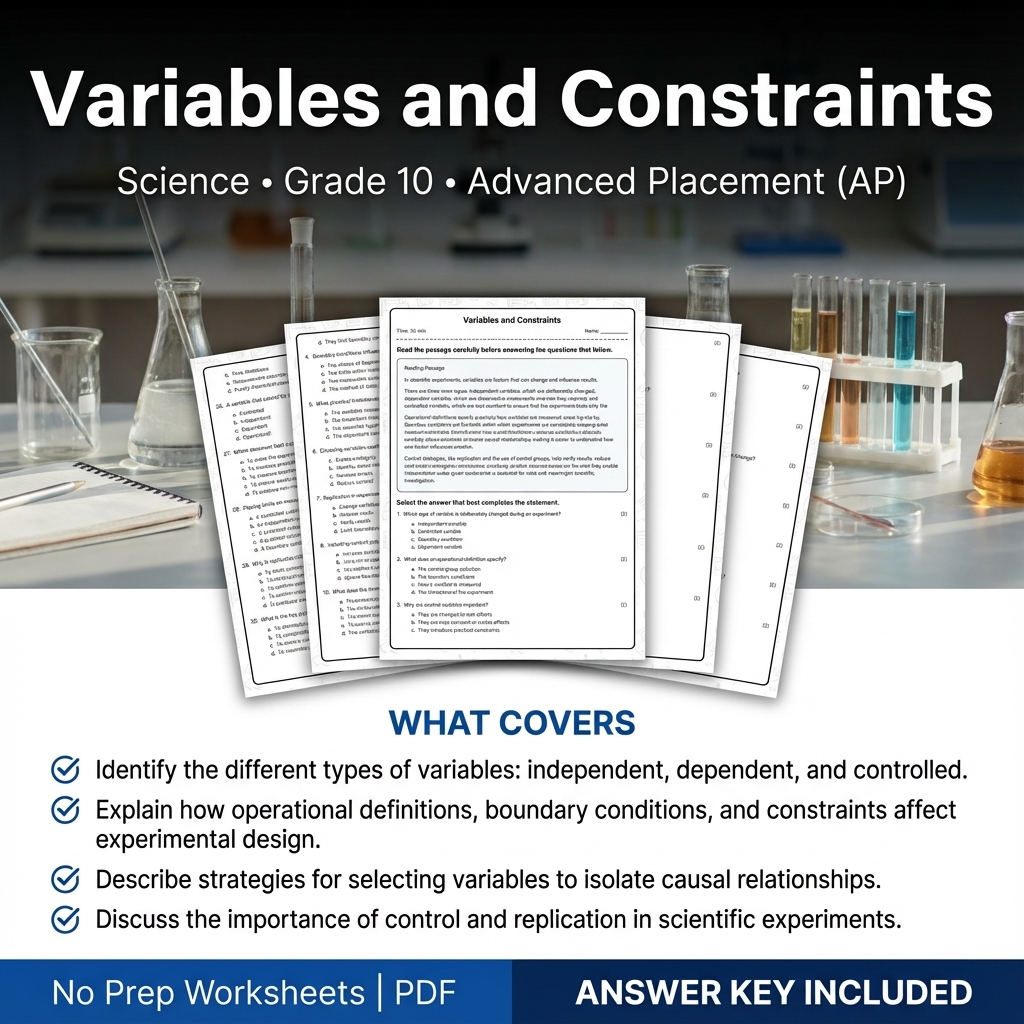
Grade 10 Science | Variables and Constraints Worksheet (Printable PDF + Answer Key)
Created byCoral Reef LearningLearning Objectives
- Identify the different types of variables: independent, dependent, and controlled.
- Explain how operational definitions, boundary conditions, and constraints affect experimental design.
- Describe strategies for selecting variables to isolate causal relationships.
Also included in: Grade 10 Science Unit Worksheet Bundle | Data Analysis & Scientific Modeling +1 more
Instant download
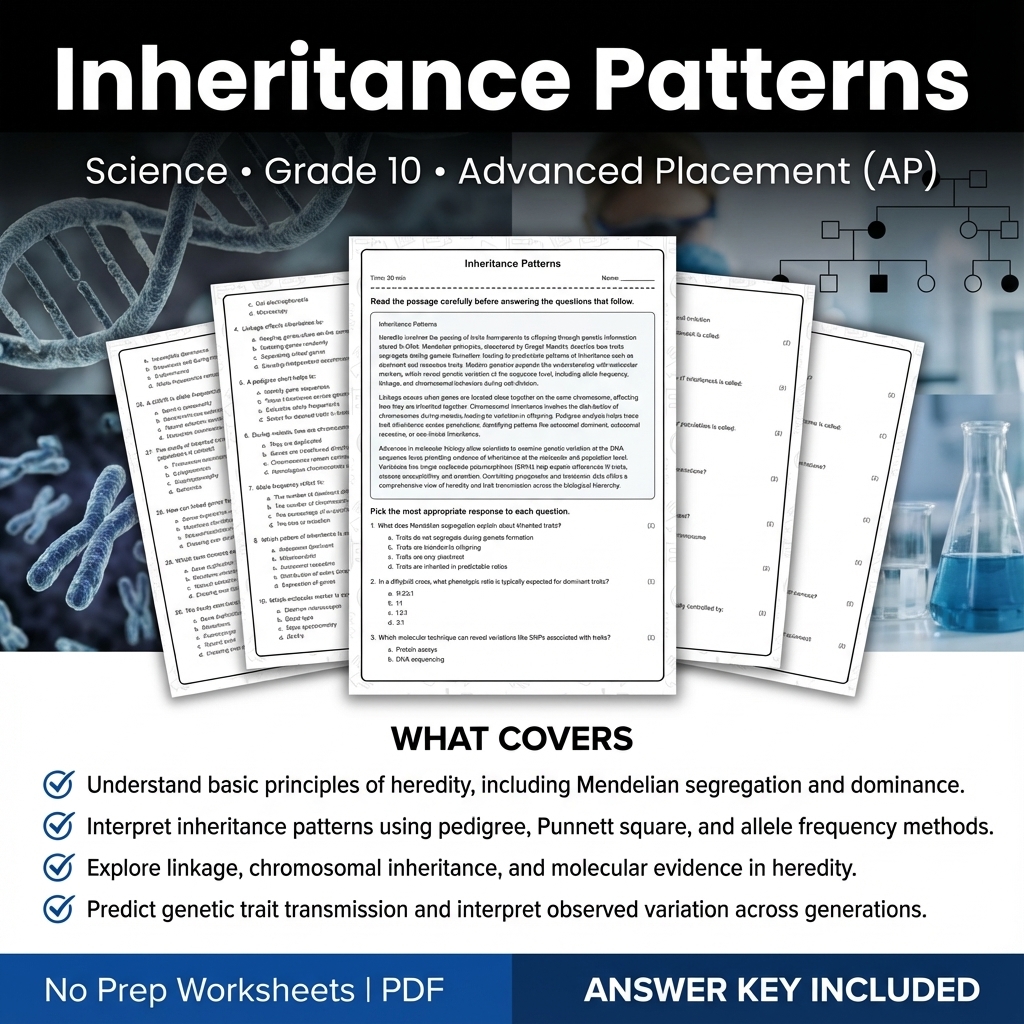
10th Grade Science | Inheritance Patterns Worksheet (Printable PDF + Answer Key)
Created byCoral Reef LearningLearning Objectives
- Understand basic principles of heredity, including Mendelian segregation and dominance.
- Interpret inheritance patterns using pedigree, Punnett square, and allele frequency methods.
- Explore linkage, chromosomal inheritance, and molecular evidence in heredity.
Also included in: Grade 10 Science UNIT Worksheet Bundle – Genetics, Ecosystems & Cell Biology +1 more
Instant download
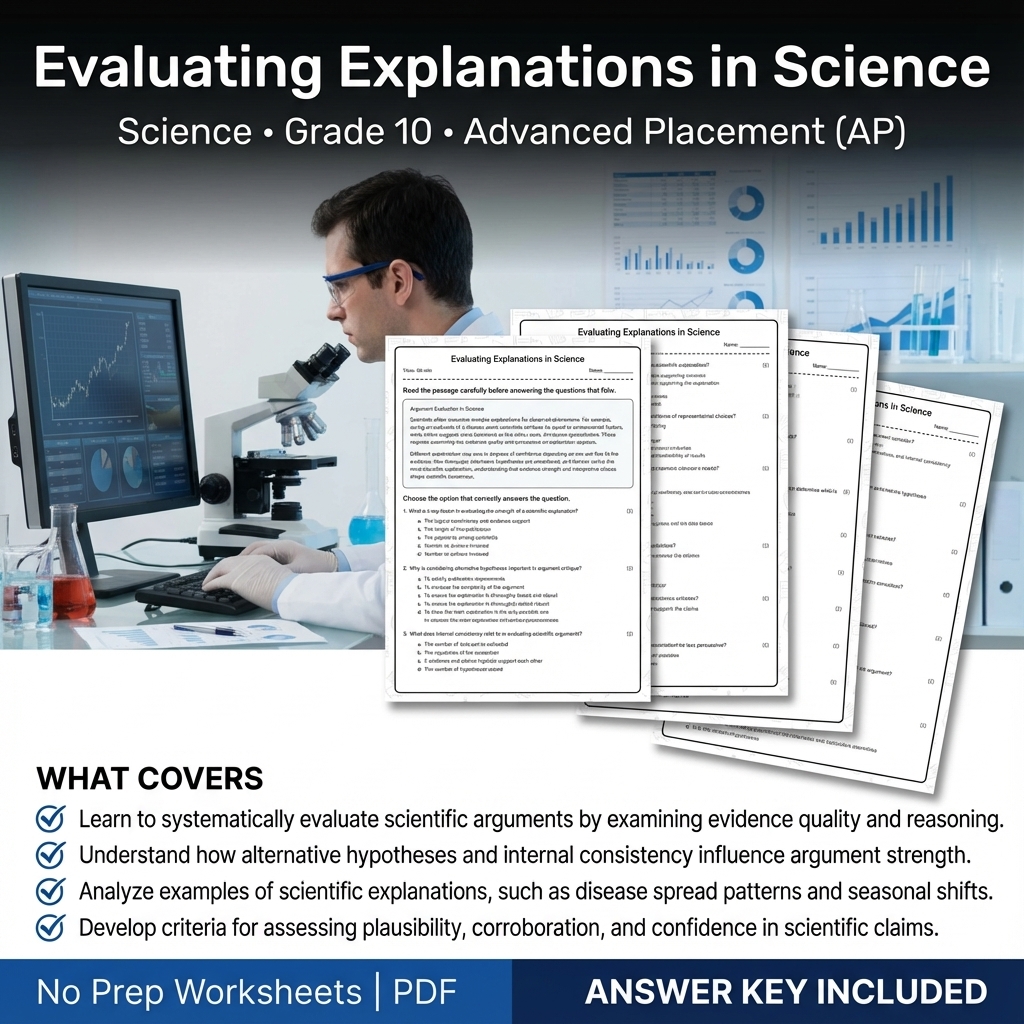
Grade 10 Science | Evaluating Scientific Explanations Worksheet (Printable PDF + Answer Key)
Created byCoral Reef LearningLearning Objectives
- Learn to systematically evaluate scientific arguments by examining evidence quality and reasoning.
- Understand how alternative hypotheses and internal consistency influence argument strength.
- Analyze examples of scientific explanations, such as disease spread patterns and seasonal shifts.
Also included in: Grade 10 Science Unit Worksheet Bundle | Data Analysis & Scientific Modeling +1 more
Instant download
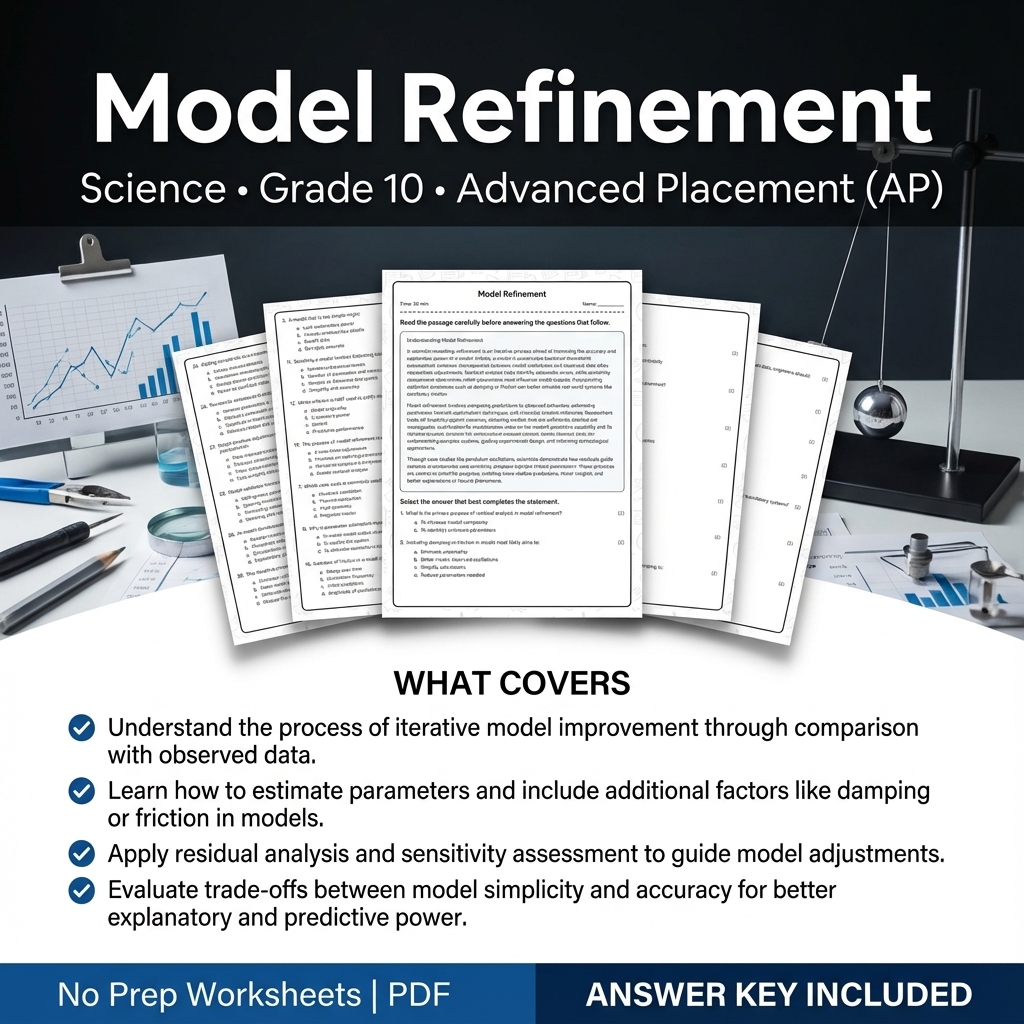
10th Grade Science | Model Refinement Worksheet (Printable PDF + Answer Key)
Created byCoral Reef LearningLearning Objectives
- Understand the process of iterative model improvement through comparison with observed data.
- Learn how to estimate parameters and include additional factors like damping or friction in models.
- Apply residual analysis and sensitivity assessment to guide model adjustments.
Also included in: Grade 10 Science Unit Worksheet Bundle | Data Analysis & Scientific Modeling +1 more
Instant download
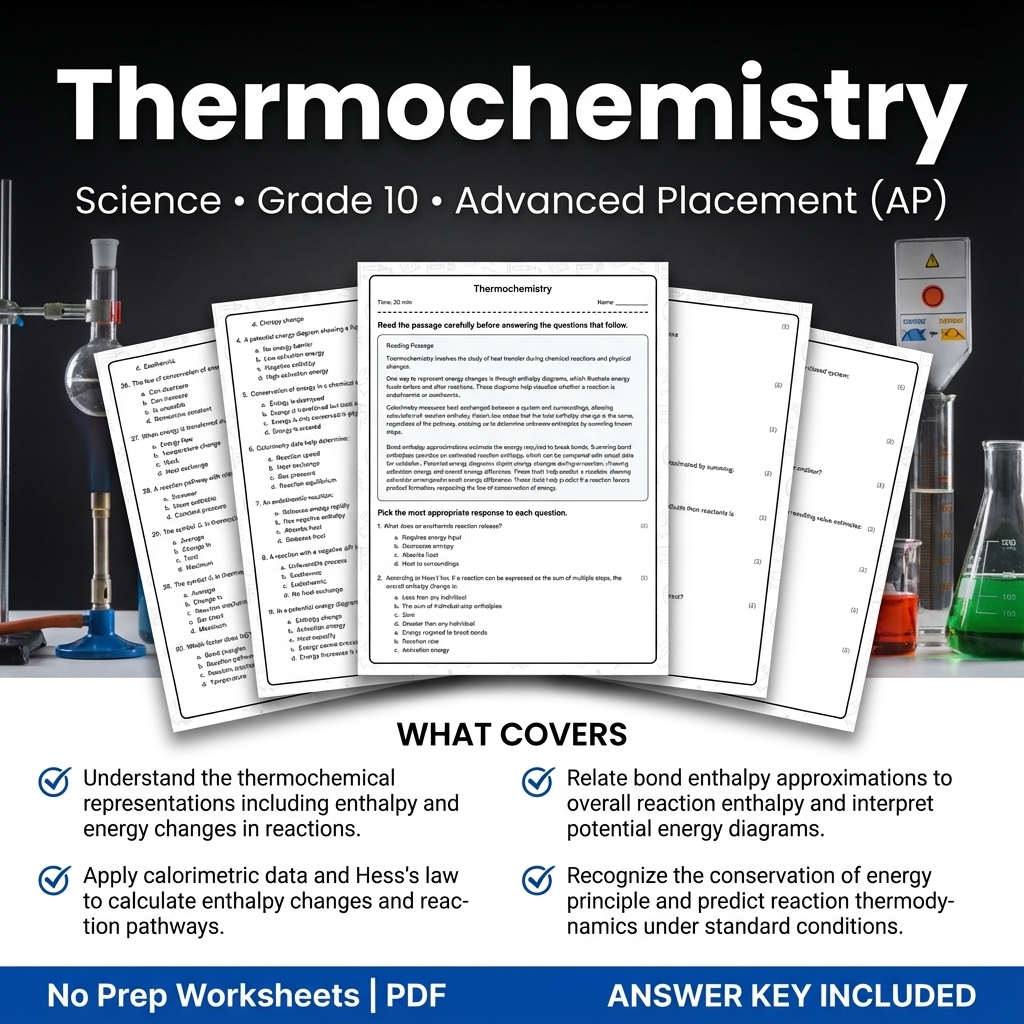
10th Grade Science | Thermochemistry Worksheet (Printable PDF + Answer Key)
Created byCoral Reef LearningLearning Objectives
- Understand the thermochemical representations including enthalpy and energy changes in reactions.
- Apply calorimetric data and Hess's law to calculate enthalpy changes and reaction pathways.
- Relate bond enthalpy approximations to overall reaction enthalpy and interpret potential energy diagrams.
Also included in: Grade 10 Science Unit Bundle | Thermochemistry, Stoichiometry & Atomic Structure +1 more
Instant download
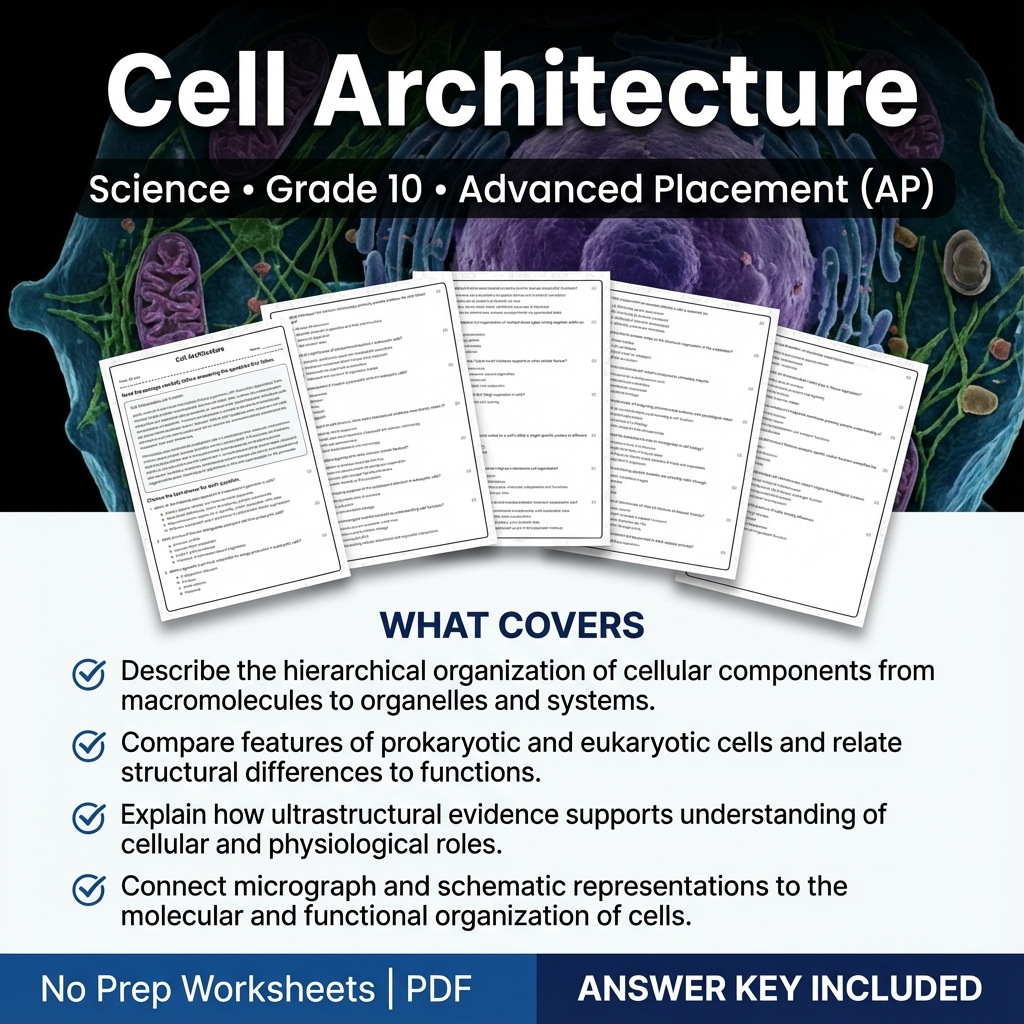
Grade 10 Science | Cell Architecture Worksheet (Printable PDF + Answer Key)
Created byCoral Reef LearningLearning Objectives
- Describe the hierarchical organization of cellular components from macromolecules to organelles and systems.
- Compare features of prokaryotic and eukaryotic cells and relate structural differences to functions.
- Explain how ultrastructural evidence supports understanding of cellular and physiological roles.
Also included in: Grade 10 Science UNIT Worksheet Bundle – Genetics, Ecosystems & Cell Biology +1 more
Instant download
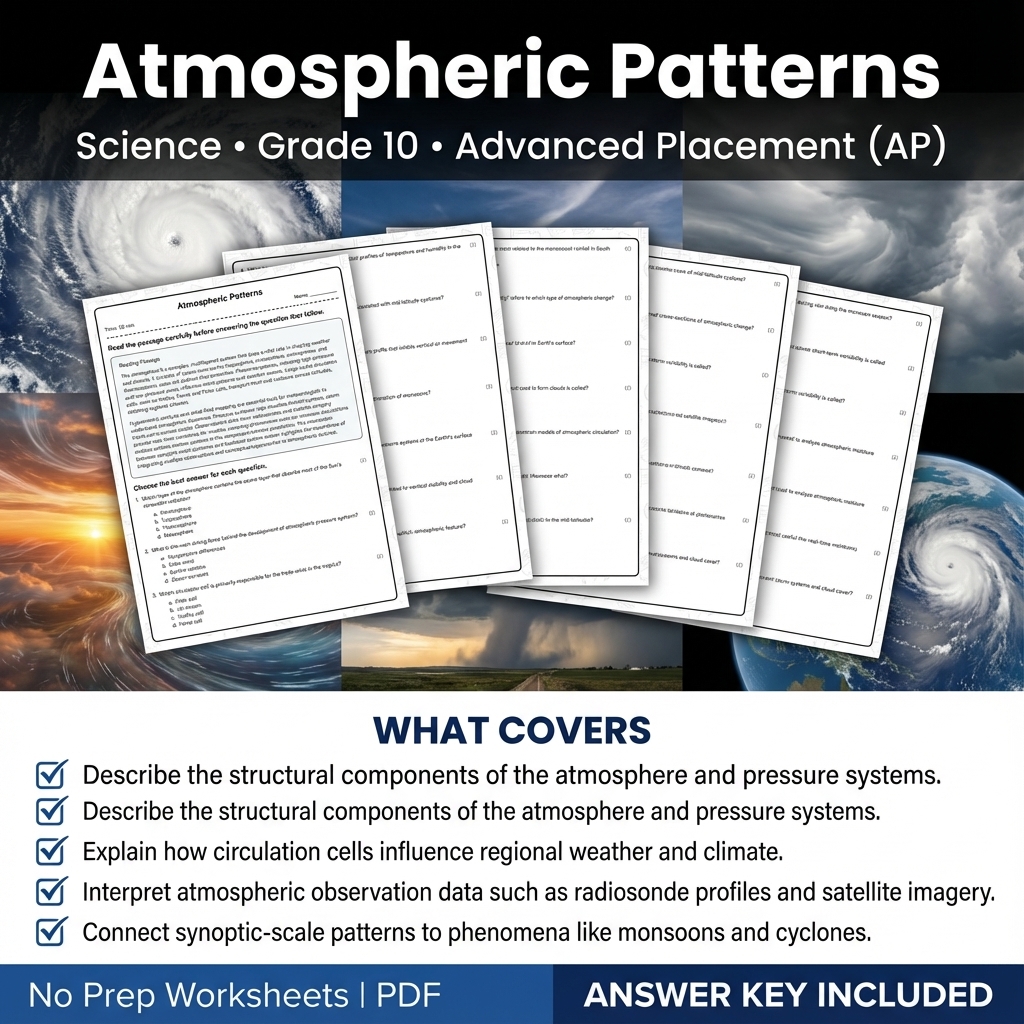
10th Grade Science | Atmospheric Patterns Worksheet (Printable PDF + Answer Key)
Created byCoral Reef LearningLearning Objectives
- Describe the structural components of the atmosphere and pressure systems.
- Explain how circulation cells influence regional weather and climate.
- Interpret atmospheric observation data such as radiosonde profiles and satellite imagery.
Also included in: Grade 10 Science Unit Worksheet Bundle – Geology, Climate, Plate Tectonics +1 more
Instant download
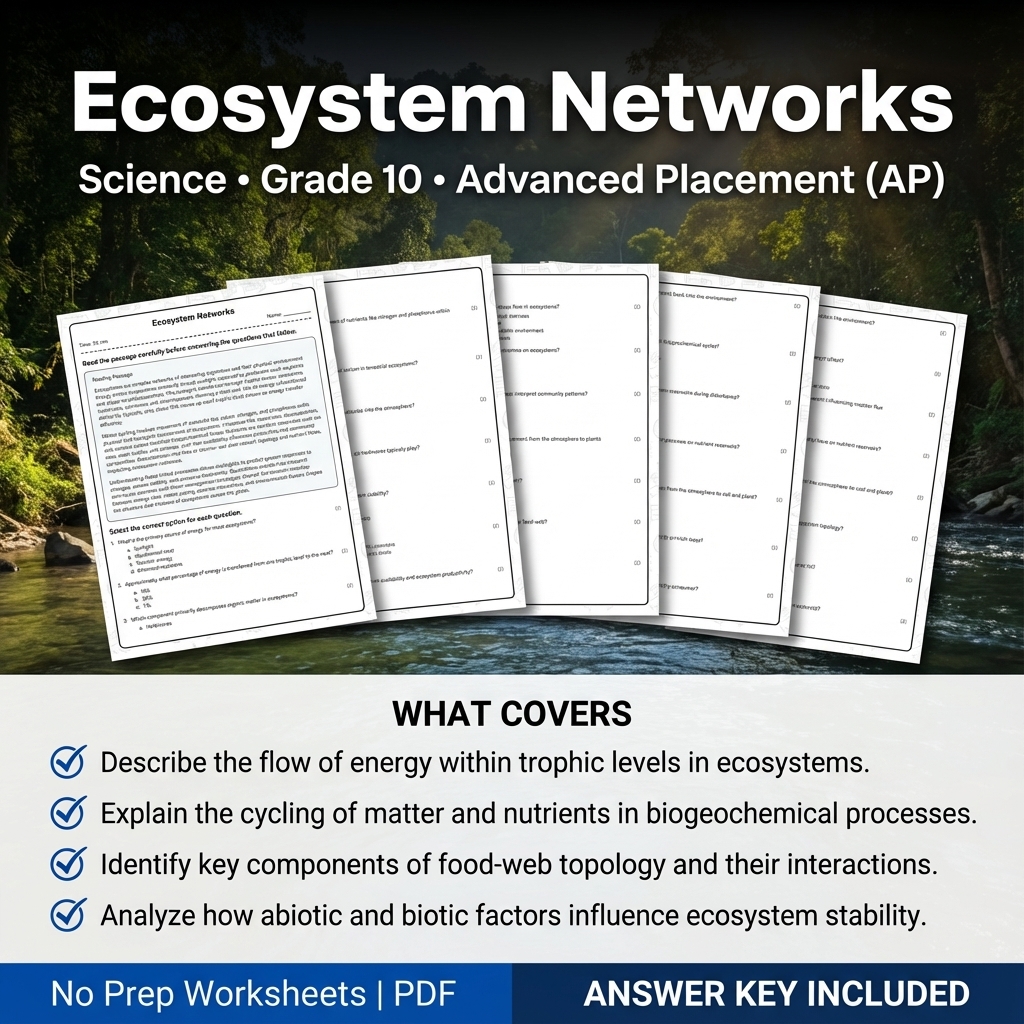
Grade 10 Science | Ecosystem Networks Worksheet (Printable PDF + Answer Key)
Created byCoral Reef LearningLearning Objectives
- Describe the flow of energy within trophic levels in ecosystems.
- Explain the cycling of matter and nutrients in biogeochemical processes.
- Identify key components of food-web topology and their interactions.
Also included in: Grade 10 Science UNIT Worksheet Bundle – Genetics, Ecosystems & Cell Biology +1 more
Instant download
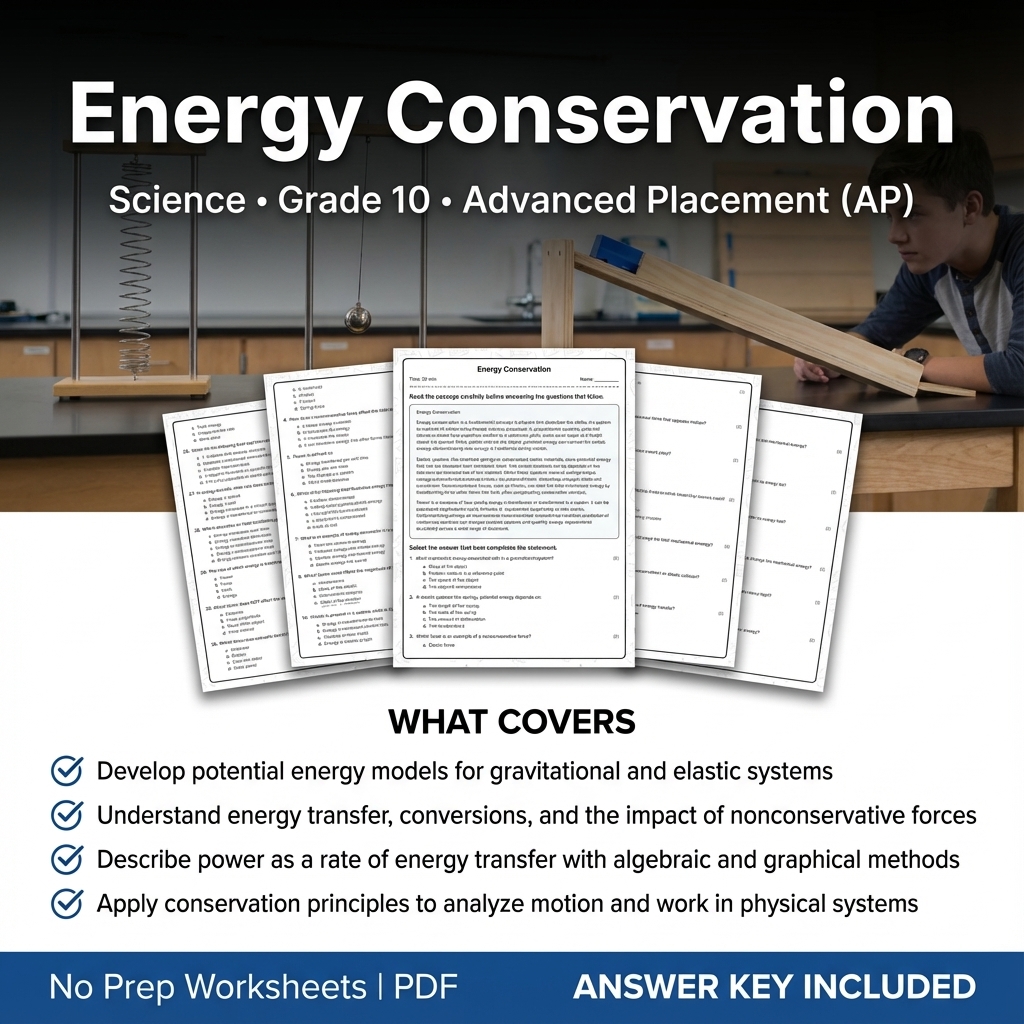
10th Grade Science | Energy Conservation Worksheet (Printable PDF + Answer Key)
Created byCoral Reef LearningLearning Objectives
- Develop potential energy models for gravitational and elastic systems
- Understand energy transfer, conversions, and the impact of nonconservative forces
- Describe power as a rate of energy transfer with algebraic and graphical methods
Also included in: Grade 10 Science Unit Worksheet Bundle – Motion, Energy & Forces (PDF Answers) +1 more
Instant download
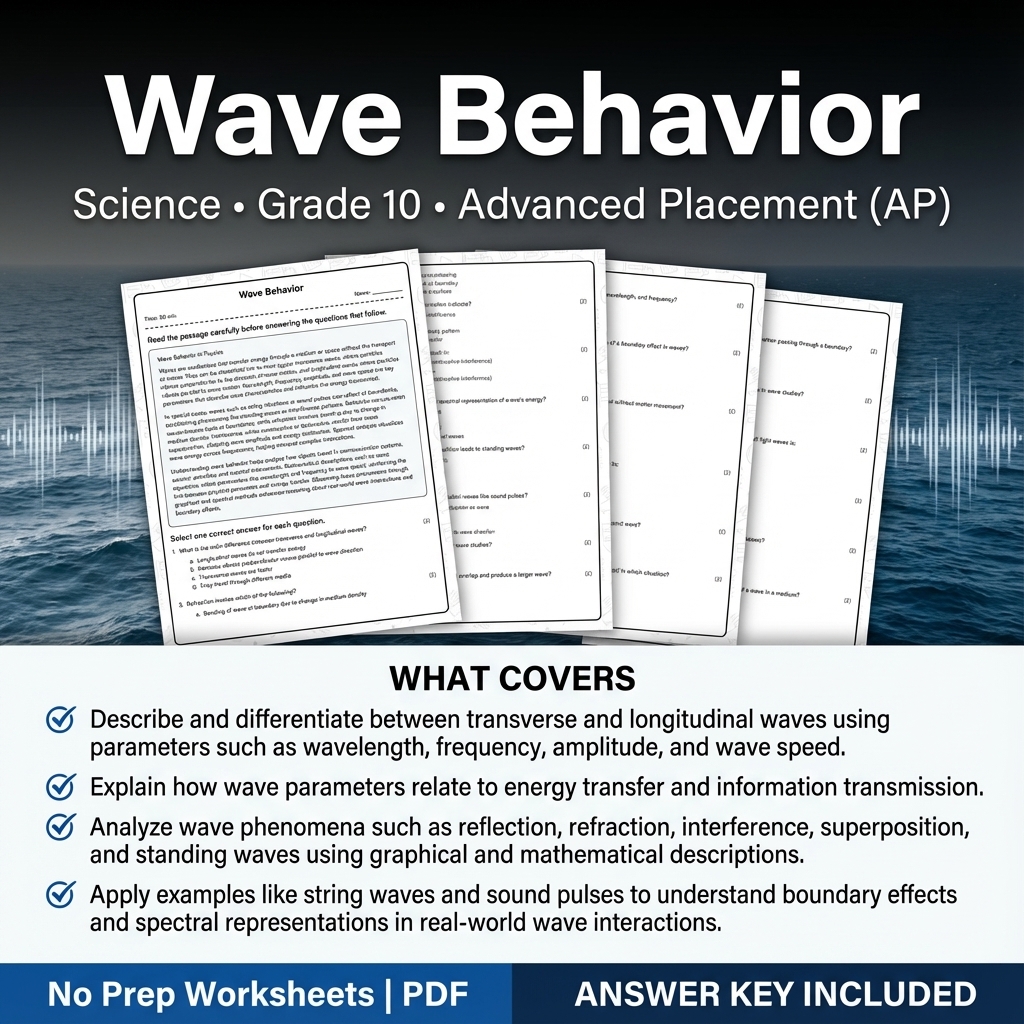
Grade 10 Science | Wave Behavior Worksheet (Printable PDF + Answer Key)
Created byCoral Reef LearningLearning Objectives
- Describe and differentiate between transverse and longitudinal waves using parameters such as wavelength, frequency, amplitude, and wave speed.
- Explain how wave parameters relate to energy transfer and information transmission.
- Analyze wave phenomena such as reflection, refraction, interference, superposition, and standing waves using graphical and mathematical descriptions.
Also included in: Grade 10 Science Unit Worksheet Bundle – Motion, Energy & Forces (PDF Answers) +1 more
Instant download
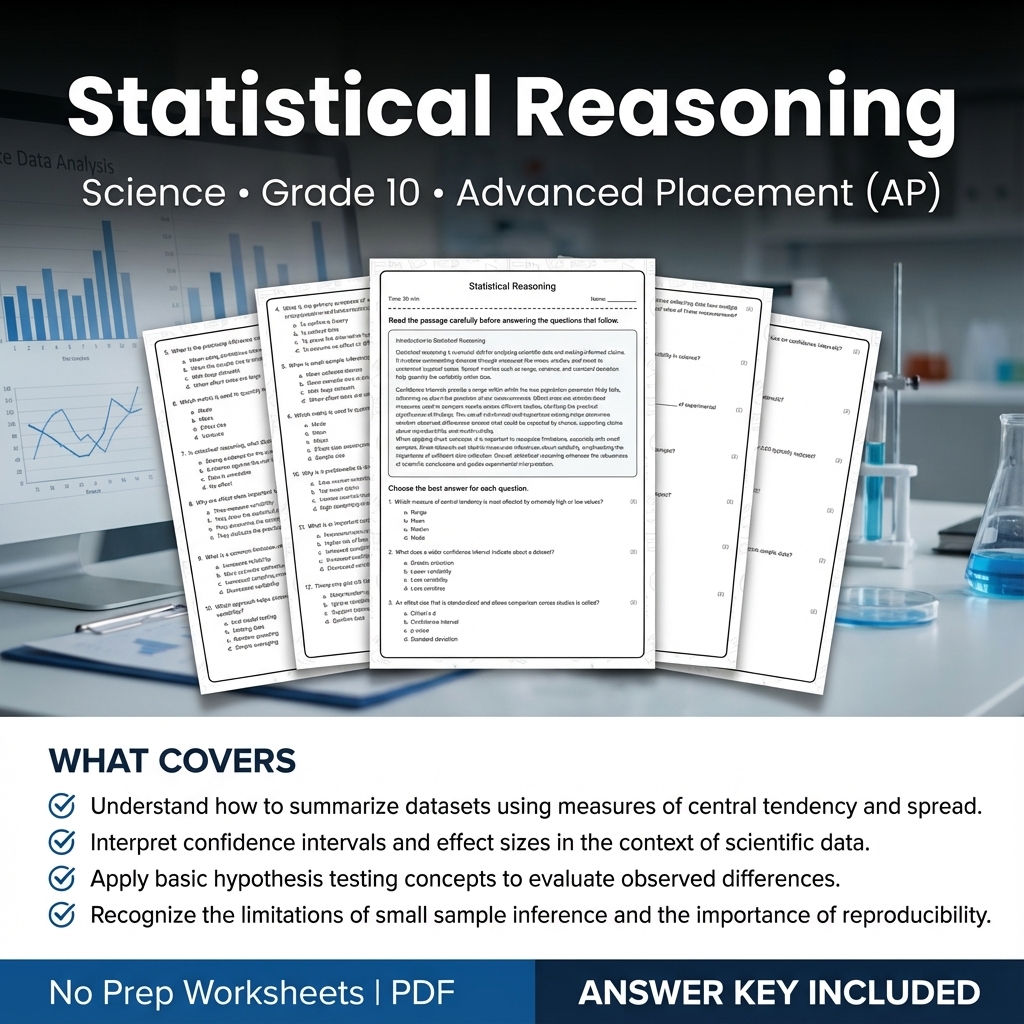
Grade 10 Science | Statistical Reasoning Worksheet (Printable PDF + Answer Key)
Created byCoral Reef LearningLearning Objectives
- Understand how to summarize datasets using measures of central tendency and spread.
- Interpret confidence intervals and effect sizes in the context of scientific data.
- Apply basic hypothesis testing concepts to evaluate observed differences.
Also included in: Grade 10 Science Unit Worksheet Bundle | Data Analysis & Scientific Modeling +1 more
Instant download
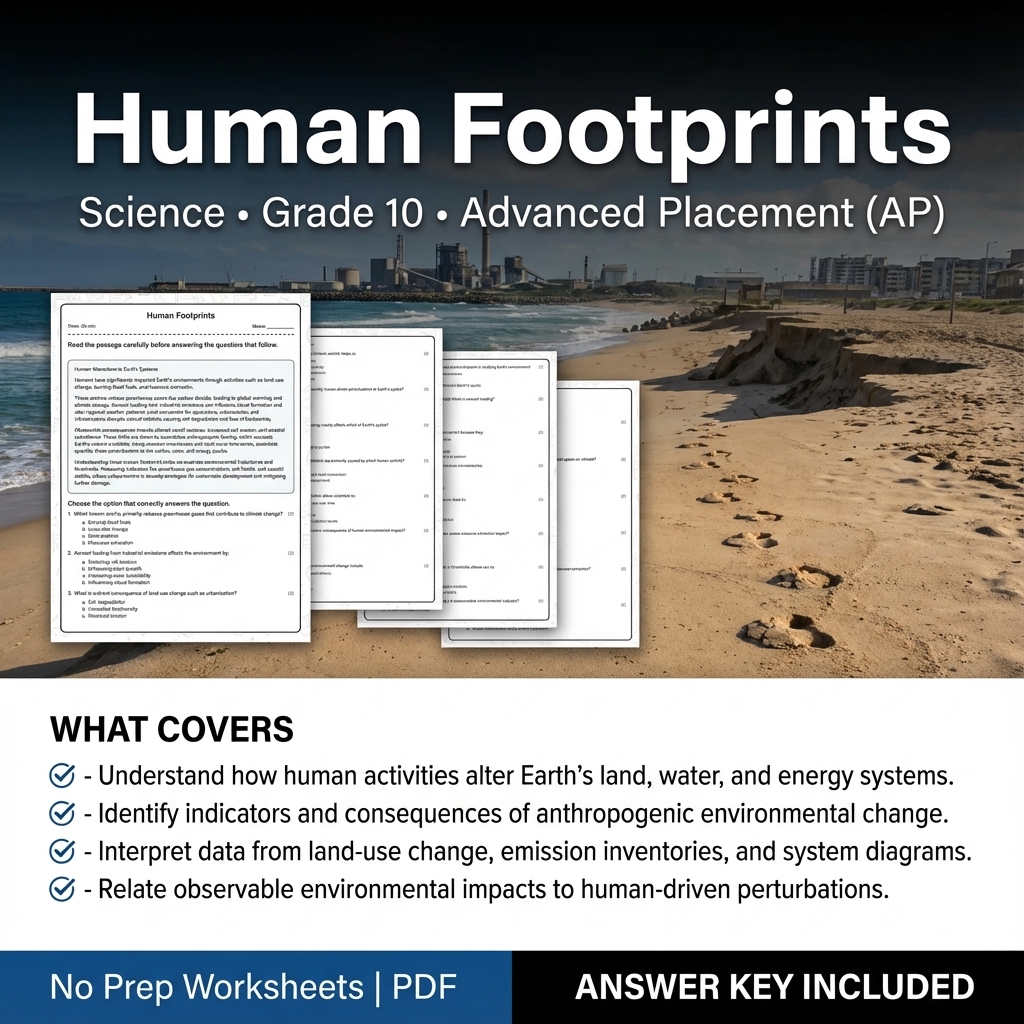
10th Grade Science | Human Footprints Worksheet (Printable PDF + Answer Key)
Created byCoral Reef LearningLearning Objectives
- Understand how human activities alter Earth's land, water, and energy systems.
- Identify indicators and consequences of anthropogenic environmental change.
- Interpret data from land-use change, emission inventories, and system diagrams.
Also included in: Grade 10 Science Unit Worksheet Bundle – Geology, Climate, Plate Tectonics +1 more
Instant download
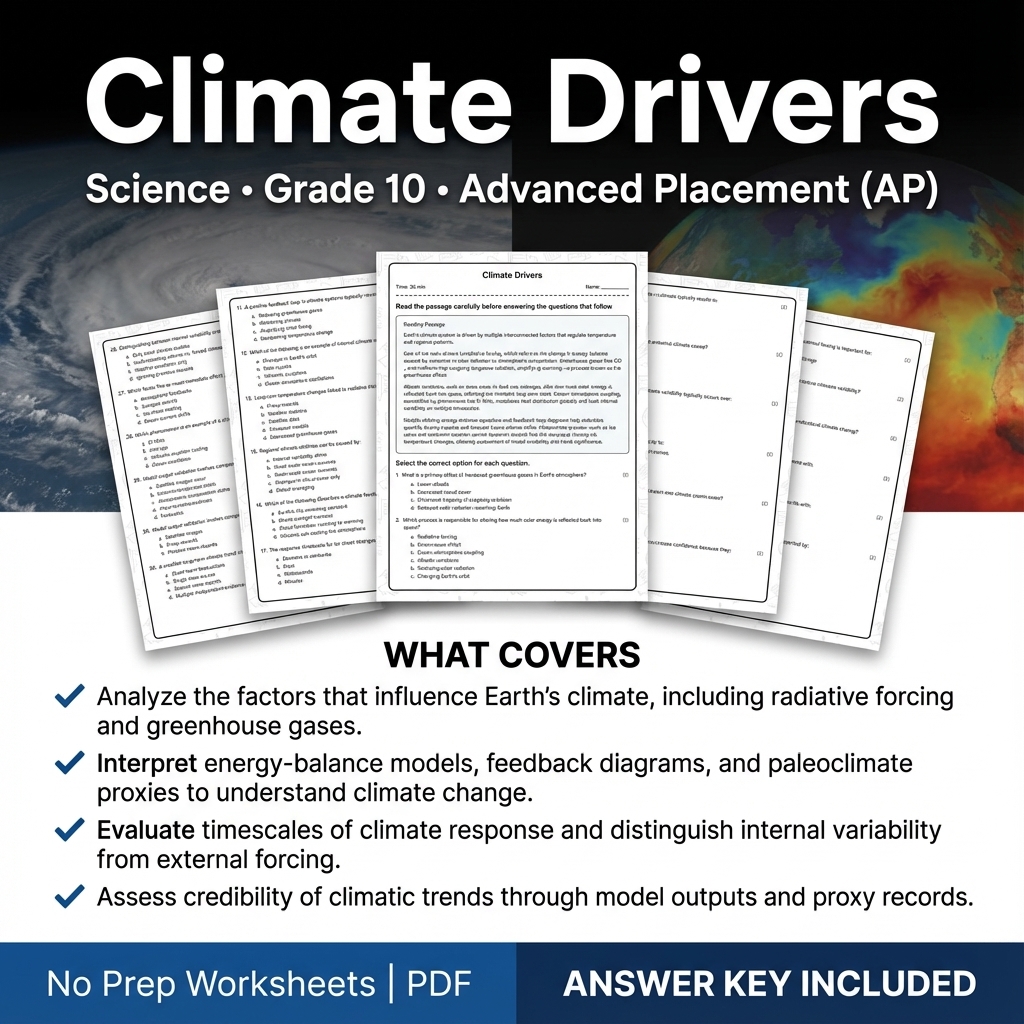
10th Grade Science | Climate Drivers Worksheet (Printable PDF + Answer Key)
Created byCoral Reef LearningLearning Objectives
- Analyze the factors that influence Earth's climate, including radiative forcing and greenhouse gases.
- Interpret energy-balance models, feedback diagrams, and paleoclimate proxies to understand climate change.
- Evaluate timescales of climate response and distinguish internal variability from external forcing.
Also included in: Grade 10 Science Unit Worksheet Bundle – Geology, Climate, Plate Tectonics +1 more
Instant download
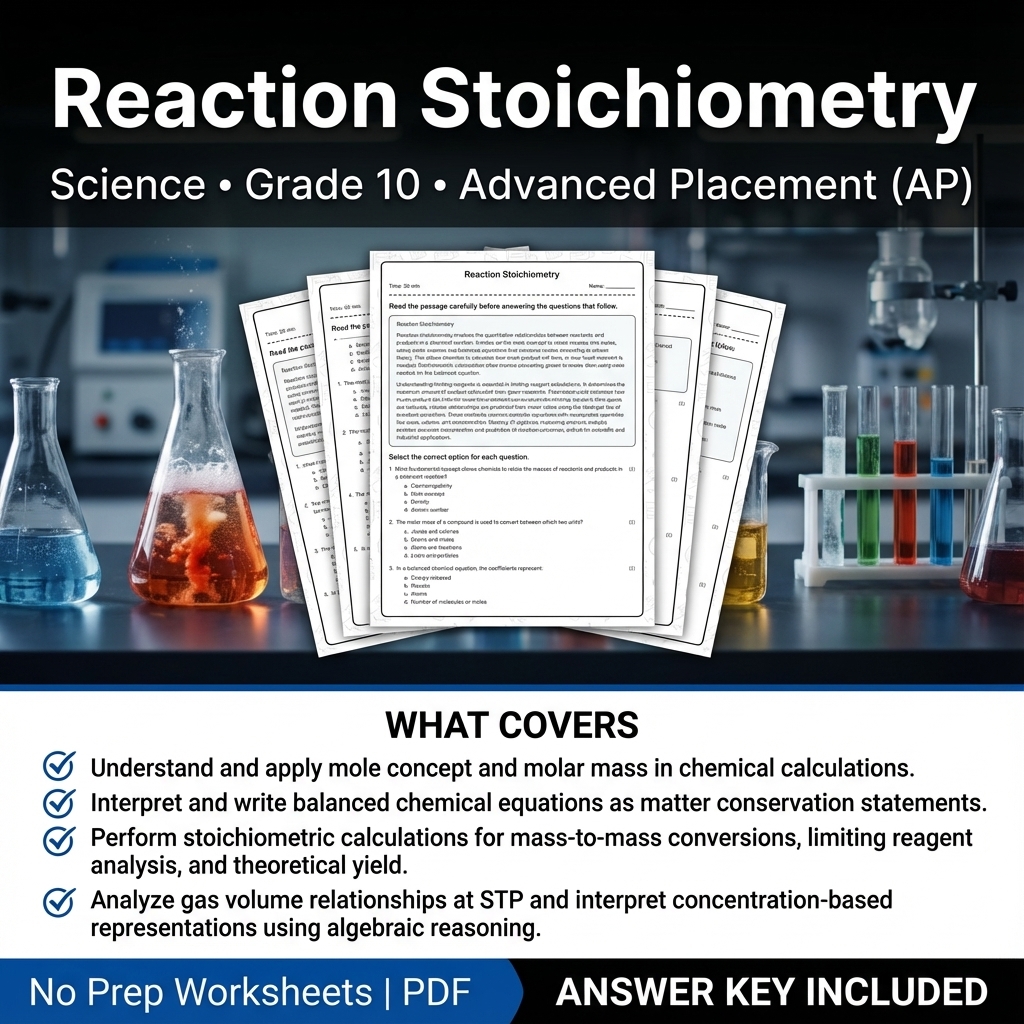
Grade 10 Science | Reaction Stoichiometry Worksheet (Printable PDF + Answer Key)
Created byCoral Reef LearningLearning Objectives
- Understand and apply mole concept and molar mass in chemical calculations.
- Interpret and write balanced chemical equations as matter conservation statements.
- Perform stoichiometric calculations for mass-to-mass conversions, limiting reagent analysis, and theoretical yield.
Also included in: Grade 10 Science Unit Bundle | Thermochemistry, Stoichiometry & Atomic Structure +1 more
Instant download

Grade 10 Science | Gene Expression Regulation Worksheet (Printable PDF + Answer Key)
Created byCoral Reef LearningLearning Objectives
- Describe mechanisms that regulate gene expression in prokaryotic and eukaryotic systems.
- Identify the roles of promoter architecture, transcription factors, chromatin modifications, and post-transcriptional controls.
- Understand how regulatory networks influence phenotypic plasticity and cellular responses.
Also included in: Grade 10 Science UNIT Worksheet Bundle – Genetics, Ecosystems & Cell Biology +1 more
Instant download
About Grade 10 Science Worksheets
Find Science worksheets built for Grade 10. All 7,038 cover core skills, practice, and review, each an instant PDF download.
Every worksheet on MyTeachingSheets is created by independent teacher-authors and reviewed before publication. All resources download as printable PDFs for classroom, homework, or at-home practice, and many include answer keys. Preview any worksheet free before buying.