
Grade 10 Science Worksheets
7,038 worksheets
Energy Transformations and Technology Design Worksheet Grade 10 Science
 Created bythe curious pencil
Learning Objectives
- Identify useful energy outputs and other transfers in operating devices.
- Compare energy transformations in historical and modern technologies.
- Explain how engineers use evidence to improve device designs.
Instant download

Plant Responses to Light and Gravity Worksheet | Grade 10 Science
Created bythe curious pencilLearning Objectives
- Explain how shoots respond to directional light.
- Compare historical experiments investigating plant growth responses.
- Identify controlled variables in plant-growth investigations.
Instant download

Chemical Reaction Types and Balancing Equations Worksheet Grade 10
Created bythe curious pencilLearning Objectives
- Identify synthesis, decomposition, and replacement reaction patterns
- Predict products for common chemical reaction types
- Balance chemical equations using coefficients to conserve atoms
Instant download

Cell Structure and Function Worksheets: Open Systems Grade 10 Science
Created bythe curious pencilLearning Objectives
- Explain why cells exchange matter and energy with their surroundings
- Identify organelles and describe their specialized functions
- Compare shared structures in plant and animal cells
Instant download

Chemical Change and Energy Transfer Worksheets | Grade 10 Science
Created bythe curious pencilLearning Objectives
- Distinguish chemical changes from physical changes using observable evidence
- Explain energy transfer during endothermic and exothermic processes
- Interpret temperature observations while recognizing measurement uncertainty
Instant download

Radiation Budgets and Climate Balance Worksheet | Grade 10 Science
Created bythe curious pencilLearning Objectives
- Explain how incoming sunlight and outgoing radiation affect Earth's energy budget.
- Calculate reflected and unreflected energy percentages in simplified radiation models.
- Interpret how greenhouse gases influence infrared energy transfer and climate.
Instant download

Thermal Energy Efficiency and Heat Engines Worksheet Grade 10 Science
Created bythe curious pencilLearning Objectives
- Calculate device efficiency from useful output and total input energy
- Compare useful output energy with energy supplied to a device
- Explain why heat engines cannot convert all thermal input into useful work
Instant download

Plant Transport and Gas Exchange Worksheet | Grade 10 Science
Created bythe curious pencilLearning Objectives
- Compare the transport roles of xylem and phloem.
- Explain how cohesion, adhesion, and transpiration contribute to water movement.
- Describe how stomata and guard cells regulate gas exchange.
Instant download

Moles and Conservation of Mass Worksheets | Grade 10 Chemistry
Created bythe curious pencilLearning Objectives
- Explain how the mole represents a specified number of chemical entities
- Calculate the number of entities represented by an amount in moles
- Use molar mass to calculate the mass of a substance
Instant download

Solubility and Chemical Properties Worksheet Grade 10 Science
Created bythe curious pencilLearning Objectives
- Compare substances using conductivity, pH, solubility, and physical state data
- Interpret solubility charts to predict dissolving behaviour under stated conditions
- Explain how water's molecular structure influences its solvent properties
Instant download

Microscopy and Cell Theory Worksheet | Grade 10 Science
Created bythe curious pencilLearning Objectives
- Explain how microscopy contributed to the development of cell theory
- Distinguish magnification from resolution in microscope images
- Identify factors that limit the quality of microscope observations
Instant download

Energy Efficiency and Design Testing Worksheets | Grade 10 Science
Created bythe curious pencilLearning Objectives
- Plan fair comparisons using measurable performance criteria and controlled conditions
- Calculate energy efficiency from useful output and total energy input
- Interpret repeated trials and identify sources of measurement uncertainty
Instant download

Chemical Investigation and Evidence-Based Decisions Worksheet Grade 10
Created bythe curious pencilLearning Objectives
- Identify testable questions and predictions for chemical investigations.
- Distinguish independent variables, dependent variables, and controlled conditions.
- Explain how repeated measurements reveal variation and uncertainty.
Instant download

Energy Conservation in Motion Worksheet | Grade 10 Physics Science
Created bythe curious pencilLearning Objectives
- Explain how gravitational potential energy changes as an object moves.
- Compare kinetic energy changes in idealized and resistive systems.
- Describe how friction transfers mechanical energy into thermal energy.
Instant download

Climate Models and Climate Change Evidence Worksheets Grade 10 Science
Created bythe curious pencilLearning Objectives
- Identify climate monitoring technologies and the evidence each provides
- Explain how climate models represent interactions within Earth's systems
- Distinguish climate projections from exact predictions
Instant download

Climate Change Evidence and Human Impacts Worksheet | Grade 10 Science
Created bythe curious pencilLearning Objectives
- Identify direct and indirect evidence used to investigate past climate conditions.
- Interpret climate records to distinguish weather variability from long-term patterns.
- Explain how fossil fuels and deforestation influence Earth's energy balance.
Instant download

Chemical Bonding, Formulas and Naming Compounds Worksheet Grade 10
Created bythe curious pencilLearning Objectives
- Predict ionic compound formulas using common ion charges.
- Explain how charge balance determines ionic compound formulas.
- Interpret subscripts in molecular formulas such as CO₂.
Instant download

Biomes and Climatographs Worksheets | Grade 10 Climate Science
Created bythe curious pencilLearning Objectives
- Identify temperature and precipitation patterns associated with major biomes.
- Interpret climatographs to compare monthly climate conditions.
- Explain how topography influences temperature, precipitation, and habitats.
Instant download

Uneven Solar Heating and Global Circulation Science Worksheets Grade 10
Created bythe curious pencilLearning Objectives
- Explain how latitude and seasonal daylight affect solar heating.
- Describe how albedo influences the absorption of solar energy.
- Explain how air and ocean currents redistribute thermal energy.
Instant download

Work, Gravitational Potential and Kinetic Energy Worksheet Grade 10
Created bythe curious pencilLearning Objectives
- Calculate mechanical work using force and displacement.
- Interpret force–distance graphs to determine work.
- Calculate gravitational potential energy using mass, height, and gravity.
Instant download

Atomic Models and Atomic Structure Worksheet | Grade 10 Science
Created bythe curious pencilLearning Objectives
- Explain how experimental evidence leads scientists to revise atomic models
- Identify the locations and electrical charges of subatomic particles
- Compare protons, neutrons, and electrons by charge and location
Instant download

Plant Responses and Experimental Evidence Worksheet Grade 10 Science
Created bythe curious pencilLearning Objectives
- Differentiate phototropism from gravitropism using plant growth examples.
- Explain how directional light influences the growth of young shoots.
- Compare controlled investigations of plant responses using experimental evidence.
Instant download

Surface Area to Volume Ratio Worksheet | Grade 10 Cell Biology
Created bythe curious pencilLearning Objectives
- Calculate the surface area of cube-shaped cell models.
- Determine the volume of cubes using their side lengths.
- Compare surface-area-to-volume ratios across different model sizes.
Instant download

Grade 10 Science | Motion Description - Daily Reading Comprehension
 Created byCoral Reef Learning
Learning Objectives
- Understand and define the variables of position, displacement, speed, velocity, and acceleration.
- Explain how time and reference frames influence the measurement of motion.
- Interpret graphs and equations related to motion along a line or curve.
Instant download
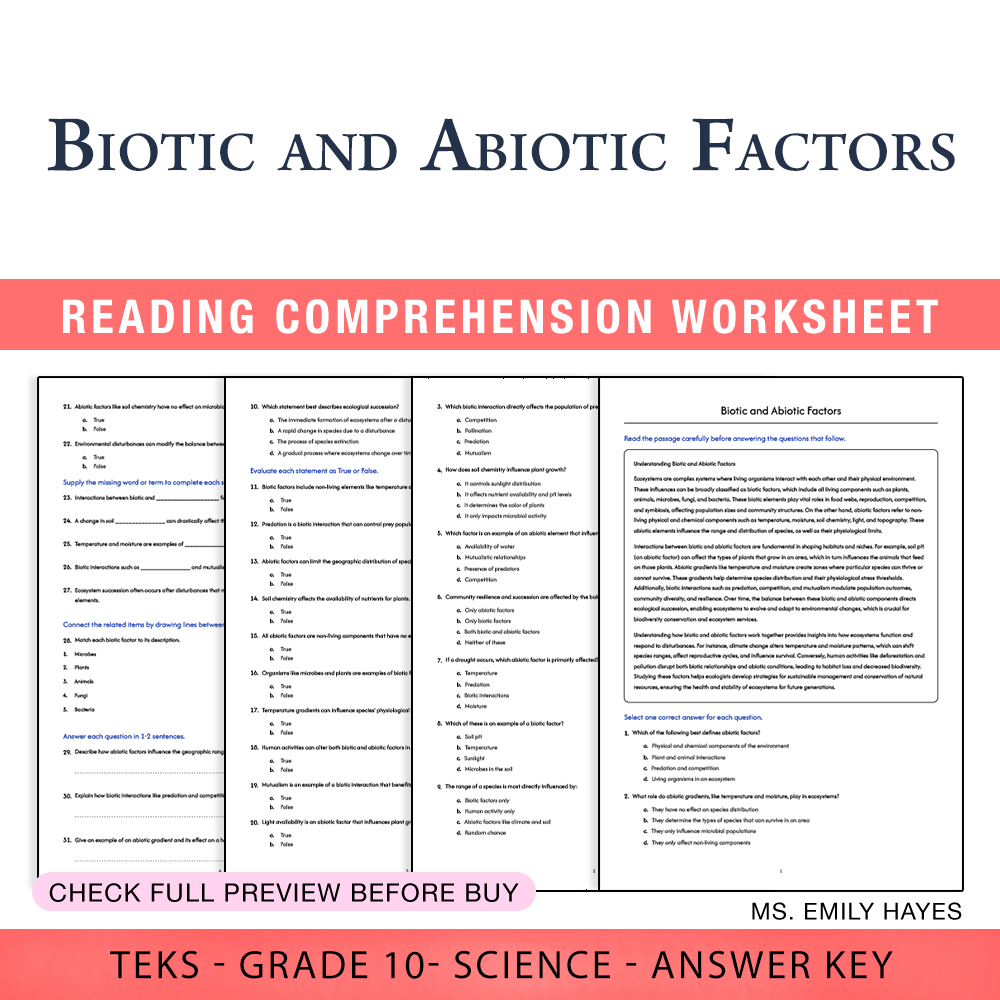
10th Grade Science | Biotic and Abiotic Factors Worksheet (PDF+ Answer Key)
 Created byCopper Leaf Classroom
Learning Objectives
- Explain the roles of biotic and abiotic factors in shaping ecosystems.
- Identify examples of biotic and abiotic elements in various habitats.
- Analyze how interactions between biotic and abiotic factors influence community dynamics.
Instant download

Grade 10 Science Worksheet Organelle Functions | Standards-Aligned Practice
JCreated byJ.S SheetsLearning Objectives
- Explain how the nucleus, mitochondria, chloroplasts, ER, Golgi apparatus, and ribosomes contribute to overall cell function
- Describe how membrane-bound organelles coordinate to maintain homeostasis
- Use evidence from a reading passage to answer questions about organelle roles and interactions
Also included in: Grade 10 Life Science Evolution, Genetics & Cells Lesson Bundle – Florida NGSSS +1 more
Instant download
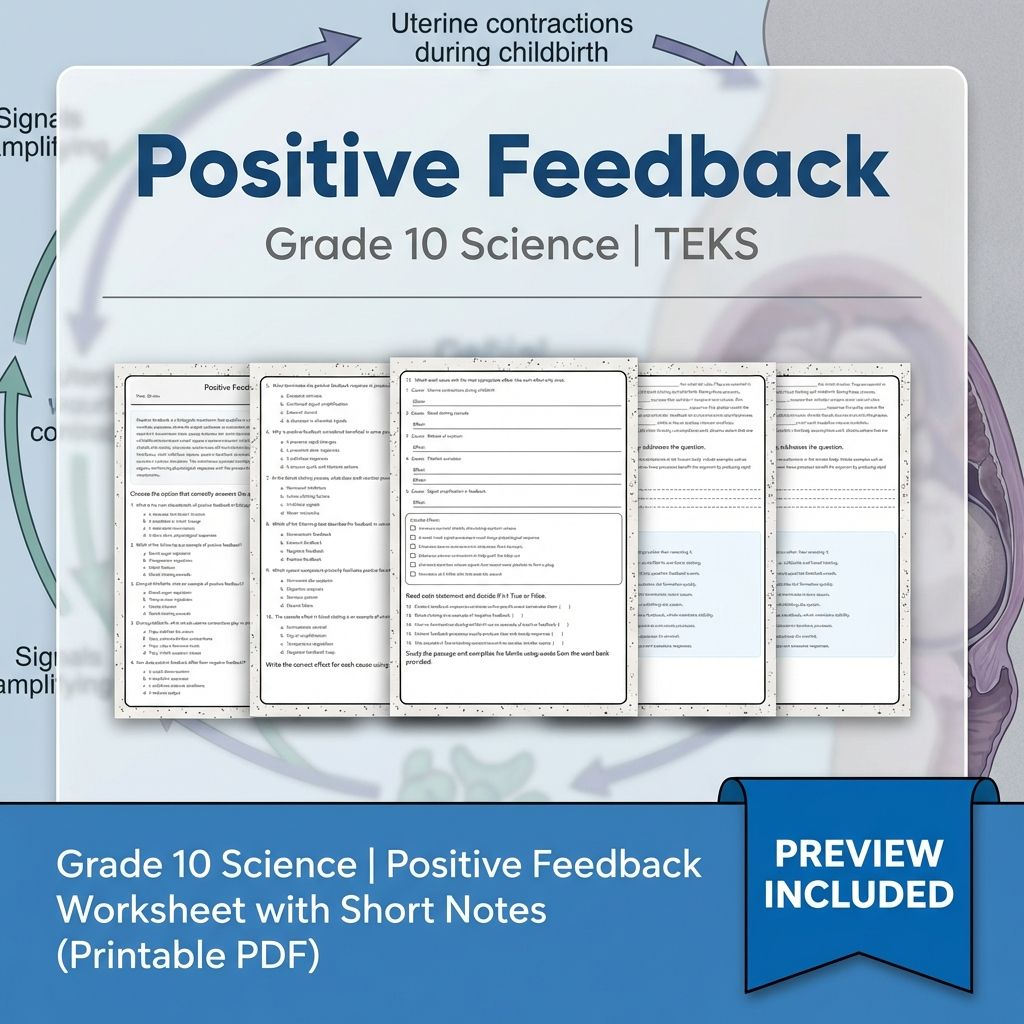
Grade 10 Science | Positive Feedback Worksheet with Short Notes (Printable PDF)
 Created byMeadowlark Worksheets
Learning Objectives
- Understand the concept of positive feedback mechanisms in physiology.
- Identify real-life examples of positive feedback, including childbirth and blood clotting.
- Explain how positive feedback amplifies biological processes.
Instant download
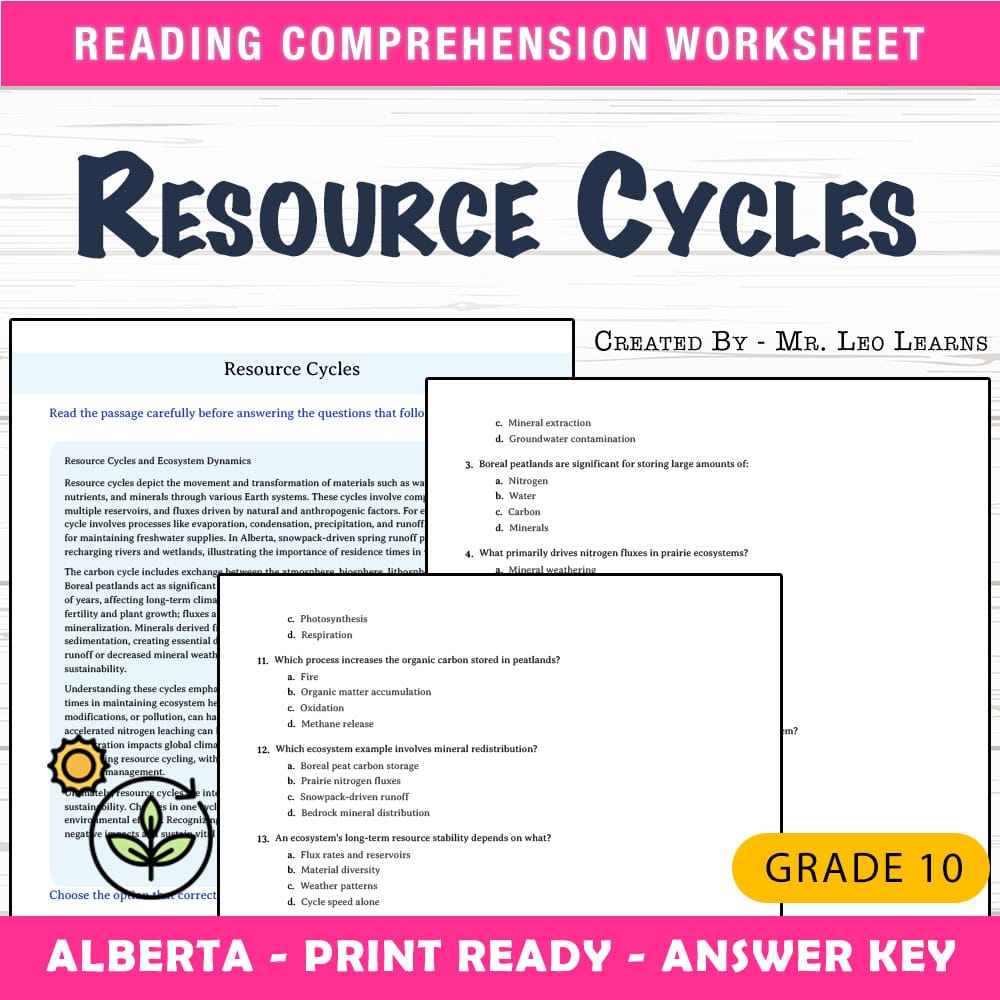
Grade 10 Science — Worksheet MCQ Paper for Mastering Resource Cycles
 Created byThe Resource Hub
Learning Objectives
- Understand the components and pathways of Earth's resource cycles.
- Identify key reservoirs and flux drivers in water, carbon, nitrogen, and mineral cycles.
- Analyze how changes in flux rates impact ecosystem function and resource availability.
Also included in: Grade 10 Science Bundle | Earth and Space Systems Worksheets +1 more
Instant download

Organelles and Cellular Compartmentalization Worksheet | TEKS Grade 10
 Created byBRIGHT PATH RESOURCES
Learning Objectives
- Classify organelles as membrane-bound or non-membrane-bound based on their structure.
- Identify organelles that perform key functions such as energy conversion, photosynthesis, protein processing, waste digestion, and genetic control.
Also included in: Grade 10 Cell Structure & Function Science Worksheets Bundle | TEKS Biology +1 more
Instant download

Cellular Specialization and Organelle Abundance Worksheet | TEKS Grade 10
Created byBRIGHT PATH RESOURCESLearning Objectives
- Identify a passage’s main idea and match supporting evidence
- Explain how organelle abundance relates to cell function
- Use vocabulary from cellular specialization to answer questions
Also included in: Grade 10 Cell Structure & Function Science Worksheets Bundle | TEKS Biology +1 more
Instant download

Diffusion and Concentration Gradients Worksheet | TEKS Grade 10 Science
Created byBRIGHT PATH RESOURCESLearning Objectives
- Explain how diffusion moves substances down a concentration gradient.
- Identify evidence of concentration gradients in cell and body examples.
- Distinguish diffusion from passive movement without a gradient.
Also included in: Grade 10 Cell Structure & Function Science Worksheets Bundle | TEKS Biology +1 more
Instant download

Microtubules and Intracellular Transport Worksheet | TEKS Grade 10 Science
Created byBRIGHT PATH RESOURCESLearning Objectives
- Explain cause-and-effect relationships between motor proteins and cargo movement on microtubules.
- Describe how microtubules contribute to organizing intracellular transport.
- Use evidence from a text to answer questions about the cytoskeleton’s transport role.
Also included in: Grade 10 Cell Structure & Function Science Worksheets Bundle | TEKS Biology +1 more
Instant download
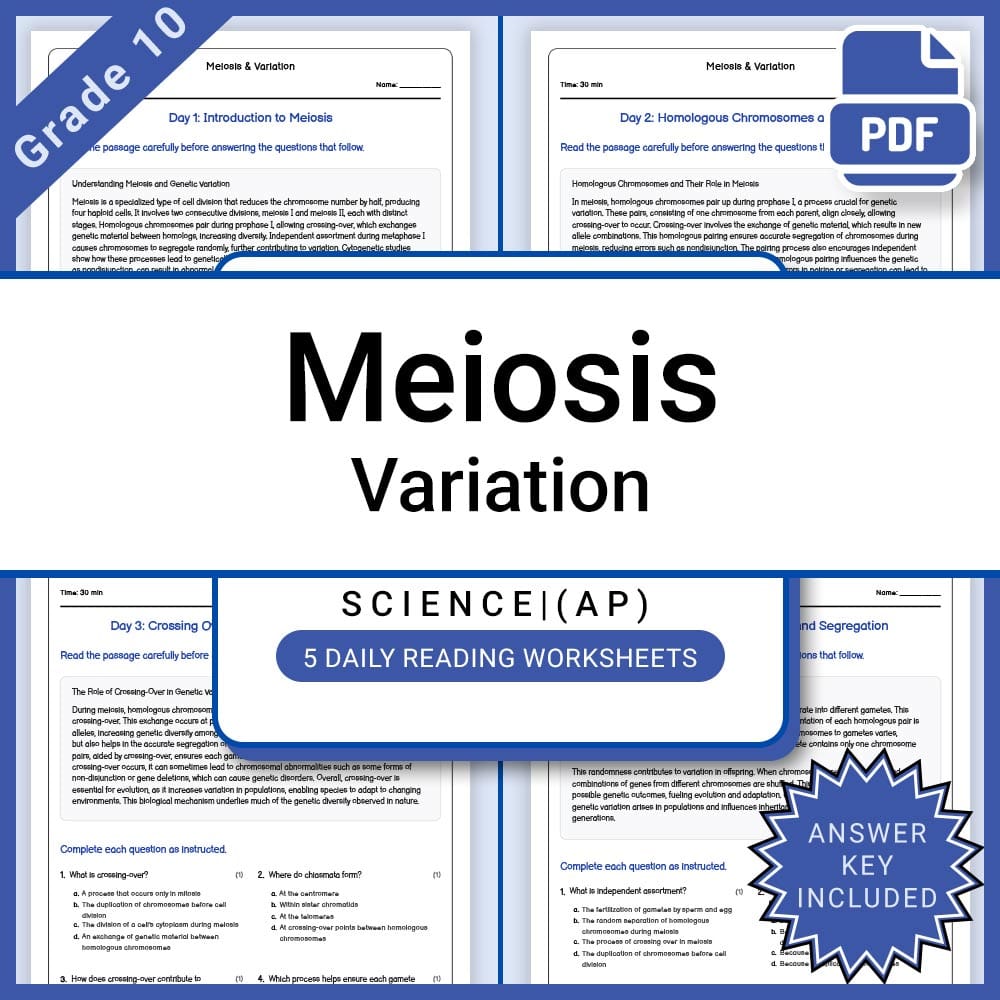
Grade 10 Science – Meiosis & Variation Daily Reading Worksheet with Answer Key
JCreated byJ.S SheetsLearning Objectives
- Understand the stages of meiosis and their significance in genetic variation.
- Describe the processes of homologous pairing, crossing-over, and independent assortment.
- Explain how meiosis leads to genetic diversity and its importance in evolution.
Also included in: Grade 10 Science Lesson Group Bundle | AP Framework & Daily Worksheets
Instant download
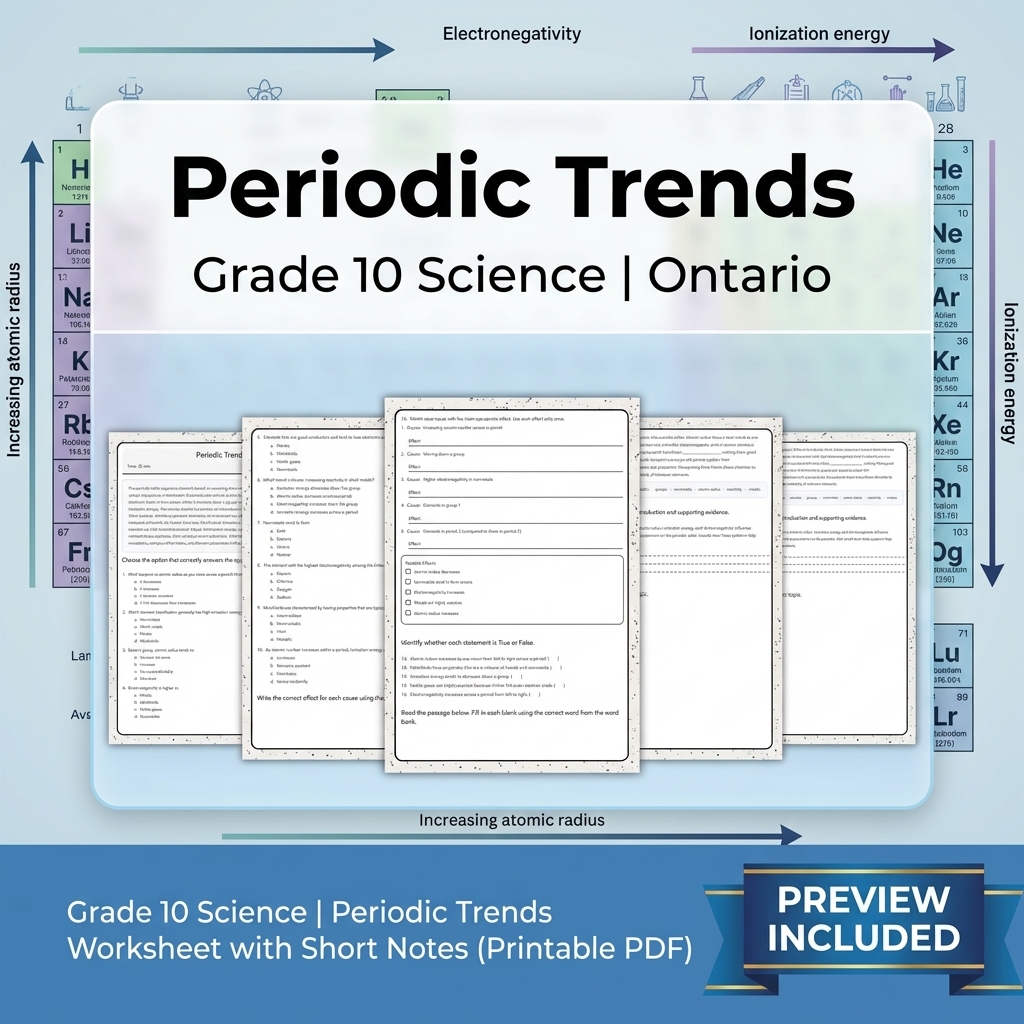
Grade 10 Science | Periodic Trends Worksheet with Short Notes (Printable PDF)
Created byMeadowlark WorksheetsLearning Objectives
- Understand the patterns of atomic radius, ionization energy, and electronegativity across the periodic table.
- Describe the classification of elements into metals, nonmetals, and metalloids based on shared properties.
- Explain how group and period relationships influence valence electrons and reactivity.
Also included in: Grade 10 Science Lesson Group Bundle with Ontario Framework +1 more
Instant download
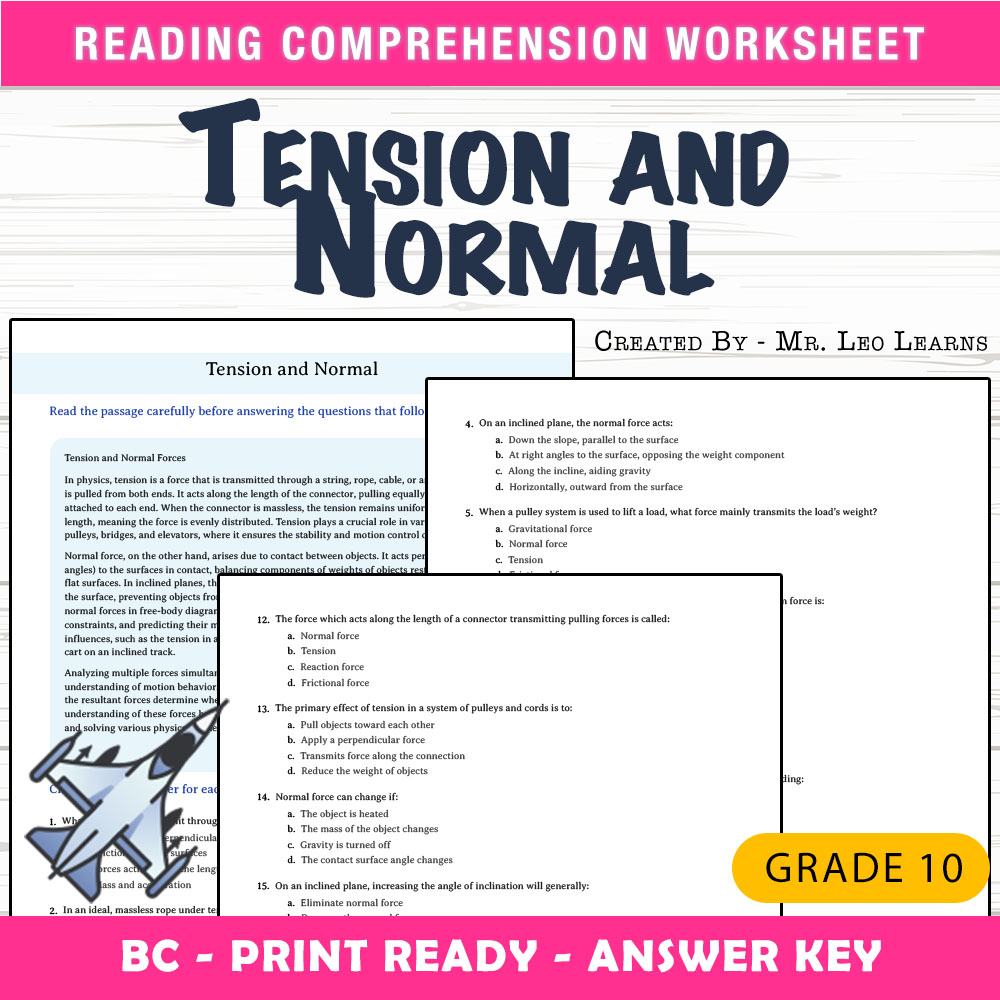
Grade 10 Science — Worksheet MCQ Paper for Mastering Tension and Normal
Created byThe Resource HubLearning Objectives
- Understand how tension transmits forces through connectors and acts along their length.
- Identify the role of normal force in contact situations and on inclines.
- Analyze how combined forces influence the motion and equilibrium of objects.
Also included in: Grade 10 Science | Forces, Motion & Fields UNIT Worksheet Bundle +1 more
Instant download

Adaptation Strategies Worksheet for AP Science Grade 10 with Answer Key
 Created byBright Quill Resources
Learning Objectives
- Evaluate trade-offs among carbon management, engineered resilience, conservation, and land-use policy in Earth systems
- Use systems thinking and scenario comparisons to predict potential effectiveness and unintended consequences of adaptation strategies
- Apply cost-benefit reasoning and uncertainty analysis to judge scalable interventions and monitoring needs
Instant download
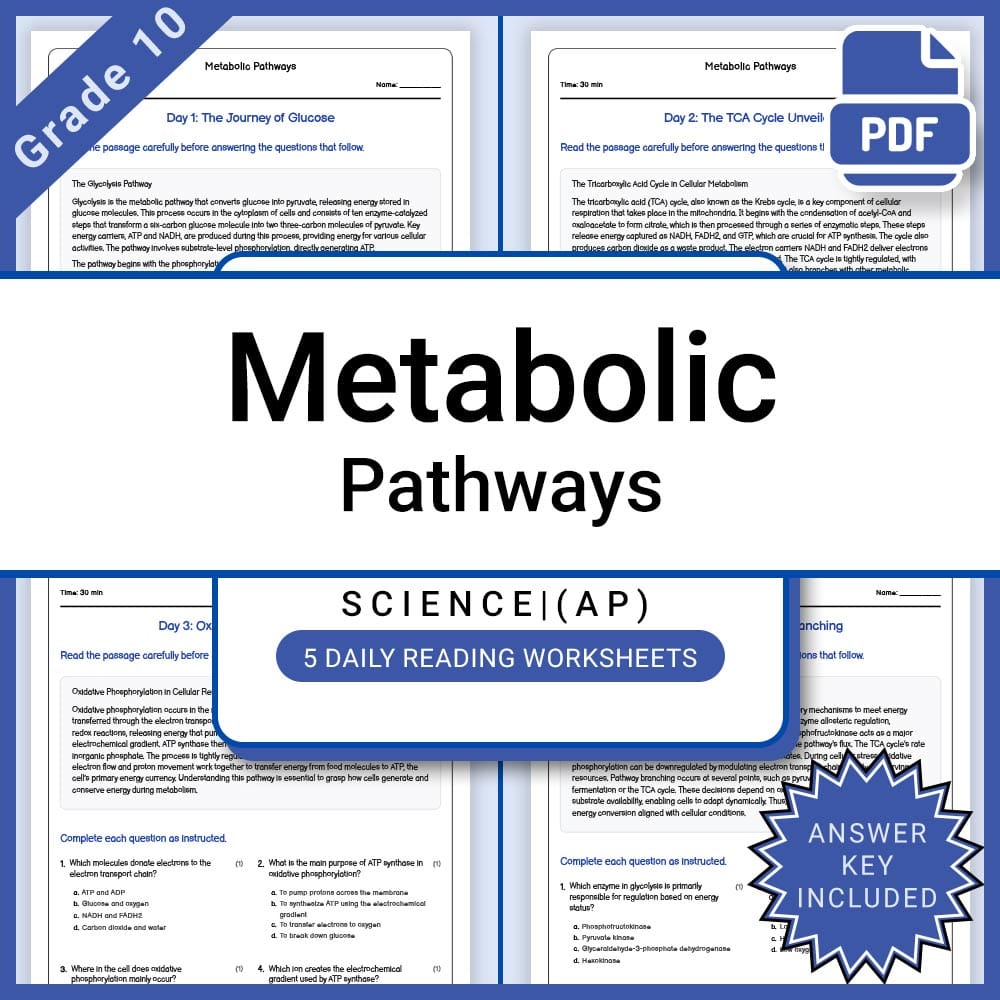
Grade 10 Science – Metabolic Pathways Daily Reading Worksheet + Answer Key
JCreated byJ.S SheetsLearning Objectives
- Understand key concepts related to Science
- Apply knowledge through practice questions
- Demonstrate comprehension of the material
Also included in: Grade 10 Science Lesson Group Bundle | AP Framework & Daily Worksheets
Instant download

Grade 10 Science – DNA Structure & Function | Daily Reading Worksheet
 Created byBright Mind Resources
Learning Objectives
- Understand the structural features of DNA, including double helix geometry, complementary base pairing, and antiparallel strands.
- Describe the mechanisms of DNA replication, including roles of DNA polymerase and helicase, and the importance of fidelity mechanisms.
- Explain how DNA sequences encode proteins through transcription and translation.
Also included in: Grade 10 Genetics Science Daily Reading Lesson Bundle | NGSS +2 more
Instant download
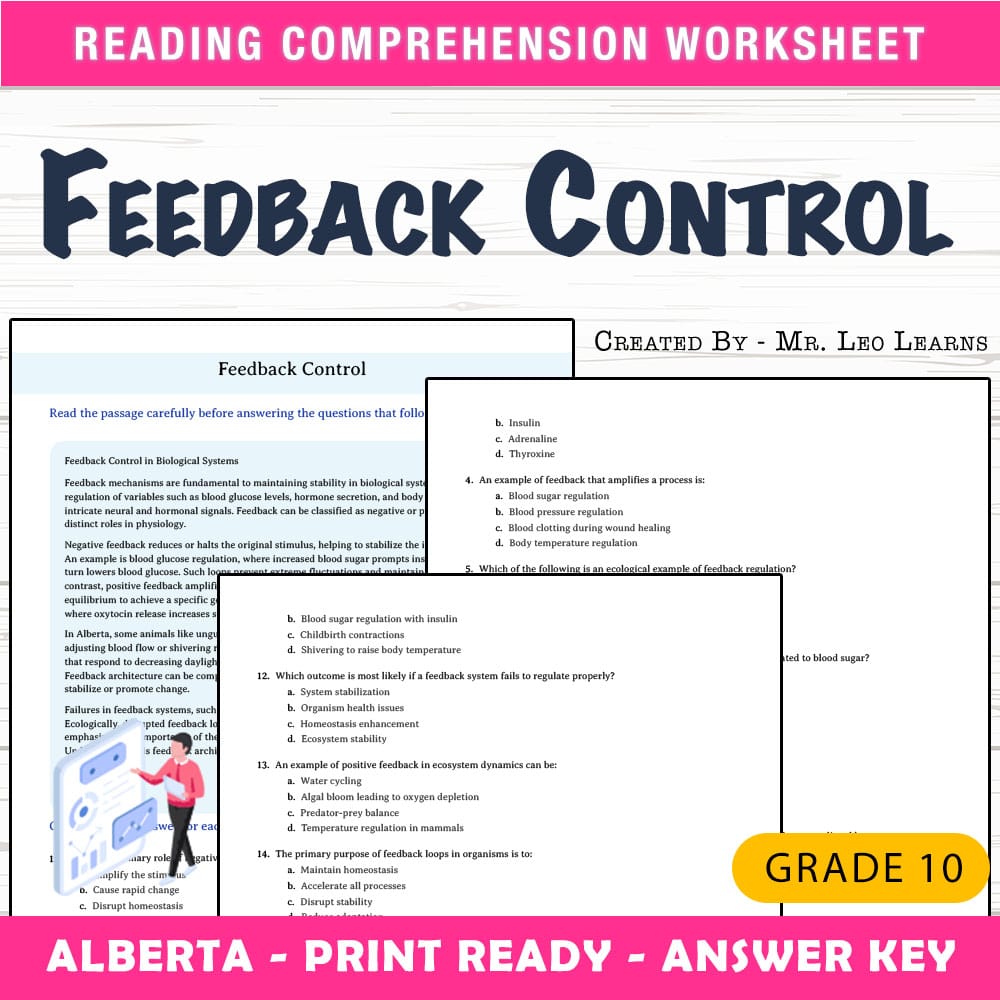
Grade 10 Science — Worksheet MCQ Paper for Mastering Feedback Control
Created byThe Resource HubLearning Objectives
- Understand the mechanisms of negative and positive feedback in physiological regulation.
- Identify real-world examples of feedback systems in organisms and ecosystems.
- Differentiate between stabilizing (negative) and amplifying (positive) feedback loops.
Also included in: Grade 10 Science Cells and Systems Lesson Bundle | Alberta Curriculum +1 more
Instant download
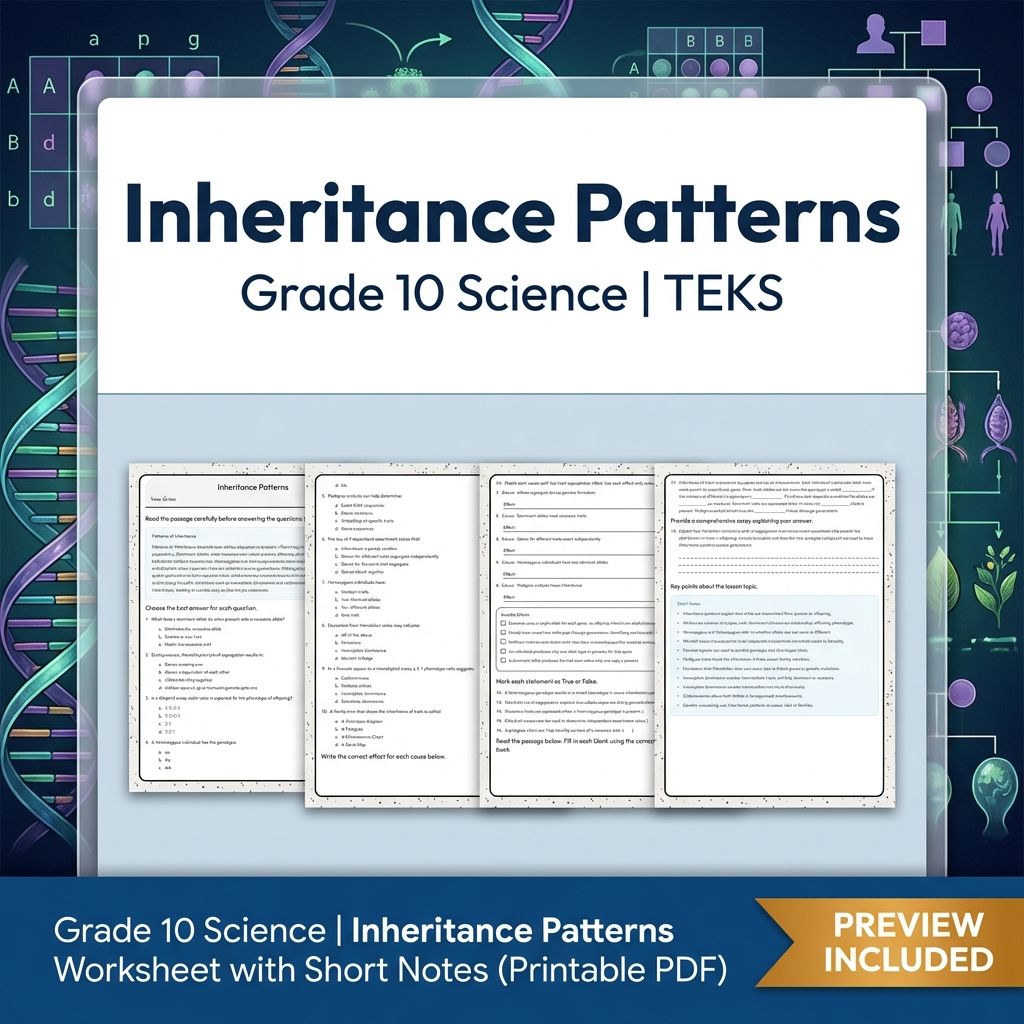
Grade 10 Science | Inheritance Patterns Worksheet with Short Notes (PDF)
Created byMeadowlark WorksheetsLearning Objectives
- Explain how dominant and recessive alleles influence traits.
- Describe Mendelian principles such as segregation and independent assortment.
- Interpret pedigree charts to analyze trait inheritance.
Instant download
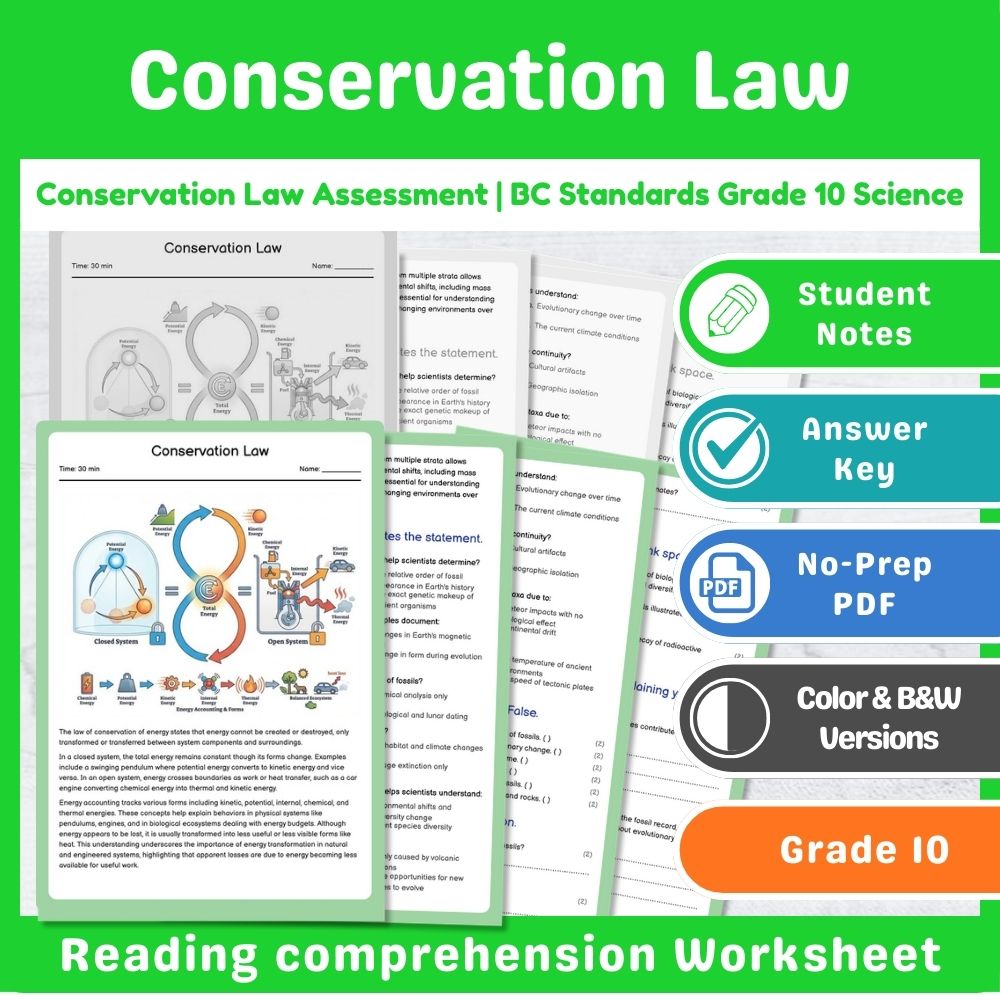
Conservation Law Assessment | BC Standards Grade 10 Science
 Created byPrism Point Learning
Learning Objectives
- Understand the principle of conservation of energy and its implications.
- Identify different forms of energy and how they transform within systems.
- Explain how energy transfer affects physical and biological processes.
Also included in: Grade 10 Science | Energy Assessment - BC Standards-Aligned Mini Bundle
Instant download
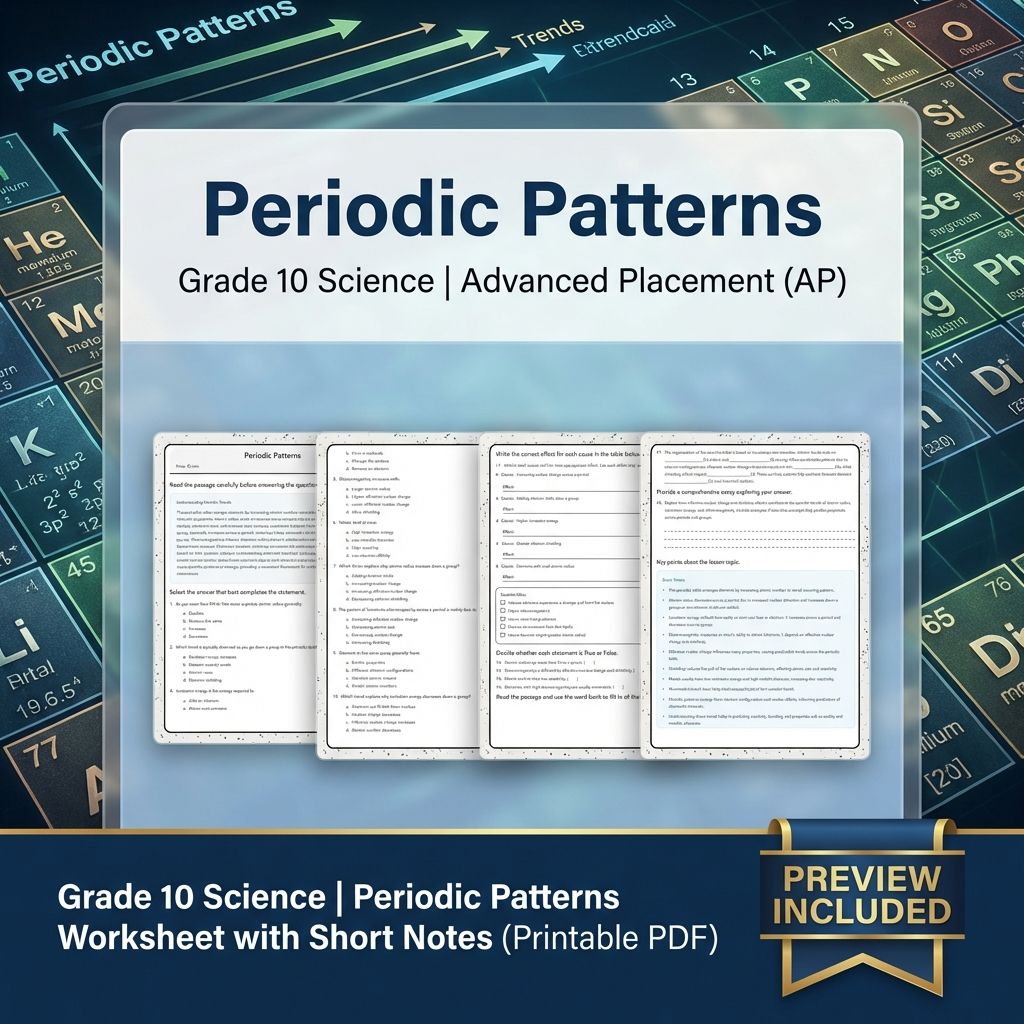
Grade 10 Science | Periodic Patterns Worksheet with Short Notes (Printable PDF)
Created byMeadowlark WorksheetsLearning Objectives
- Explain how the organization of the periodic table relates to atomic properties.
- Interpret trends such as atomic radius, ionization energy, and electronegativity across periods and groups.
- Understand the concepts of effective nuclear charge and shielding effects in atomic behavior.
Also included in: Grade 10 Science | Comprehensive Unit Bundle on Atomic Structure
Instant download
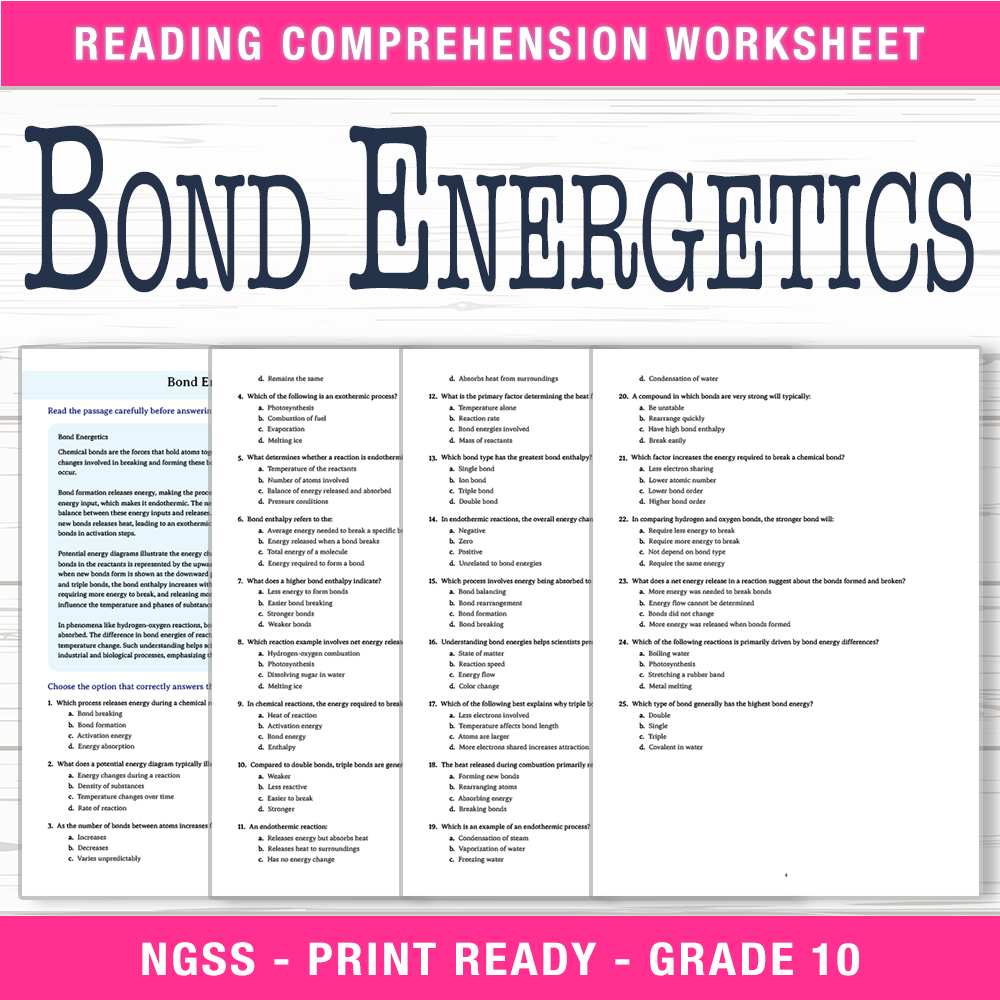
Grade 10 Science | Bond Energetics Worksheet (PDF + Answer Key)
 Created byRiverstone Classroom
Learning Objectives
- Explain how bond formation and breaking involve energy changes in chemical reactions.
- Distinguish between exothermic and endothermic processes based on bond energies.
- Interpret potential energy diagrams related to chemical bonds.
Instant download

Natural Selection Worksheet | Grade 10 Biology NGSSS | Evolution Practice + Key
 Created byEvergreen Desk Education
Learning Objectives
- Explain how natural selection changes heritable traits in a population across generations.
- Use the concept of fitness to predict how traits become more common under specific environmental conditions.
- Differentiate structural, behavioral, and physiological traits and relate them to survival and reproduction.
Instant download

Argument With Evidence Assessment for Grade 10 Science | Standards-Aligned
Created byPrism Point LearningLearning Objectives
- Understand how evidence supports scientific claims in argumentation.
- Distinguish between correlation and causation in scientific reasoning.
- Evaluate counterclaims by assessing relevant data and observations.
Instant download

Grade 10 Science | Balancing Equations Worksheet | BC Standards
 Created byLumora Learning
Learning Objectives
- Understand the importance of balancing chemical equations to reflect conservation of mass.
- Learn how to adjust coefficients without changing chemical formulas.
- Identify and interpret stoichiometric relationships in balanced equations.
Instant download
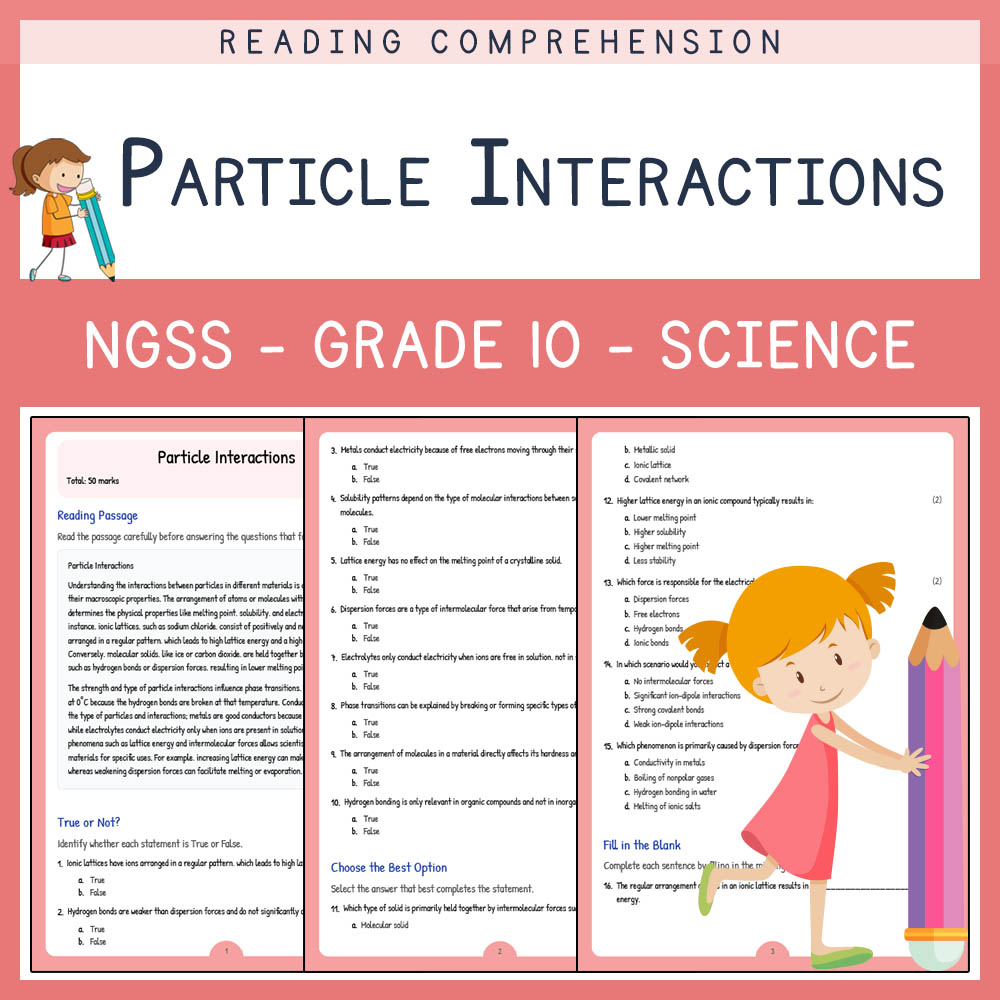
Grade 10 Science | Particle Interactions Worksheet & Answer Key (NGSS Aligned)
Created byLumora LearningLearning Objectives
- Understand how crystal structures influence material properties such as melting point and solubility.
- Analyze the role of molecular interactions, including ionic bonds, hydrogen bonds, and dispersion forces, in phase transitions.
- Compare electrical forces in metals and electrolytes and relate them to conductivity.
Instant download
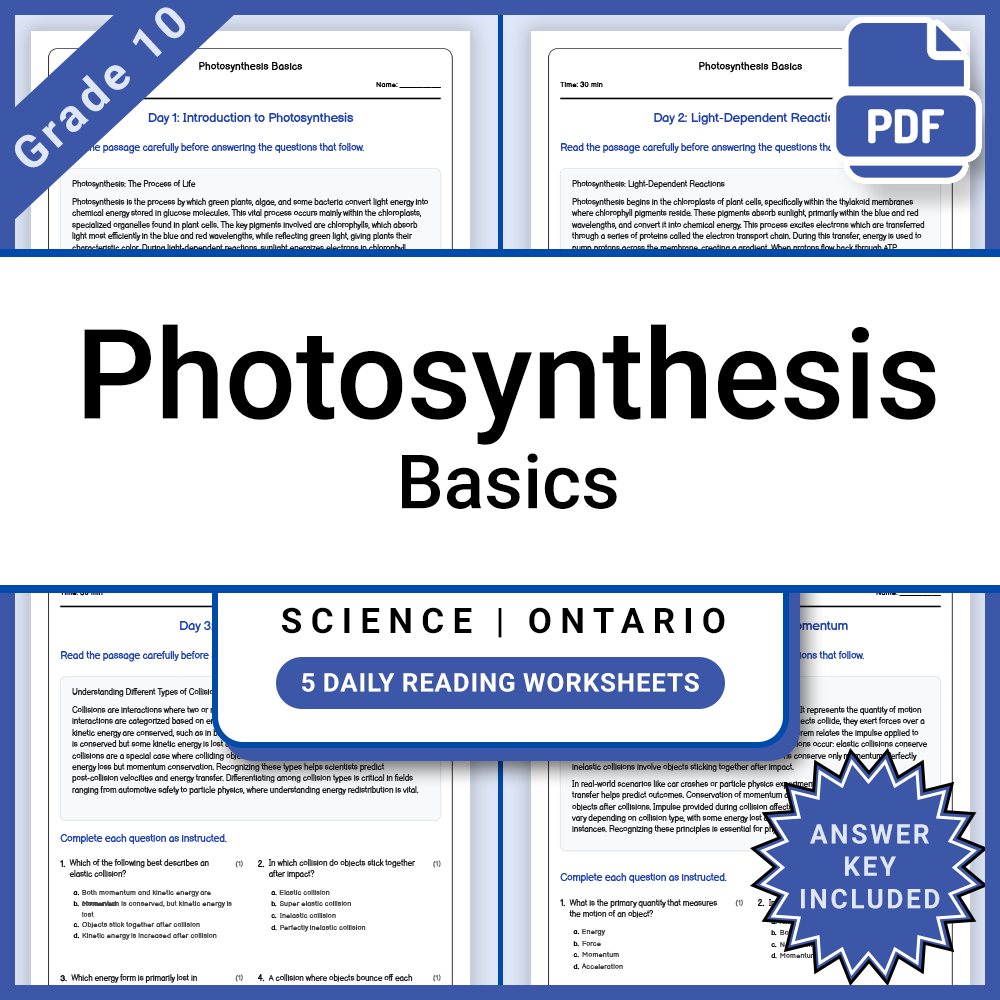
Grade 10 Science – Photosynthesis Daily Reading Worksheet with Answer Key
JCreated byJ.S SheetsLearning Objectives
- Understand the overall process of photosynthesis
- Identify the role of chloroplasts and pigments in capturing light energy
- Explain the light-dependent reactions and the Calvin cycle
Also included in: Grade 10 Science Lesson Bundle | Ontario Curriculum and Daily Reading Worksheets +1 more
Instant download
About Grade 10 Science Worksheets
Find Science worksheets built for Grade 10. All 7,038 cover core skills, practice, and review, each an instant PDF download.
Every worksheet on MyTeachingSheets is created by independent teacher-authors and reviewed before publication. All resources download as printable PDFs for classroom, homework, or at-home practice, and many include answer keys. Preview any worksheet free before buying.