
Grade 10 Science Worksheets
7,038 worksheets
Grade 10 Science – Population Dynamics Worksheet (TEKS) PDF
 Created byEvergreen Desk Education
Learning Objectives
- Explain how birth and death rates, immigration and emigration shape population size over time
- Describe how carrying capacity and limiting factors influence exponential vs. logistic growth
- Interpret how biotic interactions (competition, predation, disease) and resource availability can change growth rates
Instant download
Grade 10 Science — Worksheet MCQ Paper for Mastering Energy Technologies
 Created byThe Resource Hub
Learning Objectives
- Understand the diversity of energy conversion devices and their mechanisms.
- Evaluate the efficiency, sustainability, and environmental impact of various energy technologies.
- Compare different energy sources using quantitative metrics such as energy return on investment and efficiency.
Also included in: Grade 10 Science | Energy Transfer & Conservation UNIT Worksheet Bundle +1 more
Instant download
Grade 10 Science — Worksheet MCQ Paper for Mastering Electric Circuits
Created byThe Resource HubLearning Objectives
- Understand the components and basic principles of electric circuits.
- Identify the roles of generators, transformers, and transmission lines in electrical supply.
- Analyze factors affecting the efficiency of power transmission.
Also included in: Grade 10 Science | Energy Transfer & Conservation UNIT Worksheet Bundle +1 more
Instant download
Grade 10 Science — Photosynthesis Efficiency Worksheet MCQ for Mastery
Created byThe Resource HubLearning Objectives
- Explain the role of absorption spectra, enzymatic processes, and respiration in limiting photosynthesis efficiency.
- Compare natural photosynthesis with engineered photovoltaic systems in terms of resource needs and energy conversion.
- Evaluate environmental trade-offs involved in bioenergy cropping and land use for renewable energy.
Also included in: Grade 10 Science | Energy Transfer & Conservation UNIT Worksheet Bundle +1 more
Instant download
Grade 10 Science — Worksheet MCQ Paper for Mastering Solar Conversion
Created byThe Resource HubLearning Objectives
- Understand the processes involved in converting radiant energy into electrical and chemical forms.
- Identify the role of semiconductors and photoelectrochemical reactions in solar energy systems.
- Explain the significance of material properties like bandgaps and quantum efficiency in energy conversion.
Also included in: Grade 10 Science | Energy Transfer & Conservation UNIT Worksheet Bundle +1 more
Instant download
Grade 10 Science — Work and Energy Worksheet for Mastery
Created byThe Resource HubLearning Objectives
- Understand the relationship between work done by forces and energy transfer.
- Explain the work–energy principle and its role in mechanical systems.
- Describe how power measures the rate of energy transfer.
Also included in: Grade 10 Science | Energy Transfer & Conservation UNIT Worksheet Bundle +1 more
Instant download
Grade 10 Science — Worksheet MCQ Paper for Mastering Thermodynamics
Created byThe Resource HubLearning Objectives
- Understand the fundamental principles of thermodynamics, including energy conservation and entropy.
- Explain how heat engines and refrigerators operate between temperature reservoirs.
- Analyze the factors limiting the efficiency of real thermodynamic devices.
Also included in: Grade 10 Science | Energy Transfer & Conservation UNIT Worksheet Bundle +1 more
Instant download
Grade 10 Science — Battery Storage Worksheet MCQ Paper for Mastery
Created byThe Resource HubLearning Objectives
- Understand the principles of chemical to electrical energy conversion in batteries
- Explain how charge–discharge cycles affect battery capacity and performance
- Describe the factors influencing battery efficiency and longevity
Also included in: Grade 10 Science | Energy Transfer & Conservation UNIT Worksheet Bundle +1 more
Instant download
Grade 10 Science — Worksheet MCQ Paper for Mastering Efficiency Metrics
Created byThe Resource HubLearning Objectives
- Understand the key efficiency metrics used in energy systems.
- Interpret different efficiency indicators including percent efficiency, EROI, COP, and LCOE.
- Evaluate trade-offs and impacts when comparing energy technologies.
Also included in: Grade 10 Science | Energy Transfer & Conservation UNIT Worksheet Bundle +1 more
Instant download
Grade 10 Science — Worksheet MCQ Paper for Mastering Energy Forms
Created byThe Resource HubLearning Objectives
- Identify different forms of energy such as kinetic, potential, thermal, chemical, radiant, and nuclear.
- Understand how systems store and release energy during various processes.
- Analyze how energy shifts between forms during movement, respiration, or heating.
Also included in: Grade 10 Science | Energy Transfer & Conservation UNIT Worksheet Bundle +1 more
Instant download
Grade 10 Science — Food Web Energy Worksheet for Mastery
Created byThe Resource HubLearning Objectives
- Understand how energy flows through an ecosystem via food webs.
- Identify the roles of producers, consumers, and decomposers in energy transfer.
- Explain the concept of energy transfer efficiency between trophic levels.
Also included in: Grade 10 Science | Energy Transfer & Conservation UNIT Worksheet Bundle +1 more
Instant download
Grade 10 Science — Lifecycle Analysis Worksheet MCQ Paper
Created byThe Resource HubLearning Objectives
- Understand the concept of lifecycle analysis and its stages.
- Identify energy inputs and outputs across a technology's lifecycle.
- Explain how upstream energy investments impact overall energy benefits.
Also included in: Grade 10 Science | Energy Transfer & Conservation UNIT Worksheet Bundle +1 more
Instant download
Grade 10 Science — Mechanical Systems Worksheet MCQ Paper PDF + Answer Key
Created byThe Resource HubLearning Objectives
- Understand how mechanical systems transfer and transform energy using gears, pulleys, and levers.
- Identify the effects of friction and collisions on mechanical energy.
- Analyze energy paths, transfer efficiencies, and the function of constraints like bearings and lubrication.
Also included in: Grade 10 Science | Energy Transfer & Conservation UNIT Worksheet Bundle +1 more
Instant download
Grade 10 Science — Conservation Law Worksheet MCQ Paper PDF + Answer Key
Created byThe Resource HubLearning Objectives
- Understand the principle that energy cannot be created or destroyed but only transferred or transformed.
- Identify different forms of energy and how they relate to conservation law.
- Apply the conservation law to real-world systems like pendulums, engines, and ecological energy budgets.
Also included in: Grade 10 Science | Energy Transfer & Conservation UNIT Worksheet Bundle +1 more
Instant download
Grade 10 Science — Heat Transfer Worksheet MCQ Paper for Mastery
Created byThe Resource HubLearning Objectives
- Explain the mechanisms of heat transfer: conduction, convection, and radiation.
- Identify material properties that affect heat transfer rates.
- Describe the role of conduction, convection, and radiation in real-world systems.
Also included in: Grade 10 Science | Energy Transfer & Conservation UNIT Worksheet Bundle +1 more
Instant download
Grade 10 Science – Reaction Types Daily Reading Worksheet + Answer Key
JCreated byJ.S SheetsLearning Objectives
- Understand the basic types of chemical reactions
- Identify synthesis, decomposition, displacement, and combustion reactions
- Predict reaction products based on reaction patterns
Also included in: Grade 10 Science Lesson Group Bundle Alberta | Worksheets & Activities +1 more
Instant download
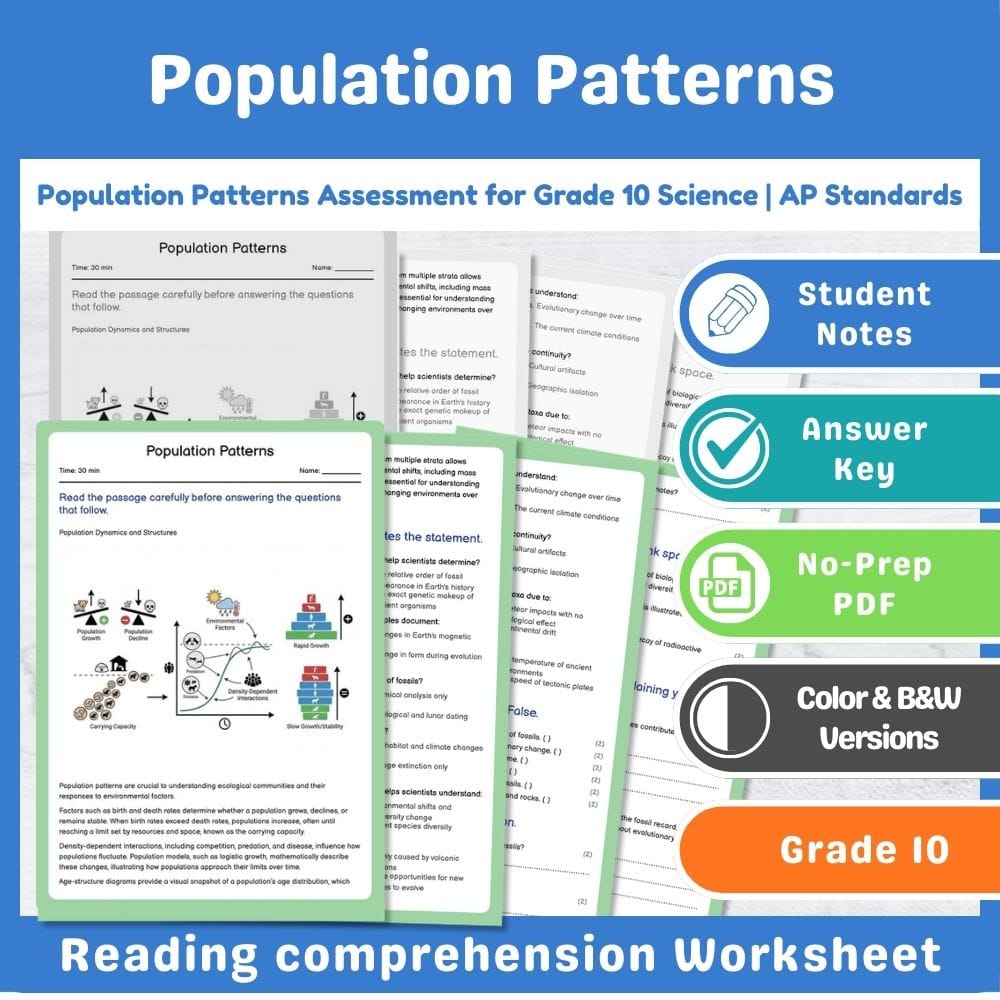
Population Patterns Assessment for Grade 10 Science | AP Standards
 Created byPrism Point Learning
Learning Objectives
- Explain factors that influence population growth, decline, and stability.
- Identify and interpret population models, age-structure diagrams, and population dynamics.
- Analyze how organism traits and environmental interactions affect population cycles and limits.
Also included in: Lesson Grade 10 Science Assessment Bundle | AP Standards-Aligned
Instant download

Cell Membrane Transport Worksheet Grade 10 Biology Activity & Review
Created byPrism Point LearningLearning Objectives
- Explain how selective permeability controls what enters and leaves a cell.
- Describe diffusion and osmosis using concentration gradients and water movement.
- Distinguish between passive transport and energy-requiring transport across membranes.
Instant download
Grade 10 Science | Photosynthesis Efficiency Worksheet (PDF + Answer Key)
 Created byCopper Leaf Classroom
Learning Objectives
- Understand the factors that influence the efficiency of photosynthesis in plants.
- Compare natural photosynthetic systems and engineered solar technologies.
- Evaluate environmental and resource trade-offs in bioenergy and renewable energy sources.
Also included in: Grade 10 Science BC – Energy, Thermodynamics & Ecosystems (PDF + Answer Key) +1 more
Instant download
10th Grade Science | Food Web Energy Worksheet (PDF + Answer Key)
Created byCopper Leaf ClassroomLearning Objectives
- Understand how energy flows through ecosystems via the food web.
- Describe the transfer and losses of energy between producers, consumers, and decomposers.
- Explain the concept of trophic transfer efficiency and its impact on ecosystem productivity.
Also included in: Grade 10 Science BC – Energy, Thermodynamics & Ecosystems (PDF + Answer Key) +1 more
Instant download

Grade 10 Science – Understanding Chemical Equations | Daily Reading Worksheet
 Created byBright Mind Resources
Learning Objectives
- Identify reactants and products in chemical equations
- Interpret chemical formulas and symbols
- Understand the use of coefficients and state symbols
Also included in: Chem Reactions Grade 10 Science Daily Reading Worksheets Lesson Bundle | BC +1 more
Instant download
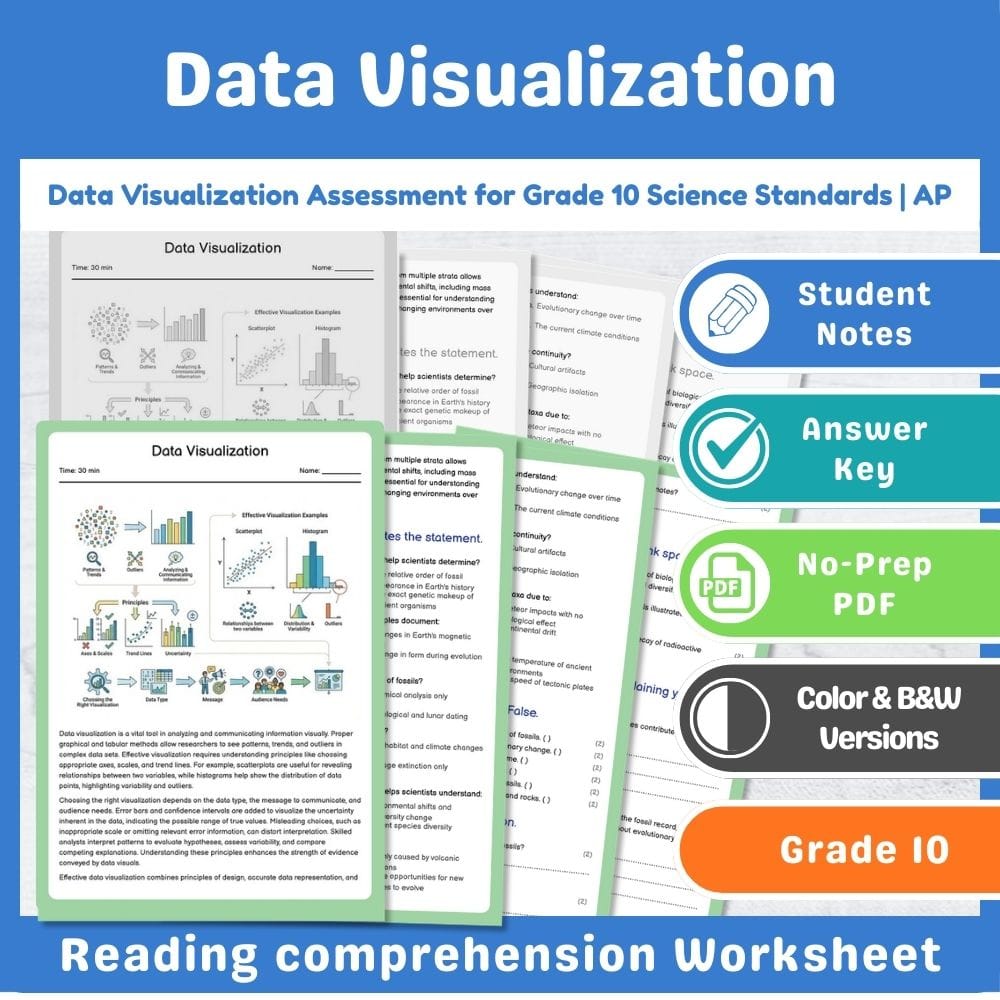
Data Visualization Assessment for Grade 10 Science Standards | AP
Created byPrism Point LearningLearning Objectives
- Describe principles and conventions for graphical and tabular representation of data.
- Identify and interpret various data visualization types such as scatterplots, histograms, and boxplots.
- Evaluate the appropriateness of different visualization choices like axes, scale, and trend lines.
Instant download
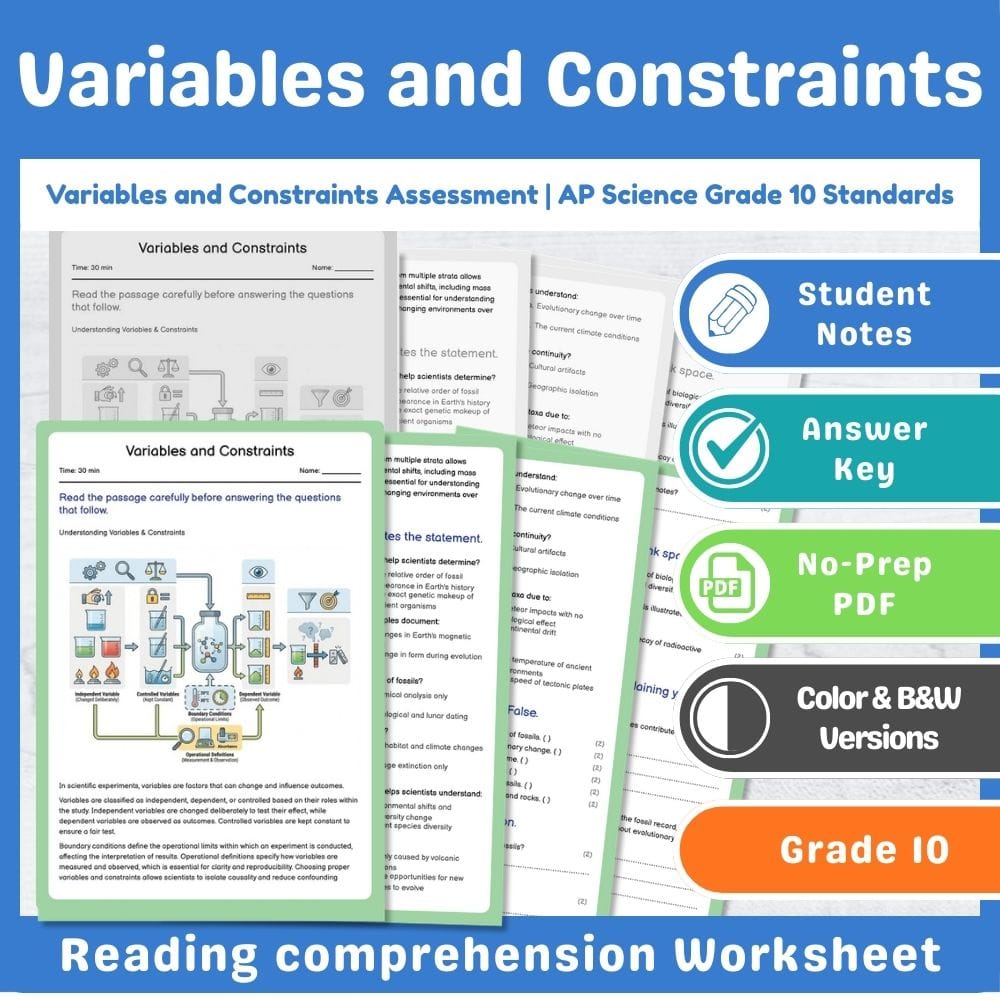
Variables and Constraints Assessment | AP Science Grade 10 Standards
Created byPrism Point LearningLearning Objectives
- Identify and classify variables as independent, dependent, or controlled in experimental scenarios.
- Explain the role of boundary conditions and operational definitions in scientific investigations.
- Discuss strategies for selecting variables and controls to produce meaningful and interpretable results.
Instant download
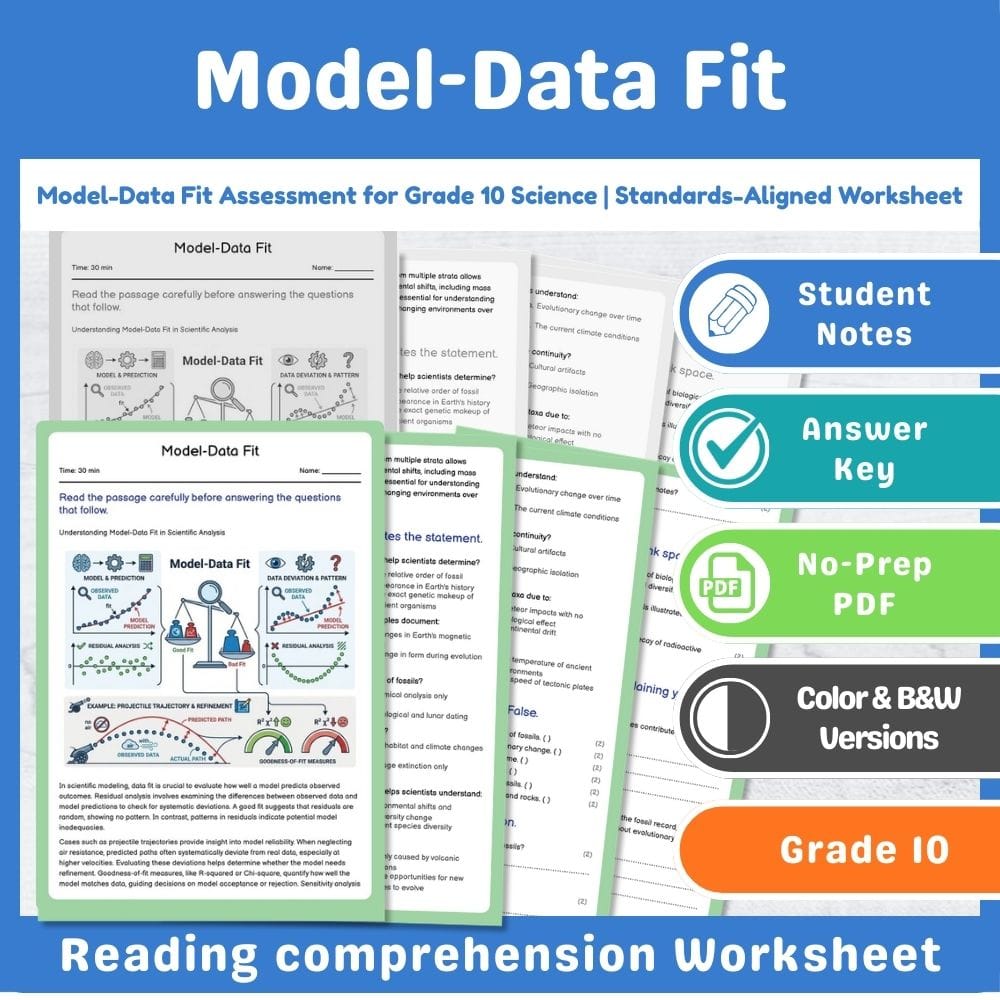
Model-Data Fit Assessment for Grade 10 Science | Standards-Aligned Worksheet
Created byPrism Point LearningLearning Objectives
- Interpret residuals and assess model adequacy using residual analysis.
- Apply goodness-of-fit concepts to evaluate the accuracy of model predictions.
- Analyze cases like projectile motion with and without air resistance to understand systematic deviations.
Instant download
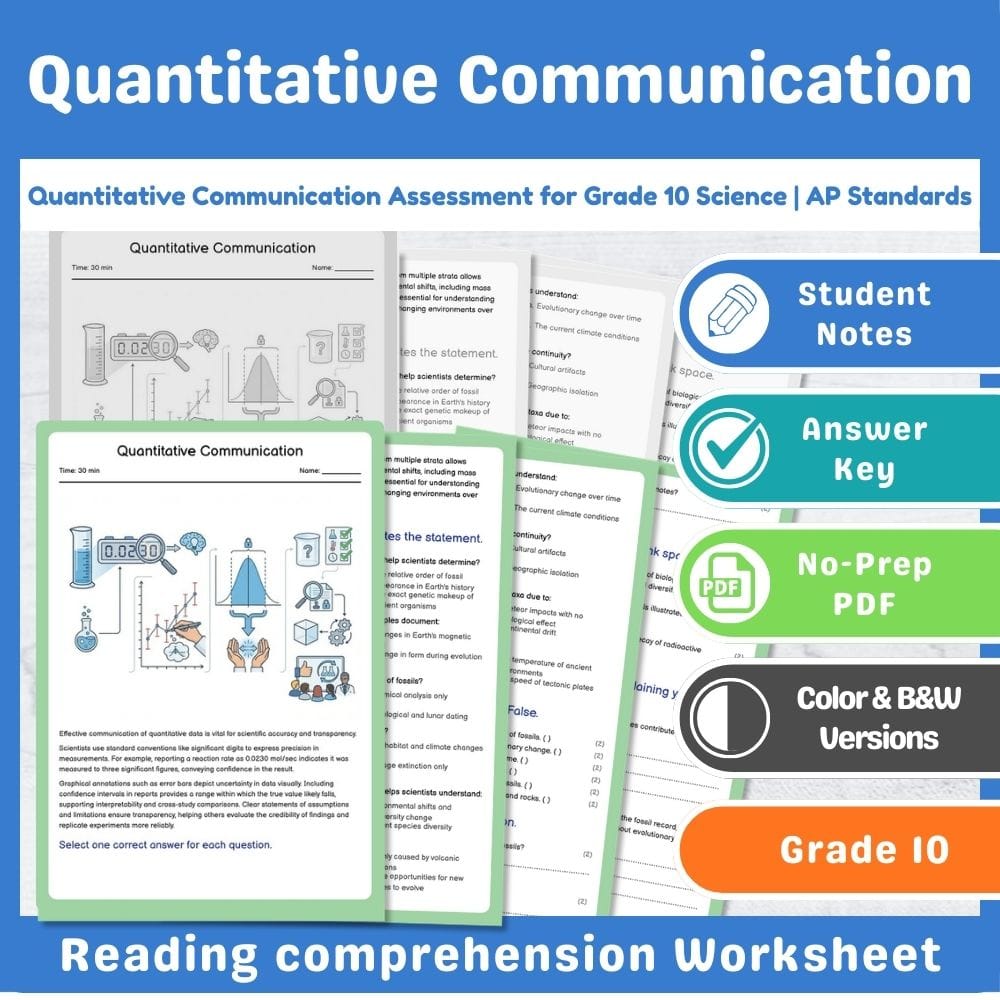
Quantitative Communication Assessment for Grade 10 Science | AP Standards
Created byPrism Point LearningLearning Objectives
- Understand conventions for reporting quantitative results, including uncertainty notation and significant digits.
- Learn strategies for visualizing data using graphs and annotations effectively.
- Identify how to articulate assumptions, limitations, and confidence intervals transparently.
Instant download
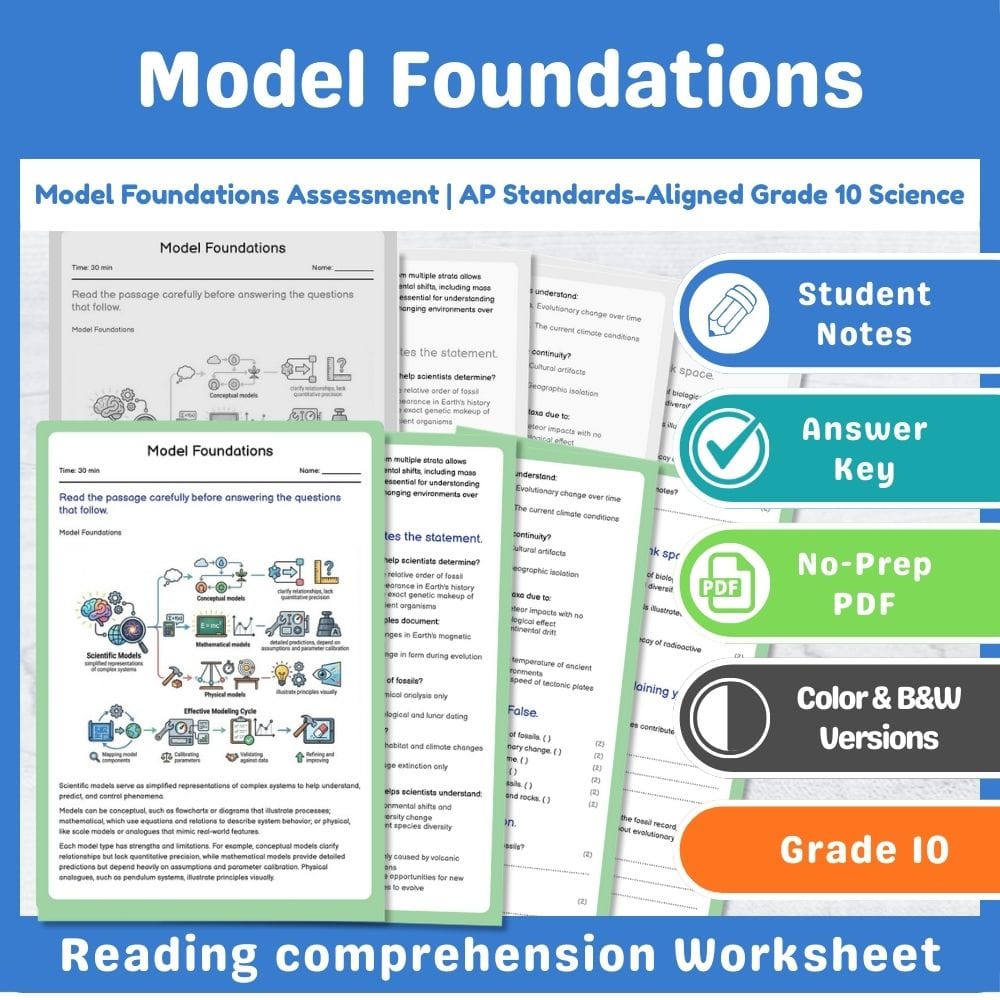
Model Foundations Assessment | AP Standards-Aligned Grade 10 Science
Created byPrism Point LearningLearning Objectives
- Explain the purpose and forms of scientific models including conceptual diagrams, mathematical relations, and physical analogues.
- Compare strengths and limitations of various types of models with examples such as pendulum motion and linear approximations.
- Understand how model components relate to observable features and how parameters and assumptions influence model applicability.
Instant download
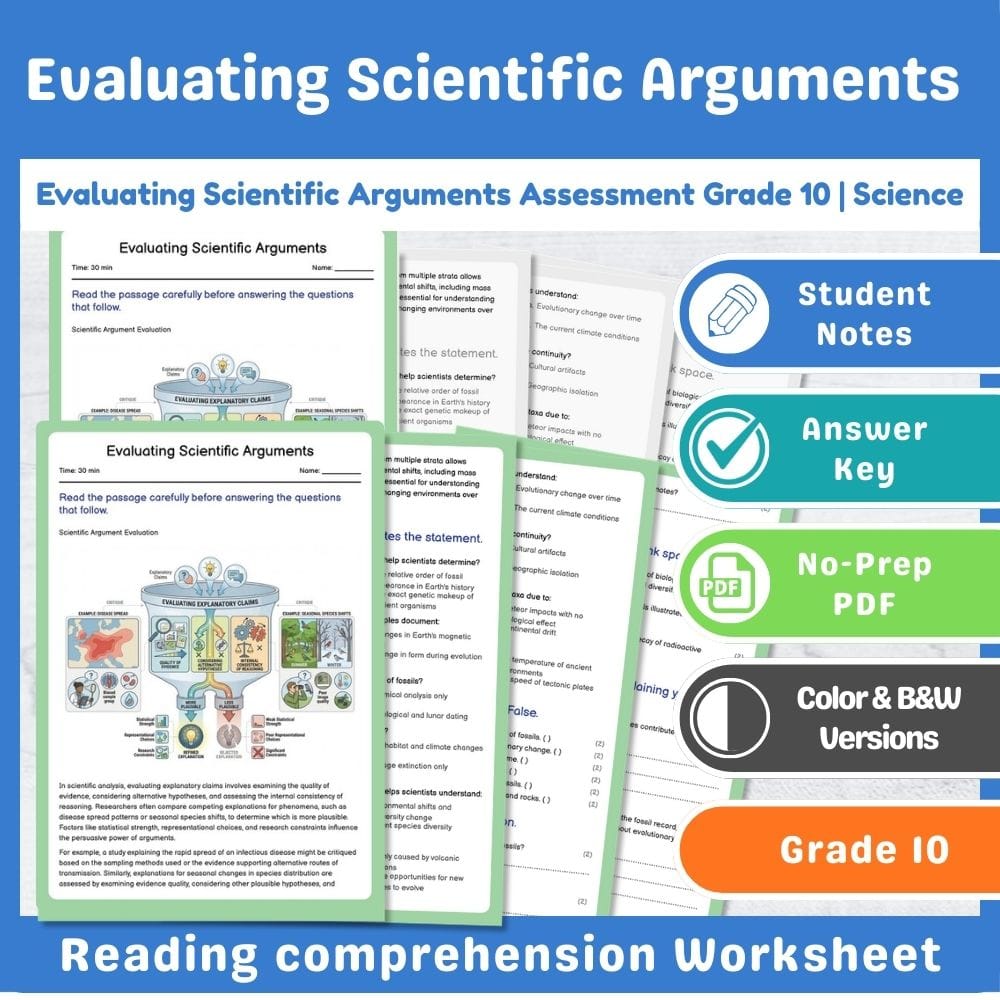
Evaluating Scientific Arguments Assessment Grade 10 | Science
Created byPrism Point LearningLearning Objectives
- Learn criteria for critically assessing explanatory claims in science.
- Examine evidence quality, alternative hypotheses, and logical coherence.
- Understand how statistical and methodological factors influence argument strength.
Instant download
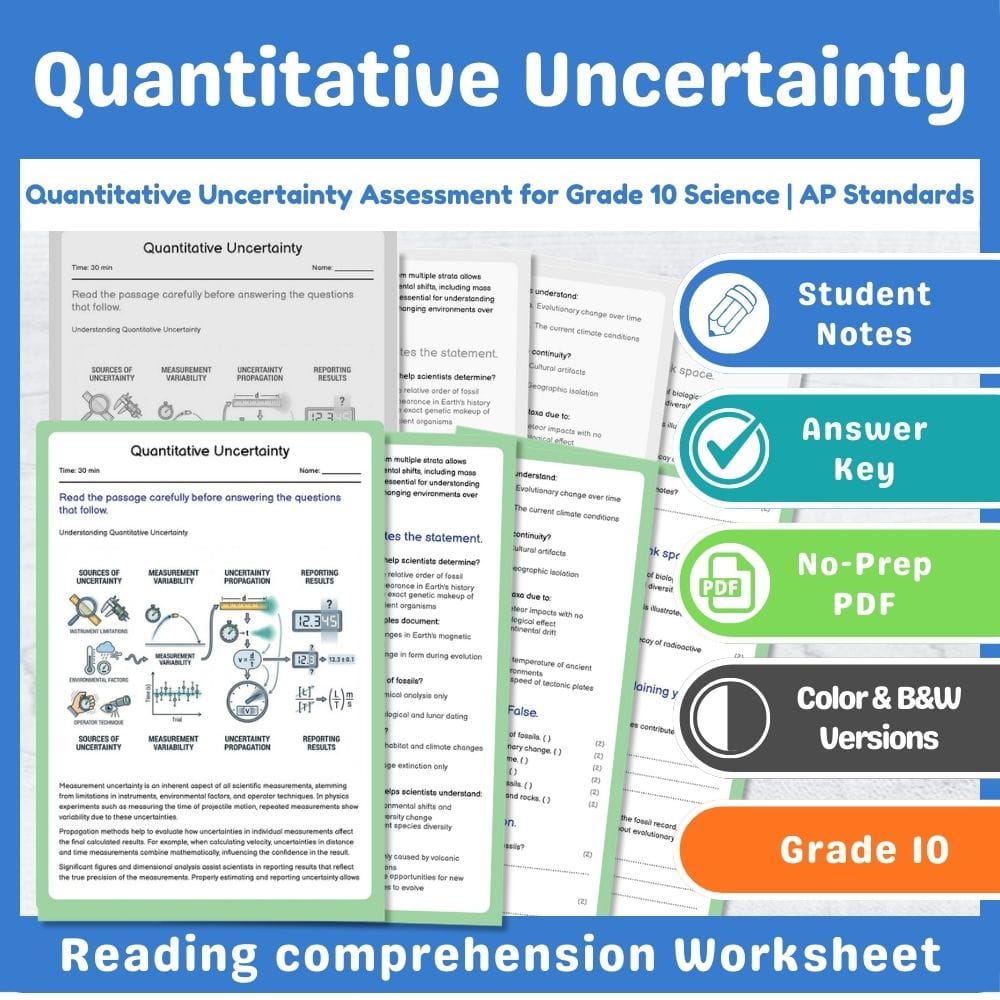
Quantitative Uncertainty Assessment for Grade 10 Science | AP Standards
Created byPrism Point LearningLearning Objectives
- Understand the concept of measurement uncertainty and its sources.
- Apply propagation methods to combine uncertainties in calculations.
- Interpret and report uncertainties using significant figures and dimensional analysis.
Instant download
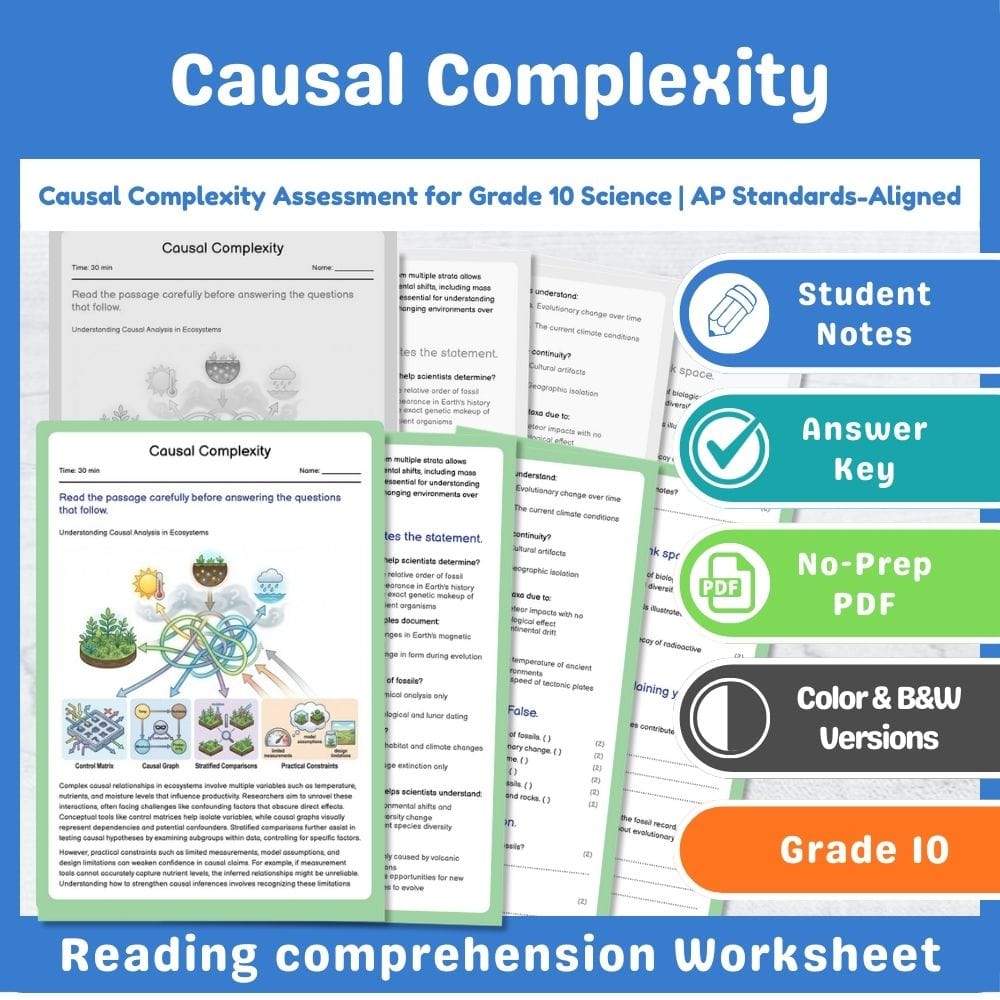
Causal Complexity Assessment for Grade 10 Science | AP Standards-Aligned
Created byPrism Point LearningLearning Objectives
- Understand methods for disentangling multivariable causal relationships in complex systems.
- Apply conceptual frameworks like control matrices, causal graphs, and stratified comparisons.
- Identify confounding factors and interaction effects in ecological and environmental contexts.
Instant download
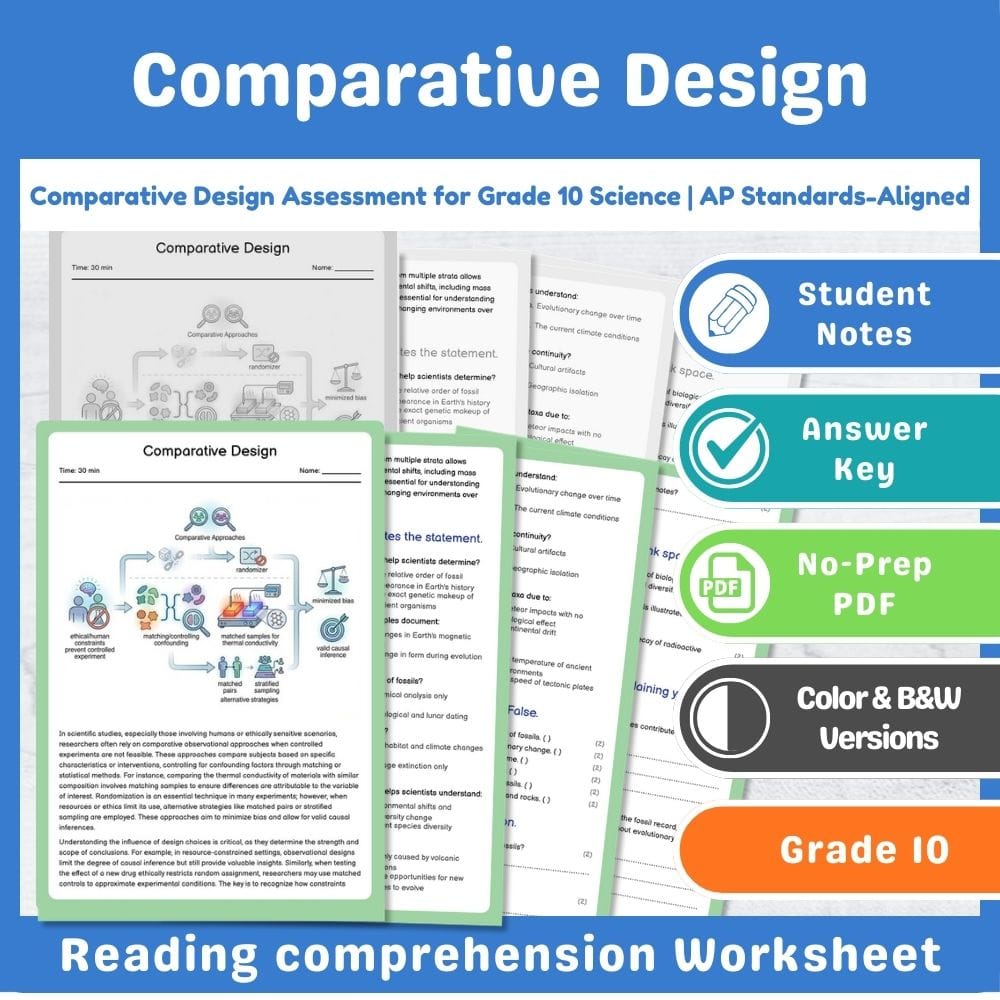
Comparative Design Assessment for Grade 10 Science | AP Standards-Aligned
Created byPrism Point LearningLearning Objectives
- Understand principles of comparative observational approaches and controlled trials.
- Identify independent and dependent variables in experimental designs.
- Recognize strategies for matching, randomization, and minimizing bias.
Instant download
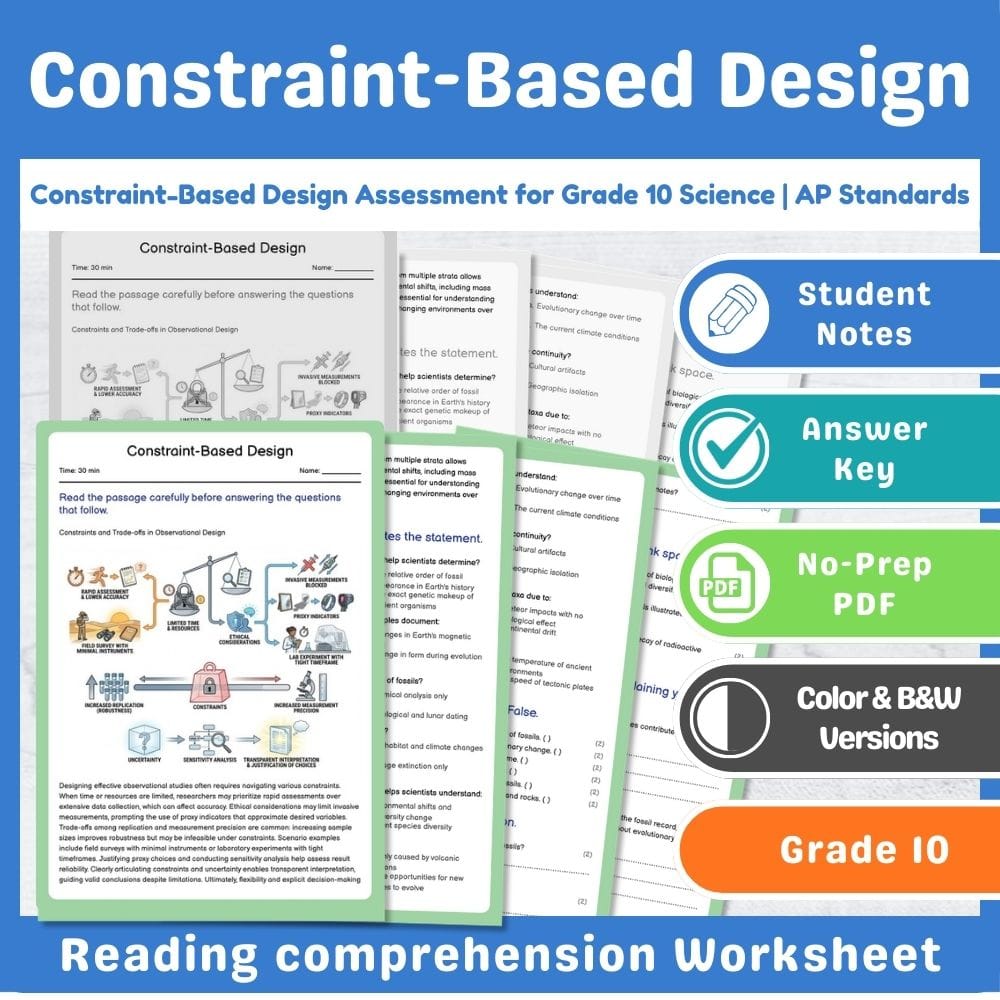
Constraint-Based Design Assessment for Grade 10 Science | AP Standards
Created byPrism Point LearningLearning Objectives
- Understand the considerations involved in designing studies under practical, ethical, or temporal constraints.
- Identify trade-offs among replication, measurement precision, and scope.
- Apply understanding of proxy measures and sensitivity analysis to assess robustness.
Instant download
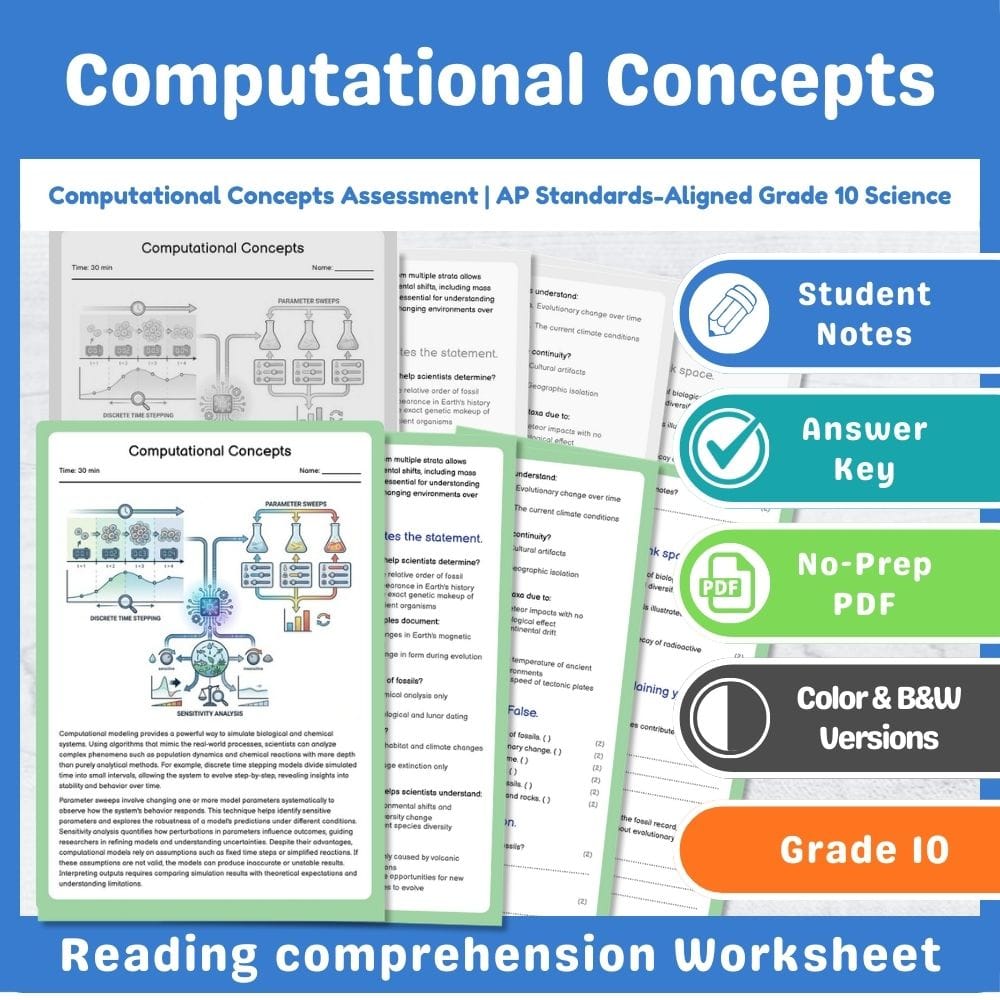
Computational Concepts Assessment | AP Standards-Aligned Grade 10 Science
Created byPrism Point LearningLearning Objectives
- Understand basic computational approaches used in modeling dynamic systems.
- Identify methods such as discrete time stepping, parameter sweeps, and sensitivity analysis.
- Recognize assumptions, stability concerns, and interpretation of simulation outputs.
Instant download
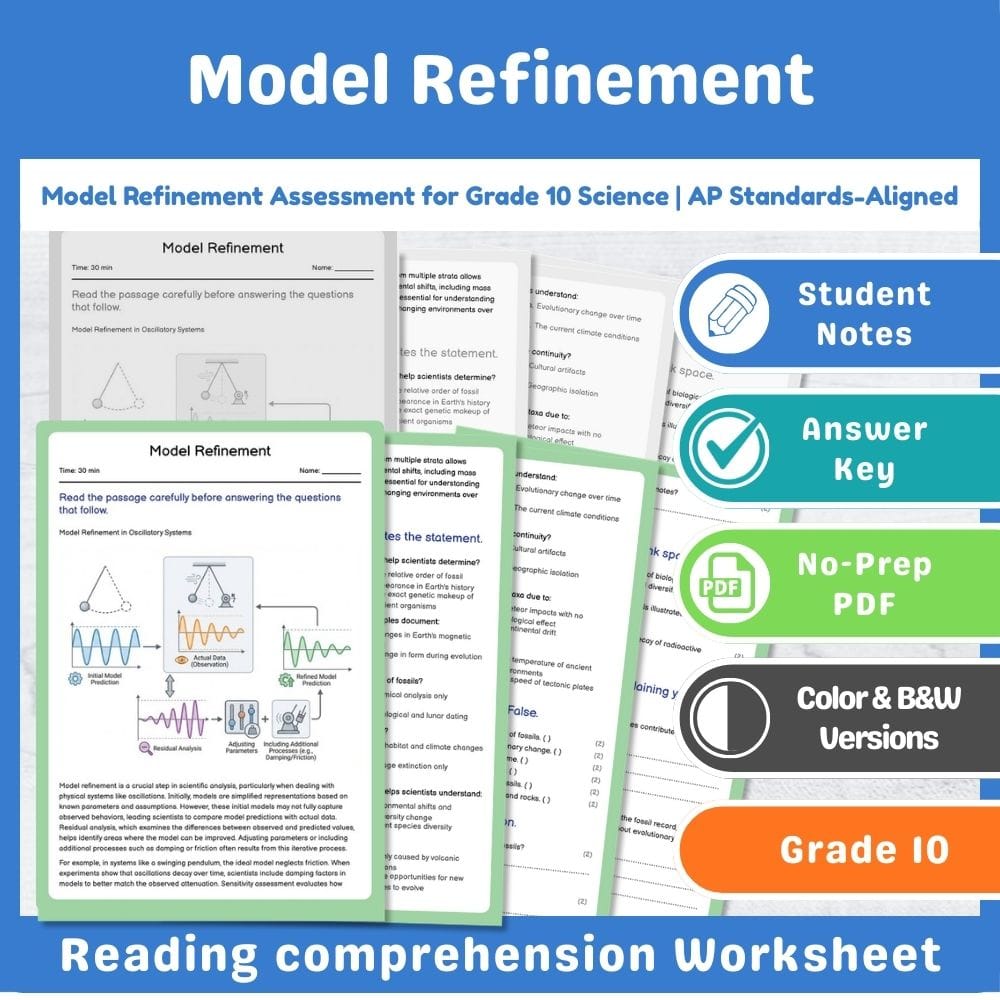
Model Refinement Assessment for Grade 10 Science | AP Standards-Aligned
Created byPrism Point LearningLearning Objectives
- Understand how iterative comparisons and residual analysis guide model improvements.
- Explain the role of parameter estimation and inclusion of additional processes like damping in refining models.
- Evaluate the criteria for choosing between simpler and more complex models based on their explanatory power and predictive accuracy.
Instant download

Grade 10 Enzymes And Transport Worksheet | Practice & PDF
 Created byClear Sky Classroom
Learning Objectives
- Explain how enzymes act as catalysts by lowering activation energy and increasing reaction rate
- Describe how membrane structure affects diffusion, osmosis, and selective transport
- Compare passive transport with active transport and identify roles of channels and pumps
Instant download
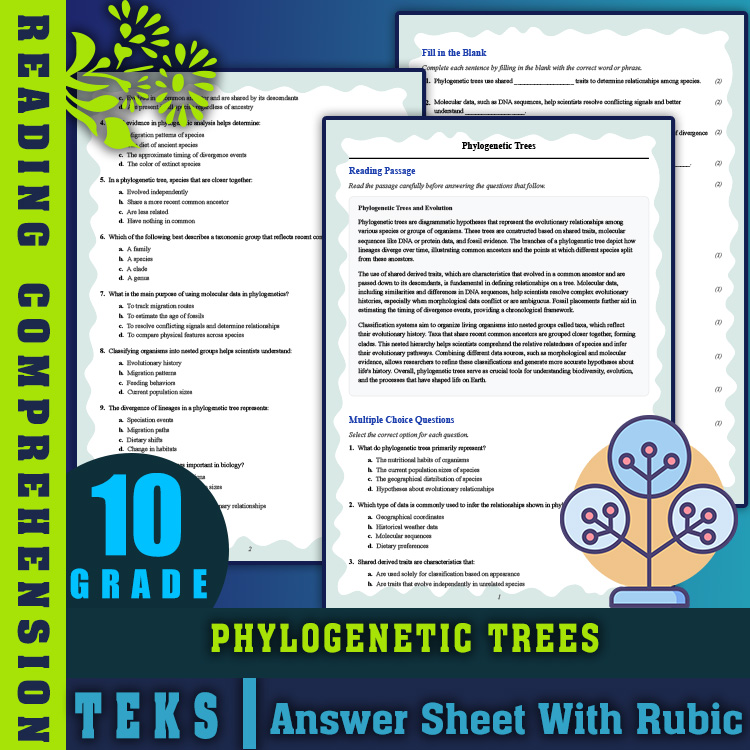
Grade 10 Science | Phylogenetic Trees Reading Worksheet (PDF & Answer Key)
JCreated byJ.S SheetsLearning Objectives
- Understand the purpose and structure of phylogenetic trees in illustrating evolutionary relationships.
- Identify shared derived traits, molecular data, and fossil evidence used to construct phylogenetic trees.
- Explain how classification reflects evolutionary history through nested groups and common ancestors.
Instant download

Grade 10 Science | Radiometric Dating - Daily Reading Comprehension
 Created byCoral Reef Learning
Learning Objectives
- Understand the concept of radioactive isotopes and their decay.
- Define half-life and explain its significance in radiometric dating.
- Identify key vocabulary related to radiometric dating.
Instant download

Grade 10 Bonding Types Worksheet PDF | Ionic Covalent Metallic Bonding
Created byEvergreen Desk EducationLearning Objectives
- Differentiate ionic, covalent, and metallic bonding at the particle level
- Predict physical properties (conductivity, melting point, and solubility) from bonding type
- Connect lattice structures and electron behavior to macroscopic observations
Instant download
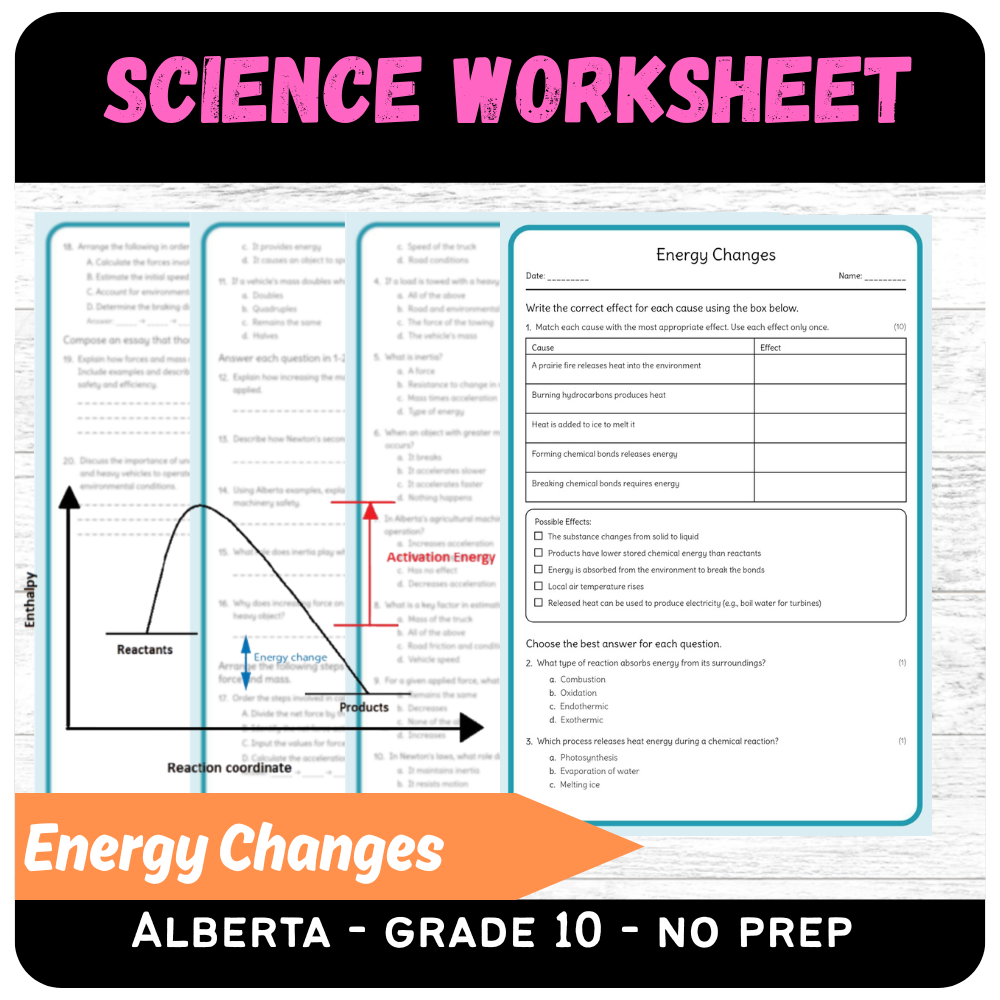
Grade 10 Science | Energy Changes Worksheet (PDF) – Alberta Curriculum
Created byBright Mind ResourcesLearning Objectives
- Understand the difference between endothermic and exothermic reactions and how energy is absorbed or released during chemical changes.
- Relate molecular bond-breaking and bond-forming processes to the macroscopic measures of energy transfer, such as calorimetric data.
- Interpret energy flow in natural phenomena like combustion and industrial processes like bitumen upgrading.
Instant download
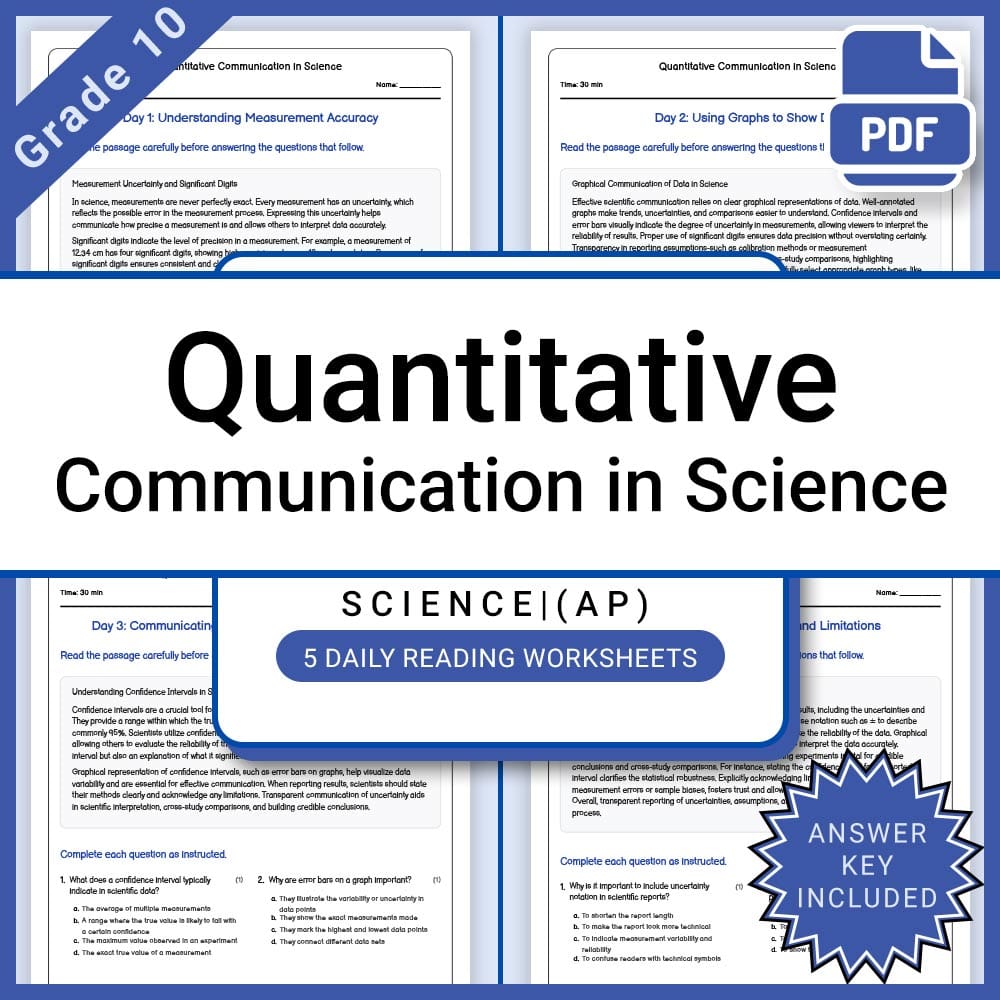
Grade 10 Science – Quantitative Communication Worksheet + Answer Key
JCreated byJ.S SheetsLearning Objectives
- Understand the importance of measurement accuracy and uncertainties
- Learn conventions for expressing significant digits
- Interpret graphical annotations and error bars
Also included in: Grade 10 Science Lesson Group – AP Curriculum Worksheets Bundle
Instant download
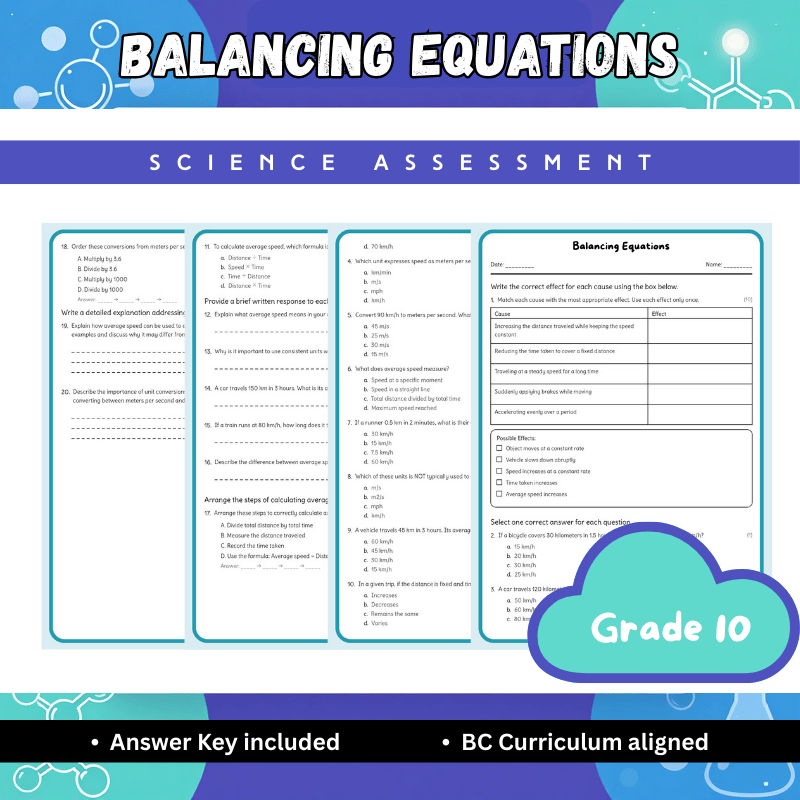
Grade 10 Science – Balancing Equations Worksheet (Answer Key) | BC Standards
Created byBright Mind ResourcesLearning Objectives
- Understand the importance of balancing chemical equations to reflect the law of conservation of mass.
- Learn how to adjust coefficients to balance chemical equations without altering formulas.
- Recognize the significance of balanced equations in stoichiometry and reaction analysis.
Instant download
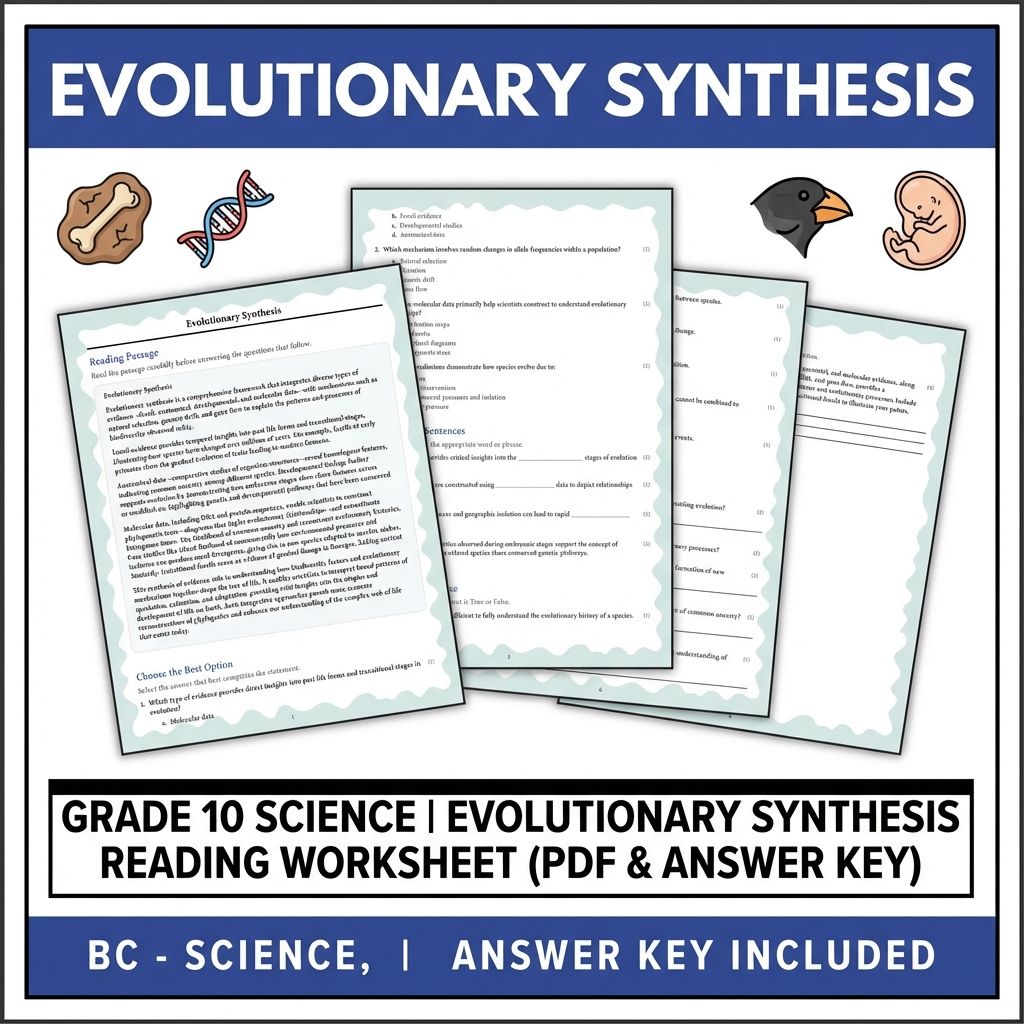
Grade 10 Science | Evolutionary Synthesis Reading Worksheet (PDF & Answer Key)
JCreated byJ.S SheetsLearning Objectives
- Understand how fossil, anatomical, developmental, and molecular data are integrated to explain biodiversity.
- Identify mechanisms like natural selection, genetic drift, and gene flow that influence evolution.
- Interpret case studies such as island finch radiation and transitional fossils to illustrate evolutionary concepts.
Instant download
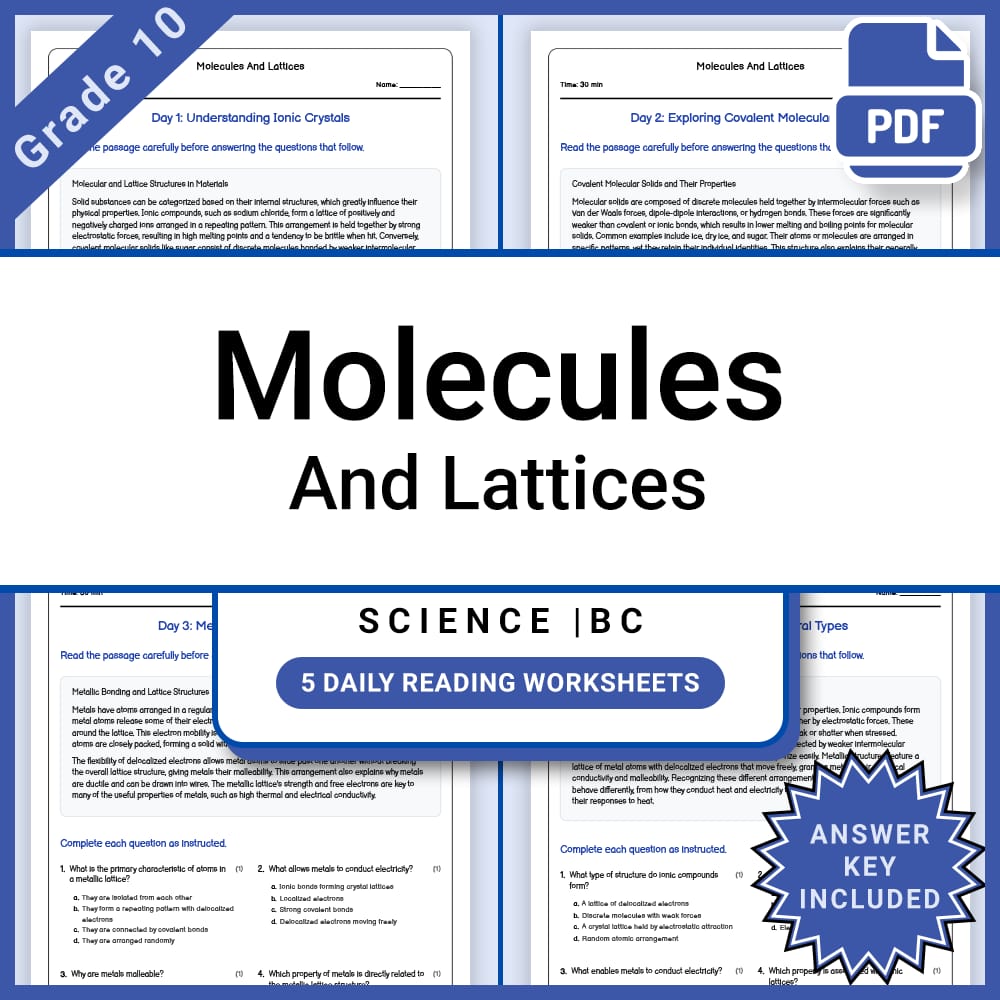
Grade 10 Science – Molecules and Lattices Daily Worksheet with Answer Key
JCreated byJ.S SheetsLearning Objectives
- Understand the structural arrangements of ionic, covalent molecular, and metallic solids
- Identify characteristics and properties influenced by these structures
- Explain how lattice structures affect material properties such as melting point, solubility, and conductivity
Also included in: Grade 10 Science Lesson Group – Core Concepts & Skills Bundle +1 more
Instant download
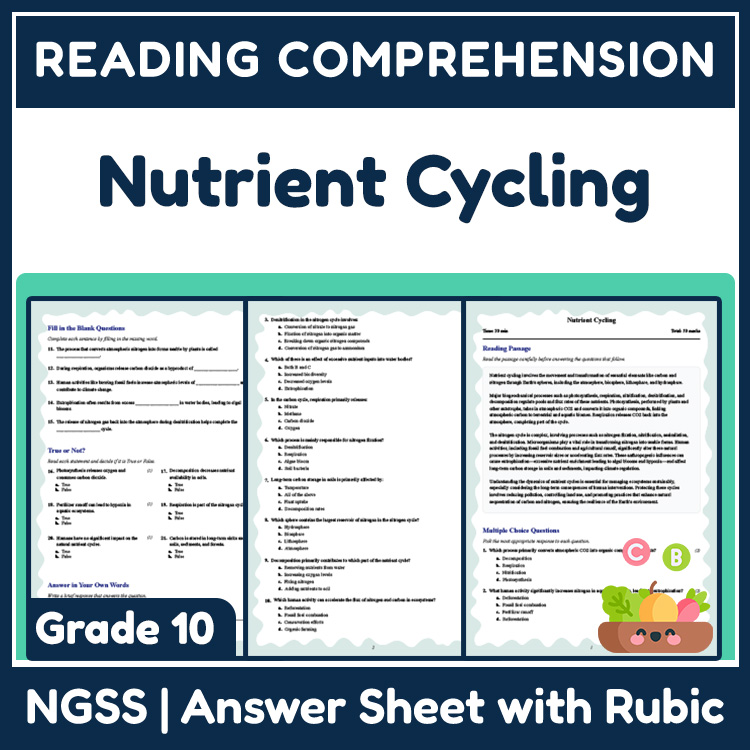
10th Grade Science | Nutrient Cycling Reading Worksheet & Rubric (PDF)
JCreated byJ.S SheetsLearning Objectives
- Understand the major biogeochemical cycles of carbon and nitrogen and their pathways among Earth's spheres.
- Analyze human impacts such as fossil fuel combustion and agricultural runoff on nutrient reservoirs and rates.
- Explain processes like photosynthesis, respiration, nitrification, denitrification, and decomposition in nutrient cycling.
Also included in: Grade 10 Science | Ecosystems & Biodiversity Uanit Worksheets
Instant download
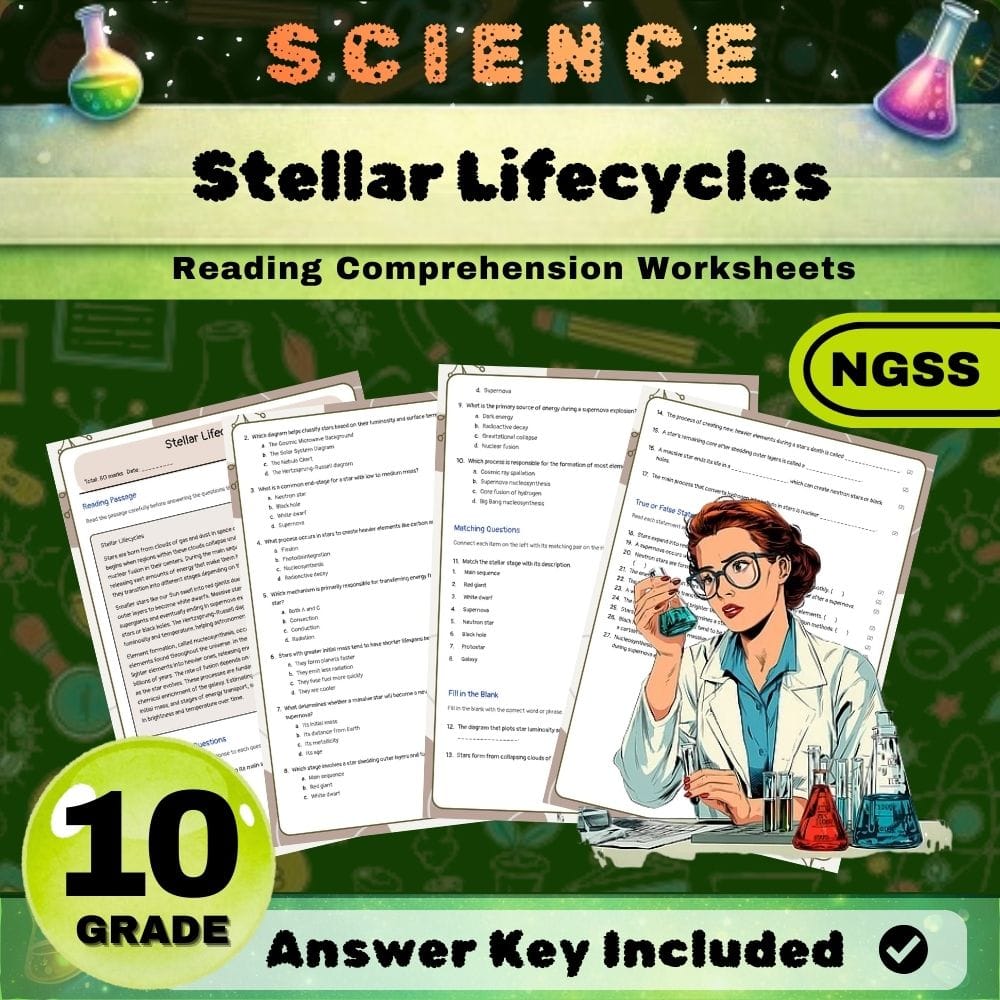
Grade 10 Science | Stellar Lifecycles Worksheet (NGSS) – PDF
 Created byMaple Path Learning
Learning Objectives
- Describe the processes involved in stellar evolution, including nuclear fusion, energy transfer, and changes in luminosity and temperature.
- Interpret the Hertzsprung-Russell diagram to understand different stages of star development.
- Explain nucleosynthesis pathways that create heavier elements during stellar evolution.
Also included in: Grade 10 Science Earth’s Place in the Universe NGSS Lesson Bundle | Framework +1 more
Instant download
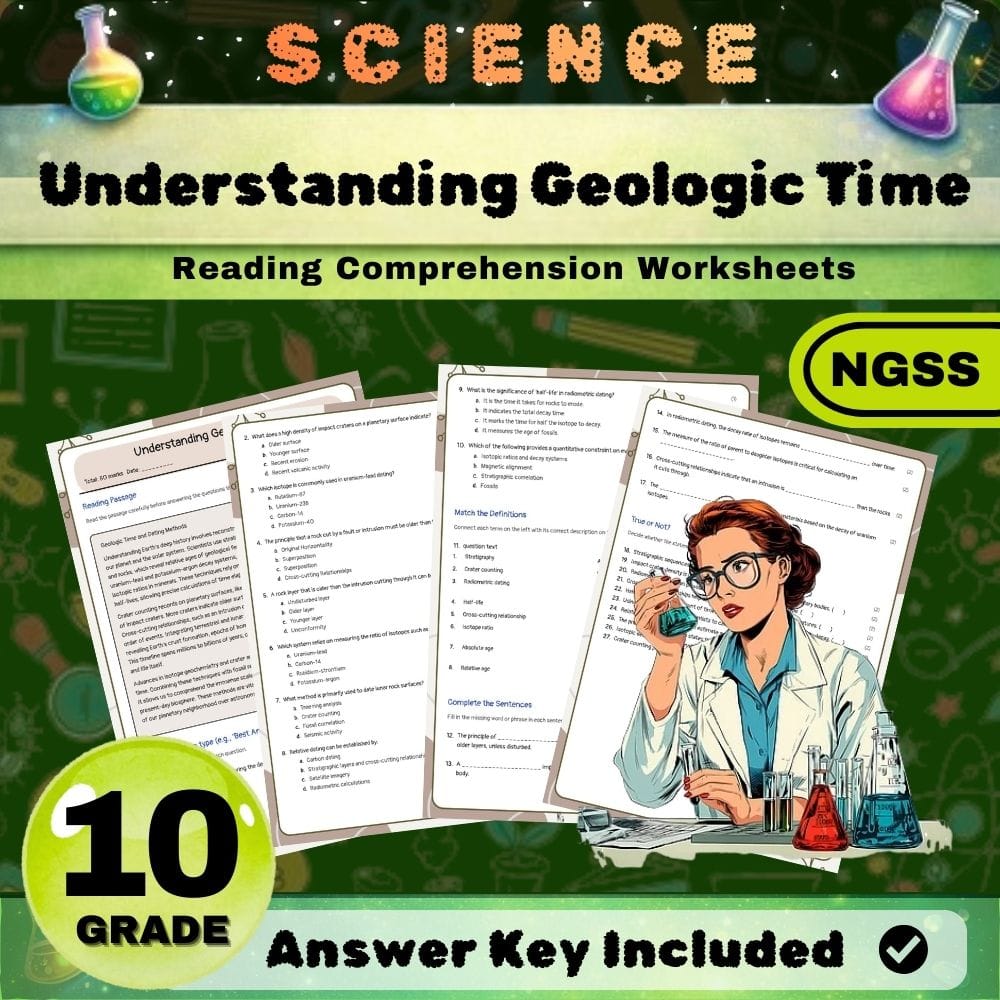
Grade 10 Science – Understanding Geologic Time Worksheet (PDF) NGSS
Created byMaple Path LearningLearning Objectives
- Explain the methods used to establish Earth's geologic history, including stratigraphy, radiometric dating, and crater counting.
- Describe how isotopic ratios and half-life decay systems help determine the age of rocks and planetary surfaces.
- Analyze the significance of cross-cutting relationships and relative dating techniques in constructing geologic timelines.
Also included in: Grade 10 Science Earth’s Place in the Universe NGSS Lesson Bundle | Framework +1 more
Instant download
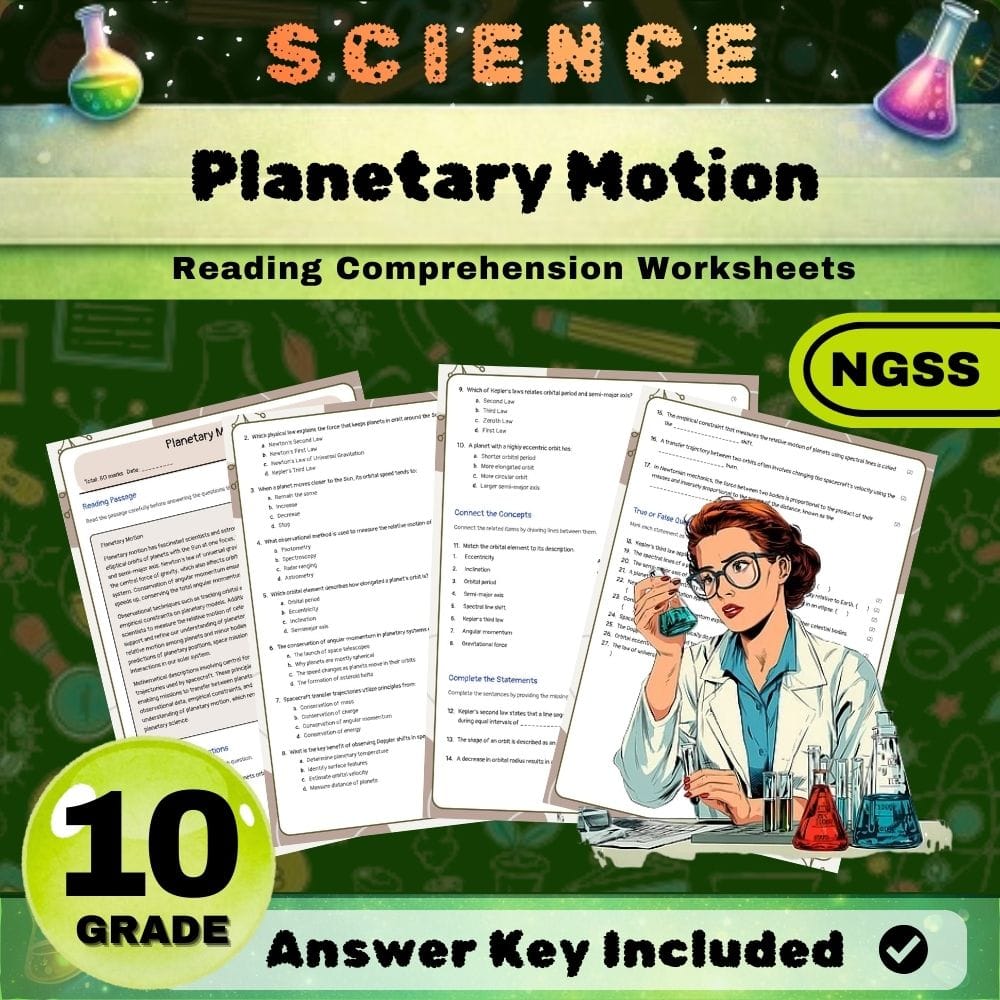
Grade 10 Science | Planetary Motion Worksheet (NGSS) - PDF
Created byMaple Path LearningLearning Objectives
- Explain the principles of Kepler's laws and Newtonian gravitation as they relate to planetary orbits.
- Describe how conservation of angular momentum influences planetary motion.
- Analyze observational data such as orbital elements and spectral line shifts to understand orbital dynamics.
Also included in: Grade 10 Science Earth’s Place in the Universe NGSS Lesson Bundle | Framework +1 more
Instant download
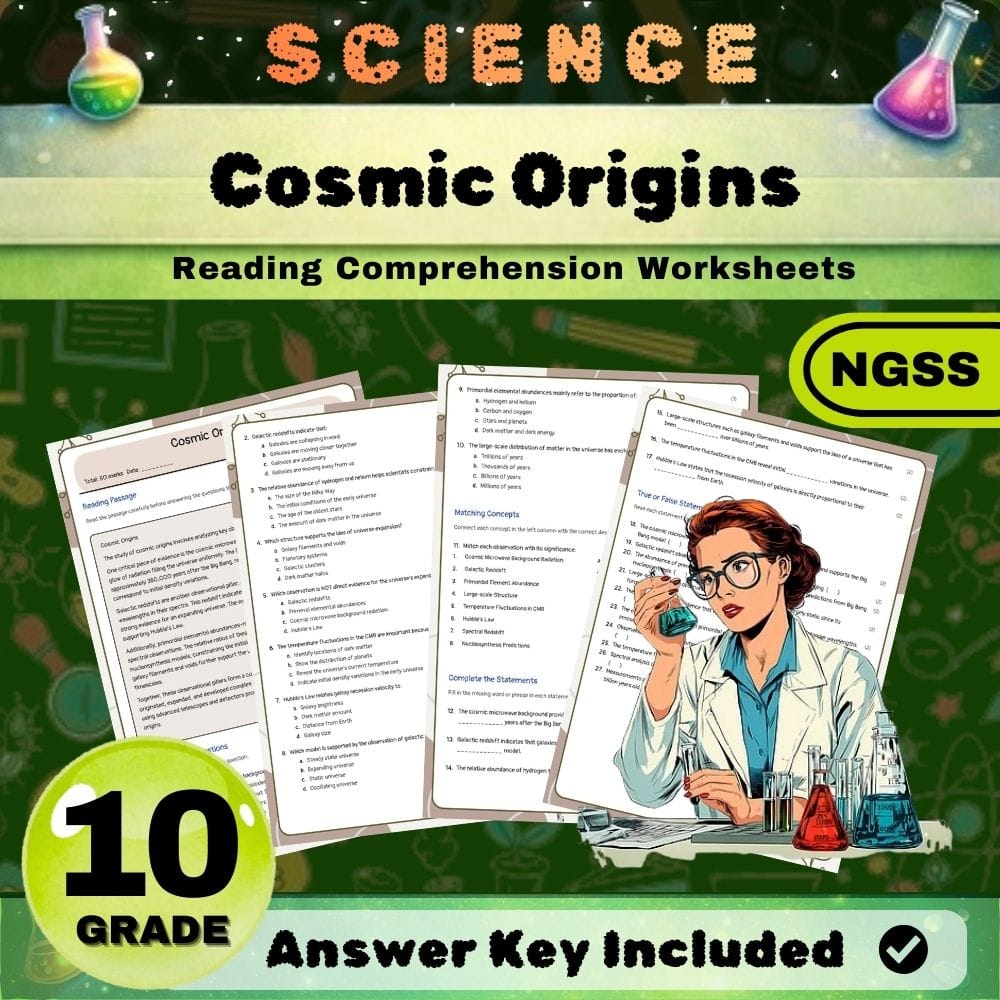
Grade 10 Science NGSS Worksheet – Cosmic Origins | PDF & Answer Key
Created byMaple Path LearningLearning Objectives
- Describe observational evidence supporting models of the universe's cosmic origins.
- Explain how cosmic microwave background radiation and galactic redshifts inform our understanding of universe expansion.
- Identify the significance of primordial elemental abundances in constraining early-universe conditions.
Also included in: Grade 10 Science Earth’s Place in the Universe NGSS Lesson Bundle | Framework +1 more
Instant download
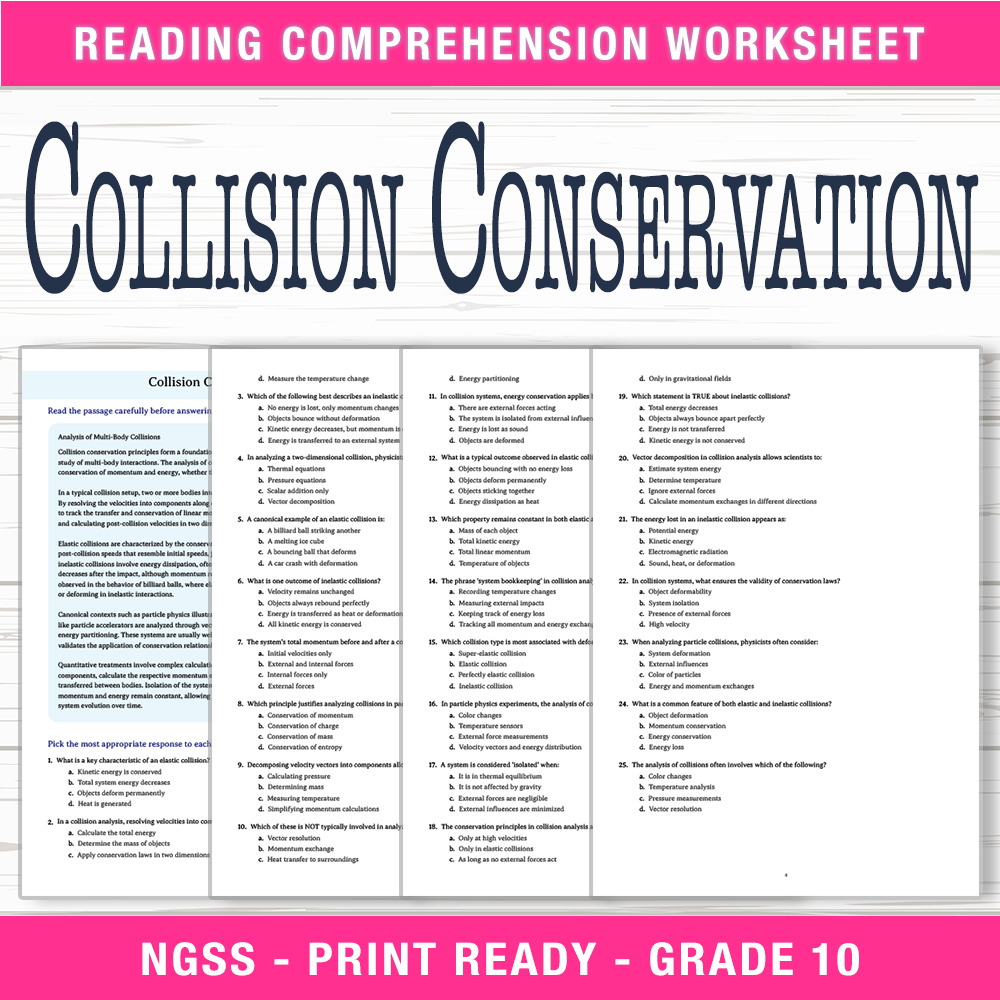
Grade 10 Science | Collision Conservation Worksheet (PDF + Answer Key)
 Created byRiverstone Classroom
Learning Objectives
- Understand the principles of conservation of momentum and energy in multi-body collisions.
- Apply vector resolution techniques to analyze two-dimensional collisions.
- Differentiate between elastic and inelastic collisions using speed distributions and energy partitioning.
Instant download
About Grade 10 Science Worksheets
Find Science worksheets built for Grade 10. All 7,038 cover core skills, practice, and review, each an instant PDF download.
Every worksheet on MyTeachingSheets is created by independent teacher-authors and reviewed before publication. All resources download as printable PDFs for classroom, homework, or at-home practice, and many include answer keys. Preview any worksheet free before buying.