
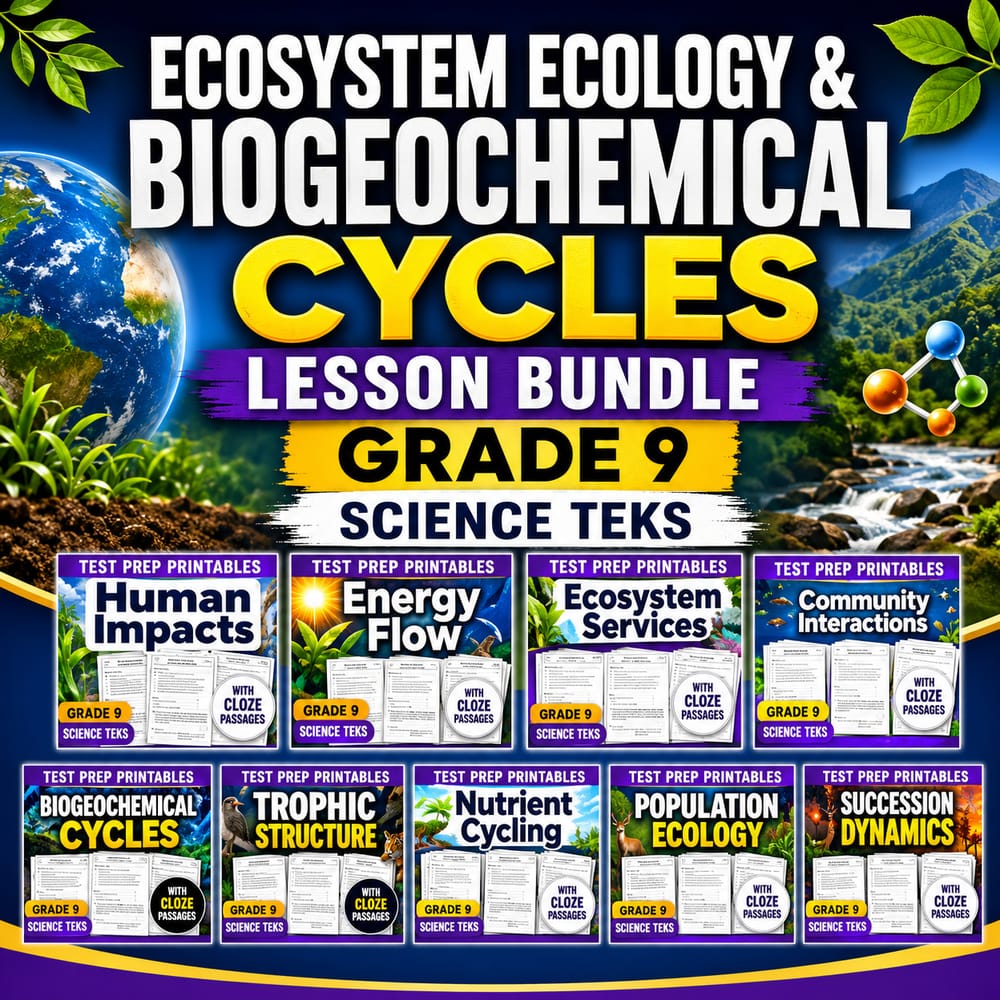
Ecosystem Ecology & Biogeochemical Cycles Lesson Bundle | Grade 9 Science TEKS
$40.00$50.00Save $10.00
Prism Point Learning
·2 followers·13 sales
SubjectScienceGradeGrade 9
What’s included
10 worksheets · Save $10.00 (20%) · prices shown inside the bundle
 Human Impacts Worksheet Pack | Grade 9 Science Activities
- Explain how land conversion, pollution, resource extraction, invasive species, and greenhouse gas emissions can change biodiversity and ecosystem functioning.
- Describe how habitat fragmentation and chemical or nutrient changes can alter species interactions, community composition, and trophic relationships.
- Connect changes in species diversity to ecosystem services such as pollination, water purification, and soil formation.
$4.00$5.00 Energy Flow Worksheet | Grade 9 Science Activities TEKS Aligned
- Explain how energy moves through ecosystems from producers to consumers and decomposers.
- Describe the role of photosynthesis in converting light energy into chemical energy.
- Use the idea of energy loss as heat to interpret energy pyramids and food-chain length.
$4.00$5.00 Ecosystem Services Worksheet | Grade 9 Science Activities
- Explain the four types of ecosystem services and how ecosystems support human well-being.
- Describe how biodiversity helps maintain ecosystem services such as pollination, water purification, nutrient cycling, and carbon sequestration.
- Analyze how land-use change, pollution, and climate shifts can reduce ecosystem service capacity and distribution.
$4.00$5.00 Community Interactions Worksheet | Grade 9 Science Practice
- Explain how different species interactions (competition, predation, herbivory, parasitism, and mutualism) affect community structure.
- Describe how keystone species and ecosystem engineers can strongly change habitat and ecosystem processes.
- Use examples to connect pairwise species interactions to indirect effects and overall ecosystem stability.
$4.00$5.00 Biogeochemical Cycles Worksheet | Grade 9 Science Assessment
- Explain how elements move among the atmosphere, hydrosphere, lithosphere, and biosphere in biogeochemical cycles
- Describe how processes such as photosynthesis, decomposition, nitrogen fixation, and weathering control nutrient availability
- Interpret cycle rates and reservoir sizes to predict system responses to disturbances
$4.00$5.00 Trophic Structure Worksheet | Grade 9 Science Practice
- Explain how trophic levels (producers, consumers, decomposers) connect through feeding relationships in food chains and webs.
- Describe how energy flow and matter cycling move through trophic groups.
- Evaluate how trophic efficiency and trophic cascades affect ecosystem productivity and species abundance.
$4.00$5.00 Resilience & Resistance Worksheet | Grade 9 Science TEKS Practice
- Explain the difference between resilience and resistance in ecosystems.
- Describe how thresholds and regime shifts can occur after disturbances.
- Identify factors and feedback processes that influence ecosystem recovery.
$4.00$5.00 Population Ecology Worksheet | Grade 9 Science Practice
- Explain how birth/reproduction, death/mortality, immigration, and emigration change population size over time
- Differentiate density-dependent and density-independent factors affecting population growth
- Connect population-level changes to carrying capacity and community structure
$4.00$5.00 Nutrient Cycling Worksheet | Grade 9 Science Activities
- Explain how nitrogen and phosphorus move through organisms, soils, water, and the atmosphere.
- Describe how biological processes (nitrogen fixation, assimilation, mineralization, and denitrification) affect nutrient availability.
- Analyze how human activities can increase nutrient loading and lead to eutrophication and oxygen loss.
$4.00$5.00 Succession Dynamics Worksheet | Grade 9 Science Activities
- Explain the difference between primary and secondary ecological succession after disturbance or initial colonization
- Describe how species turnover and changing resource availability influence habitat conditions during succession
- Interpret succession ideas using simple cause-and-effect reasoning and basic modeling components
$4.00$5.00
Reviews & Feedback
Loading reviews...
Questions & Answers
Loading questions…
About this bundle
Related categories
Frequently asked questions
Who is Ecosystem Ecology & Biogeochemical Cycles Lesson Bundle | Grade 9 Science TEKS designed for?
Ecosystem Ecology & Biogeochemical Cycles Lesson Bundle | Grade 9 Science TEKS is designed for Grade 9 students and Science learners and can be used in classrooms, homeschool, or independent practice.
How do I download Ecosystem Ecology & Biogeochemical Cycles Lesson Bundle | Grade 9 Science TEKS?
Add it to your cart and complete checkout. After payment, you can download immediately from your account, and you'll also receive a download link by email.
Similar Products

Ecosystem Dynamics & Biogeochemical Cycles Lesson Bundle | Grade 11 Science | NGSS
$16.80$24.00

Grade 11 Science Lesson Bundle TEKS Ecosystems and Ecology Worksheets
$24.00$30.00

Grade 9 Science UNIT Bundle | Ecosystems & Biogeochemical Cycles TEKS-Aligned
$24.00$30.00

Grade 4 Science Lesson Group Bundle | Ecosystems, Life Cycles & Classification
$21.60$27.00

Grade 5 Ecosystems and Life Cycles Science Lesson Bundle: General
$32.00$40.00