
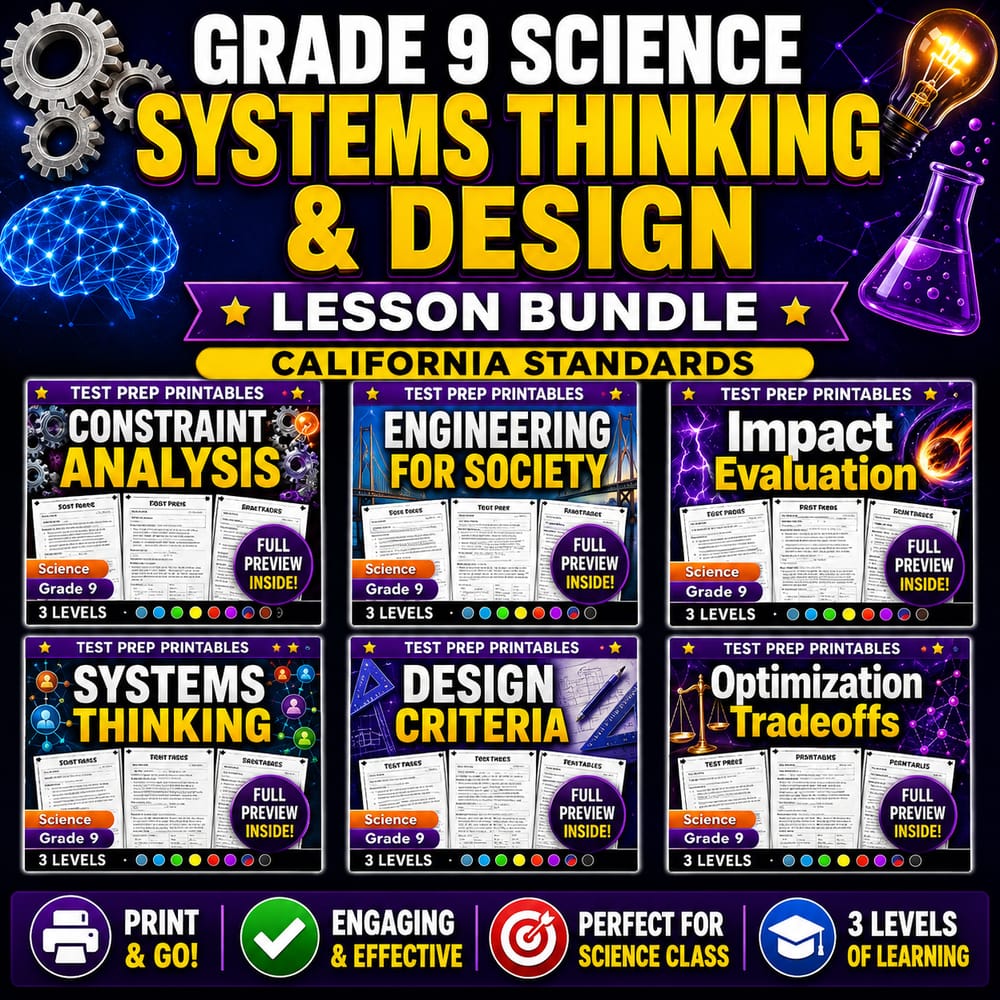
Grade 9 Science Systems Thinking & Design Lesson Bundle | California Standards
$24.00$30.00Save $6.00
Prism Point Learning
·2 followers·13 sales
SubjectScienceGradeGrade 9
What’s included
6 worksheets · Save $6.00 (20%) · prices shown inside the bundle
 Constraint Analysis Worksheet Practice | Grade 9 Science Critical Thinking
- Explain how constraints affect engineering designs and limit achievable performance.
- Identify common types of constraints (materials, cost, power, regulations, and environmental conditions) in a real system.
- Use constraint-informed reasoning to propose feasible design choices for a given engineering problem.
$4.00$5.00 Engineering for Society Worksheet for Grade 9 Science & STEM Activities
- Explain how engineering design uses performance requirements linked to human needs and public priorities.
- Describe how engineering choices affect access, reliability, and safety in real-world systems.
- Evaluate how technology trade-offs can support or limit equity and long-term usability.
$4.00$5.00 Impact Evaluation Worksheet for Grade 9 Science | STEM Analysis Activities
- Explain how scientists and engineers evaluate the benefits, risks, and tradeoffs of technologies over time.
- Identify environmental, health, and resource impacts, including unintended consequences.
- Use criteria such as reliability, emissions, land impact, and risk mitigation to compare solutions.
$4.00$5.00 Systems Thinking Worksheet for Grade 9 Science Practice & Review
- Explain how systems thinking considers matter, energy, and information flows across interacting components.
- Identify how feedback and unintended effects can result from design changes in complex systems.
- Evaluate engineered solutions by using boundaries and long-term system behavior to meet performance targets.
$4.00$5.00 Design Criteria Engineering Worksheet for Grade 9 Science Activities
- Explain how design criteria and constraints guide an engineering solution from a stated problem to testable requirements.
- Use scientific principles and evidence to connect design features to expected performance under real-world limits.
- Identify how models help predict outcomes and how measurable criteria support safer, more effective designs.
$4.00$5.00 Optimization Tradeoffs Worksheet for Grade 9 Science Engineering Design
- Explain how optimization involves balancing competing goals through tradeoffs and constraints.
- Use basic reasoning with models and evidence to compare alternative design choices.
- Describe how changes to one design parameter can affect performance, cost, durability, and efficiency.
$4.00$5.00
Reviews & Feedback
Loading reviews...
Questions & Answers
Loading questions…
About this bundle
Related categories
Frequently asked questions
Who is Grade 9 Science Systems Thinking & Design Lesson Bundle | California Standards designed for?
Grade 9 Science Systems Thinking & Design Lesson Bundle | California Standards is designed for Grade 9 students and Science learners and can be used in classrooms, homeschool, or independent practice.
How do I download Grade 9 Science Systems Thinking & Design Lesson Bundle | California Standards?
Add it to your cart and complete checkout. After payment, you can download immediately from your account, and you'll also receive a download link by email.
Similar Products

Grade 9 Engineering Design & Systems Thinking Science Lesson Bundle
$24.00$30.00

Grade 6 Prototype Design Science Lesson Bundle: General Systems Thinking
$22.40$28.00

Grade 11 Designing Reliable Systems Science Lesson Bundle – General
$14.40$18.00

Grade 10 NGSS Science: Models, Systems, and Trade-Off Design Lesson Bundle
$16.00$20.00

Grade 11 Science - Systems Thinking & Design Assessment | NGSS Standards-Aligned
$16.00$20.00