
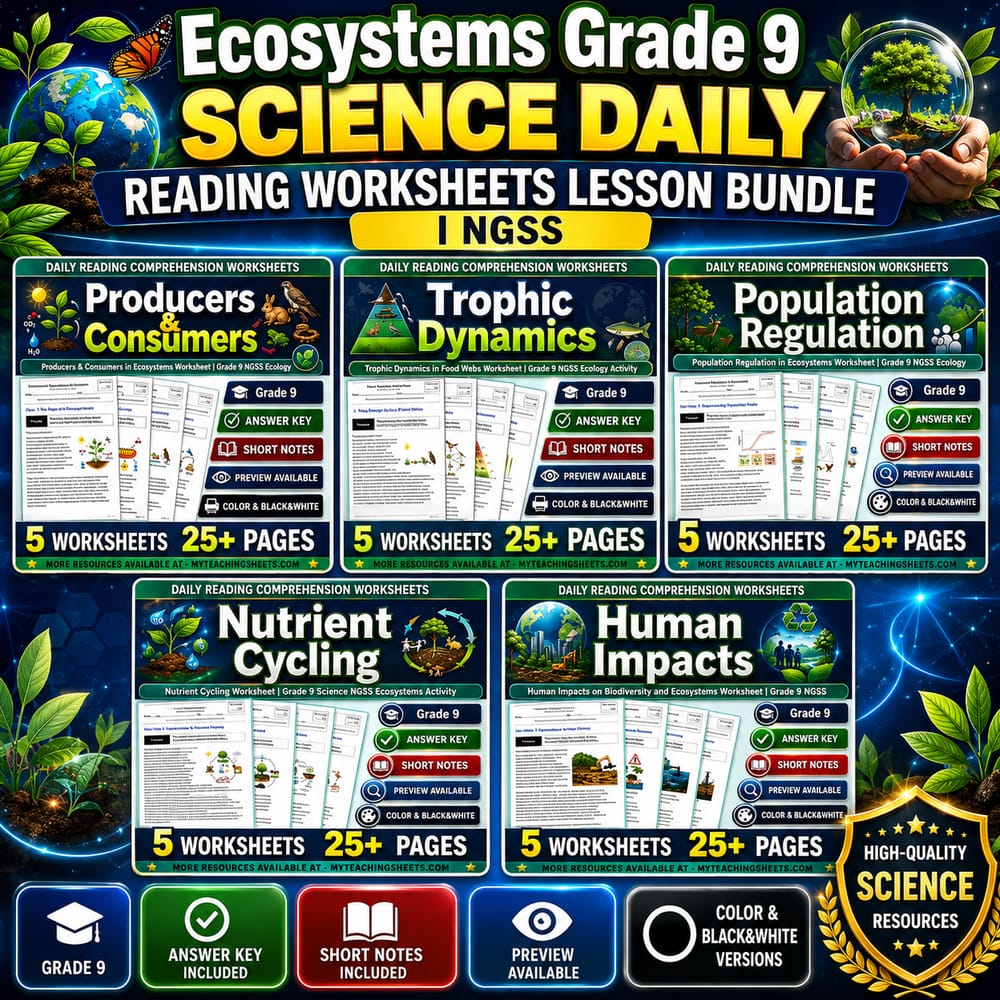
Ecosystems Grade 9 Science Daily Reading Worksheets Lesson Bundle | NGSS
$20.00$25.00Save $5.00
BRIGHT PATH RESOURCES
·3 followers·23 sales
SubjectScienceGradeGrade 9
What’s included
5 worksheets · Save $5.00 (20%) · prices shown inside the bundle
 Producers & Consumers in Ecosystems Worksheet | Grade 9 NGSS Ecology
- Understand the process of photosynthesis and how it contributes to energy flow in ecosystems.
- Identify key factors affecting photosynthesis rates and biomass accumulation.
- Explain the importance of producers like plants and algae in cycling carbon and oxygen.
$4.00$5.00 Trophic Dynamics in Food Webs Worksheet | Grade 9 NGSS Ecology Activity
- Understand the flow of energy through trophic levels in an ecosystem
- Identify the structure and components of food webs
- Describe concepts of biomass distribution, production-to-biomass ratios, and ecological efficiency
$4.00$5.00 Population Regulation in Ecosystems Worksheet | Grade 9 NGSS Ecology
- Understand key concepts related to Science
- Apply knowledge through practice questions
- Demonstrate comprehension of the material
$4.00$5.00 Nutrient Cycling Worksheet | Grade 9 Science NGSS Ecosystems Activity
- Understand the key pathways of nutrient cycling involving carbon, nitrogen, and phosphorus.
- Identify reservoirs and fluxes within nutrient cycles.
- Recognize how microbial decomposition, fixation, mineralization, and sedimentation contribute to nutrient flow.
$4.00$5.00 Human Impacts on Biodiversity and Ecosystems Worksheet | Grade 9 NGSS
- Understand how deforestation affects biodiversity.
- Analyze case studies of human impacts on ecosystems.
- Interpret empirical data related to land-use change and habitat loss.
$4.00$5.00
Reviews & Feedback
Loading reviews...
Questions & Answers
Loading questions…
About this bundle
Related categories
Frequently asked questions
Who is Ecosystems Grade 9 Science Daily Reading Worksheets Lesson Bundle | NGSS designed for?
Ecosystems Grade 9 Science Daily Reading Worksheets Lesson Bundle | NGSS is designed for Grade 9 students and Science learners and can be used in classrooms, homeschool, or independent practice.
How do I download Ecosystems Grade 9 Science Daily Reading Worksheets Lesson Bundle | NGSS?
Add it to your cart and complete checkout. After payment, you can download immediately from your account, and you'll also receive a download link by email.
Similar Products

TEKS Ecosystems Grade 6 Science Daily Reading Worksheets Lesson Bundle | TEKS
$32.00$40.00

Biology and Ecosystems Lesson Bundle – Grade 9 Science AP Daily Reading
$56.00$70.00

Grade 8 Ecosystems Daily Reading Worksheets Lesson Bundle | BC
$48.00$60.00

Ecosystems & Biodiversity Grade 7 Science Daily Reading Lesson Bundle | NGSS
$20.00$25.00

Grade 7 Ecosystems Science Lesson Bundle for Daily Reading Worksheets | Alberta
$48.00$60.00