
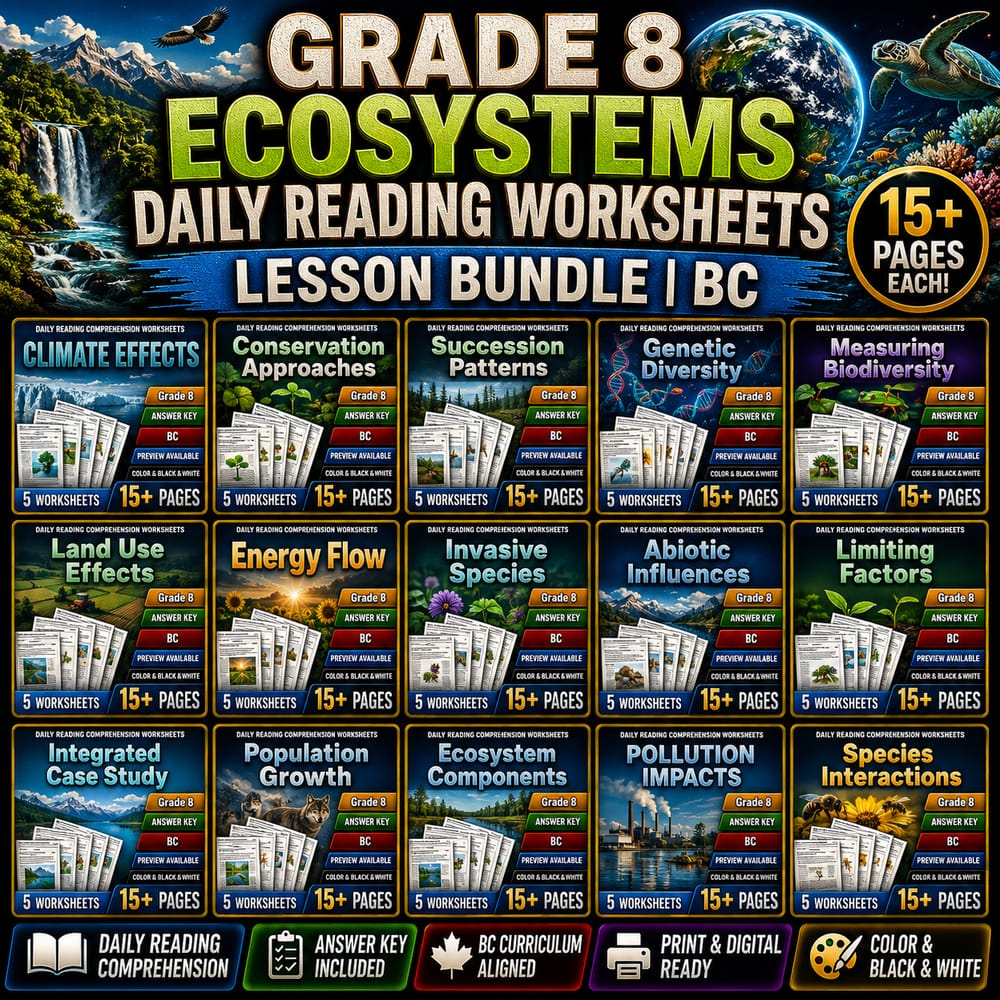


Grade 8 Ecosystems Daily Reading Worksheets Lesson Bundle | BC
$48.00$60.00Save $12.00
Bright Mind Resources
New·1 followers·12 sales
SubjectScienceGradeGrade 8
What’s included
15 worksheets · Save $12.00 (20%) · prices shown inside the bundle
 Grade 8 Science – Climate Effects & Ecosystem Impact | Daily Reading Worksheet
- Understand how climate change influences temperature and precipitation patterns.
- Identify the impacts of climate variation on ecosystems and species.
- Explain how climate drivers affect biodiversity and ecological interactions.
$3.20$4.00 Grade 8 Science – Conservation Approaches & Ecosystem Management | Worksheet
- Understand different strategies used in conservation.
- Identify the importance of protected areas, restoration, and corridors.
- Recognize factors influencing the effectiveness of conservation efforts.
$3.20$4.00 Grade 8 Science – Understanding Succession & Ecology | Daily Reading Worksheet
- Define ecological succession and distinguish between primary and secondary succession.
- Identify key factors that influence succession pathways.
- Recognize the importance of succession in ecosystem recovery and biodiversity.
$3.20$4.00 Grade 8 Science – Genetic Diversity & Variability | Daily Reading Worksheet
- Define genetic diversity and explain its significance in biological populations.
- Identify factors that influence genetic variation within and among species.
- Understand the impact of low genetic diversity on population survival.
$3.20$4.00 Grade 8 Science – Measuring Biodiversity & Ecosystems | Daily Reading Worksheet
- Understand the concept of biodiversity and its importance.
- Identify different levels of biodiversity including genetic, species, and ecosystem diversity.
- Learn about various methods used to measure biodiversity such as species richness, evenness, and diversity indices.
$3.20$4.00 Grade 8 Science – Land Use Effects & Ecosystems | Daily Reading Worksheet
- Understand how human activities impact natural habitats
- Identify the effects of habitat fragmentation on ecosystems
- Analyze land use patterns and their long-term consequences
$3.20$4.00 Grade 8 Science – Energy Flow & Ecosystems | Daily Reading Worksheet
- Understand key concepts related to Science
- Apply knowledge through practice questions
- Demonstrate comprehension of the material
$3.20$4.00 Grade 8 Science – Invasive Species & Ecosystem Impact | Daily Reading Worksheet
- Understand what defines an invasive species
- Identify the ecological traits that make certain species invasive
- Recognize the impacts invasive species have on native ecosystems
$3.20$4.00 Grade 8 Science – Abiotic Influences on Ecosystems | Daily Reading Worksheet
- Understand how light and temperature affect plant and animal life.
- Identify various abiotic factors that influence ecosystems.
- Explain how changes in abiotic conditions can alter community composition.
$3.20$4.00 Grade 8 Science – Limiting Factors & Ecosystem Balance | Daily Reading Worksheet
- Define limiting factors in relation to population size.
- Identify key food sources as a potential limiting factor.
- Describe how changes in food availability can affect animal populations.
$3.20$4.00
Reviews & Feedback
Loading reviews...
Questions & Answers
Loading questions…
About this bundle
Related categories
Frequently asked questions
Who is Grade 8 Ecosystems Daily Reading Worksheets Lesson Bundle | BC designed for?
Grade 8 Ecosystems Daily Reading Worksheets Lesson Bundle | BC is designed for Grade 8 students and Science learners and can be used in classrooms, homeschool, or independent practice.
How do I download Grade 8 Ecosystems Daily Reading Worksheets Lesson Bundle | BC?
Add it to your cart and complete checkout. After payment, you can download immediately from your account, and you'll also receive a download link by email.
Similar Products

TEKS Ecosystems Grade 6 Science Daily Reading Worksheets Lesson Bundle | TEKS
$32.00$40.00

Biology and Ecosystems Lesson Bundle – Grade 9 Science AP Daily Reading
$56.00$70.00

Ecosystems Grade 9 Science Daily Reading Worksheets Lesson Bundle | NGSS
$20.00$25.00

Grade 7 Ecosystems Science Lesson Bundle for Daily Reading Worksheets | Alberta
$48.00$60.00

Grade 8 Ecosystems Science Daily Reading Worksheets Lesson Bundle | Alberta
$48.00$60.00