
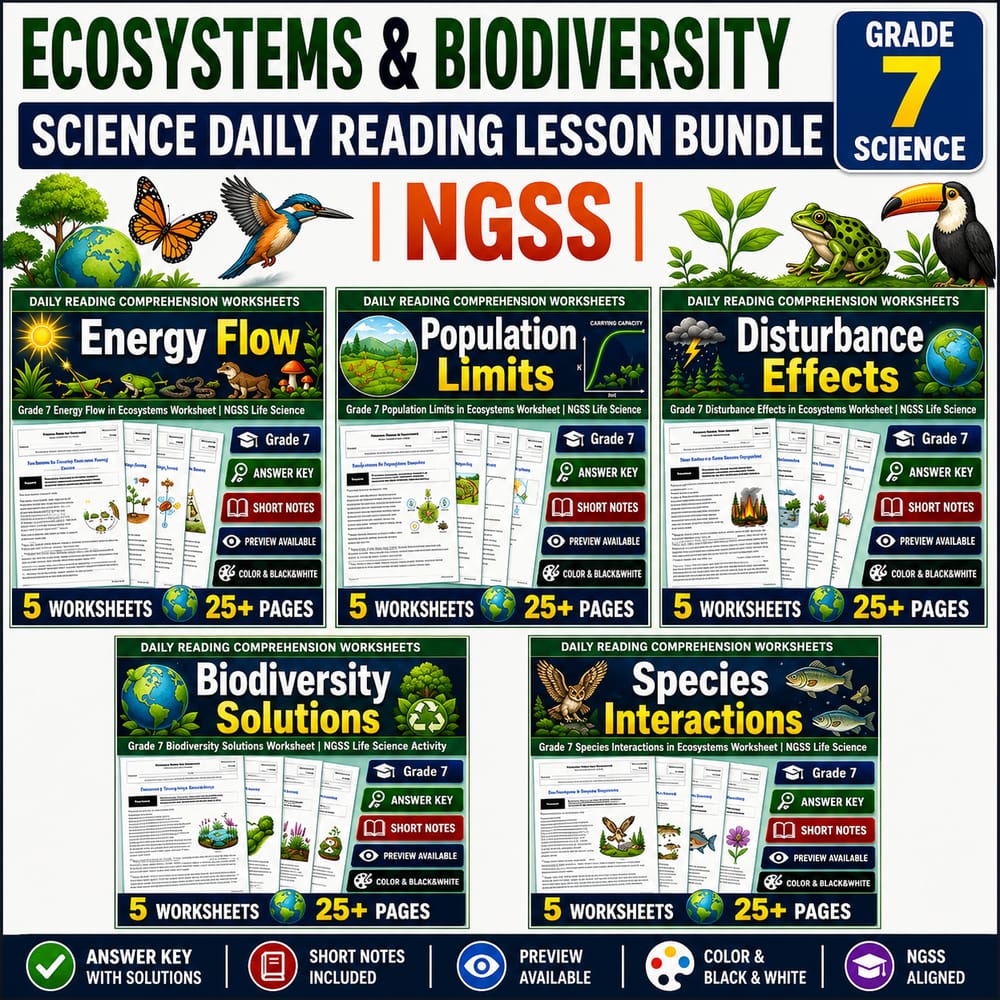
Ecosystems & Biodiversity Grade 7 Science Daily Reading Lesson Bundle | NGSS
$20.00$25.00Save $5.00
BRIGHT PATH RESOURCES
·3 followers·23 sales
SubjectScienceGradeGrade 7
What’s included
5 worksheets · Save $5.00 (20%) · prices shown inside the bundle
 Grade 7 Energy Flow in Ecosystems Worksheet | NGSS Life Science Activity
- Understand key concepts related to Science
- Apply knowledge through practice questions
- Demonstrate comprehension of the material
$4.00$5.00 Grade 7 Population Limits in Ecosystems Worksheet | NGSS Life Science
- Understand the concept of population growth and carrying capacity.
- Analyze graphical data representing population changes over time.
- Identify factors that influence population size, such as resources and competition.
$4.00$5.00 Grade 7 Disturbance Effects in Ecosystems Worksheet | NGSS Life Science
- Understand how wildfires influence plant and animal populations in forests.
- Identify different biological and physical disturbances and their impacts on ecosystems.
- Interpret data related to ecosystem recovery after disturbances.
$4.00$5.00 Grade 7 Biodiversity Solutions Worksheet | NGSS Life Science Activity
- Understand the importance of wetlands for biodiversity
- Learn management strategies like wetland restoration and habitat corridors
- Evaluate benefits and potential unintended consequences of conservation methods
$4.00$5.00 Grade 7 Species Interactions in Ecosystems Worksheet | NGSS Life Science
- Understand different types of species interactions: predation, competition, parasitism, mutualism, and commensalism.
- Identify predator-prey relationships in forest ecosystems.
- Analyze how species interactions affect community structure and resource distribution.
$4.00$5.00
Reviews & Feedback
Loading reviews...
Questions & Answers
Loading questions…
About this bundle
Related categories
Frequently asked questions
Who is Ecosystems & Biodiversity Grade 7 Science Daily Reading Lesson Bundle | NGSS designed for?
Ecosystems & Biodiversity Grade 7 Science Daily Reading Lesson Bundle | NGSS is designed for Grade 7 students and Science learners and can be used in classrooms, homeschool, or independent practice.
How do I download Ecosystems & Biodiversity Grade 7 Science Daily Reading Lesson Bundle | NGSS?
Add it to your cart and complete checkout. After payment, you can download immediately from your account, and you'll also receive a download link by email.
Similar Products

TEKS Ecosystems Grade 6 Science Daily Reading Worksheets Lesson Bundle | TEKS
$32.00$40.00

Biology and Ecosystems Lesson Bundle – Grade 9 Science AP Daily Reading
$56.00$70.00

Ecosystems Grade 9 Science Daily Reading Worksheets Lesson Bundle | NGSS
$20.00$25.00

Grade 8 Ecosystems Daily Reading Worksheets Lesson Bundle | BC
$48.00$60.00

Grade 7 Ecosystems Science Lesson Bundle for Daily Reading Worksheets | Alberta
$48.00$60.00