
Grade 9 Worksheets
9,304 grade resources
Grade 9 Science | Power Analysis Worksheet with Short Notes (Printable PDF)
 Created byMeadowlark Worksheets
Learning Objectives
- Understand the differences between power and energy in systems.
- Learn methods to calculate energy consumption over time.
- Evaluate efficiency and system losses in energy systems.
Also included in: Grade 9 Science NGSS Energy UNIT Bundle – Power, Heat, & Conversion Worksheets +1 more
Instant download

Grade 9 Science | Mechanical Energy Worksheet with Short Notes (Printable PDF)
Created byMeadowlark WorksheetsLearning Objectives
- Understand the concept of mechanical energy and its types.
- Identify different forms of energy involved in mechanical systems.
- Explain how energy is transferred and conserved in mechanical processes.
Also included in: Grade 9 Science NGSS Energy UNIT Bundle – Power, Heat, & Conversion Worksheets +1 more
Instant download
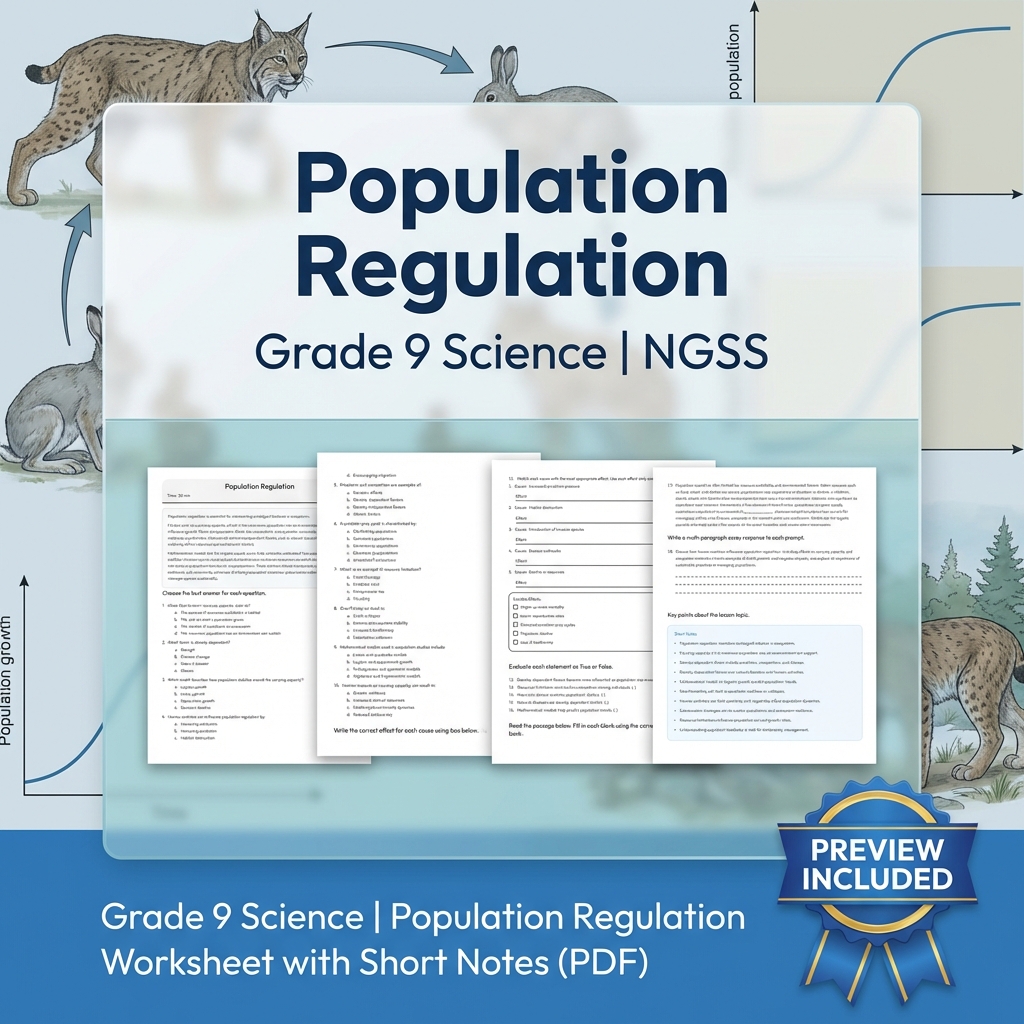
Grade 9 Science | Population Regulation Worksheet with Short Notes (PDF)
Created byMeadowlark WorksheetsLearning Objectives
- Understand factors affecting population size and dynamics, including carrying capacity, competition, predation, disease, and resource limitations.
- Analyze mathematical models such as logistic growth and predator-prey cycles.
- Evaluate human impacts on population regulation and the implications for conservation and ecosystem management.
Also included in: Grade 9 Science | Ecosystems: Interactions, Energy & Dynamics NGSS UNIT Bundle +2 more
Instant download

Grade 9 Science | Heat Quantification Worksheet with Short Notes (Printable PDF)
Created byMeadowlark WorksheetsLearning Objectives
- Understand the mathematical representations and principles of heat transfer and internal energy change.
- Apply formulas involving specific heat capacity, mass, and temperature change to real-world scenarios.
- Differentiate between conduction, convection, and radiation as modes of heat transfer.
Also included in: Grade 9 Science NGSS Energy UNIT Bundle – Power, Heat, & Conversion Worksheets +1 more
Instant download

Grade 9 Science | Energy Conversion Worksheet with Short Notes (Printable PDF)
Created byMeadowlark WorksheetsLearning Objectives
- Analyze various device mechanisms that convert energy from one form to another.
- Understand energy accounting including losses and efficiency constraints.
- Identify canonical examples such as photovoltaic cells, thermoelectric modules, and electrochemical cells.
Also included in: Grade 9 Science NGSS Energy UNIT Bundle – Power, Heat, & Conversion Worksheets +1 more
Instant download

Producers & Consumers Review & Practice Worksheet | Grade 9 Science
 Created byPrism Point Learning
Learning Objectives
- Explain how photosynthesis and cellular respiration transfer energy through ecosystems.
- Analyze how net primary productivity (NPP) and biomass accumulation affect food availability for consumers.
- Describe how organisms cycle carbon and oxygen through photosynthesis and respiration.
Also included in: Grade 9 Ecosystem Dynamics Science Lesson Bundle: NGSS Review Worksheets
Instant download

Human Impacts Practice Worksheet | Grade 9 Science NGSS Review
Created byPrism Point LearningLearning Objectives
- Explain how land-use change, invasive species, pollution, and resource extraction can reduce biodiversity.
- Interpret evidence from real-world examples (deforestation, coral reef degradation, agricultural runoff) to evaluate ecosystem impacts.
- Describe trade-offs between conservation goals, provisioning services, and socioecological outcomes.
Also included in: Grade 9 Ecosystem Dynamics Science Lesson Bundle: NGSS Review Worksheets
Instant download
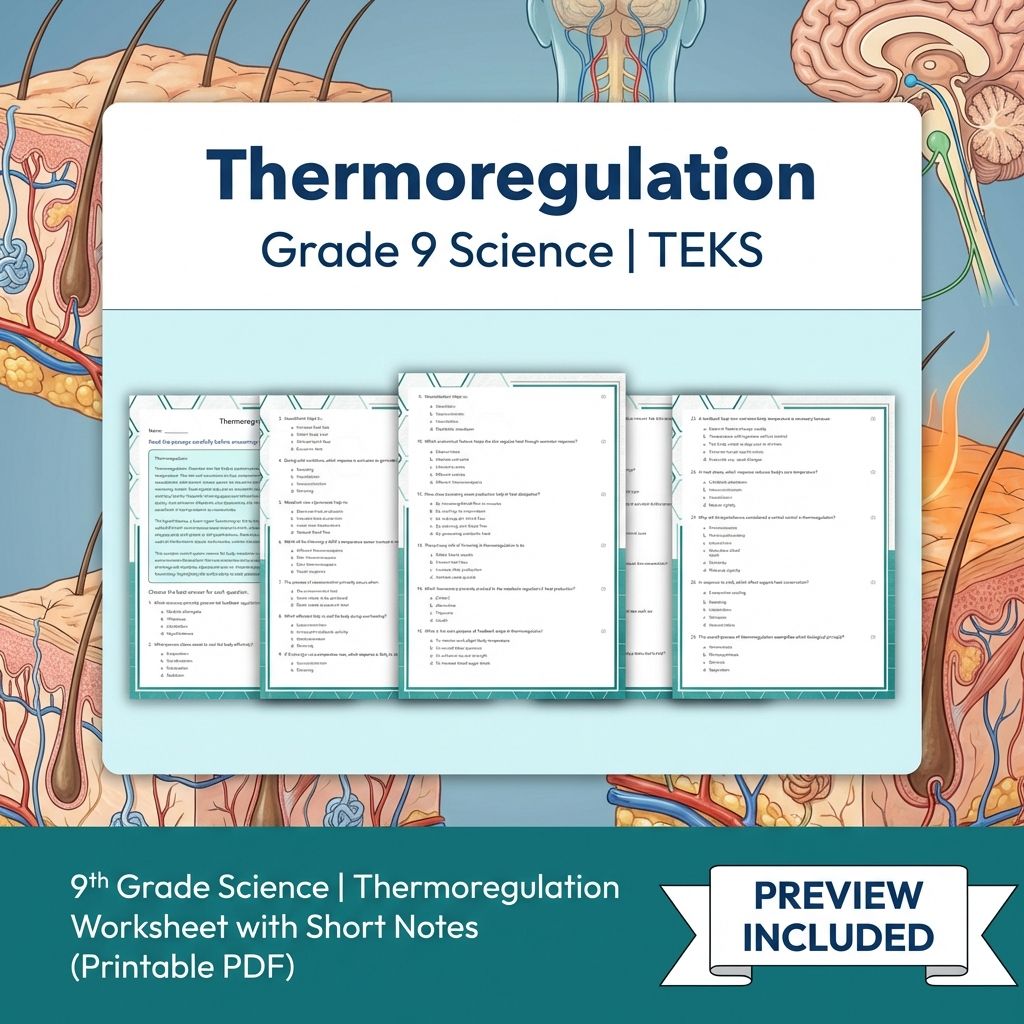
9th Grade Science | Thermoregulation Worksheet with Short Notes (Printable PDF)
Created byMeadowlark WorksheetsLearning Objectives
- Understand the mechanisms involved in human body temperature regulation.
- Identify the roles of skin, vasculature, sweat glands, muscles, and the hypothalamus in thermoregulation.
- Explain how feedback loops maintain thermal homeostasis under varying environmental conditions.
Instant download
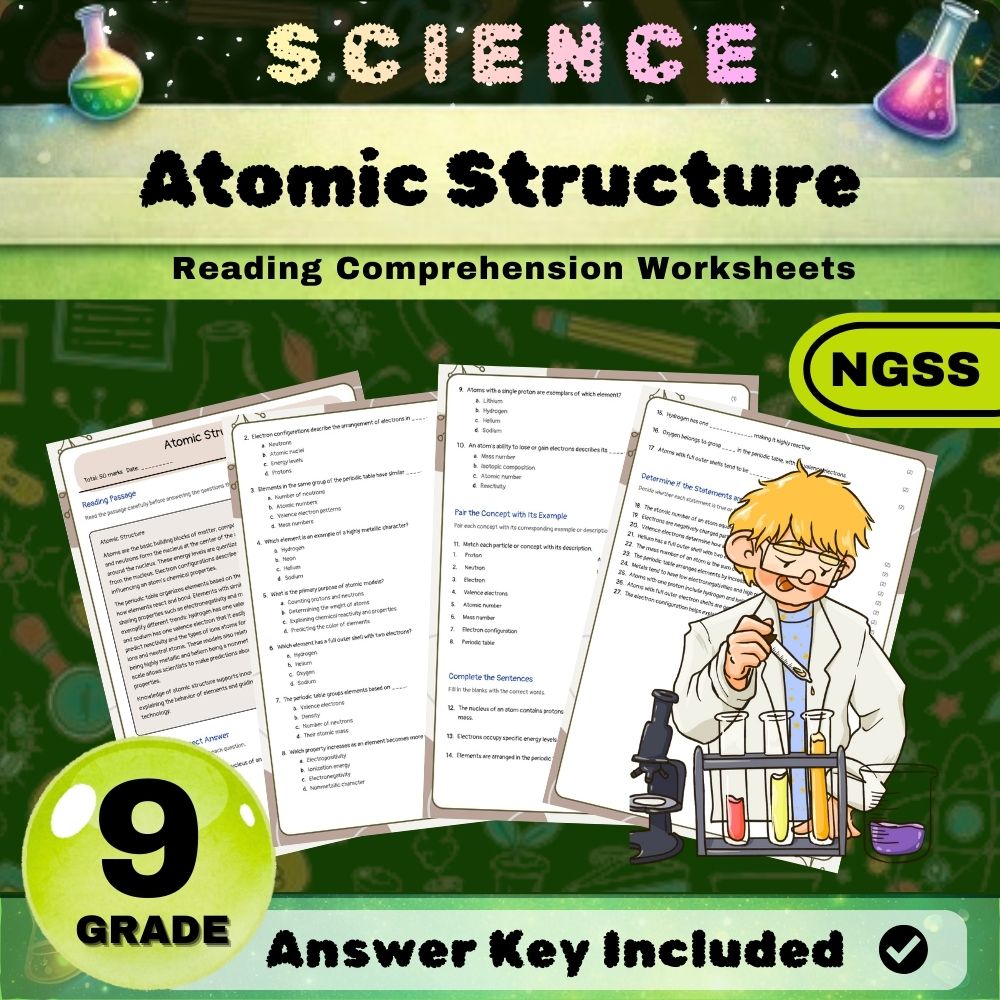
Grade 9 Science - Atomic Structure Worksheet (NGSS) PDF (Practice Set)
 Created byMaple Path Learning
Learning Objectives
- Understand the fundamental particles composing atoms, including protons, neutrons, and electrons.
- Describe electron configurations and their relation to energy levels.
- Explain how the periodic table organization reflects valence electrons and chemical behavior.
Also included in: Grade 9 Science | Matter and Its Interactions NGSS Unit Bundle – Worksheets +1 more
Instant download

Grade 9 | Black history month for Mastering Cultural Heritage | PDF + Answer Key
 Created byShaNova Worksheets
Learning Objectives
- Identify key aspects of African American cultural traditions and contributions.
- Understand the historical roots and significance of cultural practices within African American communities.
- Foster respect and appreciation for cultural diversity and heritage.
Instant download
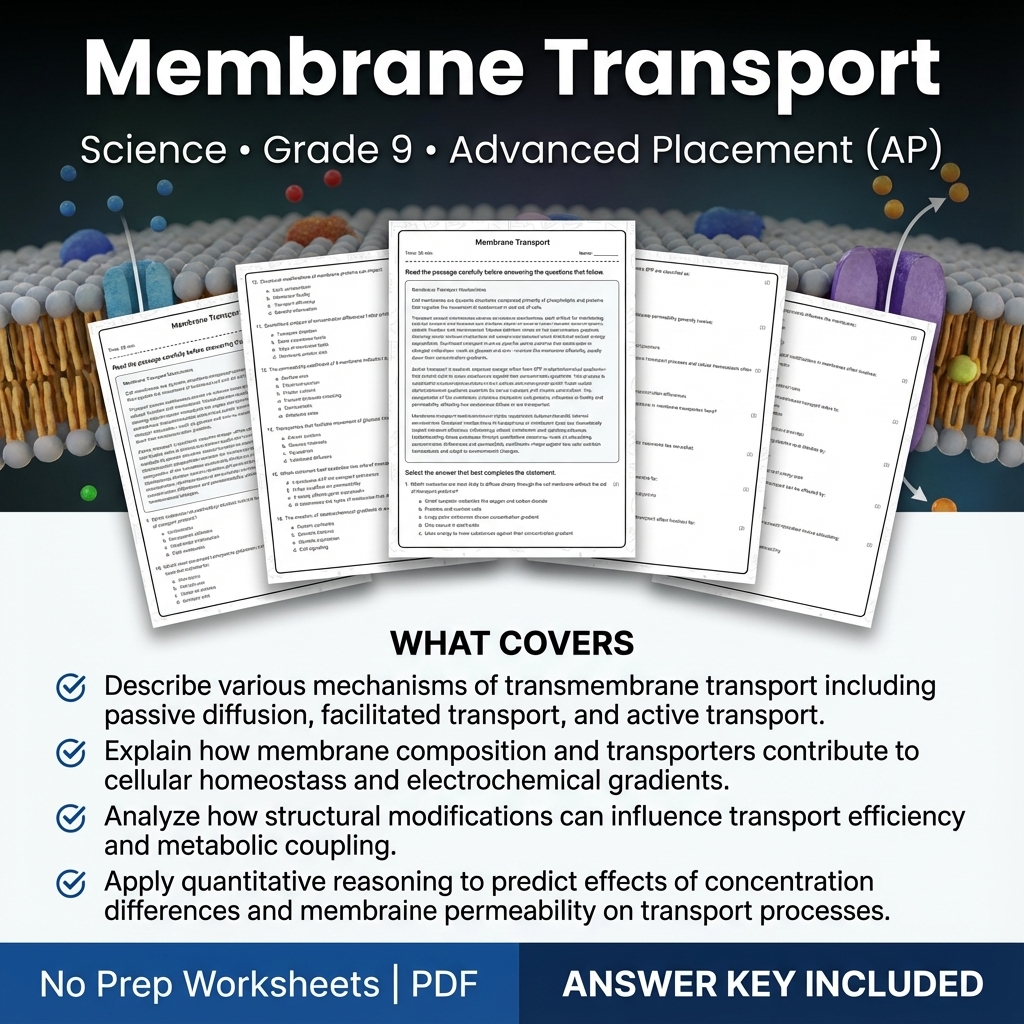
9th Grade Science | Membrane Transport Worksheet (Printable PDF + Answer Key)
 Created byCoral Reef Learning
Learning Objectives
- Describe various mechanisms of transmembrane transport including passive diffusion, facilitated transport, and active transport.
- Explain how membrane composition and transporters contribute to cellular homeostasis and electrochemical gradients.
- Analyze how structural modifications can influence transport efficiency and metabolic coupling.
Also included in: Grade 9 Science Unit Worksheet Bundle | Cell Function to Ecosystem Dynamics +2 more
Instant download
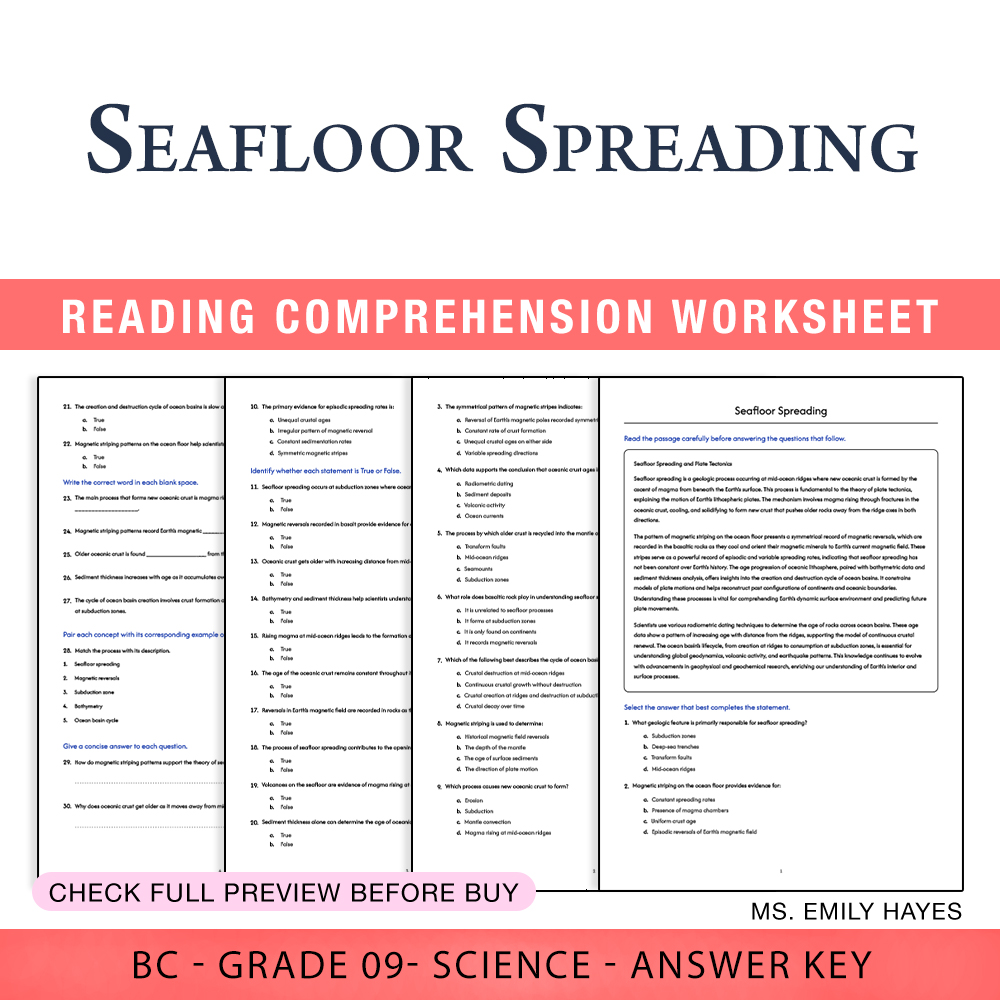
9th Grade Science | Seafloor Spreading Worksheet (PDF+ Answer Key)
 Created byCopper Leaf Classroom
Learning Objectives
- Describe the process of seafloor spreading at mid-ocean ridges and how it creates new oceanic crust.
- Explain how magnetic striping provides evidence for episodic spreading rates and plate movements.
- Analyze the age progression of oceanic lithosphere and its implications for ocean basin cycles.
Also included in: Grade 9 Science Worksheet Bundle | Earth's Dynamic Processes (PDF + Answer Key) +1 more
Instant download
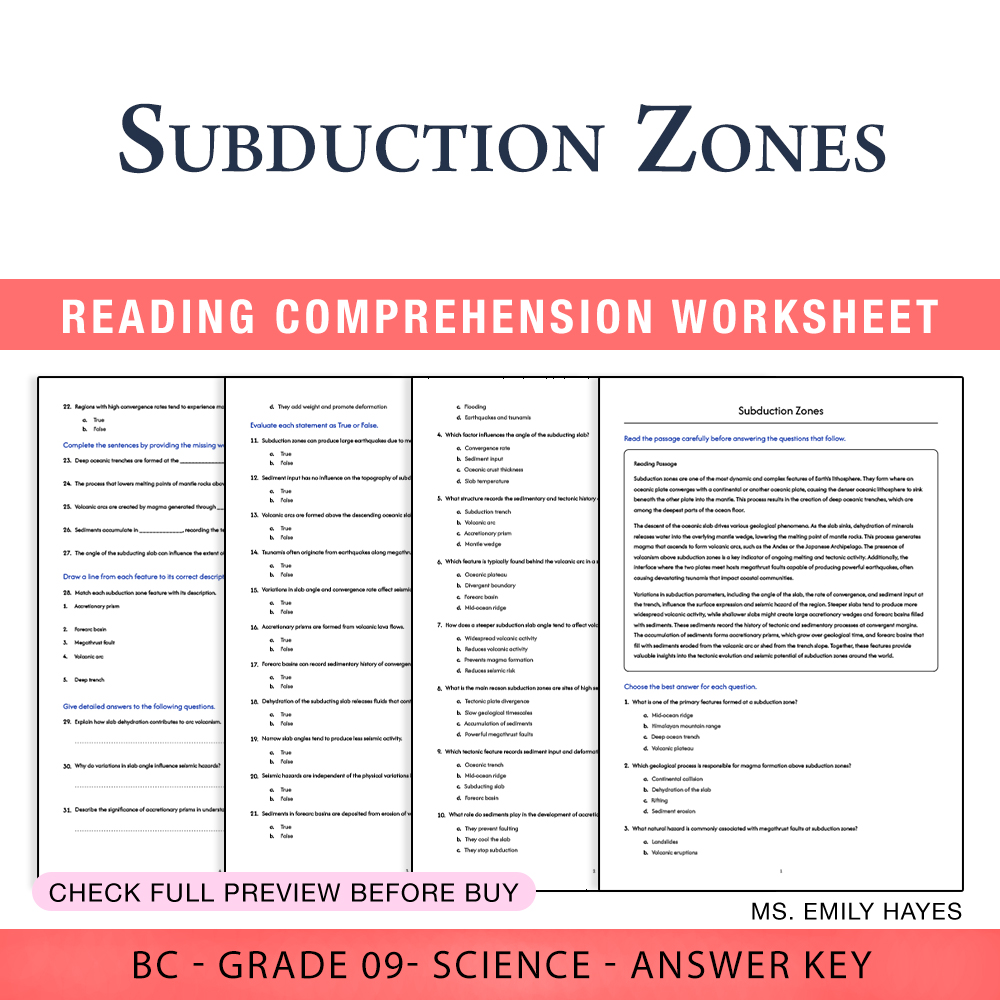
Grade 9 Science | Subduction Zones Worksheet (PDF+ Answer Key)
Created byCopper Leaf ClassroomLearning Objectives
- Understand the geological processes involved in subduction zones and their effects on Earth's surface.
- Identify key features and hazards associated with subduction zones, such as earthquakes, tsunamis, and volcanic activity.
- Explain how variations in subduction parameters influence topography and seismic hazards.
Also included in: Grade 9 Science Worksheet Bundle | Earth's Dynamic Processes (PDF + Answer Key) +1 more
Instant download
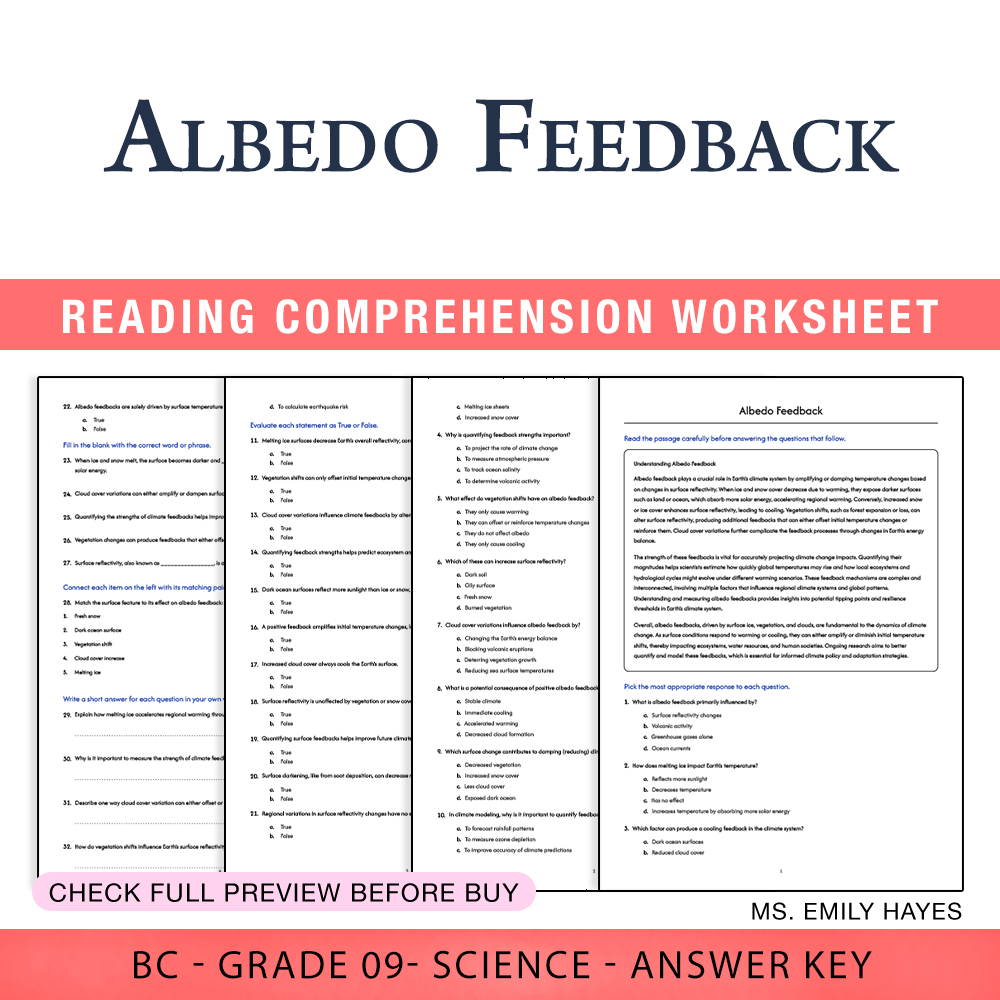
Grade 9 Science | Albedo Feedback Worksheet (PDF+ Answer Key)
Created byCopper Leaf ClassroomLearning Objectives
- Understand the concept of albedo and how surface reflectivity affects climate.
- Identify the various feedback mechanisms related to surface reflectivity changes.
- Analyze the role of ice, snow, vegetation, and clouds in albedo feedback processes.
Also included in: Grade 9 Science Worksheet Bundle | Earth's Dynamic Processes (PDF + Answer Key) +1 more
Instant download
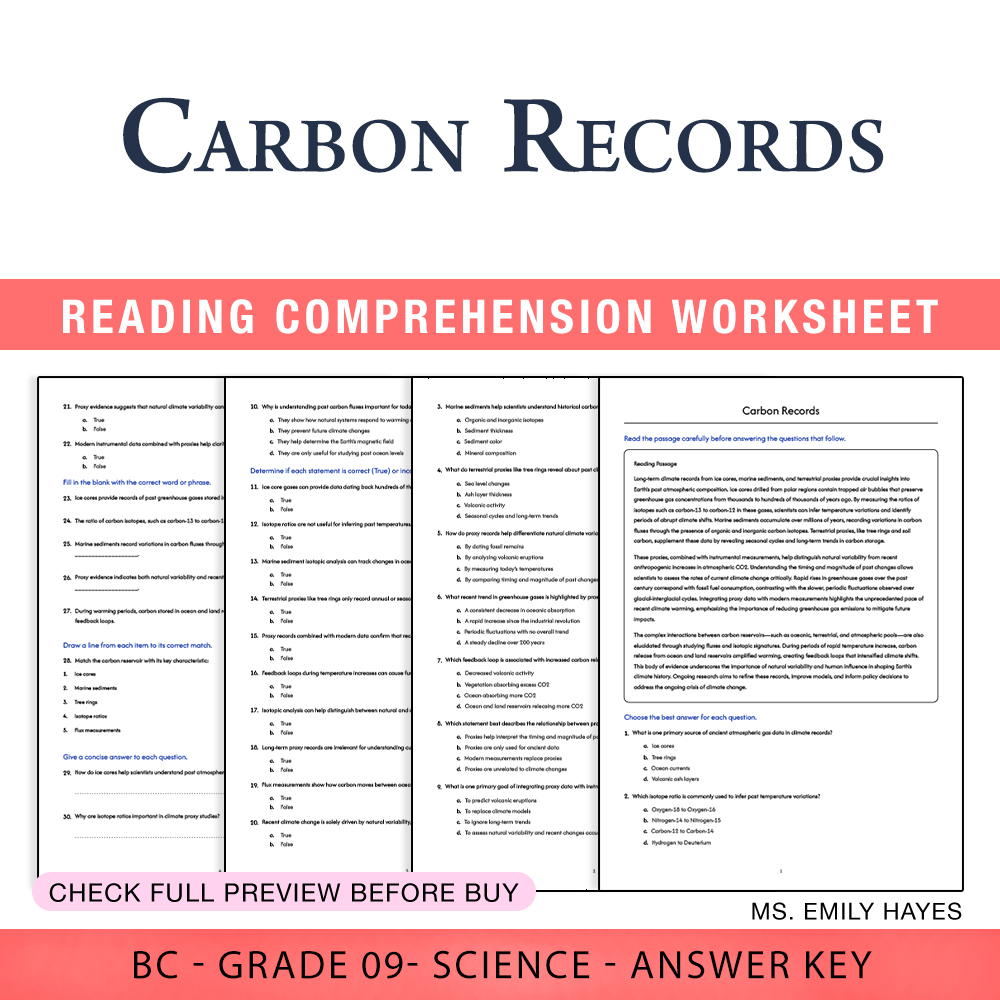
Grade 9 Science | Carbon Records Worksheet (PDF+ Answer Key)
Created byCopper Leaf ClassroomLearning Objectives
- Understand how ice cores, sediments, and proxies record past atmospheric carbon levels.
- Interpret isotope ratios and gas measurements to identify climate patterns and shifts.
- Analyze the relationship between carbon fluxes and global temperature changes.
Also included in: Grade 9 Science Worksheet Bundle | Earth's Dynamic Processes (PDF + Answer Key) +1 more
Instant download
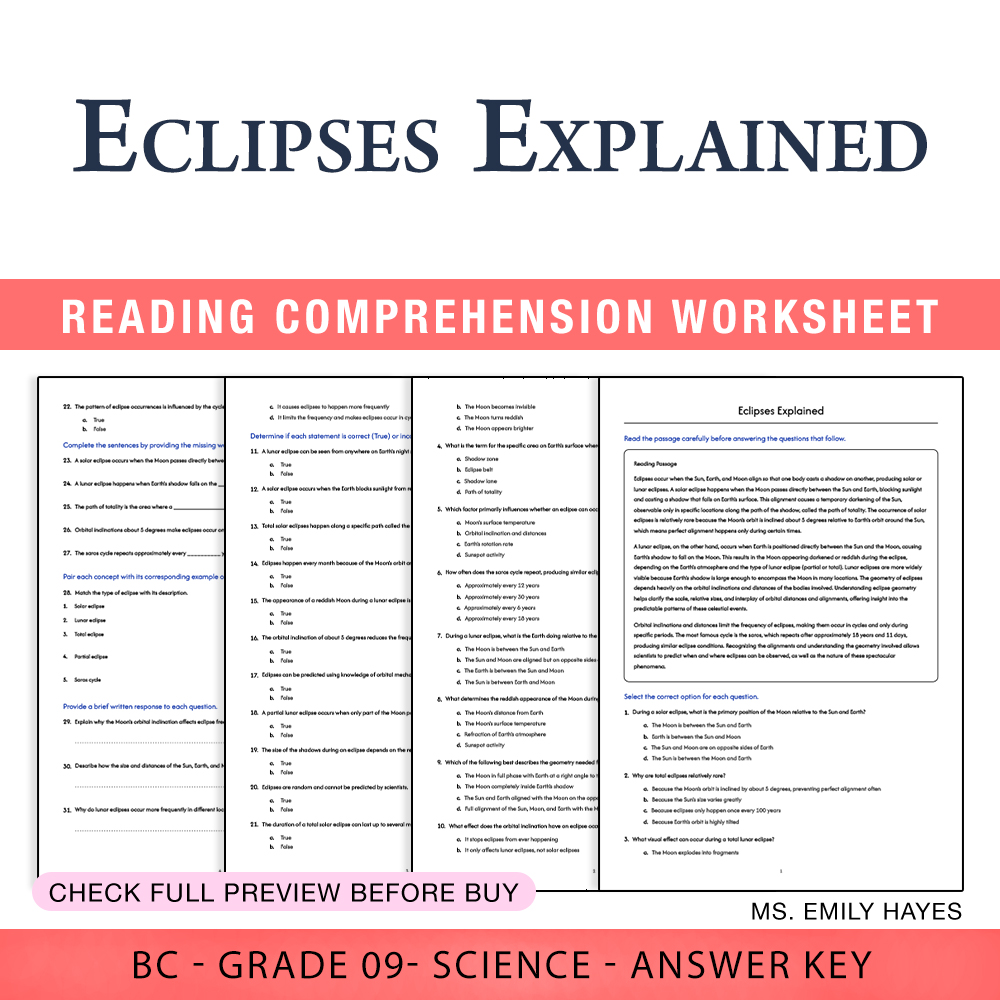
Grade 9 Science | Eclipses Explained Worksheet (PDF+ Answer Key)
Created byCopper Leaf ClassroomLearning Objectives
- Understand the basic geometry of solar and lunar eclipses.
- Identify the positions of the Sun, Earth, and Moon during different types of eclipses.
- Explain how orbital inclinations influence the occurrence and visibility of eclipses.
Also included in: Grade 9 Science Worksheet Bundle | Earth's Dynamic Processes (PDF + Answer Key) +1 more
Instant download
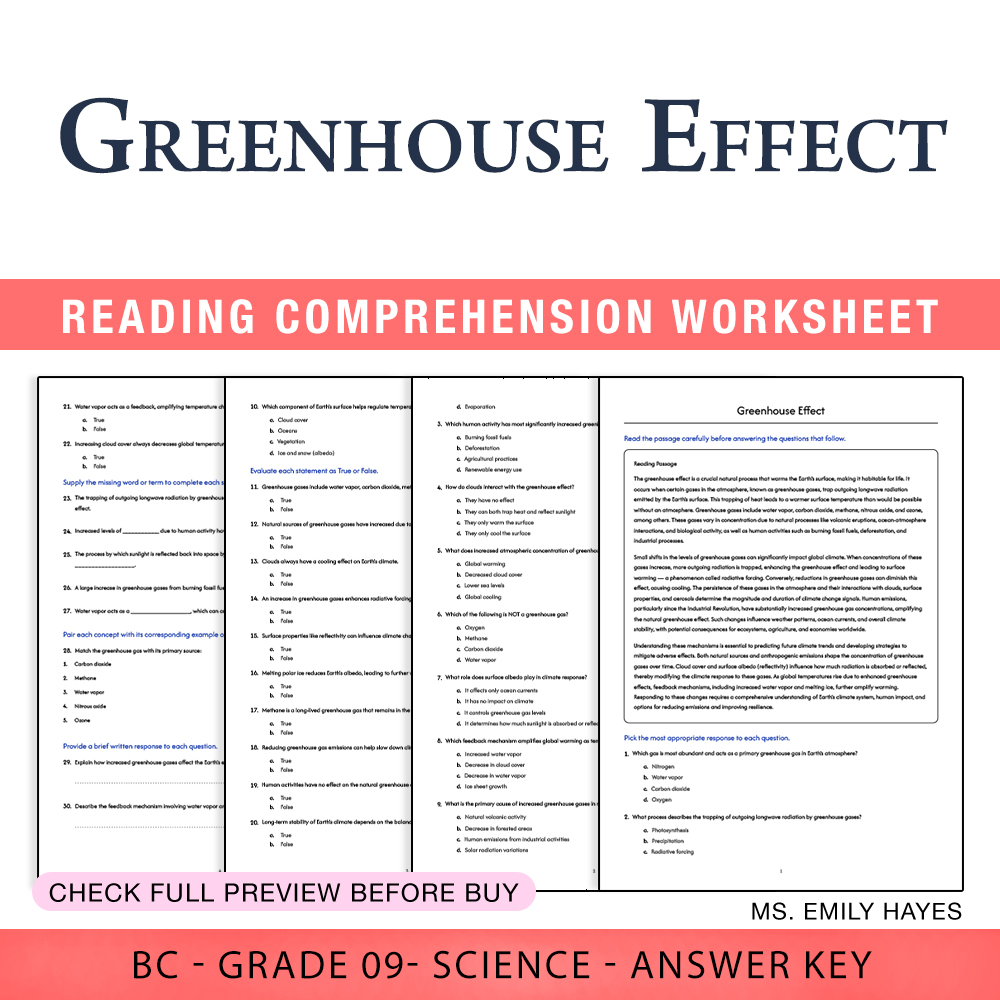
Grade 9 Science | Greenhouse Effect Worksheet (PDF+ Answer Key)
Created byCopper Leaf ClassroomLearning Objectives
- Explain the greenhouse effect and identify key greenhouse gases.
- Analyze how natural and human activities influence Earth's climate.
- Describe how changes in atmospheric composition affect radiative forcing and surface temperature.
Also included in: Grade 9 Science Worksheet Bundle | Earth's Dynamic Processes (PDF + Answer Key) +1 more
Instant download
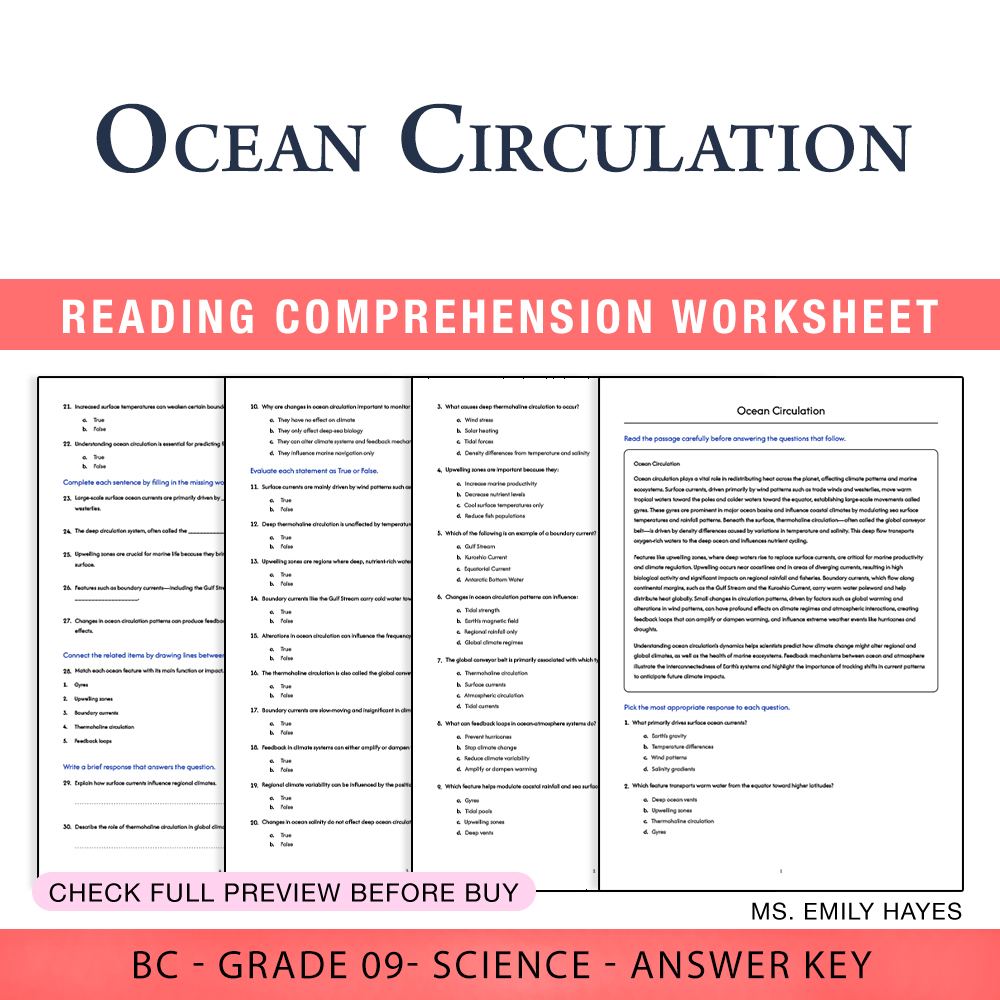
Grade 9 Science | Ocean Circulation Worksheet (PDF+ Answer Key)
Created byCopper Leaf ClassroomLearning Objectives
- Understand the mechanisms driving ocean surface and deep currents.
- Describe features such as gyres, upwelling zones, and boundary currents.
- Explain how ocean circulation influences regional climates and feedback systems.
Also included in: Grade 9 Science Worksheet Bundle | Earth's Dynamic Processes (PDF + Answer Key) +1 more
Instant download
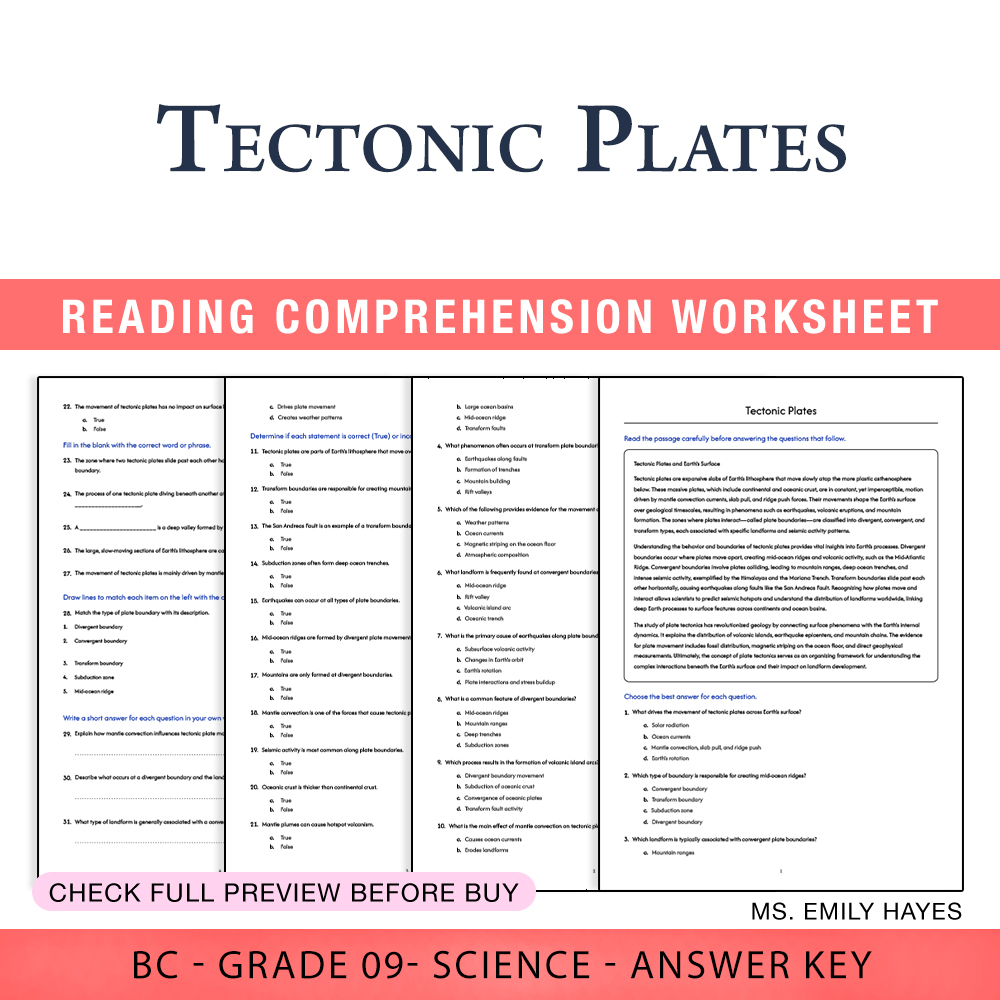
9th Grade Science | Tectonic Plates Worksheet (PDF+ Answer Key)
Created byCopper Leaf ClassroomLearning Objectives
- Understand the concept of tectonic plates and their movement.
- Identify causes and effects of plate interactions.
- Explain the types of plate boundaries and associated landforms and seismic activity.
Also included in: Grade 9 Science Worksheet Bundle | Earth's Dynamic Processes (PDF + Answer Key) +1 more
Instant download
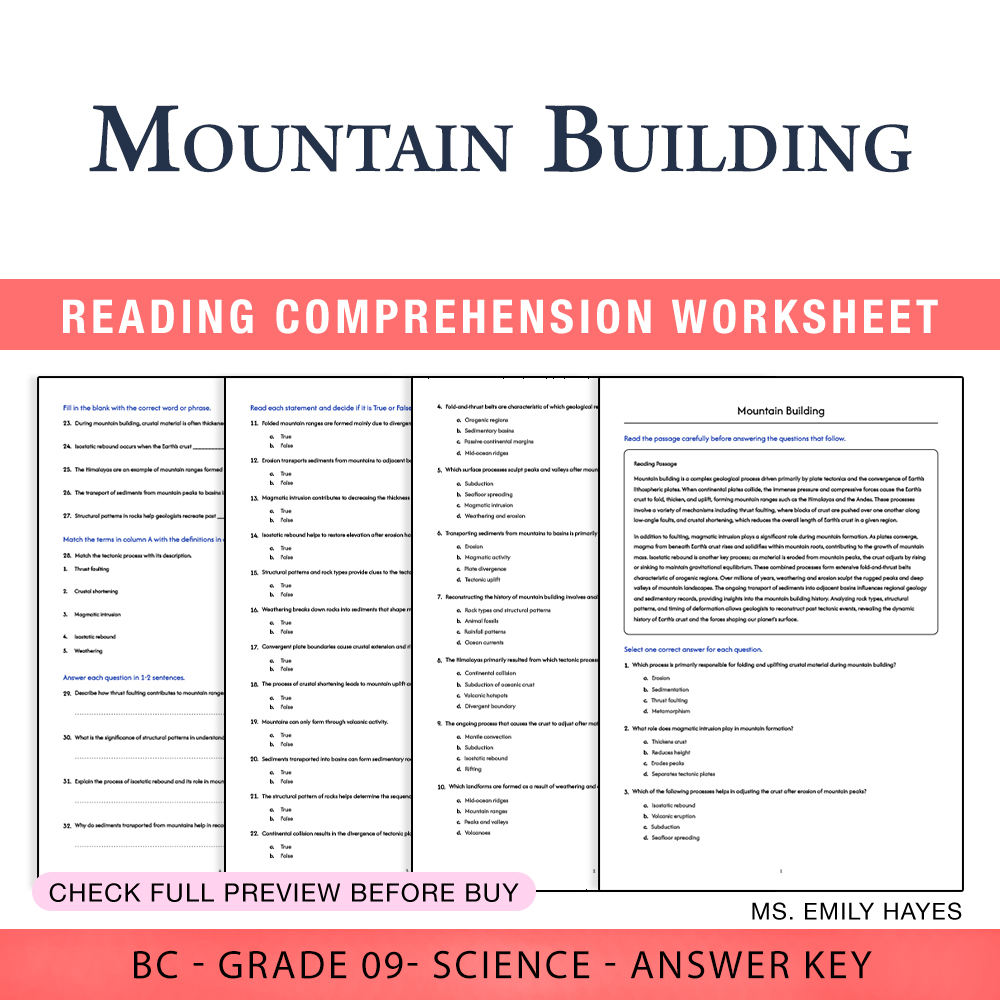
9th Grade Science | Mountain Building Worksheet (PDF+ Answer Key)
Created byCopper Leaf ClassroomLearning Objectives
- Understand the geological processes involved in mountain building resulting from plate convergence and continental collision.
- Identify the various tectonic mechanisms such as thrust faulting, crustal shortening, magmatic intrusion, and isostatic rebound.
- Explain how weathering and erosion shape mountain landscapes and transport sediments.
Also included in: Grade 9 Science Worksheet Bundle | Earth's Dynamic Processes (PDF + Answer Key) +1 more
Instant download
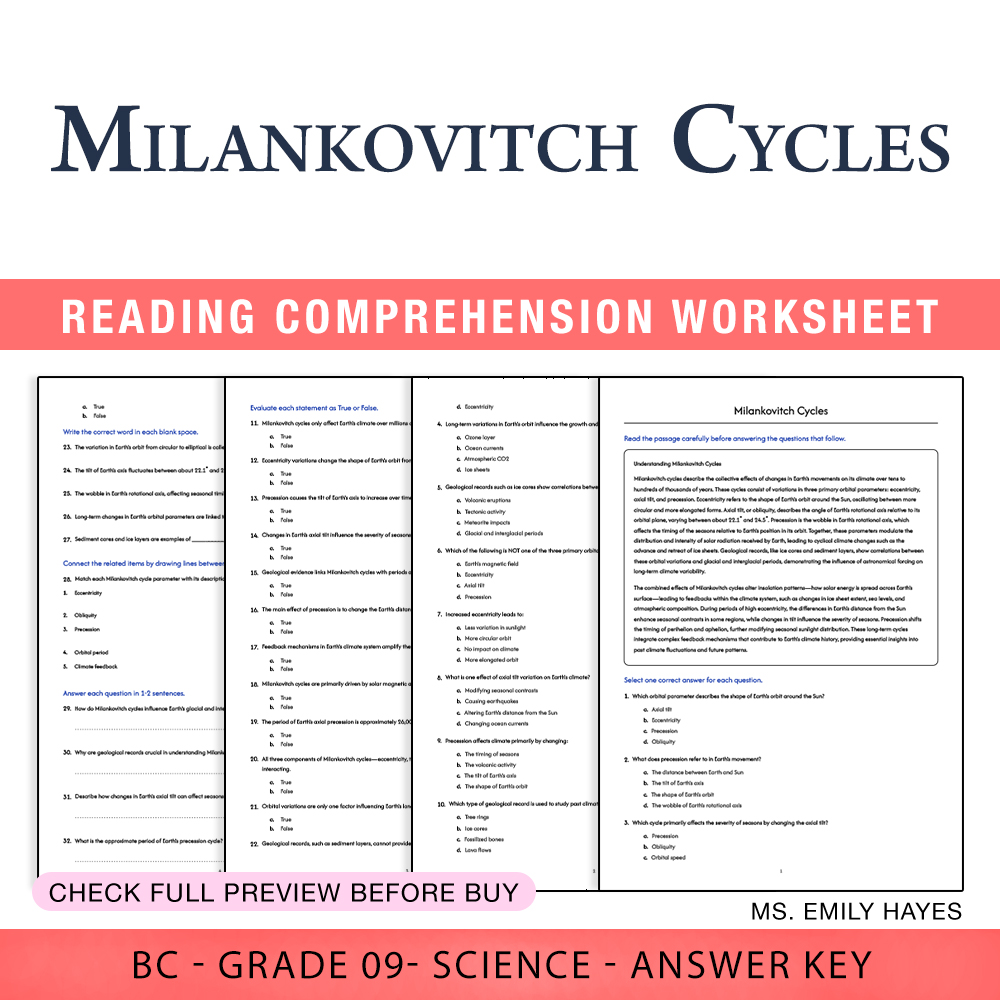
9th Grade Science | Milankovitch Cycles Worksheet (PDF+ Answer Key)
Created byCopper Leaf ClassroomLearning Objectives
- Understand the concept of Milankovitch cycles and their impact on Earth's climate.
- Identify the three main orbital parameters involved in the cycles: eccentricity, axial tilt, and precession.
- Explain how these cycles influence glacial and interglacial periods over long timescales.
Also included in: Grade 9 Science Worksheet Bundle | Earth's Dynamic Processes (PDF + Answer Key) +1 more
Instant download
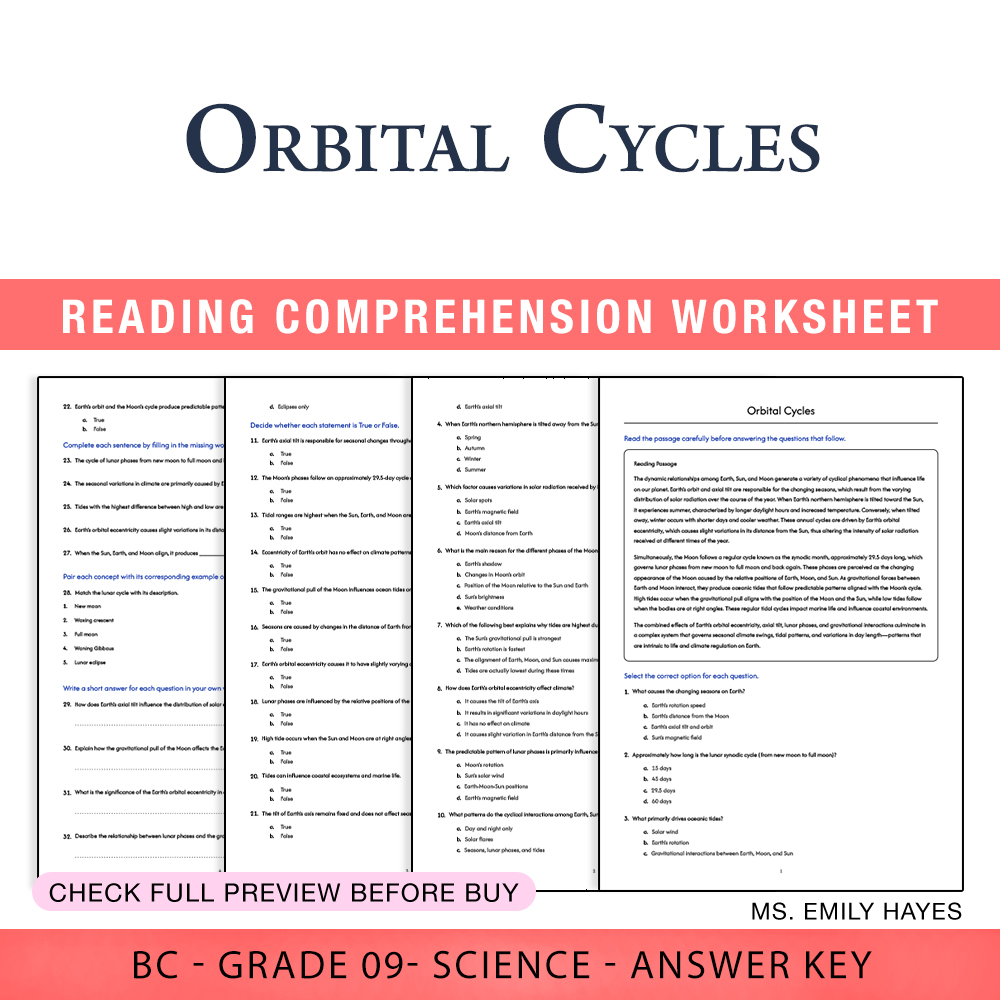
Grade 9 Science | Orbital Cycles Worksheet (PDF+ Answer Key)
Created byCopper Leaf ClassroomLearning Objectives
- Explain how Earth's axial tilt and orbital eccentricity influence seasons and climate cycles.
- Describe the variations in lunar phases and their underlying synodic cycle.
- Analyze how gravitational interactions among Earth, Moon, and Sun produce tidal patterns.
Also included in: Grade 9 Science Worksheet Bundle | Earth's Dynamic Processes (PDF + Answer Key) +1 more
Instant download
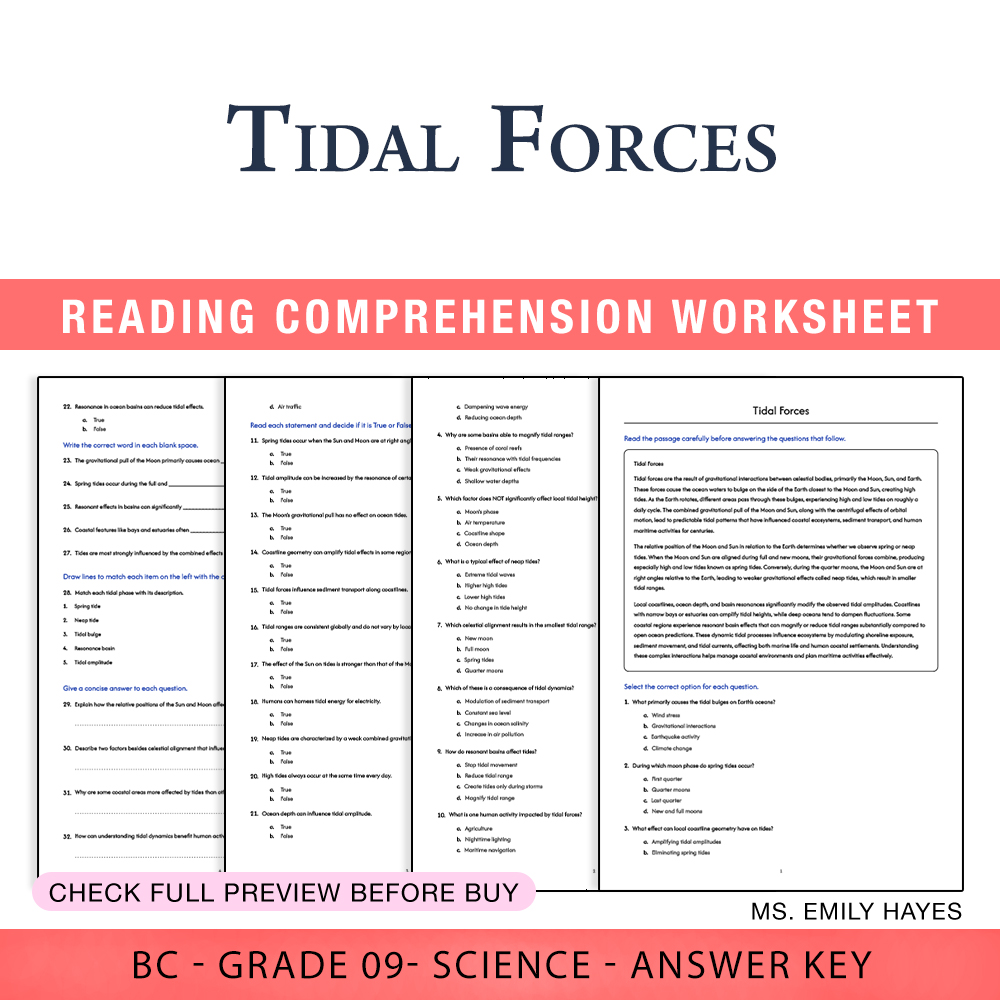
9th Grade Science | Tidal Forces Worksheet (PDF+ Answer Key)
Created byCopper Leaf ClassroomLearning Objectives
- Explain how gravitational interactions among the Moon, Sun, and Earth produce tidal forces.
- Describe the phenomena of spring and neap tides and their relation to celestial alignments.
- Analyze how local geography and basin resonance influence tidal amplitudes.
Also included in: Grade 9 Science Worksheet Bundle | Earth's Dynamic Processes (PDF + Answer Key) +1 more
Instant download
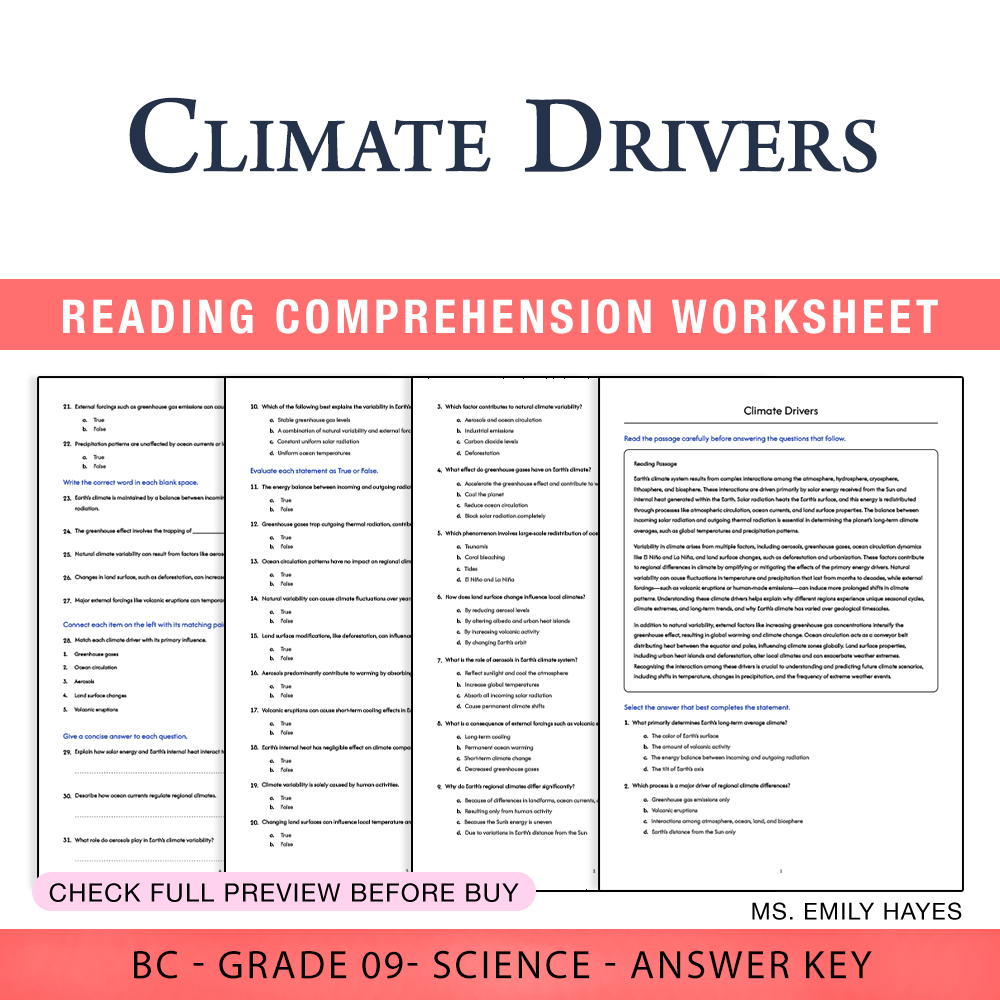
9th Grade Science | Climate Drivers Worksheet (PDF+ Answer Key)
Created byCopper Leaf ClassroomLearning Objectives
- Understand the main components influencing Earth's climate system.
- Identify how energy balance affects climate stability.
- Describe the roles of natural variability and external forcings in climate change.
Also included in: Grade 9 Science Worksheet Bundle | Earth's Dynamic Processes (PDF + Answer Key) +1 more
Instant download
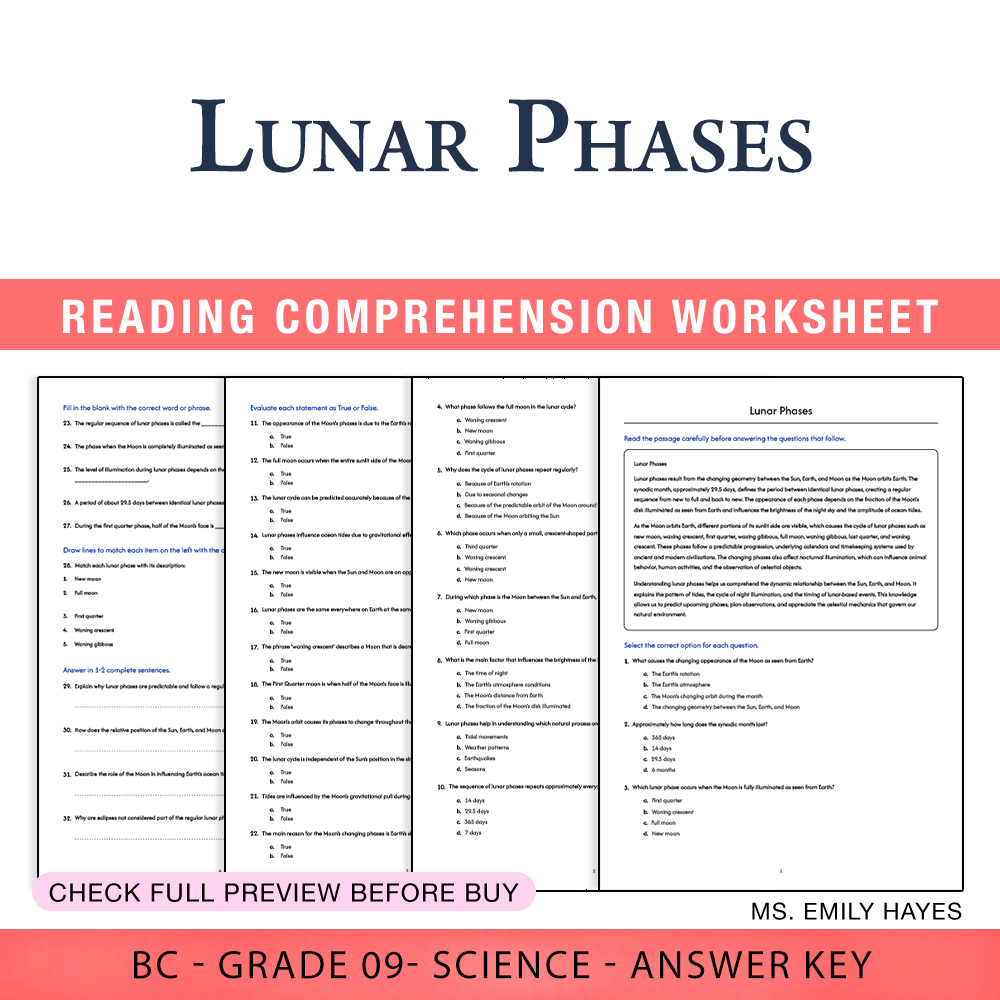
9th Grade Science | Lunar Phases Worksheet (PDF + Answer Key)
Created byCopper Leaf ClassroomLearning Objectives
- Explain the sequence of lunar phases and their causes.
- Describe how the Moon's position affects its visible appearance from Earth.
- Predict the lunar phase based on the geometry between Sun, Earth, and Moon.
Also included in: Grade 9 Science Worksheet Bundle | Earth's Dynamic Processes (PDF + Answer Key) +1 more
Instant download
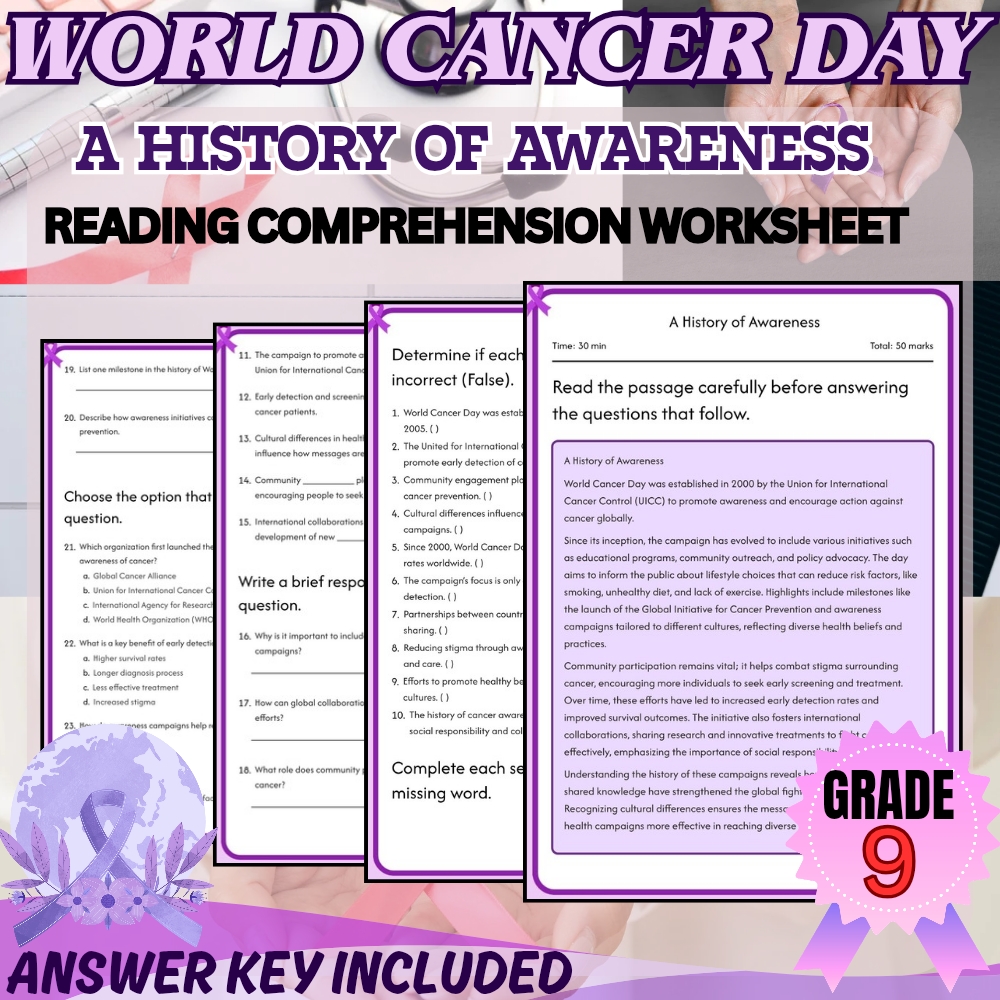
Grade 9 | World Cancer Day Worksheet for Mastering Awareness | PDF + Answer Key
Created byShaNova WorksheetsLearning Objectives
- Understand the origins and significance of World Cancer Day in raising awareness.
- Identify key milestones and campaigns in cancer prevention and early detection.
- Analyze how community engagement and cultural differences influence health awareness.
Instant download

Volcanic Processes Worksheet for Grade 9 Science | AP Earth Science
Created byPrism Point LearningLearning Objectives
- Explain how magma composition and tectonic setting influence volcanic eruption style and hazard potential.
- Compare effusive shield volcanism and explosive stratovolcano behavior using magma viscosity and volatile content.
- Use volcanic gas emissions and basic eruption timelines to describe how volcanoes modify landscapes and can affect climate.
Also included in: Earth Systems & Climate Evidence Lesson Bundle | Grade 9 Science | AP
Instant download
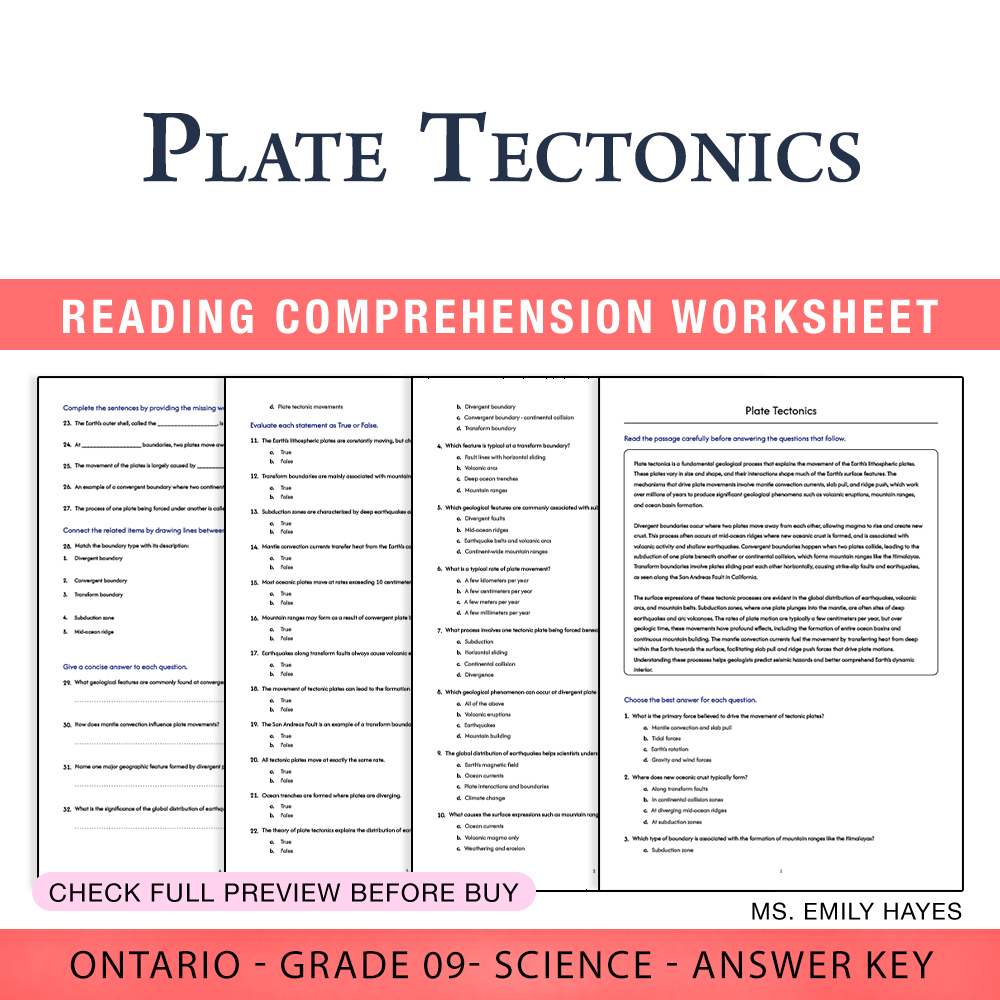
9th Grade Science | Plate Tectonics Worksheet (PDF + Answer Key)
Created byCopper Leaf ClassroomLearning Objectives
- Explain the mechanisms driving plate tectonics, including divergent, convergent, and transform boundaries.
- Describe the surface expression of plate movements, such as volcanic activity, mountain building, and ocean basin formation.
- Link mantle convection and slab pull to the forces that move tectonic plates over geological time.
Instant download
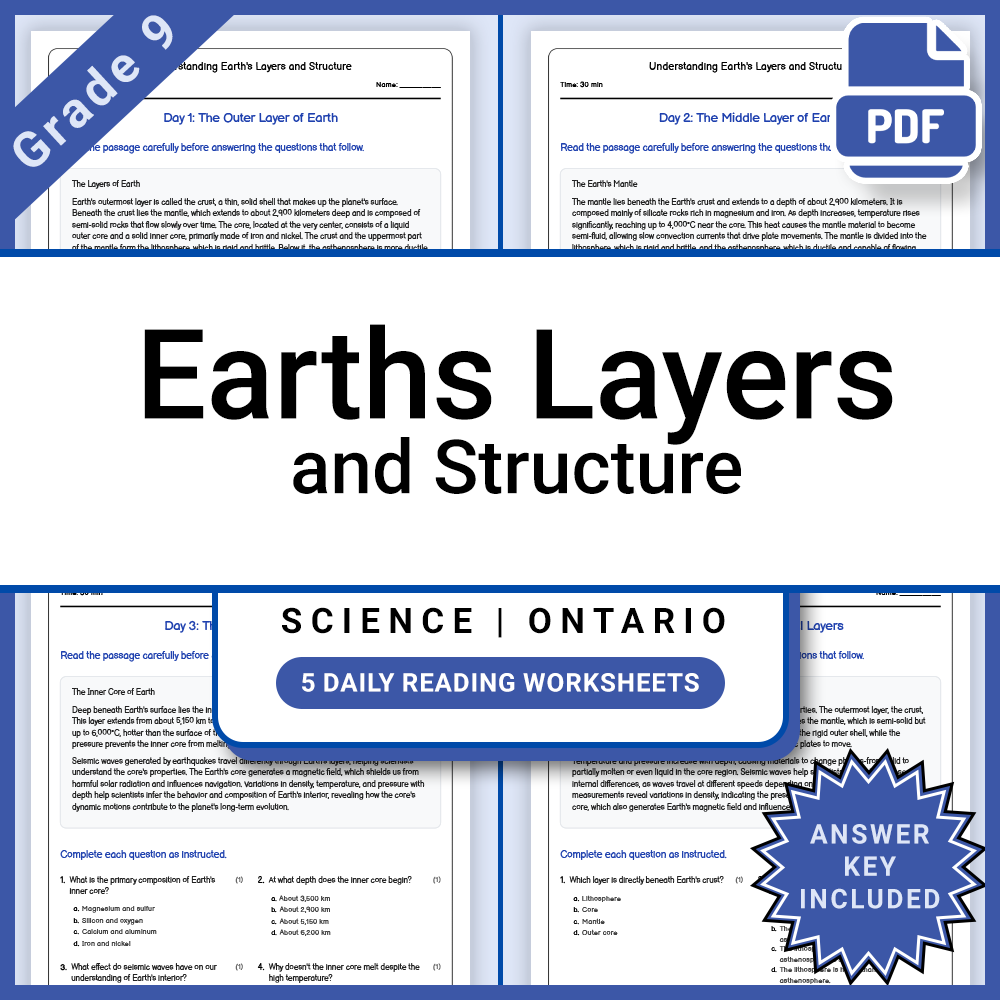
Grade 9 Science – Earth's Layers Daily Reading Worksheet + Answer Key
JCreated byJ.S SheetsLearning Objectives
- Identify the different layers of Earth and describe their characteristics.
- Explain the differences between the lithosphere and asthenosphere.
- Understand how seismic waves help scientists learn about Earth's interior.
Also included in: Grade 9 Science Lesson Group Bundle – Earth Systems & Planetary Concepts +1 more
Instant download
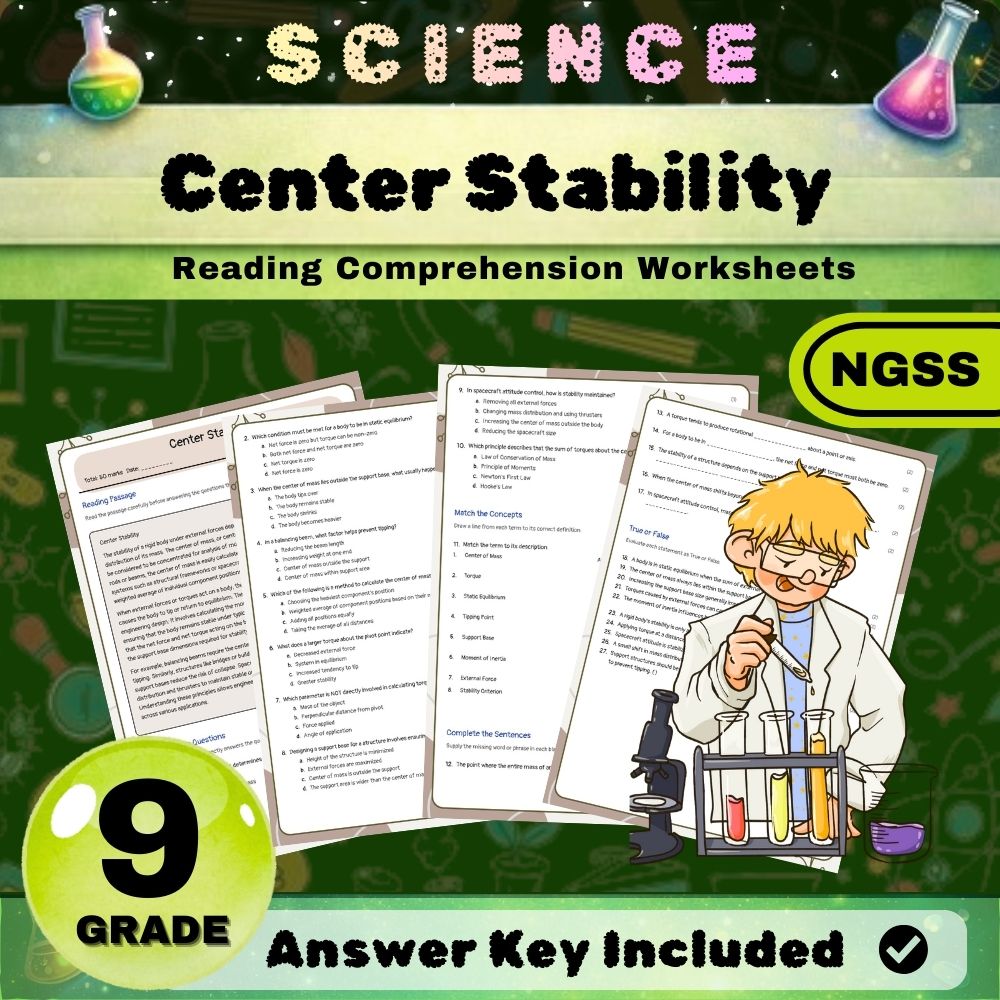
Grade 9 Science | Center Stability Worksheet (NGSS) (PDF)
Created byMaple Path LearningLearning Objectives
- Understand the concepts of center of mass and how it affects the stability of rigid bodies.
- Calculate the center of mass for composite systems and analyze their stability.
- Apply torque and equilibrium conditions to determine tipping thresholds for structures.
Also included in: Grade 9 Science | Motion and Stability Forces & Interactions NGSS Unit Bundle +1 more
Instant download

Energy Molecules Assessment | TEKS Grade 9 Science Standards
Created byPrism Point LearningLearning Objectives
- Understand the structure and role of ATP in cellular energy transfer.
- Explain how hydrolysis of ATP releases energy for cellular activities.
- Describe the process of ATP regeneration through phosphorylation.
Instant download
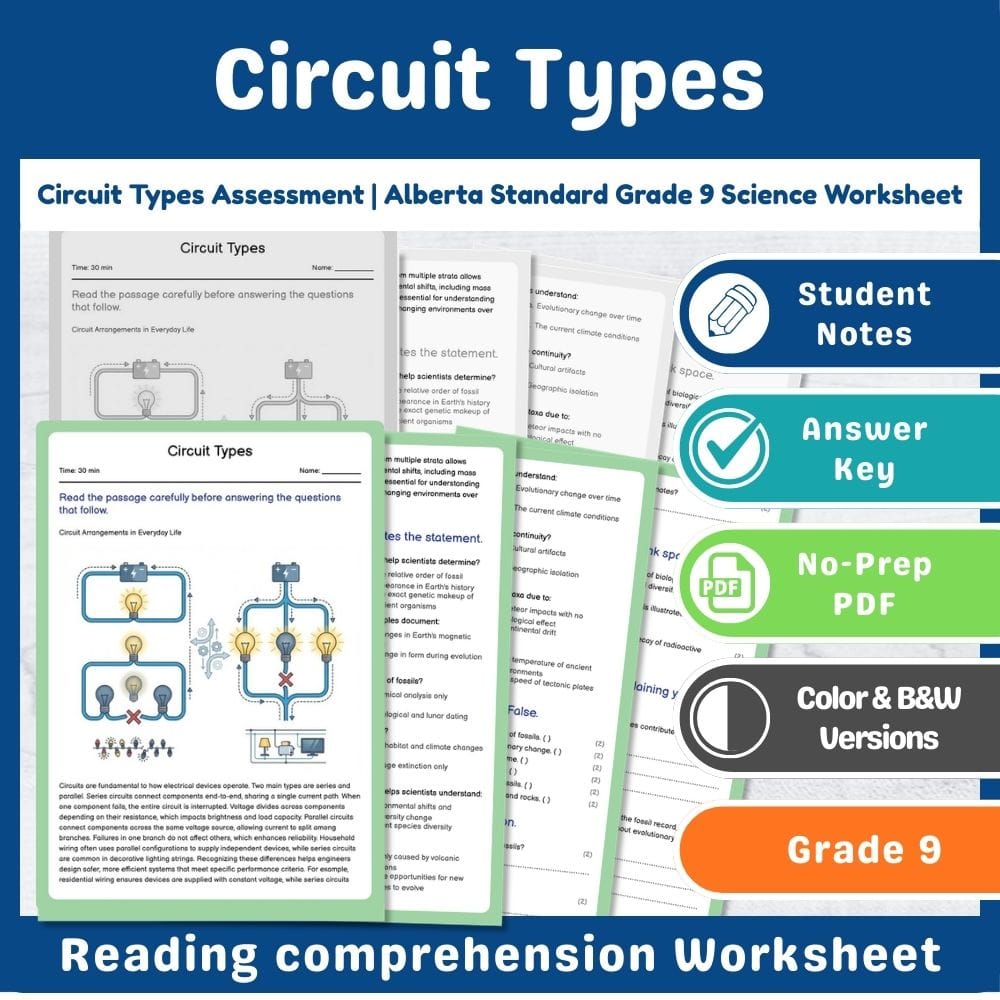
Circuit Types Assessment | Alberta Standard Grade 9 Science Worksheet
Created byPrism Point LearningLearning Objectives
- Understand the difference between series and parallel circuits.
- Identify the behavior of current and voltage in different circuit arrangements.
- Analyze the effects of circuit configuration on brightness, reliability, and performance.
Also included in: Grade 9 Electricity and Magnetism Science Lesson Bundle | Alberta Framework +1 more
Instant download

Grade 9 Health | Decision Processes Worksheet (Answer Key) for Student Mastery
 Created bySkylark Worksheets
Learning Objectives
- Understand the steps involved in effective decision-making.
- Recognize the importance of gathering information and evaluating options.
- Learn how external influences and personal values impact health decisions.
Also included in: Grade 9 Health Unit | Ethical Decisions & Media Influence Worksheets Bundle +1 more
Instant download
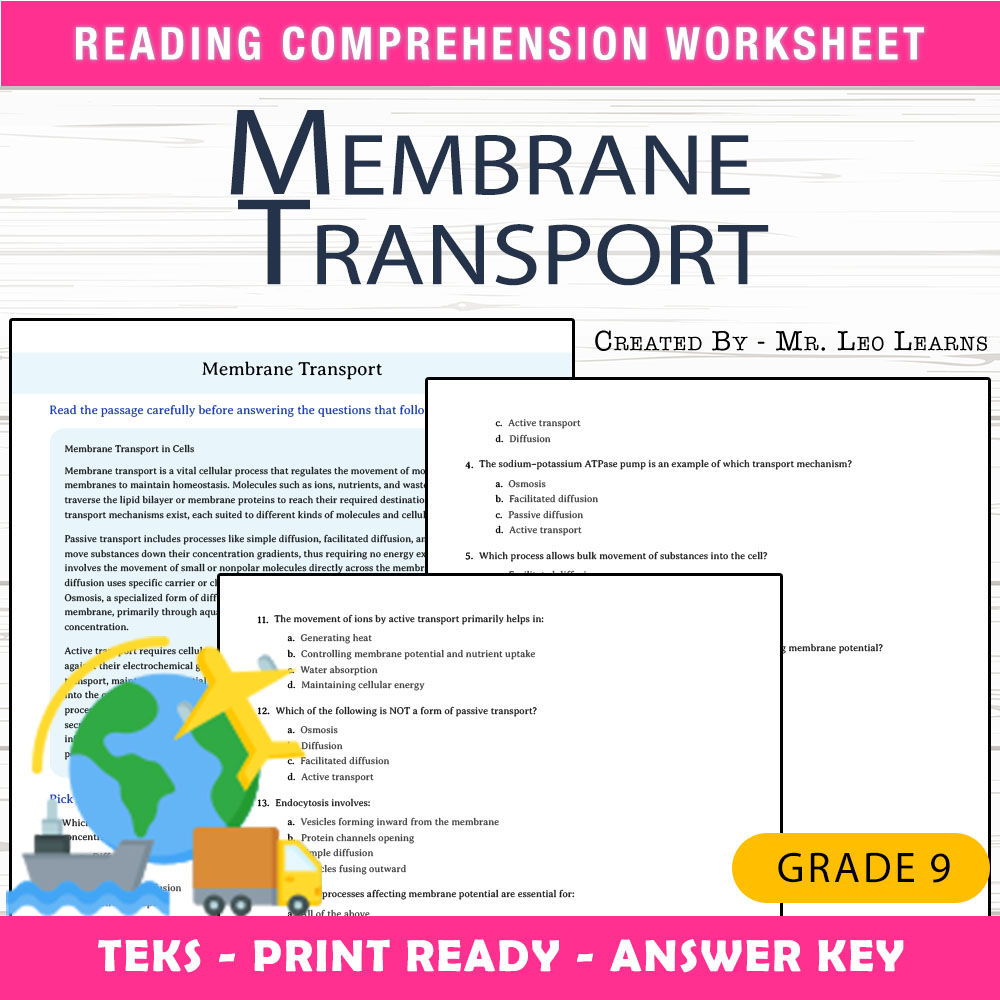
Grade 9 Science – Membrane Transport Worksheet for Mastery
 Created byThe Resource Hub
Learning Objectives
- Understand the different mechanisms of membrane transport including passive and active processes.
- Differentiate between diffusion, facilitated diffusion, osmosis, and active transport.
- Explain the role of vesicular transport such as endocytosis and exocytosis in cellular function.
Also included in: Grade 9 Science Unit | Human Body Systems & Homeostasis Worksheet Bundle +1 more
Instant download
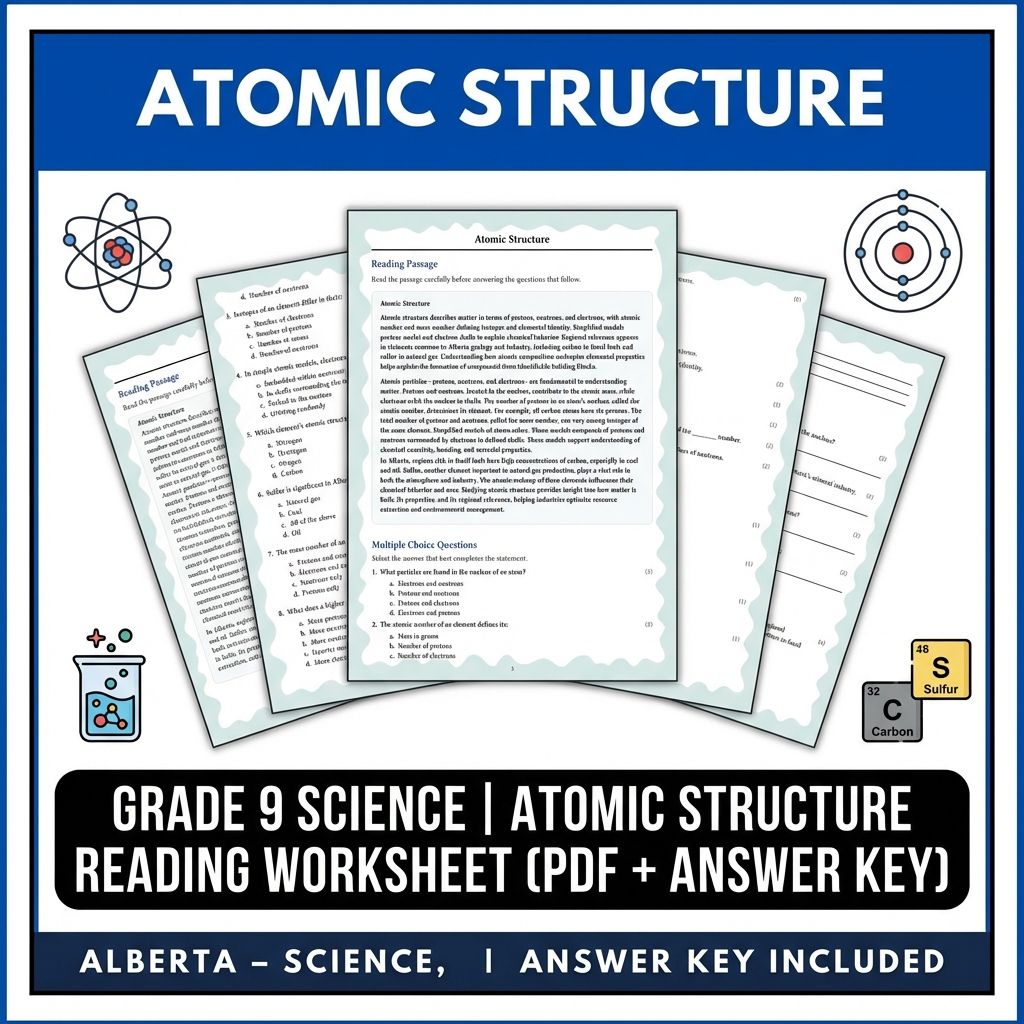
Grade 9 Science | Atomic Structure Reading Worksheet (PDF + Answer Key)
JCreated byJ.S SheetsLearning Objectives
- Explain the basic components of atomic structure: protons, neutrons, and electrons
- Define atomic number and mass number and their significance for isotopes
- Describe simple models of nuclei and electron shells to illustrate chemical behavior
Also included in: Grade 9 Science Unit Bundle – Chemistry, States & Atomic Structure Worksheets +1 more
Instant download
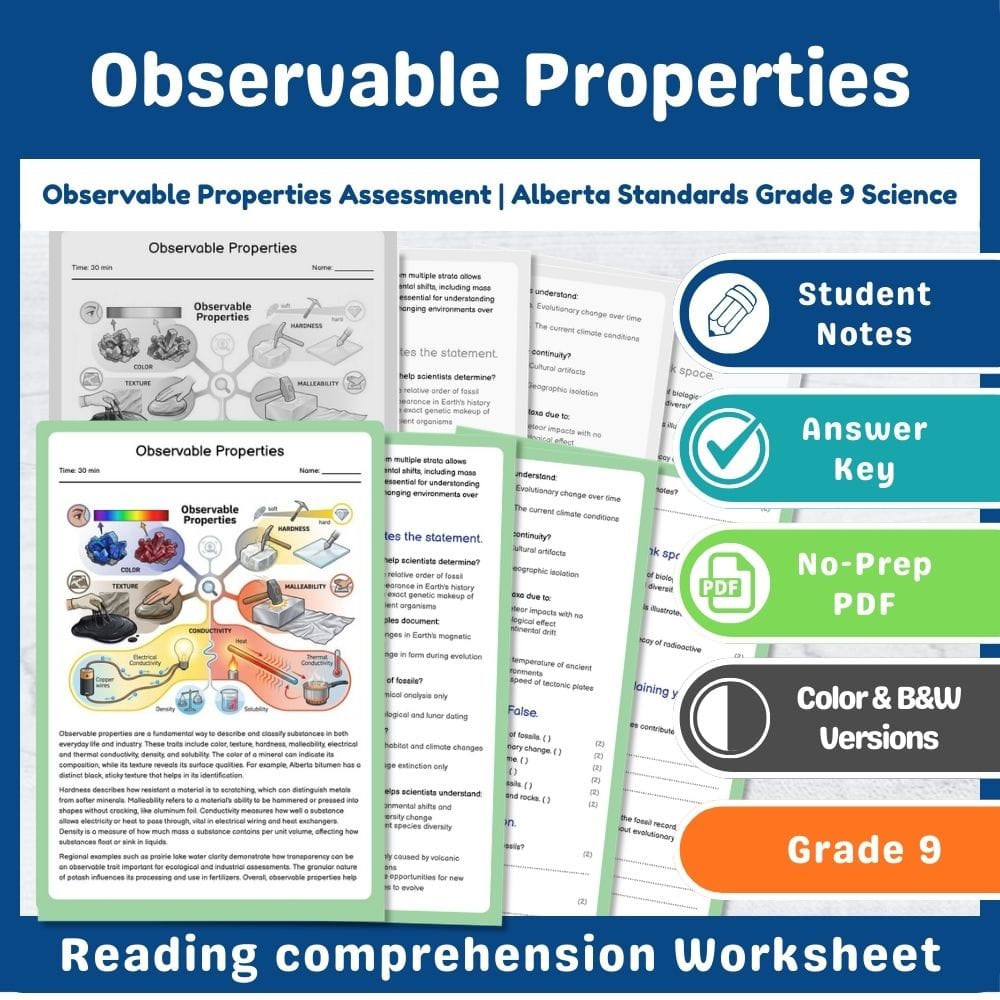
Observable Properties Assessment | Alberta Standards Grade 9 Science
Created byPrism Point LearningLearning Objectives
- Identify and describe various observable properties of substances.
- Understand how observable traits help classify different materials.
- Recognize regional examples illustrating material properties.
Also included in: Grade 9 Matter and Chemical Change Science Lesson Bundle | Alberta +1 more
Instant download
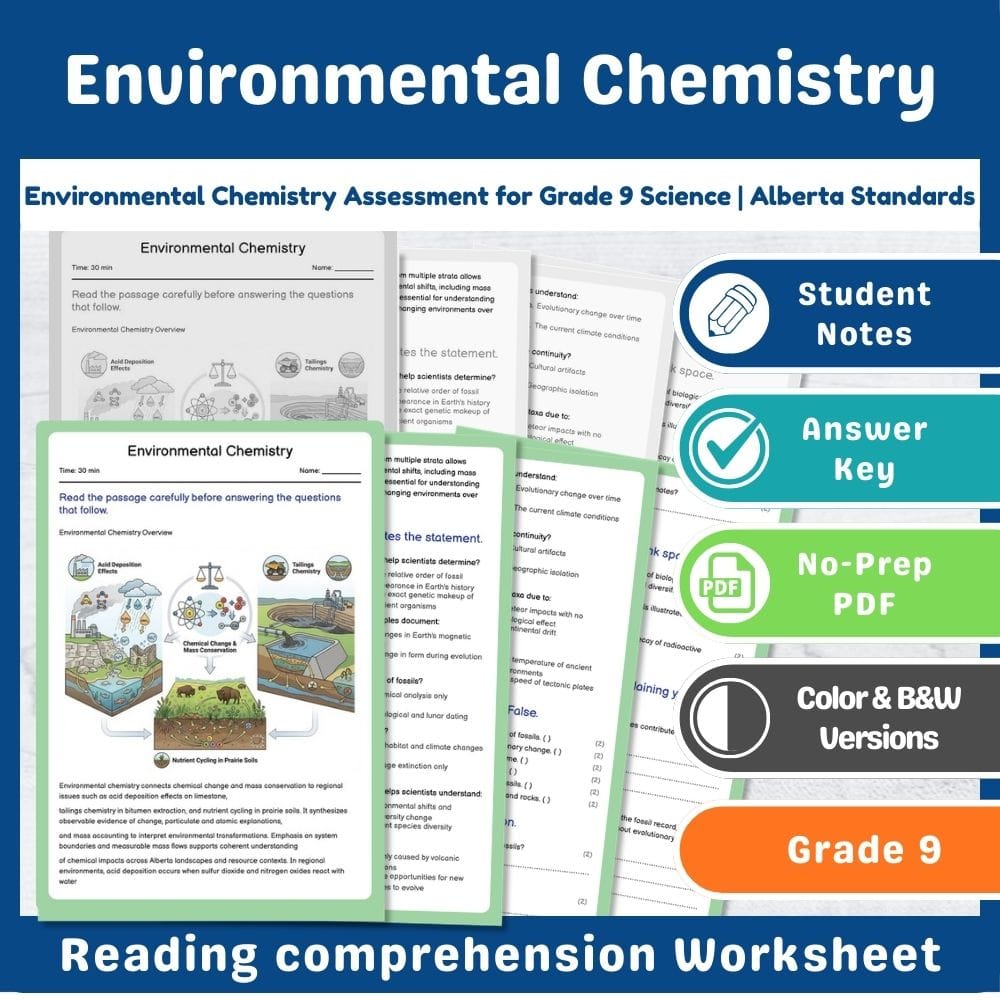
Environmental Chemistry Assessment for Grade 9 Science | Alberta Standards
Created byPrism Point LearningLearning Objectives
- Understand how chemical change and mass conservation relate to environmental issues.
- Analyze regional environmental impacts such as acid deposition and nutrient cycling.
- Interpret observable evidence of environmental transformations through particulate and atomic explanations.
Also included in: Grade 9 Matter and Chemical Change Science Lesson Bundle | Alberta +1 more
Instant download
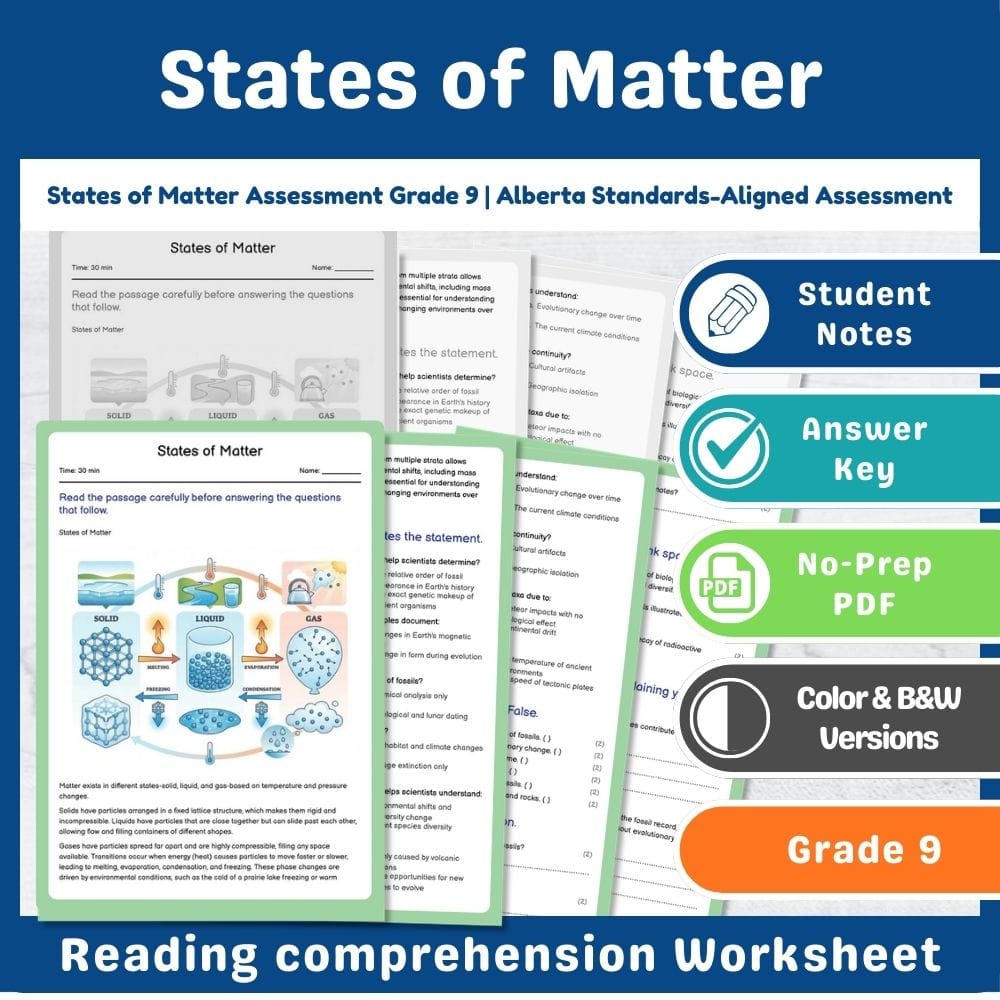
States of Matter Assessment Grade 9 | Alberta Standards-Aligned Assessment
Created byPrism Point LearningLearning Objectives
- Describe the three main states of matter: solid, liquid, and gas.
- Explain how temperature and pressure influence phase transitions.
- Identify the behaviors and properties characteristic of each state of matter.
Also included in: Grade 9 Matter and Chemical Change Science Lesson Bundle | Alberta +1 more
Instant download
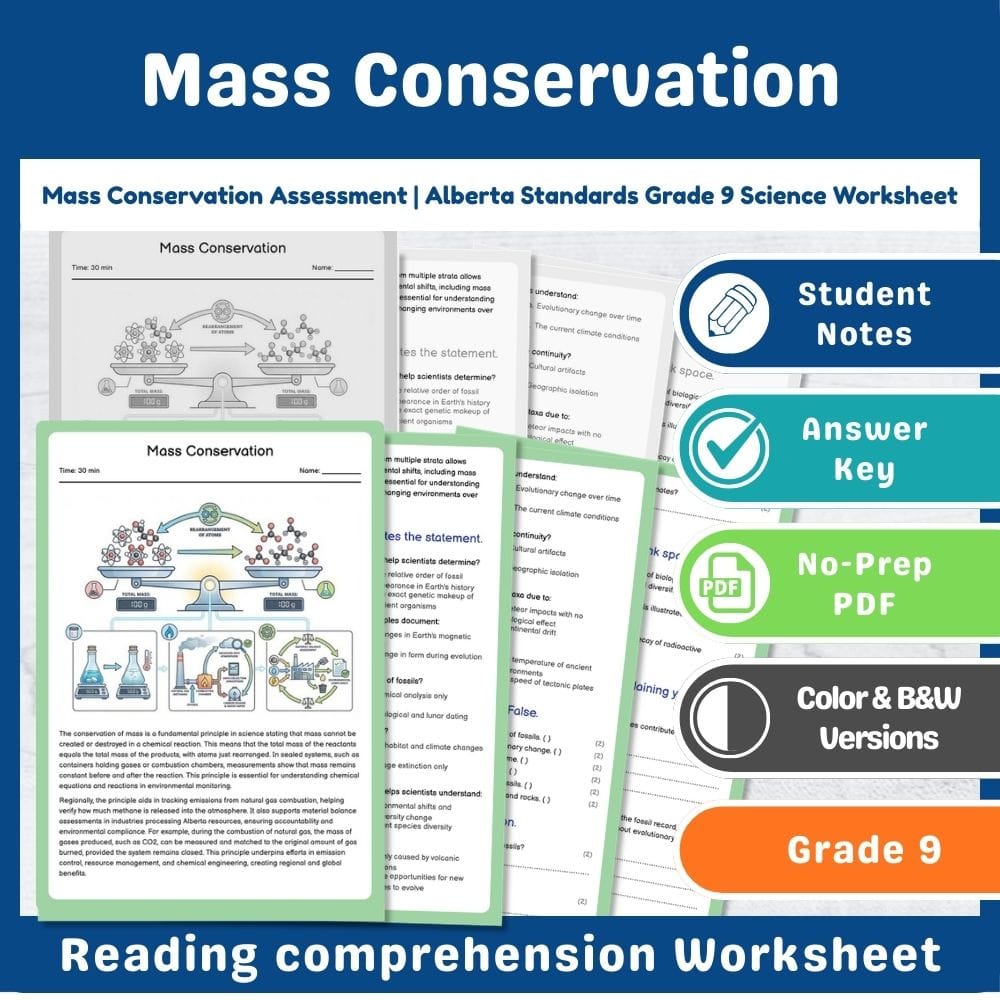
Mass Conservation Assessment | Alberta Standards Grade 9 Science Worksheet
Created byPrism Point LearningLearning Objectives
- Explain the principle of mass conservation in chemical reactions.
- Describe how mass remains constant in closed systems despite chemical changes.
- Identify regional applications of mass conservation in environmental and industrial contexts.
Also included in: Grade 9 Matter and Chemical Change Science Lesson Bundle | Alberta +1 more
Instant download
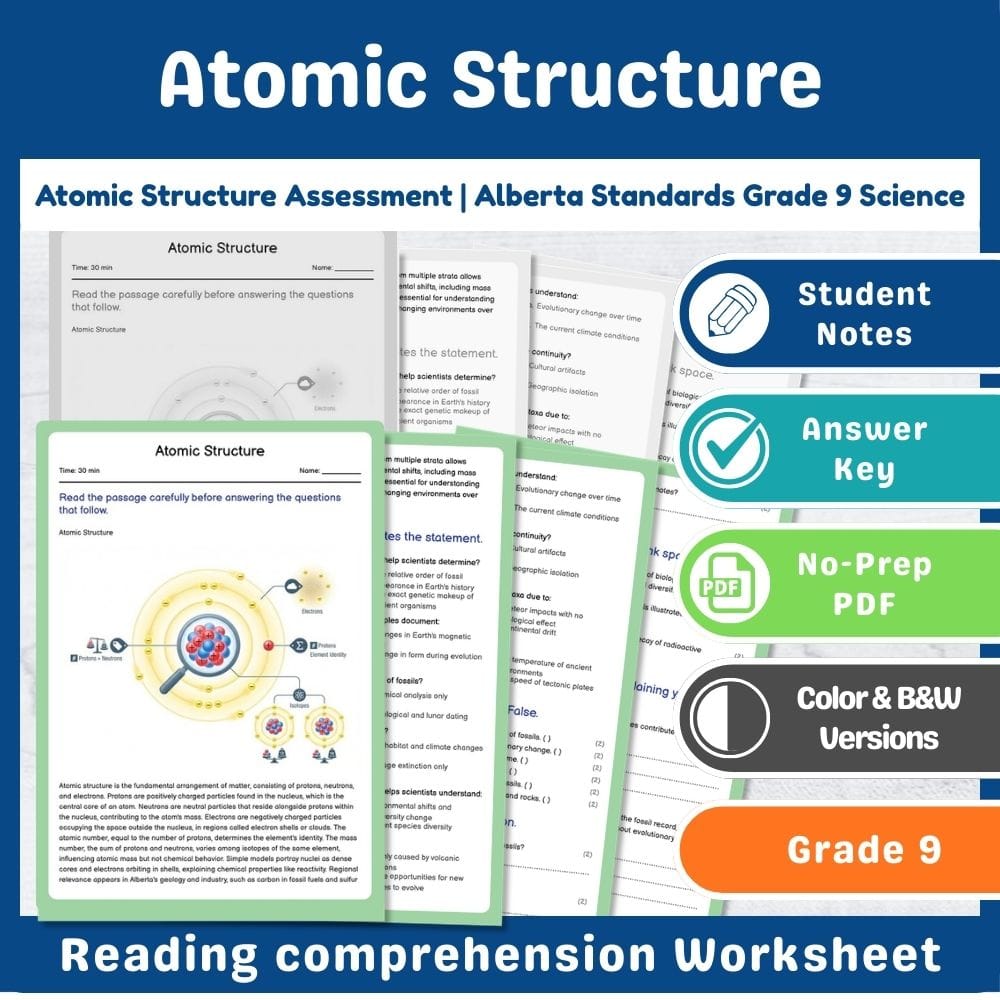
Atomic Structure Assessment | Alberta Standards Grade 9 Science
Created byPrism Point LearningLearning Objectives
- Describe the basic components of an atom: protons, neutrons, and electrons.
- Explain how atomic number and mass number define isotopes and element identity.
- Illustrate simple models of nuclei and electron shells to understand chemical behavior.
Also included in: Grade 9 Matter and Chemical Change Science Lesson Bundle | Alberta +1 more
Instant download
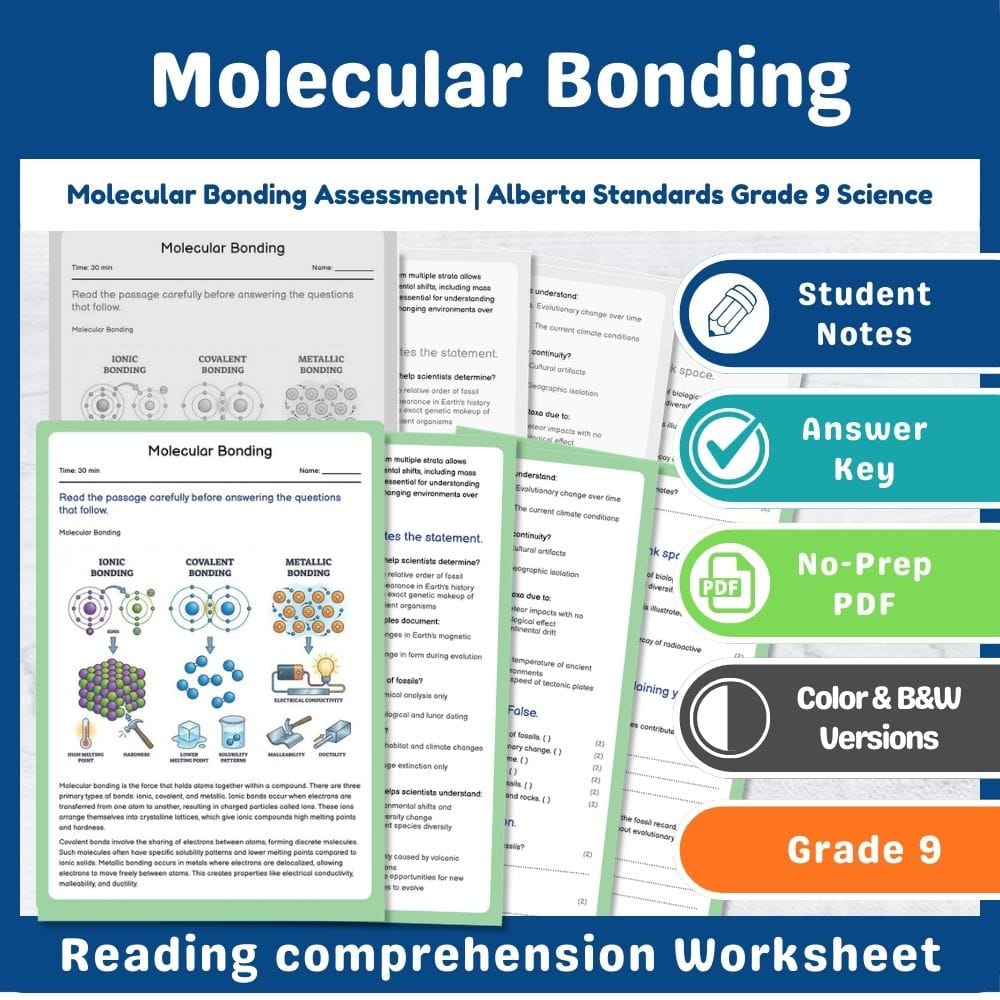
Molecular Bonding Assessment | Alberta Standards Grade 9 Science
Created byPrism Point LearningLearning Objectives
- Describe the different types of chemical bonds: ionic, covalent, and metallic.
- Identify properties of compounds based on their bonding type.
- Explain how bonding influences material properties and applications.
Also included in: Grade 9 Matter and Chemical Change Science Lesson Bundle | Alberta +1 more
Instant download

Mixtures and Solutions Assessment | Alberta Standards Grade 9 Science
Created byPrism Point LearningLearning Objectives
- Differentiate between heterogeneous mixtures and homogeneous solutions.
- Explain the roles of solute and solvent in a solution.
- Describe methods of separating mixture components based on physical properties.
Also included in: Grade 9 Matter and Chemical Change Science Lesson Bundle | Alberta +1 more
Instant download
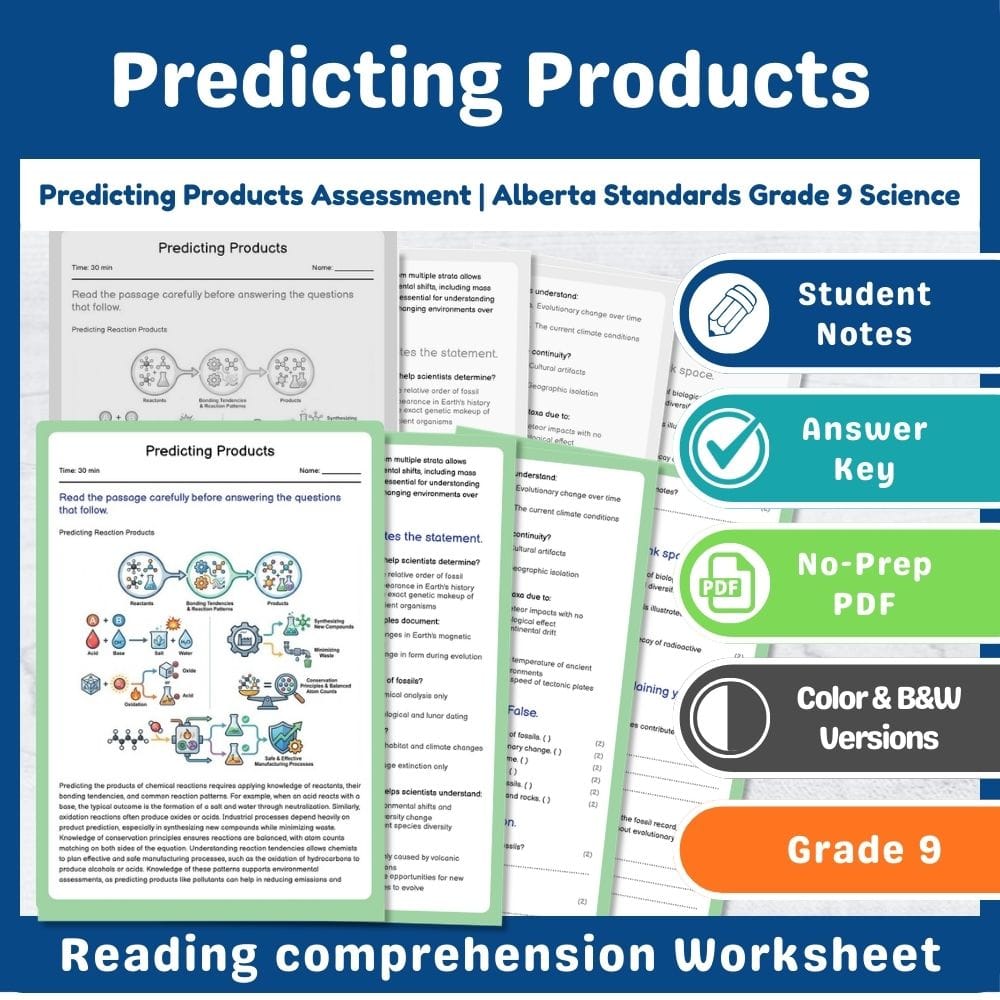
Predicting Products Assessment | Alberta Standards Grade 9 Science
Created byPrism Point LearningLearning Objectives
- Understand patterns of chemical reactions to predict likely products.
- Apply conservation principles and reactant identities in product prediction.
- Analyze industrial examples such as oxidation of hydrocarbons and neutralization reactions.
Also included in: Grade 9 Matter and Chemical Change Science Lesson Bundle | Alberta +1 more
Instant download
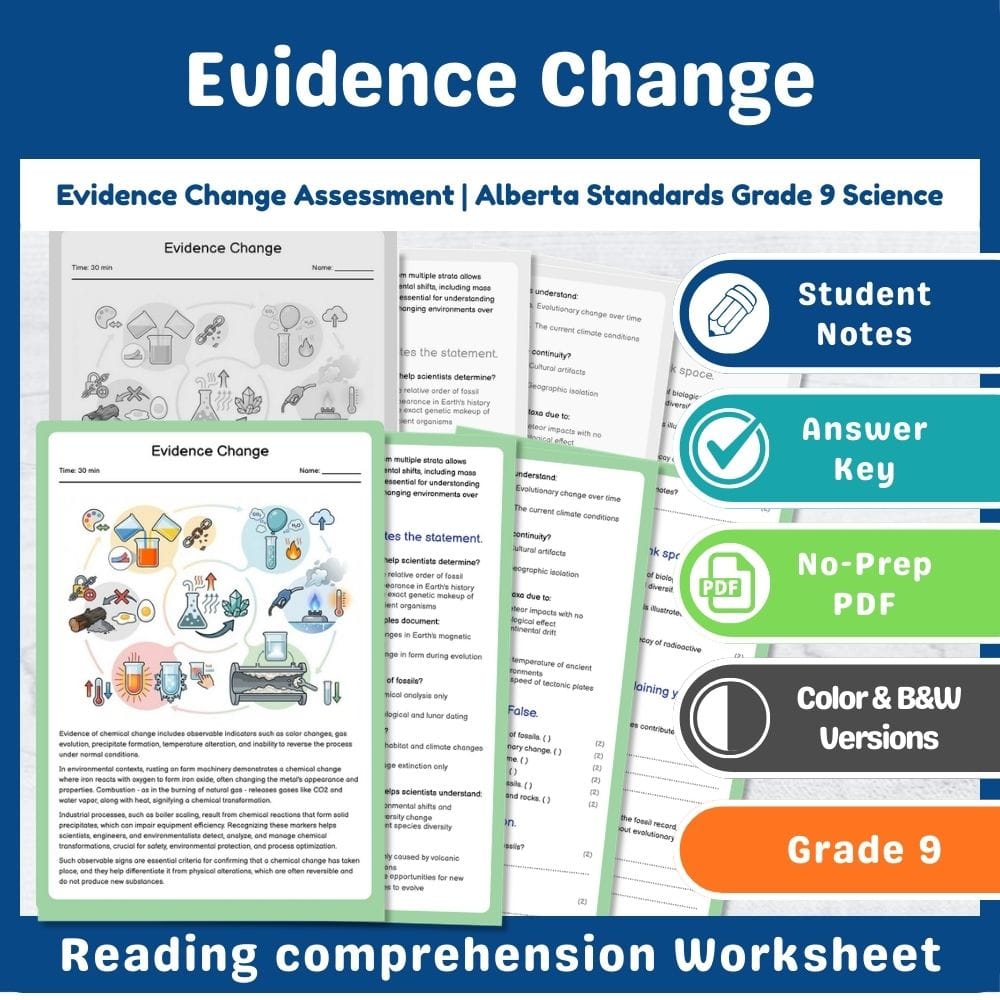
Evidence Change Assessment | Alberta Standards Grade 9 Science
Created byPrism Point LearningLearning Objectives
- Identify observable signs that indicate a chemical change has occurred.
- Distinguish between physical and chemical change markers in environmental and industrial contexts.
- Understand examples of chemical change such as rusting, combustion, and scale formation.
Also included in: Grade 9 Matter and Chemical Change Science Lesson Bundle | Alberta +1 more
Instant download
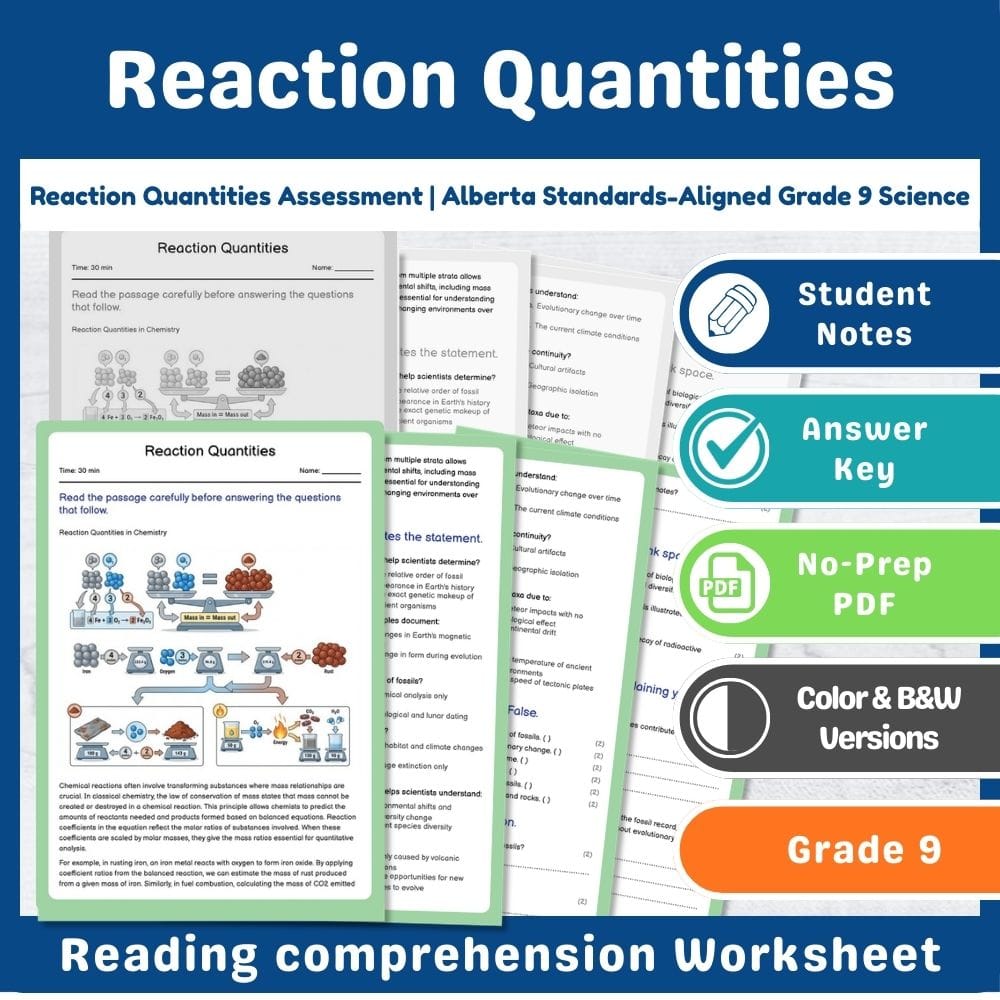
Reaction Quantities Assessment | Alberta Standards-Aligned Grade 9 Science
Created byPrism Point LearningLearning Objectives
- Understand how to interpret and use coefficient ratios in balanced chemical equations.
- Learn to relate mass measurements of reactants and products through proportional relationships.
- Apply relative mass concepts to practical scenarios involving chemical reactions.
Also included in: Grade 9 Matter and Chemical Change Science Lesson Bundle | Alberta +1 more
Instant download
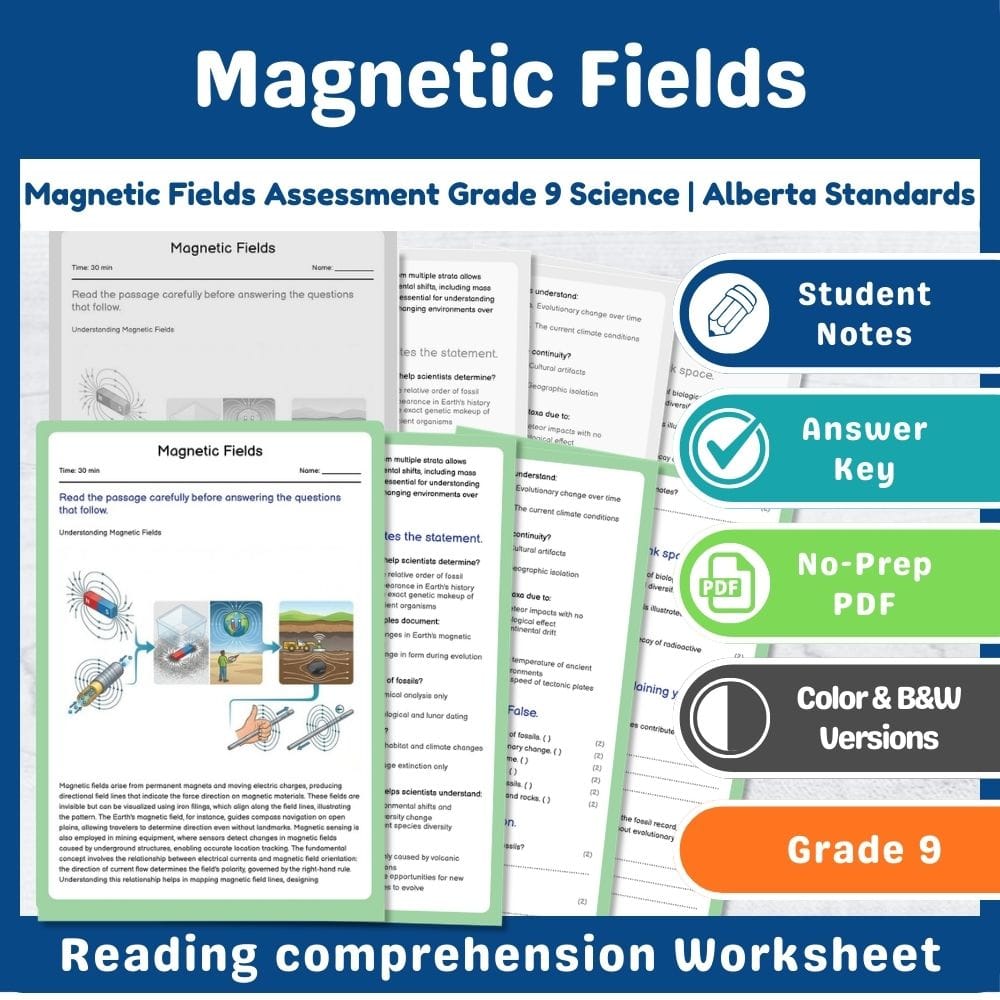
Magnetic Fields Assessment Grade 9 Science | Alberta Standards
Created byPrism Point LearningLearning Objectives
- Explain how magnetic fields are generated by permanent magnets and moving electric charges.
- Describe the concept of magnetic field lines and their directional properties.
- Connect regional phenomena like compass navigation and magnetic sensing in industry to magnetic fields.
Also included in: Grade 9 Electricity and Magnetism Science Lesson Bundle | Alberta Framework +1 more
Instant download

Grade 9 Biodiversity Limits Worksheet | Practice & Assessment PDF
 Created byClear Sky Classroom
Learning Objectives
- Explain how limiting resources and biotic interactions affect population survival and reproduction within a community
- Describe how carrying capacity constrains population size and influences biodiversity over time
- Analyze how environmental changes can shift species abundance and community composition
Instant download
Grade 9 Science | Endocrine Feedback Worksheet (Ontario) – Science (PDF)
 Created byBright Mind Resources
Learning Objectives
- Describe how hormones are synthesized, transported, and act on cells through receptor-mediated actions.
- Explain the roles of negative and positive feedback loops in hormonal regulation.
- Analyze mechanisms of glucose homeostasis involving insulin and glucagon.
Instant download
Browse more categories
About Grade 9 Worksheets
Browse 9,304 printable Grade 9 worksheets across algebra, biology, literature, and history — each a ready-to-print PDF with optional answer keys.
Every worksheet on MyTeachingSheets is created by independent teacher-authors and reviewed before publication. All resources download as printable PDFs for classroom, homework, or at-home practice, and many include answer keys. Preview any worksheet free before buying.