
Grade 9 Worksheets
9,304 grade resources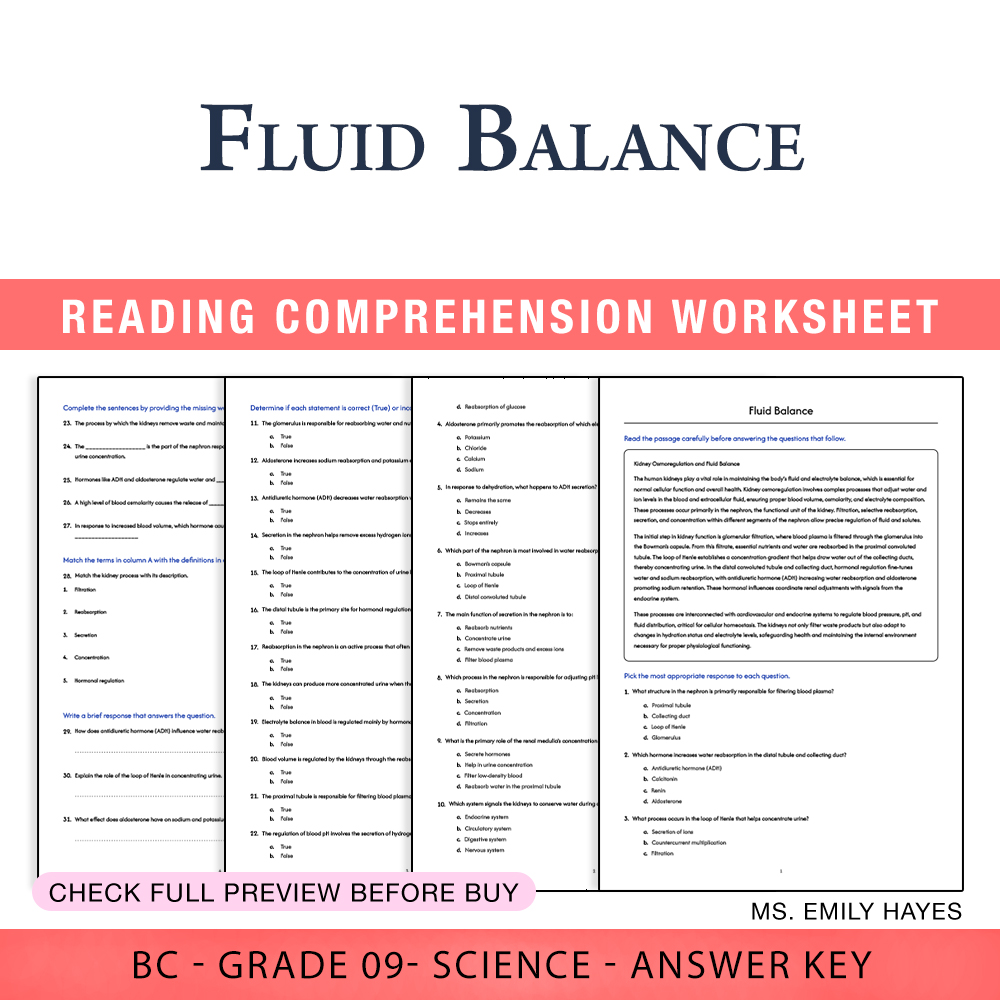
9th Grade Science | Fluid Balance Worksheet (PDF+ Answer Key)
 Created byCopper Leaf Classroom
Learning Objectives
- Describe the role of kidneys in regulating water and ion balance through osmoregulation.
- Identify processes such as filtration, reabsorption, secretion, and concentration in the nephron segments.
- Explain how hormones like antidiuretic hormone and aldosterone influence kidney function.
Also included in: Grade 9 Science Worksheet Pack | Biology & Cell Structures (PDF+ Answer Keys) +1 more
Instant download
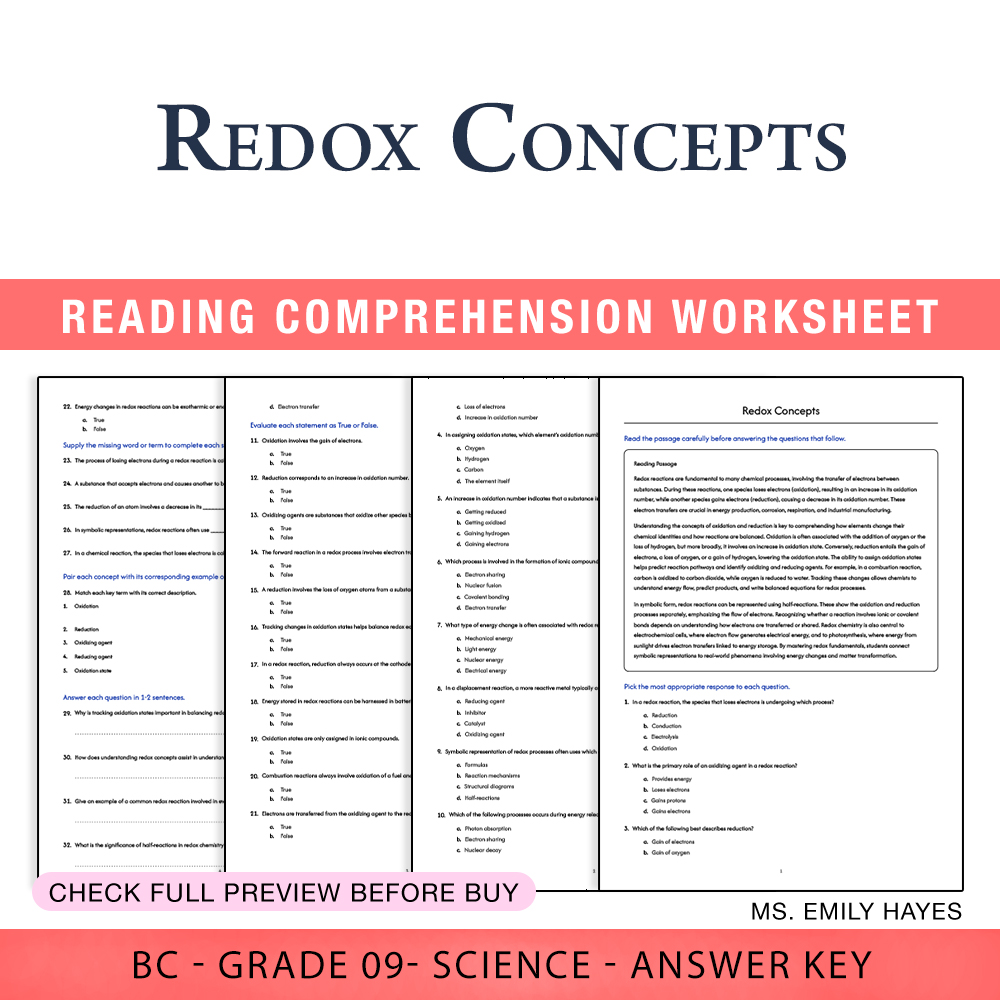
Grade 9 Science | Redox Concepts Worksheet (PDF+ Answer Key)
Created byCopper Leaf ClassroomLearning Objectives
- Explain the basic principles of oxidation and reduction in redox reactions.
- Identify oxidation states of elements in chemical equations.
- Track electron transfer to determine oxidizing and reducing agents.
Also included in: Grade 9 Science Bundle | Chemistry, Physics & Atomic Concepts (PDF + Answer Key) +1 more
Instant download
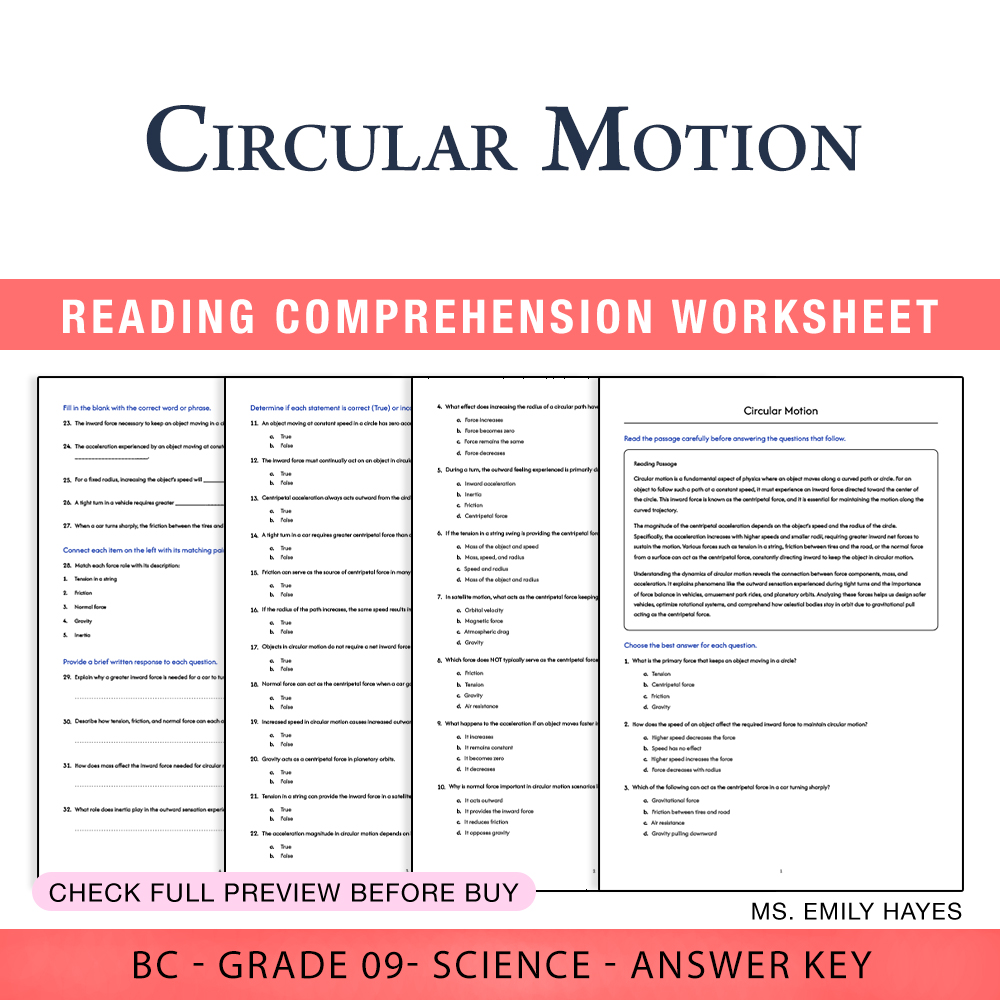
Grade 9 Science | Circular Motion Worksheet (PDF+ Answer Key)
Created byCopper Leaf ClassroomLearning Objectives
- Understand the role of centripetal force in circular motion.
- Identify the effects of inward acceleration on moving objects.
- Connect force components, mass, and acceleration in analyzing circular motion.
Also included in: Grade 9 Science Worksheet Bundle | Forces, Energy & Motion (PDF + Answer Key) +1 more
Instant download
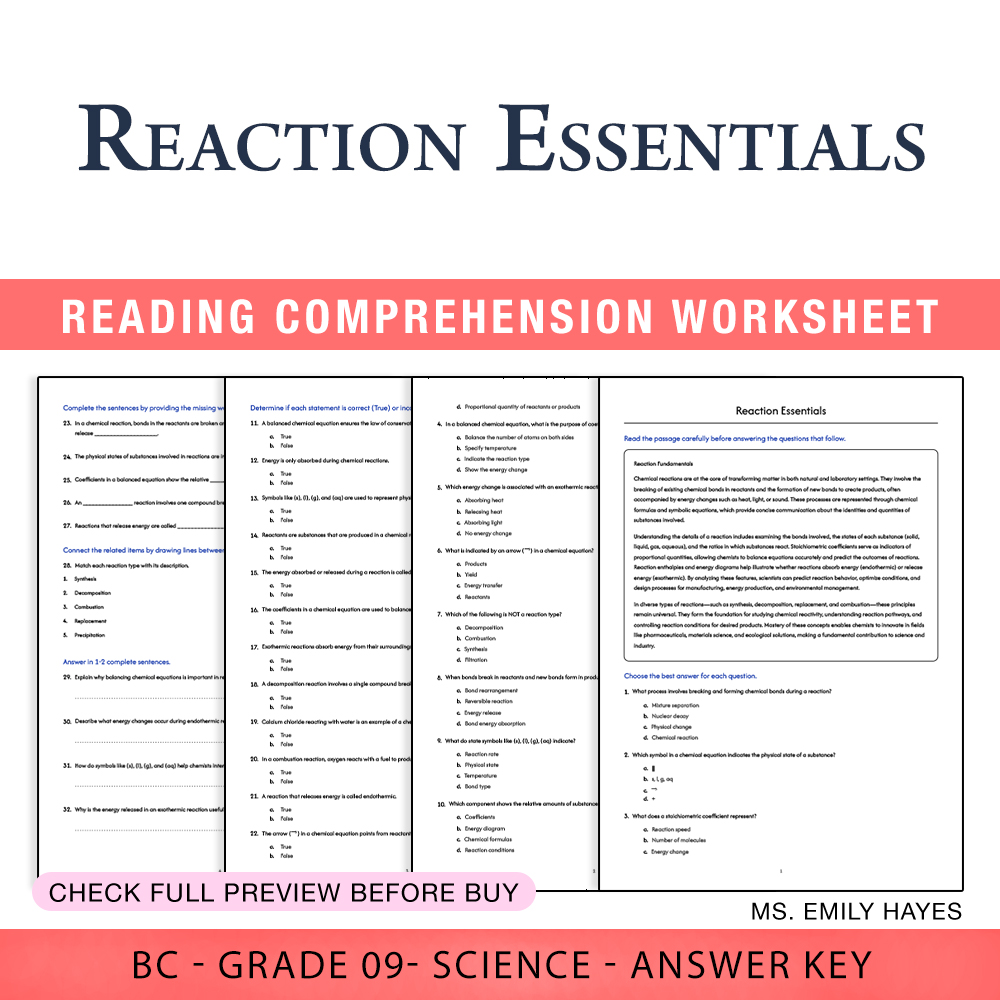
Grade 9 Science | Reaction Essentials Worksheet (PDF+ Answer Key)
Created byCopper Leaf ClassroomLearning Objectives
- Describe the components involved in chemical reactions and their transformations.
- Interpret chemical formulas and symbolic equations to understand reactions.
- Explain how bonds break and form, releasing or absorbing energy.
Also included in: Grade 9 Science Bundle | Chemistry, Physics & Atomic Concepts (PDF + Answer Key) +1 more
Instant download
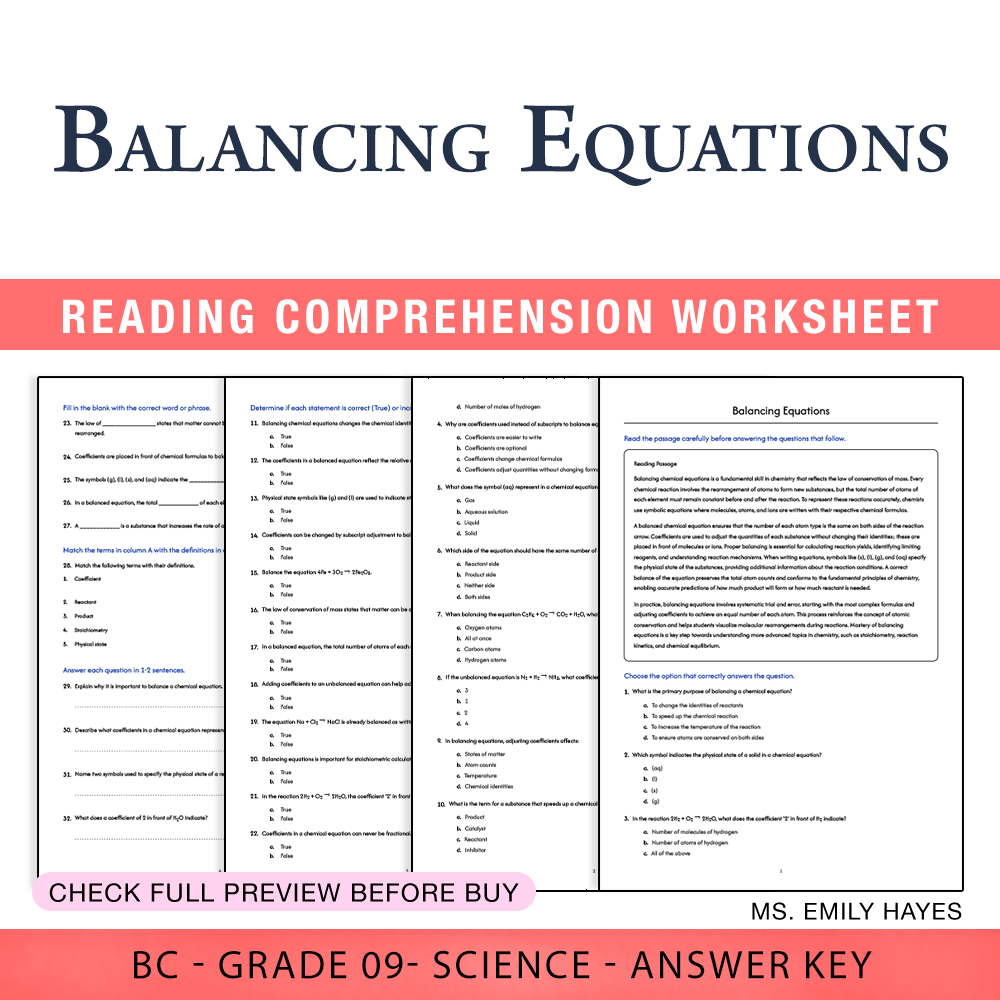
9th Grade Science | Balancing Equations Worksheet (PDF+ Answer Key)
Created byCopper Leaf ClassroomLearning Objectives
- Understand the purpose and importance of balancing chemical equations.
- Learn how to correctly balance chemical equations using coefficients.
- Identify the roles of coefficients and state symbols in chemical equations.
Also included in: Grade 9 Science Bundle | Chemistry, Physics & Atomic Concepts (PDF + Answer Key) +1 more
Instant download
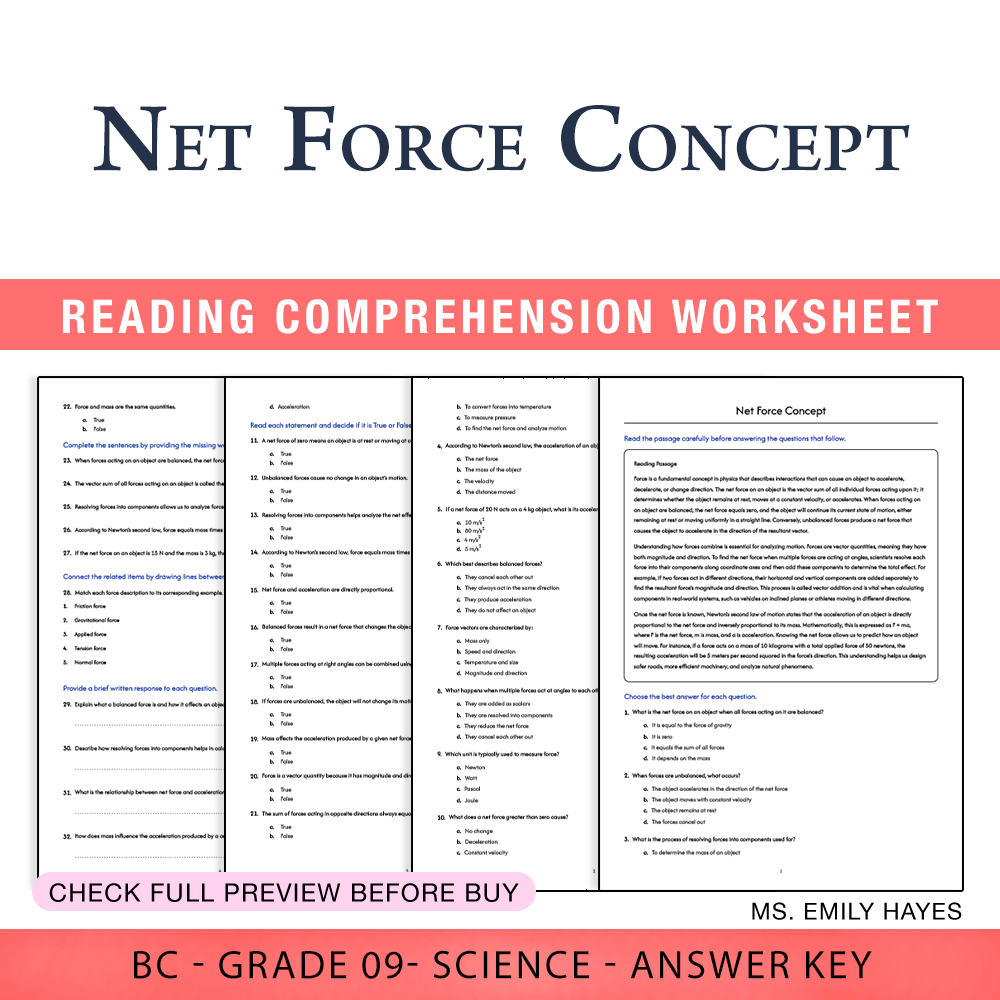
9th Grade Science | Net Force Concept Worksheet (PDF+ Answer Key)
Created byCopper Leaf ClassroomLearning Objectives
- Define and explain the concept of net force and how it affects motion.
- Describe how forces can be resolved into components and summed to find the net effect.
- Calculate the resulting acceleration when given force vectors and mass.
Also included in: Grade 9 Science Worksheet Bundle | Forces, Energy & Motion (PDF + Answer Key) +1 more
Instant download
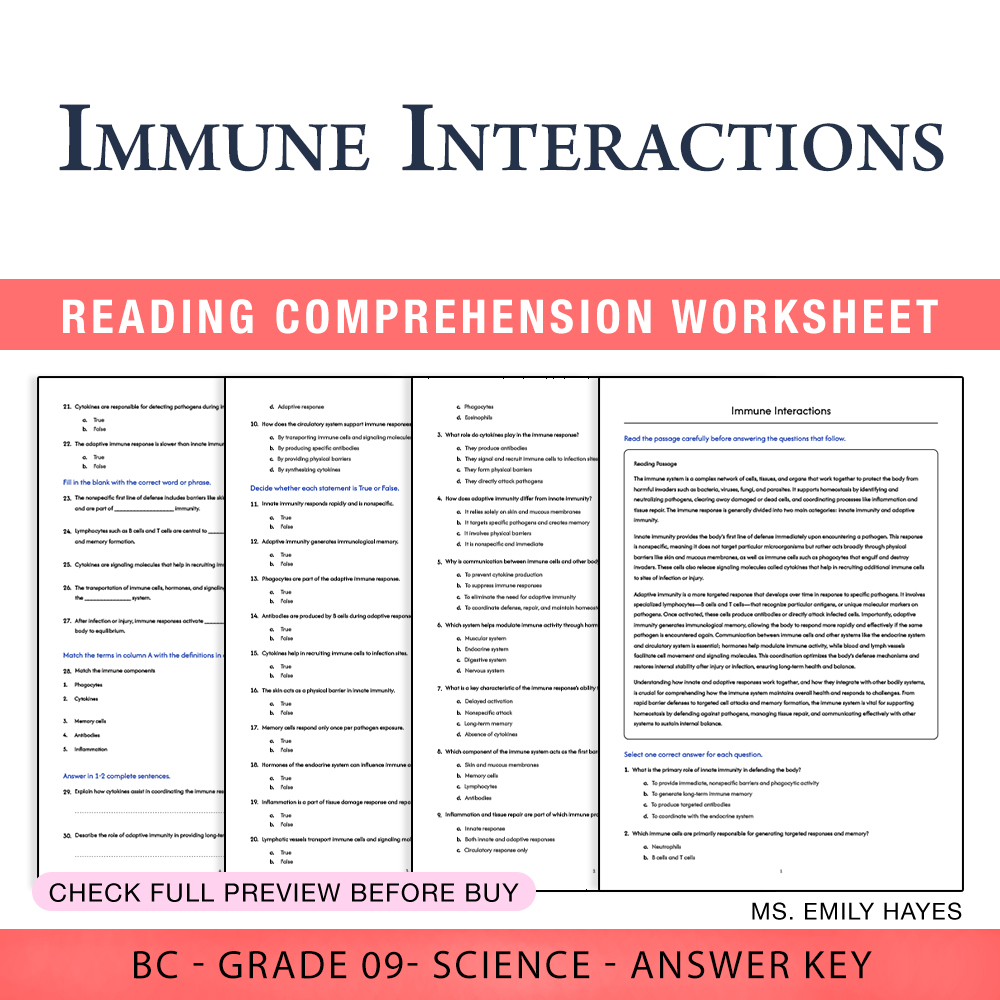
Grade 9 Science | Immune Interactions Worksheet (PDF+ Answer Key)
Created byCopper Leaf ClassroomLearning Objectives
- Describe the roles of innate and adaptive immune responses in maintaining homeostasis.
- Identify key components and functions of the immune system when defending against pathogens.
- Explain how immune communication integrates with other bodily systems, including endocrine and circulatory pathways.
Also included in: Grade 9 Science Worksheet Pack | Biology & Cell Structures (PDF+ Answer Keys) +1 more
Instant download
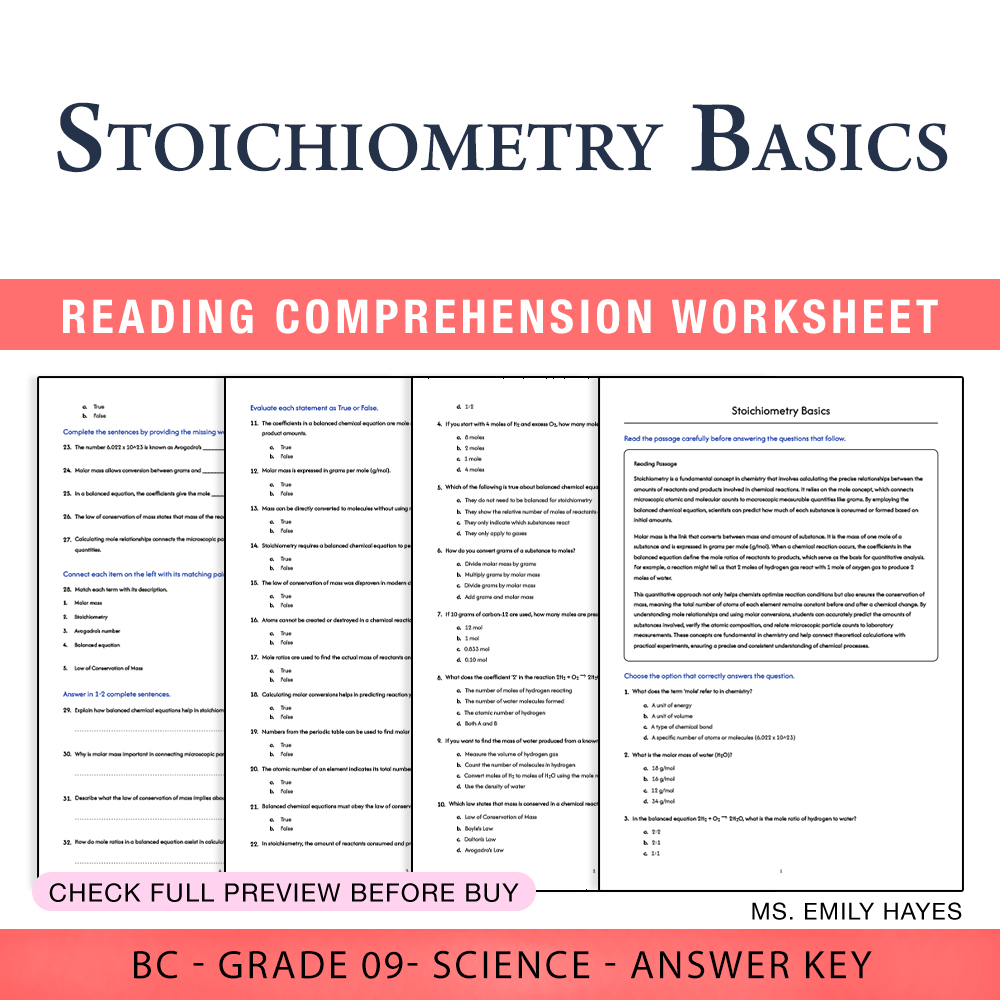
9th Grade Science | Stoichiometry Basics Worksheet (PDF+ Answer Key)
Created byCopper Leaf ClassroomLearning Objectives
- Understand how mole relationships connect reactants and products in chemical equations.
- Calculate masses and amounts of substances using molar mass and balanced equations.
- Interpret mole ratios and convert between grams and moles in chemical reactions.
Also included in: Grade 9 Science Bundle | Chemistry, Physics & Atomic Concepts (PDF + Answer Key) +1 more
Instant download
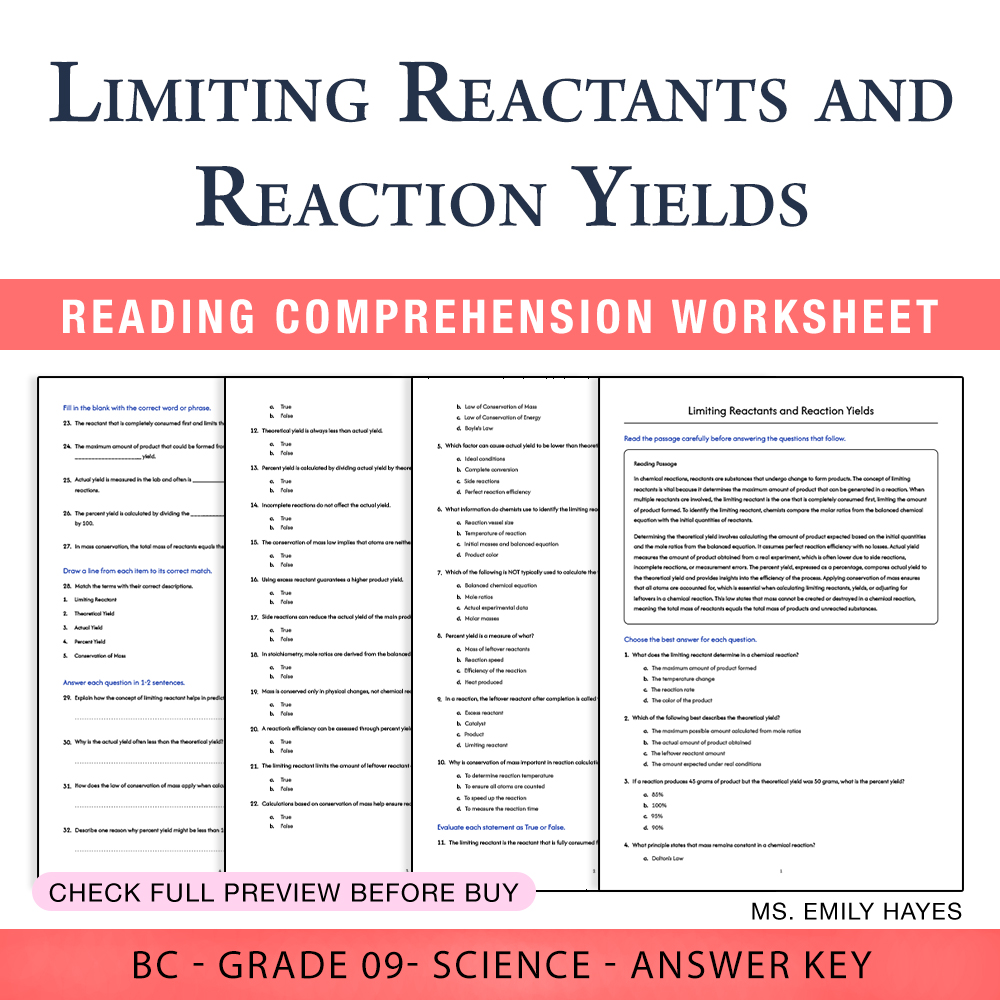
Grade 9 Science | Limiting Reactants & Reaction Yields Worksheet (PDF + Answers)
Created byCopper Leaf ClassroomLearning Objectives
- Understand the concept of limiting reactants and how they determine product formation.
- Calculate theoretical, actual, and percent yields in chemical reactions.
- Apply conservation of mass principles to reaction calculations.
Also included in: Grade 9 Science Bundle | Chemistry, Physics & Atomic Concepts (PDF + Answer Key) +1 more
Instant download
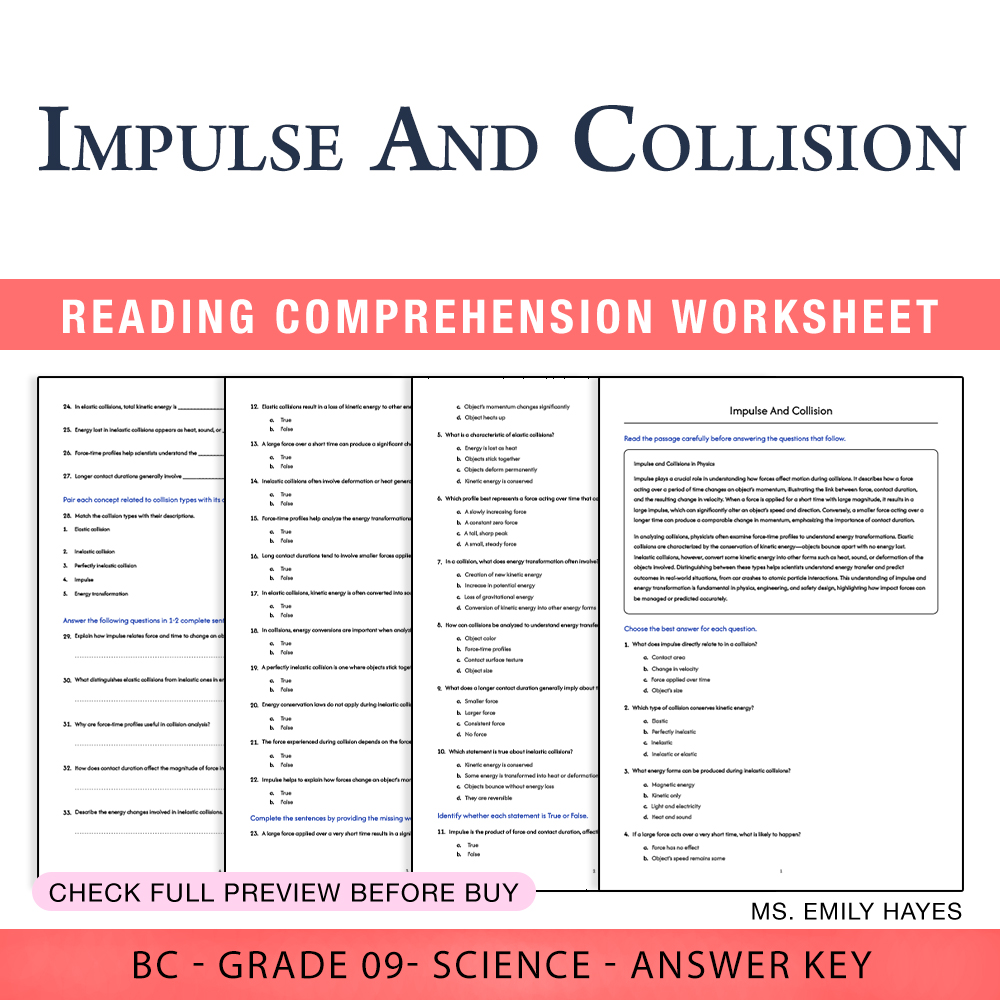
Grade 9 Science | Impulse & Collision Worksheet (PDF+ Answer Key)
Created byCopper Leaf ClassroomLearning Objectives
- Describe how impulse relates force, contact duration, and change in an object's momentum during collisions.
- Differentiate between elastic and inelastic collisions based on energy transformations.
- Analyze force-time profiles involved in collisions to predict resulting velocities and energy changes.
Also included in: Grade 9 Science Worksheet Bundle | Forces, Energy & Motion (PDF + Answer Key) +1 more
Instant download
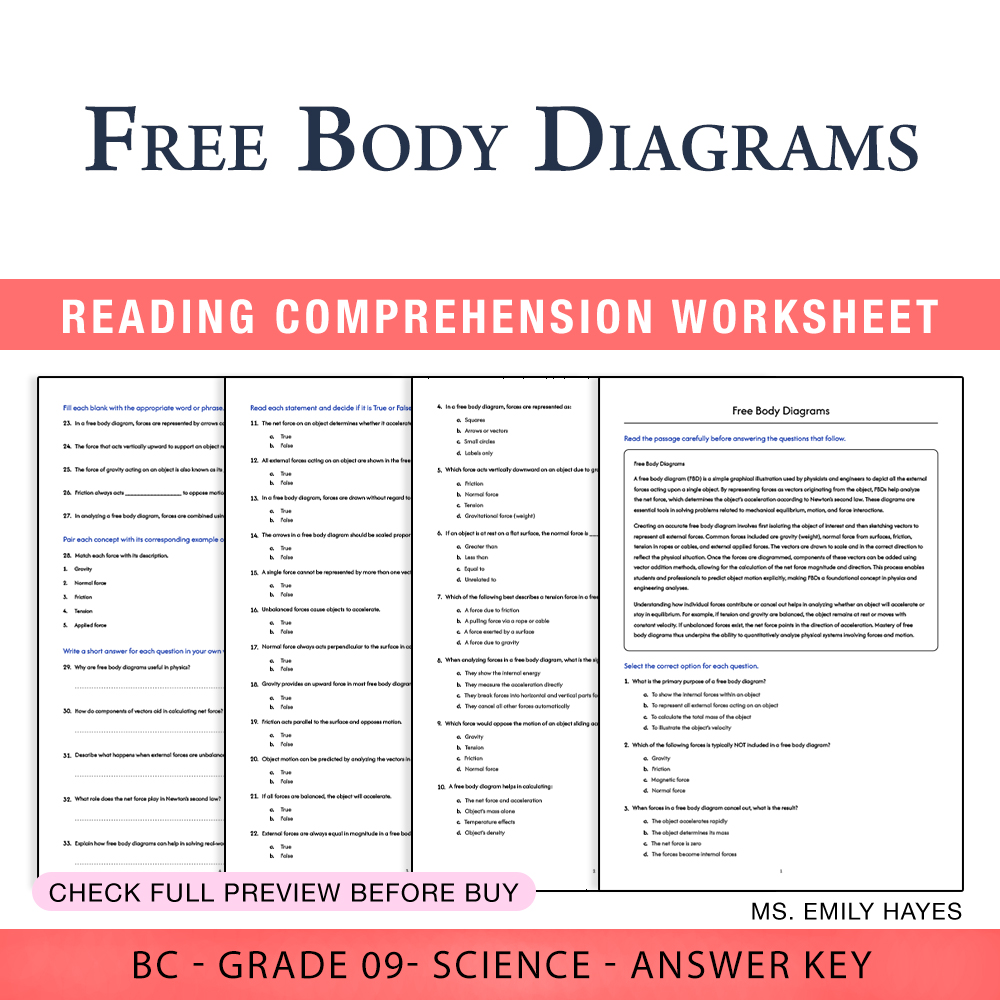
Grade 9 Science | Free Body Diagrams Worksheet (PDF+ Answer Key)
Created byCopper Leaf ClassroomLearning Objectives
- Understand the purpose and components of free body diagrams.
- Identify and sketch external forces acting on an object in various scenarios.
- Calculate net force vectors from individual force components.
Also included in: Grade 9 Science Worksheet Bundle | Forces, Energy & Motion (PDF + Answer Key) +1 more
Instant download

9th Grade Science | Mass Conservation Worksheet (PDF+ Answer Key)
Created byCopper Leaf ClassroomLearning Objectives
- Understand the principle of conservation of mass during chemical reactions.
- Interpret balanced chemical equations in terms of atoms and mass.
- Apply the law of conservation of mass to solve quantitative problems in chemistry.
Also included in: Grade 9 Science Bundle | Chemistry, Physics & Atomic Concepts (PDF + Answer Key) +1 more
Instant download
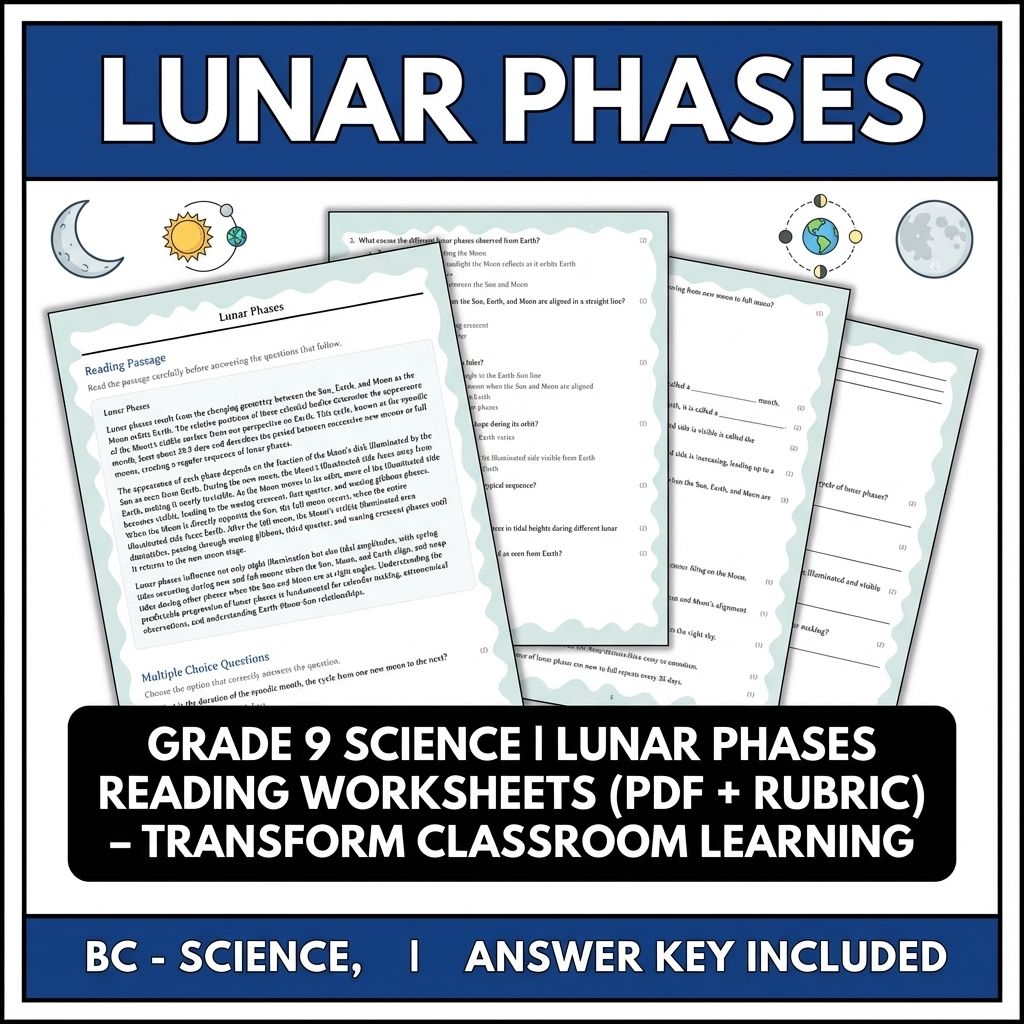
Grade 9 Science | Lunar Phases Reading Worksheets (PDF + Rubric)
JCreated byJ.S SheetsLearning Objectives
- Understand the geometric relationship between the Sun, Earth, and Moon during different lunar phases.
- Describe the cycle of lunar phases and what causes the sequence from new to full and back.
- Explain how lunar phases influence nocturnal illumination and tides.
Instant download
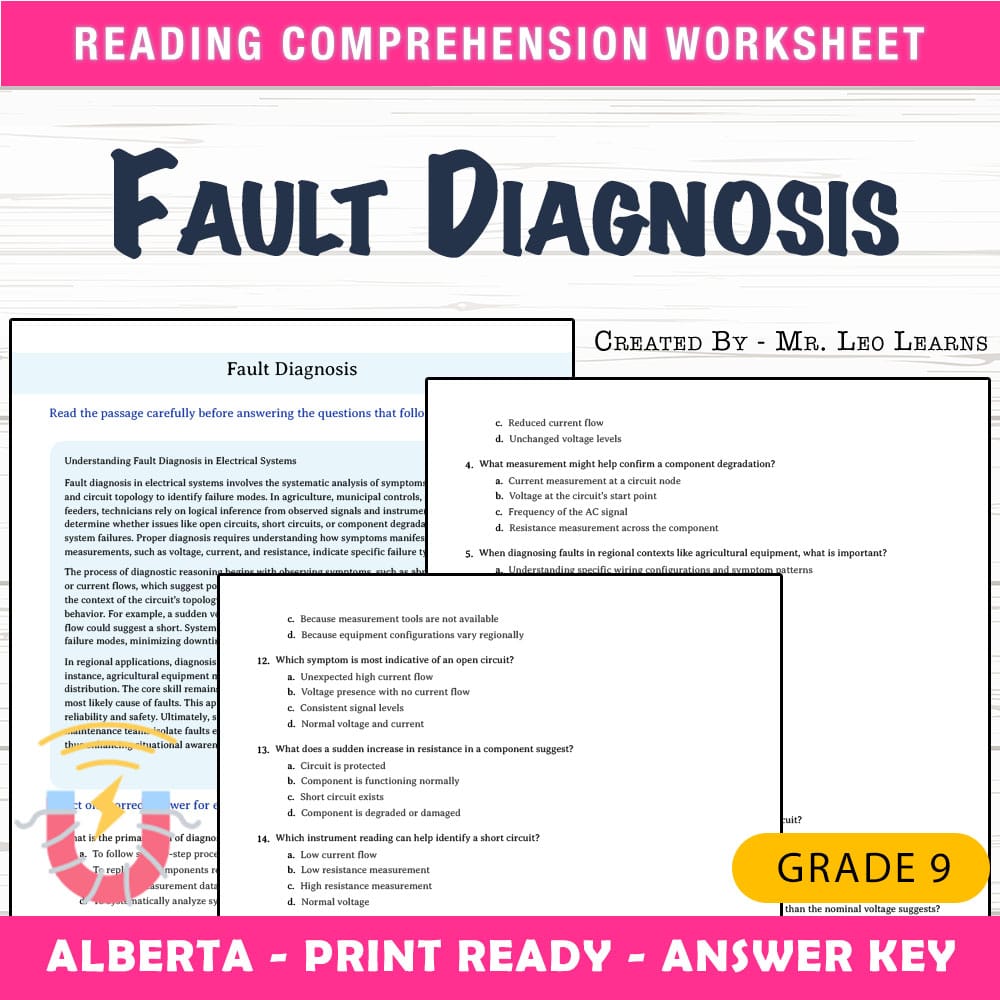
Grade 9 Science — Fault Diagnosis Worksheet MCQ Paper for Mastery
 Created byThe Resource Hub
Learning Objectives
- Understand how to interpret symptom descriptions and measurement data to diagnose electrical faults.
- Identify different failure modes such as open circuits, short circuits, and component degradation through logical inference.
- Apply systematic reasoning to restore safe and reliable operation in various regional electrical contexts.
Also included in: Grade 9 Science Electricity and Magnetism Worksheet Bundle | Alberta Curriculum +1 more
Instant download
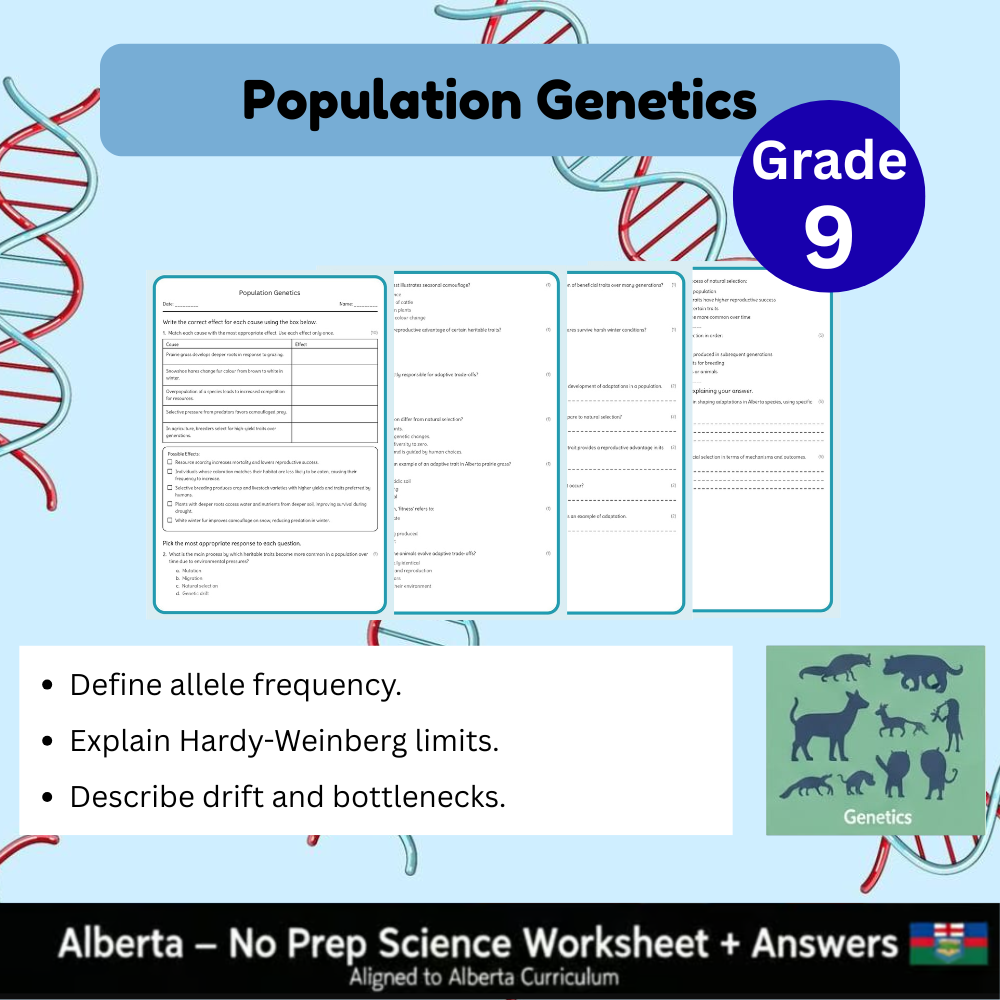
Grade 9 Science – Population Genetics Worksheet (PDF) – Alberta Standard
 Created byBright Mind Resources
Learning Objectives
- Understand the principles of allele frequency and genetic variation in populations.
- Explain the assumptions of Hardy-Weinberg equilibrium and factors disrupting it.
- Describe the effects of genetic drift, bottlenecks, and founder effects on genetic diversity.
Instant download

Grade 9 | Left Handers Day for Mastering Inclusive Design | PDF + Answer Key
 Created byShaNova Worksheets
Learning Objectives
- Explain how inclusive and universal design help left-handed people and others with different needs.
- Identify real-world examples of adaptive tools and accessible spaces.
- Use empathy to propose one design improvement that supports everyone.
Instant download
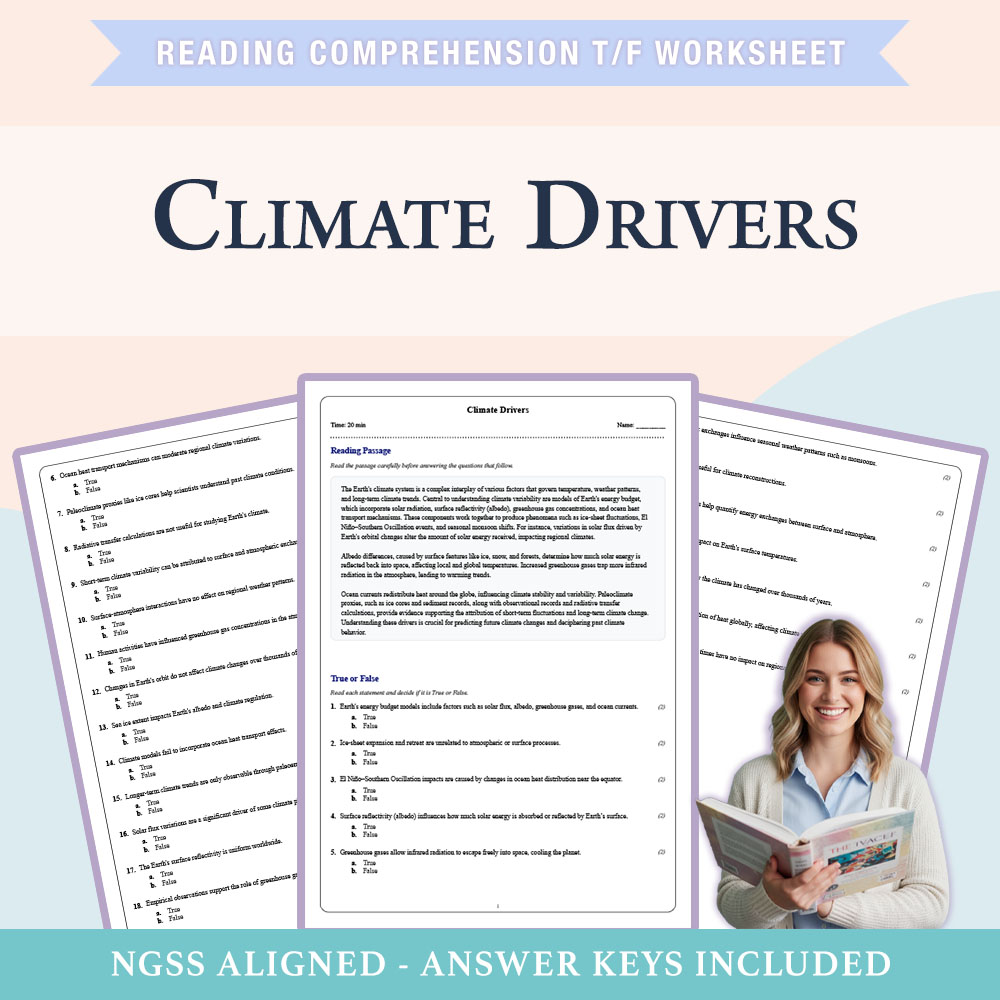
9th Grade Science | Climate Drivers Worksheet (PDF + Answer Key)
Created byCopper Leaf ClassroomLearning Objectives
- Understand the main factors influencing Earth's climate, including solar flux, albedo, greenhouse gases, and ocean heat transport.
- Explain how surface-atmosphere interactions contribute to climate variability and regional weather patterns.
- Analyze observational records, radiative calculations, and paleoclimate proxies to interpret climate trends.
Also included in: Grade 9 Science | Earth Processes & Landform Evolution Bundle (PDF +Answer Key) +1 more
Instant download
Grade 9 Science – Earth's Layer Structure Worksheet (Ontario) (PDF)
Created byBright Mind ResourcesLearning Objectives
- Describe Earth's concentric layers, including the crust, mantle, and core.
- Distinguish between lithosphere and asthenosphere in terms of mechanical behavior.
- Explain how density, temperature, and pressure vary with depth in Earth.
Instant download

Grade 9 Science | System Hierarchy Worksheet with Short Notes (Printable PDF)
 Created byMeadowlark Worksheets
Learning Objectives
- Understand the hierarchical organization from cells to organism systems.
- Identify the structure and function of tissues, organs, and organ systems.
- Explain how different systems interconnect to sustain organismal functions.
Also included in: Grade 9 Science NGSS From Molecules to Organisms Structures & Processes Bundle +1 more
Instant download

Grade 9 Climate Forcing Drivers Worksheet | Ontario Science Activities
 Created byChalk and Compass
Learning Objectives
- Explain how greenhouse gases, albedo changes, aerosols, and land-use feedbacks can alter Earth’s energy balance.
- Use basic radiative transfer and energy-budget ideas to describe how atmospheric composition affects surface temperature.
- Connect human emissions to carbon-cycle changes and to likely climate responses under different emission pathways.
Also included in: Earth Systems & Space Lesson Bundle – Grade 9 Science Ontario Framework +1 more
Instant download
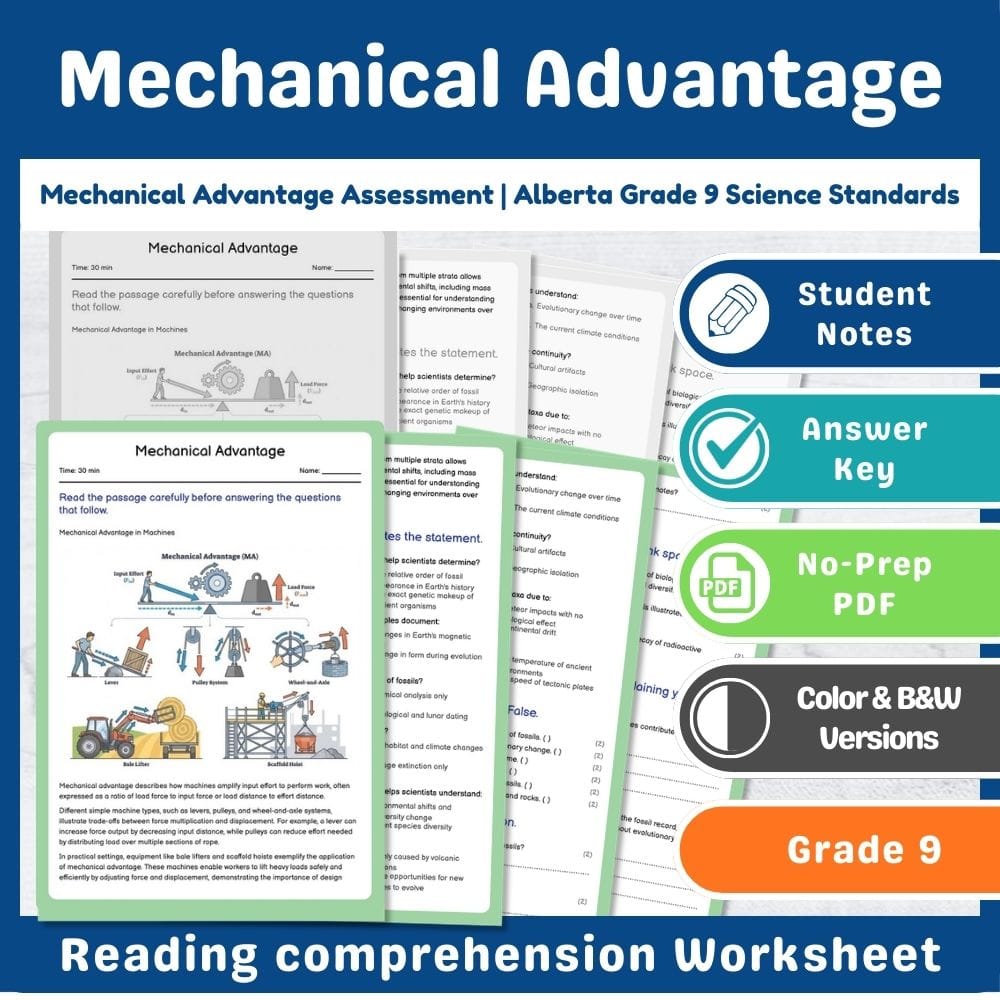
Mechanical Advantage Assessment | Alberta Grade 9 Science Standards
 Created byPrism Point Learning
Learning Objectives
- Understand the concept of mechanical advantage and how it is expressed as a ratio.
- Calculate mechanical advantage for different machine types such as levers, pulleys, and wheel systems.
- Analyze trade-offs between force reduction and displacement increase in simple machines.
Also included in: Grade 9 Forces and Motion Science Lesson Bundle Alberta Framework +1 more
Instant download
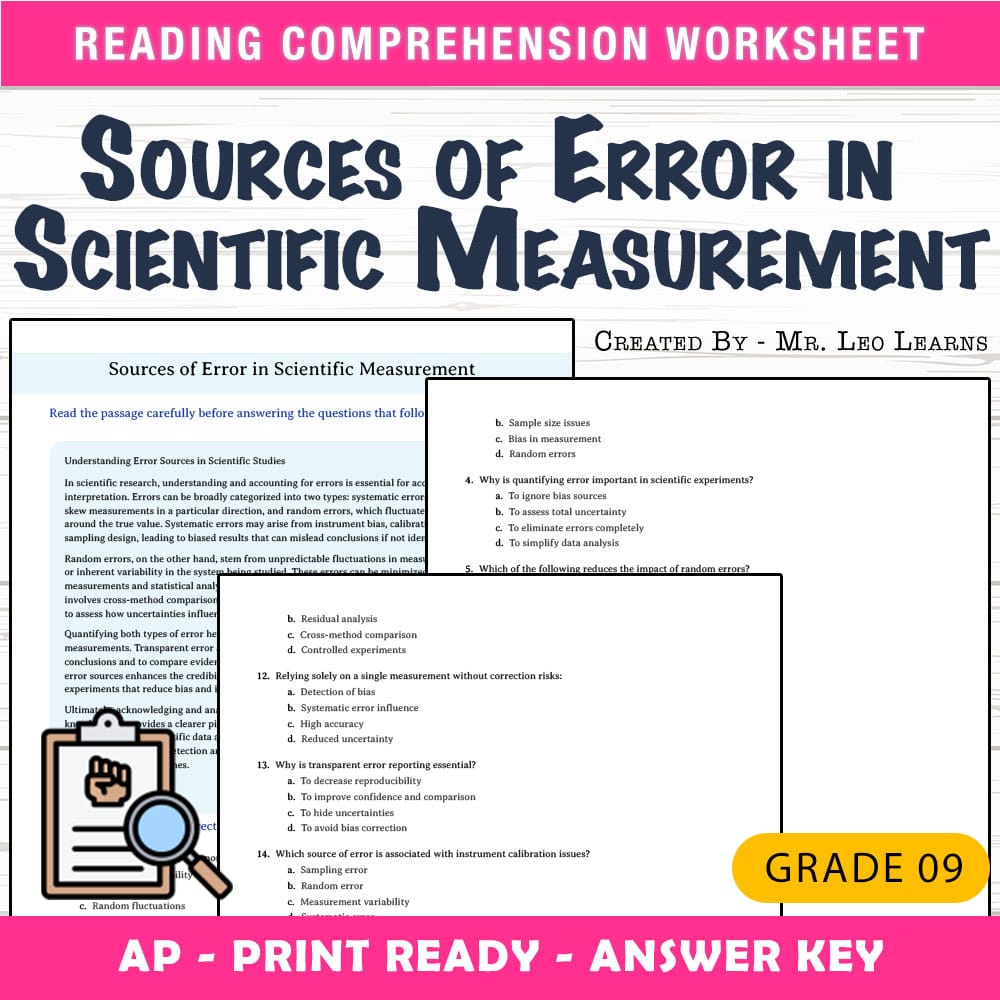
Grade 9 Science — Worksheet MCQ Paper for Mastering Sources of Error
Created byThe Resource HubLearning Objectives
- Identify common sources of systematic and random errors in scientific experiments.
- Understand methods used to detect biases and assess uncertainty.
- Recognize how error quantification impacts the interpretation of experimental results.
Also included in: Grade 9 Science Practices Lesson Bundle for AP Standards +1 more
Instant download

Grade 9 Science — Worksheet MCQ Paper for Mastering Force Interactions
Created byThe Resource HubLearning Objectives
- Understand the relationship between net external forces and changes in motion.
- Interpret force diagrams and free-body diagrams of objects in different scenarios.
- Apply Newton's second law quantitatively to calculate acceleration.
Also included in: Grade 9 Physics Principles Bundle | AP Science Worksheets for Motion & Force +1 more
Instant download

Grade 9 Science — Worksheet MCQ Paper for Mastering Integrated Modeling
Created byThe Resource HubLearning Objectives
- Understand the concept of integrated environmental models synthesizing geosphere, hydrosphere, atmosphere, and biosphere interactions.
- Identify key features of coupled models including structure, parameter sensitivity, and uncertainty propagation.
- Evaluate outcomes of environmental projections such as resource availability, landscape response, and climate feedbacks using multivariable outputs.
Also included in: Grade 9 Earth and Space Sciences AP Bundle | Science Worksheets and Activities +1 more
Instant download

Grade 9 Science — Worksheet MCQ Paper for Mastering Genetic Transmission
Created byThe Resource HubLearning Objectives
- Understand the mechanisms of inheritance and chromosome behavior during meiosis.
- Identify patterns of Mendelian inheritance and deviations such as incomplete dominance, codominance, and linkage.
- Use Punnett squares, pedigree diagrams, and probability calculations to predict genotypic and phenotypic ratios.
Also included in: Grade 9 Science Biology and Ecosystems Lesson Bundle for AP Curriculum +1 more
Instant download
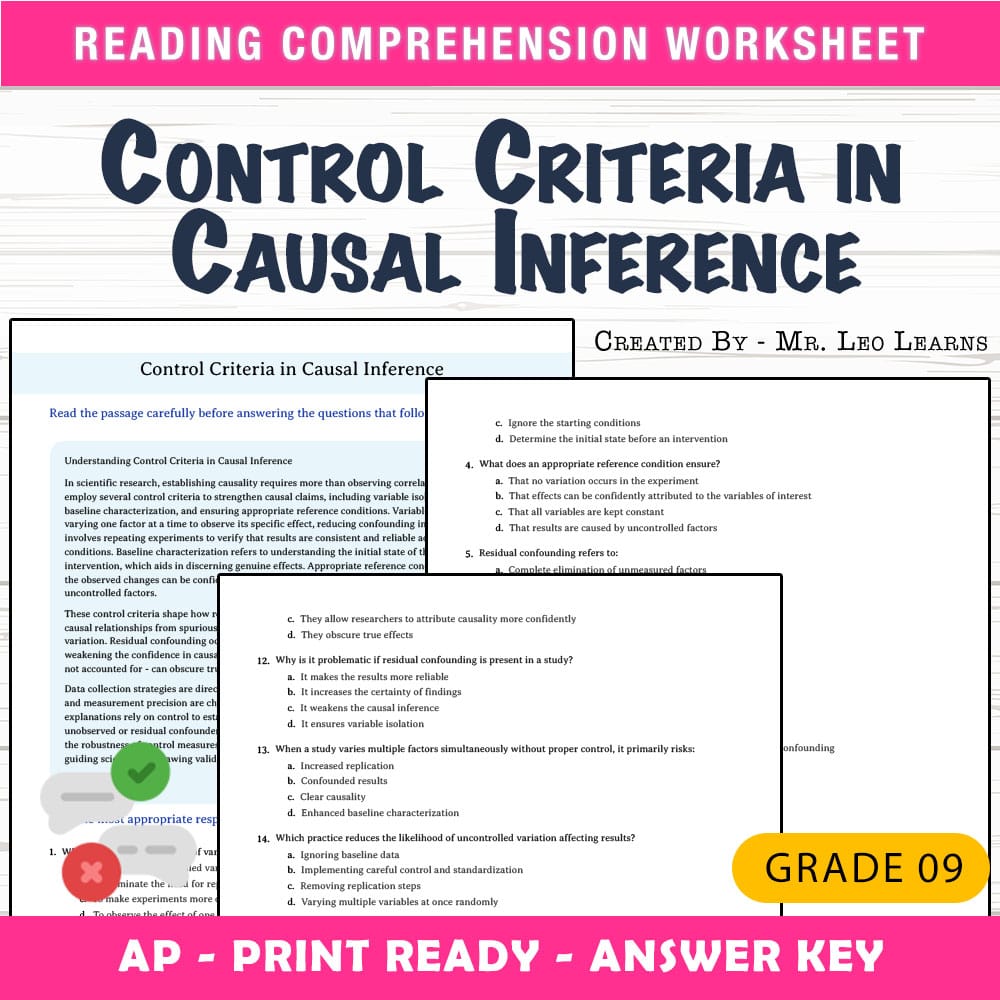
Grade 9 Science — Worksheet MCQ Paper for Mastering Control Criteria
Created byThe Resource HubLearning Objectives
- Understand the key criteria used to establish control and comparability in causal analysis.
- Identify the importance of variable isolation, replication, and baseline characterization.
- Recognize how control considerations influence data collection and the interpretation of causal claims.
Also included in: Grade 9 Science Practices Lesson Bundle for AP Standards +1 more
Instant download
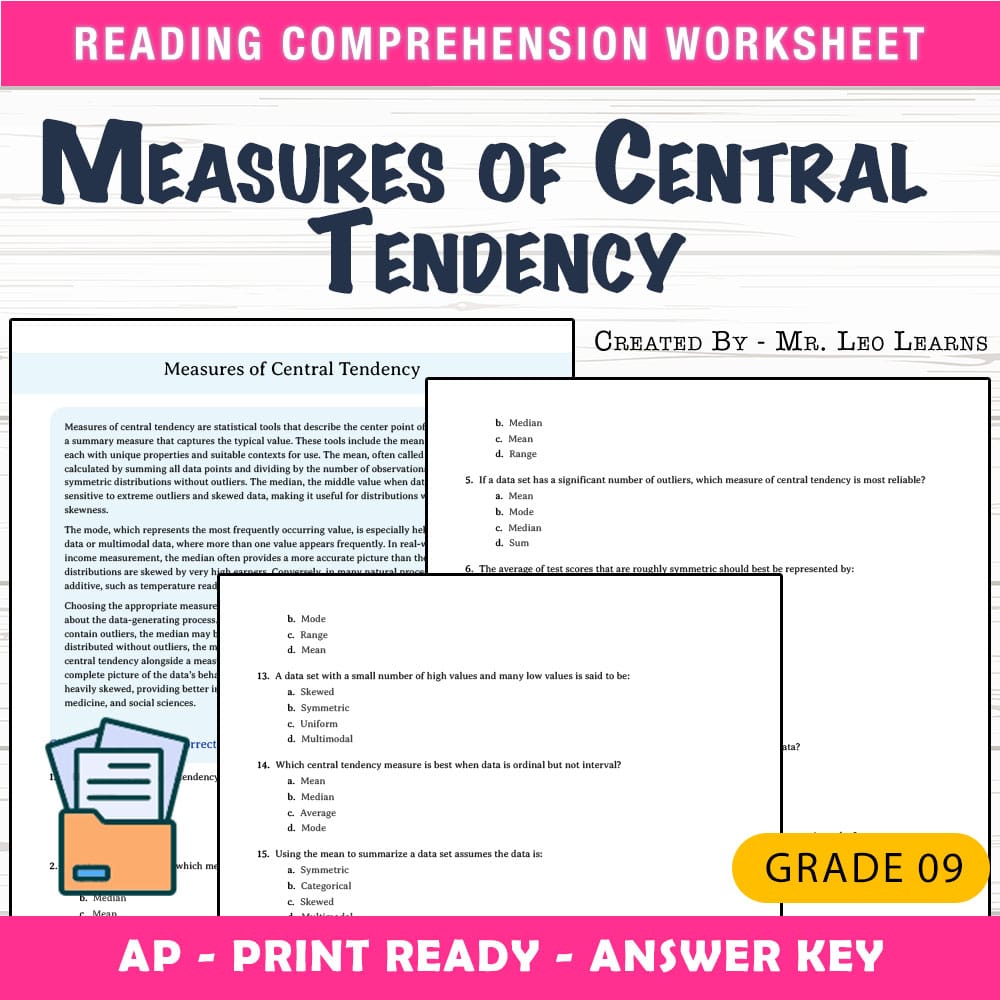
Grade 9 Science — Worksheet MCQ Paper for Measuring Central Tendency
Created byThe Resource HubLearning Objectives
- Understand the definitions and applications of mean, median, and mode.
- Compare the sensitivity of mean, median, and mode to skewness, outliers, and multimodal distributions.
- Identify appropriate measures of central tendency in different data contexts.
Also included in: Grade 9 Science Practices Lesson Bundle for AP Standards +1 more
Instant download

Grade 9 Science — Worksheet MCQ Paper for Mastering Scientific Predictions
Created byThe Resource HubLearning Objectives
- Understand the role of computational simulations and models in forecasting.
- Identify how sensitivity analysis influences prediction accuracy.
- Describe how ensembles and visualizations convey uncertainty in simulation outputs.
Also included in: Grade 9 Science Practices Lesson Bundle for AP Standards +1 more
Instant download

Grade 9 Science — Worksheet MCQ Paper for Mastering Population Genetics
Created byThe Resource HubLearning Objectives
- Understand the key models describing allele frequency changes under various evolutionary forces.
- Explain the Hardy-Weinberg equilibrium as a null model for populations.
- Recognize the impact of bottlenecks and founder effects on genetic diversity.
Also included in: Grade 9 Science Biology and Ecosystems Lesson Bundle for AP Curriculum +1 more
Instant download

Grade 9 Science — Variability Metrics Worksheet for Master
Created byThe Resource HubLearning Objectives
- Understand different measures of variability such as variance, interquartile range, and coefficient of variation.
- Interpret how variability informs confidence in statistical estimates and compares distributions.
- Relate variability metrics to sampling design and heterogeneity across groups.
Also included in: Grade 9 Science Practices Lesson Bundle for AP Standards +1 more
Instant download

Grade 9 Science — Worksheet MCQ on Model-Data Fit
Created byThe Resource HubLearning Objectives
- Understand methods for assessing the fit between models and observations.
- Identify patterns indicating systematic divergence, heteroscedasticity, or missing variables.
- Evaluate graphical and statistical criteria for model acceptance, modification, or rejection.
Also included in: Grade 9 Science Practices Lesson Bundle for AP Standards +1 more
Instant download

Grade 9 Science — Worksheet MCQ Paper for Mastering Developmental Variation | PDF + Answer Key
Created byThe Resource HubLearning Objectives
- Understand how developmental processes and gene regulation produce phenotypic diversity.
- Analyze the roles of regulatory networks, timing changes, and epigenetics in development.
- Explain the link between genetic variation and trait expression using developmental evidence.
Also included in: Grade 9 Science Biology and Ecosystems Lesson Bundle for AP Curriculum +1 more
Instant download

Grade 9 Science — Seismic Records Worksheet MCQ Paper for Mastery
Created byThe Resource HubLearning Objectives
- Interpret earthquake waveforms, travel-time curves, and epicenter maps to understand subsurface structures.
- Differentiate between P- and S-wave arrivals, waveform amplitudes, and frequency content.
- Locate rupture zones and connect seismicity patterns to tectonic environments and surface hazard phenomena.
Also included in: Grade 9 Earth and Space Sciences AP Bundle | Science Worksheets and Activities +1 more
Instant download

Grade 9 Science — Worksheet MCQ Paper for Mastering Representation Models
Created byThe Resource HubLearning Objectives
- Identify different types of scientific representation models such as mathematical formulae, graphs, diagrams, and approximations.
- Understand criteria for selecting appropriate models based on fidelity, simplicity, and predictive scope.
- Explain how mapping model components to measurable observables supports interpretation and testing.
Also included in: Grade 9 Science Practices Lesson Bundle for AP Standards +1 more
Instant download

Grade 9 Science — Evidence of Evolution Worksheet MCQ Paper
Created byThe Resource HubLearning Objectives
- Interpret multiple lines of evidence supporting descent with modification, including fossil records, comparative anatomy, biogeography, and molecular phylogenies.
- Understand mechanisms such as natural selection, genetic drift, gene flow, and mutation that influence allele frequencies and adaptive traits.
- Employ models linking selective pressures and trait variation to population responses, evaluating scenarios like antibiotic resistance and morphological adaptation.
Also included in: Grade 9 Science Biology and Ecosystems Lesson Bundle for AP Curriculum +1 more
Instant download

Grade 9 Science — Worksheet MCQ Paper for Mastering Unit Analysis
Created byThe Resource HubLearning Objectives
- Understand the principles of dimensional analysis and unit consistency.
- Apply unit checking to identify algebraic errors and validate models.
- Demonstrate how units constrain plausible relationships and assist in measurement transformations.
Also included in: Grade 9 Science Practices Lesson Bundle for AP Standards +1 more
Instant download
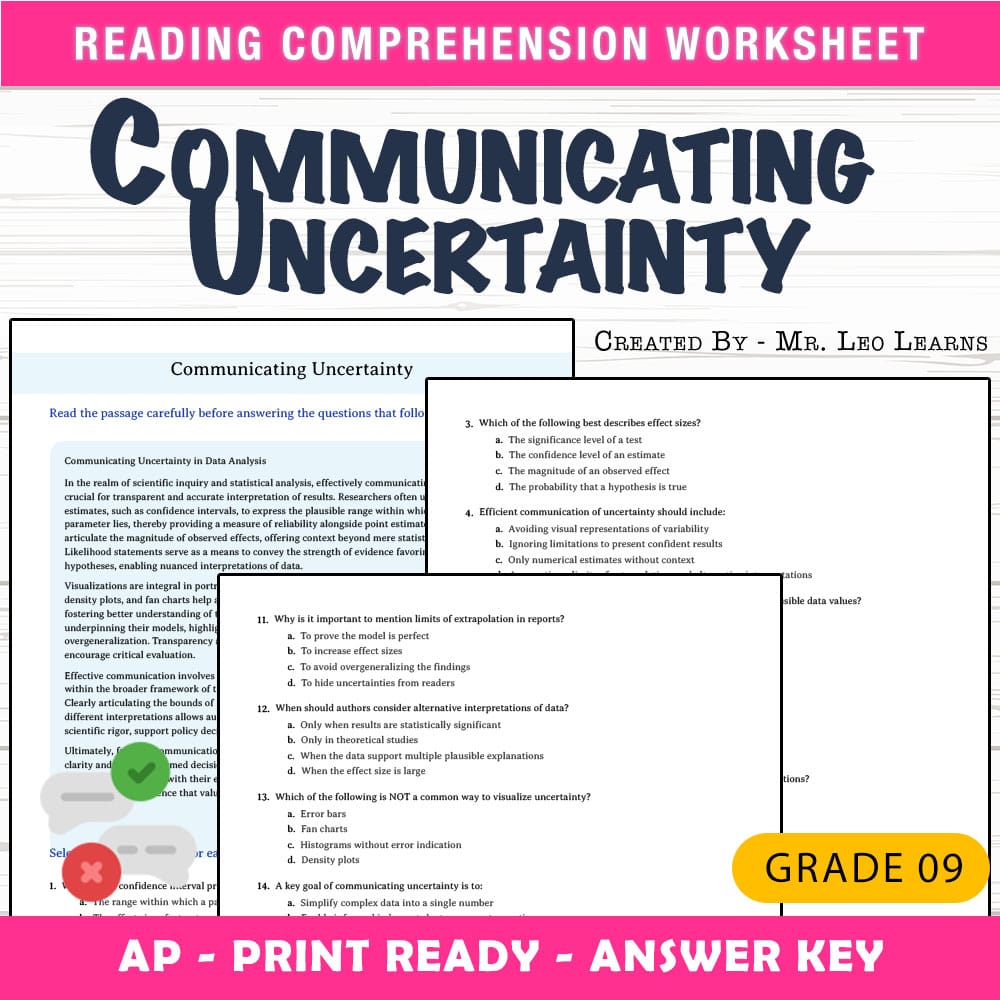
Grade 9 Science — Communicating Uncertainty Worksheet MCQ Paper
Created byThe Resource HubLearning Objectives
- Understand different conventions for conveying quantitative uncertainty and confidence in statistical inferences.
- Recognize the importance of clarity regarding assumptions, limits, and interpretations when reporting results.
- Identify various visualization techniques that portray variability and effect sizes in data communication.
Also included in: Grade 9 Science Practices Lesson Bundle for AP Standards +1 more
Instant download

Grade 9 Science — Worksheet MCQ Paper for Mastering Hydrologic Fluxes
Created byThe Resource HubLearning Objectives
- Understand the components of water budgets and how surface and subsurface water flows are quantified.
- Relate precipitation, evapotranspiration, human withdrawals, and streamflow variability within hydrologic systems.
- Explain the impacts of altered hydrologic fluxes on geomorphic processes and sediment yield.
Also included in: Grade 9 Earth and Space Sciences AP Bundle | Science Worksheets and Activities +1 more
Instant download

Grade 9 Science — Worksheet MCQ Paper for Mastering Energy Pathways
Created byThe Resource HubLearning Objectives
- Explain the process of ATP production in cellular respiration and photosynthesis.
- Describe how energy is transferred and coupled in metabolic pathways.
- Compare the roles of electron transport chains in photosynthesis and respiration.
Also included in: Grade 9 Science Biology and Ecosystems Lesson Bundle for AP Curriculum +1 more
Instant download

Grade 9 Science — Ecosystem Cycling Worksheet for Mastery
Created byThe Resource HubLearning Objectives
- Understand the processes involved in carbon and nitrogen cycles within ecosystems.
- Identify how trophic transfer and stoichiometry influence population dynamics and biodiversity.
- Analyze the effects of perturbations such as nutrient enrichment, habitat change, and invasive species on ecosystems.
Also included in: Grade 9 Science Biology and Ecosystems Lesson Bundle for AP Curriculum +1 more
Instant download
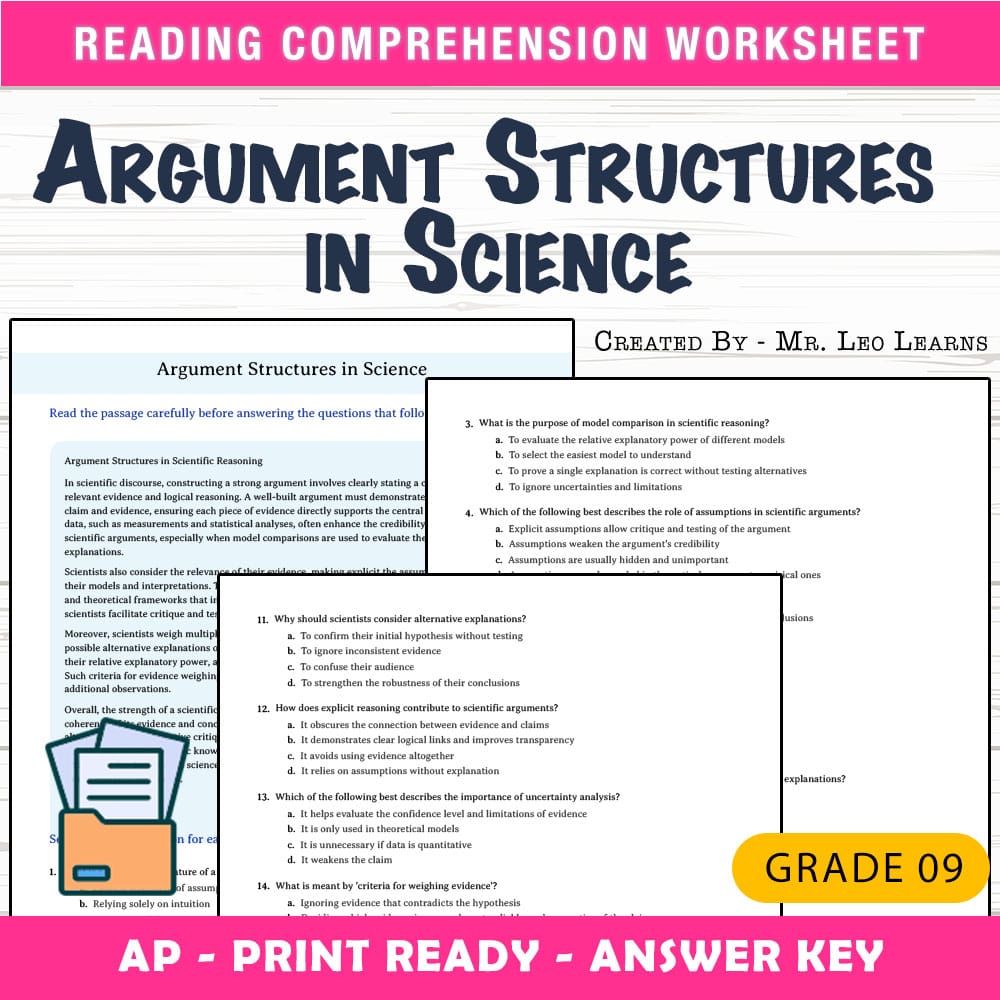
Grade 9 Science — Worksheet MCQ Paper for Mastering Argument Structures
Created byThe Resource HubLearning Objectives
- Understand the components of scientific argumentation, including claim, evidence, and reasoning.
- Evaluate the coherence, relevance, and strength of scientific arguments using qualitative and quantitative evidence.
- Identify logical links, explicit assumptions, and criteria for weighing evidence in scientific explanations.
Also included in: Grade 9 Science Practices Lesson Bundle for AP Standards +1 more
Instant download

Grade 9 Science — Measurement Fundamentals Worksheet for Mastery
Created byThe Resource HubLearning Objectives
- Understand the principles of metric measurement and instrument resolution.
- Recognize the importance of calibration and measurement protocols in data accuracy.
- Connect raw measurements to graphical and tabular representations while accounting for uncertainty.
Also included in: Grade 9 Science Practices Lesson Bundle for AP Standards +1 more
Instant download
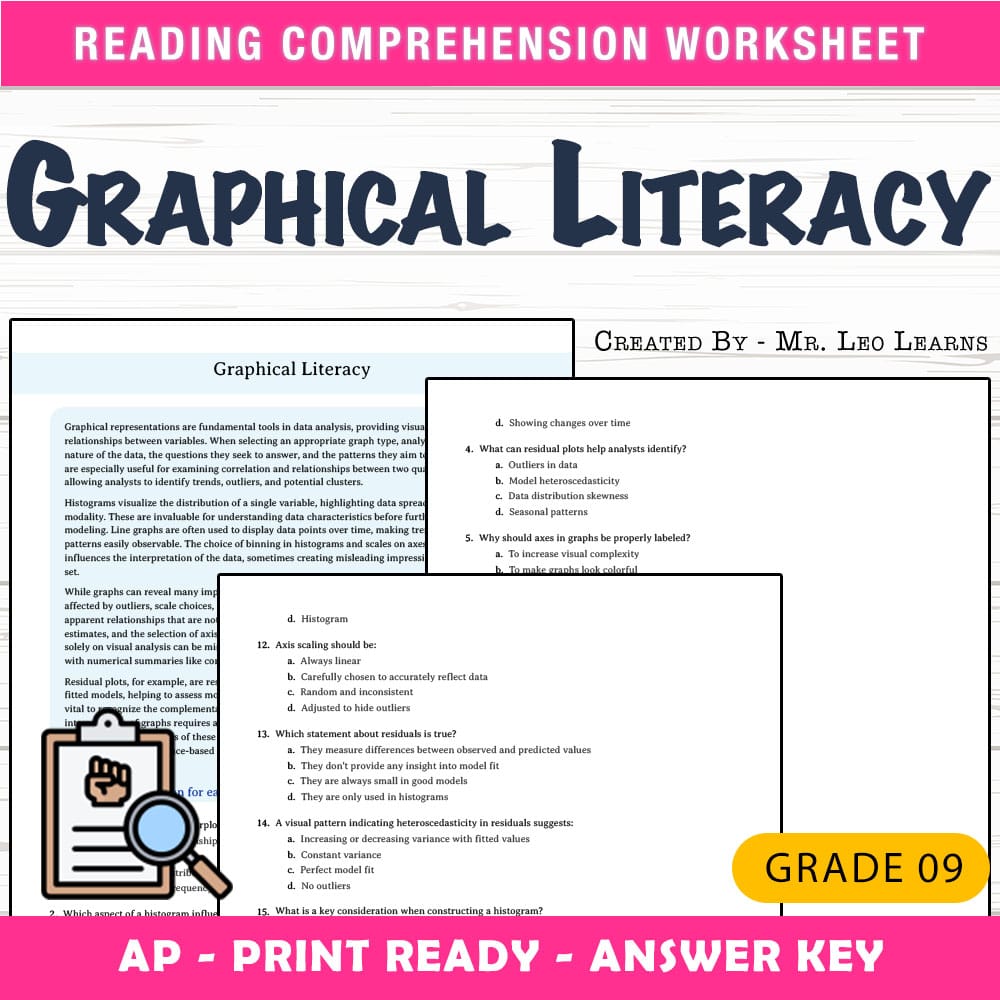
Grade 9 Science — Worksheet MCQ Paper for Mastering Graphical Literacy
Created byThe Resource HubLearning Objectives
- Understand the different types of graphical representations such as scatterplots, histograms, and line graphs.
- Evaluate the appropriateness of graph types based on data patterns and research questions.
- Identify outliers, trends, and correlation structures in graphs to inform data interpretation.
Also included in: Grade 9 Science Practices Lesson Bundle for AP Standards +1 more
Instant download
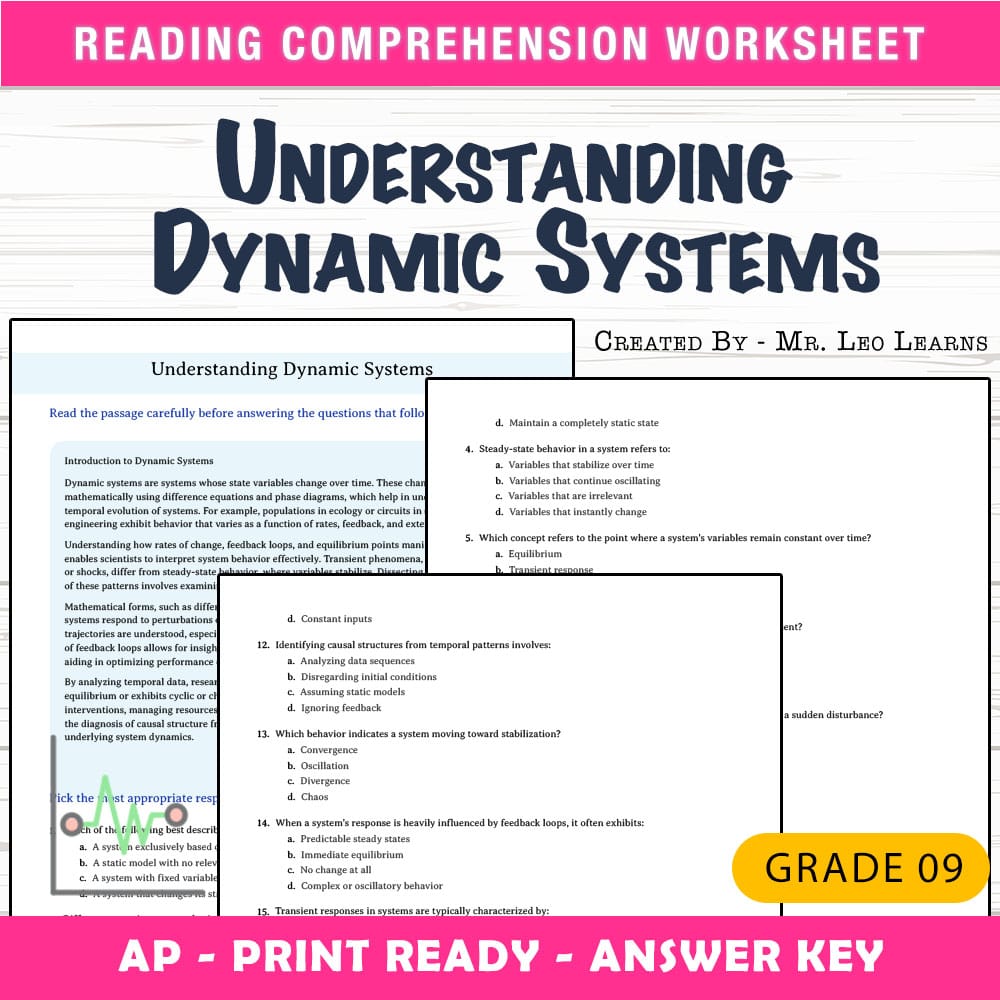
Grade 9 Science — Worksheet MCQ Paper for Mastering Dynamic Systems
Created byThe Resource HubLearning Objectives
- Interpret and analyze data from time-series descriptions of systems.
- Identify the roles of feedback loops, rates, and equilibrium in system behavior.
- Differentiate transient versus steady-state behavior using mathematical representations.
Also included in: Grade 9 Science Practices Lesson Bundle for AP Standards +1 more
Instant download
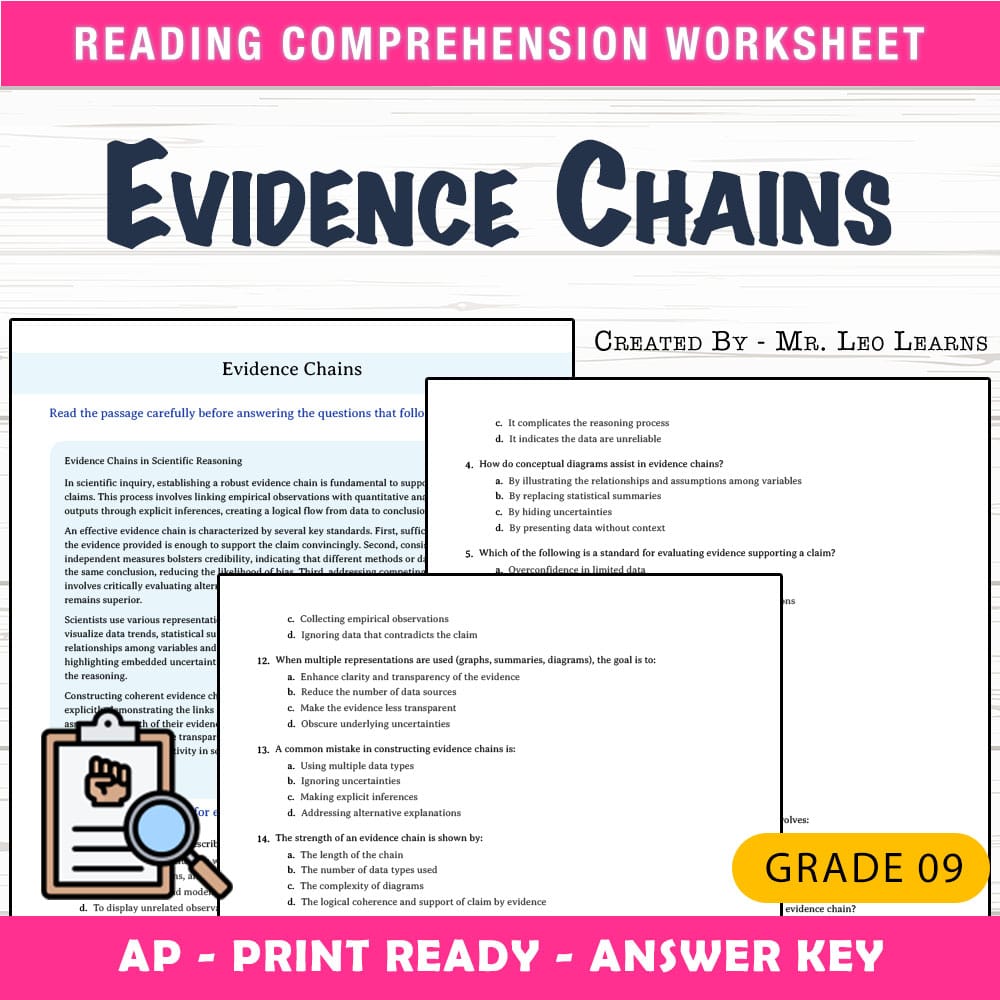
Grade 9 Science — Evidence Chains Worksheet MCQ Paper for Mastery
Created byThe Resource HubLearning Objectives
- Understand the structure of evidence-based reasoning and how it links observations, analyses, and claims.
- Identify standards for sufficiency, consistency, and handling competing explanations.
- Recognize the use of multiple representations like graphs, summaries, and diagrams in constructing evidentiary chains.
Also included in: Grade 9 Science Practices Lesson Bundle for AP Standards +1 more
Instant download
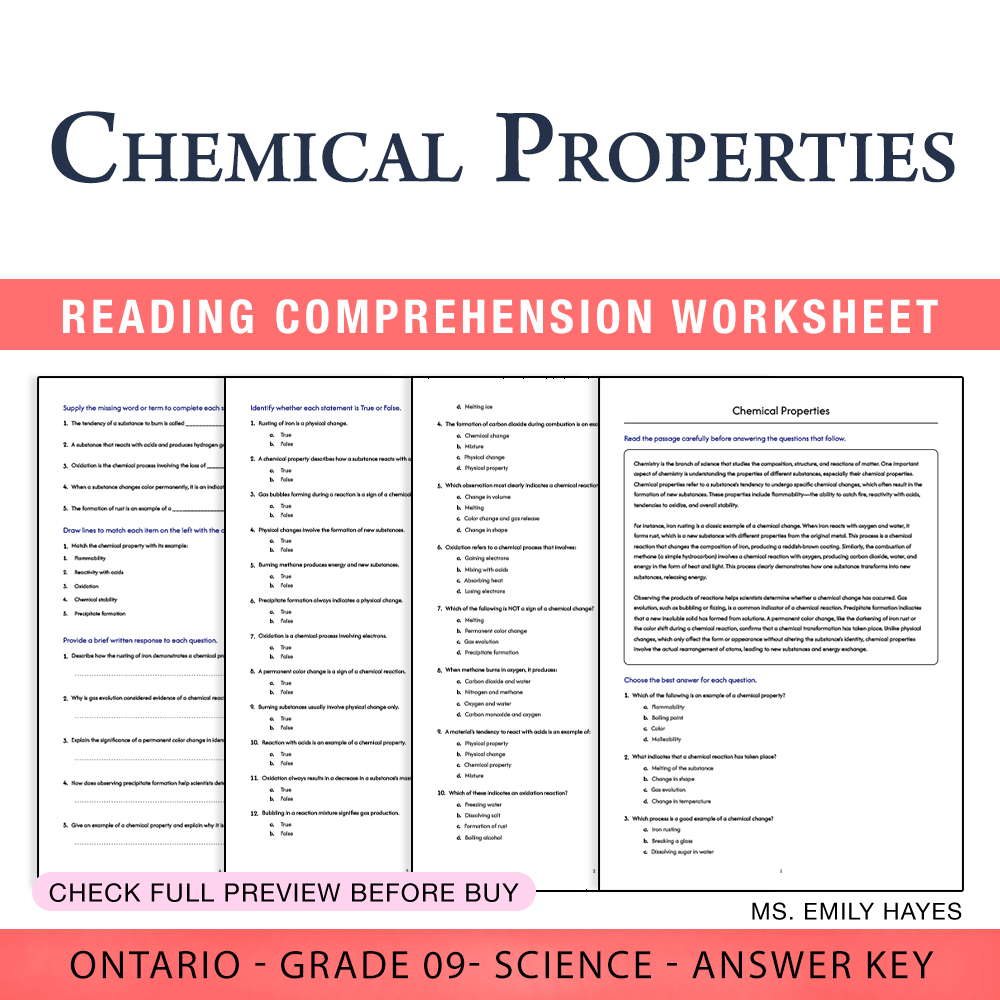
Grade 9 Science | Chemical Properties Worksheet (PDF + Answer Key)
Created byCopper Leaf ClassroomLearning Objectives
- Understand the definition of chemical properties and how they differ from physical properties.
- Identify common chemical properties such as flammability, reactivity, oxidation, and stability.
- Interpret observations indicating chemical reactions, including gas evolution, precipitate formation, and color change.
Instant download
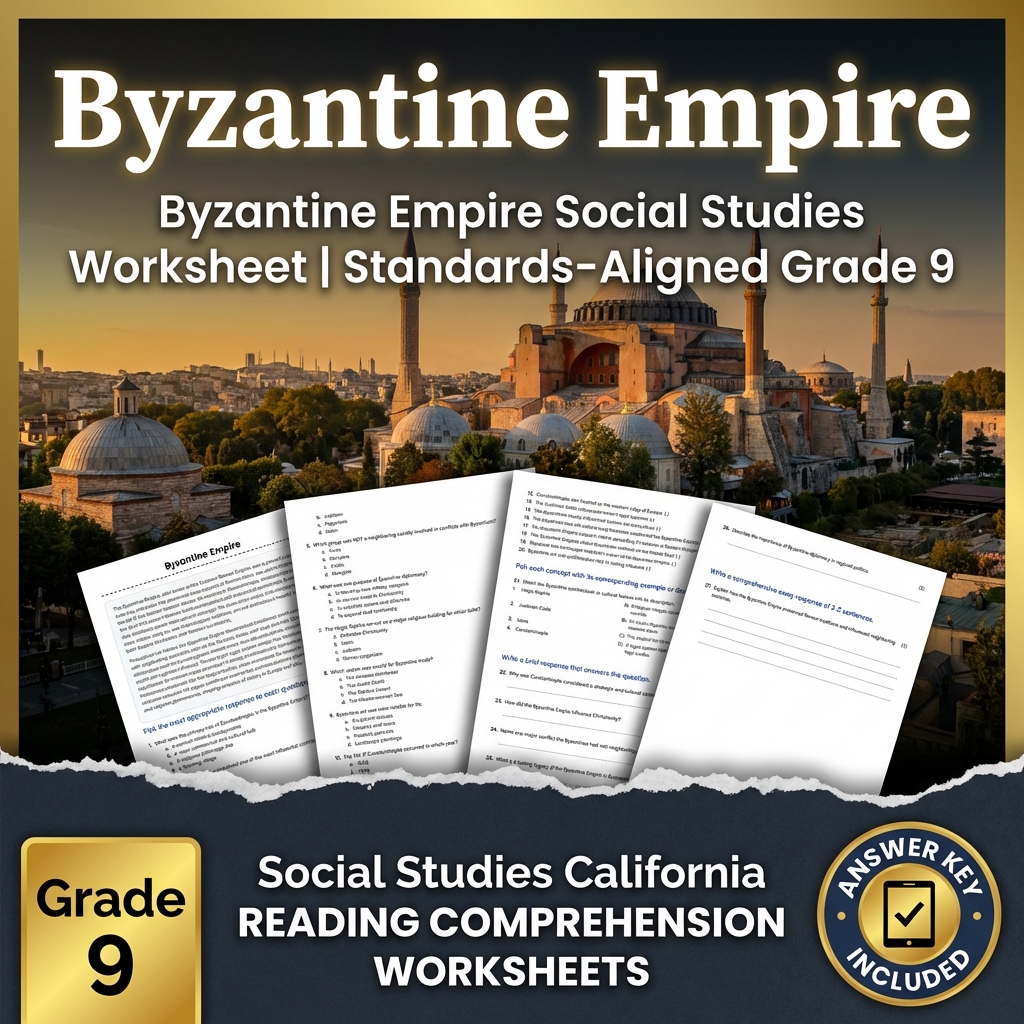
Byzantine Empire Social Studies Worksheet | Standards-Aligned Grade 9
JCreated byJ.S SheetsLearning Objectives
- Describe the key cultural, legal, and architectural traditions of the Byzantine Empire.
- Explain the strategic importance of Constantinople as a trading and cultural hub.
- Analyze the regional interactions and conflicts involving the Byzantine Empire.
Instant download

Grade 9 Science | Uncertainty and Error Worksheet | NGSSS-Aligned
 Created byLumora Learning
Learning Objectives
- Explain how uncertainty arises from both random variation and systematic error in measurements.
- Use uncertainty and appropriate significant figures to communicate results in science.
- Judge whether two measurements are consistent by comparing them within reported uncertainty.
Instant download
Browse more categories
About Grade 9 Worksheets
Browse 9,304 printable Grade 9 worksheets across algebra, biology, literature, and history — each a ready-to-print PDF with optional answer keys.
Every worksheet on MyTeachingSheets is created by independent teacher-authors and reviewed before publication. All resources download as printable PDFs for classroom, homework, or at-home practice, and many include answer keys. Preview any worksheet free before buying.