
Grade 9 Worksheets
9,304 grade resources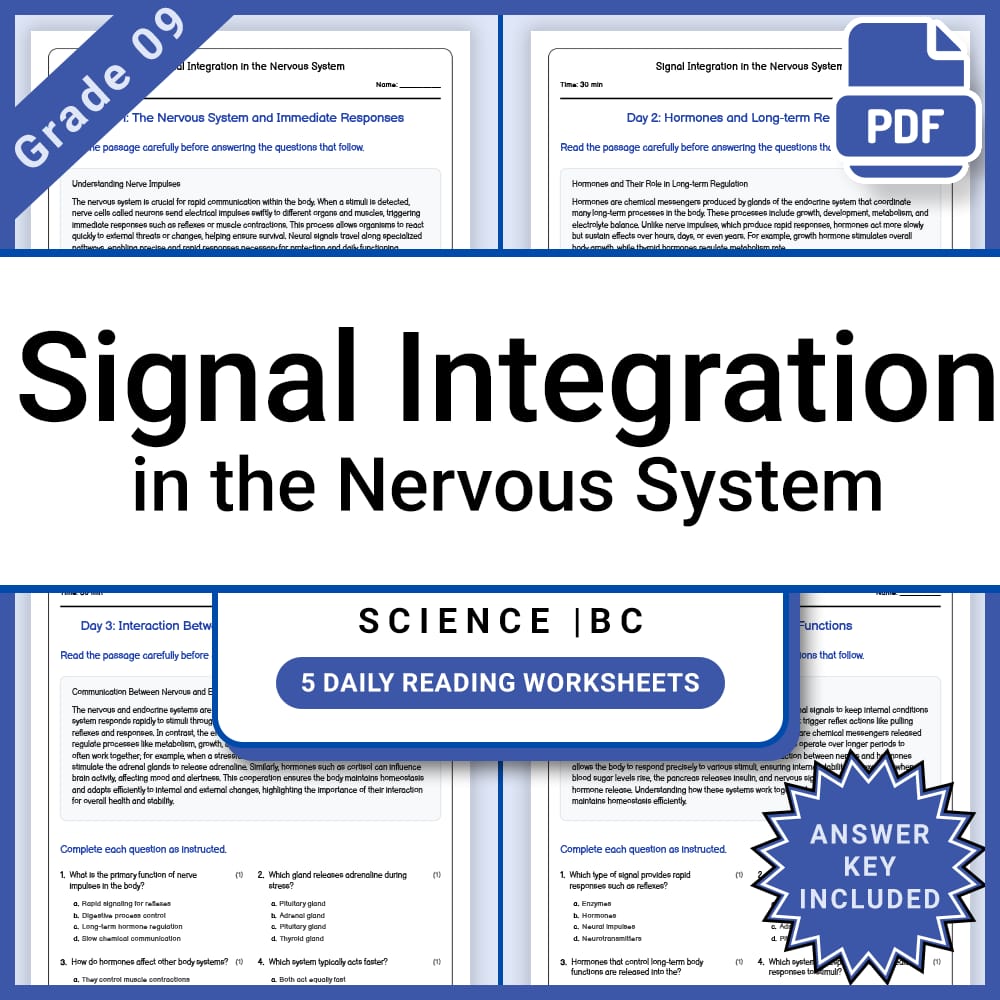
Grade 9 – Signal Integration in the Nervous System Worksheet with Answer Key
JCreated byJ.S SheetsLearning Objectives
- Understand how nerve impulses provide quick responses to stimuli
- Identify the role of the nervous system in maintaining homeostasis
- Explain the interaction between neural responses and hormonal regulation
Also included in: Grade 9 Science Lesson Group Bundle | BC Framework Activities & Worksheets +1 more
Instant download

Grade 9 Holiday End of Year Celebrations Worksheet PDF + Answer Key
 Created byShaNova Worksheets
Learning Objectives
- Explain why self-assessment and reflection help learners understand growth and challenges.
- Identify strategies for setting future goals based on evidence from the past year.
- Use reflection to strengthen social-emotional skills such as recognizing emotions and practicing respectful communication.
Instant download
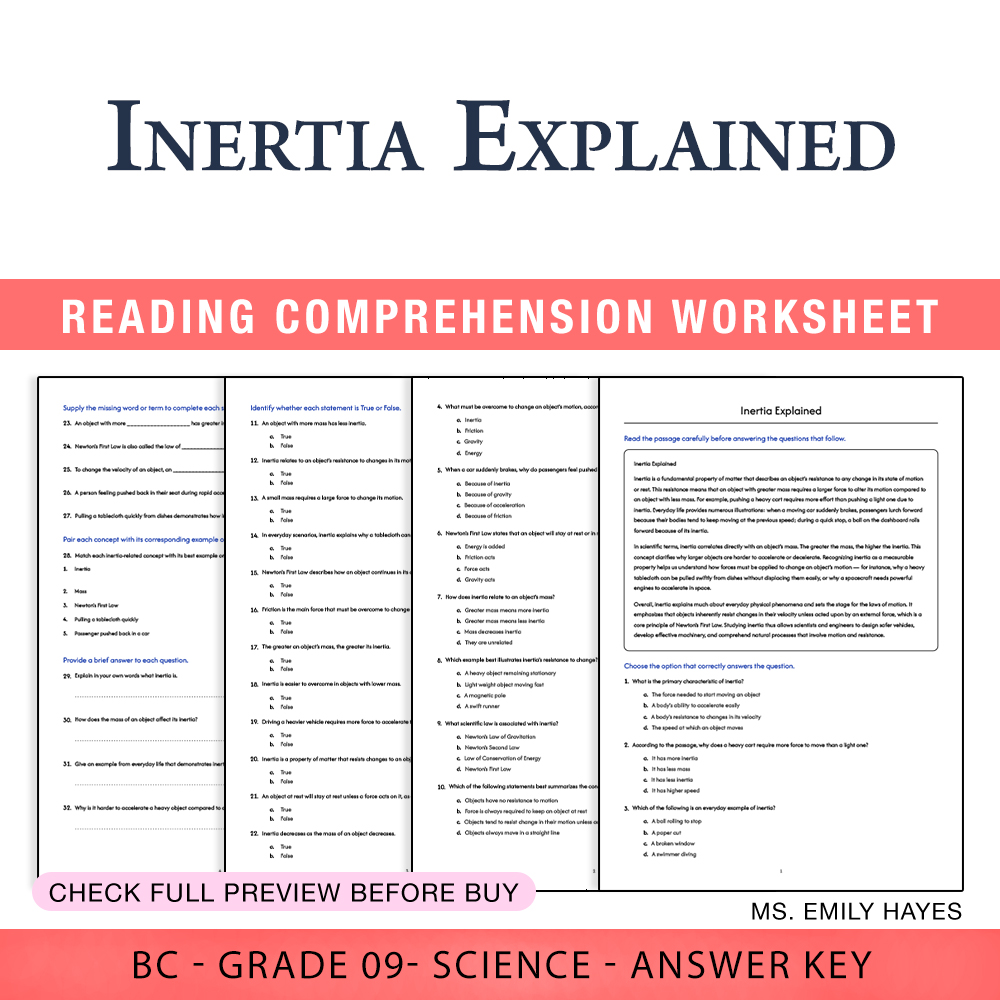
9th Grade Science | Inertia Explained Worksheet (PDF+ Answer Key)
 Created byCopper Leaf Classroom
Learning Objectives
- Understand the concept of inertia and its relation to mass.
- Identify real-world examples that demonstrate inertia.
- Explain how force overcomes inertia to change an object's motion.
Also included in: Grade 9 Science Worksheet Bundle | Forces, Energy & Motion (PDF + Answer Key) +1 more
Instant download
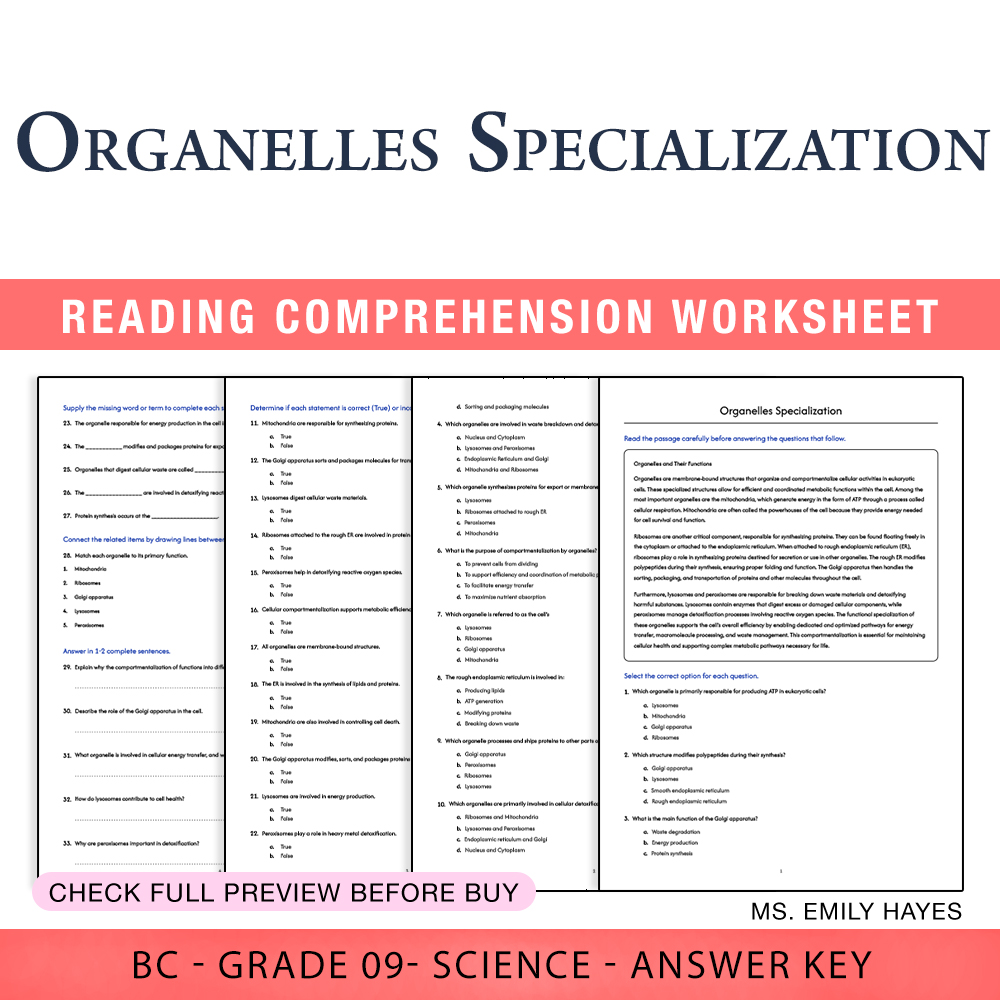
9th Grade Science | Organelles Specialization Worksheet (PDF+ Answer Key)
Created byCopper Leaf ClassroomLearning Objectives
- Describe the functions of key cellular organelles involved in specialization.
- Explain how structural differences among organelles support cellular efficiency.
- Identify the roles of mitochondria, ribosomes, rough endoplasmic reticulum, Golgi apparatus, lysosomes, and peroxisomes.
Also included in: Grade 9 Science Worksheet Pack | Biology & Cell Structures (PDF+ Answer Keys) +1 more
Instant download
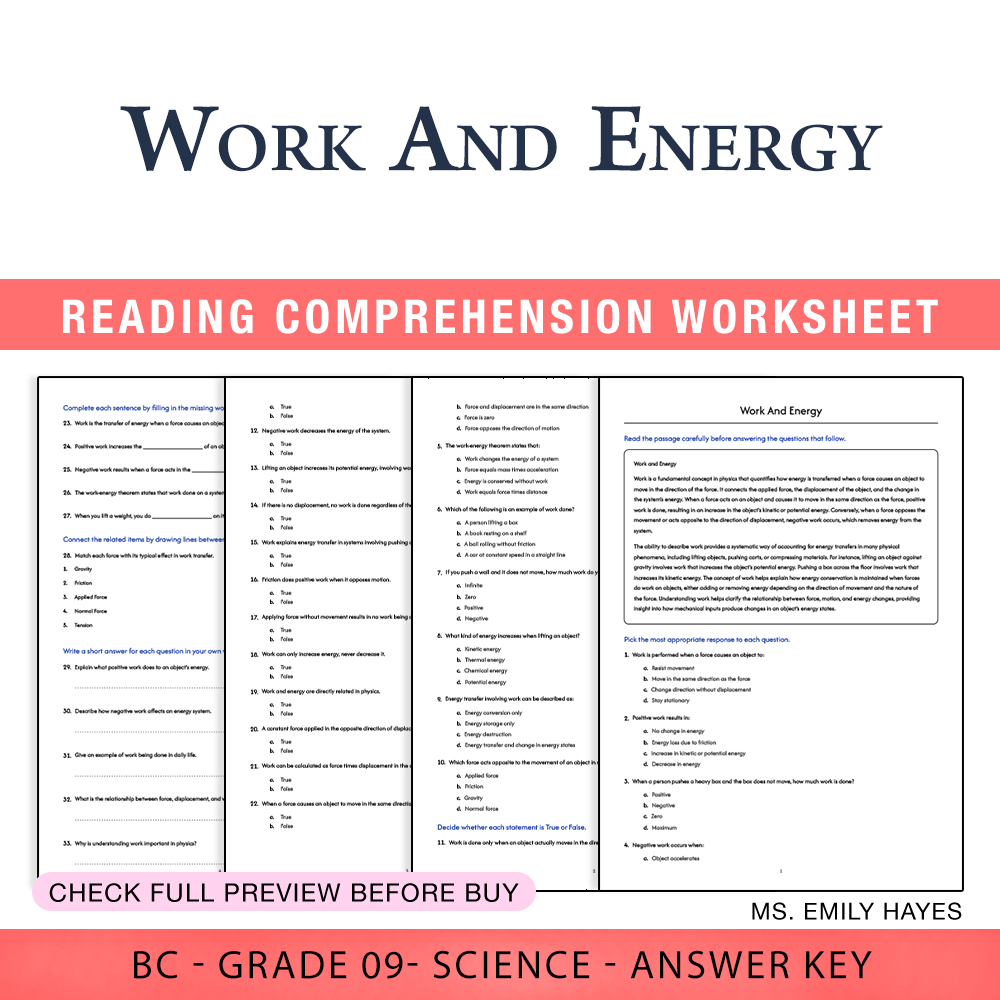
9th Grade Science | Work & Energy Worksheet (PDF+ Answer Key)
Created byCopper Leaf ClassroomLearning Objectives
- Understand the concept of work in relation to force, displacement, and energy transfer.
- Distinguish between positive and negative work and their effects on energy.
- Apply the work-energy theorem to simple physics problems.
Also included in: Grade 9 Science Worksheet Bundle | Forces, Energy & Motion (PDF + Answer Key) +1 more
Instant download
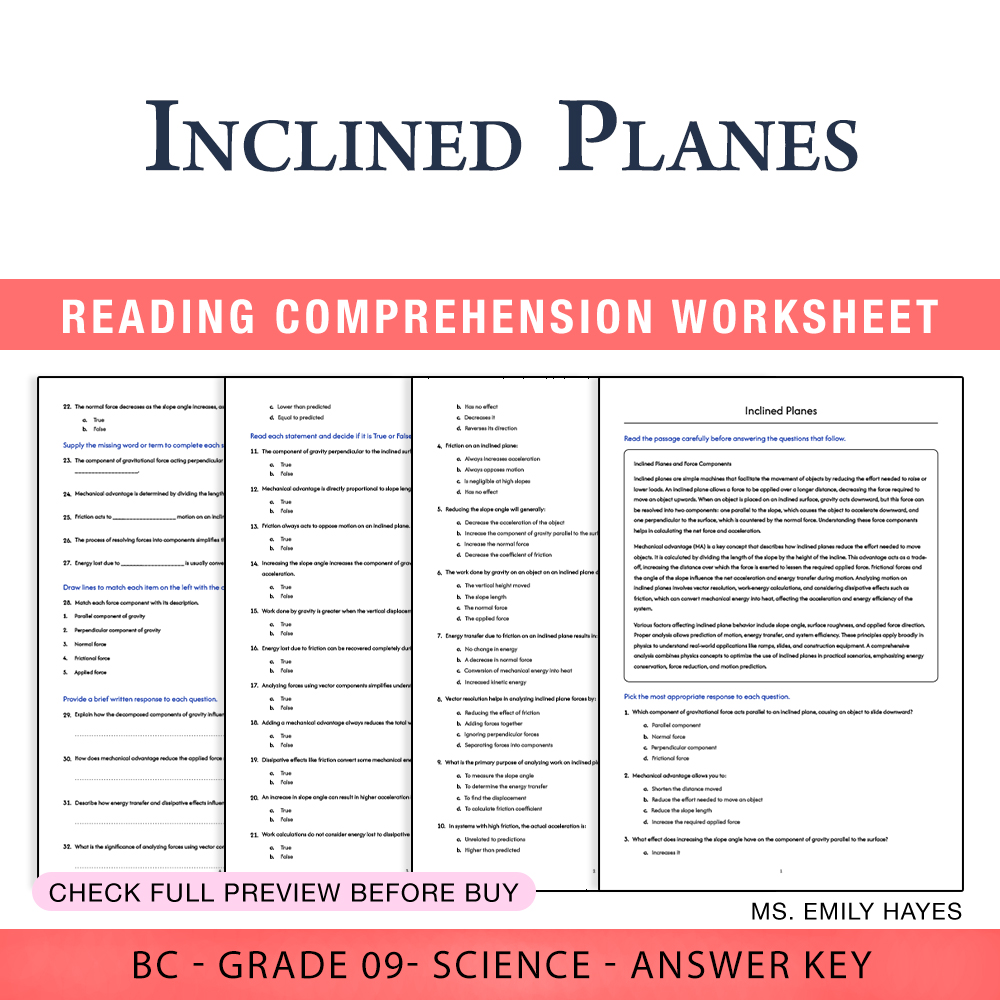
9th Grade Science | Inclined Planes Worksheet (PDF+ Answer Key)
Created byCopper Leaf ClassroomLearning Objectives
- Explain how inclined planes decompose gravitational force into components parallel and perpendicular to the surface.
- Describe the concept of mechanical advantage and how it reduces applied force at the expense of distance.
- Analyze the effects of slope angle and friction on the motion, acceleration, and energy transfer of objects on inclined planes.
Also included in: Grade 9 Science Worksheet Bundle | Forces, Energy & Motion (PDF + Answer Key) +1 more
Instant download
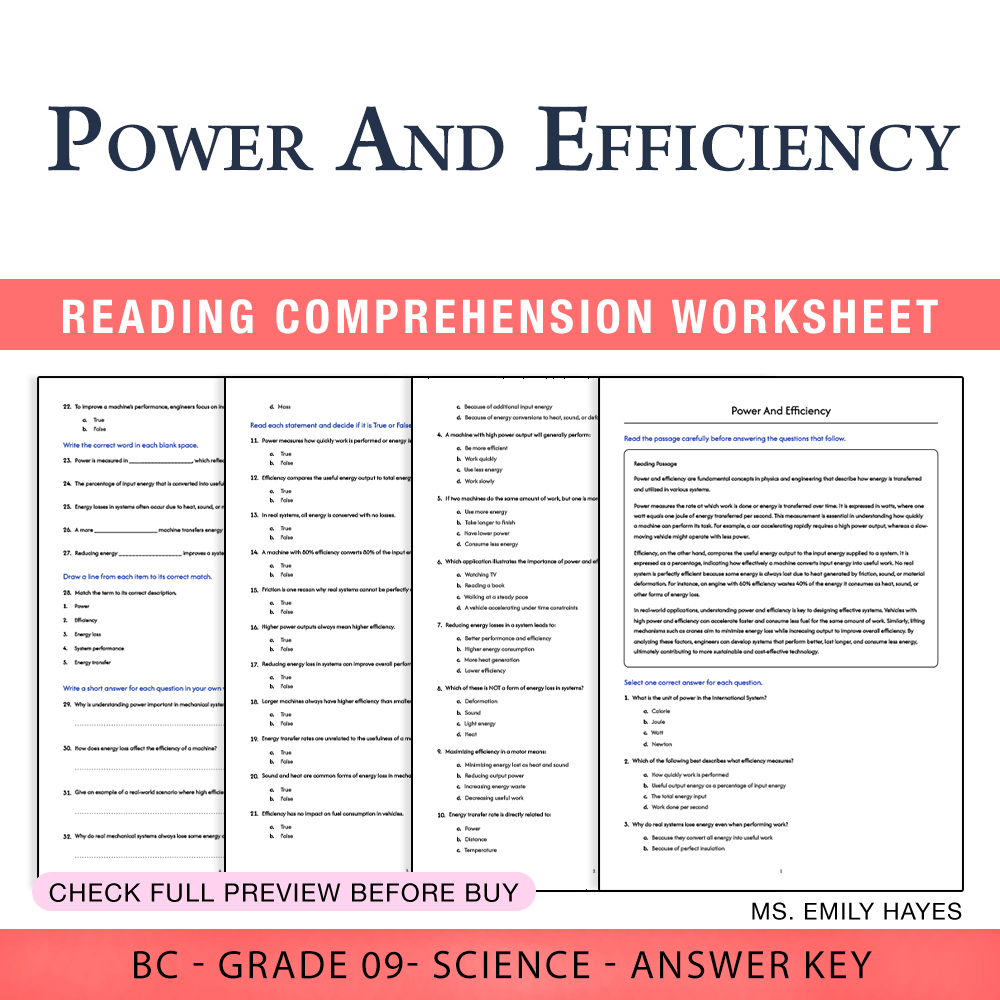
9th Grade Science | Power and Efficiency Worksheet (PDF+ Answer Key)
Created byCopper Leaf ClassroomLearning Objectives
- Understand the concepts of power and how it measures the rate of energy transfer in systems.
- Explain the meaning of efficiency and how it compares useful output energy to input energy.
- Recognize factors that cause energy loss in real systems and how they reduce efficiency.
Also included in: Grade 9 Science Worksheet Bundle | Forces, Energy & Motion (PDF + Answer Key) +1 more
Instant download
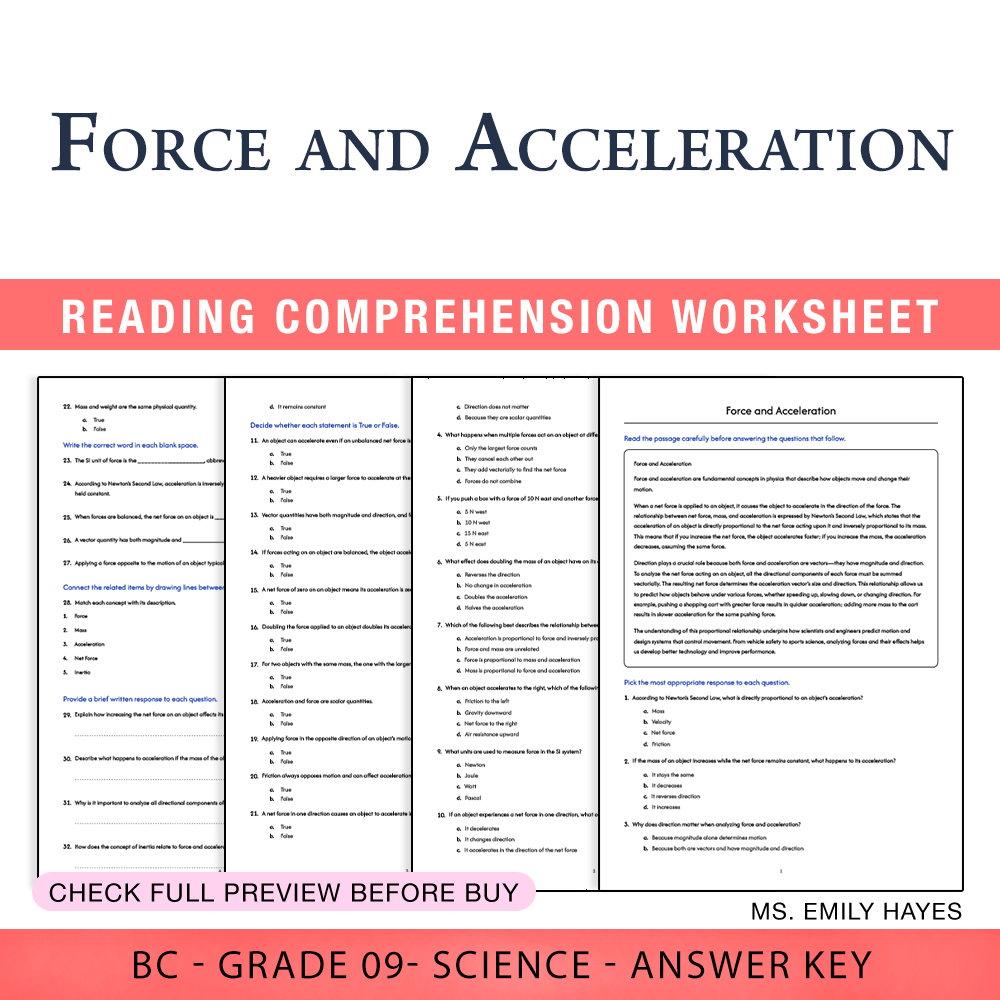
Grade 9 Science | Force and Acceleration Worksheet (PDF+ Answer Key)
Created byCopper Leaf ClassroomLearning Objectives
- Understand the relationship between net force, mass, and acceleration.
- Analyze how changes in force or mass affect acceleration.
- Apply vector concepts to force and acceleration in different directions.
Also included in: Grade 9 Science Worksheet Bundle | Forces, Energy & Motion (PDF + Answer Key) +1 more
Instant download
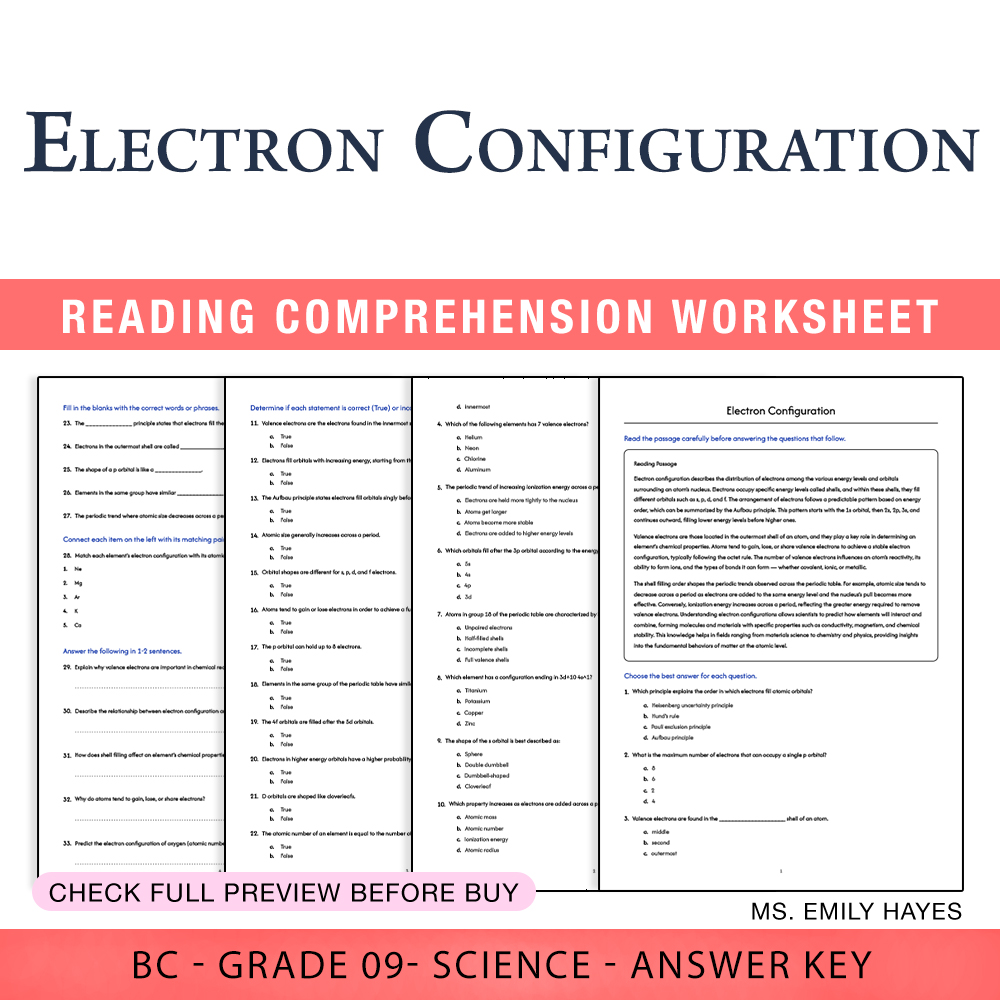
9th Grade Science | Electron Configuration Worksheet (PDF+ Answer Key)
Created byCopper Leaf ClassroomLearning Objectives
- Describe how electrons are distributed among energy levels and orbitals.
- Explain the importance of valence electrons in chemical reactivity and bonding.
- Identify the order in which electron shells are filled.
Also included in: Grade 9 Science Bundle | Chemistry, Physics & Atomic Concepts (PDF + Answer Key) +1 more
Instant download
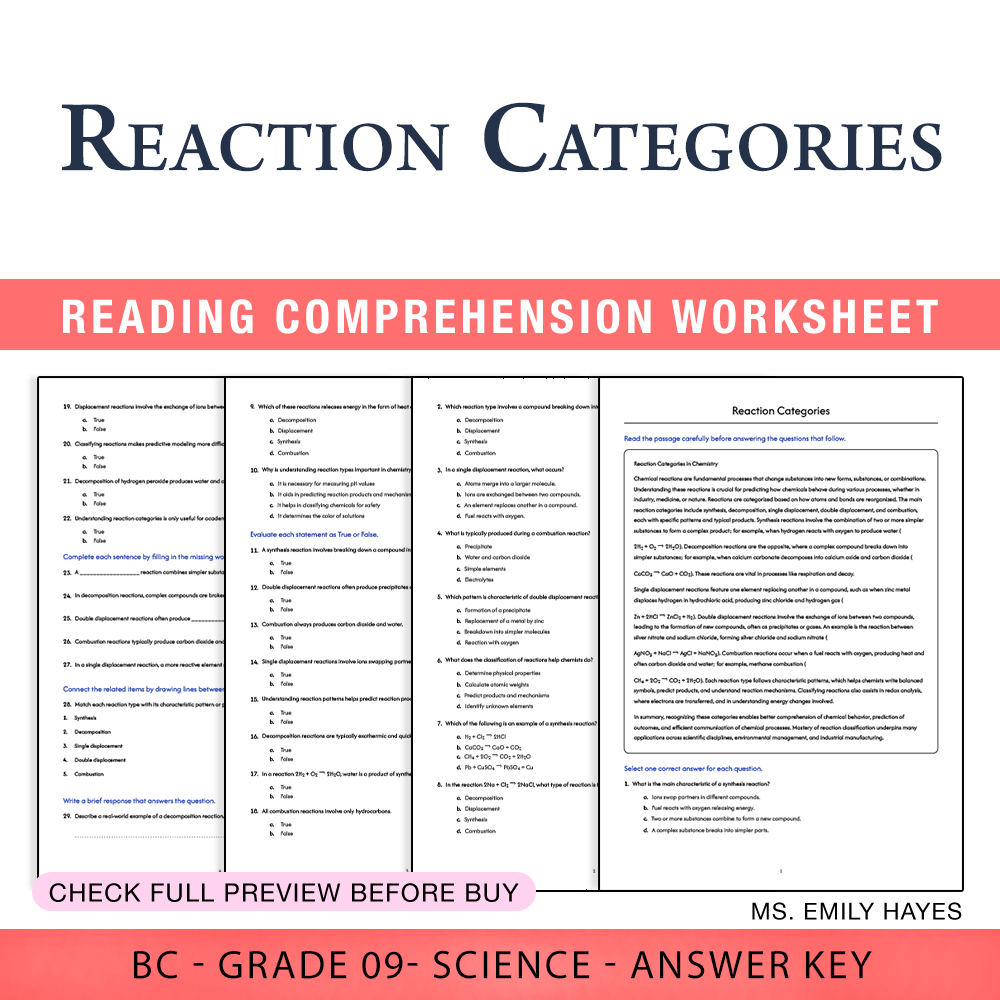
Grade 9 Science | Reaction Categories Worksheet (PDF+ Answer Key)
Created byCopper Leaf ClassroomLearning Objectives
- Identify and classify different types of chemical reactions based on reactant patterns and products.
- Understand the processes and characteristics of synthesis, decomposition, displacement, and combustion reactions.
- Predict products of various reaction types using chemical knowledge and symbolic representation.
Also included in: Grade 9 Science Bundle | Chemistry, Physics & Atomic Concepts (PDF + Answer Key) +1 more
Instant download
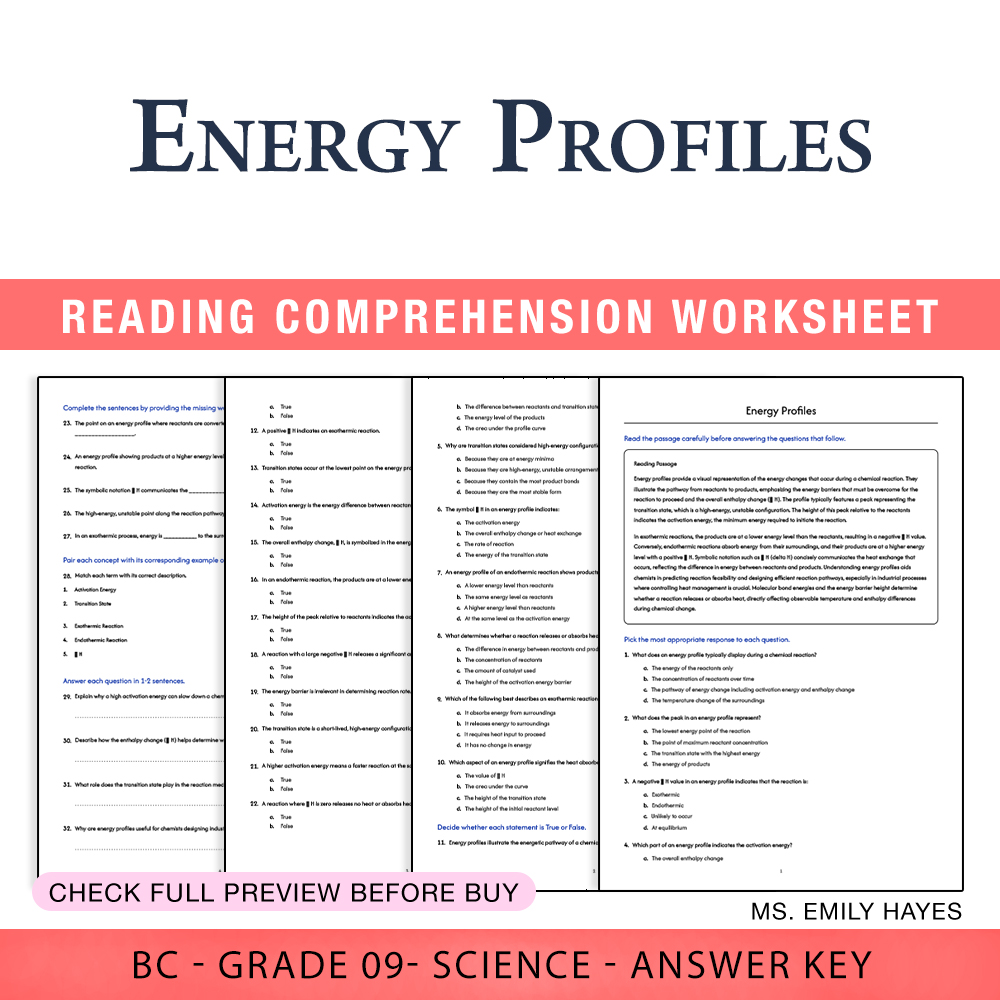
Grade 9 Science | Energy Profiles Worksheet (PDF+ Answer Key)
Created byCopper Leaf ClassroomLearning Objectives
- Describe the concept of energy profiles and their purpose in analyzing chemical reactions.
- Distinguish between exothermic and endothermic reactions based on enthalpy changes.
- Identify the significance of activation energy and transition states in reaction pathways.
Also included in: Grade 9 Science Bundle | Chemistry, Physics & Atomic Concepts (PDF + Answer Key) +1 more
Instant download
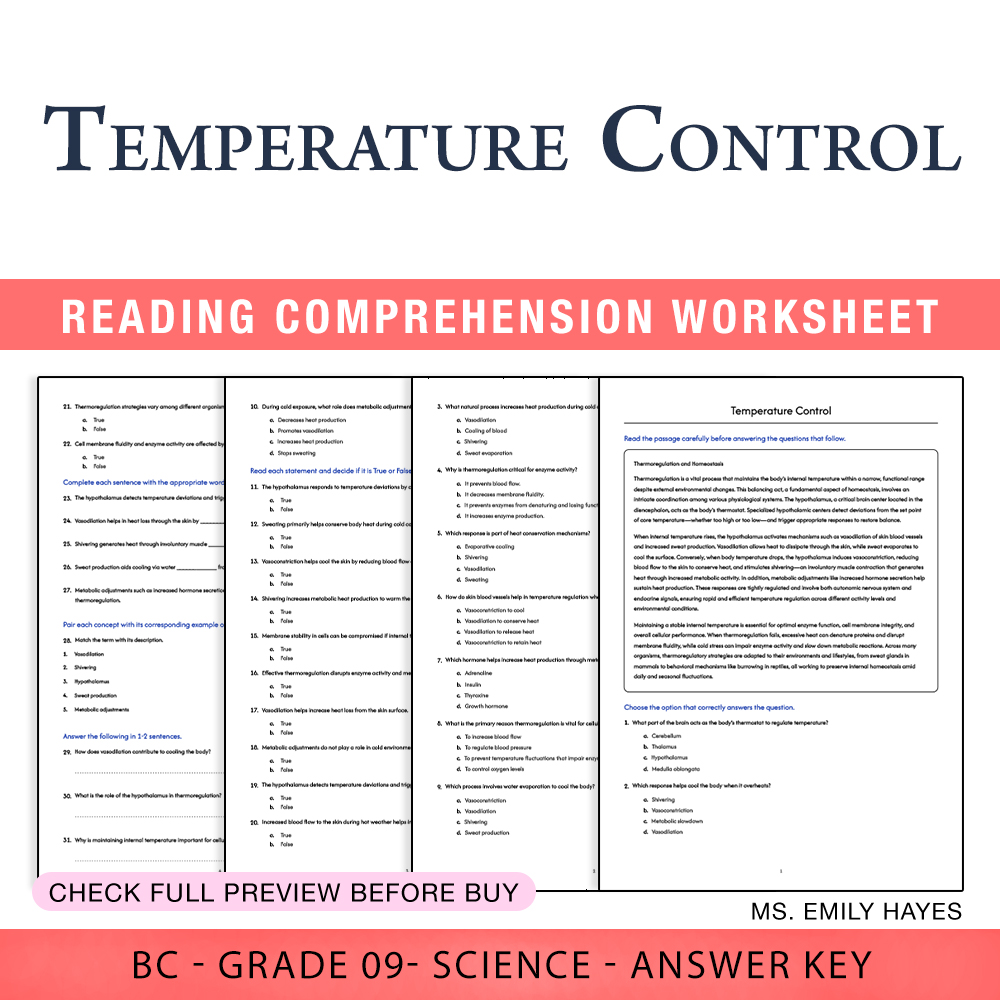
Grade 9 Science | Temperature Control Worksheet (PDF+ Answer Key)
Created byCopper Leaf ClassroomLearning Objectives
- Explain how hypothalamic centers regulate internal body temperature.
- Describe the physiological responses involved in thermoregulation.
- Identify the roles of skin blood flow, sweat production, shivering, and metabolic adjustments.
Also included in: Grade 9 Science Worksheet Pack | Biology & Cell Structures (PDF+ Answer Keys) +1 more
Instant download
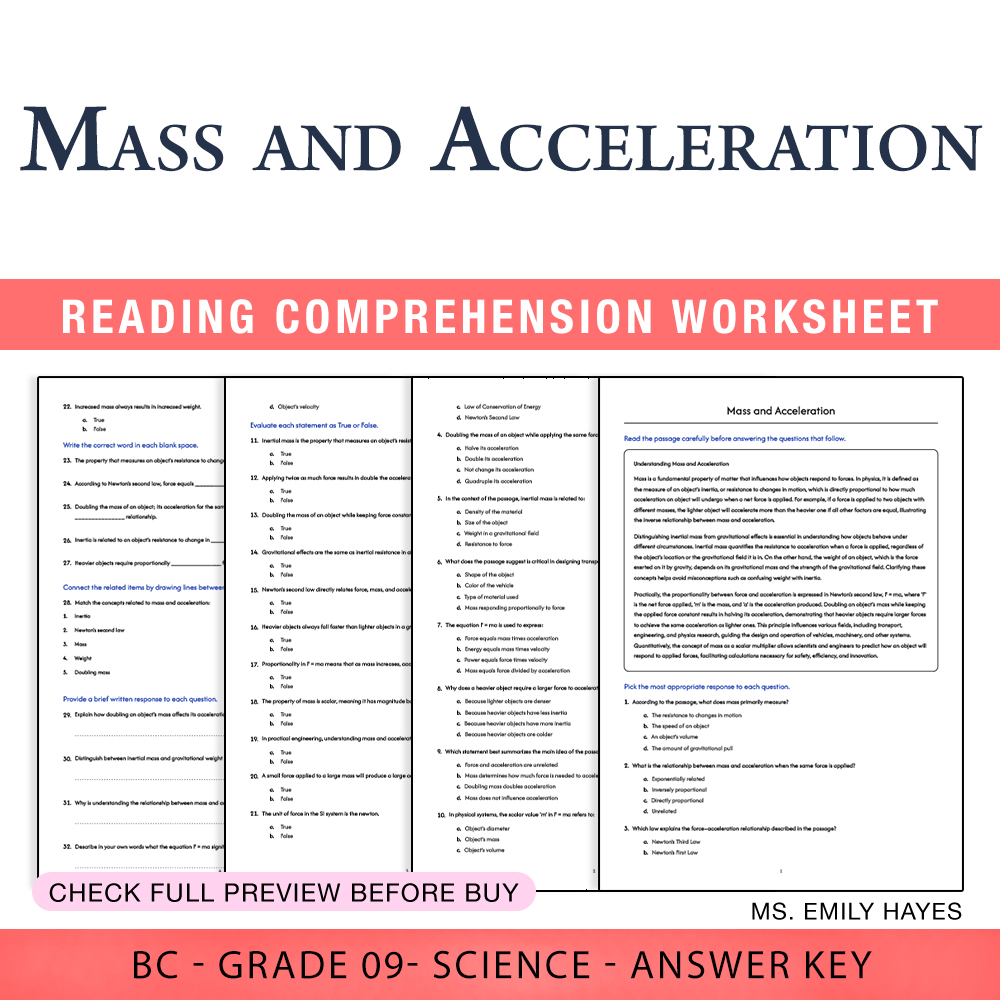
9th Grade Science | Mass and Acceleration Worksheet (PDF + Answer Key)
Created byCopper Leaf ClassroomLearning Objectives
- Explain how mass influences acceleration under a given net force.
- Distinguish between inertial mass and gravitational effects in response to forces.
- Apply the force–acceleration relationship in practical problems involving mass.
Also included in: Grade 9 Science Worksheet Bundle | Forces, Energy & Motion (PDF + Answer Key) +1 more
Instant download
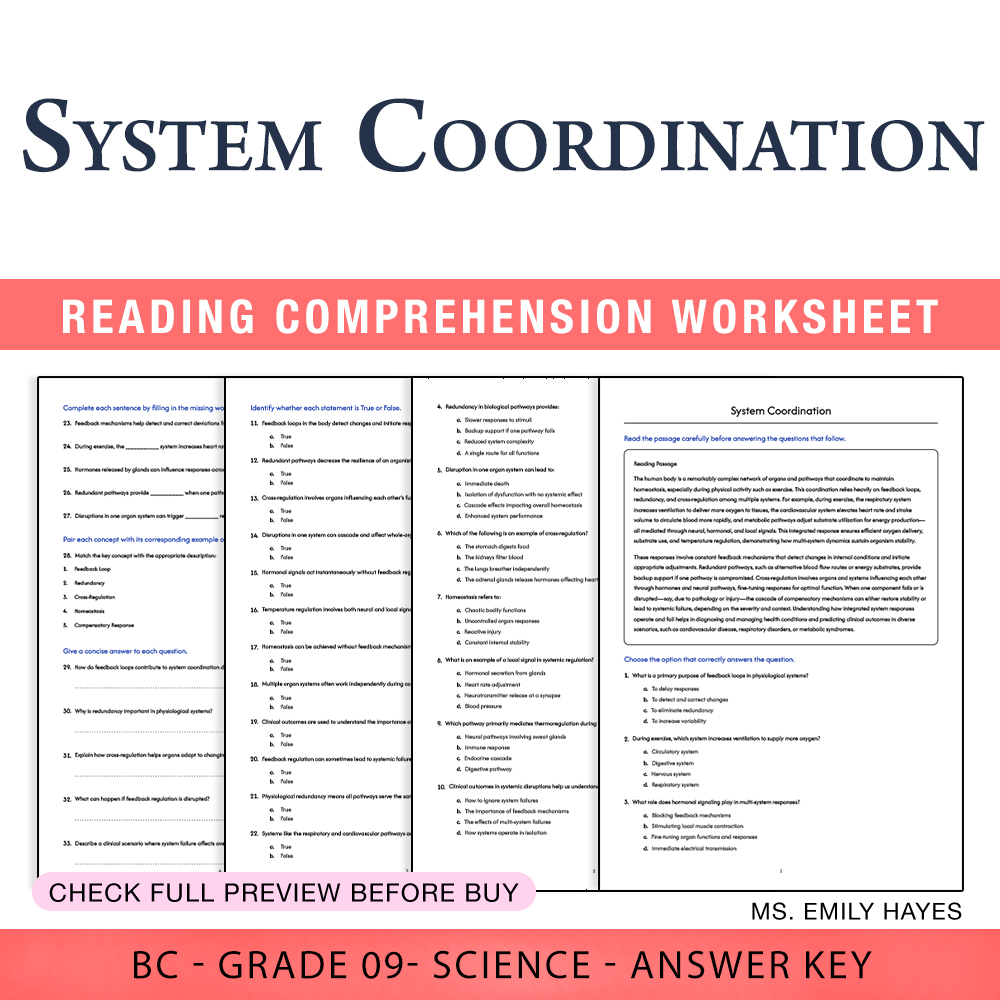
Grade 9 Science | System Coordination Worksheet (PDF+ Answer Key)
Created byCopper Leaf ClassroomLearning Objectives
- Explain how feedback loops, redundancy, and cross-regulation coordinate multiple organ systems.
- Describe how responses to exercise involve respiratory, cardiovascular, and metabolic pathways.
- Identify the mechanisms by which disruptions in one system affect overall homeostasis.
Also included in: Grade 9 Science Worksheet Pack | Biology & Cell Structures (PDF+ Answer Keys) +1 more
Instant download
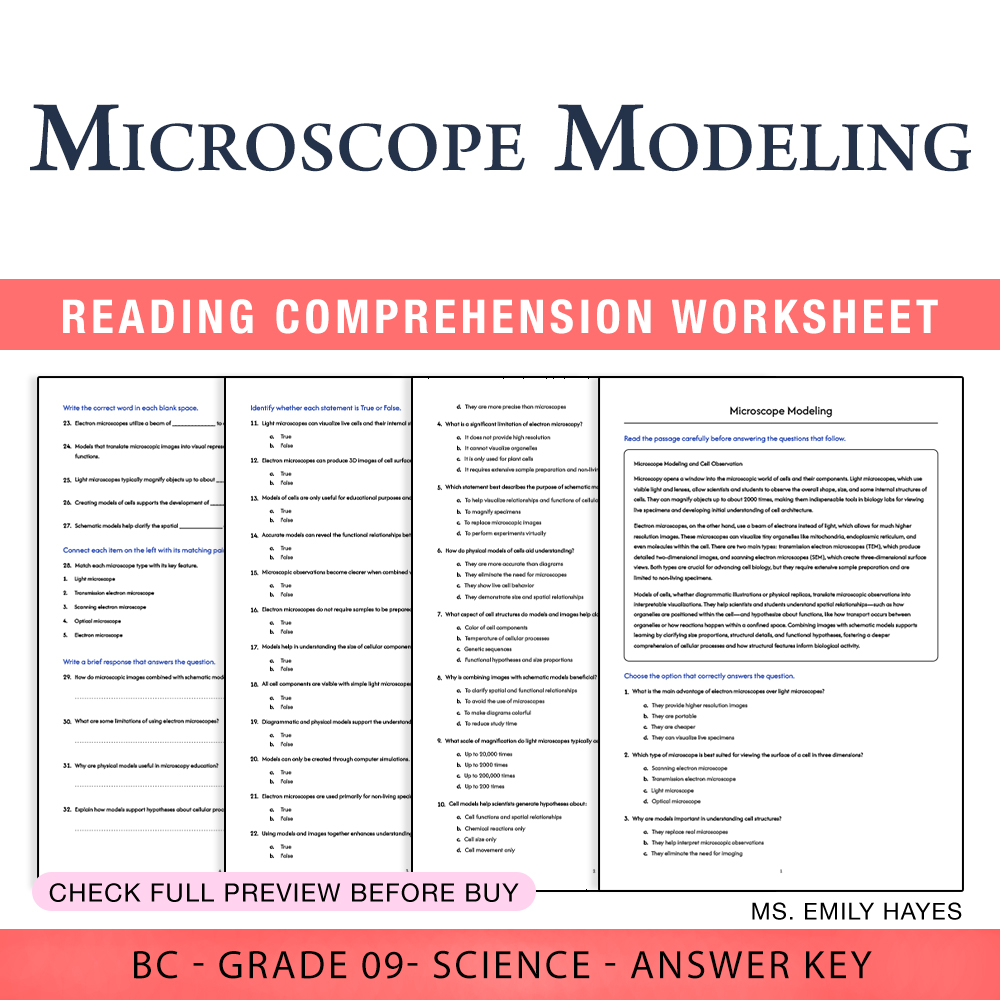
Grade 9 Science | Microscope Modeling Worksheet (PDF+ Answer Key)
Created byCopper Leaf ClassroomLearning Objectives
- Understand how microscopes reveal details of cell structures.
- Learn the differences between various types of microscopy.
- Interpret diagrammatic and physical models of cells.
Also included in: Grade 9 Science Worksheet Pack | Biology & Cell Structures (PDF+ Answer Keys) +1 more
Instant download
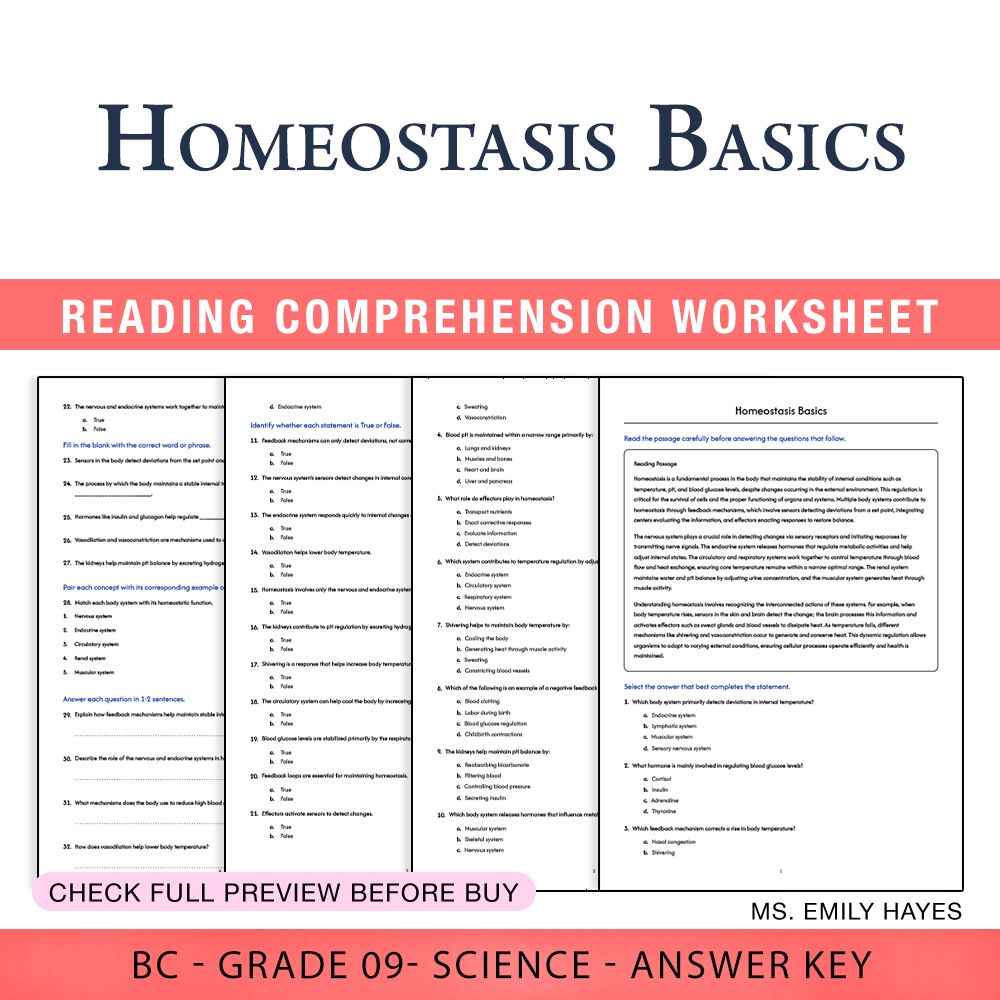
9th Grade Science | Homeostasis Basics Worksheet (PDF+ Answer Key)
Created byCopper Leaf ClassroomLearning Objectives
- Explain the concept of homeostasis and its importance in maintaining internal body conditions.
- Identify and describe the key body systems involved in homeostasis.
- Understand feedback mechanisms that regulate temperature, pH, and blood glucose levels.
Also included in: Grade 9 Science Worksheet Pack | Biology & Cell Structures (PDF+ Answer Keys) +1 more
Instant download
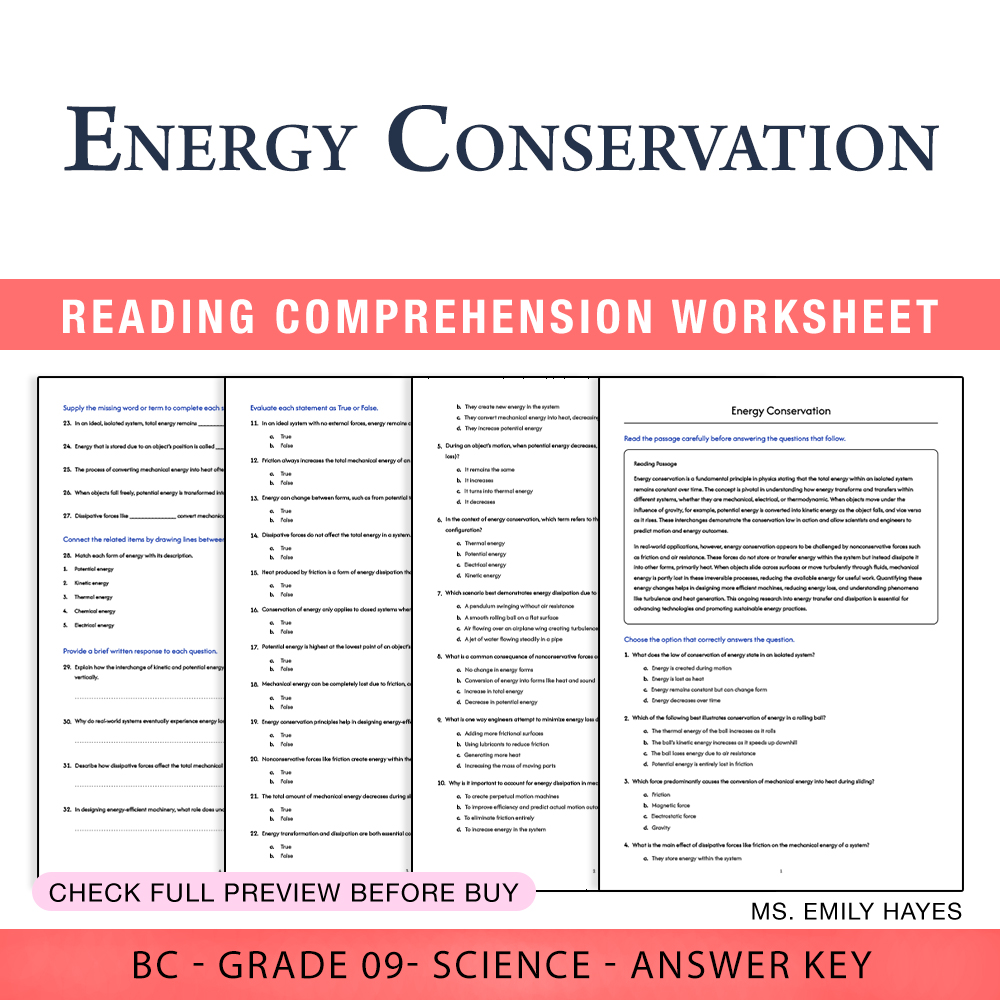
Grade 9 Science | Energy Conservation Worksheet (PDF+ Answer Key)
Created byCopper Leaf ClassroomLearning Objectives
- Understand the principle of energy conservation in isolated systems.
- Identify different forms of energy involved in mechanical and non-mechanical processes.
- Explain how energy shifts between kinetic and potential forms during motion.
Also included in: Grade 9 Science Worksheet Bundle | Forces, Energy & Motion (PDF + Answer Key) +1 more
Instant download
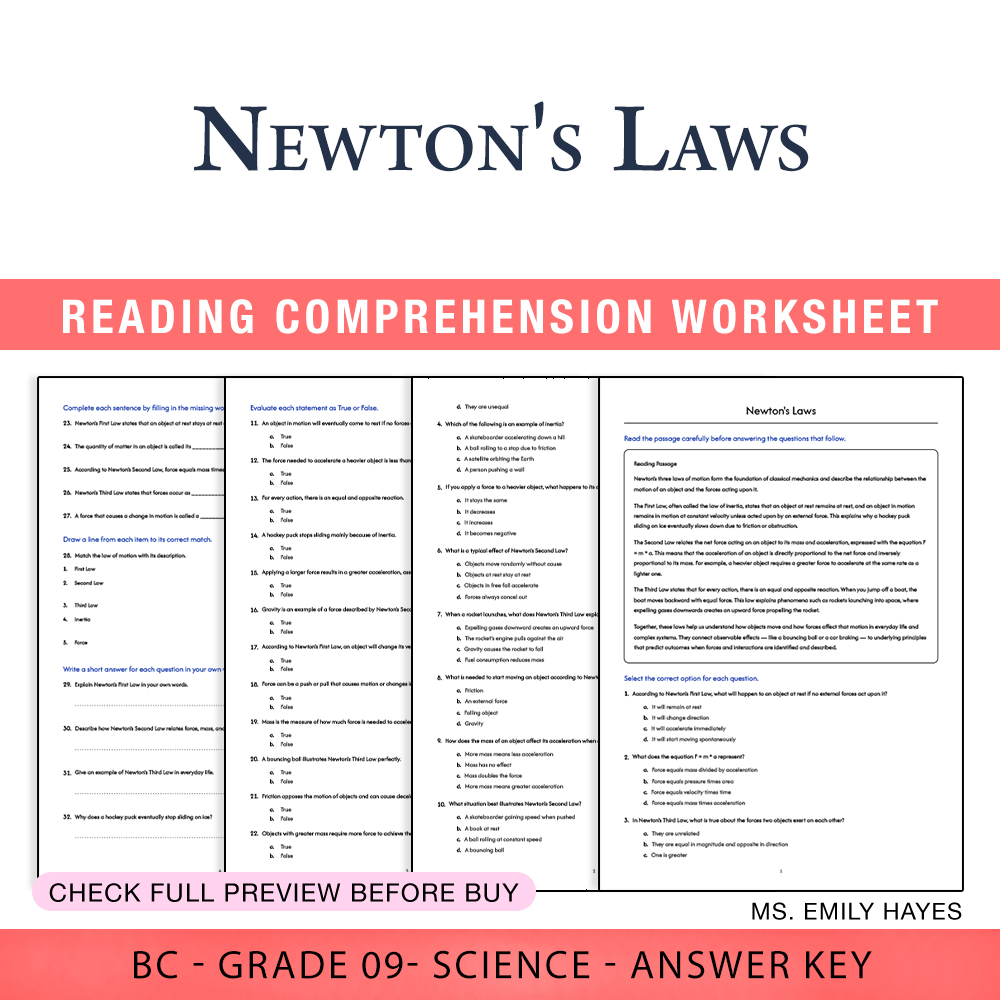
9th Grade Science | Newton's Laws of Motion Worksheet (PDF+ Answer Key)
Created byCopper Leaf ClassroomLearning Objectives
- Understand and explain Newton's three laws of motion.
- Identify real-world examples illustrating each of Newton's laws.
- Apply Newton's laws to analyze motion and forces in various situations.
Also included in: Grade 9 Science Worksheet Bundle | Forces, Energy & Motion (PDF + Answer Key) +1 more
Instant download
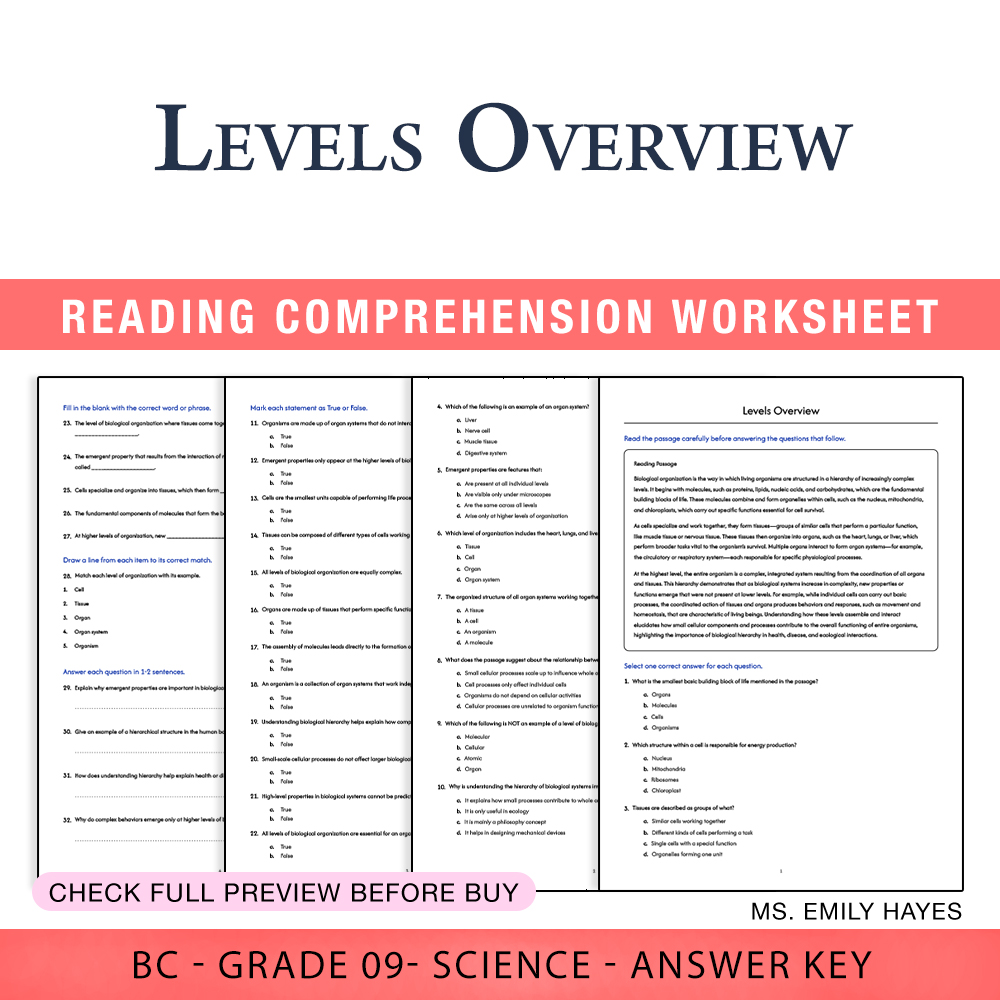
9th Grade Science | Levels of Biological Organization Worksheet(PDF+ Answer Key)
Created byCopper Leaf ClassroomLearning Objectives
- Describe the hierarchical levels of biological organization from molecules to organisms.
- Explain the concept of emergent properties at each level of biological organization.
- Understand how components assemble into complex biological systems to maintain function.
Also included in: Grade 9 Science Worksheet Pack | Biology & Cell Structures (PDF+ Answer Keys) +1 more
Instant download
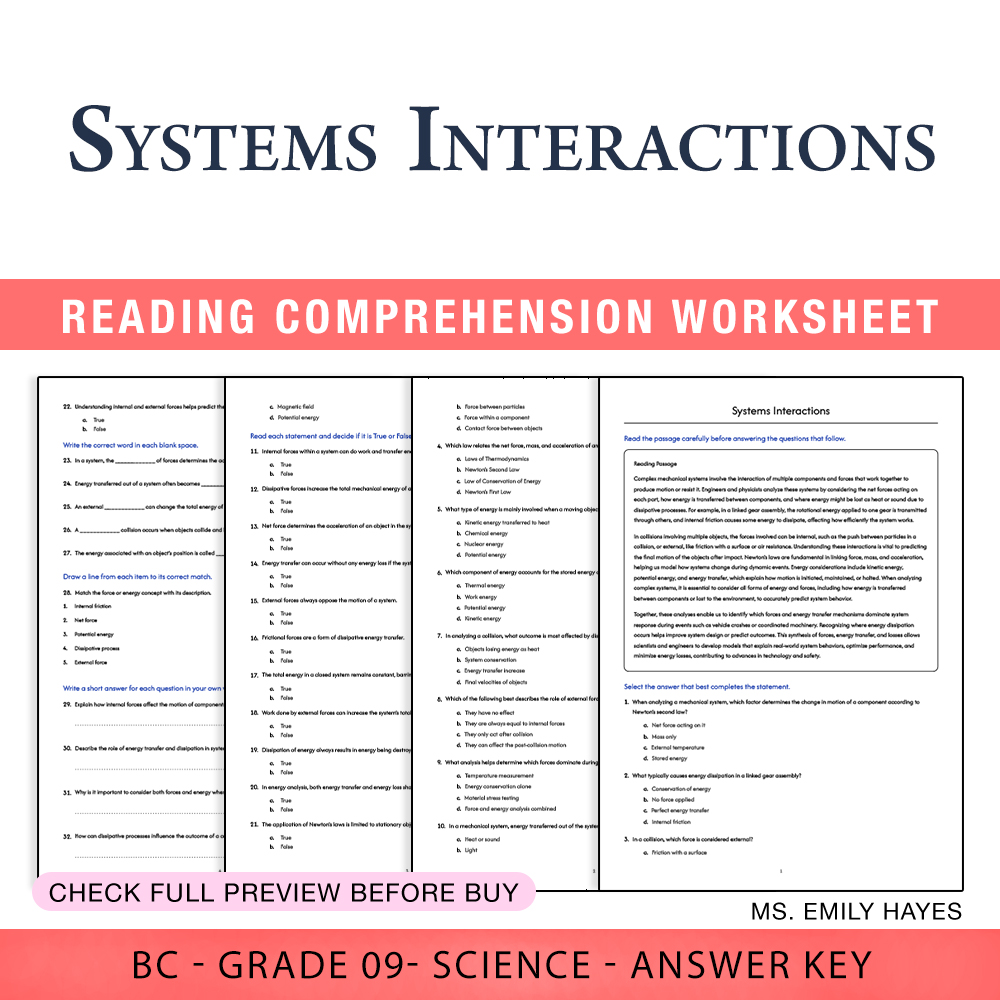
Grade 9 Science | Systems Interactions Worksheet (PDF+ Answer Key)
Created byCopper Leaf ClassroomLearning Objectives
- Understand how multiple bodies and forces interact within complex mechanical systems.
- Apply Newton’s laws, net force analysis, and energy accounting to predict system motion.
- Analyze internal and external forces, energy transfer, and energy loss in systems during events like collisions.
Also included in: Grade 9 Science Worksheet Bundle | Forces, Energy & Motion (PDF + Answer Key) +1 more
Instant download
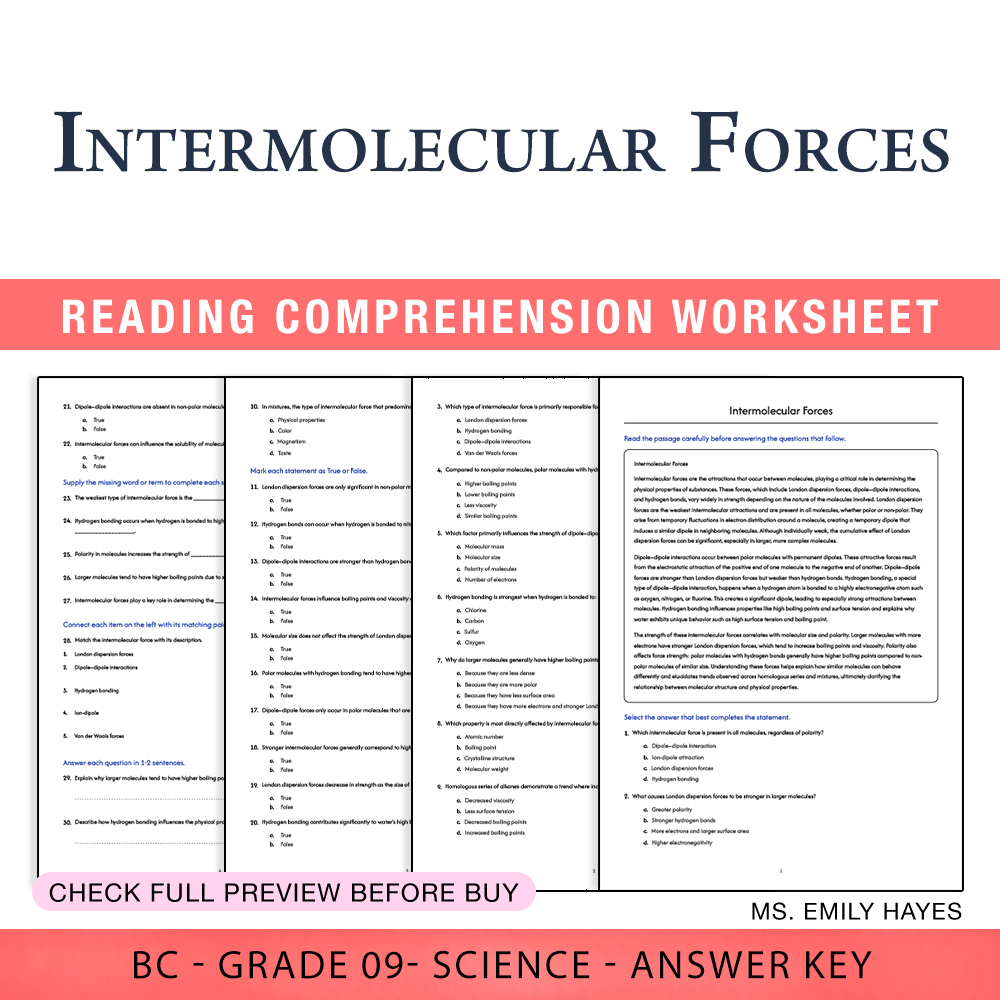
9th Grade Science | Intermolecular Forces Worksheet (PDF+ Answer Key)
Created byCopper Leaf ClassroomLearning Objectives
- Explain the types of intermolecular forces and how they affect physical properties of molecules.
- Compare London dispersion, dipole–dipole, and hydrogen bonding in terms of strength and molecular influence.
- Relate molecular structure and polarity to the strength of intermolecular forces and properties like boiling point and viscosity.
Also included in: Grade 9 Science Bundle | Chemistry, Physics & Atomic Concepts (PDF + Answer Key) +1 more
Instant download
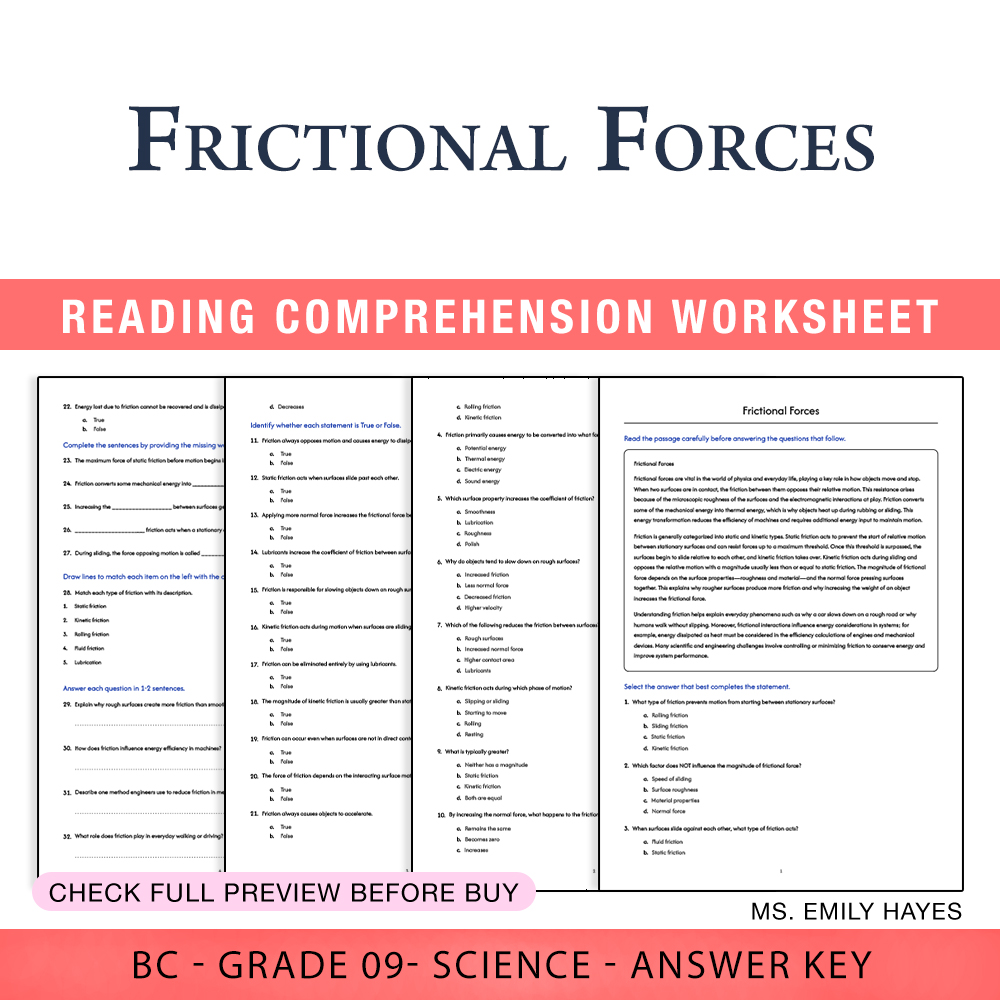
Grade 9 Science | Frictional Forces Worksheet (PDF+ Answer Key)
Created byCopper Leaf ClassroomLearning Objectives
- Explain how friction opposes motion between surfaces and converts kinetic energy to heat.
- Differentiate between static and kinetic friction and understand their roles.
- Describe factors affecting the magnitude of frictional forces.
Also included in: Grade 9 Science Worksheet Bundle | Forces, Energy & Motion (PDF + Answer Key) +1 more
Instant download
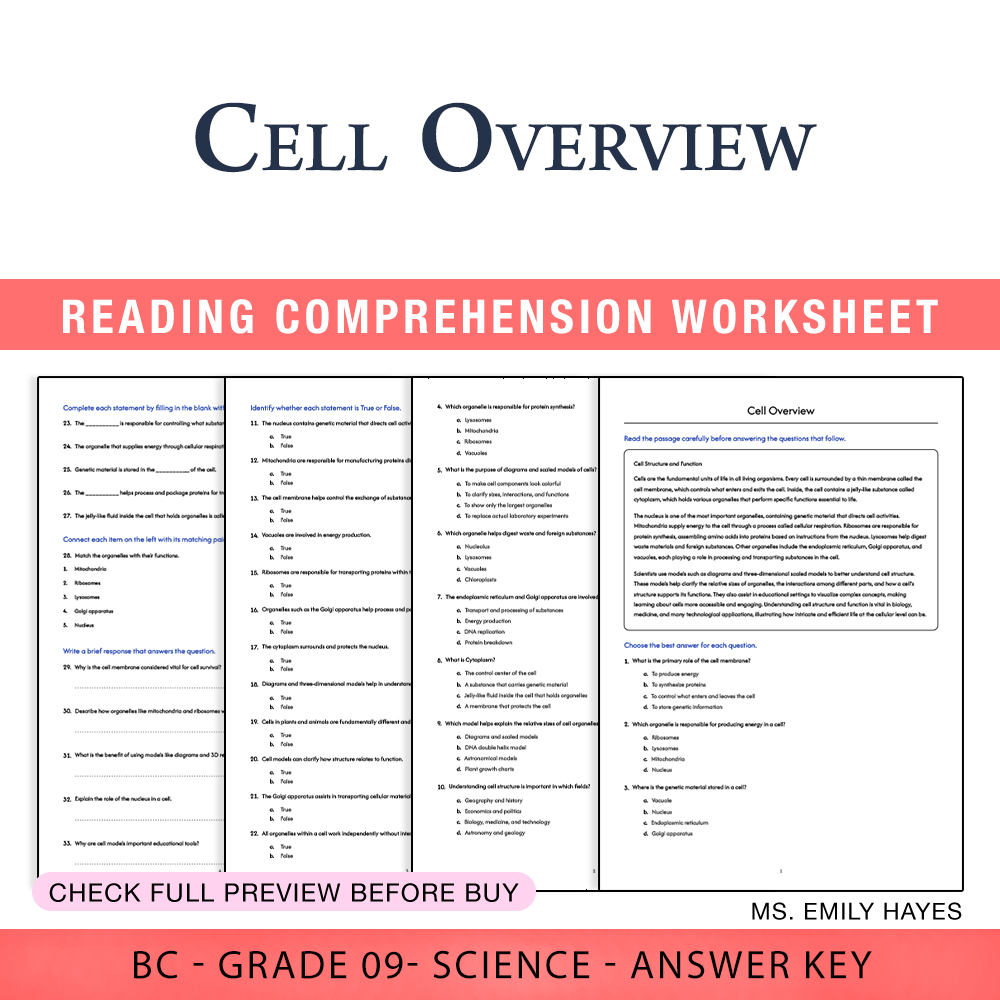
Grade 9 Science | Cell Overview Worksheet (PDF+ Answer Key)
Created byCopper Leaf ClassroomLearning Objectives
- Identify the main structures and functions of a cell and its organelles.
- Describe how cellular structures relate to their functions.
- Understand different models used to illustrate cell components and their relative sizes.
Also included in: Grade 9 Science Worksheet Pack | Biology & Cell Structures (PDF+ Answer Keys) +1 more
Instant download
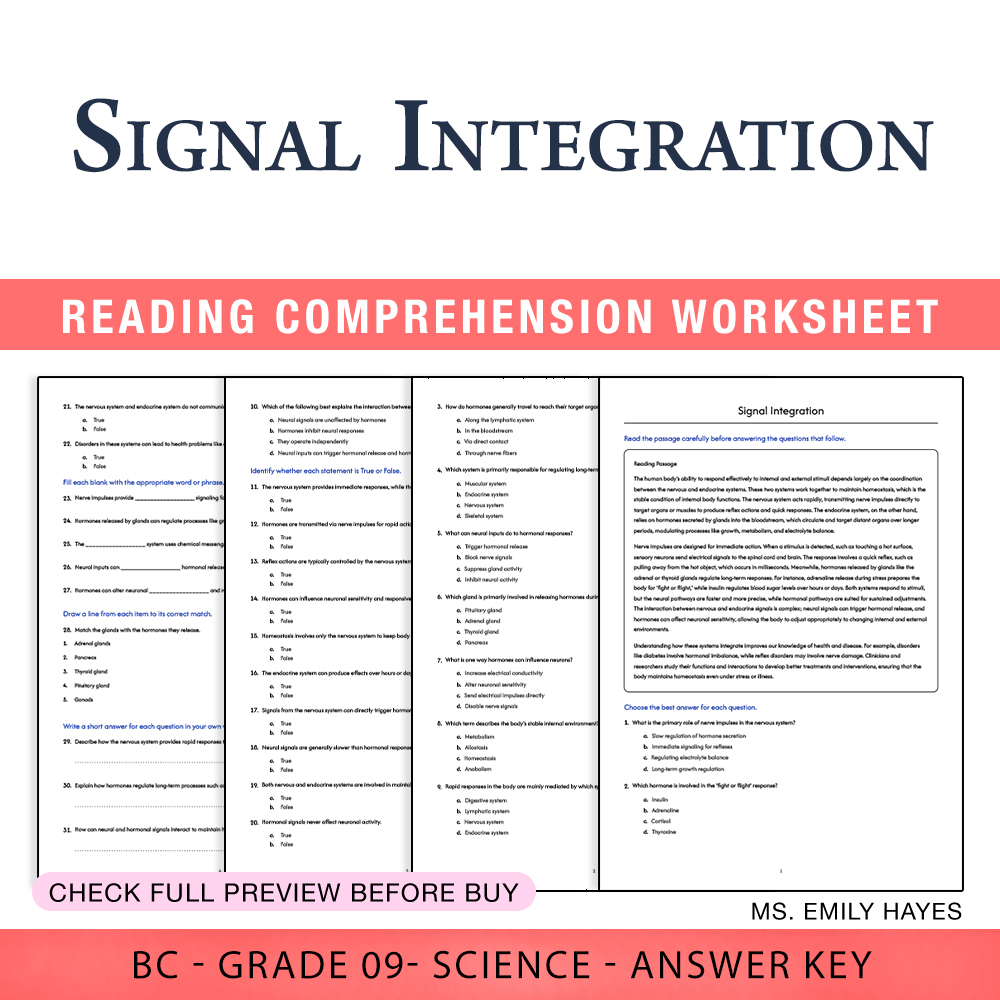
Grade 9 Science | Signal Integration Worksheet (PDF+ Answer Key)
Created byCopper Leaf ClassroomLearning Objectives
- Understand how the nervous and endocrine systems coordinate responses to stimuli.
- Identify different signals and their roles in maintaining homeostasis.
- Compare rapid nerve responses with slower hormonal responses.
Also included in: Grade 9 Science Worksheet Pack | Biology & Cell Structures (PDF+ Answer Keys) +1 more
Instant download
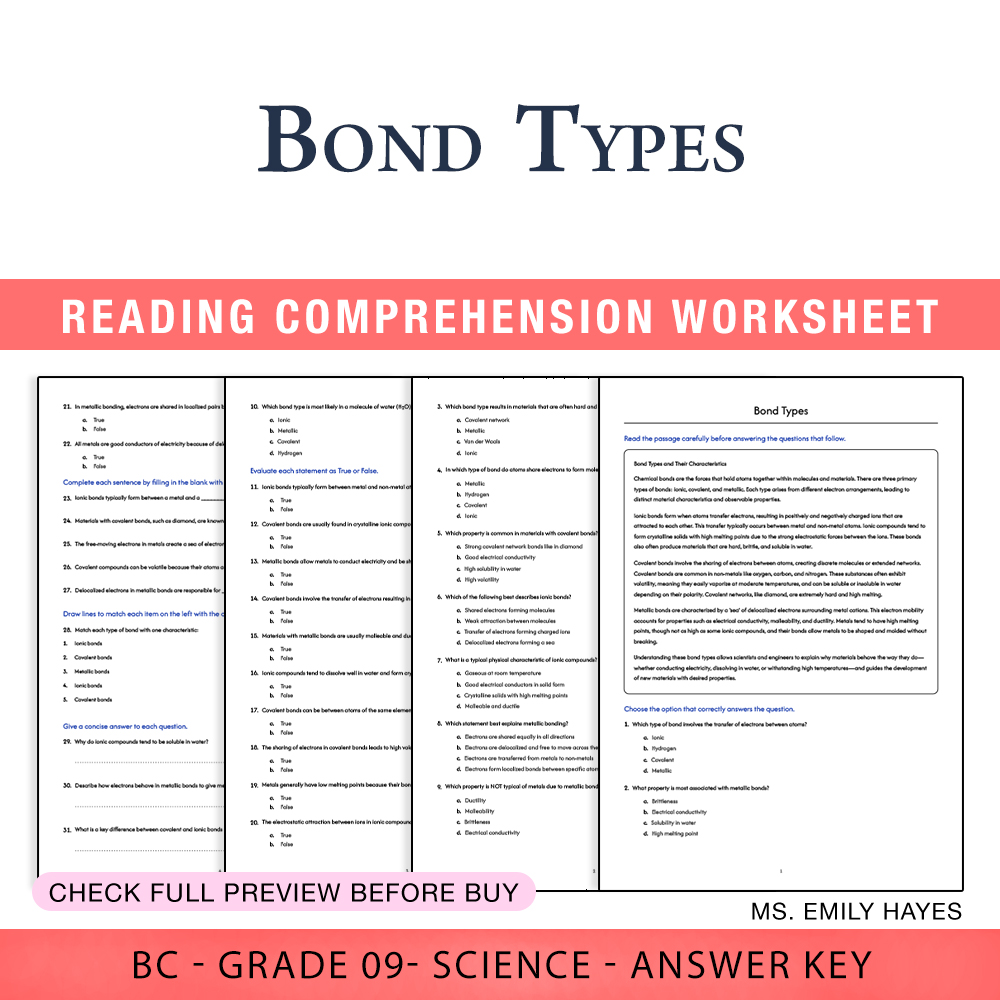
9th Grade Science | Bond Types Worksheet (PDF+ Answer Key)
Created byCopper Leaf ClassroomLearning Objectives
- Identify different types of chemical bonds: ionic, covalent, and metallic.
- Explain how electron arrangements influence bond formation and material properties.
- Distinguish between ionic, covalent, and metallic bonds based on their characteristics.
Also included in: Grade 9 Science Bundle | Chemistry, Physics & Atomic Concepts (PDF + Answer Key) +1 more
Instant download
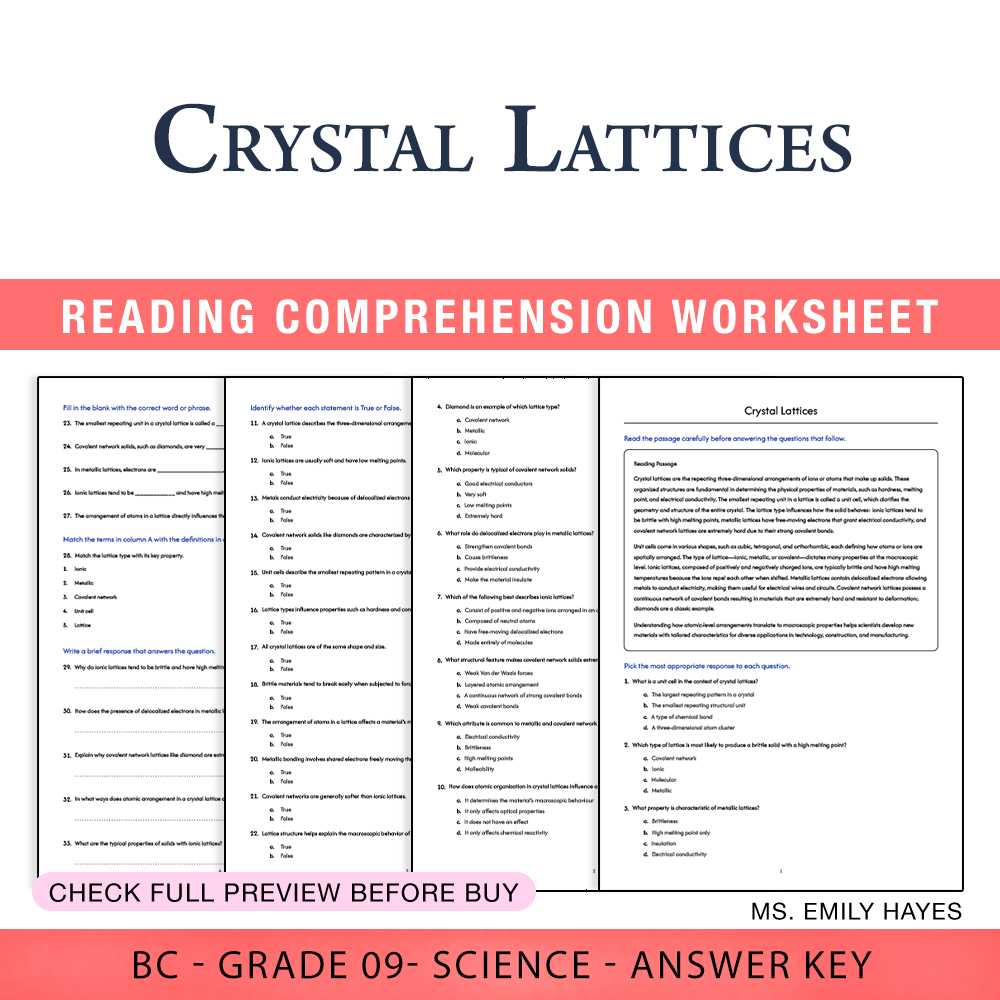
9th Grade Science | Crystal Lattices Worksheet (PDF+ Answer Key)
Created byCopper Leaf ClassroomLearning Objectives
- Understand the structure and function of different types of crystal lattices.
- Identify the characteristics and properties associated with ionic, metallic, and covalent network lattices.
- Explain how atomic arrangements influence the macroscopic properties of solids.
Also included in: Grade 9 Science Bundle | Chemistry, Physics & Atomic Concepts (PDF + Answer Key) +1 more
Instant download
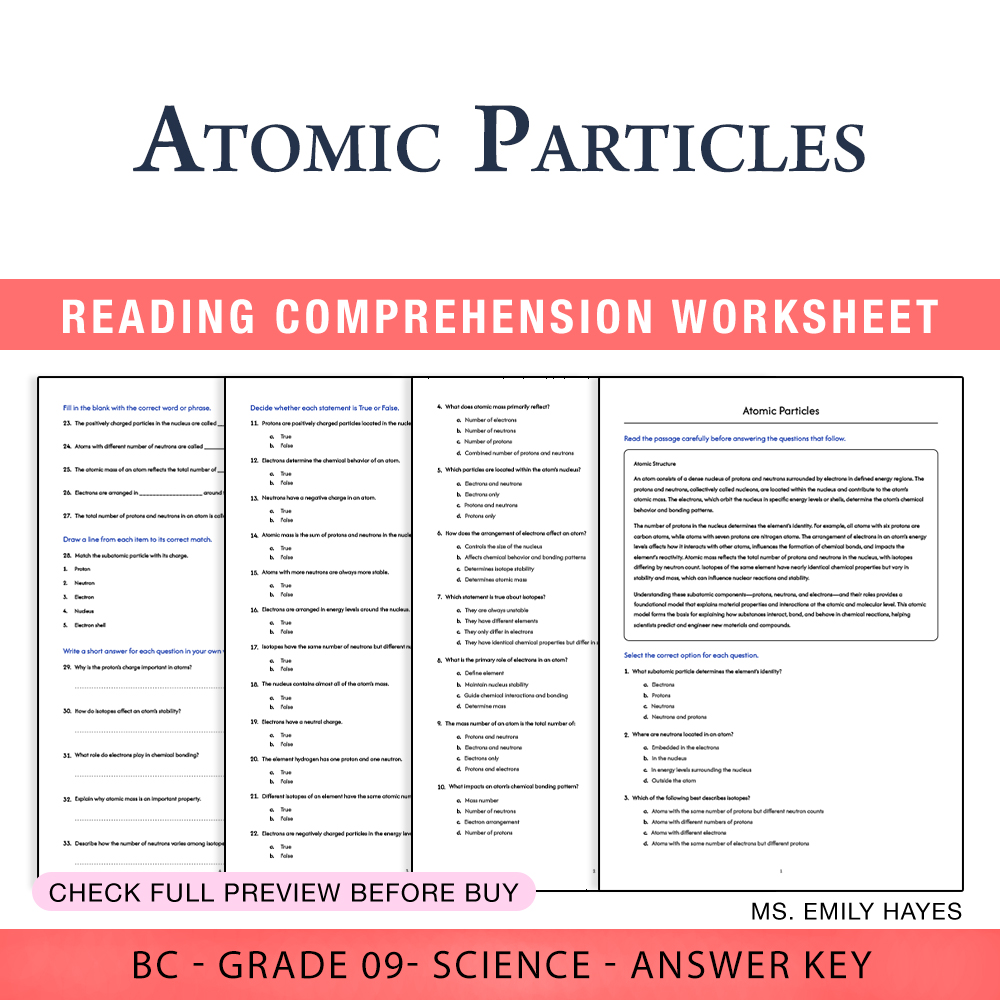
9th Grade Science | Atomic Particles Worksheet (PDF+ Answer Key)
Created byCopper Leaf ClassroomLearning Objectives
- Describe the structure of an atom, including protons, neutrons, and electrons.
- Explain how the number of protons determines the element identity.
- Understand the concept of isotopes and their effect on atomic mass and stability.
Also included in: Grade 9 Science Bundle | Chemistry, Physics & Atomic Concepts (PDF + Answer Key) +1 more
Instant download
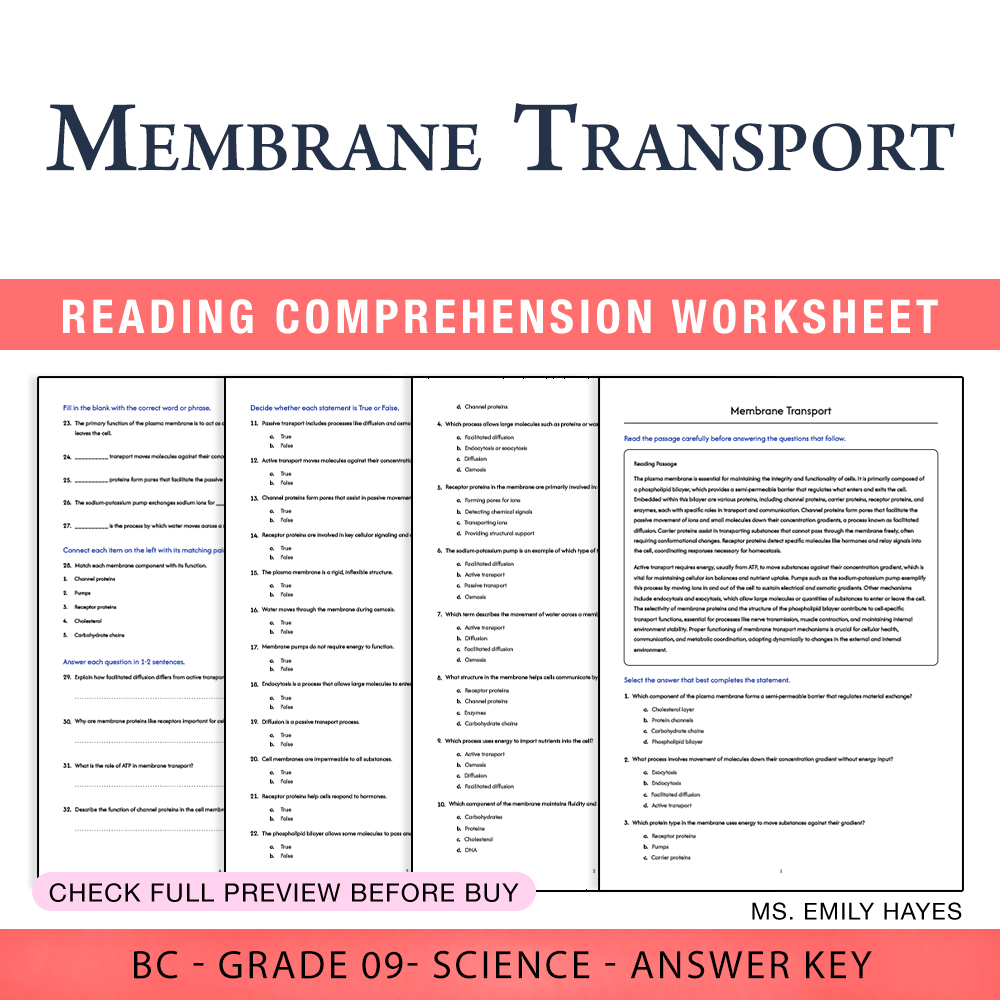
9th Grade Science | Membrane Transport Worksheet (PDF+ Answer Key)
Created byCopper Leaf ClassroomLearning Objectives
- Describe the structure of the plasma membrane and its components involved in transport.
- Differentiate between passive and active transport mechanisms.
- Explain how membrane proteins like channels, pumps, and receptors facilitate cellular functions.
Also included in: Grade 9 Science Worksheet Pack | Biology & Cell Structures (PDF+ Answer Keys) +1 more
Instant download
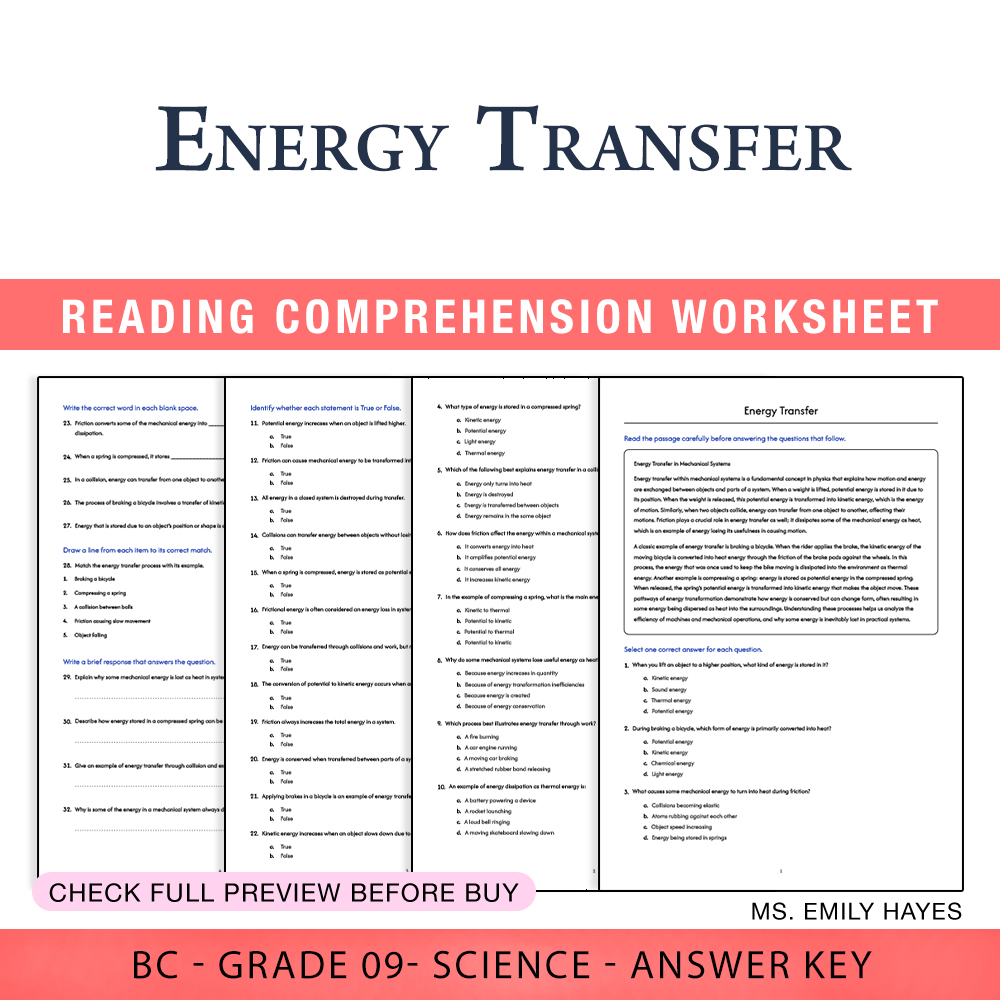
9th Grade Science | Energy Transfer Worksheet (PDF+ Answer Key)
Created byCopper Leaf ClassroomLearning Objectives
- Understand how mechanical systems transfer energy through work, collisions, and friction.
- Explain the transformation of energy from kinetic and potential forms to thermal energy.
- Analyze real-world examples like braking a bicycle or compressing a spring to describe energy conversion pathways.
Also included in: Grade 9 Science Worksheet Bundle | Forces, Energy & Motion (PDF + Answer Key) +1 more
Instant download
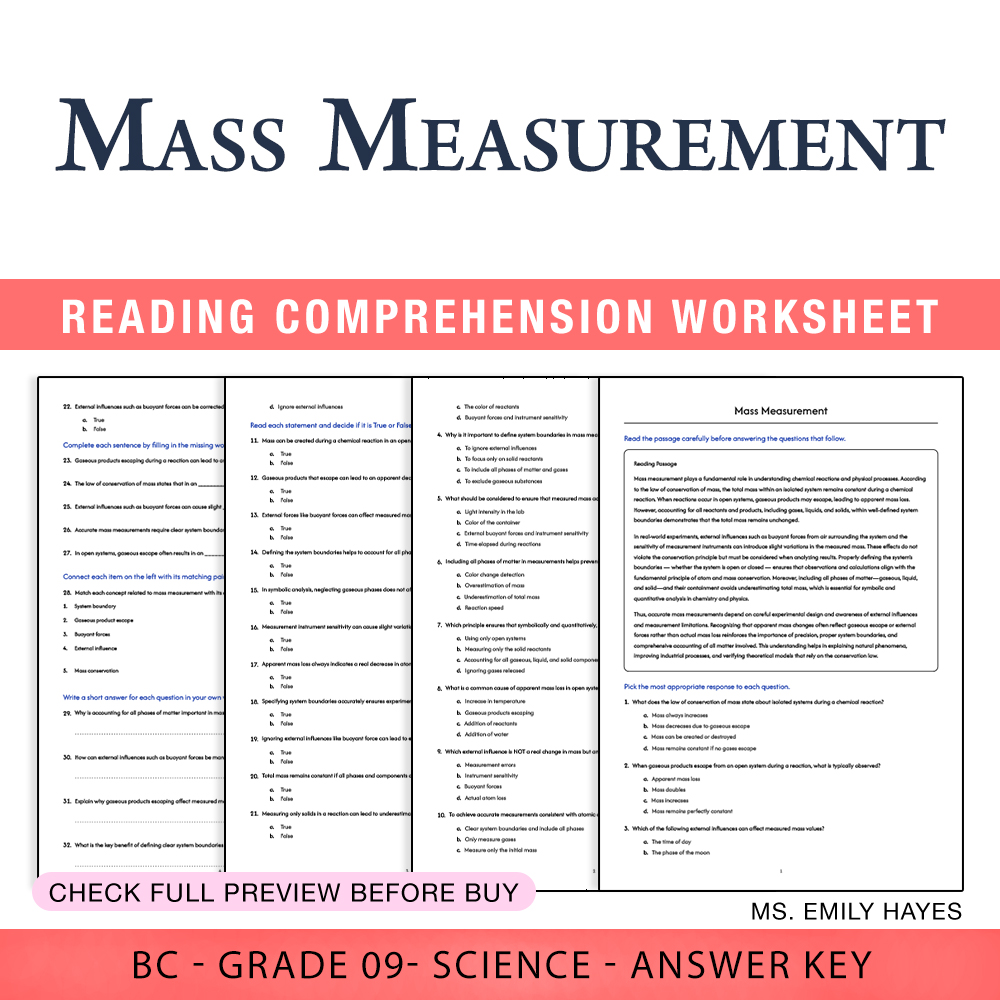
9th Grade Science | Mass Measurement Worksheet (PDF+ Answer Key)
Created byCopper Leaf ClassroomLearning Objectives
- Understand the principle of conservation of mass in chemical reactions.
- Identify factors affecting measured mass during experiments.
- Explain the importance of system boundaries in mass measurements.
Also included in: Grade 9 Science Bundle | Chemistry, Physics & Atomic Concepts (PDF + Answer Key) +1 more
Instant download
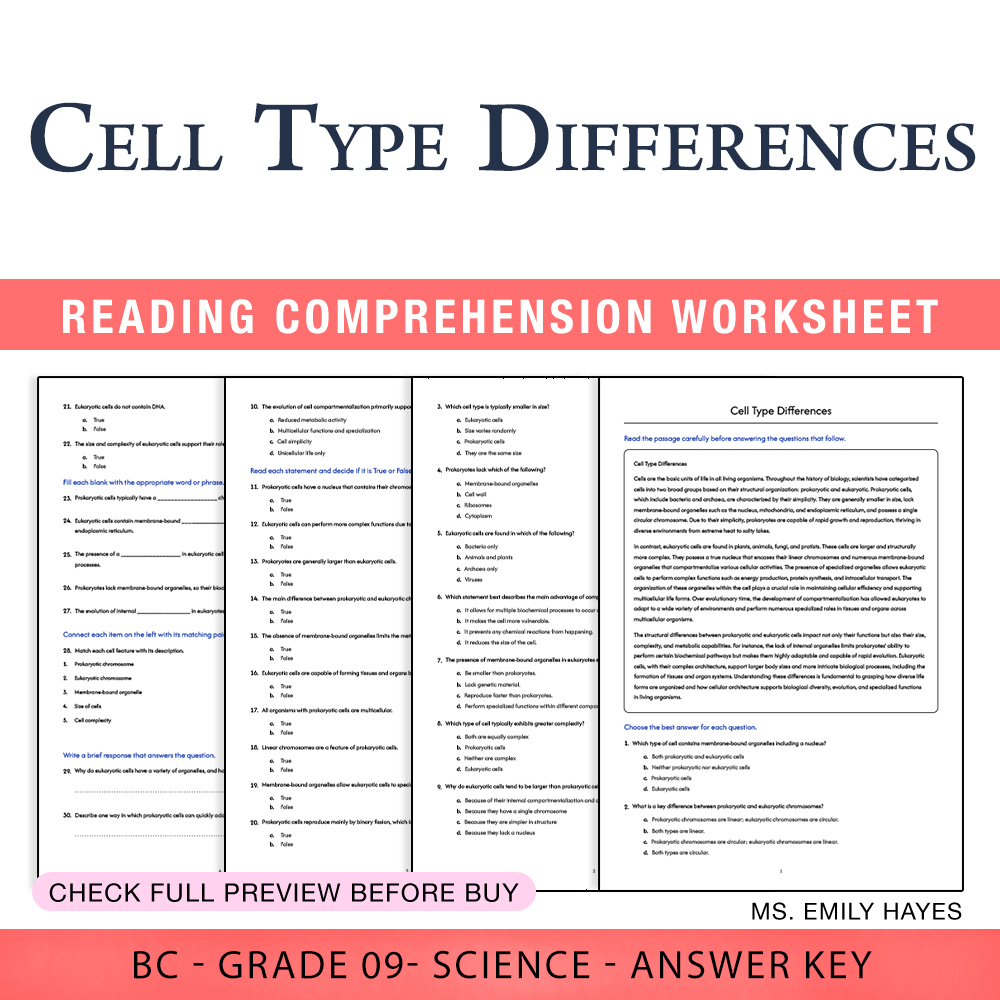
Grade 9 Science | Cell Type Differences Worksheet (PDF+ Answer Key)
Created byCopper Leaf ClassroomLearning Objectives
- Compare the structural differences between prokaryotic and eukaryotic cells.
- Identify key features of prokaryotic cells and how they differ from eukaryotic cells.
- Describe the roles of membrane-bound organelles in eukaryotic cells.
Also included in: Grade 9 Science Worksheet Pack | Biology & Cell Structures (PDF+ Answer Keys) +1 more
Instant download
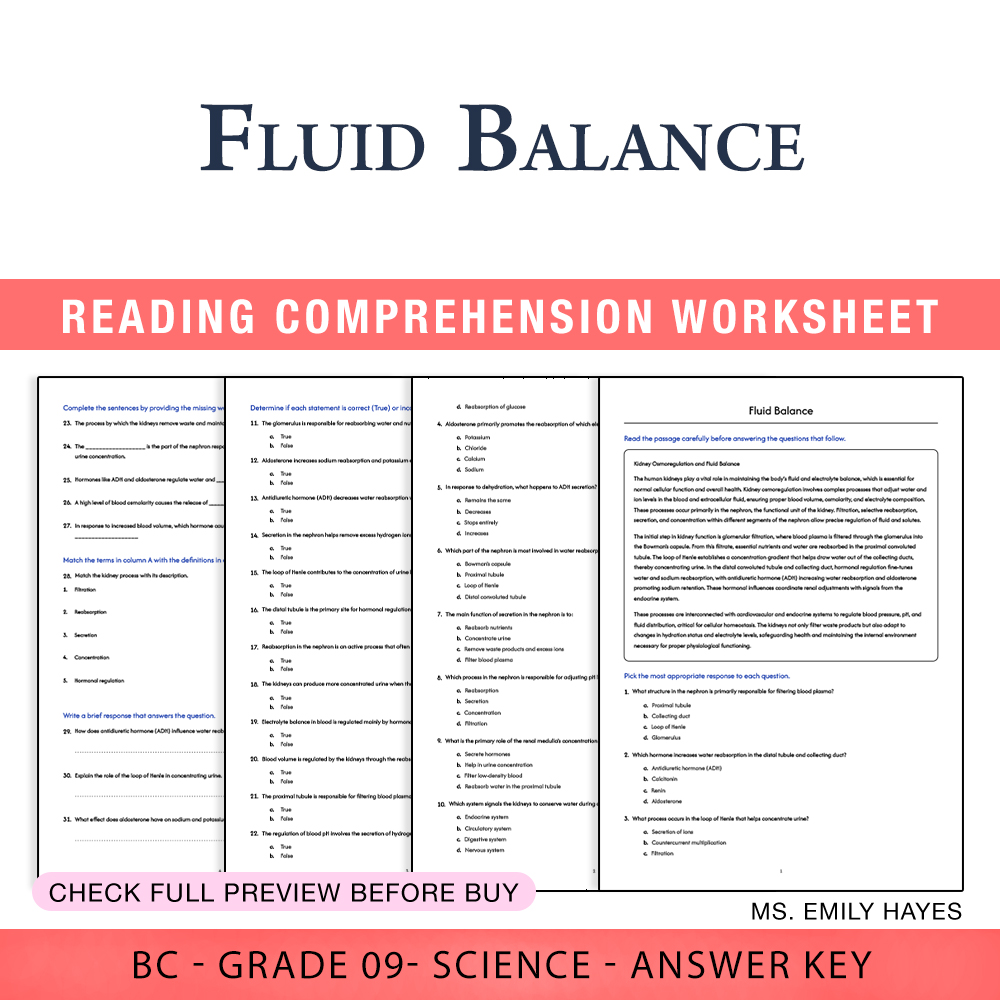
9th Grade Science | Fluid Balance Worksheet (PDF+ Answer Key)
Created byCopper Leaf ClassroomLearning Objectives
- Describe the role of kidneys in regulating water and ion balance through osmoregulation.
- Identify processes such as filtration, reabsorption, secretion, and concentration in the nephron segments.
- Explain how hormones like antidiuretic hormone and aldosterone influence kidney function.
Also included in: Grade 9 Science Worksheet Pack | Biology & Cell Structures (PDF+ Answer Keys) +1 more
Instant download
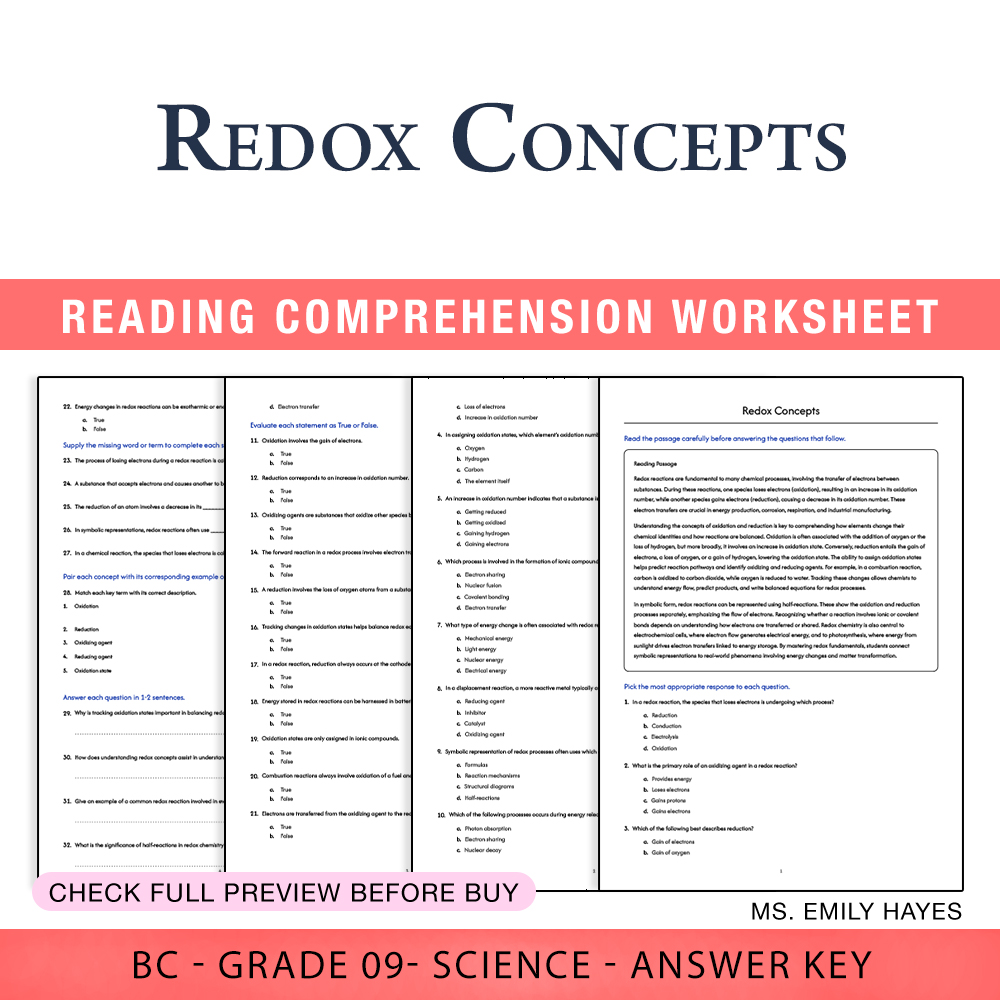
Grade 9 Science | Redox Concepts Worksheet (PDF+ Answer Key)
Created byCopper Leaf ClassroomLearning Objectives
- Explain the basic principles of oxidation and reduction in redox reactions.
- Identify oxidation states of elements in chemical equations.
- Track electron transfer to determine oxidizing and reducing agents.
Also included in: Grade 9 Science Bundle | Chemistry, Physics & Atomic Concepts (PDF + Answer Key) +1 more
Instant download
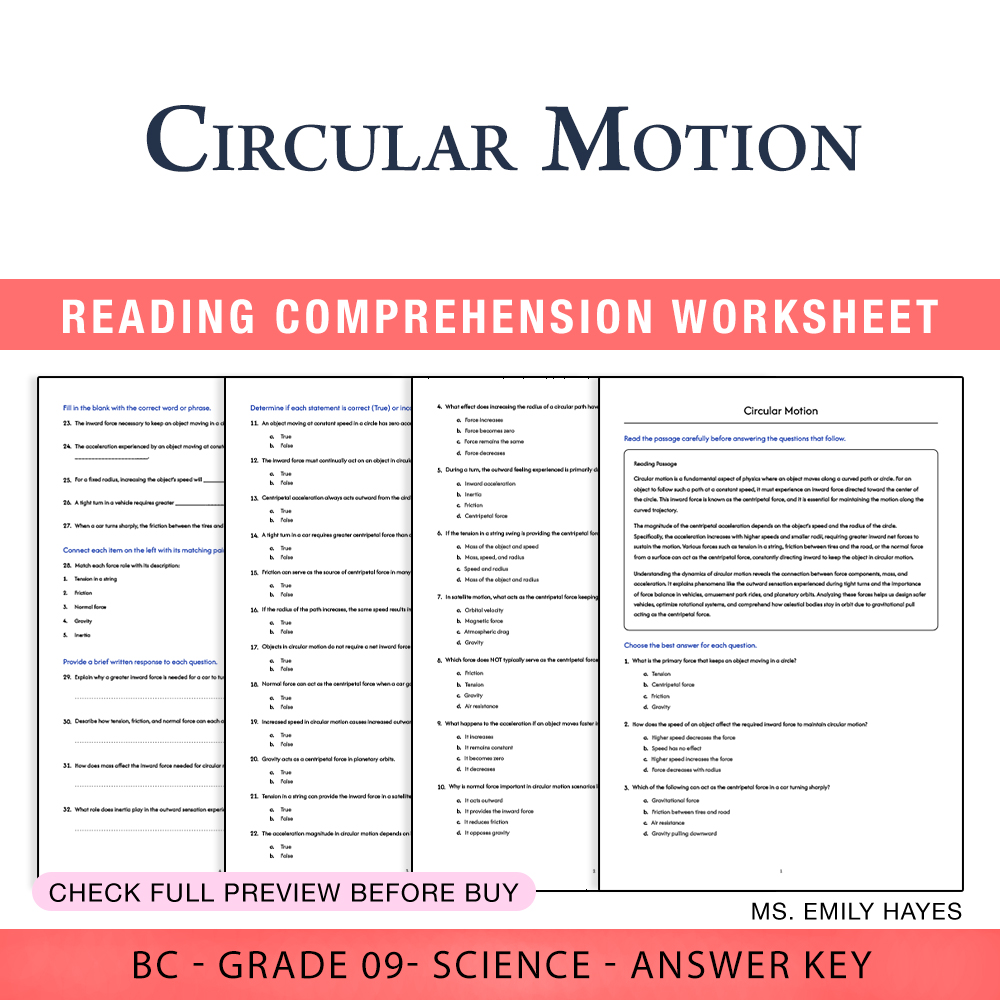
Grade 9 Science | Circular Motion Worksheet (PDF+ Answer Key)
Created byCopper Leaf ClassroomLearning Objectives
- Understand the role of centripetal force in circular motion.
- Identify the effects of inward acceleration on moving objects.
- Connect force components, mass, and acceleration in analyzing circular motion.
Also included in: Grade 9 Science Worksheet Bundle | Forces, Energy & Motion (PDF + Answer Key) +1 more
Instant download
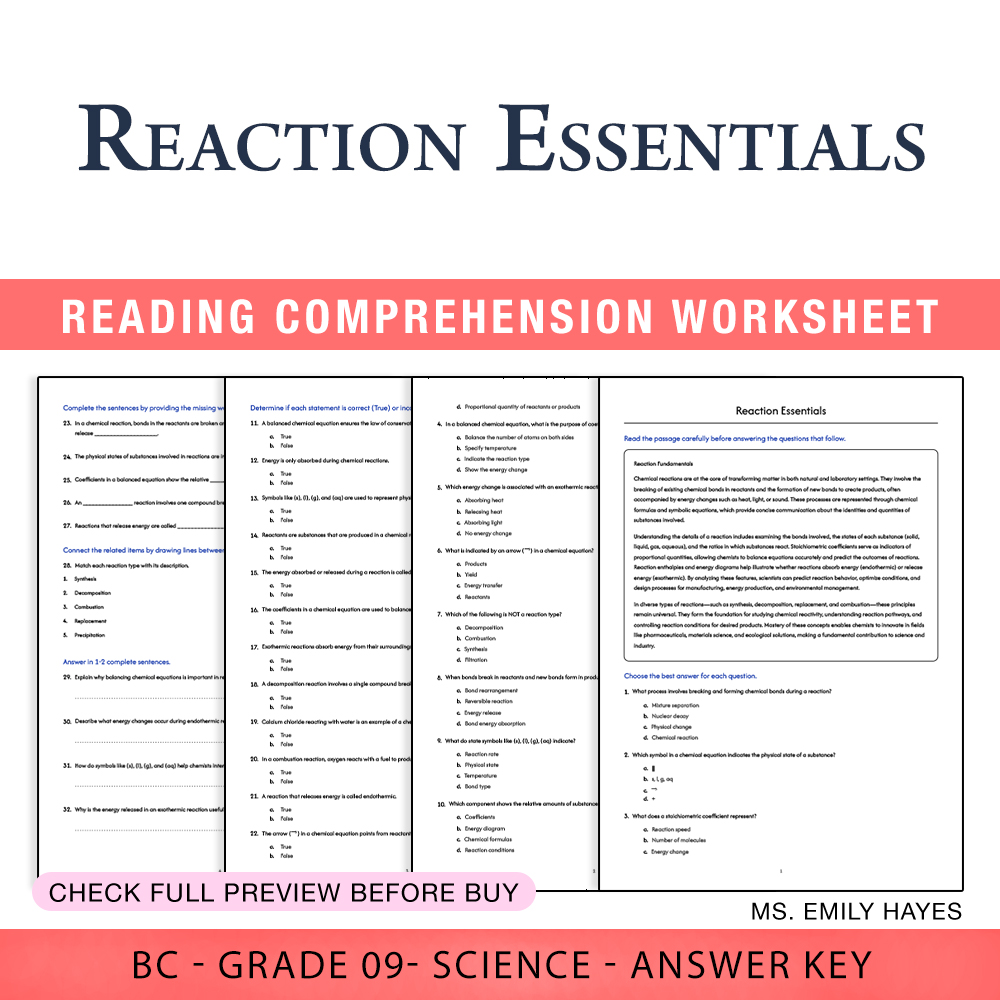
Grade 9 Science | Reaction Essentials Worksheet (PDF+ Answer Key)
Created byCopper Leaf ClassroomLearning Objectives
- Describe the components involved in chemical reactions and their transformations.
- Interpret chemical formulas and symbolic equations to understand reactions.
- Explain how bonds break and form, releasing or absorbing energy.
Also included in: Grade 9 Science Bundle | Chemistry, Physics & Atomic Concepts (PDF + Answer Key) +1 more
Instant download
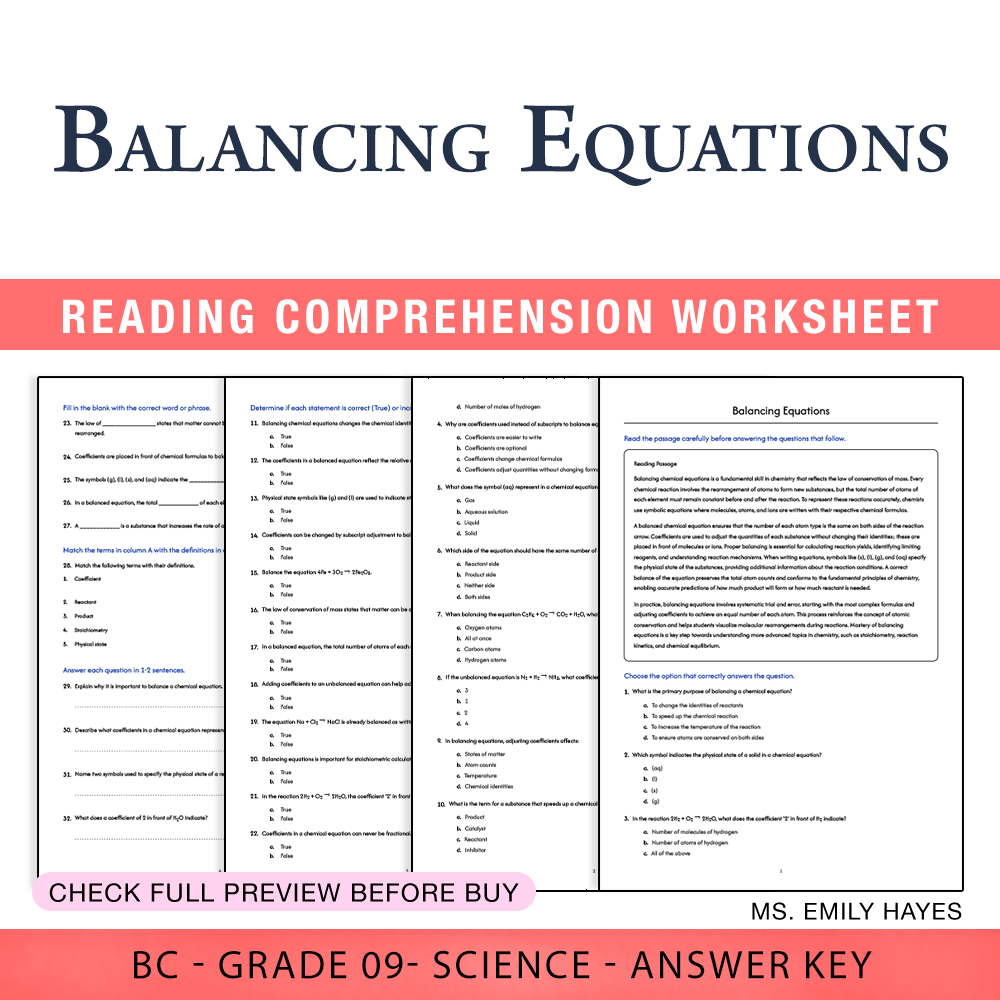
9th Grade Science | Balancing Equations Worksheet (PDF+ Answer Key)
Created byCopper Leaf ClassroomLearning Objectives
- Understand the purpose and importance of balancing chemical equations.
- Learn how to correctly balance chemical equations using coefficients.
- Identify the roles of coefficients and state symbols in chemical equations.
Also included in: Grade 9 Science Bundle | Chemistry, Physics & Atomic Concepts (PDF + Answer Key) +1 more
Instant download
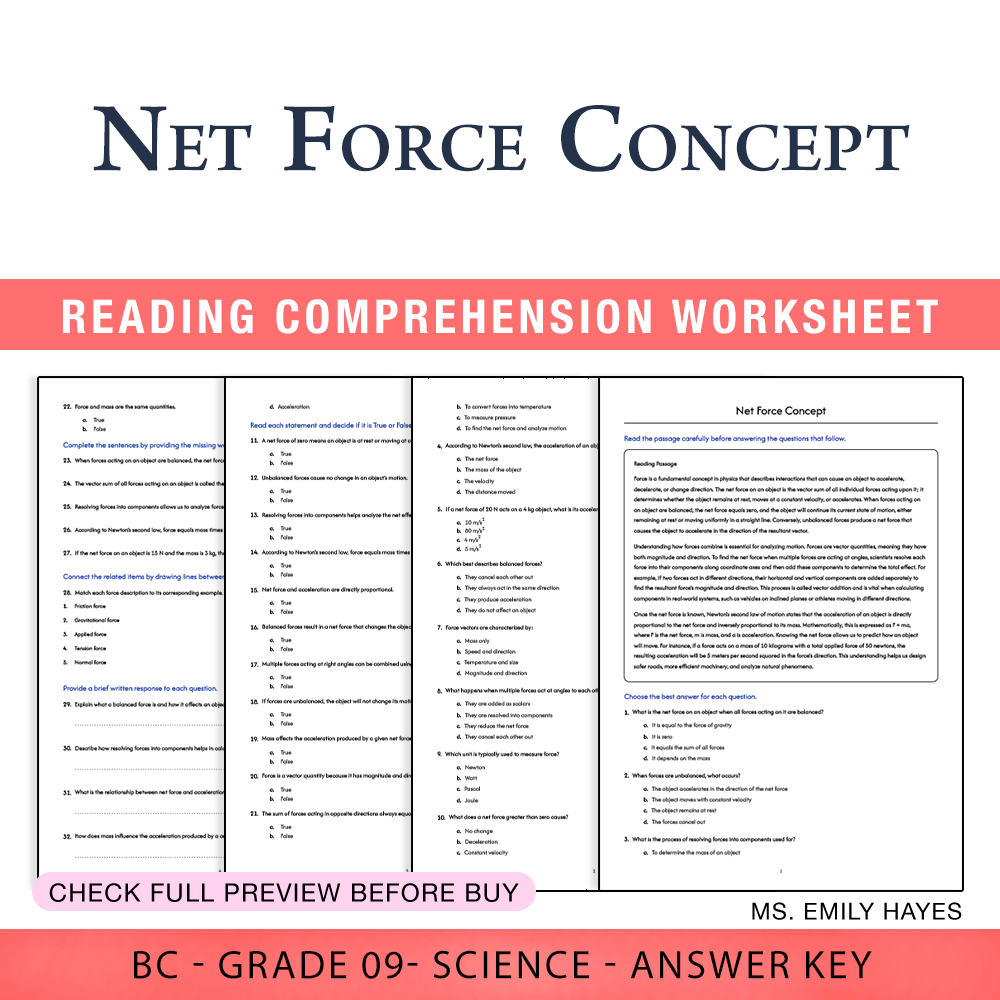
9th Grade Science | Net Force Concept Worksheet (PDF+ Answer Key)
Created byCopper Leaf ClassroomLearning Objectives
- Define and explain the concept of net force and how it affects motion.
- Describe how forces can be resolved into components and summed to find the net effect.
- Calculate the resulting acceleration when given force vectors and mass.
Also included in: Grade 9 Science Worksheet Bundle | Forces, Energy & Motion (PDF + Answer Key) +1 more
Instant download
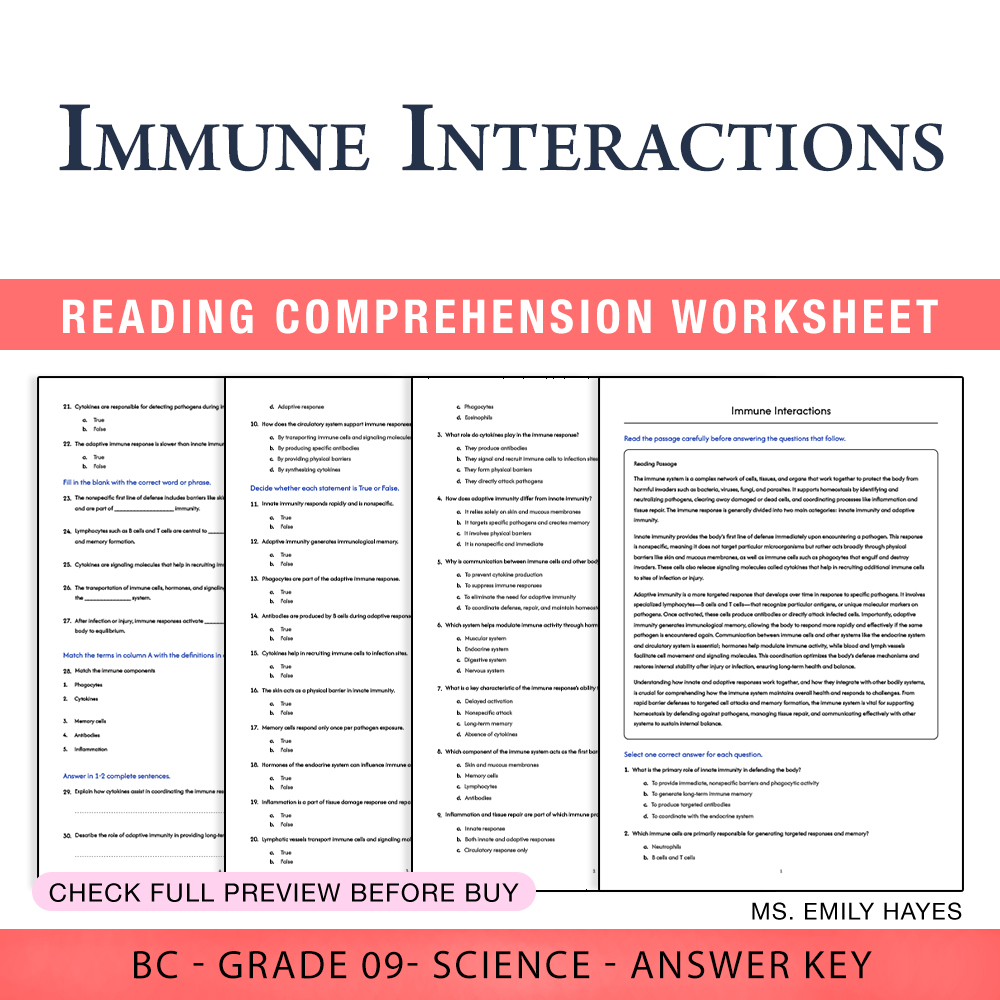
Grade 9 Science | Immune Interactions Worksheet (PDF+ Answer Key)
Created byCopper Leaf ClassroomLearning Objectives
- Describe the roles of innate and adaptive immune responses in maintaining homeostasis.
- Identify key components and functions of the immune system when defending against pathogens.
- Explain how immune communication integrates with other bodily systems, including endocrine and circulatory pathways.
Also included in: Grade 9 Science Worksheet Pack | Biology & Cell Structures (PDF+ Answer Keys) +1 more
Instant download
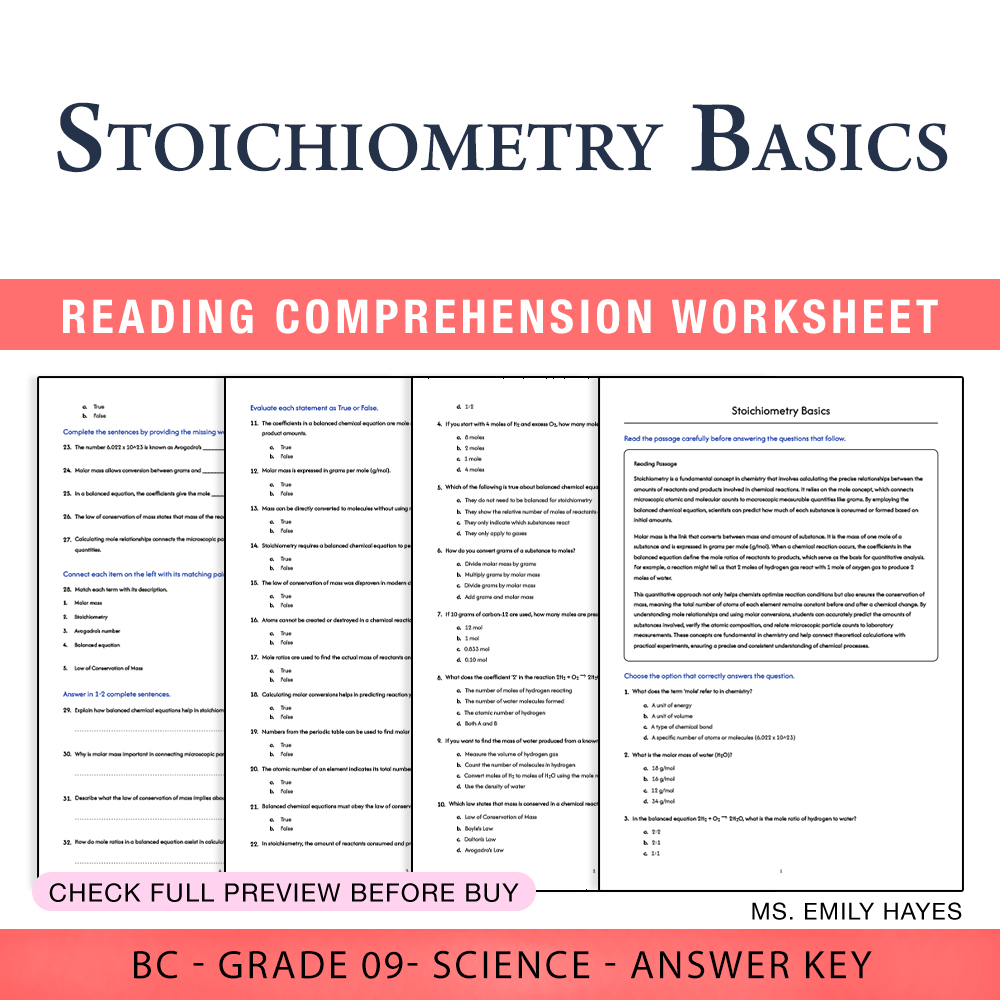
9th Grade Science | Stoichiometry Basics Worksheet (PDF+ Answer Key)
Created byCopper Leaf ClassroomLearning Objectives
- Understand how mole relationships connect reactants and products in chemical equations.
- Calculate masses and amounts of substances using molar mass and balanced equations.
- Interpret mole ratios and convert between grams and moles in chemical reactions.
Also included in: Grade 9 Science Bundle | Chemistry, Physics & Atomic Concepts (PDF + Answer Key) +1 more
Instant download
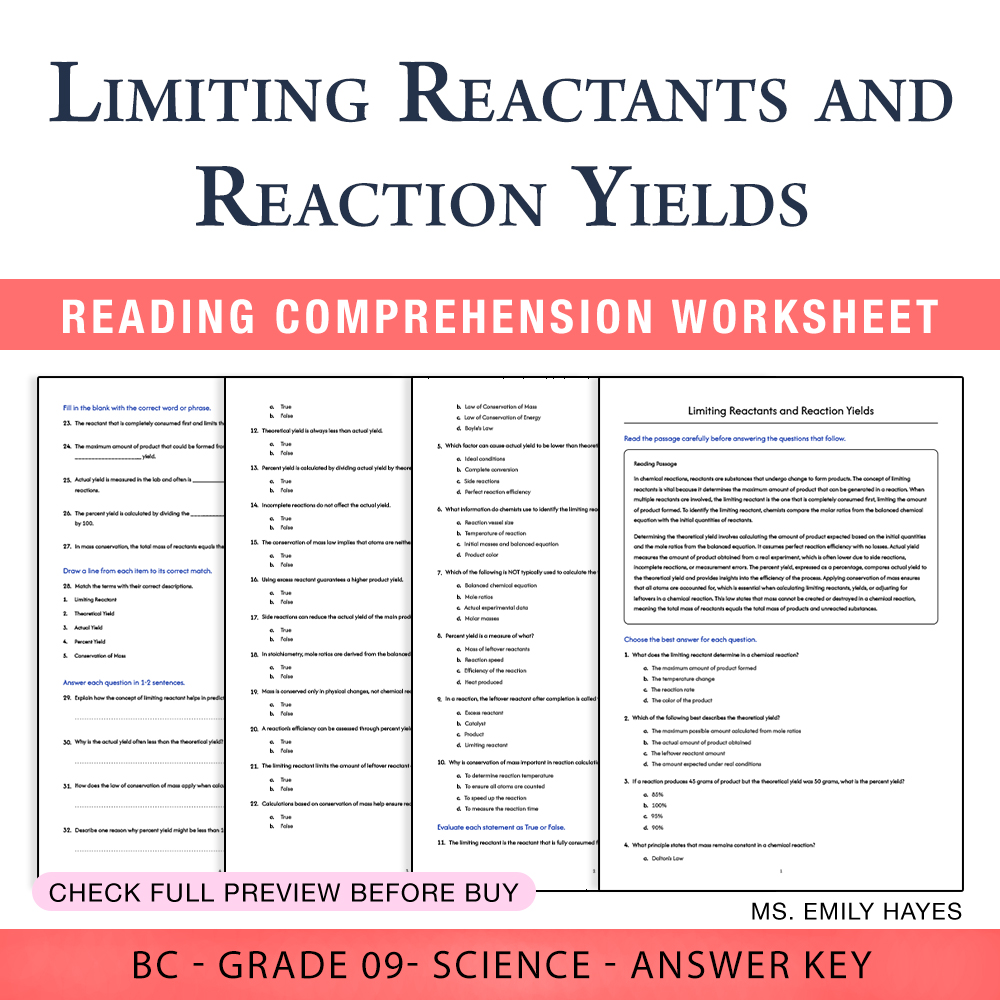
Grade 9 Science | Limiting Reactants & Reaction Yields Worksheet (PDF + Answers)
Created byCopper Leaf ClassroomLearning Objectives
- Understand the concept of limiting reactants and how they determine product formation.
- Calculate theoretical, actual, and percent yields in chemical reactions.
- Apply conservation of mass principles to reaction calculations.
Also included in: Grade 9 Science Bundle | Chemistry, Physics & Atomic Concepts (PDF + Answer Key) +1 more
Instant download
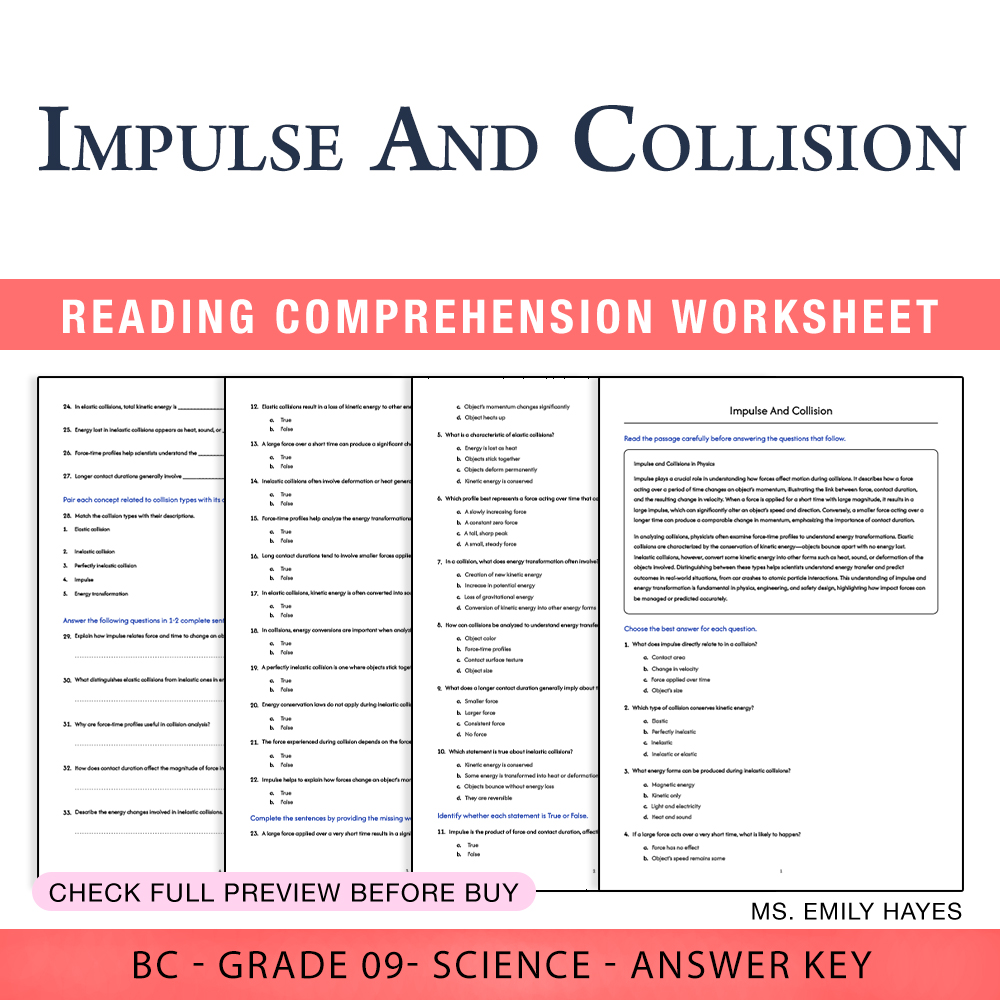
Grade 9 Science | Impulse & Collision Worksheet (PDF+ Answer Key)
Created byCopper Leaf ClassroomLearning Objectives
- Describe how impulse relates force, contact duration, and change in an object's momentum during collisions.
- Differentiate between elastic and inelastic collisions based on energy transformations.
- Analyze force-time profiles involved in collisions to predict resulting velocities and energy changes.
Also included in: Grade 9 Science Worksheet Bundle | Forces, Energy & Motion (PDF + Answer Key) +1 more
Instant download
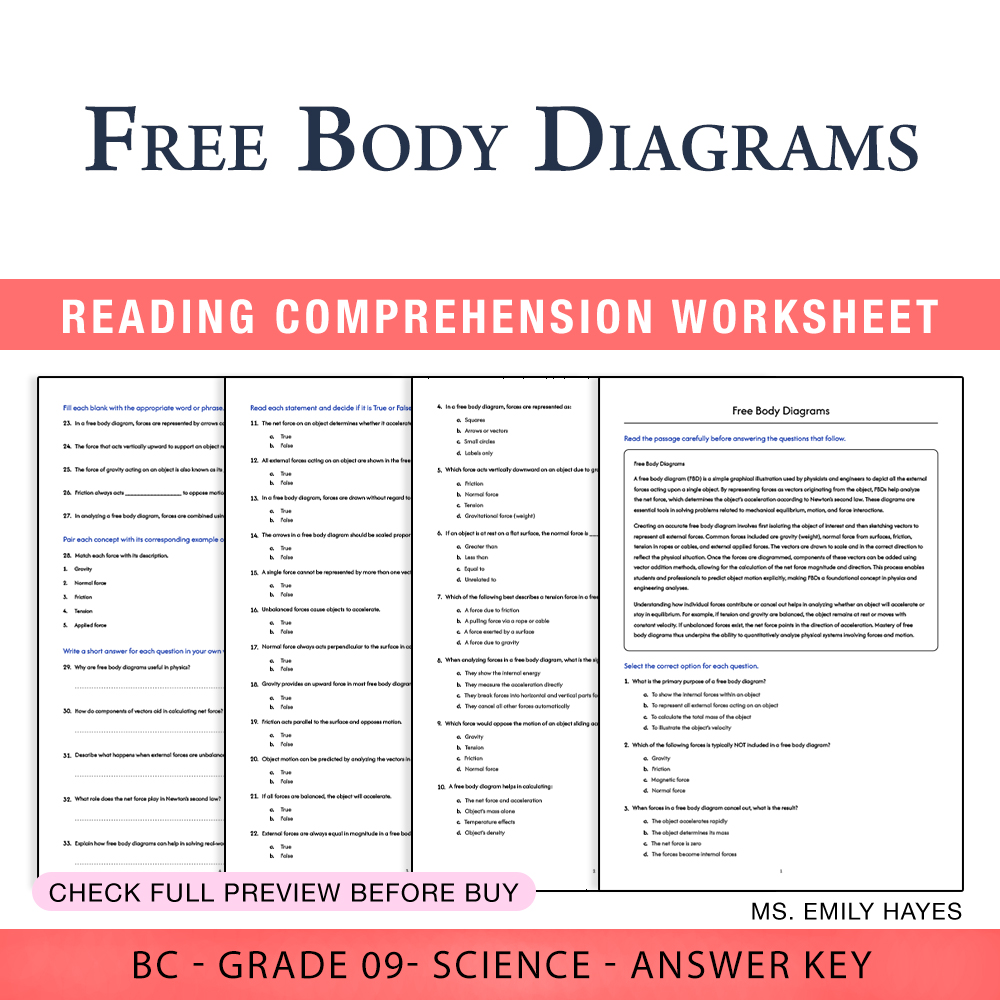
Grade 9 Science | Free Body Diagrams Worksheet (PDF+ Answer Key)
Created byCopper Leaf ClassroomLearning Objectives
- Understand the purpose and components of free body diagrams.
- Identify and sketch external forces acting on an object in various scenarios.
- Calculate net force vectors from individual force components.
Also included in: Grade 9 Science Worksheet Bundle | Forces, Energy & Motion (PDF + Answer Key) +1 more
Instant download

9th Grade Science | Mass Conservation Worksheet (PDF+ Answer Key)
Created byCopper Leaf ClassroomLearning Objectives
- Understand the principle of conservation of mass during chemical reactions.
- Interpret balanced chemical equations in terms of atoms and mass.
- Apply the law of conservation of mass to solve quantitative problems in chemistry.
Also included in: Grade 9 Science Bundle | Chemistry, Physics & Atomic Concepts (PDF + Answer Key) +1 more
Instant download
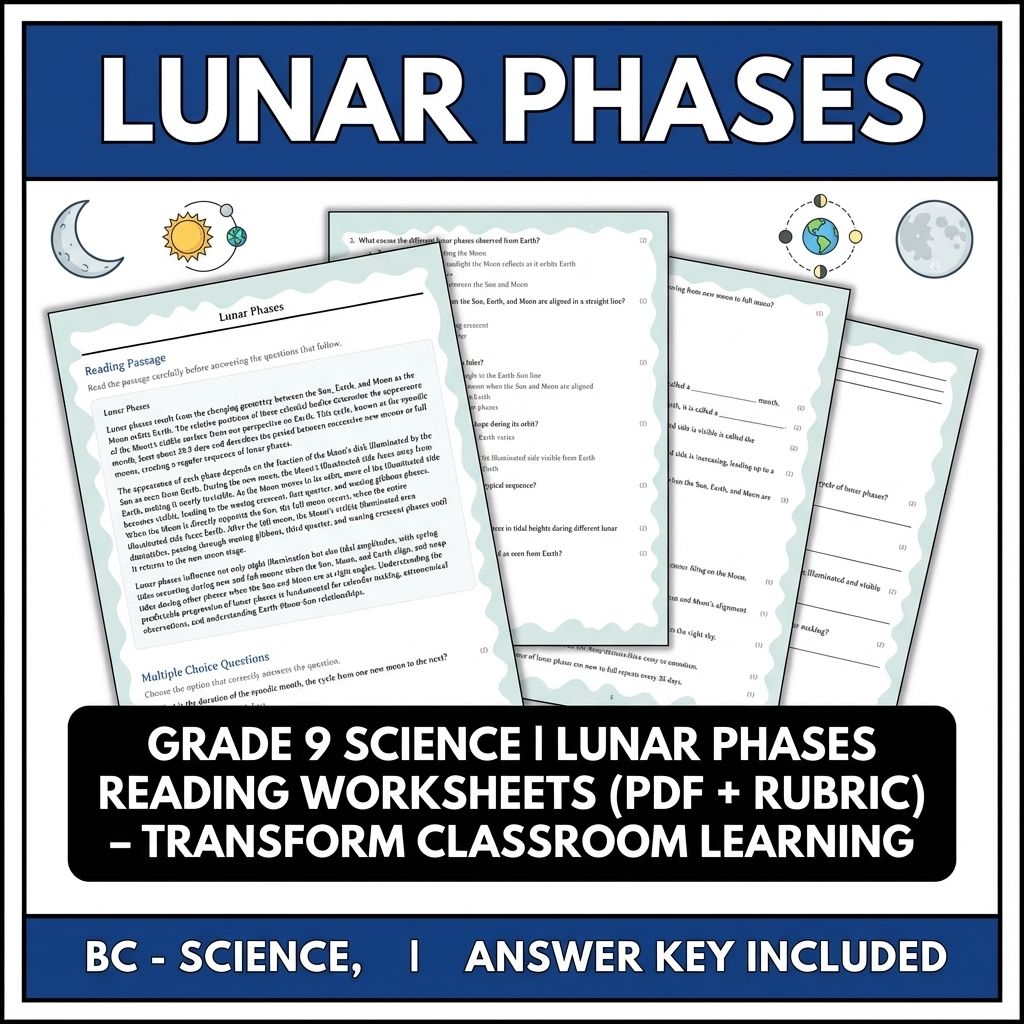
Grade 9 Science | Lunar Phases Reading Worksheets (PDF + Rubric)
JCreated byJ.S SheetsLearning Objectives
- Understand the geometric relationship between the Sun, Earth, and Moon during different lunar phases.
- Describe the cycle of lunar phases and what causes the sequence from new to full and back.
- Explain how lunar phases influence nocturnal illumination and tides.
Instant download
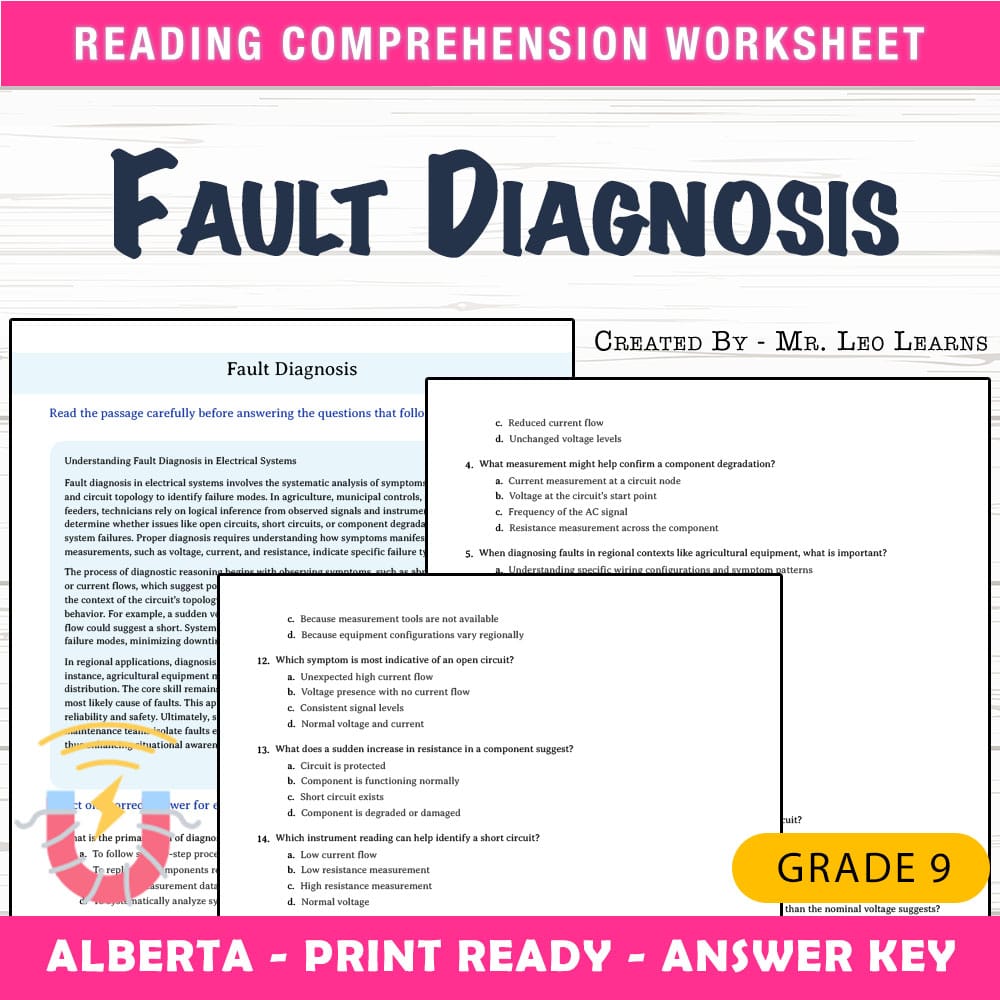
Grade 9 Science — Fault Diagnosis Worksheet MCQ Paper for Mastery
 Created byThe Resource Hub
Learning Objectives
- Understand how to interpret symptom descriptions and measurement data to diagnose electrical faults.
- Identify different failure modes such as open circuits, short circuits, and component degradation through logical inference.
- Apply systematic reasoning to restore safe and reliable operation in various regional electrical contexts.
Also included in: Grade 9 Science Electricity and Magnetism Worksheet Bundle | Alberta Curriculum +1 more
Instant download
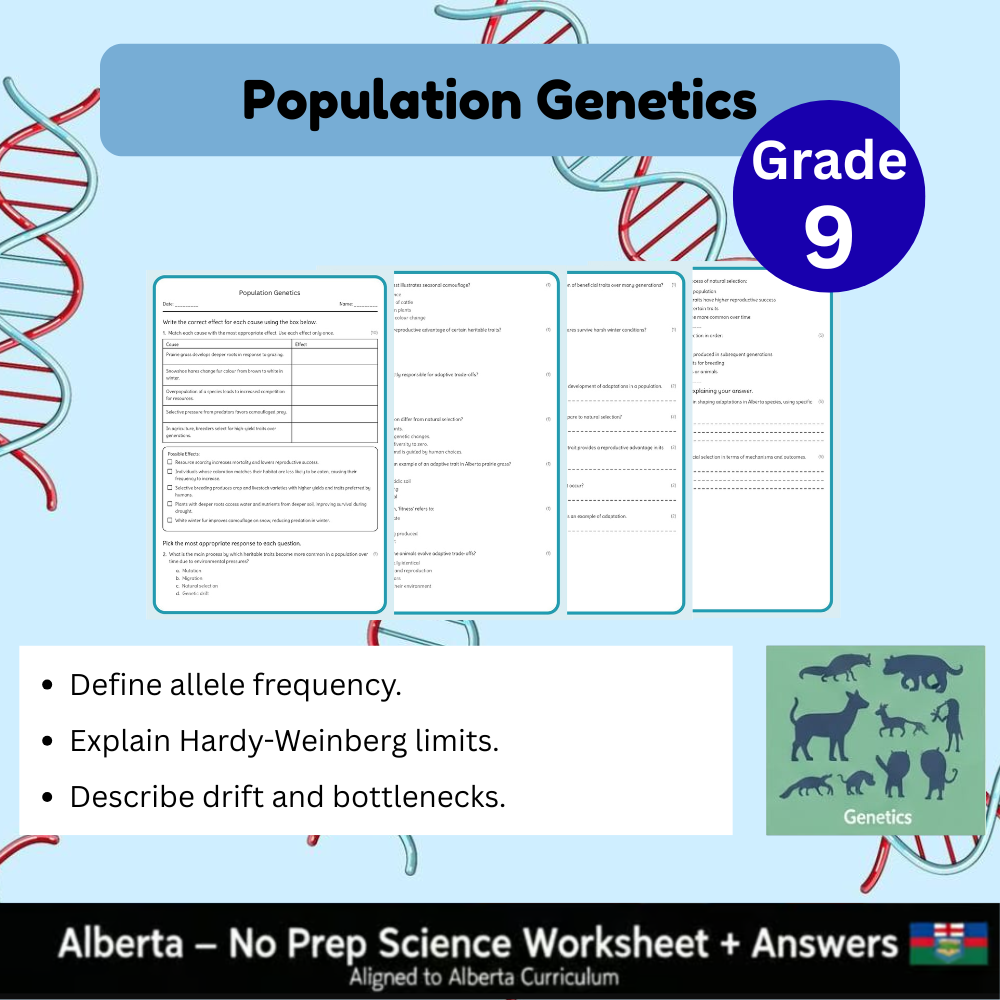
Grade 9 Science – Population Genetics Worksheet (PDF) – Alberta Standard
 Created byBright Mind Resources
Learning Objectives
- Understand the principles of allele frequency and genetic variation in populations.
- Explain the assumptions of Hardy-Weinberg equilibrium and factors disrupting it.
- Describe the effects of genetic drift, bottlenecks, and founder effects on genetic diversity.
Instant download

Grade 9 | Left Handers Day for Mastering Inclusive Design | PDF + Answer Key
Created byShaNova WorksheetsLearning Objectives
- Explain how inclusive and universal design help left-handed people and others with different needs.
- Identify real-world examples of adaptive tools and accessible spaces.
- Use empathy to propose one design improvement that supports everyone.
Instant download
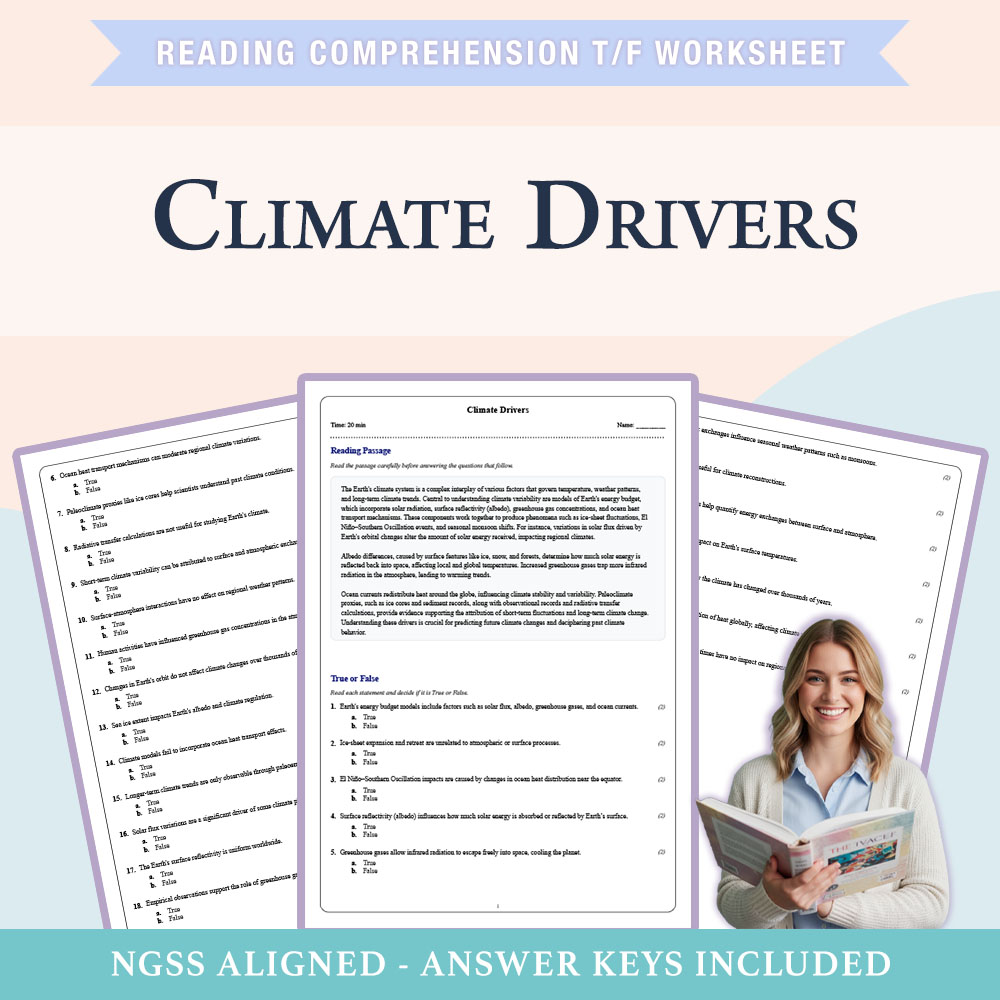
9th Grade Science | Climate Drivers Worksheet (PDF + Answer Key)
Created byCopper Leaf ClassroomLearning Objectives
- Understand the main factors influencing Earth's climate, including solar flux, albedo, greenhouse gases, and ocean heat transport.
- Explain how surface-atmosphere interactions contribute to climate variability and regional weather patterns.
- Analyze observational records, radiative calculations, and paleoclimate proxies to interpret climate trends.
Also included in: Grade 9 Science | Earth Processes & Landform Evolution Bundle (PDF +Answer Key) +1 more
Instant download
Browse more categories
About Grade 9 Worksheets
Browse 9,304 printable Grade 9 worksheets across algebra, biology, literature, and history — each a ready-to-print PDF with optional answer keys.
Every worksheet on MyTeachingSheets is created by independent teacher-authors and reviewed before publication. All resources download as printable PDFs for classroom, homework, or at-home practice, and many include answer keys. Preview any worksheet free before buying.