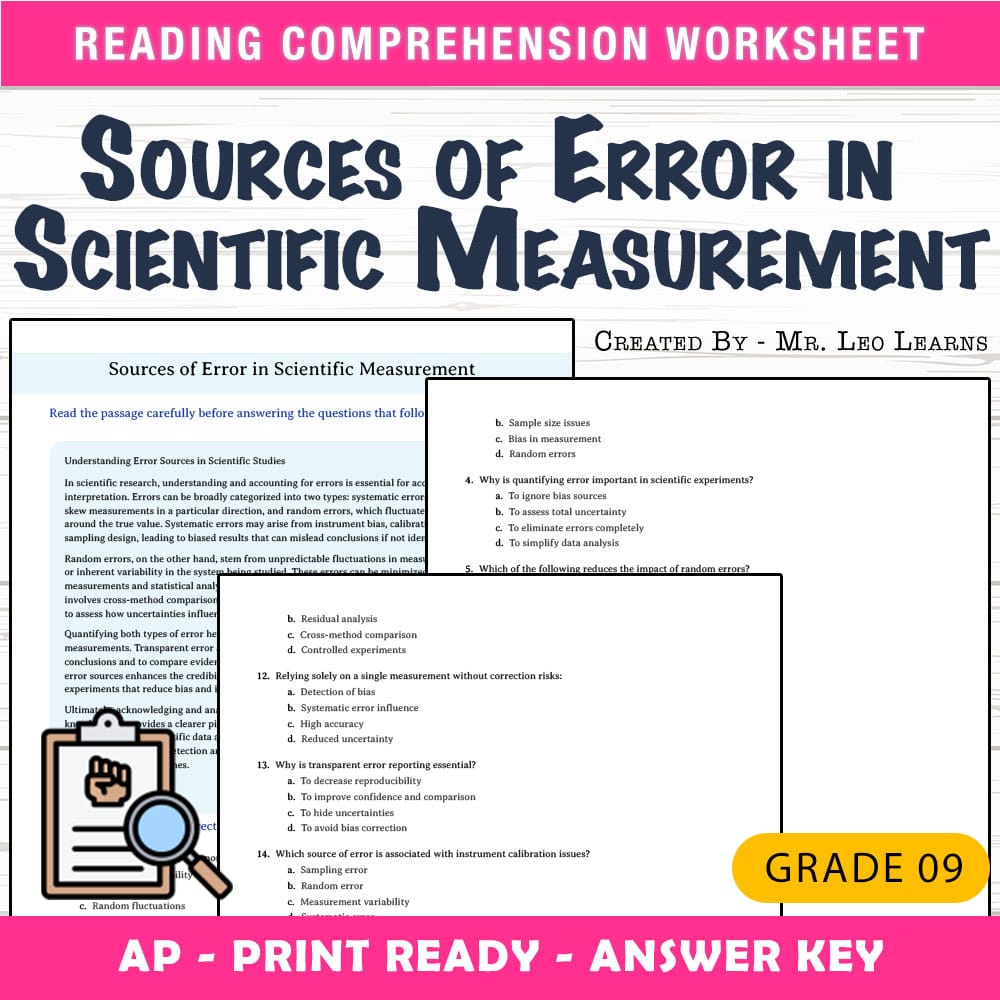
In a busy classroom, you might notice students struggling to grasp the complexities of accuracy and precision in scientific measurements. They often find it challenging to identify sources of error or understand how measurement inaccuracies impact data reliability. This worksheet provides a clear, straightforward way to reinforce these concepts through focused practice. Designed with simplicity and clarity in mind, it offers a practical tool to help students feel more confident in understanding the importance of minimizing errors in scientific research.
What This Resource Helps Students Do
This worksheet guides students through key ideas related to sources of error in scientific measurement, helping them distinguish between systematic and random errors. It supports independent learning by providing structured questions that encourage critical thinking about how errors can arise in experiments. With multiple-choice questions, students learn to analyze scenarios and identify errors accurately, which enhances their ability to evaluate experimental data confidently. This resource also fosters skill development in scientific reasoning, data interpretation, and understanding the importance of accuracy in real-world contexts.
Inside the PDF
• 1 reading passage discussing the significance of understanding errors in science
• 25 multiple-choice questions focused on sources of error and measurement accuracy
• A print-ready format designed for immediate classroom use
• PDF answer key featuring a detailed rubric for quick grading
• Layout optimized for easy photocopying and classroom distribution
How It Improves Learning
This worksheet enhances learning by breaking down complex concepts into manageable, bite-sized questions that build understanding step by step. The reading passage sets the context for why understanding errors is critical, helping students connect theory with practical applications. The multiple-choice questions challenge students to apply their knowledge, encouraging critical thinking and reasoning. Repeated practice with similar questions solidifies their grasp of reliable measurement techniques and error detection—moving them from confusion to confidence. Teachers can use this resource to reinforce lessons, assess comprehension, or provide targeted review, all while helping students develop a stronger grasp of scientific measurement principles.
Core Skills Students Will Develop
- ➡️ Understanding different types of measurement errors
- ➡️ Identifying sources of error in scientific experiments
- ➡️ Analyzing data for bias or inaccuracies
- ➡️ Applying scientific reasoning to evaluate measurement accuracy
Ways Teachers Use This Worksheet
This worksheet is a versatile resource suitable for various instructional purposes. It works well as an independent classwork activity, homework assignment, or a quick assessment of student understanding after lessons. Teachers can also incorporate it into small-group practice sessions, utilize it for review during reteaching, or assign it as early finisher work to keep students engaged productively. Its clear format and focused content make it an efficient tool for reinforcing key concepts related to measurement errors and data accuracy throughout the science curriculum.
Why This PDF Saves Time
Designed to be print-ready, this worksheet allows teachers to prepare for lessons without extra time-consuming formatting or customization. The straightforward, photocopiable PDF ensures quick distribution, saving precious planning time. The included answer key with rubric provides an essential grading aid, making assessment consistent and efficient. By offering a ready-to-use resource, it supports reliable, high-quality instruction with minimal prep involved—allowing teachers to focus more on supporting student learning rather than creating materials from scratch.
Ultimately, this worksheet is a practical, classroom-friendly tool created to boost student confidence and mastery in understanding sources of error in scientific measurement. It’s ready to print, easy to implement, and designed to help students approach scientific data with greater accuracy and confidence.😊